概要信息:
CFA level1-Mock-114
1/45
Questions 1~18 Relate to Ethics .................................................................................. 2
Questions 19~32 Relate to Quantitative analysis ...................................................... 8
Questions 33~44 Relate to Economics ...................................................................... 13
Questions 45~68 Relate to Financial Statement Analysis ....................................... 18
Questions 77~88 Relate to Equity investment ......................................................... 32
Questions 89~94 Relate to Derivatives ..................................................................... 36
Questions 95~106 Relate to Fixed-income Analysis ................................................ 38
Questions 107~110 Relate to Alternative Investments ............................................ 42
Questions 111 ~120 Relate to Portfolio Management ............................................. 43
CFA level1-Mock-114
2/45
Questions 1~18 Relate to Ethics
1. Correct answer: A.
Members and candidates must self-disclose on the annual Professional Conduct Statement all
matters that question their professional conduct, such as involvement in civil litigation or criminal
investigations or being the subject of a written complaint.
CFA Level I
"Code of Ethics and Standards of Professional Conduct"
2. Correct answer: B.
Selling stock short is a management strategy and does not necessarily violate any aspect of the
Standards of Professional Conduct.
CFA Level I
"Guidance for Standards I–VII"
Standard II(B)–Market Manipulation
3. Correct answer: C.
Kozniak does not appear to have violated any CFA Institute Standards of Professional Conduct.
Because she is known in the market for investing and brokering property and both parties have
worked with Kozniak in the past, both parties would know of her interests. In addition, in both
cases, she acts for her own account as a primary investor, not as a broker. She buys the property
for her own portfolio and then sells the property from her own portfolio. Therefore, Kozniak did
not violate Standard VI(A)–Disclosure of Conflicts. When she purchased the property for her
portfolio, she saved her client from losing the building to the bank and did not charge a sales
commission. Because the sale of the property to her other client did not take place until six months
after her purchase, and she was unable to contact the client who had earlier expressed interest
prior to her purchase, she cannot be accused of violating Standard III(A)–Loyalty, Prudence, and
Care with either client.
CFA Level I
"Guidance for Standards I–VII"
Standard III(A)–Loyalty, Prudence, and Care, Standard VI(A)–Disclosure of Conflicts
CFA level1-Mock-114
3/45
4. Correct answer: B.
The portfolio manager received permission to use his investment performance history from his
prior employer. The member violated his non-solicitation agreement by indicating his availability
to new clients on several social media sites accessible by clients of his former employer. This
action is a violation of Standard IV(A)–Loyalty because he did not act for the benefit of his former
employer. In this case, the member may cause harm to his former employer if his messages result
in clients moving to his new business from his former employer. The member also violated
Standard IV(A) by taking his employer's property, the trading software.
CFA Level I
"Guidance for Standards I–VII"
Standard IV(A)–Loyalty
5. Correct answer: A.
The analyst has conducted thorough research that indicates the company falsified its financial
results, and she should request the company address this issue publicly as recommended by
Standard II(A)–Material Nonpublic Information. If a member or candidate determines that
information is material, the member or candidate should make reasonable efforts to achieve public
dissemination of the information. This effort usually entails encouraging the issuer company to
make the information public. If public dissemination is not possible, the member or candidate
must communicate the information only to the designated supervisory and compliance personnel
within the member's or candidate's firm and must not take investment action on the basis of the
information.
CFA Level I
"Guidance for Standards I–VII"
Standard II(A)–Material Nonpublic Information
6. Correct answer: B.
The member misrepresented the returns she could realistically achieve for her clients, violating
Standard I(C)–Misrepresentation, which prohibits members and candidates from guaranteeing
CFA level1-Mock-114
4/45
clients any specific return on volatile investments.
CFA Level I
"Guidance for Standards I–VII"
Standard I(C)–Misrepresentation
7. Correct answer: A.
Miffitt has not violated Standard III (E)–Preservation of Confidentiality, which involves
information about former, current, and prospective clients.
CFA Level I
"Guidance for Standards I–VII"
Standard II(A)–Material Nonpublic Information, Standard II(B)–Market Manipulation, Standard
III(E)–Preservation of Confidentiality
8. Correct answer: B.
Under Standard IV(C)–Responsibility of Supervisors, a member should exercise reasonable
supervision by establishing and implementing compliance procedures in place prior to the
possibility of any violation occurring, which has not been done in this case.
CFA Level I
"Guidance for Standards I–VII"
Standard IV(C)–Responsibilities of Supervisors
9. Correct answer: C.
The GIPS standards state that firms must make every reasonable effort to provide a compliant
presentation to all prospective clients. As long as a prospective client has received a compliant
presentation within the previous 12 months, the firm has met this requirement. It is a GIPS
recommendation, not a requirement, that all clients receive a compliant presentation on an annual
basis.
CFA Level I
"Global Investment Performance Standards (GIPS)"
GIPS Requirement 0.A.9, GIPS Recommendation 0.B.4
CFA level1-Mock-114
5/45
10. Correct answer: A.
The utility is not a suitable investment for a fund that only invests in companies with good
environmental records. Continuing to hold this investment, therefore, was a violation of Standard
III(C)–Suitability.
CFA Level I
"Guidance for Standards I–VII"
Standard I(B)–Independence and Objectivity, Standard III(C)–Suitability, Standard VI(A)–
Disclosure of Conflicts
11. Correct answer: B.
Standard VI(A)–Disclosure of Conflicts requires the disclosure of conflicts. For Meir to
understand what potential conflicts of interest employees may have with the firm and with their
clients, he would need to know the outside interests of each staff member. The staff members
themselves may not know enough about the company and its clients to disclose those interests that
would present a potential conflict. Therefore, it may be best to have all employees declare their
outside business interests on an annual basis so Meir can make the determination as to what
outside business interests need to be disclosed to clients.
CFA Level I
"Guidance for Standards I–VII"
Standard VI(A)–Disclosure of Conflicts
12. Correct answer: B.
A personal bankruptcy does not necessarily constitute a violation of Standard I(C)–
Misrepresentation or Standard I(D)–Misconduct. If the circumstances of the bankruptcy involved
fraudulent or deceitful business conduct, then failing to disclose it may constitute a violation of the
Standards of Professional Conduct.
CFA Level I
"Guidance for Standards I–VII"
Standard I(C)–Misrepresentation, Standard I(D)–Misconduct
CFA level1-Mock-114
6/45
13. Correct answer: C.
To claim compliance, firms must meet all GIPS requirements, not just calculate their performance
according to GIPS requirements.
CFA Level I
―The GIPS Standards,‖ CFA Institute
Section: Provisions of the Global Investment Performance Standards
14. Correct answer: C.
The prospective supervisor's first step should be to not take the position. Accepting the position
with inadequate procedures in place or improper marketing material would leave Inkster at risk of
incurring a violation of Standard IV(C)–Responsibilities of Supervisors. She could agree to be
hired as an interim consultant with the bank in order to implement adequate procedures before
taking on any supervisory role.
CFA Level I
"Guidance for Standards I–VII"
Standard IV(C)–Responsibilities of Supervisors
15. Correct answer: A.
Both Musa and Kassim violated the Standards of Professional Conduct. Musa violated Standard
IV(C)–Responsibilities of Supervisors by not ensuring policies were in place to prevent violations
of the Standards of Professional Conduct (in this case, Standard VI(B)–Priority of Transactions)
by someone subject to her supervision. As the head of compliance, Musa supervised Kassim and
must meet her supervisory responsibilities outlined in the Standards of Professional Conduct.
Kassim violated Standard VI(B)–Priority of Transactions because he did not give sufficient
priority to Dunfield's clients before trading on his recommendation.
CFA Level I
"Guidance for Standards I–VII"
Standard IV(C)–Responsibilities of Supervisors, Standard VI(B)–Priority of Transactions
CFA level1-Mock-114
7/45
16. Correct answer: A.
By failing to adhere to the non-compete clause he agreed to abide by when signing his
employment contract, Hasina shows a lack of professional integrity toward his employer. This
behavior reflects poorly on the good reputation of members and is a violation of the Code of
Ethics, which states that members and candidates must act with integrity, and Standard I (D)–
Misconduct, which states that members and candidates must not engage in any professional
conduct involving dishonesty, fraud, or deceit or commit any act that reflects adversely on their
professional reputation, integrity, or competence. The Code of Ethics at times requires a member
or candidate to uphold a higher standard than that required by law, rule, or regulation—or in this
case, the strict application of the employment agreement.
CFA Level I
"Code of Ethics and Standards of Professional Conduct," "Guidance for Standards I–VII"
Standard I(A)–Knowledge of the Law, Standard I(D)–Misconduct
17. Correct answer: B.
In order to avoid violating Standard III(E)–Preservation of Confidentiality, Staal should determine
whether applicable securities regulations require disclosing the records before she provides the
confidential information concerning her client's investments.
CFA Level I
"Guidance for Standards I–VII"
Standard III(E)–Preservation of Confidentiality
18. Correct answer: A.
Compliance with the GIPS standards does not eliminate the need for in-depth due diligence on the
part of the investor.
CFA Level I
"Introduction to the Global Investment Performance Standards (GIPS)"
CFA level1-Mock-114
8/45
Questions 19~32 Relate to Quantitative analysis
19. Correct answer: B.
A confidence interval for a parameter = Point estimate ± Reliability factor × Standard error. For
example, the reliability factors for confidence intervals based on the standard normal distribution
are 1.65 for 90% confidence intervals and 1.96 for 95% confidence intervals. For a given point
estimate and standard error, the confidence interval will be narrower with a lower reliability factor.
CFA Level I
"Sampling and Estimation," Richard A. DeFusco, Dennis W. McLeavey, Jerald E. Pinto, and
David E. Runkle
Section 4.2
20. Correct answer: A.
For a positively skewed unimodal distribution, the mode is less than the median, which is less than
the mean.
CFA Level I
"Statistical Concepts and Market Returns," Richard A. DeFusco, Dennis W. McLeavey, Jerald E.
Pinto, and David E. Runkle
Section 8
21. Correct answer: C.
Failure to reject a false null hypothesis is a Type II error.
CFA Level I
"Hypothesis Testing," Richard A. DeFusco, Dennis W. McLeavey, Jerald E. Pinto, and David E.
Runkle
Section 2
22. Correct answer: C.
The appropriate test statistic is a z-statistic because the sample comes from a normal distributed
population with known variance. A z-test does not use degrees of freedom. This test is two-sided
at the 0.05 significance level, and the rejection point conditions are z > 1.960 and z < –1.960.
CFA level1-Mock-114
9/45
CFA Level I
"Hypothesis Testing," Richard A. DeFusco, Dennis W. McLeavey, Jerald E. Pinto, and David E.
Runkle
Section 3
23. Correct answer: B.
Correlation of returns between Asset A and B ρ(RA, RB), is defined as:
)(R)(R)/R ,Cov(R = )R ,(R BABABA ,
where
AR and BR are the returns of Asset A and B
)R ,Cov(R BA is the covariance of returns between Asset A and B
)(RA and )(RB are the standard deviations of returns of Asset A and B
In this problem, the correlation is 0.69 0.6857 = )1,225 × 625600/( .
CFA Level I
"Probability Concepts," Richard A. DeFusco, Dennis W. McLeavey, Jerald E. Pinto, and David E.
Runkle
Section 3
24. Correct answer: C.
Given a population that has a finite variance and a large sample size, the central limit theorem
establishes that the sampling distribution of sample means will be approximately normal, the
distribution of sample mean will have a mean equal to the population mean, and will have a
variance equal to the population variance divided by the sample size.
CFA Level I
"Sampling and Estimation," Richard A. DeFusco, Dennis W. McLeavey, Jerald E. Pinto, and
David E. Runkle
Section 3.1
CFA level1-Mock-114
10/45
25. Correct answer: C.
Resistance is defined as a price range in which selling activity is sufficient to stop the rise in price.
CFA Level I
"Technical Analysis," Barry M. Sine and Robert A. Strong
Section 3.2
26. Correct answer: C.
The p-value is the smallest level of significance at which the null hypothesis can be rejected. In
this case, the given p-value (0.0275) is less than the given level of significance (0.05); therefore,
the null hypothesis is rejected.
CFA Level I
"Hypothesis Testing," Richard A. DeFusco, Dennis W. McLeavey, Jerald E. Pinto, and David E.
Runkle
Section 2
27. Correct answer: A.
By the definition of p-value, 0.03 is the smallest level of significance at which the null hypothesis
can be rejected. An analyst cannot reject the null hypothesis at the 0.01 significance level.
CFA Level I
"Hypothesis Testing," Richard A. DeFusco, Dennis W. McLeavey, Jerald E. Pinto, and David E.
Runkle
Section 2
28. Correct answer: A.
An opportunity cost is the value that investors forgo by choosing a particular course of action.
CFA Level I
"The Time Value of Money," Richard A. DeFusco, Dennis W. McLeavey, Jerald E. Pinto, and
David E. Runkle
Section 2
CFA level1-Mock-114
11/45
29. Correct answer: B.
Events are exhaustive when they cover all possible outcomes. Mutually exclusive means that only
one event can occur at a time. Two events are dependent if the occurrence of one event does affect
the probability of occurrence of the other event. In this situation, Event A and B are both mutually
exclusive (because they cannot occur at the same time) and dependent (because if one event
occurs, the probability of the other becomes zero). However, the two events are not exhaustive
because they do not cover the event that the fund will earn a return above 5%.
CFA Level I
"Probability Concepts," Richard A. DeFusco, Dennis W. McLeavey, Jerald E. Pinto, and David E.
Runkle
Section 2
30. Correct answer: A.
The t-statistic for the given information (normally distributed populations, population variances
assumed equal) is calculated as:
5.0
2
2
1
2
2121
n
s
n
s
XX
t
PP
In this case, we have:
2
Ps = 2678.05.
94.093768.0
18
05.2678
25
05.2678
0185200
5.0
2
t
CFA Level I
―Hypothesis Testing,‖ Richard A. DeFusco, Dennis W. McLeavey, Jerald E. Pinto, and David E.
Runkle
Section 3.2
31. Correct answer: B.
Nonparametric procedures are primarily used in three situations: when the data are given in ranks,
CFA level1-Mock-114
12/45
when the data do not meet distributional assumptions, or when the hypothesis being addressed
does not concern a parameter.
CFA Level I
"Hypothesis Testing," Richard A. DeFusco, Dennis W. McLeavey, Jerald E. Pinto, and David E.
Runkle
Section 5
32. Correct answer: C.
The most appropriate test statistic for the difference between two population means (unequal and
unknown population variances) is
5.0
2
2
2
1
2
1
2121
n
s
n
s
XX
t
CFA Level I
"Hypothesis Testing," Richard A. DeFusco, Dennis W. McLeavey, Jerald E. Pinto, and David E.
Runkle
Section 3.2
CFA level1-Mock-114
13/45
Questions 33~44 Relate to Economics
33. Correct answer: B.
In first-degree price discrimination, the entire consumer surplus is captured by the producer; the
consumer surplus falls to zero.
CFA Level I
"The Firm and Market Structures," Richard G. Fritz and Michele Gambera
Section 6.4
34. Correct answer: C.
Using the expenditures approach:
GDP = Consumer spending on goods and services + Business gross fixed investment + Change in
inventories + Government spending on goods and services + Government gross fixed investment
+ Exports – Imports + Statistical discrepancy
Consumer spending on goods and services 875,060
Business gross fixed investment 286,400
Change in inventories (68,500)
Government spending on goods and services 305,600
Government gross fixed investment 84,120
Exports 219,800
Imports (250,980)
Statistical discrepancy (2,850)
= Gross domestic product (GDP) 1,448,650
CFA Level I
―Aggregate Output, Prices, and Economic Growth,‖ Paul R. Kutasovic and Richard G. Fritz
Sections 2.2, 2.3
35. Correct answer: A.
CFA level1-Mock-114
14/45
Cost-push inflation arises due to increases in costs associated with production: wages and raw
materials prices.
CFA Level I
―Understanding Business Cycles,‖ Michele Gambera, Milton Ezrati, and Bolong Cao
Section 4.2.4.1
36. Correct answer: C.
Prior to the price ceiling, the total surplus was d + e + f + g + h, consisting of consumer surplus of
f + e and producer surplus of d + g + h. The price ceiling causes the quantity supplied to decrease
to QC and for those consumers who can find supply to gain consumer surplus of g at the expense
of producers. With the decline in supply, consumers lose consumer surplus e and producers lose
producer surplus d for a combined deadweight loss of d + e.
CFA Level I
"Demand and Supply Analysis: Introduction," Richard V. Eastin and Gary L. Arbogast
Section 3.13
37. Correct answer: C.
The optimal output level is 60 units as that level produces the highest profit:
Output
(units)
Price
($/unit)
Total
Revenue ($)
Total Costs ($) Profit
($)
20 2,800 56,000 10,600 45,400
40 2,600 104,000 32,600 71,400
60 2,400 144,000 66,600 77,400
80 2,200 176,000 112,600 63,400
100 2,000 200,000 170,600 29,400
CFA Level I
―The Firm and Market Structures,‖ Richard G. Fritz and Michele Gambera
CFA level1-Mock-114
15/45
Sections 6.1, 6.2, 6.3
38. Correct answer: B.
The characteristics of monopolistic competition include a large number of competitors, low
pricing power, and the production of differentiated products (through advertising and other
non-price strategies), but these still result in some pricing power. The ease of entry results in zero
economic profits in the long run.
CFA Level I
"The Firm and Market Structures," Richard G. Fritz and Michele Gambera
Sections 2.1, 2.2, 4
39. Correct answer: C.
Nominal GDP is defined as the value of goods and services measured at current prices. Real GDP
is not affected by price increases while nominal GDP and the GDP deflator increase with price
increases:
Real GDPcurrent year = Nominal GDPcurrent year×100 GDP deflator
Real GDPcurrent year = PXbase year × QXcurrent year
CFA Level I
―Aggregate Output, Prices, and Economic Growth,‖ Paul R. Kutasovic, and Richard G. Fritz
Section 2.1.2
40. Correct answer: A.
At full employment, a weaker currency reduces the purchasing power of all domestic currency
denominated assets (including the present value of current and future income). Households
respond by reducing general expenditures and increasing savings. This response is the wealth
effect and reflects the proportion of one's income that is saved (or spent).
CFA Level I
"Demand and Supply Analysis: Consumer Demand," Richard V. Eastin and Gary L. Arbogast
Section 6.2
"Aggregate Output, Prices, and Economic Growth," Paul R. Kutasovic and Richard G. Fritz
CFA level1-Mock-114
16/45
Section 3.3.1
"Currency Exchange Rates," William A. Barker, Paul D. McNelis, and Jerry Nickelsburg
Sections 5.1, 5.2
41. Correct answer: B.
A shift in the demand curve results from a change in any variable other than the good's own price,
Px. Given the demand function, a change in either Py or I would result in a shift in the demand
curve. A change in quantity demanded, which refers to a movement along the demand curve,
arises when the good's own price changes.
CFA Level I
"Demand and Supply Analysis: Introduction," Richard V. Eastin and Gary L. Arbogast
Section 3.2
42. Correct answer: B.
In a perfectly competitive market, sellers have no pricing power and thus sell their product at the
price established by demand and supply in the market – the market equilibrium price.
CFA Level I
"The Firm and Market Structures, " Richard G. Fritz and Michele Gambera
Section 3.3
43. Correct answer: A.
Each company will consider the other’s reaction in selecting its strategy. Using the following
summary, it is best for both chains to provide 24-hour service.
Chain Consideration Best Decision
1
If it opens for 24 hours, it will see a higher payoff
regardless of what Chain 2 does.
Open for 24 hours
Chain 2
Closes at 9 p.m.
Chain 2
Opens for 24 hours
CFA level1-Mock-114
17/45
Chain 1 earns 540
instead of 180
Chain 1 earns 108
instead of 55
2
If it opens for 24 hours, it will see a higher payoff
regardless of what Chain 1 does.
Open for 24 hours Chain 1
Closes at 9 p.m.
Chain 1
Opens for 24 hours
Chain 2 earns 592
instead of 290
Chain 2 earns 140
instead of 75
CFA Level I
―The Firm and Market Structures,‖ Richard G. Fritz and Michele Gambera
Section 5.1
44. Correct answer: A.
The profit maximizing output will arise when MR = MC
MR = 150 - 10 × Q = MC = 3 × Q2 - 20 × Q + 73
On reduction, this becomes: 3 x Q2 - 10 ×Q - 77 = 0
Only with Q=7 will this equation be satisfied: 3 × 72 – 10 × 7 -77 = 0
Alternatively: by comparing net profit under each alternative
Units Marginal revenue Marginal cost TR TC Net Profit
7 150 - 10 × 7 = 80 3 × 7 2 - 20 × 7 + 73 = 80 805 484 321
8 150 - 10 × 8 = 70 3 × 8 2 - 20 × 8 + 73 = 105 880 576 304
11 150 - 10 × 11 = 40 3 × 11 2 - 20 × 11 + 73 = 216 1045 1045 0
CFA Level I
"The Firm and Market Structures," Richard G. Fritz and Michele Gambera
Section 5.1
CFA level1-Mock-114
18/45
Questions 45~68 Relate to Financial Statement Analysis
45. Correct answer: C.
A decrease in the tax rate will result in a decrease in the previously reported amounts of deferred
tax assets. That is, the value of the future tax assets, based on the new lower rate, is reduced for
offsetting future tax payments.
CFA Level I
―Income Taxes,‖ Elbie Antonites and Michael A. Broihahn
Section 3.3
46. Correct answer: C.
When a long lived asset is sold only the net gain or loss is reported on the income statement. The
gain or loss on a sale = sales proceeds – carrying amount = $80,000 – $70,000 = $10,000 gain.
CFA Level I
"Long-lived Assets," Elaine Henry and Elizabeth A. Gordon
Section 6.1
47. Correct answer: C.
The direct method of cash flow statement presentation shows the specific cash inflows and
outflows that result in reported cash flow from operating activities (e.g., cash from customers and
cash to suppliers). Companies using IFRS can decide to report interest and dividend receipts as
either an investing or operating activity, whereas under US GAAP, they must report such income
as an operating activity. The listed operating and investment activities indicate that the company
reports under IFRS using the direct method.
CFA Level I
"Understanding Cash Flow Statements," Elaine Henry, Thomas R. Robinson, Jan Hendrik van
Greuning, and Michael A. Broihahn
Sections 2.3, 2.3.2, 3.2.1.5
48. Correct answer: C.
Under US GAAP, bank overdrafts are not considered part of cash and cash equivalents and are
CFA level1-Mock-114
19/45
classified as financing cash flows.
CFA Level I
"Understanding Cash Flow Statements," Elaine Henry, Thomas R. Robinson, Jan Hendrik van
Greuning, and Michael A. Broihahn
Section 2.2
49. Correct answer: C.
Income tax expense equals income tax payable (the tax rate multiplied by the taxable income) plus
the increase in the deferred tax liabilities.
(0.30 × $215,000) + ($90,650 – $82,400) = $64,500 + $8,250 = $72,750.
CFA Level I
―Income Taxes,‖ Elbie Antonites and Michael A. Broihahn
Section 2
50. Correct answer: A.
The SEC now advocates for global accounting standards through public announcements, such as
its "Statement in Support of Convergence and Global Accounting Standards" (2010). In the past,
the SEC had required reconciliations between IFRS and US GAAP, but these requirements were
withdrawn in 2008. The SEC now imposes no requirements on its issuers.
CFA Level I
"Financial Reporting Standards," Elaine Henry, Jan Hendrik van Greuning, and Thomas R.
Robinson
Section 4
51. Correct answer: B.
The Deferred tax asset is based on the temporary difference arising from the difference in the
carrying value for taxes vs. the financial statements = (120,000 – 100,000) × 17%= 3,400. The rate
that should be used is the rate expected when the reversal will occur which is now the lower rate
of 17%.
CFA Level I
CFA level1-Mock-114
20/45
"Income Taxes," Elbie Antonites and Michael A. Broihahn
Section 3.3
52. Correct answer: A.
A common-size balance sheet expresses all balance sheet accounts as a percentage of total assets
and would provide insight into what portion of a company’s assets is liquid. On the other hand,
cash and current ratios measure liquidity relative to current liabilities, not relative to total assets.
CFA Level I
―Understanding Balance Sheets,‖ Elaine Henry and Thomas R. Robinson
Sections 7.1, 7.2
―Financial Analysis Techniques,‖ Elaine Henry, Thomas R. Robinson, and Jan Hendrik van
Greuning
Section 3.2.1
53. Correct answer: A.
Under IFRS (International Financial Reporting Standards), first determine the recoverable amount,
which is the higher of value in use (the present value of the expected future cash flows) = $32,000
or fair value minus costs to sell = $34,000 – 4,000 = $30,000
The recoverable amount ($32,000) is lower than the carrying value ($36,000). Therefore, the asset
is impaired and should be written down to that amount.
Under US GAAP, to assess impairment, the carrying value ($36,000) is compared with the
undiscounted expected future cash flows ($38,000). In this case, the carrying value is lower so the
patent is not impaired.
CFA Level I
―Long-Lived Assets,‖ Elaine Henry and Elizabeth A. Gordon
Sections 5.1, 5.2
54. Correct answer: A.
US GAAP prohibits the revaluation of PPE. Therefore, this is a source of an important difference
between US GAAP and IFRS with respect to reporting of income taxes.
CFA level1-Mock-114
21/45
CFA Level I
"Income Taxes," Elbie Antonites and Michael A. Broihahn
Section 8
55. Correct answer: C.
Because the asset is self-constructed, the costs of specifically identifiable interest during the
construction period can be capitalized and included in the cost of the showroom.
€ Millions
Construction costs 38.5
Interest expense in 2012 and 2013: 0.08 × €30 × 2 years 4.8
Total capitalized cost 43.3
Straight line depreciation expense:
(Capitalized cost – Residual value)/Useful life = (43.3 – 5.0)/40
0.9575
CFA Level I
―Long-Lived Assets,‖ Elaine Henry and Elizabeth A. Gordon
Sections 2.1, 3.1
56. Correct answer: C.
Current Ratio Cash Ratio Quick Ratio
Numerator Current assets =
Cash + Marketable securities
+ Receivables + Inventory
Cash +
Marketable
securities
Cash + Marketable
securities + Receivables
Denominator Current liabilities Current liabilities Current liabilities
Current year
Numerator 114 + 23 + 231 + 462 114 + 23 = 137 114 + 23 + 231 = 368
CFA level1-Mock-114
22/45
= 830
Denominator 390 390 390
Ratio: Current
year
2.13 0.35 0.94
Ratio: Prior
year
2.19 0.37 0.97
Change in ratio –0.06 –0.02 –0.03
CFA Level I
―Understanding Balance Sheets,‖ Elaine Henry and Thomas R. Robinson
Section 7.2
―Financial Analysis Techniques,‖ Elaine Henry, Thomas R. Robinson, and Jan Hendrik van
Greuning
Section 4.3
57. Correct answer: B.
The allowance for doubtful accounts increases by the bad debt expense recognized for the year
and decreases by the amounts written off during the year.
Beginning balance allowance for doubtful
accounts
£56 million
Plus bad debt expense ?
Minus write-offs –£84 million
Ending balance allowance for doubtful
accounts
£92 million
Solve for bad debt expense = £120 million.
CFA Level I
CFA level1-Mock-114
23/45
―Understanding Balance Sheets,‖ Elaine Henry and Thomas R. Robinson
Section 3.1.3
58. Correct answer: C.
With accelerated amortisation, first year amortisation expense is the highest.
CFA Level I
―Long-lived Assets,‖ Elaine Henry and Elizabeth A. Gordon
Sections 3.1, 3.2
59. Correct answer: A.
Net income = Comprehensive income – Other comprehensive
income
$193.0 –
$87.6
$105.4
million
Net income per share (EPS) =
Net income/Common shares outstanding
$105.4/46.5 $2.27 million
P/E = Stock price/EPS $60.75/$2.27 26.76
CFA Level I
―Understanding Income Statements,‖ Elaine Henry and Thomas R. Robinson
Section 8
―Financial Analysis Techniques,‖ Elaine Henry, Thomas R. Robinson, and Jan Hendrik van
Greuning
Section 5.1
60. Correct answer: A.
The notes provide a comprehensive description of all of the entity's accounting policies,
irrespective of whether judgment was required or whether the policies are important in
understanding the financial statements.
CFA Level I
CFA level1-Mock-114
24/45
"Financial Reporting Standards," Elaine Henry, Jan Hendrik van Greuning, and Thomas R.
Robinson
Section 8.3.1
61. Correct answer: C.
The primary benefit of the direct method is that it provides information on the specific sources of
operating cash receipts and payments.
CFA Level I
"Understanding Cash Flow Statements,"Elaine Henry, Thomas R. Robinson, Jan Hendrik van
Greuning, and Michael A. Broihahn
Section 2.3
62. Correct answer: C.
Cost of sales is reported on the same basis as revenue. To report revenue under gross reporting, the
e-commerce company must meet four criteria:
Criteria Met/Not Met
The e-commerce company must
be the primary obligor under the contract. Not met
bear the inventory risk and credit risk. Not met
be able to choose its supplier. Met
also have reasonable latitude to establish pricing. Met
The first criterion is not met. The major hotel chains have the obligation of fulfilling the room
contract once it is entered into. The second criterion is not met either because the e-commerce
company did not incur costs for vacant rooms. The major chains bear the inventory risk. Because
all criteria are not met, the e-commerce company must use net reporting for which revenue is
$500,000 and cost of sales is $250,000.
CFA Level I
CFA level1-Mock-114
25/45
―Understanding Income Statements,‖ Elaine Henry and Thomas R. Robinson
Section 3.2.4
63. Correct answer: C.
Whether securities are classified as held for trading or available for sale, they are measured at their
fair value on the balance sheet. All gains/losses on held-for-trading securities are reported on the
income statements, whereas the unrealized gains/losses on available-for-sale securities are
reported in equity. This treatment is the same for both IFRS and US GAAP reporting.
CFA Level I
"Understanding Income Statements," Elaine Henry and Thomas R. Robinson
Section 8
"Understanding Balance Sheets," Elaine Henry and Thomas R. Robinson
Section 4.5
64. Correct answer: C.
The revenue/expense-based approach is a measurement approach, not a standard setting approach.
CFA Level I
"Financial Reporting Standards," Elaine Henry, Jan Hendrik van Greuning, and Thomas R.
Robinson
Sections 2, 6.2
65. Correct answer: C.
Deferred tax balances result from temporary differences between a company’s income as reported
for tax purposes and income reported for financial statement purposes. The temporary difference
in this case arises from the difference between the depreciation for accounting purposes and the
depreciation for tax purposes. Because of this difference, the company would report more income
tax expense than would actually be paid in taxes. The difference is a deferred tax liability.
CFA level1-Mock-114
26/45
Temporary difference balance = Depreciation expense for
accounting purposes – Depreciation for tax purposes
£6,340 – £4,500 £1,840
Deferred tax balance =
Temporary difference balance × Corporate tax rate
£1,840 × 25%
£460
CFA Level I
―Understanding Balance Sheets,‖ Elaine Henry and Thomas R. Robinson
Section 5.2
―Income Taxes,‖ Elbie Antonites and Michael A. Broihahn
Sections 2.2, 4
66. Correct answer: A.
A company must disclose separate information about any operating segment which meets certain
quantitative criteria—namely, the segment constitutes 10 percent or more of the combined
operating segments’ revenue, assets, or profit. (For purposes of determining whether a segment
constitutes 10 percent or more of combined profits or losses, the criteria is expressed in terms of
the absolute value of the segment’s profit or loss as a percentage of the greater of (i) the combined
profits of all profitable segments and (ii) the absolute amount of the combined losses of all
loss-making segments.)
CFA Level I
"Financial Analysis Techniques," Elaine Henry, Thomas R. Robinson, and Jan Hendrik van
Greuning
Section 7.1
67. Correct answer: A.
CFA level1-Mock-114
27/45
(millions) Accounting Purposes Tax Purposes
Revaluation surplus (£10,000 – £6,800) = £3,200 No revaluation allowed
Depreciation, straight line 20 years 5 years remaining
Start of year balance after
revaluation, 2013
£10,000 £5,000
Depreciation, 2013 (£10,000/20 years) = £500 £1,000
Net balance, end of 2013 £9,500 £4,000
Minus revaluation surplus – £ 3,200 _____
Carrying value for purposes
of deferred taxes
£6,300 £4,000
Deferred tax liability = 0.30 × (£6,300 – £4,000) = £690
Only the portion of the difference between the tax base and the carrying amount that is not
the result of the revaluation is recognized as giving rise to a deferred tax liability. The portion
arising from the revaluation surplus is used to reduce the revaluation surplus in equity.
CFA Level I
―Income Taxes,‖ Elbie Antonites and Michael A. Broihahn
Sections 2.2, 6.2
68. Correct answer: C.
The higher the current ratio, the more liquid the company. Thus, with a current ratio of 2.6
(1,800/700), the company is less liquid than the industry, which has a current ratio of 3.2.
Current ratio = Current assets/Current liabilities.
Current Assets £ thousands Current Liabilities £ thousands
Cash 200 Accounts payable 300
Accounts receivable 350 Taxes payable 200
Inventory 1,250 Loan payable, first installment 200
Total 1,800 Total 700
CFA level1-Mock-114
28/45
CFA Level I
―Understanding Balance Sheets,‖ Elaine Henry and Thomas R. Robinson
Section 7.2
―Financial Analysis Techniques,‖ Elaine Henry, Thomas R. Robinson, and Jan Hendrik van
Greuning
Section 4.3
―Working Capital Management,‖ Edgar A. Norton, Jr., Kenneth L. Parkinson, and Pamela
Peterson Drake
Sections 2.2
CFA level1-Mock-114
29/45
Questions 69~76 Relate to Corporate finance
69. Correct answer: B.
Fixed operating cost 12,000
Operating breakeven point= = 1 000
price-var iable cos t per unit 12
,
CFA Level I
―Measures of leverage‖
70. Correct answer: A.
Breakeven quantity of sales,
VP
CF
BEQ
= (€50 million + €30 million) ÷ (€85 - €65) = 4.0 million units.
CFA Level I
―Measures of Leverage,‖ Pamela Peterson Drake, Raj Aggarwal, Cynthia Harrington, and Adam
Kobor
Section 3.6
71. Correct answer: A.
Cost of trade credit =
1
Discount1
Discount
1
period discount beyond days of 365/Number
Cost of trade credit =
%9.441
%31
3%
1
365/30
CFA Level I
―Working Capital Management,‖ Edgar A. Norton, Jr., Kenneth L. Parkinson, and Pamela
Peterson Drake
Section 7.1
72. Correct answer: A.
CFA level1-Mock-114
30/45
A reduction in inventory will increase the inventory turnover (Cost of goods sold/Average
inventory), which means that the days in inventory will be reduced (365/Inventory turnover). This
will lead to a reduction in the cash conversion cycle (also called net operating cycle). Cash
conversion cycle consists of number of days of inventory and number of days of receivables
minus number of days of payables.
CFA Level I
―Financial Analysis Techniques,‖ Thomas R. Robinson, Jan Hendrik van Greuning, Elaine Henry,
and Michael A. Broihahn
Section 4.3.2
―Working Capital Management,‖ Edgar A. Norton, Jr., Kenneth L. Parkinson, and Pamela
Peterson Drake
Section 2.2
73. Correct answer: C.
Based on the following equation:
costs Financing- costs Fixedcost Variable-Price Quantity
cost Variable-PriceQuantity
DTL
the change to accelerated depreciation increases the fixed costs, thus making DTL increase (i.e.,
the numerator does not change and the denominator decreases).
CFA Level I
―Measures of Leverage,‖ Pamela Peterson Drake, Raj Aggarwal, Cynthia Harrington, and Adam
Kobor
Section 3.5
74. Correct answer: C.
Sales risk is associated with uncertainty with respect to total revenue, which, in turn, depends on
price and units sold.
CFA Level I
―Measures of Leverage,‖ Pamela Peterson Drake, Raj Aggarwal, Cynthia Harrington, and Adam
Kobor
CFA level1-Mock-114
31/45
Section 3.1, 3.2
75. Correct answer: C.
3.6
= =1.5
nterest 3.6-1.2
EBIT
DFL
EBIT I
CFA Level I
―Measures of leverage‖
76. Correct answer: A.
In a Dutch auction, the company stipulates a range of acceptable prices. Shareholders indicate how
many shares they will tender at the various prices.
CFA Level I
―Dividends and Share Repurchases: Basics,‖ George H. Troughton and Gregory Noronha
Section 4.1
CFA level1-Mock-114
32/45
Questions 77~88 Relate to Equity investment
77. Correct answer: A.
Companies pursuing cost leadership must be able to invest in productivity-improving capital
equipment in order to be low-cost producers and maintain efficient operating systems.
CFA Level I
―Introduction to Industry and Company Analysis,‖ Patrick W. Dorsey, Anthony M. Fiore, and Ian
Rossa O’Reilly
Section 6
78. Correct answer: B.
Net profit margin = Net earnings/Sales
Net earnings = Net profit margin × Sales;
Dividends per share (Dn) = (Net earnings × Payout ratio)/Number of outstanding shares;
Therefore, D1 = ($180 million × 0.15 × 0.60)/8.1 million = $2.00
D2 = $2.00(1 + 0.25) = $2.50
D3 = $2.00(1 + 0.25)2 = $3.13
D4 = $2.00(1 + 0.25)2 (1 + 0.05) = $3.28
68.46$
05.012.0
28.3$
= V3
36.39$
12.01
86.46$
12.01
13.3$
12.01
50.2$
12.01
00.2$
v
3320
CFA Level I
―Equity Valuation: Concepts and Basic Tools,‖ John J. Nagorniak and Stephen E. Wilcox
Section 4.3
79. Correct answer: B.
Share buyback reduces equity, holding other factors (e.g., earnings) constant, thus return on equity
will be higher.
CFA Level I
―Financial Analysis Techniques,‖ Elaine Henry, Thomas R. Robinson, and Jan Hendrik van
CFA level1-Mock-114
33/45
Greuning
Sections 4.5.2, 6.2
―Introduction to Industry and Company Analysis,‖ Patrick W. Dorsey, Anthony M. Fiore, and Ian
Rossa O’Reilly
Section 6.1
80. Correct answer: B.
Operationally efficient markets are liquid markets in which the costs of arranging trades,
commissions, bid–ask spreads, and order price impacts, are low.
CFA Level I
―Market Organization and Structure,‖ Larry Harris
Section 9
81. Correct answer: C.
The put option feature facilitates raising capital because the shares are more appealing to investors.
As such, it provides a benefit to the issuing company. It also helps investors limit their potential
losses because they can sell the shares back to the issuing company if the market price falls below
the pre-specified put price. Therefore, putable common shares are beneficial to both the issuing
company and the investors.
CFA Level I
―Overview of Equity Securities,‖ Ryan C. Fuhrmann and Asjeet S. Lamba
Section 3
82. Correct answer: B.
In an efficient market, market participants will process available information and those with
opposite views will trade among each other until securities market prices fully reflect their
fundamental values. An efficient market is thus a market in which asset prices reflect all past and
present information.
CFA Level I
"Market Efficiency," W. Sean Cleary, Howard J. Atkinson and Pamela Peterson Drake
CFA level1-Mock-114
34/45
Section 2.1
83. Correct answer: C.
Market indices are used as model portfolios for index funds and exchange-traded funds, but they
are not useful as model portfolios for active funds.
CFA Level I
"Security Market Indices," Paul D. Kaplan and Dorothy C. Kelly
Section 4
84. Correct answer: A.
Because regulated markets are more informationally efficient, there are fewer arbitrage
opportunities.
CFA Level I
"Market Organization and Structure," Larry Harris
Section 10
85. Correct answer: A.
Cumulative voting allows shareholders to direct their total voting rights to specific candidates, as
opposed to having to allocate their voting rights evenly among all candidates. Thus, applying all
of the votes to one candidate provides the opportunity for a higher level of representation on the
board than would be allowed under statutory voting.
CFA Level I
―The Corporate Governance of Listed Companies: A Manual for Investors,‖ Kurt Schacht, James
C. Allen, and Matthew Orsagh
Section: Shareowner Voting
―Overview of Equity Securities,‖ Ryan C. Fuhrmann and Asjeet S. Lamba
Section 3.1
86. Correct answer: B.
If markets are semi-strong-form efficient (which also encompasses weak-form efficiency), the role
CFA level1-Mock-114
35/45
of a portfolio manager is not necessarily to beat the market, but rather to establish and manage a
portfolio consistent with the portfolio’s objectives, with appropriate diversification and asset
allocation, while taking into consideration the risk preferences and tax situation of the investor.
CFA Level I
―Market Efficiency,‖ W. Sean Cleary, Howard J. Atkinson, and Pamela Peterson Drake
Section 3.4.3
87. Correct answer: C.
Putable preference shares are less risky than their callable counterparts. They give the investor the
option to put the shares back to the company. Because of the lower risk, they will provide a lower
expected rate of return. Common shares are the most risky, whether or not they are dividend
paying, and are likely to offer the highest expected return.
CFA Level I
―Overview of Equity Securities,‖ Ryan C. Fuhrmann and Asjeet S. Lamba
Section 6.2
88. Correct answer: A.
Companies with large amounts of undervalued assets (which can be sold to reduce debt) that
generate high levels of cash flow (which are used to make interest and principal payments on the
debt) are likely candidates for MBO transactions.
CFA Level I
―Overview of Equity Securities,‖ Ryan C. Fuhrmann and Asjeet S. Lamba
Section 4
CFA level1-Mock-114
36/45
Questions 89~94 Relate to Derivatives
89. Correct answer: A.
The pricing of forwards and futures will differ if futures prices and interest rates are negatively
correlated. A negative correlation between futures prices and interest rates makes forwards more
desirable than futures in the long position.
CFA Level I
"Basics of Derivative Pricing and Valuation," Don M. Chance
Section 3.2
90. Correct answer: A.
American call prices can differ from European call prices only if the underlying stock is dividend
paying. In the absence of such cash payments, European and American call options have the same
value.
CFA Level I
"Basics of Derivative Pricing and Valuation," Don M. Chance
Section 4.3
91. Correct answer: B.
A swap is a series of forward payments. Specifically, a swap is an agreement between two parties
to exchange a series of future cash flows. The corporation receives fixed interest rate payments
and makes variable interest rate payments. Given that the contract is for one year and the floating
rate is based on three-month LIBOR, at least four payments will be made during the year.
CFA Level I
―Derivative Markets and Instruments,‖ Don M. Chance
Section 4.1
92. Correct answer: B.
If futures prices and interest rates are uncorrelated, the prices of forwards and futures will be
identical.
CFA Level I
CFA level1-Mock-114
37/45
"Basics of Derivative Pricing and Valuation," Don M. Chance
Section 3.2
93. Correct answer: C.
Derivative markets are not necessarily more or less volatile than spot markets. Derivative markets
reveal prices and volatilities of the underlying assets and facilitate risk management.
CFA Level I
"Derivative Markets and Instruments," Don M. Chance
Section 5
94. Correct answer: C.
Only deep-in-the-money put options may be exercised early. The price cannot fall below zero and
thus the additional upside of such an option is limited.
CFA Level I
"Basics of Derivative Pricing and Valuation," Don M. Chance
Section 4.3
CFA level1-Mock-114
38/45
Questions 95~106 Relate to Fixed-income Analysis
95. Correct answer: B.
The company's interest coverage ratio can be computed as: EBITDA/Interest expense. That is:
20X1 20X2
EBITDA 125.0 170.0
Interest expense 30.0 38.0
EBITDA/Interest expense 4.17 4.47
EBITDA = Operating profit + Depreciation and amortization
The company's EBITDA interest coverage ratio has improved over this period. If EBIT is used to
calculate the coverage ratios you reach the same conclusion, for 20X1 the ratio is 3.33 and for
20X2 it is 3.86.
CFA Level I
―Fundamentals of Credit Analysis‖, Christopher L. Gootkind
Section 5.2.1
96. Correct answer: A.
An FRN with a floor on the coupon rate prevents the coupon rate from falling below a
prespecified minimum rate.
CFA Level I
"Fixed-Income Securities: Defining Elements," Moorad Choudhry and Stephen E. Wilcox
Section 4.2
97. Correct answer: C.
A call provision gives the issuer the right to redeem all or part of the bond before the specified
maturity date to protect the issuer against a decline in interest rates. Therefore, it benefits the
issuer and provides a lower future funding cost.
CFA Level 1
"Fixed-Income Securities: Defining Elements," Moorad Choudhry and Stephen E. Wilcox, CFA
CFA level1-Mock-114
39/45
Section 5
98. Correct answer: A.
A security with a present value of 96.47, 19 interest payments of 8, and a 20th payment of
principal plus interest (108) has a yield to maturity of 8.37%.
CFA Level 1
"Introduction to Fixed-Income Valuation," James F. Adams and Donald J. Smith
Section 3
99. Correct answer: C.
If the discount rate increases to 7.5% from 6.5%, the price of a bond decreases. At a discount rate
of 7.5%, the bond sells at a discount to face value. As a discount bond approaches maturity, it will
increase in price over time until it reaches par at maturity.
CFA Level I
"Introduction to Fixed-Income Valuation," James F. Adams and Donald J. Smith
Section 2.3
100. Correct answer: B.
The price of the commercial paper per 100 of par value is:
DR
year
Days
FVPV 1
where PV and FV are the price and face value of the money market instrument, Days is the
number of days between settlement and maturity, Year is number of days in the year, and DR is the
discount rate stated as an annual percentage.
So, 8125.980475.0
360
90
1100
PV The bond equivalent yield is,
PV
PVFV
Days
Year
AOR So, %874.4
8125.98
8125.98100
90
365
AOR
CFA Level 1
"Introduction to Fixed-Income Valuation," James F. Adams and Donald J. Smith
Section 3.5
CFA level1-Mock-114
40/45
101. Correct answer: A.
A sinking fund arrangement is a way to reduce credit risk by making the issuer set aside funds
over time to retire the bond issue.
CFA Level 1
"Fixed-Income Markets: Issuance, Trading, and Funding," Moorad Choudhry, Steven V. Mann,
and Lavone F. Whitmer
Section 6.3.3
102. Correct answer: C.
The yield to maturity (r) is computed by solving for r in the following equation:
87.00 = 8/(1 + r)5 + 8/(1 + r)6 + 8/(1 + r)7 + 8/(1 + r)8 + 8/(1 + r)9 + 108/(1 + r)10, which gives a
yield to maturity of 6.0%.
CFA Level 1
"Introduction to Fixed-Income Valuation," James F. Adams and Donald J. Smith
103. Correct answer: A.
Balloon risk is the risk that the borrower will not be able to arrange for refinancing or sell the
property to make the balloon payment typically associated with commercial loans backing CMBS.
As a result, the CMBS may extend in maturity implying that balloon risk is a type of extension
risk.
CFA Level I
"Introduction to Asset-Backed Securities", Frank J. Fabozzi
Section 6.2.2
104. Correct answer: C.
In a mortgage pass-through security the pass-through rate is less than the mortgage rate on the
underlying pool of mortgages by an amount equal to the servicing (and other administrative) fees.
CFA Level I
"Introduction to Asset-Backed Securities", Frank J. Fabozzi
CFA level1-Mock-114
41/45
Section 5.1.1
105. Correct answer: A.
The value of the bond is
83.106$
2/30.012/27.012/23.012/18.012/12.01
5.2
2/27.012/23.012/18.012/12.01
5.2
2/23.012/18.012/12.01
5.2
2/18.012/12.01
5.2
2/12.01
5.2
CFA Level I
"Introduction to Fixed-Income Valuation," James F. Adams and Donald J. Smith
Section 4
106. Correct answer: C.
The market values of the bonds (Price × Par amount) are $17,479,376, $4,018,928, and
$6,771,416, respectively, for a portfolio value of $28,269,720. Therefore, the duration of the
portfolio is
35.948.11
720,269,28
416,771,6
19.9
720,269,28
928,018,4
56.8
720,269,28
376,479,17
CFA Level I
"Understanding Fixed-Income Risk and Return," James F. Adams and Donald J. Smith
Section 3.4
CFA level1-Mock-114
42/45
Questions 107~110 Relate to Alternative Investments
107. Correct answer: A.
When a commodity market is in contango, futures prices are higher than spot prices. When spot
prices are higher than the futures price, the market is said to be in backwardation.
CFA Level I
"Introduction to Alternative Investments," Terri Duhon, George Spentzos, and Scott D. Stewart
Section 6.4.1
108. Correct answer: B.
The Sharpe ratio and the safety-first measure use standard deviation as the measure of risk, which
ignore the negative skewness in returns. The Sortino ratio uses the downside deviation as the
measure of risk, which will reflect negative skewness if present.
CFA Level I
"Introduction to Alternative Investments," Terri Duhon, George Spentzos, and Scott D. Stewart
Section 9.2
109. Correct answer: B.
The exclusion of returns of funds that have been liquidated is called survivorship bias. It is most
likely that only poor performers are eliminated and thus reported returns are artificially inflated.
CFA Level I
"Introduction to Alternative Investments," Terri Duhon, George Spentzos, and Scott D. Stewart
Section 2
110. Correct answer: A.
The historical standard deviations of annual return for venture capital are higher than that of
common stocks. Investors should therefore require a higher return in exchange for accepting this
higher risk, along with the illiquidity of venture capital investing.
CFA Level I
"Introduction to Alternative Investments," Terri Duhon, George Spentzos, and Scott D. Stewart
Section 4.3
CFA level1-Mock-114
43/45
Questions 111 ~120 Relate to Portfolio Management
111. Correct answer: B.
Although the client owns a successful business and has a high income, she exhibits above-average
risk aversion, indicating that her ability to take risk is high but her willingness to take risk is low.
CFA Level I
"Basics of Portfolio Planning and Construction," Alistair Byrne and Frank E. Smuddle
Section 2.2
112. Correct answer: A.
One of the assumptions of the CAPM is that investors plan for the same single holding period.
CFA Level I
"Portfolio Risk and Return: Part II," Vijay Singal
Section 4.1
113. Correct answer: A.
Jensen's alpha = 0.12 – [0.027 + 1.5(0.075 – 0.027)] = 0.021, or 2.10%.
CFA Level I
"Portfolio Risk and Return: Part II," Vijay Singal
Section 4.3.2
114. Correct answer: A.
The execution step of the portfolio management process has three parts: asset allocation, security
analysis, and portfolio construction.
CFA Level I
"Portfolio Management, An Overview," Robert M. Conroy and Alistair Byrne
Section 4
115. Correct answer: C.
The optimal portfolio is identified as the point at which the capital allocation line (CAL) is
tangential to the investor's indifference curve. As investor risk aversion increases, the optimal
CFA level1-Mock-114
44/45
portfolio slides down the CAL to a point of lower expected risk and lower expected return.
CFA Level I
"Portfolio Risk and Return: Part I," Vijay Singal
Section 3.3
116. Correct answer: C.
The increase in return with every unit increase in risk keeps decreasing as one moves from left to
right because the slope of the efficient frontier continues to decrease. Thus, investors obtain
decreasing increases in returns as they assume more risk.
CFA Level I
"Portfolio Risk and Return: Part I," Vijay Singal
Section 5.2
117. Correct answer: A.
An individual's ability to take risk is affected by such factors as time horizon and expected income.
Personality type is most likely to affect an individual's willingness to take risk.
CFA Level I
"Basics of Portfolio Management and Construction," Alistair Byrne and Frank E. Smudde
Section 2.2.1
118. Correct answer: B.
The covariance is calculated from the standard deviations of the two assets and their correlation.
The portfolio weights are not relevant.
CFA Level I
"Portfolio Risk and Return: Part I," Vijay Singal
Section 4.1.3
119. Correct answer: C.
0.115.0/2.075.0/, MJKUMJKUJKU S
CFA level1-Mock-114
45/45
and 12.005.012.0105.0 FRMJKU RRRFRRJKUE
The required rate of return of JKU is 12%, and the expected return of JKU is 15%. Therefore, JKU
is undervalued relative to the security market line (SML); the risk–return relationship lies above
the SML.
CFA Level I
"Portfolio Risk and Return: Part II," Vijay Singal
Section 4
120. Correct answer: A.
The standard deviation of a two asset portfolio is calculated as follows:
2,12121
2
2
2
2
2
1
2
1 2 RRCovWWWWP
CFA Level I
"Portfolio Risk and Return: Part I," Vijay Singal
Section 2.3.3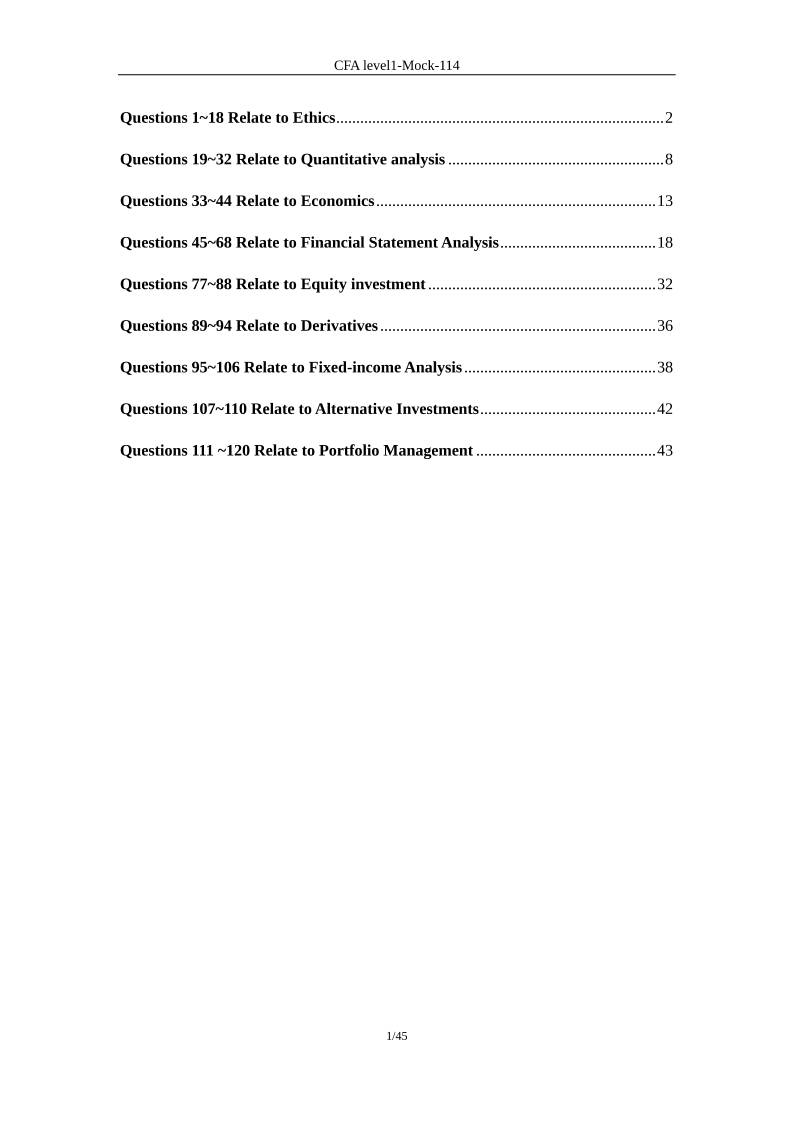


 设备数据采集
 工程招标采购
 搞笑表情
搞笑表情 微信头像
微信头像 CWMS冷库管理系统
 美女图片
美女图片 APP小游戏
 PPT模板
PPT模板 WMS仓库系统
 软件开发
软件开发