概要信息:
Cambridge IELTS 9
TEST 1
READING PASSAGE 1
You should spend about 20 minutes on Questions 1-13, which are based on Reading
Passage 1 below.

William Henry Perkin
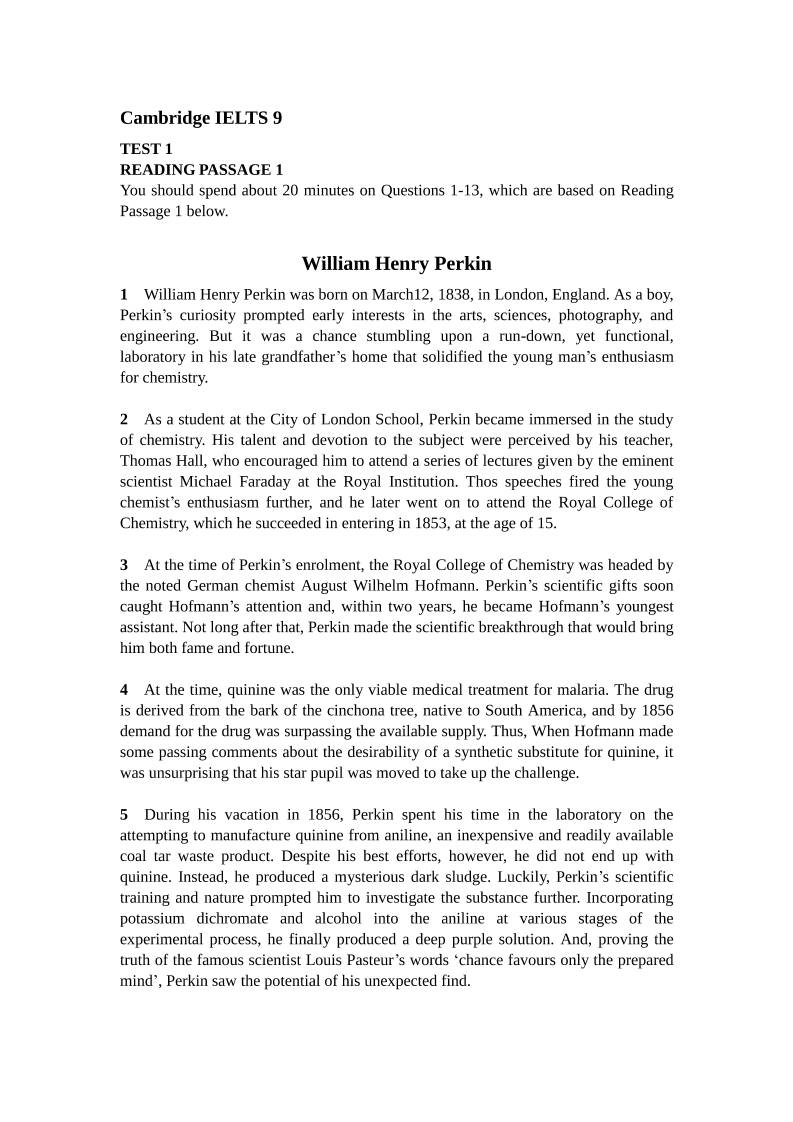
1  William Henry Perkin was born on March12, 1838, in London, England. As a boy,
Perkin’s curiosity prompted early interests in the arts, sciences, photography, and
engineering. But it was a chance stumbling upon a run-down, yet functional,
laboratory in his late grandfather’s home that solidified the young man’s enthusiasm
for chemistry.

2  As a student at the City of London School, Perkin became immersed in the study
of chemistry. His talent and devotion to the subject were perceived by his teacher,
Thomas Hall, who encouraged him to attend a series of lectures given by the eminent
scientist Michael Faraday at the Royal Institution. Thos speeches fired the young
chemist’s enthusiasm further, and he later went on to attend the Royal College of
Chemistry, which he succeeded in entering in 1853, at the age of 15.

3  At the time of Perkin’s enrolment, the Royal College of Chemistry was headed by
the noted German chemist August Wilhelm Hofmann. Perkin’s scientific gifts soon
caught Hofmann’s attention and, within two years, he became Hofmann’s youngest
assistant. Not long after that, Perkin made the scientific breakthrough that would bring
him both fame and fortune.

4  At the time, quinine was the only viable medical treatment for malaria. The drug
is derived from the bark of the cinchona tree, native to South America, and by 1856
demand for the drug was surpassing the available supply. Thus, When Hofmann made
some passing comments about the desirability of a synthetic substitute for quinine, it
was unsurprising that his star pupil was moved to take up the challenge.

5  During his vacation in 1856, Perkin spent his time in the laboratory on the
attempting to manufacture quinine from aniline, an inexpensive and readily available
coal tar waste product. Despite his best efforts, however, he did not end up with
quinine. Instead, he produced a mysterious dark sludge. Luckily, Perkin’s scientific
training and nature prompted him to investigate the substance further. Incorporating
potassium dichromate and alcohol into the aniline at various stages of the
experimental process, he finally produced a deep purple solution. And, proving the
truth of the famous scientist Louis Pasteur’s words ‘chance favours only the prepared
mind’, Perkin saw the potential of his unexpected find.

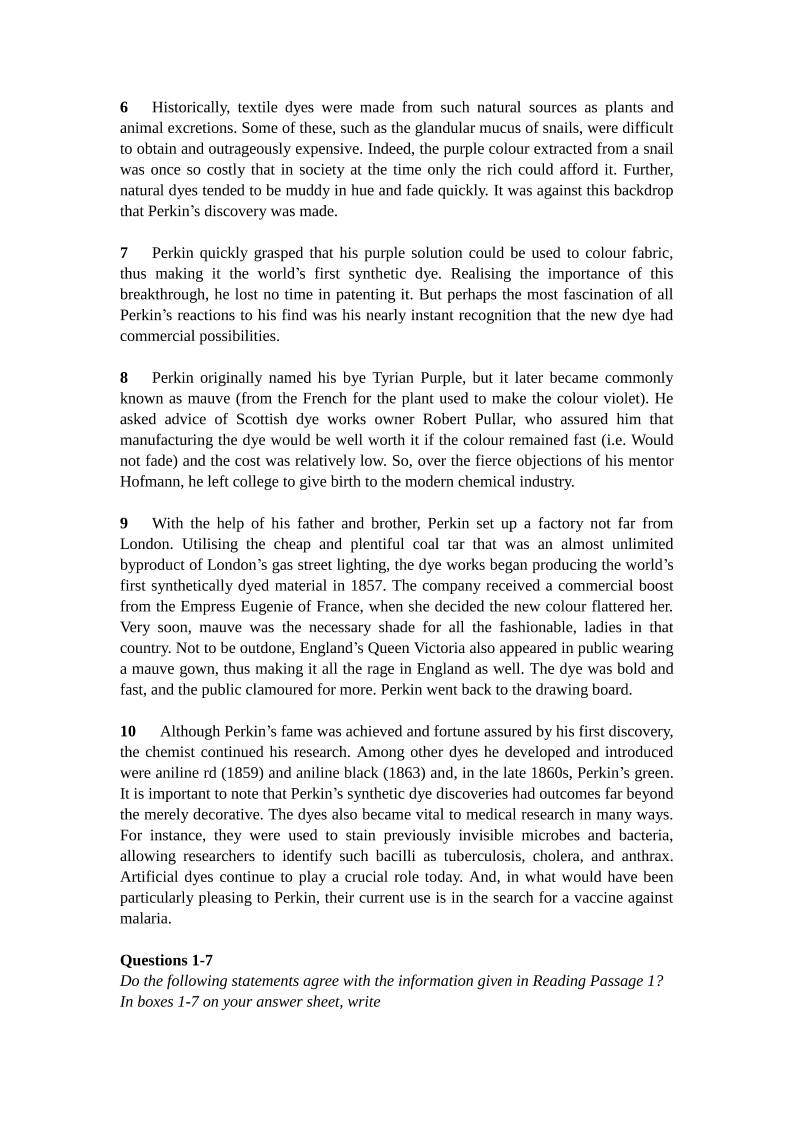
6   Historically, textile dyes were made from such natural sources as plants and
animal excretions. Some of these, such as the glandular mucus of snails, were difficult
to obtain and outrageously expensive. Indeed, the purple colour extracted from a snail
was once so costly that in society at the time only the rich could afford it. Further,
natural dyes tended to be muddy in hue and fade quickly. It was against this backdrop
that Perkin’s discovery was made.

7   Perkin quickly grasped that his purple solution could be used to colour fabric,
thus making it the world’s first synthetic dye. Realising the importance of this
breakthrough, he lost no time in patenting it. But perhaps the most fascination of all
Perkin’s reactions to his find was his nearly instant recognition that the new dye had
commercial possibilities.

8   Perkin originally named his bye Tyrian Purple, but it later became commonly
known as mauve (from the French for the plant used to make the colour violet). He
asked advice of Scottish dye works owner Robert Pullar, who assured him that
manufacturing the dye would be well worth it if the colour remained fast (i.e. Would
not fade) and the cost was relatively low. So, over the fierce objections of his mentor
Hofmann, he left college to give birth to the modern chemical industry.

9   With the help of his father and brother, Perkin set up a factory not far from
London. Utilising the cheap and plentiful coal tar that was an almost unlimited
byproduct of London’s gas street lighting, the dye works began producing the world’s
first synthetically dyed material in 1857. The company received a commercial boost
from the Empress Eugenie of France, when she decided the new colour flattered her.
Very soon, mauve was the necessary shade for all the fashionable, ladies in that
country. Not to be outdone, England’s Queen Victoria also appeared in public wearing
a mauve gown, thus making it all the rage in England as well. The dye was bold and
fast, and the public clamoured for more. Perkin went back to the drawing board.

10   Although Perkin’s fame was achieved and fortune assured by his first discovery,
the chemist continued his research. Among other dyes he developed and introduced
were aniline rd (1859) and aniline black (1863) and, in the late 1860s, Perkin’s green.
It is important to note that Perkin’s synthetic dye discoveries had outcomes far beyond
the merely decorative. The dyes also became vital to medical research in many ways.
For instance, they were used to stain previously invisible microbes and bacteria,
allowing researchers to identify such bacilli as tuberculosis, cholera, and anthrax.
Artificial dyes continue to play a crucial role today. And, in what would have been
particularly pleasing to Perkin, their current use is in the search for a vaccine against
malaria.

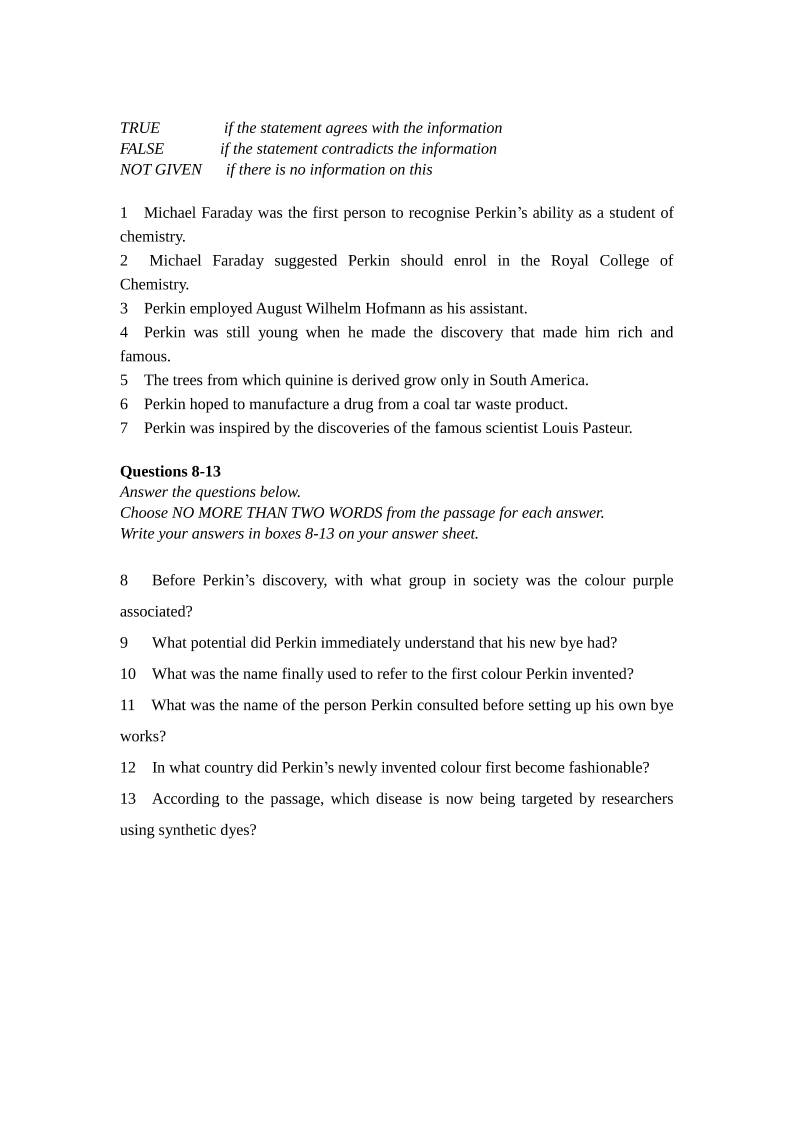
Questions 1-7
Do the following statements agree with the information given in Reading Passage 1?
In boxes 1-7 on your answer sheet, write

TRUE        if the statement agrees with the information
FALSE       if the statement contradicts the information
NOT GIVEN   if there is no information on this

1  Michael Faraday was the first person to recognise Perkin’s ability as a student of
chemistry.
2  Michael Faraday suggested Perkin should enrol in the Royal College of
Chemistry.
3  Perkin employed August Wilhelm Hofmann as his assistant.
4  Perkin was still young when he made the discovery that made him rich and
famous.
5  The trees from which quinine is derived grow only in South America.
6  Perkin hoped to manufacture a drug from a coal tar waste product.
7  Perkin was inspired by the discoveries of the famous scientist Louis Pasteur.

Questions 8-13
Answer the questions below.
Choose NO MORE THAN TWO WORDS from the passage for each answer.
Write your answers in boxes 8-13 on your answer sheet.

8   Before Perkin’s discovery, with what group in society was the colour purple
associated?
9   What potential did Perkin immediately understand that his new bye had?
10  What was the name finally used to refer to the first colour Perkin invented?
11  What was the name of the person Perkin consulted before setting up his own bye
works?
12  In what country did Perkin’s newly invented colour first become fashionable?
13  According to the passage, which disease is now being targeted by researchers
using synthetic dyes?


 设备数据采集
 工程招标采购
 搞笑表情
搞笑表情 微信头像
微信头像 CWMS冷库管理系统
 美女图片
美女图片 APP小游戏
 PPT模板
PPT模板 WMS仓库系统
 软件开发
软件开发