概要信息:
江苏专转本英语冲刺-语法必读


在考试中,虽然题目千变万化,但是万变不离其宗,只要仔细分析,就会发
现这些题目其实基本上都是时态、语态、条件句和虚拟语气、非谓语动词、倒装
句、简单句和复合句(连接手段)的各种变化形式。其中,前四项是每一个考生
必须掌握的四大语法点。

第一讲 时态(一)
1. 一般现在时
1) 用法:
A) 表示一个按规定、计划或安排要发生的动作,(仅限于某些表示“来、去、动、
停、开始、结束、继续”等的动词 )可以与表示未来时间的状语搭配使用。常
见的用法是:飞机、火车、轮船、汽车等定期定点运行的交通方式。
例:The next train leaves at 3 o'clock this afternoon. (下一趟火车今天下午 3 点开
车。)
How often does this shuttle bus run? (这班车多久一趟?)
B) 在时间和条件状语从句里经常用一般现在(有时也用现在完成时)表示将来
事情。
例:When you have finished the report, I will have waited for about 3 hours.(等你完
成这份报告的时候,我就已经等了将近 3 个小时了。)
Government cannot operate effectively _____ it is free from such interference.
A) so long as B) so that C) unless  D) because

2. 现在完成时(have done)
1) 用法:
A) 表示从过去某时刻开始,持续到现在的动作或情况,并且有可能会继续延续
下去。此时经常用延续性动词。时间状语常用 since 加一个过去的时间点,或 for
加一段时间,或 by 加一个现在时间。
Great as Newton was, many of his ideas ___________ today and are being modified by
the work of scientists of our time.
A) are to challenge            B) may be challenged
C) have been challenged        D) are challenging

2) 注意事项
A) 现在完成时是联系过去和现在的纽带。现在完成时和过去时的区别在于:现
在完成时强调动作的动态,或受动态的影响,是动态的结果,对现在有影响;过
去时只表示过去的某个具体时间里发生的动作,与现在没有联系。
例:He worked in that hospital for 8 years.(他曾经在那家医院工作了 8 年。这只
是讲述一个过去的事实,他现在已经不在那家医院了。)
He has worked in that hospital for 8 years.(他已经在那家医院里工作了 8 年。
表示他从过去开始工作,一直工作到现在,现在仍在那家医院工作。)
B) 因为含有 for 加一段时间或 since 加一个时间点这样的时间状语的完成时,有
默
默
学
默默学网,致力于专转本、计算机二级、英语四六级和考研问答www.momoxue.com
默默学网,致力于专转本、计算机二级、英语四六级和考研问答www.momoxue.com
动态和延续性的特点,所以不能使用终端动词或瞬间动词。
My sister has been married for 5 years.(过去分词做表语表示状态,可以延续)
My sister has married. Don't disturb her.(终端动词)
C) 在"this is the first/ second/ third…… time that……"句型里要求用完成时。
D) 句型"It is/ has been……since"所使用的两种时态都正确。
例:It is/ has been 10 years since I last saw him.(从我上次见到他以来已经 10 年
了。)
E) 在"no sooner than"、"hardly/ scarcely ……when"、"before"、"prior to"等句型中,
主句要求完成时。
I haven't met that professor prior to today.(以前我从未见过那位教授。)
3. 现在完成进行时(have been doing)
1) 用法:表示某一动作开始于过去某一时间,延续或重复地出现至今,或将继续
延续至将来。
例:We have been working on this project for over a month now.(到目前为止,我
们一直在处理那个项目,已经花了一个多月时间了。)
2) 注意事项:与现在完成时相比,现在完成进行时更强调:在从过去到现在的时
间里,动作或状态一直持续或一直反复出现。
It seems oil ___________ from this pipe for some time. We'll have to take the machine
apart to put it right.
A) had leaked  B) is leaking
C) leaked D) has been leaking
4. 一般过去时
A) 表示过去习惯性动作。特别是由 would/ used to do 表达的句型,本身表示的
就是过去时。
例:The old man would sit on a bench in the quiet park and look at others for hours
without doing anything or talking to anybody.(
老人过去常常坐在宁静的公园里的一条长椅上,看着其他的人,一坐就是数个小
时,什么也不干,也不和任何人交谈。)
He used to visit his mother once a week.(他以前总是每周看望一次他的母亲。)
C) 有时可代替一般现在时,表达一种婉转、客气、礼貌、商量的语气。
例:I wanted to ask you if I could borrow your car?(我想向您借车用一用,可以
吗?)
Would you mind my sitting here?(您介意我坐在这里吗?)
2) 注意事项:
A) 注意时间状语的搭配。一般过去时的时间状语应该是表示过去某个时间的词
或词组,如:yesterday, last month, in 1999, two days ago 等,绝对不可与 recently,
in the past 10 years, this month 等连用,因为这样的时间状语都与现在有关系,应
该用现在完成时或一般现在时。
B) used to do 的否定形式和疑问形式很特别:你怎么写都正确。以否定形式
为例:used not to do, didn't used to do, didn't use to do 都对。
Used to do 经常与 be used to doing sth/ sth 结构进行对比。前者表示"过去常常或
过去曾经",要求加动词原形;后者表示"习惯于",要求加名词或动名词。
5. 过去完成时(had done)
1) 用法:表示在过去的某个时间或动作以前已经发生的动作或已经存在的状态。
默
默
学
默默学网,致力于专转本、计算机二级、英语四六级和考研问答www.momoxue.com
默默学网,致力于专转本、计算机二级、英语四六级和考研问答www.momoxue.com
就是我们常说的:表示"过去的过去的动作或状态"。
Until then, his family _________ from him for six months.
A) didn't hear C) hasn't heard B) hasn't been hearing D) hadn't heard
2) 注意事项:“过去的过去”这种逻辑关系常通过上下文体现出来,而不一定受
某个时间状语的限制。
例:There had been some one in our room just now, because I noticed a burning cigarette
end on the floor when we opened the front door.(刚才有人在我们的房间里,因为
我们打开前门进来时,我注意到地板上有一支仍在燃烧的香烟。)
分析:虽然时间状语是 just now,似乎应该使用一般过去时,但是“在房间里”
这个状态是在"开门"和"注意"这两个过去的动作之前就存在的,所以应该用过去
完成时。
6. 一般将来时

A) 表示“即将、正要”时,可用 be about to do。强调近期内或马上要做的事。
例:Don't worry, I am about to make a close examination on you.(别担心,我马上

B) "be to do"的 5 种用法:
a) 表示“按计划、安排即将发生某事或打算做某事”。
例:She is to be seen in the lab on Monday.(星期一你准会在实验室见到她。)
b) 该做或不该做的事情(语气上接近于 should, must, ought to, have to),表示一
种命令、规劝性语气。
例:You are to go to bed and keep quiet, kids. Our guests are arriving in less than 5
minutes.(孩子们,你们必须 上床睡觉,不准吵闹。我们的客人 5 分钟之内就要
到了。)
c) 能或不能发生的事情(接近 can, may)
例:How am I to pay such a debt?(我怎么可能还得起这么大的一笔债呢?)
d) 不可避免将要发生的事情,后来将要发生的事情。
I assure you that the matter _______ as quickly as possible. Have a little patience.
A. will be attended B. will be attended to  C. is attended D. is attended to
e) 用于条件从句“如果……想,设想”(接近 if ……want to,或 if ……should)
C) 同样可以表示“正要、将要”的意思的句型是 be on the point of doing。
例:The coach is on the point of giving up the game because our team has been scored
7 points
I was _______ the point of telephoning him when his letter arrived.
A) in B) to C) at D) on
2) 注意事项:
在以 if, when, as long as, as soon as, after, before, in case, until, unless 等连词以及具
有连词作用的副词(immediately, the moment, directly)等引导的状语从句,一般
用现在时代替将来时。强调延续性或动态时,可用完成时。
例:I hope his health will have improved by the time you come back next year.(我希
望到明年你回来的时候,他的身体已经好多了。)
8. 将来完成时(will have done) 重点(多次考到)
1) 用法:表示从将来的某一时间开始、延续到另一个将来时间的动作或状态,或
是发生在某个将来时间,但对其后的另一个将来时间有影响的动作或状态。就好
默
默
学
默默学网,致力于专转本、计算机二级、英语四六级和考研问答www.momoxue.com
默默学网,致力于专转本、计算机二级、英语四六级和考研问答www.momoxue.com
 3340511700
4
象把现在完成时平移到时间轴的将来时时段一样。其用法从和过去及现在有关,
变成了和将来及将来的将来有关。
The conference __________ a full week by the time it ends.
A) must have lasted  B) will have lasted
C) would last           D) has lasted
It is reported that by the end of this month the output of cement in the factory ______
by about 10%.
A) will have risen B) has risen C) will be rising D) has been rising
2) 注意事项:由于本时态是由将来时和完成时融合在一起的,所以关于本时态
的注意事项,可以参考“一般将来时”和“现在完成时”的有关注意事项。


第二讲 虚拟语气(一)
虚拟语气(Subjunctive Mood)这一语法项目几乎是必考的内容。虚拟语气是一种特
殊的动词形式,用来表示说话人所说的话并不是事实,而是一种假设、愿望、怀
疑或推测。
1. 虚拟现在时表示与现在事实相反的假设,其 if 从句的谓语形式用动词的过去
式(be 一般用 were),主句用 would/ should/ could/ might +动词原形。
1) If places ______ a like, there would be little need for geographers.
A. being B. are C. be D. were
2) If I _____ the meaning of the word, I wouldn't have to look it up.
A. know B. knew C. known D. knowing
2. 虚拟过去时是表示与过去事实相反的假设,if 从句的谓语形式用过去完成时
即 had+过去分词,主句用 would / should / could / might + have +过去分词。
We didn't know his telephone number, otherwise we _____ him,
A) would have telephoned  B) must have telephoned
C) would telephone  D) had telephoned

3. 虚拟将来时是表示对将来实现的可能性很小的或不确定的假设。If 从句的谓
语形式用一般过去式或用were to / should +动词原形,主句用would / should /could/
might +动词原形。
Jean doesn't want to work right away because she thinks that if she ______ a job she
probably wouldn't be able to see her friends very often.
A. has to get B. had got C. were to get D. could have got

4. 省略 if 采用倒装语序的条件句。 (多次考到)
有时可以把含有助动词、情态动词、be 或 have 的虚拟条件句中的连词 if 省去,
而将 had , should, were 等词提到主语之前,即用倒装结构。(这种结构在口语中
很少使用)。
Had he worked harder, he _____ the exams.
A. must have got through  B. would have got through
C. would get through D. could get through

5. 有时虚拟条件句并没来 if 从句表示出来,而是用介词短语、上下文或其它方
默
默
学
默默学网,致力于专转本、计算机二级、英语四六级和考研问答www.momoxue.com
默默学网,致力于专转本、计算机二级、英语四六级和考研问答www.momoxue.com
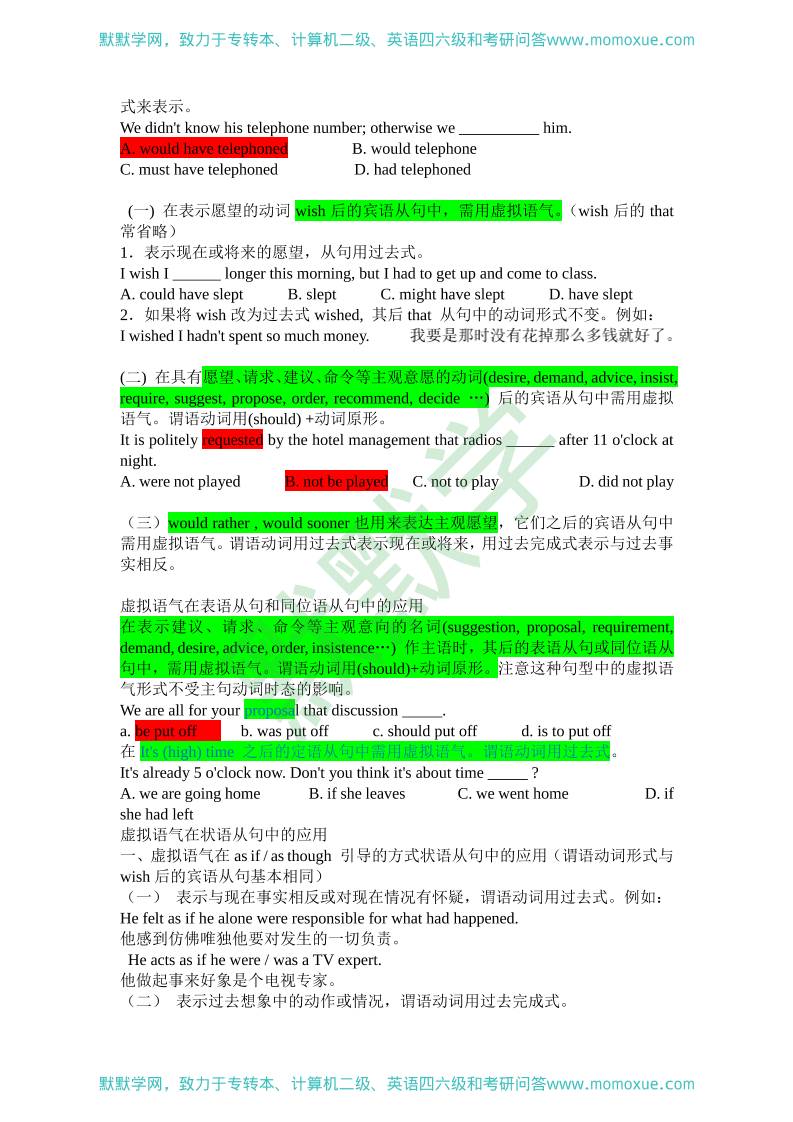
式来表示。
We didn't know his telephone number; otherwise we __________ him.
A. would have telephoned  B. would telephone
C. must have telephoned D. had telephoned

 (一) 在表示愿望的动词 wish 后的宾语从句中,需用虚拟语气。(wish 后的 that
常省略)
1.表示现在或将来的愿望,从句用过去式。
I wish I ______ longer this morning, but I had to get up and come to class.
A. could have slept B. slept  C. might have slept D. have slept
2.如果将 wish 改为过去式 wished, 其后 that 从句中的动词形式不变。例如:
I wished I hadn't spent so much money.

(二) 在具有愿望、请求、建议、命令等主观意愿的动词(desire, demand, advice, insist,
require, suggest, propose, order, recommend, decide …) 后的宾语从句中需用虚拟
语气。谓语动词用(should) +动词原形。
It is politely requested by the hotel management that radios ______ after 11 o'clock at
night.
A. were not played B. not be played   C. not to play  D. did not play

(三)would rather , would sooner 也用来表达主观愿望,它们之后的宾语从句中
需用虚拟语气。谓语动词用过去式表示现在或将来,用过去完成式表示与过去事
实相反。

虚拟语气在表语从句和同位语从句中的应用
在表示建议、请求、命令等主观意向的名词(suggestion, proposal, requirement,
demand, desire, advice, order, insistence…) 作主语时,其后的表语从句或同位语从
句中,需用虚拟语气。谓语动词用(should)+动词原形。注意这种句型中的虚拟语
气形式不受主句动词时态的影响。
We are all for your proposal that discussion _____.
a. be put off b. was put off c. should put off d. is to put off
在 It's (high) time 之后的定语从句中需用虚拟语气。谓语动词用过去式。
It's already 5 o'clock now. Don't you think it's about time _____ ?
A. we are going home  B. if she leaves  C. we went home D. if
she had left
虚拟语气在状语从句中的应用
一、虚拟语气在 as if / as though 引导的方式状语从句中的应用(谓语动词形式与
wish 后的宾语从句基本相同)
(一) 表示与现在事实相反或对现在情况有怀疑,谓语动词用过去式。例如:
He felt as if he alone were responsible for what had happened.
他感到仿佛唯独他要对发生的一切负责。
 He acts as if he were / was a TV expert.
他做起事来好象是个电视专家。
(二) 表示过去想象中的动作或情况,谓语动词用过去完成式。
默
默
学
默默学网,致力于专转本、计算机二级、英语四六级和考研问答www.momoxue.com
默默学网,致力于专转本、计算机二级、英语四六级和考研问答www.momoxue.com
The tree looked as if it ______ for a long time.
A. hasn't watered B. didn't water  C. hadn't bee watered D. wasn't watered
二、 在 lest 引导的状语从句中,谓语动词多用虚拟语气,(should )+ 动词原形。
例如:
The mad man was put in the soft-padded cell lest he _____ himself.
a. injure  b. injured c. had injure  d. would injure
三、 在 if only 引起的感叹句中需用虚拟语气。谓语动词用过去式或过去完成式。
Look at the terrible situation I am in! if only I ____ your advice.
A. follow B. had followed C. would follow D. have followed

第三讲 非谓语动词 (重点)
非谓语动词分为三类:不定式(infinitive)、动名词(gerund)和分词(participle)。
其特点是:
1. 不定式做补足语的用法
不定式做补足语时,如果和主语是主谓关系,就用不定式的主动式,如果是动宾
关系,就用被动式;如果动作时间和谓语动词同时发生,就用不定式的一般式。
如果动作时间发生在谓语动作之前,就用不定式的完成式。
1) 不定式做主语补足语
The ancient Egyptians are supposed _________ rockets to the moon.
A) to send    B) to be sending      C) to have sent    D) to have been
sending

2) 不定式做宾语补足语
有些动词和短语可用不定式做宾语补足语,构成句型:主语+谓语动词+宾语+不
定式。
这样的动词有:advice, allow, announce, ask, assist, authorize, bear, beg, bribe, cause,
command, compel, condemn, deserve, direct, drive, enable, encourage, entitle, entreat,
exhort, forbid, force, get, hate, help, implore, induce, inspire, instruct, intend, invite,
lead, leave, like, mean, need, oblige, order, permit, persuade, pray, prefer, press, prompt,
pronounce, recommend, remind, report, request, require, summon, teach, tell, tempt,
urge, want, warn, wish。
这样的短语有:call on(请求), care for(关心), count on(依靠,指望), depend
on(依赖、依靠), keep on at(困扰,追问), long for(渴望), make out(分辨),
vote for(选举), prevail on(说服), rely on(信赖), wait for(等待)。
还有一些动词和词组用不定式做宾语补足语时不带 to,但在被动形式时,其宾语
补足语不定式必须带 to。这样的动词和词组有:feel, have, hear, let, make, notice,
observe, overhear, see, watch, listen to, look at。

They are going to have the serviceman __________ an electric fan in the office
tomorrow.
A) install  B) to install    C) to be installed   D) installed

2. 不定式做宾语
大部分动词可加不定式做宾语。一些动词,特别是系动词,如 appear, chance, come,
默
默
学
默默学网,致力于专转本、计算机二级、英语四六级和考研问答www.momoxue.com
默默学网,致力于专转本、计算机二级、英语四六级和考研问答www.momoxue.com
fail, get, happen, manage, prove, seem, tend, turn out 等,后面接不定式,形式上是
宾语,实际是一种复合结构句型,除人、物做主语外,还可用 it 做主语,所跟 to
be 可省略。
There is a man at the reception desk who seems very angry and I think he means
_________ trouble.
A) making B) to make C) to have made D) having made

3. 不定式做定语
不定式做定语时,与中心词之间在逻辑上有多种关系,其中可能是互相修饰关系。
也就是:不定式修饰中心词;不定式短语末的介词与中心词组成介词短语,修饰
不定式。这些动词不定式可能是及物的(带宾语),也可能是不及物的,要特别
注意不要漏掉不定式短语末的介词。很多名词后可接不定式做定语,如 ability,
ambition, anxiety, attempt, campaign, chance, courage, decision, determination, drive
(动力) , effort, force, inclination, intention, method, motive, movement, need,
opportunity, pressure, reason, right(权力), struggle, tendency, wish, anything, anyone,
everything, everyone, nothing, no one, something, some one 等。 这类名词通常表示
抽象概念,后面用动词不定式做定语,表示该名词的具体内容。在这种结构中,
不能用分词形式。还要注意,如果不定式中的动词是不及物动词,则不定式后要
加介词,因为此时不定式与其修饰的名词实质上有动宾关系。
The pressure________causes Americans to be energetic, but it also puts them under a
constant emotional strain.
A) to compete C) to be competed B) competing D) having competed

介词+关系代词+不定式可以做定语用,这种用法是一种正式的表达法。
You will want two trees about ten feet apart, from _____ to suspend your tent.
A) there B) them C) which D) where
10. 不定式做状语
________ a teacher in a university, it is necessary to have at least a master's degree.
A) To become B) Become C) One becomes D) On becoming

4. 介词后的不定式
介词后接不定式只见于少数场合:but 后面通常接带 to 的不定式,包括 do nothing
but,can not but,can not help but,have no choice but 等等。
That was so serious a matter that I had no choice but ____ the police.
A) called in B) calling in C) call in D) to call in

动名词
1. 动名词做宾语
1) 有些动词只能接动名词做宾语,而不能接不定式。这是考试中常见的考点。请
大家务必多练多用多读多说,尽量培养语感,这比单纯死记硬背这些枯燥的词汇
要容易得多。
这些动词是:acknowledge, advice, admit, anticipate, appreciate, avoid, allow, bear,
can't help, cease, commence, complete, confess, delay, deny, discourage, detest, dread,
endure, enjoy, envy, escape, excuse, fancy, favor, figure, finish, imagine, involve, justify,
默
默
学
默默学网,致力于专转本、计算机二级、英语四六级和考研问答www.momoxue.com
默默学网,致力于专转本、计算机二级、英语四六级和考研问答www.momoxue.com
keep, mind, miss, permit, postpone, practice, quit, recall, repent, require, resent, resume,
risk, save 等等。
Mark often attempts to escape _______ whenever he breaks traffic regulations.
A) having been fined B) to have been fined C) to be fined D) being
fined

People appreciate with him because he has a good sense of humor.
A) to work B) to have worked C) working D) having working

2) 凡是动词+介词、名词+介词或形容词+介词形成的词组,都要求接动名词做宾
语,因为所有介词后的动词都要使用动名词形式。
He gives people the impression ____________ all his life abroad.
A) of having spend  B) to have spent C) of being spent
D) to spent

3) 满足句型“it is +名词或形容词+动名词”和句型“动词+ it +形容词或名词+动
名词”的形容词和名词有:good, no good, nuisance, no use, senseless, use, useless,
waste, worthwhile。
例:Do you think it worthwhile investing a large sum of money in this project?(你认
为向该项目大量投资值得吗?)

4) 有些动词后既可加不定式,也可加动名词,但用法不同,意义也不同。注意
remember, forget, stop, regret, go on, afford, attempt, try, 等单词的用法。(多次考到)
例如: afford (a) can (not) afford / be (not) able to afford + to do:经受得/不起,
负担得/不起。后面一般加表示时间、金钱方面的内容。
例:We can't afford to buy this house because we won't make the ends meet.(我们买
不起这房子,因为我们将入不敷出。)

(b) afford + doing:提供
例:The bill is a measure necessary to afford protecting labor.(这条法案是提供劳工
保护的必要措施。)
deserve, need, require, want 这几个词的共同特点是:它们后面既可加不定式,也
可加动名词,意义相同。但是,表示被动时,动名词依然使用主动形式,不定式
则变成被动形式。其中,这几个词后面加动名词的格式是常考项目之一。
Your hair wants _________. You'd better have it done tomorrow.
A) cut B) to cut C) cutting D) being cut
注意
bear 的用法与这几个词类似,但表示被动时,它后面加动名词时的形式与上述几
个词不同。
例:She can't bear being looked down upon by others.(她无法容忍被人瞧不起。)
She can't bear to be looked down upon by others.(她无法容忍被人瞧不起。)
She can't bear looking down upon others.(她无法容忍瞧不起别人(的行为)。)
此时,例句一被动形式中的动名词要用 being looked down,以免与例句三的主动
表示相混淆。
默
默
学
默默学网,致力于专转本、计算机二级、英语四六级和考研问答www.momoxue.com
默默学网,致力于专转本、计算机二级、英语四六级和考研问答www.momoxue.com
dislike, dread, hate, like, love, prefer
这些词加动名词时,表示喜欢或讨厌一般性、习惯性或发生过的某事、某物;加
不定式时,表示喜欢或讨厌的、偶然一次的、打算做的某事、某物。
prefer 的用法稍微复杂一点,它后面加不定式还是加动名词通常是由它的固定结
构或习惯用法决定的。常见的结构是:would prefer + to do(更想做某事); prefer
doing A to doing B(比起做 B 来说,更喜欢做 A。特别注意:这里的比较使用的
不是 than,而是 to)。
forget, neglect, regret, remember
这几个词的共同特点是:它们后面加不定式时,表示记得、忘记、遗憾、忽略要
做或应该做的事,总之是还没有做的事;而加动名词时,表示记得、忘记、遗憾、
忽略所做的事,也就是已经发生了、已经做了的事。

3. 动词出现在介词后面是大多是情况下是以动名词而不是以不定式的形式出现,
要特别注意:admit to(承认),approach to(方法),contribute to(起作用),confess
to(承认),resort to(求助于),reconcile to(顺从于),revert to(重新开始),submit
to(忍受),swear to(断言),take to (开始从事),be used to(习惯于),look
forward to(盼望),oppose to (反对),中的 to 都是介词而不是不定式符号。
The match was cancelled because most of the members ______ a match without a
standard court.
A) objected to having    B) were objected to have
C) objected to have    D) were objected to having

The traditional approach _______with complex problem is to break them down into
smaller, more easily managed problems.
A) to dealing B) in dealing C) dealing D) to deal

5. 惯用句型
be busy doing sth., be no good doing sth., spend some time/money doing sth., have
difficulty (in) doing sth., have a hard time (in) doing sth., have trouble / difficulty (in)
doing sth.都是惯用句型,其中动名词不能换成 to 不定式。
Jean did not have time to go to the concert last night because she was busy _______ for
her examination.
A) to prepare B) to be prepared C) preparing D) being prepared
结合选项来看,全句的意思是:“琼做完没有时间去听音乐会,因为她忙于准备
考试。”,所以答案是 D) being prepared。

6. 动名词短语之前可以有一个物主代词或名词所有格来表示它的逻辑主语。
__________ in an atmosphere of simple living was what her parents wished for.
A) The girl was educated B) The girl educated
C) The girl's being educated D) The girl to be educated

Although punctual himself, the professor was quite used ______ late for his lecture.
A) to have students B) for students' being
C) for students to be  D) to student's being
默
默
学
默默学网,致力于专转本、计算机二级、英语四六级和考研问答www.momoxue.com
默默学网,致力于专转本、计算机二级、英语四六级和考研问答www.momoxue.com

现在分词(present participle)和过去分词(past participle)。
1. 注意事项
1) 不及物动词的过去分词有两种形式:
A) 单独使用时没有被动意义,只表示完成的或静态的动作和状态。做定语时,
一般位于所修饰的词前面。
例:departed friends 分离的朋友 faded flowers 凋零的花
B) 与介词连用时,可以表示被动,做后置定语。因为在主动语态里,不及物动
词与介词连用时意味着可以接宾语。同样道理,在分词表达形式中,不及物动词
分词所修饰的词就是刚才我们谈到的宾语,对于宾语来说,这个动作就是一个被
动动作了。
2) 有一些可以做表语的现在分词和过去分词的用法是固定的。
例 如 : amazing, amazed, amusing, amused, convincing, confusing, confused,
disappointing, disappointed, encouraging, encouraged, exciting, excited, contented,
inviting, missing, misunderstanding, inexperienced 等。
这些分词没有严格意义上的被动、静态、动态、已完成或正在进行这样的含义。
它们源自动词,有动词的用法。以最常见的 interesting 和 interested 为例。若对某
事/某人感兴趣,就用 be interested in Seth./sib.的结构,主语一般都是人;如果某
事或某人本身让别人感到有意思,让人感兴趣的话,就用 sth./sb. is interesting 的
结构。

第四讲 主谓一致(一) 详细阅读(重点)
主谓一致是指谓语动词在人称和数上必须与主语一致。下面让我们看看不同类型
的主谓一致。
1. 名词做主语
1) 单复数主谓一致
A) 一般词汇:有些词汇的复数形式是固定不变的,如:crossroads (十字路口;聚
焦点), headquarters (总部), means (方法,手段), species (种类,品种), series (系列),
works (工厂)等,但其动词的单复数取决于两点:
a) 取决于限定词:
例:Every means has been tried but without much result.(各种方法都试过,可没有
多大效果。)
These works have been closed since the beginning of this year due to the strike of
the workers.(由于工人罢工,这些工厂从今年年初起就一直停工。)
b) 取决于上下文内容、作者所要表达的意思、特指还是泛指:
例:Are/ Is there any other means of solving the problem?(还有什么其它解题的方
法吗?注意:这里可以用 are 表示其它方法,也可以用 is 表示和现在所用的方法
相对比的另一种方法。)
My favorite book is The Old Man and the Sea.(我喜爱的书是《老人与海》。注
意:本句是特指。)
Our TV series are much better than those of Japan.(我国的电视剧比日本的好得
多。注意:本句是泛指。)
注意:a series of 这是一个短语,表示“一系列”,后面跟复数名词。但其动词谓
语用单数还是用复数,取决于本短语表示的是一系列“同一种类”的事物还是“不
默
默
学
默默学网,致力于专转本、计算机二级、英语四六级和考研问答www.momoxue.com
默默学网,致力于专转本、计算机二级、英语四六级和考研问答www.momoxue.com
同种类”的事物。前者用单数谓语;后者用复数谓语。
例:A series of wet days spoils our holiday.(阴雨连绵破坏了我们的假期。)
There are a series of strange objects in his suitcase.(他的提箱里有一些奇怪的东西。)
c) 从句做主语
How close parents are to their children _______ a strong influence on the character of
the children.
A) have B) has C) having D) to have
本题中 how 引导的从句做主语,为单数,所以答案是 B) has。全句的意思是:“孩
子与父母的接近程度会对孩子的性格有很大影响。”
d) 学科名词一般用单数谓语动词。但如果这个词还可表示相关活动、具体或个
别事实或事件时,则可用复数谓语。这样的词有:economics(经济学), electronics
(电子学), mathematics(数学), politics(政治学)等等。
例:Politics is a good topic for discussion.(政治是谈论的好题目。)
Economics has fascinated me.(我迷上了经济学。)
e) 有些名词具有复数形式,但其实是单数意义,有自己的复数形式。其用法与一
般名词相同,单数时可以使用不定冠词,谓语用单数;复数时谓语动词用复数。
这种名词的"伪装"很不好识别,只能靠平时词汇量和经验的积累。例如:chaos -
chaoses(琐事,杂乱), campus - campuses(校园), chorus - choruses(合唱队),
status - statuses(身份、地位), virus - viruses(病毒), analysis - analyses(分析),
basis - bases(基础), crisis - crises(危机), hypothesis - hypotheses(假设),等。
例:There was chaos everywhere in the town after the earthquake.(地震后,城内一
片混乱。)
f) 有些表示成双成对的词,常常只用复数形式,动词一律用复数,也不能用不定
冠词。比如要表示“一……”,要使用量词,通常使用"a pair of"。这样的词有:
eyeglasses(眼镜), pants(裤子), scissors(剪刀), shoes(鞋), shorts(短裤),
socks(短袜), stockings(长统袜), trousers(裤子)等。
B) 无复数形式的名词
a) 有些名词,特别是一些表示动物的名词,其单复数形式是固定不变的,但其动
词的单复数取决于其限定词和上下文内容。
例:Much of this data is conclusive.(这数据中有许多都是决定性的。)
Many of these data are conclusive. (这些数据中有许多都是决定性的。)
That Japanese has been to China for twenty times.(这位日本人已来过中国 20
次了。)
Those Japanese are visitors to our university.(那些日本人是到我们大学来参
观的客人。)
注意:Chinese, Japanese 这样的词不仅可做名词,还可和定冠词一起连用,表示
“……一类人”,是种集合名词的表达形式。因此,用于后者时,其动词的单复
数不能取决于内容,而是一定要用复数。
b) 集合名词:大部分集合名词都可使用单数或复数动词,这主要取决于作者的
强调点:强调整体时,用单数谓语;强调这个集体里的成员时,用复数谓语。这
样的集合名词有:army(军队), audience(观众、听众), board(委员会), committee
(委员会), crew(全体队员、船员、机组人员等), crowd(人群), firm(公司),
government(政府), group(组、群), majority(多数人), minority(少数人),
public(公众), staff(全体工作人员), union(联盟)等。
默
默
学
默默学网,致力于专转本、计算机二级、英语四六级和考研问答www.momoxue.com
默默学网,致力于专转本、计算机二级、英语四六级和考研问答www.momoxue.com

例:The audience was excited by the excellent show.(精彩的演出使全体观众情绪
激昂。)
The public is/are requested not to leave litter in the public places.(公众不能在
公共场所乱扔垃圾。)
注意:
1) 后一个例句中,The public 指的是在公共场所的人,谓语可用单数或复数。
2) 还有一些集合名词也没有复数形式,但只能做复数名词使用,谓语动词应该
用复数。这样的 man(人类), police(警察)等。
c) 专有名词和不可数名词的谓语一律用单数谓语。前者指人名、地名、国家名、
城市名、书名、机构名或重大事件。后者又可分为物质和抽象名词两大类。
例:The Tales of Ancient China was written by that old professor.(《古代中国神话》
是由那位老教授编写的。)
The United Nations is trying to find a better way to bring the two parties together.(联
合国正在寻求更有效的方法来调停双方。)
注意:在具体应用中,有些不可数名词可加复数词尾,这时其意义稍有变化,动
词的单复数则根据具体句子意思而定。有时甚至可加不定冠词。
例:There were bright lights in that mansion all the night.(那栋大厦整夜都亮着灯
光。)
She was a beauty even after she had three children.(她生三个孩子以后还是个美人。)
C) 另外,还有特殊复数形式的名词也需要你的特殊注意。这些词的复数形式可
能并不明显,所以常导致谓语单复数错误。
特殊复数形式的名词:phenomenon - phenomena(现象), goose - geese(鹅), mouse
- mice(老鼠)等
2) 不定代词和带限定词的名词做主语
A) 不定代词或 every 加名词做主语:every, each, either, neither, one, no one,
somebody, anybody, nobody, everyone, someone, anyone, everyone, something,
anything, nothing, everything 在句中做主语,或做限定词限定一个名词时,后面的
谓语一律用单数。
例:Each family was forced to send one labor to the army.(每家都被迫送一个劳动
力到军队去。)
Either of them isn't going to give up their chance of education.(他们两个都不想
放弃受教育的权利。)
注意:上述词语做限定词加 of 时,后面的名词或代词都应该用复数,但谓语却
用单数。即使有定语从句,其主句、从句谓语仍用单数。
例:Each one of us who is now living is destined to witness remarkable scientific
discoveries.(现在活着的人一定会见到伟大的科学发现。)
B) 限定词加名词做主语:all, any, many, more, most, some 的谓语动词的单复数取
决于它们所修饰的名词。
a) all, any, many, more, most, some 修饰单数名词时,谓语为单数;当修饰复数名
词谓语为复数。
例:All of the world is against wars.(全世界都反对战争。)
There is some girl at the telephone who wants to speak to you.(有个女孩打电话
来,找你。)
默
默
学
默默学网,致力于专转本、计算机二级、英语四六级和考研问答www.momoxue.com
默默学网,致力于专转本、计算机二级、英语四六级和考研问答www.momoxue.com
b) all, any, many, more, most, some 加复数名词时,谓语用复数动词。
例:All roads lead to Rome.(条条大路通罗马。)
There are scarcely any flies left.(几乎没有什么苍蝇了。)
c) all, any, many, more, most, some 修饰不可数名词时,谓语用单数动词。
例:If there is any trouble, please don't hesitate to turn to me.(如果有什么困难,请
立刻来找我。)
More experience is essential for getting a higher position.(要得到更高的职位,
重要的是要有更多的经验。)
d) 注意:many 不能修饰不可数名词。Many a person/ thing, more than one person
/ thing 这样的短语是固定搭配,名词为单数;most 不能和单数名词连用来表示单
数。

第五讲 主谓一致(二)
2. 含有 of 的短语和介宾短语做主语
1) half of, all of, any of, a lot of, most of, … percent of, some of, five sevenths of 等
短语的动词单复数取决于 of 后面所跟的名词或代词,即:单数名词或代词要求
用单数动词;复数名词或代词用复数动词,不可数名词或代词用单数动词。
例:In our country, more than 70 percent of population is farmers.
Half of my spare time is spent on my hobby.(我一半的业余时间都花在我的爱
好上了。)
2) a number of 后面要求加复数名词或代词,其动词用复数形式;但 the number of
后面加复数名词或代词时,其谓语用单数。因为前者的意思是“大量、许多、若
干”,等于 numbers of;后者的意思是“总数、合计”,强调的是一个数字,所以
应该看成单数主语。
例:A number of criminals have been caught by the brave policewoman.(这位勇敢
的女警察已经抓获了许多罪犯。)
The number of criminals caught by this brave policewoman has risen up to 1200.(被
这位勇敢的女警察抓获的罪犯总数已经达到 1200 人。)
3) a / the majority (of), a / the minority (of)这两个短语有两个特点:
a) 它们后面可接单数、复数和不可数名词,相应的谓语动词的单复数取决于 of
后面所跟的名词。
b) 在具体应用中,应看作者的意图而定,如果作者要强调整体,动词用单数;作
者要强调单个的个体时,谓语动词用复数,这种用法有点类似集合名词。注意:
后面接的是表示选票数的名词或代词时,谓语常用单数。
例:The nation wants peace; only a minority want the war to continue.(全国都要和
平,只有少数人希望战争延续。)
A majority of votes was in its favor, to show its confidence in its policy.(多数票对
它有利,表示对其政策的信任。)
4) the rest(of)表示“剩余、其余”,其用法也有二:
a) of 后面可接单数、复数及不可数名词,相应的谓语动词的单复数取决于 of 后
面所跟的名词。
b) 如果 the rest 表示的是剩下的东西,则谓语动词用单数;如果表示的是其余的,
特别指人时,其谓语动词应该用复数。
例:The majority of students went to the lab, the rest are staying in the classroom.(多
默
默
学
默默学网,致力于专转本、计算机二级、英语四六级和考研问答www.momoxue.com
默默学网,致力于专转本、计算机二级、英语四六级和考研问答www.momoxue.com
数学生去了实验室,其余的人留在教室。)
5) 当主语不止一个,且主语间由介词 with, together with, along with, as well as, as
much as, no less than, more than, not to mention, including, like, but, except 等连接
时,其谓语动词取决于前一个主语,即上述介词前的名词或代词。
例:Television, along with other means of communication, helps us to keep informed
about contemporary affairs.(电视以及其它一些通讯工具帮助我们不断地知道当地
发生的事情。)
Our generation, more than any other generations, views the adult world with great
interest.(是我们这一代人,而不是其它任何一代,怀着极大的兴趣,观察成人世
界。)
3. 连词加名词做主语
1) not only……but also, either……or, neither……nor, or 等连接多个主语时,谓语
动词的单复数取决于离谓语最近的那个主语。这就是我们常说的“就近原则”。
例:Neither my traveler's checks nor the money that my father cabled me is sufficient
to pay for the ticket.(不管是我的旅行支票还是我父亲汇给我的钱,都无法支付这
张票钱。)
Not only one but also all of us were invited.(不只是一个,而是我们全体都受
到邀请。)
2) 由 and 连接两个或多个主语时,后面一般都跟复数谓语动词,只有在下述几
种情况下,才要求接单数谓语:
A) 表示“兼”时:
例:The singer and dancer attends our evening.(这位歌手兼舞蹈家参加了我们的
晚会。)
The / A singer and the / a dancer attend our evening.(这/一位歌手和这/一位参加了
我们的晚会。
注意:表示两个人时,and 后面应加不定冠词、定冠词或其它限定词。)
注意:当 and 连接两个抽象名词时,没有重复"the"或其它限定词时,谓语单复数
都可以。反之,谓语要求复数动词。
例:Her calmness and confidence is / are astonishing.(她的镇静和自信令人吃惊。)
Her calmness and her confidence are astonishing.(她的镇静和自信令人吃惊。)
B) 固定词组 a knife and fork(一副刀叉), a cup and saucer(带茶托的茶杯), ice-
cream and cake(冰淇淋蛋糕), iron and steel(钢铁)等,不管做复合名词还是做
形容词,动词一律用单数。
例:Iron and steel industry is developing rapidly in western part of China.(中国西部
的钢铁工业正在飞速发展。)
注意:如果把 and 前面和后面的词作为两个不同的内涵(通常在 and 后面的名词
或代词前加不定冠词、定冠词或其它限定词),则说明 and 起并联作用,谓语应
该用复数。
例:There are a knife and a fork.(桌子上有一把刀子和一把叉子。)
C) 由句子内容决定动词的单复数,即:用 and 连接的两个词或两个句子,由于
谓语单复数不同,意义也不一样。
例:What I say and do are my own affair. = what I say is my own affair and what I do
is also my own affair.(我说什么和做什么都是我自己的事。)
What I say and do is my own affair. = that which I say and do is my own affair.
默
默
学
默默学网,致力于专转本、计算机二级、英语四六级和考研问答www.momoxue.com
默默学网,致力于专转本、计算机二级、英语四六级和考研问答www.momoxue.com
(我说什么和做什么是我自己的事。)
4. 数词、量词和动名词等做主语
1) 量词做主语:凡是计量时间、距离、金钱、体积、尺寸等的度量衡做主语时,
谓语动词都用单数。常见的这种词有:years, dollars, dozens, miles, length, width
等。
例:100 years is too long.(100 年太长。)
Eight hundred and thirty dollars is too unacceptable a price for such a small stamp.(830
美元买这么小的一张邮票,这价格太让人无法接受了。)
2) 数学上的加、减、乘、除的规律是:加法和乘法的谓语动词单复数皆可;而减
法和除法的谓语动词一律用单数。
例:One plus/ and one is/ are two.(一加一等于二。)
Ten times zero is / are zero.(10 乘 0 等于 0。)
Ten minus three is seven.(10 减 3 等于 7。)
Ten into fifty is five.(50 除以 10 等于 5。)
注意:Two tens make/ makes twenty.(两个 10 得 20。)
Two tens are twenty.(两个 10 得 20。)
在这两个例句里,动词 make 既可以用单数,也可以用复数。但如果用 be 动词做
谓语,则只能用复数。
3) 分类词做主语:由 form, kind, part, piece, portion, quantity, section, sort, type 等
词加 of 形成的短语做主语时,其谓语的单复数取决于这些词本身的单复数。
例:The newest types of computer are on show.(现在正在展出最新型的计算机。)
The shape of thing to come is unknown to everyone.(未来的发展形式谁也不
知道。)

These masters of form only produce something dull and hollow.(这种形式
主义大师只能些出些空洞无聊的话来。)
4) 动名词和不定式做主语时,谓语动词一律用单数。
Talking mends no holes.(空谈无济于事。)
To set up the tent costs us two hours each time.(每次我们支起帐篷都要花两个
小时。)
5. 从句作主语
从句作主语时,主句的谓语动词要用单数形式。
How close parents are to their children ________ a strong influence on the character of
the children.
A) have B) has C) having D) to have
"How …to their children"是一个有主谓结构的句子形式,作整个句子的主语;空
格处应当是主句的谓语动词。所以答案是 B) has。选项 C) having 和 D) to have 中
的 having 和 to have 都不能单独作谓语。
第六讲 倒装句   (重点)
倒装是一种语法手段,用于表示一定的句子结构或强调某一句子成分。倒装句有
两种:完全倒装和部分倒装。
1.
1) 完全倒装即把整个谓语放到主语之前(是整个谓语动词,而非助动词)。
例如:In came the teacher and the class began. (老师走了进来,然后开始上课。)
默
默
学
默默学网,致力于专转本、计算机二级、英语四六级和考研问答www.momoxue.com
默默学网,致力于专转本、计算机二级、英语四六级和考研问答www.momoxue.com
2) there 引出的完全倒装句:除了最常见的 there be 句型以外,there 还可以接
appear, exist, lie, remain, seem to be, stand 等,一般都译成"有"的含义,构成完全
倒装句。
例如:There appeared to be a man in black in the distance.(远处有个穿黑色衣服的
人。)
3) 由地点和时间副词引出的完全倒装句:以地点副词 here, there 和时间副词 now,
then 开头,后面的动词是 be, come, exist, fall, follow, go, lie, remain, seem, stand
等,而主语又是名词时,构成完全倒装句。
例:Under that tree sits a beautiful girl.(那棵树下坐着一位美丽的姑娘。)
_________ from the tenth floor when the policeman pointed his pistol at him.
A) Jumped down the burglar B) Down the burglar jumped
C) The burglar jumps down  D) Down jumped the burglar
注意:
1) 在 here, there 引出的倒装句中,当主语是普通名词时用完全倒装句,但当主语
是代词时,就要用部分倒装句。
例:Here comes the postman!(邮递员终于来了!注意实意谓语动词位于主语之
前。)
Here we are.(我们到了。注意系动词位于主语代词之后。)
2) 注意正语序和倒装语序的语气、意义是区别:
例:Here is the picture I love.(这正是我所喜爱的画。)
The picture I love is here.(我所喜爱的话在这里。)
3) 当主语是代词,谓语是系动词,表语是说明性的词、词组和定语从句时,可以
使用完全倒装句,起强调作用。
例:Lucky is he who has been enrolled into a famous university.(他真幸运,被一所
名牌大学录取了。)
2. 部分倒装
1) 部分倒装即只把谓语的一部分(如助动词、情态动词等)放到主语前,或把句
子的强调成分提前。
______ right now, she would get there on Sunday.
A) Would she leave  B) if she leave C) were she to leave D) If
she had left
2) 以否定词开头的句子要求部分倒装。注意下列句子中助动词或情态动词提前、
甚至补充助动词的用法:
例:Not until yesterday did little John change his mind.

In no country ______ Britain, it had been said, can one experience four seasons in the
course of a single day.
A) better than B) more than C) other than D) rather than

3) 以否定副词开头并加状语的句子要求部分倒装。这些否定副词有 barely, hardly,
little, seldom, scarcely…… when, never, no sooner…… than, rarely, no more, nor
nearly, not only 等以及 only。
Only under special circumstances _________ to take make-up tests.
A) are freshmen permitted    C) permitted are freshmen
默
默
学
默默学网,致力于专转本、计算机二级、英语四六级和考研问答www.momoxue.com
默默学网,致力于专转本、计算机二级、英语四六级和考研问答www.momoxue.com
B) freshmen are permitted     D) are permitted freshmen

注意:
a) 如果含有从句时,只要求主句倒装:
例:Only after he had spoken out the word did he realize he had made a big mistake.
(只有当他已经说出那个字后才意识到自己犯了个大错误。)
b) 如果上述否定副词出现在强调句型中的前半部分,不用倒装:
It was not until he went abroad that he know the truth of the fact.(直到他出国以后才
了解到事实真相。)
c) 如果 hardly, scarcely 后面接的是 any, ever, at all 时,意义类似 almost no/ not/
never(几乎不、从不),则无须倒装。
Hardly any people having been invited went there.(几乎没有什么受到邀请的人去
那里了。)
4) 由 no matter how, however 和 how 引导的状语从句要求部分倒装,因为形容词
或副词通常紧跟在这三个引导词后面,然后才是主语和谓语,形成形式上的部分
倒装句:
I know nothing about this river, neither how long, how wide nor how deep it is.(我一
点也不了解这条河,不知道它有多长,多宽或多深。)
5) 由 as 引导的部分倒装句:
a) 当 as 作为比较意义时,即用于 as + adj./ adv. + as 结构中时,如果把第一个 as
省略掉,就形成部分倒装句。
例:Cautious as the rest of her family (was) , she didn't seem willing to give an
immediate reply to my question.(正如她家里人一样谨慎小心,她似乎不愿意立即
回答我的问题。)
She ran down the stairs, quick as a rabbit (ran).(她跑下楼去,跑得象兔子那么快!)
b) 当 as 引导让步状语时,和 although, though 一样,当用作“尽管”之义时,可
以用于部分倒装句。
_______, there was no hope of her being able to sleep.
A) As she was exhausted B) If she was exhausted
C) Exhausted though she was D) Now that she was exhausted
c) 表示原因时,为了强调起见,也可以倒装。
Tired as he was, we decided not to disturb him.
(因为他太累了,我们决定不打扰他。)
d) 等于 so 时,意义是“也,也是”
She worked hard, so/ as did her husband.
(她工作很努力,她的丈夫工作也很努力。)
3. 其它情况的倒装句
1) so, neither, nor 除了构成上述倒装句以外,还可以取代上文出现的名词、形容
词甚至整句话,构成完全倒装句或部分倒装句。但这两种倒装的意义不同。
a) 当 so 表示“也,相同,那样”时,通常表示对前一句肯定句的赞同、一致内
容,要求使用完全倒装句:
I asked him to complete the experiment before five, so he did (=and he did that).
(我让他在 5 点以前完成实验,他做到了。)
b) so /such ……that 句型可以构成部分倒装句,表示强调 so /such 和 that 之间的
默
默
学
默默学网,致力于专转本、计算机二级、英语四六级和考研问答www.momoxue.com
默默学网,致力于专转本、计算机二级、英语四六级和考研问答www.momoxue.com
部分:
So unreasonable was his price that everybody startled.
To such length did she go in rehearsal that the two actors walked out.
c) neither 和 nor 共有 4 种倒装形式,其含义分别为:
完全倒装时:表示"也不",和上文 a)用法正好相反,表示对前一句否定句的赞
同或一致内容。
You don't know what to do now, neither/ nor do I .
(你不知道现在该做什么,我也不知道。)
和其它否定副词连用,表示"也(不)",也要求用完全倒装句:
The besieged enemy could not advance, nor / neither could they retreat.
(被包围的敌人既不能进,也不能退。)
注意:若把这句话改成:"The besieged enemy could neither advance nor retreat.(被
包围的敌人既不能进,也不能退。)"就不必倒装。
She never laughed, ______ lose her temper.
A) or she ever did B) nor did she ever C) or did she ever D) nor she
ever did
1) 用在肯定句里,构成一般否定倒装:
例:All that is true, nor must we forget it.(那全都是真的,我们可不能忘记。)
2) 部分倒装,有承上启下作用,表示同意和赞同:
A: I couldn't do anything for her.(我帮不了她。)
B: Nor you could, but you might have got somebody to help her.(你是不能帮她,但
你本可以找人帮她的。)
2) 在进行比较的句子里,如果主语不是代词时,可以倒装:
America consumes more energy than did our country.(美国消耗的能源比我们国家
多。)
Her face is rather pale and even paler are her hands.(她的脸色苍白,她的手更白。)

第七讲 复合句
定义:包含两个或多个主谓结构,并且,其中一个主谓结构充当主句,另一个或
多个主谓结构为从句,充当该主句的主语、表语、宾语、定语或状语,这样的句
子叫做复合句。
1. 主语从句
在整个句子中充当主语成分的从句。可以由从属连词 that, whether 等引导;也可
以由连接代词 what, which, who 以及由连接副词 how, when, where, why,as 等引
导。
______is known to the world,Mark Twain is a great American writer.
A) That B) Which C) As D) It

In some countries _____ is called "equality" does not really mean equal rights for all
people.
A) which B) what C) that  D) one

2. 同位语从句
从句的作用是做主语、表语或宾语的同位语(即,不是对主语、表语或宾语进行
默
默
学
默默学网,致力于专转本、计算机二级、英语四六级和考研问答www.momoxue.com
默默学网,致力于专转本、计算机二级、英语四六级和考研问答www.momoxue.com
修饰和限定,而是说明其内容含义),则叫做同位语从句。由 that 引导。
The mere fact __________ most people believe nuclear war would be madness does
not mean that it will not occur.
A) what  C) that  B) which D) why

3. 表语从句
从句叫做表语从句。可以由从属连词 that, whether等引导;由连接代词what, which,
who 等引导;由连接副词 how, when, where, why 等引导;以及由 because 等引导。
Their argument was how we know a way to test the authorities statement.
Water will continue to be _______ it is today ------- next in importance to oxygen.
A. how B. which C. as D. what

4. 宾语从句(包括间接引语)
介词后面的从句叫做宾语从句。可以由从属连词 that, whether, if 等引导;由连接
代词 what, which, who 等引导;由连接副词 how, when, where, why 等引导。
例:Professor Lee's book will show you _________ can be used in other contexts.
A. that you have observed B. that how you have observed
C. how that you have observed  D. how what you have observed
注意:由于宾语从句有时会造成整个句子的结构失去平衡,所以可将宾语从句后
置,使用 it 做形式宾语。
They have discussed it for about a whole day whether we are to be allowed to take part
in that concert.(他们就我们能否获准去听那场音乐会这件事已经讨论了几乎一整
天。)

5. 定语从句
如果从句用于修饰主句的名词(主语、宾语或表语),则其句子成分为定语,叫
做定语从句。定语从句分为两类:非限制性定语从句和限制性定语从句。前者用
逗号与主句隔开,如果去除这一部分并不改变影响主句的意思的定语从句(在非
限制性定语从句中,需要注意的是,不能用 that 替换 which 引导词)。而限制性
定语从句正好与之相反,不需逗号将从句与主句隔开,如果去除的话,将大大影
响原句要表达的意思。
指代人时,定语从句可以由关系代词 who, whom, whose 引导;指代物时,可以
由关系代词 which 引导;
指代人或物时,由 that 引导;由关系副词 when, where, why 等引导。
The residents, _________ had been damaged by the flood, were given help by the Red
Cross.
A) all their homes B) all whose homes C) all of whose homes D) all of their
homes

As _________ announced in today's papers, the Shanghai Export Commodities Fair is
also open on Sundays.
A) being B) is C) to be D) been
默
默
学
默默学网,致力于专转本、计算机二级、英语四六级和考研问答www.momoxue.com
默默学网,致力于专转本、计算机二级、英语四六级和考研问答www.momoxue.com

注意:
a) 关系代词 whom, which, that 在从句中做宾语时,常常可以省略,在口语中更
常见。
b) 引导词 where 就等于介词加 which,都指代从句的地点状语。Where 本身就可
以代替介词短语表示地点状语,而 which 只能指代介词短语中的名词,所以它前
面或从句中必须有介词。同样的情况还有 what 和 anything/ the thing that/ which。
前者等于后者。
例:This is the house where / in which I used to live.(这就是我曾经住过的房子。)
This is what / the thing he told me just now.(这就是刚才他告诉我的事情。)
第八讲 状语从句(一)
1. 时间状语从句:
1) 由 as, while 引导时,表示主句和从句的动作同时发生,或一个动作在另一个
动作或状态的过程中;
2) 由 after, when 引导时,表示主句动作在从句动作之后;
Michael used to look hurt and surprised when ________.
A) scolding B) to scold C) having scolded D) scolded

3) 由 before, when 引导时,表示主句动作发生在从句动作之前;
I had just started back for the house to change my clothes ______ I heard voices.
A) as B) when C) after D) whole

I felt somewhat disappointed and was about to leave ______ something occurred which
attracted my attention.
A) unless B) until C) when D) while

4) 由 as soon as 引导时,表示主句动作发生在从句动作的一瞬间之后(注意:the
moment,the instant,the second,the minute 都可做连词用,引导定语从句,意思
是 as soon as。);
I decided to go to the library as soon as I _______.
A) finish what I did B) finished what I did
C) would finish what I was doing  D) finished what I was doing

You see the lightning ________ it happens, but you hear the thunder later.
A) the instant B) for an instant C) on the instant D) in an instant

5) 由 just/ hardly……when, no sooner…… than 引导时,表示主句动作发生在从
句动作一瞬间之前。
I had just started back for the house to change my clothes _________ I heard voices.
A) as B) when C) after D) while

注意:表示将来动作或事情的时间状语从句中,动词要用现在时态代替将来时;
hardly……when, no sooner…… than 中的 hardly 和 no sooner 若位于句首,则其
后句子用部分倒装句。
默
默
学
默默学网,致力于专转本、计算机二级、英语四六级和考研问答www.momoxue.com
默默学网,致力于专转本、计算机二级、英语四六级和考研问答www.momoxue.com
No sooner had we reached the top of the hill _____ we all sat down to rest.
A) when B) then  C) than D) until
2. 原因状语从句:
由 because, as, since 或复合连接词 now that,in that 等引导。(注意:for 是连词,
虽然也可以表示"因为",但其后所接的是并列句中的一个独立句,而非从句。)
____ that my head had cleared, my brain was also beginning to work much better.
A) For B) Now  C) Since D) Despite
These two areas are similar _______ they both have a high rainfall during this season.
A) to that B) besides that C) in that D) except that
3. 地点状语从句
Although he knew little about the large amount of work done in the field, he succeeded
______ other more well-informed experimenters failed.
A) which B) that C) what  D) where
I have kept that portrait ______ I can see it every day, as it always reminds me of my
university days in London.
A) which B) where C) whether D) when

3. 目的状语从句
由 so that, in order that, in case 等引导。
注意:这类从句中常常用情态动词 may/ might, can/ could, should 等,以保证语气
通顺自然。
I was advised to arrange for insurance ________ I needed medical treatment.
A) nevertheless B) although  C) in case D) so that
4. 让步状语从句
由 though, although, even if, even though, however, no matter how/ what/ who 等引
导。注意

5. 比较状语从句
由 than, the…the…, as…as 引导。
They usually have less money at the end of the month than ________ at the beginning.
A) which is B) which was C) they have D) it is
比较状语从句中,than 后可以直接跟谓语动词。这类从句一般用来表示程度或范
围。
In the course of a day, students do far more than just _________ classes.
A) attend  B) attended  C) to attend  D) attending
6. 方式状语从句
由 in the same way, as 等引导。
Careful surveys have indicated that as many as 50 percent of patients do not take drugs
_____ directed.
A) like B) so  C) which D) as
Melted iron is poured into the mixer much _____ tea is poured into a cup from a teapot.
A) in the same way like  B) in the same way which
C) in the same way D) in the same way as
默
默
学
默默学网,致力于专转本、计算机二级、英语四六级和考研问答www.momoxue.com
默默学网,致力于专转本、计算机二级、英语四六级和考研问答www.momoxue.com


 设备数据采集
 工程招标采购
 搞笑表情
搞笑表情 微信头像
微信头像 CWMS冷库管理系统
 美女图片
美女图片 APP小游戏
 PPT模板
PPT模板 WMS仓库系统
 软件开发
软件开发