概要信息:
LM158/LM258/LM358/LM2904
Low Power Dual Operational Amplifiers
General Description
The LM158 series consists of two independent, high gain,
internally frequency compensated operational amplifiers
which were designed specifically to operate from a single
power supply over a wide range of voltages. Operation from
split power supplies is also possible and the low power
supply current drain is independent of the magnitude of the
power supply voltage.
Application areas include transducer amplifiers, dc gain
blocks and all the conventional op amp circuits which now
can be more easily implemented in single power supply
systems. For example, the LM158 series can be directly
operated off of the standard +5V power supply voltage which
is used in digital systems and will easily provide the required
interface electronics without requiring the additional ±15V
power supplies.
The LM358 is also available in a chip sized package
(8-Bump micro SMD) using National’s micro SMD package
technology.
Unique Characteristics
n In the linear mode the input common-mode voltage
range includes ground and the output voltage can also
swing to ground, even though operated from only a
single power supply voltage.
n The unity gain cross frequency is temperature
compensated.
n The input bias current is also temperature compensated.
Advantages
n Two internally compensated op amps
n Eliminates need for dual supplies
n Allows direct sensing near GND and VOUT also goes to
GND
n Compatible with all forms of logic
n Power drain suitable for battery operation
n Pin-out same as LM1558/LM1458 dual op amp
Features
n Available in 8-Bump micro SMD chip sized package,
(See AN-1112)
n Internally frequency compensated for unity gain
n Large dc voltage gain: 100 dB
n Wide bandwidth (unity gain): 1 MHz
(temperature compensated)
n Wide power supply range:
— Single supply: 3V to 32V
— or dual supplies: ±1.5V to ±16V
n Very low supply current drain (500 µA) — essentially
independent of supply voltage
n Low input offset voltage: 2 mV
n Input common-mode voltage range includes ground
n Differential input voltage range equal to the power
supply voltage
n Large output voltage swing: 0V to V+− 1.5V
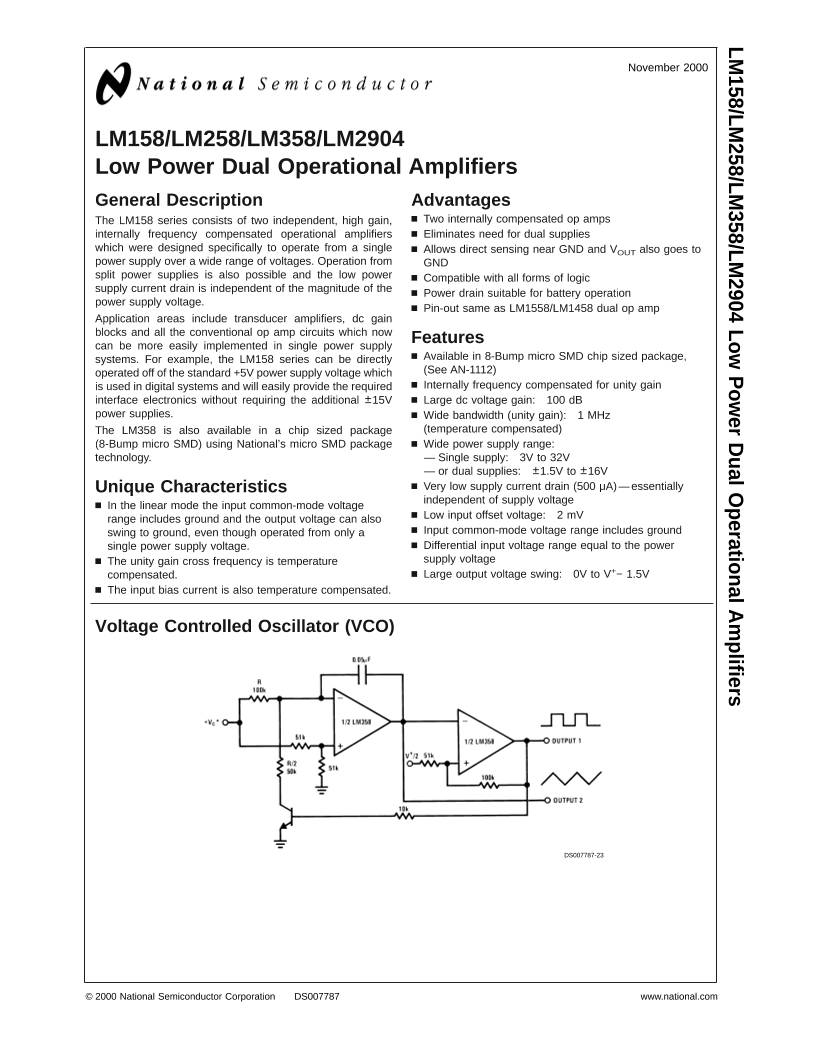
Voltage Controlled Oscillator (VCO)
DS007787-23
November 2000
LM
158/LM
258/LM
358/LM
2904
Low
P
ow
er
D
ualO
perationalA
m
plifiers
© 2000 National Semiconductor Corporation DS007787 www.national.com
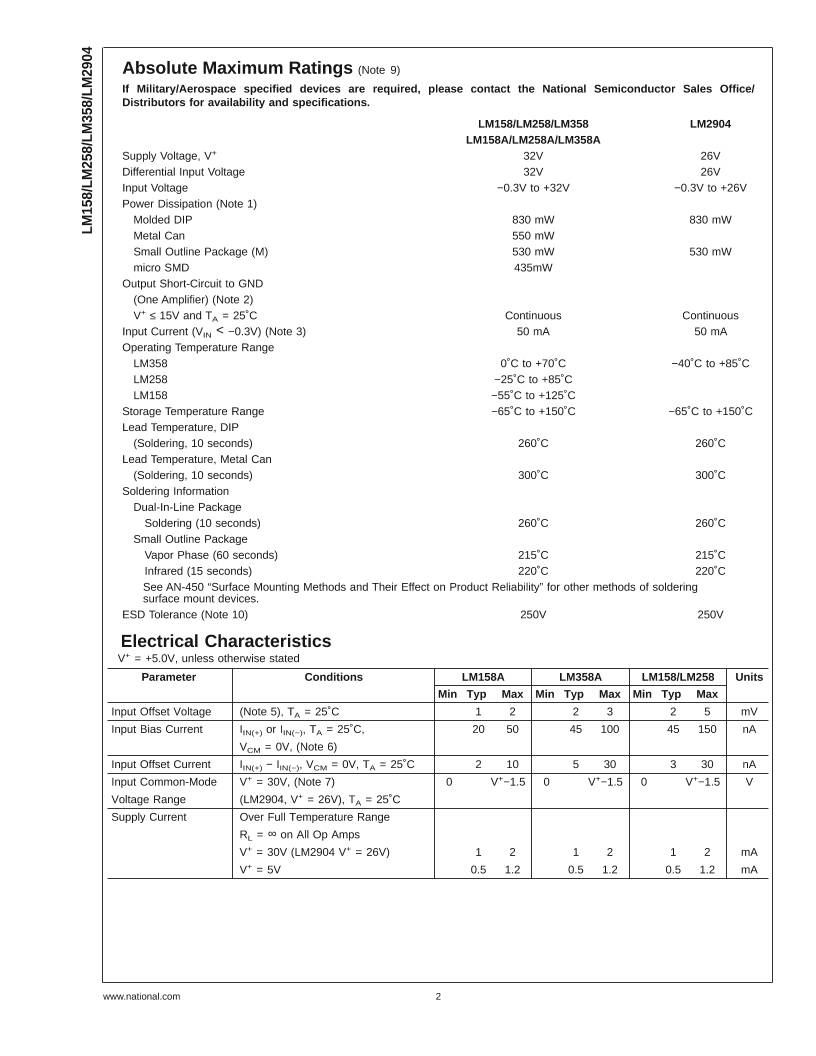
Absolute Maximum Ratings (Note 9)
If Military/Aerospace specified devices are required, please contact the National Semiconductor Sales Office/
Distributors for availability and specifications.
LM158/LM258/LM358 LM2904
LM158A/LM258A/LM358A
Supply Voltage, V+ 32V 26V
Differential Input Voltage 32V 26V
Input Voltage −0.3V to +32V −0.3V to +26V
Power Dissipation (Note 1)
Molded DIP 830 mW 830 mW
Metal Can 550 mW
Small Outline Package (M) 530 mW 530 mW
micro SMD 435mW
Output Short-Circuit to GND
(One Amplifier) (Note 2)
V+ ≤ 15V and TA = 25˚C Continuous Continuous
Input Current (VIN < −0.3V) (Note 3) 50 mA 50 mA
Operating Temperature Range
LM358 0˚C to +70˚C −40˚C to +85˚C
LM258 −25˚C to +85˚C
LM158 −55˚C to +125˚C
Storage Temperature Range −65˚C to +150˚C −65˚C to +150˚C
Lead Temperature, DIP
(Soldering, 10 seconds) 260˚C 260˚C
Lead Temperature, Metal Can
(Soldering, 10 seconds) 300˚C 300˚C
Soldering Information
Dual-In-Line Package
Soldering (10 seconds) 260˚C 260˚C
Small Outline Package
Vapor Phase (60 seconds) 215˚C 215˚C
Infrared (15 seconds) 220˚C 220˚C
See AN-450 “Surface Mounting Methods and Their Effect on Product Reliability” for other methods of soldering
surface mount devices.
ESD Tolerance (Note 10) 250V 250V
Electrical Characteristics
V+ = +5.0V, unless otherwise stated
Parameter Conditions LM158A LM358A LM158/LM258 Units
Min Typ Max Min Typ Max Min Typ Max
Input Offset Voltage (Note 5), TA = 25˚C 1 2 2 3 2 5 mV
Input Bias Current IIN(+) or IIN(−), TA = 25˚C, 20 50 45 100 45 150 nA
VCM = 0V, (Note 6)
Input Offset Current IIN(+) − IIN(−), VCM = 0V, TA = 25˚C 2 10 5 30 3 30 nA
Input Common-Mode V+ = 30V, (Note 7) 0 V+−1.5 0 V+−1.5 0 V+−1.5 V
Voltage Range (LM2904, V+ = 26V), TA = 25˚C
Supply Current Over Full Temperature Range
RL = ∞ on All Op Amps
V+ = 30V (LM2904 V+ = 26V) 1 2 1 2 1 2 mA
V+ = 5V 0.5 1.2 0.5 1.2 0.5 1.2 mA
LM
15
8/
LM
25
8/
LM
35
8/
LM
29
04
www.national.com 2
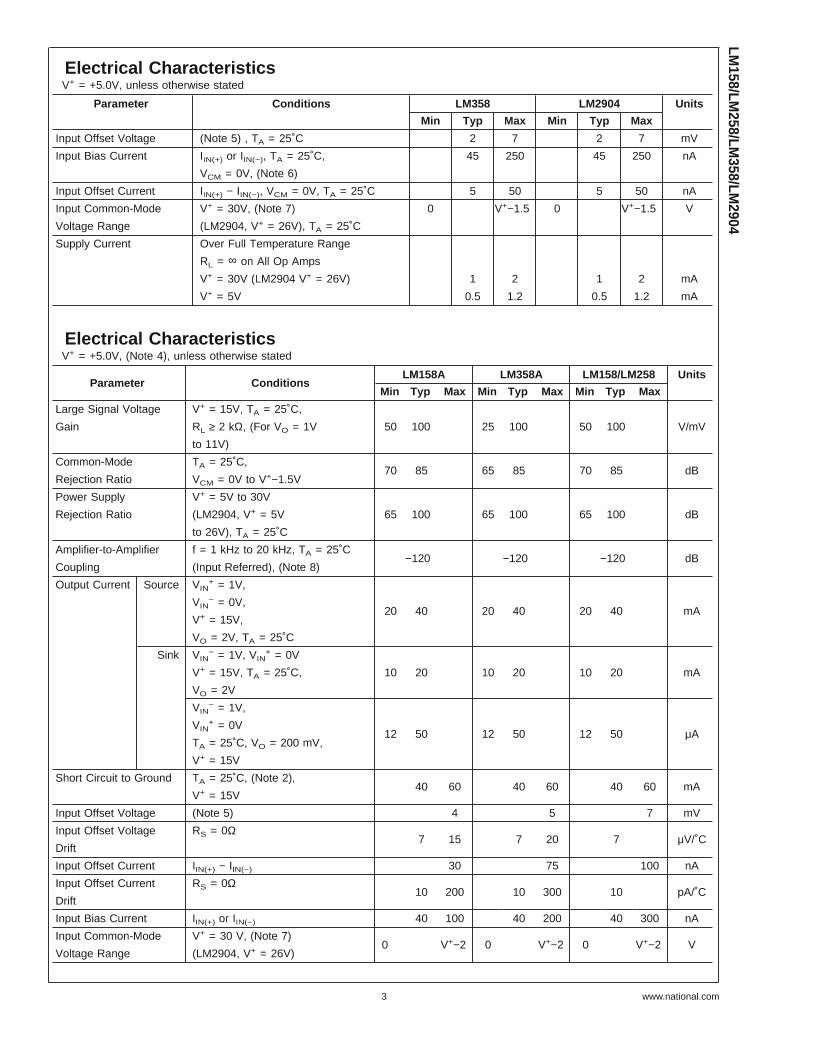
Electrical Characteristics
V+ = +5.0V, unless otherwise stated
Parameter Conditions LM358 LM2904 Units
Min Typ Max Min Typ Max
Input Offset Voltage (Note 5) , TA = 25˚C 2 7 2 7 mV
Input Bias Current IIN(+) or IIN(−), TA = 25˚C, 45 250 45 250 nA
VCM = 0V, (Note 6)
Input Offset Current IIN(+) − IIN(−), VCM = 0V, TA = 25˚C 5 50 5 50 nA
Input Common-Mode V+ = 30V, (Note 7) 0 V+−1.5 0 V+−1.5 V
Voltage Range (LM2904, V+ = 26V), TA = 25˚C
Supply Current Over Full Temperature Range
RL = ∞ on All Op Amps
V+ = 30V (LM2904 V+ = 26V) 1 2 1 2 mA
V+ = 5V 0.5 1.2 0.5 1.2 mA
Electrical Characteristics
V+ = +5.0V, (Note 4), unless otherwise stated
Parameter Conditions
LM158A LM358A LM158/LM258 Units
Min Typ Max Min Typ Max Min Typ Max
Large Signal Voltage V+ = 15V, TA = 25˚C,
Gain RL ≥ 2 kΩ, (For VO = 1V 50 100 25 100 50 100 V/mV
to 11V)
Common-Mode TA = 25˚C,
70 85 65 85 70 85 dB
Rejection Ratio VCM = 0V to V+−1.5V
Power Supply V+ = 5V to 30V
Rejection Ratio (LM2904, V+ = 5V 65 100 65 100 65 100 dB
to 26V), TA = 25˚C
Amplifier-to-Amplifier f = 1 kHz to 20 kHz, TA = 25˚C
−120 −120 −120 dB
Coupling (Input Referred), (Note 8)
Output Current Source VIN
+ = 1V,
20 40 20 40 20 40 mA
VIN
− = 0V,
V+ = 15V,
VO = 2V, TA = 25˚C
Sink VIN
− = 1V, VIN
+ = 0V
V+ = 15V, TA = 25˚C, 10 20 10 20 10 20 mA
VO = 2V
VIN
− = 1V,
12 50 12 50 12 50 µA
VIN
+ = 0V
TA = 25˚C, VO = 200 mV,
V+ = 15V
Short Circuit to Ground TA = 25˚C, (Note 2),
40 60 40 60 40 60 mA
V+ = 15V
Input Offset Voltage (Note 5) 4 5 7 mV
Input Offset Voltage RS = 0Ω
7 15 7 20 7 µV/˚C
Drift
Input Offset Current IIN(+) − IIN(−) 30 75 100 nA
Input Offset Current RS = 0Ω
10 200 10 300 10 pA/˚C
Drift
Input Bias Current IIN(+) or IIN(−) 40 100 40 200 40 300 nA
Input Common-Mode V+ = 30 V, (Note 7)
0 V+−2 0 V+−2 0 V+−2 V
Voltage Range (LM2904, V+ = 26V)
LM
158/LM
258/LM
358/LM
2904
www.national.com3
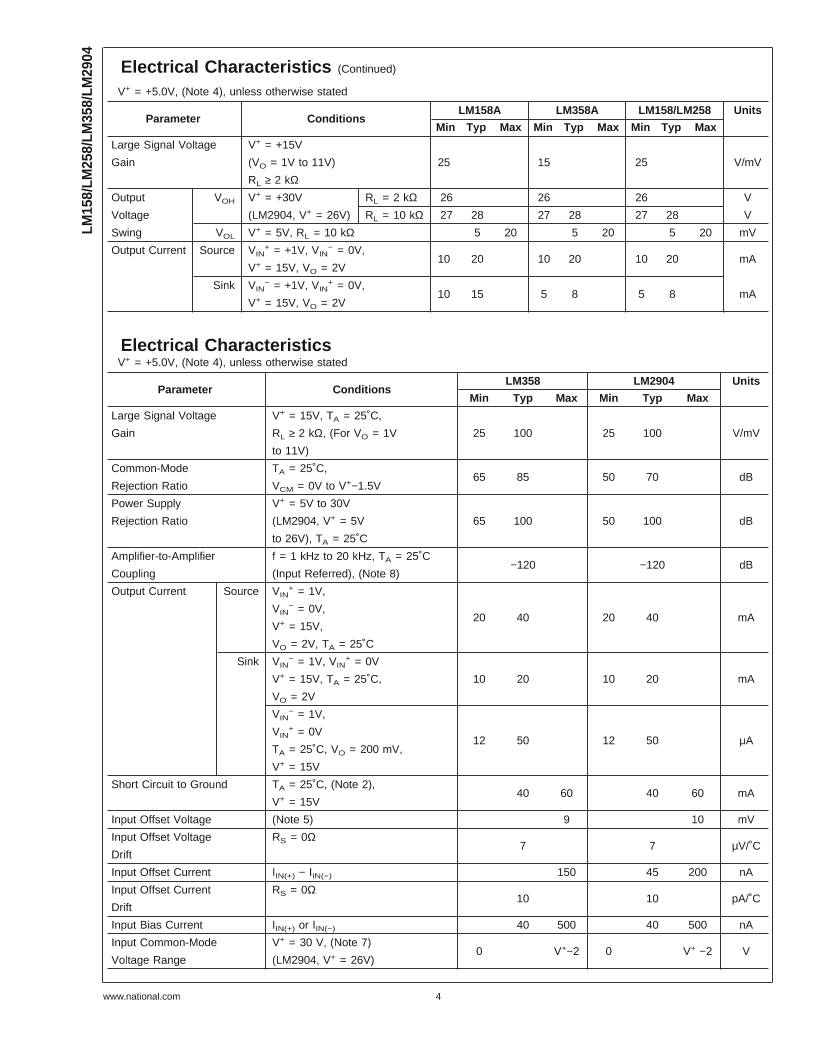
Electrical Characteristics (Continued)
V+ = +5.0V, (Note 4), unless otherwise stated
Parameter Conditions
LM158A LM358A LM158/LM258 Units
Min Typ Max Min Typ Max Min Typ Max
Large Signal Voltage V+ = +15V
25 15 25 V/mVGain (VO = 1V to 11V)
RL ≥ 2 kΩ
Output VOH V+ = +30V RL = 2 kΩ 26 26 26 V
Voltage (LM2904, V+ = 26V) RL = 10 kΩ 27 28 27 28 27 28 V
Swing VOL V+ = 5V, RL = 10 kΩ 5 20 5 20 5 20 mV
Output Current Source VIN
+ = +1V, VIN
− = 0V,
10 20 10 20 10 20 mA
V+ = 15V, VO = 2V
Sink VIN
− = +1V, VIN
+ = 0V,
10 15 5 8 5 8 mA
V+ = 15V, VO = 2V
Electrical Characteristics
V+ = +5.0V, (Note 4), unless otherwise stated
Parameter Conditions
LM358 LM2904 Units
Min Typ Max Min Typ Max
Large Signal Voltage V+ = 15V, TA = 25˚C,
Gain RL ≥ 2 kΩ, (For VO = 1V 25 100 25 100 V/mV
to 11V)
Common-Mode TA = 25˚C,
65 85 50 70 dB
Rejection Ratio VCM = 0V to V+−1.5V
Power Supply V+ = 5V to 30V
Rejection Ratio (LM2904, V+ = 5V 65 100 50 100 dB
to 26V), TA = 25˚C
Amplifier-to-Amplifier f = 1 kHz to 20 kHz, TA = 25˚C
−120 −120 dB
Coupling (Input Referred), (Note 8)
Output Current Source VIN
+ = 1V,
20 40 20 40 mA
VIN
− = 0V,
V+ = 15V,
VO = 2V, TA = 25˚C
Sink VIN
− = 1V, VIN
+ = 0V
V+ = 15V, TA = 25˚C, 10 20 10 20 mA
VO = 2V
VIN
− = 1V,
12 50 12 50 µA
VIN
+ = 0V
TA = 25˚C, VO = 200 mV,
V+ = 15V
Short Circuit to Ground TA = 25˚C, (Note 2),
40 60 40 60 mA
V+ = 15V
Input Offset Voltage (Note 5) 9 10 mV
Input Offset Voltage RS = 0Ω
7 7 µV/˚C
Drift
Input Offset Current IIN(+) − IIN(−) 150 45 200 nA
Input Offset Current RS = 0Ω
10 10 pA/˚C
Drift
Input Bias Current IIN(+) or IIN(−) 40 500 40 500 nA
Input Common-Mode V+ = 30 V, (Note 7)
0 V+−2 0 V+ −2 V
Voltage Range (LM2904, V+ = 26V)
LM
15
8/
LM
25
8/
LM
35
8/
LM
29
04
www.national.com 4
Electrical Characteristics (Continued)
V+ = +5.0V, (Note 4), unless otherwise stated
Parameter Conditions
LM358 LM2904 Units
Min Typ Max Min Typ Max
Large Signal Voltage V+ = +15V
15 15 V/mVGain (VO = 1V to 11V)
RL ≥ 2 kΩ
Output VOH V+ = +30V RL = 2 kΩ 26 22 V
Voltage (LM2904, V+ = 26V) RL = 10 kΩ 27 28 23 24 V
Swing VOL V+ = 5V, RL = 10 kΩ 5 20 5 100 mV
Output Current Source VIN
+ = +1V, VIN
− = 0V,
10 20 10 20 mA
V+ = 15V, VO = 2V
Sink VIN
− = +1V, VIN
+ = 0V,
5 8 5 8 mA
V+ = 15V, VO = 2V
Note 1: For operating at high temperatures, the LM358/LM358A, LM2904 must be derated based on a +125˚C maximum junction temperature and a thermal
resistance of 120˚C/W for MDIP, 182˚C/W for Metal Can, 189˚C/W for Small Outline package, and 230˚C/W for micro SMD, which applies for the device soldered in
a printed circuit board, operating in a still air ambient. The LM258/LM258A and LM158/LM158A can be derated based on a +150˚C maximum junction temperature.
The dissipation is the total of both amplifiers — use external resistors, where possible, to allow the amplifier to saturate or to reduce the power which is dissipated
in the integrated circuit.
Note 2: Short circuits from the output to V+ can cause excessive heating and eventual destruction. When considering short cirucits to ground, the maximum output
current is approximately 40 mA independent of the magnitude of V+. At values of supply voltage in excess of +15V, continuous short-circuits can exceed the power
dissipation ratings and cause eventual destruction. Destructive dissipation can result from simultaneous shorts on all amplifiers.
Note 3: This input current will only exist when the voltage at any of the input leads is driven negative. It is due to the collector-base junction of the input PNP
transistors becoming forward biased and thereby acting as input diode clamps. In addition to this diode action, there is also lateral NPN parasitic transistor action on
the IC chip. This transistor action can cause the output voltages of the op amps to go to the V+voltage level (or to ground for a large overdrive) for the time duration
that an input is driven negative. This is not destructive and normal output states will re-establish when the input voltage, which was negative, again returns to a value
greater than −0.3V (at 25˚C).
Note 4: These specifications are limited to −55˚C ≤ TA ≤ +125˚C for the LM158/LM158A. With the LM258/LM258A, all temperature specifications are limited to −25˚C
≤ TA ≤ +85˚C, the LM358/LM358A temperature specifications are limited to 0˚C ≤ TA ≤ +70˚C, and the LM2904 specifications are limited to −40˚C ≤ TA ≤ +85˚C.
Note 5: VO . 1.4V, RS = 0Ω with V+ from 5V to 30V; and over the full input common-mode range (0V to V+ −1.5V) at 25˚C. For LM2904, V+ from 5V to 26V.
Note 6: The direction of the input current is out of the IC due to the PNP input stage. This current is essentially constant, independent of the state of the output so
no loading change exists on the input lines.
Note 7: The input common-mode voltage of either input signal voltage should not be allowed to go negative by more than 0.3V (at 25˚C). The upper end of the
common-mode voltage range is V+ −1.5V (at 25˚C), but either or both inputs can go to +32V without damage (+26V for LM2904), independent of the magnitude of
V+.
Note 8: Due to proximity of external components, insure that coupling is not originating via stray capacitance between these external parts. This typically can be
detected as this type of capacitance increases at higher frequencies.
Note 9: Refer to RETS158AX for LM158A military specifications and to RETS158X for LM158 military specifications.
Note 10: Human body model, 1.5 kΩ in series with 100 pF.
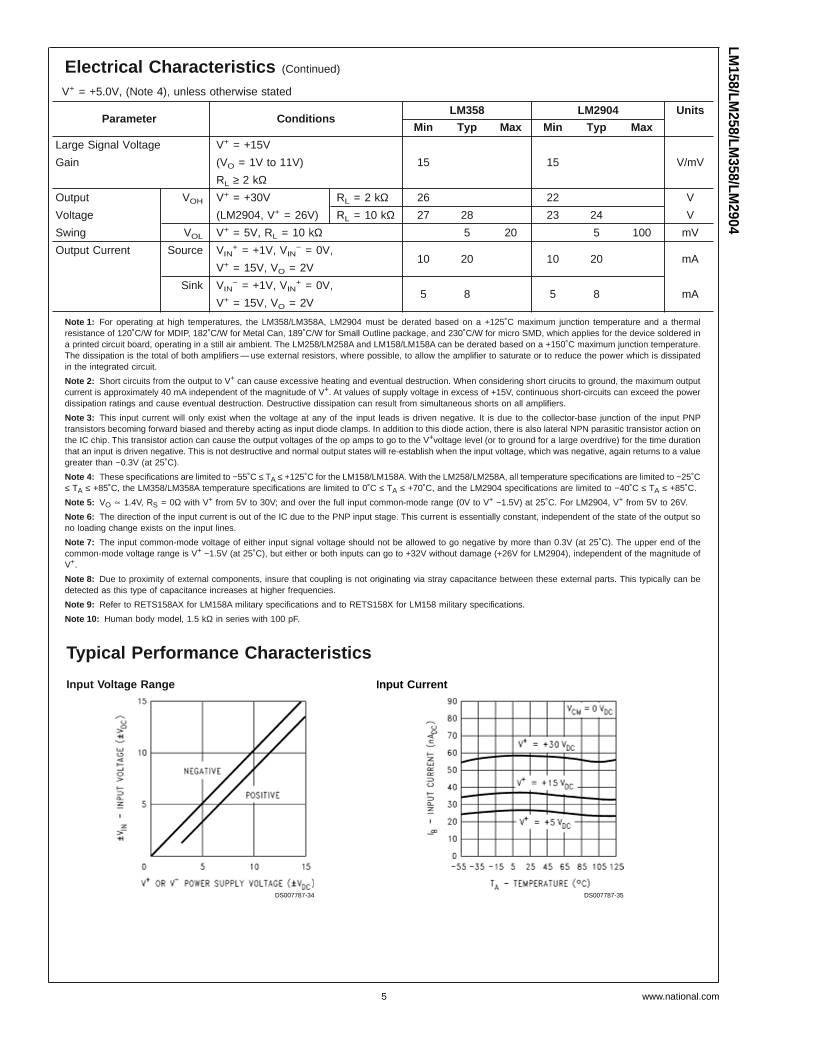
Typical Performance Characteristics
Input Voltage Range
DS007787-34
Input Current
DS007787-35
LM
158/LM
258/LM
358/LM
2904
www.national.com5
Typical Performance Characteristics (Continued)
Supply Current
DS007787-36
Voltage Gain
DS007787-37
Open Loop Frequency
Response
DS007787-38
Common-Mode
Rejection Ratio
DS007787-39
Voltage Follower Pulse
Response
DS007787-40
Voltage Follower Pulse
Response (Small Signal)
DS007787-41
LM
15
8/
LM
25
8/
LM
35
8/
LM
29
04
www.national.com 6
Typical Performance Characteristics (Continued)
Application Hints
The LM158 series are op amps which operate with only a
single power supply voltage, have true-differential inputs,
and remain in the linear mode with an input common-mode
voltage of 0 VDC. These amplifiers operate over a wide range
of power supply voltage with little change in performance
characteristics. At 25˚C amplifier operation is possible down
to a minimum supply voltage of 2.3 VDC.
Precautions should be taken to insure that the power supply
for the integrated circuit never becomes reversed in polarity
or that the unit is not inadvertently installed backwards in a
test socket as an unlimited current surge through the result-
ing forward diode within the IC could cause fusing of the
internal conductors and result in a destroyed unit.
Large differential input voltages can be easily accomodated
and, as input differential voltage protection diodes are not
needed, no large input currents result from large differential
input voltages. The differential input voltage may be larger
Large Signal Frequency
Response
DS007787-42
Output Characteristics
Current Sourcing
DS007787-43
Output Characteristics
Current Sinking
DS007787-44
Current Limiting
DS007787-45
Input Current (LM2902 only)
DS007787-46
Voltage Gain (LM2902 only)
DS007787-47
LM
158/LM
258/LM
358/LM
2904
www.national.com7
Application Hints (Continued)
than V+ without damaging the device. Protection should be
provided to prevent the input voltages from going negative
more than −0.3 VDC (at 25˚C). An input clamp diode with a
resistor to the IC input terminal can be used.
To reduce the power supply current drain, the amplifiers
have a class A output stage for small signal levels which
converts to class B in a large signal mode. This allows the
amplifiers to both source and sink large output currents.
Therefore both NPN and PNP external current boost transis-
tors can be used to extend the power capability of the basic
amplifiers. The output voltage needs to raise approximately
1 diode drop above ground to bias the on-chip vertical PNP
transistor for output current sinking applications.
For ac applications, where the load is capacitively coupled to
the output of the amplifier, a resistor should be used, from
the output of the amplifier to ground to increase the class A
bias current and prevent crossover distortion. Where the
load is directly coupled, as in dc applications, there is no
crossover distortion.
Capacitive loads which are applied directly to the output of
the amplifier reduce the loop stability margin. Values of 50
pF can be accomodated using the worst-case non-inverting
unity gain connection. Large closed loop gains or resistive
isolation should be used if larger load capacitance must be
driven by the amplifier.
The bias network of the LM158 establishes a drain current
which is independent of the magnitude of the power supply
voltage over the range of 3 VDC to 30 VDC.
Output short circuits either to ground or to the positive power
supply should be of short time duration. Units can be de-
stroyed, not as a result of the short circuit current causing
metal fusing, but rather due to the large increase in IC chip
dissipation which will cause eventual failure due to exces-
sive function temperatures. Putting direct short-circuits on
more than one amplifier at a time will increase the total IC
power dissipation to destructive levels, if not properly pro-
tected with external dissipation limiting resistors in series
with the output leads of the amplifiers. The larger value of
output source current which is available at 25˚C provides a
larger output current capability at elevated temperatures
(see typical performance characteristics) than a standard IC
op amp.
The circuits presented in the section on typical applications
emphasize operation on only a single power supply voltage.
If complementary power supplies are available, all of the
standard op amp circuits can be used. In general, introduc-
ing a pseudo-ground (a bias voltage reference of V+/2) will
allow operation above and below this value in single power
supply systems. Many application circuits are shown which
take advantage of the wide input common-mode voltage
range which includes ground. In most cases, input biasing is
not required and input voltages which range to ground can
easily be accommodated.
Connection Diagrams
8-Bump micro SMD
DS007787-55
Top View
(Bump Side Down)
micro SMD Marking Orientation
DS007787-56
Bumps are numbered counter-clockwise.
Top View
Metal Can Package
DS007787-1
Top View
LM
15
8/
LM
25
8/
LM
35
8/
LM
29
04
www.national.com 8
Connection Diagrams (Continued)
Ordering Information
Package
Temperature Range
NSC Drawing
−55˚C to 125˚C −25˚C to 85˚C 0˚C to 70˚C −40˚C to 85˚C
SO-8 LM358AM
LM358AMX
LM358M
LM358MX
LM2904M
M08A
8-Pin Molded
DIP
LM358AN
LM358N
LM2904N
N08E
8-Pin Ceramic
DIP
LM158AJ/883(Note 11)
LM158J/883(Note 11)
LM158J
LM158AJLQML(Note 12)
LM158AJQMLV(Note 12)
J08A
TO-5, 8-Pin
Metal Can
LM158AH/883(Note 11)
LM158H/883(Note 11)
LM158AH
LM158H
LM158AHLQML(Note 12)
LM158AHLQMLV(Note
12)
LM258H LM358H
H08C
8-Bump micro
SMD
LM358BP
LM358BPX
BPA08AAB
Note 11: LM158 is available per SMD #5962-8771001
LM158A is available per SMD #5962-8771002
Note 12: See STD Mil DWG 5962L87710 for Radiation Tolerant Devices
DIP/SO Package
DS007787-2
Top View
LM
158/LM
258/LM
358/LM
2904
www.national.com9
Typical Single-Supply Applications (V+ = 5.0 VDC)
Non-Inverting DC Gain (0V Output)
DS007787-6
*R not needed due to temperature independent IIN
DS007787-7
DC Summing Amplifier
(VIN’S ≥ 0 VDC and VO ≥ 0 VDC)
DS007787-8
Where: VO = V1 + V2 + V3 + V4
(V1 + V2) ≥ (V3 + V4) to keep VO > 0 VDC
Power Amplifier
DS007787-9
VO = 0 VDC for VIN = 0 VDC
AV = 10
LM
15
8/
LM
25
8/
LM
35
8/
LM
29
04
www.national.com 10
Typical Single-Supply Applications (V+ = 5.0 VDC) (Continued)
“BI-QUAD” RC Active Bandpass Filter
DS007787-10
fo = 1 kHz
Q = 50
Av = 100 (40 dB)
Fixed Current Sources
DS007787-11
Lamp Driver
DS007787-12
LM
158/LM
258/LM
358/LM
2904
www.national.com11
Typical Single-Supply Applications (V+ = 5.0 VDC) (Continued)
LED Driver
DS007787-13
Current Monitor
DS007787-14
*(Increase R1 for IL small)
VL ≤ V+ −2V
Driving TTL
DS007787-15
Voltage Follower
DS007787-17
VO = VIN
Pulse Generator
DS007787-16
LM
15
8/
LM
25
8/
LM
35
8/
LM
29
04
www.national.com 12
Typical Single-Supply Applications (V+ = 5.0 VDC) (Continued)
Squarewave Oscillator
DS007787-18
Pulse Generator
DS007787-19
Low Drift Peak Detector
DS007787-20
HIGH ZIN
LOW ZOUT
LM
158/LM
258/LM
358/LM
2904
www.national.com13
Typical Single-Supply Applications (V+ = 5.0 VDC) (Continued)
High Compliance Current Sink
DS007787-21
IO = 1 amp/volt VIN
(Increase RE for IO small)
Comparator with Hysteresis
DS007787-22
Voltage Controlled Oscillator (VCO)
DS007787-23
*WIDE CONTROL VOLTAGE RANGE: 0 VDC ≤ VC ≤ 2 (V+ −1.5V DC)
LM
15
8/
LM
25
8/
LM
35
8/
LM
29
04
www.national.com 14
Typical Single-Supply Applications (V+ = 5.0 VDC) (Continued)
AC Coupled Inverting Amplifier
DS007787-24
Ground Referencing a Differential Input Signal
DS007787-25
LM
158/LM
258/LM
358/LM
2904
www.national.com15
Typical Single-Supply Applications (V+ = 5.0 VDC) (Continued)
AC Coupled Non-Inverting Amplifier
DS007787-26
Av = 11 (As Shown)
DC Coupled Low-Pass RC Active Filter
DS007787-27
fo = 1 kHz
Q = 1
AV = 2
LM
15
8/
LM
25
8/
LM
35
8/
LM
29
04
www.national.com 16
Typical Single-Supply Applications (V+ = 5.0 VDC) (Continued)
Bandpass Active Filter
DS007787-28
fo = 1 kHz
Q = 25
High Input Z, DC Differential Amplifier
DS007787-29
LM
158/LM
258/LM
358/LM
2904
www.national.com17
Typical Single-Supply Applications (V+ = 5.0 VDC) (Continued)
Photo Voltaic-Cell Amplifier
DS007787-30
Bridge Current Amplifier
DS007787-33
High Input Z Adjustable-Gain
DC Instrumentation Amplifier
DS007787-31
LM
15
8/
LM
25
8/
LM
35
8/
LM
29
04
www.national.com 18
Typical Single-Supply Applications (V+ = 5.0 VDC) (Continued)
Schematic Diagram (Each Amplifier)
Using Symmetrical Amplifiers to
Reduce Input Current (General Concept)
DS007787-32
DS007787-3
LM
158/LM
258/LM
358/LM
2904
www.national.com19
Physical Dimensions inches (millimeters) unless otherwise noted
Metal Can Package (H)
Order Number LM158AH, LM158AH/883, LM158H,
LM158H/883, LM258H or LM358H
NS Package Number H08C
Cerdip Package (J)
Order Number LM158J, LM158J/883, LM158AJ or LM158AJ/883
NS Package Number J08A
LM
15
8/
LM
25
8/
LM
35
8/
LM
29
04
www.national.com 20
Physical Dimensions inches (millimeters) unless otherwise noted (Continued)
S.O. Package (M)
Order Number LM358M, LM358AM or LM2904M
NS Package Number M08A
LM
158/LM
258/LM
358/LM
2904
www.national.com21
Physical Dimensions inches (millimeters) unless otherwise noted (Continued)
Molded Dip Package (N)
Order Number LM358AN, LM358N or LM2904N
NS Package Number N08E
Order Number LM158AWG/883
NS Package Number W14B
LM
15
8/
LM
25
8/
LM
35
8/
LM
29
04
www.national.com 22
Physical Dimensions inches (millimeters) unless otherwise noted (Continued)
NOTES: UNLESS OTHERWISE SPECIFIED
1. EPOXY COATING
2. 63Sn/37Pb EUTECTIC BUMP
3. RECOMMEND NON-SOLDER MASK DEFINED LANDING PAD.
4. PIN 1 IS ESTABLISHED BY LOWER LEFT CORNER WITH RESPECT TO TEXT ORIENTATION REMAINING PINS ARE
NUMBERED COUNTERCLOCKWISE.
5. XXX IN DRAWING NUMBER REPRESENTS PACKAGE SIZE VARIATION WHERE X1 IS PACKAGE WIDTH, X2 IS
PACKAGE LENGTH AND X3 IS PACKAGE HEIGHT.
6. REFERENCE JEDEC REGISTRATION MO-211, VARIATION BC.
8-Bump micro SMD
NS Package Number BPA08AAB
X1 = 1.285 X2 = 1.285 X3 = 0.850
LM
158/LM
258/LM
358/LM
2904
www.national.com23
Notes
LIFE SUPPORT POLICY
NATIONAL’S PRODUCTS ARE NOT AUTHORIZED FOR USE AS CRITICAL COMPONENTS IN LIFE SUPPORT
DEVICES OR SYSTEMS WITHOUT THE EXPRESS WRITTEN APPROVAL OF THE PRESIDENT AND GENERAL
COUNSEL OF NATIONAL SEMICONDUCTOR CORPORATION. As used herein:
1. Life support devices or systems are devices or
systems which, (a) are intended for surgical implant
into the body, or (b) support or sustain life, and
whose failure to perform when properly used in
accordance with instructions for use provided in the
labeling, can be reasonably expected to result in a
significant injury to the user.
2. A critical component is any component of a life
support device or system whose failure to perform
can be reasonably expected to cause the failure of
the life support device or system, or to affect its
safety or effectiveness.
National Semiconductor
Corporation
Americas
Tel: 1-800-272-9959
Fax: 1-800-737-7018
Email: support@nsc.com
National Semiconductor
Europe
Fax: +49 (0) 180-530 85 86
Email: europe.support@nsc.com
Deutsch Tel: +49 (0) 69 9508 6208
English Tel: +44 (0) 870 24 0 2171
Français Tel: +33 (0) 1 41 91 8790
National Semiconductor
Asia Pacific Customer
Response Group
Tel: 65-2544466
Fax: 65-2504466
Email: ap.support@nsc.com
National Semiconductor
Japan Ltd.
Tel: 81-3-5639-7560
Fax: 81-3-5639-7507
www.national.com
LM
15
8/
LM
25
8/
LM
35
8/
LM
29
04
Lo
w
P
ow
er
D
ua
lO
pe
ra
tio
na
lA
m
pl
ifi
er
s
National does not assume any responsibility for use of any circuitry described, no circuit patent licenses are implied and National reserves the right at any time without notice to change said circuitry and specifications.


 设备数据采集
 工程招标采购
 搞笑表情
搞笑表情 微信头像
微信头像 CWMS冷库管理系统
 美女图片
美女图片 APP小游戏
 PPT模板
PPT模板 WMS仓库系统
 软件开发
软件开发