概要信息:
WetFeet has earned a strong reputation among college gradu-
ates and career professionals for its series of  highly credible,
no-holds-barred Insider Guides. WetFeet’s investigative writers
get behind the annual reports and corporate PR to tell the real
story of  what it’s like to work at specific companies and in
different industries. www.WetFeet.com
Careers/Job Search
WetFeet Insider Guide
Killer Consulting Resumes!
2nd Edition
K
ille
r C
o
n
s
u
ltin
g
 R
e
s
u
m
e
s
!
Just 30 seconds. On average, that’s how long a consulting recruiter spends on your
resume before deciding whether to skip it or consider you for an interview. Because even though your
resume will not get you a consulting job, it is essential to getting your foot in the door of  a top firm
and putting your candidacy into serious consideration. That’s why your resume must convincingly
present your consulting skills and capabilities. This Insider Guide will show you how to do just that,
even if  you don’t have any consulting experience.
Turn to this WetFeet Insider Guide to explore
•  How resumes are used in the consulting recruiting process.
•  How cover letters are used in the recruiting process.
•  Insider tips for resume content and format.
•  What consulting recruiters look for when reviewing a resume.
•  How to improve the quality and marketability of  your resume.
•  About buzzword bozos, or the quickest line between your resume and the trash can.
•  Reviews and rewrites of  resumes and cover letters from real consulting hopefuls.
 W
e
tF
e
e
t In
sid
e
r G
u
id
e
The WetFeet Research Methodology
You hold in your hands a copy of  the best-quality research available for job seekers. We have
designed this Insider Guide to save you time doing your job research and to provide highly
accurate information written precisely for the needs of  the job-seeking public. (We also hope
that you’ll enjoy reading it, because, believe it or not, the job search doesn’t have to be a pain
in the neck.)
Each WetFeet Insider Guide represents hundreds of  hours of  careful research and writing. We
start with a review of  the public information available. (Our writers are also experts in reading
between the lines.) We augment this information with dozens of  in-depth interviews of  people
who actually work for each company or industry we cover. And, although we keep the identity of
the rank-and-file employees anonymous to encourage candor, we also interview the company’s
recruiting staff  extensively, to make sure that we give you, the reader, accurate information about
recruiting, process, compensation, hiring targets, and so on. (WetFeet retains all editorial control
of  the product.) We also regularly survey our members and customers to learn about their
experiences in the recruiting process. Finally, each Insider Guide goes through an editorial review
and fact-checking process to make sure that the information and writing live up to our exacting
standards before it goes out the door.
Are we perfect? No—but we do believe that you’ll find our content to be the highest-quality
content of  its type available on the Web or in print. (Please see our guarantee below.) We also are
eager to hear about your experiences on the recruiting front and your feedback (both positive and
negative) about our products and our process. Thank you for your interest.
The WetFeet Guarantee
You’ve got enough to worry about with your job search. So, if  you don’t like this Insider Guide,
send it back within 30 days of  purchase and we’ll refund your money. Contact us at
1-800-926-4JOB or www.wetfeet.com/about/contactus.asp.
Who We Are
WetFeet is the trusted destination for job seekers to research companies and industries, and
manage their careers. WetFeet Insider Guides provide you with inside information for a successful
job search. At WetFeet, we do the work for you and present our results in an informative, credible,
and entertaining way. Think of  us as your own private research company whose primary mission
is to assist you in making more informed career decisions.
WetFeet was founded in 1994 by Stanford MBAs Gary Alpert and Steve Pollock. While exploring
our next career moves, we needed products like the WetFeet Insider Guides to help us through the
research and interviewing game. But they didn’t exist. So we started writing. Today, WetFeet serves
more than a million job candidates each month by helping them nail their interviews, avoid ill-
fated career decisions, and add thousands of  dollars to their compensation packages. The quality
of  our work and knowledge of  the job-seeking world have also allowed us to develop an extensive
corporate and university membership.
In addition, WetFeet’s services include two award-winning websites (WetFeet.com and
InternshipPrograms.com), Web-based recruiting technologies, consulting services, and our
exclusive research studies, such as the annual WetFeet Student Recruitment Survey. Our team
members, who come from diverse backgrounds, share a passion about the job-search process and
a commitment to delivering the highest quality products and customer service.
About Our Name
One of  the most frequent questions we receive is, “So, what’s the story behind your name?” The
short story is that the inspiration for our name comes from a popular business school case study
about L.L. Bean, the successful mail-order company. Leon Leonwood Bean got his start because
he quite simply, and very literally, had a case of  wet feet. Every time he went hunting in the Maine
woods, his shoes leaked, and he returned with soaked feet. So, one day, he decided to make a
better hunting shoe. And he did. And he told his friends, and they lined up to buy their own pairs
of  Bean boots. And L.L. Bean, the company, was born . . . all because a man who had wet feet
decided to make boots.
The lesson we took from the Bean case? Lots of  people get wet feet, but entrepreneurs make
boots. And that’s exactly what we’re doing at WetFeet.
Ins
ide
rG
uid
e
Killer Consulting
Resumes!
2nd Edition
Helping you make smarter career decisions.
WetFeet, Inc.
The Folger Building
101 Howard Street, Suite 300
San Francisco, CA 94105
Phone: (415) 284-7900 or 1-800-926-4JOB
Fax: (415) 284-7910
Website: www.WetFeet.com
Killer Consulting Resumes!
2nd Edition
ISBN: 1-58207-460-7
Photocopying Is Prohibited
Copyright 2005 WetFeet, Inc. All rights reserved. This publication is protected by the
copyright laws of the United States of America. No copying in any form is permitted.
It may not be reproduced, distributed, stored in a retrieval system, or transmitted in any
form or by any means, in part or in whole, without the express written permission of
WetFeet, Inc.
The publisher, author, and any other party involved in creation, production, delivery, or
sale of this WetFeet Insider Guide make no warranty, express or implied, about the
accuracy or reliability of the information found herein. To the degree you use this guide
or other materials referenced herein, you do so at your own risk. The materials con-
tained herein are general in nature and may not apply to particular factual or legal
circumstances. Under no circumstances shall the publisher, author, or any other party
involved in creation, production or delivery of this guide be liable to you or any other
person for damages of any kind arising from access to, or use of, its content.
Table of Contents
Consulting Resumes at a Glance . . . . . . . . . . . . . . . . . . . . . . . . . . . . . . . . . . . . . . . . 1
Overview . . . . . . . . . . . . . . . . . . . . . . . . . . . . . . . . . . . . . . . . . . . . . . . . . . . . . . . . . . 3
The Bottom Line . . . . . . . . . . . . . . . . . . . . . . . . . . . . . . . . . . . . . . . . . . . . . . . . . . . . 5
Firm’s Eye View. . . . . . . . . . . . . . . . . . . . . . . . . . . . . . . . . . . . . . . . . . . . . . . . . . . . . 7
Cover Letters Covered . . . . . . . . . . . . . . . . . . . . . . . . . . . . . . . . . . . . . . . . . . . . . . . 11
Anatomy of a Resume . . . . . . . . . . . . . . . . . . . . . . . . . . . . . . . . . . . . . . . . . . . . . . . 15
Study Break . . . . . . . . . . . . . . . . . . . . . . . . . . . . . . . . . . . . . . . . . . . . . . . . . . . . . . . 33
The Consultant’s Perspective . . . . . . . . . . . . . . . . . . . . . . . . . . . . . . . . . . . . . . . . . . 35
Preparing to Write . . . . . . . . . . . . . . . . . . . . . . . . . . . . . . . . . . . . . . . . . . . . . . . . . . 39
Basic Resume Don’ts and Dos. . . . . . . . . . . . . . . . . . . . . . . . . . . . . . . . . . . . . . . . . 53
Resumes Reviewed. . . . . . . . . . . . . . . . . . . . . . . . . . . . . . . . . . . . . . . . . . . . . . . . . . 65
Cover Letters Reviewed . . . . . . . . . . . . . . . . . . . . . . . . . . . . . . . . . . . . . . . . . . . . . 101
Cover Letter and Resume Pairs . . . . . . . . . . . . . . . . . . . . . . . . . . . . . . . . . . . . . . . 111
Getting Your Foot in the Door . . . . . . . . . . . . . . . . . . . . . . . . . . . . . . . . . . . . . . . 117
Following Up . . . . . . . . . . . . . . . . . . . . . . . . . . . . . . . . . . . . . . . . . . . . . . . . . . . . . 121
Interview Prep . . . . . . . . . . . . . . . . . . . . . . . . . . . . . . . . . . . . . . . . . . . . . . . . . . . . 125
Next Steps . . . . . . . . . . . . . . . . . . . . . . . . . . . . . . . . . . . . . . . . . . . . . . . . . . . . . . . 129
Additional Resources . . . . . . . . . . . . . . . . . . . . . . . . . . . . . . . . . . . . . . . . . . . . . . . 133

Consulting Resumes
at a Glance
The Resume’s Raison d’Etre
• 30 seconds or less to get you to the interview room—or not
• Guide for subsequent discussion in your interview
• Will NOT get you a job
Cover Letters
• Do not play a major role
• Could get you disqualified from consideration
Anatomy of the Resume
• Content: Education, Experience, Other
• Format: think clean, clear, conservative
• Avoid: Career Objective, skills resumes, colored paper
The Big Four Characteristics Sought by Consultants
• Analytical ability
• Intellect
• Leadership potential
• Achievement/results
Telling Your Story
Think about things you’ve done that demonstrate the Big Four—remember, it
doesn’t have to have been in a consulting context.
1

Overview
You’re dying to get an interview with Monitor, McKinsey, Mercer. The deadline
to submit your materials is only days away. You know that hundreds of your
classmates are applying to get a spot on the same crowded interview schedule.
Palatino, Times, Helvetica—bold, italic—nothing seems to make your resume
look any better. Worse, you know there’s no way you’ll be able to add another
extracurricular presidency to your list of “Other Activities” by next week. Even
you aren’t convinced that your resume is worth a second look. You start think-
ing about how to allocate your bid points and get not just one but several inter-
views with top firms. It’s a mathematical impossibility.
Well, maybe. But maybe not.
There’s no question that competition for jobs with the elite management con-
sulting firms is fierce. At leading business schools, at least 75 percent of students
interview with some of the big firms. However, it is not true that consulting
firms hire only people with 4.0 GPAs. Nor do they hire only people with consult-
ing experience. All the leading firms want to attract new blood. And they com-
pete intensely with each other to hire top candidates. If you really are interested
in a consulting job, you might as well be one of those under consideration.
In most cases, the first step along this path is to land an interview. And to land
a consulting interview you must have a resume—and it will need to be good.
Your resume must convincingly present your consulting skills and capabilities.
And this is possible regardless of whether you’ve already been a consultant. By
identifying and presenting your analytical, intellectual, and leadership capabilities
in a form that consultants can easily understand, you’ll undoubtedly improve
3
your chances of at least finding your way into
the interview process.
This Insider Guide is designed to help you do
the best possible job of presenting your
qualifications for a consulting position.
Although it won’t land you a job at a
prestigious firm—there’s a lot more to getting a job offer than sending in a
resume—it should give you insight into how the resume review process works
and what firms are seeking. At the very least it should help you avoid the
cardinal sin of selling yourself short. While there are countless resume-writing
guides on the market, we have yet to discover any that are geared specifically
toward management consulting. This publication is an exception. It is designed
to help college and graduate students (or anyone else pondering a career in
consulting) present themselves effectively to recruiters, resume readers, and
interviewers from the top management consulting firms in the United States.
We interviewed insiders from ten of the industry’s elite firms (including McKinsey,
Bain, Booz Allen, and Accenture) to find out exactly what they look for in resumes,
cover letters, and—down the line—interviews. Although there was some varia-
tion, the comments were remarkably consistent: As any good marketer knows,
packaging is often as important as content. In this Insider Guide, we show you
how to get a handle on both as you prepare to write your resume. We start by
looking at how firms view resumes (and cover letters). We continue with a
description of the standard consulting resume and suggestions about structure
and format, after which we tell you how to turn your experiences and education
into something that will appeal to the consulting resume reviewer. Then we
provide reviews of real resumes, along with suggestions for improvement. We
conclude with a discussion of how to move from the resume to the interview
room. After that, it’s up to you.
Are you ready to begin? Let’s dive in!
4
As any good marketer knows,
packaging is often as impor-
tant as content.
Insider Tip
The Bottom Line
Remember this: Your resume will not get you a consulting job. However it is
essential to getting your foot in the door of a top firm and putting your candi-
dacy into serious consideration. On average, the resume readers we interviewed
spend 30 seconds reviewing a resume the first time. In 30 seconds an excellent
resume conveys an image of who you are, what you’re capable of, and how you
have used your capabilities to accomplish results. It indicates that you know
yourself well and have a firm grasp of what you bring to the consulting table.
Although insiders tell us that “there isn’t one right answer” to the question of
how to create a good resume (good news for most of us!), they say the best
resumes are concise, results-oriented, and very clearly presented. The correct
structure can make you a more likely interview target and can even help you
sail more smoothly through the interview process. Through conversations with
insiders and reviews of resume books, we found that a lot of aspiring consult-
ants don’t understand this. We hope this guide will help you get ahead of them
in line.
5

Firm’s-Eye View
How Cover Letters Are Used
Whereas your resume will almost always accompany you through the interview
process, the cover letter is less important to your candidacy. Sometimes it is
attached to the resume when it’s forwarded, sometimes not.
Insiders overwhelmingly indicated that little, if any, attention is paid to cover
letters. Sometimes they’re read, sometimes not. Because of this, a cover letter is
almost more of a courtesy than a necessity (though we would not advise sub-
mitting a resume through the mail without attaching a cover letter). Those who
do read cover letters say they are useful to introduce a resume, highlight a few
relevant points, and explain why the person is interested in interviewing with a
particular firm. It seems cover letters are like standardized test scores: a bad one
(or lack of one) can hurt you, but a good one won’t necessarily help you. No
recruiter we spoke with could recall outstanding or memorable points mentioned
in a candidate’s cover letter.
That said, there are a few cases in which cover letters are more important than
indicated above. They are definitely more important when you send your resume
to a firm directly, instead of through a campus recruiting program. In such a
case the recipient might benefit from a brief introduction to you before scanning
your resume. Insiders also tell us that cover letters are used to assess candidates’
ability to write clearly and concisely. For example, candidates with a strong tech-
nical focus who might not be skilled writers and international candidates whose
first language is not English but who are seeking a position in the United States
undergo such scrutiny. When recruiters review resumes from career changers
7
looking to make a switch from industry to consulting, they often look to the
cover letter to understand the candidate’s interest in consulting and for evidence
of compelling skills that are readily transferable from the candidate’s prior
experience.
How Resumes Are Used
Having been intimately involved with your word-processing software over the
last several days, you have a pretty good understanding of what it takes to
produce a resume. But what happens to it after it leaves your hands? Our
consulting insiders tell us that your resume and cover letter have an important
but limited role in the selection and evaluation process.
From the firm’s point of view, the resume has one primary purpose: to help
determine which candidates merit interviews. No more, no less. A well-executed
resume will increase your chances of getting an interview. It won’t get you a job
offer. Secondarily, your resume will often serve as the basis for ongoing evaluation
of your candidacy. Each person who interviews you will probably have a copy
of your resume. Often the interviewer will also have a copy of the comments of
those who have already interviewed you. Your interviewer is likely to use the
resume to identify areas to explore during the interview. Weaknesses or holes
will be probed, strengths will be questioned, and anything that seems suspect
will definitely be tested.
Insiders stress that although the resume is just one piece of the puzzle, it is a
very important piece, for it is often the first impression you will make on a firm
and on those who will meet you for an interview. You owe it to yourself to put
your best foot forward.
Most firms recruit regionally and have recruiting teams in each of their offices
or regions to cover one or more schools. Recruiting teams are usually made up
of consultants from several levels (ranging from undergrad hires to partners or
8
VPs) as well as one or more administrative sup-
port staffers. At least one of the recruiters will
probably be a recent graduate of your school. This
helps the recruiting teams distinguish real and
inflated points on a resume and make informed
judgments of your credentials. For example, at one
school, being on the Dean’s list might mean you’re
in the top half of your class, while at another, that
distinction is reserved for only the top few
students. Such differences are important and will be
noted as your resume is reviewed. As one insider
puts it, “We know what’s what on the resumes.”
Your resume will likely be read by at least two consultants on the team who are
appointed to review independently submitted resumes and resume books from
target schools. These consultants select resumes that look promising based not
only on the firm’s criteria but also on their own judgment. We found no evidence
of official resume grading systems at many firms, but most reviewers do keep a
mental tally of so-called points or checks for each criterion the candidate appears
to meet on his or her resume.
The next step at many firms is for the recruiting team to discuss the top candi-
dates and decide who will receive interview offers. In these sessions the reviewer
might be asked to describe the candidate, tell his or her “story,” and explain
what is compelling about the candidate. In some cases, a senior consultant will
do a final resume review and make interview decisions, either after the group
discussion or in lieu of it.
Remember, consultants responsible for recruiting are usually busy juggling
client work, practice-development work, and several other projects. They tend
to review hundreds of resumes at a time and have very little time to spend on
each one. Knowing this will help you understand just how forgettable any single
resume can be—and just how compelling yours must be to stand out.
9
Consultants responsible for
recruiting are usually busy
juggling client work, practice-
development work, and
several other projects. They
tend to review hundreds of
resumes at a time and have
very little time to spend on
each one.
Insider Tip

Cover Letters Covered
In consulting recruiting, the cover letter is a little like the weather—it’s taken for
granted unless there’s a problem. With that in mind, we recommend a low-risk
strategy. The cover letter should be concise, well written, and at least somewhat
personalized (enough so that the recruiter won’t suspect that you’ve sent this
same cover letter to multiple recipients, changing only the names of the recruiter
and the company). Well-written cover letters establish a rapport with the reader
and convey an image of professionalism, interest, and enthusiasm.
While the cover letter (or cover message if you’re e-mailing) should be both
thoughtful and personalized, this is not the place to regurgitate your resume in
prose, nor is it the forum to explain the genesis of every academic or profes-
sional decision you’ve made to date. The purpose of the cover letter is to set
the stage for your resume, not to explain anything on it—or worse, repeat it.
At a minimum, your cover letter should indicate the position to which you’re
applying, the primary reason for your interest in the specific role at the company,
and a brief overview of the one or two qualifications that make you a compelling
candidate. Finally, the cover letter should suggest logical next steps (politely, and
never presumptuously), typically a brief telephone conversation or an in-person
meeting. By the time you’ve covered each of these points, you’ll probably have
reached the desired cover letter length: no more than one page in hard copy,
and no more than one screen shot if you’re sending your resume via e-mail. If
your message is polite, brief, well informed, and error-free, it will have served
its primary purpose.
Follow the guidelines here to ensure that your cover letter covers all your bases.
11
Namedrop
Address the cover message to a particular person by name, and indicate how
you have obtained that person’s contact information. If you have learned of the
position through a referral, mention the individual’s name early in the e-mail;
when a recruiter scans a cover message, he’s more likely to pause and review
your credentials if he recognizes a colleague’s name in the text. Among two or
more equally qualified candidates, most employers will prefer the candidate who
came into the organization via a referral from an existing employee over some-
one who responded blindly to an ad on a job posting website or (worse) through
an unsolicited resume.
Do Your Due Diligence
Before writing a cover letter to a firm, you should do some research on the
firm. Identify what about that organization specifically interests you. It may be
an industry or functional practice specialty, an article published by one of the
firm’s consultants, or a discussion with a current employee that generated your
interest in the company. It helps if the reasons you cite for your interest don’t
belie blatant plagiarism of the company’s website or word-for-word regurgitation
of the job description; a little judicious paraphrasing never hurt anyone, but the
obvious cut and paste ranks high among recruiters’ lists of pet peeves.
Whatever the case, make sure that what you write is accurate and shows that
you’ve done your homework. If you target BCG for its leadership in reengi-
neering or Monitor for its 80-year history, you’ll never make it into the reception
area. You may want to purchase our detailed Insider Guides on specific top-tier
firms or one of consulting guides. You can find a list of current titles on the
last 2 pages of this Insider Guide.
12
Answer the Question, “What’s in It for Me?”
The purpose of the cover letter is to communicate to the employer a specific
personal message about your potential value to that organization. While you
should include information on what specific factors have attracted you to the
company, make sure your approach is balanced and describes why the company
should be attracted to you. After all, your cover letter should suggest that hiring
you would be a mutually beneficial decision for you and the employer. Don’t
just talk about what the company can do for you: Explain what skills and
qualifications make you a compelling candidate.
Spotlight Your Strengths
The cover letter should include the reason you are interested in the firm and
the highlights of your resume that make you a good candidate for that firm. If
you have a nonbusiness background or are changing careers, you might briefly
explain why you are pursuing a career in consulting. If you have a contact at the
firm, mention that person. Better yet, send the resume directly to your contact
to forward to the recruiter.
E-Mail Takes Cover, Too
Put the same care into preparing your cover letter when submitting your resume
via e-mail. The ease and informality of e-mail can be deceptive and dangerous.
Your e-mail cover letter serves the same purpose as the hard-copy version. No
matter how brief your cover message, it has to be flawless. One insider recom-
mends that candidates complete the “To:” field last as they prepare a cover
message to introduce an e-mailed resume. This way, you’re covered if you acci-
dentally click “Send” before your message is ready. (This also applies to any
“CC:” addressees.) Many people learn this rule only through a painful experience.
“Ignore last message!” and “Oops!” e-mails are ineffective and can destroy your
credibility.
13
Don’t Be Presumptuous
Let’s paint a picture for you. It’s 10 a.m. on a Friday and the leader of your
University’s recruiting team—who just happens to be a consultant himself—
opens his e-mail inbox to find your cover letter and resume. He’s cranky—he’s
been on the road since Sunday night and didn’t get to bed until 3 a.m. because
of delays at LaGuardia. He’s counting on an easy day at the office so that he
can leave early and spend some quality time kicking a soccer ball around in the
backyard with Junior. He can smell the aroma of freshly cut grass when he
reads the end of your cover message: “I will call your office at 4 p.m. on Friday
to arrange a convenient time for a telephone interview.” He thinks to himself,
“Who does this kid thinks he is?” You could be Michael Porter himself, and
your resume might very well win a one-way ticket to the deleted items folder.
We’re all about suggesting next steps in your cover letter, but don’t assume that
you’re assured an interview or that you can elbow your way onto the recruiter’s
calendar at a time that’s convenient for you. In your cover letter, it’s much more
diplomatic to request (politely, we might add) a brief telephone conversation or
an in-person meeting rather than an interview. Furthermore, the stated purpose
of this meeting should be to learn more about the firm, the position, or how
the recruiter himself attained consulting fame and fortune through his raw intel-
lectual horsepower and business acumen—not how he can help you land a job.
14
Anatomy of a Resume
The first step in preparing your resume is to understand (and accept) the basic
rules, so that your presentation won’t get you thrown out of the game. There
are two areas in which you should conform to standard practice: packaging and
content. Resume readers prefer to focus more on content, but it is format that
enables them to pick out useful information quickly. To assure a good read,
both content and format must be in tip-top shape. We discuss each in greater
detail below, but as a general rule, these are not places to push the envelope.
Remember, resume readers work 60-hour weeks solving problems for Fortune
500 companies. Few of them will give you extra credit for using bright blue
paper or putting cartoons on your resume.
Resume Content
You need to customize your resume for consulting. If you are considering
several types of consulting firms, you may even want to customize it according
to the type of work the firm does, for example strategy vs. operations vs. tech-
nology (see WetFeet’s online consulting firm profiles at www.WetFeet.com).
We know that many candidates use the same resume for all inquiries, with a
customized cover letter. If you do this you risk looking amorphous, like a politi-
cian trying to appeal to a broad constituency. Don’t fall into this trap. If you
really want that consulting interview, take time to write a solid resume that’s
relevant to the type of consulting work you are pursuing.
The most important thing to do when writing your resume is to be concise.
One firm’s vice president tells us, “If you can’t reduce your resume to 1 page, I
immediately think you are unable to tell the important from the trivial, which is
a death sentence for a consultant.”
15
Your consulting resume should have two
sections: “Education” and “Experience.” An
“Other” section may be included if you have
useful information that doesn’t fit neatly into
“Education” or “Experience.” As for the
sequence, you should lead with your strength.
If you are a student, and particularly if you are
from a top-ranked school, you should lead
with “Education” unless you have outstanding experience that will better
distinguish you. Experienced professionals (those a few years or more out of
school) should always lead with and emphasize “Experience.” As your school
days become more distant, they become less relevant and firms become more
interested in your professional experience than in the fact that you were editor
of your school newspaper. The “Other” section should always be last.
Some resumes include “Career Objective,” “Career Summary,” or another gen-
eral overview section. This information is superfluous. If you think you need
to summarize your resume you have missed the mark. Remember, the resume
itself is a summary of your experience, skills, and accomplishments. As for the
“Career Objective,” this information should be included in your cover letter. It
is also self-evident: If you have sent your resume to a firm for consideration,
surely you’re looking for a job with that firm. The space would be better used
to describe your considerable assets.
Education
This section might be more aptly titled “Education and Academic Achievement.”
Information here should include schools attended, degrees conferred and when,
and other information regarding your academic achievement, including GPA,
SAT/GRE/GMAT scores, scholarships and awards earned, honor society
memberships, class ranking, and so on. List only those things that showcase
16
Resume readers prefer to
focus more on content, but it
is format that enables them to
pick out useful information
quickly.
Insider Tip
your strengths. A 3.5 GPA isn’t likely to impress anyone, nor is a 600 on the
GMAT. These are perfectly respectable statistics, but they aren’t going to wow
the reader, so you might as well save the space for other details.
Coming from a top-ranked school is helpful, but it will hardly qualify you as
unique at any of the best firms. One insider says, “If you’re not from a brand-
name school, most firms expect you to be in the top of the class.” Another
says, “The first thing that will cause me to throw out a resume is a second-rate
school.” When pressed, this insider defined a second-rate school as one not
within the “top 20,” which fortunately paves a fairly wide path among graduate
schools. While there is more leeway in the college ranks, the “top school” senti-
ment is echoed at most major firms as a quick and easy way to separate the
wheat from the chaff. If you’re from a less well-known institution, whether it’s
a college or a graduate school, be prepared to show your strengths in other
critical areas because your resume is likely to be a tougher sell.
Strong regional graduate schools are an exception to this philosophy. Since
most firms recruit regionally, there is a good chance they’ll go to a good local
school if they have an office in the area, particularly if alums from the school
work in that firm.
Experience
“The section on work experience should be short on description and long on
verifiable results,” says one insider. We couldn’t agree more. Think of this as the
results section, rather than the experience section, of your resume. You should
certainly mention the type of work you’ve done and the industries in which you have
experience, but all in the context of what you’ve accomplished. If you can quantify
the results of your work, you’ll be better off. This makes sense when you think of
the type of work consultants do. The best firms can point to the direct impact that
their work has on their clients’ bottom lines (those that can’t don’t survive long!).
17
To do this, they use measurement systems that
enable them and their clients to track progress
along the way. They want you to have done the
same for yourself and your career.
Consultants also care about the companies you’ve
worked for. Companies that are known to have
good training programs, such as General Electric
or Procter & Gamble, play well. In addition, companies that have notoriously
rigorous selection processes, such as certain investment banks or high-tech firms,
score big points. A measure of success at any of these companies is a plus,
because performing well for them indicates to the resume reader that you have
what it takes to survive in a competitive, rigorous environment of well-qualified
peers.
If your experience is in a nontraditional business area, such as the public sector,
nonprofit, or other nonbusiness, you’re going to have a tougher time. “I tend to
shy away from goofy backgrounds such as Mother Teresa’s nuns, Peace Corps,
or other areas with no direct business experience,” says one consultant. “My
assumption,” says another, “is that they can’t add value to the client if they
don’t know how business works, and we really don’t want to bill the clients to
give these people their first business experience.” Others said unusual backgrounds
were fine, as long as they revealed a record of accomplishment. “I remember
the resume of a person with an art-history major who had taken initiative and
started some programs at her school,” one recruiter said. “Although she didn’t
have a traditional background, her experience showed results.” Suffice it to say
that if your background isn’t obviously business-related you’ll need to be much
more specific about the results you have attained, and be clear about how such
achievements will enable you to excel as a consultant.
If you have a nontraditional background, you should also keep in mind that
individual firms have different levels of tolerance for and interest in attracting
18
The section on work
experience should
be short on descrip-
tion and long on
verifiable results.
“ ”
people from diverse backgrounds. To that end,
you’ll want to be sure to do your homework
on each firm’s hiring practices.
Other (or: Activities,
Additional Information, Personal)
This section is your opportunity to tell the
scanner a little more about yourself. Details
typically include activities, interests, associa-
tions, memberships, and skills not already
covered, such as proficiency in foreign
languages. Such areas of your life may be
relevant to how you will perform as a
consultant—and relevance is the key. Remember, consulting isn’t only about
crunching numbers and creating great PowerPoint presentations. You need
strong communication skills and the ability to tolerate various personalities,
ambiguity, and so on. For more of what appeals to consultants, see “Looking
for Ms. or Mr. Right.”
You can also use the “Other” section to mention activities that hint at gender,
race, religion, sexual orientation, and so on. Honestly, you may have a slight
advantage if your activities indicate that you fall into a group that the company
is trying to recruit. This is a touchy subject, but many firms are desperate to
recruit a varied workforce to serve an increasingly diverse clientele. We constantly
hear complaints from recruiters about how difficult it is to find diverse candi-
dates. Therefore, highlighting your diversity could help your candidacy.
At the same time, involvement in activities that could be viewed as controversial
could spell trouble. If you’ve championed your fervent political or religious
beliefs by leading campus protests or abortion rights marches, for example, you
may want to tone down (or omit) descriptions of these pursuits from your
19
One woman actually
wrote on her resume
that her favorite ice
cream flavor was
chocolate. She was
probably trying to
be cute and attract
attention, but we
definitely don’t need
those types on our
team.
“ ”
resume. While you may feel passionately about these activities, remember that
consulting firms prioritize your perceived cultural fit with the organization
when they’re making hiring decisions. At the resume review stage, you don’t
want to raise red flags that you might be a cultural mismatch at the firm by
describing your politically charged or potentially controversial activities early in
the process.
On the other hand, insiders tell us that interesting or unusual information in
this section can play a significant role in the decision to award an interview. “I
saw a woman’s resume with a blurb at the bottom on how she started an organ-
ization to educate the homeless in her city, and I thought, this is someone who
identifies problems and takes initiative to solve them. This is the type of person
we need on our projects,” says one consultant. However, we caution against
using this section for frivolous information. Many people we interviewed said
they had rejected otherwise decent resumes because of strange mentions in the
“Other” section. “One woman actually wrote on her resume that her favorite
ice cream flavor was chocolate,” a reviewer recalls. “She was probably trying to
be cute and attract attention, but we definitely don’t need those types on our
team. I felt no guilt in dinging her.”
While it probably won’t elicit such a strong reaction, including personal interests
that are fairly common (cooking, travel, jogging, and reading, e.g.) probably won’t
win you any points because they appear in resumes so frequently. Lines like
“traveled extensively through Europe” almost never achieve their desired effect
for the same reason. By no means would we suggest that you omit these perfectly
legitimate hobbies and experiences from your “Other” section, but if you’re
trying to choose which items to include in this section, include the ones that
are most likely to pique the genuine interest of the recruiter.
20
Resume Format
Consultants are sticklers about presentation.
Almost any consultant who has drawn a slide
can tell you a story about the time a client
pointed out a typo in a slide and used that as a
basis for criticizing several months’ worth of
solid research. With that in mind, stick with a
format that’s error-free, clean, and easy to read and that clearly shows the two
main sections: “Education” and “Experience.” Anything fancy is at best irrele-
vant, at worst a negative factor that can result in a rejection letter. Remember,
the format of your resume has one objective: to make your qualifications easy
to understand.
Conform to the Norm
Conforming to standard resume format is generally considered a good thing.
One recruiting head tells us, “I like the basic sections: ‘Education,’ ‘Experience,’
‘Interest.’ Dates on the left, body of text with bullet points, starting with verbs,
all the same tense. To the right of the company name, I like to see the location of
the company for which someone worked because I want to make sure they’re
interested in living/working here.”
A Word About Skills
Many resume books discuss the virtues of the skills-based resume format for
dressing up your experience, especially when you’ve had many positions or are
trying to change careers. We have one word about skills resumes: Fuggedabowdit!
None of our insiders like this alternative format. “I’m always suspicious when I
see a skills-based resume,” one tells us. “I feel like I have to make a leap of faith. I
prefer to see experience that illustrates skills I’m looking for.” Another consultant
is more direct. “I hate reading skills resumes,” he says. “Sometimes I don’t bother.”
21
I’m always suspi-
cious when I see a
skills-based resume.
I feel like I have to
make a leap of faith.
“ ”
Formatting Guidelines for Resumes and Cover Letters
While most resume reviewers don’t have a specific model in mind, all seem to
appreciate consistency. This generally means the following:
• A single, standard font: Times, Helvetica, or similar
• A readable font size: 11- or 12-point preferred, but no smaller than 10
• Neutral paper color: white or off-white
• Standard layout: 1-inch margins (or more), left justified, line spaces between
sections
• Clear resume organization: two or three sections labeled clearly, chronological
listing with dates on the left, bulleted points
• Clear letter organization: business format with one or two paragraphs,
addressee name, company name, and date at the top
This also means you should resist the temptation to use excessive text
formatting, graphics, or a matrix or graph. Such extras eat up space that could
22
With the market for e-business and IT consulting booming, many firms are likely to have
a better understanding of the type of work involved in scientific research and development
and will probably have consultants with similar backgrounds screen technical resumes.
This is good news for you science PhDs hoping to break into consulting. It means your
stellar research accomplishments won’t go unnoticed, and you might not have to explain
the significance of your discovery of microsecond time lags in X-ray binaries. It also
means that your resume, if written in a non-standard format, may be comprehensible to
at least a few reviewers. But why risk it? If your background appears focused in science
and technology, however, be prepared for quizzing about your people skills: leadership,
teamwork, communication.
A Note to Those with Technical and Scientific Backgrounds
be dedicated to providing evidence of your qualifications, getting you additional
checks or points, and helping you to land in the “call back” pile. Remember,
cuteness may be perceived as desperation. One insider tells us he’s suspicious of
resumes and cover letters that use attention-grabbing tactics. “Why are they so
worried their qualifications won’t stand out?” he asks.
You may want to use bullets. Why?
• Bullets make your resume more concise.
• Bullets make your resume easier to scan.
• Consultants love bullets; they write in bullets; they even think in bullets.
Insiders tell us that consultants are more likely to toss a resume into the ding
pile than to spend extra time plowing through turgid, clunky prose to find what
they’re looking for. “I’m impressed when someone has enough confidence to
write just one line followed by short bullet points,” one partner tells us. “I know
writers can bullshit their way through things by writing prose,” comments another.
When you write bullets, remember the following:
• Keep them short (one line if possible).
• Start them with action verbs.
• Make them consistent.
(Note: Consultants love horizontal page layouts, too, but we don’t recommend
that format for resumes yet.)
23
E-Mail and Online Submissions
Once you’ve crafted the perfect resume, be sure to save it in three electronic
versions:
1. Microsoft Word or other word-processing software document: This is your
presentation resume—the one with every formatting and stylistic bell and
whistle printed on good quality, heavy bond paper. This is the one that
you’ll send to recruiters via regular mail and the one you’ll take with you
when you interview. Keep several copies on hand.
2. ASCII format with line breaks: ASCII (American Standard Code of Inter-
change) allows databases and data recognition software to read your resume
without the confusion caused by formatting. Use this version to cut and
paste your document into the body of an e-mail message. In Microsoft
Word, use the “Save as” option to save your resume (named differently
from the first version) as plain text. Select the “Insert line breaks” checkbox.
3. ASCII format without line breaks: Use this to upload your resume to an
online database and to cut and paste into preset fields. Follow the directions
for number 2 above, but skip the last step.
Using ASCII versions will help you avoid formatting conflicts that can make
your document difficult to read. Unfortunately, in the ASCII versions you will
also lose the formatting you took great care to develop. To minimize the damage:
1. Replace bullets with asterisks (*).
2. Offset category headings with a row of tildes (~) or capital letters.
24
3. Change your margin settings to 2 inches; 60 characters (including spaces) is
the maximum line length. Setting a wider margin allows you to control
where the line breaks occur.
4. Select a fixed-width typeface like Courier and a 12-point font size.
5. Add white space for readability.
6. Do a test run. E-mail your resume to yourself or a friend to see how it looks.
25
26
In recent years, the prevalence of both spam and computer viruses has changed the
rules of the road for communicating with potential employers via e-mail. In an effort to
combat spam (which reportedly constitutes a whopping 60 percent of all e-mail traffic),
many companies use sophisticated spam filters to guard inboxes from suspicious
e-mails. Typically, these filters simply delete suspected spam or divert it into folders that
automatically dump e-mails after they go unchecked for a certain period of time. You
might be wondering how this phenomenon affects you, the innocent jobseeker who’s
simply trying to apply for a job at a consulting firm. After all, you’re not peddling Viagra
or body part enlargement products, so your e-mailed resume should be safe, right?
Wrong. As it turns out, following the very suggestions intended to get your resume
noticed by those people in a position to hire you may run afoul of spam filter technology.
For example, most trusted career counselors (including us!) advise job seekers to quantify
the results of their work (preferably in dollars and cents) wherever possible. After all,
who could deny that the phrase “increased sales by over $50,000,000” would catch a
recruiter’s eye? As it turns out, phrases like these may instead catch the attention of
spam filter technology, which can’t differentiate between “Increased sales by $1,000,000,”
and “Work at home; make $10,000 a month.”
Likewise, one job seeker sent his resume to a consumer products company, proudly
highlighting the fact that he had graduated from his MBA program magna cum laude. He
received an automated response alerting him that his e-mail had been deleted because
it contained a supposed obscenity. He changed “magna cum laude” to “with high honors,”
resubmitted his resume, and received an automated reply thanking him for his interest in
the company. It turns out this jobseeker was one of the lucky ones; most spam filters
won’t let you know which specific work they find troublesome; in fact, many won’t
generate an automated e-mail letting you know that your resume has been trashed.
E-Mailed Resumes
27
The spam filter will simply delete the “offensive” e-mail, relegating your resume to a
virtual black hole among advertisements for erectile dysfunction remedies and black
market prescription drugs.
How can you avoid the curse of the overzealous spam filter? We’ve provided the following
checklist to help you out:
First and foremost, follow directions!
If a company has advised you not to send e-mail attachments, don’t do it. In fact, unless
a company or recruiter has specifically instructed you to send your resume as an attach-
ment, you should send it in the body of your e-mail in plain text format. Because computer
viruses are a major threat, most recipients prefer that you include your resume directly in
the body of your e-mail. In other cases, their servers may automatically delete attachments
as a security measure. And if you’ve blatantly ignored the company’s instructions by
sending an e-mail attachment when they wanted a plain text resume in the body of the
e-mail, then you’ve simply given them an easy ding.
We know that resumes e-mailed in plain text won’t win any beauty contests, but they
represent the most reliable way to communicate your qualifications to hiring personnel.
If you simply can’t bear the thought of sending a plain text resume on its own, you can
always follow up with a properly formatted and stylized paper copy in the mail—provided,
of course, that you know the name of the specific person to whom you’re supposed to
send it. If the envelope is simply addressed to “Human Resources” or “Personnel,” you
can be sure that your pretty bond paper resume will never see the light of day.
Two words: easy access.
If you have been instructed to send your resume as an attachment, make sure it’s in
Microsoft Word (or a comparable basic software package) and include your name (at
E-Mailed Resumes (cont’d)
28
least your last name) in the name of the file (Jane_Doe_resume.doc) so that it can be
reunited with your cover message if the two part ways. Unless specifically instructed to
do so, don’t send it as a compressed file or as a PDF. Trust us: If the recipient can’t open
your file successfully the first time around, she’s not going to chase you down to request
a more compatible file.
One more tip for resumes and cover letters attached to e-mails: When you run spell-check
before sending off your attachments, make sure to click on “Ignore All” for any words,
terms, or proper names that your spell check doesn’t recognize. You don’t want the
recruiter to open up a resume and cover letter filled with red and green squiggly lines.
Choose a spam filter-resistant subject line.
Don’t leave the subject line blank, but do keep it short and sweet. Avoid words in the
subject line that are often used by spammers, such as “free,” “offer,” “increase,” and so
on. In short, the less your e-mail looks like a spam message, the less likely it will be
filtered. If you’re responding to an online job announcement, you may want to include the
job title or requisition number in the subject line, keeping in mind that the recruiter
receiving your message may be responsible for filling multiple positions. The job posting
will often include specific instructions for what to include in the subject line; these aren’t
suggestions—make sure that you follow the directions that the employer has outlined.
Leave punctuation marks (especially exclamation marks) out of the subject line, and
don’t use all capital letters or colored backgrounds. While it may be tempting to use the
subject line of an e-mail as a marketing ploy to grab a recruiter’s attention—Attention!
Ace Analyst Available—we recommend a more conservative approach that will help the
person on the receiving end track, file, or forward your resume to an interested colleague.
When in doubt, include your name and the position applied for. For example:
E-Mailed Resumes (cont’d)
29
• Grace Adler, Business Analyst
• Karen Walker, MBA
Check your resume itself for words that are overused in spam.
If you’re like the vast majority of the population, you probably have an informed frame of
reference on this one. (When in doubt, pay attention to the types of e-mail that your own
spam filter weeds out.) When you’re thinking of the action phrases that most aptly describe
your achievements, stay away from ones that are also used to market unsavory content
over e-mail. In other words, you may not wish to say that you’ve “enhanced” or “enlarged”
anything, even if these terms are used in a perfectly appropriate way in your resume.
Thanks to spammers, even innocent words like “free,” “expand,” “trial,” “mortgage,” and
“increased,” and phrases like “rapid growth” might be misconstrued by a spam filter.
We’re not suggesting that you omit these terms entirely from your resume, but forewarned
is forearmed: Take a good look at your resume, consider the phrases that might trigger a
spam filter into action, and tweak the language where you can. For example, rather than
citing the $50,000,000 in sales you’ve personally supervised, change your numerical
reference to $50 million, which is less likely to set off the spam filter alarm bells. (We
know it’s sad, but such is the world we live in today.)
Whatever the context, omit the word “spam” itself from your correspondence (i.e., “I’m
writing to make sure that you received my resume, which may have been diverted to a
spam folder in your inbox.”)
Choose a professional e-mail address for your job search.
Stay away from clever, cutesy or—even worse—potentially provocative e-mail addresses.
You may think that nachomama@whatever.com is absolutely hilarious, but neither the
recruiter nor the company’s spam filter is likely to find your wit endearing. (We should
E-Mailed Resumes (cont’d)
30
point out that even if spam filters weren’t an issue, we still wouldn’t think e-mail addresses
like these were a good idea. Few consultants would hire a “nachomama” anyway.) In
addition, some experts suggest that you avoid numbers in your e-mail address to the left
of the @ symbol. Even if you use something as innocuous as your birthday or anniversary
as the tag line (janedoe42801@whatever.com), it looks like it may contain the tracking
code that some spammers use. Err on the side of caution and change your e-mail
address to one that has few or no numbers in it.
Send your e-mails in plain text—not HMTL—format.
How can you tell which is which? If you’re writing an e-mail in which you can alter the
appearance of text (you can italicize, underline, or you can change the font), then you’re
not sending it in plain text. Some e-mail providers only allow users to write in plain text;
if you want to double check and you’re using Microsoft Outlook, click “format” in your
new message window and be sure that “plain text” is the selected format.
Play it safe.
If you have a personal contact within the organization to which you are applying, consider
asking her to forward your resume to the appropriate hiring manager on your behalf. (Not
only does this increase the odds that you’ll defeat the spam filter, but internal referrals
typically boost your overall credibility as a candidate.) If that’s not an option, run every
version of your resume and cover letter through a few different spam filters before you
send them to a potential employer. If you can, follow up on your e-mailed resume with a
hard copy sent through the regular mail. Not only will you ensure that your resume has
reached its destination, but you can include a more attractive Microsoft Word version
with your desired formatting.
E-Mailed Resumes (cont’d)
31
10. The time zone you live in.
9. Something that makes you stand out from all the other Stanford/Harvard/Wharton
graduates applying for this job.
8. A balance (as if consultants really know what that means!).
7. Experience in the industry of his current client and availability to be staffed
immediately.
6. A typo—so he can throw it out.
5. Evidence that you’ll be willing to jump on a plane and spend every week in Tacoma
(without complaining).
4. Someone who went to her alma mater. Not that she’s biased.
3. An indication that the person is breathing.
2. “I’ll know it when I see it.”
1. “You’re assuming I actually get a chance to read resumes.”
Top Ten Things Interviewers Look for When Reviewing a Resume

Study Break
Consulting firms just love to tout their differences. And we all know that the
primary factors differentiating firms are their people. We’ve researched what
several of the top firms seek in their candidates to get an idea of the real
differences among them. Crack the WetFeet Consulting Candidate–Babble
Challenge by matching each firm to its ideal candidates. (Answers following table.)
33
1. “We look for adaptability, variety, and leadership. If
you’ve only worked at a paint store, then tell us how you
moved up from sweeping the floors to custom-color mixer
to regional manager.”
2. “Individuals with comparatively strong records of
academic and managerial or professional achievement
who have the capacity for continuous development.”
3. “Highly motivated individuals who possess excellent
analytical and interpersonal abilities, a keen business sense,
proven leadership skills, and a strong academic record.”
4. “Confident, outgoing people with a sustained record of
achievement, quantitative aptitude, strong interpersonal skills,
and—most important—a willingness, even eagerness, to
Looking for Ms. and Mr. Right
Towers Perrin
McKinsey & Co.
Booz Allen Hamilton
Marakon Associates
Bain & Co.
Monitor Co.
Deloitte Consulting
A.T. Kearney
Firm Ideal Candidates
34
solve problems and make change happen out in the frontier
of new ideas, new managerial approaches, new modes of
analysis, and new geographies.”
5. “Individuals who are exceptional performers, have innate
curiosity and enthusiasm, and tremendous capacity for
providing insight, building solutions and providing value for
our clients from start to finish.”
6. “Candidates with the potential to grow into outstanding
client, team and firm leaders. . . . we focus on core
capabilities such as integrity, intellectual curiosity, initiative
and interpersonal skills.”
7. “Individuals who have demonstrated high academic
achievement and strong analytical, communication, and
problem-solving skills, along with a creative ability and
deep commitment to the firm’s values.”
8. “We look for not only strong generalists, we also look for
people who have good functional expertise.”
Looking for Ms. and Mr. Right (cont’d)
Ideal Candidates
Answers:1) Deloitte Consulting; 2) McKinsey; 3) Bain; 4) Monitor; 5) A.T.Kearney; 6) Marakon;
7) Towers Perrin; 8) Booz Allen.
The Consultant’s Perspective
Each firm has its own strategy for navigating the resume flow—you’ll want to do
your homework on their respective businesses, cultures, and staffing approaches
to get a sense of their priorities. Naturally, it makes sense to target firms that
have an obvious need for people with your background. Within each organization,
however, there are often several different breeds of resume reviewer. Based on
our research, we’ve grouped them as three different species: general scanners,
spike seekers, and idealists. You won’t know which type will pick up your resume.
However, as you figure out how to present your skills, it’s useful to know how
various consultants sort through their stacks.
Types of Resume Reviewers
General Scanners
General scanners have a broad list of attributes in mind and spend a minimal
amount of time matching resumes to their criteria. One insider explains, “I
start by doing a quick scan, looking for the obvious scoop on the person: Did
they go to a top school? Have they worked for good companies? What functional
knowledge do they have? It’s really helpful if this information comes immediately
to the eye. If I like what I see, then I’ll read through the entire resume.” This
approach is fairly typical of the way a general scanner reads resumes. Another
comments, “I try to get through a resume in under 30 seconds. If I find a pos-
sible candidate, I may spend up to 3 minutes trying to figure the person out—
to really understand what the words mean, what they really did, what problems
they really worked on, how much responsibility they really had.”
35
Spike Seekers
Spike seekers love highlights. “I’m looking for the one thing that will make this
person special in the office,” one manager tells us. “It could be a blinding problem-
solver or a person who keeps morale up. This should come out clearly in the
resume.” Several consultants told us they need to be able to tell a compelling
story about the candidate, often a story about how one or two very strong and
unique traits come through clearly in the resume.
Idealists
Some reviewers have an ideal in mind before they start reading, and look for
how well a resume measures up against it. “I look for elements of the triad:
leadership, academics (a 3.8 GPA or above and mention of honors), and a
team-type activity such as sports or community involvement. Many are very
strong in two of the three, but few have the perfect triad, which would be our
ideal candidate.” Other idealists have a preference for one thing they’d like to
see on a resume, based on their own experience as well as their observations
of how past hires have performed. These individuals are the most difficult to
please, because they each look for different things. Others believe experience is
a better indicator of a good consultant than either grades or test scores. “I always
start with the experience,” one tells us. “Most people went to a top school and
earned good grades. Experience is what really differentiates the resumes. And
it’s the most important factor in finding successful candidates for our practice.”
Another reviewer says, “I look for progression of responsibility. Everyone
presents themselves as having achieved an enormous amount, but it doesn’t
always tell a good story about how the person has grown.”
Common Characteristics
Although we’ve identified some very specific methods of resume review, we
found overwhelming similarity in what reviewers consider to be important
36
resume attributes. Most look for three or four required elements and several
others that point to a candidate’s likely success as a consultant. As a general
rule, candidates are not expected to excel in each of the required areas, but they
should have checks in all of them and show outstanding capability in at least
one. The Big Four most frequently identified “required” areas are as follows:
1. Analytical and problem-solving ability
2. Intellectual capacity
3. Leadership capability or potential
4. Aspiration, achievement, and a record of results
(We discuss these factors in greater depth and how you can demonstrate your
skills in these areas in the following section.)
Additional important factors include the following:
• Relevant industry or functional experience (very important for experienced
hires)
• Ability to work well on a team
• People skills—ability to communicate effectively
• Ability to balance multiple responsibilities
• Top schools
• Interesting activities
• Background of personal interest or relevance to the reader
Some of the above items aren’t on an official resume review list, but they
influence whether resumes are selected. Different firms weigh these items
differently, depending on the type of work they do and how they deploy junior-
level staff. BCG, for example, tends to emphasize raw intelligence, while CSC
emphasizes relevant experience.
37

Preparing to Write
Know Thy Audience and Thyself
We can’t stress enough the need to do your homework on the firms you are
targeting. This information can help you think about what, specifically, might
appeal to the recruiting team at your chosen firm, and it is most relevant should
you choose to include a reference in the cover letter. Look into the firm’s noted
areas of strength and focus, find out which industry or functional practice areas
it pursues and find out where the nearest office is. All of this information should
influence the way in which you write your resume and cover letter, and especially
the way in which you pursue an interview. Most firms have a website you can
quickly check for some basic information.
Before you begin writing your resume you must also scrutinize yourself. Which
elements of your years of wisdom, experience, and accomplishment belong on
a single sheet of paper, and which don’t? What characteristics make you stand
out from the crowd but also show that you’re a team player? This section will
help you think through your activities and accomplishments and tell your com-
pelling life story—in a way that interests consultants—in 1 page.
39
Resume reviewers look favorably on candidates with backgrounds similar to their own.
Read the employee profiles included in most firms’ recruiting materials and websites and
find someone who worked in the same company or attended the same school you did.
You’ll have a better chance of getting a favorable review.
WetFeet Resume Tip
Collect Information about Yourself
In addition to knowing all the factual information about yourself—grades, test
scores, and so on—you need to think about how to portray yourself in a posi-
tive, confident light while telling the true story of who you are and what you’ve
accomplished. You must have a good deal of insight into your experience, strengths,
and weaknesses to create a compelling resume. The sources of inspiration for
this vary. The following are just a few.
Academic Records
Gather your school transcripts, standardized test scores, scholarship applications
and awards, or any other information that may help you paint a picture of your
academic capability. Calculate your GPA, because you’ll probably need this infor-
mation at some point. If you are concerned about your GPA, calculate it using
several cuts—overall, major-only, by year, and so on—to see which provides the
most favorable view to note on your resume or at least mention in the first
interview. Also, be sure to use a standard 4.0 scale.
Recommendations
Re-read any recommendations written for you—for school, job, or contest appli-
cations. Make note of the strengths mentioned. You should highlight these
strengths as you describe your experience and accomplishments in your resume.
Performance Reviews
Employer reviews may contain information on your rating vis-à-vis your peers.
They may also include assessments of your accomplishments during your tenure.
They are another good source of strengths and possibly of some quantitative
results you’ve achieved in your career.
40
Employment History
If you don’t already have one, prepare a chronological history of the major jobs
you’ve held. Include the company names, your titles, your managers’ names, the
time you spent in those positions, your starting and ending salaries, and your
primary responsibilities. This will be very useful in identifying upward trends in
your career—increasing responsibility, increasing salary, or other advancement.
Your employment history will also help you identify any gaps that will need to
be accounted for on the resume or in the interview.
Review Your Top Accomplishments
List the most significant accomplishments from your professional, academic,
and personal lives. Write down each accomplishment, explain why it is significant
to you, how you achieved it, how others helped you, and how you measure its
success. You will need to include information about at least two of your top
accomplishments in your resume, preferably with an indication of the results
achieved.
41
Employment History
Dates Firm Position Responsibilities Start Salary End Salary
Survey Your Strengths
Using the information you’ve gathered, think about the types of work or
activities in which you have consistently succeeded—those situations in which
you’ve performed well and felt good about it. The skills you used in these
situations are most likely some of your strengths. Include evidence of these on
your resume so the reader can identify you as a strong analyst, born leader, or
formidable writer. These areas will likely be explored further in your interviews
and you’ll need to have thought through some examples from your resume.
Consider Your Weaknesses
You obviously won’t highlight your weaknesses on your resume, but omission
of information might prompt an interviewer to question you about these areas.
If your resume lacks information on leadership positions, for example, you will
need to show strengths in several other areas. It’s a good idea to have thought
through this before your interview anyway, because some interviewers still ask
the old “What are your weaknesses?” question.
42
43
Strengths & Weaknesses
Develop Your Spiel
Once you’ve written your resume, develop and practice a 20- to 30-second spiel
that summarizes your experience and major achievements. You will use this count-
less times, to introduce yourself over the phone or in an interview when the
interviewer has not had a chance to review your qualifications. This will also be
your answer to the dangerously open-ended “Tell me about yourself ” lead-in
that so many interviewers open with. Preparing your spiel will help you articulate
the items listed on your resume.
44
45
30-Second Spiel
You Can’t Recreate Your Past, But You Can Reposition It
If you suspect that the only people who get consulting interviews are those who
have already been consultants, you’re partially correct. Certainly, many firms are
biased toward experienced consultants who can “hit the ground running.” And
they are relatively safe in assuming that someone who has been a consultant
before has the skills and characteristics required to do the work. However, con-
sulting firms continually have to bring in new blood as well. (The turnover rate
is much too high for firms to survive on industry veterans alone.) Therefore, if
you haven’t worked for a consulting firm in the past, you should try for the next
best thing: demonstrating that you’ve done the same type of work, even if it
was in a different context.
How can you do this if you’ve never consulted a day in your life? Well, first of
all, you probably have done something that resembles consulting. Remember,
consulting in its purest form is problem solving. Who hasn’t had a chance to
take a problem, analyze it, make hypotheses about it, and, through research,
come to understand whether those hypotheses are correct? Examples of this
could come from work, school, or extracurricular activities.
Second, as discussed above, your consulting resume reviewer will likely be look-
ing for evidence of skills in several areas: analytical ability, intelligence, leadership
capability, and so on. Think about the things you have done that will showcase
your abilities in these areas. In the next sections, we review some of the attributes
most frequently sought by insiders. Each section also includes a list of questions
that will help you identify work you have performed or activities you have pur-
sued that will demonstrate your consulting skills.
46
Analytical and Problem-Solving Ability
Analytical and problem-solving skills are critical components of a consulting
resume. They are fundamental to your success as a consultant, especially during
the first few years. If you show no evidence of these skills, you’d better be stel-
lar in the other areas. Expect to have your problem-solving and analytic abilities
tested in your interviews.
Have you
• Used spreadsheets to create data models?
• Synthesized large amounts of information to draw conclusions?
• Identified a problem and taken a proactive approach to solving it?
• Used an unexpected method or tactic to further progress?
• Identified a root cause from an array of symptoms and developed a solution?
• Performed experiments that required formulation of a hypothesis and
collection of evidence to prove or disprove it?
If so, you may have the problem-solving ability firms look for. Be sure to
mention these activities as part of your discussion of work experience or
accomplishments.
Intellectual Achievement
Intellectual achievement is one thing consulting firms test for in case interviews.
If you graduated from college magna cum laude with a technical degree, you
might be safe. If not, expect a lot of scrutiny. It’s hard to do much repackaging
here. You either have it or you don’t. But a lack of honors probably will not
disqualify you from the running if you have attended rigorous schools, earned
good grades, and scored well on tests.
47
Have you
• Earned honors or other academic awards?
• Received academic scholarships?
• Taken particularly challenging courses or had a heavy workload?
• Pursued intellectual activities (e.g., chess)?
• Attended academically rigorous schools?
• Aced your SATs or GMATs?
• Earned a high GPA (3.6 or higher, depending on the firm)?
If so, you’ll receive points in the academic capacity category. That’s important
because academics is one of the more black-and-white categories and often one
of the least flexible. Resume reviewers usually are not lenient in this area because
a weak academic record could indicate either an inability to perform work or,
simply, laziness.
Leadership Capability or Potential
Leadership, or the potential to lead, is at the top of most firms’ wish lists. Firms
always look for individuals who have risen to leadership positions on any team
or in school organizations or companies.
Have you
• Managed people?
• Facilitated meetings?
• Led teams in solving problems?
• Coordinated outside vendors?
• Held a leadership position in a school organization, team, or club?
• Been elected to a post by your peers?
• Organized or coordinated significant events?
• Had a position of responsibility at a previous employer?
48
If you don’t have a track record as a leader, you should at least be able to show
accomplishments and results that will earn respect. And by all means, make sure
you have some stories to tell about being a great team member.
Aspiration, Achievement, and Record of Results
More and more firms are emphasizing “results orientation” in their work with
clients. Many firms now talk about both developing and implementing recom-
mendations. The implementation is where the hard work starts, but also where
the payoff is found. Firms want to know whether you have what it takes to
deliver real results.
Have you
• Brought new customers and revenue into your company?
• Made something more efficient by saving money or time?
• Implemented an innovative idea?
• Improved service or responsiveness to customers?
• Set a challenging goal and achieved it?
• Solved a problem that affected your organization’s ability to succeed?
If you haven’t done any of these or similar things, you might want to reconsider
your desire to become a consultant. These activities are part and parcel of con-
sulting work, and your ability to perform well in a results-oriented environment
will have a strong impact on your success at most firms. The need for rather
specific, often quantitative, measurements of your accomplishments should
start you thinking about how to track and measure your achievements if you
don’t already.
Industry or Functional Expertise
If you have a strong understanding of an industry and can communicate well
with clients and help firms in that industry solve their problems, you may have
49
an edge. These days clients demand consultants who are familiar with their field,
can “speak the language,” and can relate to their specific problems. It’s a good
idea to check out which firms have practice areas in your industry. They’re more
likely to be interested in your particular expertise.
Many firms have functional practice groups that seek people with previous work
experience in areas such as supply chain management, marketing, corporate
finance, human resources, customer service, and so on. If you’re experienced in
one of these fields, target the firms that specialize in it. You may want to check
out WetFeet’s Insider Guide to Specialized Consulting Careers: Health Care, Human
Resources, and Information Technology.
Have you
• Worked in an industry for a long time?
• Held various roles within one industry?
• Been responsible for analyzing or selling to an industry?
• Held similar functional roles in different industries?
• Been able to apply your functional knowledge from one industry to another?
• Worked extensively in a specific area, such as logistics or manufacturing?
• Written a thesis or research paper about a particular industry, business issue,
or other topic?
• Followed a particular industry or business topic intensively?
If not, don’t despair, though you will need to be able to point to other strengths
that counterbalance your lack of industry experience. This is more of a nice-to-
have category in many cases, especially for undergraduates—recruiters don’t
expect you to have taken 3 years off to become a manufacturing guru.
50
Teamwork
Teamwork, with clients and other consultants, is a critical component of most, if
not all, consulting assignments. Consultants constantly work in teams—project
teams, joint client teams, practice development teams, sales teams, recruiting
teams, and so on. The favorite consulting solution to any problem is to form a
team to study it. Firms look for people who can work with others. One insider
states, “We need people who can be a part of our nimble workforce” (read: form-
ing and reforming lots of different teams). Teamwork translates to an ability to
balance expressing your own opinions with listening to others and knowing
when—and when not—to impose your will.
Have you
• Been a member of a sports team?
• Worked in study groups?
• Worked on political or volunteer committees?
• Planned and attended group events?
Of course you have! We don’t know of any candidate, particularly one at the
business school level, who hasn’t been involved in working with a team (love
those study groups!). Identify the teams or groups you’ve been a part of (there is
a difference between the two—teams form around a common goal) and think
about the role you typically play. If you’ve proven your ability to play a produc-
tive role as a team member or, better yet, to effectively lead a team, highlight it.
In your interview you may be quizzed on your team involvement, the type of
role you tend to play on a team, or how you’ve worked with a team to identify
and solve a problem.
51

Basic Resume Don’ts and Dos
So now you know the consultants’ preferred content and format and you’ve
done some soul searching and come up with your perfect resume, right? Before
you plaster it on electronic bulletin boards and send a mass mailing to every
firm in Who’s Who in Consulting, check out and avoid the mistakes commonly
found in resumes and cover letters. Our insiders said the following flops were
frequent offenders.
Some common consulting resume mistakes can be turned into assets. Follow
these tips for building a stronger, more refined resume:
Don’t use vague qualitative terms such as “large” or “many,” which leave the
reader with questions about specifics.
Do use numbers where appropriate to clearly describe your accomplishments, as
in “led a team of nine sales reps.”
Don’t waste resume space with frivolous information, such as “my favorite color
is blue.”
Do include personal information that is relevant and gives the reader a better
understanding of who you are.
Don’t try to differentiate yourself with an unconventional format or tactics such
as graphics and colored paper.
Do stick to a basic, clear format that helps the reader glean information quickly
and with minimal effort.
53
Don’t puff up your titles to make them sound more impressive.
Do focus on your responsibilities more than your titles, describing work
performed and results achieved.
Don’t try to portray yourself as a jack-of-all-trades in the hope that something
will strike the reader’s fancy.
Do discuss your two or three strengths and illustrate them with experience and
achievement.
Don’t use dramatic, self-congratulatory language to describe either your
accomplishments or your suitability for consulting.
Do let your achievements speak for themselves by describing them succinctly
and objectively.
Don’t get caught in the passive voice trap, writing as if things happened to you.
Do use the active voice with verbs that indicate you’re in charge.
Don’t try to sound like an expert through the reckless use of buzzwords and
industry jargon.
Do spend time on industry and company research before sending off a resume
and cover letter.
Don’t kiss up too obviously (as in, “I would be privileged and honored to inter-
view with your esteemed firm, and perhaps join one of the greatest organiza-
tions in the world.”)
Do take the time to mention what specifically interests you about the particular
firm.
54
Don’t even think of writing more than 1 page, unless you have more than
10 years of experience.
Do distinguish the important from the trivial in your background to fit the most
relevant and significant elements onto a single page.
Buzzword Bozos and Other Big Offenders
We’ve talked a lot about what recruiters look for in resumes and cover letters.
Well, there are also lots of things they don’t like to see. If your resume fits one
of these descriptions, you run a high risk of a ding, no matter how strong your
qualifications are.
High Inflation Rates
Inflation rates are higher in consulting resumes than in developing countries
during elections. Yeah, we know, everyone exaggerates to some extent, but
insiders tell us that a resume that looks too good to be true probably is. There-
fore, most of them look at a glowing resume with a heavy dose of skepticism.
You need to sell yourself and showcase your talents without going overboard.
The biggest mistake insiders note is the tendency to overstate experience.
The Buzzword Bozo
Buzzword bozos use words in the wrong context or words that aren’t meaning-
ful in an attempt to sound savvy. If you claim to have been “responsible for
reengineering the audit approval process,” you risk appearing more naive than
you are. After all, “reengineering” is just another word for “changing,” and
“audit approval process” is redundant. Why not lose “approval” and claim to
have “changed the audit process?”
55
The Title Titillator
Title titillators think a fancy title will make their experience sound better. Con-
sider the very impressive-sounding title “Director of Strategic Operations.” What
on earth does that mean? Any consultant knows enough about how various
industries are structured to be suspicious of such a title. Go with “Director of
Business Development” instead. When in doubt, simplify so as to make your
role and responsibilities clearer, rather than more obscure.
The Liar
Frighteningly enough, many insiders we talked to said they had caught individ-
uals lying about everything from what degrees they had earned to where they
had earned them to where they had worked. One remembered a candidate from
a top finance school who had lied about being on the board of a prominent
charity. It so happened that the reader’s spouse was on that board, which made
for a very interesting dinner table conversation that evening, and an awkward
phone call to the candidate the next day. Needless to say, he was not invited
for an interview.
The Novelist
Novelists typically agonize over their cover letters, thinking that their mastery of
James Joyce–style prose will impress consulting recruiters. They spend countless
hours tinkering with margins and font sizes to cram their life’s narrative neatly
onto 1 page. Offenders of this type are often using the space to explain some-
thing, such as a career change, a low GPA, or a time gap in their resume. While
it’s understandable to address one or two of these issues (albeit briefly) in the
cover letter, it’s important to keep your audience in mind. Consultants think in
bullet points and key takeaways, not in densely packed prose. The longer your
cover letter, the more likely the recruiter is to skim it (which effectively defeats
its purpose).
56
Too Much of a Good Thing
Resumes that lack focus are big losers. They include mentions of membership in
seven different clubs without a leadership position in any of them; experience in
five industries in the past 4 years; and knowledge of marketing, sales, manufactur-
ing, finance, and information systems. Right. Why don’t such people just start
their own consulting firms?
Chek You’re Speling
Typos won’t always get you thrown into the circular, but why take the risk? Our
insiders said one typo wouldn’t disqualify a candidate, but several typos probably
would. On the other hand, any typo is a good enough reason to nix a candidate
and, depending on the reader’s mood and level of patience, a typo might be just
the excuse needed to whittle down that pile. Use your spell checker, but be sure
to proofread carefully. Spell checkers won’t catch all typos and won’t check for
other hazards such as misused contractions (your vs. you’re, it’s vs. its, etc.).
Certainly, the spell check function won’t pick up mistakes in the name of the
company or the recruiter (and consultants are sticklers for details like that, if
you can imagine it!). If you catch a recruiter on a bad day, your references to
Booz, Allen & Hamilton (when it should be Booz Allen Hamilton) might tip the
scale ever-so-subtly against you. Consultants are a notoriously detail-oriented
bunch, and a seemingly minor glitch might call your own attention to detail into
question. Don’t count on your software to make it perfect. It’s always a good
idea to have a friend or two read through your resume before you send it out.
Technology Hang-Ups
You may think e-mail is the best thing since the Pony Express, but that doesn’t
mean your recruiter does. Don’t expect the person on the receiving end to fum-
ble around with an attached file in a desperate quest to review your qualifications.
If you have any doubts about the quality of the format in which your resume
57
will arrive, because of platform or application variables, it’s best to send a hard
copy as well. “Nothing is worse than printing an e-mailed resume with a bunch
of garbage symbols in it!” rants a recruiter. Faxing is almost as fast as e-mail,
and often more reliable, although it’s definitely a good idea to follow up a faxed
resume with a phone call to make sure it was received in legible form.
A Note on Keywords
As you probably know, many organizations use resume-scanning software to
identify qualified candidates among a sea of online applications; by scanning
resumes for certain words and phrases, scanning software is intended to stream-
line the resume review process for time-starved recruiters, who may literally
receive thousands of applications for a single job posting. As this type of soft-
ware has become more prevalent, many career advisors have suggested that
candidates pepper their resumes with the keywords that recruiters use most
frequently to screen job applicants.
Keywords are almost always nouns or short phrases. They name the characteris-
tics, skills, tools, training, and experience of a successful candidate for a partic-
ular job. Make sure they’re included in your resume. It’s likely that your resume
will be entered into the firm’s online database. Just as when you perform an
Internet search and you view a list of hits, the resume database will scan your
resume for certain keywords entered by the recruiter, who then receives a report
on number of hits. The more hits, the better your chances that a recruiter will
opt to read your resume.
Visit consulting firms’ websites and check out the language used to describe
training programs and job requirements. Even if you’re applying through an on-
campus recruiting process rather than responding to an online job posting, it’s
always a good idea to consult the job description that the company provides—
as well as the list of qualifications associated with that position—to tailor and
tweak the version of the resume you use to apply for that position. Meet with
58
consultants and listen to the words they use (keeping in mind that firms
specializing in a particular industry or function—such as health care or human
resources, e.g.—have their own lingo as well). Here’s a list (although by no
means an exhaustive one) to get you started:
Industry Terms
Analysis
Applications
Applied research
Balanced scorecard
Baseline
Benchmarking
Branding
B-to-B (or B2B or business-to-business)
B-to-C (or B2C or business-to-consumer)
Business process reengineering
Case team
Change management
Commerce chain management
Consultancy
Core competencies
CRM (or customer relationship management)
E-commerce
Engagement
Enterprise application
ERP (or enterprise resource planning)
Gross margin
Internal consultant
Inventory management
Java
Just-in-time (JIT) delivery
59
Knowledge management
LINUX
Market segmentation
Outsourcing
Sell-through analysis
Six sigma
Supply chain
Total quality management
Personal Characteristics
Analytical ability
Attention to detail
Client focus
Communication skills
Follow-through
Intellectual curiosity
Interpersonal aptitude
Goal orientation
Motivation
Multitasking ability
Negotiating ability
Persuasiveness
Quantitative skills
Results focus
Tools
Bloomberg
Excel
Financial modeling
PowerPoint
Spreadsheet
60
Fair Warning
As is the case with any job search strategy, it’s best to temper your enthusiasm
for keywords with a healthy dose of good judgment. Particularly if you’re apply-
ing for a consulting position through an on-campus recruiting process at your
college or business school, your resume will be reviewed first and foremost by a
human being (and quite possibly an entire committee of them who will decide
on your interview fate by consensus). For better or for worse, consulting firms
have their own unique set of screening criteria that enable them to pare down
the consulting hopefuls from the consulting hapless, and at the resume review
stage, it’s typically the perceived quality of school you’ve attended (both under-
graduate and graduate), your academic achievement (read: GPA and test scores),
and the quality of your work experience to date.
As such, keep in mind that there is no magic bullet when it comes to consulting
resume keywords, so don’t get carried away. Never attempt to cut and splice the
entire job description into the body of your resume and cover letter in an attempt
to cram in as many keywords as possible. This strategy almost always backfires;
to the recruiters who are reviewing your resume, you’ll come across as contrived
rather than credible. Recruiters live and die by the mantra “if it looks too good
to be true, it probably is,” so don’t offend their finely tuned sensibilities by lying
or exaggerating to match the job prerequisites exactly as they appear in the job
posting. Rather than trying to outsmart resume scanning software, your best bet
is to focus on the skills on which the consulting profession requires and writing
a resume that highlights a record of sustained achievement in these areas.
61
62
You need to sound business-savvy, to use current terms to describe your experience
and abilities. How to select from the vast array of choices, and, most important, to
avoid the banal buzzwords? Use the WetFeet Resume Terms guidelines, and you will
sound professional and banking-oriented without seeming desperate.
Good, Solid Terms
These words (and their variations) are specific and quantitative without being too
technical, and imply worthy accomplishments.
result measure, ~ment
yield model
analyze forecast
manage conduct
lead implement
percent, ~age process
revenue create
Use with Caution
These terms often tip off a reader that the writer is trying to puff, embellish, or add
gloss.
consult sophisticated
strategy/strategic complex
liaison successful
recommend facilitate
work with co-anything
assist
Buzzword Alert!
63
These words have become practically meaningless through overuse. Or they were never
real words to begin with. Either way, you can be sure that in whatever context you use
them they will be “wrong” to at least one reader. Our recommendation: Avoid them.
reengineering change management
value chain incentivize
methodological any Harvard Business Review buzzwords more than a year old
Buzzword Alert! (cont’d)

Resumes Reviewed
By this point you should have a pretty good idea of how a consulting firm
handles its resumes, and you should have started thinking about how to present
your own qualifications. However, the final step remains. You have to take your
basic package of skills and experience and turn it into a compelling marketing
piece. To illustrate many of the points we have offered so far, and to give you
ideas about how to improve your presentation, we have included nine real resumes
from aspiring consultants. (We’ve changed the names and other revealing informa-
tion to protect the guilty.) We selected an assortment of people from different
backgrounds, and we reviewed them as applicants for a management consulting
position. We also asked our consulting insiders for comments and suggestions
on how these volunteers could repackage their experience for the consulting
screen. Here’s what they had to say.
65
Resume 1: MBA with Traditional Business Background
From Being Lost in Excess . . .
See the numbered items on the resume on the following 2 pages:
1. If this info is truly important, put it in the cover letter or “Other” section.
2. This information should be omitted if you’re sending your resume to a
recruiter based in the United States.
3. This list is suspiciously long and should be moved to the last section.
4. This section should come after “Experience.”
5. In general:
- Use the active voice.
- Show the highlights.
- Give results, not laundry-list descriptions.
6. What does this mean and why is it relevant?
7. Be specific: how big a budget?
8. Managed what size staff?
9. Raised how much capital? Turned a profit in how long?
10. Resulting in what cost reduction annually?
11. Managed how many people with what results?
12. So what?
13. Again, so what?
14. Pick one or two of these; which are most important to you?
66
67
PERSONAL DETAILS
Name GRANT, Andrew Wesley
Address 27 Ridge View Way, Wellington, New Zealand
Telephone (Wk) 821 1234 5991 (Hm) 821 1234 2117 (Mobile) 0419 1234 882
Nationality Australian and British
Work Permits European Union, USA, Australia, New Zealand
Age 32
Experience 15 years work experience, including five internationally
Family Married with two children
Interests Chess, Classical Guitar, Piano, Yoga, Skiing, Running, Photography,
Current Affairs, Travel and the Internet
EDUCATION
MBA (Technology) – Auckland Business School, University of Auckland
(Studying part time, working full time. 15 out of 20 subjects completed. GPA:>78%)
BA (Economics) – Royal Military College, Westland University
High School Certificate – Peninsula Grammar School, Auckland
EMPLOYMENT
1996–Current Selecta Multimedia Pty. Ltd.
Position Marketing Manager (Full Time Consultant)
Electronic Commerce
Experience • Complete marketing responsibility for new product development in the area of
Electronic Payments via the Internet, cable, mobile, and basic telephony:
market/industry research, market segmentation and sizing, focus group selection and
brief, positioning, branding, pricing, and promotion. Tools used include sophisticated
database and mapping techniques. Ongoing negotiation and development of channels,
registration processes, and customer care
• Development and successful presentation of the Business Case and Marketing
Strategy for Australian and South East Asian markets
• Determination and management of budgets
• Management of cross functional team of 8
• Provision of technical / systems consultancy in areas of encryption, the
Internet, business system requirements and security
• Developed object oriented model and new Internet based prototype for product
conceptualisation
• Conclusion / ongoing negotiations with New Zealand financial institutions/banks,
merchants and corporates, as well as (geographically dispersed) internal development
team, systems integrators and suppliers
1995-Current National Internet Pty. Ltd.
National Internet Service Provider: Dial-up, Web Authoring, Consultancy
Position Founder and Managing Director
Experience • Equity position and startup of a national Internet Service business, employing
three Directors and four staff
• Providing local dial up access nationally, LAN connectivity, web authoring, data
base design and business strategy (Internet) consultancy services
• Servicing consumers, small business and corporates in every mainland state
• Developed Business Plan, Technology and Marketing Strategies
• Generated profit within 18 months
• Raised venture capital
• Setup national inbound/outbound telemarketing and customer care centers
• Prepared and implemented national advertising strategy (print and radio)
• Concluded negotiations for sales and service channel with partner companies in
Sydney, Perth and Canberra
1
2
3
5
6
7
8
9
4
68
1992–1995 Selecta Corporation
New Zealand telecommunications company, $15 billion turnover; 70,000 staff
Position Senior Business Analyst (Full Time Consultant)
Corporate Systems and Processes, Corporate Finance
Experience • Successful identification of firmwide work flow and business process redesign
opportunities
• Responsible for development of Business Cases in consultation with senior
management at national level for a number of applications
• Successful development and implementation of associated business requirements,
functional specifications, test strategies and training in support of identified business
process redesign opportunities
• Prime focus on budget and forecasting Management and Executive Information
Systems and processes across Selecta
• Successfully performed complex financial analysis for senior management and
Selecta Board – affecting balance sheet
• Managed numerous teams across software development life cycle
1990–1992 Jervis Partners Pty. Ltd.
Commodity Traders – Precious and Non-Ferrous Metals (Family’s business)
Position Manager – Commodities Trading and Risk Management
Experience • Responsible for commodity trading in London / North American markets, and
foreign exchange risk management
• Negotiated international sales purchase agreements (import and export)
• Identified new markets for buying selling of commodities globally, resulting in a
15% increase in profits
• Managed team of 5
• Managed all commodity shipments internationally
• Developed sophisticated financial and scenario modelling to tight deadlines
1989–1990 First Boston Bank
Position Systems Accountant
Corporate Operating Services
Experience • Successful specification, development and implementation of Management and
Executive Information Systems for European operations – within budget and on time
• Managed team of 5
• Reported to London and New York
1988 to 1989 Financial Services – Management Accountant, London
Largest U.K. retail chain; 60,000 staff, £1.6 billion turnover
• Reporting to Director of Finance (Credit Cards):
• Management accounting: monthly, quarterly, year end
• Profitability, bad debt, variance, cash flow and cross spend analysis
1986 to 1988 Baden Business Publications – Trainee Financial Accountant, London
German publishing company; 11,000 staff; £1.1 billion turnover, top ten worldwide
• Financial accounting: monthly, quarterly, and year end
• Monthly variance analysis and presentation to publishers and senior management
• Trial Balance
• Also worked/trained in litigation, credit control, purchase/sales ledger, payroll, and
cashiers departments
1985 National New Zealand Bank — Undergraduate Trainee, Auckland (Part Time)
• Trained in Loan, Securities, Customer Service and Cashiers departments
1982 to 1984 Westland — Staff Cadet, Royal Military College, Westland
• Third youngest cadet to be accepted at Australia’s most prestigious Officer
Military Academy
OTHER
1996–Current Elected and actively contributing to Board of Management Synagogue
1996–1997 Elected and actively contributed to Student Council
Auckland Business School, University of Auckland
1985/86 Backpacked through North Africa, East, Central and West Europe
1981/82 Member of two month Middle East study tour (Israel, Golan, Sinai, West Bank)
1981 Completed High School Certificate at age 16
1981 Member of School Debating and Chess Teams – reached State Finals
1979–81 Attended several Outward Bound Expeditions
10
12
13
14
11
. . .To Focused and Relevant
Our rewrite focuses on Andrew’s most recent experience and mentions only his
most significant responsibilities and accomplishments. We used the active voice
to create a more compelling and less narrative tone, dumped the hyperbole, and
scaled way back on the additional information. The result is a resume that
shows evidence of the basic consulting skills (leadership potential, analytical
skills, and some level of academic achievement), highlights entrepreneurial
experience and specific accomplishments, and shows experience leading teams,
analyzing data, and bringing about change in an organization. Andrew now has
a strong, balanced resume.
See next page.
69
70
Andrew Wesley Grant
27 Ridge View Way
Wellington, New Zealand
Telephone  (Wk) 821 1234 5991 (Hm) 821 1234 2117 (Mobile) 0419 1234 882
EXPERIENCE
1996–Current Selecta Multimedia Pty. Ltd.
New Zealand telecommunications company, $15 billion turnover; 70,000 staff
Marketing Manager, Electronic Commerce
• Managed all marketing for new products involving electronic payments via the Internet, cable,
mobile, and basic telephony. Conducted market/industry research, analyzed segments and size,
and set up focus groups, positioning, branding, pricing, and promotion strategies.
• Developed business case and marketing strategy for Australian and South East Asian markets.
The plan was approved and implemented, resulting in an initial market share capture of 15%.
• Managed $500,000 budget.
• Managed cross-functional team of eight.
1995–Current National Internet Pty. Ltd.
National Internet service company providing dial-up, Web-authoring, and consultancy services.
Founder and Managing Director
• Founded and managed national Internet service provider serving more than 5,000 consumer
and business accounts.
• Developed and implemented technology and marketing strategies, negotiating contracts with
partner companies.
• Raised $500,000 in venture capital and generated profit within 18 months.
1992–1995 Selecta Corporation
Senior Business Analyst, Corporate Systems and Processes, Corporate Finance
• Developed business cases for new IT systems proposals in consultation with senior national
management.
• Identified and wrote associated business requirements, functional specifications, test
strategies and training programs in support of business process redesign opportunities
resulting in a cost reduction of $50,000 annually.
• Performed complex financial analysis for senior management and Selecta Board, which
resulted in changes to the balance sheet.
• Managed three teams across software development life cycle to deliver projects on time and
on budget.
1990–1992 Jervis Partners Pty. Ltd.
Commodity Traders – Precious and Non-Ferrous Metals
Manager – Commodities Trading and Risk Management
• Identified new markets for buying and selling of commodities globally, resulting in a 15%
increase in profits.
• Managed team of five.
EDUCATION
MBA (Technology) – Auckland Business School, University of Auckland
(Studying part-time, working full-time. 15 out of 20 subjects completed.)
BA (Economics) – Royal Military College, Westland University 1985
OTHER
Member of synagogue board of management.
Elected to Student Council, Auckland Business School, University of Auckland.
Interested in chess, classical guitar, current affairs, and the Internet.
Resume 2: MBA with Traditional Business Background
From Weak Results . . .
This list references the numbered items on the next page:
1. Who? How big?
2. What’s your role?
3. What’s the result?
4. Conducted? Attended?
5. To do what?
6. What was your role? What was the outcome?
7. Second-tier school—need to see some academic strength here.
8. How selected?
9. Big or small? How many students?
10. Top percent of class?
“Gerald’s background probably has many of the elements we’d look for, but I
don’t get the feeling he’d be a good consultant because there is no indication
that he’s strived for measured results in his professional endeavors,” one reviewer
tells us. Another cautions, “Without a degree at a top school, he’d need outstand-
ing experience to pass the screen at our firm, and this candidate just doesn’t
have it. He might be suitable for one of our European offices.” The truth isn’t
always pretty, but you need someone to give you the straight scoop!
The format of Gerald’s resume is excellent: dates on the left, logical sequenc-
ing, companies and titles clearly indicated, and concise bullets. But the sentence
structure for the bullets should be parallel—each sentence should start with an
active verb. In addition, there’s no evidence of academic achievement.
71
72
GERALD MAILLAND
306 Green Road Tel. (Home): 901 555 1821
Rochester, NY 27410 Tel. (Work): 901 555 3000
Email: gerald@ccm.com
Experience
Aug. 1996 OMNI SURGICAL, S.A. ROCHESTER, NY
to date Research Analyst – New Markets
•  Mexico and Central America
Given the task to develop a market penetration strategy and its implementation.
Establishing an office in Mexico. Selection of potential distributors.
•  Medical Device Product Manager
Identified a new market and assessed its possibilities.
Presented the project to the CEO and the Holding Company Director.
Led the product development team and carried out its market entry with
the Regional Sales Manager.
•  Training at European offices in France and the Netherlands.
Jan.– J. WALTER THOMPSON LATIN AMERICA MEXICO D.F., MEXICO
June 1995 Marketing Analyst – GENERAL MILLS account
•  Analysis of General Mills’s allocation of advertising resources throughout Latin America.
•  Created a P&L program and a database for the eight Latin American subsidiaries.
•  Proposal on chocolate Ready to Eat Cereal’s segment.
•  Research on media analysis and planning.
•  Presentations to General Mills’s executives after internal review with the account
Vice President.
Summer OMNI SURGICAL, S.A. PARIS, FRANCE
1994 Intern – Controller’s department
•  Assisted in the development of a valuation tool for contracts.
•  Developed a valuation approach for export contracts.
•  Corrected the control method of export margins.
•  Executed a valuation of total sales & rentals and related analysis.
Summer ELECTRICITE DE FRANCE BORDEAUX, FRANCE
1993 Intern – Controller’s department
•  Forecast analysis of the electric utility market in South West France.
•  Updated the “Report on External and Internal Diagnosis of the Company.”
Education
1994-1995 GEORGE MASON UNIVERSITY WASHINGTON, D.C.
Master of Business Administration, Class of 1996.
Concentration in Global Marketing and Entrepreneurship.
One out of the two first students jointly sponsored by ESLSCA and GMU
to attend Graduate School.
1992–1994 NOTRE DAME BUSINESS SCHOOL PARIS, FRANCE
Business degree, December 1995, International Business.
Ski team captain, co-creator of the baseball team. A.I.E.S.E.C. member.
Organizer of “International Week” welcoming East European business students.
1991–1992 LEROI PREPARATORY BUSINESS SCHOOL BORDEAUX, FRANCE
Co-creator and editor of the school’s newspaper.
1990–1991 EXCHANGE STUDENT, REDMOND SENIOR HIGH SCHOOL MINNEAPOLIS, MN
Graduated class of 1991. Academic Achievement Award.
Language Skills Fluent French and English, proficient Spanish, started Japanese.
Computer IBM compatible systems, Microsoft Office, Netscape. Programming in Turbo Pascal.
Personal Special interest in Latin America and Asia. Backpacked through Central and
South America.
1
2
3
4
5
6
10
7
8
9
. . . To Specific Strengths
Our rewrite requires that Gerald put some thought into how to quantify his
accomplishments. This does not have to entail numbers, but he must show that
he’s tracking his performance somehow. His strengths include a solid interna-
tional background, good research and analytical skills, marketing knowledge,
and lots of experience developing proposals, which comes in handy in consult-
ing during business development pushes. He needs to showcase these strengths
if he wants a chance at an interview. The resume on the next page is a great
example of how to do this.
In addition to improving his resume with quantitative results, Gerald will prob-
ably need to take other steps to successfully secure an interview for a consulting
position. To start, he should contact alums from his business school, set up
informational interviews with them, and really seek to understand the industry
and the players. He may want to target some boutique firms that would value
his language skills and international experience. One possibility would be to
consider firms that focus on providing advice about Latin America. Alternatively,
Gerald might have better luck approaching firms with an interest in Latin
American markets, especially in the consumer goods industry. Finally, because
his resume doesn’t jump out of the stack, Gerald will want to really have his
story down cold about why he wants to work for a particular company and
what he can bring to it that is unique.
73
74
GERALD MAILLAND
306 Green Road      Tel. (Home): 901 555 1821
Rochester, NY 27410    Tel. (Work): 901 555 3000
Email: gerald@ccm.com
Experience
Aug. 1996 OMNI SURGICAL , S.A. Rochester, NY
to date (Surgical equipment manufacturer—$55 million, sales)
Research Analyst — New Markets
• Conducted a detailed study of the medical device market in Mexico. Managed a two-month
research effort, including surveys, interviews and customer visits.
• Identified a new $10 million market, and drafted and presented a market penetration strategy to CEO.
•  Led five-person product development team and implemented market entry strategy with Regional
Sales Manager.
• Established a new three-person office in Mexico City.
• Identified eight potential distributors and negotiated distribution agreements.
Jan. to J. WALTER THOMPSON LATIN AMERICA Mexico D.F., Mexico
June 1995 Marketing Analyst — GENERAL MILLS account
• Analyzed effectiveness of General Mills’s $25 million Latin America advertising budget, and
proposed reallocation of one-third of budget to higher value channels.
• Created the first standard P&L worksheet covering eight Latin American subsidiaries, which
improved cash forecasting capabilities, and allowed office-by-office profit analysis.
• Proposed a brand extension strategy for the chocolate Ready to Eat cereal market, which formed
the basis of new product development efforts.
• Made regular presentations about business unit performance to executive committee.
Summer 1994   OMNI SURGICAL, S.A. Paris, France
Intern — Controller’s Department
• Devised a valuation tool to analyze lifetime cost of manufacturing equipment contracts and
maintenance.
• Developed a valuation system for export contracts that captured exchange rate fluctuations.
• Improved the system for estimating and setting export contract profit hurdles.
Summer 1993 ELECTRICITE DE FRANCE Bordeaux, France
Intern — Controller’s Department
• Forecasted electricity demand in Southwest France as a basis for bringing on additional generating
capacity.
• Researched company’s internal structure and external market position, and revised the standard
company operating procedures manual used by 75,000 employees.
Education
1994–1995 GEORGE MASON UNIVERSITY Washington, D.C.
Master of Business Administration, Class of 1996
Concentrating on Global Marketing and Entrepreneurship.
One of only two students to qualify, based on 3.8 GPA in first term, for
Graduate School sponsorship from ESLSCA and GMU.
1992–1994 NOTRE DAME BUSINESS SCHOOL Paris, France
Bachelor of Business, December 1995, International Business.
Ski team captain, co-creator of the baseball team. A.I.E.S.E.C. member.
Organized “International Week” welcoming Eastern European students.
1991–1992 LEROI PREPARATORY BUSINESS SCHOOL Bordeaux, France
Co-creator and editor of the school newspaper.
1990–1991 EXCHANGE STUDENT, REDMOND SR. H.S. Minneapolis, MN
Graduated in top 5% of class and won Academic Achievement Award.
Other Fluent in French and English, proficient in Spanish, starting Japanese.
Resume 3: MBA with Small Company Experience
A Model of Excellence
“Robert’s resume is a very easy read. Even at first glance he looks like a strong
candidate. We like to see a high GPA like his, especially when he’s from a less
well-known school. And the fact that he’s achieved a lot in both entrepreneurial
and corporate settings indicates that he’d do well at our firm and with a variety
of clients.”
Even though most of Robert’s experience is at a small, unknown company, the
explanation of his role, work performed, results achieved, and career progression
is so clear and thoughtful that the company becomes almost irrelevant. Would
it be stronger if his experience were at Intel? Maybe, but then we’d wonder why
he went to business school at all. . . .
He has clearly described his role and neatly summarized his responsibilities at
the top of each section. The points in the bullets illustrate specific, quantified
results achieved through research, analysis, and modeling. In addition, Robert
gives examples of team involvement, management experience, and leadership
potential through his summer employment and activities.
In spite of all of these strengths, we have a few suggestions to enhance
Robert’s resume:
1. He should lead with his experience, since that is his strength.
2. Move the dates to the left margin under experience so that they don’t
become lost in the locations.
3. Add a location for the GE experience.
75
76
ROBERT  A. MacPHERSON
422 Applegate Blvd., #633
Pittsburgh, PA  15102
(412) 555-5566
E-mail: bob@macpherson.com
EDUCATION: CARNEGIE MELLON UNIVERSITY Pittsburgh, PA
Candidate for MBA Degree to be awarded June 1998
GPA: 3.92
BATES COLLEGE Lewiston, ME
B.A., History, June 1990
National Merit Scholar
EXPERIENCE: MARKETING ASSOCIATE November 1996–present
GE – Health Care Division
Work directly with technical and marketing professionals in the design and strategic
positioning of high-tech surgical products.
• Co-leader of project team that is developing a surgical product to be used in image-guided
neuro-surgery. My role is to perform strategic market analysis, work directly with end-
users to identify key product attributes, and implement global product roll-out.
• Work directly with global product manager and European and Asian marketing managers
as lead analyst on long-term, world-wide product strategy. Responsible for identifying
global competitive threats and opportunities, evaluating regional and local market trends,
and making recommendations for systematic market penetration.
GENERAL MANAGER October 1993–July 1996
Delivery Express St. Louis, Missouri
Developed strategic systems and managed day-to-day operations for $1.1 million same-day
delivery firm.
• Instituted changes within the firm which directly led to sales growth from $250,000 to
over $1 million in lessthan three years.
• Performed market price analysis and customer price elasticity study to determine optimal service
pricing and employee compensation levels. Persuaded company president to make changes to
these systems that generated 10% increase in net revenue and 80% increase in net profit.
• Created logistical model for customer-specific delivery systems that was initially applied to
two accounts that totaled 5% of net income. The increased efficiency from this model
delivered a 30% increase in net profit while generating 66% improvement in customers’ ability
to meet critical time parameters. Model was subsequently applied to all accounts in scheduled
delivery division.
• Worked directly with client team from a chemical supply firm to customize distribution
system. This required careful process mapping, rationalization of service options, and
creation of a pull-through vendor-managed delivery system.
This system eliminated product delivery delays and reduced order cycle times to less than 24
hours while reducing the customers’ costs by over 15%.
• Used multiple regression analysis to model optimal staff levels and strategically target
recruiting efforts. Process rationalization reduced contractor turnover by 50% and recruiting
costs by over 70%.
MANAGER, BICYCLE DIVISION September 1991– October 1993
Delivery Express St. Louis, Missouri
Directed day-to-day operations of twenty bicycle messengers and two dispatchers.
• Instituted performance standard measurement tools that defined expectations for back-office
staff based on analytical performance measures.
• Used competitive benchmarking to establish quantitative goals for critical service parameters.
Achieved unprecedented 99.6% on-time delivery rate for bicycle division.
ACTIVITIES President, CMU MBA Association (May 1997 – May 1998)
AND HONORS: Co-Founder and Chair, CMU Consulting Club (September 1996)
Team Leader, CMU Volunteer Consulting Project (September 1996 – January 1997)
Finalist, “Most Valuable Student Award” – Nominated by peers (May 1997)
1 2
3
Resume 4: MBA with Nontraditional Business Background
From Prolific Prose . . .
This list references the numbered items on the next page:
1. Lose this. Doesn’t add value.
2. Second-tier school; don’t focus here first.
3. This will barely make it.
4. What is this? Was he working while going to school?
5. Not good enough to include.
6. Good! Uses active voice and gives results.
7. Bullets, please! Does he expect me to read this entire paragraph word-
for-word?
8. Too much info, most of it unhelpful.
9. Nice, but you’re not going to be touring Spain during client travel
assignments.
10. Why total? As opposed to 4 years not totaled?
11. Yes, we assume this if you’re interested in consulting. Consultants do travel.
77
78
MICHAEL D. NEWMAN
987 Cantilever Court
Weston, MA 02123
(508) 555-9021
CAREER Engineering services and management generalist with over 7 years of
SUMMARY experience in a diversified industry.  Seeking position as management con-
sultant with emphasis on operations and decision support.
EDUCATION BABSON COLLEGE Wellesley, MA
Graduate School of Business Administration GPA 3.7/4.0
Candidate for Master of Business Administration, May 1998
Charter Member, Part-Time MBA Association
OLD DOMINION UNIVERSITY Norfolk, VA
Bachelor of Science, Mechanical Engineering GPA 3.0/4.0
EXPERIENCE NAVAL SHIPYARD New London, CT
1990 – 1997 Project Engineer
Coordinated contracts and services of seven engineering divisions for over
twenty-seven projects valued at $25.9 million.  Compiled, presented, and
defended manning and budget proposals for all assigned projects.  Led a
successful process improvement initiative to double the quality of cost
estimates and managed implementation of team recommendations.  Oversaw
development and maintenance of twenty-three process instructions used to
ensure the quality and consistency of engineering services, including process
instructions for planning, estimating, and engineering nuclear projects.
Developed and maintained a database of manning and budget data for a
department of over 400 engineers and technical professionals and utilized this
resource to develop departmental budget and staffing plans.  Received
Outstanding Achievement Award for development and presentation of five-
year personnel hiring plan.  Initiated and participated in development of
departmental technical resources management system estimated to reduce
engineering cost by $52,000 per year.  Developed policy for and maintained
functional control over departmental intranet.  Developed process for and
maintained functional control over electronic distribution system for all nuclear
process instructions.
Lead Instructor, Nuclear Training
Developed, coordinated and conducted training program for engineering
personnel responsible for directing nuclear reactor systems testing for
submarines.  Oversaw preparation and administration of qualification
examinations for a division of over 100 personnel.
Testing Support, Nuclear Engineering
Wrote technical procedures for and assisted in oversight of on-site post-repair
testing of reactor plant systems.
PERSONAL Skilled in WORD, EXCEL, MINITAB, WORDPERFECT, and POWERPOINT.
Skilled in use of decision support programs LINDO and DATA.  Working
knowledge of PROJECT, VISIO, and FOXPRO.  Read/write Spanish,
communicate verbally at tourist level.  Four years total experience as editor of
Mace & Crown and County Dance News.  Willing to relocate/travel.
1
2
4
6
7
5
3
9
11
8
10
. . .To Targeted Bullets
Here’s our rewrite of Michael’s most recent experience, with bullets, of course:
Michael should add a summary of responsibilities, as we’ve done, making sure
that it’s short but captures the essence of his role as project engineer. Note that
in describing his accomplishments we omitted some of the fluff words, such
as “successful,” and added information on specific results achieved, to clarify
Michael’s depth of responsibility. We exchanged the dollar figure for a percent,
because 12 percent is more impressive than $52,000, which is the loaded equiv-
alent of less than one engineer.
79
EXPERIENCE NAVAL SHIPYARD New London, CT
1990–1997 Project Engineer
Responsible for coordinating contracts, budgets, and services of seven
engineering divisions for 27 projects valued at $25.9 million.
• Led a process improvement initiative that doubled the quality of cost
estimates, resulting in $2 million annual cost reductions.
• Created departmental staffing and budget plans by developing and
maintaining a database of manning and budget information for a
department of more than 400 professionals.
• Earned Outstanding Achievement Award for development and presentation
of five-year personnel hiring plan.
• Initiated technical resources management system estimated to reduce
engineering costs by 12% per year.
• Developed policy for and maintained functional control over departmental
intranet serving 130 users.
Resume 5: PhD with Non-Business Background
From Take My Word for It . . .
This list references the numbered items on the facing page:
1. How significant are these? How much money?
2. Indicate skills by showing experience.
3. Good, but how would this be relevant to consulting?
4. Sort of a jumble—need to illustrate with better examples.
5. No clear evidence of achievement, not to mention a very unfortunate typo
on the second line.
6. What? This makes me worry that he’d wax scientific and lose sight of the
business fundamentals.
2–6. Combine these sections, make chronological, illustrate work performed
and achieved.
Overall: Does this guy have enough business knowledge to have an impact on
clients? Readers would be skeptical. . . .
80
81
BRANDON R. SHEA
OFFICE: HOME:
Physics Department 245 S. Braithwaite Ave. # 201
Massachusetts Institute of Technology Boston, MA 02140
Cambridge, MA, 02134 617 555 1244
617 555 7854
EDUCATION
Ph.D., Physics Sept. 1991
Harvard University, Cambridge, MA
B.A., Physics (with highest honors) May 1986
Oberlin College, Oberlin, OH
FELLOWSHIPS AND AWARDS
1995 United States National Science Foundation, International Fellow (Japan)
1995 Japan Society for the Promotion of Science, Invitation Fellow
1993 Alton Bergmann Research Publication Award
1991 Achievement Research for College Scientists Fellow
TECHNICAL SKILLS
Analysis of complex data. Numerical modeling. Code development on parallel supercomputers.
Extraction of signals from noise. Image processing. Technical and proposal writing.
Undergraduate instruction (see teaching experience, below).
MANAGERIAL AND TEAM EXPERIENCE
Supervised MIT Monitor Pulsar Project. Coordinated multi-institute NASA observing
proposals. Served as principal investigator and coinvestigator on successful U.S., European, and
Japanese observing programs. Frequent visits to Japan and Europe for collaborative research and
preparation of scientific papers. Supervised graduate and undergraduate students.
RESEARCH EXPERIENCE AND ACHIEVEMENTS
SENIOR RESEARCH FELLOW, MIT 1994 to present
RESEARCH ASS OCIATE, University of Utrecht, The Netherlands 1991-1994
RESEARCH ASSISTANT, Harvard University and Institute of Space and 1988-1991
Astronautical Science, Frankfurt, Germany
Developed computationally efficient technique for signal detection with parallel supercomputers.
Compiled major review paper on accreting pulsars. Discovered microsecond time lags in a new coronal
diagnostic in binary stars. Developed optimal techniques for measuring time differences between noisy
aperiodic signals. Helped develop data acquisition and refrigeration systems of the Harvard neutrino detector.
Initiated and helped coordinate two world-wide astronomical observing campaigns.
TEACHING EXPERIENCE
1996–1997 Mentor, Summer Undergraduate Research Fellowship Program, MIT
1997 Summer Instructor, Physics Department, Rice University
1991 Supervisor and Instructor, Oberlin College Winter Term Project
1986–1987 Teaching Assistant, Physics Department, Harvard University
1984–1986 Tutor, Physics and Mathematics Departments, Oberlin College
PERSONAL
Engineering Management Certificate, MIT Industrial Relations Office
Languages: Japanese, Dutch, and German
1
2
3
5
6
4
. . . To Some Bona Fide Experience
“Brandon’s experience just doesn’t seem relevant to consulting,” notes one of
our reviewers. “I question his ability to add value in a business situation.” This
one is a real stretch, but we think there’s hope for Brandon. After all, someone
with a PhD in physics has to be smart, right? (Big point for intellectual capacity!)
Brandon’s challenge is to beef up the information in the other checklist areas:
leadership, record of results, and analytical skills.
Brandon’s uncommon background, coupled with a nonstandard resume format,
may confuse readers who are used to looking for top schools and GPAs. Brandon
should definitely put his resume into the standard three-section format to help
reviewers sift through his credentials.
We suggest the formatting on the following page:
82
83
BRANDON R. SHEA
245 S. Braithwaite Ave. #201, Boston, MA  02140
Home: (617) 555–1244  Office: (617) 555–7854
brandon_shea@mit.edu
Experience
1994 to current Senior Research Fellow Massachusetts Institute of Technology, Cambridge, MA
• Supervised Monitor pulsar project. Managed staff of four analysts.
• Responsible for structuring standard analysis, monitoring campaign, and publishing findings.
• Analyzed very large quantity of data drawn from many sources with significant
variability. Developed analysis techniques and numerical models to illustrate project findings.
1997 Summer Instructor University of Southern California, Los Angeles, CA
• Developed the curriculum for a three-month class in only one week, cutting the standard
development time by 70%.
• Received the highest ratings from student reviews ever received for a scientific class.
1996 Member, Board of Directors Colton Homeowner’s Association, Pasadena, CA
• Elected to Board of Directors of 100-member homeowner’s organization.
• Responsible for managing $150,000 budget and negotiating contracts.
• Identified opportunity for management improvements that resulted in 20% annual
savings in homeowners’ costs.
1991–1994 Research Associate University of Utrecht, The Netherlands
• Developed a computationally efficient technique for signal detection with parallel
supercomputers.
• Discovered microsecond time lags in binary stars, and developed optimal techniques for
measuring time differences between noisy aperiodic signals.
1988–1991 Research Assistant Harvard University, Cambridge, MA
• Promoted from Teaching Assistant.
• Initiated worldwide campaign to observe an astronomical object.
• Published four papers that helped solve a long-standing problem related to binary stars.
• Became the youngest recipient of the Alton Bergmann Research Publication Award for
excellence in scientific publishing.
Education
MASSACHUSETTS INSTITUTE OF TECHNOLOGY Cambridge, MA
Engineering Management Certificate, 1997.
Coursework included general business and management topics.
HARVARD UNIVERSITY Cambridge, MA
Ph.D., Physics, September 1991.
OBERLIN COLLEGE Oberlin, OH
B.A., Physics, with Highest Honors, May 1986.
Other Fluent in Dutch, Japanese, and German.
Active swimmer and member of the Harvard cycling team.
Resume 6: Basic Undergraduate
From Light on Details . . .
Note: This resume would be a ding or borderline at most firms—the high
grades might entice a reviewer, but high grades aren’t enough. . . .
This list references the numbered items on the facing page:
1. Probably not relevant to consulting, so why add?
2. Good GPA—makes the mark.
3–4. What kind of companies are KidSoft and Webstreet? How big are they?
5. Good.
6. How much money managed?
7. Note in “Education” section.
8. Not necessary.
9. Funny, but off-beat; would go over well in some places, may not at others.
84
85
NATHAN ROSENBERG
3446 30th Street
San Francisco, CA 94114
(415) 555-2429
nathan@earthlink.com
EDUCATION:
Dartmouth College, Hanover, NH
Bachelor of Arts in English, 12/95
–Substantial additional course work in global environmental issues
–GPA: 3.8
EXPERIENCE:
Kidsoft, San Mateo, CA
Technical Writer, 10/96-present
–Wrote text for children’s software
Webstreet, San Francisco, CA
Copywriter/Database Editor, 7/96–8/96
–Wrote ad copy for the World Wide Web
– Edited FileMaker Pro database
New Hampshire Conference Center, Hanover, NH
Dining Room Floor Manager, 4/96–6/96
–Supervised staff of 15 servers and bussers
–Managed deluxe meal service to 150 guests
Summer Staffer, 6/94–9/94, 6/95–9/95
–Developed and implemented programs for kids’ groups
Chacra Millalen, El Hoyo, Argentina
Farm Hand, 1/96–2/96
–Tended large, organic, biointensive garden
–Prepared meals for 10–20 people
The Weekly Review, Amos Tuck Graduate School of Business, Hanover, N.H.
Layout Manager, 9/95-12/95
–Duties included copy editing and layout of a bi-weekly newspaper
ADDITIONAL INFORMATION:
–Published article in Winter ’95 issue of SOMA magazine
–Member, Phi Beta Kappa
–Fluent in Spanish
–Familiar with Macintosh and Windows (proficient on software such as
Word, Excel, Photoshop, and FileMaker Pro)
–Extensive volunteer experience with at-risk youth
–Can play guitar and harmonica simultaneously
1
2
3
4
5
6
7
8
9
. . . To Convincing
Here is our recommendation for a rewrite of portions of Nathan’s experience.
Through conversations with him we uncovered additional relevant tasks that he
had performed while employed at each of these companies, but that he hadn’t
believed were important for his resume:
86
10/96–present Kidsoft, Inc., a $14 million software company
Technical Writer
• Wrote text for educational software targeting children.
• Evaluated competitive products and created new format for best-of-class
documentation in children’s educational game market.
• Was named “most valuable team member” by peers for work in
communication and coordination across products.
7/96–8/96 Webstreet, an online e-mail startup
Copywriter/Database Editor
• Created and maintained database to manage a dynamic portfolio of
product text.
• Responsible for writing, reviewing and editing text for more than 30
greeting products.
• Developed several innovative greeting concepts that became profitable
new product lines.
Resume 7: Undergraduate with Volunteer Experience
From Very Good . . .
This list references the numbered items on the next page:
1. Need e-mail address!
2. Excellent academic—top schools and grades.
3. What has she done related to this? Clubs? Coursework?
4. Use “Experience” instead of “Honors and Activities.”
5. Bullet each of these positions.
6. Move dates to left margin.
7. Many school activities—shows balance, leadership, and initiative.
8. Many honors—sounds good, but is it real?
9. Delete this.
10. What kind of work?
11. TYPO!! NO-NO!!
12. Not helpful; better to show evidence of these skills through experience.
13. You want to be a typist?
14. Not needed.
87
88
Amy Y. Chan
Summer address: Home address:
1642 Oxford Terrace 1465 Kapiolani Blvd, #2222
Palo Alto, CA  94305 Honolulu, HI  96817
(415) 555-5969 (808) 555-7854
EDUCATION:
Princeton University, Princeton, NJ. Anticipated BA degree, June 1999. Senior status.
GPA: 3.9/4.0. Double Major: International Relations and American Studies.
Strong interest in Business/Management and Public Policy.
Punahou High School, Honolulu, HI. Graduated May 1995. Valedictorian.
GPA: 4.0/4.0. National Merit Scholar. Earned college credit in English, Calculus,
Physics, Spanish.
University of Hawaii, Honolulu, HI, Summer 1991 and 1993.
GPA: 4.0/4.0. Coursework included Spanish, Honors English Literature and Exposition.
HONORS AND ACTIVITIES:
University Undergraduate Student Government, elected Secretary of Class of 1999.
Initiated activities to promote class spirit and unity among 1200 undergraduates.
Headed publicity committee and facilitated communication with students.
President of Volunteer Organization, 1994-95 school year.
Coordinated frequent volunteer projects with over 35 community organizations.
Presided at weekly meetings with over 60 students to discuss volunteer opportunities.
Honored at Samantha Stone international competition for Service to Community.
Honored in 15th Annual Volunteer Service Awards of Honolulu.
Commissioner of Community Action, Student Government Executive Board, 94–95.
Acting liaison between school and community for all school-wide projects.
Head Coordinator of canned food drives, clothing drives, Volunteer Week
(school-wide event to promote healthy, drug-free alternatives to substance abuse).
Vice-President (2 Years), Spanish Club, 1993–94 and 1994–95 school years.
Started organization at school. Planned activities to promote language and cultural
exploration.
First Place honors at State Declamation Foreign Language Championships.
WORK EXPERIENCE:
Public Relations Intern, Smith Communications, San Francisco, CA. Summer 1997.
Currently working with Senior Account Executives on managing clients specializing in
emerging high technology and healthcare areas.
Director of Youth Program, Volunteer Center of San Diego. San Diego, CA. 6/96–9/96.
Led the start-up and development of a youth volunteer program connecting 50 high
schools with community organizations. Entailed extensive research. Created database of
surrounding schools.
Library staff, West Street Library, Wellesley, MA. 9/95–5/96.
Managed front desk and circulation records.
Peer tutor, Honolulu, HI. 1993–94 and 1994–95 school years.
Provided private assistance for high school students.
SMMARY OF SKILLS:
–Extensive experience as Projects Coordinator, with excellent communications skills.
–Proficient with MS Word, Excel, WordPerfect, Netscape. Typing speed 80 wpm.
–High degree of competency in written and spoken Spanish.
–Quick-learning worker with analytical skills and proven leadership capabilities.
References readily available upon request.
2
3
4 5
6
8
9
10
11
14
13
12
7
1
. . . To Nearly Perfect
While Amy’s resume is very good, we have a few questions and suggestions.
For her experience section, she should select the most important activities and
experience and list them chronologically. We recommend reverse chronological
order. She also needs to describe the work she performed as a PR intern. Did
she do research, write reports, resolve client issues? The inclusion of her work as
director of a youth program is good, but what type of research was conducted?
Market research? Competitive research? What kind of database was created and
for what purpose? The mention of her experience as a library staff member
looks strange because it occurred during the school year in Wellesley, MA, during
what would have been her first year at Princeton. We immediately wonder
whether she started out at Princeton, or whether she completed her first year of
college at another university. This probably wouldn’t affect the decision to offer
an interview, but it is a distraction that would definitely be addressed early in an
interview. The rest of the information in the “Work Experience” section can
be included elsewhere in the resume or is superfluous. She should move the
Student Government mention to the “Education” section. And if she feels it’s
important, she can mention the Foreign Language First Place in the “Other”
section, where she talks about her Spanish language competency.
The summary of skills section is not necessary for a consulting resume because
firms already know what they’re looking for. Including information on standard
software packages is unnecessary. Including typing speed is unnecessary unless
you’re looking for a position as an assistant rather than a consultant. Amy says
she’s a quick study, and we’ll take her word for it because of her grades. But she
also claims to have analytical skills, although there is no evidence in the resume
of how or when they’ve been used.
We suggest the rewrite on the following page.
89
90
AMY Y. CHAN
amy_chan@URL.com
Present address: 1642 Oxford Terrace, Palo Alto, CA 94305; (415) 555-5969
Home address: 1465 Kapiolani Blvd., #2222, Honolulu, HI 96817; (808) 555-7854
EDUCATION
Princeton University Princeton, NJ
 •B.A. expected June 1999. Double major in International Relations and American GPA: 3.9
Studies. Extensive coursework (approximately 15 credits each) in Business/Management
and Public Policy departments.
 •Secretary of Class of 1999. Elected by peers to plan activities that promote class
spirit and unity among 1200 undergraduates. Head publicity committee to promote
major class events.
Punahou High School Honolulu, HI
Graduated May 1995. Class valedictorian. National Merit Scholar. Earned college credit in GPA: 4.0
English, Calculus, Physics, and Spanish.
WORK EXPERIENCE
Smith Communications San Francisco, CA
Public Relations Intern
Summer 1997 to present
 •Work with senior account executives to manage relationships with clients in emerging
high technology and healthcare industries.
 •Assist with the writing, editing, production, and distribution of press materials, including
press releases and fact sheets.
 •Conduct account-related research and compiled findings into complete coverage reports.
 •Develop and maintain media lists and editorial calendars.
 •Collaborate with office staff to devise publicity strategy and coordinate publicity
logistics for major client events.
Volunteer Center of San Diego San Diego, CA
Director of Youth Programs
Summer of 1996
 •Led the start-up and development of a youth volunteer program that connects 50 high
schools with community organizations in need of volunteers.
 •Conducted extensive research to identify participating community organizations, interview
organizations’ leadership, and determine their most immediate volunteer needs.
 •Created a comprehensive database of area schools that enabled program to effectively
match student volunteers and community groups.
West Street Library Wellesley, MA
Library Staff
September 1995 to May 1996
 •Managed front desk and circulation records.
 •Worked part time while completing first year of college in Wellesley, MA: worked an
average of 10–15 hours per week while maintaining a full course load.
PERSONAL
 •High degree of competency in written and spoken Spanish (founded high school Spanish
club; received first place honors at State Declamation Foreign Language Championships, 1995).
 •Demonstrated interest in community service initiatives (president of high school volunteer
organization; honored at 15th Annual Volunteer Awards of Honolulu).
Resume 8: Undergraduate with Scientific Background
From Unfocused on Consulting . . .
This list references the numbered items on the next page:
1. Relevant? Depends on desired type of consulting.
2. Bullets would make this easier to read.
3. Not clear how significant these research projects are.
4. Analytical? Theoretical? What types of techniques?
5. Is this a team experience?
6. Move together—delete a space.
7. Good—tells us she’s not just science-oriented, has a sense of humor;
shows critical balance.
8. Funny!
Christine’s resume indicates decent academic achievement in a competitive
major usually frequented by pre-meds. Her standardized test scores show that
she’s not just a science geek. Her experience is very science-focused so she will
need to clarify her roles in terms that are appealing to consultants. In all fairness,
however, undergraduates are not expected to have nearly the business experience
or acumen expected of MBAs and experienced hires.
91
92
Christine Elaine DeMichele
cdemichele@fas.harvard.edu
Present Address Permanent Address
Mather House #421 1263 33rd Ave.
Cambridge, MA  02138 San Francisco, CA  94123
(617) 555–5596 (415) 555–1258
EDUCATION
Harvard University, Cambridge, Massachusetts.
Candidate for B.S. in Biological Sciences, June 1997
–Overall GPA 3.74/4.0 SAT Math 740 Verbal 710
–Presidential Scholar (one of 68 for the Class of 1997).
–Selected coursework includes: computer programming, computer consulting, and statistics.
Rockridge High School, San Francisco, California.
Graduated in June 1993.
EXPERIENCE
Department of Biological Sciences, Harvard College. 1/97–present, 1/96–6/96
Biology 201 and 202 Senior Course Assistant: Supervise a weekly 5-hour core experimental
laboratory course on plant physiology and animal behavior, respectively. Deliver weekly 45-minute
lecture/slide show, help students design and run experiments, and teach students statistics and
analysis of observed data sets. Also, serve as mentor and advisor to select group of students.
(This course is required for all biology majors at Harvard College.)
Department of Dermatology, Harvard Medical Center. 4/96–9/96
Undergraduate Researcher: Worked on an independent project involving the production and
characterization of polyclonal antibodies. Utilized molecular biology techniques.
Brainstormed various methods to bypass problems with past experimental protocols.
Massachusetts General Hospital Diabetes Center, Boston, MA. 6/95–9/95
Researcher: Studied complications of diabetes mellitus at Mass General, concentrating on the eye.
My project involved studying the effects of glucose concentration on pericyte growth. Assisted
other lab members in carrying out experiments.
Exxon Chemical Company, Houston, Texas. 6/94–9/94
Process Technician: Conducted bench-scale polymerization runs and polyester recycling studies.
Data entry and analysis.
6/93–9/93
Analytical Laboratory Assistant: Conducted polymer characterization tests. Assisted with
implementation of new test procedures. Data entry.
RELATED ACTIVITIES
Computer Lab, Harvard College Spring 1996
Computer Consultant Intern: Assisted members of the Harvard community with computer-related
problems in a Macintosh-based computer cluster.
The Harvard Crimson, Harvard College. 1/95–2/96
Columnist: Co-created and co-wrote “The Daily Grind,” a satirical column that depicted the lives
of five college students as they searched for good grades, romance, and some sort of explanation
for why they were getting neither.
Harvard Hotline, Harvard College 1993–1994
Peer Counselor: Fielded phone calls from members of the Harvard community who were upset,
depressed, or just needed someone to talk to.
1
2
3
4
6
7
8
5
. . . To Consulting-Friendly
In the two rewritten examples on the next page, we’ve tried to explain what
Christine has done in terms relevant to consulting. We’ve used bullets, of course,
to enable the reader to zero in on some of her achievements. And we’ve sprin-
kled in some of our preferred terms in places where appropriate to the work
she’s done.
The activities mentioned in the “Related Activities” section provide a critical
balance to our view of Christine as a very scientific, analytical person. We might
wonder about her ability to operate in a team environment, to work with people,
and to think creatively. With the addition of her experience as a columnist,
which is very cleverly described, as well as her role as a peer counselor, we can
assume that she has at least the minimum necessary people skills.
93
94
Christine Elaine DeMichele
cdemichele@fas.harvard.edu
Present address Home address
Mather House #421 1263 33rd Avenue
Cambridge, MA 02138 San Francisco, CA 94123
(617) 555-5596 (415) 555-1258
EDUCATION
Harvard University Cambridge, MA
 •Candidate for B.S. in Biological Sciences, June 1997. Extensive coursework in computer GPA: 3.74
programming, computer consulting, and statistics.
 •Named a Presidential Scholar (one of 68) for class of 1997. Selection based on academic
achievement, leadership, and service to the community.
WORK EXPERIENCE
Department of Biological Sciences, Harvard College Cambridge, MA
Senior Course Assistant, Biology 201 (plant physiology) and Biology 202 (animal behavior)
January 1997 to present; January 1996 to June 1996
 •Supervise a weekly 5-hour core experimental laboratory course sequence required of
all biology majors at Harvard College.
 •Prepare and deliver a weekly 45-minute lecture and slide show on course material.
 •Assist students with the design and execution of laboratory experiments.
 •Teach statistical analysis of observed data sets to help students interpret outcomes.
 •Provide mentoring and academic advising services to select group of students.
Department of Dermatology, Harvard Medical Center Cambridge, MA
Undergraduate Researcher, focused on production of polyclonal antibodies
April 1996 to September 1996
 •Developed and structured an independent project to identify the characterization of
polyclonal antibodies.
 •Used molecular biology techniques to collect and analyze data.
 •Identified problems with past experimental protocols and developed new methods
that resulted in more accurate and reliable experimentation.
Massachusetts General Hospital Diabetes Center Boston, MA
Researcher, focusing on complications of diabetes mellitus, concentrating on the eye
June 1995 to September 1995
 •Formed hypotheses, developed research methodology, and conducted tests to identify
the effects of glucose concentration on pericyte growth.
 •Measured results of tests to prove hypotheses and draw relevant conclusions.
 •Acted as a team member at large, assisting other team members on experiments as needed.
ACTIVITIES
Computer Consultant Intern, Harvard College Spring 1996
Assisted members of the Harvard community with computer problems in a Macintosh-
based computer cluster.
The Harvard Crimson Columnist, Harvard College January 1995 to February 1996
Co-created and co-wrote “The Daily Grind,” a satirical column that depicted the lives of
five college students as they searched for good grades, romance, and some sort of explanation
as to why they were getting neither.
Harvard Hotline Peer Counselor, Harvard College 1993–1994
Fielded phone calls from members of the Harvard community who were upset, depressed,
or just needed someone to talk to.
Resume 9: College Grad with CEO Ego
From Cocky . . .
This list references the numbered items on the next page:
1. Very strong academics.
2. Move dates to left column, under “Experience” to show chronology.
3. Including emptying the trash every evening?
4. Good—very results-oriented.
5. Define success.
6. Is this a soap opera or a resume? Consistent use of melodramatic terms is
distracting and unprofessional.
7. Typo!
8. Doesn’t sound like much of a team player.
9. Good, quantified.
10. Innovative.
11. A long time ago . . . probably not that important anymore. Why is he
clinging to the past with so many more recent accomplishments?
“This resume is a great example of someone who thinks extremely highly of
himself,” says one of our reviewers. “The way it’s worded shouts ‘Me, Me, Me!’
I’m immediately concerned that this person, although very accomplished, is not
a team player and would not collaborate well with clients.”
95
Although this is a strong resume as far as accomplishments go, we agree with
this consultant that Richard’s ego comes across as too forceful. Confidence is a
good thing, but boastfulness is a problem. We’ve underlined and boxed the
language that is particularly suggestive of an enormous ego. We suggest that
Richard tone it down and make a few layout changes.
To make it easier to track his tenure at Clorox, we suggest that he move the
dates to the left side of the page and mention the company name only once, at
the top. His rapid career progression is impressive and should be highlighted.
In addition, he should move his state student award to the education section,
where readers look for academic achievement. We caution against touting the
awards earned in high school (and we’ve left it out of our re-write), but if he
can’t resist, he should include them in the activities section or under the high
school mention.
To change the tone, we suggest eliminating the words “my” and “personally.”
Since this is his resume, we know it’s what he did, otherwise it wouldn’t be
included. Other ways to alter the tone include eliminating words that don’t add
meaning, such as “superior,” “significant,” and “successful.” For example
“Developed a superior media plan” should be illustrated through the results of
cutting 25 percent from the budget. We don’t need Richard’s opinion that his
plan is superior.
Richard’s resume would be stronger and much less irksome to a consultant
reviewer if he stuck to his results, which are significant, and spared us the hype.
His efforts to convince management of their mistakes might be a good learning
experience to discuss in an interview, but such a mention on the resume raises
red flags.
96
97
Richard M. Corbin 18 Elm Street; Branford, CT 02130; (222)555–4005
EDUCATION Princeton, Princeton, NJ
– Earned B.A. in English in May 1991. GPA: 3.9/4.0
– Graduated magna cum laude and with distinction from the English Department.
– Elected to Phi Beta Kappa after junior year (awarded to top 5% of class).
– Test scores: GMAT—750; SAT—760M, 660/v; Math I—800; Math II—800
Fieldview High School, Branford, CT
– Graduated 1st in a class of 253 in June 1987. GPA: 4.00/4.00
EXPERIENCE Assistant Brand Manager, CLOROX, September 1993 – June 1994
• Led every aspect of a International food product launch ($65 million annual sales potential).
– Created marketing plans which improved US project’s NPV +92%, Profit +22%,
and Volume +20%.
– Developed new TV ads with +49% higher trial potential than the strongest
previously developed ads.
– Developed introductory sales plans which shipped 198% of 12-week objective.
– Successfully executed test plans (including Clorox Food’s biggest ever Year I sampling plan).
– Led development of plans for launching this product in Canada, Mexico, England, and Japan.
– Consulted on international marketing issues; significantly improved launch plans in
every country.
• Developed on my own initiative an enormously improved basic strategy for the Hidden Valley brand.
– Determined that a flanker strategy couldn’t work for Hidden Valley. Recommended
an equity strategy instead.
– For 30 months management rejected my recommendation, and consequently lost
$38 million.
– After finally implementing my strategy, HV is seeing its first potentially positive
results since 1988.
• Reversed Hidden Valley’s 3 year share decline among US Hispanics
– Dramatically improved Hispanic advertising by reapplying successful ads from Anglo business.
– Developed  a superior media plan  which exceeded all objectives while cutting-25%
from the budget.
– Identified opportunities to import products from Mexico. Project has $10 million NPV.
• Saved +$7.7 million by developing and implementing profit maximization plans on a
struggling brand.
– Analyzed results of a recent food product initiative; concluded further spending would be futile.
– Gained management’s agreement to my recommendation and implemented the plan successfully.
Brand Assistant, CLOROX, September 1993 – September 1993
– My supermarket marketing plans delivered +90% more recommendations than
objective and went national.
– My in-home trial program for senior citizens shipped +50% more units than objective
and went national.
– My Hispanic promotion plans grew our retail business +20% more than objective and paid out.
– Promoted to Assistant Brand Manager in September 1993.
Sales Management Intern, CLOROX
– Surpassed all sales quotas and job expectations. Sold 179 new items worth $100,000 annually.
– Managed 18 accounts. Developed persuasive selling skills.
Received full-time offer. Summer 1991.
Sales Representative, EASTERN IMPLEMENTS CORPORATION
– Developed winning price proposals in bidding situations. Fully managed sales and
service for 25 accounts.
– Created scheduling processes which improved efficiency and ensured we met all
deadlines. Summer 1990.
1
2
4
3
5
6
7
9
. . . To Just the Facts
We’ve incorporated our suggested changes into our resume rewrite on the
facing page. In the revised version, the recruiter will immediately see evidence
of Robert’s steady career progression without being distracted by the extraneous,
self-congratulatory language he used to describe his achievements. Robert’s
achievements speak for themselves; as the second resume demonstrates, he
doesn’t need to beat the recruiter over the head with them.
However, the recruiter reviewing Robert’s resume still might question the extent
to which he is a team player; consulting recruiters like to see a record of meas-
urable results, but they also know that consultants rarely achieve these results in
isolation. It would be reassuring to see some evidence of teamwork on Robert’s
resume. By reframing a few of his accomplishments in a team-oriented context,
Robert can polish his resume even further.
98
Co-Founder, STUDENT ADS COMPANY
– Sold ad space on text book covers; distributed 2,000 covers to students.
– Personally sold $3,500 in ads on cold calls. Made a profit of $2,000 on sales of
$5,250. Summer 1989.
ACTIVITIES Independent Travel, July 1995 – March 1996
–  Fulfilled a lifelong dream  by backpacking through Viet Nam, Thailand, India,
Nepal, and Egypt.
Princeton Activities
– Co-edited a weekly humor and satire newsletter throughout 1991 and 1992.
– Elected by classmates to serve on Princeton’s student body government. Led efforts to
improve campus safety.
– Created a volunteer student escort service to operate nightly from
12:30 AM – 2:30 AM. 1990-91
AWARDS – State Student Fellowship; Awarded to 1 outstanding undergrad in Connecticut. 1991
– All-American Band & Jazz Band; Awarded to top 104 and 23 of 4,000+ applicants. 1988.
– Eagle Scout Rank; Earned from Boy Scouts of America. 1988.
10
11
6
99
Richard M. Corbin
18 Elm Street, Branford, CT 02130
Tel: 222-555-4005; E-mail: rmcorbin@isp.com
EDUCATION PRINCETON UNIVERSITY
 • English B.A. in May 1991. GPA: 3.9.
 • Graduated with high honors and with distinction from the English department.
 • Elected to Phi Beta Kappa (awarded to top 5% of class) after junior year.
 • GMAT score: 750.
 • Elected by classmates to serve on Princeton’s student body government.
EXPERIENCE CLOROX CORPORATION
1993–1994 Assistant Brand Manager
 • Led the international launch of a food product with projected annual sales of $65 million.
 • Created marketing plans that improved U.S. project’s net present value by 92%, profit by
22%, and sales volume by 20%.
 • Developed new TV advertisements with 49% higher trial potential than previous ads.
 • Developed introductory sales plans that resulted in achieving 198% of 12-week
objective.
 • Led development of plans for international product marketing and consulted on
international marketing issues.
 • Initiated and executed an equity strategy for Hidden Valley brand, which resulted in the
brand’s first positive sales growth since 1988.
 • Saved $7.7 million by developing and implementing profit maximization plans on a
struggling brand.
1992–1993 Brand Assistant
 • Developed supermarket marketing plans that exceeded objectives by 90% and were
adopted on a nationwide scale.
 • Recommended and implemented an in-home trial program for senior citizens that
exceeded sales objectives by 50% and was adopted on a nationwide scale.
 • Devised improved promotion strategies to increase market share among Hispanics,
resulting in retail sales growth exceeding projections by 20%.
 • Promoted to assistant brand manager after one year.
Summer 1991 Sales Management Intern
 • Managed 18 accounts and sold 179 new items worth $100,000 annually, exceeding
personal sales quota.
 • Received full-time employment offer at the completion of internship program.
Summer 1990 EASTERN IMPLEMENTS CORPORATION
Sales Representative
 • Developed winning price proposals in bidding situations. Fully managed sales and
service for 25 account.
 • Created scheduling processes that improved efficiency and timeliness.
Summer 1989 STUDENT ADS COMPANY
Co-founder
 • Sold ad space on textbook covers; distributed 2,000 covers to students.
 • Personally sold $3,500 in ads through cold calls. Business made a total profit of $2,000.
ADDITIONAL Recently spent eight months traveling throughout Asia; visited Vietnam, Thailand, India,
Nepal and Egypt.

Cover Letters Reviewed
Now we will take a look at the cover letter. Although the cover letter is less
important than the resume, you’ll want to be sure that you don’t send some-
thing in that will eliminate you from consideration. The first example below fills
its role effectively. The second could easily cause trouble for the writer, regard-
less of her qualifications. By contrast, the third letter is brief but is also short
on substance. We’ve included our suggestions and revisions with each of these
cover letters.
101
Cover Letter Review 1
July 14, 2004
McKinsey & Company
Attention: Cathy Stevenson
75 Park Plaza
3rd Floor
Boston, Massachusetts 02116-3934
Dear Cathy:
Frank William suggested that I forward my resume to you for your consideration. I am a
second-year MBA student at the Krannert Graduate School of Management at Purdue
University, and I am currently working as a summer associate at Motorola in Chicago.
As Frank may have mentioned, I am in the top 5% of my class at Krannert, and I was
recently elected President of the MBA student body. In and out of the classroom I have
consistently demonstrated my capacity to make a positive impact regardless of the situation.
My analytical and personal skills are ideally suited to management consulting, and I am
confident that I would be an asset at McKinsey & Co.
I will call you next Wednesday to discuss next steps. If you do have any questions regarding
my resume or qualifications, please do not hesitate to call. I look forward to speaking with you.
Sincerely:
Bill Pendleton
102
This is a very solid letter—clear, concise, and direct. We’d recommend just a
few minor changes. If Bill wants to reach Cathy in person, he should contact
her on Friday, since consultants are often in the office then (especially at many
McKinsey offices). Otherwise he can leave a voice mail message, though that
puts him at risk of initiating a game of phone tag, which can be frustrating for
both parties. Bill should also check grammar carefully. Sticklers would note the
improper use of the preposition “at” after the word asset. The proper wording
is “I would be an asset to McKinsey & Co.”
103
Cover Letter Review 2
From Way Too Much . . .
104
LINDA S. BRADFORD
305 Locust Drive #12, Los Angeles, CA 90046
310–555–0883
August 30, 2004
Hamilton Trout
Andersen Consulting
Spear Street Tower
One Market Plaza
Suite 3700
San Francisco, CA 94105
Dear Hamilton:
The purpose of this letter is to introduce myself to you and to present Andersen Consulting
with the opportunity to increase profitability by securing my services as a professional. I have
excellent academic and professional credentials, as reflected by my enclosed resume and Harvard
Law School and undergraduate transcripts. Throughout my professional career, I have adhered
to the highest standards of excellence and have demonstrated strong communication skills,
analytical ability, poise, creativity, and dedication.
I am primed for a career change and the following explanation of my situation should give you
some insight into my decision. After graduating from Harvard Law School, I gained extensive
experience in high profile corporate litigation and counseling as a business litigator with two
well-respected law firms, Rosenberg, Henredon & Spear and Letz, Milkum, Cheatum & Leave.
In 1993, I returned to California to spend time with and care for my sister who was terminally
ill. After my sister’s death, I decided not to resume a “big firm” law practice so that I could
explore business opportunities in the entertainment industry, while continuing to practice law as
an independent contractor. Recently, after having spent sufficient time to have gained an insider’s
perspective, I concluded that I do not wish to continue pursuing a career in the entertainment
industry. Rather, I desire to embark upon a business career at the level of sophistication that I
was accustomed to in New York, primarily so that I can fully use my communication, analytical,
and interpersonal skills, and because I genuinely miss the intellectual challenge, innovative
thinking, pride in work product, and opportunity to provide the highest quality service to clients.
Instead of resuming a purely legal career, I intend to translate my experience and abilities to the
“I couldn’t get through the entire letter, given the daunting length and small font,”
one consultant tells us. “This is far too much information, and yet it doesn’t tell
me what I need to know: how her experience is relevant to consulting.”
Aside from the verbosity, numerous red flags pop up to reviewers of this cover
letter. The opening paragraph is almost silly in its confident tone. Most of our
insiders agreed the first sentence was a real turn-off, which detracted from Linda’s
credentials. The long-winded explanation of her career path, including the men-
tion of her sister’s illness, reads like a novella and indicates that she has difficulty
separating the important from the unimportant in the context of a cover letter.
This is not a good quality in an aspiring consultant. Linda has gone to the trouble
of including her transcripts, which are generally not necessary and serve to
complicate and clutter her message. A GPA on her resume would suffice. She
has even asked for advice on whether to pursue an MBA. By the time we’ve
read the cover letter, we’re pretty sure she’s not cut out to be a consultant.
105
dynamic and productivity enhancing realm of business and management consulting. I have
identified your firm, with its stellar reputation and corporate clientele, as an ideal match in light
of my qualifications, work ethic, and interest. I am particularly interested in the Process and
Strategic Services Competency Groups, and am very willing to travel extensively. I would prefer
to be based on the West Coast, and am very interested in relocating to San Francisco.
I appreciate your time and attention and look forward to discussing with you and your colleagues
a mutually beneficial association with Andersen Consulting. I am highly motivated and will
provide quality results in a cost-effective manner. I would also appreciate your advice on the
benefits of obtaining an M.B.A., which I am more than willing to pursue should this make me
more useful to your firm. If I do not hear from you in the next several days, I will call to
schedule a meeting.
Very truly yours,
Linda S. Bradford
encls.
. . . To Short and Professional
We recommend the following rewrite, which is simple, clear, and to the point.
106
LINDA S. BRADFORD
305 Locust Drive #12
Los Angeles, CA  90046
310-555-0883
August 30, 2004
Hamilton Trout
Andersen Consulting
Spear Street Tower
One Market Plaza
Suite 3700
San Francisco, CA  94105
Dear Hamilton:
I am writing to introduce myself as a candidate for a consulting position at your firm.
I have excellent academic and professional credentials, as indicated on my enclosed resume.
Throughout my professional career, I have adhered to the highest standards of excellence
and have demonstrated strong communication skills, analytical ability, poise, creativity, and
dedication. [note - we need to then see clear evidence of these claims on the resume!]
Andersen’s excellent reputation and corporate clientele are an ideal match with my interests.
In particular, I believe my experience in formulating legal strategies and preparing analyses
for complex litigation cases would be an excellent addition to your Strategic Services
Competency Group.
I plan to be in San Francisco the week of September 15 and would like to meet with you
then to further discuss my qualifications. I will call you on Friday and look forward to
scheduling a meeting at your convenience in mid-September.
Very truly yours,
Linda S. Bradford
Cover Letter Review 3
From Generic . . .
Dear Ms. Conroy,
Through the www.careerbuilder.com website, I learned of your opportunity for a Senior
Benefits Specialist. I am submitting my resume for your consideration.
I received my MBA in Management Information Systems and my BBA in Finance, Risk
Management and Insurance from Temple University. For an MBA student–consulting project,
I assisted in reviewing and redesigning the compensation structure for a suburban
Philadelphia engineering firm.
For the past six years, I have worked at Aon Consulting, the 5th largest human resources
consulting firm in the US. My primary responsibility is valuating retirement programs. I work
on Qualified Pension Plans, Retiree Medical Plans, Supplemental Executive Retirement
Programs, Deferred Compensation Plans, and Multi-employer Union Plans. Some projects
that I have worked on include mergers and acquisitions, preparing benefit statements,
calculating severance packages, projecting benefits, calculating FICA tax calculations for
Executives, and conducting pay studies.
I look forward to discussing this opportunity with you and how my skills can be an asset to
your company. I can be reached at (212) 555-6867 or via e-mail at graceadler@adler.com.
Sincerely,
Grace Adler
107
Rather than taking the time to incorporate her company- and job-specific
research into a brief, compelling cover letter, this candidate has effectively
written a Cliff Notes version of her resume. She’s an actuarial analyst who
wants to make a career transition into HR consulting, but she doesn’t mention
why she’d like to make the switch, or what interests her about this specific role
or this particular company. In fact, there’s no mention of the company to
which she’s applying anywhere on the letter. If we were the recruiter reviewing
this cover message, we’d assume she was mass-mailing this cover letter in
response to multiple postings, changing only the name of the recipient in the
e-mail cover message. Brevity is indeed important in cover messages, but it’s
also important that your interest in the job comes across as well informed and
sincere.
. . . To Targeted and Personalized
Here’s our rewrite of Grace’s cover letter, which explains specifically why she’s
interested in this position and this organization:
108
Dear Ms. Conroy,
Please allow me to introduce myself as Grace Adler, an applicant for the senior benefits
consultant position in the Stamford office of Hewitt Associates. I learned of this opportunity
through the CareerBuilder website, and based on the experience, skills, and qualifications
outlined in the job announcement, I believe that I am well suited to join your team in this
capacity.
As the attached resume indicates, I have spent the past two years working as an actuarial
analyst with Aon Consulting; I was promoted into this role after my two-year tenure as a
data analyst at the same firm. At Aon, I provide analysis and recommendations on a range
of retirement investment vehicles, including qualified pension plans, retiree medical plans,
supplemental executive retirement programs, and deferred compensation plans.
Now that I have developed a solid technical understanding of plan valuation and administration,
I am eager to assume a more strategic advisory role in the creation, review, and redesign of
competitive employee compensation packages. I am excited by the prospect of applying the
client-facing, team-building, and results-oriented focus that have developed—as well as my
familiarity with the employee benefits terrain—to a career with your organization. Not only
does the senior benefits consultant position represent a logical next step in my desired
career path, but it offers a unique opportunity to join a firm that is committed to providing
both clients and employees with opportunities for continuous development and growth.
I would be delighted to meet you to discuss this opportunity further. Please feel free to
contact me via return of e-mail or at the telephone number listed on the attached resume
should you have any questions, or should you wish to schedule a time to speak about this
position in greater detail.
Kindest regards,
Grace Adler
109

Cover Letter and Resume Pairs
Hopefully, the three examples we’ve provided have shown what distinguishes
an effective cover letter from inbox clutter: Regardless of whether it’s sent via
e-mail, snail mail, or through your campus recruiting process, your cover message
should be polite, concise, targeted, and personalized. Of course, the cover letter
doesn’t really stand on its own: It sets the stage for your resume and gives the
recipient a reason to scroll down and review your impressive qualifications. The
following examples of resume and cover letter pairs show how the two work
together to advance your case to the recruiter.
In our first example, the candidate is an experienced consultant looking to make
a switch from one consulting firm pre-MBA to another firm post-MBA. This
candidate doesn’t necessarily need to belabor the point of why he’s qualified to be
a consultant; he’s already been a consultant, and he knows he wants to continue
along the consulting career track. The primary issue this candidate needs to
address is why he’s interested in this specific firm, and why he believes he’d
thrive in the organization’s unique culture.
By contrast, the second pair belongs to an undergraduate from a top school
applying for an entry-level consultant position through an on-campus recruiting
process. In this instance, the candidate is obviously capable: top school, great
GPA, and evidence of leadership and extracurricular involvement. In his cover
letter, he has to address the questions, “Why consulting?” and “Why this firm?”
and create a link between his past accomplishments and his future consulting
career.
111
Cover Letter/Resume Pair 1
Karen Walker
497 Jersey Avenue
Jersey City, NJ  07302
(551) 555-9771
k_walker@stern.xxx.edu
Mr. Jack McFarland
Recruiting Specialist
Kurt Salmon Associates, Inc.
September 23, 2004
Dear Mr. McFarland,
I am a second-year MBA student at New York University’s Stern School of Business specializing in corporate
finance and business strategy. I hope you will consider me for your closed invitation list when you interview
candidates for your Growth & Profitability Solutions practice this fall.
As the attached resume indicates, I offer a consistent track record of successful team leadership over my
six-year management consulting career. At both Arthur Andersen Business Consulting and BearingPoint, I
led progressively larger teams of as many as eight consultants and twenty core client team members.
Through my experiences on each of these teams, I have developed exceptional analytical skills, as well as
the ability to leverage strategic thinking and effective team leadership to enable clients to successfully
resolve their most pressing organizational challenges.
Though the consulting engagements on which I have worked have spanned numerous industries, I have
developed a particular interest in the consumer products industry. To pursue this interest, I completed an
internship with the Consumer Business practice of Deloitte Consulting this past summer. At Deloitte, I
worked with a major health and beauty products company in Boston. This experience solidified my interest
in consumer packaged goods, and I believe that my enthusiasm for (and experience with) this area of
specialization will enable me to contribute significantly to the Kurt Salmon team.
In addition to highly relevant professional experience and proven analytical aptitude, I offer a sustained
record of achievement in collaborative, team-based initiatives outside of the classroom as well. Through my
conversations with current KSA team members, I have learned that consultants are actively encouraged to
take on as much responsibility and initiative as they desire; I believe that my record of academic,
professional, and extracurricular involvement will enable me to thrive in such an environment.
I look forward to meeting you and members of your team at your upcoming campus presentation, where I
hope to learn more about this exciting opportunity. In the meantime, please feel free to contact me if you
have any questions about my qualifications or should you wish to arrange a time to speak.
Sincerely,
Karen Walker
112
113
KAREN WALKER
497 Jersey Avenue
Jersey City, NJ  07302
Tel: 551-555-8071
E-mail: k_walker@stern.xxx.edu
Education: NEW YORK UNIVERSITY New York, NY
Leonard N. Stern School of Business
Master of Business Administration, May 2005
Emphasis in Corporate Finance and Business Strategy
 • Stern Scholar award recipient
 • President, Stern Strategy & Operations Club
 • VP, Stern Management Consulting Association & Director of Business Operations for a consulting trade
magazine being developed by the club with planned circulation of 30,000+
 • Member, Graduate Finance Association, Technology and New Media Group, Stern Soccer Club
 • Finalist, Deloitte Consulting Casing Challenge
 • Stern Consulting Corp – Completed program evaluation of Empowerment Business Incubation Initiative
analyzing program’s community impact and options for future organization
UNIVERSITY OF WISCONSIN Madison, WI
Bachelor of Science, Industrial Engineering, May 1997
 • Dean’s Honor List
 • Member, Institute of Industrial Engineers and Society of Manufacturing Engineers
Experience: DELOITTE CONSULTING New York, NY
Summer 2004 Summer Associate, Strategy & Operations
 • Designed specifications and managed development of business reports and executive dashboards to
meet client reporting needs as part of a Siebel 7.7 CRM implementation at a global CPG company.
 • Facilitated the development of a new, integrated process for the approval and implementation of annual
prices lists and customer-specific pricing changes.
2002-2003 BEARINGPOINT, INC. Milwaukee, WI
Senior Consultant, National Supply Chain Team
 • Analyzed manufacturing process reliability related to a major new consumer product launch and
identified a 30% gap between projected and target reliability. Designed system tests, implemented
tracking system, and developed prioritized improvement plan to close gap before product launch.
 • Developed and prioritized seven critical strategic initiatives and 56 other opportunities for a start-up
medical equipment manufacturer resulting in streamlined operations and a technology map that
forestalled a multi-million dollar systems investment for several years.
 • Managed a team including four BearingPoint consultants, two subcontracted consultants and twelve
core client team members to implement a shop floor control system at a high-tech manufacturer which
provided component level product visibility, genealogy and traceability.
1997-2002 ARTHUR ANDERSEN BUSINESS CONSULTING Milwaukee, WI
Senior Consultant, Supply Chain Team
 • Developed a financial reporting strategy articulation for a leading telecom equipment manufacturer
including current state assessment, best practices benchmarking, and recommendations for more
effective metrics, technology infrastructure and implementation timeline.
 • Led a team to improve supply chain effectiveness at a $150 million industrial products manufacturer
and recommended four initiatives with a net annual benefit over $5 million in revenue improvement and
cost reduction.
 • Managed four process improvement teams at a medical equipment manufacturer in the areas of
product data management, service subcontracting, cycle counting, and inventory management.
Improved inventory accuracy from 83% to 97% and improved service order processing time by 80%
and error rate by 50%.
 • Managed Baan IV ERP implementation teams at two industrial and automotive suppliers. Directed
system configuration, data conversion, issue resolution, employee training and post go-live support.
Additional:  • Member, American Production and Inventory Control Society and Project Management Institute
 • Certified in Production & Inventory Management (CPIM), Integrated Resource Management (CIRM)
 • Other interests include soccer, basketball, reading and travel
Cover Letter/Resume Pair 2
Dear Mr. Spencer,
I am a senior at Yale University interested in applying for the undergraduate consultant
position within Monitor’s Marketspace practice. I learned of this opportunity through your
posting on YaleLink, the online job database for undergraduates at Yale University. Based on
the YaleLink announcement, I believe that I am particularly well suited for the consultant role.
At Yale, my concentration in Economics has required that I learn to use quantitative analysis
and logical, strategic thinking as the basis for making informed business decisions and policy
recommendations. Beyond the classroom, my extracurricular activities and professional expe-
riences have enabled me to develop critical skills in three other important areas:
• Problem-solving—During my internship at a micro-credit bank last summer, I designed a
new pension scheme for a women’s cooperative bank. My success in this initiative required
creative thinking, effective research, and a results-oriented focus on our client’s needs.
• Communication and teamwork—As part of my micro-credit internship, I relied on
strong communication skills to pitch funding proposals to major financial institutions such
as Citibank and Bank of India. I also developed exceptional teamwork skills, as my
position required extensive collaboration with other interns and bank staff.
• Motivation and initiative—At Yale, I have served on the board of the College Council
for CARE (CCC)—an international development organization—for two consecutive years,
and I have led the expansion of this group onto eight other college campuses.
I believe that my capabilities in these three areas will enable me to contribute significantly to a
management consulting role after graduation. In particular, I am keenly interested in Monitor
because of its unique focus on continuous learning and development. At the on-campus
information session I attended last week, I was excited to hear current Monitor consultants
describe the organization’s formal mentoring program for new hires; because the consultant
position itself involves such a steep learning curve, I am attracted to Monitor’s firm-wide
focus on one-on-one collaboration, relationship-building, and ongoing, on-the job training.
I am very interested in speaking with you to learn more about this exciting opportunity.
Should you have any questions or should you wish to arrange a time to speak in greater
detail, please feel free to contact me at (203) 555-6731. Otherwise, I will contact you via
telephone in the next two weeks to see if it might be possible to schedule a meeting.
Kind regards,
Will Truman
114
115
WILL TRUMAN
School: P.O. Box 431, New Haven, CT 06520
Home: 420 Riverside Drive, New York, NY 10128
Phone: (203) 555-6731 • E-mail: truman@yale.edu
EDUCATION
Yale University, New Haven, CT
B.A. in Economics expected May 2005. GPA: 3.77 (GPA in Major: 3.85). SAT Math: 800 Verbal: 780.
American Chamber of Commerce Award for outstanding student combining excellence in scholarship with
achievement in other fields.
EXPERIENCE
International Institute for Corporate Governance (Yale School of Management)
Research Assistant
July 2004-August 2004.
Assisted Director of the Institute and Finance Professor at Yale School of Management with research on
how laws in over 90 countries limit expropriation of minority shareholders and creditors. Analyzed data and
examined differences between common and civil law states. Coded corporate law of a range of countries and
looked at how law was applied in specific cases of theft.
Mann Deshi Mahila Sanstha Bank (India)
Intern
June 2003-August 2003
Developed and launched pensions plan for an NGO/women’s cooperative bank specializing in microcredit.
Collected and analyzed data on the default rates of various branches of the bank, and used this research to
revise loan criteria. Created publicity materials for program, and wrote proposals to procure more than
$10,000 from Bank of India and Citibank.
Anglo-Eastern Shipping Management Co. (Hong Kong)
Temporary Allotment Officer
June 2002-August 2002
Coordinated correspondence with various banks (as well as India and UK offices) regarding allotments and
remittances to be made to merchant navy officers. Audited accounts, updated databases, generated identifi-
cation security cards using a computer program and completed administrative work.
EXTRACURRICULAR ACTIVITIES
College Council for CARE
Chair of Expansion; Publicity Manager & Campus Outreach Coordinator
September 2002-present
Initiated national expansion of this youth initiative began at Yale for CARE international – a humanitarian
agency working to alleviate poverty in developing countries. Organized a conference to educate our campus
and teach 8 other schools how to set up chapters. Publicized events held on-campus to fundraise for CARE
international or educate the local community.
Social Entrepreneurs
Online Resource Centre Chair
September 2002-December 2003
Researched resources and information on social entrepreneurship, posted online materials. Attended lectures
at Yale School of Management and helped graduate students develop their business plans for consulting local
non-profits.
Student Campaign for Child Survival
On-Campus Fundraising Officer
January 2002-January 2003
Wrote applications requesting foreign aid to fund vaccines for children in developing countries. Also worked
on outreach and nationwide expansion.
PERSONAL
Fluent in English and Hindi, proficient in Chinese (Mandarin) and intermediate (GCSE) level French. Play
violin; write theatre reviews for Yale Daily News; practice Tae Kwon Do; act as mentor for international
students; volunteer with on-campus peer counseling hotline.

Getting Your Foot in the Door
Now that you have a great resume, what should you do with it? Consulting firms
receive resumes through three primary channels: campus recruiting programs,
employee recommendations, and “over the transom”—directly from a candidate,
unsolicited or in response to an ad. Insiders tell us that your chances of getting
an interview vary significantly depending on which channel you use. But what-
ever the channel, timing is very important. It’s best to investigate the firm’s
recruiting cycle, which usually gears up around October for full-time hires or
January for summer hires. This is when firms are most likely hiring and deter-
mining the headcount they’ll need the following year.
Campus Recruiting
The best way to get into a firm is to go through the campus interviewing process.
All top firms purchase resume books from graduate schools and select candi-
dates to interview from those. They also interview on many campuses. Most
firms actively recruit at top colleges and business schools. Some, McKinsey for
example, also look at top JD and PhD programs. These days, firms are very
anxious to get the best and brightest people, and since they are already expend-
ing the energy to come to a campus to interview candidates, they feel they
should interview as many as possible. If you aren’t selected by the firm for an
interview, bid what points you must to obtain an interview. But if for some
reason you are not able to get an interview while your chosen firm is at your
campus, you should try calling the local office recruiting contact. He or she can
probably fit you in before or after that day’s scheduled appointments or arrange
to squeeze you in some other time. If recruiters like what they see on your
117
resume, they will often try to help you in this way. Remember, they are as eager
to hire top people as you are to work for their firm.
If the firm you’re targeting does recruit on your campus, it’s a good idea to
attend the information sessions usually offered a few weeks before interviews.
Many insiders we spoke with said they were more likely to spend extra time
reading a resume and even giving the benefit of the doubt to a candidate who
had expressed interest in the firm by attending events and making an effort to
meet some of the consultants there.
Personal Contact
If you’re not currently in school, or if you are, but not at one where firms
recruit, you’re going to have a greater challenge on your hands. Insiders unani-
mously agree that your best bet is to try to find someone you know at the firm
or someone who has a contact at the firm. Look into your school alumni direc-
tories to see if any graduates are working there. Or get a contact name in the
practice area in which you have relevant experience. Call the switchboard and
ask for names if you must!
The best route is to call the contact person, give him or her your 15-second
resume summary, and ask for information about the firm. You have two objec-
tives in doing this: to get more information on the firm to use in your interview,
and to get that person to ask for your resume so he or she can forward it to the
right person.
Why would someone who doesn’t know you do this for you? Money. Many
firms give employee referral bonuses. “If I refer somebody who gets hired as a
consultant, I get a $5,000 bonus,” explains one insider. “So I have a big incen-
tive to help bring in the right people.”
118
Once you have a contact, send your resume to that person. Ideally, the contact
will forward the resume to the person who reviews resumes and schedules
interviews, with a note asking that an interview be granted. There’s always the
risk that the contact will think you’re not the right fit, in which case you won’t
be recommended. Don’t worry. Your contact is not the only person who reviews
resumes. Most firms recruit in a decentralized system. You have many more
doors to knock on, in different practice areas, depending on the size of the
office, and in different offices within the firm.
Insiders tell us that an employee recommendation strongly affects the decision
whether to interview a candidate. Though we don’t have statistics, all agree that
your chances of getting an interview through a personal contact go way up,
even if your resume is less than stellar. With a stellar resume and a recommen-
dation, you’re probably a shoo-in.
Over the Transom
If you strike out in the personal contact arena, your resume really counts. It’s
the only tool you have to sell yourself, and it represents your only chance to get
a foot in the door (though the multiple-door theory still holds—if one closes,
another can be opened). When submitting your resume, whether in response to
a job listing or without solicitation, target firms that are likely to be interested in
your background. Your resume will most likely be screened by an administrator
for the “required four,” then forwarded to a recruiter in the specific practice
area. Specialization, to the greatest extent possible, is probably your best angle.
You have a better chance of getting an interview if someone with a similar
background, who has needs in your area of expertise, reads your resume.
119

Following Up
One head of recruiting confesses, “The biggest pains-in-the-asses finally do get
interviews.” We don’t advocate becoming a nuisance, but there is something to
be said for persistence. After all, as we said above, many firms look for people
who take initiative and are good problem solvers. You get the picture.
Here are a few basic rules for following up once you’ve sent your resume:
• Be persistent but not pesky—two calls in 1 day are overkill; two calls in
1 week are probably fine.
• Be prescriptive in your requests—ask specifically for what you want, whether
it’s to schedule an interview or have a casual chat on the phone.
• Keep the ball in your court—you’ll probably feel more in control if you can
plan the next steps rather than wait by the phone.
• Make yourself easily available—provide a number where a message can be
left at any time; if possible, plan to travel to the firm’s office for a meeting at
your expense.
The Phone Fandango
Insiders tell us that one of the most difficult things to do is return phone calls
while on the road. Put yourself in the shoes of the average consultant with
recruiting responsibility. You’re at the client site at least 4 days a week, with the
possibility of Fridays in your office. You’re under a Friday deadline. The analysts
are behind schedule due to a software glitch. The client is getting antsy about
the amount of change that might be required. The head of your practice has
scheduled an impromptu visit to check in on the project tomorrow. Your signif-
icant other is mad because you forgot to call last night. . . .
121
Here’s what happens when a consultant listens to your voice mail at 11:53 p.m.
Wednesday:
You: This is Susan Brown calling on Wednesday at 10 a.m. I sent you my resume
on Monday and wondered whether you’d had a chance to take a look at it. I’ll
be in all day today, at (333) 555-8956.
Consultant thinks: Who is Susan Brown and why is she calling me?
The consultant has certainly not seen the resume—he hasn’t even been in the
office since last Friday. And he surely doesn’t have time to return your call
without committing a time-zone foul. When he finally gets a few minutes free
with access to a phone, he’s more likely to call his significant other or pet
poodle than to return a phantom resume call.
Message Magic
If you plan to call, here are some better approaches:
You: This is Susan Brown calling on Wednesday. At Sandy Smith’s request, I
sent my resume to you on Monday. I would like to schedule an interview and
will call you on Friday to discuss my qualifications.
Consultant thinks: I’ll deal with this Friday if I have time in the office.
This is an improvement. Now at least the consultant can be on the lookout for
the resume and has some incentive to do so, because Sandy is a friend and
colleague.
You: This is Susan Brown calling. I recently sent my resume to you and would like
to discuss my qualifications. I have 4 years’ experience working in the packaged
foods industry as a manufacturing engineer and I recently received my MBA from
the Fuqua School at Duke University. I will call back next week once you’ve had
a chance to review my resume so we can schedule a time to meet.
122
Consultant thinks: I’d better look for this resume. We’re always looking for
manufacturing experience.
This is good. Presuming you have done your homework and contacted a
consultant in either the packaged foods or manufacturing practice area of the
firm, the consultant is at least likely to try to find your resume and read it.
A good idea for your second follow-up call next week might go something like this:
You: This is Susan Brown, the candidate with manufacturing experience in pack-
aged foods and an MBA from Fuqua. I’ll be in Boston this Friday and would
like to meet with you to discuss my qualifications if your schedule allows. If you
would call me back and let me know if it would be possible to arrange a short
meeting on Friday, I would appreciate it. You may leave a message for me any
time at (333) 555-8956, or I will call you Friday morning to make plans then.
Consultant thinks: Hmm, I remember this resume and it’s probably worth
seeing her. I’ll check my schedule and leave a message for her this evening.
You left another brief summary of your experience so the consultant would
remember seeing the resume. You were specific about your plans to be in
Boston on Friday, which gives the consultant an opportunity to interview you
without having to pay your airfare.
If you’ve left a message and your call hasn’t been returned, don’t hesitate to call
again. Remember, consultants are usually fully booked during the day and often
work late into the night, when the last thing on their minds is returning resume
calls. The best tactic is to be persistent and pleasant without badgering. Most
insiders we spoke with said they usually make an effort at least to return a call,
even if they aren’t interested in interviewing the candidate. Don’t give up until
you’ve tried at least three times over 2 weeks to contact the consultant.
123
If you’ve left three messages and all have been ignored, you may want to send
your resume to someone else and start the process again. Another option is to
contact an administrator in the office, or the consultant’s assistant if one exists,
and determine the best method of contacting your target. Many firms commu-
nicate primarily through voice mail, although you might have luck using e-mail
or even leaving a good old-fashioned message with the secretary. Tailor your
approach to what you have learned about how the particular firm communicates.
Note: If you don’t reach the consultant, your treatment of the recruiting admin-
istrator should be positive and respectful. Treat any person at the firm the same
way you would the professional responsible for reviewing your resume. We know
of more than one candidate rejected by the recruiting administrator because of
an attitude!
124
Interview Prep
Many insiders tell us they develop case study questions according to experience
mentioned on a candidate’s resume. This is especially true for undergraduates,
who are generally not expected to have broad industry knowledge but are
expected to be able to analyze an industry they’ve worked in, for example.
The best way to prepare for the first interview is to know your resume extremely
well. Prepare your 20- to 30-second spiel to familiarize your interviewer with
your background and major accomplishments. You should be able to describe
points on your resume in a clear, concise, and convincing manner. You should
also be prepared to discuss each area of your “Experience” section, providing
details and insight wherever possible. Consultants want evidence that you are
thoughtful about your experience—both successes and failures—and that you
demonstrate a capacity to learn and grow as you progress.
Resume Blunders
As we have mentioned, your resume will help the interviewer identify areas to
probe during the first interview. In particular, consultants will look for weak-
nesses or inconsistencies to check, and may even formulate questions or cases
directed at your resume weaknesses. Read your resume with a critical eye, look-
ing for things that might appear odd or inconsistent. Use the list below to help
you identify those areas that are of particular concern to consultants.
Time Gaps
One reason consultants like chronological resumes is that they want to know
whether a candidate took time off between school years or jobs. Time off is
125
not necessarily a bad thing, but you need to be prepared to explain any lapses
between jobs or between your sophomore and junior year, for example. If you
traveled, be prepared to describe something you learned during that time. If
you took time off to have a baby, resolve a personal issue, or “find yourself,”
you need to practice your answer to the time gap question. It’s usually best not
to go into a lot of personal detail—insiders tell us this is a warning sign, espe-
cially in the first interview. But be clear and focus on what you accomplished
during that time. Firms want to be sure you can handle the normal rigors of
4 or more years in academia, jobs with increasing responsibility, and balancing
your personal and professional lives.
Inconsistent Performance
If your accomplishments appear strong in one area and weak in another—
1200 on the SATs with a 3.2 GPA, honors graduate of a top school with no
notable professional accomplishments—you should expect questions about this
disparity. The interviewer will want to know the reason behind your low GPA
(did you work part time during school?) or your mediocre experience. Be
prepared to explain any circumstances that impacted your performance, but
again, avoid undue personal detail.
Career Hopping
If you’ve been at several companies in just a few years, or never stayed at one
company longer than a year or two, you risk being perceived as a job-hopper.
Your interviewer may wonder whether you’ve been fired for poor performance.
Frequent career changes sometimes indicate that a person has difficulty sticking
with a situation, working through problems, or committing to a job. All of
these are obvious concerns to consultants, whose work requires tenacity and a
strong commitment to delivering client value. In addition, most consulting
firms look for people who want to stay around for a while. Three years is often
126
considered a break-even point, but many firms would like individuals with
longer-term tenure in mind.
Former Consultants
If you’ve been a consultant before and are interviewing with another firm,
expect questions about your interest in the new firm and your continued com-
mitment to a career in consulting. “The early years as a consultant involve pay-
ing your dues,” says one insider. “I always question a candidate who has left a
firm after a few years and now is interviewing here. I assume they were forced
out and I’m skeptical of their consulting ability.” Most insiders said they were
eager to talk to experienced consultants, but that they definitely quiz the candi-
date’s motive for leaving a former firm.
Local Yokels
If you’ve spent most of your academic and professional life in Boston, you
may be questioned about your sudden interest in joining the Chicago office of
a firm. This is especially true for those who have attended school and worked
in California. Midwest and East Coast firms have a terrible time getting these
candidates to relocate, and in some cases they have all but given up trying. A
firm that must fly you out for an interview will probably quiz you over the phone
before anteing up. And relocation costs, often paid by the firm, are reserved for
candidates who demonstrate a real commitment to the new locale and are pre-
pared to make the inevitable lifestyle compromises that come with relocating.
127

Next Steps
At this point, you’ve learned what resume reviewers are looking for as they scan
the all-important 1-page summary of your life. You’ve reviewed the standard
consulting resume structure and format, and you’ve considered how to tie your
academic, extracurricular, and professional experiences together in a way that
would persuade even the most cynical consulting recruiter to give you one of a
few prized interview slots. You’ve reviewed the sample resumes and cover letters
in this guide, and you’re confident that you can now discern the ordinary resumes
from the extraordinary ones. Now what?
We’ve compiled the following list of suggested next steps, as well as a few
other resources and publications that jobseekers have found helpful as they’ve
navigated the recruiting process.
Suggested Next Steps
Students: Visit Your Career Center
Most career-placement offices at both colleges and business schools offer
resume consultations, resume- and cover letter–writing workshops, and one-on-
one mock interview practice sessions. Many of them also compile binders of
resumes from current and former students that are readily available for your
reference. Take advantage of these! Even if all of the resources at the career
planning offices are general rather than consulting-specific, you’ll take home a
lot of valuable information about effective resume writing and interviewing.
Successful candidates—particularly those who’ve endured the notoriously
rigorous recruiting process for management consulting—take all of the help
that they can get as they prepare for interviews.
129
Research the Consulting Industry
Even if you’ve read all of WetFeet’s resources on consulting, be sure to keep
your industry knowledge up to date. A general resource for information about
the consulting industry is Consultants News, published by Kennedy Information.
For more information about this and other Kennedy publications, visit
ConsultingCentral.com or the Kennedy Information website, www.kennedyinfo.com.
Though a subscription to the publication (required for online access to content)
costs a hefty $349 a year, current and back issues of Consultants News may be
available through your business school library; if they are, this publication is
definitely worth a look for the otherwise hard-to-find information on industry
and firm-specific trends and developments.
Reading Fast Company, Fortune, Forbes, Business Week, Business 2.0, the Wall Street
Journal, and the New York Times is also an easy way to stay up-to-date on the
latest events and issues that management consultants address, and will arm you
with plenty of information for your interviews. Each of these publications has
a corresponding website that’s worth a visit. If you’re currently a student and
your library offers access to Factiva (an online database that offers full-text
articles from thousands of individual publications, including all of those listed
in the Reference section of this book), you can search for industry-specific and
company-specific news to prepare for interviews. Plunkett Research—another
online database—also offers a wealth of information about the consulting indus-
try, including detailed profiles of consulting firms, white papers that describe
the trends shaping the industry, and industry-specific interview tips. If your
campus library offers Plunkett Research Online—or if it offers the print versions
of its consulting industry guide—it’s worth taking a look at these resources in
advance of your interviews. If you’re pressed for time and need a quick-and-
dirty synopsis of a particular firm, take a look at the Hoover’s online database
(www.hoovers.com).
130
Read Firm-Specific Literature
As you write your cover letter and resume, be sure to check out any firm-
specific literature you can find. This includes the WetFeet Insider Guides to
consulting firms (see the list at the end of this book), which provide insights
into the firms’ areas of relative strength and insiders’ perceptions of the com-
panies’ culture. In addition, be sure to review any recruiting literature on file at
your campus career center. This information is likely to be fairly general, but it
will provide a useful overview of each firm’s organizational structure and respec-
tive recruiting processes. Also, these materials will give you a general sense of
the employment brand that the firm is trying to convey—in other words, you’ll
get a sense of how the firm distinguishes itself from other firms in the market-
place that compete for talent.
Visit Company Websites
Check out the website of each firm to which you’re applying. This does not
mean that you’ll be expected to memorize and regurgitate either the company’s
financials or its business principles in the course of the interview. However, if
you’re interviewing with a public company, you should probably at least take a
gander at the firm’s annual report (generally available through the “Investor
Relations” section of the firm’s website). In addition to providing detailed infor-
mation on the company’s financials, the annual report highlights the key trans-
actions in which the bank was involved over the course of the previous year
and summarizes the relative performance of each of its major revenue-gener-
ating areas. Also, check out the most recent press releases for any noteworthy
developments that have taken place since the last annual report went to press.
131
Attend On-Campus Information Sessions
Trust us: The hour that you spend at each firm’s on-campus meet-and-greet will
be time well spent. At the information session, the company will undoubtedly
address the topic of what sets it apart from its chief competitors—its competi-
tors for business and its competitors for talented people. In addition, these
information sessions provide an opportunity for you to meet current consultants
and to hear them answer the questions that you’ve been formulating through-
out the course of your research.
Take the Time to Speak with Insiders!
There’s really no substitute for good old-fashioned informational networking
(a process which should be relatively easy for current MBA students, who have
a considerable network of B-school students, former consultants, summer
interns, and alumni to consult). If you’re an undergrad with fewer industry
contacts, check out your career center’s alumni database for the names and
contact details of current firm employees (preferably within the practice area
to which you’re applying).
132
Additional Resources
WetFeet Resources
Visit WetFeet.com to get help on everything from finding the right firm to
acing your case. There you will find:
• Articles on writing killer cover letters and resumes
• Tips on putting your best foot forward in your interviews
• Guides to specific consulting firms
• An in-depth Insider Guide series on how to ace your case interviews
• Plus a wide range of topical information relevant to your job
In particular, you might find WetFeet’s Insider Guide to Careers in Management
Consulting helpful. In this popular Insider Guide, you’ll explore:
• Profiles of 37 top strategy, Big Four, and specialty consulting firms.
• Consulting opportunities beyond McKinsey and BCG.
• Which firm is right for you—based on our exclusive Consulting Firm
Appeal Test.
• The latest industry trends.
• Industry rankings of the major firms.
• A week in the life of a typical consultant.
• The typical career paths at the different firms.
• How to prepare for the recruiting process, including the dreaded case
interview.
• Key differences between working for a consulting firm vs. an investment bank.
133
134
Books
The Fast Track: The Insider’s Guide to Winning Jobs in Management
Consulting, Investment Banking, and Securities Trading
Mariam Naficy (Broadway, 1997)
Though outdated, this book still provides an excellent overview of careers in
management consulting. As the name implies, this book is a particularly good
resource for those for those candidates comparing potential opportunities in
multiple areas.
Consultants News Career Guide to the Top Consulting Firms
(Kennedy Information, 2000)
This reference guide—published by Kennedy Information, the primary source
of competitive intelligence and market analysis on the consulting industry—is
also somewhat outdated, but is definitely worth a look if you’re preparing your-
self for the consulting firm recruiting process. Based on dozens of interviews
with current and former consultants at 25 top firms, the book includes infor-
mation on the corporate culture at various firms, typical career paths, relative
compensation, firm histories, and recruiting process.
The Overnight Resume
Donald Asher (Ten Speed Press, 1999)
The author of this book, Donald Asher, is also the author of Asher’s Bible of
Executive Resumes and How to Write Them, long considered a must-read reference
book for senior-level professionals looking to switch jobs. In The Overnight
Resume, Asher offers guidance on writing a clear, concise, and targeted resume
that reflects the individual candidate’s specific career objectives. It doesn’t
include much in the way of industry-specific resume guidance, but it’s worth-
while supplemental reading if you need additional ideas to get you started.
And even if you feel confident that your resume is in ship-shape, check out the
book’s cartoons—they’re guaranteed to inject a little bit of brevity and humor
into an otherwise tedious and stressful job-search experience.
Get the Interview Every Time
Brenda Greene (Dearborn Trade Publishing, 2004)
This book offers advice based on interviews with more than 50 Fortune 500
employers, who share their insights on what commands their attention (and
what gets on their nerves) when they review resumes. This guide isn’t consulting-
industry specific (in fact, few consulting firms made the list of companies that
Greene surveyed), but it is packed with useful job search information nonethe-
less. It includes several sample resumes and cover letters that represent what
hiring managers, directors, and vice presidents want to see, and it includes prac-
tical guidance on how to research companies and opportunities before sending
any resumes; how to distill your experiences into the constraints of a 1-page
resume and cover letter; and how to design and submit an electronic resume
correctly.
135
WETFEET’S INSIDER GUIDE SERIES
JOB SEARCH GUIDES
Getting Your Ideal Internship
Job Hunting A to Z: Landing the Job You Want
Killer Consulting Resumes!
Killer Investment Banking Resumes!
Killer Cover Letters & Resumes!
Negotiating Your Salary & Perks
Networking Works!
INTERVIEW GUIDES
Ace Your Case: Consulting Interviews
Ace Your Case II: 15 More Consulting Cases
Ace Your Case III: Practice Makes Perfect
Ace Your Case IV: The Latest & Greatest
Ace Your Case V: Return to the Case Interview
Ace Your Interview!
Beat the Street: Investment Banking Interviews
Beat the Street II: I-Banking Interview Practice Guide
CAREER & INDUSTRY GUIDES
Careers in Accounting
Careers in Advertising & Public Relations
Careers in Asset Management & Retail Brokerage
Careers in Biotech & Pharmaceuticals
Careers in Brand Management
Careers in Consumer Products
Careers in Entertainment & Sports
Careers in Human Resources
Careers in Information Technology
Careers in Investment Banking
Careers in Management Consulting
Careers in Manufacturing
Careers in Marketing & Market Research
Careers in Nonprofits & Government Agencies
Careers in Real Estate
Specialized Consulting Careers: Health Care, Human Resources &
Information Technology
Careers in Supply Chain Management
Careers in Venture Capital
Consulting for PhDs, Doctors & Lawyers
Industries & Careers for MBAs
Industries & Careers for Undergrads
COMPANY GUIDES
Accenture
Bain & Company
Boston Consulting Group
Booz Allen Hamilton
Citigroup’s Corporate & Investment Bank
Credit Suisse First Boston
Deloitte Consulting
Goldman Sachs Group
J.P. Morgan Chase & Company
Lehman Brothers
McKinsey & Company
Merrill Lynch
Morgan Stanley
25 Top Consulting Firms
Top 20 Biotechnology & Pharmaceuticals Firms
Top 25 Financial Services Firms
The WetFeet Research Methodology
You hold in your hands a copy of  the best-quality research available for job seekers. We have
designed this Insider Guide to save you time doing your job research and to provide highly
accurate information written precisely for the needs of  the job-seeking public. (We also hope
that you’ll enjoy reading it, because, believe it or not, the job search doesn’t have to be a pain
in the neck.)
Each WetFeet Insider Guide represents hundreds of  hours of  careful research and writing. We
start with a review of  the public information available. (Our writers are also experts in reading
between the lines.) We augment this information with dozens of  in-depth interviews of  people
who actually work for each company or industry we cover. And, although we keep the identity of
the rank-and-file employees anonymous to encourage candor, we also interview the company’s
recruiting staff  extensively, to make sure that we give you, the reader, accurate information about
recruiting, process, compensation, hiring targets, and so on. (WetFeet retains all editorial control
of  the product.) We also regularly survey our members and customers to learn about their
experiences in the recruiting process. Finally, each Insider Guide goes through an editorial review
and fact-checking process to make sure that the information and writing live up to our exacting
standards before it goes out the door.
Are we perfect? No—but we do believe that you’ll find our content to be the highest-quality
content of  its type available on the Web or in print. (Please see our guarantee below.) We also are
eager to hear about your experiences on the recruiting front and your feedback (both positive and
negative) about our products and our process. Thank you for your interest.
The WetFeet Guarantee
You’ve got enough to worry about with your job search. So, if  you don’t like this Insider Guide,
send it back within 30 days of  purchase and we’ll refund your money. Contact us at
1-800-926-4JOB or www.wetfeet.com/about/contactus.asp.
Who We Are
WetFeet is the trusted destination for job seekers to research companies and industries, and
manage their careers. WetFeet Insider Guides provide you with inside information for a successful
job search. At WetFeet, we do the work for you and present our results in an informative, credible,
and entertaining way. Think of  us as your own private research company whose primary mission
is to assist you in making more informed career decisions.
WetFeet was founded in 1994 by Stanford MBAs Gary Alpert and Steve Pollock. While exploring
our next career moves, we needed products like the WetFeet Insider Guides to help us through the
research and interviewing game. But they didn’t exist. So we started writing. Today, WetFeet serves
more than a million job candidates each month by helping them nail their interviews, avoid ill-
fated career decisions, and add thousands of  dollars to their compensation packages. The quality
of  our work and knowledge of  the job-seeking world have also allowed us to develop an extensive
corporate and university membership.
In addition, WetFeet’s services include two award-winning websites (WetFeet.com and
InternshipPrograms.com), Web-based recruiting technologies, consulting services, and our
exclusive research studies, such as the annual WetFeet Student Recruitment Survey. Our team
members, who come from diverse backgrounds, share a passion about the job-search process and
a commitment to delivering the highest quality products and customer service.
About Our Name
One of  the most frequent questions we receive is, “So, what’s the story behind your name?” The
short story is that the inspiration for our name comes from a popular business school case study
about L.L. Bean, the successful mail-order company. Leon Leonwood Bean got his start because
he quite simply, and very literally, had a case of  wet feet. Every time he went hunting in the Maine
woods, his shoes leaked, and he returned with soaked feet. So, one day, he decided to make a
better hunting shoe. And he did. And he told his friends, and they lined up to buy their own pairs
of  Bean boots. And L.L. Bean, the company, was born . . . all because a man who had wet feet
decided to make boots.
The lesson we took from the Bean case? Lots of  people get wet feet, but entrepreneurs make
boots. And that’s exactly what we’re doing at WetFeet.
WetFeet has earned a strong reputation among college gradu-
ates and career professionals for its series of  highly credible,
no-holds-barred Insider Guides. WetFeet’s investigative writers
get behind the annual reports and corporate PR to tell the real
story of  what it’s like to work at specific companies and in
different industries. www.WetFeet.com
Careers/Job Search
WetFeet Insider Guide
Killer Consulting Resumes!
2nd Edition
K
ille
r C
o
n
s
u
ltin
g
 R
e
s
u
m
e
s
!
Just 30 seconds. On average, that’s how long a consulting recruiter spends on your
resume before deciding whether to skip it or consider you for an interview. Because even though your
resume will not get you a consulting job, it is essential to getting your foot in the door of  a top firm
and putting your candidacy into serious consideration. That’s why your resume must convincingly
present your consulting skills and capabilities. This Insider Guide will show you how to do just that,
even if  you don’t have any consulting experience.
Turn to this WetFeet Insider Guide to explore
•  How resumes are used in the consulting recruiting process.
•  How cover letters are used in the recruiting process.
•  Insider tips for resume content and format.
•  What consulting recruiters look for when reviewing a resume.
•  How to improve the quality and marketability of  your resume.
•  About buzzword bozos, or the quickest line between your resume and the trash can.
•  Reviews and rewrites of  resumes and cover letters from real consulting hopefuls.
 W
e
tF
e
e
t In
sid
e
r G
u
id
e
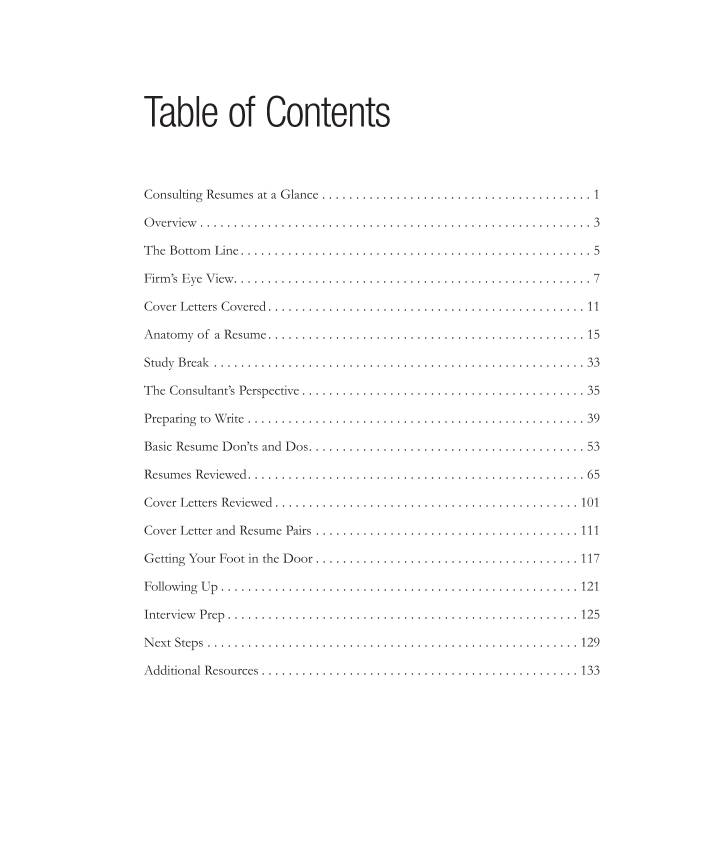


 设备数据采集
 工程招标采购
 搞笑表情
搞笑表情 微信头像
微信头像 CWMS冷库管理系统
 美女图片
美女图片 APP小游戏
 PPT模板
PPT模板 WMS仓库系统
 软件开发
软件开发