概要信息:
BBF RFC 105 The Intein standard
BBF RFC 105: The Intein standard - a universal way
to modify proteins after translation
Constantin Ahlmann-Eltze, Charlotte Bunne, Magdalena Büscher, Jan
Gleixner, Max Horn, Anna Huhn, Nils Klughammer, Jakob Kreft,
Elisabeth Schäfer, Carolin Schmelas, Silvan Schmitz, Max Waldhauer,
Philipp Bayer, Stephen Krämer, Julia Neugebauer, Pierre Wehler, Joel
Beaudouin, Barbara Di Ventura, Roland Eils
October 26, 2014
1 Purpose
This Request for Comments (RFC) proposes a new standard that allows for
easy and flexible cloning of intein constructs and thus makes this technology
accessible to the synthetic biology community.
2 Relation to other BBF RFCs
RFC[105] does not replace any earlier BBF RFC completely. As RFC[105]
describes a way for the assembly of fusion proteins containing one or two
intein parts, it replaces fusion protein cloning standards such as BBF RFCs
121, 232, 253, 264 and 375 for that special case. RFC[105] is fully compatible
with and thus extends RFC[10]6 or any other cloning standard not facilitating
BsaI.
3 Copyright Notice
Copyright (C) The BioBricks Foundation (2014). All Rights Reserved.
4 Nomenclature and Abbreviations
RFC refers to a BioBrick Foundation (BBF) Request for Comments (RFC).
All sequences herein are denoted 5’ to 3’. A Part – written with capital P –
represents a piece of DNA being a functional unit, as meant by the Registry
of Biological Parts7. XN denotes the N-terminal part of the protein or fusion
1
BBF RFC 105 The Intein standard
protein X. CDS refers to a coding sequence without stop codons. POI refers
to a protein/peptide of interest.
5 Motivation
Inteins are an amazing tool for synthetic biology: their ability for auto-
catalytic modification of 1-D protein structures allows their use for a great
variety of applications ranging from the purification of proteins, protein cir-
cularization, protein labeling and biosensing to the direct control of protein
activity.8
Each of these applications requires the combination of a protein/peptide
of interest with a set of inteins or split inteins, which have been characterized
previously. Standardization of the cloning process would enable the genera-
tion of such constructs from a very limited set of progenitor Parts. Modu-
larization would allow the reuse of existing Parts and the easy exploration of
different inteins or exteins for a given task.
However, existing standards do not meet the requirements for such a stan-
dard, as they either leave scars at the splice site (RFCs[121, 232, 253, 375]),
which compromise the functionality of the final constructs, or require custom
oligos (RFC[264]) and tedious backbone amplification(RFCs[289, 5310, 6111])
for each intein/extein combination.
Therefore, a new standard that allows for the easy and flexible cloning
of intein Parts based on six standardized overhangs and type IIs restriction
enzymes was developed, tested and will be described in the following.
6 Formal Description
RFC[105] describes the following nine types of constructs i.e. RFC[10] Parts,
each consisting of combinations of six sub-parts connected with one of eight
standard overhangs.
6.1 Parts
A Circularization/Oligomerization Part MUST contain a C-intein
sub-Part immediately followed by an insertion site, immediately
followed by an N-intein sub-Part. The C-intein sub-Part MUST
be in-frame with an ORF of the preceding elements. The preceding
2
BBF RFC 105 The Intein standard
elements SHOULD be either a RFC[10] prefix followed by an RBS and
a start codon or a RFC[10] prefix for CDSs followed by an ATG start
codon. The N-intein sub-Part SHOULD be followed by two TAA
stop-codons and the RFC[10] suffix. The sequence MUST not contain
any BsaI recognition sites other than the ones specified. See fig. 1 for
a graphical explanation.
Circularisation Part
Translation
Complement
.Xbal rFC10 prefix] j(N)-POl-l(C) CDS selection markAr] Bsal ~~_[RFC10 s .ffix] Spel
over ang CC POl-inserti... .
-C-intein •• N-intein-lii
TC TAGATGNNC AA CNGAGACCNNNNGG TCTCNT GCTNNTAA TAA TAC TAGT
M N C ? * * .
AGAT ~TA CNNG TTGP CT CTGGNNNNCCAG AG NACGAPNATTATT AT GAT ~A
' Bsal
Figure 1: Circularization/Oligomerization Part. Optional parts are
annotated with squared brackets. (visualized using [12])
An insert for Circularization/Oligomerization MUST contain the CDS
of a POI preceded by a BsaI recognition site, any single nucleotide and
overhang CC (GGTCTCNCAAC) and followed by overhang NN, any
single nucleotide and the reversed BsaI recognition site (TGCTNGAGACC).
It MAY be surrounded by RFC[10] prefix and suffix.
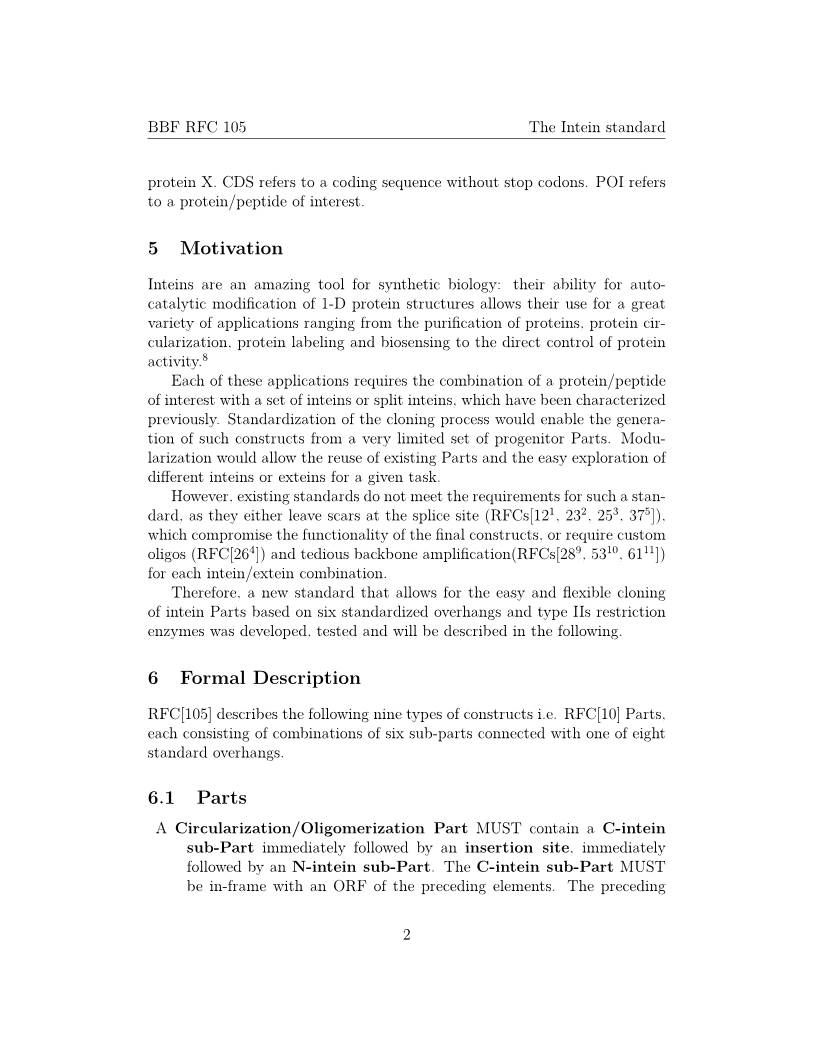
A N-intein assembly Part MUST contain the nucleotides GATG (overhang
A) immediately followed by an insertion site, immediately followed
by an N-intein sub-Part. The N-intein sub-Part should be fol-
lowed by two TAA stop-codons and the RFC[10] suffix. A His6 tag or
any other additional CDS MAY be put before the stop codons. The
overhang A should be preceded by either the RFC[10] prefix and a
RBS or the RFC[10] prefix for CDSs shortened by the final G. The se-
quence MUST not contain any BsaI recognition sites other than the
ones specified. See fig. 2 for a graphical explanation.
3
BBF RFC 105 The Intein standard
N-assembly part
[RF~~jql orefix) oveiang A ~· ___.B ...... s ..... al_~· l{N)-POljl{C) CDS
[selection marker]-~- RFC10 suffix
TCTAGATGNGAGACC NNNNGG TCTCNTGCTNN TAA TAA TAC TAGT
, Spel
Translation M C ? * * .
Complement AGAT~TA~NC TC TGGNNNNCCAGAGNACG~NNATTATTATGATCA
ssa'1
Figure 2: N-intein assembly Part Optional parts are annotated with
squared brackets. (visualized using [12])
An N-intein insert MUST contain the CDS of a POI preceded by a BsaI
recognition site, any single nucleotide and overhang A (GGTCTCNGATG)
and followed by overhang NN, any single nucleotide and the reversed
BsaI recognition site (TGCTNGAGACC). The sequence SHOULD not con-
tain any BsaI recognition sites other than the ones specified. It MAY
be surrounded by RFC[10] prefix and suffix.
A N-intein assembly Part with additional C-terminal insertion site
is a N-intein assembly Part that MUST have an additional inser-
tion site preceded by NNTGGT (overhang NC) between the N-intein
sub-Part and the two TAA stop codons. The arbitrary NN nucleotides
SHOULD be GG so that the six additional nucleotides code for two Gly.
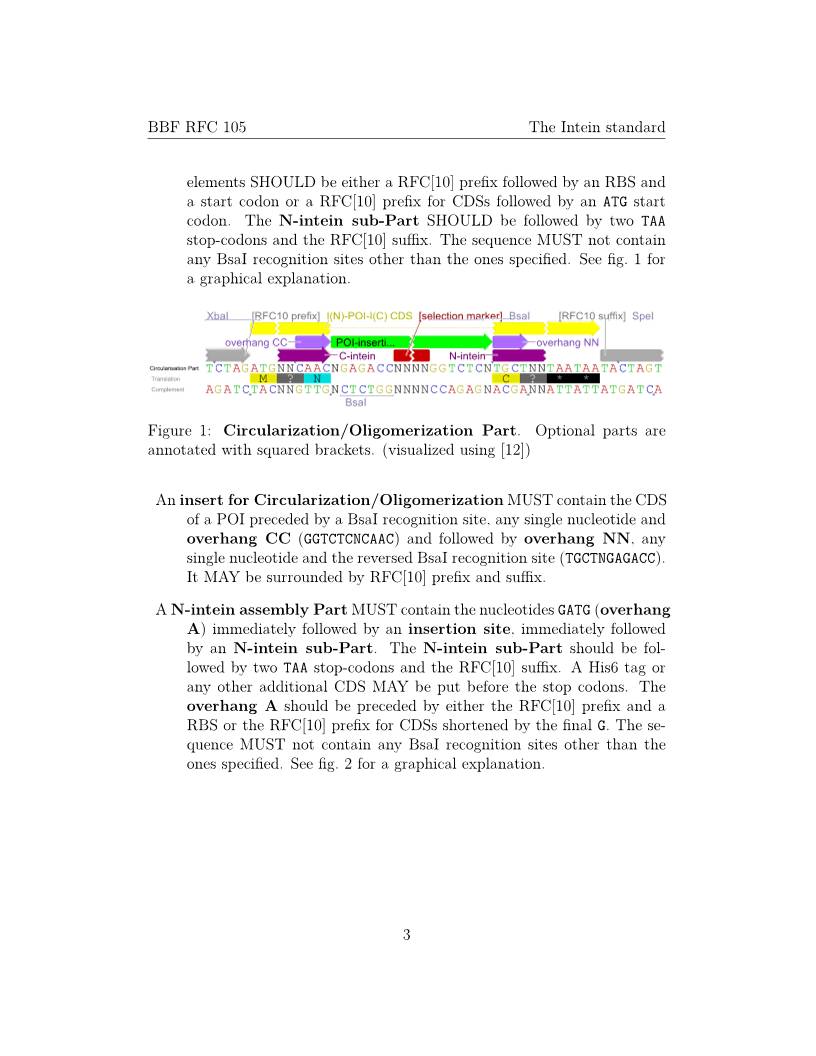
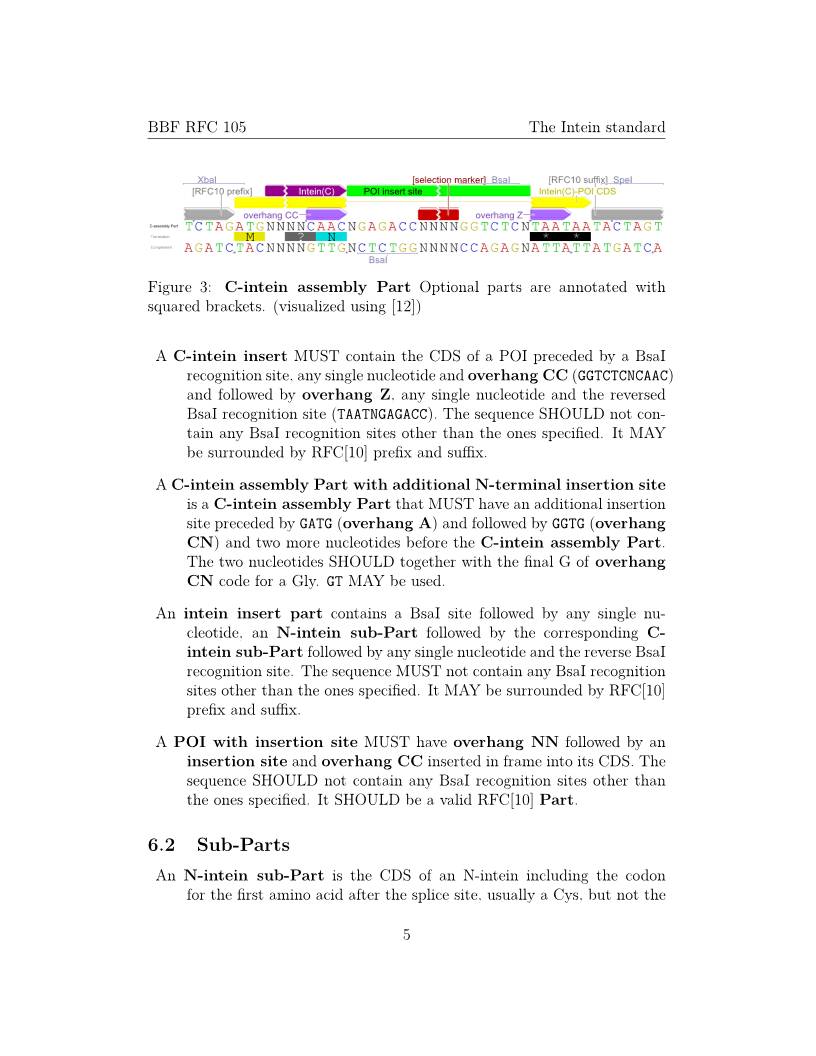
A C-intein assembly Part MUST contain a C-intein sub-Part, imme-
diately followed by an insertion site, immediately followed by TAAT
(overhang Z) immediately followed by AA resulting in two TAA stop-
codons. The C-intein sub-Part MUST be in-frame with an ORF of
the preceding elements. The preceding elements SHOULD be either
a RFC[10] prefix followed by an RBS and a start codon or a RFC[10]
prefix for CDSs followed by an ATG start codon. The sequence MUST
not contain any BsaI recognition sites other than the ones specified.
See fig. 3 for a graphical explanation.
4
BBF RFC 105 The Intein standard
. Xbal . [RFC10 suffix;..=,;-, ~ -----S...._p ....... el_ ____,
[RFC1? prefix] lntein(C)jPOI CDS
.-J. overhang cc~ -- overhang z-~
C-assemblyPart TTC T A GA T G NNNNTC AA C N GA GA C C NNNN G G T C T C NTT AA T AA T ATC T A G T
Translation M
Complement A GA T C.T A C NNNN G TT G.N C T c T G G NNNN C C A GA G NA TT A.TT A T GA T C.A
I
Bsal
Figure 3: C-intein assembly Part Optional parts are annotated with
squared brackets. (visualized using [12])
A C-intein insert MUST contain the CDS of a POI preceded by a BsaI
recognition site, any single nucleotide and overhang CC (GGTCTCNCAAC)
and followed by overhang Z, any single nucleotide and the reversed
BsaI recognition site (TAATNGAGACC). The sequence SHOULD not con-
tain any BsaI recognition sites other than the ones specified. It MAY
be surrounded by RFC[10] prefix and suffix.
A C-intein assembly Part with additional N-terminal insertion site
is a C-intein assembly Part that MUST have an additional insertion
site preceded by GATG (overhang A) and followed by GGTG (overhang
CN) and two more nucleotides before the C-intein assembly Part.
The two nucleotides SHOULD together with the final G of overhang
CN code for a Gly. GT MAY be used.
An intein insert part contains a BsaI site followed by any single nu-
cleotide, an N-intein sub-Part followed by the corresponding C-
intein sub-Part followed by any single nucleotide and the reverse BsaI
recognition site. The sequence MUST not contain any BsaI recognition
sites other than the ones specified. It MAY be surrounded by RFC[10]
prefix and suffix.
A POI with insertion site MUST have overhang NN followed by an
insertion site and overhang CC inserted in frame into its CDS. The
sequence SHOULD not contain any BsaI recognition sites other than
the ones specified. It SHOULD be a valid RFC[10] Part.
6.2 Sub-Parts
An N-intein sub-Part is the CDS of an N-intein including the codon
for the first amino acid after the splice site, usually a Cys, but not the
5
BBF RFC 105 The Intein standard
codon for the last N-extein amino acid. The first four native nucleotides
MUST be changed to TGCT (overhang NN) (TGC coding for Cys). The
5th and 6th nucleotide SHOULD be changed such that they together
with 4th nucleotide T code for the the native or at least a similar amino
acid. For a non-splicing N-intein sub-Part overhang NN∗(GGCT)
MUST be used instead of overhang NN.
A C-intein sub-Part is the CDS of a C-intein including the codon for
the last amino acid before the splice site, usually an Asn, but not the
codon for the first extein amino acid, usually a Cys. The last four
native nucleotides MUST be changed to CAAC (overhang CC) (the
AAC coding for Asn). The 6th and 5th last nucleotides SHOULD be
changed such that they together with 4th last nucleotide C code for
the the native or at least a similar amino acid. For a non-splicing
C-intein sub-Part overhang NN∗(AGGC) MUST be used instead of
overhang CC.
An insertion site MUST start with an arbitrary nucleotide followed by
the reversed BsaI recognition site (GAGACC) and end with an arbitrary
nucleotide preceded by the BsaI recognition site (GGTCTC). This way
BsaI will cut the top strand 4 nucleotides upstream and directly down-
stream of the insertion site and the bottom strand directly upstream
and the bottom strand 4 nucleotides downstream of the insertion site.
The insertion site SHOULD contain a selection marker. An addi-
tional insertion site MAY use a reverse BsmBI (GAGACG) and a BsmBI
recognition site (CGTCTC) instead of the reverse BsaI and the BsaI site
respectively.
A selection marker MUST be a DNA sequence that if transformed into
a cell allows for selection of clones not carrying it. BBa_J04450 is
RECOMMENDED.
6.3 Standard overhangs
RFC[105] defines the following eight 4 nt standard overhangs that will allow
for flexible assembly of intein fusion proteins from progenitor parts without
interfering scars:
A: Sequence: GATG. This overhang contains an ATG start codon. It serves
as the connection between backbones and N-terminal POIs.
6
BBF RFC 105 The Intein standard
NN: Sequence: TGCT. This overhang codes for the first amino acid of N-
inteins, a Cys, and for a third of the +2 amino acid, either a Phe, Leu,
Ser, Tyr, Cys or Trp.
NN∗: Sequence: GGCT. Standard overhang for the assembly of non-splicing
control Parts. The GGC codes for a Gly instead of a Cys which acts as
the major nucleophile in the splicing process.
NC: Sequence: TGGT. This overhang codes together with the RECOM-
MENDED preceding GG for two Gly. It allows for the insertion of
an additional POI behind the C-terminus of N-Inteins.
CC: Sequence: CAAC. This overhang codes for an Asn, the last amino acid
of C-inteins, and for one third of -2 amino acid. It allows to connect
POIs with C-intein CDSs.
CC∗: Sequence: AGGC. Standard overhang for the assembly of non-splicing
control Parts. The GGC codes for a Gly instead of Asn which seems to
be required for C-terminal cleavage. Like overhang CCit is used to
connect POIs with C-intein CDSs.
CN: Sequence: GGTG. This overhang codes together with the RECOM-
MENDED following GT for two Gly which serve as linker between the
N-terminus of a C-intein sub-Part and additional POI CDSs.
Z: Sequence: TAAT. This overhang builds together with the RECOMMENDED
following AA two TAA stop codons and serves as the connection between
C-terminal POIs and backbones.
7 Usage
Fusion protein Parts with Inteins can be easily assembled from RFC[105]
conforming progenitor Parts using a one-pot Golden Gate13 assembly reac-
tion. The protocol listed in appendix 10.1 MAY be employed to perform this
reaction.
If the progenitor parts include additional BsaI sites, the user SHOULD
perform an additional religation step after the Golgen Gate assembly reac-
tion. The protocol listed in appendix 10.2 MAY be employed to perform
this reaction. In that case, the progenitor part MUST contain a selection
marker, as the original backbone will recircularize.
7
BBF RFC 105 The Intein standard
Progenitor Parts MAY be assembled using Circular Polymerase Extension
Cloning (CPEC)14 or High Throughput CPE Cloning and Transformation
(HiCT), as described in BBF RFC 9915. Inserts, if not available on plasmids,
MAY be created using an extension PCR reaction, which adds the flanking
BsaI sites as described above. It is then RECOMMENDED to also introduce
this part into a standard RFC[10] backbone, so that the flanked insert created
by the aforementioned extension PCR is available for future assemblies.
Inteins can be used to circularize or oligomerize proteins by fusing a C-
intein to the N-terminus of that protein and the corresponding N-intein to the
C-terminus (IC-POI-IN). See fig. 4a for a schematic overview of the assembly
of such parts using standard constructs. Figure 4b gives an example of how
intein assembly Parts may be used to add a tag to a POI after translation.
A similar strategy can be used for most other intein parts.
8 Discussion
Standardization of overhangs between distinct groups of functionally related
parts bears a big advantage. It allows reusing these parts for different as-
semblies, eliminates the need for the design of custom cloning strategies and
eases the overall process. However, they usually come at the cost of interfer-
ing scars introduced at the ligation site.
RFC[105]was specifically designed to overcome this problem by defining
functional standardized overhangs. The defined overhangs are either part
of existing standards (overhang A, overhang Z), code for short Gly link-
ers that minimize interference of Tags or other POIs with intein domains
(overhang NC, overhang CN) or are highly conserved motifs in intein
sequences (overhang NN, overhang CC). The latter are most relevant
for the intein function: Additional amino acids that would be introduced
by a scar would also appear in the spliced proteins and thus hinder the de-
sign of optimal linkers for circularization and render protein activation by
reconstitution of the active site of enzyme impossible.
Overhang NN can code for the N-terminus of 50.3 % of all N-inteins
listed in the intein database InBase16. This does not decrease the potential
of the proposed method, since those amino acids could be substituted by
chemically similar ones and the most promising inteins like Npu DnaE or
gp41-1 are compatible. The aspartic acid at the C-terminus of C-inteins is
even more conserved so that 93.1% of all intein C-termini resemble overhang
8
BBF RFC 105 The Intein standard
POI LinkerIC IN
circular protein
with designed linker
linker POI
cleaved off
inteins
expression
splicing reaction
IC
IN
POI
linker
IN
IC
selection markerGTTG
CAACIC
coding region
BsaI BsaI
ACGA
TGCT IN
coding region
GoldenGate reaction
BsaI
POI 1GTTG
CAAC
coding region
BsaI
ACGA
TGCTlinker
(a) Protein circularization
GoldenGate
reaction
IC
POI 1
IN
POI 2
POI 1IC INPOI 2
cleaved off
inteinsIN
IC
POI 1+2
coexpression
trans-splicing reaction
BsaI
selection marker ACGA
TGCT IN
coding region
BsaI
CTAC
GATG
BsaI
selection markerGTTG
CAACIC
coding region
BsaI
ATTATT
TAATAA
BsaI
POI 1GTTG
CAAC
coding region
BsaI
ATTA
TAAT
BsaI
POI 2 ACGA
TGCT
coding region
BsaI
CTAC
GATG
(b) Protein assembly
Figure 4: Usage example of standard circularization and assembly Parts.
(a) Use of the Circularization/Oligomerization Part with a insert for
Circularization/Oligomerization for the generation a circular protein.
(b) Usage of the N-intein assembly Part with an N-intein insert and
the C-intein assembly Part with a C-intein insert.
9
BBF RFC 105 The Intein standard
(a) Anti-His Western blot image
that shows the circularization of λ-
lysozyme using an RFC[105] Npu
DnaE circularization Part.
(b) Western blot image that shows
the reconstitution of split sfGFP us-
ing the Npu DnaE split intein.
Figure 5: Example results of applications of standard circularization and
assembly Parts.
CC.
The described standard was extensively used by the iGEM Team Hei-
delberg for the circularization of several enzymes and the reconstitution of
split fluorescence proteins. Moreover an intein toolbox was build around it.
For instance BBa_K1362000, BBa_K1362100 and BBa_K1362101 repre-
sent respectively a RFC[105] conform Circularization/Oligomerization
Part, N-intein assembly Part and C-intein assembly Part utilizing
the Npu DnaE intein. Figure 5 shows exemplary results of the successful
application of the herein described methods. Visit the team wiki (http:
//2014.igem.org/Team:Heidelberg) for detailed information.
9 Authors’ Contact Information
Constantin Ahlmann-Eltze: constantin.ahlmann@t-online.de
Charlotte Bunne: bunne@stud.uni-heidelberg.de
10
BBF RFC 105 The Intein standard
Magdalena Büscher: m.buescher@dkfz-heidelberg.de
Jan Gleixner: jan.gleixner@gmail.com
Max Horn: maexlich@gmail.com
Anna Huhn: anna.g.huhn@gmail.com
Nils Klughammer: klughammer@stud.uni-heidelberg.de
Jakob Kreft: jakob@kreft-mail.de
Elisabeth Schäfer: lisl@schaeferhome.de
Carolin Schmelas: schmelas@stud.uni-heidelberg.de
Silvan Schmitz: silvan@silvanschmitz.de
Max Waldhauer: waldhauer@stud.uni-heidelberg.de
Philipp Bayer: philipp.bayer@lab-alumni.de
Stephen Krämer: stephenkraemer@gmail.com
Julia Neugebauer: julia.neugebauer@bioquant.uni-heidelberg.de
Pierre Wehler: pierre.wehler@bioquant.uni-heidelberg.de
Joel Beaudouin: j.beaudouin@dkfz.de
Barbara Di Ventura: barbara.diventura@bioquant.uni-heidelberg.de
Roland Eils: r.eils@dkfz.de
References
1. Knight, T. BBF RFC-12 Draft Standard for Biobrick BB-2 Biological
Parts. BioBricks Found. Req. Comments.  (2007).
2. Phillips, I. & Silver, P. A New Biobrick Assembly Strategy Designed for
Facile Protein Engineering. BioBricks Found. Req. Comments.  (2006).
3. Müller, K., Arndt, K., iGEM 2007 Team Freiburg & Grünberg, R. BBF
RFC 25: Fusion Protein (Freiburg) Biobrick assembly standard. Bio-
Bricks Found. Req. Comments.  (2009).
4. Sleight, S. C. BBF RFC 26: In-Fusion BioBrick Assembly. BioBricks
Found. Req. Comments.
(2009).
11
BBF RFC 105 The Intein standard
5. Benčina, M. & Jerala, R. BBF RFC 37 : Fusion protein BioBrick as-
sembly standard with optional linker extension. BioBricks Found. Req.
Comments. doi:http://hdl.handle.net/1721.1/73912.  (2009).
6. Knight, T. Draft Standard for Biobrick Biological Parts 2007. .
7. Selvarajah, V. What are biological parts 2013.
8. Wood, D. W. & Camarero, J. a. Intein applications: from protein purifi-
cation and labeling to metabolic control methods. J. Biol. Chem. 289,
14512–9. issn: 1083-351X (May 2014).
9. Peisajovich, S. G., Horwitz, A., Hoeller, O., Rhau, B. & Lim, W. BBF
RFC 28: A method for combinatorial multi-part assembly based on the
Type IIs restriction enzyme AarI. BioBricks Found. Req. Comments,
1–5 (2009).
10. Jiang, H. et al. BBF RFC 53: USTC MetaPart Assembly Standard –
Extending RFC 10 to Enable Scarless Protein Fusion with Type IIS
Restriction Enzyme EarI and SapI. BioBricks Found. Req. Comments,
1–28 (2010).
11. Shi, Z., Li, T. & Chen, G. BBF RFC 61: Fast multiple gene fragment
ligation method based on Type IIs restriction enzyme DraIII. BioBricks
Found. Req. Comments.
(2010).
12. Biomatters. Geneious version 7.1 .
13. Engler, C., Kandzia, R. & Marillonnet, S. A One Pot, One Step, Preci-
sion Cloning Method with High Throughput Capability. PLoS ONE 3,
e3647 (Nov. 2008).
14. Quan, J. & Tian, J. Circular polymerase extension cloning of complex
gene libraries and pathways. PloS one 4, e6441 (2009).
15. Beer, R. et al. BBF RFC 99: HiCT: High Throughput Protocols For
CPE Cloning And Transformation (2013).
16. Perler, F. B. InBase: the Intein Database. Nucleic Acids Res. 30, 383–4.
issn: 1362-4962 (Jan. 2002).
12
BBF RFC 105 The Intein standard
10 Appendix: Recommended materials and methods
10.1 Golden Gate Assembly (cycling)
• Mix 150ng of the backbone and equimolar amounts of the insert(s) in
water in a PCR tube for a total volume of 15 µL.
• Add 1.5 µL of 10X T4 Ligase Buffer and, when using BsaI or another
restriction enzyme that requires it, BSA (Bovine Serum Albumin) at a
final concentration of 1X.
• Add 1 µL of each restriction enzyme and 1 µL of T4 DNA Ligase (400,000
cohesive end ligation units/ml).
• Optional: Add 1 µL of T4 Polynucleotide Kinase, if several inserts with-
out 5’-phosphorylation (e.g. annealed oligos) are used.
• Place the reaction in a thermocycler and run the following program:
25 cycles of 4 min ligation at 16 ◦C, 3 min restriction at 37 ◦C, 5 min
at 50 ◦C (final restriction) and 5 min of heat inactivation at 80 ◦C.
10.2 Religation after Golden Gate Assembly
• Add 12.5 µL of water, 1.5 µL of T4 Ligase Buffer and 1 µL of T4 DNA
Ligase to your Golden Gate reaction.
• Incubate for 20 min at 16 ◦C, then heat inactivate for 10 min at 65 ◦C.
13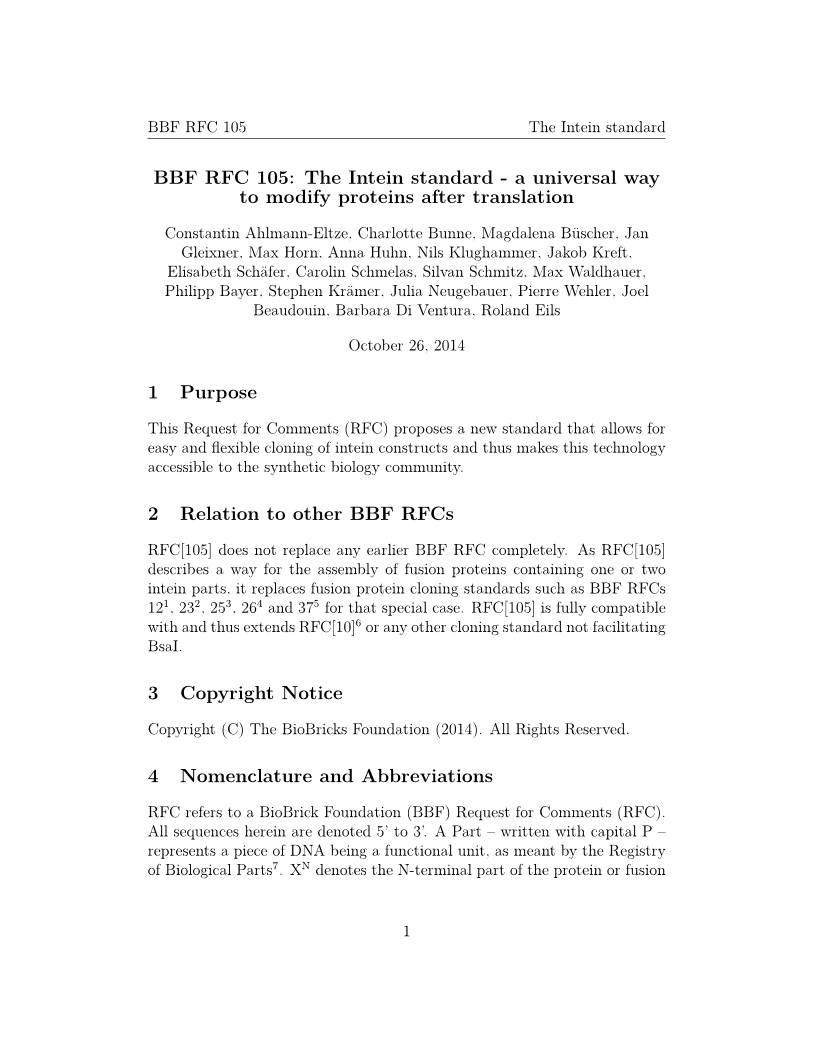


 设备数据采集
 工程招标采购
 搞笑表情
搞笑表情 微信头像
微信头像 CWMS冷库管理系统
 美女图片
美女图片 APP小游戏
 PPT模板
PPT模板 WMS仓库系统
 软件开发
软件开发