概要信息:
Introduction to HYSYS Simulation
Heat Transfer Calculations

Chemical Engineering, Rowan University (Revised 4/18/2001)

In this exercise, you will simulate two heat exchangers and calculate the heat transferred between a hot and a cold
stream using a chemical process simulation package from Hyprotech Inc.  This program is used by industry to
design and simulate process plants such as oil and gas refineries, chemical and pharmaceuticals production facilities.
A typical sampling of well-known companies using this software are given below:
• DuPont, Eastman Kodak, Monsanto, Hoechst Celanese, Rohm & Haas
• Shell, Amoco, Exxon Chemical, Olin, Conoco, Phillips
• Foster Wheeler, Arthur D. Little, Ballard, Koch
• Hoffman LaRoche, International Flavors and Fragrances,
This software is written in C++ which is a language that you have learned.  The cost of this software is
approximately $45,000 for the dynamic version and $20,000 for the steady-state version.  This price is for only one
user!  For more information on Hyprotech go to www.hyprotech.com

The overall process for this simulation is to
• Select a thermodynamics package that describes the physical and chemical properties of the chosen chemicals
• Select the unit operations
• Define all required inputs and output streams.  Specify required values of temperature, pressure, flowrate and
chemical concentration.

Start your computer:
Rowan University has a license to run HYSYS PLANT version 2.2, which is both a steady state and dynamic
simulation program.

For convenience Hyprotech suggests that you copy the
HYSYS directories to your personal drive on galaxy.
These  are located in \\galaxy\public1\chemical
engineering\HYSYS (To do this you may need to map a
drive (Start, Windows Explorer, Tools, Map Network
Drive…,)  In these directories you will save your
configuration files and cases.

In HYSYS there is a limited online Help package, which
can be obtained using the Help command from the menu
bar or by pressing the F1 key.  There is an extensive
collection of manuals that can be accessed from
\\engnet1\apps\Hysys_Doc\Menu.pdf.  Remember that we
are running HYSYS PLANT.

1. Start HYSYS PLANT
Third Floor Lab (windows NT) Start => E
Network apps => Engineering Apps => HYSYS Plant
First floor labs (windows 2000) Press Start => Engineering Apps
=>HYSYS Plant
ngineering
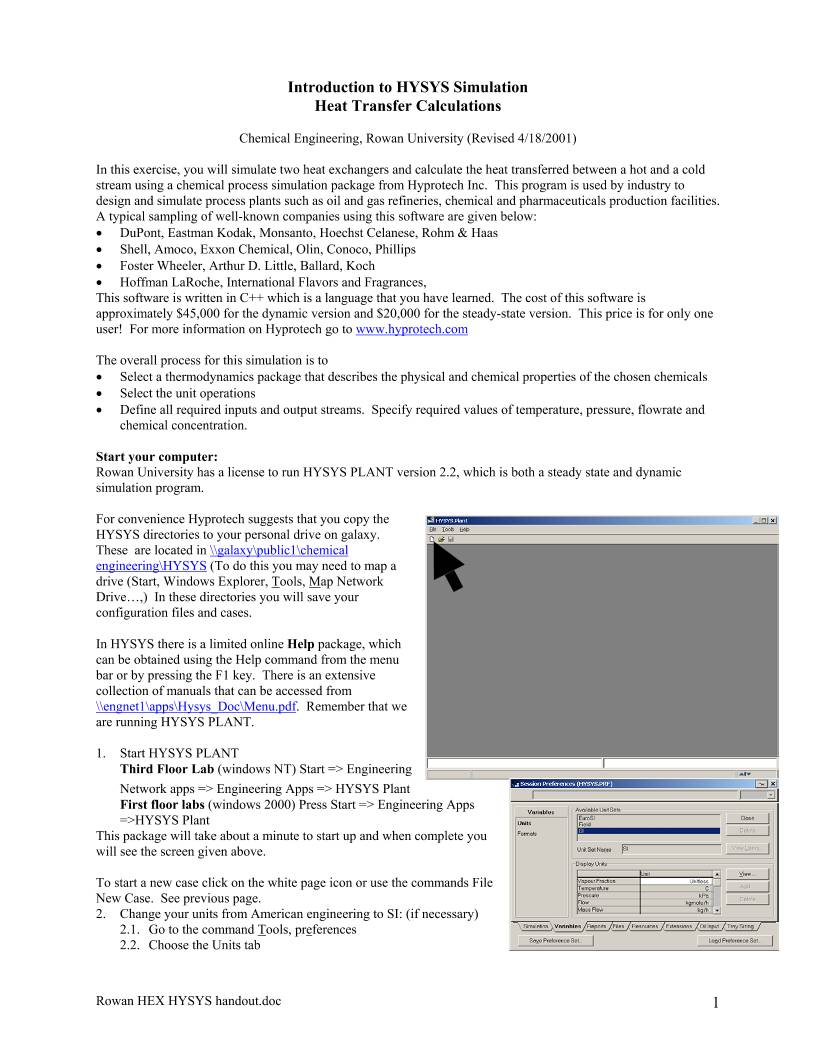
This package will take about a minute to start up and when complete you
will see the screen given above.

To start a new case click on the white page icon or use the commands File
New Case.  See previous page.
2. Change your units from American engineering to SI: (if necessary)
2.1. Go to the command Tools, preferences
2.2. Choose the Units tab
Rowan HEX HYSYS handout.doc 1
2.3. Select SI
2.4. Press Save Preference Set to your galaxy drive
2.5. Press close.
 a
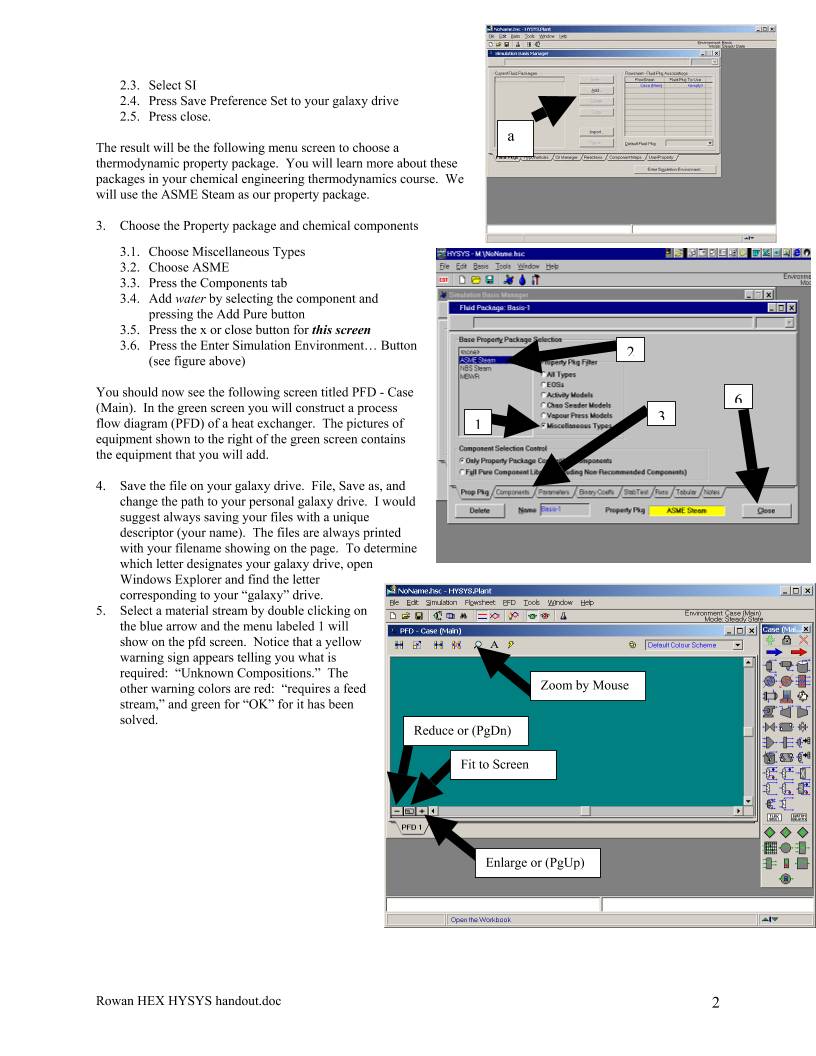
The result will be the following menu screen to choose a
thermodynamic property package.  You will learn more about these
packages in your chemical engineering thermodynamics course.  We
will use the ASME Steam as our property package.

3. Choose the Property package and chemical components
3.1. Choose Miscellaneous Types
3
6
2
1
3.2. Choose ASME
3.3. Press the Components tab
3.4. Add water by selecting the component and
pressing the Add Pure button
3.5. Press the x or close button for this screen
3.6. Press the Enter Simulation Environment… Button
(see figure above)

You should now see the following screen titled PFD - Case
(Main).  In the green screen you will construct a process
flow diagram (PFD) of a heat exchanger.  The pictures of
equipment shown to the right of the green screen contains
the equipment that you will add.

4. Save the file on your galaxy drive.  File, Save as, and
change the path to your personal galaxy drive.  I would
suggest always saving your files with a unique
descriptor (your name).  The files are always printed
with your filename showing on the page.  To determine
which letter designates your galaxy drive, open
Windows Explorer and find the letter
corresponding to your “galaxy” drive.
5. Select a material stream by double clicking on
the blue arrow and the menu labeled 1 will
show on the pfd screen.  Notice that a yellow
warning sign appears telling you what is
required:  “Unknown Compositions.”  The
other warning colors are red:  “requires a feed
stream,” and green for “OK” for it has been
solved.
Zoom by Mouse
Reduce or (PgDn)
Fit to Screen
Enlarge or (PgUp)
Rowan HEX HYSYS handout.doc 2
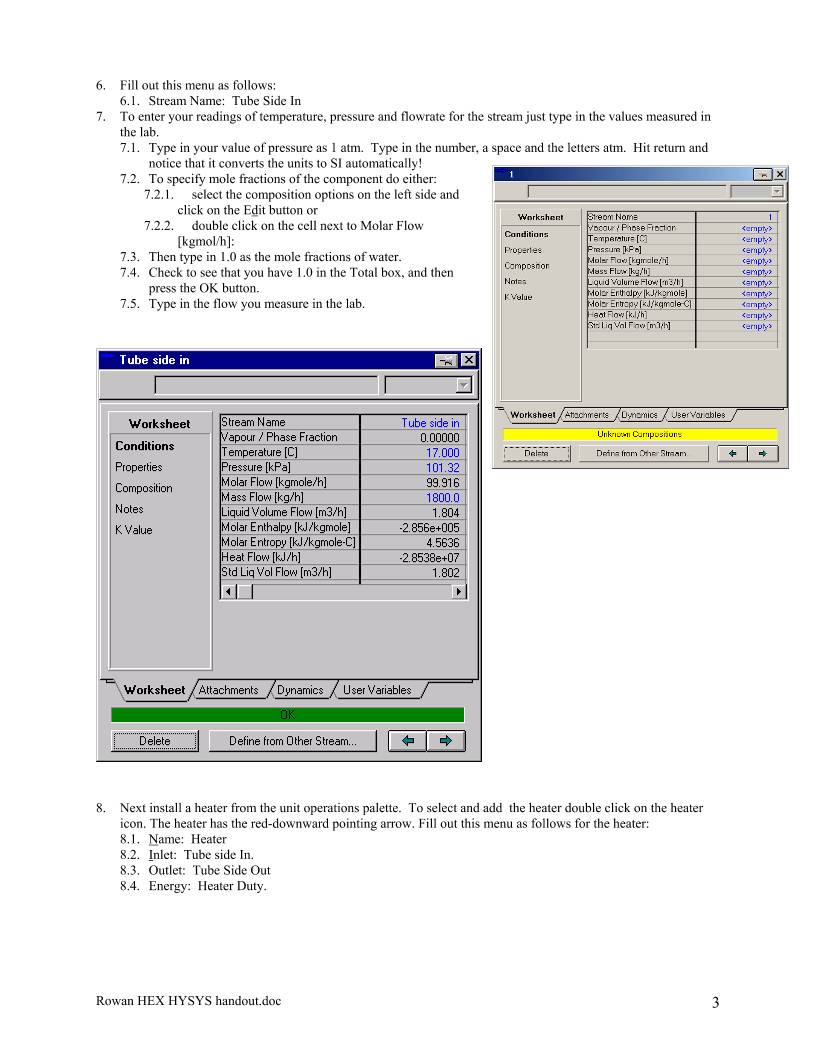
6. Fill out this menu as follows:
6.1. Stream Name:  Tube Side In
7. To enter your readings of temperature, pressure and flowrate for the stream just type in the values measured in
the lab.
7.1. Type in your value of pressure as 1 atm.  Type in the number, a space and the letters atm.  Hit return and
notice that it converts the units to SI automatically!
7.2. To specify mole fractions of the component do either:
7.2.1. select the composition options on the left side and
click on the Edit button or
7.2.2. double click on the cell next to Molar Flow
[kgmol/h]:
7.3. Then type in 1.0 as the mole fractions of water.
7.4. Check to see that you have 1.0 in the Total box, and then
press the OK button.
7.5. Type in the flow you measure in the lab.


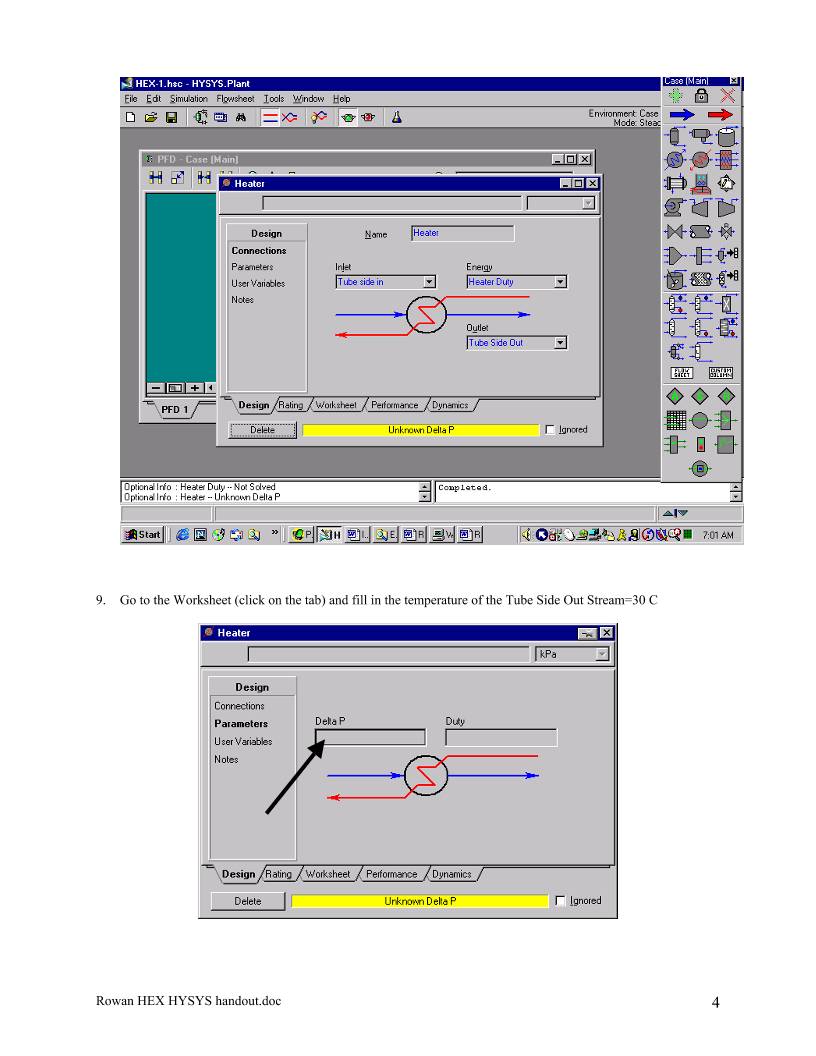
8. Next install a heater from the unit operations palette.  To select and add  the heater double click on the heater
icon. The heater has the red-downward pointing arrow. Fill out this menu as follows for the heater:
8.1. Name:  Heater
8.2. Inlet:  Tube side In.
8.3. Outlet:  Tube Side Out
8.4. Energy:  Heater Duty.


Rowan HEX HYSYS handout.doc 3


9. Go to the Worksheet (click on the tab) and fill in the temperature of the Tube Side Out Stream=30 C

Rowan HEX HYSYS handout.doc 4

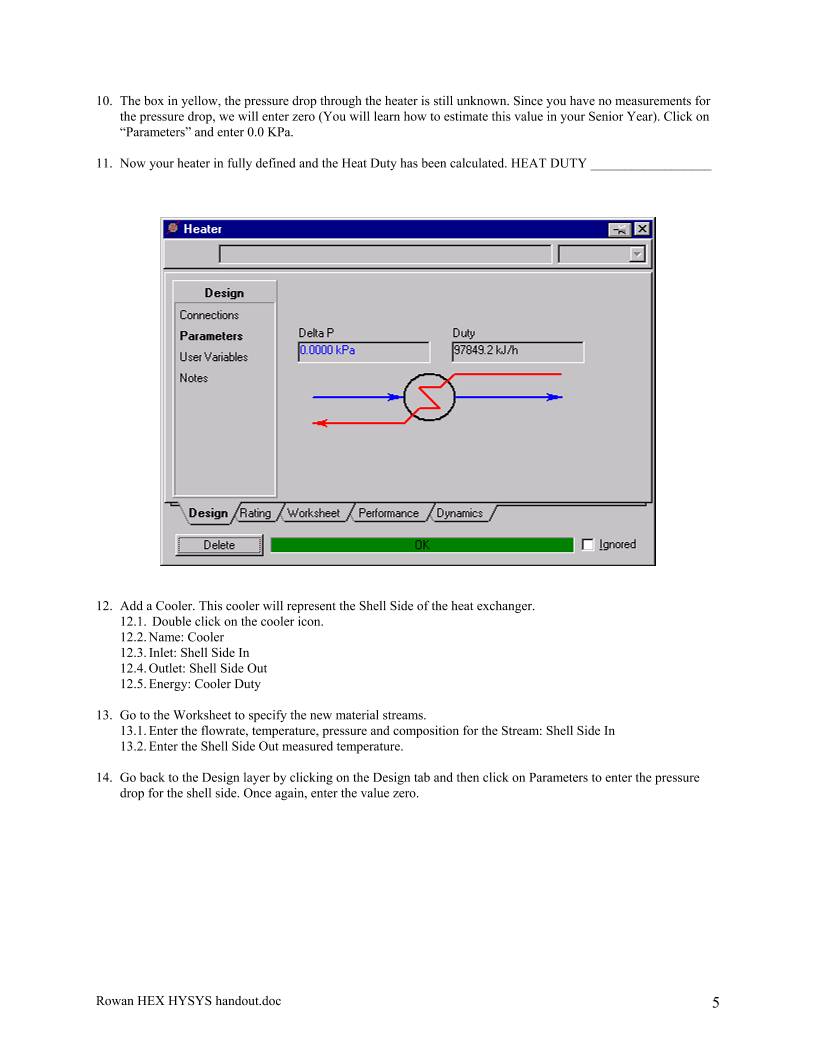
10. The box in yellow, the pressure drop through the heater is still unknown. Since you have no measurements for
the pressure drop, we will enter zero (You will learn how to estimate this value in your Senior Year). Click on
“Parameters” and enter 0.0 KPa.

11. Now your heater in fully defined and the Heat Duty has been calculated. HEAT DUTY __________________


12. Add a Cooler. This cooler will represent the Shell Side of the heat exchanger.
12.1.  Double click on the cooler icon.
12.2. Name: Cooler
12.3. Inlet: Shell Side In
12.4. Outlet: Shell Side Out
12.5. Energy: Cooler Duty

13. Go to the Worksheet to specify the new material streams.
13.1. Enter the flowrate, temperature, pressure and composition for the Stream: Shell Side In
13.2. Enter the Shell Side Out measured temperature.

14. Go back to the Design layer by clicking on the Design tab and then click on Parameters to enter the pressure
drop for the shell side. Once again, enter the value zero.
Rowan HEX HYSYS handout.doc 5


15. Copy the heat duty of the Cooler __________________________

16. The hot water in the Shell Side is responsible for heating up the cold water that runs in the Tube Side. Write an
energy balance for the system. hotcoldhothotphothotcoldcoldpcoldcold QQTcFQTcFQ ==∆=∆= ?,, ,,

Compare the heat duties of both heat exchangers.  Explain.


17. Printout your HYSYS workbook Specsheets and PFD.  To print a specsheet:
a) Check the printer by selecting File Printer Setup.  The graphics printer prints the pfd’s and the report
printer prints text or workbook.
b) Select the workbook by pressing the toolbar button as shown in the figure below.
c) Select File, Print,
d) Choose All Pages - Compact.
e) Preview it
Also printout your process flow diagram, (PFD) by choosing the print command while the PFD is active.
Rowan HEX HYSYS handout.doc 6


 设备数据采集
 工程招标采购
 搞笑表情
搞笑表情 微信头像
微信头像 CWMS冷库管理系统
 美女图片
美女图片 APP小游戏
 PPT模板
PPT模板 WMS仓库系统
 软件开发
软件开发