概要信息:
www.cadfamily.com EMail:cadserv21@hotmail.com
The document is for study only,if tort to your rights,please inform us,we will delete
Chemometrics
Chemometrics: Data Analysis for the Laboratory and Chemical Plant.
Richard G. Brereton
Copyright 2003 John Wiley & Sons, Ltd.
ISBNs: 0-471-48977-8 (HB); 0-471-48978-6 (PB)
www.cadfamily.com EMail:cadserv21@hotmail.com
The document is for study only,if tort to your rights,please inform us,we will delete
Chemometrics
Data Analysis for the Laboratory
and Chemical Plant
Richard G. Brereton
University of Bristol, UK
www.cadfamily.com EMail:cadserv21@hotmail.com
The document is for study only,if tort to your rights,please inform us,we will delete
Copyright 2003 John Wiley & Sons Ltd, The Atrium, Southern Gate, Chichester,
West Sussex PO19 8SQ, England
Telephone (+44) 1243 779777
Email (for orders and customer service enquiries): cs-books@wiley.co.uk
Visit our Home Page on www.wileyeurope.com or www.wiley.com
All Rights Reserved. No part of this publication may be reproduced, stored in a retrieval system or
transmitted in any form or by any means, electronic, mechanical, photocopying, recording, scanning
or otherwise, except under the terms of the Copyright, Designs and Patents Act 1988 or under the
terms of a licence issued by the Copyright Licensing Agency Ltd, 90 Tottenham Court Road,
London W1T 4LP, UK, without the permission in writing of the Publisher. Requests to the
Publisher should be addressed to the Permissions Department, John Wiley & Sons Ltd, The Atrium,
Southern Gate, Chichester, West Sussex PO19 8SQ, England, or emailed to permreq@wiley.co.uk,
or faxed to (+44) 1243 770571.
This publication is designed to provide accurate and authoritative information in regard to the
subject matter covered. It is sold on the understanding that the Publisher is not engaged in rendering
professional services. If professional advice or other expert assistance is required, the services of a
competent professional should be sought.
Other Wiley Editorial Offices
John Wiley & Sons Inc., 111 River Street, Hoboken, NJ 07030, USA
Jossey-Bass, 989 Market Street, San Francisco, CA 94103-1741, USA
Wiley-VCH Verlag GmbH, Boschstr. 12, D-69469 Weinheim, Germany
John Wiley & Sons Australia Ltd, 33 Park Road, Milton, Queensland 4064, Australia
John Wiley & Sons (Asia) Pte Ltd, 2 Clementi Loop #02-01, Jin Xing Distripark, Singapore 129809
John Wiley & Sons Canada Ltd, 22 Worcester Road, Etobicoke, Ontario, Canada M9W 1L1
Wiley also publishes its books in a variety of electronic formats. Some content that appears
in print may not be available in electronic books.
Library of Congress Cataloging-in-Publication Data
Brereton, Richard G.
Chemometrics : data analysis for the laboratory and chemical plant / Richard Brereton.
p. cm.
Includes bibliographical references and index.
ISBN 0-471-48977-8 (hardback : alk. paper) – ISBN 0-470-84911-8 (pbk. : alk. paper)
1. Chemistry, Analytic–Statistical methods–Data processing. 2. Chemical
processes–Statistical methods–Data processing. I. Title.
QD75.4.S8 B74 2002
543′.007′27–dc21 2002027212
British Library Cataloguing in Publication Data
A catalogue record for this book is available from the British Library
ISBN 0-471-48977-8 (Hardback)
ISBN 0-471-48978-6 (Paperback)
Typeset in 10/12pt Times by Laserwords Private Limited, Chennai, India
Printed and bound in Great Britain by Antony Rowe Ltd, Chippenham, Wiltshire
This book is printed on acid-free paper responsibly manufactured from sustainable forestry
in which at least two trees are planted for each one used for paper production.
www.cadfamily.com EMail:cadserv21@hotmail.com
The document is for study only,if tort to your rights,please inform us,we will delete
Contents
Preface . . . . . . . . . . . . . . . . . . . . . . . . . . . . . . . . . . . . . . . . . . . . . . . . . . . . . . . . . . . . ix
Supplementary Information . . . . . . . . . . . . . . . . . . . . . . . . . . . . . . . . . . . . . . . . . . . . . xii
Acknowledgements . . . . . . . . . . . . . . . . . . . . . . . . . . . . . . . . . . . . . . . . . . . . . . . . . . . xiii
1 Introduction . . . . . . . . . . . . . . . . . . . . . . . . . . . . . . . . . . . . . . . . . . . . . . . . . . . . . . 1
1.1 Points of View . . . . . . . . . . . . . . . . . . . . . . . . . . . . . . . . . . . . . . . . . . . . . . . . . . . 1
1.2 Software and Calculations . . . . . . . . . . . . . . . . . . . . . . . . . . . . . . . . . . . . . . . . . . . 6
1.3 Further Reading . . . . . . . . . . . . . . . . . . . . . . . . . . . . . . . . . . . . . . . . . . . . . . . . . . 8
1.3.1 General . . . . . . . . . . . . . . . . . . . . . . . . . . . . . . . . . . . . . . . . . . . . . . . . . . . 8
1.3.2 Specific Areas . . . . . . . . . . . . . . . . . . . . . . . . . . . . . . . . . . . . . . . . . . . . . . . 10
1.3.3 Internet Resources . . . . . . . . . . . . . . . . . . . . . . . . . . . . . . . . . . . . . . . . . . . . 11
1.4 References . . . . . . . . . . . . . . . . . . . . . . . . . . . . . . . . . . . . . . . . . . . . . . . . . . . . . 12
2 Experimental Design . . . . . . . . . . . . . . . . . . . . . . . . . . . . . . . . . . . . . . . . . . . . . . . . . 15
2.1 Introduction . . . . . . . . . . . . . . . . . . . . . . . . . . . . . . . . . . . . . . . . . . . . . . . . . . . . 15
2.2 Basic Principles . . . . . . . . . . . . . . . . . . . . . . . . . . . . . . . . . . . . . . . . . . . . . . . . . . 19
2.2.1 Degrees of Freedom . . . . . . . . . . . . . . . . . . . . . . . . . . . . . . . . . . . . . . . . . . . 19
2.2.2 Analysis of Variance and Comparison of Errors . . . . . . . . . . . . . . . . . . . . . . . . . 23
2.2.3 Design Matrices and Modelling . . . . . . . . . . . . . . . . . . . . . . . . . . . . . . . . . . . 30
2.2.4 Assessment of Significance . . . . . . . . . . . . . . . . . . . . . . . . . . . . . . . . . . . . . . 36
2.2.5 Leverage and Confidence in Models . . . . . . . . . . . . . . . . . . . . . . . . . . . . . . . . 47
2.3 Factorial Designs . . . . . . . . . . . . . . . . . . . . . . . . . . . . . . . . . . . . . . . . . . . . . . . . . 53
2.3.1 Full Factorial Designs . . . . . . . . . . . . . . . . . . . . . . . . . . . . . . . . . . . . . . . . . . 54
2.3.2 Fractional Factorial Designs . . . . . . . . . . . . . . . . . . . . . . . . . . . . . . . . . . . . . . 60
2.3.3 Plackett–Burman and Taguchi Designs . . . . . . . . . . . . . . . . . . . . . . . . . . . . . . . 66
2.3.4 Partial Factorials at Several Levels: Calibration Designs . . . . . . . . . . . . . . . . . . . 69
2.4 Central Composite or Response Surface Designs . . . . . . . . . . . . . . . . . . . . . . . . . . . . 76
2.4.1 Setting Up the Design . . . . . . . . . . . . . . . . . . . . . . . . . . . . . . . . . . . . . . . . . . 76
2.4.2 Degrees of Freedom . . . . . . . . . . . . . . . . . . . . . . . . . . . . . . . . . . . . . . . . . . . 79
2.4.3 Axial Points . . . . . . . . . . . . . . . . . . . . . . . . . . . . . . . . . . . . . . . . . . . . . . . . 80
2.4.4 Modelling . . . . . . . . . . . . . . . . . . . . . . . . . . . . . . . . . . . . . . . . . . . . . . . . . . 83
2.4.5 Statistical Factors . . . . . . . . . . . . . . . . . . . . . . . . . . . . . . . . . . . . . . . . . . . . . 84
2.5 Mixture Designs . . . . . . . . . . . . . . . . . . . . . . . . . . . . . . . . . . . . . . . . . . . . . . . . . 84
2.5.1 Mixture Space . . . . . . . . . . . . . . . . . . . . . . . . . . . . . . . . . . . . . . . . . . . . . . . 85
2.5.2 Simplex Centroid . . . . . . . . . . . . . . . . . . . . . . . . . . . . . . . . . . . . . . . . . . . . . 85
2.5.3 Simplex Lattice . . . . . . . . . . . . . . . . . . . . . . . . . . . . . . . . . . . . . . . . . . . . . . 88
2.5.4 Constraints . . . . . . . . . . . . . . . . . . . . . . . . . . . . . . . . . . . . . . . . . . . . . . . . . 90
2.5.5 Process Variables . . . . . . . . . . . . . . . . . . . . . . . . . . . . . . . . . . . . . . . . . . . . . 96
www.cadfamily.com EMail:cadserv21@hotmail.com
The document is for study only,if tort to your rights,please inform us,we will delete
vi CONTENTS
2.6 Simplex Optimisation . . . . . . . . . . . . . . . . . . . . . . . . . . . . . . . . . . . . . . . . . . . . . . 97
2.6.1 Fixed Sized Simplex . . . . . . . . . . . . . . . . . . . . . . . . . . . . . . . . . . . . . . . . . . . 97
2.6.2 Elaborations . . . . . . . . . . . . . . . . . . . . . . . . . . . . . . . . . . . . . . . . . . . . . . . . 99
2.6.3 Modified Simplex . . . . . . . . . . . . . . . . . . . . . . . . . . . . . . . . . . . . . . . . . . . . . 100
2.6.4 Limitations . . . . . . . . . . . . . . . . . . . . . . . . . . . . . . . . . . . . . . . . . . . . . . . . . 101
Problems . . . . . . . . . . . . . . . . . . . . . . . . . . . . . . . . . . . . . . . . . . . . . . . . . . . . . . . . . 102
3 Signal Processing . . . . . . . . . . . . . . . . . . . . . . . . . . . . . . . . . . . . . . . . . . . . . . . . . . . 119
3.1 Sequential Signals in Chemistry . . . . . . . . . . . . . . . . . . . . . . . . . . . . . . . . . . . . . . . 119
3.1.1 Environmental and Geological Processes . . . . . . . . . . . . . . . . . . . . . . . . . . . . . 119
3.1.2 Industrial Process Control . . . . . . . . . . . . . . . . . . . . . . . . . . . . . . . . . . . . . . . 120
3.1.3 Chromatograms and Spectra . . . . . . . . . . . . . . . . . . . . . . . . . . . . . . . . . . . . . . 120
3.1.4 Fourier Transforms . . . . . . . . . . . . . . . . . . . . . . . . . . . . . . . . . . . . . . . . . . . . 120
3.1.5 Advanced Methods . . . . . . . . . . . . . . . . . . . . . . . . . . . . . . . . . . . . . . . . . . . . 121
3.2 Basics . . . . . . . . . . . . . . . . . . . . . . . . . . . . . . . . . . . . . . . . . . . . . . . . . . . . . . . . 122
3.2.1 Peakshapes . . . . . . . . . . . . . . . . . . . . . . . . . . . . . . . . . . . . . . . . . . . . . . . . . 122
3.2.2 Digitisation . . . . . . . . . . . . . . . . . . . . . . . . . . . . . . . . . . . . . . . . . . . . . . . . . 125
3.2.3 Noise . . . . . . . . . . . . . . . . . . . . . . . . . . . . . . . . . . . . . . . . . . . . . . . . . . . . . 128
3.2.4 Sequential Processes . . . . . . . . . . . . . . . . . . . . . . . . . . . . . . . . . . . . . . . . . . . 131
3.3 Linear Filters . . . . . . . . . . . . . . . . . . . . . . . . . . . . . . . . . . . . . . . . . . . . . . . . . . . . 131
3.3.1 Smoothing Functions . . . . . . . . . . . . . . . . . . . . . . . . . . . . . . . . . . . . . . . . . . 131
3.3.2 Derivatives . . . . . . . . . . . . . . . . . . . . . . . . . . . . . . . . . . . . . . . . . . . . . . . . . 138
3.3.3 Convolution . . . . . . . . . . . . . . . . . . . . . . . . . . . . . . . . . . . . . . . . . . . . . . . . 138
3.4 Correlograms and Time Series Analysis . . . . . . . . . . . . . . . . . . . . . . . . . . . . . . . . . . 142
3.4.1 Auto-correlograms . . . . . . . . . . . . . . . . . . . . . . . . . . . . . . . . . . . . . . . . . . . . 142
3.4.2 Cross-correlograms . . . . . . . . . . . . . . . . . . . . . . . . . . . . . . . . . . . . . . . . . . . . 145
3.4.3 Multivariate Correlograms . . . . . . . . . . . . . . . . . . . . . . . . . . . . . . . . . . . . . . . 146
3.5 Fourier Transform Techniques . . . . . . . . . . . . . . . . . . . . . . . . . . . . . . . . . . . . . . . . 147
3.5.1 Fourier Transforms . . . . . . . . . . . . . . . . . . . . . . . . . . . . . . . . . . . . . . . . . . . . 147
3.5.2 Fourier Filters . . . . . . . . . . . . . . . . . . . . . . . . . . . . . . . . . . . . . . . . . . . . . . . 156
3.5.3 Convolution Theorem . . . . . . . . . . . . . . . . . . . . . . . . . . . . . . . . . . . . . . . . . . 161
3.6 Topical Methods . . . . . . . . . . . . . . . . . . . . . . . . . . . . . . . . . . . . . . . . . . . . . . . . . 163
3.6.1 Kalman Filters . . . . . . . . . . . . . . . . . . . . . . . . . . . . . . . . . . . . . . . . . . . . . . . 163
3.6.2 Wavelet Transforms . . . . . . . . . . . . . . . . . . . . . . . . . . . . . . . . . . . . . . . . . . . 167
3.6.3 Maximum Entropy (Maxent) and Bayesian Methods . . . . . . . . . . . . . . . . . . . . . . 168
Problems . . . . . . . . . . . . . . . . . . . . . . . . . . . . . . . . . . . . . . . . . . . . . . . . . . . . . . . . . 173
4 Pattern Recognition . . . . . . . . . . . . . . . . . . . . . . . . . . . . . . . . . . . . . . . . . . . . . . . . . 183
4.1 Introduction . . . . . . . . . . . . . . . . . . . . . . . . . . . . . . . . . . . . . . . . . . . . . . . . . . . . 183
4.1.1 Exploratory Data Analysis . . . . . . . . . . . . . . . . . . . . . . . . . . . . . . . . . . . . . . . 183
4.1.2 Unsupervised Pattern Recognition . . . . . . . . . . . . . . . . . . . . . . . . . . . . . . . . . . 183
4.1.3 Supervised Pattern Recognition . . . . . . . . . . . . . . . . . . . . . . . . . . . . . . . . . . . . 184
4.2 The Concept and Need for Principal Components Analysis . . . . . . . . . . . . . . . . . . . . . 184
4.2.1 History . . . . . . . . . . . . . . . . . . . . . . . . . . . . . . . . . . . . . . . . . . . . . . . . . . . . 185
4.2.2 Case Studies . . . . . . . . . . . . . . . . . . . . . . . . . . . . . . . . . . . . . . . . . . . . . . . . 186
4.2.3 Multivariate Data Matrices . . . . . . . . . . . . . . . . . . . . . . . . . . . . . . . . . . . . . . . 188
4.2.4 Aims of PCA . . . . . . . . . . . . . . . . . . . . . . . . . . . . . . . . . . . . . . . . . . . . . . . 190
www.cadfamily.com EMail:cadserv21@hotmail.com
The document is for study only,if tort to your rights,please inform us,we will delete
CONTENTS vii
4.3 Principal Components Analysis: the Method . . . . . . . . . . . . . . . . . . . . . . . . . . . . . . . 191
4.3.1 Chemical Factors . . . . . . . . . . . . . . . . . . . . . . . . . . . . . . . . . . . . . . . . . . . . . 191
4.3.2 Scores and Loadings . . . . . . . . . . . . . . . . . . . . . . . . . . . . . . . . . . . . . . . . . . . 192
4.3.3 Rank and Eigenvalues . . . . . . . . . . . . . . . . . . . . . . . . . . . . . . . . . . . . . . . . . . 195
4.3.4 Factor Analysis . . . . . . . . . . . . . . . . . . . . . . . . . . . . . . . . . . . . . . . . . . . . . . 204
4.3.5 Graphical Representation of Scores and Loadings . . . . . . . . . . . . . . . . . . . . . . . . 205
4.3.6 Preprocessing . . . . . . . . . . . . . . . . . . . . . . . . . . . . . . . . . . . . . . . . . . . . . . . 210
4.3.7 Comparing Multivariate Patterns . . . . . . . . . . . . . . . . . . . . . . . . . . . . . . . . . . . 219
4.4 Unsupervised Pattern Recognition: Cluster Analysis . . . . . . . . . . . . . . . . . . . . . . . . . . 224
4.4.1 Similarity . . . . . . . . . . . . . . . . . . . . . . . . . . . . . . . . . . . . . . . . . . . . . . . . . . 224
4.4.2 Linkage . . . . . . . . . . . . . . . . . . . . . . . . . . . . . . . . . . . . . . . . . . . . . . . . . . . 227
4.4.3 Next Steps . . . . . . . . . . . . . . . . . . . . . . . . . . . . . . . . . . . . . . . . . . . . . . . . . 229
4.4.4 Dendrograms . . . . . . . . . . . . . . . . . . . . . . . . . . . . . . . . . . . . . . . . . . . . . . . . 229
4.5 Supervised Pattern Recognition . . . . . . . . . . . . . . . . . . . . . . . . . . . . . . . . . . . . . . . . 230
4.5.1 General Principles . . . . . . . . . . . . . . . . . . . . . . . . . . . . . . . . . . . . . . . . . . . . 231
4.5.2 Discriminant Analysis . . . . . . . . . . . . . . . . . . . . . . . . . . . . . . . . . . . . . . . . . . 233
4.5.3 SIMCA . . . . . . . . . . . . . . . . . . . . . . . . . . . . . . . . . . . . . . . . . . . . . . . . . . . 243
4.5.4 Discriminant PLS . . . . . . . . . . . . . . . . . . . . . . . . . . . . . . . . . . . . . . . . . . . . . 248
4.5.5 K Nearest Neighbours . . . . . . . . . . . . . . . . . . . . . . . . . . . . . . . . . . . . . . . . . 249
4.6 Multiway Pattern Recognition . . . . . . . . . . . . . . . . . . . . . . . . . . . . . . . . . . . . . . . . . 251
4.6.1 Tucker3 Models . . . . . . . . . . . . . . . . . . . . . . . . . . . . . . . . . . . . . . . . . . . . . . 252
4.6.2 PARAFAC . . . . . . . . . . . . . . . . . . . . . . . . . . . . . . . . . . . . . . . . . . . . . . . . . 253
4.6.3 Unfolding . . . . . . . . . . . . . . . . . . . . . . . . . . . . . . . . . . . . . . . . . . . . . . . . . . 254
Problems . . . . . . . . . . . . . . . . . . . . . . . . . . . . . . . . . . . . . . . . . . . . . . . . . . . . . . . . . 255
5 Calibration . . . . . . . . . . . . . . . . . . . . . . . . . . . . . . . . . . . . . . . . . . . . . . . . . . . . . . . 271
5.1 Introduction . . . . . . . . . . . . . . . . . . . . . . . . . . . . . . . . . . . . . . . . . . . . . . . . . . . . 271
5.1.1 History and Usage . . . . . . . . . . . . . . . . . . . . . . . . . . . . . . . . . . . . . . . . . . . . 271
5.1.2 Case Study . . . . . . . . . . . . . . . . . . . . . . . . . . . . . . . . . . . . . . . . . . . . . . . . . 273
5.1.3 Terminology . . . . . . . . . . . . . . . . . . . . . . . . . . . . . . . . . . . . . . . . . . . . . . . . 273
5.2 Univariate Calibration . . . . . . . . . . . . . . . . . . . . . . . . . . . . . . . . . . . . . . . . . . . . . . 276
5.2.1 Classical Calibration . . . . . . . . . . . . . . . . . . . . . . . . . . . . . . . . . . . . . . . . . . . 276
5.2.2 Inverse Calibration . . . . . . . . . . . . . . . . . . . . . . . . . . . . . . . . . . . . . . . . . . . . 279
5.2.3 Intercept and Centring . . . . . . . . . . . . . . . . . . . . . . . . . . . . . . . . . . . . . . . . . . 280
5.3 Multiple Linear Regression . . . . . . . . . . . . . . . . . . . . . . . . . . . . . . . . . . . . . . . . . . 284
5.3.1 Multidetector Advantage . . . . . . . . . . . . . . . . . . . . . . . . . . . . . . . . . . . . . . . . 284
5.3.2 Multiwavelength Equations . . . . . . . . . . . . . . . . . . . . . . . . . . . . . . . . . . . . . . 284
5.3.3 Multivariate Approaches . . . . . . . . . . . . . . . . . . . . . . . . . . . . . . . . . . . . . . . . 288
5.4 Principal Components Regression . . . . . . . . . . . . . . . . . . . . . . . . . . . . . . . . . . . . . . 292
5.4.1 Regression . . . . . . . . . . . . . . . . . . . . . . . . . . . . . . . . . . . . . . . . . . . . . . . . . 292
5.4.2 Quality of Prediction . . . . . . . . . . . . . . . . . . . . . . . . . . . . . . . . . . . . . . . . . . 295
5.5 Partial Least Squares . . . . . . . . . . . . . . . . . . . . . . . . . . . . . . . . . . . . . . . . . . . . . . . 297
5.5.1 PLS1 . . . . . . . . . . . . . . . . . . . . . . . . . . . . . . . . . . . . . . . . . . . . . . . . . . . . . 298
5.5.2 PLS2 . . . . . . . . . . . . . . . . . . . . . . . . . . . . . . . . . . . . . . . . . . . . . . . . . . . . . 303
5.5.3 Multiway PLS . . . . . . . . . . . . . . . . . . . . . . . . . . . . . . . . . . . . . . . . . . . . . . . 307
5.6 Model Validation . . . . . . . . . . . . . . . . . . . . . . . . . . . . . . . . . . . . . . . . . . . . . . . . . 313
5.6.1 Autoprediction . . . . . . . . . . . . . . . . . . . . . . . . . . . . . . . . . . . . . . . . . . . . . . . 313
www.cadfamily.com EMail:cadserv21@hotmail.com
The document is for study only,if tort to your rights,please inform us,we will delete
viii CONTENTS
5.6.2 Cross-validation . . . . . . . . . . . . . . . . . . . . . . . . . . . . . . . . . . . . . . . . . . . . . . 315
5.6.3 Independent Test Sets . . . . . . . . . . . . . . . . . . . . . . . . . . . . . . . . . . . . . . . . . . 317
Problems . . . . . . . . . . . . . . . . . . . . . . . . . . . . . . . . . . . . . . . . . . . . . . . . . . . . . . . . . 323
6 Evolutionary Signals . . . . . . . . . . . . . . . . . . . . . . . . . . . . . . . . . . . . . . . . . . . . . . . . . 339
6.1 Introduction . . . . . . . . . . . . . . . . . . . . . . . . . . . . . . . . . . . . . . . . . . . . . . . . . . . . 339
6.2 Exploratory Data Analysis and Preprocessing . . . . . . . . . . . . . . . . . . . . . . . . . . . . . . 341
6.2.1 Baseline Correction . . . . . . . . . . . . . . . . . . . . . . . . . . . . . . . . . . . . . . . . . . . 341
6.2.2 Principal Component Based Plots . . . . . . . . . . . . . . . . . . . . . . . . . . . . . . . . . . 342
6.2.3 Scaling the Data . . . . . . . . . . . . . . . . . . . . . . . . . . . . . . . . . . . . . . . . . . . . . 350
6.2.4 Variable Selection . . . . . . . . . . . . . . . . . . . . . . . . . . . . . . . . . . . . . . . . . . . . 360
6.3 Determining Composition . . . . . . . . . . . . . . . . . . . . . . . . . . . . . . . . . . . . . . . . . . . 365
6.3.1 Composition . . . . . . . . . . . . . . . . . . . . . . . . . . . . . . . . . . . . . . . . . . . . . . . . 365
6.3.2 Univariate Methods . . . . . . . . . . . . . . . . . . . . . . . . . . . . . . . . . . . . . . . . . . . 367
6.3.3 Correlation and Similarity Based Methods . . . . . . . . . . . . . . . . . . . . . . . . . . . . 372
6.3.4 Eigenvalue Based Methods . . . . . . . . . . . . . . . . . . . . . . . . . . . . . . . . . . . . . . 376
6.3.5 Derivatives . . . . . . . . . . . . . . . . . . . . . . . . . . . . . . . . . . . . . . . . . . . . . . . . . 380
6.4 Resolution . . . . . . . . . . . . . . . . . . . . . . . . . . . . . . . . . . . . . . . . . . . . . . . . . . . . . 386
6.4.1 Selectivity for All Components . . . . . . . . . . . . . . . . . . . . . . . . . . . . . . . . . . . . 387
6.4.2 Partial Selectivity . . . . . . . . . . . . . . . . . . . . . . . . . . . . . . . . . . . . . . . . . . . . . 392
6.4.3 Incorporating Constraints . . . . . . . . . . . . . . . . . . . . . . . . . . . . . . . . . . . . . . . . 396
Problems . . . . . . . . . . . . . . . . . . . . . . . . . . . . . . . . . . . . . . . . . . . . . . . . . . . . . . . . . 398
Appendices . . . . . . . . . . . . . . . . . . . . . . . . . . . . . . . . . . . . . . . . . . . . . . . . . . . . . . . 409
A.1 Vectors and Matrices . . . . . . . . . . . . . . . . . . . . . . . . . . . . . . . . . . . . . . . . . . 409
A.2 Algorithms . . . . . . . . . . . . . . . . . . . . . . . . . . . . . . . . . . . . . . . . . . . . . . . . . 412
A.3 Basic Statistical Concepts . . . . . . . . . . . . . . . . . . . . . . . . . . . . . . . . . . . . . . . 417
A.4 Excel for Chemometrics . . . . . . . . . . . . . . . . . . . . . . . . . . . . . . . . . . . . . . . . 425
A.5 Matlab for Chemometrics . . . . . . . . . . . . . . . . . . . . . . . . . . . . . . . . . . . . . . . 456
Index . . . . . . . . . . . . . . . . . . . . . . . . . . . . . . . . . . . . . . . . . . . . . . . . . . . . . . . . . . . 479
www.cadfamily.com EMail:cadserv21@hotmail.com
The document is for study only,if tort to your rights,please inform us,we will delete
Preface
This text is a product of several years activities from myself. First and foremost, the task
of educating students in my research group from a wide variety of backgrounds over
the past 10 years has been a significant formative experience, and this has allowed
me to develop a large series of problems which we set every 3 weeks and present
answers in seminars. From my experience, this is the best way to learn chemometrics!
In addition, I have had the privilege to organise international quality courses mainly
for industrialists with the participation as tutors of many representatives of the best
organisations and institutes around the world, and I have learnt from them. Different
approaches are normally taken when teaching industrialists who may be encountering
chemometrics for the first time in mid-career and have a limited period of a few days
to attend a condensed course, and university students who have several months or
even years to practice and improve. However, it is hoped that this book represents a
symbiosis of both needs.
In addition, it has been a great inspiration for me to write a regular fortnightly
column for Chemweb (available to all registered users on www.chemweb.com) and
some of the material in this book is based on articles first available in this format.
Chemweb brings a large reader base to chemometrics, and feedback via e-mails or
even travels around the world have helped me formulate my ideas. There is a very
wide interest in this subject but it is somewhat fragmented. For example, there is a
strong group of near-infrared spectroscopists, primarily in the USA, that has led to the
application of advanced ideas in process monitoring, who see chemometrics as a quite
technical industrially oriented subject. There are other groups of mainstream chemists
who see chemometrics as applicable to almost all branches of research, ranging from
kinetics to titrations to synthesis optimisation. Satisfying all these diverse people is
not an easy task.
This book relies heavily on numerical examples: many in the body of the text come
from my favourite research interests, which are primarily in analytical chromatography
and spectroscopy; to have expanded the text more would have produced a huge book
of twice the size, so I ask the indulgence of readers whose area of application may
differ. Certain chapters, such as that on calibration, could be approached from widely
different viewpoints, but the methodological principles are the most important and if
you understand how the ideas can be applied in one area you will be able to translate
to your own favourite application. In the problems at the end of each chapter I cover a
wider range of applications to illustrate the broad basis of these methods. The emphasis
of this book is on understanding ideas, which can then be applied to a wide variety of
problems in chemistry, chemical engineering and allied disciplines.
It was difficult to select what material to include in this book without making it too
long. Every expert to whom I have shown this book has made suggestions for new
material. Some I have taken into account and I am most grateful for every proposal,
others I have mentioned briefly or not at all, mainly for reasons of length and also to
ensure that this text sees the light of day rather than constantly expands without end.
www.cadfamily.com EMail:cadserv21@hotmail.com
The document is for study only,if tort to your rights,please inform us,we will delete
x CHEMOMETRICS
There are many outstanding specialist books for the enthusiast. It is my experience,
though, that if you understand the main principles (which are quite few in number),
and constantly apply them to a variety of problems, you will soon pick up the more
advanced techniques, so it is the building blocks that are most important.
In a book of this nature it is very difficult to decide on what detail is required for the
various algorithms: some readers will have no real interest in the algorithms, whereas
others will feel the text is incomplete without comprehensive descriptions. The main
algorithms for common chemometric methods are presented in Appendix A.2. Step-
by-step descriptions of methods, rather than algorithms, are presented in the text. A
few approaches that will interest some readers, such as cross-validation in PLS, are
described in the problems at the end of appropriate chapters which supplement the text.
It is expected that readers will approach this book with different levels of knowledge
and expectations, so it is possible to gain a great deal without having an in-depth
appreciation of computational algorithms, but for interested readers the information is
nevertheless available. People rarely read texts in a linear fashion, they often dip in
and out of parts of it according to their background and aspirations, and chemometrics
is a subject which people approach with very different types of previous knowledge
and skills, so it is possible to gain from this book without covering every topic in full.
Many readers will simply use Add-ins or Matlab commands and be able to produce
all the results in this text.
Chemometrics uses a very large variety of software. In this book we recommend
two main environments, Excel and Matlab; the examples have been tried using both
environments, and you should be able to get the same answers in both cases. Users
of this book will vary from people who simply want to plug the data into existing
packages to those that are curious and want to reproduce the methods in their own
favourite language such as Matlab, VBA or even C. In some cases instructors may use
the information available with this book to tailor examples for problem classes. Extra
software supplements are available via the publisher’s www. SpectroscopyNOW.com
Website, together with all the datasets and solutions associated with this book.
The problems at the end of each chapter form an important part of the text, the
examples being a mixture of simulations (which have an important role in chemo-
metrics) and real case studies from a wide variety of sources. For each problem the
relevant sections of the text that provide further information are referenced. However,
a few problems build on the existing material and take the reader further: a good
chemometrician should be able to use the basic building blocks to understand and use
new methods. The problems are of various types, so not every reader will want to
solve all the problems. Also, instructors can use the datasets to construct workshops
or course material that go further than the book.
I am very grateful for the tremendous support I have had from many people when
asking for information and help with datasets, and permission where required. Chemweb
is thanked for agreement to present material modified from articles originally published
in their e-zine, The Alchemist, and the Royal Society of Chemistry for permission
to base the text of Chapter 5 on material originally published in The Analyst [125,
2125–2154 (2000)]. A full list of acknowledgements for the datasets used in this text
is presented after this preface.
Tom Thurston and Les Erskine are thanked for a superb job on the Excel add-in, and
Hailin Shen for outstanding help with Matlab. Numerous people have tested out the
answers to the problems. Special mention should be given to Christian Airiau, Kostas
www.cadfamily.com EMail:cadserv21@hotmail.com
The document is for study only,if tort to your rights,please inform us,we will delete
PREFACE xi
Zissis, Tom Thurston, Conrad Bessant and Cevdet Demir for access to a comprehensive
set of answers on disc for a large number of exercises so I can check mine. In addition,
several people have read chapters and made detailed comments, particularly checking
numerical examples. In particular, I thank Hailin Shen for suggestions about improving
Chapter 6 and Mohammed Wasim for careful checking of errors. In some ways the
best critics are the students and postdocs working with me, because they are the people
that have to read and understand a book of this nature, and it gives me great confidence
that my co-workers in Bristol have found this approach useful and have been able to
learn from the examples.
Finally I thank the publishers for taking a germ of an idea and making valuable
suggestions as to how this could be expanded and improved to produce what I hope
is a successful textbook, and having faith and patience over a protracted period.
Bristol, February 2002 Richard Brereton
www.cadfamily.com EMail:cadserv21@hotmail.com
The document is for study only,if tort to your rights,please inform us,we will delete
Supplementary Information
Supplementary information is available on the publisher’s spectroscopyNOW website.
To access this information, go to www.spectroscopynow.com and select the ‘Chemo-
metrics’ channel. A website for the book is available – you should be able to access
this either via the “Features” on the opening page or the left-hand side “Education”
menu. If in doubt, use the search facility to find the book, or send an e-mail to
chemometrics@wiley.co.uk.
The website contains the following.
1. Extensive worked solutions to all problems in the book.
2. All the datasets both in the problems and the main text, organised as tables in Word,
available as a single downloadable zip file. These are freely available to all readers
of the book, but you are asked to acknowledge their source in any publication or
report, for example via citations.
3. VBA code for PCA and labelling points as described in Section A.4.6.1. These are
freely available.
4. Excel macros for MLR, PCA, PCR and PLS as described in Section A.4.6.2, written
by Tom Thurston, based on original material by Les Erskine. These are freely
available for private and academic educational uses, but if used for profit making
activities such as consultancy or industrial research, or profit making courses, you
must contact bris-chemom@bris.ac.uk for terms of agreement.
5. Matlab procedures corresponding to the main methods in the book, cross-referenced
to specific sections, written by Hailin Shen. These are freely available for pri-
vate and academic educational uses, but if used for profit making activities such
as consultancy or industrial research, or profit making courses, you must contact
bris-chemom@bris.ac.uk for terms of agreement.
A password is required for the Excel macros and Matlab procedures, as outlined in
the website; this is available to all readers of the book. This corresponds to a specific
word on a given line of a given page of the book. The password may change but
there will always be current details available on-line. If there are problems, contact
chemometrics@wiley.co.uk.
www.cadfamily.com EMail:cadserv21@hotmail.com
The document is for study only,if tort to your rights,please inform us,we will delete
Acknowledgements
The following have provided me with sources of data for this text. All other case
studies are simulations.
Dataset Source
Problem 2.2 A. Nordin, L. Eriksson and M. Öhman, Fuel, 74, 128–135
(1995)
Problem 2.6 G. Drava, University of Genova
Problem 2.7 I. B. Rubin, T. J. Mitchell and G. Goldstein, Anal. Chem.,
43, 717–721 (1971)
Problem 2.10 G. Drava, University of Genova
Problem 2.11 Y. Yifeng, S. Dianpeng, H. Xuebing and W. Shulan, Bull.
Chem. Soc. Jpn., 68, 1115–1118 (1995)
Problem 2.12 D. V. McCalley, University of West of England, Bristol
Problem 2.15 D. Vojnovic, B. Campisi, A. Mattei and L. Favreto,
Chemom. Intell. Lab. Syst., 27, 205–219 (1995)
Problem 2.16 L. E. Garcia-Ayuso and M. D. Luque de Castro, Anal.
Chim. Acta, 382, 309–316 (1999)
Problem 3.8 K. D. Zissis, University of Bristol
Problem 3.9 C. Airiau, University of Bristol
Table 4.1 S. Dunkerley, University of Bristol
Table 4.2 D. V. McCalley, University of West of England, Bristol
Tables 4.14, 4.15 D. V. McCalley, University of West of England, Bristol
Problem 4.1 A. Javey, Chemometrics On-line
Problem 4.5 D. Duewer, National Institute of Standards and Technology,
USA
Problem 4.7 S. Wold, University of Umeå (based on R. Cole and K.
Phelps, J. Sci. Food Agric., 30, 669–676 (1979))
Problem 4.8 P. Bruno, M. Caselli, M. L. Curri, A. Genga, R. Striccoli
and A. Traini, Anal. Chim. Acta, 410, 193–202 (2000)
Problem 4.10 R. Vendrame, R. S. Braga, Y. Takahata and D. S. Galvão,
J. Chem. Inf. Comput. Sci., 39, 1094–1104 (1999)
Problem 4.12 S. Dunkerley, University of Bristol
Table 5.1 S. D. Wilkes, University of Bristol
Table 5.20 S. D. Wilkes, University of Bristol
Problem 5.1 M. C. Pietrogrande, F. Dondi, P. A. Borea and C. Bighi,
Chemom. Intell. Lab. Syst., 5, 257–262 (1989)
Problem 5.3 H. Martens and M. Martens, Multivariate Analysis of
Quality, Wiley, Chichester, 2001, p. 14
Problem 5.6 P. M. Vacas, University of Bristol
Problem 5.9 K. D. Zissis, University of Bristol
www.cadfamily.com EMail:cadserv21@hotmail.com
The document is for study only,if tort to your rights,please inform us,we will delete
xiv CHEMOMETRICS
Problem 6.1 S. Dunkerley, University of Bristol
Problem 6.3 S. Dunkerley, University of Bristol
Problem 6.5 R. Tauler, University of Barcelona (results published in
R. Gargallo, R. Tauler and A. Izquierdo-Ridorsa, Quim.
Anali., 18, 117–120 (1999))
Problem 6.6 S. P. Gurden, University of Bristol
www.cadfamily.com EMail:cadserv21@hotmail.com
The document is for study only,if tort to your rights,please inform us,we will delete
1 Introduction
1.1 Points of View
There are numerous groups of people interested in chemometrics. One of the problems
over the past two decades is that each group has felt it is dominant or unique in the
world. This is because scientists tend to be rather insular. An analytical chemist will
publish in analytical chemistry journals and work in an analytical chemistry department,
a statistician or chemical engineer or organic chemist will tend to gravitate towards
their own colleagues. There are a few brave souls who try to cross disciplines but on
the whole this is difficult. However, many of the latest advances in theoretical statistics
are often too advanced for routine chemometrics applications, whereas many of the
problems encountered by the practising analytical chemist such as calibrating pipettes
and checking balances are often too mundane to the statistician. Cross-citation analy-
sis of different groups of journals, where one looks at which journal cites which other
journal, provides fascinating insights into the gap between the theoretical statistics and
chemometrics literature and the applied analytical chemistry journals. The potential for
chemometrics is huge, ranging from physical chemistry such as kinetics and equilib-
rium studies, to organic chemistry such as reaction optimisation and QSAR, theoretical
chemistry, most areas of chromatography and spectroscopy on to applications as varied
as environmental monitoring, scientific archaeology, biology, forensic science, indus-
trial process monitoring, geochemistry, etc., but on the whole there is no focus, the ideas
being dissipated in each discipline separately. The specialist chemometrics community
tends to be mainly interested in industrial process control and monitoring plus certain
aspects of analytical chemistry, mainly near-infrared spectroscopy, probably because
these are areas where there is significant funding for pure chemometrics research. A
small number of tutorial papers, reviews and books are known by the wider community,
but on the whole there is quite a gap, especially between computer based statisticians
and practising analytical chemists.
This division between disciplines spills over into industrial research. There are often
quite separate data analysis and experimental sections in many organisations. A mass
spectrometrist interested in principal components analysis is unlikely to be given time
by his or her manager to spend a couple of days a week mastering the various ins
and outs of modern chemometric techniques. If the problem is simple, that is fine; if
more sophisticated, the statistician or specialist data analyst will muscle in, and try
to take over the project. But the statistician may have no feeling for the experimental
difficulties of mass spectrometry, and may not understand when it is most effective to
continue with the interpretation and processing of data, or when to suggest changing
some mass spectrometric parameters.
All these people have some interest in data analysis or chemometrics, but approach
the subject in radically different ways. Writing a text that is supposed to appeal to a
broad church of scientists must take this into account. The average statistician likes
to build on concepts such as significance tests, matrix least squares and so on. A
Chemometrics: Data Analysis for the Laboratory and Chemical Plant.
Richard G. Brereton
Copyright 2003 John Wiley & Sons, Ltd.
ISBNs: 0-471-48977-8 (HB); 0-471-48978-6 (PB)
www.cadfamily.com EMail:cadserv21@hotmail.com
The document is for study only,if tort to your rights,please inform us,we will delete
2 CHEMOMETRICS
statistician is unlikely to be satisfied if he or she cannot understand a method in
algebraic terms. Most texts, even most introductory texts, aimed at statisticians contain
a fair amount of algebra. Chemical engineers, whilst not always so keen to learn
about distributions and significance tests, are often very keen on matrix algebra, and a
chemometrics course taught by a chemical engineer will often start with matrix least
squares and linear algebra.
Practical chemists, on the other hand, often think quite differently. Many laboratory
based chemists are doing what they are doing precisely because at an early phase in
their career they were put off by mathematicians. This is especially so with organic
chemists. They do not like ideas expressed in terms of formal maths, and equations are
‘turn offs’. So a lecture course aimed at organic chemists would contain a minimum of
maths. Yet some of these people recognise later in their career that they do need data
analytical tools, even if these are to design simple experiments or for linear regression,
or in QSAR. They will not, however, be attracted to chemometrics if they are told
they are required first to go on a course on advanced statistical significance testing
and distributions, just to be able to perform a simple optimisation in the laboratory.
I was told once by a very advanced mathematical student that it was necessary to
understand Gallois field theory in order to perform multilevel calibration designs, and
that everyone in chemometrics should know what Krilov space is. Coming from a
discipline close to computing and physics, this may be true. In fact, the theoretical
basis of some of the methods can be best understood by these means. However, tell
this to an experimentalist in the laboratory that this understanding is required prior to
performing these experiments and he or she, even if convinced that chemometrics has
an important role, will shy away. In this book we do not try to introduce the concepts
of Gallois field theory or Krilov space, although I would suspect not many readers
would be disappointed by such omissions.
Analytical chemists are major users of chemometrics, but their approach to the sub-
ject often causes big dilemmas. Many analytical chemists are attracted to the discipline
because they are good at instrumentation and practical laboratory work. The major-
ity spend their days recording spectra or chromatograms. They know what to do if a
chromatographic column needs changing, or if a mass spectrum is not fragmenting as
expected. Few have opted to work in this area specifically because of their mathemati-
cal background, yet many are confronted with huge quantities of data. The majority of
analytical chemists accept the need for statistics and a typical education would involve
some small level of statistics, such as comparison of means and of errors and a lit-
tle on significance tests, but the majority of analytical texts approach these subjects
with a minimum of maths. A number then try to move on to more advanced data
analysis methods, mainly chemometrics, but often do not recognise that a different
knowledge base and skills are required. The majority of practising analytical chemists
are not mathematicians, and find equations difficult; however, it is important to have
some understanding of the background to the methods they use. Quite correctly, it is
not necessary to understand the statistical theory of principal components analysis or
singular value decomposition or even to write a program to perform this (although it
is in fact very easy!). However, it is necessary to have a feel for methods for data
scaling, variable selection and interpretation of the principal components, and if one
has such knowledge it probably is not too difficult to expand one’s understanding to
the algorithms themselves. In fact, the algorithms are a relatively small part of the data
www.cadfamily.com EMail:cadserv21@hotmail.com
The document is for study only,if tort to your rights,please inform us,we will delete
INTRODUCTION 3
Analytical
Chemistry
Organic
Chemistr
y
Statistics
Mathematics
Computing
Engineerin
g
Industrial
Biology
Food
Applications
among others
Theoretical
and Physical
Chemistry
CHEMOMETRICS
Figure 1.1
How chemometrics relates to other disciplines
analysis, and even in a commercial chemometric software package PCA or PLS (two
popular approaches) may involve between 1 and 5 % of the code.
The relationship of chemometrics to different disciplines is indicated in Figure 1.1.
On the left are the enabling sciences, mainly quite mathematical and not laboratory
based. Statistics, of course, plays a major role in chemometrics, and many applied
statisticians will be readers of this book. Statistical approaches are based on mathe-
matical theory, so statistics falls between mathematics and chemometrics. Computing
is important as much of chemometrics relies on software. However, chemometrics is
not really computer science, and this book will not describe approaches such as neural
networks or genetic programming, despite their potential importance in helping solve
many complex problems in chemistry. Engineers, especially chemical and process engi-
neers, have an important need for chemometric methods in many areas of their work,
and have a quite different perspective from the mainstream chemist.
On the right are the main disciplines of chemistry that benefit from chemometrics.
Analytical chemistry is probably the most significant area, although some analytical
chemists make the mistake of claiming chemometrics uniquely as their own. Chemo-
metrics has a major role to play and had many of its origins within analytical chemistry,
but is not exclusively within this domain. Environmental chemists, biologists, food
chemists as well as geochemists, chemical archaeologists, forensic scientists and so
on depend on good analytical chemistry measurements and many routinely use mul-
tivariate approaches especially for pattern recognition, and so need chemometrics to
help interpret their data. These scientists tend to identify with analytical chemists. The
organic chemist has a somewhat different need for chemometrics, primarily in the
areas of experimental design (e.g. optimising reaction conditions) and QSAR (quanti-
tative structure–analysis relationships) for drug design. Finally, physical chemists such
as spectroscopists, kineticists and materials scientists often come across methods for
signal deconvolution and multivariate data analysis.
www.cadfamily.com EMail:cadserv21@hotmail.com
The document is for study only,if tort to your rights,please inform us,we will delete
4 CHEMOMETRICS
Environmental, clinical, food, industrial,
biological, physical, organic chemistry etc.
Applying and modifying
methods, developing software.
First
applications
to chemical
systems.
Theoretical
statisticians.
Mathematical sophistication
Applications
Figure 1.2
People interested in chemometrics
Different types of people will be interested in chemometrics, as illustrated in Figure 1.2.
The largest numbers are application scientists. Many of these will not have a very
strong mathematical background, and their main interest is to define the need for data
analysis, to design experiments and to interpret results. This group may consist of
some tens of thousands of people worldwide, and is quite large. A smaller number of
people will apply methods in new ways, some of them developing software. These may
well be consultants that interface with the users: many specialist academic research
groups are at this level. They are not doing anything astoundingly novel as far as
theoretical statisticians are concerned, but they will take problems that are too tough
and complex for an applications scientist and produce new solutions, often tinkering
with the existing methods. Industrial data analysis sections and dedicated software
houses usually fit into this category too. There will be a few thousand people in such
categories worldwide, often organised into diverse disciplines. A rather smaller number
of people will be involved in implementing the first applications of computational
and statistical methods to chemometrics. There is a huge theoretical statistical and
computational literature of which only a small portion will eventually be useful to
chemists. In-vogue approaches such as multimode data analysis, Bayesian statistics,
and wavelet transforms are as yet not in common currency in mainstream chemistry,
but fascinate the more theoretical chemometrician and over the years some will make
their way into the chemists’ toolbox. Perhaps in this group there are a few hundred or
so people around the world, often organised into very tightly knit communities. At the
top of the heap are a very small number of theoreticians. Not much of chemical data
analysis is truly original from the point of view of the mathematician – many of the
‘new’ methods might have been reported in the mathematical literature 10, 20 or even
50 years ago; maybe the number of mathematically truly original chemometricians
www.cadfamily.com EMail:cadserv21@hotmail.com
The document is for study only,if tort to your rights,please inform us,we will delete
INTRODUCTION 5
is 10 or less. However, mathematical novelty is not the only sign of innovation. In
fact, much of science involves connecting ideas. A good chemometrician may have
the mathematical ability to understand the ideas of the theoretician and then translate
these into potential applications. He or she needs to be a good listener and to be able
to link the various levels of the triangle. Chemical data analysis differs from more
unitary disciplines such as organic chemistry, where most scientists have a similar
training base, and above a certain professional level the difference is mainly in the
knowledge base.
Readers of this book are likely to be of two kinds, as illustrated in Figure 1.3. The
first are those who wish to ascend the triangle, either from outside or from a low level.
Many of these might be analytical chemists, for example an NIR spectroscopist who
has seen the need to process his or her data and may wish some further insight into the
methods being used. Or an organic chemist might wish to have the skills to optimise
a synthesis, or a food chemist may wish to be able to interpret the tools for relating
the results of a taste panel to chemical constituents. Possibly you have read a paper,
attended a conference or a course or seen some software demonstrated. Or perhaps
in the next-door laboratory, someone is already doing some chemometrics, perhaps
you have heard about experimental design or principal components analysis and need
some insight into the methods. Maybe you have some results but have little idea how to
interpret them and perhaps by changing parameters using a commercial package you are
deluged with graphs and not really certain whether they are meaningful. Some readers
might be MSc or PhD students wishing to delve a little deeper into chemometrics.
The second group already has some mathematical background but wishes to enter
the triangle from the side. Some readers of this book will be applied statisticians, often
Analytical, organic, environmental, biological, physical, industrial, archaeological etc. chemists
Statisticians and
Computer scientists
Chemical and
Process engineers
Figure 1.3
Groups of people with potential interest in this text
www.cadfamily.com EMail:cadserv21@hotmail.com
The document is for study only,if tort to your rights,please inform us,we will delete
6 CHEMOMETRICS
working in industry. Matrix algebra, significance tests and distributions are well known,
but what is needed is to brush up on techniques as applied specifically to chemical
problems. In some organisations there are specific data processing sections and this
book is aimed as a particularly useful reference for professionals working in such an
environment. Because there are not a large number of intensive courses in chemical
data analysis, especially leading to degrees, someone with a general background in
statistical data analysis who has moved job or is taking on extra responsibilities will
find this book a valuable reference. Chemical engineers have a special interest in
chemometrics and many are encountering the ideas when used to monitor processes.
1.2 Software and Calculations
The key to chemometrics is to understand how to perform meaningful calculations
on data. In most cases these calculations are too complex to do by hand or using a
calculator, so it is necessary to use some software.
The approach taken in this text, which differs from many books on chemometrics,
is to understand the methods using numerical examples. Some excellent texts and
reviews are more descriptive, listing the methods available together with literature
references and possibly some examples. Others have a big emphasis on equations and
output from packages. This book, however, is based primarily on how I personally
learn and understand new methods, and how I have found it most effective to help
students working with me. Data analysis is not really a knowledge based subject,
but more a skill based subject. A good organic chemist may have an encyclopaedic
knowledge of reactions in their own area. The best supervisor will be able to list to
his or her students thousands of reactions, or papers or conditions that will aid their
students, and with experience this knowledge base grows. In chemometrics, although
there are quite a number of named methods, the key is not to learn hundreds of
equations by heart, but to understand a few basic principles. These ideas, such as
multiple linear regression, occur again and again but in different contexts. To become
skilled in chemometric data analysis, what is required is practice in manipulating
numbers, not an enormous knowledge base. Although equations are necessary for the
formal description of methods, and cannot easily be avoided, it is easiest to understand
the methods in this book by looking at numbers. So the methods described in this text
are illustrated using numerical examples which are available for the reader to reproduce.
The datasets employed in this book are available on the publisher’s Website. In addition
to the main text there are extensive problems at the end of each main chapter. All
numerical examples are fairly small, designed so that you can check all the numbers
yourselves. Some are reduced versions of larger datasets, such as spectra recorded at
5 nm rather than 1 nm intervals. Many real examples, especially in chromatography
and spectroscopy, simply differ in size to those in this book. Also, the examples are
chosen so that they are feasible to analyse fairly simply.
One of the difficulties is to decide what software to employ in order to analyse
the data. This book is not restrictive and you can use any approach you like. Some
readers like to program their own methods, for example in C or Visual Basic. Others
may like to use a statistical packages such as SAS or SPSS. Some groups use ready
packaged chemometrics software such as Pirouette, Simca, Unscrambler and several
others on the market. One problem with using packages is that they are often very
www.cadfamily.com EMail:cadserv21@hotmail.com
The document is for study only,if tort to your rights,please inform us,we will delete
INTRODUCTION 7
focused in their facilities. What they do they do excellently, but if they cannot do
what you want you may be stuck, even for relatively simple calculations. If you have
an excellent multivariate package but want to use a Kalman filter, where do you
turn? Perhaps you have the budget to buy another package, but if you just want to
explore the method, the simplest implementation takes only an hour or less for an
experienced Matlab programmer to implement. In addition, there are no universally
agreed definitions, so a ‘factor’ or ‘eigenvector’ might denote something quite different
according to the software used. Some software has limitations, making it unsuitable
for many applications of chemometrics, a very simple example being the automatic
use of column centring in PCA in most general statistical packages, whereas many
chemometric methods involve using uncentred PCA.
Nevertheless, many of the results from the examples in this book can successfully
be obtained using commercial packages, but be aware of the limitations, and also
understand the output of any software you use. It is important to recognise that the
definitions used in this book may differ from those employed by any specific package.
Because there are a huge number of often incompatible definitions available, even
for fairly common parameters, in order not to confuse the reader we have had to
adopt one single definition for each parameter, so it is important to check carefully
with your favourite package or book or paper if the results appear to differ from those
presented in this book. It is not the aim of this text to replace an international committee
that defines chemometrics terms. Indeed, it is unlikely that such a committee would
be formed because of the very diverse backgrounds of those interested in chemical
data analysis.
However, in this text we recommend that readers use one of two main environments.
The first is Excel. Almost everyone has some familiarity with Excel, and in
Appendix A.4 specific features that might be useful for chemometrics are described.
Most calculations can be performed quite simply using normal spreadsheet functions.
The exception is principal components analysis (PCA), for which a small program must
be written. For instructors and users of VBA (a programming language associated with
Excel), a small macro that can be edited is available, downloadable from the publisher’s
Website. However, some calculations such as cross-validation and partial least squares
(PLS), whilst possible to set up using Excel, can be tedious. It is strongly recommended
that readers do reproduce these methods step by step when first encountered, but after
a few times, one does not learn much from setting up the spreadsheet each time. Hence
we also provide a package that contains Excel add-ins for VBA to perform PCA, PLS,
MLR (multiple linear regression) and PCR (principal components regression), that can
be installed on PCs which have at least Office 97, Windows 98 and 64 Mbyte memory.
The software also contains facilities for validation. Readers of this book should choose
what approach they wish to take.
A second environment, that many chemical engineers and statisticians enjoy, is Mat-
lab, described in Appendix A.5. Historically the first significant libraries of programs
in chemometrics first became available in the late 1980s. Quantum chemistry, originat-
ing in the 1960s, is still very much Fortran based because this was the major scientific
programming environment of the time, and over the years large libraries have been
developed and maintained, so a modern quantum chemist will probably learn For-
tran. The vintage of chemometrics is such that a more recent environment to scientific
programming has been adopted by the majority, and many chemometricians swap soft-
ware using Matlab. The advantage is that Matlab is very matrix oriented and it is most
www.cadfamily.com EMail:cadserv21@hotmail.com
The document is for study only,if tort to your rights,please inform us,we will delete
8 CHEMOMETRICS
convenient to think in terms of matrices, especially since most data are multivariate.
Also, there are special facilities for performing singular value decomposition (or PCA)
and the pseudoinverse used in regression, meaning that it is not necessary to program
these basic functions. The user interface of Matlab is not quite as user-friendly as Excel
and is more suited to the programmer or statistician rather than the laboratory based
chemist. However, there have been a number of recent enhancements, including links
to Excel, that allow easy interchange of data, which enables simple programs to be
written that transfer data to and from Excel. Also, there is no doubt at all that matrix
manipulation, especially for complex algorithms, is quite hard in VBA and Excel.
Matlab is an excellent environment for learning the nuts and bolts of chemometrics.
A slight conceptual problem with Matlab is that it is possible to avoid looking at the
raw numbers, whereas most users of Excel will be forced to look at the raw numerical
data in detail, and I have come across experienced Matlab users who are otherwise
very good at chemometrics but who sometimes miss quite basic information because
they are not constantly examining the numbers – so if you are a dedicated Matlab user,
look at the numerical information from time to time!
An ideal situation would probably involve using both Excel and Matlab simultane-
ously. Excel provides a good interface and allows flexible examination of the data,
whereas Matlab is best for developing matrix based algorithms. The problems in this
book have been tested both in Matlab and Excel and identical answers obtained. Where
there are quirks of either package, the reader is guided. If you are approaching the tri-
angle of Figure 1.3 from the sides you will probably prefer Matlab, whereas if you
approach it from the bottom, it is more likely that Excel will be your choice.
Two final words of caution are needed. The first is that some answers in this book
have been rounded to a few significant figures. Where intermediate results of a calcu-
lation have been presented, putting these intermediate results back may not necessarily
result in exactly the same numerical results as retaining them to higher accuracy and
continuing the calculations. A second issue that often perplexes new users of multivari-
ate methods is that it is impossible to control the sign of a principal component (see
Chapter 4 for a description of PCA). This is because PCs involve calculating square
roots which may give negative as well as positive answers. Therefore, using differ-
ent packages, or even the same package but with different starting points, can result
in reflected graphs, with scores and loadings that are opposite in sign. It is therefore
unlikely to be a mistake if you obtain PCs that are opposite in sign to those in this book.
1.3 Further Reading
There have been a large number of texts and review articles covering differing aspects
of chemometrics, often aimed at a variety of audiences. This chapter summarises some
of the most widespread. In most cases these texts will allow the reader to delve further
into the methods introduced within this book. In each category only a few main books
will be mentioned, but most have extensive bibliographies allowing the reader to access
information especially from the primary literature.
1.3.1 General
The largest text in chemometrics is published by Massart and co-workers, part of
two volumes [1,2]. These volumes provide an in-depth summary of many modern
www.cadfamily.com EMail:cadserv21@hotmail.com
The document is for study only,if tort to your rights,please inform us,we will delete
INTRODUCTION 9
chemometric methods, involving a wide range of techniques, and many references to
the literature. The first volume, though, is strongly oriented towards analytical chemists,
but contains an excellent grounding in basic statistics for measurement science. The
books are especially useful as springboards for the primary literature. This text is a
complete rewrite of the original book published in 1988 [3], which is still cited as a
classic in the analytical chemistry literature.
Otto’s book on chemometrics [4] is a welcome recent text, that covers quite a range
of topics but at a fairly introductory level. The book looks at computing in general in
analytical chemistry including databases, and instrumental data acquisition. It does not
deal with the multivariate or experimental design aspects in a great deal of detail but is a
very clearly written introduction for the analytical chemist, by an outstanding educator.
Beebe and co-workers at Dow Chemical have recently produced a book [5] which
is useful for many practitioners, and contains very clear descriptions especially of
multivariate calibration in spectroscopy. However there is a strong ‘American School’
originating in part from the pioneering work of Kowalski in NIR spectroscopy and
process control, and whilst covering the techniques required in this area in an out-
standing way, and is well recommended as a next step for readers of this text working
in this application area, it lacks a little in generality, probably because of the very
close association between NIR and chemometrics in the minds of some. Kramer has
produced a somewhat more elementary book [6]. He is well known for his consultancy
company and highly regarded courses, and his approach is less mathematical. This will
suit some people very well, but may not be presented in a way that suits statisticians
and chemical engineers.
One of the first ever texts in the area of chemometrics was co-authored by Kowal-
ski [7]. The book is somewhat mathematical and condensed, but provided a good
manual for the mathematically minded chemometrician of the mid-1980s, and is a use-
ful reference. Kowalski also edited a number of symposium volumes in the early days
of the subject. An important meeting, the NATO Advanced Study School in Cosenza,
Italy, in 1983, brought together many of the best international workers in this area and
the edited volume from this is a good snapshot of the state-of-the-art of the time [8],
although probably the interest is more for the historians of chemometrics.
The present author published a book on chemometrics about a decade ago [9],
which has an emphasis on signal resolution and minimises matrix algebra, and is
an introductory tutorial book especially for the laboratory based chemist. The jour-
nal Chemometrics and Intelligent Laboratory Systems published regular tutorial review
articles over its first decade or more of existence. Some of the earlier articles are
good introductions to general subjects such as principal components analysis, Fourier
transforms and Matlab. They are collected together as two volumes [10,11]. They also
contain some valuable articles on expert systems.
Meloun and co-workers published a two volume text in the early 1990s [12,13].
These are very thorough texts aimed primarily at the analytical chemist. The first
volume contains detailed descriptions of a large number of graphical methods for
handling analytical data, and a good discussion of error analysis, and the second volume
is a very detailed discussion of linear and polynomial regression.
Martens and Martens produced a recent text which gives quite a detailed discussion
on how multivariate methods can be used in quality control [14], but covers sev-
eral aspects of modern chemometrics, and so should be classed as a general text on
chemometrics.
www.cadfamily.com EMail:cadserv21@hotmail.com
The document is for study only,if tort to your rights,please inform us,we will delete
10 CHEMOMETRICS
1.3.2 Specific Areas
There are a large number of texts and review articles dealing with specific aspects of
chemometrics, interesting as a next step up from this book, and for a comprehensive
chemometrics library.
1.3.2.1 Experimental Design
In the area of experimental design there are innumerable texts, many written by statisti-
cians. Specifically aimed at chemists, Deming and Morgan produced a highly regarded
book [15] which is well recommended as a next step after this text. Bayne and Rubin
have written a clear and thorough text [16]. An introductory book discussing mainly
factorial designs was written by Morgan as part of the Analytical Chemistry by Open
Learning Series [17]. For mixture designs, involving compositional data, the clas-
sical statistical text by Cornell is much cited and recommended [18], but is quite
mathematical.
1.3.2.2 Pattern Recognition
There are several books on pattern recognition and multivariate analysis. An introduc-
tion to several of the main techniques is provided in an edited book [19]. For more
statistical in-depth descriptions of principal components analysis, books by Joliffe [20]
and Mardia and co-authors [21] should be read. An early but still valuable book by
Massart and Kaufmann covers more than just its title theme ‘cluster analysis’ [22] and
provides clear introductory material.
1.3.2.3 Multivariate Curve Resolution
Multivariate curve resolution is the main topic of Malinowski’s book [23]. The author
is a physical chemist and so the book is oriented towards that particular audience, and
especially relates to the spectroscopy of mixtures. It is well known because the first
edition (in 1980) was one of the first major texts in chemometrics to contain formal
descriptions of many common algorithms such as principal components analysis.
1.3.2.4 Multivariate Calibration
Multivariate calibration is a very popular area, and the much reprinted classic by
Martens and Næs [24] is possibly the most cited book in chemometrics. Much of the
text is based around NIR spectroscopy which was one of the major success stories in
applied chemometrics in the 1980s and 1990s, but the clear mathematical descriptions
of algorithms are particularly useful for a wider audience.
1.3.2.5 Statistical Methods
There are numerous books on general statistical methods in chemistry, mainly oriented
towards analytical and physical chemists. Miller and Miller wrote a good introduc-
tion [25] that takes the reader through many of the basic significance tests, distributions,
etc. There is a small amount on chemometrics in the final chapter. The Royal Society
www.cadfamily.com EMail:cadserv21@hotmail.com
The document is for study only,if tort to your rights,please inform us,we will delete
INTRODUCTION 11
of Chemistry publish a nice introductory tutorial text by Gardiner [26]. Caulcutt and
Boddy’s book [27] is also a much reprinted and useful reference. There are several
other competing texts, most of which are very thorough, for example, in describing
applications of the t-test, F -test and analysis of variance (ANOVA) but which do
not progress much into modern chemometrics. If you are a physical chemist, Gans’
viewpoint on deconvolution and curve fitting may suit you more [28], covering many
regression methods, but remember that physical chemists like equations more than
analytical chemists and so approach the topic in a different manner.
1.3.2.6 Digital Signal Processing and Time Series
There are numerous books on digital signal processing (DSP) and Fourier transforms.
Unfortunately, many of the chemically based books are fairly technical in nature and
oriented towards specific techniques such as NMR; however, books written primarily
by and for engineers and statisticians are often quite understandable. A recommended
reference to DSP contains many of the main principles [29], but there are several sim-
ilar books available. For nonlinear deconvolution, Jansson’s book is well known [30].
Methods for time series analysis are described in more depth in an outstanding and
much reprinted book written by Chatfield [31].
1.3.2.7 Articles
We will not make very great reference to the primary literature in this text. Many of the
authors of well regarded texts first published material in the form of research, review
and tutorial articles, which then evolved into books. However, it is worth mentioning
a very small number of exceptionally well regarded tutorial papers. A tutorial by Wold
and co-workers on principal components analysis [32] in the 1980s is a citation classic
in the annals of chemometrics. Geladi and Kowalski’s tutorial [33] on partial least
squares is also highly cited and a good introduction. In the area of moving average
filters, Savitsky and Golay’s paper [34] is an important original source.
1.3.3 Internet Resources
Another important source of information is via the Internet. Because the Internet
changes very rapidly, it is not practicable in this text to produce a very comprehensive
list of Websites; however, some of the best resources provide regularly updated links
to other sites, and are likely to be maintained over many years.
A good proportion of the material in this book is based on an expanded version
of articles originally presented in ChemWeb’s e-zine the Alchemist. Registration is
free [35] and past articles are in the chemometrics archive. There are several topics
that are not covered in this book. Interested readers are also referred to an article which
provides a more comprehensive list of Web resources [36].
Wiley’s Chemometrics World is a comprehensive source of information freely avail-
able to registered users via their SpectroscopyNOW Website [37], and the datasets and
software from this book are available via this Website.
There are one or two excellent on-line textbooks, mainly oriented towards statisti-
cians. Statsoft have a very comprehensive textbook [38] that would allow readers to
delve into certain topics introduced in this text in more detail. Hyperstat also produce an
www.cadfamily.com EMail:cadserv21@hotmail.com
The document is for study only,if tort to your rights,please inform us,we will delete
12 CHEMOMETRICS
on-line statistics textbook, mainly dealing with traditional statistical methods, but their
Website also provides references to other electronic tutorial material [39], including
Stockburger’s book on multivariate statistics [40].
1.4 References
1. D. L. Massart, B. G. M. Vandeginste, L. M. C. Buydens, S. De Jong, P. J. Lewi and J. Sme-
yers-Verbeke, Handbook of Chemometrics and Qualimetrics Part A, Elsevier, Amsterdam,
1997.
2. B. M. G. Vandeginste, D. L. Massart, L. M. C. Buydens, S. de Jong, P. J. Lewi and J. Sme-
yers-Verbeke, Handbook of Chemometrics and Qualimetrics Part B, Elsevier, Amsterdam,
1998.
3. D. L. Massart, B. G. M. Vandeginste, S. N. Deming, Y. Michotte, and L. Kaufman, Chemo-
metrics: a Textbook, Elsevier, Amsterdam, 1988.
4. M. Otto, Chemometrics: Statistics and Computer Applications in Analytical Chemistry, Wiley-
VCH, Weinheim, 1998.
5. K. R. Beebe, R. J. Pell and M. B. Seasholtz, Chemometrics: a Practical Guide, Wiley, New
York, 1998.
6. R. Kramer, Chemometrics Techniques for Quantitative Analysis, Marcel Dekker, New York,
1998.
7. M. A. Sharaf, D. L. Illman and B. R. Kowalski, Chemometrics, Wiley, New York, 1996.
8. B. R. Kowalski (Editor), Chemometrics: Mathematics and Statistics in Chemistry, Reidel,
Dordrecht, 1984.
9. R. G. Brereton, Chemometrics: Applications of Mathematics and Statistics to Laboratory
Systems, Ellis Horwood, Chichester, 1990.
10. D. L. Massart, R. G. Brereton, R. E. Dessy, P. K. Hopke, C. H. Spiegelman and W. Weg-
scheider (Editors), Chemometrics Tutorials, Elsevier, Amsterdam, 1990.
11. R. G. Brereton, D. R. Scott, D. L. Massart, R. E. Dessy, P. K. Hopke, C. H. Spiegelman
and W. Wegscheider (Editors), Chemometrics Tutorials II, Elsevier, Amsterdam, 1992.
12. M. Meloun, J. Militky and M. Forina, Chemometrics for Analytical Chemistry, Vol. 1, Ellis
Horwood, Chichester, 1992.
13. M. Meloun, J. Militky and M. Forina, Chemometrics for Analytical Chemistry, Vol. 2, Ellis
Horwood, Chichester, 1994.
14. H. Martens and M. Martens, Multivariate Analysis of Quality, Wiley, Chichester, 2000.
15. S. N. Deming and S. L. Morgan, Experimental Design: a Chemometric Approach, Elsevier,
Amsterdam, 1994.
16. C. K. Bayne and I. B. Rubin, Practical Experimental Designs and Optimisation Methods
for Chemists, VCH, Deerfield Beach, FL, 1986.
17. E. Morgan, Chemometrics: Experimental Design, Wiley, Chichester, 1995.
18. J. A. Cornell, Experiments with Mixtures: Design, Models, and the Analysis of Mixture Data,
Wiley, New York, 2nd edn, 1990.
19. R. G. Brereton (Editor), Multivariate Pattern Recognition in Chemometrics, Illustrated by
Case Studies, Elsevier, Amsterdam, 1992.
20. I. T. Joliffe, Principal Components Analysis, Springer-Verlag, New York, 1987.
21. K. V. Mardia, J. T. Kent and J. M. Bibby, Multivariate Analysis, Academic Press, London,
1979.
22. D. L. Massart and L. Kaufmann, The Interpretation of Analytical Chemical Data by the Use
of Cluster Analysis, Wiley, New York, 1983.
23. E. R. Malinowski, Factor Analysis in Chemistry, Wiley, New York, 2nd edn, 1991.
24. H. Martens and T. Næs, Multivariate Calibration, Wiley, Chichester, 1989.
25. J. N. Miller and J. Miller, Statistics for Analytical Chemistry, Prentice-Hall, Hemel Hemp-
stead, 1993.
26. W. P. Gardiner, Statistical Analysis Methods for Chemists: a Software-based Approach,
Royal Society of Chemistry, Cambridge, 1997.
27. R. Caulcutt and R. Boddy, Statistics for Analytical Chemists, Chapman and Hall, London,
1983.
www.cadfamily.com EMail:cadserv21@hotmail.com
The document is for study only,if tort to your rights,please inform us,we will delete
INTRODUCTION 13
28. P. Gans, Data Fitting in the Chemical Sciences: by the Method of Least Squares, Wiley,
Chichester, 1992.
29. P. A. Lynn and W. Fuerst, Introductory Digital Signal Processing with Computer Applica-
tions, Wiley, Chichester, 2nd edn, 1998.
30. P. A. Jansson (Editor), Deconvolution: with Applications in Spectroscopy, Academic Press,
New York, 1984.
31. C. Chatfield, Analysis of Time Series: an Introduction, Chapman and Hall, London, 1989.
32. S. Wold, K. Esbensen and P. Geladi, Chemom. Intell. Lab. Syst., 2, 37 (1987).
33. P. Geladi and B. R. Kowalski, Anal. Chim. Acta, 185, 1 (1986).
34. A. Savitsky and M. J. E. Golay, Anal. Chem., 36, 1627 (1964).
35. www.chemweb.com.
36. R. G. Brereton, Chemometrics on the Net, Alchemist , 2 April 2001 (www.chemweb.com).
37. www.spectroscopynow.com.
38. www.statsoft.com/textbook/stathome.html.
39. http://davidmlane.com/hyperstat/.
40. www.psychstat.smsu.edu/MultiBook/mlt00.htm.
www.cadfamily.com EMail:cadserv21@hotmail.com
The document is for study only,if tort to your rights,please inform us,we will delete
2 Experimental Design
2.1 Introduction
Although all chemists acknowledge the need to be able to design laboratory based
experiments, formal statistical (or chemometric) rules are rarely taught as part of main-
stream chemistry. In contrast, a biologist or psychologist will often spend weeks care-
fully constructing a formal statistical design prior to investing what could be months or
years in time-consuming and often unrepeatable experiments and surveys. The simplest
of experiments in chemistry are relatively quick and can be repeated, if necessary under
slightly different conditions, so not all chemists see the need for formalised experimen-
tal design early in their career. For example, there is little point spending a week con-
structing a set of experiments that take a few hours to perform. This lack of expertise in
formal design permeates all levels from management to professors and students. How-
ever, most real world experiments are expensive; for example, optimising conditions
for a synthesis, testing compounds in a QSAR study, or improving the chromatographic
separation of isomers can take days or months of people’s time, and it is essential under
such circumstances to have a good appreciation of the fundamentals of design.
There are several key reasons why the chemist can be more productive if he or she
understands the basis of design, including the following four main areas.
1. Screening. These types of experiments involve seeing which factors are important
for the success of a process. An example may be the study of a chemical reac-
tion, dependent on proportion of solvent, catalyst concentration, temperature, pH,
stirring rate, etc. Typically 10 or more factors might be relevant. Which can be
eliminated, and which should be studied in detail? Approaches such as factorial or
Plackett–Burman designs (Sections 2.3.1–2.3.3) are useful in this context.
2. Optimisation. This is one of the commonest applications in chemistry. How to
improve a synthetic yield or a chromatographic separation? Systematic methods
can result in a better optimum, found more rapidly. Simplex is a classical method
for optimisation (Section 2.6), although several designs such as mixture designs
(Section 2.5) and central composite designs (Section 2.4) can also be employed to
find optima.
3. Saving time. In industry, this is possibly the major motivation for experimental
design. There are obvious examples in optimisation and screening, but even more
radical cases, such as in the area of quantitative structure–property relationships.
From structural data, of existing molecules, it is possible to predict a small num-
ber of compounds for further testing, representative of a larger set of molecules.
This allows enormous savings in time. Fractional factorial, Taguchi and Plack-
ett–Burman designs (Sections 2.3.2 and 2.3.3) are good examples, although almost
all experimental designs have this aspect in mind.
4. Quantitative modelling. Almost all experiments, ranging from simple linear cali-
bration in analytical chemistry to complex physical processes, where a series of
Chemometrics: Data Analysis for the Laboratory and Chemical Plant.
Richard G. Brereton
Copyright 2003 John Wiley & Sons, Ltd.
ISBNs: 0-471-48977-8 (HB); 0-471-48978-6 (PB)
www.cadfamily.com EMail:cadserv21@hotmail.com
The document is for study only,if tort to your rights,please inform us,we will delete
16 CHEMOMETRICS
Y
ie
ld
Concentration
p
H
0.
2
0.
6 1
1.
4
1.
8
2.
2
2.
6
6
5.4
4.8
4.2
3.6
3
Figure 2.1
Yield of a reaction as a function of pH and catalyst concentration
observations are required to obtain a mathematical model of the system, benefit
from good experimental design. Many such designs are based around the cen-
tral composite design (Section 2.4), although calibration designs (Section 2.3.4) are
also useful.
An example of where systematic experimental design is valuable is the optimisation
of the yield of a reaction as a function of reagent concentration. A true representation
is given in Figure 2.1. In reality this contour plot is unknown in advance, but the
experimenter wishes to determine the pH and concentration (in mM) that provides the
best reaction conditions. To within 0.2 of a pH and concentration unit, this optimum
happens to be pH 4.4 and 1.0 mM. Many experimentalists will start by guessing one
of the factors, say concentration, then finding the best pH at that concentration.
Consider an experimenter who chooses to start the experiment at 2 mM and wants
to find the best pH. Figure 2.2 shows the yield at 2.0 mM. The best pH is undoubtedly
a low one, in fact pH 3.4. So the next stage is to perform the experiments at pH 3.4
and improve on the concentration, as shown in Figure 2.3. The best concentration is
1.4 mM. These answers, pH 3.4 and 1.4 mM, are far from the true values.
The reason for this problem is that the influences of pH and temperature are not
independent. In chemometric terms, they ‘interact’. In many cases, interactions are
commonsense. The best pH in one solvent may be different to that in another solvent.
Chemistry is complex, but how to find the true optimum, by a quick and efficient
manner, and be confident in the result? Experimental design provides the chemist with
a series of rules to guide the optimisation process which will be explored later.
A rather different example relates to choosing compounds for biological tests. Con-
sider the case where it is important to determine whether a group of compounds
is harmful, often involving biological experiments. Say there are 50 potential com-
pounds in the group. Running comprehensive and expensive tests on each compound
www.cadfamily.com EMail:cadserv21@hotmail.com
The document is for study only,if tort to your rights,please inform us,we will delete
EXPERIMENTAL DESIGN 17
10
15
20
25
pH
yi
el
d
3 4 5 6
Figure 2.2
Cross-section through surface of Figure 2.1 at 2 mM
10
15
20
25
yi
el
d
0 1 2 3
concentration (mM)
Figure 2.3
Cross-section through surface of Figure 2.1 at pH 3.4
is prohibitive. However, it is likely that certain structural features will relate to toxicity.
The trick of experimental design is to choose a selection of the compounds and then
decide to perform tests only this subset.
Chemometrics can be employed to develop a mathematical relationship between
chemical property descriptors (e.g. bond lengths, polarity, steric properties, reactivities,
functionalities) and biological functions, via a computational model such as principal
components analysis. The question asked is whether it is really necessary to test all
www.cadfamily.com EMail:cadserv21@hotmail.com
The document is for study only,if tort to your rights,please inform us,we will delete
18 CHEMOMETRICS
Figure 2.4
Choice of nine molecules based on two properties
50 compounds for this model? The answer is no. Choosing a set of 8 or 16 compounds
may provide adequate information to predict not only the influence of the remaining
compounds (and this can be tested), but any unknown in the group.
Figure 2.4 illustrates a simple example. An experimenter is interested in studying the
influence of hydrophobicity and dipoles on a set of candidate compounds, for example,
in chromatography. He or she finds out these values simply by reading the literature
and plots them in a simple graph. Each circle in the figure represents a compound.
How to narrow down the test compounds? One simple design involves selecting nine
candidates, those at the edges, corners and centre of the square, indicated by arrows in
the diagram. These candidates are then tested experimentally, and represent a typical
range of compounds. In reality there are vastly more chemical descriptors, but similar
approaches can be employed, using, instead of straight properties, statistical functions
of these to reduce the number of axes, often to about three, and then choose a good
and manageable selection of compounds.
The potential uses of rational experimental design throughout chemistry are large,
and some of the most popular designs will be described below. Only certain selec-
tive, and generic, classes of design are discussed in this chapter, but it is important to
recognise that the huge number of methods reported in the literature are based on a
small number of fundamental principles. Most important is to appreciate the motiva-
tions of experimental design rather than any particular named method. The material in
this chapter should permit the generation of a variety of common designs. If very spe-
cialist designs are employed there must be correspondingly specialist reasons for such
choice, so the techniques described in this chapter should be applicable to most common
situations. Applying a design without appreciating the motivation is dangerous.
www.cadfamily.com EMail:cadserv21@hotmail.com
The document is for study only,if tort to your rights,please inform us,we will delete
EXPERIMENTAL DESIGN 19
For introductory purposes multiple linear regression (MLR) is used to relate the
experimental response to the conditions, as is common to most texts in this area, but
it is important to realise that other regression methods such as partial least squares
(PLS) are applicable in many cases, as discussed in Chapter 5. Certain designs, such
as those of Section 2.3.4, have direct relevance to multivariate calibration. In some
cases multivariate methods such as PLS can be modified by inclusion of squared and
interaction terms as described below for MLR. It is important to remember, however,
that in many areas of chemistry a lot of information is available about a dataset, and
conceptually simple approaches based on MLR are often adequate.
2.2 Basic Principles
2.2.1 Degrees of Freedom
Fundamental to the understanding of experimental designs is the idea of degrees of
freedom. An important outcome of many experiments is the measurement of errors.
This can tell us how confidently a phenomenon can be predicted; for example, are
we really sure that we can estimate the activity of an unknown compound from its
molecular descriptors, or are we happy with the accuracy with which a concentration
can be determined using spectroscopy? In addition, what is the weak link in a series of
experiments? Is it the performance of a spectrometer or the quality of the volumetric
flasks? Each experiment involves making a series of observations, which allow us to
try to answer some of these questions, the number of degrees of freedom relating to
the amount of information available for each answer. Of course, the greater the number
of degrees of freedom, the more certain we can be of our answers, but the more the
effort and work are required. If we have only a limited amount of time available, it is
important to provide some information to allow us to answer all the desired questions.
Most experiments result in some sort of model, which is a mathematical way of
relating an experimental response to the value or state of a number of factors. An
example of a response is the yield of a synthetic reaction; the factors may be the
pH, temperature and catalyst concentration. An experimenter wishes to run a reaction
under a given set of conditions and predict the yield. How many experiments should
be performed in order to provide confident predictions of the yield at any combination
of the three factors? Five, ten, or twenty? Obviously, the more experiments, the better
are the predictions, but the greater the time, effort and expense. So there is a balance,
and experimental design helps to guide the chemist as to how many and what type of
experiments should be performed.
Consider a linear calibration experiment, for example measuring the peak height
in electronic absorption spectroscopy as a function of concentration, at five different
concentrations, illustrated in Figure 2.5. A chemist may wish to fit a straight line model
to the experiment of the form
y = b0 + b1x
where y is the response (in this case the peak height), x is the value of the factor
(in this case concentration) and b0 and b1 are the coefficients of the model. There are
two coefficients in this equation, but five experiments have been performed. More than
enough experiments have been performed to give an equation for a straight line, and the
www.cadfamily.com EMail:cadserv21@hotmail.com
The document is for study only,if tort to your rights,please inform us,we will delete
20 CHEMOMETRICS
0
0.2
0.4
0.6
0.8
1
p
ea
k
h
ei
g
h
t
(A
U
)
0 1 2 3 4 5 6
concentration (mM)
Figure 2.5
Graph of spectroscopic peak height against concentration at five concentrations
remaining experiments help answer the question ‘how well is the linear relationship
obeyed?’ This could be important to the experimenter. For example, there may be
unknown interferents, or the instrument might be very irreproducible, or there may be
nonlinearities at high concentrations. Hence not only must the experiments be used to
determine the equation relating peak height to concentration but also to answer whether
the relationship is truly linear and reproducible.
The ability to determine how well the data fit a linear model depends on the number
of degrees of freedom which is given, in this case, by
D = N − P
where N is the number of experiments and P the number of coefficients in the model.
In this example
• N = 5
• P = 2 (the number of coefficients in the equation y = b0 + b1x)
so that
• D = 3
There are three degrees of freedom allowing us to determine the ability of predict the
model, often referred to as the lack-of-fit.
From this we can obtain a value which relates to how well the experiment obeys
a linear model, often referred to as an error, or by some statisticians as a variance.
However, this error is a simple number, which in the case discussed will probably be
expressed in absorbance units (AU). Physical interpretation is not so easy. Consider an
error that is reported as 100 mAU: this looks large, but then express it as AU and it
becomes 0.1. Is it now a large error? The absolute value of the error must be compared
with something, and here the importance of replication comes into play. It is useful to
www.cadfamily.com EMail:cadserv21@hotmail.com
The document is for study only,if tort to your rights,please inform us,we will delete
EXPERIMENTAL DESIGN 21
repeat the experiment a few times under identical conditions: this gives an idea of the
reproducibility of the experimental sometimes called the analytical or experimental
error. The larger the error, the harder it is to make good predictions. Figure 2.6 is of a
linear calibration experiment with large errors: these may be due to many reasons, for
example, instrumental performance, quality of volumetric flasks, accuracy of weighings
and so on. It is hard to see visually whether the results can be adequately described by
a linear equation or not. The reading that results in the experiment at the top right hand
corner of the graph might be a ‘rogue’ experiment, often called an outlier. Consider
a similar experiment, but with lower experimental error (Figure 2.7). Now it looks as
0
0 1 2 3 4 5 6
0.2
0.4
0.6
0.8
1
p
ea
k
h
ei
g
h
t
(A
U
)
concentration (mM)
Figure 2.6
Experiment with high instrumental errors
0
0 1 2 3 4 5 6
0.2
0.4
0.6
0.8
1
p
ea
k
h
ei
g
h
t
(A
U
)
concentration (mM)
Figure 2.7
Experiment with low instrumental errors
www.cadfamily.com EMail:cadserv21@hotmail.com
The document is for study only,if tort to your rights,please inform us,we will delete
22 CHEMOMETRICS
if a linear model is unlikely to be suitable, but only because the experimental error is
small compared with the deviation from linearity. In Figures 2.6 and 2.7, an extra five
degrees of freedom (the five replicates) have been added to provide information on
experimental error. The degrees of freedom available to test for lack-of-fit to a linear
model are now given by
D = N − P − R
where R equals the number of replicates, so that
D = 10 − 2 − 5 = 3
Although this number remains the same as in Figure 2.5, five extra experiments have
been performed to give an idea of the experimental error.
In many designs it is important to balance the number of unique experiments against
the number of replicates. Each replicate provides a degree of freedom towards mea-
suring experimental error. Some investigators use a degree of freedom tree which
represents this information; a simplified version is illustrated in Figure 2.8. A good
rule of thumb is that the number of replicates (R) should be similar to the number
of degrees of freedom for the lack-of-fit (D), unless there is an overriding reason for
studying one aspect of the system in preference to another. Consider three experimental
designs in Table 2.1. The aim is to produce a linear model of the form
y = b0 + b1x1 + b2x2
The response y may represent the absorbance in a spectrum and the two xs the con-
centrations of two compounds. The value of P is equal to 3 in all cases.
Number of experiments
(N )
Number of parameters
(P )
Number of replicates
(R)
Remaining degrees of
freedom (N − P)
Number of degrees of
freedom to test model
(D = N − P − R)
Figure 2.8
Degree of freedom tree
www.cadfamily.com EMail:cadserv21@hotmail.com
The document is for study only,if tort to your rights,please inform us,we will delete
EXPERIMENTAL DESIGN 23
Table 2.1 Three experimental designs.
Experiment No. Design 1 Design 2 Design 3
A B A B A B
1 1 1 1 2 1 3
2 2 1 2 1 1 1
3 3 1 2 2 3 3
4 1 2 2 3 3 1
5 2 2 3 2 1 3
6 3 2 2 2 1 1
7 1 3 2 2 3 3
8 2 3 2 2 3 1
9 3 3
• Design 1. This has a value of R equal to 0 and D = 6. There is no information
about experimental error and all effort has gone into determining the model. If it
is known with certainty, in advance, that the response is linear (or this information
is not of interest) this experiment may be a good one, but otherwise relatively too
little effort is placed in measuring replicates. Although this design may appear to
provide an even distribution over the experimental domain, the lack of replication
information could, in some cases, lose crucial information.
• Design 2. This has a value of R equal to 3 and D = 2. There is a reasonable balance
between taking replicates and examining the model. If nothing much is known of
certainty about the system, this is a good design taking into account the need to
economise on experiments.
• Design 3. This has a value of R equal to 4 and D = 1. The number of repli-
cates is rather large compared with the number of unique experiments. However, if
the main aim is simply to investigate experimental reproducibility over a range of
concentrations, this approach might be useful.
It is always possible to break down a set of planned experiments in this manner,
and is a recommended first step prior to experimentation.
2.2.2 Analysis of Variance and Comparison of Errors
A key aim of experimentation is to ask how significant a factor is. In Section 2.2.1
we discussed how to design an experiment that allows sufficient degrees of freedom
to determine the significance of a given factor; below we will introduce an important
way of providing numerical information about this significance.
There are many situations in where this information is useful, some examples
being listed.
• In an enzyme catalysed extraction, there are many possible factors that could have an
influence over the extraction efficiency, such as incubation temperature, extraction
time, extraction pH, stirring rates and so on. Often 10 or more possible factors can
be identified. Which are significant and should be studied or optimised further?
• In linear calibration, is the baseline important? Are there curved terms; is the con-
centration too high so that the Beer–Lambert law is no longer obeyed?
www.cadfamily.com EMail:cadserv21@hotmail.com
The document is for study only,if tort to your rights,please inform us,we will delete
24 CHEMOMETRICS
• In the study of a simple reaction dependent on temperature, pH, reaction time and
catalyst concentration, are the interactions between these factors important? In par-
ticular, are higher order interactions (between more than two factors) significant?
A conventional approach is to set up a mathematical model linking the response to
coefficients of the various factors. Consider the simple linear calibration experiment,
of Section 2.2.1 where the response and concentration are linked by the equation
y = b0 + b1x
The term b0 represents an intercept term, which might be influenced by the baseline of
the spectrometer, the nature of a reference sample (for a double beam instrument) or
the solvent absorption. Is this term significant? Extra terms in an equation will always
improve the fit to a straight line, so simply determining how well a straight line is
fitted to the data does not provide the full picture.
The way to study this is to determine a model of the form
y = b1x
and ask how much worse the fit is to the data. If it is not much worse, then the extra
(intercept) term is not very important. The overall lack-of-fit to the model excluding the
intercept term can be compared with the replicate error. Often these errors are called
variances, hence the statistical term analysis of variance, abbreviated to ANOVA. If the
lack-of-fit is much larger than the replicate error, it is significant, hence the intercept
term must be taken into account (and the experimenter may wish to check carefully how
the baseline, solvent background and reference sample influence the measurements).
Above, we discussed how an experiment is divided up into different types of degrees
of freedom, and we need to use this information in order to obtain a measure of
significance.
Two datasets, A and B, are illustrated in Figures 2.9 and 2.10: the question asked is
whether there is a significant intercept term; the numerical data are given in Table 2.2.
These provide an indication as to how serious a baseline error is in a series of instru-
mental measurements. The first step is to determine the number of degrees of freedom.
For each experiment
• N (the total number of experiments) equals 10;
• R (the number of replicates) equals 4, measured at concentrations 1, 3, 4 and 6 mM.
Two models can be determined, the first without an intercept of the form y = bx and
the second with an intercept of the form y = b0 + b1x. In the former case
D = N − R − 1 = 5
and in the latter case
D = N − R − 2 = 4
The tricky part comes in determining the size of the errors.
• The total replicate error can be obtained by observing the difference between the
responses under identical experimental concentrations. For the data in Table 2.2, the
www.cadfamily.com EMail:cadserv21@hotmail.com
The document is for study only,if tort to your rights,please inform us,we will delete
EXPERIMENTAL DESIGN 25
0
5
10
15
20
0 1 2 3 4 5 6 7
concentration (mM)
p
ea
k
h
ei
g
h
t
Figure 2.9
Graph of peak height against concentration for ANOVA example, dataset A
0
5
10
15
20
0 1 2 3 4 5 6 7
concentration (mM)
p
ea
k
h
ei
g
h
t
Figure 2.10
Graph of peak height against concentration for ANOVA example, dataset B
replication is performed at 1, 3, 4 and 6 mM. A simple way of determining this
error is as follows.
1. Take the average reading at each replicated level or concentration.
2. Determine the differences between this average and the true reading for each
replicated measurement.
www.cadfamily.com EMail:cadserv21@hotmail.com
The document is for study only,if tort to your rights,please inform us,we will delete
26 CHEMOMETRICS
Table 2.2 Numerical information for data-
sets A and B.
Concentration A B
1 3.803 4.797
1 3.276 3.878
2 5.181 6.342
3 6.948 9.186
3 8.762 10.136
4 10.672 12.257
4 8.266 13.252
5 13.032 14.656
6 15.021 17.681
6 16.426 15.071
3. Then calculate the sum of squares of these differences (note that the straight sum
will always be zero).
This procedure is illustrated in Table 2.3(a) for the dataset A and it can be seen that
the replicate sum of squares equals 5.665 in this case.
Algebraically this sum of squares is defined as
Srep =
I∑
i=1
(yi − yi)
2
where yi is the mean response at each unique experimental condition: if, for example,
only one experiment is performed at a given concentration it equals the response,
whereas if three replicated experiments are performed under identical conditions, it
is the average of these replicates. There are R degrees of freedom associated with
this parameter.
• The total residual error sum of squares is simply the sum of square difference
between the observed readings and those predicted using a best fit model (for
example obtained using standard regression procedures in Excel). How to determine
the best fit model using multiple linear regression will be described in more detail in
Section 2.4. For a model with an intercept, y = b0 + b1x, the calculation is presented
in Table 2.3(b), where the predicted model is of the form y = 0.6113 + 2.4364x,
giving a residual sum of square error of Sresid = 8.370.
Algebraically, this can be defined by
Sresid =
I∑
i=1
(yi − ŷi )
2
and has (N − P ) degrees of freedom associated with it.
It is also related to the difference between the total sum of squares for the raw
dataset given by
Stotal =
I∑
i=1
y2
i = 1024.587
www.cadfamily.com EMail:cadserv21@hotmail.com
The document is for study only,if tort to your rights,please inform us,we will delete
EXPERIMENTAL DESIGN 27
Table 2.3 Calculation of errors for dataset A, model including intercept.
(a) Replicate error
Concentration Replicate Difference Squared
difference
Absorbance Average
1 3.803 0.263 0.069
1 3.276 3.540 −0.263 0.069
2 5.181
3 6.948 −0.907 0.822
3 8.762 7.855 0.907 0.822
4 10.672 1.203 1.448
4 8.266 9.469 −1.203 1.448
5 13.032
6 15.021 −0.702 0.493
6 16.426 15.724 0.702 0.493
Sum of square replicate error 5.665
(b) Overall error (data fitted using univariate calibration)
Concentration Absorbance Fitted data Difference Squared
difference
1 3.803 3.048 0.755 0.570
1 3.276 3.048 0.229 0.052
2 5.181 5.484 −0.304 0.092
3 6.948 7.921 −0.972 0.945
3 8.762 7.921 0.841 0.708
4 10.672 10.357 0.315 0.100
4 8.266 10.357 −2.091 4.372
5 13.032 12.793 0.238 0.057
6 15.021 15.230 −0.209 0.044
6 16.426 15.230 1.196 1.431
Total squared error 8.370
and the sum of squares for the predicted data:
Sreg =
I∑
i=1
ŷ2
i = 1016.207
so that
Sresid = Stotal − Sreg = 1024.587 − 1016.207 = 8.370
• The lack-of-fit sum of square error is simply the difference between these two
numbers or 2.705, and may be defined by
Slof = Sresid − Srep = 8.370 − 5.665
or
Slof =
I∑
i=1
(yi − ŷi)
2 = Smean − Sreg
www.cadfamily.com EMail:cadserv21@hotmail.com
The document is for study only,if tort to your rights,please inform us,we will delete
28 CHEMOMETRICS
Table 2.4 Error analysis for datasets A and B.
A B
Model without intercept y = 2.576x y = 2.948x
Total error sum of squares Sresid 9.115 15.469
Replicate error sum of squares
(d.f. = 4) Srep
5.665 (mean = 1.416) 4.776 (mean = 1.194)
Difference between sum of
squares (d.f. = 5): lack-of-fit Slof
3.450 (mean = 0.690) 10.693 (mean = 2.139)
Model with intercept y = 0.611 + 2.436x y = 2.032 + 2.484x
Total error sum of squares Sresid 8.370 7.240
Replicate error sum of squares
(d.f. = 4) Srep
5.665 (mean = 1.416) 4.776 (mean = 1.194)
Difference between sum of
squares (d.f. = 4): lack-of-fit Slof
2.705 (mean = 0.676) 2.464 (mean = 0.616)
where
Smean =
I∑
i=1
y2
i
and has (N − P − R) degrees of freedom associated with it.
Note that there are several equivalent ways of calculating these errors.
There are, of course, two ways in which a straight line can be fitted, one with and
one without the intercept. Each generates different error sum of squares according to
the model. The values of the coefficients and the errors are given in Table 2.4 for both
datasets. Note that although the size of the term for the intercept for dataset B is larger
than dataset A, this does not in itself indicate significance, unless the replicate error is
taken into account.
Errors are often presented either as mean square or root mean square errors. The
root mean square error is given by
s = √
(S/d)
where d is the number of degrees of freedom associated with a particular sum of
squares. Note that the calculation of residual error for the overall dataset differs accord-
ing to the authors. Strictly this sum of squares should be divided by (N − P ) or, for
the example with the intercept, 8 (=10 − 2). The reason for this is that if there are no
degrees of freedom for determining the residual error, the apparent error will be equal
to exactly 0, but this does not mean too much. Hence the root mean square residual
error for dataset A using the model with the intercept is strictly equal to
√
(8.370/8)
or 1.0228. This error can also be converted to a percentage of the mean reading for the
entire dataset (which is 9.139), resulting in a mean residual of 11.19 % by this criterion.
However, it is also possible, provided that the number of parameters is significantly
less than the number of experiments, simply to divide by N for the residual error, giv-
ing a percentage of 10.01 % in this example. In many areas of experimentation, such
as principal components analysis and partial least squares regression (see Chapter 5,
Section 5.5), it is not always easy to analyse the degrees of freedom in a straight-
forward manner, and sometimes acceptable, if, for example, there are 40 objects in a
www.cadfamily.com EMail:cadserv21@hotmail.com
The document is for study only,if tort to your rights,please inform us,we will delete
EXPERIMENTAL DESIGN 29
dataset, simply to divide by the mean residual error by the number of objects. Many
mathematicians debate the meaning of probabilities and errors: is there an inherent
physical (or natural) significance to an error, in which case the difference between 10
and 11 % could mean something or do errors primarily provide general guidance as
to how good and useful a set of results is? For chemists, it is more important to get
a ballpark figure for an error rather than debate the ultimate meaning of the number
numbers. The degrees of freedom would have to take into account the number of prin-
cipal components in the model, as well as data preprocessing such as normalisation
and standardisation as discussed in Chapter 4. In this book we adopt the convention of
dividing by the total number of degrees of freedom to get a root mean square residual
error, unless there are specific difficulties determining this number.
Several conclusions can be drawn from Table 2.4.
• The replicate sum of squares is obviously the same no matter which model is
employed for a given experiment, but differs for each experiment. The two exper-
iments result in roughly similar replicate errors, suggesting that the experimental
procedure (e.g. dilutions, instrumental method) is similar in both cases. Only four
degrees of freedom are used to measure this error, so it is unlikely that these two
measured replicate errors will be exactly equal. Measurements can be regarded as
samples from a larger population, and it is necessary to have a large sample size
to obtain very close agreement to the overall population variance. Obtaining a high
degree of agreement may involve several hundred repeated measurements, which is
clearly overkill for such a comparatively straightforward series of experiments.
• The total error reduces when an intercept term is added in both cases. This is
inevitable and does not necessarily imply that the intercept is significant.
• The difference between the total error and the replicate error relates to the lack-of-fit.
The bigger this is, the worse is the model.
• The lack-of-fit error is slightly smaller than the replicate error, in all cases except
when the intercept is removed from the model for the dataset B, where it is large,
10.693. This suggests that adding the intercept term to the second dataset makes a
big difference to the quality of the model and so the intercept is significant.
Conventionally these numbers are often compared using ANOVA. In order for this
to be meaningful, the sum of squares should be divided by the number of degrees of
freedom to give the ‘mean’ sum of squares in Table 2.4. The reason for this is that
the larger the number of measurements, the greater the underlying sum of squares will
be. These mean squares can are often called variances, and it is simply necessary to
compare their sizes, by taking ratios. The larger the ratio to the mean replicate error,
the greater is the significance. It can be seen that in all cases apart from the model
Table 2.5 ANOVA table: two parameter model, dataset B.
Source of
variation
Sum of
squares
Degrees of
freedom
Mean sum of
squares
Variance
ratio
Total 1345.755 10 134.576
Regression 1338.515 2 669.258
Residual 7.240 8 0.905
Replicate 4.776 4 1.194
Lack-of-fit 2.464 4 0.616 0.516
www.cadfamily.com EMail:cadserv21@hotmail.com
The document is for study only,if tort to your rights,please inform us,we will delete
30 CHEMOMETRICS
without the intercept arising from dataset B, the mean lack-of-fit error is considerably
less than the mean replicate error. Often the results are presented in tabular form; a
typical example for the two parameter model of dataset B is given in Table 2.5, the
five sums of squares Stotal , Sreg , Sresid , Srep and Slof , together with the relevant degrees
of freedom, mean square and variance ratio, being presented. The number 0.516 is the
key to assess how well the model describes the data and is often called the F -ratio
between the mean lack-of-fit error and the mean replicate error, which will be discussed
in more detail in Section 2.2.4.4. Suffice it to say that the higher this number, the more
significant is an error. A lack-of-fit that is much less than the replicate error is not
significant, within the constraints of the experiment.
Most statistical packages produce ANOVA tables if required, and it is not always
necessary to determine these errors manually, although it is important to appreciate the
principles behind such calculations. However, for simple examples a manual calculation
is often quite and a good alternative to the interpretation of the output of complex
statistical packages.
The use of ANOVA is widespread and is based on these simple ideas. Normally two
mean errors are compared, for example, one due to replication and the other due to
lack-of-fit, although any two errors or variances may be compared. As an example, if
there are 10 possible factors that might have an influence over the yield in a synthetic
reaction, try modelling the reaction removing one factor at a time, and see how much the
lack-of-fit error increases: if not much relative to the replicates, the factor is probably
not significant. It is important to recognise that reproducibility of the reaction has an
influence over apparent significance also. If there is a large replicate error, then some
significant factors might be missed out.
2.2.3 Design Matrices and Modelling
The design matrix is a key concept. A design may consist of a series of experiments
performed under different conditions, e.g. a reaction at differing pHs, temperatures,
and concentrations. Table 2.6 illustrates a typical experimental set-up, together with
an experimental response, e.g. the rate constant of a reaction. Note the replicates in
the final five experiments: in Section 2.4 we will discuss such an experimental design
commonly called a central composite design.
2.2.3.1 Models
It is normal to describe experimental data by forming a mathematical relationship
between the factors or independent variables such as temperature and a response or
dependent variable such as a synthetic yield, a reaction time or a percentage impurity.
A typical equation for three factors might be of the form
ŷ = (response)
b0+ (an intercept or average)
b1x1 + b2x2 + b3x3+ (linear terms depending on each of the three factors)
b11x1
2 + b22x2
2 + b33x3
2+ (quadratic terms depending on each of the three
factors)
b12x1x2 + b13x1x3 + b23x2x3 (interaction terms between the factors).
Notice the ‘hat’ on top of the y; this is because the equation estimates its value, and
is unlikely to give an exact value that agrees experimentally because of error.
www.cadfamily.com EMail:cadserv21@hotmail.com
The document is for study only,if tort to your rights,please inform us,we will delete
EXPERIMENTAL DESIGN 31
Table 2.6 Typical experimental design.
pH Temperature (◦C) Concentration (mM) Response (y)
6 60 4 34.841
6 60 2 16.567
6 20 4 45.396
6 20 2 27.939
4 60 4 19.825
4 60 2 1.444
4 20 4 37.673
4 20 2 23.131
6 40 3 23.088
4 40 3 12.325
5 60 3 16.461
5 20 3 33.489
5 40 4 26.189
5 40 2 8.337
5 40 3 19.192
5 40 3 16.579
5 40 3 17.794
5 40 3 16.650
5 40 3 16.799
5 40 3 16.635
The justification for these terms is as follows.
• The intercept is an average in certain circumstances. It is an important term because
the average response is not normally achieved when the factors are at their average
values. Only in certain circumstances (e.g. spectroscopy if it is known there are no
baseline problems or interferents) can this term be ignored.
• The linear terms allow for a direct relationship between the response and a given
factor. For some experimental data, there are only linear terms. If the pH increases,
does the yield increase or decrease and, if so, by how much?
• In many situations, quadratic terms are important. This allows curvature, and is
one way of obtaining a maximum or minimum. Most chemical reactions have an
optimum performance at a particular pH, for example. Almost all enzymic reactions
work in this way. Quadratic terms balance out the linear terms.
• Earlier in Section 2.1, we discussed the need for interaction terms. These arise
because the influence of two factors on the response is rarely independent. For
example, the optimum pH at one temperature may differ from that at a different
temperature.
Some of these terms may not be very significant or relevant, but it is up to the experi-
menter to check this using approaches such as ANOVA (Section 2.2.2) and significance
tests (Section 2.2.4). In advance of experimentation it is often hard to predict which
factors are important.
2.2.3.2 Matrices
There are 10 terms or parameters in the equation above. Many chemometricians find
it convenient to work using matrices. Although a significant proportion of traditional
www.cadfamily.com EMail:cadserv21@hotmail.com
The document is for study only,if tort to your rights,please inform us,we will delete
32 CHEMOMETRICS
Experiments
Rows (20)
Parameters Columns (10)
DESIGN MATRIX
Figure 2.11
Design matrix
texts often shy away from matrix based notation, with modern computer packages and
spreadsheets it is easy and rational to employ matrices. The design matrix is simply
one in which
• the rows refer to experiments and
• the columns refer to individual parameters in the mathematical model or equation
linking the response to the values of the individual factors.
In the case described, the design matrix consists of
• 20 rows as there are 20 experiments and
• 10 columns as there are 10 parameters in the model, as is illustrated symbolically
in Figure 2.11.
For the experiment discussed above, the design matrix is given in Table 2.7. Note
the first column, of 1s: this corresponds to the intercept term, b0, which can be regarded
as multiplied by the number 1 in the equation. The figures in the table can be checked
numerically. For example, the interaction term between pH and temperature for the
first experiment is 360, which equals 6 × 60, and appears in the eighth column of the
first row corresponding the term b12.
There are two considerations required when computing a design matrix, namely
• the number and arrangement of the experiments, including replication and
• the mathematical model to be tested.
It is easy to see that
• the 20 responses form a vector with 20 rows and 1 column, called y;
• the design matrix has 10 columns and 20 rows, as illustrated in Table 2.7, and is
called D; and
• the 10 coefficients of the model form a vector with 10 rows and 1 column, called b.
www.cadfamily.com EMail:cadserv21@hotmail.com
The document is for study only,if tort to your rights,please inform us,we will delete
EXPERIMENTAL DESIGN 33
Table 2.7 Design matrix for the experiment in Table 2.6.
Intercept Linear terms Quadratic terms Interaction terms
b0
Intercept
b1
pH
b2
Temp
b3
Conc
b11
pH2
b22
Temp2
b33
Conc2
b12
pH × temp
b13
pH × conc
b23
Temp × conc
1 6 60 4 36 3600 16 360 24 240
1 6 60 2 36 3600 4 360 12 120
1 6 20 4 36 400 16 120 24 80
1 6 20 2 36 400 4 120 12 40
1 4 60 4 16 3600 16 240 16 240
1 4 60 2 16 3600 4 240 8 120
1 4 20 4 16 400 16 80 16 80
1 4 20 2 16 400 4 80 8 40
1 6 40 3 36 1600 9 240 18 120
1 4 40 3 16 1600 9 160 12 120
1 5 60 3 25 3600 9 300 15 180
1 5 20 3 25 400 9 100 15 60
1 5 40 4 25 1600 16 200 20 160
1 5 40 2 25 1600 4 200 10 80
1 5 40 3 25 1600 9 200 15 120
1 5 40 3 25 1600 9 200 15 120
1 5 40 3 25 1600 9 200 15 120
1 5 40 3 25 1600 9 200 15 120
1 5 40 3 25 1600 9 200 15 120
1 5 40 3 25 1600 9 200 15 120
2.2.3.3 Determining the Model
The relationship between the response, the coefficients and the experimental conditions
can be expressed in matrix form by
ŷ = D.b
as illustrated in Figure 2.12. It is simple to show that this is the matrix equivalent to
the equation introduced in Section 2.2.3.1. It is surprisingly easy to calculate b (or the
coefficients in the model) knowing D and y using MLR (multiple linear regression).
This approach will be discussed in greater detail in Chapter 5, together with other
potential ways such as PCR and PLS.
• If D is a square matrix, then there are exactly the same number of experiments as
coefficients in the model and
b = D−1.y
• If D is not a square matrix (as in the case in this section), then use the pseudo-
inverse, an easy calculation in Excel, Matlab and almost all matrix based software,
as follows:
b = (D ′.D)−1.D ′.y
The idea of the pseudo-inverse is used in several places in this text, for example,
see Chapter 5, Sections 5.2 and 5.3, for a general treatment of regression. A simple
www.cadfamily.com EMail:cadserv21@hotmail.com
The document is for study only,if tort to your rights,please inform us,we will delete
34 CHEMOMETRICS
Response = Design matrix . Coefficients
=y D
b
20 20
10
10 (P )
(N ) (N )
(P )
1 1
Figure 2.12
Relationship between response, design matrix and coefficients
derivation is as follows:
y ≈ D.b so D′.y ≈ D′.D.b or (D′.D)−1.D′.y ≈ (D′.D)−1.(D′.D).b ≈ b
In fact we obtain estimates of b from regression, so strictly there should be a hat
on top of the b, but in order to simplify the notation we ignore the hat and so the
approximation sign becomes an equals sign.
It is important to recognise that for some designs there are several alternative methods
for calculating these regression coefficients, which will be described in the relevant
sections, but the method of regression described above will always work provided that
the experiments are designed appropriately. A limitation prior to the computer age
was the inability to determine matrix inverses easily, so classical statisticians often got
around this by devising methods often for summing functions of the response, and in
some cases designed experiments specifically to overcome the difficulty of inverses
and for ease of calculation. The dimensions of the square matrix (D ′.D ) equal the
number of parameters in a model, and so if there are 10 parameters it would not be
easy to compute the relevant inverse manually, although this is a simple operation
using modern computer based packages.
There are a number of important consequences.
• If the matrix D is a square matrix, the estimated values of ŷ are identical with
the observed values y. The model provides an exact fit to the data, and there are no
degrees of freedom remaining to determine the lack-of-fit. Under such circumstances
there will not be any replicate information but, nevertheless, the values of b can pro-
vide valuable information about the size of different effects. Such a situation might
occur, for example, in factorial designs (Section 2.3). The residual error between the
observed and fitted data will be zero. This does not imply that the predicted model
exactly represents the underlying data, simply that the number of degrees of freedom
is insufficient for determination of prediction errors. In all other circumstances there
is likely to be an error as the predicted and observed response will differ.
www.cadfamily.com EMail:cadserv21@hotmail.com
The document is for study only,if tort to your rights,please inform us,we will delete
EXPERIMENTAL DESIGN 35
• The matrix D – or D ′.D (if the number of experiments is more than the number of
parameters) – must have an inverse. If it does not, it is impossible to calculate the
coefficients b. This is a consequence of poor design, and may occur if two terms
or factors are correlated to each other. For well designed experiments this problem
will not occur. Note that a design in which the number of experiments is less than
the number of parameters has no meaning.
2.2.3.4 Predictions
Once b has been determined, it is then possible to predict y and so calculate the
sums of squares and other statistics as outlined in Sections 2.2.2 and 2.2.4. For the
data in Table 2.6, the results are provided in Table 2.8, using the pseudo-inverse to
obtain b and then predict ŷ. Note that the size of the parameters does not necessarily
indicate significance, in this example. It is a common misconception that the larger the
parameter the more important it is. For example, it may appear that the b22 parameter
is small (0.020) relative to the b11 parameter (0.598), but this depends on the physical
measurement units:
• the pH range is between 4 and 6, so the square of pH varies between 16 and 36 or
by 20 units overall;
• the temperature range is between 20 and 60 ◦C, the squared range varying between
400 and 3600 or by 3200 units overall, which is a 160-fold difference in range
compared with pH;
• therefore, to be of equal importance b22 would need to be 160 times smaller than b11;
• since the ratio b11: b22 is 29.95, in fact b22 is considerably more significant than b11.
Table 2.8 The vectors b and ŷ for data in
Table 2.6.
Parameter Predicted y
b0 58.807 35.106
b1 −6.092 15.938
b2 −2.603 45.238
b3 4.808 28.399
b11 0.598 19.315
b22 0.020 1.552
b33 0.154 38.251
b12 0.110 22.816
b13 0.351 23.150
b23 0.029 12.463
17.226
32.924
26.013
8.712
17.208
17.208
17.208
17.208
17.208
17.208
www.cadfamily.com EMail:cadserv21@hotmail.com
The document is for study only,if tort to your rights,please inform us,we will delete
36 CHEMOMETRICS
In Section 2.2.4 we discuss in more detail how to tell whether a given parameter
is significant, but it is very dangerous indeed to rely on visual inspection of tables of
regression parameters and make deductions from these without understanding carefully
how the data are scaled.
If carefully calculated, three types of information can come from the model.
• The size of the coefficients can inform the experimenter how significant the coef-
ficient is. For example, does pH significantly improve the yield of a reaction? Or
is the interaction between pH and temperature significant? In other words, does the
temperature at which the reaction has a maximum yield differ at pH 5 and at pH 7?
• The coefficients can be used to construct a model of the response, for example
the yield of a reaction as a function of pH and temperature, and so establish the
optimum conditions for obtaining the best yield. In this case, the experimenter is
not so interested in the precise equation for the yield but is very interested in the
best pH and temperature.
• Finally, a quantitative model may be interesting. Predicting the concentration of a
compound from the absorption in a spectrum requires an accurate knowledge of the
relationship between the variables. Under such circumstances the precise value of
the coefficients is important. In some cases it is known that there is a certain kind
of model, and the task is mainly to obtain a regression or calibration equation.
Although the emphasis in this chapter is on multiple linear regression techniques,
it is important to recognise that the analysis of design experiments is not restricted to
such approaches, and it is legitimate to employ multivariate methods such as principal
components regression and partial least squares as described in detail in Chapter 5.
2.2.4 Assessment of Significance
In many traditional books on statistics and analytical chemistry, large sections are
devoted to significance testing. Indeed, an entire and very long book could easily
be written about the use of significance tests in chemistry. However, much of the
work on significance testing goes back nearly 100 years, to the work of Student, and
slightly later to R. A. Fisher. Whereas their methods based primarily on the t-test and
F -test have had a huge influence in applied statistics, they were developed prior to
the modern computer age. A typical statistical calculation, using pen and paper and
perhaps a book of logarithm or statistical tables, might take several days, compared with
a few seconds on a modern microcomputer. Ingenious and elaborate approaches were
developed, including special types of graph papers and named methods for calculating
the significance of various effects.
These early methods were developed primarily for use by specialised statisticians,
mainly trained as mathematicians, in an environment where user-friendly graphics and
easy analysis of data were inconceivable. A mathematical statistician will have a good
feeling for the data, and so is unlikely to perform calculations or compute statistics
from a dataset unless satisfied that the quality of data is appropriate. In the modern age
everyone can have access to these tools without a great deal of mathematical expertise
but, correspondingly, it is possible to misuse methods in an inappropriate manner. The
practising chemist needs to have a numerical and graphical feel for the significance of
his or her data, and traditional statistical tests are only one of a battery of approaches
used to determine the significance of a factor or effect in an experiment.
www.cadfamily.com EMail:cadserv21@hotmail.com
The document is for study only,if tort to your rights,please inform us,we will delete
EXPERIMENTAL DESIGN 37
Table 2.9 Coding of data.
Variable Units −1 +1
pH −Log[H+] 4 6
Temperature ◦C 20 60
Concentration mM 2 4
This section provides an introduction to a variety of approaches for assessing signif-
icance. For historical reasons, some methods such as cross-validation and independent
testing of models are best described in the chapters on multivariate methods (see
Chapters 4 and 5), although the chemometrician should have a broad appreciation of
all such approaches and not be restricted to any one set of methods.
2.2.4.1 Coding
In Section 2.2.3, we introduced an example of a three factor design, given in Table 2.6,
described by 10 regression coefficients. Our comment was that the significance of the
coefficients cannot easily be assessed by inspection because the physical scale for each
variable is different. In order to have a better idea of the significance it is useful to
put each variable on a comparable scale. It is common to code experimental data.
Each variable is placed on a common scale, often with the highest coded value of each
variable equal to +1 and the lowest to −1. Table 2.9 represents a possible way to scale
the data, so for factor 1 (pH) a coded value (or level) or −1 corresponds to a true pH
of 4. Note that coding does not need to be linear: in fact pH is actually measured on
a logarithmic scale.
The design matrix simplifies considerably, and together with the corresponding
regression coefficients is presented in Table 2.10. Now the coefficients are approxi-
mately on the same scale, and it appears that there are radical differences between
these new numbers and the coefficients in Table 2.8. Some of the differences and their
interpretation are listed below.
• The coefficient b0 is very different. In the current calculation it represents the pre-
dicted response in the centre of the design, where the coded levels of the three factors
are (0, 0, 0). In the calculation in Section 2.2.3 it represents the predicted response
at 0 pH units, 0 ◦C and 0 mM, conditions that cannot be reached experimentally.
Note also that this approximates to the mean of the entire dataset (21.518) and is
close to the average over the six replicates in the central point (17.275). For a perfect
fit, with no error, it will equal the mean of the entire dataset, as it will for designs
centred on the point (0, 0, 0) in which the number of experiments equals the number
of parameters in the model such as a factorial designs discussed in Section 2.6.
• The relative size of the coefficients b11 and b22 changes dramatically compared with
Table 2.8, the latter increasing hugely in apparent size when the coded dataset is
employed. Provided that the experimenter chooses appropriate physical conditions, it
is the coded values that are most helpful for interpretation of significance. A change
in pH of 1 unit is more important than a change in temperature of 1 ◦C. A temperature
range of 40 ◦C is quite small, whereas a pH range of 40 units would be almost
unconceivable. Therefore, it is important to be able to compare directly the size of
parameters in the coded scale.
www.cadfamily.com EMail:cadserv21@hotmail.com
The document is for study only,if tort to your rights,please inform us,we will delete
38 CHEMOMETRICS
Table 2.10 Coded design matrix together with values of coded coefficients.
x0 x1 x2 x3 x2
1 x2
2 x2
3 x1x2 x1x3 x2x3
1 1 1 1 1 1 1 1 1 1
1 1 1 −1 1 1 1 1 −1 −1
1 1 −1 1 1 1 1 −1 1 −1
1 1 −1 −1 1 1 1 −1 −1 1
1 −1 1 1 1 1 1 −1 −1 1
1 −1 1 −1 1 1 1 −1 1 −1
1 −1 −1 1 1 1 1 1 −1 −1
1 −1 −1 −1 1 1 1 1 1 1
1 1 0 0 1 0 0 0 0 0
1 −1 0 0 1 0 0 0 0 0
1 0 1 0 0 1 0 0 0 0
1 0 −1 0 0 1 0 0 0 0
1 0 0 1 0 0 1 0 0 0
1 0 0 −1 0 0 1 0 0 0
1 0 0 0 0 0 0 0 0 0
1 0 0 0 0 0 0 0 0 0
1 0 0 0 0 0 0 0 0 0
1 0 0 0 0 0 0 0 0 0
1 0 0 0 0 0 0 0 0 0
1 0 0 0 0 0 0 0 0 0
Values
b0 b1 b2 b3 b11 b22 b33 b12 b13 b23
17.208 5.343 −7.849 8.651 0.598 7.867 0.154 2.201 0.351 0.582
• Another very important observation is that the sign of significant parameters can also
change as the coding of the data is changed. For example, the sign of the parameter
for b1 is negative (−6.092) in Table 2.8 but positive (+5.343) in Table 2.10, yet the
size and sign of the b11 term do not change. The difference between the highest and
lowest true pH (2 units) is the same as the difference between the highest and lowest
coded values of pH, also 2 units. In Tables 2.8 and 2.10 the value of b1 is approxi-
mately 10 times greater in magnitude than b11 and so might appear much more sig-
nificant. Furthermore, it is one of the largest terms apart from the intercept. What has
gone wrong with the calculation? Does the value of y increase with increasing pH or
does it decrease? There can be only one physical answer. The clue to change of sign
comes from the mathematical transformation. Consider a simple equation of the form
y = 10 + 50x − 5x2
and a new transformation from a range of raw values between 9 and 11 to coded
values between −1 and +1, so that
c = x − 10
where c is the coded value. Then
y = 10 + 50(c + 10) − 5(c + 10)2
= 10 + 50c + 500 − 5c2 − 100c − 500
= 10 − 50c − 5c2
www.cadfamily.com EMail:cadserv21@hotmail.com
The document is for study only,if tort to your rights,please inform us,we will delete
EXPERIMENTAL DESIGN 39
0
10
20
4 5 6
pH
R
es
p
o
n
se
Figure 2.13
Graph of estimated response versus pH at the central temperature of the design in Table 2.6
an apparent change in sign. Using raw data, we might conclude that the response
increases with increasing x, whereas with the coded data, the opposite conclusion
might be drawn. Which is correct? Returning to our example, although the graph of
the response depends on interaction effects, and so the relationship between y and
pH is different at each temperature and concentration, but at the central point of the
design, it is given in Figure 2.13, increasing monotonically over the experimental
region. Indeed, the average value of the response when the pH is equal to 6 is
higher than the average value when it is equal to 4. Hence it is correct to conclude
that the response increases with pH, and the negative coefficient of Table 2.8 is
misleading. Using coded data provides correct conclusions about the trends whereas
the coefficients for the raw data may lead to incorrect deductions.
Therefore, without taking great care, misleading conclusions can be obtained about
the significance and influence of the different factors. It is essential that the user of
simple chemometric software is fully aware of this, and always interprets numbers in
terms of physical meaning.
2.2.4.2 Size of Coefficients
The simplest approach to determining significance is simply to look at the magnitude
of the coefficients. Provided that the data are coded correctly, the larger the coeffi-
cient, the greater is its significance. This depends on each coded factor varying over
approximately the same range (between +1 and −1 in this case). Clearly, small dif-
ferences in range are not important, often the aim is to say whether a particular factor
has a significant influence or not rather than a detailed interpretation of the size of the
coefficients. A value of 5.343 for b1 implies that on average the response is higher by
5.343 if the value of b1 is increased by one coded pH unit. This is easy to verify, and
provides an alternative, classical, approach to the calculation of the coefficients:
1. consider the 10 experiments at which b1 is at a coded level of either +1 or −1,
namely the first 10 experiments;
www.cadfamily.com EMail:cadserv21@hotmail.com
The document is for study only,if tort to your rights,please inform us,we will delete
40 CHEMOMETRICS
2. then group these in five pairs, each of which the levels of the other two main factors
are identical; these pairs are {1, 5}, {2, 6}, {3, 7}, {4, 8} and {9, 10};
3. take the difference between the responses at the levels and average them:
[(34.841 − 19.825) + (16.567 − 1.444) + (45.396 − 37.673)
+ (27.939 − 23.131) + (23.088 − 12.325)]/5
which gives an answer of 10.687 representing the average change in value of the
response when the pH is increased from a coded value of −1 to one of +1, half of
which equals the coefficient 5.343.
It is useful to make practical deductions from the data which will guide the
experimenter.
• The response varies over a range of 43.953 units between the lowest and highest
observation in the experimental range.
• Hence the linear effect of pH, on average, is to increase the response by twice
the coded coefficient or 10.687 units over this range, approximately 25 % of the
variation, probably quite significant. The effect of the interaction between pH and
concentration (b13), however, is only 0.702 units or a very small contribution, rather
less than the replicate error, so this factor is unlikely to be useful.
• The squared terms must be interpreted slightly differently. The lowest possible coded
value for the squared terms is 0, not −1, so we do not double these values to obtain
an indication of significance, the range of variation of the squared terms being
between 0 and +1, or half that of the other terms.
It is not necessary, of course, to have replicates to perform this type of analysis. If the
yield of a reaction varies between 50 and 90 % over a range of experimental conditions,
then a factor that contributes, on average, only 1 % of this increase is unlikely to
be too important. However, it is vital in all senses that the factors are coded for
meaningful comparison. In addition, certain important properties of the design (namely
orthogonality) which will be discussed in detail in later sections are equally important.
Provided that the factors are coded correctly, it is fairly easy to make qualitative
comparisons of significance simply by examining the size of the coefficients either
numerically and graphically. In some cases the range of variation of each individual
factor might differ slightly (for example squared and linear terms above), but provided
that this is not dramatic, for rough indications the sizes of the factors can be legitimately
compared. In the case of two level factorial designs (described in Sections 2.6–2.8),
each factor is normally scaled between −1 and +1, so all coefficients are on the
same scale.
2.2.4.3 Student’s t-Test
An alternative, statistical indicator, based on Student’s t-test, can be used, provided
that more experiments are performed than there are parameters in the model. Whereas
this and related statistical indicators have a long and venerated history, it is always
important to back up the statistics by simple graphs and considerations about the data.
There are many diverse applications of a t-test, but in the context of analysing the
significance of factors on designed experiments, the following the main steps are used
www.cadfamily.com EMail:cadserv21@hotmail.com
The document is for study only,if tort to your rights,please inform us,we will delete
EXPERIMENTAL DESIGN 41
Table 2.11 Calculation of t-statistic.
(a) Matrix (D ′.D)−1
b0 b1 b2 b3 b11 b22 b33 b12 b13 b23
b0 0.118 0.000 0.000 0.000 −0.045 −0.045 −0.045 0.000 0.000 0.000
b1 0.000 0.100 0.000 0.000 0.000 0.000 0.000 0.000 0.000 0.000
b2 0.000 0.000 0.100 0.000 0.000 0.000 0.000 0.000 0.000 0.000
b3 0.000 0.000 0.000 0.100 0.000 0.000 0.000 0.000 0.000 0.000
b11 −0.045 0.000 0.000 0.000 0.364 −0.136 −0.136 0.000 0.000 0.000
b22 −0.045 0.000 0.000 0.000 −0.136 0.364 −0.136 0.000 0.000 0.000
b33 −0.045 0.000 0.000 0.000 −0.136 −0.136 0.364 0.000 0.000 0.000
b12 0.000 0.000 0.000 0.000 0.000 0.000 0.000 0.125 0.000 0.000
b13 0.000 0.000 0.000 0.000 0.000 0.000 0.000 0.000 0.125 0.000
b23 0.000 0.000 0.000 0.000 0.000 0.000 0.000 0.000 0.000 0.125
(b) Values of t and significance
s ν
√
sν b t % Probability
b0 0.118 0.307 17.208 56.01 >99.9
b1 0.100 0.283 5.343 18.91 >99.9
b2 0.100 0.283 −7.849 −27.77 >99.9
b3 0.100 0.283 8.651 30.61 >99.9
b11 0.364 0.539 0.598 1.11 70.7
b22 0.364 0.539 7.867 14.60 >99.9
b33 0.364 0.539 0.154 0.29 22.2
b12 0.125 0.316 2.201 6.97 >99.9
b13 0.125 0.316 0.351 1.11 70.7
b23 0.125 0.316 0.582 1.84 90.4
and are illustrated in Table 2.11 for the example described above using the coded
values of Table 2.9.
1. Calculate the matrix (D ′D)−1. This will be a square matrix with dimensions equal
to the number of parameters in the model.
2. Calculate the error sum of squares between the predicted and observed data (com-
pare the actual response in Table 2.6 with the predictions of Table 2.8):
Sresid =
I∑
i=1
(yi − ŷi )
2 = 7.987
3. Take the mean the error sum of squares (divided by the number of degrees of
freedom available for testing for regression):
s = Sresid/(N − P) = 7.987/(20 − 10) = 0.799
Note that the t-test is not applicable to data where the number of experiments equals
the number of parameters, such as full factorial designs discussed in Section 2.3.1,
where all possible terms are included in the model.
4. For each of the P parameters (=10 in this case), take the appropriate number
from the diagonal of the matrix of Table 2.11(a) obtained in step 1 above. This
www.cadfamily.com EMail:cadserv21@hotmail.com
The document is for study only,if tort to your rights,please inform us,we will delete
42 CHEMOMETRICS
is called the variance for each parameter, so that, for example, v11 = 0.364 (the
variance of b11).
5. For each coefficient, b, calculate t = b/
√
sv. The higher this ratio, the more signif-
icant is the coefficient. This ratio is used for the t-test.
6. The statistical significance can then be obtained from a two-tailed t-distribution
(this is described in detail in Appendix A.3.4), or most packages such as Excel have
simple functions for the t-test. Take the absolute value of the ratio calculated above.
If you use a table, along the left-hand column of a t-distribution table are tabulated
degrees of freedom, which equal the number available to test for regression, or
N − P or 10 in this case. Along the columns, locate the percentage probability
(often the higher the significance the smaller is the percentage, so simply subtract
from 1). The higher this probability, the greater is the confidence that the factor
is significant. So, using Table A.4 we see that a critical value of 4.1437 indicates
99.9 % certainty that a parameter is significant for 10 degrees of freedom, hence any
value above this is highly significant. 95 % significance results in a value of 1.8125,
so b23 is just above this level. In fact, the numbers in Table 2.11 were calculated
using the Excel function TDIST, which gives provides probabilities for any value
of t and any number of degrees of freedom. Normally, fairly high probabilities are
expected if a factor is significant, often in excess of 95 %.
2.2.4.4 F-test
The F -test is another alternative. A common use of the F -test is together with ANOVA,
and asks how significant one variance (or mean sum of squares) is relative to another
one; typically, how significant the lack-of-fit is compared with the replicate error.
Simply determine the mean square lack-of-fit to replicate errors (e.g. see Table 2.4)
and check the size of this number. F -distribution tables are commonly presented at
various probability levels. We use a one-tailed F -test in this case as the aim is to
see whether one variance is significantly bigger than another, not whether it differs
significantly; this differs from the t-test, which is two tailed in the application described
in Section 2.2.4.3. The columns correspond to the number of degrees of freedom for
Slof and the rows to Srep (in the case discussed in here). The table allows one to
ask how significant is the error (or variance) represented along the columns relative
to that represented along the rows. Consider the proposed models for datasets A and
B both excluding the intercept. Locate the relevant number [for a 95 % confidence
that the lack-of-fit is significant, five degrees of freedom for the lack-of-fit and four
degrees of freedom for the replicate error, this number is 6.26, see Table A.3 (given
by a distribution often called F(5,4)), hence an F -ratio must be greater than this value
for this level of confidence]. Returning to Table 2.4, it is possible to show that the
chances of the lack-of-fit to a model without an intercept are not very high for the
data in Figure 2.9 (ratio = 0.49), but there is some doubt about the data arising from
Figure 2.10 (ratio = 1.79); using the FDIST function in Excel we can see that the
probability is 70.4 %, below the 95 % confidence that the intercept is significant, but
still high enough to give us some doubts. Nevertheless, the evidence is not entirely
conclusive. A reason is that the intercept term (2.032) is of approximately the same
order of magnitude as the replicate error (1.194), and for this level of experimental
variability it will never be possible to predict and model the presence of an intercept
of this size with a high degree of confidence.
www.cadfamily.com EMail:cadserv21@hotmail.com
The document is for study only,if tort to your rights,please inform us,we will delete
EXPERIMENTAL DESIGN 43
Table 2.12 F -ratio for experiment with low experimental error.
Concentration Absorbance Model with
intercept
Model without
intercept
1 3.500 b0 0.854 n/a
1 3.398 b1 2.611 2.807
2 6.055
3 8.691 Sreg 0.0307 1.4847
3 8.721 Srep 0.0201 0.0201
4 11.249 Slof 0.0107 1.4646
4 11.389
5 13.978
6 16.431
6 16.527 F -ratio 0.531 58.409
The solution is perform new experiments, perhaps on a different instrument, in which
the reproducibility is much greater. Table 2.12 is an example of such a dataset, with
essential statistics indicated. Now the F -ratio for the lack-of-fit without the intercept
becomes 58.409, which is significant at the >99 % level (critical value from Table A.2)
whereas the lack-of-fit with the intercept included is less than the experimental error.
2.2.4.5 Normal Probability Plots
For designs where there are no replicates (essential for most uses of the F -test) and
also where there no degrees of freedom available to assess the lack-of-fit to the data
(essential for a t-test), other approaches can be employed to examine the significance
of coefficients.
As discussed in Section 2.3, two-level factorial designs are common, and provided
that the data are appropriately coded, the size of the coefficients relates directly to
their significance. Normally several coefficients are calculated, and an aim of experi-
mentation is to determine which have significance, the next step possibly then being
to perform another more detailed design for quantitative modelling of the significant
effects. Often it is convenient to present the coefficients graphically, and a classical
approach is to plot them on normal probability paper. Prior to the computer age, a
large number of different types of statistical graph paper were available, assisting data
analysis. However, in the age of computers, it is easy to obtain relevant graphs using
simple computer packages.
The principle of normal probability plots is that if a series of numbers is randomly
selected, they will often form a normal distribution (see Appendix A.3.2). For example,
if I choose seven numbers randomly, I would expect, in the absence of systematic
effects, that these numbers would be approximately normally distributed. Hence if we
look at the size of seven effects, e.g. as assessed by their values of b (provided that
the data are properly coded and the experiment is well designed, of course), and the
effects are simply random, on average we would expect the size of each effect to occur
evenly over a normal distribution curve. In Figure 2.14, seven lines are indicated on
the normal distribution curve (the horizontal axis representing standard deviations from
the mean) so that the areas between each line equal one-seventh of the total area (the
areas at the extremes adding up to 1/7 in total). If, however, an effect is very large,
it will fall at a very high or low value, so large that it is unlikely to be arise from
www.cadfamily.com EMail:cadserv21@hotmail.com
The document is for study only,if tort to your rights,please inform us,we will delete
44 CHEMOMETRICS
Normal distribution
−4 −3 −2 −1 0 1 2 3 4
standard deviation
p
ro
b
ab
ili
ty
Figure 2.14
Seven lines, equally spaced in area, dividing the normal distribution into eight regions, the six
central regions and the sum of the two extreme regions having equal areas
Table 2.13 Normal probability calculation.
Effect Coefficient (p − 0.5)/7 Standard deviation
b1 −6.34 0.0714 −1.465
b12 −0.97 0.2143 −0.792
b13 0.6 0.3571 −0.366
b123 1.36 0.5 0
b3 2.28 0.6429 0.366
b12 5.89 0.7858 0.792
b2 13.2 0.9286 1.465
random processes, and is significant. Normal probability plots can be used to rank the
coefficients in size (the most negative being the lowest, the most positive the highest),
from the rank determine the likely position in the normal probability plot and then
produce a graph of the coefficients against this likely position. The insignificant effects
should form approximately on a straight line in the centre of the graph, significant
effects will deviate from this line.
Table 2.13 illustrates the calculation.
1. Seven possible coefficients are to be assessed for significance. Note that the b0
coefficient cannot be analysed in this way.
2. They are ranked from 1 to 7 where p is the rank.
3. Then the values of (p − 0.5)/7 are calculated. This indicates where in the normal
distribution each effect is likely to fall. For example, the value for the fourth coef-
ficient is 0.5, meaning that the coefficient might be expected in the centre of the
distribution, corresponding to a standard deviation from the mean of 0, as illustrated
in Figure 2.14.
www.cadfamily.com EMail:cadserv21@hotmail.com
The document is for study only,if tort to your rights,please inform us,we will delete
EXPERIMENTAL DESIGN 45
4. Then work out how many standard deviations corresponding to the area under
the normal curve calculated in step 3, using normal distribution tables or standard
functions in most data analysis packages. For example, a probability of 0.9286
(coefficient b2) falls at 1.465 standard deviations. See Table A.1 in which a 1.46
standard deviations correspond to a probability of 0.927 85 or use the NORMINV
function in Excel.
5. Finally, plot the size of the effects against the value obtained in step 4, to give, for
the case discussed, the graph in Figure 2.15. The four central values fall roughly
on a straight line, suggesting that only coefficients b1, b2 and b12, which deviate
from the straight line, are significant.
Like many classical methods of data analysis, the normal probability plot has limi-
tations. It is only useful if there are several factors, and clearly will not be much use in
the case of two or three factors. It also assumes that a large number of the factors are
not significant, and will not give good results if there are too many significant effects.
However, in certain cases it can provide useful preliminary graphical information,
although probably not much used in modern computer based chemometrics.
−2
−1
0
1
2
−10 0 5−5 10 15
1.5
0.5
−0.5
−1.5
Figure 2.15
Normal probability plot
www.cadfamily.com EMail:cadserv21@hotmail.com
The document is for study only,if tort to your rights,please inform us,we will delete
46 CHEMOMETRICS
2.2.4.6 Dummy Factors
Another very simple approach is to include one or more dummy factors. These can
be built into a design, and might, for example, be the colour of shoes worn by the
experimenter, some factor that is not likely to have a real effect on the experiment;
level −1 might correspond to black shoes and level +1 to brown shoes. Mathematical
models can be built including this factor, and effects smaller than this factor ignored
(remembering as ever to ensure that the scaling of the data is sensible).
2.2.4.7 Limitations of Statistical Tests
Whereas many traditionalists often enjoy the security that statistical significance tests
give, it is important to recognise that these tests do depend on assumptions about the
underlying data that may not be correct, and a chemist should be very wary of making
decisions based only on a probability obtained from a computerised statistical software
package without looking at the data, often graphically. Some typical drawbacks are
as follows.
• Most statistical tests assume that the underlying samples and experimental errors fall
on a normal distribution. In some cases this is not so; for example, when analysing
some analytical signals it is unlikely that the noise distribution will be normal:
it is often determined by electronics and sometimes even data preprocessing such
as the common logarithmic transform used in electronic absorption and infrared
spectroscopy.
• The tests assume that the measurements arise from the same underlying population.
Often this is not the case, and systematic factors will come into play. A typical
example involves calibration curves. It is well known that the performance of an
instrument can vary from day to day. Hence an absorption coefficient measured
on Monday morning is not necessarily the same as the coefficient measured on
Tuesday morning, yet all the coefficients measured on Monday morning might fall
into the same class. If a calibration experiment is performed over several days or
even hours, the performance of the instrument may vary and the only real solution
is to make a very large number of measurements over a long time-scale, which may
be impractical.
• The precision of an instrument must be considered. Many typical measurements,
for example, in atomic spectroscopy, are recorded to only two significant figures.
Consider a dataset in which about 95 % of the readings were recorded between 0.10
and 0.30 absorbance units, yet a statistically designed experiment tries to estimate 64
effects. The t-test provides information on the significance of each effect. However,
statistical tests assume that the data are recorded to indefinite accuracy, and will not
take this lack of numerical precision into account. For the obvious effects, chemo-
metrics will not be necessary, but for less obvious effects, the statistical conclusions
will be invalidated because of the low numerical accuracy in the raw data.
Often it is sufficient simply to look at the size of factors, the significance of the
lack-of-fit statistics, perform simple ANOVA or produce a few graphs, to make valid
scientific deductions. In most cases, significance testing is used primarily for a pre-
liminary modelling of the data and detailed experimentation should be performed after
eliminating those factors that are deemed unimportant. It is not necessary to have a very
www.cadfamily.com EMail:cadserv21@hotmail.com
The document is for study only,if tort to your rights,please inform us,we will delete
EXPERIMENTAL DESIGN 47
detailed theoretical understanding of statistical significance tests prior to the design and
analysis of chemical experiments, although a conceptual appreciation of, for example,
the importance of coding is essential.
2.2.5 Leverage and Confidence in Models
An important experimental question relates to how well quantitative information can
be predicted after a series of experiments has been carried out. For example, if obser-
vations have been made between 40 and 80 ◦C, what can we say about the experiment
at 90 ◦C? It is traditional to cut off the model sharply outside the experimental region,
so that the model is used to predict only within the experimental limits. However, this
approaches misses much information. The ability to make a prediction often reduces
smoothly from the centre of the experiments, being best at 60 ◦C and worse the further
away from the centre in the example above. This does not imply that it is impossible
to make any statement about the response at 90 ◦C, simply that there is less confidence
in the prediction than at 80 ◦C, which, in turn, is predicted less well than at 60 ◦C. It
is important to be able to visualise how the ability to predict a response (e.g. a syn-
thetic yield or a concentration) varies as the independent factors (e.g. pH, temperature)
are changed.
When only one factor is involved in the experiment, the predictive ability is often
visualised by confidence bands. The ‘size’ of these confidence bands depends on the
magnitude of the experimental error. The ‘shape’, however, depends on the exper-
imental design, and can be obtained from the design matrix (Section 2.2.3) and is
influenced by the arrangement of experiments, replication procedure and mathemat-
ical model. The concept of leverage is used as a measure of such confidence. The
mathematical definition is given by
H = D.(D ′.D)−1.D ′
where D is the design matrix. This new matrix is sometimes called the hat matrix
and is a square matrix with the number of rows and columns equal to the number of
experiments. Each of n experimental points has a value of leverage hn (the diagonal
element of the hat matrix) associated with it. Alternatively, the value of leverage can
be calculated as follows:
hn = dn .(D ′.D)−1.d ′
n
where dn is the row of the design matrix corresponding to an individual experiment.
The steps in determining the values of leverage for a simple experiment are illustrated
in Table 2.14.
1. Set up design matrix.
2. Calculate (D ′D)−1. Note that this matrix is also used in the t-test, as discussed in
Section 2.2.4.3.
3. Calculate the hat matrix and determine the diagonal values.
4. These diagonal values are the values of leverage for each experiment.
This numerical value of leverage has certain properties.
www.cadfamily.com EMail:cadserv21@hotmail.com
The document is for study only,if tort to your rights,please inform us,we will delete
48 CHEMOMETRICS
Table 2.14 Calculation of leverage.
www.cadfamily.com EMail:cadserv21@hotmail.com
The document is for study only,if tort to your rights,please inform us,we will delete
EXPERIMENTAL DESIGN 49
• The value is always greater than 0.
• The lower the value, the higher is the confidence in the prediction. A value of 1
indicates very poor prediction. A value of 0 indicates perfect prediction and will not
be achieved.
• If there are P coefficients in the model, the sum of the values for leverage at each
experimental point adds up to P . Hence the sum of the values of leverage for the
12 experiments in Table 2.14 is equal to 6.
In the design in Table 2.14, the leverage is lowest at the centre, as expected. How-
ever, the value of leverage for the first four points in slightly lower than that for the
second four points. As discussed in Section 2.4, this design is a form of central com-
posite design, with the points 1–4 corresponding to a factorial design and points 5–8
to a star design. Because the leverage, or confidence, in the model differs, the design
is said to be nonrotatable, which means that the confidence is not solely a function of
distance from the centre of experimentation. How to determine rotatability of designs
is discussed in Section 2.4.3.
Leverage can also be converted to equation form simply by substituting the algebraic
expression for the coefficients in the equation
h = d .(D ′.D)−1.d ′
where, in the case of Table 2.14,
d = ( 1 x1 x2 x1
2 x2
2 x1x2 )
to give an equation, in this example, of the form
h = 0.248 − 0.116(x1
2 + x2
2) + 0.132(x1
4 + x2
4) + 0.316x1
2x2
2
The equation can be obtained by summing the appropriate terms in the matrix (D ′.D)−1.
This is illustrated graphically in Figure 2.16. Label each row and column by the cor-
responding terms in the model, and then find the combinations of terms in the matrix
1
1
0
0
x1
x1
x1x2
x2
x2 x1x2
x1
2
x1
2
x2
2
x2
2
0 0
0
0
0
0
0
0.248 0 0 −0.116
−0.116
−0.116
−0.116 0
0
0 0
0
0
0 0 0 0 0
0
0
0.118
0.118
0.132
0.1320.033
0.033
0.25
Figure 2.16
Method of calculating equation for leverage term x1
2x2
2
www.cadfamily.com EMail:cadserv21@hotmail.com
The document is for study only,if tort to your rights,please inform us,we will delete
50 CHEMOMETRICS
that result in the coefficients of the leverage equation, for x1
2x2
2 there are three such
combinations so that the term 0.316 = 0.250 + 0.033 + 0.033.
This equation can also be visualised graphically and used to predict the confidence
of any point, not just where experiments were performed. Leverage can also be used
to predict the confidence in the prediction under any conditions, which is given by
y± = s
√
[F(1,N−P)(1 + h)]
where s is the root mean square residual error given by
√
Sresid/(N − P) as determined
in Section 2.2.2, the F -statistic as introduced in Section 2.2.4.4, which can be obtained
at any desired level of confidence but most usually at 95 % limits and is one-sided.
Note that this equation technically refers to the confidence in the individual prediction
and there is a slightly different equation for the mean response after replicates have
been averaged given by
y± = s
√ [
F(1,N−P)
(
1
M
+ h
)]
See Section 2.2.1 for definitions of N and P ; M is the number of replicates taken at
a given point, for example if we repeat the experiment at 10 mM five times, M = 5.
If repeated only once, then this equation is the same as the first one.
Although the details of these equations may seem esoteric, there are two important
considerations:
• the shape of the confidence bands depends entirely on leverage;
• the size depends on experimental error.
These and most other equations developed by statisticians assume that the exper-
imental error is the same over the entire response surface: there is no satisfactory
agreement for how to incorporate heteroscedastic errors. Note that there are several
different equations in the literature according to the specific aims of the confidence
interval calculations, but for brevity we introduce only two which can be generally
applied to most situations.
Table 2.15 Leverage for three possible single variable designs using a two parameter
linear model.
Concentration Leverage
Design A Design B Design C Design A Design B Design C
1 1 1 0.234 0.291 0.180
1 1 1 0.234 0.291 0.180
1 2 1 0.234 0.141 0.180
2 2 1 0.127 0.141 0.180
2 3 2 0.127 0.091 0.095
3 3 2 0.091 0.091 0.095
4 3 2 0.127 0.091 0.095
4 4 3 0.127 0.141 0.120
5 4 3 0.234 0.141 0.120
5 5 4 0.234 0.291 0.255
5 5 5 0.234 0.291 0.500
www.cadfamily.com EMail:cadserv21@hotmail.com
The document is for study only,if tort to your rights,please inform us,we will delete
EXPERIMENTAL DESIGN 51
To show how leverage can help, consider the example of univariate calibration;
three designs A–C (Table 2.15) will be analysed. Each experiment involves perform-
ing 11 experiments at five different concentration levels, the only difference being
the arrangement of the replicates. The aim is simply to perform linear calibration to
produce a model of the form y = b0 + b1x, where x is the concentration, and to com-
pare how each design predicts confidence. The leverage can be calculated using the
design matrix D, which consists of 11 rows (corresponding to each experiment) and
two columns (corresponding to each coefficient). The hat matrix consists of 11 rows
and 11 columns, the numbers on the diagonal being the values of leverage for each
experimental point. The leverage for each experimental point is given in Table 2.15.
It is also possible to obtain a graphical representation of the equation as shown in
Figure 2.17 for designs A–C.
What does this tell us?
• Design A contains more replicates at the periphery of the experimentation than
design B, and so results in a flatter graph. This design will provide predictions that
are fairly even throughout the area of interest.
• Design C shows how replication can result in a major change in the shape of the
curve for leverage. The asymmetric graph is a result of replication regime. In fact,
the best predictions are no longer in the centre of experimentation.
Le
ve
ra
ge
0
0.2
0.4
0.6
0 1 2 3 4 5 6
Concentration
(c)
0
0.2
0.4
0.6
0 1 2
Le
ve
ra
ge
3 4 5 6
Concentration
(a)
Le
ve
ra
ge
0
0.2
0.4
0.6
0 1 2 3 4 5 6
Concentration
(b)
Figure 2.17
Graph of leverage for designs in Table 2.15.
www.cadfamily.com EMail:cadserv21@hotmail.com
The document is for study only,if tort to your rights,please inform us,we will delete
52 CHEMOMETRICS
0
1
x 2
(m
M
)
x1 mM
0.5 0.7 0.9
0.4
0.3
Figure 2.18
Two factor design consisting of five experiments
This approach can used for univariate calibration experiments more generally. How
many experiments are necessary to produce a given degree of confidence in the
prediction? How many replicates are sensible? How good is the prediction outside
the region of experimentation? How do different experimental arrangements relate? In
order to obtain an absolute value of the confidence of predictions, it is also necessary,
of course, to determine the experimental error, but this together, with the leverage,
which is a direct consequence of the design and model, is sufficient information. Note
that leverage will change if the model changes.
Leverage is most powerful as a tool when several factors are to be studied. There
is no general agreement as to the definition of an experimental space under such cir-
cumstances. Consider the simple design of Figure 2.18, consisting of five experiments.
Where does the experimental boundary stop? The range of concentrations for the first
compound is 0.5–0.9 mM and for the second compound 0.2–0.4 mM. Does this mean
we can predict the response well when the concentrations of the two compounds are
at 0.9 and 0.4 mM, respectively? Probably not, as some people would argue that the
experimental region is a circle, not a square. For this nice symmetric arrangement of
experiments it is possible to envisage an experimental region, but imagine telling the
laboratory worker that if the concentration of the second compound is 0.34 mM then if
the concentration of the first is 0.77 mM the experiment is within the region, whereas
if it is 0.80 mM it is outside. There will be confusion as to where the model starts and
stops. For some supposedly simply designs such as a full factorial design the definition
of the experimental region is even harder to conceive.
The best solution is to produce a simple graph to show how confidence in the predic-
tion varies over the experimental region. Consider the two designs in Figure 2.19. Using
a very simple linear model, of the form y = b1x1 + b2x2, the leverage for both designs
is as given Figure 2.20. The consequence of the different experimental arrangements is
now obvious, and the result in the second design on the confidence in predictions can be
seen. Although a two factor example is fairly straightforward, for multifactor designs
www.cadfamily.com EMail:cadserv21@hotmail.com
The document is for study only,if tort to your rights,please inform us,we will delete
EXPERIMENTAL DESIGN 53
(a) (b)
−2
−1
0
1
2
−1 0 1 2
−2
−1
0
1
2
−2 −1 0 1 2−2
Figure 2.19
Two experimental arrangements
−2.00
−1.50
−1.00
−0.50
0.00
0.50
1.00
1.50
2.00
−2
.0
−1
.5
−1
.0
−0
.5 0.
0
0.
5
1.
0
1.
5
2.
0
−2
.0
−1
.5
−1
.0
−5
.0 0.
0
0.
5
1.
0
1.
5
2.
0
−2.00
−1.50
−1.00
−0.50
0.00
0.50
1.00
1.50
2.00(a) (b)
Figure 2.20
Graph of leverage for experimental arrangements in Figure 2.19
(e.g. mixtures of several compounds) it is hard to produce an arrangement of samples
in which there is symmetric confidence in the results over the experimental domain.
Leverage can show the effect of changing an experimental parameter such as the
number of replicates, or, in the case of central composite design, the position of the
axial points (see Section 2.4). Some interesting features emerge from this analysis. For
example, confidence is not always highest in the centre of experimentation, depend-
ing on the number of replicates. The method in this section is an important tool for
visualising how changing design relates to the ability to make quantitative predictions.
2.3 Factorial Designs
In this and the remaining sections of this chapter we will introduce a number of possible
designs, which can be understood using the building blocks introduced in Section 2.2.
www.cadfamily.com EMail:cadserv21@hotmail.com
The document is for study only,if tort to your rights,please inform us,we will delete
54 CHEMOMETRICS
Factorial designs are some of the simplest, often used for screening or when there are
a large number of possible factors. As will be seen, they have limitations, but are the
easiest to understand. Many designs are presented as a set of rules which provide the
experimenter with a list of conditions, and below we will present the rules for many
of the most common methods.
2.3.1 Full Factorial Designs
Full factorial designs at two levels are mainly used for screening, that is, to determine
the influence of a number of effects on a response, and to eliminate those that are
not significant, the next stage being to undertake a more detailed study. Sometimes,
where detailed predictions are not required, the information from factorial designs is
adequate, at least in situations where the aim is fairly qualitative (e.g. to improve the
yield of a reaction rather than obtain a highly accurate rate dependence that is then
interpreted in fundamental molecular terms).
Consider a chemical reaction, the performance of which is known to depend on pH
and temperature, including their interaction. A set of experiments can be proposed to
study these two factors, each at two levels, using a two level, two factor experimental
design. The number of experiments is given by N = lk, where l is the number of levels
(=2), and k the number of factors (=2), so in this case N = 4. For three factors, the
number of experiments will equal 8, and so on, provided that the design is performed
at two levels only. The following stages are used to construct the design and interpret
the results.
1. The first step is to choose a high and low level for each factor, for example, 30◦
and 60◦, and pH 4 and 6.
2. The next step is to use a standard design. The value of each factor is usually coded
(see Section 2.2.4.1) as − (low) or + (high). Note that some authors use −1 and +1
or even 1 and 2 for low and high. When reading different texts, do not get confused:
always first understand what notation has been employed. There is no universally
agreed convention for coding; however, design matrices that are symmetric around
0 are almost always easier to handle computationally. There are four possible unique
sets of experimental conditions which can be represented as a table analogous to
four binary numbers, 00 (−−), 01 (−+), 10 (+−) and 11 (++), which relate to a
set of physical conditions.
3. Next, perform the experiments and obtain the response. Table 2.16 illustrates the
coded and true set of experimental conditions plus the response, which might, for
example be the percentage of a by-product, the lower the better. Something imme-
diately appears strange from these results. Although it is obvious that the higher
Table 2.16 Coding of a simple two factor, two level design and the response.
Experiment
No.
Factor 1 Factor 2 Temperature pH Response
1 − − 30 4 12
2 − + 30 6 10
3 + − 60 4 24
4 + + 60 6 25
www.cadfamily.com EMail:cadserv21@hotmail.com
The document is for study only,if tort to your rights,please inform us,we will delete
EXPERIMENTAL DESIGN 55
Table 2.17 Design matrix.
Intercept Temperature pH Temp. ∗ pH
1 30 4 120
1 30 6 180
1 60 4 240
1 60 6 360
−−→
b0 b1 b2 b12
+ − − −
+ − + −
+ + − +
+ + + +
the temperature, the higher is the percentage by-product, there does not seem to
be any consistent trend as far as pH is concerned. Provided that the experimen-
tal results were recorded correctly, this suggests that there must be an interaction
between temperature and pH. At a lower temperature, the percentage decreases with
increase in pH, but the opposite is observed at a higher temperature. How can we
interpret this?
4. The next step, of course, is to analyse the data, by setting up a design matrix
(see Section 2.2.3). We know that an interaction term must be taken into account,
and set up a design matrix as given in Table 2.17 based on a model of the form
y = b0 + b1x1 + b2x2 + b11x1x2. This can be expressed either as a function of the
true or coded concentrations, but, as discussed in Section 2.2.4.1, is probably best
as coded values. Note that four possible coefficients that can be obtained from the
four experiments. Note also that each of the columns in Table 2.17 is different. This
is an important and crucial property and allows each of the four possible terms to
be distinguished uniquely from one another, and is called orthogonality. Observe,
also, that squared terms are impossible because four experiments can be used to
obtain only a maximum of four terms, and also the experiments are performed at
only two levels; ways of introducing such terms will be described in Section 2.4.
5. Calculate the coefficients. It is not necessary to employ specialist statistical software
for this. In matrix terms, the response can be given by y = D.b, where b is a vector
of the four coefficients and D is presented in Table 2.17. Simply use the matrix
inverse so that b = D−1.y . Note that there are no replicates and the model will
exactly fit the data. The parameters are listed below.
• For raw values:
intercept = 10
temperature coefficient = 0.2
pH coefficient = −2.5
interaction term = 0.05
• For coded values:
intercept = 17.5
temperature coefficient = 6.75
pH coefficient = −0.25
interaction term = 0.75
6. Finally, interpret the coefficients. Note that for the raw values, it appears that pH
is much more influential than temperature, and also that the interaction is very
small. In addition, the intercept term is not the average of the four readings. The
reason why this happens is that the intercept is the predicted response at pH 0
and 0 ◦C, conditions unlikely to be reached experimentally. The interaction term
appears very small, because units used for temperature correspond to a range of
30 ◦C as opposed to a pH range of 2. A better measure of significance comes from
www.cadfamily.com EMail:cadserv21@hotmail.com
The document is for study only,if tort to your rights,please inform us,we will delete
56 CHEMOMETRICS
the coded coefficients. The effect of temperature is overwhelming. Changing pH has
a very small influence, which is less than the interaction between the two factors,
explaining why the response is higher at pH 4 when the reaction is studied at 30 ◦C,
but the opposite is true at 60 ◦C.
Two level full factorial designs (also sometimes called saturated factorial designs),
as presented in this section, take into account all linear terms, and all possible k way
interactions. The number of different types of terms can be predicted by the binomial
theorem [given by k!/(k − m)!m! for mth-order interactions and k factors, e.g. there
are six two factor (=m) interactions for four factors (=k)]. Hence for a four factor,
two level design, there will be 16 experiments, the response being described by an
equation with a total of 16 terms, of which
• there is one interaction term;
• four linear terms such as b1;
• six two factor interaction terms such as b1b2;
• four three factor interactions terms such as b1b2b3;
• and one four factor interaction term b1b2b3b4.
The coded experimental conditions are given in Table 2.18(a) and the corresponding
design matrix in Table 2.18(b). In common with the generally accepted conventions,
a + symbol is employed for a high level and a − for a low level. The values of
the interactions are obtained simply by multiplying the levels of the individual factors
together. For example, the value of x1x2x4 for the second experiment is + as it is a
product of − × − × +. Several important features should be noted.
• Every column (apart from the intercept) contains exactly eight high and eight low
levels. This property is called balance.
• Apart from the first column, each of the other possible pairs of columns have the
property that each for each experiment at level + for one column, there are equal
number of experiments for the other columns at levels + and −. Figure 2.21 shows
a graph of the level of any one column (apart from the first) plotted against the
level of any other column. For any combination of columns 2–16, this graph will be
identical, and is a key feature of the design. It relates to the concept of orthogonality,
which is used in other contexts throughout this book. Some chemometricians regard
each column as a vector in space, so that any two vectors are at right angles to
each other. Algebraically, the correlation coefficient between each pair of columns
equals 0. Why is this so important? Consider a case in which the values of two
factors (or indeed any two columns) are related as in Table 2.19. In this case, every
time the first factor is at a high level, the second is at a low level and vice versa.
Thus, for example, every time a reaction is performed at pH 4, it is also performed
at 60 ◦C, and every time it is performed at pH 6, it is also performed at 30 ◦C, so
how can an effect due to increase in temperature be distinguished from an effect due
to decrease in pH? It is impossible. The two factors are correlated. The only way to
be completely sure that the influence of each effect is independent is to ensure that
the columns are orthogonal, that is, not correlated.
• The other remarkable property is that the inverse of the design matrix is related to
the transpose by
D−1 = (1/N)D ′
www.cadfamily.com EMail:cadserv21@hotmail.com
The document is for study only,if tort to your rights,please inform us,we will delete
EXPERIMENTAL DESIGN 57
Table 2.18 Four factor, two level full factorial design.
(a) Coded experimental conditions
Experiment No. Factor 1 Factor 2 Factor 3 Factor 4
1 − − − −
2 − − − +
3 − − + −
4 − − + +
5 − + − −
6 − + − +
7 − + + −
8 − + + +
9 + − − −
10 + − − +
11 + − + −
12 + − + +
13 + + − −
14 + + − +
15 + + + −
16 + + + +
(b) Design matrix
x0 x1 x2 x3 x4 x1x2 x1x3 x1x4 x2x3 x2x4 x3x4 x1x2x3 x1x2x4 x1x3x4 x2x3x4 x1x2x3x4
+ − − − − + + + + + + − − − − +
+ − − − + + + − + − − − + + + −
+ − − + − + − + − + − + − + + −
+ − − + + + − − − − + + + − − +
+ − + − − − + + − − + + + − + −
+ − + − + − + − − + − + − + − +
+ − + + − − − + + − − − + + − +
+ − + + + − − − + + + − − − + −
+ + − − − − − − + + + + + + − −
+ + − − + − − + + − − + − − + +
+ + − + − − + − − + − − + − + +
+ + − + + − + + − − + − − + − −
+ + + − − + − − − − + − − + + +
+ + + − + + − + − + − − + − − −
+ + + + − + + − + − − + − − − −
+ + + + + + + + + + + + + + + +
where there are N experiments. This a general feature of all saturated two level
designs, and relates to an interesting classical approach for determining the size of
each effect. Using modern matrix notation, the simplest method is simply to calculate
b = D−1.y
but many classical texts use an algorithm involving multiplying the response by each
column (of coded coefficients) and dividing by the number of experiments to obtain
the value of the size of each factor. For the example in Table 2.16, the value of the
effect due to temperature can be given by
b1 = (−1 × 12 − 1 × 10 + 1 × 24 + 1 × 25)/4 = 6.75
www.cadfamily.com EMail:cadserv21@hotmail.com
The document is for study only,if tort to your rights,please inform us,we will delete
58 CHEMOMETRICS
Figure 2.21
Graph of levels of one term against another in the design in Table 2.18
Table 2.19 Correlated
factors.
− +
+ −
− +
+ −
− +
+ −
− +
+ −
− +
+ −
− +
+ −
− +
+ −
− +
+ −
identical with that obtained using simply matrix manipulations. Such method for
determining the size of the effects was extremely useful to classical statisticians prior
to matrix oriented software, and still widely used, but is limited only to certain very
specific designs. It is also important to recognise that some texts divide the expression
above by N /2 rather than N , making the classical numerical value of the effects equal
to twice those obtained by regression. So long as all the effects are on the same scale,
it does not matter which method is employed when comparing the size of each factor.
www.cadfamily.com EMail:cadserv21@hotmail.com
The document is for study only,if tort to your rights,please inform us,we will delete
EXPERIMENTAL DESIGN 59
An important advantage of two level factorial designs is that some factors can be
‘categorical’ in nature, that is, they do not need to refer to a quantitative parameter.
One factor may be whether a reaction mixture is stirred (+ level) or not (− level),
and another whether it is carried out under nitrogen or not. Thus these designs can be
used to ask qualitative questions. The values of the b parameters relate directly to the
significance or importance of these factors and their interactions.
Two level factorial designs can be used very effectively for screening, but also
have pitfalls.
• They only provide an approximation within the experimental range. Note that for the
model above it is possible to obtain nonsensical predictions of negative percentage
yields outside the experimental region.
• They cannot take quadratic terms into account, as the experiments are performed
only at two levels.
• There is no replicate information.
• If all possible interaction terms are taken into account no error can be estimated, the
F -test and t-test not being applicable. However, if it is known that some interactions
are unlikely or irrelevant, it is possible to model only the most important factors.
For example, in the case of the design in Table 2.18, it might be decided to model
only the intercept, four single factor and six two factor interaction terms, making 11
terms in total, and to ignore the higher order interactions. Hence,
• N = 16;
• P = 11;
• (N − P) = 5 terms remain to determine the fit to the model.
Some valuable information about the importance of each term can be obtained under
such circumstances. Note, however, the design matrix is no longer square, and it is not
possible to use the simple approaches above to calculate the effects, regression using
the pseudo-inverse being necessary.
However, two level factorial designs remain popular largely because they are extrem-
ely easy to set up and understand; also, calculation of the coefficients is very straight-
forward. One of the problems is that once there are a significant number of factors
involved, it is necessary to perform a large number of experiments: for six factors,
64 experiments are required. The ‘extra experiments’ really only provide information
about the higher order interactions. It is debatable whether a six factor, or even four
factor, interaction is really relevant or even observable. For example, if an extrac-
tion procedure is to be studied as a function of (a) whether an enzyme is present
or not, (b) incubation time, (c) incubation temperature, (d) type of filter, (e) pH and
(f) concentration, what meaning will be attached to the higher order interactions, and
even if they are present can they be measured with any form of confidence? And
is it economically practicable or sensible to spend such a huge effort studying these
interactions? Information such as squared terms is not available, so detailed models
of the extraction behaviour are not available either, nor is any replicate information
being gathered. Two improvements are as follows. If it is desired to reduce the number
experiments by neglecting some of the higher order terms, use designs discussed in
Sections 2.3.2 and 2.3.3. If it is desired to study squared or higher order terms whilst
reducing the number of experiments, use the designs discussed in Section 2.4.
Sometimes it is not sufficient to study an experiment at two levels. For example,
is it really sufficient to use only two temperatures? A more detailed model will be
www.cadfamily.com EMail:cadserv21@hotmail.com
The document is for study only,if tort to your rights,please inform us,we will delete
60 CHEMOMETRICS
−1
+1.5
−0.5
−1.5
0.5
−1.5 −0.5 +0.5 +1.5
+1
0
−1
+10
Figure 2.22
Three and four level full factorial designs
obtained using three temperatures; in addition, such designs either will allow the use
of squared terms or, if only linear terms used in the model, some degrees of freedom
will be available to assess goodness-of-fit. Three and four level designs for two factors
are presented in Figure 2.22 with the values of the coded experimental conditions in
Table 2.20. Note that the levels are coded to be symmetrical around 0, and so that
each level differs by one from the next. These designs are called multilevel factorial
designs. The number of experiments can become very large if there are several factors,
for example, a five factor design at three levels involves 35 or 243 experiments. In
Section 2.3.4 we will discuss how to reduce the size safely and in a systematic manner.
2.3.2 Fractional Factorial Designs
A weakness of full factorial designs is the large number of experiments that must be
performed. For example, for a 10 factor design at two levels, 1024 experiments are
www.cadfamily.com EMail:cadserv21@hotmail.com
The document is for study only,if tort to your rights,please inform us,we will delete
EXPERIMENTAL DESIGN 61
Table 2.20 Full factorial
designs corresponding to
Figure 2.22.
(a) Three levels
−1 −1
−1 0
−1 +1
0 −1
0 0
0 +1
+1 −1
+1 0
+1 +1
(b) Four levels
−1.5 −1.5
−1.5 −0.5
−1.5 +0.5
−1.5 +1.5
−0.5 −1.5
−0.5 −0.5
−0.5 +0.5
−0.5 +1.5
+0.5 −1.5
+0.5 −0.5
+0.5 +0.5
+0.5 +1.5
+1.5 −1.5
+1.5 −0.5
+1.5 +0.5
+1.5 +1.5
required, which may be impracticable. These extra experiments do not always result
in useful or interesting extra information and so are wasteful of time and resources.
Especially in the case of screening, where a large number of factors may be of potential
interest, it is inefficient to run so many experiments in the first instance. There are
numerous tricks to reduce the number of experiments.
Consider a three factor, two level design. Eight experiments are listed in Table 2.21,
the conditions being coded as usual. Figure 2.23 is a symbolic representation of the
experiments, often presented on the corners of a cube, whose axes correspond to each
factor. The design matrix for all the possible coefficients can be set up as is also
illustrated in Table 2.21 and consists of eight possible columns, equal to the number of
experiments. Some columns represent interactions, such as the three factor interaction,
that are not very likely. At first screening we may primarily wish to say whether the
three factors have any real influence on the response, not to study the model in detail.
In a more complex situation, we may wish to screen 10 possible factors, and reducing
the number of factors to be studied further to three or four makes the next stage of
experimentation easier.
How can we reduce the number of experiments safely and systematically? Two level
fractional factorial designs are used to reduce the number of experiments by 1/2, 1/4,
1/8 and so on. Can we halve the number of experiments? At first glance, a simple
www.cadfamily.com EMail:cadserv21@hotmail.com
The document is for study only,if tort to your rights,please inform us,we will delete
62 CHEMOMETRICS
Table 2.21 Full factorial design for three factors together with the design matrix.
Experiment Factor 1 Factor 2 Factor 3 Design matrix
No.
x0 x1 x2 x3 x1x2 x1x3 x2x3 x1x2x3
1 + + + + + + + + + + +
2 + + − + + + − + − − −
3 + − + + + − + − + − −
4 + − − + + − − − − + +
5 − + + + − + + − − + −
6 − + − + − + − − + − +
7 − − + + − − + + − − +
8 − − − + − − − + + + −
1
Factor 1
F
ac
to
r
2 Factor 3
6
7
5
4
3
2
8
Figure 2.23
Representation of a three factor, two level design
approach might be to take the first four experiments of Table 2.21. However, these
would leave the level of the first factor at +1 throughout. A problem is that we now
no longer study the variation of this factor, so we do not obtain any information on
how factor 1 influences the response, and are studying the wrong type of variation,
in fact such a design would remove all four terms from the model that include the
first factor, leaving the intercept, two single factor terms and the interaction between
factors 2 and 3, not the hoped for information, unless we know that factor 1 and its
interactions are insignificant.
Can a subset of four experiments be selected that allows us to study all three factors?
Rules have been developed to produce these fractional factorial designs obtained by
taking the correct subset of the original experiments. Table 2.22 illustrates a possible
fractional factorial design that enables all factors to be studied. There are a number of
important features:
www.cadfamily.com EMail:cadserv21@hotmail.com
The document is for study only,if tort to your rights,please inform us,we will delete
EXPERIMENTAL DESIGN 63
Table 2.22 Fractional factorial design.
Experiment Factor 1 Factor 2 Factor 3 Matrix of effects
No.
x0 x1 x2 x3 x1x2 x1x3 x2x3 x1x2x3
1 + + + + + + + + + + +
2 + − − + + − − − − + +
3 − − + + − − + + − − +
4 − + − + − + − − + − +
1
Factor 1
F
ac
to
r
2 Factor 3
4
3
2
Figure 2.24
Fractional factorial design
• every column in the experimental matrix is different;
• in each column, there are an equal number of − and + levels;
• for each experiment at level + for factor 1, there are equal number of experiments
for factors 2 and 3 which are at levels + and −, and the columns are orthogonal.
The properties of this design can be understood better by visualisation (Figure 2.24):
half the experiments have been removed. For the remainder, each face of the cube now
corresponds to two rather than four experiments, and every alternate corner corresponds
to an experiment.
The matrix of effects in Table 2.22 is also interesting. Whereas the first four columns
are all different, the last four each correspond to one of the first four columns. For
example, the x1x2 column exactly equals the x3 column. What does this imply in
reality? As the number of experiments is reduced, the amount of information is corre-
spondingly reduced. Since only four experiments are now performed, it is only possible
to measure four unique factors. The interaction between factors 1 and 2 is said to be
confounded with factor 3. This might mean, for example, that, using this design the
interaction between temperature and pH is indistinguishable from the influence of con-
centration alone. However, not all interactions will be significant, and the purpose of
www.cadfamily.com EMail:cadserv21@hotmail.com
The document is for study only,if tort to your rights,please inform us,we will delete
64 CHEMOMETRICS
a preliminary experiment is often simply to sort out which main factors should be
studied in detail later. When calculating the effects, it is important to use only four
unique columns in the design matrix, rather than all eight columns, as otherwise the
matrix will not have an inverse.
Note that two level fractional factorial designs only exist when the number of exper-
iments equals a power of 2. In order to determine the minimum number of experiments
do as follows:
• determine how many terms are interesting;
• then construct a design whose size is the next greatest power of 2.
Setting up a fractional factorial design and determining which terms are confounded
is relatively straightforward and will be illustrated with reference to five factors.
A half factorial design involves reducing the experiments from 2k to 2k−1 or, in this
case, from 32 to 16.
1. In most cases, the aim is to
• confound k factor interactions with the intercept;
• (k − 1) factor interactions with single factor interactions;
• up to (k − 1)/2 factor interactions with (k − 1)/2 + 1 factor interactions if the
number of factors is odd, or k/2 factor interactions with themselves if the number
of factors is even.
i.e. for five factors, confound 0 factor interactions (intercept) with 5, 1 factor inter-
actions (pure variables) with 4, and 2 factor interactions with 3 factor interactions,
and for six factors, confound 0 with 6, 1 with 5, 2 with 4 factor interactions, and 3
factor interactions with themselves.
2. Set up a k − 1 factor design for the first k − 1 factors, i.e. a 4 factor design consisting
of 16 experiments.
3. Confound the kth (or final) factor with the product of the other factors by setting
the final column as either − or + the product of the other factors. A simple notation
is often used to analyse these designs, whereby the final column is given by k =
+1∗2∗ . . . ∗(k − 1) or k = −1∗2∗ . . . ∗(k − 1). The case where 5 = +1∗2∗3∗4 is
illustrated in Table 2.23. This means that a four factor interaction (most unlikely
to have any physical meaning) is confounded with the fifth factor. There are, in
fact, only two different types of design with the properties of step 1 above. Each
design is denoted by how the intercept (I) is confounded, and it is easy to show
that this design is of the type I = +1∗2∗3∗4∗5, the other possible design being of
type I = −1∗2∗3∗4∗5. Table 2.23, therefore, is one possible half factorial design
for five factors at two levels.
4. It is possible to work out which of the other terms are confounded with each other,
either by multiplying the columns of the design together or from first principles, as
follows. Every column multiplied by itself will result in a column of + signs or I as
the square of either −1 or +1 is always +1. Each term will be confounded with one
other term in this particular design. To demonstrate which term 1∗2∗3 is confounded
with, simply multiply 5 by 4 since 5 = 1∗2∗3∗4, so 5∗4 = 1∗2∗3∗4∗4 = 1∗2∗3
since 4∗4 equals I. These interactions for the design of Table 2.23 are presented in
Table 2.24.
5. In the case of negative numbers, ignore the negative sign. If two terms are correlated,
it does not matter if the correlation coefficient is positive or negative, they cannot
www.cadfamily.com EMail:cadserv21@hotmail.com
The document is for study only,if tort to your rights,please inform us,we will delete
EXPERIMENTAL DESIGN 65
Table 2.23 Confounding factor 5 with the product of factors 1–4.
Factor 1
1
Factor 2
2
Factor 3
3
Factor 4
4
Factor 5
+1∗2∗3∗4
− − − − +
− − − + −
− − + − −
− − + + +
− + − − −
− + − + +
− + + − +
− + + + −
+ − − − −
+ − − + +
+ − + − +
+ − + + −
+ + − − +
+ + − + −
+ + + − −
+ + + + +
Table 2.24 Confounding interac-
tion terms in design of Table 2.23.
I +1∗2∗3∗4∗5
1 +2∗3∗4∗5
2 +1∗3∗4∗5
3 +1∗2∗4∗5
4 +1∗2∗3∗5
5 +1∗2∗3∗4
1∗2 +3∗4∗5
1∗3 +2∗4∗5
1∗4 +2∗3∗5
1∗5 +2∗3∗4
2∗3 +1∗4∗5
2∗4 +1∗3∗5
2∗5 +1∗3∗4
3∗4 +1∗2∗5
3∗5 +1∗2∗4
4∗5 +1∗2∗3
be distinguished. In practical terms, this implies that if one term increases the
other decreases.
Note that it is possible to obtain other types of half factorials, but these may involve,
for example, confounding single factor terms with two factor interactions.
A smaller factorial design can be constructed as follows.
1. For a 2−f fractional factorial, first set up the design consisting of 2k−f experi-
ments for the first k − f factors, i.e. for a quarter (f = 2) of a five (=k) factorial
experiment, set up a design consisting of eight experiments for the first three factors.
2. Determine the lowest order interaction that must be confounded. For a quarter of a
five factorial design, second-order interactions must be confounded. Then, almost
www.cadfamily.com EMail:cadserv21@hotmail.com
The document is for study only,if tort to your rights,please inform us,we will delete
66 CHEMOMETRICS
Table 2.25 Quarter factorial design.
Factor 1
1
Factor 2
2
Factor 3
3
Factor 4
−1∗2
Factor 5
1∗2∗3
− − − − −
− − + − +
− + − + +
− + + + −
+ − − + +
+ − + + −
+ + − − −
+ + + − +
arbitrarily (unless there are good reasons for specific interactions to be confounded)
set up the last two columns as products (times − or +) of combinations of the other
columns, with the proviso that the products must include as least as many terms
as the lowest order interaction to be confounded. Therefore, for our example, any
two factor (or higher) interaction is entirely valid. In Table 2.25, a quarter factorial
design where 4 = −1∗2 and 5 = 1∗2∗3 is presented.
3. Confounding can be analysed as above, but now each term will be confounded with
three other terms for a quarter factorial design (or seven other terms for an eighth
factorial design).
In more complex situations, such as 10 factor experiments, it is unlikely that there
will be any physical meaning attached to higher order interactions, or at least that
these interactions are not measurable. Therefore, it is possible to select specific inter-
actions that are unlikely to be of interest, and consciously reduce the experiments in a
systematic manner by confounding these with lower order interactions.
There are obvious advantages in two level fractional factorial designs, but these do
have some drawbacks:
• there are no quadratic terms, as the experiments are performed only at two levels;
• there are no replicates;
• the number of experiments must be a power of two.
Nevertheless, this approach is very popular in many exploratory situations and has the
additional advantage that the data are easy to analyse. It is important to recognise,
however, that experimental design has a long history, and a major influence on the
minds of early experimentalists and statisticians has always been ease of calculation.
Sometimes extra experiments are performed simply to produce a design that could
be readily analysed using pencil and paper. It cannot be over-stressed that inverse
matrices were very difficult to calculate manually, but modern computers now remove
this difficulty.
2.3.3 Plackett–Burman and Taguchi Designs
Where the number of factors is fairly large, the constraint that the number of experiments
must equal a power of 2 can be rather restrictive. Since the number of experiments must
always exceed the number of factors, this would mean that 32 experiments are required
for the study of 19 factors, and 64 experiments for the study of 43 factors. In order
www.cadfamily.com EMail:cadserv21@hotmail.com
The document is for study only,if tort to your rights,please inform us,we will delete
EXPERIMENTAL DESIGN 67
Table 2.26 A Plackett–Burman design.
to overcome this problem and reduce the number of experiments, other approaches
are needed.
Plackett and Burman published their classical paper in 1946, which has been much
cited by chemists. Their work originated from the need for war-time testing of compo-
nents in equipment manufacture. A large number of factors influenced the quality of
these components and efficient procedures were required for screening. They proposed
a number of two level factorial designs, where the number of experiments is a multiple
of four. Hence designs exist for 4, 8, 12, 16, 20, 24, etc., experiments. The number of
experiments exceeds the number of factors, k, by one.
One such design is given in Table 2.26 for 11 factors and 12 experiments and has
various features.
• In the first row, all factors are at the same level.
• The first column from rows 2 to k is called a generator. The key to the design is that
there are only certain allowed generators which can be obtained from tables. Note
that the number of factors will always be an odd number equal to k = 4m − 1 (or
11 in this case), where m is any integer. If the first row consists of −, the generator
will consist of 2m (=6 in this case) experiments at the + level and 2m − 1 (=5 in
this case) at the − level, the reverse being true if the first row is at the + level. In
Table 2.26, the generator is + + − + + + + − − − +−.
• The next 4m − 2 (=10) columns are generated from the first column simply by
shifting the down cells by one row. This is indicated by diagonal arrows in the
table. Notice that experiment 1 is not included in this procedure.
• The level of factor j in experiment (or row) 2 equals to the level of this factor in
row k for factor j − 1. For example, the level of factor 2 in experiment 2 equals
the level of factor 1 in experiment 12.
There are as many high as low levels of each factor over the 12 experiments, as would
be expected. The most important property of the design, however, is orthogonality.
Consider the relationship between factors 1 and 2.
• There are six instances in which factor 1 is at a high level and six at a low level.
• For each of the six instances at which factor 1 is at a high level, in three cases
factor 2 is at a high level, and in the other three cases it is at a low level. A similar
www.cadfamily.com EMail:cadserv21@hotmail.com
The document is for study only,if tort to your rights,please inform us,we will delete
68 CHEMOMETRICS
Table 2.27 Generators for Plackett–Burman design; first row is at – level.
Factors Generator
7 + + + − + − −
11 + + − + + + − − − + −
15 + + + + − + − + + − − + − − −
19 + + − + + + + − + − + − − − − + +−
23 + + + + + − + − + + − − + + − − + − + − − − −
relationship exists where factor 1 is at a low level. This implies that the factors are
orthogonal or uncorrelated, an important condition for a good design.
• Any combination of two factors is related in a similar way.
Only certain generators possess all these properties, so it is important to use only
known generators.
Standard Plackett–Burman designs exist for 7, 11, 15, 19 and 23 factors; generators
are given in Table 2.27. Note that for 7 and 15 factors it is also possible to use
conventional fractional factorial designs as discussed in Section 2.3.2. However, in the
old adage all roads lead to Rome, in fact fractional factorial and Plackett–Burman
designs are equivalent, the difference simply being in the way the experiments and
factors are organised in the data table. In reality, it should make no difference in
which order the experiments are performed (in fact, it is best if the experiments are
run in a randomised order) and the factors can be represented in any order along the
rows. Table 2.28 shows that for 7 factors, a Plackett–Burman design is the same as
a sixteenth factorial (=27−4 = 8 experiments), after rearranging the rows, as indicated
by the arrows. The confounding of the factorial terms is also indicated. It does not
really matter which approach is employed.
If the number of experimental factors is less that of a standard design (a multiple of
4 minus 1), the final factors are dummy ones. Hence if there are only 10 real factors,
use an 11 factor design, the final factor being a dummy one: this may be a variable that
has no effect on the experiment, such as the technician that handed out the glassware
or the colour of laboratory furniture.
If the intercept term is included, the design matrix is a square matrix, so the coeffi-
cients for each factor are given by
b = D−1.y
Table 2.28 Equivalence of Plackett–Burman and fractional factorial design for seven factors.
www.cadfamily.com EMail:cadserv21@hotmail.com
The document is for study only,if tort to your rights,please inform us,we will delete
EXPERIMENTAL DESIGN 69
Provided that coded values are used throughout, since there are no interaction or
squared terms, the size of the coefficients is directly related to importance. An alter-
native method of calculation is to multiply the response by each column, dividing by
the number of experiments:
bj =
N∑
i=1
xij yi/N
as in normal full factorial designs where xij is a number equal to +1 or −1 according
to the value in the experimental matrix. If one or more dummy factor is included, it is
easy to compare the size of the real factors with that of the dummy factor, and factors
that are demonstrably larger in magnitude have significance.
An alternative approach comes from the work of Glenichi Taguchi. His method of
quality control was much used by Japanese industry, and only fairly recently was it
recognised that certain aspects of the theory are very similar to Western practices. His
philosophy was that consumers desire products that have constant properties within
narrow limits. For example, a consumer panel may taste the sweetness of a product,
rating it from 1 to 10. A good marketable product may result in a taste panel score of
8: above this value the product is too sickly, and below it the consumer expects the
product to be sweeter. There will be a huge number of factors in the manufacturing
process that might cause deviations from the norm, including suppliers of raw materials,
storage and preservation of the food and so on. Which factors are significant? Taguchi
developed designs for screening large numbers of potential factors.
His designs are presented in the form of a table similar to that of Plackett and
Burman, but with a 1 for a low and 2 for a high level. Superficially, Taguchi designs
might appear different, but by changing the notation, and swapping rows and columns
around, it is possible to show that both types of design are identical and, indeed, the
simpler designs are the same as the well known partial factorial designs. There is a
great deal of controversy surrounding Taguchi’s work; while many statisticians feel
that he has ‘reinvented the wheel’, he was an engineer, but his way of thinking had a
major and positive effect on Japanese industrial productivity. Before globalisation and
the Internet, there was less exchange of ideas between different cultures. His designs
are part of a more comprehensive approach to quality control in industry.
Taguchi designs can be extended to three or more levels, but construction becomes
fairly complicated. Some texts do provide tables of multilevel screening designs, and
it is also possible to mix the number of levels, for example having one factor at
two levels and another at three levels. This could be useful, for example, if there are
three alternative sources of one raw material and two of another. Remember that the
factors can fall into discrete categories and do not have to be numerical values such as
temperature or concentrations. A large number of designs have been developed from
Taguchi’s work, but most are quite specialist, and it is not easy to generalise. The
interested reader is advised to consult the source literature.
2.3.4 Partial Factorials at Several Levels: Calibration Designs
Two level designs are useful for exploratory purposes and can sometimes result in
useful models, but in many areas of chemistry, such as calibration (see Chapter 5 for
more details), it is desirable to have several levels, especially in the case of spectra of
www.cadfamily.com EMail:cadserv21@hotmail.com
The document is for study only,if tort to your rights,please inform us,we will delete
70 CHEMOMETRICS
mixtures. Much of chemometrics is concerned primarily with linearly additive models
of the form
X = C .S
where X is an observed matrix, such as a set of spectra, each row consisting of a spec-
trum, and each column of a wavelength, C is a matrix of, e.g., concentrations, each row
consisting of the concentration of a number of compounds in a spectrum, and S could
consist of the corresponding spectra of each compound. There are innumerable varia-
tions on this theme, in some cases where all the concentrations of all the components
in a mixture are known, the aim being to develop a calibration model that predicts
the concentrations from an unknown spectrum, to cases where the concentrations of
only a few components in a mixture are known. In many situations, it is possible
to control the experiments by mixing up components in the laboratory but in other
cases this is not practicable, samples being taken from the field. A typical laboratory
based experiment might involve recording a series of four component mixtures at five
concentration levels.
A recommended strategy is as follows:
1. perform a calibration experiment, by producing a set of mixtures on a series of
compounds of known concentrations to give a ‘training set’;
2. then test this model on an independent set of mixtures called a ‘test set’;
3. finally, use the model on real data to produce predictions.
More detail is described in Chapter 5, Section 5.6. Many brush aside the design of
training sets, often employing empirical or random approaches. Some chemometricians
recommend huge training sets of several hundred samples so as to get a representa-
tive distribution, especially if there are known to be half a dozen or more significant
components in a mixture. In large industrial calibration models, such a procedure is
often considered important for robust predictions. However, this approach is expensive
in time and resources, and rarely possible in routine laboratory studies. More seri-
ously, many instrumental calibration models are unstable, so calibration on Monday
might vary significantly from calibration on Tuesday; hence if calibrations are to be
repeated at regular intervals, the number of spectra in the training set must be limited.
Finally, very ambitious calibrations can take months or even years, by which time the
instruments and often the detection methods may have been replaced.
For the most effective calibration models, the nature of the training set must be
carefully thought out using rational experimental design. Provided that the spectra
are linearly additive, and there are no serious baseline problems or interactions there
are standard designs that can be employed to obtain training sets. It is important to
recognise that the majority of chemometric techniques for regression and calibration
assume linear additivity. In the case where this may not be so, either the experimental
conditions can be modified (for example, if the concentration of a compound is too
high so that the absorbance does not obey the Beer–Lambert law, the solution is simply
diluted) or various approaches for multilinear modelling are required. It is important
to recognise that there is a big difference between the application of chemometrics
to primarily analytical or physical chemistry, where it is usual to be able to attain
conditions of linearity, and organic or biological chemistry (e.g. QSAR), where often
this is not possible. The designs in this section are most applicable in the former case.
www.cadfamily.com EMail:cadserv21@hotmail.com
The document is for study only,if tort to your rights,please inform us,we will delete
EXPERIMENTAL DESIGN 71
In calibration it is normal to use several concentration levels to form a model.
Indeed, for information on lack-of-fit and so predictive ability, this is essential. Hence
two level factorial designs are inadequate and typically four or five concentration levels
are required for each compound. However, chemometric techniques are most useful for
multicomponent mixtures. Consider an experiment carried out in a mixture of methanol
and acetone. What happens if the concentrations of acetone and methanol in a training
set are completely correlated? If the concentration of acetone increases, so does that of
methanol, and similarly with a decrease. Such an experimental arrangement is shown
in Figure 2.25. A more satisfactory design is given in Figure 2.26, in which the two
0
m
et
ha
no
l (
m
M
)
acetone (mM)
0.5 0.7 0.9
0.4
0.35
0.3
Figure 2.25
Poorly designed calibration experiment
0
m
et
ha
no
l (
m
M
)
acetone (mM)
0.5 0.7 0.9
0.4
0.35
0.3
Figure 2.26
Well designed calibration experiment
www.cadfamily.com EMail:cadserv21@hotmail.com
The document is for study only,if tort to your rights,please inform us,we will delete
72 CHEMOMETRICS
concentrations are completely uncorrelated or orthogonal. In the former design there
is no way of knowing whether a change in spectral characteristic results from change
in concentration of acetone or of methanol. If this feature is consciously built into
the training set and expected in all future samples, there is no problem, but if a future
sample arises with a high acetone and low methanol concentration, calibration software
will give a wrong answer for the concentration of each component. This is potentially
very serious, especially when the result of chemometric analysis of spectral data is
used to make decisions, such as the quality of a batch of pharmaceuticals, based on
the concentration of each constituent as predicted by computational analysis of spectra.
Some packages include elaborate diagnostics for so-called outliers, which may in many
cases be perfectly good samples but ones whose correlation structure differs from that
of the training set. In this chapter we will emphasize the importance of good design.
In the absence of any certain knowledge (for example, that in all conceivable future
samples the concentrations of acetone and methanol will be correlated), it is safest to
design the calibration set so that the concentrations of as many compounds as possible
in a calibration set are orthogonal.
A guideline to designing a series of multicomponent mixtures for calibration is
described below.
1. Determine how many components in the mixture (=k) and the maximum and mini-
mum concentration of each component. Remember that, if studied by spectroscopy
or chromatography, the overall absorbance when each component is at a maximum
should be within the Beer–Lambert limit (about 1.2 AU for safety).
2. Decide how many concentration levels are required each compound (=l), typically
four or five. Mutually orthogonal designs are only possible if the number of con-
centration levels is a prime number or a power of a prime number, meaning that
they are possible for 3, 4, 5, 7, 8 and 9 levels but not 6 or 10 levels.
3. Decide on how many mixtures to produce. Designs exist involving N = mlp mix-
tures, where l equals the number of concentration levels, p is an integer at least
equal to 2, and m an integer at least equal to 1. Setting both m and p at their
minimum values, at least 25 experiments are required to study a mixture (of more
than one component) at five concentration levels, or l2 at l levels.
4. The maximum number of mutually orthogonal compound concentrations in a mix-
ture design where m = 1 is four for a three level design, five for a four level design
and 12 for a five level design, so using five levels can dramatically increase the
number of compounds that we can study using calibration designs. We will discuss
how to extend the number of mutually orthogonal concentrations below. Hence
choose the design and number of levels with the number of compounds of interest
in mind.
The method for setting up a calibration design will be illustrated by a five level, eight
compound, 25 experiment, mixture. The theory is rather complicated so the design will
be presented as a series of steps.
1. The first step is to number the levels, typically from −2 (lowest) to +2 (high-
est), corresponding to coded concentrations, e.g. the level −2 = 0.7 mM and level
+2 = 1.1 mM; note that the concentration levels can be coded differently for each
component in a mixture.
www.cadfamily.com EMail:cadserv21@hotmail.com
The document is for study only,if tort to your rights,please inform us,we will delete
EXPERIMENTAL DESIGN 73
−2
2
−1 1
Figure 2.27
Cyclic permuter
2. Next, choose a repeater level, recommended to be the middle level, 0. For a 5 level
design, and 7 to 12 factors (=components in a mixture), it is essential that this is
0. The first experiment is at this level for all factors.
3. Third, select a cyclical permuter for the remaining (l − 1) levels. This relates each
of these four levels as will be illustrated below; only certain cyclic generators can
be used, namely −2 −−→ −1 −−→ 2 −−→ 1 −−→ −2 and −2 −−→ 1 −−→ 2 −−→
−1 −−→ −2 which have the property that factors j and j + l + 1 are orthogonal
(these are listed in Table 2.30, as discussed below). For less than l + 2 (=7) factors,
any permuter can be used so long as it includes all four levels. One such permuter
is illustrated in Figure 2.27, and is used in the example below.
4. Finally, select a difference vector ; this consists of l − 1 numbers from 0 to l − 2,
arranged in a particular sequence (or four numbers from 0 to 3 in this example).
Only a very restricted set of such vectors are acceptable of which {0 2 3 1} is one.
The use of the difference vector will be described below.
5. Then generate the first column of the design consisting of l2 (=25) levels in this
case, each level corresponding to the concentration of the first compound in the
mixture in each of 25 experiments.
(a) The first experiment is at the repeater level for each factor.
(b) The l − 1 (=4) experiments 2, 8, 14 and 20 are at the repeater level (=0 in
this case). In general, the experiments 2, 2 + l + 1, 2 + 2(l + 1) up to 2 + (l −
1) × (l + 1) are at this level. These divide the columns into “blocks” of 5 (=l)
experiments.
(c) Now determine the levels for the first block, from experiments 3 to 7 (or in
general, experiments 3 to 2 + l). Experiment 3 can be at any level apart from
the repeater. In the example below, we use level −2. The key to determining
the levels for the next four experiments is the difference vector. The conditions
for the fourth experiment are obtained from the difference vector and cyclic
generator. The difference vector {0 2 3 1} implies that the second experiment
of the block is zero cyclical differences away from the third experiment or
www.cadfamily.com EMail:cadserv21@hotmail.com
The document is for study only,if tort to your rights,please inform us,we will delete
74 CHEMOMETRICS
−2 using the cyclic permuter of Figure 2.27. The next number in the difference
vector is 2, making the fifth experiment at level 2 which is two cyclic differences
from −2. Continuing, the sixth experiment is three cyclic differences from the
fifth experiment or at level −1, and the final experiment of the block is at
level 2.
(d) For the second block (experiments 9 to 13), simply shift the first block by one
cyclic difference using the permuter of Figure 2.27 and continue until the last
(or fourth) block is generated.
6. Then generate the next column of the design as follows:
(a) the concentration level for the first experiment is always at the repeater level;
(b) the concentration for the second experiment is at the same level as the third
experiment of the previous column, up to the 24th [or (l2 − 1)th etc.] experiment;
(c) the final experiment is at the same level as the second experiment for the
previous column.
7. Finally, generate successive columns using the principle in step 6 above.
The development of the design is illustrated in Table 2.29. Note that a full five level
factorial design for eight compounds would require 58 or 390 625 experiments, so there
has been a dramatic reduction in the number of experiments required.
There are a number of important features to note about the design in Table 2.29.
• In each column there are an equal number of −2, −1, 0, +1 and +2 levels.
Table 2.29 Development of a multilevel partial factorial design.
9
10
11
12
13
14
15
16
17
18
19
20
21
22
23
24
25
www.cadfamily.com EMail:cadserv21@hotmail.com
The document is for study only,if tort to your rights,please inform us,we will delete
EXPERIMENTAL DESIGN 75
(a) Factors 1 vs 2
–2
–1
0
1
2
–2 –1 0 1 2
(b) Factors 1 vs 7
Figure 2.28
Graph of factor levels for the design in Table 2.29
• Each column is orthogonal to every other column, that is the correlation coeffi-
cient is 0.
• A graph of the levels of any two factors against each other is given in Figure 2.28(a)
for each combination of factors except factors 1 and 7, and 2 and 8, for which a
graph is given in Figure 2.28(b). It can be seen that in most cases the levels of any
two factors are distributed exactly as they would be for a full factorial design, which
would require almost half a million experiments. The nature of the difference vector
is crucial to this important property. Some compromise is required between factors
differing by l + 1 (or 6) columns, such as factors 1 and 7. This is unavoidable unless
more experiments are performed.
Table 2.30 summarises information to generate some common designs, including the
difference vectors and cyclic permuters, following the general rules above for different
designs. Look for the five factor design and it can be seen that {0 2 3 1} is one possible
difference vector, and also the permuter used above is one of two possibilities.
www.cadfamily.com EMail:cadserv21@hotmail.com
The document is for study only,if tort to your rights,please inform us,we will delete
76 CHEMOMETRICS
Table 2.30 Parameters for construction of a multilevel calibration design.
Levels Experiments Max. no.
of orthogonal
factors
Repeater Difference
vectors
Cyclic
permuters
3 9 4 Any {01}, {10}
4 16 5 Any {021}, {120}
5 25 12 0 {0231}, {1320},
{2013}, {3102}
−2 → −1 → 2 → 1 → −2,
−2 → 1 → 2 → −1 → −2
7 49 16 0 {241 035}, {514 302}, −3 → 2 → 3 → −1 → 1 → −2 → −3,
{451 023}, {124 350}, −3 → 1 → −1 → 2 → 3 → −2 → −3,
{530 142}, {203 415}, −3 → −2 → 3 → 2 → −1 → 1 → −3,
{320 154}, {053 421} −3 → −2 → 1 → −1 → 3 → 2 → −3
It is possible to expand the number of factors using a simple trick of matrix algebra.
If a matrix A is orthogonal, then the matrix
(
A A
A −A
)
is also orthogonal. Therefore, new matrices can be generated from the original orthog-
onal designs, to expand the number of compounds in the mixture.
2.4 Central Composite or Response Surface Designs
Two level factorial designs are primarily useful for exploratory purposes and calibration
designs have special uses in areas such as multivariate calibration where we often
expect an independent linear response from each component in a mixture. It is often
important, though, to provide a more detailed model of a system. There are two prime
reasons. The first is for optimisation – to find the conditions that result in a maximum or
minimum as appropriate. An example is when improving the yield of synthetic reaction,
or a chromatographic resolution. The second is to produce a detailed quantitative model:
to predict mathematically how a response relates to the values of various factors. An
example may be how the near-infrared spectrum of a manufactured product relates to
the nature of the material and processing employed in manufacturing.
Most exploratory designs do not involve recording replicates, nor do they provide
information on squared terms; some, such as Plackett–Burman and highly fractional
factorials, do not even provide details of interactions. In the case of detailed modelling
it is often desirable at a first stage to reduce the number of factors via exploratory
designs as described in Section 2.3, to a small number of main factors (perhaps three
or four) that are to be studied in detail, for which both squared and interaction terms
in the model are of interest.
2.4.1 Setting Up the Design
Many designs for use in chemistry for modelling are based on the central composite
design (sometimes called a response surface design), the main principles of which will
be illustrated via a three factor example, in Figure 2.29 and Table 2.31. The first step,
www.cadfamily.com EMail:cadserv21@hotmail.com
The document is for study only,if tort to your rights,please inform us,we will delete
EXPERIMENTAL DESIGN 77
Central
Composite
ReplicationStarFull FactorialFractional
Factorial
Figure 2.29
Elements of a central composite design, each axis representing one factor
of course, is to code the factors, and it is always important to choose sensible physical
values for each of the factors first. It is assumed that the central point for each factor
is 0, and the design is symmetric around this. We will illustrate the design for three
factors, which can be represented by points on a cube, each axis corresponding to a
factor. A central composite design is constructed as several superimposed designs.
• The smallest possible fractional factorial three factor design consists of four exper-
iments, used to estimate the three linear terms and the intercept. Such as design will
not provide estimates of the interactions, replicates or squared terms.
• Extending this to eight experiments provides estimates of all interaction terms. When
represented by a cube, these experiments are placed on the eight corners, and are
consist of a full factorial design. All possible combinations of +1 and −1 for the
three factors are observed.
• Another type of design, often designated a star design, can be employed to estimate
the squared terms. In order to do this, at least three levels are required for each
factor, often denoted by +a, 0 and −a, with level 0 being in the centre. The reason
for this is that there must be at least three points to fit a quadratic. Points where
one factor is at level +a are called axial points. Each axial point involves setting
one factor at level ±a and the remaining factors at level 0. One simple design sets
a equal to 1, although, as we will see below, this value of the axial point is not
always recommended. For three factors, a star design consists of the centre point,
and six in the centre (or above) each of the six faces of the cube.
• Finally it is often useful to be able estimate the experimental error (as discussed
in Section 2.2.2), and one method is to perform extra replicates (typically five) in
the centre. Obviously other approaches to replication are possible, but it is usual to
replicate in the centre and assume that the error is the same throughout the response
surface. If there are any overriding reasons to assume that heteroscedasticity of errors
has an important role, replication could be performed at the star or factorial points.
However, much of experimental design is based on classical statistics where there is
no real detailed information about error distributions over an experimental domain,
or at least obtaining such information would be unnecessarily laborious.
• Performing a full factorial design, a star design and five replicates, results in 20
experiments. This design is a type of central composite design. When the axial or
star points are situated at a = ±1, the design is sometimes called a face centred
cube design (see Table 2.31).
www.cadfamily.com EMail:cadserv21@hotmail.com
The document is for study only,if tort to your rights,please inform us,we will delete
78 CHEMOMETRICS
Table 2.31 Construction of a
central composite design.
Fractional factorial
1 1 1
1 −1 −1
−1 −1 1
−1 1 −1
Full factorial
1 1 1
1 1 −1
1 −1 1
1 −1 −1
−1 1 1
−1 1 −1
−1 −1 1
−1 −1 −1
Star
0 0 −1
0 0 1
0 1 0
0 −1 0
1 0 0
−1 0 0
0 0 0
Replication in centre
0 0 0
0 0 0
0 0 0
0 0 0
0 0 0
Central composite
1 1 1
1 1 −1
1 −1 1
1 −1 −1
−1 1 1
−1 1 −1
−1 −1 1
−1 −1 −1
0 0 −1
0 0 1
0 1 0
0 −1 0
1 0 0
−1 0 0
0 0 0
0 0 0
0 0 0
0 0 0
0 0 0
0 0 0
www.cadfamily.com EMail:cadserv21@hotmail.com
The document is for study only,if tort to your rights,please inform us,we will delete
EXPERIMENTAL DESIGN 79
2.4.2 Degrees of Freedom
In this section we analyse in detail the features of such designs. In most cases, however
many factors are used, only two factor interactions are computed so higher order
interactions are ignored, although, of course, provided that sufficient degrees of freedom
are available to estimate the lack-of-fit, higher interactions are conceivable.
• The first step is to set up a model. A full model including all two factor interac-
tions consists of 1 + 2k + [k(k − 1)]/2 = 1 + 6 + 3 or 10 parameters in this case,
consisting of
– 1 intercept term (of the form b0),
– 3 (=k) linear terms (of the form b1),
– 3 (=k) squared terms (of the form b11),
– and 3 (=[k(k − 1)]/2) interaction terms (of the form b12),
or in equation form
ŷ = b0 + b1x1 + b2x2 + b3x3 + b11x1
2 + b22x2
2 + b33x3
2
+ b12x1x2 + b13x1x3 + b23x2x3
• A degree of freedom tree can be drawn up as illustrated in Figure 2.30. We can
see that
– there are 20 (=N ) experiments overall,
– 10 (=P ) parameters in the model,
– 5 (=R) degrees of freedom to determine replication error,
– and 5 (=N − P − R) degrees of freedom for the lack-of-fit.
Number of experiments
(20)
Number of parameters
(10)
Remaining degrees of
freedom (10)
Number of replicates (5)
Number of degrees of
freedom to test model (5)
Figure 2.30
Degrees of freedom for central composite design of Table 2.31
www.cadfamily.com EMail:cadserv21@hotmail.com
The document is for study only,if tort to your rights,please inform us,we will delete
80 CHEMOMETRICS
Note that the number of degrees of freedom for the lack-of-fit equals that for repli-
cation in this case, suggesting quite a good design.
The total number of experiments, N (=20), equals the sum of
• 2k (=8) factorial points, often represented as the corners of the cube,
• 2k + 1 (=7) star points, often represented as axial points on (or above) the faces of
the cube plus one in the centre,
• and R (=5) replicate points, in the centre.
There are a large number of variations on this theme but each design can be defined
by four parameters, namely
1. the number of factorial or cubic points (Nf );
2. the number of axial points (Na), usually one less than the number of points in the
star design;
3. the number of central points (Nc), usually one more than the number of replicates;
4. the position of the axial points a.
In most cases, it is best to use a full factorial design for the factorial points, but if
the number of factors is large, it is legitimate to reduce this and use a partial factorial
design. There are almost always 2k axial points.
The number of central points is often chosen according to the number of degrees
of freedom required to assess errors via ANOVA and the F -test (see Sections 2.2.2
and 2.2.4.4), and should be approximately equal to the number of degrees of freedom
for the lack-of-fit, with a minimum of about four unless there are special reasons for
reducing this.
2.4.3 Axial Points
The choice of the position of the axial (or star) points and how this relates to the
number of replicates in the centre is an interesting issue. Whereas many chemists
use these designs fairly empirically, it is worth noting two statistical properties that
influence the property of these designs. It is essential to recognise, though, that there
is no single perfect design, indeed many of the desirable properties of a design are
incompatible with each other.
1. Rotatability implies that the confidence in the predictions depends only on the
distance from the centre of the design. For a two factor design, this means that
all experimental points in a circle of a given radius will be predicted equally well.
This has useful practical consequences, for example, if the two factors correspond to
concentrations of acetone and methanol, we know that the further the concentrations
are from the central point the lower is the confidence. Methods for visualising this
were described in Section 2.2.5. Rotatability does not depend on the number of
replicates in the centre, but only on the value of a, which should equal 4
√
Nf ,
where Nf is the number of factorial points, equal to 2k if a full factorial is used,
for this property. Note that the position of the axial points will differ if a fractional
factorial is used for the cubic part of the design.
2. Orthogonality implies that all the terms (linear, squared and two factor interactions)
are orthogonal to each other in the design matrix, i.e. the correlation coefficient
www.cadfamily.com EMail:cadserv21@hotmail.com
The document is for study only,if tort to your rights,please inform us,we will delete
EXPERIMENTAL DESIGN 81
between any two terms (apart from the zero order term where it is not defined)
equals 0. For linear and interaction terms this will always be so, but squared terms
are not so simple, and in the majority of central composite designs they are not
orthogonal. The rather complicated condition is
a =
√√
N × Nf − Nf
2
which depends on the number of replicates since a term for the overall number of
experiments is included in the equation. A small lack of orthogonality in the squared
terms can sometimes be tolerated, but it is often worth checking any particular design
for this property.
Interestingly these two conditions are usually not compatible, resulting in considerable
dilemmas to the theoretician, although in practical situations the differences of a for
the two different properties are not so large, and in some cases it is not very meaningful
experimentally to get too concerned about small differences in the acial points of the
design. Table 2.32 analyses the properties of three two factor designs with a model
of the form y = b0 + b1x1 + b2x2 + b11x1
2 + b22x22
2 + b12x1x2 (P = 6). Design A is
rotatable, Design B is orthogonal and Design C has both properties. However, the third
is extremely inefficient in that seven replicates are required in the centre, indeed half
the design points are in the centre, which makes little practical sense. Table 2.33 lists
the values of a for rotatability and orthogonality for different numbers of factors and
replicates. For the five factor design a half factorial design is also tabulated, whereas
in all other cases the factorial part is full. It is interesting that for a two factor design
with one central point (i.e. no replication), the value of a for orthogonality is 1, making
it identical with a two factor, three level design [see Table 2.20(a)], there being four
factorial and five star points or 32 experiments in total.
Terminology varies according to authors, some calling only the rotatable designs
true central composite designs. It is very important to recognise that the literature on
statistics is very widespread throughout science, especially in experimental areas such
as biology, medicine and chemistry, and to check carefully an author’s precise usage
of terminology. It is important not to get locked in a single textbook (even this one!), a
single software package or a single course provider. In many cases, to simplify, a single
terminology is employed. Because there are no universally accepted conventions, in
which chemometrics differs from, for example, organic chemistry, and most historical
attempts to set up committees have come to grief or been dominated by one specific
strand of opinion, every major group has its own philosophy.
The real experimental conditions can be easily calculated from a coded design. For
example, if coded levels +1, 0 and −1 for a rotatable design correspond to temperatures
of 30, 40 and 50 ◦C for a two factor design, the axial points correspond to temperatures
of 25.9 and 54.1 ◦C, whereas for a four factor design these points are 20 and 60 ◦C.
Note that these designs are only practicable where factors can be numerically defined,
and are not normally employed if some data are categorical, unlike factorial designs.
However, it is sometimes possible to set the axial points at values such as ±1 or ±2
under some circumstance to allow for factors that can take discrete values, e.g. the
number of cycles in an extraction procedure, although this does restrict the properties
of the design.
www.cadfamily.com EMail:cadserv21@hotmail.com
The document is for study only,if tort to your rights,please inform us,we will delete
82 CHEMOMETRICS
Table 2.32 Three possible two factor central composite designs.
Design A
−1 −1 Rotatability
√
−1 1 Orthogonality ×
1 −1 Nc 6
1 1 a 1.414
−1.414 0
1.414 0 Lack-of-fit (d.f.) 3
0 −1.414 Replicates (d.f.) 5
0 1.414
0 0
0 0
0 0
0 0
0 0
0 0
Design B
−1 −1 Rotatability ×
−1 1 Orthogonality
√
1 −1 Nc 6
1 1 a 1.320
−1.320 0
1.320 0 Lack-of-fit (d.f.) 3
0 −1.320 Replicates (d.f.) 5
0 1.320
0 0
0 0
0 0
0 0
0 0
0 0
Design C
−1 −1 Rotatability
√
−1 1 Orthogonality
√
1 −1 Nc 8
1 1 a 1.414
−1.414 0
1.414 0 Lack-of-fit (d.f.) 3
0 −1.414 Replicates (d.f.) 7
0 1.414
0 0
0 0
0 0
0 0
0 0
0 0
0 0
0 0
A rotatable four factor design consists of 30 experiments, namely
• 16 factorial points at all possible combinations of ±1;
• nine star points, including a central point of (0, 0, 0, 0) and eight points of the form
(±2,0,0,0), etc.;
www.cadfamily.com EMail:cadserv21@hotmail.com
The document is for study only,if tort to your rights,please inform us,we will delete
EXPERIMENTAL DESIGN 83
Table 2.33 Position of the axial points for rotatability and ortho-
gonality for central composite designs with varying number of repli-
cates in the centre.
Rotatability Orthogonality
k Nc
4 5 6
2 1.414 1.210 1.267 1.320
3 1.682 1.428 1.486 1.541
4 2.000 1.607 1.664 1.719
5 2.378 1.764 1.820 1.873
5 (half factorial) 2.000 1.719 1.771 1.820
• typically five further replicates in the centre; note that a very large number of
replicates (11) would be required to satisfy orthogonality with the axial points
at two units, and this is probably overkill in many real experimental situations.
Indeed, if resources are available for so many replicates, it might make sense to
replicate different experimental points to check whether errors are even over the
response surface.
2.4.4 Modelling
Once the design is performed it is then possible to calculate the values of the terms using
regression and design matrices or almost any standard statistical software and assess
the significance of each term using ANOVA, F -tests and t-tests if felt appropriate. It
is important to recognise that these designs are mainly employed in order to produce
a detailed model, and also to look at interactions and higher order (quadratic) terms.
The number of experiments becomes excessive if the number of factors is large, and
if more than about five significant factors are to be studied, it is best to narrow down
the problem first using exploratory designs, although the possibility of using fractional
factorials on the corners helps. Remember also that it is conventional (but not always
essential) to ignore interaction terms above second order.
After the experiments have been performed, it is then possible to produce a detailed
mathematical model of the response surface. If the purpose is optimisation, it might
then be useful, for example, by using contour or 3D plots, to determine the posi-
tion of the optimum. For relatively straightforward cases, partial derivatives can be
employed to solve the equations, as illustrated in Problems 2.7 and 2.16, but if there
are a large number of terms an analytical solution can be difficult and also there
can be more than one optimum. It is recommended always to try to look at the
system graphically, even if there are too many factors to visualise the whole of
the experimental space at once. It is also important to realise that there may be
other issues that affect an optimum, such as expense of raw materials, availability
of key components, or even time. Sometimes a design can be used to model several
responses, and each one can be analysed separately; perhaps one might be the yield of
a reaction, another the cost of raw materials and another the level of impurities in a
produce. Chemometricians should resist the temptation to insist on a single categorical
‘correct’ answer.
www.cadfamily.com EMail:cadserv21@hotmail.com
The document is for study only,if tort to your rights,please inform us,we will delete
84 CHEMOMETRICS
2.4.5 Statistical Factors
Another important use of central composite designs is to determine a good range of
compounds for testing such as occurs in quantitative structure–activity relationships
(QSARs). Consider the case of Figure 2.4. Rather than the axes being physical vari-
ables such as concentrations, they can be abstract mathematical or statistical variables
such as principal components (see Chapter 4). These could come from molecular prop-
erty descriptors, e.g. bond lengths and angles, hydrophobicity, dipole moments, etc.
Consider, for example, a database of several hundred compounds. Perhaps a selection
are interesting for biological tests. It may be very expensive to test all compounds, so
a sensible strategy is to reduce the number of compounds. Taking the first two PCs
as the factors, a selection of nine representative compounds can be obtained using a
central composite design as follows.
1. Determine the principal components of the original dataset.
2. Scale each PC, for example, so that the highest score equals +1 and the lowest
score equals −1.
3. Then choose those compounds whose scores are closest to the desired values. For
example, in the case of Figure 2.4, choose a compound whose score is closest to
(−1,−1) for the bottom left-hand corner, and closest to (0, 0) for the centre point.
4. Perform experimental tests on this subset of compounds and then use some form of
modelling to relate the desired activity to structural data. Note that this modelling
does not have to be multilinear modelling as discussed in this section, but could
also be PLS (partial least squares) as introduced in Chapter 5.
2.5 Mixture Designs
Chemists and statisticians use the term ‘mixture’ in different ways. To a chemist, any
combination of several substances is a mixture. In more formal statistical terms, how-
ever, a mixture involves a series of factors whose total is a constant sum; this property
is often called ‘closure’ and will be discussed in completely different contexts in the
area of scaling data prior to principal components analysis (Chapter 4, Section 4.3.6.5
and Chapter 6, Section 6.2.3.1). Hence in statistics (and chemometrics) a solvent sys-
tem in HPLC or a blend of components in products such as paints, drugs or food is
considered a mixture, as each component can be expressed as a proportion and the
total adds up to 1 or 100 %. The response could be a chromatographic separation, the
taste of a foodstuff or physical properties of a manufactured material. Often the aim of
experimentation is to find an optimum blend of components that tastes best, or provide
the best chromatographic separation, or the material that is most durable.
Compositional mixture experiments involve some specialist techniques and a whole
range of considerations must be made before designing and analysing such experiments.
The principal consideration is that the value of each factor is constrained. Take, for
example, a three component mixture of acetone, methanol and water, which may be
solvents used as the mobile phase for a chromatographic separation. If we know that
there is 80 % water in the mixture, there can be no more than 20 % acetone or methanol
in the mixture. If there is also 15 % acetone, the amount of methanol is fixed at 5 %.
In fact, although there are three components in the mixtures, these translate into two
independent factors.
www.cadfamily.com EMail:cadserv21@hotmail.com
The document is for study only,if tort to your rights,please inform us,we will delete
EXPERIMENTAL DESIGN 85
A
B
C
C
100% Factor 2
B
100% Factor 3
A
100% Factor 1Factor 1
0% 100%
F
ac
to
r
2
0%
100%
Fa
cto
r 3
0%
100%
Figure 2.31
Three component mixture space
2.5.1 Mixture Space
Most chemists represent their experimental conditions in mixture space, which cor-
responds to all possible allowed proportions of components that add up to 100 %. A
three component mixture can be represented by a triangle (Figure 2.31), which is a
two-dimensional cross-section of a three-dimensional space, represented by a cube,
showing the allowed region in which the proportions of the three components add
up to 100 %. Points within this triangle or mixture space represent possible mixtures
or blends:
• the three corners correspond to single components;
• points along the edges correspond to binary mixtures;
• points inside the triangle correspond to ternary mixtures;
• the centre of the triangle corresponds to an equal mixture of all three components;
• all points within the triangle are physically allowable blends.
As the number of components increases, so does the dimensionality of the mixture
space. Physically meaningful mixtures can be represented as points in this space:
• for two components the mixture space is simply a straight line;
• for three components it is a triangle;
• for four components it is a tetrahedron.
Each object (pictured in Figure 2.32) is called a simplex – the simplest possible
object in space of a given dimensionality: the dimensionality is one less than the
number of factors or components in a mixture, so a tetrahedron (three dimensions)
represents a four component mixture.
There are a number of common designs which can be envisaged as ways of deter-
mining a sensible number and arrangement of points within the simplex.
2.5.2 Simplex Centroid
2.5.2.1 Design
These designs are probably the most widespread. For k factors they involve performing
2k − 1 experiments, i.e. for four factors, 15 experiments are performed. It involves all
www.cadfamily.com EMail:cadserv21@hotmail.com
The document is for study only,if tort to your rights,please inform us,we will delete
86 CHEMOMETRICS
Three dimensions
Two components
One dimension Two dimensions
Three components Four components
Figure 2.32
Simplex in one, two and three dimensions
Factor 1
Factor 3
2
Factor 2
5 4
6
7
3
1
Figure 2.33
Three factor simplex centroid design
possible combinations of the proportions 1, 1/2 to 1/k and is best illustrated by an
example. A three factor design consists of
• three single factor combinations;
• three binary combinations;
• one ternary combination.
These experiments are represented graphically in mixture space of Figure 2.33 and
tabulated in Table 2.34.
2.5.2.2 Model
Just as previously, a model and design matrix can be obtained. However, the nature
of the model requires some detailed thought. Consider trying to estimate model of
the form
y =c0 + c1x1 + c2x2 + c3x3 + c11x1
2 + c22x2
2 + c33x3
2 + c12x1x2 + c13x1x3 + c23x2x3
www.cadfamily.com EMail:cadserv21@hotmail.com
The document is for study only,if tort to your rights,please inform us,we will delete
EXPERIMENTAL DESIGN 87
Table 2.34 Three factor simplex centroid design.
Experiment Factor 1 Factor 2 Factor 3
1 1 0 0
2
}
Single factor 0 1 0
3 0 0 1
4 1/2 1/2 0
5
}
Binary 1/2 0 1/2
6 0 1/2 1/2
7
}
Ternary 1/3 1/3 1/3
This model consists of 10 terms, impossible if only seven experiments are performed.
How can the number of terms be reduced? Arbitrarily removing three terms such as
the quadratic or interaction terms has little theoretical justification. A major problem
with the equation above is that the value of x3 depends on x1 and x2, since it equals
1 − x1 − x2 so there are, in fact, only two independent factors. If a design matrix
consisting of the first four terms of the equation above was set up, it would not have
an inverse, and the calculation is impossible. The solution is to set up a reduced model.
Consider, instead, a model consisting only of the first three terms:
y = a0 + a1x1 + a2x2
This is, in effect, equivalent to a model containing just the three single factor terms
without an intercept since
y = a0(x1 + x2 + x3) + a1x1 + a2x2 = (a0 + a1)x1 + (a0 + a2)x2 + a0x3
= b1x1 + b2x2 + b3x3
It is not possible to produce a model contain both the intercept and the three sin-
gle factor terms. Closed datasets, such as occur in mixtures, have a whole series of
interesting mathematical properties, but it is primarily important simply to watch for
these anomalies.
The two common types of model, one with an intercept and one without an intercept
term, are related. Models excluding the intercept are often referred to as Sheffé models
and those with the intercept as Cox models. Normally a full Sheffé model includes all
higher order interaction terms, and for this design is given by
y = b1x1 + b2x2 + b3x3 + b12x1x2 + b13x1x3 + b23x2x3 + b123x1x2x3
Since seven experiments have been performed, all seven terms can be calculated, namely
• three one factor terms;
• three two factor interactions;
• one three factor interaction.
The design matrix is given in Table 2.35, and being a square matrix, the terms can
easily be determined using the inverse. For interested readers, the relationship between
the two types of models is explored in more detail in the Problems, but in most cases
we recommend using a Sheffé model.
www.cadfamily.com EMail:cadserv21@hotmail.com
The document is for study only,if tort to your rights,please inform us,we will delete
88 CHEMOMETRICS
Table 2.35 Design matrix for a three factor simplex centroid design.
x1 x2 x3 x1x2 x1x3 x2x3 x1x2x3
1.000 0.000 0.000 0.000 0.000 0.000 0.000
0.000 1.000 0.000 0.000 0.000 0.000 0.000
0.000 0.000 1.000 0.000 0.000 0.000 0.000
0.500 0.500 0.000 0.250 0.000 0.000 0.000
0.500 0.000 0.500 0.000 0.250 0.000 0.000
0.000 0.500 0.500 0.000 0.000 0.250 0.000
0.333 0.333 0.333 0.111 0.111 0.111 0.037
2.5.2.3 Multifactor Designs
A general simplex centroid design for k factors consists of 2k − 1 experiments, of
which there are
• k single blends;
• k × (k − 1)/2 binary blends, each component being present in a proportion of 1/2;
• k!/[(k − m)!m!] blends containing m components (these can be predicted by the
binomial coefficients), each component being present in a proportion of 1/m;
• one blend consisting of all components, each component being present in a propor-
tion of 1/k.
Each type of blend yields an equivalent number of interaction terms in the Sheffé model.
Hence for a five component mixture and three component blends, there will be 5!/[(5 −
3)!3!] = 10 mixtures such as (1/3 1/3 1/3 0 0) containing all possible combinations,
and 10 terms such as b1b2b3.
It is normal to use all possible interaction terms in the mixture model, although this
does not leave any degrees of freedom for determining lack-of-fit. Reducing the number
of higher order interactions in the model but maintaining the full design is possible,
but this must be carefully thought out, because each term can also be re-expressed,
in part, as lower order interactions using the Cox model. This will, though, allow the
calculation of some measure of confidence in predictions. It is important to recognise
that the columns of the mixture design matrix are not orthogonal and can never be,
because the proportion of each component depends on all others, so there will always
be some correlation between the factors.
For multifactor mixtures, it is often impracticable to perform a full simplex centroid
design and one approach is to simply to remove higher order terms, not only from the
model but also the design. A five factor design containing up to second-order terms
is presented in Table 2.36. Such designs can be denoted as {k,m} simplex centroid
designs, where k is the number of components in the mixture and m the highest order
interaction. Note that at least binary interactions are required for squared terms (in the
Cox model) and so for optimisation.
2.5.3 Simplex Lattice
Another class of designs called simplex lattice designs have been developed and are
often preferable to the reduced simplex centroid design when it is required to reduce
the number of interactions. They span the mixture space more evenly.
www.cadfamily.com EMail:cadserv21@hotmail.com
The document is for study only,if tort to your rights,please inform us,we will delete
EXPERIMENTAL DESIGN 89
Table 2.36 A {5, 2} simplex centroid design.
1 0 0 0 0
0 1 0 0 0
0 0 1 0 0
0 0 0 1 0
0 0 0 0 1
1/2 1/2 0 0 0
1/2 0 1/2 0 0
1/2 0 0 1/2 0
1/2 0 0 0 1/2
0 1/2 1/2 0 0
0 1/2 0 1/2
0 1/2 0 0 1/2
0 0 1/2 1/2 0
0 0 1/2 0 1/2
0 0 0 1/2 1/2
A {k,m} simplex lattice design consists of all possible combinations of 0, 1/m,
2/m, . . . , m/m or a total of
N = (k + m − 1)!/[(k − 1)!m!]
experiments where there are k factors. A {3, 3} simplex lattice design can be set up
analogous to the {3, 3} simplex centroid design given in Table 2.34. There are
• three single factor experiments,
• six experiments where one factor is at 2/3 and the other at 1/3,
• and one experiment where all factors are at 1/3,
resulting in 5!/(2!3!) = 10 experiments in total, as illustrated in Table 2.37 and
Figure 2.34. Note that there are now more experiments than are required for a full
Sheffé model, so some information about the significance of each parameter could
be obtained; however, no replicates are measured. Generally, though, chemists mainly
use mixture models for the purpose of optimisation or graphical presentation of results.
Table 2.38 lists how many experiments are required for a variety of {k, m} simplex
centroid designs.
Table 2.37 Three factor simplex lattice design.
Experiment Factor 1 Factor 2 Factor 3
1 1 0 0
2
}
Single factor 0 1 0
3 0 0 1
4 2/3 1/3 0
5 1/3 2/3 0
6 2/3 0 1/3
7
Binary 1/3 0 2/3
8 0 2/3 1/3
9 0 1/3 2/3
10
}
Ternary 1/3 1/3 1/3
www.cadfamily.com EMail:cadserv21@hotmail.com
The document is for study only,if tort to your rights,please inform us,we will delete
90 CHEMOMETRICS
Factor 1
Factor 3 Factor 2
1
2 3
5
4
7
6
10
8 9
Figure 2.34
Three factor simplex lattice design
Table 2.38 Number of experiments required for various simplex
lattice designs, with different numbers of factors and interactions.
Factors (k) Interactions (m)
2 3 4 5 6
2 3
3 6 10
4 10 20 35
5 15 35 70 126
6 21 56 126 252 462
2.5.4 Constraints
In chemistry, there are frequently constraints on the proportions of each factor. For
example, it might be of interest to study the effect of changing the proportion of
ingredients in a cake. Sugar will be one ingredient, but there is no point baking a cake
using 100 % sugar and 0 % of each other ingredient. A more sensible approach is to
put a constraint on the amount of sugar, perhaps between 2 and 5 %, and look for
solutions in this reduced mixture space. A good design will only test blends within the
specified regions.
Constrained mixture designs are often difficult to set up, but there are four fundamen-
tal situations, exemplified in Figure 2.35, each of which requires a different strategy.
1. Only a lower bound for each factor is specified in advance.
• The first step is to determine whether the proposed lower bounds are feasible.
The sum of the lower bounds must be less than one. For three factors, lower
bounds of 0.5, 0.1 and 0.2 are satisfactory, whereas lower bounds of 0.3, 0.4 and
0.5 are not.
• The next step is to determine new upper bounds. For each factor these are 1
minus the sum of the lower bounds for all other factors. If the lower bounds
for three factors are 0.5, 0.1 and 0.2, then the upper bound for the first factor is
www.cadfamily.com EMail:cadserv21@hotmail.com
The document is for study only,if tort to your rights,please inform us,we will delete
EXPERIMENTAL DESIGN 91
100 % Factor 2 100 % Factor 3
100 % Factor 1
Lower
bound
Lower
bound
Lower
bound
Allowed
mixture
Upper
bound
Upper
bound
100 % Factor 1
Allowed
mixture
100 % Factor 3 100 % Factor 2
Upper
bound
(b) Upper bounds defined (a) Lower bounds defined
(d) Upper and lower bounds
defined
100 % Factor 1
Allowed
mixture
100 % Factor 3100 % Factor 2
(c) Upper and lower bounds defined,
fourth factor as filler
F
ac
to
r
2
Factor 3
Factor 1
Figure 2.35
Four situations encountered in constrained mixture designs
1 − 0.1 − 0.2 = 0.7, so the upper bound of one factor plus the lower bounds of
the other two must equal one.
• The third step is to take a standard design and the recalculate the conditions,
as follows:
xnew ,f = xold ,f (U,f − Lf ) + Lf
where Lf and Uf are the lower and upper bounds for factor f . This is illustrated
in Table 2.39.
The experiments fall in exactly the same pattern as the original mixture space. Some
authors call the vertices of the mixture space ‘pseudo-components’, so the first
pseudo-component consists of 70 % of pure component 1, 10 % of pure component
2 and 20 % of pure component 3. Any standard design can now be employed. It is
also possible to perform all the modelling on the pseudo-components and convert
back to the true proportions at the end.
2. An upper bound is placed on each factor in advance. The constrained mixture
space often becomes somewhat more complex dependent on the nature of the upper
bounds. The trick is to find the extreme corners of a polygon in mixture space,
www.cadfamily.com EMail:cadserv21@hotmail.com
The document is for study only,if tort to your rights,please inform us,we will delete
92 CHEMOMETRICS
Table 2.39 Constrained mixture design with three lower bounds.
Simple centroid design Constrained design
Factor 1 Factor 2 Factor 3 Factor 1 Factor 2 Factor 3
1.000 0.000 0.000 0.700 0.100 0.200
0.000 1.000 0.000 0.500 0.300 0.200
0.000 0.000 1.000 0.500 0.100 0.400
0.500 0.500 0.000 0.600 0.200 0.200
0.500 0.000 0.500 0.600 0.100 0.300
0.000 0.500 0.500 0.500 0.200 0.300
0.333 0.333 0.333 0.567 0.167 0.267
Lower 0.5 0.1 0.2
Upper 0.7 0.3 0.4
Table 2.40 Constrained mixture designs with upper bounds established in advance.
(a) Upper
bounds
0.3 0.4 0.5
1 0.3 0.4 0.3 Factors 1 and 2 high
2 0.3 0.2 0.5 Factors 1 and 3 high
3 0.1 0.4 0.5 Factors 2 and 3 high
4 0.3 0.3 0.4 Average of experiments 1 and 2
5 0.2 0.4 0.4 Average of experiments 1 and 3
6 0.2 0.3 0.5 Average of experiments 2 and 3
7 0.233 0.333 0.433 Average of experiments 1, 2 and 3
(b) Upper
bounds
0.7 0.5 0.2
1 0.7 0.1 0.2 Factors 1 and 3 high
2 0.3 0.5 0.2 Factors 2 and 3 high
3 0.7 0.3 0.0 Factor 1 high, factor 2 as high as
possible
4 0.5 0.5 0.0 Factor 2 high, factor 1 as high as
possible
5 0.7 0.2 0.1 Average of experiments 1 and 3
6 0.4 0.5 0.1 Average of experiments 2 and 4
7 0.5 0.3 0.2 Average of experiments 1 and 2
8 0.6 0.4 0.0 Average of experiments 3 and 4
perform experiments at these corners, midway along the edges and, if desired, in
the centre of the design. There are no hard and fast rules as the theory behind these
designs is complex. Recommended guidance is provided below for two situations.
The methods are illustrated in Table 2.40 for a three factor design.
• If the sum of all (k − 1) upper bounds is ≤1, then do as follows:
(a) set up k experiments where all but one factor is its upper bound [the first
three in Table 2.40(a)]; these are the extreme vertices of the constrained
mixture space;
(b) then set up binary intermediate experiments, simply the average of two of
the k extremes;
(c) if desired, set up ternary experiments, and so on.
www.cadfamily.com EMail:cadserv21@hotmail.com
The document is for study only,if tort to your rights,please inform us,we will delete
EXPERIMENTAL DESIGN 93
• If this condition is not met, the constrained mixture space will resemble an irreg-
ular polygon as in Figure 2.35(b). An example is illustrated in Table 2.40(b).
(a) Find the extreme vertices for those combinations of (k − 1) factors that are
less than one, of which there are two in this example.
(b) Each missing vertex (one in this case) increases the number of new vertices
by one. If, for example, it is impossible to simultaneously reach maxima for
factors 1 and 2, create one new vertex with factor 1 at its highest level (U1),
factor 3 at 0 and factor 2 at (1 − U1), with another vertex for factor 2 at U2,
factor 3 at 0 and factor 1 at (1 − U2).
(c) If there are v vertices, calculate extra experimental points between the ver-
tices. Since the figure formed by the vertices in (b) has four sides, there will be
four extra experiments, making eight in total. This is equivalent to perform-
ing one experiment on each corner of the mixture space in Figure 2.35(b),
and one experiment on each edge.
(d) Occasionally, one or more experiments are performed in the middle of the
new mixture space, which is the average of the v vertices.
Note that in some circumstances, a three factor constrained mixture space may
be described by a hexagon, resulting in 12 experiments on the corners and edges.
Provided that there are no more than four factors, the constrained mixture space is
often best visualised graphically, and an even distribution of experimental points
can be determined by geometric means.
3. Each factor has an upper and lower bound and a (k + 1)th factor is added (the fourth
in this example), so that the total comes to 100 %; this additional factor is called
a filler. An example might be where the fourth factor is water, the others being
solvents, buffer solutions, etc. This is common in chromatography, for example,
if the main solvent is aqueous. Standard designs such as factorial designs can be
employed for the three factors in Figure 2.35(c), with the proportion of the final
factor computed from the remainder, given by (1 − x1 − x2 − x3). Of course, such
designs will only be available if the upper bounds are low enough that their sum
is no more than (often much less than) one. However, in some applications it is
common to have some background filler, for example flour in baking of a cake, and
active ingredients that are present in small amounts.
4. Upper and lower bounds defined in advance. In order to reach this condition, the
sum of the upper bound for each factor plus the lower bounds for the remaining
factors must not be greater than one, i.e. for three factors
U1 + L2 + L3 ≤ 1
and so on for factors 2 and 3. Note that the sum of all the upper bounds together
must be at least equal to one. Another condition for three factors is that
L1 + U2 + U3 ≥ 1
otherwise the lower bound for factor 1 can never be achieved, similar conditions
applying to the other factors. These equations can be extended to designs with more
factors. Two examples are illustrated in Table 2.41, one feasible and the other not.
The rules for setting up the mixture design are, in fact, straightforward for three
factors, provided that the conditions are met.
www.cadfamily.com EMail:cadserv21@hotmail.com
The document is for study only,if tort to your rights,please inform us,we will delete
94 CHEMOMETRICS
Table 2.41 Example of simultaneous
constraints in mixture designs.
Impossible conditions
Lower 0.1 0.5 0.4
Upper 0.6 0.7 0.8
Possible conditions
Lower 0.1 0.0 0.2
Upper 0.4 0.6 0.7
1. Determine how many vertices; the maximum will be six for three factors. If the sum
of the upper bound for one factor and the lower bounds for the remaining factors
equal one, then the number of vertices is reduced by one. The number of vertices
also reduces if the sum of the lower bound of one factor and the upper bounds of
the remaining factors equals one. Call this number ν. Normally one will not obtain
conditions for three factors for which there are less than three vertices, if any less,
the limits are too restrictive to show much variation.
2. Each vertex corresponds to the upper bound for one factor, the lower bound for
another factor and the final factor is the remainder, after subtracting from 1.
3. Order the vertices so that the level of one factor remains constant between vertices.
4. Double the number of experiments, by taking the average between each successive
vertex (and also the average between the first and last), to provide 2ν experiments.
These correspond to experiments on the edges of the mixture space.
5. Finally it is usual to perform an experiment in the centre, which is simply the
average of all the vertices.
Table 2.42 illustrates two constrained mixture designs, one with six and the other
with five vertices. The logic can be extended to several factors but can be complicated.
Table 2.42 Constrained mixture design where both upper and lower
limits are known in advance.
(a) Six vertices
Lower 0.1 0.2 0.3
Upper 0.4 0.5 0.6
Step 1
• 0.4 + 0.2 + 0.3 = 0.9
• 0.1 + 0.5 + 0.3 = 0.9
• 0.1 + 0.2 + 0.6 = 0.9
so ν = 6
Steps 2 and 3 Vertices
A 0.4 0.2 0.4
B 0.4 0.3 0.3
C 0.1 0.5 0.4
D 0.2 0.5 0.3
E 0.1 0.3 0.6
F 0.2 0.2 0.6
www.cadfamily.com EMail:cadserv21@hotmail.com
The document is for study only,if tort to your rights,please inform us,we will delete
EXPERIMENTAL DESIGN 95
Table 2.42 (continued )
Steps 4 and 5 Design
1 A 0.4 0.2 0.4
2 Average A & B 0.4 0.25 0.35
3 B 0.4 0.3 0.3
4 Average B & C 0.25 0.4 0.35
5 C 0.1 0.5 0.4
6 Average C & D 0.15 0.5 0.35
7 D 0.2 0.5 0.3
8 Average D & E 0.15 0.4 0.45
9 E 0.1 0.3 0.6
10 Average E & F 0.15 0.25 0.6
11 F 0.2 0.2 0.6
12 Average F & A 0.3 0.2 0.5
13 Centre 0.2333 0.3333 0.4333
(b) Five vertices
Lower 0.1 0.3 0
Upper 0.7 0.6 0.4
Step 1
• 0.7 + 0.3 + 0.0 = 1.0
• 0.1 + 0.6 + 0.0 = 0.7
• 0.1 + 0.3 + 0.4 = 0.8
so ν = 5
Steps 2 and 3 Vertices
A 0.7 0.3 0.0
B 0.4 0.6 0.0
C 0.1 0.6 0.3
D 0.1 0.5 0.4
E 0.3 0.3 0.4
Steps 4 and 5 Design
1 A 0.7 0.3 0.0
2 Average A & B 0.55 0.45 0.0
3 B 0.4 0.6 0.0
4 Average B & C 0.25 0.6 0.15
5 C 0.1 0.6 0.3
6 Average C & D 0.1 0.55 0.35
7 D 0.1 0.5 0.4
8 Average D & E 0.2 0.4 0.4
9 E 0.3 0.3 0.4
10 Average E & A 0.5 0.3 0.2
11 Centre 0.32 0.46 0.22
If one is using a very large number of factors all with constraints, as can sometimes be
the case, for example in fuel or food chemistry where there may be a lot of ingredients
that influence the quality of the product, it is probably best to look at the original
literature as designs for multifactor constrained mixtures are very complex: there is
insufficient space in this introductory text to describe all the possibilities in detail.
Sometimes constraints might be placed on one or two factors, or one factor could have
www.cadfamily.com EMail:cadserv21@hotmail.com
The document is for study only,if tort to your rights,please inform us,we will delete
96 CHEMOMETRICS
an upper limit, another a lower limit, and so on. There are no hard and fast rules, but
when the number of factors is sufficiently small it is important to try to visualise the
design. The trick is to try to obtain a fairly even distribution of experimental points over
the mixture space. Some techniques, which will indeed have feasible design points, do
not have this property.
2.5.5 Process Variables
Finally, it is useful to mention briefly designs for which there are two types of variable,
conventional (often called process) variables, such as pH and temperature, and mixture
variables, such as solvents. A typical experimental design is represented in Figure 2.36,
in the case of two process variables and three mixture variables consisting of 28
experiments. Such designs are relatively straightforward to set up, using the principles
in this and earlier chapters, but care should be taken when calculating a model, which
can become very complex. The interested reader is strongly advised to check the
detailed literature as it is easy to become very confused when analysing such types
of design, although it is important not to be put off; as many problems in chemistry
involve both types of variables and since there are often interactions between mixture
and process variables (a simple example is that the pH dependence of a reaction
depends on solvent composition), such situations can be fairly common.
Figure 2.36
Mixture design with process variables
www.cadfamily.com EMail:cadserv21@hotmail.com
The document is for study only,if tort to your rights,please inform us,we will delete
EXPERIMENTAL DESIGN 97
2.6 Simplex Optimisation
Experimental designs can be employed for a large variety of purposes, one of the
most successful being optimisation. Traditional statistical approaches normally involve
forming a mathematical model of a process, and then, either computationally or alge-
braically, optimising this model to determine the best conditions. There are many
applications, however, in which a mathematical relationship between the response and
the factors that influence it is not of primary interest. Is it necessary to model precisely
how pH and temperature influence the yield of a reaction? When shimming an NMR
machine, is it really important to know the precise relationship between field homo-
geneity and resolution? In engineering, especially, methods for optimisation have been
developed which do not require a mathematical model of the system. The philosophy
is to perform a series of experiments, changing the values of the control parameters,
until a desired response is obtained. Statisticians may not like this approach as it is not
normally possible to calculate confidence in the model and the methods may fail when
experiments are highly irreproducible, but in practice sequential optimisation has been
very successfully applied throughout chemistry.
One of the most popular approaches is called simplex optimisation. A simplex is
the simplest possible object in N -dimensional space, e.g. a line in one dimension
and a triangle in two dimensions, as introduced previously (Figure 2.32). Simplex
optimisation implies that a series of experiments are performed on the corners of such
a figure. Most simple descriptions are of two factor designs, where the simplex is a
triangle, but, of course, there is no restriction on the number of factors.
2.6.1 Fixed Sized Simplex
The most common, and easiest to understand, method of simplex optimisation is called
the fixed sized simplex. It is best described as a series of rules.
The main steps are as follows, exemplified by a two factor experiment.
1. Define how many factors are of interest, which we will call k.
2. Perform k + 1(=3) experiments on the vertices of a simplex (or triangle for two
factors) in factor space. The conditions for these experiments depend on the step
size. This defines the final ‘resolution’ of the optimum. The smaller the step size,
the better the optimum can be defined, but the more the experiments are neces-
sary. A typical initial simplex using the step size above might consist of the three
experiments, for example
(a) pH 3, temperature 30 ◦C;
(b) pH 3.01, temperature 31 ◦C;
(c) pH 3.02, temperature 30 ◦C.
Such a triangle is illustrated in Figure 2.37. It is important to establish sensible
initial conditions, especially the spacing between the experiments; in this example
one is searching very narrow pH and temperature ranges, and if the optimum is far
from these conditions, the optimisation will take a long time.
3. Rank the response (e.g. the yield of rate of the reaction) from 1 (worst) to k + 1
(best) over each of the initial conditions. Note that the response does not need to
be quantitative, it could be qualitative, e.g. which food tastes best. In vector form
the conditions for the nth response are given by xn, where the higher the value of
www.cadfamily.com EMail:cadserv21@hotmail.com
The document is for study only,if tort to your rights,please inform us,we will delete
98 CHEMOMETRICS
a
b
1 2
3
new
3.00 3.01 3.02 3.03
pH
centroid of b and c
31
30
te
m
pe
ra
tu
re
c
Figure 2.37
Initial experiments (a, b and c) on the edge of a simplex: two factors, and the new conditions
if experiment a results in the worst response
n the better is the response, e.g. x3 = (3.01 31) implies that the best response was
at pH 3.01 and 31 ◦C.
4. Establish new conditions for the next experiment as follows:
xnew = c + c − x1
where c is the centroid of the responses 2 to k + 1 (excluding the worst response),
defined by the average of these responses represented in vector form, an alternative
expression for the new conditions is xnew = x2 + x3 − x1 when there are two factors.
In the example above
• if the worst response is at x1 = (3.00 30),
• the centroid of the remaining responses is c = [(3.01 + 3.02)/2 (30 + 31)/2] =
(3.015 30.5),
• so the new response is xnew = (3.015 30.5) + (30.015 30.5) − (3.00 30) =
(30.03 31).
This is illustrated in Figure 2.37, with the centroid indicated. The new experimental
conditions are often represented by reflection of the worst conditions in the centroid
of the remaining conditions. Keep the points xnew and the kth (=2) best responses
from the previous simplex, resulting in k + 1 new responses. The worst response
from the previous simplex is rejected.
5. Continue as in steps 3 and 4 unless the new conditions result in a response that is
worst than the remaining k(=2) conditions, i.e. ynew < y2, where y is the corre-
sponding response and the aim is maximisation. In this case return to the previous
conditions, and calculate
xnew = c + c − x2
where c is the centroid of the responses 1 and 3 to k + 1 (excluding the second
worst response) and can also be expressed by xnew = x1 + x3 − x2, for two factors.
www.cadfamily.com EMail:cadserv21@hotmail.com
The document is for study only,if tort to your rights,please inform us,we will delete
EXPERIMENTAL DESIGN 99
Factor 1
F
ac
to
r
2
Figure 2.38
Progress of a fixed sized simplex
In the case illustrated in Figure 2.37, this would simply involve reflecting point 2 in
the centroid of points 1 and 3. Keep these new conditions together with the worst
and the k − 1 best responses from the previous simplex. The second worst response
from the previous simplex is rejected, so in the case of three factors, we keep old
responses 1, 3 and the new one, rather than old responses 2, 3 and the new one.
6. Check for convergence. When the simplex is at an optimum it normally oscillates
around in a triangle or hexagon. If the same conditions reappear, stop. There are a
variety of stopping rules, but it should generally be obvious when optimisation has
been achieved. If you are writing a robust package you will be need to take a lot of
rules into consideration, but if you are doing the experiments manually it is normal
simply to check what is happening.
The progress of a fixed sized simplex is illustrated in Figure 2.38.
2.6.2 Elaborations
There are many elaborations that have been developed over the years. One of the most
important is the k + 1 rule. If a vertex has remained part of the simplex for k + 1
steps, perform the experiment again. The reason for this is that response surfaces
may be noisy, so an unduly optimistic response could have been obtained because of
experimental error. This is especially important when the response surface is flat near
the optimum. Another important issue relates to boundary conditions. Sometimes there
are physical reasons why a condition cannot cross a boundary, an obvious case being
a negative concentration. It is not always easy to deal with such situations, but it is
possible to use step 5 rather than step 4 above under such circumstances. If the simplex
constantly tries to cross a boundary either the constraints are slightly unrealistic and
so should be changed, or the behaviour near the boundary needs further investigation.
Starting a new simplex near the boundary with a small step size may solve the problem.
www.cadfamily.com EMail:cadserv21@hotmail.com
The document is for study only,if tort to your rights,please inform us,we will delete
100 CHEMOMETRICS
2.6.3 Modified Simplex
A weakness with the standard method for simplex optimisation is a dependence on the
initial step size, which is defined by the initial conditions. For example, in Figure 2.37
we set a very small step size for both variables; this may be fine if we are sure we are
near the optimum, but otherwise a bigger triangle would reach the optimum quicker,
the problem being that the bigger step size may miss the optimum altogether. Another
method is called the modified simplex algorithm and allows the step size to be altered,
reduced as the optimum is reached, or increased when far from the optimum.
For the modified simplex, step 4 of the fixed sized simplex (Section 2.6.1) is changed
as follows. A new response at point xtest is determined, where the conditions are
obtained as for fixed sized simplex. The four cases below are illustrated in Figure 2.39.
(a) If the response is better than all the other responses in the previous simplex, i.e.
ytest > yk+1 then expand the simplex, so that
xnew = c + α(c − x1)
where α is a number greater than 1, typically equal to 2.
(b) If the response is better than the worst of the other responses in the previous
simplex, but worst than the second worst, i.e. y1 < ytest < y2, then contract the
1 2
3
Case c
Case b
Case d
Case a
Test conditions
Figure 2.39
Modified simplex. The original simplex is indicated in bold, with the responses ordered from 1
(worst) to 3 (best). The test conditions are indicated
www.cadfamily.com EMail:cadserv21@hotmail.com
The document is for study only,if tort to your rights,please inform us,we will delete
EXPERIMENTAL DESIGN 101
simplex but in the direction of this new response:
xnew = c + β(c − x1)
where β is a number less than 1, typically equal to 0.5.
(c) If the response is worse than the other responses, i.e. ytest < y1, then contract the
simplex but in the opposite direction of this new response:
xnew = c − β(c − x1)
where β is a number less than 1, typically equal to 0.5.
(d) In all other cases simply calculate
xnew = xtest = c + c − x1
as in the normal (fixed-sized) simplex.
Then perform another experiment at xnew and keep this new experiment plus the k(=2)
best experiments from the previous simplex to give a new simplex.
Step 5 still applies: if the value of the response at the new vertex is less than that
of the remaining k responses, return to the original simplex and reject the second best
response, repeating the calculation as above.
There are yet further sophistications such as the supermodified simplex, which allows
mathematical modelling of the shape of the response surface to provide guidelines as
to the choice of the next simplex. Simplex optimisation is only one of several compu-
tational approaches to optimisation, including evolutionary optimisation and steepest
ascent methods. However, it has been much used in chemistry, largely owing to the
work of Deming and colleagues, being one of the first systematic approaches applied
to the optimisation of real chemical data.
2.6.4 Limitations
In many well behaved cases, simplex performs well and is an efficient approach for
optimisation. There are, however, a number of limitations.
• If there is a large amount of experimental error, then the response is not very
reproducible. This can cause problems, for example, when searching a fairly flat
response surface.
• Sensible initial conditions and scaling (coding) of the factors are essential. This can
only come form empirical chemical knowledge.
• If there are serious discontinuities in the response surface, this cannot always be
taken into account.
• There is no modelling information. Simplex does not aim to predict an unknown
response, produce a mathematical model or test the significance of the model using
ANOVA. There is no indication of the size of interactions or related effects.
There is some controversy as to whether simplex methods should genuinely be
considered as experimental designs, rather than algorithms for optimisation. Some
statisticians often totally ignore this approach and, indeed, many books and courses of
www.cadfamily.com EMail:cadserv21@hotmail.com
The document is for study only,if tort to your rights,please inform us,we will delete
102 CHEMOMETRICS
experimental design in chemistry will omit simplex methods altogether, concentrating
exclusively on approaches for mathematical modelling of the response surface. How-
ever, engineers and programmers have employed simplex and related approaches for
optimisation for many years, and these methods have been much used, for example,
in spectroscopy and chromatography, and so should be considered by the chemist. As
a practical tool where the detailed mathematical relationship between response and
underlying variables is not of primary concern, the methods described above are very
valuable. They are also easy to implement computationally and to automate and simple
to understand.
Problems
Problem 2.1 A Two Factor, Two Level Design
Section 2.2.3 Section 2.3.1
The following represents the yield of a reaction recorded at two catalyst concentrations
and two reaction times:
Concentration (mM) Time (h) Yield (%)
0.1 2 29.8
0.1 4 22.6
0.2 2 32.6
0.2 4 26.2
1. Obtain the design matrix from the raw data, D, containing four coefficients of
the form
y = b0 + b1x1 + b2x2 + b12x1x2
2. By using this design matrix, calculate the relationship between the yield (y) and the
two factors from the relationship
b = D−1.y
3. Repeat the calculations in question 2 above, but using the coded values of the
design matrix.
Problem 2.2 Use of a Fractional Factorial Design to Study Factors That Influence NO Emissions
in a Combustor
Section 2.2.3 Section 2.3.2
It is desired to reduce the level of NO in combustion processes for environmental
reasons. Five possible factors are to be studied. The amount of NO is measured as
mg MJ−1 fuel. A fractional factorial design was performed. The following data were
obtained, using coded values for each factor:
www.cadfamily.com EMail:cadserv21@hotmail.com
The document is for study only,if tort to your rights,please inform us,we will delete
EXPERIMENTAL DESIGN 103
Load Air: fuel
ratio
Primary
air (%)
NH3
(dm3 h−1)
Lower
secondary air (%)
NO
(mg MJ−1)
−1 −1 −1 −1 1 109
1 −1 −1 1 −1 26
−1 1 −1 1 −1 31
1 1 −1 −1 1 176
−1 −1 1 1 1 41
1 −1 1 −1 −1 75
−1 1 1 −1 −1 106
1 1 1 1 1 160
1. Calculate the coded values for the intercept, the linear and all two factor interaction
terms. You should obtain a matrix of 16 terms.
2. Demonstrate that there are only eight unique possible combinations in the 16
columns and indicate which terms are confounded.
3. Set up the design matrix inclusive of the intercept and five linear terms.
4. Determine the six terms arising from question 3 using the pseudo-inverse. Interpret
the magnitude of the terms and comment on their significance.
5. Predict the eight responses using ŷ = D.b and calculate the percentage root mean
square error, adjusted for degrees of freedom, relative to the average response.
Problem 2.3 Equivalence of Mixture Models
Section 2.5.2.2
The following data are obtained for a simple mixture design:
Factor 1 Factor 2 Factor 3 Response
1 0 0 41
0 1 0 12
0 0 1 18
0.5 0.5 0 29
0.5 0 0.5 24
0 0.5 0.5 17
1. The data are to be fitted to a model of the form
y = b1x1 + b2x2 + b3x3 + b12x1x2 + b13x1x3 + b23x2x3
Set up the design matrix, and by calculating D−1.y determine the six coefficients.
2. An alternative model is of the form
y = a0 + a1x1 + a2x2 + a11x1
2 + a22x2
2 + a12x1x2
Calculate the coefficients for this model.
3. Show, algebraically, the relationship between the two sets of coefficients, by
substituting
x3 = 1 − x1 − x2
www.cadfamily.com EMail:cadserv21@hotmail.com
The document is for study only,if tort to your rights,please inform us,we will delete
104 CHEMOMETRICS
into the equation for the model 1 above. Verify that the numerical terms do indeed
obey this relationship and comment.
Problem 2.4 Construction of Mixture Designs
Section 2.5.3 Section 2.5.4
1. How many experiments are required for {5, 1}, {5, 2} and {5, 3} simplex lattice
designs?
2. Construct a {5, 3} simplex lattice design.
3. How many combinations are required in a full five factor simplex centroid design?
Construct this design.
4. Construct a {3, 3} simplex lattice design.
5. Repeat the above design using the following lower bound constraints:
x1 ≥ 0.0
x2 ≥ 0.3
x3 ≥ 0.4
Problem 2.5 Normal Probability Plots
Section 2.2.4.5
The following is a table of responses of eight experiments at coded levels of three
variables, A, B and C:
A B C response
−1 −1 −1 10
1 −1 −1 9.5
−1 1 −1 11
1 1 −1 10.7
−1 −1 1 9.3
1 −1 1 8.8
−1 1 1 11.9
1 1 1 11.7
1. It is desired to model the intercept and all single, two and three factor coefficients.
Show that there are only eight coefficients and explain why squared terms cannot
be taken into account.
2. Set up the design matrix and calculate the coefficients. Do this without using the
pseudo-inverse.
3. Excluding the intercept term, there are seven coefficients. A normal probability
plot can be obtained as follows. First, rank the seven coefficients in order. Then,
for each coefficient of rank p calculate a probability (p − 0.5)/7. Convert these
probabilities into expected proportions of the normal distribution for a reading of
appropriate rank using an appropriate function in Excel. Plot the values of each
of the seven effects (horizontal axis) against the expected proportion of normal
distribution for a reading of given rank.
www.cadfamily.com EMail:cadserv21@hotmail.com
The document is for study only,if tort to your rights,please inform us,we will delete
EXPERIMENTAL DESIGN 105
4. From the normal probability plot, several terms are significant. Which are they?
5. Explain why normal probability plots work.
Problem 2.6 Use of a Saturated Factorial Design to Study Factors in the Stability of a Drug
Section 2.3.1 Section 2.2.3
The aim of the study is to determine factors that influence the stability of a drug,
diethylpropion, as measured by HPLC after 24 h. The higher the percentage, the better
is the stability. Three factors are considered:
Factor Level (−) Level (+)
Moisture (%) 57 75
Dosage form Powder Capsule
Clorazepate (%) 0 0.7
A full factorial design is performed, with the following results, using coded values for
each factor:
Factor 1 Factor 2 Factor 3 Response
−1 −1 −1 90.8
1 −1 −1 88.9
−1 1 −1 87.5
1 1 −1 83.5
−1 −1 1 91.0
1 −1 1 74.5
−1 1 1 91.4
1 1 1 67.9
1. Determine the design matrix corresponding to the model below, using coded val-
ues throughout:
y = b0 + b1x1 + b2x2 + b3x3 + b12x1x2 + b13x1x3 + b23x2x3 + b123x1x2x3
2. Using the inverse of the design matrix, determine the coefficients b = D−1.y .
3. Which of the coefficients do you feel are significant? Is there any specific interaction
term that is significant?
4. The three main factors are all negative, which, without considering the interaction
terms, would suggest that the best response is when all factors are at their lowest
level. However, the response for the first experiment is not the highest, and this
suggests that for best performance at least one factor must be at a high level.
Interpret this in the light of the coefficients.
5. A fractional factorial design could have been performed using four experiments.
Explain why, in this case, such a design would have missed key information.
6. Explain why the inverse of the design matrix can be used to calculate the terms in
the model, rather than using the pseudo-inverse b = (D ′.D)−1.D ′.y . What changes
in the design or model would require using the pseudo-inverse in the calculations?
www.cadfamily.com EMail:cadserv21@hotmail.com
The document is for study only,if tort to your rights,please inform us,we will delete
106 CHEMOMETRICS
7. Show that the coefficients in question 2 could have been calculated by multiplying
the responses by the coded value of each term, summing all eight values, and
dividing by eight. Demonstrate that the same answer is obtained for b1 using both
methods of calculation, and explain why.
8. From this exploratory design it appears that two major factors and their interac-
tion are most significant. Propose a two factor central composite design that could
be used to obtain more detailed information. How would you deal with the third
original factor?
Problem 2.7 Optimisation of Assay Conditions for tRNAs Using a Central Composite Design
Section 2.4 Section 2.2.3 Section 2.2.2 Section 2.2.4.4 Section 2.2.4.3
The influence of three factors, namely pH, enzyme concentration and amino acid con-
centration, on the esterification of tRNA arginyl-tRNA synthetase is to be studied by
counting the radioactivity of the final product, using 14C-labelled arginine. The higher
is the count, the better are the conditions.
The factors are coded at five levels as follows:
Level
−1.7 −1 0 1 1.7
Factor 1: enzyme (µg protein) 3.2 6.0 10.0 14.0 16.8
Factor 2: arginine (pmol) 860 1000 1200 1400 1540
Factor 3: pH 6.6 7.0 7.5 8.0 8.4
The results of the experiments are as follows:
Factor 1 Factor 2 Factor 3 Counts
1 1 1 4930
1 1 −1 4810
1 −1 1 5128
1 −1 −1 4983
−1 1 1 4599
−1 1 −1 4599
−1 −1 1 4573
−1 −1 −1 4422
1.7 0 0 4891
−1.7 0 0 4704
0 1.7 0 4566
0 −1.7 0 4695
0 0 1.7 4872
0 0 −1.7 4773
0 0 0 5063
0 0 0 4968
0 0 0 5035
www.cadfamily.com EMail:cadserv21@hotmail.com
The document is for study only,if tort to your rights,please inform us,we will delete
EXPERIMENTAL DESIGN 107
Factor 1 Factor 2 Factor 3 Counts
0 0 0 5122
0 0 0 4970
0 0 0 4925
1. Using a model of the form
ŷ = b0 + b1x1 + b2x2 + b3x3 + b11x1
2 + b22x2
2 + b33x3
2
+ b12x1x2 + b13x1x3 + b23x2x3
set up the design matrix D.
2. How many degrees-of-freedom are required for the model? How many are available
for replication and so how many left to determine the significance of the lack-of-fit?
3. Determine the coefficients of the model using the pseudo-inverse b = (D ′.D)−1.D ′.y
where y is the vector of responses.
4. Determine the 20 predicted responses by ŷ = D.b, and so the overall sum of square
residual error, and the root mean square residual error (divide by the residual degrees
of freedom). Express the latter error as a percentage of the standard deviation of the
measurements. Why is it more appropriate to use a standard deviation rather than
a mean in this case?
5. Determine the sum of square replicate error, and so, from question 4, the sum of
square lack-of-fit error. Divide the sum of square residual, lack-of-fit and replicate
errors by their appropriate degrees of freedom and so construct a simple ANOVA
table with these three errors, and compute the F -ratio.
6. Determine the variance of each of the 10 parameters in the model as follows.
Compute the matrix (D ′.D)−1 and take the diagonal elements for each parameter.
Multiply these by the mean square residual error obtained in question 5.
7. Calculate the t-statistic for each of the 10 parameters in the model, and so determine
which are most significant.
8. Select the intercept and five other most significant coefficients and determine a new
model. Calculate the new sum of squares residual error, and comment.
9. Using partial derivatives, determine the optimum conditions for the enzyme assay
using coded values of the three factors. Convert these to the raw experimental
conditions.
Problem 2.8 Simplex Optimisation
Section 2.6
Two variables, a and b, influence a response y. These variables may, for example,
correspond to pH and temperature, influencing level of impurity. It is the aim of
optimisation to find the values of a and b that give the minimum value of y.
The theoretical dependence of the response on the variables is
y = 2 + a2 − 2a + 2b2 − 3b + (a − 2)(b − 3)
www.cadfamily.com EMail:cadserv21@hotmail.com
The document is for study only,if tort to your rights,please inform us,we will delete
108 CHEMOMETRICS
Assume that this dependence is unknown in advance, but use it to generate the response
for any value of the variables. Assume there is no noise in the system.
1. Using partial derivatives show that the minimum value of y is obtained when
a = 15/7 and compute the value of b and y at this minimum.
2. Perform simplex optimisation using as a starting point
a b
0 0
1 0
0.5 0.866
This is done by generating the equation for y and watching how y changes with
each new set of conditions a and b. You should reach a point where the response
oscillates; although the oscillation is not close to the minimum, the values of a and
b giving the best overall response should be reasonable. Record each move of the
simplex and the response obtained.
3. What are the estimated values of a, b and y at the minimum and why do they differ
from those in question 1?
4. Perform a simplex using a smaller step-size, namely starting at
a b
0 0
0.5 0
0.25 0.433
What are the values of a, b and y and why are they much closer to the true
minimum?
Problem 2.9 Error Analysis for Simple Response Modelling
Section 2.2.2 Section 2.2.3
The follow represents 12 experiments involving two factors x1 and x2, together with
the response y:
x1 x2 y
0 0 5.4384
0 0 4.9845
0 0 4.3228
0 0 5.2538
−1 −1 8.7288
−1 1 0.7971
1 −1 10.8833
www.cadfamily.com EMail:cadserv21@hotmail.com
The document is for study only,if tort to your rights,please inform us,we will delete
EXPERIMENTAL DESIGN 109
x1 x2 y
1 1 11.1540
1 0 12.4607
−1 0 6.3716
0 −1 6.1280
0 1 2.1698
1. By constructing the design matrix and then using the pseudo-inverse, calculate the
coefficients for the best fit model given by the equation
y = b0 + b1x1 + b2x2 + b11x1
2 + b22x2
2 + b12x1x2
2. From these coefficients, calculate the 12 predicted responses, and so the residual
(modelling) error as the sum of squares of the residuals.
3. Calculate the contribution to this error of the replicates simply by calculating
the average response over the four replicates, and then subtracting each replicate
response, and summing the squares of these residuals.
4. Calculate the sum of square lack-of-fit error by subtracting the value in question 3
from that in question 2.
5. Divide the lack-of-fit and replicate errors by their respective degrees of freedom
and comment.
Problem 2.10 The Application of a Plackett–Burman Design to the Screening of Factors
Influencing a Chemical Reaction
Section 2.3.3
The yield of a reaction of the form
A + B −−→ C
is to be studied as influenced by 10 possible experimental conditions, as follows:
Factor Units Low High
x1 % NaOH % 40 50
x2 Temperature ◦C 80 110
x3 Nature of catalyst A B
x4 Stirring Without With
x5 Reaction time min 90 210
x6 Volume of solvent ml 100 200
x7 Volume of NaOH ml 30 60
x8 Substrate/NaOH ratio mol/ml 0.5 × 10⁻³ 1 × 10−3
x9 Catalyst/substrate ratio mol/ml 4 × 10⁻³ 6 × 10−3
x10 Reagent/substrate ratio mol/mol 1 1.25
www.cadfamily.com EMail:cadserv21@hotmail.com
The document is for study only,if tort to your rights,please inform us,we will delete
110 CHEMOMETRICS
The design, including an eleventh dummy factor, is as follows, with the observed yields:
Expt No. x1 x2 x3 x4 x5 x6 x7 x8 x9 x10 x11 Yield (%)
1 − − − − − − − − − − − 15
2 + + − + + + − − − + − 42
3 − + + − + + + − − − + 3
4 + − + + − + + + − − − 57
5 − + − + + − + + + − − 38
6 − − + − + + − + + + − 37
7 − − − + − + + − + + + 74
8 + − − − + − + + − + + 54
9 + + − − − + − + + − + 56
10 + + + − − − + − + + − 64
11 − + + + − − − + − + + 65
12 + − + + + − − − + − + 59
1. Why is a dummy factor employed? Why is a Plackett–Burman design more desir-
able than a two level fractional factorial in this case?
2. Verify that all the columns are orthogonal to each other.
3. Set up a design matrix, D, and determine the coefficients b0 to b11.
4. An alternative method for calculating the coefficients for factorial designs such as
the Plackett–Burman design is to multiply the yields of each experiment by the
levels of the corresponding factor, summing these and dividing by 12. Verify that
this provides the same answer for factor 1 as using the inverse matrix.
5. A simple method for reducing the number of experimental conditions for further
study is to look at the size of the factors and eliminate those that are less than the
dummy factor. How many factors remain and what are they?
Problem 2.11 Use of a Constrained Mixture Design to Investigate the Conductivity
of a Molten Salt System
Section 2.5.4 Section 2.5.2.2
A molten salt system consisting of three components is prepared, and the aim is to
investigate the conductivity according to the relative proportion of each component.
The three components are as follows:
Component Lower limit Upper limit
x1 NdCl3 0.2 0.9
x2 LiCl 0.1 0.8
x3 KCl 0.0 0.7
The experiment is coded to give pseudo-components so that a value of 1 corresponds to
the upper limit, and a value of 0 to the lower limit of each component. The experimental
www.cadfamily.com EMail:cadserv21@hotmail.com
The document is for study only,if tort to your rights,please inform us,we will delete
EXPERIMENTAL DESIGN 111
results are as follows:
z1 z2 z3 Conductivity (�−1 cm−1)
1 0 0 3.98
0 1 0 2.63
0 0 1 2.21
0.5 0.5 0 5.54
0.5 0 0.5 4.00
0 0.5 0.5 2.33
0.3333 0.3333 0.3333 3.23
1. Represent the constrained mixture space, diagrammatically, in the original mixture
space. Explain why the constraints are possible and why the new reduced mixture
space remains a triangle.
2. Produce a design matrix consisting of seven columns in the true mixture space as
follows. The true composition of a component 1 is given by Z1(U1 − L1) + L1,
where U and L are the upper and lower bounds for the component. Convert all
three columns of the matrix above using this equation and then set up a design
matrix, containing three single factor terms, and all possible two and three factor
interaction terms (using a Sheffé model).
3. Calculate the model linking the conductivity to the proportions of the three salts.
4. Predict the conductivity when the proportion of the salts is 0.209, 0.146 and 0.645.
Problem 2.12 Use of Experimental Design and Principal Components Analysis for Reduction of
Number of Chromatographic Tests
Section 2.4.5 Section 4.3.6.4 Section 4.3 Section 4.4.1
The following table represents the result of a number of tests performed on eight
chromatographic columns, involving performing chromatography on eight compounds
at pH 3 in methanol mobile phase, and measuring four peakshape parameters. Note
that you may have to transpose the matrix in Excel for further work. The aim is to
reduce the number of experimental tests necessary using experimental design. Each
test is denoted by a mnemonic. The first letter (e.g. P) stands for a compound, the
second part of the name, k, N, N(df), or As standing for four peakshape/retention time
measurements.
Inertsil
ODS
Inertsil
ODS-2
Inertsil
ODS-3
Kromasil
C18
Kromasil
C8
Symmetry
C18
Supelco
ABZ+
Purospher
Pk 0.25 0.19 0.26 0.3 0.28 0.54 0.03 0.04
PN 10 200 6930 7420 2980 2890 4160 6890 6960
PN(df) 2650 2820 2320 293 229 944 3660 2780
PAs 2.27 2.11 2.53 5.35 6.46 3.13 1.96 2.08
Nk 0.25 0.12 0.24 0.22 0.21 0.45 0 0
NN 12 000 8370 9460 13 900 16 800 4170 13 800 8260
NN(df) 6160 4600 4880 5330 6500 490 6020 3450
www.cadfamily.com EMail:cadserv21@hotmail.com
The document is for study only,if tort to your rights,please inform us,we will delete
112 CHEMOMETRICS
Inertsil
ODS
Inertsil
ODS-2
Inertsil
ODS-3
Kromasil
C18
Kromasil
C8
Symmetry
C18
Supelco
ABZ+
Purospher
NAs 1.73 1.82 1.91 2.12 1.78 5.61 2.03 2.05
Ak 2.6 1.69 2.82 2.76 2.57 2.38 0.67 0.29
AN 10 700 14 400 11 200 10 200 13 800 11 300 11 700 7160
AN(df) 7790 9770 7150 4380 5910 6380 7000 2880
AAs 1.21 1.48 1.64 2.03 2.08 1.59 1.65 2.08
Ck 0.89 0.47 0.95 0.82 0.71 0.87 0.19 0.07
CN 10 200 10 100 8500 9540 12 600 9690 10 700 5300
CN(df) 7830 7280 6990 6840 8340 6790 7250 3070
CAs 1.18 1.42 1.28 1.37 1.58 1.38 1.49 1.66
Qk 12.3 5.22 10.57 8.08 8.43 6.6 1.83 2.17
QN 8800 13 300 10 400 10 300 11 900 9000 7610 2540
QN(df) 7820 11 200 7810 7410 8630 5250 5560 941
QAs 1.07 1.27 1.51 1.44 1.48 1.77 1.36 2.27
Bk 0.79 0.46 0.8 0.77 0.74 0.87 0.18 0
BN 15 900 12 000 10 200 11 200 14 300 10 300 11 300 4570
BN(df) 7370 6550 5930 4560 6000 3690 5320 2060
BAs 1.54 1.79 1.74 2.06 2.03 2.13 1.97 1.67
Dk 2.64 1.72 2.73 2.75 2.27 2.54 0.55 0.35
DN 9280 12 100 9810 7070 13 100 10 000 10 500 6630
DN(df) 5030 8960 6660 2270 7800 7060 7130 3990
DAs 1.71 1.39 1.6 2.64 1.79 1.39 1.49 1.57
Rk 8.62 5.02 9.1 9.25 6.67 7.9 1.8 1.45
RN 9660 13 900 11 600 7710 13 500 11 000 9680 5140
RN(df) 8410 10 900 7770 3460 9640 8530 6980 3270
RAs 1.16 1.39 1.65 2.17 1.5 1.28 1.41 1.56
1. Transpose the data so that the 32 tests correspond to columns of a matrix (vari-
ables) and the eight chromatographic columns to the rows of a matrix (objects).
Standardise each column by subtracting the mean and dividing by the population
standard deviation (Chapter 4, Section 4.3.6.4). Why is it important to standardise
these data?
2. Perform PCA (principal components analysis) on these data and retain the first three
loadings (methods for performing PCA are discussed in Chapter 4, Section 4.3; see
also Appendix A.2.1 and relevant sections of Appendices A.4 and A.5 if you are
using Excel or Matlab).
3. Take the three loadings vectors and transform to a common scale as follows. For
each loadings vector select the most positive and most negative values, and code
these to +1 and −1, respectively. Scale all the intermediate values in a similar
fashion, leading to a new scaled loadings matrix of 32 columns and 3 rows. Produce
the new scaled loadings vectors.
4. Select a factorial design as follows, with one extra point in the centre, to obtain a
range of tests which is a representative subset of the original tests:
www.cadfamily.com EMail:cadserv21@hotmail.com
The document is for study only,if tort to your rights,please inform us,we will delete
EXPERIMENTAL DESIGN 113
Design point PC1 PC2 PC3
1 − − −
2 + − −
3 − + −
4 + + −
5 − − +
6 + − +
7 − + +
8 + + +
9 0 0 0
Calculate the Euclidean distance of each of the 32 scaled loadings from each of
the nine design points; for example, the first design point calculates the Euclidean
distance of the loadings scaled as in question 3 from the point (−1,−1,−1), by the
equation
d1 =
√
(p11 + 1)2 + (p12 + 1)2 + (p13 + 1)2
(Chapter 4, Section 4.4.1).
5. Indicate the chromatographic parameters closest to the nine design points. Hence
recommend a reduced number of chromatographic tests and comment on the strategy.
Problem 2.13 A Mixture Design with Constraints
Section 2.5.4
It is desired to perform a three factor mixture design with constraints on each factor
as follows:
x1 x2 x3
Lower 0.0 0.2 0.3
Upper 0.4 0.6 0.7
1. The mixture design is normally represented as an irregular polygon, with, in this
case, six vertices. Calculate the percentage of each factor at the six coordinates.
2. It is desired to perform 13 experiments, namely on the six corners, in the middle
of the six edges and in the centre. Produce a table of the 13 mixtures.
3. Represent the experiment diagrammatically.
Problem 2.14 Construction of Five Level Calibration Designs
Section 2.3.4
The aim is to construct a five level partial factorial (or calibration) design involving
25 experiments and up to 14 factors, each at levels −2, −1, 0, 1 and 2. Note that this
design is only one of many possible such designs.
www.cadfamily.com EMail:cadserv21@hotmail.com
The document is for study only,if tort to your rights,please inform us,we will delete
114 CHEMOMETRICS
1. Construct the experimental conditions for the first factor using the following rules.
• The first experiment is at level −2.
• This level is repeated for experiments 2, 8, 14 and 20.
• The levels for experiments 3–7 are given as follows (0, 2, 0, 0, 1).
• A cyclic permuter of the form 0 −−→ −1 −−→ 1 −−→ 2 −−→ 0 is then used.
Each block of experiments 9–13, 15–19 and 21–25 are related by this permuter,
each block being one permutation away from the previous block, so experiments
9 and 10 are at levels −1 and 0, for example.
2. Construct the experimental conditions for the other 13 factors as follows.
• Experiment 1 is always at level −2 for all factors.
• The conditions for experiments 2–24 for the other factors are simply the cyclic
permutation of the previous factor as explained in Section 2.3.4.
So produce the matrix of experimental conditions.
3. What is the difference vector used in this design?
4. Calculate the correlation coefficients between all pairs of factors 1–14. Plot the two
graphs of the levels of factor 1 versus factors 2 and 7. Comment.
Problem 2.15 A Four Component Mixture Design Used for Blending of Olive Oils
Section 2.5.2.2
Fourteen blends of olive oils from four cultivars A–D are mixed together in the design
below presented together with a taste panel score for each blend. The higher the score
the better the taste of the olive oil.
A B C D Score
1 0 0 0 6.86
0 1 0 0 6.50
0 0 1 0 7.29
0 0 0 1 5.88
0.5 0.5 0 0 7.31
0.5 0 0.5 0 6.94
0.5 0 0 0.5 7.38
0 0.5 0.5 0 7.00
0 0.5 0 0.5 7.13
0 0 0.5 0.5 7.31
0.333 33 0.333 33 0.333 33 0 7.56
0.333 33 0.333 33 0 0.333 33 7.25
0.333 33 0 0.333 33 0.333 33 7.31
0 0.333 33 0.333 33 0.333 33 7.38
1. It is desired to produce a model containing 14 terms, namely four linear, six two
component and four three component terms. What is the equation for this model?
2. Set up the design matrix and calculate the coefficients.
3. A good way to visualise the data is via contours in a mixture triangle, allowing
three components to vary and constraining the fourth to be constant. Using a step
size of 0.05, calculate the estimated responses from the model in question 2 when
www.cadfamily.com EMail:cadserv21@hotmail.com
The document is for study only,if tort to your rights,please inform us,we will delete
EXPERIMENTAL DESIGN 115
D is absent and A + B + C = 1. A table of 231 numbers should be produced. Using
a contour plot, visualise these data. If you use Excel, the upper right-hand half of
the plot may contain meaningless data; to remove these, simply cover up this part
of the contour plot with a white triangle. In modern versions of Matlab and some
other software packages, triangular contour plots can be obtained straightforwardly
Comment on the optimal blend using the contour plot when D is absent.
4. Repeat the contour plot in question 3 for the following: (i) A + B + D = 1, (ii) B +
C + D = 1 and (iii) A + C + D = 1, and comment.
5. Why, in this example, is a strategy of visualisation of the mixture contours probably
more informative than calculating a single optimum?
Problem 2.16 Central Composite Design Used to Study the Extraction of Olive Seeds in a Soxhlet
Section 2.4 Section 2.2.2
Three factors, namely (1) irradiation power as a percentage, (2) irradiation time in sec-
onds and (3) number of cycles, are used to study the focused microwave assisted Soxh-
let extraction of olive oil seeds, the response measuring the percentage recovery, which
is to be optimised. A central composite design is set up to perform the experiments.
The results are as follows, using coded values of the variables:
Factor 1 Factor 2 Factor 3 Response
−1 −1 −1 46.64
−1 −1 1 47.23
−1 1 −1 45.51
−1 1 1 48.58
1 −1 −1 42.55
1 −1 1 44.68
1 1 −1 42.01
1 1 1 43.03
−1 0 0 49.18
1 0 0 44.59
0 −1 0 49.22
0 1 0 47.89
0 0 −1 48.93
0 0 1 49.93
0 0 0 50.51
0 0 0 49.33
0 0 0 49.01
0 0 0 49.93
0 0 0 49.63
0 0 0 50.54
1. A 10 parameter model is to be fitted to the data, consisting of the intercept, all
single factor linear and quadratic terms and all two factor interaction terms. Set
up the design matrix, and by using the pseudo-inverse, calculate the coefficients
of the model using coded values.
www.cadfamily.com EMail:cadserv21@hotmail.com
The document is for study only,if tort to your rights,please inform us,we will delete
116 CHEMOMETRICS
2. The true values of the factors are as follows:
Variable −1 +1
Power (%) 30 60
Time (s) 20 30
Cycles 5 7
Re-express the model in question 1 in terms of the true values of each variable,
rather than the coded values.
3. Using the model in question 1 and the coded design matrix, calculate the 20
predicted responses and the total error sum of squares for the 20 experiments.
4. Determine the sum of squares replicate error as follows: (i) calculate the mean
response for the six replicates; (ii) calculate the difference between the true and
average response, square these and sum the six numbers.
5. Determine the sum of squares lack-of-fit error as follows: (i) replace the six repli-
cate responses by the average response for the replicates; (ii) using the 20 responses
(with the replicates averaged) and the corresponding predicted responses, calculate
the differences, square them and sum them.
6. Verify that the sums of squares in questions 4 and 5 add up to the total error
obtained in question 3.
7. How many degrees of freedom are available for assessment of the replicate and
lack-of-fit errors? Using this information, comment on whether the lack-of-fit is
significant, and hence whether the model is adequate.
8. The significance each term can be determined by omitting the term from the overall
model. Assess the significance of the linear term due to the first factor and the
interaction term between the first and third factors in this way. Calculate a new
design matrix with nine rather than ten columns, removing the relevant column,
and also remove the corresponding coefficients from the equation. Determine the
new predicted responses using nine factors, and calculate the increase in sum of
square error over that obtained in question 3. Comment on the significance of these
two terms.
9. Using coded values, determine the optimum conditions as follows. Discard the two
interaction terms that are least significant, resulting in eight remaining terms in the
equation. Obtain the partial derivatives with respect to each of the three variables,
and set up three equations equal to zero. Show that the optimum value of the third
factor is given by −b3/(2b33), where the coefficients correspond to the linear and
quadratic terms in the equations. Hence calculate the optimum coded values for
each of the three factors.
10. Determine the optimum true values corresponding to the conditions obtained in
question 9. What is the percentage recovery at this optimum? Comment.
Problem 2.17 A Three Component Mixture Design
Section 2.5.2
A three factor mixture simplex centroid mixture design is performed, with the following
results:
www.cadfamily.com EMail:cadserv21@hotmail.com
The document is for study only,if tort to your rights,please inform us,we will delete
EXPERIMENTAL DESIGN 117
x1 x2 x3 Response
1 0 0 9
0 1 0 12
0 0 1 17
0.5 0.5 0 3
0.5 0 0.5 18
0 0.5 0.5 14
0.3333 0.3333 0.3333 11
1. A seven term model consisting of three linear terms, three two factor interaction
terms and one three factor interaction term is fitted to the data. Give the equation
for this model, compute the design matrix and calculate the coefficients.
2. Instead of seven terms, it is decided to fit the model only to the three linear terms.
Calculate these coefficients using only three terms in the model employing the
pseudo-inverse. Determine the root mean square error for the predicted responses,
and comment on the difference in the linear terms in question 1 and the significance
of the interaction terms.
3. It is possible to convert the model of question 1 to a seven term model in two
independent factors, consisting of two linear terms, two quadratic terms, two linear
interaction terms and a quadratic term of the form x1x2(x1 + x2). Show how the
models relate algebraically.
4. For the model in question 3, set up the design matrix, calculate the new coefficients
and show how these relate to the coefficients calculated in question 1 using the
relationship obtained in question 3.
5. The matrices in questions 1, 2 and 4 all have inverses. However, a model that
consisted of an intercept term and three linear terms would not, and it is impossible
to use regression analysis to fit the data under such circumstances. Explain these
observations.
www.cadfamily.com EMail:cadserv21@hotmail.com
The document is for study only,if tort to your rights,please inform us,we will delete
3 Signal Processing
3.1 Sequential Signals in Chemistry
Sequential signals are surprisingly widespread in chemistry, and require a large number
of methods for analysis. Most data are obtained via computerised instruments such as
those for NIR, HPLC or NMR, and raw information such as peak integrals, peak shifts
and positions is often dependent on how the information from the computer is first
processed. An appreciation of this step is essential prior to applying further multivariate
methods such as pattern recognition or classification. Spectra and chromatograms are
examples of series that are sequential in time or frequency. However, time series also
occur very widely in other areas of chemistry, for example in the area of industrial
process control and natural processes.
3.1.1 Environmental and Geological Processes
An important source of data involves recording samples regularly with time. Classically
such time series occur in environmental chemistry and geochemistry. A river might
be sampled for the presence of pollutants such as polyaromatic hydrocarbons or heavy
metals at different times of the year. Is there a trend, and can this be related to
seasonal factors? Different and fascinating processes occur in rocks, where depth in
the sediment relates to burial time. For example, isotope ratios are a function of climate,
as relative evaporation rates of different isotopes are temperature dependent: certain
specific cyclical changes in the Earth’s rotation have resulted in the Ice Ages and so
climate changes, leave a systematic chemical record. A whole series of methods for
time series analysis based primarily on the idea of correlograms (Section 3.4) can be
applied to explore such types of cyclicity, which are often hard to elucidate. Many
of these approaches were first used by economists and geologists who also encounter
related problems.
One of the difficulties is that long-term and interesting trends are often buried
within short-term random fluctuations. Statisticians distinguish between various types
of noise which interfere with the signal as discussed in Section 3.2.3. Interestingly, the
statistician Herman Wold, who is known among many chemometricians for the early
development of the partial least squares algorithm, is probably more famous for his
work on time series, studying this precise problem.
In addition to obtaining correlograms, a large battery of methods are available to
smooth time series, many based on so-called ‘windows’, whereby data are smoothed
over a number of points in time. A simple method is to take the average reading
over five points in time, but sometimes this could miss out important information
about cyclicity especially for a process that is sampled slowly compared to the rate
of oscillation. A number of linear filters have been developed which are applicable to
this time of data (Section 3.3), this procedure often being described as convolution.
Chemometrics: Data Analysis for the Laboratory and Chemical Plant.
Richard G. Brereton
Copyright 2003 John Wiley & Sons, Ltd.
ISBNs: 0-471-48977-8 (HB); 0-471-48978-6 (PB)
www.cadfamily.com EMail:cadserv21@hotmail.com
The document is for study only,if tort to your rights,please inform us,we will delete
120 CHEMOMETRICS
3.1.2 Industrial Process Control
In industry, a time series may occur in the manufacturing process of a product. It could
be crucial that a drug has a certain well defined composition, otherwise an entire batch is
unmarketable. Sampling the product regularly in time is essential, for two reasons. The
first is monitoring, simply to determine whether the quality is within acceptable limits.
The second is for control, to predict the future and check whether the process is getting
out of control. It is costly to destroy a batch, and not economically satisfactory to obtain
information about acceptability several days after the event. As soon as the process
begins to go wrong it is often advisable to stop the plant and investigate. However,
too many false alarms can be equally inefficient. A whole series of methods have been
developed for the control of manufacturing processes, an area where chemometrics
can often play a key and crucial role. In this text we will not be discussing statistical
control charts in detail, the whole topic being worthy of a book in its own right,
concentrating primarily on areas of interest to the practising chemist, but a number of
methods outlined in this chapter are useful for the handling of such sequential processes,
especially to determine if there are long-term trends that are gradually influencing the
composition or nature of a manufactured product. Several linear filters together with
modifications such as running median smoothing and reroughing (Section 3.3) can be
employed under such circumstances. Chemometricians are specially interested in the
extension to multivariate methods, for example, monitoring a spectrum as recorded
regularly in time, which will be outlined in detail in later chapters.
3.1.3 Chromatograms and Spectra
The most common applications of methods for handling sequential series in chemistry
arise in chromatography and spectroscopy and will be emphasized in this chapter.
An important aim is to smooth a chromatogram. A number of methods have been
developed here such as the Savitsky–Golay filter (Section 3.3.1.2). A problem is that
if a chromatogram is smoothed too much the peaks become blurred and lose resolution,
negating the benefits, so optimal filters have been developed that remove noise without
broadening peaks excessively.
Another common need is to increase resolution, and sometimes spectra are routinely
displayed in the derivative mode (e.g. electron spin resonance spectroscopy): there are
a number of rapid computational methods for such calculations that do not emphasize
noise too much (Section 3.3.2). Other approaches based on curve fitting and Fourier
filters are also very common.
3.1.4 Fourier Transforms
The Fourier transform (FT) has revolutionised spectroscopy such as NMR and IR
over the past two decades. The raw data are not obtained as a comprehensible spec-
trum but as a time series, where all spectroscopic information is muddled up and a
mathematical transformation is required to obtain a comprehensible spectrum. One rea-
son for performing FT spectroscopy is that a spectrum of acceptable signal to noise
ratio is recorded much more rapidly then via conventional spectrometers, often 100
times more rapidly. This has allowed the development of, for example, 13C NMR as
a routine analytical tool, because the low abundance of 13C is compensated by faster
data acquisition. However, special methods are required to convert this ‘time domain’
www.cadfamily.com EMail:cadserv21@hotmail.com
The document is for study only,if tort to your rights,please inform us,we will delete
SIGNAL PROCESSING 121
information (called a free induction decay in NMR parlance) to a ‘frequency domain’
spectrum, which can be interpreted directly (see Section 3.5.1).
Parallel with Fourier transform spectroscopy have arisen a large number of approaches
for enhancement of the quality of such data, often called Fourier deconvolution, involv-
ing manipulating the time series prior to Fourier transformation (see Section 3.5.2).
Many of these filters have their origins in engineering and are often described as digital
filters. These are quite different to the classical methods for time series analysis used in
economics or geology. Sometimes it is even possible to take non-Fourier data, such as a
normal spectrum, and Fourier transform it back to a time series, then use deconvolution
methods and Fourier transform back again, often called Fourier self-deconvolution.
Fourier filters can be related to linear methods in Section 3.3 by an important prin-
ciple called the convolution theorem as discussed in Section 3.5.3.
3.1.5 Advanced Methods
In data analysis there will always be new computational approaches that promote great
interest among statisticians and computer scientists. To the computer based chemist
such methods are exciting and novel. Much frontline research in chemometrics is
involved in refining such methods, but it takes several years before the practical
worth or otherwise of novel data analytical approaches is demonstrated. The practising
chemist, in many cases, may often obtain just as good results using an extremely simple
method rather than a very sophisticated algorithm. To be fair, the originators of many
of these methods never claimed they will solve every problem, and often presented the
first theoretical descriptions within well defined constraints. The pressure for chemo-
metricians to write original research papers often exaggerates the applicability of some
methods, and after the initial enthusiasm and novelty has worn off some approaches
tend to receive an unfairly bad press as other people find they can obtain just as good
results using extremely basic methods. The original advocates would argue that this is
because their algorithms are designed only for certain situations, and have simply been
misapplied to inappropriate problems, but if applied in appropriate circumstances can
be quite powerful.
Methods for so-called non-linear deconvolution have been developed over the past
few years, one of the best known being maximum entropy (Section 3.6.3). This latter
approach was first used in IR astronomy to deblur weak images of the sky, and has been
successfully applied to police photography to determine car number plates from poor
photographic images of a moving car in a crime. Enhancing the quality of a spectrum
can also be regarded as a form of image enhancement and so use similar computational
approaches. A very successful application is in NMR imaging for medical tomography.
The methods are called non-linear because they do not insist that the improved image is
a linear function of the original data. A number of other approaches are also available
in the literature, but maximum entropy has received much publicity largely because of
the readily available software.
Wavelet transforms (Section 3.6.2) are a hot topic, and involve fitting a spectrum
or chromatogram to a series of functions based upon a basic shape called a wavelet,
of which there are several in the literature. These transforms have the advantage that,
instead of storing, for example, 1024 spectral datapoints, it may be possible to retain
only a few most significant wavelets and still not lose much information. This can
result in both data decompression and denoising of data.
www.cadfamily.com EMail:cadserv21@hotmail.com
The document is for study only,if tort to your rights,please inform us,we will delete
122 CHEMOMETRICS
Rapid algorithms for real-time filtering have attracted much interest among engineers,
and can be used to follow a process by smoothing the data as they occur. The Kalman
filter is one such method (Section 3.6.1) that has been reported extensively in the analyt-
ical chemistry literature. It was an interesting challenge to programmers, representing
a numerical method that is not particularly difficult to implement but of sufficient
sophistication to involve a few afternoons’ work especially on computer systems with
limited memory and no direct matrix manipulation functions. Such approaches cap-
tured the imagination of the more numerate chemists and so form the basis of a large
number of papers. With faster and more powerful computers, such filters (which are
computationally very complex) are not universally useful, but many chemometricians
of the 1980s and early 1990s cut their teeth on Kalman filters and in certain situations
there still is a need for these techniques.
3.2 Basics
3.2.1 Peakshapes
Chromatograms and spectra are normally considered to consist of a series of peaks, or
lines, superimposed upon noise. Each peak arises from either a characteristic absorption
or a characteristic compound. In most cases the underlying peaks are distorted for a
variety of reasons such as noise, blurring, or overlap with neighbouring peaks. A major
aim of chemometric methods is to obtain the underlying, undistorted, information.
Peaks can be characterised in a number of ways, but a common approach, as illus-
trated in Figure 3.1, is to characterise each peak by
Width at half height
Area
Position of centre
Figure 3.1
Main parameters that characterise a peak
www.cadfamily.com EMail:cadserv21@hotmail.com
The document is for study only,if tort to your rights,please inform us,we will delete
SIGNAL PROCESSING 123
1. a position at the centre (e.g. the elution time or spectral frequency),
2. a width, normally at half-height, and
3. an area.
The relationship between area and peak height is dependent on the peakshape, as
discussed below, although heights are often easier to measure experimentally. If all
peaks have the same shape, then the ratios of heights are proportional to ratios of areas.
However, area is usually a better measure of chemical properties such as concentration
and it is important to obtain precise information relating to peakshapes before relying
on heights, for example as raw data for pattern recognition programs.
Sometimes the width at a different percentage of the peak height is cited rather than
the half-width. A further common measure is when the peak has decayed to a small
percentage of the overall height (for example 1 %), which is often taken as the total
width of the peak, or alternatively has decayed to a size that relates to the noise.
In many cases of spectroscopy, peakshapes can be very precisely predicted, for
example from quantum mechanics, such as in NMR or visible spectroscopy. In other
situations, the peakshape is dependent on complex physical processes, for example in
chromatography, and can only be modelled empirically. In the latter situation it is not
always practicable to obtain an exact model, and a number of closely similar empirical
estimates will give equally useful information.
Three common peakshapes cover most situations. If these general peakshapes are
not suitable for a particular purpose, it is probably best to consult specialised literature
on the particular measurement technique.
3.2.1.1 Gaussians
These peakshapes are common in most types of chromatography and spectroscopy. A
simplified equation for a Gaussian is
xi = A exp[−(xi − x0)
2/s2]
where A is the height at the centre, x0 is the position of the centre and s relates to the
peak width.
Gaussians are based on a normal distribution where x0 corresponds to the mean of
a series of measurements and s/
√
2 to the standard deviation.
It can be shown that the width at half-height of a Gaussian peak is given by �1/2 =
2s
√
ln 2 and the area by
√
πAs using the equation presented above; note that this
depends on both the height and the width.
Note that Gaussians are also the statistical basis of the normal distribution (see
Appendix A.3.2), but the equation is normally scaled so that the area under the curve
equals one. For signal analysis, we will use this simplified expression.
3.2.1.2 Lorentzians
The Lorentzian peakshape corresponds to a statistical function called the Cauchy dis-
tribution. It is less common but often arises in certain types of spectroscopy such as
NMR. A simplified equation for a Lorentzian is
xi = A/[1 + (xi − x0)
2/s2]
www.cadfamily.com EMail:cadserv21@hotmail.com
The document is for study only,if tort to your rights,please inform us,we will delete
124 CHEMOMETRICS
Lorentzian
Gaussian
Figure 3.2
Gaussian and Lorentzian peakshapes of equal half-heights
where A is the height at the centre, x0 is the position of the centre and s relates to the
peak width.
It can be shown that the width at half-height of a Lorentzian peak is given by
�1/2 = 2s and the area by πAs; note this depends on both the height and the width.
The main difference between Gaussian and Lorentzian peakshapes is that the latter
has a bigger tail, as illustrated in Figure 3.2 for two peaks with identical half-widths
and heights.
3.2.1.3 Asymmetric Peakshapes
In many forms of chromatography it is hard to obtain symmetrical peakshapes. Although
there are a number of sophisticated models available, a very simple first approximation is
that of a Lorentzian/Gaussian peakshape. Figure 3.3(a) represents a tailing peakshape,
in which the left-hand side is modelled by a Gaussian and the right-hand side by a
Lorentzian. A fronting peak is illustrated in Figure 3.3(b); such peaks are much rarer.
3.2.1.4 Use of Peakshape Information
Peakshape information can be employed in two principal ways.
1. Curve fitting is fairly common. There are a variety of computational algorithms,
most involving some type of least squares minimisation. If there are suspected (or
known) to be three peaks in a cluster, of Gaussian shape, then nine parameters need
to be found, namely the three peak positions, peak widths and peak heights. In any
curve fitting it is important to determine whether there is certain knowledge of the
peakshapes, and of certain features, for example the positions of each component. It
is also important to appreciate that many chemical data are not of sufficient quality
for very detailed models. In chromatography an empirical approach is normally
adequate: over-modelling can be dangerous. The result of the curve fitting can be
a better description of the system; for example, by knowing peak areas, it may be
possible to determine relative concentrations of components in a mixture.
2. Simulations also have an important role in chemometrics. Such simulations are
a way of trying to understand a system. If the result of a chemometric method
www.cadfamily.com EMail:cadserv21@hotmail.com
The document is for study only,if tort to your rights,please inform us,we will delete
SIGNAL PROCESSING 125
(a)
(b)
Figure 3.3
Asymmetric peakshapes often described by a Gaussian/Lorentzian model. (a) Tailing: left is
Gaussian and right Lorentzian. (b) Fronting: left is Lorentzian and right Gaussian
(such as multivariate curve resolution – see Chapter 6) results in reconstructions
of peaks that are close to the real data, then the underlying peakshapes provide a
good description. Simulations are also used to explore how well different techniques
work, and under what circumstances they break down.
A typical chromatogram or spectrum consists of several peaks, at different positions,
of different intensities and sometimes of different shapes. Figure 3.4 represents a cluster
of three peaks, together with their total intensity. Whereas the right-hand side peak pair
is easy to resolve visually, this is not true for the left-hand side peak pair, and it would
be especially hard to identify the position and intensity of the first peak of the cluster
without using some form of data analysis.
3.2.2 Digitisation
Almost all modern laboratory based data are now obtained via computers, and are
acquired in a digitised rather than analogue form. It is always important to understand
how digital resolution influences the ability to resolve peaks.
Many techniques for recording information result in only a small number of data-
points per peak. A typical NMR peak may be only a few hertz at half-width, especially
using well resolved instrumentation. Yet a spectrum recorded at 500 MHz, where 8K
(=8192) datapoints are used to represent 10 ppm (or 5000 Hz) involves each datapoint
www.cadfamily.com EMail:cadserv21@hotmail.com
The document is for study only,if tort to your rights,please inform us,we will delete
126 CHEMOMETRICS
Figure 3.4
Three peaks forming a cluster
representing 1.64 = 8192/5000 Hz. A 2 Hz peakwidth is represented by only 3.28
datapoints. In chromatography a typical sampling rate is 2 s, yet peak half-widths may
be 20 s or less, and interesting compounds separated by 30 s. Poor digital resolution
can influence the ability to obtain information. It is useful to be able to determine how
serious these errors are.
Consider a Gaussian peak, with a true width at half-height of 30 units, and a height
of 1 unit. The theoretical area can be calculated using the equations in Section 3.2.1.1:
• the width at half-height is given by 2s
√
ln 2, so that s = 30/(2
√
ln 2) = 18.017 units;
• the area is given by
√
πAs, but A = 1, so that the area is
√
π30/(2
√
ln 2) =
31.934 units.
Typical units for area might be AU.s if the sampling time is in seconds and the intensity
in absorption units.
Consider the effect of digitising this peak at different rates, as indicated in Table 3.1,
and illustrated in Figure 3.5. An easy way of determining integrated intensities is simply
to sum the product of the intensity at each datapoint (xi) by the sampling interval
(δ) over a sufficiently wide range, i.e. to calculate δ�xi . The estimates are given in
Table 3.1 and it can be seen that for the worst digitised peak (at 24 units, or once per
half-height), the estimated integral is 31.721, an error of 0.67 %.
A feature of Table 3.1 is that the acquisition of data starts at exactly two datapoints
in each case. In practice, the precise start of acquisition cannot easily be controlled
and is often irreproducible, and it is easy to show that when poorly digitised, esti-
mated integrals and apparent peakshapes will depend on this offset. In practice, the
instrumental operator will notice a bigger variation in estimated integrals if the digital
resolution is low. Although peakwidths must approach digital resolution for there to
be significant errors in integration, in some techniques such as GC–MS or NMR this
condition is often obtained. In many situations, instrumental software is used to smooth
or interpolate the data, and many users are unaware that this step has automatically
taken place. These simple algorithms can result in considerable further distortions in
quantitative parameters.
www.cadfamily.com EMail:cadserv21@hotmail.com
The document is for study only,if tort to your rights,please inform us,we will delete
SIGNAL PROCESSING 127
0 20 40 60
T
im
e
80 100 120
Figure 3.5
Influence on the appearance of a peak as digital resolution is reduced
Table 3.1 Reducing digital resolution.
8 units 16 units 20 units 24 units
Time Intensity Time Intensity Time Intensity Time Intensity
2 0.000 2 0.000 2 0.000 2 0.000
10 0.000 18 0.004 22 0.012 26 0.028
18 0.004 34 0.125 42 0.369 50 0.735
26 0.028 50 0.735 62 0.988 74 0.547
34 0.125 66 0.895 82 0.225 98 0.012
42 0.369 82 0.225 102 0.004
50 0.735 98 0.012
58 0.988 114 0.000
66 0.895
74 0.547
82 0.225
90 0.063
98 0.012
106 0.001
114 0.000
Integral 31.934 31.932 31.951 31.721
www.cadfamily.com EMail:cadserv21@hotmail.com
The document is for study only,if tort to your rights,please inform us,we will delete
128 CHEMOMETRICS
A second factor that can influence quantitation is digital resolution in the intensity
direction (or vertical scale in the graph). This is due to the analogue to digital con-
verter (ADC) and sometimes can be experimentally corrected by changing the receiver
gain. However, for most modern instrumentation this limitation is not so serious and,
therefore, will not be discussed in detail below, but is illustrated in Problem 3.7.
3.2.3 Noise
Imposed on signals is noise. In basic statistics, the nature and origin of noise are often
unknown, and assumed to obey a normal distribution. Indeed, many statistical tests
such as the t-test and F -test (see Appendices A.3.3 and A.3.4) assume this, and are
only approximations in the absence of experimental study of such noise distributions. In
laboratory based chemistry, there are two fundamental sources of error in instrumental
measurements.
1. The first involves sample preparation, for example dilution, weighing and extrac-
tion efficiency. We will not discuss these errors in this chapter, but many of the
techniques of Chapter 2 have relevance.
2. The second is inherent to the measurement technique. No instrument is perfect, so
the signal is imposed upon noise. The observed signal is given by
x = x̃ + e
where x̃ is the ‘perfect’ or true signal, and e is a noise function. The aim of
most signal processing techniques is to obtain information on the true underlying
signal in the absence of noise, i.e. to separate the signal from the noise. The ‘tilde’
notation is to be distinguished from the ‘hat’ notation, which refers to the estimated
signal, often obtained from regression techniques including methods described in
this chapter. Note that in this chapter, x will be used to denote the analytical signal
or instrumental response, not y as in Chapter 2. This is so as to introduce a notation
that is consistent with most of the open literature. Different investigators working
in different areas of science often independently developed incompatible notation,
and in a overview such as this text it is preferable to stick reasonably closely to the
generally accepted conventions to avoid confusion.
There are two main types of measurement noise.
3.2.3.1 Stationary Noise
The noise at each successive point (normally in time) does not depend on the noise at
the previous point. In turn, there are two major types of stationary noise.
1. Homoscedastic noise. This is the simplest to envisage. The features of the noise,
normally the mean and standard deviation, remain constant over the entire data
series. The most common type of noise is given by a normal distribution, with
mean zero, and standard deviation dependent on the instrument used. In most real
world situations, there are several sources of instrumental noise, but a combination
of different symmetric noise distributions often tends towards a normal distribution.
Hence this is a good approximation in the absence of more detailed knowledge of
a system.
www.cadfamily.com EMail:cadserv21@hotmail.com
The document is for study only,if tort to your rights,please inform us,we will delete
SIGNAL PROCESSING 129
2. Heteroscedastic noise. This type of noise is dependent on signal intensity, often pro-
portional to intensity. The noise may still be represented by a normal distribution,
but the standard deviation of that distribution is proportional to intensity. A form
of heteroscedastic noise often appears to arise if the data are transformed prior to
processing, a common method being a logarithmic transform used in many types of
spectroscopy such as UV/vis or IR spectroscopy, from transmittance to absorbance.
The true noise distribution is imposed upon the raw data, but the transformed infor-
mation distorts this.
Figure 3.6 illustrates the effect of both types of noise on a typical signal. It is impor-
tant to recognise that several detailed models of noise are possible, but in practice it is
not easy or interesting to perform sufficient experiments to determine such distributions.
Indeed, it may be necessary to acquire several hundred or thousand spectra to obtain
an adequate noise model, which represents overkill in most real world situations. It is
not possible to rely too heavily on published studies of noise distribution because each
instrument is different and the experimental noise distribution is a balance between
several sources, which differ in relative importance in each instrument. In fact, as the
manufacturing process improves, certain types of noise are reduced in size and new
effects come into play, hence a thorough study of noise distributions performed say
5 years ago is unlikely to be correct in detail on a more modern instrument.
In the absence of certain experimental knowledge, it is best to stick to a fairly
straightforward distribution such as a normal distribution.
3.2.3.2 Correlated Noise
Sometimes, as a series is sampled, the level of noise in each sample depends on that
of the previous sample. This is common in process control. For example, there may
be problems in one aspect of the manufacturing procedure, an example being the
proportion of an ingredient. If the proportion is in error by 0.5 % at 2 pm, does this
provide an indication of the error at 2.30 pm?
Many such sources cannot be understood in great detail, but a generalised approach
is that of autoregressive moving average (ARMA) noise.
Figure 3.6
Examples of noise. From the top: noise free, homoscedastic, heteroscedastic
www.cadfamily.com EMail:cadserv21@hotmail.com
The document is for study only,if tort to your rights,please inform us,we will delete
130 CHEMOMETRICS
1. The moving average (MA) component relates the noise at time i to the values of
the noise at previous times. A model of order p is given by
ei =
t=p∑
t=0
ci−t ei−t
where ei−t is the noise at time i − t and ci−t is a corresponding coefficient. A
simple approach for simulating or modelling this type of noise is to put p = 1 and
set the coefficient to 1. Under such circumstances
ei = gi + ei−1
where gi may be generated using a normal distribution. Table 3.2 illustrates a
stationary noise distribution and an MA distribution generated simply by adding
successive values of the noise, so that, for example, the noise at time = 4 is given
by 0.00547 = −0.04527 + 0.05075.
2. The autoregressive component relates the noise to the observed value of the response
at one or more previous times. A model of order p is given by
xi =
t=p∑
t=0
ci−t xi−t + ei
Note that in a full ARMA model, ei itself is dependent on past values of noise.
There is a huge literature on ARMA processes, which are particularly important in the
analysis of long-term trends such as in economics: it is likely that an underlying factor
Table 3.2 Stationary and moving average
noise.
Time Stationary Moving average
1 −0.12775
2 0.14249 0.01474
3 −0.06001 −0.04527
4 0.05075 0.00548
5 0.06168 0.06716
6 −0.14433 −0.07717
7 −0.10591 −0.18308
8 0.06473 −0.11835
9 0.05499 −0.06336
10 −0.00058 −0.06394
11 0.04383 −0.02011
12 −0.08401 −0.10412
13 0.21477 0.11065
14 −0.01069 0.09996
15 −0.08397 0.01599
16 −0.14516 −0.12917
17 0.11493 −0.01424
18 0.00830 −0.00595
19 0.13089 0.12495
20 0.03747 0.16241
www.cadfamily.com EMail:cadserv21@hotmail.com
The document is for study only,if tort to your rights,please inform us,we will delete
SIGNAL PROCESSING 131
causing errors in estimates changes with time rather than fluctuating completely randomly.
A battery of specialised techniques to cope with such situations have been developed.
The chemist must be aware of these noise models, especially when studying natural
phenomena such as in environmental chemistry, but also to a lesser extent in instrumental
analysis. However, there is rarely sufficient experimental evidence to establish highly
sophisticated noise models. It is well advised, however, when studying a process, to
determine whether a stationary noise distribution is adequate, especially if the results of
simulations are to be relied upon, so an appreciation of basic methods for modelling noise
is important. Very elaborate models are unlikely to be easy to verify experimentally.
3.2.3.3 Signal to Noise Ratio
The signal to noise ratio is a useful parameter to measure. The higher this number, the
more intense the signal is relative to the background. This measurement is essentially
empirical, and involves dividing the height of a relevant signal (normally the most
intense if there are several in a dataset) by the root mean square of the noise, measured
in a region of the data where there is known to be no signal.
3.2.4 Sequential Processes
Not all chemometric data arise from spectroscopy or chromatography, some are from
studying processes evolving over time, ranging from a few hours (e.g. a manufacturing
process) to thousands of years (e.g. a geological process). Many techniques for studying
such processes are common to those developed in analytical instrumentation.
In some cases cyclic events occur, dependent, for example, on time of day, season
of the year or temperature fluctuations. These can be modelled using sine functions,
and are the basis of time series analysis (Section 3.4). In addition, cyclicity is also
observed in Fourier spectroscopy, and Fourier transform techniques (Section 3.5) may
on occasions be combined with methods for time series analysis.
3.3 Linear Filters
3.3.1 Smoothing Functions
A key need is to obtain as informative a signal as possible after removing the noise from a
dataset. When data are sequentially obtained, such as in time or frequency, the underlying
signals often arise from a sum of smooth, monotonic functions, such as are described
in Section 3.2.1, whereas the underlying noise is a largely uncorrelated function. An
important method for revealing the signals involves smoothing the data; the principle is
that the noise will be smoothed away using mild methods, whilst the signal will remain.
This approach depends on the peaks having a half-width of several datapoints: if digital
resolution is very poor signals will appear as spikes and may be confused with noise.
It is important to determine the optimum filter for any particular application. Too
much smoothing and the signal itself is reduced in intensity and resolution. Too little
smoothing, and noise remains. The optimum smoothing function depends on peak-
widths (in datapoints) as well as noise characteristics.
3.3.1.1 Moving Averages
Conceptually, the simplest methods are linear filters whereby the resultant smoothed
data are a linear function of the raw data. Normally this involves using the surrounding
www.cadfamily.com EMail:cadserv21@hotmail.com
The document is for study only,if tort to your rights,please inform us,we will delete
132 CHEMOMETRICS
datapoints, for example, using a function of the three points in Figure 3.7 to recalculate
a value for point i. Algebraically, such functions are expressed by
xi ,new =
p∑
j=−p
cjxi+j
One of the simplest is a three point moving average (MA). Each point is replaced by
the average of itself and the points before and after, so in the equation above p = 1
and cj = 1/3 for all three points.
The filter can be extended to a five (p = 2, c = 1/5), seven, etc., point MA:
• the more the points in the filter, the greater is the reduction in noise, but the higher
is the chance of blurring the signal;
• the number of points in the filter is often called a ‘window’.
The filter is moved along the time series or spectrum, each datapoint being replaced
successively by the corresponding filtered datapoint. The optimal filter depends on the
noise distribution and signal width. It is best to experiment with a number of different
filter widths.
3.3.1.2 Savitsky–Golay Filters, Hanning and Hamming Windows
MA filters have the disadvantage in that they use a linear approximation for the data.
However, peaks are often best approximated by curves, e.g. a polynomial. This is
particularly true at the centre of a peak, where a linear model will always underestimate
the intensity. Quadratic, cubic or even quartic models provide better approximations.
The principle of moving averages can be extended. A seven point cubic filter, for
example, is used to fit
x̂i = b0 + b1i + b2i
2 + b3i
3
using a seven point window, replacing the centre point by its best fit estimate. The win-
dow is moved along the data, point by point, the calculation being repeated each time.
However, regression is computationally intense and it would be time consuming to
perform this calculation in full simply to improve the appearance of a spectrum or
chromatogram, which may consist of hundreds of datapoints. The user wants to be
xi−1
xi
xi+1
Figure 3.7
Selection of points to use in a three point moving average filter
www.cadfamily.com EMail:cadserv21@hotmail.com
The document is for study only,if tort to your rights,please inform us,we will delete
SIGNAL PROCESSING 133
able to select a menu item or icon on a screen and almost instantaneously visualise an
improved picture. Savitsky and Golay in 1964 presented an alternative, and simplified,
method of determining the new value of xi simply by re-expressing the calculation as
a sum of coefficients. These Savitsky–Golay filters are normally represented in tabular
form (see Table 3.3). Both quadratic and cubic models result in identical coefficients,
as do quartic and quintic models. To determine a coefficient cj ,
1. decide on the order of the model (quadratic and cubic models give identical results
as do quartic and quintic models);
2. decide on the window size;
3. determine cj by selecting the appropriate number from Table 3.3 and dividing by
the normalisation constant.
Several other MA methods have been proposed in the literature, two of the best known
being the Hanning window (named after Julius Von Hann) (which for 3 points has weights
0.25, 0.5 and 0.25), and the Hamming window (named after R. W. Hamming) (which
for 5 points has weights 0.0357, 0.2411, 0.4464, 0.2411, 0.0357) – not to be confused in
name but very similar in effects. These windows can be calculated for any size, but we
recommend these two filter sizes.
Note that although quadratic, cubic or higher approximations of the data are employed,
the filters are still called linear because each filtered point is a linear combination of the
original data.
3.3.1.3 Calculation of Linear Filters
The calculation of moving average and Savitsky–Golay filters is illustrated in Table 3.4.
• The first point of the three point moving average (see column 2) is simply given by
−0.049 = (0.079 − 0.060 − 0.166)/3
• The first point of the seven point Savitsky–Golay quadratic/cubic filtered data can
be calculated as follows:
— From Table 3.3, obtain the seven coefficients, namely c−3 = c3 = −2/21 =
−0.095, c−2 = c2 = 3/21 = 0.143, c−1 = c1 = 6/21 = 0.286 and c0 = 7/21 =
0.333.
Table 3.3 Savitsky–Golay coefficients ci+j for smoothing.
Window size j 5 7 9 7 9
Quadratic/cubic Quartic/quintic
−4 −21 15
−3 −2 14 5 −55
−2 −3 3 39 −30 30
−1 12 6 54 75 135
0 17 7 59 131 179
1 12 6 54 75 135
2 −3 3 39 −30 30
3 −2 14 5 −55
4 −21 15
Normalisation constant 35 21 231 231 429
www.cadfamily.com EMail:cadserv21@hotmail.com
The document is for study only,if tort to your rights,please inform us,we will delete
134 CHEMOMETRICS
Table 3.4 Results of various filters on a dataset.
Raw data Moving average Quadratic/cubic Savitsky–Golay
3 point 5 point 7 point 5 point 7 point 9 point
0.079
−0.060 −0.049
−0.166 −0.113 −0.030 −0.156
−0.113 −0.056 −0.017 0.030 −0.081 −0.069
0.111 0.048 0.038 0.067 0.061 0.026 −0.005
0.145 0.156 0.140 0.168 0.161 0.128 0.093
0.212 0.233 0.291 0.338 0.206 0.231 0.288
0.343 0.400 0.474 0.477 0.360 0.433 0.504
0.644 0.670 0.617 0.541 0.689 0.692 0.649
1.024 0.844 0.686 0.597 0.937 0.829 0.754
0.863 0.814 0.724 0.635 0.859 0.829 0.765
0.555 0.651 0.692 0.672 0.620 0.682 0.722
0.536 0.524 0.607 0.650 0.491 0.539 0.628
0.482 0.538 0.533 0.553 0.533 0.520 0.540
0.597 0.525 0.490 0.438 0.550 0.545 0.474
0.495 0.478 0.395 0.381 0.516 0.445 0.421
0.342 0.299 0.330 0.318 0.292 0.326 0.335
0.061 0.186 0.229 0.242 0.150 0.194 0.219
0.156 0.102 0.120 0.157 0.103 0.089 0.081
0.090 0.065 0.053 0.118 0.074 0.016 0.041
−0.050 0.016 0.085 0.081 −0.023 0.051 0.046
0.007 0.059 0.070 0.080 0.047 0.055 0.070
0.220 0.103 0.063 0.071 0.136 0.083 0.072
0.081 0.120 0.091 0.063 0.126 0.122 0.102
0.058 0.076 0.096 0.054 0.065 0.114 0.097
0.089 0.060 0.031 0.051 0.077 0.033 0.054
0.033 0.005 0.011 0.015 0.006 0.007
−0.107 −0.030 −0.007 −0.051
−0.016 −0.052
−0.032
— Multiply these coefficients by the raw data and sum to obtain the smoothed value
of the data:
xi ,new = −0.095 × 0.079 + 0.143 × −0.060 + 0.286 × −0.166 + 0.333
× −0.113 + 0.286 × 0.111 + 0.143 × 0.145 − 0.095 × 0.212 = −0.069
Figure 3.8(a) is a representation of the raw data. The result of using MA filters
is shown in Figure 3.8(b). A three point MA preserves the resolution (just), but a
five point MA loses this and the cluster appears to be composed of only one peak. In
contrast, the five and seven point quadratic/cubic Savitsky–Golay filters [Figure 3.8(c)]
preserve resolution whilst reducing noise and only starts to lose resolution when using
a nine point function.
3.3.1.4 Running Median Smoothing
Most conventional filters involve computing local multilinear models, but in certain
areas, such as process analysis, there can be spikes (or outliers) in the data which
are unlikely to be part of a continuous process. An alternative method involves using
www.cadfamily.com EMail:cadserv21@hotmail.com
The document is for study only,if tort to your rights,please inform us,we will delete
SIGNAL PROCESSING 135
running median smoothing (RMS) functions which calculate the median rather than
the mean over a window. An example of a process is given in Table 3.5. A five point
MA and five point RMS smoothing function are compared. A check on the calculation
of the two different filters is as follows.
• The five point MA filter at time 4 is −0.010, calculated by taking the mean values
for times 2–6, i.e.
−0.010 = (0.010 − 0.087 − 0.028 + 0.021 + 0.035)/5
• The five point RMS filter at time 4 is 0.010. This is calculating by arranging the read-
ings for times 2–6 in the order −0.087, −0.028, 0.010, 0.021, 0.035, and selecting
the middle value.
Time
In
te
ns
ity
In
te
ns
ity
(a) Raw data
Time
(b) Moving average filters
−0.2
−0.4
0
0.2
0.4
0.6
0.8
1
1.2
0 5 10 15 20 25 30
0
0.2
0.4
0.6
0.8
1
0 5 10 15 20 25 30
5 Point
3 Point
7 Point
−0.2
Figure 3.8
Filtering of data
www.cadfamily.com EMail:cadserv21@hotmail.com
The document is for study only,if tort to your rights,please inform us,we will delete
136 CHEMOMETRICS
Time
In
te
ns
ity
(c) Quadratic/cubic Savitsky-Golay filters
−0.2
−0.4
0
0.2
0.4
0.6
0.8
1
0 5 10 15 20 25 30
5 Point
7 Point
9 Point
Figure 3.8
(continued )
Table 3.5 A sequential process: illustration of moving
average and median smoothing.
Time Data 5 point MA 5 point RMS
1 0.133
2 0.010
3 −0.087 0.010 0.010
4 −0.028 −0.010 0.010
5 0.021 0.048 0.021
6 0.035 0.047 0.021
7 0.298 0.073 0.035
8 −0.092 0.067 0.035
9 0.104 0.109 0.104
10 −0.008 0.094 0.104
11 0.245 0.207 0.223
12 0.223 0.225 0.223
13 0.473 0.251 0.223
14 0.193 0.246 0.223
15 0.120 0.351 0.223
16 0.223 0.275 0.193
17 0.745 0.274 0.190
18 0.092 0.330 0.223
19 0.190 0.266 0.190
20 0.398 0.167 0.190
21 −0.095 0.190 0.207
22 0.250 0.200 0.239
23 0.207 0.152 0.207
24 0.239
25 0.160
The results are presented in Figure 3.9. Underlying trends are not obvious from inspec-
tion of the raw data. Of course, further mathematical analysis might reveal a systematic
trend, but in most situations the first inspection is graphical. In real time situations,
such as process control, on-line graphical inspection is essential. The five point MA
www.cadfamily.com EMail:cadserv21@hotmail.com
The document is for study only,if tort to your rights,please inform us,we will delete
SIGNAL PROCESSING 137
0.0
−0.1
−0.2
0.1
0.2
0.3
0.4
0.5
0.6
0.7
0.8
0 5 10 15 20 25 30
Raw data
5 point MA
5 point RMS
Time
In
te
ns
ity
Figure 3.9
Comparison of moving average (MA) and running median smoothing (RMS)
does suggest a systematic process, but it is not at all clear whether the underlying
process increases monotonically with time, or increases and then decreases. The five
point RMS suggests an increasing process, and is much smoother than the result of a
MA filter.
Each type of smoothing function removes different features in the data and often
a combination of several approaches is recommended especially for real world prob-
lems. Dealing with outliers is an important issue: sometimes these points are due to
measurement errors. Many processes take time to deviate from the expected value, and
a sudden glitch in the system unlikely to be a real effect. Often a combination of filters
is recommend, for example a five point median smoothing followed by a three point
Hanning window. These methods are very easy to implement computationally and it
is possible to view the results of different filters simultaneously.
3.3.1.5 Reroughing
Finally, brief mention will be made of the technique of reroughing. The ‘rough’ is
given by
Rough = Original − Smooth
where the smoothed data value is obtained by one of the methods described above.
The rough represents residuals but can in itself be smoothed. A new original data value
is calculated by
Reroughed = Smooth + Smoothed rough
This is useful if there is suspected to be a number of sources of noise. One type of
noise may genuinely reflect difficulties in the underlying data, the other may be due
to outliers that do not reflect a long term trend. Smoothing the rough can remove one
of these sources.
www.cadfamily.com EMail:cadserv21@hotmail.com
The document is for study only,if tort to your rights,please inform us,we will delete
138 CHEMOMETRICS
3.3.2 Derivatives
The methods in Section 3.3.1 are concerned primarily with removing noise. Most
methods leave peakwidths either unchanged or increased, equivalent to blurring. In
signal analysis an important separate need is to increase resolution. In Section 3.5.2
we will discuss the use of filters combined with Fourier transformation. In Chapter 6
we will discuss how to improve resolution when there is an extra dimension to the
data (multivariate curve resolution). However, a simple and frequently used approach
is to calculate derivatives. The principle is that inflection points in close peaks become
turning points in the derivatives. The first and second derivatives of a pure Gaussian
are presented in Figure 3.10.
• The first derivative equals zero at the centre of the peak, and is a good way of
accurately pinpointing the position of a broad peak. It exhibits two turning points.
• The second derivative is a minimum at the centre of the peak, crosses zero at the
positions of the turning points for the first derivative and exhibits two further turning
points further apart than in the first derivative.
• The apparent peak width is reduced using derivatives.
The properties are most useful when there are several closely overlapping peaks,
and higher order derivatives are commonly employed, for example in electron spin
resonance and electronic absorption spectroscopy, to improve resolution. Figure 3.11
illustrates the first and second derivatives of two closely overlapping peaks. The second
derivative clearly indicates two peaks and fairly accurately pinpoints their positions.
The appearance of the first derivative would suggest that the peak is not pure but, in
this case, probably does not provide definitive evidence. It is, of course, possible to
continue and calculate the third, fourth, etc., derivatives.
There are, however, two disadvantages of derivatives. First, they are computa-
tionally intense, as a fresh calculation is required for each datapoint in a spectrum
or chromatogram. Second, and most importantly, they amplify noise substantially,
and, therefore, require low signal to noise ratios. These limitations can be overcome
by using Savitsky–Golay coefficients similar to those described in Section 3.3.1.2,
which involve rapid calculation of smoothed higher derivatives. The coefficients for
a number of window sizes and approximations are presented in Table 3.6. This is a
common method for the determination of derivatives and is implemented in many
software packages.
3.3.3 Convolution
Common principles occur in different areas of science, often under different names, and
are introduced in conceptually radically different guises. In many cases the driving force
is the expectations of the audience, who may be potential users of techniques, customers
on courses or even funding bodies. Sometimes even the marketplace forces different
approaches: students attend courses with varying levels of background knowledge and
will not necessarily opt (or pay) for courses that are based on certain requirements. This
is especially important in the interface between mathematical and experimental science.
Smoothing functions can be introduced in a variety of ways, for example, as sums
of coefficients or as a method for fitting local polynomials. In the signal analysis
literature, primarily dominated by engineers, linear filters are often reported as a form
www.cadfamily.com EMail:cadserv21@hotmail.com
The document is for study only,if tort to your rights,please inform us,we will delete
SIGNAL PROCESSING 139
0 5 10 15 20 25 30
0 5 10 15 20 25 30
0 5 10 15 20 25 30
Figure 3.10
A Gaussian together with its first and second derivatives
www.cadfamily.com EMail:cadserv21@hotmail.com
The document is for study only,if tort to your rights,please inform us,we will delete
140 CHEMOMETRICS
0 5 10 15 20 25 30
0 5 10 15 20 25
0 5 10 15 20 25 30
30
Figure 3.11
Two closely overlapping peaks together with their first and second derivatives
www.cadfamily.com EMail:cadserv21@hotmail.com
The document is for study only,if tort to your rights,please inform us,we will delete
SIGNAL PROCESSING 141
Table 3.6 Savitsky–Golay coefficients ci+j for derivatives.
Window size j 5 7 9 5 7 9
First derivatives Quadratic Cubic/quartic
−4 −4 86
−3 −3 −3 22 −142
−2 −2 −2 −2 1 −67 −193
−1 −1 −1 −1 −8 −58 −126
0 0 0 0 0 0 0
1 1 1 1 8 58 126
2 2 2 2 −1 67 193
3 3 3 −22 142
4 4 −86
Normalisation 10 28 60 12 252 1188
Second derivatives Quadratic/cubic Quartic/quintic
−4 28 −4158
−3 5 7 −117 12243
−2 2 0 −8 −3 603 4983
−1 −1 −3 −17 48 −171 −6963
0 −2 −4 −20 −90 −630 −12210
1 −1 −3 −17 48 −171 −6963
2 2 0 −8 −3 603 4983
3 5 7 −117 12243
4 28 −4158
Normalisation 7 42 462 36 1188 56628
of convolution. The principles of convolution are straightforward. Two functions, f
and g, are convoluted to give h if
hi =
j=p∑
j=−p
fjgi+j
Sometimes this operation is written using a convolution operator denoted by an asterisk,
so that
h(i) = f (i) ∗ g(i)
This process of convolution is exactly equivalent to digital filtering, in the
example above:
xnew (i) = x(i) ∗ g(i)
where g(i) is a filter function. It is, of course, possible to convolute any two functions
with each other, provided that each is of the same size. It is possible to visualise these
filters graphically. Figure 3.12 illustrates the convolution function for a three point MA,
a Hanning window and a five point Savitsky–Golay second derivative quadratic/cubic
filter. The resulted spectrum is the convolution of such functions with the raw data.
Convolution is a convenient general mathematical way of dealing with a number of
methods for signal enhancement.
www.cadfamily.com EMail:cadserv21@hotmail.com
The document is for study only,if tort to your rights,please inform us,we will delete
142 CHEMOMETRICS
Figure 3.12
From top to bottom: a three point moving average, a Hanning window and a five point
Savitsky–Golay quadratic derivative window
3.4 Correlograms and Time Series Analysis
Time series analysis has a long statistical vintage, with major early applications in
economics and engineering. The aim is to study cyclical trends. In the methods in
Section 3.3, we were mainly concerned with peaks arising from chromatography or
spectroscopy or else processes such as occur in manufacturing. There were no underly-
ing cyclical features. However, in certain circumstances features can reoccur at regular
intervals. These could arise from a geological process, a manufacturing plant or envi-
ronmental monitoring, the cyclic changes being due to season of the year, time of day
or even hourly events.
The aim of time series analysis is to reveal mainly the cyclical trends in a dataset.
These will be buried within noncyclical phenomena and also various sources of noise.
In spectroscopy, where the noise distributions are well understood and primarily sta-
tionary, Fourier transforms are the method of choice. However, when studying natural
processes, there are likely to be a much larger number of factors influencing the
response, including often correlated (or ARMA) noise. Under such circumstances, time
series analysis is preferable and can reveal even weak cyclicities. The disadvantage is
that original intensities are lost, the resultant information being primarily about how
strong the evidence is that a particular process reoccurs regularly. Most methods for
time series analysis involve the calculation of a correlogram at some stage.
3.4.1 Auto-correlograms
The most basic calculation is that of an auto-correlogram. Consider the information
depicted in Figure 3.13, which represents a process changing with time. It appears that
there is some cyclicity but this is buried within the noise. The data are presented in
Table 3.7.
www.cadfamily.com EMail:cadserv21@hotmail.com
The document is for study only,if tort to your rights,please inform us,we will delete
SIGNAL PROCESSING 143
−2
0
2
4
6
8
10
12
0 5 10 15 20 25 30
Time
In
te
n
si
ty
Figure 3.13
A time series
Table 3.7 Data of Figure 3.13 together
with the data lagged by five points in time.
i Data, l = 0 Data, l = 5
1 2.768 0.262
2 4.431 1.744
3 −0.811 5.740
4 0.538 4.832
5 −0.577 5.308
6 0.262 3.166
7 1.744 −0.812
8 5.740 −0.776
9 4.832 0.379
10 5.308 0.987
11 3.166 2.747
12 −0.812 5.480
13 −0.776 3.911
14 0.379 10.200
15 0.987 3.601
16 2.747 2.718
17 5.480 2.413
18 3.911 3.008
19 10.200 3.231
20 3.601 4.190
21 2.718 3.167
22 2.413 3.066
23 3.008 0.825
24 3.231 1.338
25 4.190 3.276
26 3.167
27 3.066
28 0.825
29 1.338
30 3.276
www.cadfamily.com EMail:cadserv21@hotmail.com
The document is for study only,if tort to your rights,please inform us,we will delete
144 CHEMOMETRICS
A correlogram involves calculating the correlation coefficient between a time series
and itself, shifted by a given number of datapoints called a ‘lag’. If there are I dat-
apoints in the original time series, then a correlation coefficient for a lag of l points
will consist of I − l datapoints. Hence, in Table 3.7, there are 30 points in the origi-
nal dataset, but only 25 points in the dataset for which l = 5. Point number 1 in the
shifted dataset corresponds to point number 6 in the original dataset. The correlation
coefficient for lag l is given by
rl =
I−l∑
i=1
xixi+l − 1
I − l
I−l∑
i=1
xi
I∑
i=l
xi
√√√√ I−l∑
i=1
x2
i − 1
I − l
I−l∑
i=1
xi
√√√√ I∑
i=l
x2
i − 1
I − l
I∑
i=l
xi
Sometimes a simplified equation is employed:
rl =
(
I−l∑
i=1
xixi+p − 1
I − l
I−l∑
i=1
xi
I∑
i=l
xi
) /
(I − l)
(
I∑
i=1
x2
i − 1
I
I∑
i=1
xi
) /
I
The latter equation is easier for repetitive computations because the term at the bottom
needs to be calculated only once, and such shortcuts were helpful prior to the computer
age. However, using modern packages, it is not difficult to use the first equation, which
will be employed in this text. It is important, though, always to understand and check
different methods. In most cases there is little difference between the two calculations.
There are a number of properties of the correlogram:
1. for a lag of 0, the correlation coefficient is 1;
2. it is possible to have both negative and positive lags, but for an auto-correlogram,
rl = r−l , and sometimes only one half of the correlogram is displayed;
3. the closer the correlation coefficient is to 1, the more similar are the two series; if
a high correlation is observed for a large lag, this indicates cyclicity;
4. as the lag increases, the number of datapoints used to calculate the correlation
coefficient decreases, and so rl becomes less informative and more dependent on
noise. Large values of l are not advisable; a good compromise is to calculate the
correlogram for values of l up to I/2, or half the points in the original series.
The resultant correlogram is presented in Figure 3.14. The cyclic pattern is now much
clearer than in the original data. Note that the graph is symmetric about the origin, as
expected, and the maximum lag used in this example equals 14 points.
An auto-correlogram emphasizes only cyclical features. Sometimes there are non-
cyclical trends superimposed over the time series. Such situations regularly occur in
economics. Consider trying to determine the factors relating to expenditure in a seaside
www.cadfamily.com EMail:cadserv21@hotmail.com
The document is for study only,if tort to your rights,please inform us,we will delete
SIGNAL PROCESSING 145
0
0.2
0.4
0.6
0.8
1
1.2
0−5
−0.2
−0.4
−0.6
−10−15 5 10 15
Lag
C
o
rr
el
at
io
n
Figure 3.14
Auto-correlogram of the data in Figure 3.13
resort. A cyclical factor will undoubtedly be seasonal, there being more business in
the summer. However, other factors such as interest rates and exchange rates will also
come into play and the information will be mixed up in the resultant statistics. Expen-
diture can also be divided into food, accommodation, clothes and so on. Each will
be influenced to a different extent by seasonality. Correlograms specifically emphasise
the cyclical causes of expenditure. In chemistry, they are most valuable when time
dependent noise interferes with stationary noise, for example in a river where there
may be specific types of pollutants or changes in chemicals that occur spasmodically
but, once discharged, take time to dissipate.
The correlogram can be processed further either by Fourier transformation or smooth-
ing functions, or a combination of both; these techniques are discussed in Sections 3.3
and 3.5. Sometimes the results can be represented in the form of probabilities, for
example the chance that there really is a genuine underlying cyclical trend of a given
frequency. Such calculations, though, make certain definitive assumptions about the
underlying noise distributions and experimental error and cannot always be generalised.
3.4.2 Cross-correlograms
It is possible to extend these principles to the comparison of two independent time
series. Consider measuring the levels of Ag and Ni in a river with time. Although
each may show a cyclical trend, are there trends common to both metals? The cross-
correlation function between x and y can be calculated for a lag of l:
rl = cxy,l
sxsy
www.cadfamily.com EMail:cadserv21@hotmail.com
The document is for study only,if tort to your rights,please inform us,we will delete
146 CHEMOMETRICS
where cxy,l is the covariance between the functions at lag l, given by
cxy,l =
I−l∑
i=1
(xi − x)(yi+l − y)/(I − l) for l � 0
cxy,l =
I−l∑
i=1
(xi+l − x)(yi − y)/(I − l) for l < 0
and s corresponds to the appropriate standard deviations (see Appendix A.3.1.3 for
more details about the covariance). Note that the average of x and y should strictly
be recalculated according to the number of datapoints in the window but, in practice,
provided that the window is not too small the overall average is acceptable.
The cross-correlogram is no longer symmetric about zero, so a negative lag does not
give the same result as a positive lag. Table 3.8 is for two time series, 1 and 2. The raw
time series and the corresponding cross-correlogram are presented in Figure 3.15. The
raw time series appear to exhibit a long-term trend to increase, but it is not entirely
obvious that there are common cyclical features. The correlogram suggests that both
contain a cyclical trend of around eight datapoints, since the correlogram exhibits a
strong minimum at l = ±8.
3.4.3 Multivariate Correlograms
In the real world there may be a large number of variables that change with time, for
example the composition of a manufactured product. In a chemical plant the resultant
material could depend on a huge number of factors such as the quality of the raw mate-
rial, the performance of the apparatus and even the time of day, which could relate to
who is on shift or small changes in power supplies. Instead of monitoring each factor
individually, it is common to obtain an overall statistical indicator, often related to a
principal component (see Chapter 4). The correlogram is computed of this mathemati-
cal summary of the raw data rather than the concentration of an individual constituent.
Table 3.8 Two time series, for which the cross-correlogram is presented in
Figure 3.15.
Time Series 1 Series 2 Time Series 1 Series 2
1 2.768 1.061 16 3.739 2.032
2 2.583 1.876 17 4.192 2.485
3 0.116 0.824 18 1.256 0.549
4 −0.110 1.598 19 2.656 3.363
5 0.278 1.985 20 1.564 3.271
6 2.089 2.796 21 3.698 5.405
7 1.306 0.599 22 2.922 3.629
8 2.743 1.036 23 4.136 3.429
9 4.197 2.490 24 4.488 2.780
10 5.154 4.447 25 5.731 4.024
11 3.015 3.722 26 4.559 3.852
12 1.747 3.454 27 4.103 4.810
13 0.254 1.961 28 2.488 4.195
14 1.196 1.903 29 2.588 4.295
15 3.298 2.591 30 3.625 4.332
www.cadfamily.com EMail:cadserv21@hotmail.com
The document is for study only,if tort to your rights,please inform us,we will delete
SIGNAL PROCESSING 147
0
−20 −15
−0.2
0.2
0.4
0.6
0.8
−0.4
−10 −5 0 5 10 15 20
C
or
re
la
tio
n
Lag
Figure 3.15
Two time series (top) and their corresponding cross-correlogram (bottom)
3.5 Fourier Transform Techniques
The mathematics of Fourier transformation (FT) has been well established for two
centuries, but early computational algorithms were first applied in the 1960s, a prime
method being the Cooley–Tukey algorithm. Originally employed in physics and engi-
neering, FT techniques are now essential tools of the chemist. Modern NMR, IR and
X-ray spectroscopy, among others, depend on FT methods. FTs have been extended to
two-dimensional time series, plus a wide variety of modifications, for example phasing,
resolution enhancement and applications to image analysis have been developed over
the past two decades.
3.5.1 Fourier Transforms
3.5.1.1 General Principles
The original literature on Fourier series and transforms involved applications to contin-
uous datasets. However, in chemical instrumentation, data are not sampled continuously
but at regular intervals in time, so all data are digitised. The discrete Fourier trans-
form (DFT) is used to process such data and will be described below. It is important to
recognise that DFTs have specific properties that distinguish them from continuous FTs.
DFTs involve transformation between two types of data. In FT-NMR the raw data are
acquired at regular intervals in time, often called the time domain, or more specifically
www.cadfamily.com EMail:cadserv21@hotmail.com
The document is for study only,if tort to your rights,please inform us,we will delete
148 CHEMOMETRICS
a free induction decay (FID). FT-NMR has been developed over the years because it is
much quicker to obtain data than using conventional (continuous wave) methods. An
entire spectrum can be sampled in a few seconds, rather than minutes, speeding up the
procedure of data acquisition by one to two orders of magnitude. This has meant that it
is possible to record spectra of small quantities of compounds or of natural abundance
of isotopes such as 13C, now routine in modern chemical laboratories.
The trouble with this is that the time domain is not easy to interpret, and here arises
the need for DFTs. Each peak in a spectrum can be described by three parameters,
namely a height, width and position, as in Section 3.2.1. In addition, each peak has a
shape; in NMR this is Lorentzian. A spectrum consists of a sum of peaks and is often
referred to as the frequency domain. However, raw data, e.g. in NMR are recorded
in the time domain and each frequency domain peak corresponds to a time series
characterised by
• an initial intensity;
• an oscillation rate; and
• a decay rate.
The time domain consists of a sum of time series, each corresponding to a peak in
the spectrum. Superimposed on this time series is noise. Fourier transforms convert
the time series to a recognisable spectrum as indicated in Figure 3.16. Each parameter
in the time domain corresponds to a parameter in the frequency domain as indicated
in Table 3.9.
• The faster the rate of oscillation in the time series, the further away the peak is from
the origin in the spectrum.
• The faster the rate of decay in the time series, the broader is the peak in the spectrum.
• The higher the initial intensity in the time series, the greater is the area of the
transformed peak.
Decay rate
Initial intensity
Oscillation frequency
Position
Width
Area
FOURIER TRANSFORM
Time domain Frequency domain
Figure 3.16
Fourier transformation from a time domain to a frequency domain
www.cadfamily.com EMail:cadserv21@hotmail.com
The document is for study only,if tort to your rights,please inform us,we will delete
SIGNAL PROCESSING 149
Table 3.9 Equivalence between parameters
in the time domain and frequency domain.
Time domain Frequency domain
Initial intensity Peak area
Oscillation frequency Peak position
Decay rate Peak width
The peakshape in the frequency domain relates to the decay curve (or mechanism)
in the time domain. The time domain equivalent of a Lorentzian peak is
f (t) = A cos(ωt)e−t/s
where A is the initial height (corresponding to the area in the transform), ω is the
oscillation frequency (corresponding to the position in the transform) and s is the decay
rate (corresponding to the peak width in the transform). The key to the lineshape is
the exponential decay mechanism, and it can be shown that a decaying exponential
transforms into a Lorentzian. Each type of time series has an equivalent in peakshape
in the frequency domain, and together these are called a Fourier pair. It can be shown
that a Gaussian in the frequency domain corresponds to a Gaussian in the time domain,
and an infinitely sharp spike in the frequency domain to a nondecaying signal in the
time domain.
In real spectra, there will be several peaks, and the time series appear much more
complex than in Figure 3.16, consisting of several superimposed curves, as exemplified
in Figure 3.17. The beauty of Fourier transform spectroscopy is that all the peaks can
1 14 27 40 53 66 79 92 10
5
11
8
13
1
14
4
15
7
17
0
18
3
19
6
20
9
22
2
23
5
24
8
26
1
27
4
28
7
30
0
31
3
32
6
33
9
35
2
36
5
37
8
39
1
40
4
41
7
43
0
44
3
45
6
46
9
48
2
49
5
Figure 3.17
Typical time series consisting of several components
www.cadfamily.com EMail:cadserv21@hotmail.com
The document is for study only,if tort to your rights,please inform us,we will delete
150 CHEMOMETRICS
be observed simultaneously, so allowing rapid acquisition of data, but a mathematical
transform is required to make the data comprehensible.
3.5.1.2 Fourier Transform Methods
The process of Fourier transformation converts the raw data (e.g. a time series) to two
frequency domain spectra, one which is called a real spectrum and the other imaginary
(this terminology comes from complex numbers). The true spectrum is represented
only by half the transformed data as indicated in Figure 3.18. Hence if there are 1000
datapoints in the original time series, 500 will correspond to the real transform and
500 to the imaginary transform.
The mathematics of Fourier transformation is not too difficult to understand, but
it is important to realise that different authors use slightly different terminology and
definitions, especially with regard to constants in the transform. When reading a paper
or text, consider these factors very carefully and always check that the result is realistic.
We will adopt a number of definitions as follows.
The forward transform converts a purely real series into both a real and an imaginary
transform, which spectrum may be defined by
F(ω) = RL(ω) − i IM(ω)
where F is the Fourier transform, ω the frequency in the spectrum, i the square root
of −1 and RL and IM the real and imaginary halves of the transform, respectively.
The real part is obtained by performing a cosine transform on the original data,
given by (in its simplest form)
RL(n) =
M−1∑
m=0
f (m) cos(nm/M)
and the imaginary part by performing a sine transform:
IM(n) =
M−1∑
m=0
f (m) sin(nm/M)
Real
Time
Series
Real
Spectrum
Imaginary
Spectrum
Figure 3.18
Transformation of a real time series to real and imaginary pairs
www.cadfamily.com EMail:cadserv21@hotmail.com
The document is for study only,if tort to your rights,please inform us,we will delete
SIGNAL PROCESSING 151
These terms need some explanation:
• there are M datapoints in the original data;
• m refers to each point in the original data;
• n is a particular point in the transform;
• the angles are in cycles per second.
If one uses radians, one must multiply the angles by 2π and if degrees divide by
360◦, but the equations above are presented in a simple way. There are a number of
methods for determining the units of the transformed data, but provided that we are
transforming a purely real time series to a real spectrum of half the size (M/2), then if
the sampling interval in the time domain is δt s, the interval of each datapoint in the
frequency domain is δω = 1/(Mδt) Hz (= cycles per second). To give an example, if
we record 8000 datapoints in total in the time domain at intervals of 0.001 s (so the
total acquisition time is 8 s), then the real spectrum will consist of 4000 datapoints at
intervals of 1/(8000 × 0.001) = 0.125 Hz. The rationale behind these numbers will be
described in Section 3.5.1.4. Some books contain equations that appear more compli-
cated than those presented here because they transform from time to frequency units
rather than from datapoints.
An inverse transform converts the real and imaginary pairs into a real series and is
of the form
f (t) = RL(t) + i IM(t)
Note the + sign. Otherwise the transform is similar to the forward transform, the real
part involving the multiplication of a cosine wave with the spectrum. Sometimes a
factor of 1/N , where there are N datapoints in the transformed data, is applied to the
inverse transform, so that a combination of forward and inverse transforms gives the
starting answer.
FTs are best understood by a simple numerical example. For simplicity we will give
an example where there is a purely real spectrum and both real and imaginary time
series – the opposite to normal but perfectly reasonable: in the case of Fourier self-
convolution (Section 3.5.2.3) this indeed is the procedure. We will show only the real
half of the transformed time series. Consider a spike as pictured in Figure 3.19. The
spectrum is of zero intensity except at one point, m = 2. We assume there are M(=20)
points numbered from 0 to 19 in the spectrum.
What happens to the first 10 points of the transform? The values are given by
RL(n) =
19∑
m=0
f (m) cos(nm/M)
Since f (m) = 0 except where m = 2, when it f (m) = 10, the equation simplifies still
further so that
RL(n) = 10 cos(2n/20)
The angular units of the cosine are cycles per unit time, so this angle must be multiplied
by 2π to convert to radians (when employing computer packages for trigonometry,
always check whether units are in degrees, radians or cycles; this is simple to do: the
cosine of 360◦ equals the cosine of 2π radians which equals the cosine of 1 cycle
www.cadfamily.com EMail:cadserv21@hotmail.com
The document is for study only,if tort to your rights,please inform us,we will delete
152 CHEMOMETRICS
0
1
2
3
4
5
6
7
8
9
10
0 2 4 6 8 10 12 14 16 18 20
10
−10
0
−8
−6
−4
−2
2
4
6
8
1 2 4 5 6 7 8 93 10
Figure 3.19
Fourier transform of a spike
and equals 1). As shown in Figure 3.19, there is one cycle every 10 datapoints, since
2 × 10/20 = 1, and the initial intensity equals 10 because this is the area of the spike
(obtaining by summing the intensity in the spectrum over all datapoints). It should be
evident that the further the spike is from the origin, the greater the number of cycles
in the transform. Similar calculations can be employed to demonstrate other properties
of Fourier transforms as discussed above.
3.5.1.3 Real and Imaginary Pairs
In the Fourier transform of a real time series, the peakshapes in the real and imaginary
halves of the spectrum differ. Ideally, the real spectrum corresponds to an absorp-
tion lineshape, and the imaginary spectrum to a dispersion lineshape, as illustrated
in Figure 3.20. The absorption lineshape is equivalent to a pure peakshape such as a
Lorentzian or Gaussian, whereas the dispersion lineshape is a little like a derivative.
www.cadfamily.com EMail:cadserv21@hotmail.com
The document is for study only,if tort to your rights,please inform us,we will delete
SIGNAL PROCESSING 153
Absorption
Dispersion
Figure 3.20
Absorption and dispersion lineshapes
However, often these two peakshapes are mixed together in the real spectrum owing
to small imperfections in acquiring the data, called phase errors. The reason for this is
that data acquisition does not always start exactly at the top of the cosine wave, and
in practice, the term cos(ωt) is substituted by cos(ωt + φ), where the angle φ is the
phase angle. Since a phase angle in a time series of −90◦ converts a cosine wave into
a sine wave, the consequence of phase errors is to mix the sine and cosine components
of the real and imaginary transforms for a perfect peakshape. As this angle changes,
the shape of the real spectrum gradually distorts, as illustrated in Figure 3.21. There
are various different types of phase errors. A zero-order phase error is one which is
constant through a spectrum, whereas a first-order phase error varies linearly from
one end of a spectrum to the other, so that φ = φ0 + φ1ω and is dependent on ω.
Higher order phase errors are possible for example when looking at images of the
body or food.
There are a variety of solutions to this problem, a common one being to correct
this by adding together proportions of the real and imaginary data until an absorption
peakshape is achieved using an angle ψ so that
ABS = cos(ψ)RL + sin(ψ)IM
Ideally this angle should equal the phase angle, which is experimentally unknown.
Sometimes phasing is fairly tedious experimentally, and can change across a spec-
trum. For complex problems such as two-dimensional Fourier transforms, phasing can
be difficult.
An alternative is to take the absolute value, or magnitude, spectrum, which is
defined by
MAG =
√
RL2 + IM2
Although easy to calculate and always positive, it is important to realise that it is not
quantitative: the peak area of a two-component mixture is not equal to the sum of peak
areas of each individual component, the reason being that the sum of squares of two
numbers is not equal to the square of their sum. Because sometimes spectroscopic peak
www.cadfamily.com EMail:cadserv21@hotmail.com
The document is for study only,if tort to your rights,please inform us,we will delete
154 CHEMOMETRICS
Figure 3.21
Illustration of phase errors (time series on left and real transform on the right)
areas (or heights) are used for chemometric pattern recognition studies, it is important
to appreciate this limitation.
3.5.1.4 Sampling Rates and Nyquist Frequency
An important property of DFTs relates to the rate which data are sampled. Consider
the time series in Figure 3.22, each cross indicating a sampling point. If it is sampled
at half the rate, it will appear that there is no oscillation, as every alternative datapoint
www.cadfamily.com EMail:cadserv21@hotmail.com
The document is for study only,if tort to your rights,please inform us,we will delete
SIGNAL PROCESSING 155
Figure 3.22
A sparsely sampled time series
will be eliminated. Therefore, there is no way of distinguishing such a series from a
zero frequency series. The oscillation frequency in Figure 3.22 is called the Nyquist
frequency. Anything that oscillates faster than this frequency will appear to be at a
lower frequency. The rate of sampling establishes the range of observable frequencies.
The higher the rate, the greater is the range of observable frequencies. In order to
increase the spectral width, a higher sampling rate is required, and so more datapoints
must be collected per unit time. The equation
M = 2ST
links the number of datapoints acquired (e.g. M = 4000), the range of observable
frequencies (e.g. S = 500 Hz) and the acquisition time (e.g. T = 4 s). Higher frequen-
cies are ‘folded over’ or ‘aliased’, and appear to be at lower frequencies, as they are
indistinguishable. If S = 500 Hz, a peak oscillating at 600 Hz will appear at 400 Hz
in the transform. Note that this relationship determines how a sampling rate in the
time domain results in a digital resolution in the frequency or spectral domain (see
Section 3.5.1.3). In the time domain, if samples are taken every δt = T /M s, in the
frequency domain we obtain a datapoint every δω = 2S/M = 1/T = 1/(Mδt) Hz.
Note that in certain types of spectroscopy (such as quadrature detection FT-NMR)
it is possible to record two time domain signals (treated mathematically as real and
imaginary time series) and transform these into real and imaginary spectra. In such
cases, only M/2 points are recorded in time, so the sampling frequency in the time
domain is halved.
The Nyquist frequency is not only important in instrumental analysis. Consider
sampling a geological core where depth relates to time, to determine whether the change
in concentrations of a compound, or isotopic ratios, display cyclicity. A finite amount of
core is needed to obtain adequate quality samples, meaning that there is a limitation in
samples per unit length of core. This, in turn, limits the maximum frequency that can be
www.cadfamily.com EMail:cadserv21@hotmail.com
The document is for study only,if tort to your rights,please inform us,we will delete
156 CHEMOMETRICS
observed. More intense sampling may require a more sensitive analytical technique, so
for a given method there is a limitation to the range of frequencies that can be observed.
3.5.1.5 Fourier Algorithms
A final consideration relates to algorithms used for Fourier transforms. DFT methods
became widespread in the 1960s partly because Cooley and Tukey developed a rapid
computational method, the fast Fourier transform (FFT). This method required the
number of sampling points to be a power of two, e.g. 1024, 2048, etc., and many
chemists still associate powers of two with Fourier transformation. However, there is no
special restriction on the number of data points in a time series, the only consideration
relating to the speed of computation. The method for Fourier transformation introduced
above is slow for large datasets, and early computers were much more limited in
capabilities, but it is not always necessary to use rapid algorithms in modern day
applications unless the amount of data is really large. There is a huge technical literature
on Fourier transform algorithms, but it is important to recognise that an algorithm is
simply a means to an end, and not an end in itself.
3.5.2 Fourier Filters
In Section 3.3 we discussed a number of linear filter functions that can be used to
enhance the quality of spectra and chromatograms. When performing Fourier trans-
forms, it is possible to apply filters to the raw (time domain) data prior to Fourier
transformation, and this is a common method in spectroscopy to enhance resolution or
signal to noise ratio, as an alternative to applying filters directly to the spectral data.
3.5.2.1 Exponential Filters
The width of a peak in a spectrum depends primarily on the decay rate in the time
domain. The faster the decay, the broader is the peak. Figure 3.23 illustrates a broad
peak together with its corresponding time domain. If it is desired to increase resolution,
a simple approach is to change the shape of the time domain function so that the decay
is slower. In some forms of spectroscopy (such as NMR), the time series contains a
term due to exponential decay and can be characterised by
f (t) = A cos(ωt)e−t/s = A cos(ωt)e−λt
as described in Section 3.5.1.1. The larger the magnitude of λ, the more rapid the decay,
and hence the broader the peak. Multiplying the time series by a positive exponential
of the form
g(t) = e+κt
changes the decay rate to give a new time series:
h(t) = f (t) · g(t) = A cos(ωt)e−λte+κt
The exponential decay constant is now equal to −λ + κ . Provided that κ < λ, the rate
of decay is reduced and, as indicated in Figure 3.24, results in a narrower linewidth in
the transform, and so improved resolution.
www.cadfamily.com EMail:cadserv21@hotmail.com
The document is for study only,if tort to your rights,please inform us,we will delete
SIGNAL PROCESSING 157
1 2 3 4 5 6 7 8 9 10 11 12 13 14 15
Figure 3.23
Fourier transformation of a rapidly decaying time series
3.5.2.2 Influence of Noise
Theoretically, it is possible to conceive of multiplying the original time series by
increasingly positive exponentials until peaks are one datapoint wide. Clearly there is
a flaw in our argument, as otherwise it would be possible to obtain indefinitely narrow
peaks and so achieve any desired resolution.
The difficulty is that real spectra always contain noise. Figure 3.25 represents a
noisy time series, together with the exponentially filtered data. The filtered time series
amplifies noise substantially, which can interfere with signals. Although the peak width
of the new transform has indeed decreased, the noise has increased. In addition to
making peaks hard to identify, noise also reduces the ability to determine integrals and
so concentrations and sometimes to accurately pinpoint peak positions.
How can this be solved? Clearly there are limits to the amount of peak sharpening
that is practicable, but the filter function can be improved so that noise reduction and
resolution enhancement are applied simultaneously. One common method is to multiply
www.cadfamily.com EMail:cadserv21@hotmail.com
The document is for study only,if tort to your rights,please inform us,we will delete
158 CHEMOMETRICS
1 2 3 4 5 6 7 8 9 10 11 12 13 14 15
Figure 3.24
Result of multiplying the time series in Figure 3.23 by a positive exponential (original signal is
dotted line)
the time series by a double exponential filter of the form
g(t) = e+κt−νt2
where the first (linear) term of the exponential increases with time and enhances res-
olution, and the second (quadratic) term decreases noise. Provided that the values of
κ and ν are chosen correctly, the result will be increased resolution without increased
noise. The main aim is to emphasize the middle of the time series whilst reducing the
end. These two terms can be optimised theoretically if peak widths and noise levels
are known in advance but, in most practical cases, they are chosen empirically. The
effect on the noisy data in Figure 3.25 is illustrated in Figure 3.26, for a typical double
exponential filter, the dotted line representing the result of the single exponential filter.
www.cadfamily.com EMail:cadserv21@hotmail.com
The document is for study only,if tort to your rights,please inform us,we will delete
SIGNAL PROCESSING 159
Filtered signal
Unfiltered signal
Multiply by positive exponential
FT
1 2 3 4 5 6 7 8 9 10 11 12 13 14 15
Figure 3.25
Result of multiplying a noisy time series by a positive exponential and transforming the new
signal
www.cadfamily.com EMail:cadserv21@hotmail.com
The document is for study only,if tort to your rights,please inform us,we will delete
160 CHEMOMETRICS
1 2 3 4 5 6 7 8 9 10 11 12 13 14 15 16 17 18 19 20 21 22 23 24 25 26 27 28 29 30
1 2 3 4 5 76 8 9 10 11 12 13 14 15
Figure 3.26
Multiplying the data in Figure 3.25 by a double exponential
The time series decays more slowly than the original, but there is not much increase
in noise. The peakshape in the transform is almost as narrow as that obtained using a
single exponential, but noise is dramatically reduced.
A large number of so-called matched or optimal filters have been proposed in the
literature, many specific to a particular kind of data, but the general principles are to
obtain increased resolution without introducing too much noise. In some cases pure
noise reduction filters (e.g. negative exponentials) can be applied where noise is not a
serious problem. It is important to recognise that these filters can distort peakshapes.
Although there is a substantial literature on this subject, the best approach is to tackle
the problem experimentally rather than rely on elaborate rules. Figure 3.27 shows the
result of applying a simple double exponential function to a typical time series. Note
the bell-shaped function, which is usual. The original spectrum suggests a cluster of
www.cadfamily.com EMail:cadserv21@hotmail.com
The document is for study only,if tort to your rights,please inform us,we will delete
SIGNAL PROCESSING 161
FT
FT
Figure 3.27
Use of a double exponential filter
peaks, but only two clear peaks are visible. Applying a filter function suggests that there
are at least four underlying peaks in the spectrum, although there is some distortion of
the data in the middle, probably a result of a function that is slightly too severe.
3.5.2.3 Fourier Self-deconvolution
In many forms of spectroscopy such as NMR and IR, data are acquired directly as
a time series, and must be Fourier transformed to obtain an interpretable spectrum.
However, any spectrum or chromatogram can be processed using methods described
in this section, even if not acquired as a time series. The secret is to inverse transform
(see Section 3.5.1) back to a time series.
Normally, three steps are employed, as illustrated in Figure 3.28:
1. transform the spectrum into a time series: this time series does not physically exist
but can be handled by a computer;
2. then apply a Fourier filter to the time series;
3. finally, transform the spectrum back, resulting in improved quality.
This procedure is called Fourier self-deconvolution, and is an alternative to the digital
filters in Section 3.3.
3.5.3 Convolution Theorem
Some people are confused by the difference between Fourier filters and linear smooth-
ing and resolution functions. In fact, both methods are equivalent and are related
www.cadfamily.com EMail:cadserv21@hotmail.com
The document is for study only,if tort to your rights,please inform us,we will delete
162 CHEMOMETRICS
Inverse
transform
Filter
Forward
transform
Figure 3.28
Fourier self-deconvolution of a peak cluster
by the convolution theorem, and both have similar aims, to improve the quality of
spectroscopic or chromatographic or time series data.
The principles of convolution have been discussion in Section 3.3.3. Two functions,
f and g, are said to be convoluted to give h if
hi =
j=p∑
j=−p
fjgi+j
Convolution involves moving a window or digital filter function (such as a Savit-
sky–Golay or moving average) along a series of data such as a spectrum, multiplying
the data by that function at each successive datapoint. A three point moving average
www.cadfamily.com EMail:cadserv21@hotmail.com
The document is for study only,if tort to your rights,please inform us,we will delete
SIGNAL PROCESSING 163
involves multiplying each set of three points in a spectrum by a function containing
the values (1/3, 1/3, 1/3), and the spectrum is said to be convoluted by the moving
average filter function.
Filtering a time series, using Fourier time domain filters, however, involves multi-
plying the entire time series by a single function, so that
Hi = Fi.Gi
The convolution theorem states that f , g and h are Fourier transforms of F , G and H .
Hence linear filters as applied directly to spectroscopic data have their equivalence as
Fourier filters in the time domain; in other words, convolution in one domain is equiv-
alent to multiplication in the other domain. Which approach is best depends largely on
computational complexity and convenience. For example, both moving averages and
exponential Fourier filters are easy to apply, and so are simple approaches, one applied
direct to the frequency spectrum and the other to the raw time series. Convoluting a
spectrum with the Fourier transform of an exponential decay is a difficult procedure
and so the choice of domain is made according to how easy the calculations are.
3.6 Topical Methods
There are a number of more sophisticated methods that have been developed over
the past two decades. In certain instances a more specialised approach is appropriate
and also generates much interest in the literature. There are particular situations, for
example, where data are very noisy or incomplete, or where rapid calculations are
required, which require particular solutions. The three methods listed below are topical
and implemented within a number of common software packages. They do not represent
a comprehensive review but are added for completion, as they are regularly reported
in the chemometrics literature and are often available in common software packages.
3.6.1 Kalman Filters
The Kalman filter has its origin in the need for rapid on-line curve fitting. In some
situations, such as chemical kinetics, it is desirable to calculate a model whilst the
reaction is taking place rather than wait until the end. In on-line applications such as
process control, it may be useful to see a smoothed curve as the process is taking
place, in real time, rather than later. The general philosophy is that, as something
evolves with time, more information becomes available so the model can be refined.
As each successive sample is recorded, the model improves. It is possible to predict
the response from information provided at previous sample times and see how this
differs from the observed response, so changing the model.
Kalman filters are fairly complex to implement computationally, but the principles
are as follows, and will be illustrated by the case where a single response (y) depends
on a single factor (x). There are three main steps:
1. Model the current datapoint (i), for example, calculate ŷi|i−1 = xi · bi−1 using a
polynomial in x, and methods introduced in Chapter 2. The parameters bi−1 are
initially guesses, which are refined with time. The | symbol means that the model
www.cadfamily.com EMail:cadserv21@hotmail.com
The document is for study only,if tort to your rights,please inform us,we will delete
164 CHEMOMETRICS
of yi is based on the first i − 1 datapoints, xi is a row vector consisting of the
terms in a model (usually, but not exclusively, polynomial) and b is a column
vector. For example, if xi = 2, then a three parameter quadratic model of the form
yi = b0 + b1x + b2x2
2 gives xi = (1, 2, 4).
2. This next step is to see how well this model predicts the current datapoint and
calculate di = yi − ŷi|i−1, which is called the innovation. The closer these values
are, the better is the model.
3. Finally, refine the model by recalculating the coefficients
bi = bi−1 + kidi
If the estimated and observed values of y are identical, the value of b will be
unchanged. If the observed value is more than the estimated value, it makes sense
to increase the size of the coefficients to compensate. The column vector ki is called
the gain vector. There are a number of ways of calculating this, but the larger it is
the greater is the uncertainty in the data.
A common (but complicated way) of calculating the gain vector is as follows.
1. Start with a matrix Vi−1 which represents the variance of the coefficients. This is a
square matrix, with the number or rows and columns equal to the number of coef-
ficients in the model. Hence if there are five coefficients, there will be 25 elements
in the matrix. The higher these numbers are, the less certain is the prediction of the
coefficients. Start with a diagonal matrix containing some high numbers.
2. Guess a number r that represents the approximate error at each point. This could
be the root mean square replicate error. This number is not too crucial, and it can
be set as a constant throughout the calculation.
3. The vector ki is given by
ki = V i−1.x
′
i
xi.V i−1.x
′
i − r
= V i−1.x
′
i
q − r
4. The new matrix Vi is given by
Vi = Vi−1 − ki .xi .Vi−1
The magnitude of the elements of this matrix should reduce with time, as the
measurements become more certain, meaning a consequential reduction in k and
so the coefficient b converging (see step 3 of the main algorithm).
Whereas it is not always necessary to understand the computational details, it is impor-
tant to appreciate the application of the method. Table 3.10 represents the progress of
such a calculation.
• A model of the form yi = b0 + b1x + b2x
2 is to be set up, there being three coeffi-
cients.
• The initial guess of the three coefficients is 0.000. Therefore, the guess of the
response when x = 0 is 0, and the innovation is 0.840 − 0.000 (or the observed
minus the predicted using the initial model).
www.cadfamily.com EMail:cadserv21@hotmail.com
The document is for study only,if tort to your rights,please inform us,we will delete
SIGNAL PROCESSING 165
Table 3.10 Kalman filter calculation.
xi yi b0 b1 b2 x̂i k
0.000 0.840 0.841 0.000 0.000 0.000 1.001 0.000 0.000
1.000 0.737 0.841 −0.052 −0.052 0.841 −0.001 0.501 0.501
2.000 0.498 0.841 −0.036 −0.068 0.530 0.001 −0.505 0.502
3.000 0.296 0.849 −0.114 −0.025 0.124 0.051 −0.451 0.250
4.000 0.393 0.883 −0.259 0.031 0.003 0.086 −0.372 0.143
5.000 0.620 0.910 −0.334 0.053 0.371 0.107 −0.304 0.089
6.000 0.260 0.842 −0.192 0.020 0.829 0.119 −0.250 0.060
7.000 0.910 0.898 −0.286 0.038 0.458 0.125 −0.208 0.042
8.000 0.124 0.778 −0.120 0.010 1.068 0.127 −0.176 0.030
9.000 0.795 0.817 −0.166 0.017 0.490 0.127 −0.150 0.023
10.000 0.436 0.767 −0.115 0.010 0.831 0.126 −0.129 0.017
11.000 0.246 0.712 −0.064 0.004 0.693 0.124 −0.113 0.014
12.000 0.058 0.662 −0.024 −0.001 0.469 0.121 −0.099 0.011
13.000 −0.412 0.589 0.031 −0.006 0.211 0.118 −0.088 0.009
14.000 0.067 0.623 0.007 −0.004 −0.236 0.115 −0.078 0.007
15.000 −0.580 0.582 0.033 −0.006 −0.210 0.112 −0.070 0.006
16.000 −0.324 0.605 0.020 −0.005 −0.541 0.108 −0.063 0.005
17.000 −0.896 0.575 0.036 −0.007 −0.606 0.105 −0.057 0.004
18.000 −1.549 0.510 0.069 −0.009 −0.919 0.102 −0.052 0.004
19.000 −1.353 0.518 0.065 −0.009 −1.426 0.099 −0.047 0.003
20.000 −1.642 0.521 0.064 −0.009 −1.675 0.097 −0.043 0.003
21.000 −2.190 0.499 0.073 −0.009 −1.954 0.094 −0.040 0.002
22.000 −2.206 0.513 0.068 −0.009 −2.359 0.091 −0.037 0.002
• Start with a matrix
Vi =
100 0 0
0 100 0
0 0 100
the diagonal numbers representing high uncertainty in measurements of the param-
eters, given the experimental numbers.
• Use a value of r of 0.1. Again this is a guess, but given the scatter of the experimental
points, it looks as if this is a reasonable number. In fact, values 10-fold greater or
smaller do not have a major impact on the resultant model, although they do influence
the first few estimates.
As more samples are obtained it can be seen that
• the size of k decreases;
• the values of the coefficients converge;
• there is a better fit to the experimental data.
Figure 3.29 shows the progress of the filter. The earlier points are very noisy and
deviate considerably from the experimental data, whereas the later points represent a
fairly smooth curve. In Figure 3.30, the progress of the three coefficients is presented,
the graphs being normalised to a common scale for clarity. Convergence takes about 20
iterations. A final answer of yi = 0.513 + 0.068x − 0.009x2 is obtained in this case.
It is important to recognise that Kalman filters are computationally elaborate and are
not really suitable unless there is a special reason for performing on-line calculations.
www.cadfamily.com EMail:cadserv21@hotmail.com
The document is for study only,if tort to your rights,please inform us,we will delete
166 CHEMOMETRICS
−3.0
−2.5
−2.0
−1.5
−1.0
−0.5
0.0
0.5
1.0
1.5
0 5 10 15 20 25
Raw data
Filtered data
Figure 3.29
Progress of the Kalman filter, showing the filtered and raw data
b0
b2
b1
Figure 3.30
Change in the three coefficients predicted by the Kalman filter with time
It is possible to take the entire X and y data of Table 3.10 and perform multiple linear
regression as discussed in Chapter 2, so that
y = X .b
or
b = (X ′.X )−1.X ′.y
www.cadfamily.com EMail:cadserv21@hotmail.com
The document is for study only,if tort to your rights,please inform us,we will delete
SIGNAL PROCESSING 167
using the standard equation for the pseudo-inverse, giving an equation, yi = 0.512 +
0.068x − 0.009x2, only very slightly different to the prediction by Kalman filters. If all
the data are available there is little point in using Kalman filters in this case; the method
is mainly useful for on-line predictions. On the whole, with modern computers, speed
is no longer a very important consideration for curve fitting if all the data are available
in one block, so some of the major interest in this area is historical; nevertheless, for
real time graphical applications, Kalman filters are still useful, especially if one wants
to look at a process evolving.
Kalman filters can be extended to more complex situations with many variables
and many responses. The model does not need to be multilinear but, for example,
may be exponential (e.g. in kinetics). Although the equations increase considerably in
complexity, the basic ideas are the same.
3.6.2 Wavelet Transforms
Another topical method in chemical signal processing is the wavelet transform. The
general principles are discussed below, without providing detailed information about
algorithms, and provide a general understanding of the approach; wavelets are imple-
mented in several chemometric packages, so many people have come across them.
Wavelet transforms are normally applied to datasets whose size is a power of two,
for example consisting of 512 or 1024 datapoints. If a spectrum or chromatogram is
longer, it is conventional simply to clip the data to a conveniently sized window.
A wavelet is a general function, usually, but by no means exclusively, of time, g(t),
which can be modified by translation (b) or dilation (expansion/contraction) (a). The
function should add up to 0, and can be symmetric around its mid-point. A very simple
example the first half of which has the value +1 and the second half −1. Consider a
small spectrum eight datapoints in width. A very simple basic wavelet function consists
of four +1s followed by four −1s. This covers the entire spectrum and is said to be
a wavelet of level 0. It is completely expanded and there is no room to translate this
function as it covers the entire spectrum. The function can be halved in size (a = 2),
to give a wavelet of level 1. This can now be translated (changing b), so there are two
possible wavelets of level 1. The wavelets may be denoted by {n,m} where n is the
level and m the translation.
Seven wavelets for an eight point series are presented in Table 3.11. The smallest
is a two point wavelet. It can be seen that for a series consisting of 2N points,
• there will be N levels numbered from 0 to N − 1;
• there will be 2n wavelets at level n;
• there will be 2N − 1 wavelets in total if all levels are employed.
Table 3.11 Wavelets.
Level 0 1 1 1 1 −1 −1 −1 −1 {0, 1}
Level 1 1 1 −1 −1 {1, 1}
1 1 −1 −1 {1, 2}
Level 2 1 −1 {2, 1}
1 −1 {2, 2}
1 −1 {2, 3}
1 −1 {2, 4}
www.cadfamily.com EMail:cadserv21@hotmail.com
The document is for study only,if tort to your rights,please inform us,we will delete
168 CHEMOMETRICS
The key to the usefulness of wavelet transforms is that it is possible to express the
data in terms of a sum of wavelets. For a spectrum 512 datapoints long, there will be
511, plus associated scaling factors. This transform is sometimes expressed by
h = W .f
where
• f represents the raw data (e.g. a spectrum of 512 points in time);
• W is a square matrix (with dimensions 512 × 512 in our example);
• h are the coefficients of the wavelets, the calculation determining the best fit coef-
ficients.
It is beyond the scope of this text to provide details as to how to obtain W, but many
excellent papers exist on this topic.
Of course, a function such as that in Table 3.11 is not always ideal or particularly
realistic in many cases, so much interest attaches to determining optimum wavelet
functions, there being many proposed and often exotically named wavelets.
There are two principal uses for wavelets.
1. The first involves smoothing. If the original data consist of 512 datapoints, and are
exactly fitted by 511 wavelets, choose the most significant wavelets (those with the
highest coefficients), e.g. the top 50. In fact, if the nature of the wavelet function is
selected with care only a small number of such wavelets may be necessary to model
a spectrum which, in itself, consists of only a small number of peaks. Replace the
spectrum simply with that obtained using the most significant wavelets.
2. The second involves data compression. Instead of storing all the raw data, store
simply the coefficients of the most significant wavelets. This is equivalent to say-
ing that if a spectrum is recorded over 1024 datapoints but consists of only five
overlapping Gaussians, it is more economical (and, in fact, useful to the chemist)
to store the parameters for the Gaussians rather than the raw data. In certain areas
such as LC–MS there is a huge redundancy of data, most mass numbers having no
significance and many data matrices being extremely sparse. Hence it is useful to
reduce the amount of information.
Wavelets are a computationally sophisticated method for achieving these two facilities
and are an area of active research within the data analytical community.
3.6.3 Maximum Entropy (Maxent) and Bayesian Methods
Over the past two decades there has been substantial scientific interest in the application
of maximum entropy techniques with notable successes, for the chemist, in areas such
as NMR spectroscopy and crystallography. Maxent has had a long statistical vintage,
one of the modern pioneers being Jaynes, but the first significant scientific applications
were in the area of deblurring of infrared images of the sky, involving the development
of the first modern computational algorithm, in the early 1980s. Since then, there
has been an explosion of interest and several implementations are available within
commercial instrumentation. The most spectacular successes have been in the area of
image analysis, for example NMR tomography, as well as forensic applications such
www.cadfamily.com EMail:cadserv21@hotmail.com
The document is for study only,if tort to your rights,please inform us,we will delete
SIGNAL PROCESSING 169
as obtaining clear car number plates from hazy police photographs. In addition, there
has been a very solid and large literature in the area of analytical chemistry.
3.6.3.1 Bayes’ Theorem
The fundamental application of maximum entropy techniques requires an understanding
of Bayes’ theorem. Various definitions are necessary:
• Data are experimental observations, for example the measurement of a time series of
free induction decay prior to Fourier transformation. Data space contains a dataset
for each experiment.
• A map is the desired result, for example a clean and noise free spectrum, or the
concentration of several compounds in a mixture. Map space exists in a similar
fashion to data space.
• An operation or transformation links these two spaces, such as Fourier transforma-
tion or factor analysis.
The aim of the experimenter is to obtain as good an estimate of map space as possible,
consistent with his or her knowledge of the system. Normally there are two types
of knowledge:
1. Prior knowledge is available before the experiment. There is almost always some
information available about chemical data. An example is that a true spectrum will
always be positive: we can reject statistical solutions that result in negative inten-
sities. Sometimes much more detailed information such as lineshapes or compound
concentrations is known.
2. Experimental information, which refines the prior knowledge to give a posterior
model of the system.
The theorem is often presented in the following form:
probability (answer given new information)
∝ probability (answer given prior information)
× probability (new information given answer)
or
p(map|experiment) ∝ p(map|prior information) × p(experiment|map)
where the | symbol stands for ‘given by’ and p is probability.
Many scientists ignore the prior information, and for cases where data are fairly
good, this can be perfectly acceptable. However, chemical data analysis is most useful
where the answer is not so obvious, and the data are difficult to analyse. The Bayesian
method allows prior information or measurements to be taken into account. It also
allows continuing experimentation, improving a model all the time.
3.6.3.2 Maximum Entropy
Maxent is one method for determining the probability of a model. A simple example
is that of the toss of a six sided unbiassed die. What is the most likely under-
lying frequency distribution, and how can each possible distribution be measured?
Figure 3.31 illustrates a flat distribution and Figure 3.32 a skew distribution (expressed
www.cadfamily.com EMail:cadserv21@hotmail.com
The document is for study only,if tort to your rights,please inform us,we will delete
170 CHEMOMETRICS
0
1 2 3 4 5 6
0.05
0.1
0.15
0.2
0.25
Figure 3.31
Frequency distribution for the toss of a die
0
0.05
0.1
0.15
0.2
0.25
1 2 3 4 5 6
Figure 3.32
Another, but less likely, frequency distribution for toss of a die
www.cadfamily.com EMail:cadserv21@hotmail.com
The document is for study only,if tort to your rights,please inform us,we will delete
SIGNAL PROCESSING 171
as proportions). The concept of entropy can be introduced in a simple form is defined by
S = −
I∑
i=1
pi log(pi)
where pi is the probability of outcome i. In the case of our die, there are six out-
comes, and in Figure 3.31 each outcome has a probability of 1/6. The distribution with
maximum entropy is the most likely underlying distribution. Table 3.12 presents the
entropy calculation for the two distributions and demonstrates that the even distribu-
tion results in the highest entropy and so is best, given the evidence available. In the
absence of experimental information, a flat distribution is indeed the most likely. There
is no reason why any one number on the die should be favoured above other numbers.
These distributions can be likened to spectra sampled at six datapoints – if there is no
other information, the spectrum with maximum entropy is a flat distribution.
However, constraints can be added. For example, it might be known that the die is
actually a biassed die with a mean of 4.5 instead of 3.5, and lots of experiments suggest
this. What distribution is expected now? Consider distributions A and B in Table 3.13.
Which is more likely? Maximum entropy will select distribution B. It is rather unlikely
(unless we know something) that the numbers 1 and 2 will never appear. Note that the
value of 0log(0) is 0, and that in this example, logarithms are calculated to the base
10, although using natural logarithms is equally acceptable. Of course, in this simple
example we do not include any knowledge about the distribution of the faces of the
Table 3.12 Maximum entropy calculation for unbiased die.
p p log (p)
Figure 3.31 Figure 3.32 Figure 3.31 Figure 3.32
1 0.167 0.083 0.130 0.090
2 0.167 0.167 0.130 0.130
3 0.167 0.167 0.130 0.130
4 0.167 0.167 0.130 0.130
5 0.167 0.167 0.130 0.130
6 0.167 0.222 0.130 0.145
Entropy 0.778 0.754
Table 3.13 Maximum entropy calculation for biased
die.
p p log(p)
A B A B
1 0.00 0.0238 0.000 0.039
2 0.00 0.0809 0.000 0.088
3 0.25 0.1380 0.151 0.119
4 0.25 0.1951 0.151 0.138
5 0.25 0.2522 0.151 0.151
6 0.25 0.3093 0.151 0.158
Entropy 0.602 0.693
www.cadfamily.com EMail:cadserv21@hotmail.com
The document is for study only,if tort to your rights,please inform us,we will delete
172 CHEMOMETRICS
die, and it might be that we suspect that uneven weight causes this deviation. We could
then include more information, perhaps that the further a face is from the weight the
less likely it is to land upwards, this could help refine the distributions further.
A spectrum or chromatogram can be considered as a probability distribution. If the
data are sampled at 1000 different points, then the intensity at each datapoint is a
probability. For a flat spectrum, the intensity at each point in the spectrum equals
0.001, so the entropy is given by
S = −
1000∑
i=1
0.001 log(0.001) = −1000 × 0.001 × (−3) = 3
This, in fact, is the maximum entropy solution but does not yet take account of exper-
imental data, but is the most likely distribution in the absence of more information.
It is important to realise that there are a number of other definitions of entropy in
the literature, only the most common being described in this chapter.
3.6.3.3 Modelling
In practice, there are an infinite, or at least very large, number of statistically identical
models that can be obtained from a system. If I know that a chromatographic peak
consists of two components, I can come up with any number of ways of fitting the
chromatogram all with identical least squares fits to the data. In the absence of further
information, a smoother solution is preferable and most definitions of entropy will pick
such an answer.
Although, in the absence of any information at all, a flat spectrum or chromatogram
is the best answer, experimentation will change the solutions considerably, and should
pick two underlying peaks that fit the data well, consistent with maximum entropy.
Into the entropic model information can be built relating to knowledge of the system.
Normally a parameter calculated as
entropy function − statistical fit function
High entropy is good, but not at the cost of a numerically poor fit to the data; however,
a model that fits the original (and possibly very noisy) experiment well is not a good
model if the entropy is too low. The statistical fit can involve a least squares function
such as χ2 which it is hoped to minimise. In practice, what we are saying is that
for a number of models with identical fit to the data, the one with maximum entropy
is the most likely. Maximum entropy is used to calculate a prior probability (see
discussion on Bayes’ theorem) and experimentation refines this to give a posterior
probability. Of course, it is possible to refine the model still further by performing yet
more experiments, using the posterior probabilities of the first set of experiments as
prior probabilities for the next experiments. In reality, this is what many scientists do,
continuing experimentation until they reach a desired level of confidence, the Bayesian
method simply refining the solutions.
For relatively sophisticated applications it is necessary to implement the method as
a computational algorithm, there being a number of packages available in instrumen-
tal software. One of the biggest successes has been the application to FT-NMR, the
implementation being as follows.
www.cadfamily.com EMail:cadserv21@hotmail.com
The document is for study only,if tort to your rights,please inform us,we will delete
SIGNAL PROCESSING 173
1. Guess the solution, e.g. a spectrum using whatever knowledge is available. In NMR
it is possible to start with a flat spectrum.
2. Take this guess and transform it into data space, for example Fourier transforming
the spectrum to a time series.
3. Using a statistic such as the χ2 statistic, see how well this guess compares with the
experimental data.
4. Refine this guess of data space and try to reduce the statistic by a set amount. There
will, of course, be a large number of possible solutions; select the solution with
maximum entropy.
5. Then repeat the cycle but using the new solution until a good fit to the data
is available.
It is important to realise that least squares and maximum entropy solutions often
provide different best answers and move the solution in opposite directions, hence
a balance is required. Maximum entropy algorithms are often regarded as a form
of nonlinear deconvolution. For linear methods the new (improved) data set can be
expressed as linear functions of the original data as discussed in Section 3.3, whereas
nonlinear solutions cannot. Chemical knowledge often favours nonlinear answers: for
example, we know that most underlying spectra are all positive, yet solutions involving
sums of coefficients may often produce negative answers.
Problems
Problem 3.1 Savitsky–Golay and Moving Average Smoothing Functions
Section 3.3.1.2 Section 3.3.1.1
A dataset is recorded over 26 sequential points to give the following data:
0.0168 0.7801
0.0591 0.5595
−0.0009 0.6675
0.0106 0.7158
0.0425 0.5168
0.0236 0.1234
0.0807 0.1256
0.1164 0.0720
0.7459 −0.1366
0.7938 −0.1765
1.0467 0.0333
0.9737 0.0286
0.7517 −0.0582
1. Produce a graph of the raw data. Verify that there appear to be two peaks, but
substantial noise. An aim is to smooth away the noise but preserving resolution.
2. Smooth the data in the following five ways: (a) five point moving average; (b) seven
point moving average; (c) five point quadratic Savitsky–Golay filter; (d) seven point
www.cadfamily.com EMail:cadserv21@hotmail.com
The document is for study only,if tort to your rights,please inform us,we will delete
174 CHEMOMETRICS
quadratic Savitsky–Golay filter; and (e) nine point quadratic Savitsky–Golay filter.
Present the results numerically and in the form of two graphs, the first involv-
ing superimposing (a) and (b) and the second involving superimposing (c), (d)
and (e).
3. Comment on the differences between the five smoothed datasets in question 2.
Which filter would you choose as the optimum?
Problem 3.2 Fourier Functions
Section 3.5
The following represent four real functions, sampled over 32 datapoints, numbered
from 0 to 31:
Sample A B C D
0 0 0 0 0
1 0 0 0 0
2 0 0 0.25 0
3 0 0 0.5 0
4 0 0 0.25 0.111
5 0 0.25 0 0.222
6 1 0.5 0 0.333
7 0 0.25 0 0.222
8 0 0 0 0.111
9 0 0 0 0
10 0 0 0 0
11 0 0 0 0
12 0 0 0 0
13 0 0 0 0
14 0 0 0 0
15 0 0 0 0
16 0 0 0 0
17 0 0 0 0
18 0 0 0 0
19 0 0 0 0
20 0 0 0 0
21 0 0 0 0
22 0 0 0 0
23 0 0 0 0
24 0 0 0 0
25 0 0 0 0
26 0 0 0 0
27 0 0 0 0
28 0 0 0 0
29 0 0 0 0
30 0 0 0 0
31 0 0 0 0
www.cadfamily.com EMail:cadserv21@hotmail.com
The document is for study only,if tort to your rights,please inform us,we will delete
SIGNAL PROCESSING 175
1. Plot graphs of these functions and comment on the main differences.
2. Calculate the real transform over the points 0 to 15 of each of the four functions
by using the following equation:
RL(n) =
M−1∑
m=0
f (m) cos(nm/M)
where M = 32, n runs from 0 to 15 and m runs from 0 to 31 (if you use angles in
radians you should include the factor of 2π in the equation).
3. Plot the graphs of the four real transforms.
4. How many oscillations are in the transform for A? Why is this? Comment on the
reason why the graph does not decay.
5. What is the main difference between the transforms of A, B and D, and why is
this so?
6. What is the difference between the transforms of B and C, and why?
7. Calculate the imaginary transform of A, replacing cosine by sine in the equation
above and plot a graph of the result. Comment on the difference in appearance
between the real and imaginary transforms.
Problem 3.3 Cross-correlograms
Section 3.4.2
Two time series, A and B are recorded as follows: (over 29 points in time, the first two
columns represent the first 15 points in time and the last two columns the remaining
14 points)
A B A B
6.851 3.721 2.149 1.563
2.382 0.024 −5.227 −4.321
2.629 5.189 −4.980 0.517
3.047 −1.022 −1.655 −3.914
−2.598 −0.975 −2.598 −0.782
−0.449 −0.194 4.253 2.939
−0.031 −4.755 7.578 −0.169
−7.578 1.733 0.031 5.730
−4.253 −1.964 0.449 −0.154
2.598 0.434 2.598 −0.434
1.655 2.505 −3.047 −0.387
4.980 −1.926 −2.629 −5.537
5.227 3.973 −2.382 0.951
−2.149 −0.588 −6.851 −2.157
0.000 0.782
1. Plot superimposed graphs of each time series.
2. Calculate the cross-correlogram of these time series, by lagging the second time
series by between −20 and 20 points relative to the first time series. To perform
www.cadfamily.com EMail:cadserv21@hotmail.com
The document is for study only,if tort to your rights,please inform us,we will delete
176 CHEMOMETRICS
this calculation for a lag of +5 points, shift the second time series so that the first
point in time (3.721) is aligned with the sixth point (−0.449) of the first series,
shifting all other points as appropriate, and calculate the correlation coefficient of
the 25 lagged points of series B with the first 25 points of series A.
3. Plot a graph of the cross-correlogram. Are there any frequencies common to both
time series?
Problem 3.4 An Introduction to Maximum Entropy
Section 3.6.3.2
The value of entropy can be defined, for a discrete distribution, by − ∑I
i=1 pi log pi ,
where there are i states and pi is the probability of each state. In this problem, use
probabilities to the base 10 for comparison.
The following are three possible models of a spectrum, recorded at 20 wavelengths:
A B C
0.105 0.000 0.118
0.210 0.000 0.207
0.368 0.000 0.332
0.570 0.000 0.487
0.779 0.002 0.659
0.939 0.011 0.831
1.000 0.044 0.987
0.939 0.135 1.115
0.779 0.325 1.211
0.570 0.607 1.265
0.368 0.882 1.266
0.210 1.000 1.201
0.105 0.882 1.067
0.047 0.607 0.879
0.018 0.325 0.666
0.006 0.135 0.462
0.002 0.044 0.291
0.001 0.011 0.167
0.000 0.002 0.087
0.000 0.000 0.041
1. The spectral models may be regarded as a series of 20 probabilities of absorbance
at each wavelength. Hence if the total absorbance over 20 wavelengths is summed
to x, then the probability at each wavelength is simply the absorbance divided by
x. Convert the three models into three probability vectors.
2. Plot a graph of the three models.
3. Explain why only positive values of absorbance are expected for ideal models.
4. Calculate the entropy for each of the three models.
5. The most likely model, in the absence of other information, is one with the most
positive entropy. Discuss the relative entropies of the three models.
www.cadfamily.com EMail:cadserv21@hotmail.com
The document is for study only,if tort to your rights,please inform us,we will delete
SIGNAL PROCESSING 177
6. What other information is normally used when maximum entropy is applied to
chromatography or spectroscopy?
Problem 3.5 Some Simple Smoothing Methods for Time Series
Section 3.3.1.4 Section 3.3.1.2 Section 3.3.1.5
The following represents a time series recorded at 40 points in time. (The first column
represents the first 10 points in time, and so on.) The aim of this problem is to look
at a few smoothing functions.
16.148 16.628 16.454 17.176
17.770 16.922 16.253 17.229
16.507 17.655 17.140 17.243
16.760 16.479 16.691 17.176
16.668 16.578 16.307 16.682
16.433 16.240 17.487 16.557
16.721 17.478 17.429 17.463
16.865 17.281 16.704 17.341
15.456 16.625 16.124 17.334
17.589 17.111 17.312 16.095
1. Plot a graph of the raw data.
2. Calculate three and five point median smoothing functions (denoted by ‘3’ and ‘5’)
on the data (to do this, replace each point by the median of a span of N points),
and plot the resultant graphs.
3. Re-smooth the three point median smoothed data by a further three point median
smoothing function (denoted by ‘33’) and then further by a Hanning window of the
form x̂i = 0.25xi−j + 0.5xi + 0.25xi+j (denoted by ‘33H’), plotting both graphs as
appropriate.
4. For the four smoothed datasets in points 2 and 3, calculate the ‘rough’ by subtracting
the smooth from the original data, and plot appropriate graphs.
5. Smooth the rough obtained from the ‘33’ dataset in point 2 by a Hanning window,
and plot a graph.
6. If necessary, superimpose selected graphs computed above on top of the graph of
the original data, comment on the results, and state where you think there may be
problems with the process, and whether these are single discontinuities or deviations
over a period of time.
Problem 3.6 Multivariate Correlograms
Section 3.4.1 Section 3.4.3 Section 4.3
The following data represent six measurements (columns) on a sample taken at 30
points in time (rows).
0.151 0.070 1.111 −3.179 −3.209 −0.830
−8.764 −0.662 −10.746 −0.920 −8.387 −10.730
8.478 −1.145 −3.412 1.517 −3.730 11.387
−10.455 −8.662 −15.665 −8.423 −8.677 −5.209
−14.561 −12.673 −24.221 −7.229 −15.360 −13.078
www.cadfamily.com EMail:cadserv21@hotmail.com
The document is for study only,if tort to your rights,please inform us,we will delete
178 CHEMOMETRICS
0.144 −8.365 −7.637 1.851 −6.773 −5.180
11.169 −7.514 4.265 1.166 −2.531 5.570
−0.169 −10.222 −6.537 0.643 −7.554 −7.441
−5.384 10.033 −3.394 −2.838 −1.695 1.787
−16.154 −1.021 −19.710 −7.255 −10.494 −8.910
−12.160 −11.327 −20.675 −13.737 −14.167 −4.166
−13.621 −7.623 −14.346 −4.428 −8.877 −15.555
4.985 14.100 3.218 14.014 1.588 −0.403
−2.004 0.032 −7.789 1.958 −8.476 −5.601
−0.631 14.561 5.529 1.573 4.462 4.209
0.120 4.931 −2.821 2.159 0.503 4.237
−6.289 −10.162 −14.459 −9.184 −9.207 −0.314
12.109 9.828 4.683 5.089 2.167 17.125
13.028 0.420 14.478 9.405 8.417 4.700
−0.927 −9.735 −0.106 −3.990 −3.830 −6.613
3.493 −3.541 −0.747 6.717 −1.275 −3.854
−4.282 −3.337 2.726 −4.215 4.459 −2.810
−16.353 0.135 −14.026 −7.458 −5.406 −9.251
−12.018 −0.437 −7.208 −5.956 −2.120 −8.024
10.809 3.737 8.370 6.779 3.963 7.699
−8.223 6.303 2.492 −5.042 −0.044 −7.220
−10.299 8.805 −8.334 −3.614 −7.137 −6.348
−17.484 6.710 0.535 −9.090 4.366 −11.242
5.400 −4.558 10.991 −7.394 9.058 11.433
−10.446 −0.690 1.412 −11.214 4.081 −2.988
1. Perform PCA (uncentred) on the data, and plot a graph of the scores of the first
four PCs against time (this technique is described in Chapter 4 in more detail).
2. Do you think there is any cyclicity in the data? Why?
3. Calculate the correlogram of the first PC, using lags of 0–20 points. In order to
determine the correlation coefficient of a lag of two points, calculate the correlation
between points 3–30 and 1–28. The correlogram is simply a graph of the correlation
coefficient against lag number.
4. From the correlogram, if there is cyclicity, determine the approximate frequency of
this cyclicity, and explain.
Problem 3.7 Simple Integration Errors When Digitisation is Poor
Section 3.2.1.1 Section 3.2.2
A Gaussian peak, whose shape is given by
A = 2e−(7−x)2
where A is the intensity as a function of position (x) is recorded.
1. What is the expected integral of this peak?
2. What is the exact width of the peak at half-height?
www.cadfamily.com EMail:cadserv21@hotmail.com
The document is for study only,if tort to your rights,please inform us,we will delete
SIGNAL PROCESSING 179
3. The peak is recorded at every x value between 1 and 20. The integral is computed
simply by adding the intensity at each of these values. What is the estimated integral?
4. The detector is slightly misaligned, so that the data are not recorded at integral values
of x. What are the integrals if the detector records the data at (a) 1.2, 2.2, . . . , 20.2,
(b) 1.5, 2.5, . . . , 20.5 and (c) 1.7, 2.7, . . . , 20.7.
5. There is a poor ADC resolution in the intensity direction: five bits represent a true
reading of 2, so that a true value of 2 is represented by 11111 in the digital recorder.
The true reading is always rounded down to the nearest integer. This means that
possible levels are 0/31 (=binary 00000), 2/31 (=00001), 3/31, etc. Hence a true
reading of 1.2 would be rounded down to 18/31 or 1.1613. Explain the principle of
ADC resolution and show why this is so.
6. Calculate the estimated integrals for the case in question 3 and the three cases in
question 4 using the ADC of question 5 (hint: if using Excel you can use the INT
function).
Problem 3.8 First and Second Derivatives of UV/VIS Spectra Using the Savitsky–Golay method
Section 3.3.1.2
Three spectra have been obtained, A consisting of pure compound 1, B of a mixture of
compounds 1 and 2 and C of pure compound 2. The data, together with wavelengths,
scaled to a maximum intensity of 1, are as follows:
Wavelength
(nm)
A B C
220 0.891 1.000 1.000
224 1.000 0.973 0.865
228 0.893 0.838 0.727
232 0.592 0.575 0.534
236 0.225 0.288 0.347
240 0.108 0.217 0.322
244 0.100 0.244 0.370
248 0.113 0.267 0.398
252 0.132 0.262 0.376
256 0.158 0.244 0.324
260 0.204 0.251 0.306
264 0.258 0.311 0.357
268 0.334 0.414 0.466
272 0.422 0.536 0.595
276 0.520 0.659 0.721
280 0.621 0.762 0.814
284 0.711 0.831 0.854
288 0.786 0.852 0.834
292 0.830 0.829 0.763
296 0.838 0.777 0.674
300 0.808 0.710 0.589
304 0.725 0.636 0.529
www.cadfamily.com EMail:cadserv21@hotmail.com
The document is for study only,if tort to your rights,please inform us,we will delete
180 CHEMOMETRICS
Wavelength
(nm)
A B C
308 0.606 0.551 0.480
312 0.477 0.461 0.433
316 0.342 0.359 0.372
320 0.207 0.248 0.295
324 0.113 0.161 0.226
328 0.072 0.107 0.170
332 0.058 0.070 0.122
336 0.053 0.044 0.082
340 0.051 0.026 0.056
344 0.051 0.016 0.041
348 0.051 0.010 0.033
1. Produce and superimpose the graphs of the raw spectra. Comment.
2. Calculate the five point Savitsky–Golay quadratic first and second derivatives of
A. Plot the graphs, and interpret them; compare both first and second derivatives
and discuss the appearance in terms of the number and positions of the peaks.
3. Repeat this for spectrum C. Why is the pattern more complex? Interpret the graphs.
4. Calculate the five point Savitsky–Golay quadratic second derivatives of all three
spectra and superimpose the resultant graphs. Repeat for the seven point derivatives.
Which graph is clearer, five or seven point derivatives? Interpret the results for spec-
trum B. Do the derivatives show it is clearly a mixture? Comment on the appearance
of the region between 270 and 310 nm, and compare with the original spectra.
Problem 3.9 Fourier Analysis of NMR Signals
Section 3.5.1.4 Section 3.5.1.2 Section 3.5.1.3
The data below consists of 72 sequential readings in time (organised in columns for
clarity), which represent a raw time series (or FID) acquired over a region of an NMR
spectrum. The first column represents the first 20 points in time, the second points 21
to 40, and so on.
−2732.61 −35.90 −1546.37 267.40
−14083.58 845.21 −213.23 121.18
−7571.03 −1171.34 1203.41 11.60
5041.98 −148.79 267.88 230.14
5042.45 2326.34 −521.55 −171.80
2189.62 611.59 45.08 −648.30
1318.62 −2884.74 −249.54 −258.94
−96.36 −2828.83 −1027.97 264.47
−2120.29 −598.94 −39.75 92.67
−409.82 1010.06 1068.85 199.36
3007.13 2165.89 160.62 −330.19
5042.53 1827.65 −872.29 991.12
3438.08 −786.26 −382.11
www.cadfamily.com EMail:cadserv21@hotmail.com
The document is for study only,if tort to your rights,please inform us,we will delete
SIGNAL PROCESSING 181
−2854.03 −2026.73 −150.49
−9292.98 −132.10 −460.37
−6550.05 932.92 256.68
3218.65 −305.54 989.48
7492.84 −394.40 −159.55
1839.61 616.13 −1373.90
−2210.89 −306.17 −725.96
1. The data were acquired at intervals of 0.008124 s. What is the spectral width of the
Fourier transform, taking into account that only half the points are represented in
the transform? What is the digital resolution of the transform?
2. Plot a graph of the original data, converting the horizontal axis to seconds.
3. In a simple form, the real transform can be expressed by
RL(n) =
M−1∑
m=0
f (m) cos(nm/M)
Define the parameters in the equation in terms of the dataset discussed in this
problem. What is the equivalent equation for the imaginary transform?
4. Perform the real and imaginary transforms on this data (note you may have to
write a small program to do this, but it can be laid out in a spreadsheet without
a program). Notice that n and m should start at 0 rather than 1, and if angles are
calculated in radians it is necessary to include a factor of 2π . Plot the real and
imaginary transforms using a scale of hertz for the horizontal axis.
5. Comment on the phasing of the transform and produce a graph of the absolute
value spectrum.
6. Phasing involves finding an angle ψ such that
ABS = cos(ψ)RL + sin(ψ)IM
A first approximation is that this angle is constant throughout a spectrum. By looking
at the phase of the imaginary transform, obtained in question 4, can you produce a
first guess of this angle? Produce the result of phasing using this angle and comment.
7. How might you overcome the remaining problem of phasing?
www.cadfamily.com EMail:cadserv21@hotmail.com
The document is for study only,if tort to your rights,please inform us,we will delete
4 Pattern Recognition
4.1 Introduction
One of the first and most publicised success stories in chemometrics is pattern recog-
nition. Much chemistry involves using data to determine patterns. For example, can
infrared spectra be used to classify compounds into ketones and esters? Is there a
pattern in the spectra allowing physical information to be related to chemical knowl-
edge? There have been many spectacular successes of chemical pattern recognition.
Can a spectrum be used in forensic science, for example to determine the cause of a
fire? Can a chromatogram be used to decide on the origin of a wine and, if so, what
main features in the chromatogram distinguish different wines? And is it possible to
determine the time of year the vine was grown? Is it possible to use measurements of
heavy metals to discover the source of pollution in a river?
There are several groups of methods for chemical pattern recognition.
4.1.1 Exploratory Data Analysis
Exploratory data analysis (EDA) consists mainly of the techniques of principal compo-
nents analysis (PCA) and factor analysis (FA). The statistical origins are in biology and
psychology. Psychometricians have for many years had the need to translate numbers
such as answers to questions in tests into relationships between individuals. How can
verbal ability, numeracy and the ability to think in three dimensions be predicted from
a test? Can different people be grouped by these abilities? And does this grouping
reflect the backgrounds of the people taking the test? Are there differences according
to educational background, age, sex or even linguistic group?
In chemistry, we too need to ask similar questions, but the raw data are often chro-
matographic or spectroscopic. An example is animal pheromones: animals recognise
each other more by smell than by sight, and different animals often lay scent trails,
sometimes in their urine. The chromatogram of a urine sample may containing sev-
eral hundred compounds, and it is often not obvious to the untrained observer which
are the most significant. Sometimes the most potent compounds are present in only
minute quantities. Yet animals can often detect through scent marking whether there
is one of the opposite sex in-heat looking for a mate, or whether there is a dangerous
intruder entering his or her territory. Exploratory data analysis of chromatograms of
urine samples can highlight differences in chromatograms of different social groups
or different sexes, and give a simple visual idea as to the main relationships between
these samples. Sections 4.2 and 4.3 cover these approaches.
4.1.2 Unsupervised Pattern Recognition
A more formal method of treating samples is unsupervised pattern recognition, mainly
consisting of cluster analysis. Many methods have their origins in numerical taxonomy.
Chemometrics: Data Analysis for the Laboratory and Chemical Plant.
Richard G. Brereton
Copyright 2003 John Wiley & Sons, Ltd.
ISBNs: 0-471-48977-8 (HB); 0-471-48978-6 (PB)
www.cadfamily.com EMail:cadserv21@hotmail.com
The document is for study only,if tort to your rights,please inform us,we will delete
184 CHEMOMETRICS
Biologists measure features in different organisms, for example various body length
parameters. Using a couple of dozen features, it is possible to see which species
are most similar and draw a picture of these similarities, called a dendrogram, in
which more closely related species are closer to each other. The main branches of
the dendrogram can represent bigger divisions, such as subspecies, species, genera
and families.
These principles can be directly applied to chemistry. It is possible to determine
similarities in amino acid sequences in myoglobin in a variety of species. The more
similar the species, the closer is the relationship: chemical similarity mirrors biological
similarity. Sometimes the amount of information is so huge, for example in large
genomic or crystallographic databases, that cluster analysis is the only practicable way
of searching for similarities.
Unsupervised pattern recognition differs from exploratory data analysis in that the
aim of the methods is to detect similarities, whereas using EDA there is no particular
prejudice as to whether or how many groups will be found. Cluster analysis is described
in more detail in Section 4.4.
4.1.3 Supervised Pattern Recognition
There are a large number of methods for supervised pattern recognition, mostly aimed
at classification. Multivariate statisticians have developed many discriminant functions,
some of direct relevance to chemists. A classical application is the detection of forgery
of banknotes. Can physical measurements such as width and height of a series of
banknotes be used to identify forgeries? Often one measurement is not enough, so
several parameters are required before an adequate mathematical model is available.
So in chemistry, similar problems occur. Consider using a chemical method such as
IR spectroscopy to determine whether a sample of brain tissue is cancerous or not. A
method can be set up in which the spectra of two groups, cancerous and noncancerous
tissues, are recorded. Then some form of mathematical model is set up. Finally, the
diagnosis of an unknown sample can be predicted.
Supervised pattern recognition requires a training set of known groupings to be
available in advance, and tries to answer a precise question as to the class of an
unknown sample. It is, of course, always necessary first to establish whether chemical
measurements are actually good enough to fit into the predetermined groups. However,
spectroscopic or chromatographic methods for diagnosis are often much cheaper than
expensive medical tests, and provide a valuable first diagnosis. In many cases chemical
pattern recognition can be performed as a type of screening, with doubtful samples
being subjected to more sophisticated tests. In areas such as industrial process control,
where batches of compounds might be produced at hourly intervals, a simple on-line
spectroscopic test together with chemical data analysis is often an essential first step
to determine the possible acceptability of a batch.
Section 4.5 describes a variety of such techniques and their applications.
4.2 The Concept and Need for Principal Components Analysis
PCA is probably the most widespread multivariate chemometric technique, and because
of the importance of multivariate measurements in chemistry, it is regarded by many
as the technique that most significantly changed the chemist’s view of data analysis.
www.cadfamily.com EMail:cadserv21@hotmail.com
The document is for study only,if tort to your rights,please inform us,we will delete
PATTERN RECOGNITION 185
4.2.1 History
There are numerous claims to the first use of PCA in the literature. Probably the most
famous early paper was by Pearson in 1901. However, the fundamental ideas are based
on approaches well known to physicists and mathematicians for much longer, namely
those of eigenanalysis. In fact, some school mathematics syllabuses teach ideas about
matrices which are relevant to modern chemistry. An early description of the method
in physics was by Cauchy in 1829. It has been claimed that the earliest nonspecific
reference to PCA in the chemical literature was in 1878, although the author of the
paper almost certainly did not realise the potential, and was dealing mainly with a
simple problem of linear calibration.
It is generally accepted that the revolution in the use of multivariate methods took
place in psychometrics in the 1930s and 1940s, of which Hotelling’s work is regarded
as a classic. Psychometrics is well understood by most students of psychology and one
important area involves relating answers in tests to underlying factors, for example,
verbal and numerical ability as illustrated in Figure 4.1. PCA relates a data matrix
consisting of these answers to a number of psychological ‘factors’. In certain areas of
statistics, ideas of factor analysis and PCA are intertwined, but in chemistry the two
approaches have different implications: PCA involves using abstract functions of the
data to look at patterns whereas FA involves obtaining information such as spectra that
can be directly related to the chemistry.
Natural scientists of all disciplines, including biologists, geologists and chemists,
have caught on to these approaches over the past few decades. Within the chemical
community, the first major applications of PCA were reported in the 1970s, and form
the foundation of many modern chemometric methods described in this chapter.
PeoplePeople
Answers to questions Factors
Figure 4.1
Factor analysis in psychology
www.cadfamily.com EMail:cadserv21@hotmail.com
The document is for study only,if tort to your rights,please inform us,we will delete
186 CHEMOMETRICS
4.2.2 Case Studies
In order to illustrate the main concepts of PCA, we will introduce two case studies,
both from chromatography (although there are many other applications in the problems
at the end of the chapter). It is not necessary to understand the detailed chemical
motivations behind the chromatographic technique. The first case studies represents
information sequentially related in time, and the second information where there is no
such relationship but variables are on very different scales.
4.2.2.1 Case Study 1: Resolution of Overlapping Peaks
This case study involves a chromatogram obtained by high-performance liquid chro-
matography with diode array detection (HPLC–DAD) sampled at 30 points in time
(each at 1 s intervals) and 28 wavelengths of approximately 4.8 nm intervals as pre-
sented in Table 4.1 (note that the wavelengths are rounded to the nearest nanometre
for simplicity, but the original data were not collected at exact nanometre intervals).
Absorbances are presented in AU (absorbance units). For readers not familiar with this
application, the dataset can be considered to consist of a series of 30 spectra recorded
sequentially in time, arising from a mixture of compounds each of which has its own
characteristic underlying unimodal time profile (often called an ‘elution profile’).
The data can be represented by a 30 × 28 matrix, the rows corresponding to elution
times and the columns wavelengths. Calling this matrix X, and each element xij , the
profile chromatogram
Xi =
28∑
j=1
xij
is given in Figure 4.2, and consists of at least two co-eluting peaks.
4.2.2.2 Case Study 2: Chromatographic Column Performance
This case study is introduced in Table 4.2. The performances of eight commercial chro-
matographic columns are measured. In order to do this, eight compounds are tested,
and the results are denoted by a letter (P, N, A, C, Q, B, D, R). Four peak charac-
teristics are measured, namely, k′ (which relates to elution time), N (relating to peak
width), N(df) (another peak width parameter) and As (asymmetry). Each measurement
is denoted by a mnemonic of two halves, the first referring to the compound and the
second to the nature of the test, k being used for k′ and As for asymmetry. Hence the
measurement CN refers to a peak width measurement on compound C. The matrix is
transposed in Table 4.2, for ease of presentation, but is traditionally represented by an
8 × 32 matrix, each of whose rows represents a chromatographic column and whose
columns represent a measurement. Again for readers not familiar with this type of case
study, the aim is to ascertain the similarities between eight objects (chromatographic
columns – not be confused with columns of a matrix) as measured by 32 parameters
(related to the quality of the chromatography).
One aim is to determine which columns behave in a similar fashion, and another
which tests measure similar properties, so to reduce the number of tests from the
original 32.
www.cadfamily.com EMail:cadserv21@hotmail.com
The document is for study only,if tort to your rights,please inform us,we will delete
PATTERN RECOGNITION 187
Ta
bl
e
4.
1
C
as
e
st
ud
y
1:
a
ch
ro
m
at
og
ra
m
re
co
rd
ed
at
30
po
in
ts
in
tim
e
an
d
28
w
av
el
en
gt
hs
(n
m
).
22
0
22
5
23
0
23
4
23
9
24
4
24
9
25
3
25
8
26
3
26
8
27
2
27
7
28
2
28
7
29
1
29
6
30
1
30
6
31
0
31
5
32
0
32
5
32
9
33
4
33
9
34
4
34
9
1
0.
00
6
0.
00
4
0.
00
3
0.
00
3
0.
00
3
0.
00
4
0.
00
4
0.
00
3
0.
00
2
0.
00
3
0.
00
4
0.
00
5
0.
00
6
0.
00
6
0.
00
5
0.
00
4
0.
00
3
0.
00
2
0.
00
2
0.
00
3
0.
00
3
0.
00
2
0.
00
2
0.
00
1
0.
00
1
0.
00
0
0.
00
0
0.
00
0
2
0.
04
0
0.
02
9
0.
02
3
0.
02
1
0.
02
6
0.
03
0
0.
02
9
0.
02
3
0.
01
8
0.
02
1
0.
02
9
0.
03
8
0.
04
5
0.
04
6
0.
04
0
0.
03
0
0.
02
1
0.
01
7
0.
01
7
0.
01
9
0.
01
9
0.
01
7
0.
01
3
0.
00
9
0.
00
5
0.
00
2
0.
00
1
0.
00
0
3
0.
15
9
0.
11
5
0.
09
1
0.
08
5
0.
10
1
0.
12
0
0.
11
7
0.
09
0
0.
07
1
0.
08
4
0.
11
6
0.
15
3
0.
17
8
0.
18
2
0.
15
8
0.
12
0
0.
08
3
0.
06
6
0.
06
9
0.
07
5
0.
07
5
0.
06
7
0.
05
3
0.
03
5
0.
01
9
0.
00
8
0.
00
3
0.
00
1
4
0.
36
7
0.
26
7
0.
21
2
0.
19
8
0.
23
6
0.
28
0
0.
27
1
0.
20
9
0.
16
5
0.
19
4
0.
27
0
0.
35
4
0.
41
3
0.
42
2
0.
36
8
0.
27
9
0.
19
4
0.
15
5
0.
16
0
0.
17
3
0.
17
4
0.
15
7
0.
12
3
0.
08
1
0.
04
3
0.
01
9
0.
00
8
0.
00
3
5
0.
55
2
0.
40
5
0.
32
1
0.
29
6
0.
35
2
0.
41
9
0.
40
5
0.
31
2
0.
24
7
0.
29
1
0.
40
5
0.
53
2
0.
62
1
0.
63
5
0.
55
5
0.
42
2
0.
29
6
0.
23
7
0.
24
4
0.
26
2
0.
26
2
0.
23
4
0.
18
3
0.
12
0
0.
06
5
0.
02
9
0.
01
1
0.
00
4
6
0.
63
4
0.
47
7
0.
37
2
0.
32
3
0.
37
7
0.
44
9
0.
43
5
0.
33
8
0.
27
1
0.
32
1
0.
44
7
0.
58
8
0.
68
9
0.
71
0
0.
62
9
0.
49
0
0.
35
6
0.
28
9
0.
28
9
0.
30
1
0.
29
2
0.
25
5
0.
19
6
0.
12
9
0.
06
9
0.
03
1
0.
01
2
0.
00
5
7
0.
68
7
0.
55
3
0.
41
2
0.
29
9
0.
32
9
0.
39
1
0.
38
2
0.
30
5
0.
25
5
0.
31
0
0.
43
3
0.
57
1
0.
67
6
0.
71
3
0.
65
7
0.
54
6
0.
43
0
0.
36
2
0.
34
0
0.
32
5
0.
29
0
0.
23
4
0.
17
2
0.
11
1
0.
06
0
0.
02
6
0.
01
0
0.
00
4
8
0.
79
5
0.
69
9
0.
49
4
0.
27
0
0.
26
3
0.
31
1
0.
31
1
0.
26
2
0.
24
0
0.
30
4
0.
42
6
0.
56
5
0.
68
2
0.
74
4
0.
73
1
0.
66
2
0.
57
1
0.
49
7
0.
43
8
0.
37
8
0.
29
9
0.
20
9
0.
13
9
0.
08
7
0.
04
6
0.
02
1
0.
00
8
0.
00
3
9
0.
91
4
0.
85
4
0.
58
6
0.
25
1
0.
20
7
0.
24
3
0.
25
2
0.
23
0
0.
23
3
0.
30
8
0.
43
2
0.
57
6
0.
70
8
0.
79
8
0.
82
4
0.
79
3
0.
72
4
0.
64
3
0.
54
7
0.
44
1
0.
31
7
0.
19
1
0.
11
1
0.
06
6
0.
03
5
0.
01
6
0.
00
6
0.
00
3
10
0.
96
0
0.
92
8
0.
62
8
0.
23
2
0.
16
5
0.
19
3
0.
20
6
0.
20
2
0.
22
2
0.
30
1
0.
42
4
0.
56
8
0.
70
5
0.
80
9
0.
86
0
0.
85
5
0.
80
2
0.
71
9
0.
60
2
0.
46
9
0.
32
0
0.
17
4
0.
09
1
0.
05
1
0.
02
6
0.
01
2
0.
00
5
0.
00
2
11
0.
92
4
0.
90
2
0.
60
6
0.
20
6
0.
13
3
0.
15
5
0.
17
0
0.
17
4
0.
20
1
0.
27
7
0.
39
1
0.
52
4
0.
65
5
0.
76
0
0.
81
9
0.
82
6
0.
78
6
0.
70
7
0.
58
7
0.
45
0
0.
29
9
0.
15
4
0.
07
4
0.
04
0
0.
02
1
0.
00
9
0.
00
4
0.
00
2
12
0.
83
4
0.
81
5
0.
54
4
0.
17
8
0.
10
8
0.
12
6
0.
14
0
0.
14
7
0.
17
4
0.
24
3
0.
34
2
0.
46
0
0.
57
6
0.
67
2
0.
72
9
0.
74
1
0.
70
9
0.
63
8
0.
52
8
0.
40
2
0.
26
4
0.
13
2
0.
06
1
0.
03
2
0.
01
6
0.
00
7
0.
00
3
0.
00
2
13
0.
72
5
0.
70
4
0.
46
8
0.
15
0
0.
08
9
0.
10
3
0.
11
5
0.
12
3
0.
14
8
0.
20
6
0.
29
1
0.
39
1
0.
49
0
0.
57
3
0.
62
4
0.
63
6
0.
61
0
0.
55
0
0.
45
5
0.
34
5
0.
22
5
0.
11
1
0.
05
0
0.
02
6
0.
01
3
0.
00
6
0.
00
3
0.
00
1
14
0.
61
5
0.
59
6
0.
39
5
0.
12
5
0.
07
3
0.
08
5
0.
09
5
0.
10
2
0.
12
3
0.
17
3
0.
24
4
0.
32
7
0.
41
1
0.
48
1
0.
52
5
0.
53
5
0.
51
4
0.
46
3
0.
38
3
0.
29
0
0.
18
9
0.
09
3
0.
04
2
0.
02
1
0.
01
1
0.
00
5
0.
00
2
0.
00
1
15
0.
51
9
0.
50
0
0.
33
1
0.
10
5
0.
06
1
0.
07
1
0.
08
0
0.
08
6
0.
10
3
0.
14
4
0.
20
3
0.
27
3
0.
34
3
0.
40
2
0.
43
8
0.
44
7
0.
42
9
0.
38
7
0.
32
0
0.
24
2
0.
15
8
0.
07
7
0.
03
5
0.
01
8
0.
00
9
0.
00
4
0.
00
2
0.
00
1
16
0.
43
7
0.
41
9
0.
27
7
0.
08
8
0.
05
2
0.
06
0
0.
06
7
0.
07
2
0.
08
6
0.
12
1
0.
17
1
0.
22
9
0.
28
8
0.
33
7
0.
36
7
0.
37
4
0.
35
9
0.
32
4
0.
26
8
0.
20
3
0.
13
2
0.
06
5
0.
02
9
0.
01
5
0.
00
8
0.
00
4
0.
00
2
0.
00
1
17
0.
36
9
0.
35
4
0.
23
4
0.
07
5
0.
04
4
0.
05
1
0.
05
7
0.
06
1
0.
07
3
0.
10
2
0.
14
4
0.
19
3
0.
24
3
0.
28
4
0.
30
9
0.
31
5
0.
30
2
0.
27
2
0.
22
5
0.
17
1
0.
11
2
0.
05
5
0.
02
5
0.
01
3
0.
00
7
0.
00
3
0.
00
2
0.
00
1
18
0.
31
4
0.
30
0
0.
19
8
0.
06
4
0.
03
8
0.
04
4
0.
04
9
0.
05
2
0.
06
2
0.
08
7
0.
12
2
0.
16
5
0.
20
6
0.
24
1
0.
26
3
0.
26
7
0.
25
6
0.
23
1
0.
19
1
0.
14
5
0.
09
5
0.
04
7
0.
02
1
0.
01
1
0.
00
6
0.
00
3
0.
00
1
0.
00
1
19
0.
26
9
0.
25
7
0.
17
0
0.
05
5
0.
03
3
0.
03
8
0.
04
2
0.
04
5
0.
05
3
0.
07
4
0.
10
5
0.
14
1
0.
17
7
0.
20
7
0.
22
5
0.
22
9
0.
21
9
0.
19
7
0.
16
3
0.
12
4
0.
08
1
0.
04
1
0.
01
9
0.
01
0
0.
00
5
0.
00
2
0.
00
1
0.
00
1
20
0.
23
3
0.
22
2
0.
14
7
0.
04
8
0.
02
9
0.
03
3
0.
03
7
0.
03
9
0.
04
6
0.
06
4
0.
09
1
0.
12
2
0.
15
3
0.
17
9
0.
19
4
0.
19
7
0.
18
9
0.
17
0
0.
14
1
0.
10
7
0.
07
0
0.
03
5
0.
01
6
0.
00
9
0.
00
4
0.
00
2
0.
00
1
0.
00
1
21
0.
20
3
0.
19
3
0.
12
7
0.
04
2
0.
02
5
0.
02
9
0.
03
3
0.
03
4
0.
04
0
0.
05
6
0.
07
9
0.
10
7
0.
13
3
0.
15
6
0.
16
9
0.
17
1
0.
16
4
0.
14
7
0.
12
2
0.
09
3
0.
06
1
0.
03
1
0.
01
4
0.
00
8
0.
00
4
0.
00
2
0.
00
1
0.
00
0
22
0.
17
8
0.
16
9
0.
11
2
0.
03
7
0.
02
2
0.
02
6
0.
02
9
0.
03
0
0.
03
6
0.
04
9
0.
07
0
0.
09
4
0.
11
7
0.
13
7
0.
14
8
0.
15
0
0.
14
3
0.
12
9
0.
10
7
0.
08
2
0.
05
4
0.
02
7
0.
01
3
0.
00
7
0 .
00
4
0.
00
2
0.
00
1
0.
00
0
23
0.
15
7
0.
14
9
0.
09
9
0.
03
2
0.
02
0
0.
02
3
0.
02
6
0.
02
7
0.
03
1
0.
04
4
0.
06
2
0.
08
3
0.
10
4
0.
12
1
0.
13
1
0.
13
2
0.
12
6
0.
11
4
0.
09
4
0.
07
2
0.
04
8
0.
02
4
0.
01
1
0.
00
6
0 .
00
3
0.
00
2
0.
00
1
0.
00
0
24
0.
14
0
0.
13
2
0.
08
8
0.
02
9
0.
01
8
0.
02
1
0.
02
3
0.
02
4
0.
02
8
0.
03
9
0.
05
5
0.
07
4
0.
09
2
0.
10
7
0.
11
6
0.
11
8
0.
11
2
0.
10
1
0.
08
4
0.
06
4
0.
04
2
0.
02
1
0.
01
0
0.
00
5
0.
00
3
0.
00
1
0.
00
1
0.
00
0
25
0.
12
5
0.
11
8
0.
07
8
0.
02
6
0.
01
6
0.
01
9
0.
02
1
0.
02
1
0.
02
5
0.
03
5
0.
04
9
0.
06
6
0.
08
2
0.
09
6
0.
10
4
0.
10
5
0.
10
0
0.
09
0
0.
07
5
0.
05
7
0.
03
8
0.
01
9
0.
00
9
0.
00
5
0.
00
3
0.
00
1
0.
00
1
0.
00
0
26
0.
11
2
0.
10
6
0.
07
0
0.
02
3
0.
01
5
0.
01
7
0.
01
9
0.
01
9
0.
02
3
0.
03
1
0.
04
4
0.
05
9
0.
07
4
0.
08
6
0.
09
3
0.
09
4
0.
09
0
0.
08
1
0.
06
7
0.
05
1
0.
03
4
0.
01
7
0.
00
8
0.
00
4
0.
00
2
0.
00
1
0.
00
1
0.
00
0
27
0.
10
1
0.
09
6
0.
06
3
0.
02
1
0.
01
3
0.
01
5
0.
01
7
0.
01
8
0.
02
0
0.
02
8
0.
04
0
0.
05
4
0.
06
7
0.
07
8
0.
08
4
0.
08
5
0.
08
1
0.
07
3
0.
06
1
0.
04
6
0.
03
1
0.
01
6
0.
00
8
0.
00
4
0.
00
2
0.
00
1
0.
00
0
0.
00
0
28
0.
09
2
0.
08
7
0.
05
7
0.
01
9
0.
01
2
0.
01
4
0.
01
5
0.
01
6
0.
01
9
0.
02
6
0.
03
6
0.
04
9
0.
06
1
0.
07
1
0.
07
6
0.
07
7
0.
07
3
0.
06
6
0.
05
5
0.
04
2
0.
02
8
0.
01
4
0.
00
7
0.
00
4
0.
00
2
0.
00
1
0.
00
0
0.
00
0
29
0.
08
4
0.
07
9
0.
05
2
0.
01
7
0.
01
1
0.
01
3
0.
01
4
0.
01
5
0.
01
7
0.
02
3
0.
03
3
0.
04
4
0.
05
5
0.
06
4
0.
07
0
0.
07
0
0.
06
7
0.
06
0
0.
05
0
0.
03
8
0.
02
5
0.
01
3
0.
00
6
0.
00
3
0.
00
2
0.
00
1
0.
00
0
0.
00
0
30
0.
07
6
0.
07
2
0.
04
8
0.
01
6
0.
01
0
0.
01
2
0.
01
3
0.
01
3
0.
01
5
0.
02
1
0.
03
0
0.
04
1
0.
05
1
0.
05
9
0.
06
4
0.
06
4
0.
06
1
0.
05
5
0.
04
6
0.
03
5
0.
02
3
0.
01
2
0.
00
6
0.
00
3
0.
00
2
0.
00
1
0.
00
0
0.
00
0
www.cadfamily.com EMail:cadserv21@hotmail.com
The document is for study only,if tort to your rights,please inform us,we will delete
188 CHEMOMETRICS
0
2
4
6
8
10
12
14
1 6 11 16
Datapoint
P
ro
fil
e
21 26
Figure 4.2
Case study 1: chromatographic peak profiles
4.2.3 Multivariate Data Matrices
A key idea is that most chemical measurements are inherently multivariate. This means
that more than one measurement can be made on a single sample. An obvious example
is spectroscopy: we can record a spectrum at hundreds of wavelength on a single
sample. Many traditional chemical approaches are univariate, in which only one wave-
length (or measurement) is used per sample, but this misses much information. Another
important application is quantitative structure–property–activity relationships, in which
many physical measurements are available on a number of candidate compounds (bond
lengths, dipole moments, bond angles, etc.). Can we predict, statistically, the biological
activity of a compound? Can this assist in pharmaceutical drug development? There
are several pieces of information available. PCA is one of several multivariate methods
that allows us to explore patterns in these data, similar to exploring patterns in psy-
chometric data. Which compounds behave similarly? Which people belong to a similar
group? How can this behaviour be predicted from available information?
As an example, consider a chromatogram in which a number of compounds are
detected with different elution times, at the same time as a their spectra (such as UV
or mass spectra) are recorded. Coupled chromatography, such as high-performance
chromatography–diode array detection (HPLC–DAD) or liquid chromatography–mass
spectrometry (LC–MS), is increasingly common in modern laboratories, and repre-
sents a rich source of multivariate data. These data can be represented as a matrix as
in Figure 4.3.
What might we want to ask about the data? How many compounds are in the
chromatogram would be useful information. Partially overlapping peaks and minor
www.cadfamily.com EMail:cadserv21@hotmail.com
The document is for study only,if tort to your rights,please inform us,we will delete
PATTERN RECOGNITION 189
Table 4.2 Case study 2: 32 performance parameters and eight chromatographic columns.
Parameter Inertsil
ODS
Inertsil
ODS-2
Inertsil
ODS-3
Kromasil
C18
Kromasil
C8
Symmetry
C18
Supelco
ABZ+
Purospher
Pk 0.25 0.19 0.26 0.3 0.28 0.54 0.03 0.04
PN 10 200 6 930 7 420 2 980 2 890 4 160 6 890 6 960
PN(df) 2 650 2 820 2 320 293 229 944 3 660 2 780
PAs 2.27 2.11 2.53 5.35 6.46 3.13 1.96 2.08
Nk 0.25 0.12 0.24 0.22 0.21 0.45 0 0
NN 12 000 8 370 9 460 13 900 16 800 4 170 13 800 8 260
NN(df) 6 160 4 600 4 880 5 330 6 500 490 6 020 3 450
NAs 1.73 1.82 1.91 2.12 1.78 5.61 2.03 2.05
Ak 2.6 1.69 2.82 2.76 2.57 2.38 0.67 0.29
AN 10 700 14 400 11 200 10 200 13 800 11 300 11 700 7 160
AN(df) 7 790 9 770 7 150 4 380 5 910 6 380 7 000 2 880
AAs 1.21 1.48 1.64 2.03 2.08 1.59 1.65 2.08
Ck 0.89 0.47 0.95 0.82 0.71 0.87 0.19 0.07
CN 10 200 10 100 8 500 9 540 12 600 9 690 10 700 5 300
CN(df) 7 830 7 280 6 990 6 840 8 340 6 790 7 250 3 070
CAs 1.18 1.42 1.28 1.37 1.58 1.38 1.49 1.66
Qk 12.3 5.22 10.57 8.08 8.43 6.6 1.83 2.17
QN 8 800 13 300 10 400 10 300 11 900 9 000 7 610 2 540
QN(df) 7 820 11 200 7 810 7 410 8 630 5 250 5 560 941
QAs 1.07 1.27 1.51 1.44 1.48 1.77 1.36 2.27
Bk 0.79 0.46 0.8 0.77 0.74 0.87 0.18 0
BN 15 900 12 000 10 200 11 200 14 300 10 300 11 300 4 570
BN(df) 7 370 6 550 5 930 4 560 6 000 3 690 5 320 2 060
BAs 1.54 1.79 1.74 2.06 2.03 2.13 1.97 1.67
Dk 2.64 1.72 2.73 2.75 2.27 2.54 0.55 0.35
DN 9 280 12 100 9 810 7 070 13 100 10 000 10 500 6 630
DN(df) 5 030 8 960 6 660 2 270 7 800 7 060 7 130 3 990
DAs 1.71 1.39 1.6 2.64 1.79 1.39 1.49 1.57
Rk 8.62 5.02 9.1 9.25 6.67 7.9 1.8 1.45
RN 9 660 13 900 11 600 7 710 13 500 11 000 9 680 5 140
RN(df) 8 410 10 900 7 770 3 460 9 640 8 530 6 980 3 270
RAs 1.16 1.39 1.65 2.17 1.5 1.28 1.41 1.56
T
im
e
Wavelength
Figure 4.3
Matrix representation of coupled chromatographic data
impurities are the bug-bears of modern chromatography. What are the spectra of
these compounds? Can we reliably determine these spectra which may be useful for
library searching? Finally, what are the quantities of each component? Some of this
information could undoubtedly be obtained by better chromatography, but there is a
limit, especially with modern trends towards recording more and more data, more and
www.cadfamily.com EMail:cadserv21@hotmail.com
The document is for study only,if tort to your rights,please inform us,we will delete
190 CHEMOMETRICS
more rapidly. And in many cases the identities and amounts of unknowns may not be
available in advance. PCA is one tool from multivariate statistics that can help sort out
these data. We will discuss the main principles in this chapter but deal with this type
of application in greater depth in Chapter 6.
4.2.4 Aims of PCA
There are two principal needs in chemistry. In the case of the example of case study 1,
we would like to extract information from the two way chromatogram.
• The number of significant PCs is ideally equal to the number of significant compo-
nents. If there are three components in the mixture, then we expect that there are
only three PCs.
• Each PC is characterised by two pieces of information, the scores, which, in the
case of chromatography, relate to the elution profiles, and the loadings, which relate
to the spectra.
Below we will look in more detail how this information is obtained. However, the
ultimate information has a physical meaning to chemists.
Figure 4.4 represents the result of performing PCA (standardised as discussed in
Section 4.3.6.4) on the data of case study 2. Whereas in case study 1 we can often
relate PCs to chemical factors such as spectra of individual compounds, for the second
example there is no obvious physical relationship and PCA is mainly employed to see
the main trends in the data more clearly. One aim is to show which columns behave
Inertsil ODS
Inertsil ODS-2
Inertsil ODS–3
Kromasil C18
Kromasil C8
Symmetry C18
Supelco ABZ+
Purospher
−4
−3
−2
−1
0
1
2
3
4
5
6
−4 −2 0 2 4 6 8 10
PC1
P
C
2
Figure 4.4
Plot of scores of PC2 versus PC1 after standardisation for case study 2
www.cadfamily.com EMail:cadserv21@hotmail.com
The document is for study only,if tort to your rights,please inform us,we will delete
PATTERN RECOGNITION 191
in a similar fashion. The picture suggests that the three Inertsil columns behave very
similarly whereas Kromasil C18 and Supelco ABZ+ behave in a diametrically opposite
manner. This could be important, for example, in the determination of which columns
are best for different types of separations; if columns appear in opposite ends of the
graph they are likely to fulfil different functions. The resultant picture is a principal
component plot. We will discuss below how to use these plots, which can be regarded
as a form of map or graphical representation of the data.
4.3 Principal Components Analysis: the Method
4.3.1 Chemical Factors
As an illustration, we will use the case of coupled chromatography, such as HPLC–DAD,
as in case study 1. For a simple chromatogram, the underlying dataset can be described
as a sum of responses for each significant compound in the data, which are characterised
by (a) an elution profile and (b) a spectrum, plus noise or instrumental error. In matrix
terms, this can be written as
X = C.S + E
where
• X is the original data matrix or coupled chromatogram;
• C is a matrix consisting of the elution profiles of each compound;
• S is a matrix consisting of the spectra of each compound;
• E is an error matrix.
This is illustrated in Figure 4.5.
Consider the matrix of case study 1, a portion of a chromatogram recorded over 30
and 28 wavelengths, consisting of two partially overlapping compounds:
X
S
C
E
=
+
•
Figure 4.5
Chemical factors
www.cadfamily.com EMail:cadserv21@hotmail.com
The document is for study only,if tort to your rights,please inform us,we will delete
192 CHEMOMETRICS
• X is a matrix of 30 rows and 28 columns;
• C is a matrix of 30 rows and 2 columns, each column corresponding to the elution
profile of a single compound;
• S is a matrix of 2 rows and 28 columns, each row corresponding to the spectrum of
a single compound;
• E is a matrix of the same size as X.
If we observe X, can we then predict C and S? In previous chapters we have used
a ‘hat’ notation to indicate a prediction, so it is also possible to write the equation
above as
X ≈ Ĉ.Ŝ
Ideally, the predicted spectra and chromatographic elution profiles are close to the
true ones, but it is important to realise that we can never directly or perfectly observe
the underlying data. There will always be measurement error, even in practical spec-
troscopy. Chromatographic peaks may be partially overlapping or even embedded,
meaning that chemometric methods will help resolve the chromatogram into individ-
ual components.
One aim of chemometrics is to obtain these predictions after first treating the chro-
matogram as a multivariate data matrix, and then performing PCA. Each compound
in the mixture is a ‘chemical’ factor with its associated spectra and elution profile,
which can be related to principal components, or ‘abstract’ factors, by a mathematical
transformation.
4.3.2 Scores and Loadings
PCA, however, results in an abstract mathematical transformation of the original data
matrix, which takes the form
X = T .P + E
where
• T are called the scores, and have as many rows as the original data matrix;
• P are the loadings, and have as many columns as the original data matrix;
• the number of columns in the matrix T equals the number of rows in the matrix P.
It is possible to calculate scores and loadings matrices as large as desired, provided
that the ‘common’ dimension is no larger than the smallest dimension of the original
data matrix, and corresponds to the number of PCs that are calculated.
Hence if the original data matrix is dimensions 30 × 28 (or I × J ), no more than
28 (nonzero) PCs can be calculated. If the number of PCs is denoted by A, then this
number can be no larger than 28.
• The dimensions of T will be 30 × A;
• the dimensions of P will be A × 28.
Each scores matrix consists of a series of column vectors, and each loadings matrix
a series of row vectors. Many authors denote these vectors by ta and pa , where a is
the number of the principal component (1, 2, 3 up to A). The scores matrices T and
P are composed of several such vectors, one for each principal component. The first
www.cadfamily.com EMail:cadserv21@hotmail.com
The document is for study only,if tort to your rights,please inform us,we will delete
PATTERN RECOGNITION 193
Scores
T
Data
XI
J
I
JA
Loadings
P
A
PCA
Figure 4.6
Principal components analysis
scores vector and the first loadings vector are often called the eigenvectors of the first
principal component. This is illustrated in Figure 4.6. Each successive component is
characterised by a pair of eigenvectors.
The first three scores and loadings vectors for the data of Table 4.1 (case study 1)
are presented in Table 4.3 for the first three PCs (A = 3).
There are a number of important features of scores and loadings. It is important to
recognise that the aim of PCA involves finding mathematical functions which contain
certain properties which can then be related to chemical factors, and in themselves PCs
are simply abstract mathematical entities.
• All scores and loadings vectors have the following property:
— the sums �I
i=1tia .tib = 0 and �J
j=1paj .pbj = 0
where a �= b, and t and p correspond to the elements of the corresponding eigenvec-
tors. Some authors state that the scores and loadings vectors are mutually orthogonal,
since some of the terminology of chemometrics arises from multivariate statistics,
www.cadfamily.com EMail:cadserv21@hotmail.com
The document is for study only,if tort to your rights,please inform us,we will delete
194 CHEMOMETRICS
Table 4.3 Scores and loadings for case study 1.
Scores Loadings
0.017 0.006 −0.001 0.348 −0.103 −0.847
0.128 0.046 0.000 0.318 −0.254 −0.214
0.507 0.182 −0.002 0.220 −0.110 −0.011
1.177 0.422 −0.001 0.101 0.186 −0.022
1.773 0.626 0.001 0.088 0.312 −0.028
2.011 0.639 0.000 0.104 0.374 −0.031
2.102 0.459 −0.004 0.106 0.345 −0.018
2.334 0.180 −0.003 0.094 0.232 0.008
2.624 −0.080 0.007 0.093 0.132 0.041
2.733 −0.244 0.018 0.121 0.123 0.048
2.602 −0.309 0.016 0.170 0.166 0.060
2.320 −0.310 0.006 0.226 0.210 0.080
1.991 −0.280 −0.004 0.276 0.210 0.114
1.676 −0.241 −0.009 0.308 0.142 0.117
1.402 −0.202 −0.012 0.314 −0.002 0.156
1.176 −0.169 −0.012 0.297 −0.166 0.212
0.991 −0.141 −0.012 0.267 −0.284 0.213
0.842 −0.118 −0.011 0.236 −0.290 0.207
0.721 −0.100 −0.009 0.203 −0.185 0.149
0.623 −0.086 −0.009 0.166 −0.052 0.107
0.542 −0.073 −0.008 0.123 0.070 0.042
0.476 −0.063 −0.007 0.078 0.155 0.000
0.420 −0.055 −0.006 0.047 0.158 −0.018
0.373 −0.049 −0.006 0.029 0.111 −0.018
0.333 −0.043 −0.005 0.015 0.061 −0.021
0.299 −0.039 −0.005 0.007 0.027 −0.013
0.271 −0.034 −0.004 0.003 0.010 −0.017
0.245 −0.031 −0.004 0.001 0.003 −0.003
0.223 −0.028 −0.004
0.204 −0.026 −0.003
where people like to think of PCs as vectors in multidimensional space, each variable
representing an axis, so some of the geometric analogies have been incorporated into
the mainstream literature. If the columns are mean-centred, then also:
— the correlation coefficient between any two scores vectors is equal to 0.
• Each loadings vector is also normalised. There are various different definitions of a
normalised vector, but we use �J
j=1p
2
aj = 1. Note that there are several algorithms
for PCA; using the SVD (singular value decomposition) method, the scores are also
normalised, but in this text we will restrict the calculations to the NIPALS methods.
It is sometimes stated that the loadings vectors are orthonormal.
• Some people use the square matrix T ′.T , which has the properties that all elements
are zero except along the diagonals, the value of the diagonal elements relating
to the size (or importance) of each successive PC. The square matrix P .P ′ has
the special property that it is an identity matrix, with the dimensions equal to the
number of PCs.
After PCA, the original variables (e.g. absorbances recorded at 28 wavelengths)
are reduced to a number of significant principal components (e.g. three). PCA can be
used as a form of variable reduction, reducing the large original dataset (recorded at
www.cadfamily.com EMail:cadserv21@hotmail.com
The document is for study only,if tort to your rights,please inform us,we will delete
PATTERN RECOGNITION 195
S
am
pl
es
S
am
pl
es
Variables Scores
PCA
Figure 4.7
PCA as a form of variable reduction
28 wavelengths) to a much smaller more manageable dataset (e.g. consisting of three
principal components) which can be interpreted more easily, as illustrated in Figure 4.7.
The loadings represent the means to this end.
The original data are said to be mathematically modelled by the PCs. Using A PCs,
it is possible to establish a model for each element of X of the form
xij =
A∑
a=1
tiapaj + eij = x̂ij + eij
which is the nonmatrix version of the fundamental PCA equation at the start of this
section. Hence the estimated value of x for the data of Table 4.1 at the tenth wavelength
(263 nm) and eighth point in time (true value of 0.304) is given by
• 2.334 × 0.121 = 0.282 for a one component model and
• 2.334 × 0.121 + 0.180 × 0.123 = 0.304 for a two component model,
suggesting that two PCs provide a good estimate of this datapoint.
4.3.3 Rank and Eigenvalues
A fundamental next step is to determine the number of significant factors or PCs in
a matrix. In a series of mixture spectra or portion of a chromatogram, this should,
ideally, correspond to the number of compounds under observation.
The rank of a matrix is a mathematical concept that relates to the number of sig-
nificant compounds in a dataset, in chemical terms to the number of compounds in a
mixture. For example, if there are six compounds in a chromatogram, the rank of the
data matrix from the chromatogram should ideally equal 6. However, life is never so
simple. What happens is that noise distorts this ideal picture, so even though there may
be only six compounds, either it may appear that the rank is 10 or more, or else the
apparent rank might even be reduced if the distinction between the profiles for certain
compounds are indistinguishable from the noise. If a 15 × 300 X matrix (which may
correspond to 15 UV/vis spectra recorded at 1 nm intervals between 201 and 500 nm)
has a rank of 6, the scores matrix T has six columns and the loadings matrix P has
six rows.
www.cadfamily.com EMail:cadserv21@hotmail.com
The document is for study only,if tort to your rights,please inform us,we will delete
196 CHEMOMETRICS
Note that there is sometimes a difference in definition in the literature between the
exact mathematical rank (which involves finding the number of PCs that precisely
model a dataset with no residual error) and the approximate (or chemical) rank which
involves defining the number of significant components in a dataset; we will be con-
cerned with this later in the chapter.
4.3.3.1 Eigenvalues
Normally after PCA, the size of each component can be measured. This is often
called an eigenvalue: the earlier (and more significant) the components, the larger their
size. There are a number of definitions in the literature, but a simple one defines the
eigenvalue of a PC as the sum of squares of the scores, so that
ga =
I∑
i=1
t2
ia
where ga is the ath eigenvalue.
The sum of all nonzero eigenvalues for a datamatrix equals the sum of squares of
the entire data-matrix, so that
K∑
a=1
ga =
I∑
i=1
J∑
j=1
x2
ij
where K is the smaller of I or J . Note that if the data are preprocessed prior to PCA,
x must likewise be preprocessed for this property to hold; if mean centring has been
performed, K cannot be larger than I − 1, where I equals the number of samples.
Frequently eigenvalues are presented as percentages, for example of the sum of
squares of the entire (preprocessed) dataset, or
Va = 100
ga
I∑
i=1
J∑
j=1
x2
ij
Successive eigenvalues correspond to smaller percentages.
The cumulative percentage eigenvalue is often used to determine (approximately)
what proportion of the data has been modelled using PCA and is given by �A
a=1ga .
The closer to 100 %, the more faithful is the model. The percentage can be plotted
against the number of eigenvalues in the PC model.
It is an interesting feature that the residual sum of squares
RSS A =
I∑
i=1
J∑
j=1
x2
ij −
A∑
a=1
ga
after A eigenvalues also equals the sum of squares for the error matrix, between the
PC model and the raw data, whose elements are defined by
eij = xij − x̂ij = xij −
A∑
a=1
tiapaj
www.cadfamily.com EMail:cadserv21@hotmail.com
The document is for study only,if tort to your rights,please inform us,we will delete
PATTERN RECOGNITION 197
or
I∑
i=1
J∑
j=1
x2
ij −
A∑
a=1
ga =
I∑
i=1
J∑
j=1
e2
ij
This is because the product of any two different eigenvectors is 0 as discussed in
Section 4.3.2.
The first three eigenvalues for the data of Table 4.1 are presented in Table 4.4. The
total sum of squares of the entire dataset is 61.00, allowing the various percentages
to be calculated. It can be seen that two eigenvalues represent more than 99.99 % of
the data in this case. In fact the interpretation of the size of an eigenvalue depends, in
part, on the nature of the preprocessing. However, since the chromatogram probably
consists of only two compounds in the cluster, this conclusion is physically reasonable.
The data in Table 4.2 provide a very different story: first these need to be standardised
(see Section 4.3.6.4 for a discussion about this). There are only eight objects but
one degree of freedom is lost on standardising, so seven nonzero eigenvalues can be
calculated as presented in Table 4.5. Note now that there could be several (perhaps
four) significant PCs, and the cut-off is not so obvious as for case study 1. Another
interesting feature is that the sum of all nonzero eigenvalues comes to exactly 256 or
the number of elements in the X matrix. It can be shown that this is a consequence of
standardising.
Using the size of eigenvalues we can try to estimate the number of significant
components in the dataset.
A simple rule might be to reject PCs whose cumulative eigenvalues account for
less that a certain percentage (e.g. 5 %) of the data; in the case of Table 4.5 this
would suggest that only the first four components are significant. For Table 4.4, this
would suggest that only one PC should be retained. However, in the latter case
we would be incorrect, as the original information was not centred prior to PCA and
the first component is mainly influenced by the overall size of the dataset. Centring
the columns reduces the total sum of squares of the dataset from 61.00 to 24.39. The
Table 4.4 Eigenvalues for case study 1
(raw data).
ga Va Cumulative %
59.21 97.058 97.058
1.79 2.939 99.997
0.0018 0.003 100.000
Table 4.5 Eigenvalues for case study
2 (standardised).
ga Va Cumulative %
108.59 42.42 42.42
57.35 22.40 64.82
38.38 14.99 79.82
33.98 13.27 93.09
8.31 3.25 96.33
7.51 2.94 99.27
1.87 0.73 100.00
www.cadfamily.com EMail:cadserv21@hotmail.com
The document is for study only,if tort to your rights,please inform us,we will delete
198 CHEMOMETRICS
Table 4.6 Size of eigenvalues for case
study 1 after column centring.
ga Va Cumulative %
22.6 92.657 92.657
1.79 7.338 99.995
0.0103 0.004 100.000
eigenvalues from the mean-centred principal components are presented in Table 4.6
and now the first eigenvalue contributes less, so suggesting that two components are
required to model 95 % of the data. There is no general guidance as to whether to use
centred or raw data when determining the number of significant components, the most
appropriate method being dependent on the nature of the data, and one’s experience.
More elaborate information can be obtained by looking at the size of the error matrix
as defined above. The sum of squares of the matrix E can be expressed as the difference
between the sum of squares of the matrices X and X̂. Consider Table 4.5: after three
components are calculated
• the sum of squares of X̂ equals 204.32 (or the sum of the first three eigenvalues =
108.59 + 57.35 + 38.38). However,
• the sum of the square of the original data X equals 256 since the data have been
standardised and there are 32 × 8 measurements. Therefore,
• the sum of squares of the error matrix E equals 256 − 204.32 or 51.68; this number
is also equal to the sum of eigenvalues 4–7.
Sometime the eigenvalues can be interpreted in physical terms. For example,
• the dataset of Table 4.1 consists of 30 spectra recorded in time at 28 wavelengths;
• the error matrix is of size 30 × 28, consisting of 840 elements;
• but the error sum of squares after a = 1 PC as been calculated equals 60.99 −
59.21 = 1.78 AU2;
• so the root mean square error is equal to
√
1.78/840 = 0.046 (in fact some chemo-
metricians adjust this for the loss of degrees of freedom due to the calculation of
one PC, but because 840 is a large number this adjustment is small and we will
stick to the convention in this book of dividing x errors simply by the number of
elements in the data matrix).
Is this a physically sensible number? This depends on the original units of measurement
and what the instrumental noise characteristics are. If it is known that the root mean
square noise is about 0.05 units, then it seems sensible. If the noise level, however, is
substantially lower, then not enough PCs have been calculated. In fact, most modern
chromatographic instruments can determine peak intensities much more accurately
than 0.05 AU, so this would suggest a second PC is required. Many statisticians do
not like these approaches, but in most areas of instrumentally based measurements
it is possible to measure noise levels. In psychology or economics we cannot easily
consider performing experiments in the absence of signals.
The principle of examining the size of successive eigenvalues can be extended, and
in spectroscopy a large number of so-called ‘indicator’ functions have been proposed,
many by Malinowski, whose text on factor analysis is a classic. Most functions involve
www.cadfamily.com EMail:cadserv21@hotmail.com
The document is for study only,if tort to your rights,please inform us,we will delete
PATTERN RECOGNITION 199
producing graphs of functions of eigenvalues and predicting the number of significant
components using various criteria. Over the past decade, several new functions have
been proposed, some based on distributions such as the F -test. For more statistical
applications such as QSAR these indicator functions are not so applicable, but in spec-
troscopy and certain forms of chromatography where there are normally a physically
defined number of factors and well understood error (or noise) distributions, such
approaches are valuable. From a simple rule of thumb, knowing (or estimating) the
noise distribution, e.g. from a portion of a chromatogram or spectrum where there is
known to be no compounds (or a blank), and then determining how many eigenvalues
are required to reduce the level of error, allowing an estimate of rank.
4.3.3.2 Cross-Validation
A complementary series of methods for determining the number of significant factors
are based on cross-validation. It is assumed that significant components model ‘data’,
whilst later (and redundant) components model ‘noise’. Autopredictive models involve
fitting PCs to the entire dataset, and always provide a closer fit to the data the more the
components are calculated. Hence the residual error will be smaller if 10 rather than
nine PCs are calculated. This does not necessarily indicate that it is correct to retain
all 10 PCs; the later PCs may model noise which we do not want.
The significance of the each PC can be tested out by see how well an ‘unknown’
sample is predicted. In many forms of cross-validation, each sample is removed once
from the dataset and then the remaining samples are predicted. For example, if there
are 10 samples, perform PC on nine samples, and see how well the remaining sample
is predicted. This can be slightly tricky, the following steps are normally employed.
1. Initially leave out sample 1 (=i).
2. Perform PCA on the remaining I − 1 samples, e.g. samples 2–9. For efficiency it
is possible to calculate several PCs (=A) simultaneously. Obtain the scores T and
loadings P. Note that there will be different scores and loadings matrices according
to which sample is removed.
3. Next determine the what the scores would be for sample i simply by
t̂ i = xi.P
′
Note that this equation is simple, and is obtained from standard multiple linear
regression t̂ i = xi.P
′.(P .P ′)−1, but the loadings are orthonormal, so (P .P ′)−1 is
a unit matrix.
4. Then calculate the model for sample i for a PCs by
a,cv x̂i = a t̂ i .
aP
where the superscript a refers to the model using the first a PCs, so ax̂i has the
dimension 1 × J , a t̂ i has dimensions 1 × a (i.e. is a scalar if only one PC is retained)
and consists of the first a scores obtained in step 3, and aP has dimensions a × J
and consists of the first a rows of the loadings matrix.
5. Next, repeat this by leaving another sample out and going to step 2 until all samples
have been removed once.
www.cadfamily.com EMail:cadserv21@hotmail.com
The document is for study only,if tort to your rights,please inform us,we will delete
200 CHEMOMETRICS
6. The errors, often called the predicted residual error sum of squares or PRESS, is
then calculated
PRESSa =
I∑
i=1
J∑
j=1
(a,cvx̂ij − xij )
2
This is simply the sum of square difference between the observed and true values
for each object using an a PC model.
The PRESS errors can then be compared with the RSS (residual sum of square) errors
for each object for straight PCA (sometimes called the autoprediction error), given by
RSSa =
I∑
i=1
J∑
j
x2
ij −
a∑
k=1
gk
or
RSSa =
I∑
i=1
J∑
j=1
(a,auto x̂ij − xij )
2
All equations presented above assume no mean centring or data preprocessing, and
further steps are required involving subtracting the mean of I − 1 samples each time a
sample is left out. If the data are preprocessed prior to cross-validation, it is essential
that both PRESS and RSS are presented on the same scale. A problem is that if one
takes a subset of the original data, the mean and standard deviation will differ for
each group, so it is safest to convert all the data to the original units for calculation of
errors. The computational method can be complex and there are no generally accepted
conventions, but we recommend the following.
1. Preprocess the entire dataset.
2. Perform PCA on the entire dataset, to give predicted X̂ in preprocessed units (e.g.
mean centred or standardised).
3. Convert this matrix back to the original units.
4. Determine the RSS in the original units.
5. Next take one sample out and determine statistics such as means or standard
deviations for the remaining I − 1 samples.
6. Then preprocess these remaining samples and perform PCA on these data.
7. Scale the remaining I th sample using the mean and standard deviation (as appro-
priate) obtained in step 5.
8. Obtain the predicted scores t̂ i for this sample, using the loadings in step 6 and the
scaled vector xi obtained in step 7.
9. Predict the vector x̂i by multiplying t̂ i .p where the loadings have been determined
from the I − 1 preprocessed samples in step 6.
10. Now rescale the predicted vector to the original units.
11. Next remove another sample, and repeat steps 6–11 until each sample is
removed once.
12. Finally, calculate PRESS values in the original units.
There are a number of variations in cross-validation, especially methods for cal-
culating errors, and each group or programmer has their own favourite. For brevity
www.cadfamily.com EMail:cadserv21@hotmail.com
The document is for study only,if tort to your rights,please inform us,we will delete
PATTERN RECOGNITION 201
we recommend a single approach. Note that although some steps are common, it is
normal to use different criteria when using cross-validation in multivariate calibration
as described in Chapter 5, Section 5.6.2. Do not be surprised if different packages
provide what appear to be different numerical answers for the estimation of similar
parameters – always try to understand what the developer of the software has intended;
normally extensive documentation is available.
There are various ways of interpreting these two errors numerically, but a common
approach is to compare the PRESS error using a + 1 PCs with the RSS using a PCs.
If the latter error is significantly larger, then the extra PC is modelling only noise, and
so is not significant. Sometimes this is mathematically defined by computing the ratio
PRESSa/PRESSa−1 and if this exceeds 1, use a − 1 PCs in the model. If the errors
are close in size, it is safest to continue checking further components, and normally
there will be a sharp difference when sufficient components have been computed.
Often PRESS will start to increase after the optimum number of components have
been calculated.
It is easiest to understand the principle using a small numerical example. Because
the datasets of case studies 1 and 2 are rather large, a simulation will be introduced.
Table 4.7 is for a dataset consisting of 10 objects and eight measurements. In
Table 4.8(a) the scores and loadings for eight PCs (the number is limited by the
measurements) using only samples 2–10 are presented. Table 4.8(b) Illustrates the
calculation of the sum of square cross-validated error for sample 1 as increasing number
of PCs are calculated. In Table 4.9(a) these errors are summarised for all samples. In
Table 4.9(b) eigenvalues are calculated, together with the residual sum of squares as
increasing number of PCs are computed for both autopredictive and cross-validated
models. The latter can be obtained by summing the rows in Table 4.9(a). RSS decreases
continuously, whereas PRESS levels off. This information can be illustrated graphically
(see Figure 4.8): the vertical sale is usually presented logarithmically, which takes into
account the very high first eigenvalues, usual in cases where the data are uncentred,
and so the first eigenvalue is mainly one of size and can appear (falsely) to dominate
the data. Using the criteria above, the PRESS value of the fourth PC is greater than
the RSS of the third PC, so an optimal model would appear to consist of three PCs. A
simple graphical approach, taking the optimum number of PCs to be where the graph
of PRESS levels off or increases, would likewise suggest that there are three PCs in the
model. Sometimes PRESS values increase after the optimum number of components
has been calculated, but this is not so in this example.
There are, of course, many other modifications of cross-validation, and two of the
most common are listed below.
1. Instead of removing one object at a time, remove a block of objects, for example
four objects, and then cycle round so that each object is part of a group. This can
speed up the cross-validation algorithm. However, with modern fast computers, this
enhancement is less needed.
2. Remove portions of the data rather than individual samples. Statisticians have devel-
oped a number of approaches, and some traditional chemometrics software uses this
method. This involves removing a certain number of measurements and replacing
them by guesses, e.g. the standard deviation of the column, performing PCA and
then determining how well these measurements are predicted. If too many PCs have
been employed the measurements are not predicted well.
www.cadfamily.com EMail:cadserv21@hotmail.com
The document is for study only,if tort to your rights,please inform us,we will delete
202 CHEMOMETRICS
Table 4.7 Cross-validation example.
A B C D E F G H
1 89.821 59.760 68.502 48.099 56.296 95.478 71.116 95.701
2 97.599 88.842 95.203 71.796 97.880 113.122 72.172 92.310
3 91.043 79.551 104.336 55.900 107.807 91.229 60.906 97.735
4 30.015 22.517 60.330 21.886 53.049 23.127 12.067 37.204
5 37.438 38.294 50.967 29.938 60.807 31.974 17.472 35.718
6 83.442 48.037 59.176 47.027 43.554 84.609 67.567 81.807
7 71.200 47.990 86.850 35.600 86.857 57.643 38.631 67.779
8 37.969 15.468 33.195 12.294 32.042 25.887 27.050 37.399
9 34.604 68.132 63.888 48.687 86.538 63.560 35.904 40.778
10 74.856 36.043 61.235 37.381 53.980 64.714 48.673 73.166
Table 4.8 Calculation of cross-validated error for sample 1.
(a) Scores and loadings for first 8 PCs on 9 samples, excluding sample 1.
Scores
259.25 9.63 20.36 2.29 −3.80 0.04 −2.13 0.03
248.37 −8.48 −5.08 −3.38 1.92 −5.81 0.53 −0.46
96.43 −24.99 −20.08 8.34 2.97 0.12 0.33 0.29
109.79 −23.52 −3.19 −0.38 −5.57 0.38 3.54 1.41
181.87 46.76 4.34 2.51 2.44 0.30 0.65 1.63
180.04 −16.41 −20.74 −2.09 −1.57 1.91 −3.55 0.16
80.31 8.27 −13.88 −5.92 2.75 2.54 0.60 1.17
157.45 −34.71 27.41 −1.10 4.03 2.69 0.80 −0.46
161.67 23.85 −12.29 0.32 −1.12 2.19 2.14 −2.63
Loadings
0.379 0.384 −0.338 −0.198 −0.703 0.123 −0.136 0.167
0.309 −0.213 0.523 −0.201 −0.147 −0.604 −0.050 0.396
0.407 −0.322 −0.406 0.516 0.233 −0.037 −0.404 0.286
0.247 −0.021 0.339 0.569 −0.228 0.323 0.574 0.118
0.412 −0.633 −0.068 −0.457 −0.007 0.326 0.166 −0.289
0.388 0.274 0.431 0.157 0.064 0.054 −0.450 −0.595
0.263 0.378 0.152 −0.313 0.541 0.405 0.012 0.459
0.381 0.291 −0.346 −0.011 0.286 −0.491 0.506 −0.267
(b) Predictions for sample 1
Predicted PC1 PC7
scores
207.655 43.985 4.453 −1.055 4.665 −6.632 0.329
Predictions A B C D E F G H Sum of
square error
PC1 78.702 64.124 84.419 51.361 85.480 80.624 54.634 79.109 2025.934
95.607 54.750 70.255 50.454 57.648 92.684 71.238 91.909 91.235
94.102 57.078 68.449 51.964 57.346 94.602 71.916 90.369 71.405
94.310 57.290 67.905 51.364 57.828 94.436 72.245 90.380 70.292
� 91.032 56.605 68.992 50.301 57.796 94.734 74.767 91.716 48.528
90.216 60.610 69.237 48.160 55.634 94.372 72.078 94.972 4.540
PC7 90.171 60.593 69.104 48.349 55.688 94.224 72.082 95.138 4.432
www.cadfamily.com EMail:cadserv21@hotmail.com
The document is for study only,if tort to your rights,please inform us,we will delete
PATTERN RECOGNITION 203
Table 4.9 Calculation of RSS and PRESS.
(a) Summary of cross-validated sum of square errors
Object 1 2 3 4 5 6 7 8 9 10
PC1
2025.9 681.1 494.5 1344.6 842 2185.2 1184.2 297.1 2704 653.5
91.2 673 118.1 651.5 66.5 67.4 675.4 269.8 1655.4 283.1
71.4 91.6 72.7 160.1 56.7 49.5 52.5 64.6 171.6 40.3
70.3 89.1 69.7 159 56.5 36.2 51.4 62.1 168.5 39.3
� 48.5 59.4 55.5 157.4 46.7 36.1 39.4 49.9 160.8 29.9
4.5 40.8 8.8 154.5 39.5 19.5 38.2 18.9 148.4 26.5
PC7 4.4 0.1 2.1 115.2 30.5 18.5 27.6 10 105.1 22.6
(b) RSS and PRESS calculations
Eigenvalues RSS PRESS PRESSa /RSSa−1
316522.1 10110.9 12412.1
7324.6 2786.3 4551.5 0.450
2408.7 377.7 830.9 0.298
136.0 241.7 802.2 2.124
117.7 123.9 683.7 2.829
72.9 51.1 499.7 4.031
36.1 15.0 336.2 6.586
15.0 0.0 n/a
0
1
2
3
4
5
6 754
Component
R
es
id
ua
l e
rr
or
321
Figure 4.8
Graph of log of PRESS (top) and RSS (bottom) for dataset in Table 4.7
www.cadfamily.com EMail:cadserv21@hotmail.com
The document is for study only,if tort to your rights,please inform us,we will delete
204 CHEMOMETRICS
As in the case of most chemometric methods, there are innumerable variations on
the theme, and it is important to be careful to check every author in detail. However,
the ‘leave one sample out at a time’ method described above is popular, and relatively
easy to implement and understand.
4.3.4 Factor Analysis
Statisticians do not always distinguish between factor analysis and principal compo-
nents analysis, but for chemists factors often have a physical significance, whereas
PCs are simply abstract entities. However, it is possible to relate PCs to chemical
information, such as elution profiles and spectra in HPLC–DAD by
X̂ = T .P = Ĉ.Ŝ
The conversion from ‘abstract’ to ‘chemical’ factors is sometimes called a rotation or
transformation and will be discussed in more detail in Chapter 6, and is illustrated in
Figure 4.9. Note that factor analysis is by no means restricted to chromatography. An
example is the pH titration profile of a number of species containing different numbers
of protons together with their spectra. Each equilibrium species has a pH titration
profile and a characteristic spectrum.
CHROMATOGRAM
LOADINGS
PCA
TRANSFORMATION
SPECTRA
E
LU
T
IO
N
P
R
O
F
IL
E
S
S
C
O
R
E
S
Figure 4.9
Relationship between PCA and factor analysis in coupled chromatography
www.cadfamily.com EMail:cadserv21@hotmail.com
The document is for study only,if tort to your rights,please inform us,we will delete
PATTERN RECOGNITION 205
Factor analysis is often called by a number of alternative names such as ‘rotation’
or ‘transformation’, but is a procedure used to relate the abstract PCs to meaningful
chemical factors, and the influence of Malinowski in the 1980s introduced this termi-
nology into chemometrics.
4.3.5 Graphical Representation of Scores and Loadings
Many revolutions in chemistry relate to the graphical presentation of information. For
example, fundamental to the modern chemist’s way of thinking is the ability to draw
structures on paper in a convenient and meaningful manner. Years of debate preceded
the general acceptance of the Kekulé structure for benzene: today’s organic chemist
can write down and understand complex structures of natural products without the
need to plough through pages of numbers of orbital densities and bond lengths. Yet,
underlying these representations are quantum mechanical probabilities, so the ability
to convert from numbers to a simple diagram has allowed a large community to think
clearly about chemical reactions.
So with statistical data, and modern computers, it is easy to convert from num-
bers to graphs. Many modern multivariate statisticians think geometrically as much as
numerically, and concepts such as principal components are often treated as objects
in an imaginary space rather than mathematical entities. The algebra of multidimen-
sional space is the same as that of multivariate statistics. Older texts, of course, were
written before the days of modern computing, so the ability to produce graphs was
more limited. However, now it is possible to obtain a large number of graphs rapidly
using simple software, and much is even possible using Excel. There are many ways of
visualising PCs. Below we will look primarily at graphs of first two PCs, for simplicity.
4.3.5.1 Scores Plots
One of the simplest plots is that of the score of one PC against the other. Figure 4.10
illustrates the PC plot of the first two PCs obtained from case study 1, corresponding
to plotting a graph of the first two columns of Table 4.3. The horizontal axis represents
the scores for the first PC and the vertical axis those for the second PC. This ‘picture’
can be interpreted as follows:
• the linear regions of the graph represent regions of the chromatogram where there
are pure compounds;
• the curved portion represents a region of co-elution;
• the closer to the origin, the lower the intensity.
Hence the PC plot suggests that the region between 6 and 10 s (approximately) is
one of co-elution. The reason why this method works is that the spectrum over the
chromatogram changes with elution time. During co-elution the spectral appearance
changes most, and PCA uses this information.
How can these graphs help?
• The pure regions can inform us about the spectra of the pure compounds.
• The shape of the PC plot informs us of the amount of overlap and quality of chro-
matography.
www.cadfamily.com EMail:cadserv21@hotmail.com
The document is for study only,if tort to your rights,please inform us,we will delete
206 CHEMOMETRICS
30
20
15
14
13 12 11
10
9
8
7
6
5
4
3
2
1
−0.4
−0.2
0.2
0.4
0.6
0.8
0.0
0.5 1.0 1.5 2.0 2.5 3.00.0
PC1
P
C
2
Figure 4.10
Scores of PC2 (vertical axis) versus PC1 (horizontal axis) for case study 1
• The number of bends in a PC plot can provide information about the number of
different compounds in a complex multipeak cluster.
In cases where there is a meaningful sequential order to a dataset, as in spectroscopy
or chromatography, but also, for example, where objects are related in time or pH, it is
possible to plot the scores against sample number (see Figure 4.11). From this it appears
that the first PC primarily relates to the magnitude of the measurements, whereas the
second discriminates between the two components in the mixture, being positive for
the fastest eluting component and negative for the slowest. Note that the appearance
and interpretation of such plots depend crucially on data scaling, as will be discussed
in Section 4.3.6. This will be described in more detail in Chapter 6, Section 6.2 in the
context of evolutionary signals.
The scores plot for the first two PCs of case study 2 has already been presented in
Figure 4.4. Unlike case study 1, there is no sequential significance in the order of the
chromatographic columns. However, several deductions are possible.
• Closely clustering objects, such as the three Inertsil columns, behave very similarly.
• Objects that are diametrically opposed are ‘negatively correlated’, for example Kro-
masil C8 and Purospher. This means that a parameter that has a high value for
Purospher is likely to have a low value for Kromasil C8 and vice versa. This would
suggest that each column has a different purpose.
Scores plots can be used to answer many different questions about the relationship
between objects and more examples are given in the problems at the end of this chapter.
www.cadfamily.com EMail:cadserv21@hotmail.com
The document is for study only,if tort to your rights,please inform us,we will delete
PATTERN RECOGNITION 207
−0.5
0.0
0.5
1.0
1.5
2.0
2.5
3.0
0 5 10 15
Datapoint
P
C
s
co
re
s
20 25
PC1
PC2
Figure 4.11
Scores of the first two PCs of case study 1 versus sample number
4.3.5.2 Loadings Plots
It is not only the scores, however, that are of interest, but also sometimes the loadings.
Exactly the same principles apply in that the value of the loadings at one PC can
be plotted against that at the other PC. The result for the first two PCs for case
study 1 is shown in Figure 4.12. This figure looks complicated, which is because both
spectra overlap and absorb at similar wavelengths. The pure spectra are presented in
Figure 4.13. Now we can understand a little more about these graphs.
We can see that the top of the scores plot corresponds to the direction for the fastest
eluting compound (=A), whereas the bottom corresponds to that for the slowest eluting
compound (=B) (see Figure 4.10). Similar interpretation can be obtained from the
loadings plots. Wavelengths in the bottom half of the graph correspond mainly to B,
for example 301 and 225 nm. In Figure 4.13, these wavelengths are indicated and
represent the maximum ratio of the spectral intensities of B to A. In contrast, high
wavelengths, above 325 nm, belong to A, and are displayed in the top half of the
graph. The characteristic peak for A at 244 nm is also obvious in the loadings plot.
Further interpretation is possible, but it can easily be seen that the loadings plots
provide detailed information about which wavelengths are most associated with which
compound. For complex multicomponent clusters or spectral of mixtures, this infor-
mation can be very valuable, especially if the pure components are not available.
The loadings plot for case study 2 is especially interesting, and is presented in
Figure 4.14. What can we say about the tests?
www.cadfamily.com EMail:cadserv21@hotmail.com
The document is for study only,if tort to your rights,please inform us,we will delete
208 CHEMOMETRICS
220
225
230
234
239
244
249
253
258
263
268
272 277
282
287
291
296
301
306
310
315
320325
329
334
349
−0.4
−0.3
−0.2
−0.1
0.0
0.1
0.2
0.3
0.4
0.5
0.1 0.2 0.3 0.40.0
PC1
P
C
2
Figure 4.12
Loadings plot of PC2 (vertical axis) against PC1 (horizontal axis) for case study 1
220 240 260 280
Wavelength (nm)
300 320 340
225
301
B
A
Figure 4.13
Pure spectra of compounds in case study 1
www.cadfamily.com EMail:cadserv21@hotmail.com
The document is for study only,if tort to your rights,please inform us,we will delete
PATTERN RECOGNITION 209
RAs
RN(df)
RN
Rk
DAs
DN(df)
DN
Dk
BAs
BN(df)
BN
Bk
QAs
QN(df)
QN
Qk
CAs
CN(df)
CN
Ck
AAs
AN(df)
AN
Ak
NAs
NN(df)
NN
Nk
PAs
PN(df)
PN
Pk
0
0 0.1
0.1
0.2
0.2
0.3
0.3
−0.3
−0.3
−0.4
−0.2
−0.2
−0.1
−0.1
PC1
P
C
2
Figure 4.14
Loadings plots for the first two (standardised) PCs of case study 2
• The k loadings are very closely clustered, suggesting that this parameter does not
vary much according to compound or column. As, N and N(df) show more discrim-
ination. N and N(df) are very closely correlated.
• As and N are almost diametrically opposed, suggesting that they measure opposite
properties, i.e. a high As corresponds to a low N [or N(df)] value.
• Some parameters are in the middle of the loadings plots, such as NN. These behave
atypically and are probably not useful indicators of column performance.
• Most loadings are on an approximate circle. This is because standardisation is used,
and suggests that we are probably correct in keeping only two principal components.
• The order of the compounds for both As and N reading clockwise around the circle
are very similar, with P, D and N at one extreme and Q and C at the other extreme.
This suggests that behaviour is grouped according to chemical structure, and also that
it is possible to reduce the number of test compounds by selecting one compound
in each group.
These conclusions can provide very valuable experimental clues as to which tests are
most useful. For example, it might be impracticable to perform large numbers of tests,
so can we omit some compounds? Should we measure all these parameters, or are some
of them useful and some not? Are some measurements misleading, and not typical of
the overall pattern?
Loadings plots can be used to answer a lot of questions about the data, and are a
very flexible facility available in almost all chemometrics software.
www.cadfamily.com EMail:cadserv21@hotmail.com
The document is for study only,if tort to your rights,please inform us,we will delete
210 CHEMOMETRICS
4.3.5.3 Extensions
In many cases, more than two significant principal components characterise the data,
but the concepts above can be employed, except that many more possible graphs can be
computed. For example, if four significant components are calculated, we can produce
six possible graphs, of each possible combination of PCs, for example, PC 4 versus
2, or PC 3 versus 1, and so on. If there are A significant PCs, there will be
∑A−1
a=1 a
possible PC plots of one PC against another. Each graph could reveal interesting trends.
It is also possible to produce three-dimensional PC plots, the axes of which consist of
three PCs (normally the first three) and so visualise relationships between and clusters
of variables in three-dimensional space.
4.3.6 Preprocessing
All chemometric methods are influenced by the method for data preprocessing, or
preparing information prior to application of mathematical algorithms. An understand-
ing is essential for correct interpretation from multivariate data packages, but will be
illustrated with reference to PCA, and is one of the first steps in data preparation.
It is often called scaling and the most appropriate choice can relate to the chemical
or physical aim of the analysis. Scaling is normally performed prior to PCA, but in
this chapter it is introduced afterwards as it is hard to understand how preprocessing
influences the resultant models without first appreciating the main concepts of PCA.
4.3.6.1 Example
As an example, consider a data matrix consisting of 10 rows (labelled from 1 to 10)
and eight columns (labelled from A to H), as in Table 4.10. This could represent
a portion of a two-way HPLC–DAD data matrix, the elution profile of which in
given in Figure 4.15, but similar principles apply to all multivariate data matrices.
We choose a small example rather than case study 1 for this purpose, in order to
be able to demonstrate all the steps numerically. The calculations are illustrated with
reference to the first two PCs, but similar ideas are applicable when more components
are computed.
4.3.6.2 Raw Data
The resultant principal components scores and loadings plots are given in Figure 4.16.
Several conclusions are possible.
• There are probably two main compounds, one which has a region of purity between
points 1 and 3, and the other between points 8 and 10.
• Measurements (e.g. spectral wavelengths) A, B, G and H correspond mainly to the
first chemical component, whereas measurements D and E to the second chemi-
cal component.
PCA has been performed directly on the raw data, something statisticians in other
disciplines very rarely do. It is important to be very careful when using for chemical
www.cadfamily.com EMail:cadserv21@hotmail.com
The document is for study only,if tort to your rights,please inform us,we will delete
PATTERN RECOGNITION 211
Table 4.10 Raw data for Section 4.3.6.
A B C D E F G H
1 0.318 0.413 0.335 0.196 0.161 0.237 0.290 0.226
2 0.527 0.689 0.569 0.346 0.283 0.400 0.485 0.379
3 0.718 0.951 0.811 0.521 0.426 0.566 0.671 0.526
4 0.805 1.091 0.982 0.687 0.559 0.676 0.775 0.611
5 0.747 1.054 1.030 0.804 0.652 0.695 0.756 0.601
6 0.579 0.871 0.954 0.841 0.680 0.627 0.633 0.511
7 0.380 0.628 0.789 0.782 0.631 0.505 0.465 0.383
8 0.214 0.402 0.583 0.635 0.510 0.363 0.305 0.256
9 0.106 0.230 0.378 0.440 0.354 0.231 0.178 0.153
10 0.047 0.117 0.212 0.257 0.206 0.128 0.092 0.080
1098765
Datapoint
4321
Figure 4.15
Profile for data in Table 4.10
data packages that have been designed primarily by statisticians. What is mainly inter-
esting in traditional studies is the deviation around a mean, for example, how do the
mean characteristics of a forged banknote vary? What is an ‘average’ banknote? In
chemistry, however, we are often (but by no means exclusively) interested in the devi-
ation above a baseline, such as in spectroscopy. It is also crucial to recognise that some
of the traditional properties of principal components, such as the correlation coefficient
between two score vectors being equal to zero, are no longer valid for raw data. Despite
this, there is often good chemical reason for using applying PCA to the raw data.
www.cadfamily.com EMail:cadserv21@hotmail.com
The document is for study only,if tort to your rights,please inform us,we will delete
212 CHEMOMETRICS
10
9
8
7
6
5
4
3
2
1
H
G
F
E
D
C
B
A
.
0.4
0.5
−0.4
0.3
−0.3
0.2
−0.2
0.1
−0.1
0
0 1 1.5 2 2.5
0.8
0.6
−0.6
0.4
−0.4
0.2
−0.2
0
0 0.05 0.1 0.15 0.2 0.25 0.3 0.35 0.4 0.45 0.5
PC1
PC1
P
C
2
P
C
2
Figure 4.16
Scores and loadings plots of first two PCs of data in Table 4.10
4.3.6.3 Mean Centring
It is, however, possible to mean centre the columns by subtracting the mean of each
column (or variable) so that
cenxij = xij − xj
www.cadfamily.com EMail:cadserv21@hotmail.com
The document is for study only,if tort to your rights,please inform us,we will delete
PATTERN RECOGNITION 213
Table 4.11 Mean-centred data corresponding to Table 4.10.
A B C D E F G H
1 −0.126 −0.231 −0.330 −0.355 −0.285 −0.206 −0.175 −0.146
2 0.083 0.045 −0.095 −0.205 −0.163 −0.042 0.020 0.006
3 0.273 0.306 0.146 −0.030 −0.020 0.123 0.206 0.153
4 0.360 0.446 0.318 0.136 0.113 0.233 0.310 0.238
5 0.303 0.409 0.366 0.253 0.206 0.252 0.291 0.229
6 0.135 0.226 0.290 0.291 0.234 0.185 0.168 0.139
7 −0.064 −0.017 0.125 0.231 0.184 0.062 0.000 0.010
8 −0.230 −0.243 −0.081 0.084 0.064 −0.079 −0.161 −0.117
9 −0.338 −0.414 −0.286 −0.111 −0.093 −0.212 −0.287 −0.220
10 −0.397 −0.528 −0.452 −0.294 −0.240 −0.315 −0.373 −0.292
The result is presented in Table 4.11. Note that the sum of each column is now zero.
Almost all traditional statistical packages perform this operation prior to PCA, whether
desired or not. The PC plots are presented in Figure 4.17.
The most obvious difference is that the scores plot is now centred around the origin.
However, the relative positions of the points in both graphs change slightly, the largest
effect being on the loadings in this case. In practice, mean centring can have a large
influence, for example if there are baseline problems or only a small region of the
data is recorded. The reasons why the distortion is not dramatic in this case is that
the averages of the eight variables are comparable in size, varying from 0.38 to 0.64.
If there is a much wider variation this can change the patterns of both scores and
loadings plots significantly, so the scores of the mean-centred data are not necessarily
the ‘shifted’ scores of the original dataset.
Mean centring often has a significant influence on the relative size of the first eigen-
value, which is reduced dramatically in size, and can influence the apparent number of
significant components in a dataset. However, it is important to recognise that in signal
analysis the main feature of interest is variation above a baseline, so mean centring is
not always appropriate in a physical sense in certain areas of chemistry.
4.3.6.4 Standardisation
Standardisation is another common method for data scaling and occurs after mean
centring; each variable is also divided by its standard deviation:
stnxij = xij − xj√√√√ I∑
i=1
(xij − xj )
2/I
see Table 4.12 for our example. Note an interesting feature that the sum of squares of
each column equals 10 (which is the number of objects in the dataset), and note also
that the ‘population’ rather than ‘sample’ standard deviation (see Appendix A.3.1.2)
is employed. Figure 4.18 represents the new graphs. Whereas the scores plot hardly
changes in appearance, there is a dramatic difference in the appearance of the load-
ings. The reason is that standardisation puts all the variables on approximately the same
scale. Hence variables (such as wavelengths) of low intensity assume equal significance
www.cadfamily.com EMail:cadserv21@hotmail.com
The document is for study only,if tort to your rights,please inform us,we will delete
214 CHEMOMETRICS
10
9
8
7
6
5
4
3
21
0
H
G
F
E
D
C
B
A
0
−0.1
−0.2
−0.3
−0.4
0.1
0.2
0.3
0.4
−0.6
−0.4
−0.2
0
0
0.2
0.4
0.6
0.8
0.1 0.2 0.3 0.4 0.5 0.6
−1.5 −1 −0.5 0.5 1
PC1
PC1
P
C
2
P
C
2
Figure 4.17
Scores and loadings plots of first two PCs of data in Table 4.11
to those of high intensity. Note that now the variables are roughly the same distance
away from the origin, on an approximate circle (this looks distorted simply because
the horizontal axis is longer than the vertical axis), because there are only two signif-
icant components. If there were three significant components, the loadings would fall
roughly on a sphere, and so on as the number of components is increased. This simple
www.cadfamily.com EMail:cadserv21@hotmail.com
The document is for study only,if tort to your rights,please inform us,we will delete
PATTERN RECOGNITION 215
Table 4.12 Standardised data corresponding to Table 4.10.
A B C D E F G H
1 −0.487 −0.705 −1.191 −1.595 −1.589 −1.078 −0.760 −0.818
2 0.322 0.136 −0.344 −0.923 −0.909 −0.222 0.087 0.035
3 1.059 0.933 0.529 −0.133 −0.113 0.642 0.896 0.856
4 1.396 1.361 1.147 0.611 0.629 1.218 1.347 1.330
5 1.174 1.248 1.321 1.136 1.146 1.318 1.263 1.277
6 0.524 0.690 1.046 1.306 1.303 0.966 0.731 0.774
7 −0.249 −0.051 0.452 1.040 1.026 0.326 0.001 0.057
8 −0.890 −0.740 −0.294 0.376 0.357 −0.415 −0.698 −0.652
9 −1.309 −1.263 −1.033 −0.497 −0.516 −1.107 −1.247 −1.228
10 −1.539 −1.608 −1.635 −1.321 −1.335 −1.649 −1.620 −1.631
visual technique is also a good method for confirming that there are two significant
components in a dataset.
Standardisation can be important in real situations. Consider, for example, a case
where the concentrations of 30 metabolites are monitored in a series of organisms.
Some metabolites might be abundant in all samples, but their variation is not very
significant. The change in concentration of the minor compounds might have a signifi-
cant relationship to the underlying biology. If standardisation is not performed, PCA
will be dominated by the most intense compounds.
In some cases standardisation (or closely related scaling) is an essential first step in
data analysis. In case study 2, each type of chromatographic measurement is on a differ-
ent scale. For example, the N values may exceed 10 000, whereas k’ rarely exceeds 2.
If these two types of information were not standardised, PCA will be dominated pri-
marily by changes in N, hence all analysis of case study 2 in this chapter involves
preprocessing via standardisation. Standardisation is also useful in areas such as quan-
titative structure–property relationships, where many different pieces of information
are measured on very different scales, such as bond lengths and dipoles.
4.3.6.5 Row Scaling
Scaling the rows to a constant total, usually 1 or 100, is a common procedure,
for example
csxij = xij
J∑
j=1
xij
Note that some people use term ‘normalisation’ in the chemometrics literature to define
this operation, but others define normalised vectors (see Section 4.3.2 and Chapter 6,
Section 6.2.2) as those whose sum of squares rather than sum of elements equals one.
In order to reduce confusion, in this book we will restrict the term normalisation to
the transformation that sets the sum of squares to one.
Scaling the rows to a constant total is useful if the absolute concentrations of samples
cannot easily be controlled. An example might be biological extracts: the precise
amount of material might vary unpredictably, but the relative proportions of each
chemical can be measured. This method of scaling introduces a constraint which is
often called closure. The numbers in the multivariate data matrix are proportions and
www.cadfamily.com EMail:cadserv21@hotmail.com
The document is for study only,if tort to your rights,please inform us,we will delete
216 CHEMOMETRICS
10
9
8
7
6
5
4
3
21
0
−5
−0.5
−1.5
−1
−4 −3 −2 −1 0
H
G
F
E
D
C
B
A
0
0 0.05 0.1 0.15 0.2 0.25 0.3 0.35 0.4
2 3 41
0.5
1.5
1
−0.6
−0.4
−0.2
0.2
0.4
0.6
0.8
PC1
PC1
P
C
2
P
C
2
Figure 4.18
Scores and loadings plots of first two PCs of data in Table 4.12
www.cadfamily.com EMail:cadserv21@hotmail.com
The document is for study only,if tort to your rights,please inform us,we will delete
PATTERN RECOGNITION 217
Table 4.13 Scaling rows to constant total of 1 for the data in Table 4.10.
A B C D E F G H
1 0.146 0.190 0.154 0.090 0.074 0.109 0.133 0.104
2 0.143 0.187 0.155 0.094 0.077 0.109 0.132 0.103
3 0.138 0.183 0.156 0.100 0.082 0.109 0.129 0.101
4 0.130 0.176 0.159 0.111 0.090 0.109 0.125 0.099
5 0.118 0.166 0.162 0.127 0.103 0.110 0.119 0.095
6 0.102 0.153 0.167 0.148 0.119 0.110 0.111 0.090
7 0.083 0.138 0.173 0.171 0.138 0.111 0.102 0.084
8 0.066 0.123 0.178 0.194 0.156 0.111 0.093 0.078
9 0.051 0.111 0.183 0.213 0.171 0.112 0.086 0.074
10 0.041 0.103 0.186 0.226 0.181 0.112 0.081 0.071
some of the properties are closely analogous to properties of compositional mixtures
(Chapter 2, Section 2.5).
The result is presented in Table 4.13 and Figure 4.19. The scores plot appears very
different from those in previous figures. The datapoints now lie on a straight line (this
is a consequence of there being exactly two components in this particular dataset). The
‘mixed’ points are in the centre of the straight line, with the pure regions at the extreme
ends. Note that sometimes, if extreme points are primarily influenced by noise, the PC plot
can be distorted, and it is important to select carefully an appropriate region of the data.
4.3.6.6 Further Methods
There is a very large battery of methods for data preprocessing, although those described
above are the most common.
• It is possible to combine approaches, for example, first to scale the rows to a constant
total and then standardise a dataset.
• Weighting of each variable according to any external criterion of importance is
sometimes employed.
• Logarithmic scaling of measurements is often useful if there are large variations in
intensities. If there are a small number of negative or zero numbers in the raw dataset,
these can be handled by setting them to small a positive number, for example, equal
to half the lowest positive number in the existing dataset (or for each variable as
appropriate). Clearly, if a dataset is dominated by negative numbers or has many
zero or missing values, logarithmic scaling is inappropriate.
• Selectively scaling some of the variables to a constant total is also useful, and it
is even possible to divide the variables into blocks and perform scaling separately
on each block. This could be useful if there were several types of measurement,
for example two spectra and one chromatogram, each constituting a single block.
If one type of spectrum is recorded at 100 wavelengths and a second type at 20
wavelengths, it may make sense to scale each type of spectrum to ensure equal
significance of each block.
Undoubtedly, however, the appearance and interpretation not only of PC plots but
also of almost all chemometric techniques, depend on data preprocessing. The influence
of preprocessing can be dramatic, so it is essential for the user of chemometric software
to understand and question how and why the data have been scaled prior to interpreting
the result from a package. More consequences are described in Chapter 6.
www.cadfamily.com EMail:cadserv21@hotmail.com
The document is for study only,if tort to your rights,please inform us,we will delete
218 CHEMOMETRICS
10
9
8
7
6
5
4
3
2
1
0
0.05
−0.05
−0.1
−0.15
0.1
0.15
0
0.2
−0.2
−0.4
−0.6
−0.8
0.4
0.6
H
G
F
E
D
C
B
A
0
0.352 0.354 0.356 0.358 0.362 0.364 0.366 0.368 0.37 0.3720.36
0.05 0.1 0.20.15 0.30.25 0.40.35 0.50.45
PC1
PC1
P
C
2
P
C
2
Figure 4.19
Scores and loadings plots of first two PCs of data in Table 4.13
www.cadfamily.com EMail:cadserv21@hotmail.com
The document is for study only,if tort to your rights,please inform us,we will delete
PATTERN RECOGNITION 219
4.3.7 Comparing Multivariate Patterns
PC plots are often introduced only by reference to the independent loadings or scores
plot of a single dataset. However, there are common patterns within different graphs.
Consider taking measurements of the concentration of a mineral in a geochemical
deposit. This information could be presented as a table of sampling sites and observed
concentrations, but a much more informative approach would be to produce a pic-
ture in which physical location and mineral concentration are superimposed, such as a
coloured map, each different colour corresponding to a concentration range of the min-
eral. Two pieces of information are connected, namely geography and concentration.
Hence in many applications of multivariate analysis, one aim may be to connect the
samples (e.g. geographical location/sampling site) represented by scores, to the vari-
ables (e.g. chemical measurements) represented by loadings. Graphically this requires
the superimposition of two types of information.
Another common need is to compare two independent types of measurements. Con-
sider recording the results of a taste panel for a type of food. Their scores relate
to the underlying chemical or manufacturing process. A separate measurement could
be chemical, such as a chromatographic or spectroscopic profile. Ideally the chemi-
cal measurements will relate to the taste: can each type of measurement give similar
information and, so, can we predict the taste by using analytical chemical techniques?
4.3.7.1 Biplots
A biplot involves the superimposition of a scores and a loadings plot. In order to super-
impose each plot on a sensible scale, one approach is to divide the scores as follows:
new tia = tia
I∑
i=1
t2
ia/I
Note that if the scores are mean centred, the denominator equals the variance. Some
authors us the expression in the denominator of this equation to denote an eigenvalue, so
in certain articles it is stated that the scores of each PC are divided by their eigenvalue.
As is usual in chemometrics, it is important to recognise that there are many different
schools of thought and incompatible definitions.
Consider superimposing these plots for case study 2 to give Figure 4.20. What can
we deduce from this?
• We see that Purospher lies at the extreme position along the horizontal axis, as does
CAs. Hence we would expect CAs to have a high value for Purospher, which can be
verified by examining Table 4.2 (1.66). A similar comment can be made concerning
DAs and Kromasil C18. These tests are good specific markers for particular columns.
• Likewise, parameters at opposite corners to chromatographic columns will exhibit
characteristically low values, for example, QN has a value of 2540 for Purospher.
• The chromatographic columns Supelco ABZ+ and Symmetry C18 are almost dia-
metrically opposed, and good discriminating parameters are the measurements on
the peaks corresponding to compound P (pyridine), PAs and PN(df). Hence to distin-
guish the behaviour between columns lying on this line, one of the eight compounds
can be employed for the tests.
www.cadfamily.com EMail:cadserv21@hotmail.com
The document is for study only,if tort to your rights,please inform us,we will delete
220 CHEMOMETRICS
Purospher
Supelco ABZ+
Symmetry C18
Kromasil C8
Kromasil C18
Inertsil ODS-3
Inertsil ODS-2
Inertsil ODS
RAs
RN(df)
RN
Rk
DAs
DN(df)
DN
Dk BAs
BN(df)
BN
Bk
QAs
QN(df)
QN
Qk
CAs
CN(df)
CN
Ck
AAs
AN(df)
AN
Ak
NAs
NN(df)
NN
Nk
PAs
PN(df)
PN
Pk
0
0.3
0−0.3 −0.2 −0.1 0.1 0.2 0.3 0.4
0.1
0.2
−0.3
−0.2
−0.1
−0.4
PC1
P
C
2
Figure 4.20
Biplot
Many other deductions can be made from Figure 4.20, but biplots provide a valuable
pictorial representation of the relationship between measurements (in this case chro-
matographic tests) and objects (in this case chromatographic columns).
It is not necessary to restrict biplots to two PCs but, of course, when more than three
are used graphical representation becomes difficult, and numerical measures are often
employed, using statistical software.
4.3.7.2 Procrustes Analysis
Another important facility is to be able to compare different types of measurements.
For example, the mobile phase in the example in Figure 4.4 is methanol. How about
using a different mobile phase? A statistical method called procrustes analysis will
help us here.
Procrustes was a Greek god who kept a house by the side of the road where he
offered hospitality to passing strangers, who were invited in for a meal and a night’s
rest in his very special bed which Procrustes described as having the unique property
that its length exactly matched whomsoever lay down upon it. What he did not say
was the method by which this ‘one-size-fits-all’ was achieved: as soon as the guest lay
down Procrustes went to work upon them, stretching them if they were too short for
the bed or chopping off their legs if they were too long.
www.cadfamily.com EMail:cadserv21@hotmail.com
The document is for study only,if tort to your rights,please inform us,we will delete
PATTERN RECOGNITION 221
Similarly, procrustes analysis in chemistry involves comparing two diagrams, such
as two PC scores plots. One such plot is the reference and a second plot is manipulated
to resemble the reference plot as closely as possible. This manipulation is done math-
ematically involving up to three main transformations.
1. Reflection. This transformation is a consequence of the inability to control the sign
of a principal component.
2. Rotation.
3. Scaling (or stretching). This transformation is used because the scales of the two
types of measurements may be very different.
4. Translation.
If two datasets are already standardised, transformation 3 may not be necessary, and
the fourth transformation is not often used.
The aim is to reduce the root mean square difference between the scores of the
reference dataset and the transformed dataset:
r =
√√√√ I∑
i=1
A∑
a=1
(ref tia − trans tia)2/I
For case study 2, it might be of interest to compare performances using different
mobile phases (solvents). The original data were obtained using methanol: are similar
separations achievable using acetonitrile or THF? The experimental measurements are
presented in Tables 4.14 and 4.15. PCA is performed on the standardised data (trans-
posing the matrices as appropriate). Figure 4.21 illustrates the two scores plots using
−4
−3
−2
−1
0
1
2
3
4
5
6
−6 −4 −2 0 2 4 6 8 10
Inertsil ODS-2
Inertsil ODS
Kromasil C8
Inertsil ODS-3
Symmetry C18
Kromasil C-18
Supelco ABZ+
Purospher
PC1
P
C
2
Figure 4.21
Comparison of scores plots for methanol and acetonitrile (case study 2)
www.cadfamily.com EMail:cadserv21@hotmail.com
The document is for study only,if tort to your rights,please inform us,we will delete
222 CHEMOMETRICS
Table 4.14 Chromatographic parameters corresponding to case study 2, obtained using ace-
tonitrile as mobile phase.
Parameter Inertsil
ODS
Inertsil
ODS-2
Inertsil
ODS-3
Kromasil
C18
Kromasil
C8
Symmetry
C18
Supelco
ABZ+
Purospher
Pk 0.13 0.07 0.11 0.15 0.13 0.37 0 0
PN 7 340 10 900 13 500 7 450 9 190 9 370 18 100 8 990
PN(df) 5 060 6 650 6 700 928 1 190 3 400 7 530 2 440
PAs 1.55 1.31 1.7 4.39 4.36 1.92 2.16 2.77
Nk 0.19 0.08 0.16 0.16 0.15 0.39 0 0
NN 15 300 11 800 10 400 13 300 16 800 5 880 16 100 10 700
NN(df) 7 230 6 020 5 470 3 980 7 860 648 6 780 3 930
NAs 1.81 1.91 1.81 2.33 1.83 5.5 2.03 2.2
Ak 2.54 1.56 2.5 2.44 2.48 2.32 0.62 0.2
AN 15 500 16 300 14 900 11 600 16 300 13 500 13 800 9 700
AN(df) 9 100 10 400 9 480 3 680 8 650 7 240 7 060 4 600
AAs 1.51 1.62 1.67 2.6 1.85 1.72 1.85 1.8
Ck 1.56 0.85 1.61 1.39 1.32 1.43 0.34 0.11
CN 14 600 14 900 13 500 13 200 18 100 13 100 18 000 9 100
CN(df) 13 100 12 500 12 200 10 900 15 500 10 500 11 700 5 810
CAs 1.01 1.27 1.17 1.2 1.17 1.23 1.67 1.49
Qk 7.34 3.62 7.04 5.6 5.48 5.17 1.4 0.92
QN 14 200 16 700 13 800 14 200 16 300 11 100 10 500 4 200
QN(df) 12 800 13 800 11 400 10 300 12 600 5 130 7 780 2 220
QAs 1.03 1.34 1.37 1.44 1.41 2.26 1.35 2.01
Bk 0.67 0.41 0.65 0.64 0.65 0.77 0.12 0
BN 15 900 12 000 12 800 14 100 19 100 12 900 13 600 5 370
BN(df) 8 100 8 680 6 210 5 370 8 820 5 290 6 700 2 470
BAs 1.63 1.5 1.92 2.11 1.9 1.97 1.82 1.42
Dk 5.73 4.18 6.08 6.23 6.26 5.5 1.27 0.75
DN 14 400 20 200 17 700 11 800 18 500 15 600 14 600 11 800
DN(df) 10 500 15 100 13 200 3 870 12 600 10 900 10 400 8 950
DAs 1.39 1.51 1.54 2.98 1.65 1.53 1.49 1.3
Rk 14.62 10.8 15.5 15.81 14.57 13.81 3.41 2.22
RN 12 100 19 400 17 500 10 800 16 600 15 700 14 000 10 200
RN(df) 9 890 13 600 12 900 3 430 12 400 11 600 10 400 7 830
RAs 1.3 1.66 1.62 3.09 1.52 1.54 1.49 1.32
methanol and acetonitrile, as procrustes rotation has been performed to ensure that
they agree as closely as possible, whereas Figure 4.22 is for methanol and THF. It
appears that acetonitrile has similar properties to methanol as a mobile phase, but THF
is very different.
It is not necessary to restrict each measurement technique to two PCs; indeed, in
many practical cases four or five PCs are employed. Computer software is available
to compare scores plots and provide a numerical indicator of the closeness of the fit,
but it is not easy to visualise. Because PCs do not often have a physical meaning, it
is important to recognise that in some cases it is necessary to include several PCs for
a meaningful result. For example, if two datasets are characterised by four PCs, and
each one is of approximately equal size, the first PC for the reference dataset may
correlate most closely with the third for the comparison dataset, so including only the
www.cadfamily.com EMail:cadserv21@hotmail.com
The document is for study only,if tort to your rights,please inform us,we will delete
PATTERN RECOGNITION 223
Table 4.15 Chromatographic parameters corresponding to case study 2, obtained using THF
as mobile phase.
Parameter Inertsil
ODS
Inertsil
ODS-2
Inertsil
ODS-3
Kromasil
C18
Kromasil
C8
Symmetry
C18
Supelco
ABZ+
Purospher
Pk 0.05 0.02 0.02 0.04 0.04 0.31 0 0
PN 17 300 12 200 10 200 14 900 18 400 12 400 16 600 13 700
PN(df) 11 300 7 080 6 680 7 560 11 400 5 470 10 100 7 600
PAs 1.38 1.74 1.53 1.64 1.48 2.01 1.65 1.58
Nk 0.05 0.02 0.01 0.03 0.03 0.33 0 0
NN 13 200 9 350 7 230 11 900 15 800 3 930 14 300 11 000
NN(df) 7 810 4 310 4 620 7 870 11 500 543 7 870 6 140
NAs 1.57 2 1.76 1.43 1.31 5.58 1.7 1.7
Ak 2.27 1.63 1.79 1.96 2.07 2.37 0.66 0.19
AN 14 800 15 300 13 000 13 500 18 300 12 900 14 200 11 000
AN(df) 10 200 11 300 10 700 9 830 14 200 9 430 9 600 7 400
AAs 1.36 1.46 1.31 1.36 1.32 1.37 1.51 1.44
Ck 0.68 0.45 0.52 0.53 0.54 0.84 0.15 0
CN 14 600 11 800 9 420 11 600 16 500 11 000 12 700 8 230
CN(df) 12 100 9 170 7 850 9 820 13 600 8 380 9 040 5 100
CAs 1.12 1.34 1.22 1.14 1.15 1.28 1.42 1.48
Qk 4.67 2.2 3.03 2.78 2.67 3.28 0.9 0.48
QN 10 800 12 100 9 150 10 500 13 600 8 000 10 100 5 590
QN(df) 8 620 9 670 7 450 8 760 11 300 3 290 7 520 4 140
QAs 1.17 1.36 1.3 1.19 1.18 2.49 1.3 1.38
Bk 0.53 0.39 0.42 0.46 0.51 0.77 0.11 0
BN 14 800 12 100 11 900 14 300 19 100 13 700 15 000 4 290
BN(df) 8 260 6 700 8 570 9 150 14 600 9 500 9 400 3 280
BAs 1.57 1.79 1.44 1.44 1.3 1.37 1.57 1.29
Dk 3.11 3.08 2.9 2.89 3.96 4.9 1.36 0.66
DN 10 600 15 000 10 600 9 710 14 400 10 900 11 900 8 440
DN(df) 8 860 12 800 8 910 7 800 11 300 7 430 8 900 6 320
DAs 1.15 1.32 1.28 1.28 1.28 1.6 1.37 1.31
Rk 12.39 12.02 12.01 11.61 15.15 19.72 5.6 3.08
RN 9 220 17 700 13 000 10 800 13 800 12 100 12 000 9 160
RN(df) 8 490 13 900 11 000 8 820 12 000 8 420 9 630 7 350
RAs 1.07 1.51 1.32 1.31 1.27 1.64 1.32 1.25
first two components in the model could result in very misleading conclusions. It is
usually a mistake to compare PCs of equivalent significance to each other, especially
when their sizes are fairly similar.
Procrustes analysis can be used to answer fairly sophisticated questions. For example,
in sensory research, are the results of a taste panel comparable to chemical measure-
ments? If so, can the rather expensive and time-consuming taste panel be replaced by
chromatography? A second use of procrustes analysis is to reduce the number of tests,
an example being clinical trials. Sometimes 50 or more bacteriological tests are per-
formed, but can these be reduced to 10 or fewer? A way to check this is by performing
PCA on the results of all 50 tests and compare the scores plot when using a subset of
10 tests. If the two scores plots provide comparable information, the 10 selected tests
are just as good as the full set of tests. This can be of significant economic benefit.
www.cadfamily.com EMail:cadserv21@hotmail.com
The document is for study only,if tort to your rights,please inform us,we will delete
224 CHEMOMETRICS
−6
−4
−2
0
2
4
6
8
10
−8 −6 −4 −2 0 2 4 6 8 10
Purospher
Supelco ABZ+
Inertsil ODS-2
Inertsil ODS
Kromasil C8
Inertsil ODS-3
Kromasil C-18
Symmetry C18
PC1
P
C
2
Figure 4.22
Comparison of scores plots for methanol and THF (case study 2)
4.4 Unsupervised Pattern Recognition: Cluster Analysis
Exploratory data analysis such as PCA is used primarily to determine general relation-
ships between data. Sometimes more complex questions need to be answered, such as,
do the samples fall into groups? Cluster analysis is a well established approach that
was developed primarily by biologists to determine similarities between organisms.
Numerical taxonomy emerged from a desire to determine relationships between differ-
ent species, for example genera, families and phyla. Many textbooks in biology show
how organisms are related using family trees.
The chemist also wishes to relate samples in a similar manner. Can protein sequences
from different animals be related and does this tell us about the molecular basis of
evolution? Can the chemical fingerprint of wines be related and does this tell us about
the origins and taste of a particular wine? Unsupervised pattern recognition employs a
number of methods, primarily cluster analysis, to group different samples (or objects)
using chemical measurements.
4.4.1 Similarity
The first step is to determine the similarity between objects. Table 4.16 consists of
six objects, 1–6, and five measurements, A–E. What are the similarities between
the objects? Each object has a relationship to the remaining five objects. How can a
numerical value of similarity be defined? A similarity matrix can be obtained, in which
the similarity between each pair of objects is calculated using a numerical indicator.
Note that it is possible to preprocess data prior to calculation of a number of these
measures (see Section 4.3.6).
www.cadfamily.com EMail:cadserv21@hotmail.com
The document is for study only,if tort to your rights,please inform us,we will delete
PATTERN RECOGNITION 225
Table 4.16 Example of cluster analysis.
A B C D E
1 0.9 0.5 0.2 1.6 1.5
2 0.3 0.2 0.6 0.7 0.1
3 0.7 0.2 0.1 0.9 0.1
4 0.1 0.4 1.1 1.3 0.2
5 1.0 0.7 2.0 2.2 0.4
6 0.3 0.1 0.3 0.5 0.1
Table 4.17 Correlation matrix.
1 2 3 4 5 6
1 1.000
2 −0.041 1.000
3 0.503 0.490 1.000
4 −0.018 0.925 0.257 1.000
5 −0.078 0.999 0.452 0.927 1.000
6 0.264 0.900 0.799 0.724 0.883 1.000
Four of the most popular ways of determining how similar objects are to each other
are as follows.
1. Correlation coefficient between samples. A correlation coefficient of 1 implies that
samples have identical characteristics, which all objects have with themselves. Some
workers use the square or absolute value of a correlation coefficient, and it depends
on the precise physical interpretation as to whether negative correlation coefficients
imply similarity or dissimilarity. In this text we assume that the more negative is
the correlation coefficient, the less similar are the objects. The correlation matrix is
presented in Table 4.17. Note that the top right-hand side is not presented as it is
the same as the bottom left-hand side. The higher is the correlation coefficient, the
more similar are the objects.
2. Euclidean distance. The distance between two samples samples k and l is defined by
dkl =
√√√√ J∑
j=1
(xkj − xlj )
2
where there are j measurements and xij is the j th measurement on sample i,
for example, x23 is the third measurement on the second sample, equalling 0.6 in
Table 4.16. The smaller is this value, the more similar are the samples, so this
distance measure works in an opposite manner to the correlation coefficient and
strictly is a dissimilarity measure. The results are presented in Table 4.18. Although
correlation coefficients vary between −1 and +1, this is not true for the Euclidean
distance, which has no limit, although it is always positive. Sometimes the equation
is presented in matrix format:
dkl = √
(xk − xl).(xk − xl)′
www.cadfamily.com EMail:cadserv21@hotmail.com
The document is for study only,if tort to your rights,please inform us,we will delete
226 CHEMOMETRICS
Table 4.18 Euclidean distance matrix.
1 2 3 4 5 6
1 0.000
2 1.838 0.000
3 1.609 0.671 0.000
4 1.800 0.837 1.253 0.000
5 2.205 2.245 2.394 1.600 0.000
6 1.924 0.374 0.608 1.192 2.592 0.000
Euclidean distance
Manhattan distance
Figure 4.23
Euclidean and Manhattan distances
where the objects are row vectors as in Table 4.16; this method is easy to implement
in Excel or Matlab.
3. Manhattan distance. This is defined slightly differently to the Euclidean distance
and is given by
dkl =
J∑
j=1
|xkj − xlj |
The difference between the Euclidean and Manhattan distances is illustrated in
Figure 4.23. The values are given in Table 4.19; note the Manhattan distance will
always be greater than (or in exceptional cases equal to) the Euclidean distance.
www.cadfamily.com EMail:cadserv21@hotmail.com
The document is for study only,if tort to your rights,please inform us,we will delete
PATTERN RECOGNITION 227
Table 4.19 Manhattan distance matrix.
1 2 3 4 5 6
1 0
2 3.6 0
3 2.7 1.1 0
4 3.4 1.6 2.3 0
5 3.8 4.4 4.3 3.2 0
6 3.6 0.6 1.1 2.2 5 0
4. Mahalanobis distance. This method is popular with many chemometricians and,
whilst superficially similar to the Euclidean distance, it takes into account that
some variables may be correlated and so measure more or less the same properties.
The distance between objects k and l is best defined in matrix terms by
dkl =
√
(xk − xl).C−1.(xk − xl)′
where C is the variance–covariance matrix of the variables, a matrix symmet-
ric about the diagonal, whose elements represent the covariance between any two
variables, of dimensions J × J . See Appendix A.3.1 for definitions of these param-
eters; note that one should use the population rather than sample statistics. This
measure is very similar to the Euclidean distance except that the inverse of the
variance–covariance matrix is inserted as a scaling factor. However, this method
cannot easily be applied where the number of measurements (or variables) exceeds
the number of objects, because the variance–covariance matrix would not have an
inverse. There are some ways around this (e.g. when calculating spectral similari-
ties where the number of wavelengths far exceeds the number of spectra), such as
first performing PCA and then retaining the first few PCs for subsequent analysis.
For a meaningful measure, the number of objects must be significantly greater than
the number of variables, otherwise there are insufficient degrees of freedom for
measurement of this parameter. In the case of Table 4.16, the Mahalanobis distance
would be an inappropriate measure unless either the number of samples is increased
or the number of variables decreased. This distance metric does have its uses in
chemometrics, but more commonly in the areas of supervised pattern recognition
(Section 4.5) where its properties will be described in more detail. Note in contrast
that if the number of variables is small, although the Mahalanobis distance is an
appropriate measure, correlation coefficients are less useful.
There are several other related distance measures in the literature, but normally good
reasons are required if a very specialist distance measure is to be employed.
4.4.2 Linkage
The next step is to link the objects. The most common approach is called agglomerative
clustering whereby single objects are gradually connected to each other in groups. Any
similarity measure can be used in the first step, but for simplicity we will illustrate this
using only the correlation coefficients of Table 4.17. Similar considerations apply to
all the similarity measures introduced in Section 4.4.1, except that in the other cases
the lower the distance the more similar the objects.
www.cadfamily.com EMail:cadserv21@hotmail.com
The document is for study only,if tort to your rights,please inform us,we will delete
228 CHEMOMETRICS
1. From the raw data, find the two objects that are most similar (closest together).
According to Table 4.17, these are objects 2 and 5, as they have the highest cor-
relation coefficient (=0.999) (remember that because only five measurements have
been recorded there are only four degrees of freedom for calculation of correlation
coefficients, meaning that high values can be obtained fairly easily).
2. Next, form a ‘group’ consisting of the two most similar objects. Four of the original
objects (1, 3 and 6) and a group consisting of objects 2 and 5 together remain,
leaving a total of five new groups, four consisting of a single original object and
one consisting of two ‘clustered’ objects.
3. The tricky bit is to decide how to represent this new grouping. As in the case of
distance measures, there are several approaches. The main task is to recalculate
the numerical similarity values between the new group and the remaining objects.
There are three principal ways of doing this.
(a) Nearest neighbour. The similarity of the new group from all other groups is
given by the highest similarity of either of the original objects to each other
object. For example, object 6 has a correlation coefficient of 0.900 with object 2,
and 0.883 with object 5. Hence the correlation coefficient with the new com-
bined group consisting of objects 2 and 5 is 0.900.
(b) Furthest neighbour. This is the opposite to nearest neighbour, and the lowest
similarity is used, 0.883 in our case. Note that the furthest neighbour method
of linkage refers only to the calculation of similarity measures after new groups
are formed, and the two groups (or objects) with highest similarity are always
joined first.
(c) Average linkage. The average similarity is used, 0.892 in our case. There are,
in fact, two different ways of doing this, according to the size of each group
being joined together. Where they are of equal size (e.g. each consists of one
object), both methods are equivalent. The two different ways are as follows.
• Unweighted. If group A consists of NA objects and group B of NB objects,
the new similarity measure is given by
sAB = (NAsA + NBsB)/(NA + NB)
• Weighted. The new similarity measure is given by
sAB = (sA + sB)/2
The terminology indicates that for the unweighted method, the new similarity mea-
sure takes into consideration the number of objects in a group, the conventional
terminology possibly being the opposite to what is expected. For the first link, each
method provides identical results.
There are numerous further linkage methods, but it would be rare that a chemist
needs to use too many combination of similarity and linkage methods, however, a
good rule of thumb is to check the result of using a combination of approaches.
The new data matrix using nearest neighbour clustering is presented in Table 4.20,
with the new values shaded. Remember that there are many similarity measures and
methods for linking, so this table represents only one possible way of handling the
information.
www.cadfamily.com EMail:cadserv21@hotmail.com
The document is for study only,if tort to your rights,please inform us,we will delete
PATTERN RECOGNITION 229
4.4.3 Next Steps
The next steps consist of continuing to group the data just as above, until all objects
have joined one large group. Since there are six original objects, there will be five
steps before this is achieved. At each step, the most similar pair of objects or clusters
are identified, then they are combined into one new cluster, until all objects have been
joined. The calculation is illustrated in Table 4.20, using nearest neighbour linkage,
with the most similar objects at each step indicated in bold type, and the new similarity
measures shaded. In this particular example, all objects ultimately belong to the same
cluster, although arguably object 1 (and possibly 3) does not have a very high similarity
to the main group. In some cases, several clusters can be formed, although ultimately
one large group is usually formed.
It is normal then to determine at what similarity measure each object joined a larger
group, and so which objects resemble each other most.
4.4.4 Dendrograms
Often the result of hierarchical clustering is presented in the form of a dendrogram
(sometimes called a ‘tree diagram’). The objects are organised in a row, according
Table 4.20 Nearest neighbour cluster analysis, using correlation coef-
ficients for similarity measures, and data in Table 4.16.
www.cadfamily.com EMail:cadserv21@hotmail.com
The document is for study only,if tort to your rights,please inform us,we will delete
230 CHEMOMETRICS
S
im
ila
ri
ty
2 5 4 6 3 1
Figure 4.24
Dendrogram for cluster analysis example
to their similarities: the vertical axis represents the similarity measure at which each
successive object joins a group. Using nearest neighbour linkage and correlation coeffi-
cients for similarities, the dendrogram for Table 4.20 is presented in Figure 4.24. It can
be seen that object 1 is very different from the others. In this case all the other objects
appear to form a single group, but other clustering methods may give slightly different
results. A good approach is to perform several different methods of cluster analysis
and compare the results. If similar clusters are obtained, no matter which method is
employed, we can rely on the results.
4.5 Supervised Pattern Recognition
Classification (often called supervised pattern recognition) is at the heart of chemistry.
Mendeleev’s periodic table, grouping of organic compounds by functionality and list-
ing different reaction types all involve classification. Much of traditional chemistry
involves grouping chemical behaviour. Most early texts in organic, inorganic and ana-
lytical chemistry are systematically divided into chapters according to the behaviour
or structure of the underlying compounds or techniques.
So the modern chemist also has a significant need for classification. Can a spectrum
be used to determine whether a compound is a ketone or an ester? Can the chro-
matogram of a tissue sample be used to determine whether a patient is cancerous or
not? Can we record the spectrum of an orange juice and decide its origin? Is it possible
to monitor a manufacturing process by near-infrared spectroscopy and decide whether
the product is acceptable or not? Supervised pattern recognition is used to assign sam-
ples to a number of groups (or classes). It differs from cluster analysis where, although
the relationship between samples is important, there are no predefined groups.
www.cadfamily.com EMail:cadserv21@hotmail.com
The document is for study only,if tort to your rights,please inform us,we will delete
PATTERN RECOGNITION 231
4.5.1 General Principles
Although there are numerous algorithms in the literature, chemists and statisticians
often use a common strategy for classification no matter what algorithm is employed.
4.5.1.1 Modelling the Training Set
The first step is normally to produce a mathematical model between some measurements
(e.g. spectra) on a series of objects and their known groups. These objects are called
a training set. For example, a training set might consist of the near-infrared spectra
of 30 orange juices, 10 known to be from Spain, 10 known to be from Brazil and 10
known to be adulterated. Can we produce a mathematical equation that predicts the
class to which an orange juice belongs from its spectrum?
Once this has been done, it is usual to determine how well the model predicts the
groups. Table 4.21 illustrates a possible scenario. Of the 30 spectra, 24 are correctly
classified, as indicated along the diagonals. Some classes are modelled better than
others, for example, nine out of 10 of the Spanish orange juices are correctly classified,
but only seven of the Brazilians. A parameter representing the percentage correctly
classified (%CC) can be calculated. After application of the algorithm, the origin (or
class) of each spectrum is predicted. In this case, the overall value of %CC is 80 %.
Note that some groups appear to be better modelled than others, but also that the
training set is fairly small, so it may not be particularly significant that seven out of
10 are correctly classified in one group compared with nine in another. A difficulty
in many real situations is that it can be expensive to perform experiments that result
in large training sets. There appears to be some risk of making a mistake, but many
spectroscopic techniques are used for screening, and there is a high chance that suspect
orange juices (e.g. those adulterated) would be detected, which could then be subject to
further detailed analysis. Chemometrics combined with spectroscopy acts like a ‘sniffer
dog’ in a customs checkpoint trying to detect drugs. The dog may miss some cases,
and may even get excited when there are no drugs, but there will be a good chance the
dog is correct. Proof, however, only comes when the suitcase is opened. Spectroscopy
is a common method for screening. Further investigations might involve subjecting a
small number of samples to intensive, expensive, and in some cases commercially or
politically sensitive tests, and a laboratory can only afford to look in detail at a portion
of samples, just as customs officers do not open every suitcase.
4.5.1.2 Test Sets and Cross-Validation
However, normally training sets give fairly good predictions, because the model itself
has been formed using these datasets, but this does not mean that the method is yet
Table 4.21 Predictions from a training set.
Known Predicted Correct %CC
Spain Brazil Adulterated
Spain 9 0 1 9 90
Brazil 1 7 2 7 70
Adulterated 0 2 8 8 80
Overall 24 80
www.cadfamily.com EMail:cadserv21@hotmail.com
The document is for study only,if tort to your rights,please inform us,we will delete
232 CHEMOMETRICS
Table 4.22 Predictions from a test set.
Predicted Correct %CC
Spain Brazil Adulterated
Spain 5 3 2 5 50
Brazil 1 6 3 6 60
Adulterated 4 2 4 4 40
Overall 15 50
safe to use in practical situations. A recommended next step is to test the quality of
predictions using an independent test set. This is a series of samples that has been left
out of the original calculations, and is like a ‘blind test’. These samples are assumed to
be of unknown class membership at first, then the model from the training set is applied
to these extra samples. Table 4.22 presents the predictions from a test set (which does
not necessarily need to be the same size as the training set), and we see that now
only 50 % are correctly classified so the model is not particularly good. The %CC will
almost always be lower for the test set.
Using a test set to determine the quality of predictions is a form of validation. The
test set could be obtained, experimentally, in a variety of ways, for example 60 orange
juices might be analysed in the first place, and then randomly divided into 30 for the
training set and 30 for the test set. Alternatively, the test set could have been produced
in an independent laboratory.
A second approach is cross-validation. This technique was introduced in the con-
text of PCA in Section 4.3.3.2, and other applications will be described in Chapter 5
Section 5.6.2, and so will be introduced only briefly below. Only a single training set is
required, but what happens is that one (or a group) of objects is removed at a time, and
a model determined on the remaining samples. Then the predicted class membership
of the object (or set of objects) left out is tested. This procedure is repeated until all
objects have been left out. For example, it would be possible to produce a class model
using 29 orange juices. Is the 30th orange juice correctly classified? If so, this counts
towards the percentage correctly classified. Then, instead of removing the 30th orange
juice, we decide to remove the 29th and see what happens. This is repeated 30 times,
which leads to a value of %CC for cross-validation. Normally the cross-validated %CC
is lower (worse) than that for the training set. In this context cross-validation is not
used to obtain a numerical error, unlike in PCA, but the proportion assigned to correct
groups. However, if the %CC of the training and test set and cross-validation are all
very similar, the model is considered to be a good one. Where alarm bells ring is if
the %CC is high for the training set but significantly lower when using one of the
two methods for validation. It is recommended that all classification methods be vali-
dated in some way, but sometimes there can be limitations on the number of samples
available. Note that there are many very different types of cross-validation available
according to methods, so the use in this section differs strongly from other applications
discussed in this text.
4.5.1.3 Improving the Data
If the model is not very satisfactory, there are a number of ways to improve it. The
first is to use a different computational algorithm. The second is to modify the existing
www.cadfamily.com EMail:cadserv21@hotmail.com
The document is for study only,if tort to your rights,please inform us,we will delete
PATTERN RECOGNITION 233
method – a common approach might involve wavelength selection in spectroscopy; for
example, instead of using an entire spectrum, many wavelengths which are not very
meaningful, can we select the most diagnostic parts of the spectrum? Finally, if all else
fails, the analytical technique might not be up to scratch. Sometimes a low %CC may
be acceptable in the case of screening; however, if the results are to be used to make
a judgement (for example in the validation of the quality of pharmaceutical products
into ‘acceptable’ and ‘unacceptable’ groups), a higher %CC of the validation sets is
mandatory. The limits of acceptability are not primarily determined statistically, but
according to physical needs.
4.5.1.4 Applying the Model
Once a satisfactory model is available, it can then be applied to unknown samples,
using analytical data such as spectra or chromatograms, to make predictions. Usually
by this stage, special software is required that is tailor-made for a specific application
and measurement technique. The software will also have to determine whether a new
sample really fits into the training set or not. One major difficulty is the detection of
outliers that belong to none of the previously studied groups, for example if a Cypriot
orange juice sample was measured when the training set consists just of Spanish and
Brazilian orange juices. In areas such as clinical and forensic science, outlier detection
can be important, indeed an incorrect conviction or inaccurate medical diagnosis could
be obtained otherwise.
Another important consideration is the stability of the method over time; for example,
instruments tend to perform slightly differently every day. Sometimes this can have
a serious influence on the classification ability of chemometrics algorithms. One way
round this is to perform a small test on the instrument on a regular basis.
However, there have been some significant successes, a major area being in industrial
process control using near-infrared spectroscopy. A manufacturing plant may produce
samples on a continuous basis, but there are a large number of factors that could result
in an unacceptable product. The implications of producing substandard batches may
be economic, legal and environmental, so continuous testing using a quick and easy
method such as on-line spectroscopy is valuable for the rapid detection of whether
a process is going wrong. Chemometrics can be used to classify the spectra into
acceptable or otherwise, and so allow the operator to close down a manufacturing
plant in real time if it looks as if a batch can no longer be assigned to the group of
acceptable samples.
4.5.2 Discriminant Analysis
Most traditional approaches to classification in science are called discriminant analysis
and are often also called forms of ‘hard modelling’. The majority of statistically based
software packages such as SAS, BMDP and SPSS contain substantial numbers of
procedures, referred to by various names such as linear (or Fisher) discriminant analysis
and canonical variates analysis. There is a substantial statistical literature in this area.
4.5.2.1 Univariate Classification
The simplest form of classification is univariate, where one measurement or variable
is used to divide objects into groups. An example may be a blood alcohol reading.
www.cadfamily.com EMail:cadserv21@hotmail.com
The document is for study only,if tort to your rights,please inform us,we will delete
234 CHEMOMETRICS
If a reading on a meter in a police station is above a certain level, then the suspect
will be prosecuted for drink driving, otherwise not. Even in such a simple situation,
there can be ambiguities, for example measurement errors and metabolic differences
between people.
4.5.2.2 Multivariate Models
More often, several measurements are required to determine the group to which a
sample belongs. Consider performing two measurements and producing a graph of the
values of these measurements for two groups, as in Figure 4.25. The objects represented
Class A Class B
centre centre
line 1
line 2
Class B
Class A
Figure 4.25
Discrimination between two classes, and projections
www.cadfamily.com EMail:cadserv21@hotmail.com
The document is for study only,if tort to your rights,please inform us,we will delete
PATTERN RECOGNITION 235
by circles are clearly distinct from those represented by squares, but neither of the two
measurements alone can discriminate between these groups, and therefore both are
essential for classification. It is possible, however, to draw a line between the two
groups. If above the line, an object belongs to class A, otherwise to class B.
Graphically this can be represented by projecting the objects on to a line at right
angles to the discriminating line, as demonstrated in the figure. The projection can now
be converted to a position along line 2 of the figure. The distance can be converted to a
number, analogous to a ‘score’. Objects with lower values belong to class A, whereas
those with higher values belong to class B. It is possible to determine class membership
simply according to whether the value is above or below a divisor. Alternatively, it is
possible to determine the centre of each class along the projection and if the distance
to the centre of class A is greater than that to class B, the object is placed in class A,
and vice versa, but this depends on each class being roughly equally diffuse.
It is not always possible to divide the classes exactly into two groups by this method
(see Figure 4.26), but the misclassified samples are far from the centre of both classes,
with two class distances that are approximately equal. It would be possible to define a
boundary towards the centre of the overall dataset, where classification is deemed to
be ambiguous.
The data can also be presented in the form of a distance plot, where the two axes are
the distances to the centres of the projections of each class as presented in Figure 4.27.
This figure probably does not tell us much that cannot be derived from Figure 4.26.
However, the raw data actually consist of more than one measurement, and it is possible
to calculate the Euclidean class distance using the raw two-dimensional information,
by computing the centroids of each class in the raw data rather than one-dimensional
projection. Now the points can fall anywhere on a plane, as illustrated in Figure 4.28.
This graph is often called a class distance plot and can still be divided into four regions:
1. top left: almost certainly class A;
2. bottom left: possibly a member of both classes, but it might be that we do not have
enough information;
3. bottom right: almost certainly class B;
4. top right: unlikely to be a member of either class, sometimes called an outlier.
Class A
Class A Class B
Class B
line 1
line 2 centre centre
Figure 4.26
Discrimination where exact cut-off is not possible
www.cadfamily.com EMail:cadserv21@hotmail.com
The document is for study only,if tort to your rights,please inform us,we will delete
236 CHEMOMETRICS
Class B
Class A
Ambiguous
Figure 4.27
Distance plot to class centroids of the projection in Figure 4.26
Centre class A
Centre class B
Class distances
Figure 4.28
Class distance plot
In chemistry, these four divisions are perfectly reasonable. For example, if we try to use
spectra to classify compounds into ketones and esters, there may be some compounds
that are both or neither. If, on the other hand, there are only two possible classifications,
for example whether a manufacturing sample is acceptable or not, a conclusion about
objects in the bottom left or top right is that the analytical data is insufficiently good
to allow us to assign conclusively a sample to a graph. This is a valuable conclusion,
for example it is helpful to tell a laboratory that their clinical diagnosis or forensic
test is inconclusive and that if they want better evidence they should perform more
experiments or analyses.
4.5.2.3 Mahalanobis Distance and Linear Discriminant Functions
Previously we discussed the use of different similarity measures in cluster analysis
(Section 4.4.1), including various approaches for determining the distance between
www.cadfamily.com EMail:cadserv21@hotmail.com
The document is for study only,if tort to your rights,please inform us,we will delete
PATTERN RECOGNITION 237
objects. Many chemometricians use the Mahalanobis distance, sometimes called the
‘statistical’ distance, between objects, and we will expand on the concept below.
In areas such as spectroscopy it is normal that some wavelengths or regions of
the spectra are more useful than others for discriminant analysis. This is especially
true in near-infrared (NIR) spectroscopy. Also, different parts of a spectrum might
be of very different intensities. Finally, some classes are more diffuse than others. A
good example is in forensic science, where forgeries often have a wider dispersion
to legitimate objects. A forger might work in his or her back room or garage, and
there can be a considerable spread in quality, whereas the genuine article is probably
manufactured under much stricter specifications. Hence a large deviation from the mean
may not be significant in the case of a class of forgeries. The Mahalanobis distance
takes this information into account. Using a Euclidean distance each measurement
assumes equal significance, so correlated variables, which may represent an irrelevant
feature, can have a disproportionate influence on the analysis.
In supervised pattern recognition, a major aim is to define the distance of an object
from the centre of a class. There are two principle uses of statistical distances. The first
is to obtain a measurement analogous to a score, often called the linear discriminant
function, first proposed by the statistician R A Fisher. This differs from the distance
above in that it is a single number if there are only two classes. It is analogous to the
distance along line 2 in Figure 4.26, but defined by
fi = (xA − xB).C−1
AB.xi′
where
CAB = (NA − 1)CA + (NB − 1)CB
(NA + NB − 2)
which is often called the pooled variance–covariance matrix, and can be extended
to any number of groups; NA represents the number of objects in group A, and CA
the variance–covariance matrix for this group (whose diagonal elements correspond
to the variance of each variable and the off-diagonal elements the covariance – use
the population rather than sample formula), with xA the corresponding centroid. Note
that the mathematics becomes more complex if there are more than two groups. This
function can take on negative values.
The second is to determine the Mahalanobis distance to the centroid of any given
group, a form of class distance. There will be a separate distance to the centre of each
group defined, for class A, by
diA =
√
(xi − xA).C−1
A .(xi − xA)′
where xi is a row vector for sample i and xA is the mean measurement (or cen-
troid) for class A. This measures the scaled distance to the centroid of a class anal-
ogous to Figure 4.28, but scaling the variables using the Mahalanobis rather than
Euclidean criterion.
An important difficulty with using this distance is that the number of objects much be
significantly larger than the number of measurements. Consider the case of Mahalanobis
distance being used to determine within group distances. If there are J measurements
than there must be at least J + 2 objects for there to be any discrimination. If there
www.cadfamily.com EMail:cadserv21@hotmail.com
The document is for study only,if tort to your rights,please inform us,we will delete
238 CHEMOMETRICS
are less than J + 1 measurements, the variance–covariance matrix will not have an
inverse. If there are J + 1 objects, the estimated squared distance to the centre of
the cluster will equal J for each object no matter what its position in the group, and
discrimination will only be possible if the class consists of at least J + 2 objects, unless
some measurements are discarded or combined. This is illustrated in Table 4.23 (as
can be verified computationally), for a simple dataset.
Note how the average squared distance from the mean of the dataset over all objects
always equals 5 (=J ) no matter how large the group. It is important always to under-
stand the fundamental properties of this distance measure, especially in spectroscopy
or chromatography where there are usually a large number of potential variables which
must first be reduced, sometimes by PCA.
We will illustrate the methods using a simple numerical example (Table 4.24), con-
sisting of 19 samples, the first nine of which are members of group A, and the second
10 of group B. The data are presented in Figure 4.29. Although the top left-hand
Table 4.23 Squared Mahalanobis distance from the centre of a dataset as increasing number
of objects are included.
A B C D E 6 objects 7 objects 8 objects 9 objects
1 0.9 0.5 0.2 1.6 1.5 5 5.832 6.489 7.388
2 0.3 0.3 0.6 0.7 0.1 5 1.163 1.368 1.659
3 0.7 0.7 0.1 0.9 0.5 5 5.597 6.508 6.368
4 0.1 0.4 1.1 1.3 0.2 5 5.091 4.457 3.938
5 1 0.7 2.6 2.1 0.4 5 5.989 6.821 7.531
6 0.3 0.1 0.5 0.5 0.1 5 5.512 2.346 2.759
7 0.9 0.1 0.5 0.6 0.7 5.817 5.015 4.611
8 0.3 1.2 0.7 0.1 1.4 6.996 7.509
9 1 0.7 0.6 0.5 0.9 3.236
Table 4.24 Example of discriminant analysis.
Class Sample x1 x2
A 1 79 157
A 2 77 123
A 3 97 123
A 4 113 139
A 5 76 72
A 6 96 88
A 7 76 148
A 8 65 151
A 9 32 88
B 10 128 104
B 11 65 35
B 12 77 86
B 13 193 109
B 14 93 84
B 15 112 76
B 16 149 122
B 17 98 74
B 18 94 97
B 19 111 93
www.cadfamily.com EMail:cadserv21@hotmail.com
The document is for study only,if tort to your rights,please inform us,we will delete
PATTERN RECOGNITION 239
19
18
17
16
15
14
13
12
11
10
9
8 7
6
5
4
32
1
0
20
40
60
80
180
160
140
120
100
0 50 100 150
x1
x 2
200 250
Figure 4.29
Graph of data in Table 4.24: class A is indicated by diamonds and class B by circles
corner corresponds mainly to group A, and the bottom right-hand corner to group B,
no single measurement is able to discriminate and there is a region in the centre where
both classes are represented, and it is not possible to draw a line that unambiguously
distinguishes the two classes.
The calculation of the linear discriminant function is presented in Table 4.25 and
the values are plotted in Figure 4.30. It can be seen that objects 5, 6, 12 and 18 are
not easy to classify. The centroids of each class in this new dataset using the linear
discriminant function can be calculated, and the distance from these values could be
calculated; however, this would result in a diagram comparable to Figure 4.27, missing
information obtained by taking two measurements.
The class distances using both variables and the Mahalanobis method are presented
in Table 4.26. The predicted class for each object is the one whose centroid it is closest
to. Objects 5, 6, 12 and 18 are still misclassified, making a %CC of 79 %. However,
it is not always a good idea to make hard and fast deductions, as discussed above,
as in certain situations an object could belong to two groups simultaneously (e.g. a
compound having two functionalities), or the quality of the analytical data may be
insufficient for classification. The class distance plot is presented in Figure 4.31. The
data are better spread out compared with Figure 4.29 and there are no objects in the
top right-hand corner; the misclassified objects are in the bottom left-hand corner. The
boundaries for each class can be calculated using statistical considerations, and are
normally available from most packages. Depending on the aim of the analysis, it is
possible to select samples that are approximately equally far from the centroids of both
classes and either reject them or subject them to more measurements.
www.cadfamily.com EMail:cadserv21@hotmail.com
The document is for study only,if tort to your rights,please inform us,we will delete
240 CHEMOMETRICS
Table 4.25 Calculation of discriminant function for data
in Table 4.24.
Class A Class B
Covariance matrix
466.22 142.22 1250.2 588.1
142.22 870.67 588.1 512.8
Centroid
79 121 112 88
(xA − xB)
−33 33
CAB
881.27 378.28
378.28 681.21
C−1
AB
0.00149 −0.00083
−0.0008 0.00198
(xA − xB ).C−1
AB
−0.0765 0.0909
Linear discriminant function
1 8.23 11 −1.79
2 5.29 12 1.93
3 3.77 13 −4.85
4 4.00 14 0.525
5 0.73 15 −1.661
6 0.66 16 −0.306
7 7.646 17 −0.77
8 8.76 18 1.63
9 5.556 19 −0.03
10 −0.336
19 1817 1615 1413 1211 10
9 876
5 43−6 −4 −2 0 2 4 6 82 1
10
Figure 4.30
Linear discriminant function
Whereas the results in this section could probably be obtained fairly easily by inspect-
ing the original data, numerical values of class membership have been obtained which
can be converted into probabilities, assuming that the measurement error is normally
distributed. In most real situations, there will be a much larger number of measure-
ments, and discrimination (e.g. by spectroscopy) is not easy to visualise without further
data analysis. Statistics such as %CC can readily be obtained from the data, and it is
also possible to classify unknowns or validation samples as discussed in Section 4.5.1
by this means. Many chemometricians use the Mahalanobis distance as defined above,
but the normal Euclidean distance or a wide range of other measures can also be
employed, if justified by the data, just as in cluster analysis.
www.cadfamily.com EMail:cadserv21@hotmail.com
The document is for study only,if tort to your rights,please inform us,we will delete
PATTERN RECOGNITION 241
Table 4.26 Mahalanobis distances from class centroids.
Object Distance to
Class A
Distance to
Class B
True
classification
Predicted
classification
1 1.25 5.58 A A
2 0.13 3.49 A A
3 0.84 2.77 A A
4 1.60 3.29 A A
5 1.68 1.02 A B
6 1.54 0.67 A B
7 0.98 5.11 A A
8 1.36 5.70 A A
9 2.27 3.33 A A
10 2.53 0.71 B B
11 2.91 2.41 B B
12 1.20 1.37 B A
13 5.52 2.55 B B
14 1.57 0.63 B B
15 2.45 0.78 B B
16 3.32 1.50 B B
17 2.04 0.62 B B
18 1.21 1.25 B A
19 1.98 0.36 B B
19
18
17
16
15
14
13
12
11
10
9
8
7
6
5
4
3
2
1
0
1
2
3
4
5
6
0 1 2 3 4 5 6
Figure 4.31
Class distance plot: horizontal axis = class A, vertical axis = class B
www.cadfamily.com EMail:cadserv21@hotmail.com
The document is for study only,if tort to your rights,please inform us,we will delete
242 CHEMOMETRICS
4.5.2.4 Extending the Methods
There are numerous extensions to the basic method in the section above, some of
which are listed below.
• Probabilities of class membership and class boundaries or confidence intervals can
be constructed, assuming a multivariate normal distribution.
• Discriminatory power of variables. This is described in a different context in
Section 4.5.3, in the context of SIMCA, but similar parameters can be obtained for
any method of discrimination. This can have practical consequences; for example,
if variables are expensive to measure it is possible to reduce the expense by making
only the most useful measurements.
• The method can be extended to any number of classes. It is easy to calculate the
Mahalanobis distance to several classes, and determine which is the most appropriate
classification of an unknown sample, simply by finding the smallest class distance.
More discriminant functions are required, however, and the computation can be
rather complicated.
• Instead of using raw data, it is possible to use the PCs of the data. This acts as a
form of variable reduction, but also simplifies the distance measures, because the
variance–covariance matrix will only contain nonzero elements on the diagonals.
The expressions for Mahalanobis distance and linear discriminant functions simplify
dramatically.
• One interesting modification involves the use of Bayesian classification functions.
Such concepts have been introduced previously (see Chapter 3) in the context of
signal analysis. The principle is that membership of each class has a predefined
(prior) probability, and the measurements are primarily used to refine this. If we
are performing a routine screen of blood samples for drugs, the chances might be
very low (less than 1 %). In other situations an expert might already have done
preliminary tests and suspects that a sample belongs to a certain class, so the prior
probability of class membership is much higher than in the population as a whole;
this can be taken into account. Normal statistical methods assume that there is an
equal chance of membership of each class, but the distance measure can be modified
as follows:
diA =
√
(x − xA).C−1
A .(xi − xA)′ + 2 ln(qA)
where qA is the prior probability of membership of class A. The prior probabilities
of membership of all relevant classes must add up to 1. It is even possible to use the
Bayesian approach to refine class membership as more data are acquired. Screening
will provide a probability of class membership which can then be used as prior
probability for a more rigorous test, and so on.
• Several other functions such as the quadratic and regularised discriminant functions
have been proposed and are suitable under certain circumstances.
It is always important to examine each specific paper and software package for
details on the parameters that have been calculated. In many cases, however, fairly
straightforward approaches suffice.
www.cadfamily.com EMail:cadserv21@hotmail.com
The document is for study only,if tort to your rights,please inform us,we will delete
PATTERN RECOGNITION 243
4.5.3 SIMCA
The SIMCA method, first advocated by the S. Wold in the early 1970s, is regarded
by many as a form of soft modelling used in chemical pattern recognition. Although
there are some differences with linear discriminant analysis as employed in traditional
statistics, the distinction is not as radical as many would believe. However, SIMCA
has an important role in the history of chemometrics so it is important to understand
the main steps of the method.
4.5.3.1 Principles
The acronym SIMCA stands for soft independent modelling of class analogy. The idea
of soft modelling is illustrated in Figure 4.32. Two classes can overlap (and hence are
‘soft’), and there is no problem with an object belonging to both (or neither) class
simultaneously. In most other areas of statistics, we insist that an object belongs to a
discrete class, hence the concept of hard modelling. For example, a biologist trying
to determine the sex of an animal from circumstantial evidence (e.g. urine samples)
knows that the animal cannot simultaneously belong to two sexes at the same time,
and a forensic scientist trying to determine whether a banknote is forged or not knows
Figure 4.32
Two overlapping classes
www.cadfamily.com EMail:cadserv21@hotmail.com
The document is for study only,if tort to your rights,please inform us,we will delete
244 CHEMOMETRICS
that there can be only one true answer: if this appears not to be so, the problem lies
with the quality of the evidence. The philosophy of soft modelling is that, in many
situations in chemistry, it is entirely legitimate for an object to fit into more than one
class simultaneously, for example a compound may have an ester and an alkene group,
and so will exhibit spectroscopic characteristics of both functionalities, so a method
that assumes that the answer must be either an ester or an alkene is unrealistic. In
practice, though, it is possible to calculate class distances from discriminant analysis
(Section 4.5.2.3) that are close to two or more groups.
Independent modelling of classes, however, is a more useful feature. After making
a number of measurements on ketones and alkenes, we may decide to include amides
in the model. Figure 4.33 represents the effect of this additional class which can be
added independently to the existing model without any changes. In contrast, using
classical discriminant analysis the entire modelling procedure must be repeated if extra
numbers of groups are added, since the pooled variance–covariance matrix must be
recalculated.
4.5.3.2 Methodology
The main steps of SIMCA are as follows.
Principal Components Analysis
Each group is independently modelled using PCA. Note that each group could be
described by a different number of PCs. Figure 4.34 represents two groups, each
Figure 4.33
Three overlapping classes
www.cadfamily.com EMail:cadserv21@hotmail.com
The document is for study only,if tort to your rights,please inform us,we will delete
PATTERN RECOGNITION 245
Figure 4.34
Two groups obtained from three measurements
characterised by three raw measurements, e.g. chromatographic peak heights or phys-
ical properties. However, one group falls mainly on a straight line, defined as the first
principal component of the group, whereas the other falls roughly on a plane whose
axes are defined by the first two principal components of this group. When we perform
discriminant analysis we can also use PCs prior to classification, but the difference is
that the PCs are of the entire dataset (which may consist of several groups) rather than
of each group separately.
It is important to note that a number of methods have been proposed for determining
how many PCs are most suited to describe a class, which have been described in
Section 4.3.3. The original advocates of SIMCA used cross-validation, but there is no
reason why one cannot ‘pick and mix’ various steps in different methods.
Class Distance
The class distance can be calculated as the geometric distance from the PC models; see
the illustration in Figure 4.35. The unknown is much closer to the plane formed than
the line, and so is tentatively assigned to this class. A more elaborate approach is often
employed in which each group is bounded by a region of space, which represents 95 %
confidence that a particular object belongs to a class. Hence geometric class distances
can be converted to statistical probabilities.
Modelling Power
The modelling power of each variable for each separate class is defined by
Mj = 1 − sjresid /sjraw
www.cadfamily.com EMail:cadserv21@hotmail.com
The document is for study only,if tort to your rights,please inform us,we will delete
246 CHEMOMETRICS
∗
Figure 4.35
Class distance of unknown object (represented by an asterisk) to two classes in Figure 4.34
where sjraw is the standard deviation of the variable in the raw data and sjresid the
standard deviation of the variable in the residuals given by
E = X − T .P
which is the difference between the observed data and the PC model for the class. This
is illustrated in Table 4.27 for a single class, with the following steps.
1. The raw data consist of seven objects and six measurements, forming a 7 × 6 matrix.
The standard deviation of all six variables in calculated.
2. PCA is performed on this data and two PCs are retained. The scores (T) and loadings
(P) matrices are computed.
3. The original data are estimated by PCA by multiplying T and P together.
4. The residuals, which are the difference between the datasets obtained in steps 1 and
3, are computed (note that there are several alternative ways of doing this). The
standard deviation of the residuals for all six variables is computed.
5. Finally, using the standard deviations obtained in steps 1 and 4, the modelling power
of the variables for this class is obtained.
The modelling power varies between 1 (excellent) and 0 (no discrimination). Variables
with M below 0.5 are of little use. In this example, it can be seen that variables 4 and 6
are not very helpful, whereas variables 2 and 5 are extremely useful. This information
can be used to reduce the number of measurements.
www.cadfamily.com EMail:cadserv21@hotmail.com
The document is for study only,if tort to your rights,please inform us,we will delete
PATTERN RECOGNITION 247
Table 4.27 Calculation of modelling power in SIMCA.
1. Raw data
24.990 122.326 68.195 28.452 105.156 48.585
14.823 51.048 57.559 21.632 62.764 26.556
28.612 171.254 114.479 43.287 159.077 65.354
41.462 189.286 113.007 25.289 173.303 50.215
5.168 50.860 37.123 16.890 57.282 35.782
20.291 88.592 63.509 14.383 85.250 35.784
31.760 151.074 78.699 34.493 141.554 56.030
sjraw 10.954 51.941 26.527 9.363 43.142 12.447
2. PCA
Scores Loadings
185.319 0.168 0.128 −0.200
103.375 19.730 0.636 −0.509
273.044 9.967 0.396 0.453
288.140 −19.083 0.134 0.453
92.149 15.451 0.594 −0.023
144.788 3.371 0.229 0.539
232.738 −5.179
3. Data estimated by PCA
23.746 117.700 73.458 24.861 110.006 42.551
9.325 55.652 49.869 22.754 60.906 34.313
33.046 168.464 112.633 41.028 161.853 67.929
40.785 192.858 105.454 29.902 171.492 55.739
8.739 50.697 43.486 19.316 54.342 29.436
17.906 90.307 58.859 20.890 85.871 34.990
30.899 150.562 89.814 28.784 138.280 50.536
4. Residuals
1.244 4.626 −5.263 3.591 −4.850 6.034
5.498 −4.604 7.689 −1.122 1.858 −7.757
−4.434 2.790 1.846 2.259 −2.776 −2.575
0.677 −3.572 7.553 −4.612 1.811 −5.524
−3.570 0.163 −6.363 −2.426 2.940 6.346
2.385 −1.715 4.649 −6.508 −0.621 0.794
0.861 0.512 −11.115 5.709 3.274 5.494
sjresid 3.164 3.068 6.895 4.140 2.862 5.394
5. Modelling power
0.711 0.941 0.740 0.558 0.934 0.567
Discriminatory Power
Another measure is how well a variable discriminates between two classes. This is
distinct from modelling power – being able to model one class well does not necessarily
imply being able to discriminate two groups effectively. In order to determine this, it
is necessary to fit each sample to both class models. For example, fit sample 1 to the
PC model of both class A and class B. The residual matrices are then calculated, just
as for discriminatory power, but there are now four such matrices:
1. samples in class A fitted to the model of class A;
2. samples in class A fitted to the model of class B;
www.cadfamily.com EMail:cadserv21@hotmail.com
The document is for study only,if tort to your rights,please inform us,we will delete
248 CHEMOMETRICS
3. samples in class B fitted to the model of class B;
4. samples in class B fitted to the model of class A.
We would expect matrices 2 and 4 to be a worse fit than matrices 1 and 3. The standard
deviations are then calculated for these matrices to give
Dj =
√
classAmodelBsjresid
2 + classBmodelAsjresid
2
classAmodelAsjresid
2 + classBmodelBsjresid
2
The bigger the value, the higher is the discriminatory power. This could be useful
information, for example if clinical or forensic measurements are expensive, so allow-
ing the experimenter to choose only the most effective measurements. Discriminatory
power can be calculated between any two classes.
4.5.3.3 Validation
Like all methods for supervised pattern recognition, testing and cross-validation are
possible in SIMCA. There is a mystique in the chemometrics literature whereby some
general procedures are often mistakenly associated with a particular package or algo-
rithm; this is largely because the advocates promote specific strategies that form part
of papers or software that is widely used. It also should be recognised that there are
two different needs for validation: the first is to determine the optimum number of
PCs for a given class model, and the second to determine whether unknowns are
classified adequately.
4.5.4 Discriminant PLS
An important variant that is gaining popularity in chemometrics circles is called dis-
criminant PLS (DPLS). We describe the PLS method in more detail in Chapter 5,
Section 5.4 and also Appendix A.2, but it is essentially another approach to regres-
sion, complementary to MLR with certain advantages in particular situations. The
principle is fairly simple. For each class, set up a model
ĉ = T .q
where T are the PLS scores obtained from the original data, q is a vector, the length
equalling the number of significant PLS components, and ĉ is a class membership
function; this is obtained by PLS regression from an original c vector whose elements
have values of 1 if an object is a member of a class and 0 otherwise and an X matrix
consisting of the original preprocessed data. If there are three classes, then a matrix Ĉ,
of dimensions I × 3, can be obtained from a training set consisting of I objects; the
closer each element is to 1, the more likely an object is to be a member of the particular
class. All the normal procedures of training and test sets, and cross-validation, can be
used with DPLS, and various extensions have been proposed in the literature.
MLR regression on to a class membership function would not work well because
the aim of conventional regression is to model the data exactly and it is unlikely that
a good relationship could be obtained, but PLS does not require an exact fit to the
data, so DPLS is more effective. Because we describe the PLS method in detail in
www.cadfamily.com EMail:cadserv21@hotmail.com
The document is for study only,if tort to your rights,please inform us,we will delete
PATTERN RECOGNITION 249
Chapter 5, we will not give a numerical example in this chapter, but if the number
of variables is fairly large, approaches such as Mahalanobis distance are not effective
unless there is variable reduction either by first using PCA or simply selecting some
of the measurements, so the approach discussed in this section is worth trying.
4.5.5 K Nearest Neighbours
The methods of SIMCA, discriminant analysis and DPLS involve producing statisti-
cal models, such as principal components and canonical variates. Nearest neighbour
methods are conceptually much simpler, and do not require elaborate statistical com-
putations.
The KNN (or K nearest neighbour) method has been with chemists for over 30 years.
The algorithm starts with a number of objects assigned to each class. Figure 4.36
represents five objects belonging to two classes A and class B recorded using two
measurements, which may, for example, be chromatographic peak areas or absorption
intensities at two wavelengths; the raw data are presented in Table 4.28.
4.5.5.1 Methodology
The method is implemented as follows.
1. Assign a training set to known classes.
2. Calculate the distance of an unknown to all members of the training set (see
Table 4.28). Usually a simple ‘Euclidean’ distance is computed, see Section 4.4.1.
3. Rank these in order (1 = smallest distance, and so on).
10.00
9.00
8.00
7.00
6.00
5.00
4.00
3.00
2.00
1.00
0.00
0.00 2.00 4.00 6.00 8.00 10.00 12.00
Class B
Class A
x1
x 2
Figure 4.36
Two groups
www.cadfamily.com EMail:cadserv21@hotmail.com
The document is for study only,if tort to your rights,please inform us,we will delete
250 CHEMOMETRICS
Table 4.28 Example for KNN classification: the three closest distances
are indicated in bold.
Class x1 x2 Distance to unknown Rank
A 5.77 8.86 3.86 6
A 10.54 5.21 5.76 10
A 7.16 4.89 2.39 4
A 10.53 5.05 5.75 9
A 8.96 3.23 4.60 8
B 3.11 6.04 1.91 3
B 4.22 6.89 1.84 2
B 6.33 8.99 4.16 7
B 4.36 3.88 1.32 1
B 3.54 8.28 3.39 5
Unknown 4.78 5.13
8.00
8.00
7.00
6.00
6.00
5.00
4.00
4.00
3.00
2.00
2.00
1.00
0.00
0.00
9.00
10.00
10.00 12.00
x1
x 2
Figure 4.37
Three nearest neighbours to unknown
4. Pick the K smallest distances and see what classes the unknown in closest to; this
number is usually a small odd number. The case where K = 3 is illustrated in
Figure 4.37 for our example. All objects belong to class B.
5. Take the ‘majority vote’ and use this for classification. Note that if K = 5, one of
the five closest objects belongs to class A in this case.
6. Sometimes it is useful to perform KNN analysis for a number of values of K , e.g.
3, 5 and 7, and see if the classification changes. This can be used to spot anomalies
or artefacts.
www.cadfamily.com EMail:cadserv21@hotmail.com
The document is for study only,if tort to your rights,please inform us,we will delete
PATTERN RECOGNITION 251
If, as is usual in chemistry, there are many more than two measurements, it is simply
necessary to extend the concept of distance to one in multidimensional space. Although
we cannot visualise more than three dimensions, computers can handle geometry in
an indefinite number of dimensions, and the idea of distance is easy to generalise. In
the case of Figure 4.36 it is not really necessary to perform an elaborate computation
to classify the unknown, but when a large number of measurements have been made,
e.g. in spectroscopy, it is often hard to determine the class of an unknown by simple
graphical approaches.
4.5.5.2 Limitations
This conceptually simple approach works well in many situations, but it is important
to understand the limitations.
The first is that the numbers in each class of the training set should be approximately
equal, otherwise the ‘votes’ will be biased towards the class with most representatives.
The second is that for the simplest implementations, each variable assumes equal
significance. In spectroscopy, we may record hundreds of wavelengths, and some will
either not be diagnostic or else be correlated. A way of getting round this is either to
select the variables or else to use another distance measure, just as in cluster analysis.
Mahalanobis distance is a common alternative measure. The third problem is that
ambiguous or outlying samples in the training set can result in major problems in the
resultant classification. Fourth, the methods take no account of the spread or variance
in a class. For example, if we were trying to determine whether a forensic sample is a
forgery, it is likely that the class of forgeries has a much higher variance to the class
of nonforged samples. The methods in the Sections 4.5.2 to 4.5.4 would normally take
this into account.
However, KNN is a very simple approach that can be easily understood and pro-
grammed. Many chemists like these approaches, whereas statisticians often prefer the
more elaborate methods involving modelling the data. KNN makes very few assump-
tions, whereas methods based on modelling often inherently make assumptions such as
normality of noise distributions that are not always experimentally justified, especially
when statistical tests are then employed to provide probabilities of class membership.
In practice, a good strategy is to use several different methods for classification and
see if similar results are obtained. Often the differences in performance of various
approaches are not entirely due to the algorithm itself but in data scaling, distance
measures, variable selection, validation method and so on. Some advocates of certain
approaches do not always make this entirely clear.
4.6 Multiway Pattern Recognition
Most traditional chemometrics is concerned with two-way data, often represented by
matrices. However, over the past decade there has been increasing interest in three-
way chemical data. Instead of organising the information as a two-dimensional array
[Figure 4.38(a)], it falls into a three-dimensional ‘tensor’ or box [Figure 4.38(b)].
Such datasets are surprisingly common. In Chapter 5 we discussed multiway PLS
(Section 5.5.3), the discussion in this section being restricted to pattern recognition.
www.cadfamily.com EMail:cadserv21@hotmail.com
The document is for study only,if tort to your rights,please inform us,we will delete
252 CHEMOMETRICS
(a)
I
J
(b)
I
J
K
Figure 4.38
(a) Two-way and (b) three-way data
20
24
6
Figure 4.39
Possible method of arranging environmental sampling data
Consider, for example, an environmental chemical experiment in which the concen-
trations of six elements are measured at 20 sampling sites on 24 days in a year. There
will be 20 × 24 × 6 or 2880 measurements; however, these can be organised as a
‘box’ with 20 planes each corresponding to a sampling site, and of dimensions 24 × 6
(Figure 4.39). Such datasets have been available for many years to psychologists and
in sensory research. A typical example might involve a taste panel assessing 20 food
products. Each food could involve the use of 10 judges who score eight attributes,
resulting in a 20 × 10 × 8 box. In psychology, we might be following the reactions
of 15 individuals to five different tests on 10 different days, possibly each day under
slightly different conditions, and so have a 15 × 5 × 10 box. These problems involve
finding the main factors that influence the taste of a food or the source of pollutant or
the reactions of an individual, and are a form of pattern recognition.
Three-dimensional analogies to principal components are required. There are no
direct analogies to scores and loadings as in PCA, so the components in each of the
three dimensions are often called ‘weights’. There are a number of methods available
to tackle this problem.
4.6.1 Tucker3 Models
These models involve calculating weight matrices corresponding to each of the three
dimensions (e.g. sampling site, date and metal), together with a ‘core’ box or array,
www.cadfamily.com EMail:cadserv21@hotmail.com
The document is for study only,if tort to your rights,please inform us,we will delete
PATTERN RECOGNITION 253
LI
I
J
K
K
M
J N
Figure 4.40
Tucker3 decomposition
which provides a measure of magnitude. The three weight matrices do not necessarily
have the same dimensions, so the number of significant components for the sampling
sites may be different to those for the dates, unlike normal PCA where one of the
dimensions of both the scores and loadings matrices must be identical. This model (or
decomposition) is represented in Figure 4.40. The easiest mathematical approach is by
expressing the model as a summation:
xijk ≈
L∑
l=1
M∑
m=1
N∑
n=1
ailbjmcknzlmn
where z represents what is often called a core array and a, b and c are functions relating
to each of the three types of variable. Some authors use the concept of ‘tensor multi-
plication’, being a 3D analogy to ‘matrix multiplication’ in two dimensions; however,
the details are confusing and conceptually it is probably best to stick to summations,
which is what computer programs do.
4.6.2 PARAFAC
PARAFAC (parallel factor analysis) differs from the Tucker3 models in that each of
the three dimensions contains the same number of components. Hence the model can
be represented as the sum of contributions due to g components, just as in normal
PCA, as illustrated in Figure 4.41 and represented algebraically by
xijk ≈
G∑
g=1
aigbjgckg
Each component can be characterised by one vector that is analogous to a scores
vector and two vectors that are analogous to loadings, but some keep to the notation
of ‘weights’ in three dimensions. Components can, in favourable circumstances, be
assigned a physical meaning. A simple example might involve following a reaction
by recording a chromatogram from HPLC–DAD at different reaction times. A box
www.cadfamily.com EMail:cadserv21@hotmail.com
The document is for study only,if tort to your rights,please inform us,we will delete
254 CHEMOMETRICS
I
J
K + etc.+ +
Figure 4.41
PARAFAC
whose dimensions are reaction time × elution time × wavelength is obtained. If there
are three factors in the data, this would imply three significant compounds in a cluster
in the chromatogram (or three significant reactants), and the weights should correspond
to the reaction profile, the chromatogram and the spectrum of each compound.
PARAFAC is difficult to use, however, and, although the results are easy to interpret
physically, it is conceptually more complex than PCA. Nevertheless, it can lead to
results that are directly interpretable physically, whereas the factors in PCA have a
purely abstract meaning.
4.6.3 Unfolding
Another approach is simply to ‘unfold’ the ‘box’ to give a long matrix. In the envi-
ronmental chemistry example, instead of each sample being represented by a 24 × 6
matrix, it could be represented by a vector of length 144, each measurement consisting
of the measurement of one element on one date, e.g. the measurement of Cd concen-
tration on July 15. Then a matrix of dimensions 20 (sampling sites) × 144 (variables)
is produced (Figure 4.42) and subjected to normal PCA. Note that a box can be sub-
divided into planes in three different ways (compare Figure 4.39 with Figure 4.42),
according to which dimension is regarded as the ‘major’ dimension. When unfolding
it is also important to consider details of scaling and centring which become far more
complex in three dimensions as opposed to two. After unfolding, normal PCA can be
performed. Components can be averaged over related variables, for example we could
take an average loading for Cd over all dates to give an overall picture of its influence
on the observed data.
This comparatively simple approach is sometimes sufficient but the PCA calculation
neglects to take into account the relationships between the variables. For example, the
K
2420
6
20 24
144
24
Figure 4.42
Unfolding
www.cadfamily.com EMail:cadserv21@hotmail.com
The document is for study only,if tort to your rights,please inform us,we will delete
PATTERN RECOGNITION 255
relationship between concentration of Cd on July 15 and that on August 1 is considered
to be no stronger than the relationship between Cd concentration on July 15 and Hg on
November 1 during the calculation of the components. However, after the calculations
have been performed it is still possible to regroup the loadings and sometimes an easily
understood method such as unfolded PCA can be of value.
Problems
Problem 4.1 Grouping of Elements from Fundamental Properties Using PCA
Section 4.3.2 Section 4.3.3.1 Section 4.3.5 Section 4.3.6.4
The table below lists 27 elements, divided into six groups according to their position
in the periodic table together with five physical properties.
Element Group Melting
point (K)
Boiling
point (K)
Density Oxidation
number
Electronegativity
Li 1 453.69 1615 534 1 0.98
Na 1 371 1156 970 1 0.93
K 1 336.5 1032 860 1 0.82
Rb 1 312.5 961 1530 1 0.82
Cs 1 301.6 944 1870 1 0.79
Be 2 1550 3243 1800 2 1.57
Mg 2 924 1380 1741 2 1.31
Ca 2 1120 1760 1540 2 1
Sr 2 1042 1657 2600 2 0.95
F 3 53.5 85 1.7 −1 3.98
Cl 3 172.1 238.5 3.2 −1 3.16
Br 3 265.9 331.9 3100 −1 2.96
I 3 386.6 457.4 4940 −1 2.66
He 4 0.9 4.2 0.2 0 0
Ne 4 24.5 27.2 0.8 0 0
Ar 4 83.7 87.4 1.7 0 0
Kr 4 116.5 120.8 3.5 0 0
Xe 4 161.2 166 5.5 0 0
Zn 5 692.6 1180 7140 2 1.6
Co 5 1765 3170 8900 3 1.8
Cu 5 1356 2868 8930 2 1.9
Fe 5 1808 3300 7870 2 1.8
Mn 5 1517 2370 7440 2 1.5
Ni 5 1726 3005 8900 2 1.8
Bi 6 544.4 1837 9780 3 2.02
Pb 6 600.61 2022 11340 2 1.8
Tl 6 577 1746 11850 3 1.62
1. Standardise the five variables, using the population (rather than sample) standard
deviation. Why is this preprocessing necessary to obtain sensible results in this case?
www.cadfamily.com EMail:cadserv21@hotmail.com
The document is for study only,if tort to your rights,please inform us,we will delete
256 CHEMOMETRICS
2. Calculate the scores, loadings and eigenvalues of the first two PCs of the standard-
ised data. What is the sum of the first two eigenvalues, and what proportion of the
overall variability do they represent?
3. Plot a graph of the scores of PC2 versus PC1, labelling the points. Comment on
the grouping in the scores plot.
4. Plot a graph of the loadings of PC2 versus PC1, labelling the points. Which variables
cluster together and which appears to behave differently? Hence which physical
property mainly accounts for PC2?
5. Calculate the correlation matrix between each of the five fundamental parameters.
How does this relate to clustering in the loadings plot?
6. Remove the parameter that exhibits a high loading in PC2 and recalculate the scores
using only four parameters. Plot the scores. What do you observe, and why?
Problem 4.2 Introductory PCA
Section 4.3.2 Section 4.3.3.1
The following is a data matrix, consisting of seven samples and six variables:
2.7 4.3 5.7 2.3 4.6 1.4
2.6 3.7 7.6 9.1 7.4 1.8
4.3 8.1 4.2 5.7 8.4 2.4
2.5 3.5 6.5 5.4 5.6 1.5
4.0 6.2 5.4 3.7 7.4 3.2
3.1 5.3 6.3 8.4 8.9 2.4
3.2 5.0 6.3 5.3 7.8 1.7
The scores of the first two principal components on the centred data matrix are given
as follows: −4.0863 −1.6700
3.5206 −2.0486
−0.0119 3.7487
−0.7174 −2.3799
−1.8423 1.7281
3.1757 0.6012
−0.0384 0.0206
1. Since X ≈ T .P , calculate the loadings for the first two PCs using the pseudoinverse,
remembering to centre the original data matrix first.
2. Demonstrate that the two scores vectors are orthogonal and the two loadings vectors
are orthonormal. Remember that the answer will only to be within a certain degree
of numerical accuracy.
3. Determine the eigenvalues and percentage variance of the first two principal com-
ponents.
Problem 4.3 Introduction to Cluster Analysis
Section 4.4
The following dataset consists of seven measurements (rows) on six objects A–F
(columns)
www.cadfamily.com EMail:cadserv21@hotmail.com
The document is for study only,if tort to your rights,please inform us,we will delete
PATTERN RECOGNITION 257
A B C D E F
0.9 0.3 0.7 0.5 1.0 0.3
0.5 0.2 0.2 0.4 0.7 0.1
0.2 0.6 0.1 1.1 2 0.3
1.6 0.7 0.9 1.3 2.2 0.5
1.5 0.1 0.1 0.2 0.4 0.1
0.4 0.9 0.7 1.8 3.7 0.4
1.5 0.3 0.3 0.6 1.1 0.2
1. Calculate the correlation matrix between the six objects.
2. Using the correlation matrix, perform cluster analysis using the furthest neighbour
method. Illustrate each stage of linkage.
3. From the results in 2, draw a dendrogram, and deduce which objects cluster closely
into groups.
Problem 4.4 Classification Using Euclidean Distance and KNN
Section 4.5.5 Section 4.4.1
The following data represent three measurements, x, y and z, made on two classes
of compound:
Object Class x y z
1 A 0.3 0.4 0.1
2 A 0.5 0.6 0.2
3 A 0.7 0.5 0.3
4 A 0.5 0.6 0.5
5 A 0.2 0.5 0.1
6 B 0.2 0.1 0.6
7 B 0.3 0.4 0.5
8 B 0.1 0.3 0.7
9 B 0.4 0.5 0.7
1. Calculate the centroids of each class (this is done simply by averaging the values
of the three measurements over each class).
2. Calculate the Euclidean distance of all nine objects from the centroids of both
classes A and B (you should obtain a table of 18 numbers). Verify that all objects
do, indeed, belong to their respective classes.
3. An object of unknown origins has measurements (0.5, 0.3, 0.3). What is the distance
from the centroids of each class and so to which class is it more likely to belong?
4. The K nearest neighbour criterion can also be used for classification. Find the
distance of the object in question 3 from the nine objects in the table above. Which
are the three closest objects, and does this confirm the conclusions in question 3?
5. Is there one object in the original dataset that you might be slightly suspicious about?
www.cadfamily.com EMail:cadserv21@hotmail.com
The document is for study only,if tort to your rights,please inform us,we will delete
258 CHEMOMETRICS
Problem 4.5 Certification of NIR Filters Using PC Scores Plots
Section 4.3.2 Section 4.3.5.1 Section 4.3.3.1 Section 4.3.6.4
These data were obtained by the National Institute of Standards and Technology (USA)
while developing a transfer standard for verification and calibration of the x-axis of NIR
spectrometers. Optical filters were prepared from two separate melts, 2035 and 2035a,
of a rare earth glass. Filters from both melts provide seven well-suited adsorption
bands of very similar but not exactly identical location. One filter, Y, from one of
the two melts was discovered to be unlabelled. Four 2035 filters and one 2035a filter
were available at the time of this discovery. Six replicate spectra were taken from
each filter. Band location data from these spectra are provided below, in cm−1. The
expected location uncertainties range from 0.03 to 0.3 cm−1.
Type No. P1 P2 P3 P4 P5 P6 P7
2035 18 5138.58 6804.70 7313.49 8178.65 8681.82 9293.94 10245.45
2035 18 5138.50 6804.81 7313.49 8178.71 8681.73 9293.93 10245.49
2035 18 5138.47 6804.87 7313.43 8178.82 8681.62 9293.82 10245.52
2035 18 5138.46 6804.88 7313.67 8178.80 8681.52 9293.89 10245.54
2035 18 5138.46 6804.96 7313.54 8178.82 8681.63 9293.79 10245.51
2035 18 5138.45 6804.95 7313.59 8178.82 8681.70 9293.89 10245.53
2035 101 5138.57 6804.77 7313.54 8178.69 8681.70 9293.90 10245.48
2035 101 5138.51 6804.82 7313.57 8178.75 8681.73 9293.88 10245.53
2035 101 5138.49 6804.91 7313.57 8178.82 8681.63 9293.80 10245.55
2035 101 5138.47 6804.88 7313.50 8178.84 8681.63 9293.78 10245.55
2035 101 5138.48 6804.97 7313.57 8178.80 8681.70 9293.79 10245.50
2035 101 5138.47 6804.99 7313.59 8178.84 8681.67 9293.82 10245.52
2035 102 5138.54 6804.77 7313.49 8178.69 8681.62 9293.88 10245.49
2035 102 5138.50 6804.89 7313.45 8178.78 8681.66 9293.82 10245.54
2035 102 5138.45 6804.95 7313.49 8178.77 8681.65 9293.69 10245.53
2035 102 5138.48 6804.96 7313.55 8178.81 8681.65 9293.80 10245.52
2035 102 5138.47 6805.00 7313.53 8178.83 8681.62 9293.80 10245.52
2035 102 5138.46 6804.97 7313.54 8178.83 8681.70 9293.81 10245.52
2035 103 5138.52 6804.73 7313.42 8178.75 8681.73 9293.93 10245.48
2035 103 5138.48 6804.90 7313.53 8178.78 8681.63 9293.84 10245.48
2035 103 5138.45 6804.93 7313.52 8178.73 8681.72 9293.83 10245.56
2035 103 5138.47 6804.96 7313.53 8178.78 8681.59 9293.79 10245.51
2035 103 5138.46 6804.94 7313.51 8178.81 8681.65 9293.77 10245.52
2035 103 5138.48 6804.98 7313.57 8178.82 8681.51 9293.80 10245.51
2035a 200 5139.26 6806.45 7314.93 8180.19 8682.57 9294.46 10245.62
2035a 200 5139.22 6806.47 7315.03 8180.26 8682.52 9294.35 10245.66
2035a 200 5139.21 6806.56 7314.92 8180.26 8682.61 9294.34 10245.68
2035a 200 5139.20 6806.56 7314.90 8180.23 8682.49 9294.31 10245.69
2035a 200 5139.19 6806.58 7314.95 8180.24 8682.64 9294.32 10245.67
2035a 200 5139.20 6806.50 7314.97 8180.21 8682.58 9294.27 10245.64
Y 201 5138.53 6804.82 7313.62 8178.78 8681.78 9293.77 10245.52
www.cadfamily.com EMail:cadserv21@hotmail.com
The document is for study only,if tort to your rights,please inform us,we will delete
PATTERN RECOGNITION 259
Type No. P1 P2 P3 P4 P5 P6 P7
Y 201 5138.49 6804.87 7313.47 8178.75 8681.66 9293.74 10245.52
Y 201 5138.48 6805.00 7313.54 8178.85 8681.67 9293.75 10245.54
Y 201 5138.48 6804.97 7313.54 8178.82 8681.70 9293.79 10245.53
Y 201 5138.47 6804.96 7313.51 8178.77 8681.52 9293.85 10245.54
Y 201 5138.48 6804.97 7313.49 8178.84 8681.66 9293.87 10245.50
1. Standardise the peak positions for the 30 known samples (exclude samples Y).
2. Perform PCA on these data, retaining the first two PCs. Calculate the scores and
eigenvalues. What will the sum of squares of the standardised data equal, and so
what proportion of the variance is accounted for by the first two PCs?
3. Produce a scores plot of the first two PCs of this data, indicating the two groups
using different symbols. Verify that there is a good discrimination using PCA.
4. Determine the origin of Y as follows. (a) For each variable subtract the mean and
divide by the standard deviation of the 30 known samples to give a 6 × 7 matrix
stand X . (b) Then multiply this standardised data by the overall loadings, for the first
PC to give T = stand X .P ′ and predict the scores for these samples. (c) Superimpose
the scores of Y on to the scores plot obtained in 3, and so determine the origin
of Y.
5. Why is it correct to calculate T = stand X .P ′ rather than using the pseudo-inverse
and calculate T = stand X .P ′(P .P ′)−1?
Problem 4.6 Simple KNN Classification
Section 4.5.5 Section 4.4.1
The following represents five measurements on 16 samples in two classes, a and b:
Sample Class
1 37 3 56 32 66 a
2 91 84 64 37 50 a
3 27 34 68 28 63 a
4 44 25 71 25 60 a
5 46 60 45 23 53 a
6 25 32 45 21 43 a
7 36 53 99 42 92 a
8 56 53 92 37 82 a
9 95 58 59 35 33 b
10 29 25 30 13 21 b
11 96 91 55 31 32 b
12 60 34 29 19 15 b
13 43 74 44 21 34 b
14 62 105 36 16 21 b
15 88 70 48 29 26 b
16 95 76 74 38 46 b
www.cadfamily.com EMail:cadserv21@hotmail.com
The document is for study only,if tort to your rights,please inform us,we will delete
260 CHEMOMETRICS
1. Calculate the 16 × 16 sample distance matrix, by computing the Euclidean distance
between each sample.
2. For each sample, list the classes of the three and five nearest neighbours, using the
distance matrix as a guide.
3. Verify that most samples belong to their proposed class. Is there a sample that is
most probably misclassified?
Problem 4.7 Classification of Swedes into Fresh and Stored using SIMCA
Section 4.5.3 Section 4.3.6 Section 4.3.5 Section 4.3.2 Section 4.3.3.1
The following consist of a training set of 14 swedes (vegetable) divided into two
groups, fresh and stored (indicated by F and S in the names), with the areas of eight
GC peaks (A–H) from the extracts indicated. The aim is to set up a model to classify
a swede into one of these two groups.
A B C D E F G H
FH 0.37 0.99 1.17 6.23 2.31 3.78 0.22 0.24
FA 0.84 0.78 2.02 5.47 5.41 2.8 0.45 0.46
FB 0.41 0.74 1.64 5.15 2.82 1.83 0.37 0.37
FI 0.26 0.45 1.5 4.35 3.08 2.01 0.52 0.49
FK 0.99 0.19 2.76 3.55 3.02 0.65 0.48 0.48
FN 0.7 0.46 2.51 2.79 2.83 1.68 0.24 0.25
FM 1.27 0.54 0.90 1.24 0.02 0.02 1.18 1.22
SI 1.53 0.83 3.49 2.76 10.3 1.92 0.89 0.86
SH 1.5 0.53 3.72 3.2 9.02 1.85 1.01 0.96
SA 1.55 0.82 3.25 3.23 7.69 1.99 0.85 0.87
SK 1.87 0.25 4.59 1.4 6.01 0.67 1.12 1.06
SB 0.8 0.46 3.58 3.95 4.7 2.05 0.75 0.75
SM 1.63 1.09 2.93 6.04 4.01 2.93 1.05 1.05
SN 3.45 1.09 5.56 3.3 3.47 1.52 1.74 1.71
In addition, two test set samples, X and Y, each belonging to one of the groups F
and S have also been analysed by GC:
A B C D E F G H
FX 0.62 0.72 1.48 4.14 2.69 2.08 0.45 0.45
SY 1.55 0.78 3.32 3.2 5.75 1.77 1.04 1.02
1. Transform the data first by taking logarithms and then standardising over the 14
training set samples (use the population standard deviation). Why are these trans-
formations used?
2. Perform PCA on the transformed PCs of the 14 objects in the training set, and retain
the first two PCs. What are the eigenvalues of these PCs and to what percentage
www.cadfamily.com EMail:cadserv21@hotmail.com
The document is for study only,if tort to your rights,please inform us,we will delete
PATTERN RECOGNITION 261
variability do they correspond? Obtain a scores plot, indicating the objects from
each class in different symbols. Is there an outlier in the PC plot?
3. Remove this outlier, restandardise the data over 13 objects and perform PCA again.
Produce the scores plot of the first two PCs, indicating each class with different
symbols. Comment on the improvement.
4. Rescale the data to provide two new datasets, one based on standardising over the
first class and the other over the second class (minus the outlier) in all cases using
logarithmically transformed data. Hence dataset (a) involves subtracting the mean
and dividing by the standard deviation for the fresh swedes and dataset (b) for the
stored swedes. Call these datasets F X and SX , each will be of dimensions 13 × 8,
the superscript relating to the method of preprocessing.
5. For each dataset (a) and (b) perform PCA over the objects belonging only to its
own class (six or seven objects as appropriate) and keep the loadings of the first PC
in each case. Call these loadings vectors F p and Sp. Two row vectors, consisting
of eight numbers, should be obtained.
6. For each dataset calculate the predicted scores for the first PC given by F t =
F X .F p ′ and S t = SX .Sp ′. Then recalculate the predicted datasets using models
(a) and (b) by multiplying the predicted scores by the appropriate loadings, and call
these FX̂ and SX̂.
7. For each of the 13 objects in the training set i, calculate the distance from the PC
model of each class c by determine dic =
√
�J
j=1(
cxij − cx̂ij )
2, where J = 8 and
corresponds to the measurements, and the superscript c indicates a model of for
class c. For these objects produce a class distance plot.
8. Extend the class distance plot to include the two samples in the test set using the
method of steps 6 and 7 to determine the distance from the PC models. Are they
predicted correctly?
Problem 4.8 Classification of Pottery from Pre-classical Sites in Italy, Using Euclidean and
Mahalanobis Distance Measures
Section 4.3.6.4 Section 4.3.2 Section 4.3.3.1 Section 4.3.5 Section 4.4.1 Section 4.5.2.3
Measurements of elemental composition was performed on 58 samples of pottery from
southern Italy, divided into two groups A (black carbon containing bulks) and B (clayey
ones). The data are as follows:
Ti
(%)
Sr
(ppm)
Ba
(ppm)
Mn
(ppm)
Cr
(ppm)
Ca
(%)
Al
(%)
Fe
(%)
Mg
(%)
Na
(%)
K
(%)
Class
A1 0.304 181 1007 642 60 1.640 8.342 3.542 0.458 0.548 1.799 A
A2 0.316 194 1246 792 64 2.017 8.592 3.696 0.509 0.537 1.816 A
A3 0.272 172 842 588 48 1.587 7.886 3.221 0.540 0.608 1.970 A
A4 0.301 147 843 526 62 1.032 8.547 3.455 0.546 0.664 1.908 A
A5 0.908 129 913 775 184 1.334 11.229 4.637 0.395 0.429 1.521 A
E1 0.394 105 1470 1377 90 1.370 10.344 4.543 0.408 0.411 2.025 A
E2 0.359 96 1188 839 86 1.396 9.537 4.099 0.427 0.482 1.929 A
E3 0.406 137 1485 1924 90 1.731 10.139 4.490 0.502 0.415 1.930 A
E4 0.418 133 1174 1325 91 1.432 10.501 4.641 0.548 0.500 2.081 A
L1 0.360 111 410 652 70 1.129 9.802 4.280 0.738 0.476 2.019 A
L2 0.280 112 1008 838 59 1.458 8.960 3.828 0.535 0.392 1.883 A
www.cadfamily.com EMail:cadserv21@hotmail.com
The document is for study only,if tort to your rights,please inform us,we will delete
262 CHEMOMETRICS
Ti
(%)
Sr
(ppm)
Ba
(ppm)
Mn
(ppm)
Cr
(ppm)
Ca
(%)
Al
(%)
Fe
(%)
Mg
(%)
Na
(%)
K
(%)
Class
L3 0.271 117 1171 681 61 1.456 8.163 3.265 0.521 0.509 1.970 A
L4 0.288 103 915 558 60 1.268 8.465 3.437 0.572 0.479 1.893 A
L5 0.253 102 833 415 193 1.226 7.207 3.102 0.539 0.577 1.972 A
C1 0.303 131 601 1308 65 0.907 8.401 3.743 0.784 0.704 2.473 A
C2 0.264 121 878 921 69 1.164 7.926 3.431 0.636 0.523 2.032 A
C3 0.264 112 1622 1674 63 0.922 7.980 3.748 0.549 0.497 2.291 A
C4 0.252 111 793 750 53 1.171 8.070 3.536 0.599 0.551 2.282 A
C5 0.261 127 851 849 61 1.311 7.819 3.770 0.668 0.508 2.121 A
G8 0.397 177 582 939 61 1.260 8.694 4.146 0.656 0.579 1.941 A
G9 0.246 106 1121 795 53 1.332 8.744 3.669 0.571 0.477 1.803 A
G10 1.178 97 886 530 441 6.290 8.975 6.519 0.323 0.275 0.762 A
G11 0.428 457 1488 1138 85 1.525 9.822 4.367 0.504 0.422 2.055 A
P1 0.259 389 399 443 175 11.609 5.901 3.283 1.378 0.491 2.148 B
P2 0.185 233 456 601 144 11.043 4.674 2.743 0.711 0.464 0.909 B
P3 0.312 277 383 682 138 8.430 6.550 3.660 1.156 0.532 1.757 B
P6 0.183 220 435 594 659 9.978 4.920 2.692 0.672 0.476 0.902 B
P7 0.271 392 427 410 125 12.009 5.997 3.245 1.378 0.527 2.173 B
P8 0.203 247 504 634 117 11.112 5.034 3.714 0.726 0.500 0.984 B
P9 0.182 217 474 520 92 12.922 4.573 2.330 0.590 0.547 0.746 B
P14 0.271 257 485 398 955 11.056 5.611 3.238 0.737 0.458 1.013 B
P15 0.236 228 203 592 83 9.061 6.795 3.514 0.750 0.506 1.574 B
P16 0.288 333 436 509 177 10.038 6.579 4.099 1.544 0.442 2.400 B
P17 0.331 309 460 530 97 9.952 6.267 3.344 1.123 0.519 1.746 B
P18 0.256 340 486 486 132 9.797 6.294 3.254 1.242 0.641 1.918 B
P19 0.292 289 426 531 143 8.372 6.874 3.360 1.055 0.592 1.598 B
P20 0.212 260 486 605 123 9.334 5.343 2.808 1.142 0.595 1.647 B
F1 0.301 320 475 556 142 8.819 6.914 3.597 1.067 0.584 1.635 B
F2 0.305 302 473 573 102 8.913 6.860 3.677 1.365 0.616 2.077 B
F3 0.300 204 192 575 79 7.422 7.663 3.476 1.060 0.521 2.324 B
F4 0.225 181 160 513 94 5.320 7.746 3.342 0.841 0.657 2.268 B
F5 0.306 209 109 536 285 7.866 7.210 3.528 0.971 0.534 1.851 B
F6 0.295 396 172 827 502 9.019 7.775 3.808 1.649 0.766 2.123 B
F7 0.279 230 99 760 129 5.344 7.781 3.535 1.200 0.827 2.305 B
D1 0.292 104 993 723 92 7.978 7.341 3.393 0.630 0.326 1.716 B
D2 0.338 232 687 683 108 4.988 8.617 3.985 1.035 0.697 2.215 B
D3 0.327 155 666 590 70 4.782 7.504 3.569 0.536 0.411 1.490 B
D4 0.233 98 560 678 73 8.936 5.831 2.748 0.542 0.282 1.248 B
M1 0.242 186 182 647 92 5.303 8.164 4.141 0.804 0.734 1.905 B
M2 0.271 473 198 459 89 10.205 6.547 3.035 1.157 0.951 0.828 B
M3 0.207 187 205 587 87 6.473 7.634 3.497 0.763 0.729 1.744 B
G1 0.271 195 472 587 104 5.119 7.657 3.949 0.836 0.671 1.845 B
G2 0.303 233 522 870 130 4.610 8.937 4.195 1.083 0.704 1.840 B
G3 0.166 193 322 498 80 7.633 6.443 3.196 0.743 0.460 1.390 B
G4 0.227 170 718 1384 87 3.491 7.833 3.971 0.783 0.707 1.949 B
G5 0.323 217 267 835 122 4.417 9.017 4.349 1.408 0.730 2.212 B
G6 0.291 272 197 613 86 6.055 7.384 3.343 1.214 0.762 2.056 B
G7 0.461 318 42 653 123 6.986 8.938 4.266 1.579 0.946 1.687 B
www.cadfamily.com EMail:cadserv21@hotmail.com
The document is for study only,if tort to your rights,please inform us,we will delete
PATTERN RECOGNITION 263
1. Standardise this matrix, and explain why this transformation is important. Why
is it normal to use the population rather than the sample standard deviation? All
calculations below should be performed on this standardised data matrix.
2. Perform PCA, initially calculating 11 PCs, on the data of question 1. What is the
total sum of the eigenvalues for all 11 components, and to what does this number
relate?
3. Plot the scores of PC2 versus PC1, using different symbols for classes A and B.
Is there a good separation between classes? One object appears to be an outlier:
which one?
4. Plot the loadings of PC2 versus PC1. Label these with the names of the elements.
5. Compare the loadings plot to the scores plot. Pick two elements that appear diagnostic
of the two classes: these elements will appear in the loadings plot in the same direction
of the classes (there may be more than one answer to this question). Plot the value of
the standardised readings these elements against each other, using different symbols
and show that reasonable (but not perfect) discrimination is possible.
6. From the loadings plots, choose a pair of elements that are very poor at discrimi-
nating (at right angles to the discriminating direction) and show that the resultant
graph of the standardised readings of each element against the other is very poor
and does not provide good discrimination.
7. Calculate the centroids of class A (excluding the outlier) and class B. Calculate
the Euclidean distance of the 58 samples to both these centroids. Produce a class
distance plot of distance to centroid of class A against class B, indicating the classes
using different symbols, and comment.
8. Determine the variance–covariance matrix for the 11 elements and each of the
classes (so there should be two matrices of dimensions 11 × 11); remove the outlier
first. Hence calculate the Mahalanobis distance to each of the class centroids. What
is the reason for using Mahalanobis distance rather than Euclidean distance? Produce
a class distance plot for this new measure, and comment.
9. Calculate the %CC using the class distances in question 8, using the lowest distance
to indicate correct classification.
Problem 4.9 Effect of Centring on PCA
Section 4.3.2 Section 4.3.3.1 Section 4.3.6.3
The following data consist of simulations of a chromatogram sampled at 10 points in
time (rows) and at eight wavelengths (columns):
0.131 0.069 0.001 0.364 0.436 0.428 0.419 0.089
0.311 0.293 0.221 0.512 1.005 0.981 0.503 0.427
0.439 0.421 0.713 1.085 1.590 1.595 1.120 0.386
0.602 0.521 0.937 1.462 2.056 2.214 1.610 0.587
1.039 0.689 0.913 1.843 2.339 2.169 1.584 0.815
1.083 1.138 1.539 2.006 2.336 2.011 1.349 0.769
1.510 1.458 1.958 1.812 2.041 1.565 1.075 0.545
1.304 1.236 1.687 1.925 1.821 1.217 0.910 0.341
0.981 1.034 1.336 1.411 1.233 0.721 0.637 0.334
0.531 0.628 0.688 0.812 0.598 0.634 0.385 0.138
www.cadfamily.com EMail:cadserv21@hotmail.com
The document is for study only,if tort to your rights,please inform us,we will delete
264 CHEMOMETRICS
1. Perform PCA on the data, both raw and centred. Calculate the first five PCs includ-
ing scores, and loadings.
2. Verify that the scores and loadings are all orthogonal and that the sum of squares
of the loadings equals 1.
3. Calculate the eigenvalues (defined by sum of squares of the scores of the PCs) of
the first five PCs for both raw and centred data.
4. For the raw data, verify that the sum of the eigenvalues approximately equals the
sum of squares of the data.
5. The sum of the eigenvalues of the column centred data can be roughly related to
the sum of the eigenvalues for the uncentred data as follows. Take the mean of each
column, square it, multiply by the number of objects in each column (=10) and
then add these values for all the eight columns together. This plus the sum of the
eigenvalues of the column centred data matrix should be nearly equal to the sum
of the eigenvalues of the raw data. Show this numerically, and explain why.
6. How many components do you think are in the data? Explain why the mean centred
data, in this case, give answers that are easier to interpret.
Problem 4.10 Linear Discriminant Analysis in QSAR to Study the Toxicity of Polycyclic
Aromatic Hydrocarbons (PAHs)
Section 4.3.2 Section 4.3.5.1 Section 4.5.2.3
Five molecular descriptors, A–E, have been calculated using molecular orbital com-
putations for 32 PAHs, 10 of which are have carcinogenic activity (A) and 22 not (I),
as given below, the two groups being indicated:
A B C D E
(1) Dibenzo[3,4;9,10]pyrene A −0.682 0.34 0.457 0.131 0.327
(2) Benzo[3,4]pyrene A −0.802 0.431 0.441 0.231 0.209
(3) Dibenzo[3,4;8,9]pyrene A −0.793 0.49 0.379 0.283 0.096
(4) Dibenzo[3,4;6,7]pyrene A −0.742 0.32 0.443 0.288 0.155
(5) Dibenzo[1,2;3,4]pyrene A −0.669 0.271 0.46 0.272 0.188
(6) Naphtho[2,3;3,4]pyrene A −0.648 0.345 0.356 0.186 0.17
(7) Dibenz[1,2;5,6]anthracene A −0.684 0.21 0.548 0.403 0.146
(8) Tribenzo[3,4;6,7;8,9]pyrene A −0.671 0.333 0.426 0.135 0.292
(9) Dibenzo[1,2;3,4]phenanthrene A −0.711 0.179 0.784 0.351 0.434
(10) Tribenzo[3,4;6,7;8,9]pyrene A −0.68 0.284 0.34 0.648 −0.308
(11) Dibenzo[1,2;5,6]phenanthrene I −0.603 0.053 0.308 0.79 −0.482
(12) Benz[1,2]anthracene I −0.715 0.263 0.542 0.593 −0.051
(13) Chrysene I −0.792 0.272 0.71 0.695 0.016
(14) Benzo[3,4]phenanthrene I −0.662 0.094 0.649 0.716 −0.067
(15) Dibenz[1,2;7,8]anthracene I −0.618 0.126 0.519 0.5 0.019
(16) Dibenz[1,2;3,4]anthracene I −0.714 0.215 0.672 0.342 0.33
(17) Benzo[1,2]pyrene I −0.718 0.221 0.541 0.308 0.233
(18) Phenanthrene I −0.769 0.164 0.917 0.551 0.366
(19) Triphenylene I −0.684 0 0.57 0.763 −0.193
(20) Benzo[1,2]naphthacene I −0.687 0.36 0.336 0.706 −0.37
www.cadfamily.com EMail:cadserv21@hotmail.com
The document is for study only,if tort to your rights,please inform us,we will delete
PATTERN RECOGNITION 265
A B C D E
(21) Dibenzo[3,4;5,6]phenanthrene I −0.657 0.121 0.598 0.452 0.147
(22) Picene I −0.68 0.178 0.564 0.393 0.171
(23) Tribenz[1,2;3,4;5,6]anthracene I −0.637 0.115 0.37 0.456 −0.087
(24) Dibenzo[1,2;5,6]pyrene I −0.673 0.118 0.393 0.395 −0.001
(25) Phenanthr[2,3;1,2]anthracene I −0.555 0.126 0.554 0.25 0.304
(26) Benzo[1,2]pentacene I −0.618 0.374 0.226 0.581 −0.356
(27) Anthanthrene I −0.75 0.459 0.299 0.802 −0.503
(28) Benzene I −1 0 2 2 0
(29) Naphthalene I −1 0.382 1 1.333 −0.333
(30) Pyrene I −0.879 0.434 0.457 0.654 −0.197
(31) Benzo[ghi ]perylene I −0.684 0.245 0.42 0.492 −0.072
(32) Coronene I −0.539 0 0.431 0.45 −0.019
1. Perform PCA on the raw data, and produce a scores plot of PC2 versus PC1. Two
compounds appear to be outliers, as evidenced by high scores on PC1. Distinguish
the two groups using different symbols.
2. Remove these outliers and repeat the PCA calculation, and produce a new scores
plot for the first two PCs, distinguishing the groups. Perform all subsequent steps
on the reduced dataset of 30 compounds minus outliers using the raw data.
3. Calculate the variance–covariance matrix for each group (minus the outliers) sep-
arately and hence the pooled variance–covariance matrix CAB .
4. Calculate the centroids for each class, and hence the linear discriminant function
given by (xA − xB).C−1
AB.x′
i for each object i. Represent this graphically. Suggest
a cut-off value of this function which will discriminate most of the compounds.
What is the percentage correctly classified?
5. One compound is poorly discriminated in question 4: could this have been predicted
at an earlier stage in the analysis?
Problem 4.11 Class Modelling Using PCA
Section 4.3.2 Section 4.3.3.1 Section 4.5.3
Two classes of compounds are studied. In each class, there are 10 samples, and eight
variables have been measured. The data are as follows, with each column representing
a variable and each row a sample:
Class A
−20.1 −13.8 −32.4 −12.1 8.0 −38.3 2.4 −21.0
38.2 3.6 −43.6 2.2 30.8 7.1 −6.2 −5.4
−19.2 1.4 39.3 −7.5 −24.1 −2.9 −0.4 −7.7
9.0 0.2 −15.1 3.0 10.3 2.0 −1.2 2.0
51.3 12.6 −13.3 7.5 20.6 36.7 −32.2 −14.5
−13.9 7.4 61.5 −11.6 −35 7.1 −3 −11.7
−18.9 −2.4 17.6 −8.5 −14.8 −13.5 9.9 −2.7
35.1 10.3 −0.4 6.5 9.9 31.2 −25.4 −9.4
www.cadfamily.com EMail:cadserv21@hotmail.com
The document is for study only,if tort to your rights,please inform us,we will delete
266 CHEMOMETRICS
16.6 6.0 5.8 −1.8 −6.4 19.6 −7.1 −1.2
7.1 −2.7 −24.8 7.1 14.9 1.1 −3.0 4.8
Class B
−2.9 −5.4 −12.0 −9.1 3.3 −13.3 −18.9 −30.5
30.7 8.3 −8.0 −39.1 3.8 −25.5 9.0 −47.2
15.1 7.1 10.9 −10.7 16.5 −17.2 −9.0 −34.6
−18.2 −13 −17 6.6 9.1 −9.6 −45.2 −34.6
12.2 2.8 −3.8 −5.2 4.0 1.2 −4.8 −11.2
19.8 19.8 55.0 −30 −26.3 0.3 33.2 −7.1
19.9 5.8 −3.1 −25.3 1.2 −15.6 9.5 −27.0
22.4 4.8 −9.1 −30.6 −3.2 −16.4 12.1 −28.9
5.5 0.6 −7.1 −11.7 −16.0 5.8 18.5 11.4
−36.2 −17.3 −14.1 32.3 2.75 11.2 −39.7 9.1
In all cases perform uncentred PCA on the data. The exercises could be repeated
with centred PCA, but only one set of answers is required.
1. Perform PCA on the overall dataset involving all 20 samples.
2. Verify that the overall dataset is fully described by five PCs. Plot a graph of the
scores of PC2 versus PC1 and show that there is no obvious distinction between
the two classes.
3. Independent class modelling is common in chemometrics, and is the basis of
SIMCA. Perform uncentred PCA on classes A and B separately, and verify that
class A is described reasonably well using two PCs, but class B by three PCs.
Keep only these significant PCs in the data.
4. The predicted fit to a class can be computed as follows. To test the fit to class
A, take the loadings of the PC model for class A, including two components
(see question 3). Then multiply the observed row vector for each sample in class
A by the loadings model, to obtain two scores. Perform the same operation for
each sample in class A. Calculate the sum of squares of the scores for each sam-
ple, and compare this with the sum of squares original data for this sample. The
closer these numbers are, the better. Repeat this for samples of class B, using
the model of class A. Perform this operation (a) fitting all samples to the class A
model as above and (b) fitting all samples to the class B model using three PCs
this time.
5. A table consisting of 40 sums of squares (20 for the model of class A and 16
for the model of class B) should be obtained. Calculate the ratio of the sum
of squares of the PC scores for a particular class model to the sum of squares
of the original measurements for a given sample. The closer this is to 1, the
better the model. A good result will involve a high value (>0.9) for the ratio
using its own class model and a low value (<0.1) for the ratio using a different
class model.
6. One class seems to be fit much better than the other. Which is it? Comment on the
results, and suggest whether there are any samples in the less good class that could
be removed from the analysis.
www.cadfamily.com EMail:cadserv21@hotmail.com
The document is for study only,if tort to your rights,please inform us,we will delete
PATTERN RECOGNITION 267
Problem 4.12 Effect of Preprocessing on PCA in LC–MS
Section 4.3.2 Section 4.3.5 Section 4.3.6 Section 4.3.3.1
The intensity of the ion current at 20 masses (96–171) and 27 points in time of an
LC–MS chromatogram of two partially overlapping peaks is recorded as follows on
page 268:
1. Produce a graph of the total ion current (the sum of intensity over the 20 masses)
against time.
2. Perform PCA on the raw data, uncentred, calculating two PCs. Plot the scores
of PC2 versus PC1. Are there any trends? Plot the scores of the first two PCs
against elution time. Interpret the probable physical meaning of these two principal
components. Obtain a loadings plot of PC2 versus PC1, labelling some of the points
furthest from the origin. Interpret this graph with reference to the scores plot.
3. Scale the data along the rows, by making each row add up to 1. Perform PCA. Why
is the resultant scores plot of little physical meaning?
4. Repeat the PCA in step 4, but remove the first three points in time. Compute the
scores and loadings plots of PC2 versus PC1. Why has the scores plot dramatically
changed in appearance compared with that obtained in question 2? Interpret this
new plot.
5. Return to the raw data, retaining all 27 original points in time. Standardise the
columns. Perform PCA on this data, and produce graphs of PC2 versus PC1 for
both the loadings and scores. Comment on the patterns in the plots.
6. What are the eigenvalues of the first two PCs of the standardised data? Comment
on the size of the eigenvalues and how this relates to the appearance of the loadings
plot in question 5.
Problem 4.13 Determining the Number of Significant Components in a Dataset by
Cross-validation
Section 4.3.3.2
The following dataset represents six samples (rows) and seven measurements (columns):
62.68 52.17 49.50 62.53 56.68 64.08 59.78
113.71 63.27 94.06 99.50 62.90 98.08 79.61
159.72 115.51 128.46 124.03 76.09 168.02 120.16
109.92 81.11 72.57 72.55 42.82 106.65 87.80
89.42 47.73 68.24 73.68 49.10 78.73 59.86
145.95 96.16 105.36 107.76 48.91 139.58 96.75
The aim is to determine the number of significant factors in the dataset.
1. Perform PCA on the raw data, and calculate the eigenvalues for the six nonzero
components. Verify that these eigenvalues add up to the sum of squares of the
entire dataset.
2. Plot a graph of eigenvalue against component number. Why is it not clear from
this graph how many significant components are in the data? Change the vertical
scale to a logarithmic one, and produce a new graph. Comment on the difference
in appearance.
www.cadfamily.com EMail:cadserv21@hotmail.com
The document is for study only,if tort to your rights,please inform us,we will delete
268 CHEMOMETRICS
96
95
78
15
5
97
41
15
4
68
19
1
11
3
79
51
17
2
19
0
67
15
6
17
3
16
4
11
2
17
1
−5
.2
2
21
.2
5
7.
06
−5
.6
0
0.
76
−1
.3
1
−1
8.
86
5.
54
−1
.1
1
9.
07
4.
78
5.
24
−4
.1
0
1.
37
3.
93
−0
.0
9
−2
.2
7
−0
.0
1
0.
47
−0
.6
4
12
.3
2
15
.4
5
24
.8
9
0.
68
1.
35
3.
40
16
.4
4
7.
08
1.
31
4.
79
3.
32
3.
33
−1
.7
8
−0
.9
6
2.
71
2.
05
2.
73
2.
43
0.
20
−0
.8
4
11
5.
15
88
.4
7
51
.1
3
28
.1
0
20
.0
1
19
.2
4
15
.5
8
45
.0
9
1.
12
1.
57
−5
.4
2
−5
.0
8
−1
.9
1
−0
.8
3
4.
04
6.
03
−4
.4
6
−1
.3
1
−6
.5
4
2.
90
54
4.
69
24
0.
76
3.
69
10
7.
08
83
.6
6
10
9.
34
44
.9
6
71
.5
0
11
.5
6
2.
20
2.
18
4.
54
9.
53
−0
.9
0
28
.9
4
18
.4
6
10
.9
8
5.
09
2.
72
2.
43
11
12
.0
9
41
0.
71
13
.3
7
20
1.
24
14
8.
15
23
1.
92
12
7.
30
19
8.
73
30
.5
4
9.
15
9.
14
3.
47
12
.1
8
14
.5
4
61
.0
9
34
.5
3
23
.4
7
6.
24
−2
.4
2
6.
37
12
26
.3
8
55
7.
41
81
.5
4
23
5.
87
20
4.
20
24
4.
35
14
0.
59
19
2.
32
68
.9
4
19
.3
5
8.
71
5.
81
19
.0
1
36
.9
5
86
.3
6
40
.9
5
22
.7
7
6.
39
3.
20
11
.7
3
14
90
.1
7
62
2.
00
15
6.
30
24
0.
23
16
4.
59
26
3.
74
13
8.
90
11
3.
47
11
3.
68
11
.1
6
19
.6
3
14
.1
4
39
.3
8
58
.7
5
60
.7
0
37
.1
9
21
.5
8
6.
83
7.
45
11
.6
9
15
57
.1
3
75
6.
45
24
9.
16
20
5.
44
21
2.
87
25
5.
27
17
0.
75
87
.2
2
14
9.
62
8.
04
39
.8
2
28
.3
6
37
.9
8
51
.9
3
58
.0
7
34
.8
1
23
.5
0
4.
11
10
.9
8
17
.0
4
13
49
.7
3
64
0.
86
35
9.
48
24
4.
02
18
6.
86
20
4.
96
11
5.
28
64
.5
6
14
7.
56
27
.7
9
43
.4
4
24
.5
2
51
.9
6
83
.3
4
51
.6
6
31
.7
9
22
.4
0
8.
07
7.
82
33
.3
3
13
74
.6
4
45
4.
83
45
4.
54
17
5.
32
15
4.
20
14
6.
15
11
8.
83
73
.9
9
13
6.
44
34
.1
2
39
.2
3
34
.8
2
34
.8
2
73
.4
3
35
.3
9
23
.3
3
21
.7
1
4.
44
9.
96
14
.6
8
12
07
.7
8
52
8.
04
50
8.
69
20
7.
57
17
2.
53
14
0.
39
11
2.
46
21
.1
5
12
7.
40
28
.4
8
46
.5
3
41
.2
1
35
.4
2
75
.8
2
33
.9
3
26
.1
4
25
.3
9
15
.1
9
14
.4
7
15
.8
4
12
22
.4
6
27
0.
99
47
2.
10
22
7.
69
18
3.
13
12
8.
84
10
2.
10
66
.3
1
16
9.
38
28
.2
1
61
.1
2
37
.5
9
52
.2
8
82
.4
6
28
.2
8
30
.1
5
17
.3
0
12
.0
4
22
.5
9
14
.2
2
12
40
.0
2
53
1.
42
46
8.
20
22
9.
35
16
6.
19
15
5.
55
13
0.
11
78
.7
6
15
3.
54
24
.9
7
41
.9
8
30
.9
6
45
.2
6
74
.4
0
25
.2
3
28
.8
0
23
.9
6
11
.8
8
11
.3
3
15
.6
5
13
43
.1
4
50
5.
11
39
9.
50
19
8.
66
13
8.
98
12
5.
46
11
8.
22
68
.6
1
10
6.
16
24
.9
5
46
.2
1
36
.6
2
40
.2
0
49
.4
9
32
.0
9
28
.7
1
22
.1
8
18
.2
2
15
.6
8
11
.9
5
12
39
.6
4
62
0.
82
31
0.
26
20
7.
63
13
6.
69
16
8.
99
11
8.
21
61
.1
3
11
6.
28
7.
25
54
.2
7
40
.5
6
37
.3
6
49
.0
2
29
.6
2
23
.4
0
21
.0
2
13
.0
4
15
.3
6
9.
99
12
79
.4
4
57
3.
64
34
7.
99
15
4.
41
16
9.
51
15
2.
62
14
9.
96
50
.7
6
83
.8
5
30
.0
4
47
.0
6
32
.8
7
38
.9
2
46
.1
4
31
.1
6
24
.1
2
27
.8
0
17
.0
4
17
.6
8
11
.5
1
11
46
.3
0
38
0.
67
37
4.
81
16
9.
75
13
8.
29
13
5.
18
15
8.
56
32
.7
2
80
.8
9
39
.7
4
38
.3
8
31
.2
4
24
.5
9
35
.6
4
28
.3
0
23
.2
8
18
.3
9
21
.9
3
23
.6
1
11
.2
8
10
56
.8
0
47
4.
85
36
7.
77
16
5.
68
14
2.
32
14
4.
29
11
9.
43
73
.9
8
70
.9
4
27
.5
2
38
.3
4
39
.1
0
27
.5
2
46
.3
1
36
.3
8
21
.4
0
25
.5
1
28
.8
7
20
.2
5
11
.6
3
10
76
.3
9
43
3.
11
30
9.
50
18
9.
47
14
1.
80
12
3.
69
11
8.
59
74
.5
4
62
.7
0
37
.7
7
36
.1
9
29
.9
0
33
.9
3
39
.3
4
35
.3
3
25
.9
2
13
.8
3
24
.0
3
17
.1
5
10
.1
0
10
07
.2
8
38
3.
06
23
3.
38
16
8.
77
12
5.
95
12
5.
74
13
1.
29
52
.8
8
58
.2
2
40
.2
2
39
.0
3
40
.1
7
26
.3
8
36
.0
4
30
.0
1
26
.5
6
23
.5
3
23
.5
4
25
.7
4
7.
39
91
9.
18
39
7.
39
21
8.
33
16
2.
08
12
2.
76
95
.1
5
99
.5
3
70
.6
6
57
.4
7
47
.4
0
29
.8
7
32
.8
5
32
.8
8
31
.4
3
28
.0
4
24
.8
3
20
.2
8
22
.6
6
15
.7
4
5.
23
65
6.
45
37
1.
74
20
1.
15
11
9.
10
79
.7
2
90
.1
9
84
.6
5
27
.9
5
41
.0
4
31
.6
5
29
.9
1
28
.2
0
25
.9
0
12
.0
8
29
.3
5
19
.1
9
22
.2
3
22
.3
0
7.
81
2.
63
72
7.
64
29
4.
33
28
1.
14
13
4.
72
90
.9
0
97
.6
4
92
.0
0
56
.1
7
37
.3
6
42
.1
7
25
.2
9
30
.4
8
30
.2
1
23
.7
0
23
.5
9
14
.2
2
20
.2
7
19
.4
6
15
.7
3
9.
23
65
6.
70
28
2.
45
30
8.
55
13
8.
62
93
.7
8
87
.4
4
61
.8
5
58
.6
5
46
.3
1
22
.8
0
35
.3
1
22
.4
4
34
.2
8
23
.1
2
15
.2
7
20
.8
5
15
.7
4
16
.5
8
22
.2
8
8.
96
74
5.
82
34
5.
59
19
3.
12
14
4.
01
81
.1
5
97
.7
6
80
.3
0
39
.7
4
44
.3
4
35
.2
0
18
.8
3
30
.6
8
30
.6
9
24
.0
5
21
.5
7
22
.2
5
17
.8
6
17
.9
2
14
.6
3
9.
35
52
6.
49
26
8.
84
23
6.
18
14
9.
61
88
.2
0
68
.6
5
93
.6
7
81
.9
5
45
.0
2
33
.4
9
27
.1
6
26
.2
3
27
.1
6
20
.4
9
20
.7
7
16
.9
8
14
.3
8
20
.7
9
11
.4
0
12
.3
2
43
1.
35
16
4.
86
19
0.
95
11
2.
79
78
.2
7
43
.1
5
26
.4
8
52
.9
7
23
.3
6
24
.2
1
21
.4
7
19
.5
1
12
.2
9
15
.8
4
15
.8
8
13
.7
6
9.
59
13
.9
1
4.
51
8.
99
www.cadfamily.com EMail:cadserv21@hotmail.com
The document is for study only,if tort to your rights,please inform us,we will delete
PATTERN RECOGNITION 269
3. Remove sample 1 from the dataset, and calculate the five nonzero PCs arising from
samples 2–6. What are the loadings? Use these loadings to determine the predicted
scores t̂ = x.p′ for sample 1 using models based on one, two, three, four and
five PCs successively, and hence the predictions x̂ for each model.
4. Repeat this procedure, leaving each of the samples out once. Hence calculate the
residual sum of squares over the entire dataset (all six samples) for models based
on 1–5 PCs, and so obtain PRESS values.
5. Using the eigenvalues obtained in question 1, calculate the residual sum of squares
error for 1–5 PCs and autoprediction.
6. List the RSS and PRESS values, and calculate the ratio PRESSa/RSSa−1. How
many PCs do you think will characterise the data?
www.cadfamily.com EMail:cadserv21@hotmail.com
The document is for study only,if tort to your rights,please inform us,we will delete
5 Calibration
5.1 Introduction
5.1.1 History and Usage
Calibration involves connecting one (or more) sets of variables together. Usually one
set (often called a ‘block’) is a series of physical measurements, such as some spectra
or molecular descriptors and the other contains one or more parameter such as the
concentrations of a number of compounds or biological activity. Can we predict the
concentration of a compound in a mixture spectrum or the properties of a material from
its known structural parameters? Calibration provides the answer. In its simplest form,
calibration is simply a form of regression as discussed in Chapter 3, in the context of
experimental design.
Multivariate calibration has historically been a major cornerstone of chemometrics.
However, there are a large number of diverse schools of thought, mainly dependent
on people’s background and the software with which they are familiar. Many main-
stream statistical packages do not contain the PLS algorithm whereas some specialist
chemometric software is based around this method. PLS is one of the most publicised
algorithms for multivariate calibration that has been widely advocated by many in
chemometrics, following the influence of S. Wold, whose father first proposed this in
the context of economics. There has developed a mystique surrounding PLS, a tech-
nique with its own terminology, conferences and establishment. However, most of its
prominent proponents are chemists. There are a number of commercial packages in
the market-place that perform PLS calibration and result in a variety of diagnostic
statistics. It is important, though, to understand that a major historical (and economic)
driving force was near-infrared (NIR) spectroscopy, primarily in the food industry and
in process analytical chemistry. Each type of spectroscopy and chromatography has
its own features and problems, so much software was developed to tackle specific
situations which may not necessarily be very applicable to other techniques such as
chromatography, NMR or MS. In many statistical circles, NIR and chemometrics are
almost inseparably intertwined. However, other more modern techniques are emerging
even in process analysis, so it is not at all certain that the heavy investment on the use
of PLS in NIR will be so beneficial in the future. Indeed, as time moves on instruments
improve in quality so many of the computational approaches developed one or two
decades ago to deal with problems such as background correction, and noise distri-
butions are not so relevant nowadays, but for historical reasons it is often difficult to
distinguish between these specialist methods required to prepare data in order to obtain
meaningful information from the chemometrics and the actual calibration steps them-
selves. Despite this, chemometric approaches to calibration have very wide potential
applicability throughout all areas of quantitative chemistry and NIR spectroscopists
will definitely form an important readership base of this text.
There are very many circumstances in which multivariate calibration methods are
appropriate. The difficulty is that to develop a comprehensive set of data analytical
Chemometrics: Data Analysis for the Laboratory and Chemical Plant.
Richard G. Brereton
Copyright 2003 John Wiley & Sons, Ltd.
ISBNs: 0-471-48977-8 (HB); 0-471-48978-6 (PB)
www.cadfamily.com EMail:cadserv21@hotmail.com
The document is for study only,if tort to your rights,please inform us,we will delete
272 CHEMOMETRICS
techniques for a particular situation takes a huge investment in resources and time, so
the applications of multivariate calibration in some areas of science are much less well
established than in others. It is important to separate the methodology that has built up
around a small number of spectroscopic methods such as NIR from the general prin-
ciples applicable throughout chemistry. There are probably several hundred favourite
diagnostics available to the professional user of PLS, e.g. in NIR spectroscopy, yet
each one has been developed with a specific technique or problem in mind, and are
not necessarily generally applicable to all calibration problems.
There are a whole series of problems in chemistry for which multivariate calibra-
tion is appropriate, but each is very different in nature. Many of the most successful
applications have been in the spectroscopy or chromatography of mixtures and we
will illustrate this chapter with this example, although several diverse applications are
presented in the problems at the end.
1. The simplest is calibration of the concentration of a single compound using a spec-
troscopic or chromatographic method, an example being the determination of the
concentration of chlorophyll by electronic absorption spectroscopy (EAS) – some-
times called UV/vis spectroscopy. Instead of using one wavelength (as is con-
ventional for the determination of molar absorptivity or extinction coefficients),
multivariate calibration involves using all or several of the wavelengths. Each
variable measures the same information, but better information is obtained by con-
sidering all the wavelengths.
2. A more complex situation is a multi-component mixture where all pure standards
are available. It is possible to control the concentration of the reference compounds,
so that a number of carefully designed mixtures can be produced in the laboratory.
Sometimes the aim is to see whether a spectrum of a mixture can be employed
to determine individual concentrations and, if so, how reliably. The aim may be
to replace a slow and expensive chromatographic method by a rapid spectroscopic
approach. Another rather different aim might be impurity monitoring: how well the
concentration of a small impurity can be determined, for example, buried within a
large chromatographic peak.
3. A different approach is required if only the concentration of a portion of the com-
ponents is known in a mixture, for example, polyaromatic hydrocarbons within coal
tar pitch volatiles. In natural samples there may be tens or hundreds of unknowns,
but only a few can be quantified and calibrated. The unknown interferents cannot
necessarily be determined and it is not possible to design a set of samples in the
laboratory containing all the potential components in real samples. Multivariate cal-
ibration is effective providing the range of samples used to develop the model is
sufficiently representative of all future samples in the field. If it is not, the predictions
from multivariate calibration could be dangerously inaccurate. In order to protect
against samples not belonging to the original dataset, a number of approaches for
determination of outliers and experimental design have been developed.
4. A final case is where the aim of calibration is not so much to determine the con-
centration of a particular compound but to determine a statistical parameter. There
will no longer be pure standards available, and the training set must consist of a
sufficiently representative group. An example is to determine the concentration of
a class of compounds in food, such as protein in wheat. It is not possible (or desir-
able) to isolate each single type of protein, and we rely on the original samples
www.cadfamily.com EMail:cadserv21@hotmail.com
The document is for study only,if tort to your rights,please inform us,we will delete
CALIBRATION 273
being sufficiently representative. This situation also occurs, for example, in quan-
titative structure–property relationships (QSPR) or quantitative structure–activity
relationships (QSAR).
There are many pitfalls in the use of calibration models, perhaps the most serious
being variability in instrument performance over time. Each measurement technique
has different characteristics and on each day and even hour the response can vary.
How serious this is for the stability of the calibration model should be assessed before
investing a large effort. Sometimes it is necessary to reform the calibration model on
a regular basis, by running a standard set of samples, possibly on a daily or weekly
basis. In other cases multivariate calibration gives only a rough prediction, but if the
quality of a product or the concentration of a pollutant appears to exceed a certain
limit, then other more detailed approaches can be used to investigate the sample. For
example, on-line calibration in NIR can be used for screening a manufactured sample,
and any dubious batches investigated in more detail using chromatography.
This chapter will describe the main algorithms and principles of calibration. We will
concentrate on situations in which there is a direct linear relationship between blocks of
variables. It is possible to extend the methods to include multilinear (such as squared)
terms simply by extended the X matrix, for example, in the case of spectroscopy at
high concentrations or nonlinear detection systems.
5.1.2 Case Study
It is easiest to illustrate the methods in this chapter using a small case study, involv-
ing recording
• 25 EAS spectra at
• 27 wavelengths (from 220 to 350 nm at 5 nm intervals) and
• consisting of a mixture of 10 compounds [polyaromatic hydrocarbons (PAHs)].
In reality the spectra might be obtained at higher digital resolution, but for illustrative
purposes we reduce the sampling rate. The aim is to predict the concentrations of
individual PAHs from the mixture spectra. The spectroscopic data are presented in
Table 5.1 and the concentrations of the compounds in Table 5.2.
The methods in this chapter will be illustrated as applied to the spectroscopy of mix-
tures as this is a common and highly successful application of calibration in chemistry.
However, similar principles apply to a wide variety of calibration problems.
5.1.3 Terminology
We will refer to physical measurements of the form in Table 5.1 as the ‘x’ block
and those in Table 5.2 as the ‘c’ block. One area of confusion is that users of differ-
ent techniques in chemometrics tend to employ incompatible notation. In the area of
experimental design it is usual to call the measured response ‘y’, e.g. the absorbance
in a spectrum, and the concentration or any related parameter ‘x’. In traditional mul-
tivariate calibration this notation is swapped around. For the purpose of a coherent
text it would be confusing to use two opposite notations; however, some compatibility
with the established literature is desirable. Figure 5.1 illustrates the notation used in
this text.
www.cadfamily.com EMail:cadserv21@hotmail.com
The document is for study only,if tort to your rights,please inform us,we will delete
274 CHEMOMETRICS
Ta
bl
e
5.
1
C
as
e
st
ud
y
co
ns
is
tin
g
of
25
sp
ec
tr
a
re
co
rd
ed
at
27
w
av
el
en
gt
hs
(n
m
)
(a
bs
or
ba
nc
es
in
A
U
).
N
o.
22
0
22
5
23
0
23
5
24
0
24
5
25
0
25
5
26
0
26
5
27
0
27
5
28
0
28
5
29
0
29
5
30
0
30
5
31
0
31
5
32
0
32
5
33
0
33
5
34
0
34
5
35
0
1
0.
77
1
0.
71
4
0.
65
8
0.
53
7
0.
58
7
0.
67
1
0.
76
8
0.
83
7
0.
67
3
0.
67
8
0.
74
1
0.
75
5
0.
68
2
0.
63
3
0.
70
6
0.
29
0
0.
20
8
0.
16
1
0.
13
5
0.
13
7
0.
16
2
0.
13
0
0.
12
7
0.
16
5
0.
11
0
0.
07
5
0.
05
3
2
0.
95
1
0.
82
6
0.
73
7
0.
63
8
0.
73
8
0.
91
1
1.
12
1
1.
16
2
0.
86
9
0.
87
0
0.
96
5
1.
05
0
0.
99
3
0.
93
4
1.
00
8
0.
40
5
0.
25
4
0.
18
5
0.
15
7
0.
15
9
0.
18
0
0.
15
5
0.
15
0
0.
17
8
0.
14
0
0.
10
5
0.
07
7
3
0.
91
2
0.
84
7
0.
68
9
0.
51
4
0.
50
4
0.
62
2
0.
80
5
0.
89
2
0.
69
7
0.
72
8
0.
79
0
0.
72
8
0.
69
2
0.
63
9
0.
71
7
0.
29
2
0.
22
4
0.
16
8
0.
13
4
0.
12
3
0.
13
6
0.
11
5
0.
09
5
0.
10
2
0.
08
9
0.
06
8
0.
04
8
4
0.
68
8
0.
67
9
0.
66
2
0.
55
8
0.
65
5
0.
73
8
0.
83
8
0.
88
3
0.
67
0
0.
65
6
0.
70
4
0.
66
8
0.
56
2
0.
51
6
0.
57
3
0.
29
5
0.
21
2
0.
17
2
0.
13
8
0.
14
4
0.
17
9
0.
13
0
0.
13
4
0.
19
1
0.
10
7
0.
06
0
0.
04
6
5
0.
87
3
0.
80
1
0.
73
2
0.
64
0
0.
75
0
0.
82
0
0.
90
7
0.
95
5
0.
69
2
0.
68
1
0.
77
5
0.
86
6
0.
79
8
0.
74
9
0.
82
7
0.
31
1
0.
21
3
0.
17
0
0.
15
1
0.
16
2
0.
20
1
0.
15
8
0.
17
0
0.
23
9
0.
14
6
0.
09
4
0.
06
7
6
0.
95
3
0.
85
0
0.
73
2
0.
61
2
0.
72
4
0.
88
2
1.
01
3
1.
08
7
0.
86
0
0.
85
9
0.
92
5
0.
93
8
0.
86
9
0.
81
0
0.
86
8
0.
39
0
0.
24
1
0.
17
5
0.
13
8
0.
14
1
0.
16
7
0.
12
9
0.
13
5
0.
17
8
0.
11
5
0.
07
8
0.
05
6
7
0.
61
3
0.
57
7
0.
54
7
0.
44
8
0.
50
8
0.
46
3
0.
47
3
0.
54
9
0.
51
0
0.
56
0
0.
60
4
0.
49
3
0.
36
9
0.
34
3
0.
36
3
0.
21
5
0.
17
8
0.
16
5
0.
13
6
0.
14
2
0.
18
3
0.
12
2
0.
12
9
0.
19
3
0.
08
9
0.
04
1
0.
03
0
8
0.
92
7
0.
86
6
0.
79
9
0.
60
5
0.
61
8
0.
67
1
0.
77
1
0.
84
2
0.
64
6
0.
65
8
0.
71
6
0.
82
9
0.
78
3
0.
73
1
0.
79
4
0.
29
2
0.
22
0
0.
15
5
0.
12
0
0.
12
3
0.
14
4
0.
12
2
0.
12
7
0.
16
4
0.
11
3
0.
07
8
0.
05
6
9
0.
58
5
0.
57
7
0.
54
3
0.
45
0
0.
51
5
0.
61
4
0.
73
4
0.
81
5
0.
62
4
0.
64
2
0.
72
4
0.
71
6
0.
68
0
0.
64
9
0.
71
3
0.
29
8
0.
21
3
0.
16
7
0.
13
6
0.
12
6
0.
13
7
0.
10
9
0.
10
4
0.
12
9
0.
09
8
0.
07
4
0.
05
7
10
0.
83
5
0.
86
6
0.
80
3
0.
55
0
0.
56
3
0.
57
7
0.
64
2
0.
73
2
0.
67
5
0.
71
3
0.
83
6
0.
93
8
0.
91
1
0.
84
7
0.
91
0
0.
35
8
0.
22
6
0.
17
3
0.
15
3
0.
16
0
0.
18
6
0.
15
6
0.
15
7
0.
19
3
0.
13
4
0.
09
3
0.
06
6
11
0.
47
7
0.
45
4
0.
45
0
0.
43
3
0.
53
8
0.
59
3
0.
66
1
0.
72
4
0.
55
4
0.
56
1
0.
61
6
0.
46
9
0.
35
5
0.
32
2
0.
34
5
0.
21
1
0.
15
4
0.
13
9
0.
11
4
0.
11
8
0.
15
4
0.
10
0
0.
10
0
0.
15
4
0.
07
1
0.
03
0
0.
01
6
12
0.
49
6
0.
45
0
0.
40
2
0.
33
1
0.
38
9
0.
50
4
0.
61
3
0.
59
9
0.
38
3
0.
34
4
0.
35
3
0.
36
6
0.
33
8
0.
30
9
0.
33
4
0.
19
4
0.
12
3
0.
09
4
0.
07
6
0.
07
0
0.
07
7
0.
06
5
0.
05
6
0.
06
5
0.
05
3
0.
03
6
0.
02
5
13
0.
59
4
0.
51
2
0.
44
1
0.
39
2
0.
48
9
0.
56
2
0.
63
7
0.
64
7
0.
41
5
0.
38
7
0.
42
1
0.
46
1
0.
39
6
0.
36
1
0.
42
4
0.
16
1
0.
10
3
0.
07
6
0.
06
2
0.
07
6
0.
11
0
0.
08
2
0.
09
4
0.
14
4
0.
07
8
0.
04
3
0.
02
8
14
0.
51
2
0.
47
8
0.
40
9
0.
31
9
0.
37
5
0.
39
5
0.
43
6
0.
48
7
0.
43
9
0.
44
9
0.
47
4
0.
43
8
0.
36
2
0.
33
1
0.
36
0
0.
20
4
0.
15
8
0.
12
2
0.
08
9
0.
08
7
0.
10
7
0.
07
5
0.
07
9
0.
11
4
0.
06
4
0.
04
0
0.
02
8
15
0.
66
2
0.
58
3
0.
58
6
0.
56
4
0.
68
7
0.
70
8
0.
74
8
0.
75
7
0.
61
1
0.
58
1
0.
64
1
0.
72
7
0.
63
8
0.
59
6
0.
65
8
0.
27
7
0.
17
1
0.
13
3
0.
11
3
0.
12
8
0.
16
8
0.
12
5
0.
14
3
0.
21
1
0.
11
4
0.
06
7
0.
04
4
16
0.
76
8
0.
58
8
0.
50
1
0.
38
6
0.
42
9
0.
53
9
0.
67
1
0.
74
0
0.
60
7
0.
62
7
0.
69
3
0.
77
2
0.
75
1
0.
71
0
0.
78
1
0.
28
7
0.
17
4
0.
11
6
0.
09
3
0.
08
9
0.
09
5
0.
08
7
0.
08
1
0.
08
7
0.
08
1
0.
06
9
0.
04
7
17
0.
63
5
0.
55
7
0.
48
7
0.
37
7
0.
40
4
0.
48
8
0.
59
7
0.
66
9
0.
60
3
0.
62
5
0.
64
7
0.
57
6
0.
51
5
0.
47
7
0.
52
4
0.
26
0
0.
18
8
0.
13
9
0.
10
5
0.
09
6
0.
10
4
0.
08
4
0.
07
1
0.
07
7
0.
06
1
0.
04
5
0.
03
1
18
0.
57
5
0.
48
9
0.
43
2
0.
37
5
0.
40
8
0.
44
9
0.
52
5
0.
56
9
0.
44
2
0.
45
1
0.
50
1
0.
51
9
0.
47
4
0.
45
8
0.
50
0
0.
21
9
0.
15
1
0.
11
9
0.
09
5
0.
09
2
0.
10
7
0.
08
5
0.
08
1
0.
10
6
0.
07
2
0.
04
7
0.
03
2
19
0.
76
8
0.
71
3
0.
64
4
0.
52
8
0.
59
9
0.
80
7
1.
00
9
1.
03
5
0.
75
0
0.
72
2
0.
79
0
0.
90
7
0.
92
1
0.
86
6
0.
92
4
0.
37
5
0.
21
9
0.
14
4
0.
11
8
0.
11
6
0.
12
3
0.
12
0
0.
11
4
0.
11
9
0.
11
5
0.
09
6
0.
07
0
20
0.
81
1
0.
65
5
0.
59
3
0.
49
6
0.
60
1
0.
69
4
0.
81
0
0.
83
5
0.
66
9
0.
67
1
0.
71
8
0.
64
1
0.
56
6
0.
52
4
0.
57
3
0.
29
0
0.
18
2
0.
14
8
0.
12
3
0.
11
9
0.
14
1
0.
10
3
0.
09
8
0.
13
0
0.
08
0
0.
05
1
0.
03
6
21
0.
82
7
0.
71
4
0.
66
0
0.
53
5
0.
60
1
0.
66
0
0.
72
9
0.
77
5
0.
61
9
0.
60
1
0.
64
0
0.
66
7
0.
57
1
0.
52
5
0.
60
2
0.
24
2
0.
16
0
0.
12
0
0.
10
3
0.
12
2
0.
16
4
0.
12
7
0.
13
3
0.
18
2
0.
10
5
0.
05
9
0.
03
7
22
0.
67
3
0.
49
2
0.
42
7
0.
44
7
0.
58
4
0.
75
1
0.
90
8
0.
93
1
0.
65
6
0.
61
1
0.
62
3
0.
55
2
0.
46
6
0.
41
8
0.
44
3
0.
27
5
0.
19
9
0.
14
6
0.
10
4
0.
09
4
0.
10
6
0.
07
4
0.
07
0
0.
09
5
0.
06
4
0.
04
2
0.
03
0
23
0.
94
9
0.
85
2
0.
71
1
0.
55
9
0.
58
6
0.
70
1
0.
85
5
0.
90
7
0.
73
7
0.
73
1
0.
80
1
0.
95
6
0.
93
4
0.
88
1
0.
93
4
0.
38
0
0.
23
9
0.
15
8
0.
12
7
0.
12
5
0.
13
8
0.
12
6
0.
12
4
0.
13
8
0.
11
8
0.
09
3
0.
06
3
24
0.
93
9
0.
83
5
0.
72
3
0.
62
2
0.
71
6
0.
79
1
0.
90
8
1.
03
1
0.
89
4
0.
94
8
1.
03
6
1.
07
9
0.
94
8
0.
89
7
0.
98
3
0.
38
6
0.
26
0
0.
18
9
0.
15
0
0.
16
0
0.
19
9
0.
15
5
0.
16
3
0.
21
9
0.
14
5
0.
10
1
0.
07
0
25
1.
05
5
0.
98
9
0.
89
4
0.
68
1
0.
66
3
0.
72
6
0.
83
7
0.
91
4
0.
81
3
0.
84
0
0.
91
6
0.
89
2
0.
83
7
0.
78
5
0.
84
6
0.
35
9
0.
23
7
0.
17
9
0.
15
1
0.
15
0
0.
17
5
0.
14
5
0.
12
8
0.
14
7
0.
11
6
0.
08
6
0.
05
8
www.cadfamily.com EMail:cadserv21@hotmail.com
The document is for study only,if tort to your rights,please inform us,we will delete
CALIBRATION 275
Table 5.2 Concentrations of the 10 PAHsa in the data in Table 5.1.
Spectrum No. PAH concentration mg l−1
Py Ace Anth Acy Chry Benz Fluora Fluore Nap Phen
1 0.456 0.120 0.168 0.120 0.336 1.620 0.120 0.600 0.120 0.564
2 0.456 0.040 0.280 0.200 0.448 2.700 0.120 0.400 0.160 0.752
3 0.152 0.200 0.280 0.160 0.560 1.620 0.080 0.800 0.160 0.188
4 0.760 0.200 0.224 0.200 0.336 1.080 0.160 0.800 0.040 0.752
5 0.760 0.160 0.280 0.120 0.224 2.160 0.160 0.200 0.160 0.564
6 0.608 0.200 0.168 0.080 0.448 2.160 0.040 0.800 0.120 0.940
7 0.760 0.120 0.112 0.160 0.448 0.540 0.160 0.600 0.200 0.188
8 0.456 0.080 0.224 0.160 0.112 2.160 0.120 1.000 0.040 0.188
9 0.304 0.160 0.224 0.040 0.448 1.620 0.200 0.200 0.040 0.376
10 0.608 0.160 0.056 0.160 0.336 2.700 0.040 0.200 0.080 0.188
11 0.608 0.040 0.224 0.120 0.560 0.540 0.040 0.400 0.040 0.564
12 0.152 0.160 0.168 0.200 0.112 0.540 0.080 0.200 0.120 0.752
13 0.608 0.120 0.280 0.040 0.112 1.080 0.040 0.600 0.160 0.376
14 0.456 0.200 0.056 0.040 0.224 0.540 0.120 0.800 0.080 0.376
15 0.760 0.040 0.056 0.080 0.112 1.620 0.160 0.400 0.080 0.940
16 0.152 0.040 0.112 0.040 0.336 2.160 0.080 0.400 0.200 0.376
17 0.152 0.080 0.056 0.120 0.448 1.080 0.080 1.000 0.080 0.564
18 0.304 0.040 0.168 0.160 0.224 1.080 0.200 0.400 0.120 0.188
19 0.152 0.120 0.224 0.080 0.224 2.700 0.080 0.600 0.040 0.940
20 0.456 0.160 0.112 0.080 0.560 1.080 0.120 0.200 0.200 0.940
21 0.608 0.080 0.112 0.200 0.224 1.620 0.040 1.000 0.200 0.752
22 0.304 0.080 0.280 0.080 0.336 0.540 0.200 1.000 0.160 0.940
23 0.304 0.200 0.112 0.120 0.112 2.700 0.200 0.800 0.200 0.564
24 0.760 0.080 0.168 0.040 0.560 2.700 0.160 1.000 0.120 0.376
25 0.304 0.120 0.056 0.200 0.560 2.160 0.200 0.600 0.080 0.752
a Abbreviations used in this chapter: Py = pyrene; Ace = acenaphthene; Anth = anthracene; Acy = acenaphthylene; Chry =
chrysene; Benz = benzanthracene; Fluora = fluoranthene; Fluore = fluorene; Nap = naphthalene; Phen = phenanthracene.
Y
Response e.g.
Spectroscopic
Experimental design
Independent
variable, e.g.
Concentration
X C
Measurement
e.g. Spectroscopic
Calibration
Predicted
parameter, e.g.
Concentration
X
Figure 5.1
Different notations for calibration and experimental design as used in this book
www.cadfamily.com EMail:cadserv21@hotmail.com
The document is for study only,if tort to your rights,please inform us,we will delete
276 CHEMOMETRICS
5.2 Univariate Calibration
Univariate calibration involves relating two single variables to each other, and is often
called linear regression. It is easy to perform using most data analysis packages.
5.2.1 Classical Calibration
One of the simplest problems is to determine the concentration of a single compound
using the response at a single detector, for example a single spectroscopic wavelength
or a chromatographic peak area.
Mathematically a series of experiments can be performed to relate the concentration
to spectroscopic measurements as follows:
x ≈ c.s
where, in the simplest case, x is a vector consisting, for example, of absorbances at
one wavelength for a number of samples, and c is of the corresponding concentrations.
Both vectors have length I , equal to the number of samples. The scalar s relates these
parameters and is determined by regression. Classically, most regression packages try
to find s.
A simple method for solving this equation is to use the pseudo-inverse (see Chapter 2,
Section 2.2.2.3, for an introduction):
c′.x ≈ (c′.c).s
so
(c′.c)−1.c′.x ≈ (c′.c)−1.(c′.c).s
or
s ≈ (c′.c)−1.c′.x =
I∑
i=1
xici
I∑
i=1
c2
i
Many conventional texts express regression equations in the form of summations
rather than matrices, but both approaches are equivalent; with modern spreadsheets
and matrix oriented programming environments it is easier to build on the matrix
based equations and the summations can become rather unwieldy if the problem is
more complex. In Figure 5.2, the absorbance of the 25 spectra at 335 nm is plotted
against the concentration of pyrene. The graph is approximately linear, and provides a
best fit slope calculated by
I∑
i=1
xici = 1.916
www.cadfamily.com EMail:cadserv21@hotmail.com
The document is for study only,if tort to your rights,please inform us,we will delete
CALIBRATION 277
0.30
0.30 0.40
Concentration mg l−1
A
bs
or
ba
nc
e
(A
U
)
0.50 0.60 0.70 0.80
0.25
0.20
0.20
0.15
0.10
0.10
0.05
0.00
0.00
Figure 5.2
Absorbance at 335 nm for the PAH case study plotted against concentration of pyrene
and
I∑
i=1
c2
i = 6.354
so that x̂ = 0.301c. The predictions are presented in Table 5.3. The spectra of the
10 pure standards are superimposed in Figure 5.3, with pyrene indicated in bold. It
can be seen that pyrene has unique absorbances at higher wavelengths, so 335 nm will
largely be characteristic of this compound. For most of the other compounds in these
spectra, it would not be possible to obtain such good results from univariate calibration.
The quality of prediction can be determined by the residuals (or errors), i.e. the differ-
ence between the observed and predicted, i.e. x − x̂, the smaller, the better. Generally,
the root mean error is calculated:
E =
√√√√ I∑
i=1
(xi − x̂i )2/d
where d is called the degrees of freedom. In the case of univariate calibration this equals
the number of observations (N ) minus the number of parameters in the model (P ) or
in this case, 25 − 1 = 24 (see Chapter 2, Section 2.2.1), so that
E = √
0.0279/24 = 0.0341
www.cadfamily.com EMail:cadserv21@hotmail.com
The document is for study only,if tort to your rights,please inform us,we will delete
278 CHEMOMETRICS
Table 5.3 Concentration of pyrene, absorbance at
335 nm and predictions of absorbance, using single
parameter classical calibration.
Concentration
(mg l−1)
Absorbance at
335 nm
Predicted
absorbance
0.456 0.165 0.137
0.456 0.178 0.137
0.152 0.102 0.046
0.760 0.191 0.229
0.760 0.239 0.229
0.608 0.178 0.183
0.760 0.193 0.229
0.456 0.164 0.137
0.304 0.129 0.092
0.608 0.193 0.183
0.608 0.154 0.183
0.152 0.065 0.046
0.608 0.144 0.183
0.456 0.114 0.137
0.760 0.211 0.229
0.152 0.087 0.046
0.152 0.077 0.046
0.304 0.106 0.092
0.152 0.119 0.046
0.456 0.130 0.137
0.608 0.182 0.183
0.304 0.095 0.092
0.304 0.138 0.092
0.760 0.219 0.229
0.304 0.147 0.092
220 240 260 280 300 320 340
Figure 5.3
Spectra of pure standards, digitised at 5 nm intervals. Pyrene is indicated in bold
www.cadfamily.com EMail:cadserv21@hotmail.com
The document is for study only,if tort to your rights,please inform us,we will delete
CALIBRATION 279
This error can be represented as a percentage of the mean, E% = 100(E/x) = 24.1 %
in this case. Sometimes the percentage error is calculated relative to the standard
deviation rather than mean: this is more appropriate if the data are mean centred
(because the mean is 0), or if the data are all clustered at high values, in which case
an apparently small error relative to the mean still may imply a fairly large deviation;
there are no hard and fast rules and in this chapter we will calculate errors relative to
the mean unless stated otherwise. It is always useful, however, to check the original
graph (Figure 5.2) just to be sure, and this percentage appears reasonable. Provided
that a consistent measure is used throughout, all percentage errors will be comparable.
This approach to calibration, although widely used throughout most branches of
science, is nevertheless not always appropriate in all applications. We may want to
answer the question ‘can the absorbance in a spectrum be employed to determine
the concentration of a compound?’. It is not the best approach to use an equation
that predicts the absorbance from the concentration when our experimental aim is the
reverse. In other areas of science the functional aim might be, for example, to predict
an enzymic activity from its concentration. In the latter case univariate calibration
as outlined in this section results in the correct functional model. Nevertheless, most
chemists employ classical calibration and provided that the experimental errors are
roughly normal and there are no significant outliers, all the different univariate methods
should result in approximately similar conclusions.
For a new or unknown sample, however, the concentration can be estimated (approx-
imately) by using the inverse of the slope or
ĉ = 3.32x
5.2.2 Inverse Calibration
Although classical calibration is widely used, it is not always the most appropriate
approach in chemistry, for two main reasons. First, the ultimate aim is usually to
predict the concentration (or independent variable) from the spectrum or chromatogram
(response) rather than vice versa. The second relates to error distributions. The errors
in the response are often due to instrumental performance. Over the years, instruments
have become more reproducible. The independent variable (often concentration) is
usually determined by weighings, dilutions and so on, and is often by far the largest
source of errors. The quality of volumetric flasks, syringes and so on has not improved
dramatically over the years, whereas the sensitivity and reproducibility of instruments
has increased manyfold. Classical calibration fits a model so that all errors are in
the response [Figure 5.4(a)], whereas a more appropriate assumption is that errors are
primarily in the measurement of concentration [Figure 5.4(b)].
Calibration can be performed by the inverse method whereby
c ≈ x .b
or
b ≈ (x ′.x)−1.x ′.c =
I∑
i=1
xici
I∑
i=1
x2
i
www.cadfamily.com EMail:cadserv21@hotmail.com
The document is for study only,if tort to your rights,please inform us,we will delete
280 CHEMOMETRICS
(a) (b)
Figure 5.4
Difference between errors in (a) classical and (b) inverse calibration
giving for this example, ĉ = 3.16x, a root mean square error of 0.110 or 24.2 %
relative to the mean. Note that b is only approximately the inverse of s (see above),
because each model makes different assumptions about error distributions. The results
are presented in Table 5.4. However, for good data, both models should provide fairly
similar predictions, and if not there could be some other factor that influences the
data, such as an intercept, nonlinearities, outliers or unexpected noise distributions.
For heteroscedastic noise distributions there are a variety of enhancements to linear
calibration. However, these are rarely taken into consideration when extending the
principles to the multivariate calibration.
The best fit straight lines for both methods of calibration are given in Figure 5.5.
At first it looks as if these are a poor fit to the data, but an important feature is that
the intercept is assumed to be zero. The method of regression forces the line through
the point (0,0). Because of other compounds absorbing in the spectrum, this is a poor
approximation, so reducing the quality of regression. We look at how to improve this
model below.
5.2.3 Intercept and Centring
In many situations it is appropriate to include extra terms in the calibration model.
Most commonly an intercept (or baseline) term is included to give an inverse model
of the form
c ≈ b0 + b1x
which can be expressed in matrix/vector notation by
c ≈ X .b
for inverse calibration, where c is a column vector of concentrations and b is a column
vector consisting of two numbers, the first equal to b0 (the intercept) and the second to
b1 (the slope). X is now a matrix of two columns, the first of which is a column of
ones and the second the absorbances.
www.cadfamily.com EMail:cadserv21@hotmail.com
The document is for study only,if tort to your rights,please inform us,we will delete
CALIBRATION 281
Table 5.4 Concentration of pyrene, absorbance at 335 nm
and predictions of concentration, using single parameter
inverse calibration.
Concentration
(mg l−1)
Absorbance at
335 nm
Predicted concentration
(mg l−1)
0.456 0.165 0.522
0.456 0.178 0.563
0.152 0.102 0.323
0.760 0.191 0.604
0.760 0.239 0.756
0.608 0.178 0.563
0.760 0.193 0.611
0.456 0.164 0.519
0.304 0.129 0.408
0.608 0.193 0.611
0.608 0.154 0.487
0.152 0.065 0.206
0.608 0.144 0.456
0.456 0.114 0.361
0.760 0.211 0.668
0.152 0.087 0.275
0.152 0.077 0.244
0.304 0.106 0.335
0.152 0.119 0.377
0.456 0.130 0.411
0.608 0.182 0.576
0.304 0.095 0.301
0.304 0.138 0.437
0.760 0.219 0.693
0.304 0.147 0.465
0.00
0.05
0.10
0.15
0.20
0.25
0.30
0.00 0.10 0.20 0.30 0.40 0.50 0.60 0.70 0.80
Inverse
Classical
Concentration mg l−1
A
bs
or
ba
nc
e
(A
U
)
Figure 5.5
Best fit straight lines for classical and inverse calibration: data for pyrene at 335 nm, no intercept
www.cadfamily.com EMail:cadserv21@hotmail.com
The document is for study only,if tort to your rights,please inform us,we will delete
282 CHEMOMETRICS
Exactly the same principles can be employed for calculating the coefficients as in
Section 2.1.2, but in this case b is a vector rather than scalar, and X is a matrix rather
than a vector, so that
b ≈ (X ′.X )−1.X ′.c
or
ĉ = −0.173 + 4.227x
Note that the coefficients are different to those of Section 5.2.2. One reason is that there
are still a number of interferents, from the other PAHs, in the spectrum at 335 nm, and
these are modelled partly by the intercept term. The models of the previous sections
force the best fit straight line to pass through the origin. A better fit can be obtained if
this condition is not required. The new best fit straight line is presented in Figure 5.6
and results, visually, in a much better fit to the data.
The predicted concentrations are fairly easy to obtain, the easiest approach involving
the use of matrix based methods, so that
ĉ = X.b
the root mean square error being given by
E = √
0.229/23 = 0.100 mg l−1
representing an E% of 21.8 % relative to the mean. Note that the error term should
be divided by 23 (number of degrees of freedom rather than 25) to reflect the two
parameters used in the model.
One interesting and important consideration is that the apparent root mean square
error in Sections 5.2.2 and 5.2.3 is only reduced by a small amount, yet the best fit
straight line appears much worse if we neglect the intercept. The reason for this is that
there is still a considerable replicate error, and this cannot readily be modelled using a
0.30
0.25
0.20
0.15
0.10
0.05
0.00
0.00 0.10 0.20 0.30 0.40 0.50 0.60 0.70 0.80 0.90
Concentration mg l−1
A
bs
or
ba
nc
e
(A
U
)
Figure 5.6
Best fit straight line using inverse calibration: data of Figure 5.5 and an intercept term
www.cadfamily.com EMail:cadserv21@hotmail.com
The document is for study only,if tort to your rights,please inform us,we will delete
CALIBRATION 283
single compound model. If this contribution were removed the error would be reduced
dramatically.
An alternative, and common, method for including the intercept is to mean centre
both the x and the c variables to fit the equation
c − c ≈ (x − x)b
or
cenc ≈ cenxb
or
b ≈ (cenx ′.cenx)−1.cenx ′.cenc =
I∑
i=1
(xi − x)(ci − c)
I∑
i=1
(xi − x)2
It is easy to show algebraically that
• the value of b when both variables have been centred is identical with the value
of b1 obtained when the data are modelled including an intercept term (=4.227 in
this example);
• the value of b0 (intercept term for uncentred data) is given by c − bx = 0.469 −
4.227 × 0.149 = −0.173, so the two methods are related.
It is common to centre both sets of variables for this reason, the calculations being
mathematically simpler than including an intercept term. Note that both blocks must
be centred, and the predictions are of the concentrations minus their mean, so the mean
concentration must be added back to return to the original physical values.
0
0.1
0.2
0.3
0.4
0.5
0.6
0.7
0.8
0.9
0.0 0.1 0.3 0.5 0.70.2 0.4 0.6 0.8
True concentration mg l−1
P
re
di
ct
ed
c
on
ce
nt
ra
tio
n
m
g
l−1
Figure 5.7
Predicted (vertical) versus known (horizontal) concentrations using the methods in Section 5.2.3
www.cadfamily.com EMail:cadserv21@hotmail.com
The document is for study only,if tort to your rights,please inform us,we will delete
284 CHEMOMETRICS
In calibration it is common to plot a graph of predicted versus observed concentra-
tions as presented in Figure 5.7. This looks superficially similar to that in the previous
figure, but the vertical scale is different and the graph goes through the origin (providing
the data have been mean centred). There is a variety of potential graphical output and
it is important not to be confused, but to distinguish each type of information carefully.
It is important to realise that the predictions for the method described in this section
differ from those obtained for the uncentred data. It is also useful to realise that similar
methods can be applied to classical calibration, the details being omitted for brevity,
as it is recommended that inverse calibration is performed in normal circumstances.
5.3 Multiple Linear Regression
5.3.1 Multidetector Advantage
Multiple linear regression (MLR) is an extension when more than one response is
employed. There are two principal reasons for this. The first is that there may be more
than one component in a mixture. Under such circumstances it is usual to employ more
than one response (the exception being if the concentrations of some of the compo-
nents are known to be correlated): for N components, at least N wavelengths should
normally be used. The second is that each detector contains extra, and often comple-
mentary, information: some individual wavelengths in a spectrum may be influenced by
noise or unknown interferents. Using, for example, 100 wavelengths averages out the
information, and will often provide a better result than relying on a single wavelength.
5.3.2 Multiwavelength Equations
In certain applications, equations can be developed that are used to predict the concen-
trations of compounds by monitoring at a finite number of wavelengths. A classical
area is in pigment analysis by electronic absorption spectroscopy, for example in the
area of chlorophyll chemistry. In order to determine the concentration of four pig-
ments in a mixture, investigators recommend monitoring at four different wavelengths,
and to use an equation that links absorbance at each wavelength to concentration of
the pigments.
In the PAH case study, only certain compounds absorb above 330 nm, the main ones
being pyrene, fluoranthene, acenaphthylene and benzanthracene (note that the small
absorbance due to a fifth component may be regarded as an interferent, although adding
this to the model will, of course, result in better predictions). It is possible to choose four
wavelengths, preferably ones in which the absorbance ratios of these four compounds
differ. The absorbance at wavelengths 330, 335, 340 and 345 nm are indicated in
Figure 5.8. Of course, it is not necessary to select four sequential wavelengths; any
four wavelengths would be sufficient, provided that the four compounds are the main
ones represented by these variables to give an X matrix with four columns and 25 rows.
Calibration equations can be obtained, as follows, using inverse methods.
• First, select the absorbances of the 25 spectra at these four wavelengths.
• Second, obtain the corresponding C matrix consisting of the relevant concentrations.
These new (reduced) matrices are presented in Table 5.5.
• The aim is to find coefficients B relating X and C by C ≈ X .B , where B is a
4 × 4 matrix, each column representing a compound and each row a wavelength.
www.cadfamily.com EMail:cadserv21@hotmail.com
The document is for study only,if tort to your rights,please inform us,we will delete
CALIBRATION 285
330 335 340
Wavelength (nm)
A
bs
or
ba
nc
e
345
Figure 5.8
Absorbances of pure Pyr, Fluor, Benz and Ace between 330 and 345 nm
Table 5.5 Matrices for four components.
X C
330 335 340 345 Py Ace Benz Fluora
0.127 0.165 0.110 0.075 0.456 0.120 1.620 0.120
0.150 0.178 0.140 0.105 0.456 0.040 2.700 0.120
0.095 0.102 0.089 0.068 0.152 0.200 1.620 0.080
0.134 0.191 0.107 0.060 0.760 0.200 1.080 0.160
0.170 0.239 0.146 0.094 0.760 0.160 2.160 0.160
0.135 0.178 0.115 0.078 0.608 0.200 2.160 0.040
0.129 0.193 0.089 0.041 0.760 0.120 0.540 0.160
0.127 0.164 0.113 0.078 0.456 0.080 2.160 0.120
0.104 0.129 0.098 0.074 0.304 0.160 1.620 0.200
0.157 0.193 0.134 0.093 0.608 0.160 2.700 0.040
0.100 0.154 0.071 0.030 0.608 0.040 0.540 0.040
0.056 0.065 0.053 0.036 0.152 0.160 0.540 0.080
0.094 0.144 0.078 0.043 0.608 0.120 1.080 0.040
0.079 0.114 0.064 0.040 0.456 0.200 0.540 0.120
0.143 0.211 0.114 0.067 0.760 0.040 1.620 0.160
0.081 0.087 0.081 0.069 0.152 0.040 2.160 0.080
0.071 0.077 0.061 0.045 0.152 0.080 1.080 0.080
0.081 0.106 0.072 0.047 0.304 0.040 1.080 0.200
0.114 0.119 0.115 0.096 0.152 0.120 2.700 0.080
0.098 0.130 0.080 0.051 0.456 0.160 1.080 0.120
0.133 0.182 0.105 0.059 0.608 0.080 1.620 0.040
0.070 0.095 0.064 0.042 0.304 0.080 0.540 0.200
0.124 0.138 0.118 0.093 0.304 0.200 2.700 0.200
0.163 0.219 0.145 0.101 0.760 0.080 2.700 0.160
0.128 0.147 0.116 0.086 0.304 0.120 2.160 0.200
www.cadfamily.com EMail:cadserv21@hotmail.com
The document is for study only,if tort to your rights,please inform us,we will delete
286 CHEMOMETRICS
Table 5.6 Matrix B for Section 5.3.2.
Py Ace Benz Fluor
330 −3.870 2.697 14.812 −4.192
335 8.609 −2.391 3.033 0.489
340 −5.098 4.594 −49.076 7.221
345 1.848 −4.404 65.255 −2.910
This equation can be solved using the regression methods in Section 5.2.2, changing
vectors and scalars to matrices, so that B = (X ′.X )−1.X ′.C , giving the matrix in
Table 5.6.
• If desired, represent in equation form, for example, the first column of B suggests that
estimated [pyrene] = −3.870A330 + 8.609A335 − 5.098A340 + 1.848A345
In many areas of optical spectroscopy, these types of equations are very common.
Note, though, that changing the wavelengths can have a radical influence on the
coefficients, and slight wavelength irreproducibility between spectrometers can lead
to equations that are not easily transferred.
• Finally, estimate the concentrations by
Ĉ = X .B
as indicated in Table 5.7.
The estimates by this approach are very much better than the univariate approaches in
this particular example. Figure 5.9 shows the predicted versus known concentrations
for pyrene. The root mean square error of prediction is now
E =
√√√√ I∑
i=1
(ci − ĉi)
2/21
(note that the divisor is 21 not 25 as four degrees of freedom are lost because there are
four compounds in the model), equal to 0.042 or 9.13 %, of the average concentration,
a significant improvement. Further improvement could be obtained by including the
intercept (usually performed by centring the data) and including the concentrations of
more compounds. However, the number of wavelengths must be increased if the more
compounds are used in the model.
It is possible also to employ classical methods. For the single detector, single wave-
length model in Section 2.1.1,
ĉ = x(1/s)
where s is a scalar and x and c are vectors corresponding to the concentrations and
absorbances for each of the I samples. Where there are several components in the
mixture, this becomes
Ĉ = X.S′.(S.S′)−1
www.cadfamily.com EMail:cadserv21@hotmail.com
The document is for study only,if tort to your rights,please inform us,we will delete
CALIBRATION 287
Table 5.7 Estimated concentrations (mg l−1) for four components
as described in Section 5.3.2.
Py Ace Benz Fluor
0.507 0.123 1.877 0.124
0.432 0.160 2.743 0.164
0.182 0.122 1.786 0.096
0.691 0.132 1.228 0.130
0.829 0.144 2.212 0.185
0.568 0.123 1.986 0.125
0.784 0.115 0.804 0.077
0.488 0.126 1.923 0.137
0.345 0.096 1.951 0.119
0.543 0.168 2.403 0.133
0.632 0.096 0.421 0.081
0.139 0.081 0.775 0.075
0.558 0.078 0.807 0.114
0.423 0.058 0.985 0.070
0.806 0.110 1.535 0.132
0.150 0.079 1.991 0.087
0.160 0.089 1.228 0.050
0.319 0.089 1.055 0.095
0.174 0.128 2.670 0.131
0.426 0.096 1.248 0.082
0.626 0.146 1.219 0.118
0.298 0.071 0.925 0.093
0.278 0.137 2.533 0.129
0.702 0.137 2.553 0.177
0.338 0.148 2.261 0.123
0.0
0.0
0.1
0.2
0.3
0.4
0.5
0.6
0.7
0.8
0.9
0.1 0.3 0.50.2 0.4
True concentration mg l−1
P
re
di
ct
ed
c
on
ce
nt
ra
tio
n
m
g
l−1
0.6 0.7 0.8
Figure 5.9
Predicted versus known concentration of pyrene, using a four component model and the wave-
lengths 330, 335, 340 and 345 nm (uncentred)
www.cadfamily.com EMail:cadserv21@hotmail.com
The document is for study only,if tort to your rights,please inform us,we will delete
288 CHEMOMETRICS
and the trick is to estimate S, which can be done in one of two ways: (1) by knowl-
edge of the true spectra or (2) by regression since C .S ≈ X , so Ŝ = (C ′.C )−1C ′.X .
Note that
B ≈ S ′.(S .S ′)−1
However, as in univariate calibration, the coefficients obtained using both approaches
may not be exactly equal, as each method makes different assumptions about error
structure.
Such equations make assumptions that the concentrations of the significant analytes
are all known, and work well only if this is true. Application to mixtures where there
are unknown interferents can result in serious estimation errors.
5.3.3 Multivariate Approaches
The methods in Section 5.3.2 could be extended to all 10 PAHs, and with appropriate
choice of 10 wavelengths may give reasonable estimates of concentrations. However,
all the wavelengths contain some information and there is no reason why most of the
spectrum cannot be employed.
There is a fairly confusing literature on the use of multiple linear regression for
calibration in chemometrics, primarily because many workers present their arguments
in a very formalised manner. However, the choice and applicability of any method
depends on three main factors:
1. the number of compounds in the mixture (N = 10 in this case) or responses to
be estimated;
2. the number of experiments (I = 25 in this case), often spectra or chromatograms;
3. the number of variables (J = 27 wavelengths in this case).
In order to have a sensible model, the number of compounds must be less than or
equal to the smaller of the number of experiments or number of variables. In certain
specialised cases this limitation can be infringed if it is known that there are correla-
tions between concentrations of different compounds. This may happen, for example,
in environmental chemistry, where there could be tens or hundreds of compounds in
a sample, but the presence of one (e.g. a homologous series) indicates the presence
of another, so, in practice there are only a few independent factors or groups of com-
pounds. Also, correlations can be built into the design. In most real world situations
there definitely will be correlations in complex multicomponent mixtures. However, the
methods described below are for the case where the number of compounds is smaller
than the number of experiments or number of detectors.
The X data matrix is ideally related to the concentration and spectral matrices by
X ≈ C .S
where X is a 25 × 27 matrix, C a 25 × 10 matrix and S a 10 × 27 matrix in the example
discussed here. In calibration it is assumed that a series of experiments are performed
in which C is known (e.g. a set of mixtures of compounds with known concentrations
are recorded spectroscopically). An estimate of S can then be obtained by
Ŝ = (C ′.C )−1.C ′.X
www.cadfamily.com EMail:cadserv21@hotmail.com
The document is for study only,if tort to your rights,please inform us,we will delete
CALIBRATION 289
and then the concentrations can be predicted using
Ĉ = X.Ŝ ′.(Ŝ.Ŝ ′)−1
exactly as above. This can be extended to estimating the concentrations in any unknown
spectrum by
ĉ = x.Ŝ ′.(Ŝ.Ŝ ′)−1 = x.B
Unless the number of experiments is exactly equal to the number of compounds, the
prediction will not be completely model the data. This approach works because the
matrices (C ′.C ) and (Ŝ .Ŝ ′) are square matrices whose dimensions equal the number of
compounds in the mixture (10 × 10) and have inverses, provided that experiments have
been suitably designed and the concentrations of the compounds are not correlated. The
predicted concentrations, using this approach, are given in Table 5.8, together with the
percentage root mean square prediction error; note that there are only 15 degrees of
freedom (=25 experiments −10 compounds). Had the data been centred, the number
of degrees of freedom would be reduced further. The predicted concentrations are
reasonably good for most compounds apart from acenaphthylene.
Table 5.8 Estimated concentrations for the case study using uncentred MLR and all wavelengths.
Spectrum No. PAH concentration (mg l−1)
Py Ace Anth Acy Chry Benz Fluora Fluore Nap Phen
1 0.509 0.092 0.200 0.151 0.369 1.731 0.121 0.654 0.090 0.433
2 0.438 0.100 0.297 0.095 0.488 2.688 0.148 0.276 0.151 0.744
3 0.177 0.150 0.303 0.217 0.540 1.667 0.068 0.896 0.174 0.128
4 0.685 0.177 0.234 0.150 0.369 1.099 0.128 0.691 0.026 0.728
5 0.836 0.137 0.304 0.155 0.224 2.146 0.159 0.272 0.194 0.453
6 0.593 0.232 0.154 0.042 0.435 2.185 0.071 0.883 0.146 1.030
7 0.777 0.164 0.107 0.129 0.497 0.439 0.189 0.390 0.158 0.206
8 0.419 0.040 0.198 0.284 0.044 2.251 0.143 1.280 0.088 0.299
9 0.323 0.141 0.247 0.037 0.462 1.621 0.196 0.101 −0.003 0.298
10 0.578 0.236 0.020 0.107 0.358 2.659 0.093 0.036 0.070 0.305
11 0.621 0.051 0.214 0.111 0.571 0.458 0.062 0.428 0.022 0.587
12 0.166 0.187 0.170 0.142 0.087 0.542 0.100 0.343 0.103 0.748
13 0.580 0.077 0.248 0.133 0.051 1.120 −0.042 0.689 0.176 0.447
14 0.468 0.248 0.057 −0.006 0.237 0.558 0.157 0.712 0.103 0.351
15 0.770 0.016 0.066 0.119 0.094 1.680 0.187 0.450 0.080 0.920
16 0.101 0.026 0.100 0.041 0.338 2.230 0.102 0.401 0.201 0.381
17 0.169 0.115 0.063 0.069 0.478 1.054 0.125 0.829 0.068 0.523
18 0.271 0.079 0.142 0.106 0.222 1.086 0.211 0.254 0.151 0.261
19 0.171 0.152 0.216 0.059 0.274 2.587 0.081 0.285 0.013 0.925
20 0.399 0.116 0.095 0.170 0.514 1.133 0.101 0.321 0.243 1.023
21 0.651 0.025 0.146 0.232 0.230 1.610 −0.013 0.940 0.184 0.616
22 0.295 0.135 0.256 0.052 0.349 0.502 0.237 0.970 0.161 1.037
23 0.296 0.214 0.116 0.069 0.144 2.589 0.202 0.785 0.162 0.588
24 0.774 0.085 0.187 −0.026 0.547 2.671 0.128 1.107 0.108 0.329
25 0.324 0.035 0.036 0.361 0.472 2.217 0.094 0.918 0.128 0.779
E% 9.79 44.87 15.58 69.43 13.67 4.71 40.82 31.38 29.22 16.26
www.cadfamily.com EMail:cadserv21@hotmail.com
The document is for study only,if tort to your rights,please inform us,we will delete
290 CHEMOMETRICS
220 240 260 280
Wavelength (nm)
300 320 340
Figure 5.10
Normalised spectra of the 10 PAHs estimated by MLR, pyrene in bold
The predicted spectra are presented in Figure 5.10, and are not nearly as well pre-
dicted as the concentrations. In fact, it would be remarkable that for such a complex
mixture it is possible to reconstruct 10 spectra well, given that there is a great deal
of overlap. Pyrene, which is indicated in bold, exhibits most of the main peak max-
ima of the known pure data (compare with Figure 5.3). Often, other knowledge of the
system is required to produce better reconstructions of individual spectra. The reason
why concentration predictions appear to work significantly better than spectral recon-
struction is that, for most compounds, there are characteristic regions of the spectrum
containing prominent features. These parts of the spectra for individual compounds
will be predicted well, and will disproportionately influence the effectiveness of the
method for determining concentrations. However, MLR as described in this section is
not an effective method for determining spectra in complex mixtures, and should be
employed primarily as a way of determining concentrations.
MLR predicts concentrations well in this case because all significant compounds
are included in the model, and so the data are almost completely modelled. If we
knew of only a few compounds, there would be much poorer predictions. Consider the
situation in which only pyrene, acenaphthene and anthracene are known. The C matrix
now has only three columns, and the predicted concentrations are given in Table 5.9.
The errors are, as expected, much larger than those in Table 5.8. The absorbances
of the remaining seven compounds are mixed up with those of the three modelled
components. This problem could be overcome if some characteristic wavelengths or
regions of the spectrum at which the selected compounds absorb most strongly are
identified, or if the experiments were designed so that there are correlations in the
data, or even by a number of methods for weighted regression, but the need to provide
information about all significant compounds is a major limitation of MLR.
The approach described above is a form of classical calibration, and it is also possible
to envisage an inverse calibration model since
Ĉ = X .B
www.cadfamily.com EMail:cadserv21@hotmail.com
The document is for study only,if tort to your rights,please inform us,we will delete
CALIBRATION 291
Table 5.9 Estimates for three PAHs using the full dataset and
MLR but including only three compounds in the model.
Spectrum No. PAH concentration (mg l−1)
Py Ace Anth
1 0.539 0.146 0.156
2 0.403 0.173 0.345
3 0.199 0.270 0.138
4 0.749 0.015 0.231
5 0.747 0.103 0.211
6 0.489 0.165 0.282
7 0.865 0.060 −0.004
8 0.459 0.259 0.080
9 0.362 0.121 0.211
10 0.512 0.351 −0.049
11 0.742 −0.082 0.230
12 0.209 0.023 0.218
13 0.441 0.006 0.202
14 0.419 0.095 0.051
15 0.822 0.010 0.192
16 0.040 0.255 0.151
17 0.259 0.162 0.122
18 0.323 0.117 0.104
19 0.122 0.179 0.346
20 0.502 0.085 0.219
21 0.639 0.109 0.130
22 0.375 −0.062 0.412
23 0.196 0.316 0.147
24 0.638 0.218 0.179
25 0.545 0.317 0.048
E% 22.04986 105.7827 52.40897
However, unlike in Section 2.2.2, there are now more wavelengths than samples or
components in the mixture. The matrix B is given by
B = (X ′.X )−1.X ′.C
as above. A problem with this approach is that the matrix (X ′X ) is now a large matrix,
with 27 rows and 27 columns, compared with the matrices used above which have
10 rows and 10 columns only. If there are only 10 components in a mixtures, in a
noise free experiment, the matrix X ′X would only have 10 degrees of freedom and
no inverse. In practice, a numerical inverse can be computed but it will be largely
a function of noise, and often contain some very large (and meaningless) numbers,
because many of the columns of the matrix will contain correlations, as the determinant
of the matrix X ′.X will be very small. This use of the inverse is only practicable if
1. the number of experiments and wavelengths is at least equal to the number of
components in the mixture, and
2. the number of experiments is at least equal to the number of wavelengths.
Condition 2 either requires a large number of extra experiments to be performed or a
reduction to 25 wavelengths. There have been a number of algorithms developed for
www.cadfamily.com EMail:cadserv21@hotmail.com
The document is for study only,if tort to your rights,please inform us,we will delete
292 CHEMOMETRICS
wavelength selection, so enabling inverse models to be produced, but there is no real
advantage over classical least squares in these situations.
5.4 Principal Components Regression
MLR based methods have the disadvantage that all significant components must be
known. PCA based methods do not require details about the spectra or concentrations
of all the compounds in a mixture, although it is important to make a sensible estimate
of how many significant components characterise a mixture, but not necessarily their
characteristics.
Principal components are primarily abstract mathematical entities and further details
are described in Chapter 4. In multivariate calibration the aim is to convert these to
compound concentrations. PCR uses regression (sometimes also called transformation
or rotation) to convert PC scores to concentrations. This process is often loosely called
factor analysis, although terminology differs according to author and discipline. Note
that although the chosen example in this chapter involves calibrating concentrations to
spectral absorbances, it is equally possible, for example, to calibrate the property of a
material to its structural features, or the activity of a drug to molecular parameters.
5.4.1 Regression
If cn is a vector containing the known concentration of compound n in the spectra
(25 in this instance), then the PC scores matrix, T, can be related as follows:
cn ≈ T .rn
where rn is a column vector whose length equals the number of PCs retained, some-
times called a rotation or transformation vector. Ideally, the length of rn should be
equal to the number of compounds in the mixture (= 10 in this case). However, noise,
spectral similarities and correlations between concentrations often make it hard to pro-
vide an exact estimate of the number of significant components; this topic has been
introduced in Section 4.3.3 of Chapter 4. We will assume, for the purpose of this
section, that 10 PCs are employed in the model.
The scores of the first 10 PCs are presented in Table 5.10, using raw data.
The transformation vector can be obtained by using the pseudo-inverse of T:
rn = (T ′.T )−1T ′.cn
Note that the matrix (T ′.T ) is actually a diagonal matrix, whose elements consist of
10 eigenvalues of the PCs, and each element of r could be expressed as a summation:
rna =
I∑
i=1
tiacin
A∑
a=1
ga
www.cadfamily.com EMail:cadserv21@hotmail.com
The document is for study only,if tort to your rights,please inform us,we will delete
CALIBRATION 293
Table 5.10 Scores of the first 10 PCs for the PAH case study.
2.757 0.008 0.038 0.008 0.026 0.016 0.012 −0.004 0.006 −0.006
3.652 −0.063 −0.238 −0.006 0.021 0.000 0.018 0.005 0.009 0.013
2.855 −0.022 0.113 0.049 −0.187 0.039 0.053 0.004 0.007 −0.003
2.666 0.267 0.040 −0.007 0.073 0.067 −0.002 −0.002 −0.013 −0.006
3.140 0.029 0.006 −0.153 0.111 −0.015 0.030 0.022 0.014 0.006
3.437 0.041 −0.090 0.034 −0.027 −0.018 −0.010 −0.014 −0.032 0.006
1.974 0.161 0.296 0.107 0.090 −0.010 0.003 0.037 0.004 0.008
2.966 −0.129 0.161 −0.147 −0.043 0.016 −0.006 −0.010 0.013 −0.035
2.545 −0.054 −0.143 0.080 0.074 0.073 0.013 0.008 0.025 −0.006
3.017 −0.425 0.159 0.002 0.096 0.049 −0.010 0.013 −0.018 0.022
2.005 0.371 0.003 0.120 0.093 0.032 0.015 −0.025 0.003 0.003
1.648 0.239 −0.020 −0.123 −0.090 0.051 −0.017 0.021 −0.009 0.007
1.884 0.215 0.020 −0.167 −0.024 −0.041 0.041 −0.007 −0.017 0.001
1.666 0.065 0.126 0.070 −0.007 −0.005 −0.016 0.036 −0.025 −0.009
2.572 0.085 −0.028 −0.095 0.184 −0.046 −0.045 −0.016 0.013 −0.006
2.532 −0.262 −0.126 0.047 −0.084 −0.076 0.004 0.005 0.017 0.010
2.171 0.014 0.028 0.166 −0.080 0.008 −0.018 −0.007 −0.003 −0.007
1.900 −0.020 0.027 −0.015 −0.006 −0.018 −0.005 0.030 0.029 −0.002
3.174 −0.114 −0.312 −0.059 −0.014 0.066 −0.009 −0.016 −0.011 0.007
2.610 0.204 0.037 0.036 −0.069 −0.041 −0.020 −0.005 0.012 0.033
2.567 0.119 0.155 −0.090 −0.017 −0.050 0.017 −0.023 −0.013 0.005
2.389 0.445 −0.190 0.045 −0.091 −0.026 −0.026 0.021 0.006 −0.015
3.201 −0.282 −0.043 −0.062 −0.066 −0.015 −0.026 0.032 −0.015 −0.009
3.537 −0.182 −0.071 0.166 0.094 −0.069 0.026 −0.013 −0.016 −0.021
3.343 −0.113 0.252 0.012 −0.086 0.019 −0.031 −0.048 0.018 0.004
Table 5.11 Vector r for pyrene.
0.166
0.470
0.624
−0.168
1.899
−1.307
1.121
0.964
−3.106
−0.020
or even as a product of vectors:
rna = t ′
a.cn
A∑
a=1
ga
We remind the reader of the main notation:
• n refers to compound number (e.g. pyrene = 1);
• a to PC number (e.g. 10 significant components, not necessarily equal to the number
of compounds in a series of samples);
• i to sample number (=1–25 in this case).
www.cadfamily.com EMail:cadserv21@hotmail.com
The document is for study only,if tort to your rights,please inform us,we will delete
294 CHEMOMETRICS
This vector for pyrene using 10 PCs is presented in Table 5.11. If the concentrations of
some or all the compounds are known, PCR can be extended simply by replacing the
vector ck with a matrix C, each column corresponding to a compound in the mixture,
so that
C ≈ T .R
and
R = (T ′.T )−1.T ′.C
The number of PCs must be at least equal to the number of compounds of interest in
the mixture. R has dimensions A × N .
If the number of PCs and number of significant compounds are equal, so that, in
this example, T and C are 25 × 10 matrices, then R is a square matrix of dimensions
N × N and
X̂ = T .P = T .R.R−1.P = Ĉ.Ŝ
Hence, by calculating R−1.P , it is possible to determine the estimated spectra of each
individual component without knowing this information in advance, and by calculating
T .R concentration estimates can be obtained. Table 5.12 provides the concentration
estimates using PCR with 10 significant components. The percentage mean square
Table 5.12 Concentration estimates for the PAHs using PCR and 10 components (uncentred).
Spectrum PAH concentration (mg l−1)
No.
Py Ace Anth Acy Chry Benz Fluora Fluore Nap Phen
1 0.505 0.113 0.198 0.131 0.375 1.716 0.128 0.618 0.094 0.445
2 0.467 0.120 0.286 0.113 0.455 2.686 0.137 0.381 0.168 0.782
3 0.161 0.178 0.296 0.174 0.558 1.647 0.094 0.836 0.162 0.161
4 0.682 0.177 0.231 0.165 0.354 1.119 0.123 0.720 0.049 0.740
5 0.810 0.128 0.297 0.156 0.221 2.154 0.159 0.316 0.189 0.482
6 0.575 0.170 0.159 0.107 0.428 2.240 0.072 0.942 0.146 1.000
7 0.782 0.152 0.104 0.152 0.470 0.454 0.162 0.477 0.169 0.220
8 0.401 0.111 0.192 0.170 0.097 2.153 0.182 1.014 0.062 0.322
9 0.284 0.084 0.237 0.106 0.429 1.668 0.166 0.241 0.022 0.331
10 0.578 0.197 0.023 0.157 0.321 2.700 0.077 0.194 0.090 0.300
11 0.609 0.075 0.194 0.103 0.550 0.460 0.080 0.472 0.038 0.656
12 0.185 0.172 0.183 0.147 0.083 0.558 0.086 0.381 0.101 0.701
13 0.555 0.103 0.241 0.092 0.084 1.104 0.007 0.576 0.156 0.475
14 0.461 0.167 0.067 0.089 0.212 0.624 0.111 0.812 0.114 0.304
15 0.770 0.019 0.076 0.089 0.115 1.669 0.178 0.393 0.068 0.884
16 0.109 0.033 0.101 0.040 0.349 2.189 0.108 0.352 0.190 0.376
17 0.178 0.102 0.073 0.086 0.481 1.057 0.112 0.805 0.073 0.486
18 0.271 0.067 0.145 0.104 0.221 1.077 0.183 0.273 0.142 0.250
19 0.186 0.135 0.217 0.101 0.253 2.618 0.071 0.369 0.036 0.919
20 0.406 0.109 0.111 0.145 0.534 1.126 0.111 0.306 0.220 0.973
21 0.665 0.110 0.152 0.130 0.284 1.541 0.044 0.720 0.165 0.614
22 0.315 0.112 0.258 0.092 0.336 0.501 0.205 0.981 0.162 1.009
23 0.327 0.179 0.126 0.115 0.126 2.610 0.160 0.847 0.161 0.537
24 0.766 0.075 0.168 0.029 0.525 2.692 0.121 1.139 0.124 0.383
25 0.333 0.110 0.053 0.210 0.539 2.151 0.135 0.709 0.086 0.738
E% 10.27 36.24 15.76 42.06 9.05 4.24 31.99 24.77 21.11 16.19
www.cadfamily.com EMail:cadserv21@hotmail.com
The document is for study only,if tort to your rights,please inform us,we will delete
CALIBRATION 295
error of prediction (equalling the square root sum of squares of the errors of prediction
divided by 15 minus the number of degrees of freedom which equals 25 − 10 to account
for the number of components in the model, and not by 25) for all 10 compounds is
also presented. In most cases it is slightly better than using MLR; there are certainly
fewer very large errors. However, the major advantage is that the prediction using
PCR is the same if only one or all 10 compounds are included in the model. In this
it differs radically from MLR; the estimates in Table 5.9 are much worse than those
in Table 5.8, for example. The first main task when using PCR is to determine how
many significant components are necessary to model the data.
5.4.2 Quality of Prediction
A key issue in calibration is to determine how well the data have been modelled. We
have used only one indicator above, but it is important to appreciate that there are
many other potential statistics.
5.4.2.1 Modelling the c Block
Most look at how well the concentration is predicted, or the c (or according to some
authors y) block of data.
The simplest method is to determine the sum of square of residuals between the true
and predicted concentrations:
Sc =
I∑
i=1
(cin − ĉin)
2
where
ĉin =
A∑
a=1
tiaran
for compound n using a principal components. The larger this error, the worse is the
prediction, so the error decreases as more components are calculated.
Often the error is reported as a root mean square error:
E =
√√√√√√
I∑
i=1
(cin − ĉin)
2
I − a
If the data are centred, a further degree of freedom is lost, so the sum of square
residuals is divided by I − a − 1.
This error can also be presented as a percentage error:
E% = 100E/cn
where cn is the mean concentration in the original units. Sometimes the percentage of
the standard deviation is calculated instead, but in this text we will compute errors as
a percentage of the mean unless specifically stated otherwise.
www.cadfamily.com EMail:cadserv21@hotmail.com
The document is for study only,if tort to your rights,please inform us,we will delete
296 CHEMOMETRICS
5.4.2.2 Modelling the x Block
It is also possible to report errors in terms of quality of modelling of spectra (or
chromatograms), often called the x block error.
The quality of modelling of the spectra using PCA (the x variance) can likewise be
calculated as follows:
Sx =
I∑
i=1
J∑
j=1
(xij − x̂ij )
2
where
x̂ij =
A∑
a=1
tiapaj
However, this error also can be expressed in terms of eigenvalues or scores, so that
Sx =
I∑
i=1
J∑
j=1
x2
ij −
A∑
a=1
ga =
I∑
i=1
J∑
j=1
x2
ij −
A∑
a=1
I∑
i=1
t2
ia
for A principal components. These can be converted to root mean square errors as above:
E = √
Sx/I .J
Note that many people divide by I .J (= 25 × 27 = 675 in our case) rather than the
more strictly correct I .J − a (adjusting for degrees of freedom), because I .J is very
large relative to a, and we will adopt this convention.
The percentage root mean square error may be defined by (for uncentred data)
E% = 100E/x
Note that if x is centred, the divisor is often given by
√√√√ I∑
i=1
J∑
j=1
(xij − xj )
I .J
2
where xj is the average of all the measurements for the samples for variable j . Obvi-
ously there are several other ways of defining this error: if you try to follow a paper
or a package, read very carefully the documents provided by the authors, and if there
is no documentation, do not trust the answers.
Note that the x error depends only on the number of PCs, no matter how many
compounds are being modelled, but the error in concentration estimates depends also
on the specific compound, there being a different percentage error for each compound
in the mixture. For 0 PCs, the estimates of the PCs and concentrations is simply 0 or,
if mean-centred, the mean. The graphs of root mean square errors for both the con-
centration estimates of pyrene and spectra as increasing numbers of PCs are calculated
are given in Figure 5.11, using a logarithmic scale for the error. Although the x error
graph declines steeply, which might falsely suggest that only a small number of PCs
www.cadfamily.com EMail:cadserv21@hotmail.com
The document is for study only,if tort to your rights,please inform us,we will delete
CALIBRATION 297
0.001
0.01
0.1
1 3 5 7 139 11 15
0.01
0.1
1
1 3 5 7 9 11 13 15
(a) x block
Component number
R
M
S
e
rr
or
R
M
S
e
rr
or
(b) c block
Component number
Figure 5.11
Root mean square errors of estimation of pyrene using uncentred PCR
are required for the model, the c error graph exhibits a much gentler decline. Some-
times these graphs are presented either as percentage variance remaining (or explained
by each PC) or eigenvalues.
5.5 Partial Least Squares
PLS is often presented as the major regression technique for multivariate data. In fact
its use is not always justified by the data, and the originators of the method were
well aware of this, but, that being said, in some applications PLS has been spectacu-
larly successful. In some areas such as QSAR, or even biometrics and psychometrics,
www.cadfamily.com EMail:cadserv21@hotmail.com
The document is for study only,if tort to your rights,please inform us,we will delete
298 CHEMOMETRICS
PLS is an invaluable tool, because the underlying factors have little or no physical
meaning so a linearly additive model in which each underlying factor can be inter-
preted chemically is not anticipated. In spectroscopy of chromatography we usually
expect linear additivity, and this is especially important for chemical instrumental
data, and under such circumstances simpler methods such as MLR are often useful
provided that there is a fairly full knowledge of the system. However, PLS is always
an important tool when there is partial knowledge of the data, a well known example
being the measurement of protein in wheat by NIR spectroscopy. A model can be
obtained from a series of wheat samples, and PLS will use typical features in this
dataset to establish a relationship to the known amount of protein. PLS models can
be very robust provided that future samples contain similar features to the original
data, but the predictions are essentially statistical. Another example is the determi-
nation of vitamin C in orange juices using spectroscopy: a very reliable PLS model
could be obtained using orange juices from a particular region of Spain, but what if
some Brazilian orange juice is included? There is no guarantee that the model will per-
form well on the new data, as there may be different spectral features, so it is always
important to be aware of the limitations of the method, particularly to remember that
the use of PLS cannot compensate for poorly designed experiments or inadequate
experimental data.
An important feature of PLS is that it takes into account errors in both the concentra-
tion estimates and the spectra. A method such as PCR assumes that the concentration
estimates are error free. Much traditional statistics rests on this assumption, that all
errors are of the variables (spectra). If in medicine it is decided to determine the con-
centration of a compound in the urine of patients as a function of age, it is assumed
that age can be estimated exactly, the statistical variation being in the concentration of
a compound and the nature of the urine sample. Yet in chemistry there are often sig-
nificant errors in sample preparation, for example accuracy of weighings and dilutions,
and so the independent variable in itself also contains errors. Classical and inverse
calibration force the user to choose which variable contains the error, whereas PLS
assumes that it is equally distributed in both the x and c blocks.
5.5.1 PLS1
The most widespread approach is often called PLS1. Although there are several algo-
rithms, the main ones due to Wold and Martens, the overall principles are fairly
straightforward. Instead of modelling exclusively the x variables, two sets of models
are obtained as follows:
X = T .P + E
c = T .q + f
where q has analogies to a loadings vector, although is not normalised. These matrices
are represented in Figure 5.12. The product of T and P approximates to the spectral
data and the product of T and q to the true concentrations; the common link is T.
An important feature of PLS is that it is possible to obtain a scores matrix that is
common to both the concentrations (c) and measurements (x). Note that T and P for
PLS are different to T and P obtained in PCA, and unique sets of scores and loadings
are obtained for each compound in the dataset. Hence if there are 10 compounds
www.cadfamily.com EMail:cadserv21@hotmail.com
The document is for study only,if tort to your rights,please inform us,we will delete
CALIBRATION 299
I
I
X T
P
T
J J
I
I
A
A
A
A
c
1 1
=
=
E
J
I
f
1
+
+
I
q
Figure 5.12
Principles of PLS1
of interest, there will be 10 sets of T, P and q. In this way PLS differs from PCR
in which there is only one set of T and P, the PCA step taking no account of the
c block. It is important to recognise that there are several algorithms for PLS available
in the literature, and although the predictions of c are the same in each case, the
scores and loadings are not. In this book and the associated Excel software, we use
the algorithm of Appendix A.2.2. Although the scores are orthogonal (as in PCA),
the loadings are not (which is an important difference to PCA), and, furthermore, the
loadings are not normalised, so the sum of squares of each p vector does not equal one.
If you are using a commercial software package, it is important to be check exactly
what constraints and assumptions the authors make about the scores and loadings
in PLS.
Additionally, the analogy to ga or the eigenvalue of a PC involves multiplying the
sum of squares of both ta and pa together, so we define the magnitude of a PLS
component as
ga =
(
I∑
i=1
t2
ia
)
J∑
j=1
p2
aj
This will have the property that the sum of values of ga for all nonzero components
add up to the sum of squares of the original (preprocessed) data. Note that in contrast
to PCA, the size of successive values of ga does not necessarily decrease as each
component is calculated. This is because PLS does not only model the x data, and is
a compromise between x and c block regression.
There are a number of alternative ways of presenting the PLS regression equations
in the literature, all mathematically equivalent. In the models above, we obtain three
arrays T, P and q. Some authors calculate a normalised vector, w, proportional to q,
and the second equation becomes
c = T .B .w + f
www.cadfamily.com EMail:cadserv21@hotmail.com
The document is for study only,if tort to your rights,please inform us,we will delete
300 CHEMOMETRICS
where B is a diagonal matrix. Analogously, it is also possible to the define the PCA
decomposition of x as a product of three arrays (the SVD method which is used in
Matlab is a common alternative to NIPALS), but the models used in this chapter have
the simplicity of using a single scores matrix for both blocks of data, and modelling
each dataset using two matrices.
For a dataset consisting of 25 spectra observed at 27 wavelengths, for which eight
PLS components are calculated, there will be
• a T matrix of dimensions 25 × 8;
• a P matrix of dimensions 8 × 27;
• an E matrix of dimensions 25 × 27;
• a q vector of dimensions 8 × 1;
• an f vector of dimensions 25× 1.
Note that there will be 10 separate sets of these arrays, in the case discussed in this
chapter, one for each compound in the mixture, and that the T matrix will be compound
dependent, which differs from PCR.
Each successive PLS component approximates both the concentration and spectral
data better. For each PLS component, there will be a
• spectral scores vector t;
• spectral loadings vector p;
• concentration loadings scalar q.
In most implementations of PLS it is conventional to centre both the x and c data,
by subtracting the mean of each column, before analysis. In fact, there is no general
scientific need to do this. Many spectroscopists and chromatographers perform PCA
uncentred, but many early applications of PLS (e.g. outside chemistry) were of such
a nature that centring the data was appropriate. Many of the historical developments
in PLS as used for multivariate calibration in chemistry relate to applications in NIR
spectroscopy, where there are specific spectroscopic problems, such as due to baselines,
which, in turn would favour centring. However, as generally applied in many branches
of chemistry, uncentred PLS is perfectly acceptable. Below, though, we use the most
widespread implementation (involving centring) for the sake of compatibility with the
most common computational implementations of the method.
For a given compound, the remaining percentage error in the x matrix for a PLS
components can be expressed in a variety of ways as discussed in Section 5.4.2.2.
Note that there are slight differences according to authors that take into account the
number of degrees of freedom left in the model. The predicted measurements simply
involve calculating X̂ = T .P and adding on the column means where appropriate, and
error indicators in the x block that can defined similarly to those used in PCR, see
Section 5.4.2.2. The only difference is that each compound generates a separate scores
matrix, unlike PCR where there is a single scores matrix for all compounds in the
mixture and so there will be a different behaviour in the x block residuals according
to compound.
The concentration of compound n is predicted by
ĉin =
A∑
a=1
tianqan + cn
www.cadfamily.com EMail:cadserv21@hotmail.com
The document is for study only,if tort to your rights,please inform us,we will delete
CALIBRATION 301
Table 5.13 Calculation of concentration estimates for pyrene using two PLS components.
Component 1
q = 0.222
Component 2
q = 0.779
Estimated
concentration
Scores ti1q Scores ti2q ti1q + ti2q ti1q + ti2q + c
0.088 0.020 0.052 0.050 0.058 0.514
0.532 0.118 −0.139 −0.133 0.014 0.470
0.041 0.009 −0.169 −0.162 −0.117 0.339
0.143 0.032 0.334 0.319 0.281 0.737
0.391 0.087 0.226 0.216 0.255 0.711
0.457 0.102 −0.002 −0.002 0.100 0.556
−0.232 −0.052 0.388 0.371 0.238 0.694
0.191 0.042 −0.008 −0.007 0.037 0.493
−0.117 −0.026 −0.148 −0.142 −0.137 0.319
0.189 0.042 −0.136 −0.130 −0.059 0.397
−0.250 −0.055 0.333 0.319 0.193 0.649
−0.621 −0.138 −0.046 −0.044 −0.173 0.283
−0.412 −0.092 0.105 0.101 −0.013 0.443
−0.575 −0.128 0.004 0.004 −0.125 0.331
0.076 0.017 0.264 0.253 0.214 0.670
−0.264 −0.059 −0.485 −0.464 −0.420 0.036
−0.358 −0.080 −0.173 −0.165 −0.209 0.247
−0.485 −0.108 −0.117 −0.112 −0.195 0.261
0.162 0.036 −0.356 −0.340 −0.229 0.227
0.008 0.002 0.105 0.100 0.080 0.536
0.038 0.008 0.209 0.200 0.164 0.620
−0.148 −0.033 0.080 0.076 0.026 0.482
0.197 0.044 −0.329 −0.315 −0.201 0.255
0.518 0.115 −0.041 −0.039 0.085 0.541
0.432 0.096 0.050 0.048 0.133 0.589
or, in matrix terms
cn − cn = Tn.qn
where cn is a vector of the average concentration. Hence the scores of each PLS
component are proportional to the contribution of the component to the concentration
estimate. The method of the concentration estimation for two PLS components for
pyrene is presented in Table 5.13.
The mean square error in the concentration estimate is defined just as in PCR. It
is also possible to define this error in various different ways using t and q. In the
case of the c block estimates, it is usual to divide the sum of squares by I − A − 1.
These error terms have been discussed in greater detail in Section 5.4.2. The x block
is usually mean centred and so to obtain a percentage error most people divide by the
standard deviation, whereas for the c block the estimates are generally expressed in the
original concentration units, so we will retain the convention of dividing by the mean
concentration unless there is a specific reason for another approach. As in all areas
of chemometrics, each group and software developer has their own favourite way of
calculating parameters, so it is essential never to accept output from a package blindly.
The calculation of x block error is presented for the case of pyrene. Table 5.14
gives the magnitudes of the first 15 PLS components, defined as the product of the
sum of squares for t and p of each component. The total sum of squares of the
www.cadfamily.com EMail:cadserv21@hotmail.com
The document is for study only,if tort to your rights,please inform us,we will delete
302 CHEMOMETRICS
Table 5.14 Magnitudes of first 15 PLS1 components (centred
data) for pyrene.
Component Magnitude Component Magnitude
1 7.944 9 0.004
2 1.178 10 0.007
3 0.484 11 0.001
4 0.405 12 0.002
5 0.048 13 0.002
6 0.158 14 0.003
7 0.066 15 0.001
8 0.01
mean centred spectra is 10.313, hence the first two components account for 100 ×
(7.944 + 1.178)/10.313 = 88.4 % of the overall variance, so the root mean square
error after two PLS components have been calculated is
√
1.191/(27 × 25) = 0.042
(since 1.191 is the residual error) or, expressed as a percentage of the mean centred data,
E% = 0.042/
√
10.313/(27 × 25) = 40.0 %. This could be expressed as a percentage of
the mean of the raw data = 0.042/0.430 = 9.76 %. The latter appears much lower and
is a consequence of the fact that the mean of the data is considerably higher than the
standard deviation of the mean centred data. It is probably best simply to determine the
percentage residual sum of square error (= 100 − 88.4 = 11.6 %) as more components
are computed, but it is important to be aware that there are several approaches for the
determination of errors.
The error in concentration predictions for pyrene using two PLS components can be
computed from Table 5.13:
• the sum of squares of the errors is 0.385;
• dividing this by 22 and taking the square root leads to a root mean square error of
0.128 mg l−1;
• the average concentration of pyrene is 0.456 mg l−1;
• hence the percentage root mean square error (compared with the raw data) is 28.25 %.
Relative to the standard deviation of the centred data it is even higher. Hence the ‘x’
and ‘c’ blocks are modelled in different ways and it is important to recognise that
the percentage error of prediction in concentration may diverge considerably from the
percentage error of prediction of the spectra. It is sometimes possible to reconstruct
spectral blocks fairly well but still not predict concentrations very effectively. It is best
practice to look at errors in both blocks simultaneously to gain an understanding of
the quality of predictions.
The root mean square errors for modelling both blocks of data as successive numbers
of PLS components are calculated for pyrene are illustrated in Figure 5.13, and those
for acenaphthene in Figure 5.14. Several observations can be made. First, the shape
of the graph of residuals for the two blocks is often very different, see especially
acenaphthene. Second, the graph of c residuals tends to change much more dramatically
than that for x residuals, according to compound, as might be expected. Third, tests
for numbers of significant PLS components might give different answers according to
which block is used for the test.
www.cadfamily.com EMail:cadserv21@hotmail.com
The document is for study only,if tort to your rights,please inform us,we will delete
CALIBRATION 303
1
0.1
0.01
0.001
0.0001
0.001
0.01
0.1
1 3 5 7 9 11 13 15
1 3 5 7 9 11 13 15
(a) x block
Component number
Component number
(b) c block
R
M
S
e
rr
or
R
M
S
e
rr
or
Figure 5.13
Root mean square errors in x and c blocks, PLS1 centred and pyrene
The errors using 10 PLS components are summarised in Table 5.15, and are better
than PCR in this case. It is important, however, not to get too excited about the
improved quality of predictions. The c or concentration variables may in themselves
contain errors, and what has been shown is that PLS forces the solution to model
the apparent c block better, but it does not necessarily imply that the other methods
are worse at discovering the truth. If, however, we have a lot of confidence in the
experimental procedure for determining c (e.g. weighing, dilution, etc.), PLS will result
in a more faithful reconstruction.
5.5.2 PLS2
An extension to PLS1 was suggested some 15 years ago, often called PLS2. In
fact there is little conceptual difference, except that the latter allows the use of
www.cadfamily.com EMail:cadserv21@hotmail.com
The document is for study only,if tort to your rights,please inform us,we will delete
304 CHEMOMETRICS
1 3 5 7 9 11 13 15
1 3 5 7 9 11 13 15
0.001
0.01
0.1
0.01
0.1
(b) c block
(a) x block
Component number
Component number
R
M
S
e
rr
or
R
M
S
e
rr
or
Figure 5.14
Root mean square errors in x and c blocks, PLS1 centred and acenaphthene
a concentration matrix, C, rather than concentration vectors for each individual
compound in a mixture, and the algorithm is iterative. The equations above alter slightly
in that Q is now a matrix not a vector, so that
X = T .P + E
C = T .Q + F
The number of columns in C and Q are equal to the number of compounds of interest.
In PLS1 one compound is modelled at a time, whereas in PLS2 all known compounds
can be included in the model simultaneously. This is illustrated in Figure 5.15.
www.cadfamily.com EMail:cadserv21@hotmail.com
The document is for study only,if tort to your rights,please inform us,we will delete
CALIBRATION 305
Table 5.15 Concentration estimates of the PAHs using PLS1 and 10 components (centred).
Spectrum No. PAH concentration (mg l−1)
Py Ace Anth Acy Chry Benz Fluora Fluore Nap Phen
1 0.462 0.112 0.170 0.147 0.341 1.697 0.130 0.718 0.110 0.553
2 0.445 0.065 0.280 0.175 0.440 2.758 0.138 0.408 0.177 0.772
3 0.147 0.199 0.285 0.162 0.562 1.635 0.111 0.784 0.159 0.188
4 0.700 0.174 0.212 0.199 0.333 1.097 0.132 0.812 0.054 0.785
5 0.791 0.167 0.285 0.111 0.223 2.118 0.171 0.211 0.176 0.519
6 0.616 0.226 0.176 0.040 0.467 2.172 0.068 0.752 0.116 0.928
7 0.767 0.119 0.108 0.180 0.452 0.522 0.153 0.577 0.177 0.202
8 0.476 0.085 0.228 0.157 0.109 2.155 0.129 0.967 0.046 0.184
9 0.317 0.145 0.232 0.042 0.440 1.576 0.171 0.187 0.009 0.367
10 0.614 0.178 0.046 0.154 0.334 2.702 0.039 0.174 0.084 0.219
11 0.625 0.029 0.237 0.121 0.574 0.543 0.042 0.423 0.039 0.516
12 0.179 0.161 0.185 0.175 0.091 0.560 0.098 0.363 0.110 0.709
13 0.579 0.119 0.262 0.061 0.118 1.074 0.012 0.522 0.149 0.428
14 0.463 0.198 0.067 0.054 0.226 0.561 0.134 0.788 0.110 0.330
15 0.752 0.041 0.062 0.075 0.113 1.646 0.193 0.401 0.072 0.943
16 0.149 0.017 0.115 0.037 0.338 2.186 0.062 0.474 0.196 0.349
17 0.148 0.106 0.050 0.096 0.453 1.044 0.112 0.974 0.092 0.585
18 0.274 0.075 0.149 0.119 0.223 1.098 0.199 0.280 0.147 0.256
19 0.151 0.119 0.213 0.109 0.236 2.664 0.075 0.536 0.050 0.953
20 0.458 0.140 0.114 0.095 0.555 1.067 0.100 0.220 0.198 0.944
21 0.615 0.080 0.120 0.189 0.226 1.581 0.040 1.024 0.198 0.738
22 0.318 0.091 0.267 0.097 0.329 0.523 0.187 0.942 0.157 0.967
23 0.295 0.160 0.124 0.160 0.122 2.669 0.182 0.826 0.171 0.531
24 0.761 0.072 0.167 0.047 0.541 2.687 0.153 1.049 0.122 0.378
25 0.296 0.120 0.047 0.197 0.555 2.166 0.170 0.590 0.082 0.758
E% 5.47 19.06 7.85 22.48 3.55 2.46 21.96 12.96 16.48 7.02
X T
P
T
Q
J J
I
I
A
A
A
A
C
N
=
=
E
J
I
+
+
N
I
F
N
I
I
Figure 5.15
Principles of PLS2
www.cadfamily.com EMail:cadserv21@hotmail.com
The document is for study only,if tort to your rights,please inform us,we will delete
306 CHEMOMETRICS
Table 5.16 Concentration estimates of the PAHs using PLS2 and 10 components (centred).
Spectrum No. PAH concentration mg l−1
Py Ace Anth Acy Chry Benz Fluora Fluore Nap Phen
1 0.505 0.110 0.193 0.132 0.365 1.725 0.125 0.665 0.089 0.459
2 0.460 0.116 0.285 0.105 0.453 2.693 0.144 0.363 0.150 0.760
3 0.162 0.180 0.294 0.173 0.563 1.647 0.094 0.787 0.161 0.157
4 0.679 0.173 0.224 0.164 0.343 1.134 0.123 0.752 0.038 0.748
5 0.811 0.135 0.294 0.149 0.230 2.152 0.162 0.221 0.183 0.475
6 0.575 0.182 0.156 0.108 0.442 2.228 0.077 0.827 0.153 1.002
7 0.779 0.151 0.107 0.143 0.469 0.453 0.167 0.484 0.156 0.199
8 0.397 0.100 0.198 0.183 0.093 2.165 0.181 1.035 0.070 0.306
9 0.295 0.089 0.238 0.108 0.433 1.665 0.158 0.238 0.032 0.341
10 0.581 0.203 0.029 0.148 0.327 2.690 0.079 0.191 0.088 0.287
11 0.609 0.070 0.207 0.108 0.559 0.453 0.079 0.484 0.049 0.636
12 0.190 0.176 0.186 0.144 0.086 0.549 0.083 0.411 0.105 0.709
13 0.565 0.107 0.249 0.095 0.092 1.088 0.000 0.595 0.173 0.478
14 0.468 0.173 0.067 0.089 0.214 0.610 0.108 0.830 0.124 0.322
15 0.771 0.018 0.073 0.096 0.112 1.668 0.175 0.415 0.077 0.906
16 0.119 0.030 0.110 0.037 0.345 2.189 0.101 0.442 0.192 0.369
17 0.181 0.098 0.070 0.090 0.468 1.061 0.106 0.903 0.076 0.510
18 0.278 0.067 0.151 0.102 0.226 1.073 0.178 0.292 0.147 0.249
19 0.184 0.131 0.218 0.102 0.245 2.617 0.071 0.434 0.034 0.925
20 0.410 0.120 0.111 0.134 0.543 1.117 0.115 0.243 0.215 0.963
21 0.663 0.100 0.147 0.129 0.262 1.558 0.040 0.845 0.152 0.630
22 0.308 0.108 0.257 0.093 0.335 0.509 0.209 0.954 0.156 0.998
23 0.320 0.179 0.123 0.114 0.129 2.610 0.164 0.817 0.157 0.537
24 0.763 0.072 0.165 0.038 0.524 2.696 0.120 1.123 0.130 0.390
25 0.327 0.110 0.049 0.216 0.544 2.150 0.139 0.650 0.091 0.746
E% 10.25 34.11 13.66 44.56 6.99 4.26 33.41 18.62 25.83 14.77
It is a simple extension to predict all the concentrations simultaneously, the PLS2
predictions, together with root mean square errors being given in Table 5.16. Note that
there is now only one set of scores and loadings for the x (spectroscopic) dataset, and
one set of ga common to all 10 compounds. However, the concentration estimates are
different when using PLS2 compared with PLS1. In this way PLS differs from PCR
where it does not matter if each variable is modelled separately or all together. The
reasons are rather complex but relate to the fact that for PCR the principal components
are calculated independently of the c variables, whereas the PLS components are also
influenced by both blocks of variables.
In some cases PLS2 is helpful, especially since it is easier to perform computa-
tionally if there are several c variables compared with PLS1. Instead of obtaining
10 independent models, one for each PAH, in this example, we can analyse all the
data in one go. However, in many situations PLS2 concentration estimates are, in fact,
worse than PLS1 estimates, so a good strategy might be to perform PLS2 as a first step,
which could provide further information such as which wavelengths are significant and
which concentrations can be determined with a high degree of confidence, and then
perform PLS1 individually for the most appropriate compounds.
www.cadfamily.com EMail:cadserv21@hotmail.com
The document is for study only,if tort to your rights,please inform us,we will delete
CALIBRATION 307
5.5.3 Multiway PLS
Two-way data such as HPLC–DAD, LC–MS and LC–NMR are increasingly common in
chemistry, especially with the growth of coupled chromatography. Conventionally either
a univariate parameter (e.g. a peak area at a given wavelength) (methods in Section 5.2)
or a chromatographic elution profile at a single wavelength (methods in Sections 5.3 to
5.5.2) is used for calibration, allowing the use of normal regression techniques described
above. However, additional information has been recorded for each sample, often involv-
ing both an elution profile and a spectrum. A series of two-way chromatograms are
available, and can be organised into a three-way array, often visualised as a box, some-
times denoted by X where the line underneath the array name indicates a third dimension.
Each level of the box consists of a single chromatogram. Sometimes these three-way
arrays are called ‘tensors’, but tensors often have special properties in physics which are
unnecessarily complex and confusing to the chemometrician. We will use the notation
of tensors only where it helps in understanding the existing methods.
Enhancements of the standard methods for multivariate calibration are required.
Although it is possible to use methods such as three-way MLR, most chemometri-
cians have concentrated on developing approaches based on PLS, to which we will be
restricted below. Theoreticians have extended these methods to cases where there are
several dimensions in both the ‘x’ and ‘c’ blocks, but the most complex practical case
is where there are three dimensions in the ‘x’ block, as happens for a series of coupled
chromatograms or in fluorescence excitation–emission spectroscopy, for example. A
simple simulated numerical example is presented in Table 5.17, in which the x block
consists of four two-way chromatograms, each of dimensions 5 × 6. There are three
components in the mixture, the c block consisting of a 4 × 3 matrix. We will restrict
the discussion for the case where each column of c is to be estimated independently
(analogous to PLS1) rather than all in one go. Note that although PLS is by far the
most popular approach for multiway calibration, it is possible to envisage methods
analogous to MLR or PCR, but they are rarely used.
5.5.3.1 Unfolding
One of the simplest methods is to create a single, long, data matrix from the original
three-way tensor. In the case of Table 5.17, we have four samples, which could be
arranged as a 4 × 5 × 6 tensor (or ‘box’). The three dimensions will be denoted I , J
and K . It is possible to change the shape so that any binary combination of variables
is converted to a new variable, for example, the intensity of the variable at J = 2
and K = 3, and the data can now be represented by 5 × 6 = 30 variables and is the
unfolded form of the original data matrix. This operation is illustrated in Figure 5.16.
It is now a simple task to perform PLS (or indeed any other multivariate approach), as
discussed above. The 30 variables are centred and the predictions of the concentrations
performed when increasing number of components are used (note that three is the
maximum permitted for column centred data in this case, so this example is somewhat
simple). All the methods described above can be applied.
An important aspect of three-way calibration involves scaling, which can be rather
complex. The are four fundamental ways in which the data can be treated:
1. no centring;
2. centre the columns in each J × K plane and then unfold with no further centring,
so, for example, x1,1,1 becomes 390–(390 + 635 + 300 + 65 + 835)/5;
www.cadfamily.com EMail:cadserv21@hotmail.com
The document is for study only,if tort to your rights,please inform us,we will delete
308 CHEMOMETRICS
Table 5.17 Three-way calibration dataset.
(a) X block, each of the 4 (=I ) samples gives a two-way
5 × 6 (=J × K) matrix
390 421 871 940 610 525
635 357 952 710 910 380
300 334 694 700 460 390
65 125 234 238 102 134
835 308 1003 630 1180 325
488 433 971 870 722 479
1015 633 1682 928 1382 484
564 538 1234 804 772 434
269 317 708 364 342 194
1041 380 1253 734 1460 375
186 276 540 546 288 306
420 396 930 498 552 264
328 396 860 552 440 300
228 264 594 294 288 156
222 120 330 216 312 114
205 231 479 481 314 268
400 282 713 427 548 226
240 264 576 424 336 232
120 150 327 189 156 102
385 153 482 298 542 154
(b) C block, concentrations of three compounds in each
of the four samples
1 9 10
7 11 8
6 2 6
3 4 5
I
J
K
X
I K K K
1 2 J
J.K
Figure 5.16
Unfolding a data matrix
3. unfold the raw data and centre afterwards, so, for example, x1,1,1 becomes
390–(390 + 488 + 186 + 205)/4 = 72.75;
4. combine methods 2 and 3, start with centring as in step 2, then unfold and recentre
a second time.
These four methods are illustrated in Table 5.18 for the case of the xi,1,1, the variables
in the top left-hand corner of each of the four two-way datasets. Note that methods 3
www.cadfamily.com EMail:cadserv21@hotmail.com
The document is for study only,if tort to your rights,please inform us,we will delete
CALIBRATION 309
Table 5.18 Four methods of mean centring the data in Table 5.17, illustrated by the
variable xi,1,1 as discussed in Section 5.5.3.1.
Sample Method 1 Method 2 Method 3 Method 4
1 390 −55 72.75 44.55
2 488 −187.4 170.75 −87.85
3 186 −90.8 −131.25 8.75
4 205 −65 −112.25 34.55
and 4 provide radically different answers; for example, sample 2 has the highest value
(=170.75) using method 3, but the lowest using method 4 (= −87.85).
Standardisation is also sometimes employed, but must be done before unfolding for
meaningful results; an example might be in the GC–MS of a series of samples, each
mass being of different absolute intensity. A sensible strategy might be as follows:
1. standardise each mass in each individual chromatogram, to provide I standardised
matrices of dimensions J × K ;
2. unfold;
3. centre each of the variables.
Standardising at the wrong stage of the analysis can result in meaningless data so it
is always essential to think carefully of the physical (and numerical) consequences of
any preprocessing which is far more complex and has far more options than for simple
two-way data.
After this preprocessing, all the normal multivariate calibration methods can be
employed.
5.5.3.2 Trilinear PLS1
Some of the most interesting theoretical developments in chemometrics over the past
few years have been in so-called ‘multiway’ or ‘multimode’ data analysis. Many such
methods have been available for some years, especially in the area of psychometrics,
and a few do have relevance to chemistry. It is important, though, not to get too carried
away with the excitement of these novel theoretical approaches. We will restrict the
discussion here to trilinear PLS1, involving a three-way x block and a single c variable.
If there are several known calibrants, the simplest approach is to perform trilinear PLS1
individually on each variable.
Since centring can be fairly complex for three-way data, and there is no inherent
reason to do this, for simplicity it is assumed that data are not centred, so raw con-
centrations and chromatographic/spectroscopic measurements are employed. The data
in Table 5.17 can be considered to be arranged in the form of a cube, with three
dimensions, I for the number of samples and J and K for the measurements.
Trilinear PLS1 attempts to model both the ‘x’ and ‘c’ blocks simultaneously. Here
we will illustrate the use with the algorithm of Appendix A.2.4, based on methods
proposed by de Jong and Bro.
Superficially, trilinear PLS1 has many of the same objectives as normal PLS1, and
the method as applied to the x block is often represented diagrammatically as in
Figure 5.17, replacing ‘squares’ or matrices by ‘boxes’ or tensors, and replacing, where
necessary, the dot product (‘.’) by something called a tensor product (‘⊗’). The ‘c’
www.cadfamily.com EMail:cadserv21@hotmail.com
The document is for study only,if tort to your rights,please inform us,we will delete
310 CHEMOMETRICS
I
A
J
A
K
A
I
J
K
E
J
KA
I
A
PT T
kP
iP
= =
I
J
K
X
I
J
K
E
+
+
Figure 5.17
Representation of trilinear PLS1
block decomposition can be represented as per PLS1 and is omitted from the diagram
for brevity. In fact, as we shall see, this is an oversimplification, and is not an entirely
accurate description of the method.
In trilinear PLS1, for each component it is possible to determine
• a scores vector (t), of length I or 4 in this example;
• a weight vector, which has analogy to a loadings vector (j p) of length J or 5 in
this example, referring to one of the dimensions (e.g. time), whose sum of squares
equals 1;
• another weight vector, which has analogy to a loadings vector (kp) of length K or
6 in this example, referring to the other one of the dimensions (e.g. wavelength)
whose sum of squares also equals 1.
Superficially these vectors are related to scores and loadings in normal PLS, but in
practice they are completely different, a key reason being that these vectors are not
orthogonal in trilinear PLS1 influencing the additivity of successive components. Here,
we keep the notation scores and loadings, simply for the purpose of retaining familiarity
with terminology usually used in two-way data analysis.
In addition, a vector q is determined after each new component, by
q=(T ′.T )−1.T ′.c
so that
ĉ = T .q
www.cadfamily.com EMail:cadserv21@hotmail.com
The document is for study only,if tort to your rights,please inform us,we will delete
CALIBRATION 311
or
c = T .q + f
where T is the scores matrix, the columns of which consist of the individual scores
vectors for each component and has dimensions I × A or 4 × 3 in this example if
three PLS components are computed, and q is a column vector of dimensions A × 1
or 3 × 1 in our example.
A key difference from bilinear PLS1 as described in Section 5.5.1 is that the elements
of q have to be recalculated afresh as new components are computed, whereas for
two-way PLS, the first element of q, for example, is the same no matter how many
components are calculated. This limitation is a consequence of nonorthogonality of
individual columns of matrix T.
The x block residuals after each component are often computed conventionally by
resid,axijk = resid ,a−1x − ti
jpkp
where resid,axijk is the residual after a components are calculated, which would lead to
a model
x̂ijk =
A∑
a=1
ti
jpj
kpk
Sometimes these equations are written as tensor products, but there are numerous
ways of multiplying tensors together, so this notation can be confusing and it is often
conceptually more convenient to deal directly with vectors and matrices, just as in
Section 5.5.3.1 by unfolding the data. This procedure can be called matricisation.
In mathematical terms, we can state that
unfolded X̂ =
A∑
a=1
ta.
unfolded pa
where unfolded pa is simply a row vector of length J.K . Where trilinear PLS1 differs
from unfolded PLS described in Section 5.5.3.1 is that a matrix Pa of dimensions
J × K can be obtained for each PLS component given by
Pa =jpa .
kpa
and Pa is unfolded to give unfolded pa .
Figure 5.18 represents this procedure, avoiding tensor multiplication, using conven-
tional matrices and vectors together with unfolding. A key problem with the common
implementation of trilinear PLS1 is that, since the scores and loadings of successive
components are not orthogonal, the methods for determining residual errors are simply
an approximation. Hence the x block residual is not modelled very well, and the error
matrices (or tensors) do not have an easily understood physical meaning. It also means
that there are no obvious analogies to eigenvalues. This means that it is not easy to
determine the size of the components or the modelling power using the x scores and
loadings, but, nevertheless, the main aim is to predict the concentration (or c block),
www.cadfamily.com EMail:cadserv21@hotmail.com
The document is for study only,if tort to your rights,please inform us,we will delete
312 CHEMOMETRICS
I
J
K
X
unfolded
X
I
J.K
unfoldedp
I
1 J.K
1
unfoldedp
I
1 J.K
1+ +
T
J
K
Kp
jp
Kp
jp
J
K1
1
T
P
J
K
J
K1
1
Figure 5.18
Matricisation in three-way calibration
Table 5.19 Calculation of three trilinear PLS1 components for the data in Table 5.17.
Component t j p k p q ĉ RMS
concentration
residuals
RMS of x
‘residuals’
1 3135.35 0.398 0.339 0.00140 4.38 20.79 2.35 × 10⁶
4427.31 0.601 0.253 6.19
2194.17 0.461 0.624 3.07
1930.02 0.250 0.405 2.70
0.452 0.470
0.216
2 −757.35 −0.252 0.381 0.00177 1.65 1.33 1.41 × 10⁶
−313.41 0.211 0.259 0.00513 6.21
511.73 0.392 0.692 6.50
−45.268 0.549 0.243 3.18
−0.661 0.485
0.119
3 −480.37 −0.875 −0.070 0.00201 1 0.00 1.01 × 10⁶
−107.11 −0.073 0.263 0.00508 7
−335.17 −0.467 0.302 0.00305 6
−215.76 −0.087 0.789 3
0.058 0.004
0.461
so we are not always worried about this limitation, so trilinear PLS1 is an accept-
able method, provided that care is taken to interpret the output and not to expect the
residuals to have a physical meaning.
In order to understand this method further, trilinear PLS1 is performed on the first
compound. The main results are given in Table 5.19 (using uncentred data). It can be
seen that three components provide an exact model of the concentration, but there is
www.cadfamily.com EMail:cadserv21@hotmail.com
The document is for study only,if tort to your rights,please inform us,we will delete
CALIBRATION 313
still an apparent residual error in the x matrix, representing 2.51 % of the overall sum
of squares of the data: this error has no real physical or statistical meaning, except that
it is fairly small. Despite this problem, it is essential to recognise that the concentration
has been modelled correctly. Analytical chemists who expect to relate errors directly
to physical properties often find this hard to appreciate.
A beauty of multimode methods is that the dimensions of c (or indeed X ) can be
changed, for example, a matrix C can be employed consisting of several different
compounds, exactly as in PLS2, or even a tensor. It is possible to define the number
of dimensions in both the x and c blocks, for example, a three-way x block and a
two-way c block may consist of a series of two-way chromatograms each containing
several compounds. However, unless one has a good grip of the theory or there is a
real need from the nature of the data, it is best to reduce the problem to one of trilinear
PLS1: for example, a concentration matrix C can be treated as several concentration
vectors, in the same way that a calibration problem that might appear to need PLS2
can be reduced to several calculations using PLS1.
Whereas there has been a huge interest in multimode calibration in the theoretical
chemometrics literature, it is important to recognise that there are limitations to the
applicability of such techniques. Good, very high order, data are rare in chemistry. Even
three-way calibration, such as in HPLC–DAD, has to be used cautiously as there are
frequent experimental difficulties with exact alignments of chromatograms in addition
to interpretation of the numerical results. However, there have been some significant
successes in areas such as sensory research and psychometrics and certain techniques
such as fluorescence excitation–emission spectroscopy where the wavelengths are very
stable show promise for the future.
Using genuine three-way methods (even when redefined in terms of matrices) differs
from unfolding in that the connection between different variables is retained; in an
unfolded data matrix there is no indication of whether two variables share the same
elution time or spectroscopic wavelength.
5.6 Model Validation
Unquestionably one of the most important aspects of all calibration methods is model
validation. Several questions need to be answered:
• how many significant components are needed to characterise a dataset?;
• how well is an unknown predicted?;
• how representative are the data used to produce a model?
It is possible to obtain as close a fit as desired using more and more PLS or PCA
components, until the raw data are fitted exactly; however, the later terms are unlikely
to be physically meaningful. There is a large literature on how to decide what model
to adapt, which requires an appreciation of model validation, experimental design and
how to measure errors. Most methods aim to guide the experimenter as to how many
significant components to retain. The methods are illustrated below with reference to
PLS1, but similar principles apply to all calibration methods, including MLR, PCR,
PLS2 and trilinear PLS1.
5.6.1 Autoprediction
The simplest approach to determining number of significant components is by measuring
the autoprediction error. This is the also called the root mean square error of calibration.
www.cadfamily.com EMail:cadserv21@hotmail.com
The document is for study only,if tort to your rights,please inform us,we will delete
314 CHEMOMETRICS
Usually (but not exclusively) the error is calculated on the concentration data matrix
(c), and we will restrict the discussion below to errors in concentration for brevity: it is
important to understand that similar equations can be obtained for the ‘x’ data block.
As more components are calculated, the residual error decreases. There are two ways
of calculating this error:
1Ecal =
√√√√√√
I∑
i=1
(ci − ĉi)
2
I − a − 1
where a PLS components have been calculated and the data have been centred, or
2Ecal =
√√√√√√
I∑
i=1
(ci − ĉi)
2
I
Note that these errors can easily be converted to a percentage variance or mean square
errors as described in Sections 5.4 and 5.5.
The value of 2Ecal will always decline in value as more components are calculated,
whereas that of 1Ecal has the possibility of increasing slightly in size although, in most
well behaved cases, it will also decrease with increase in the number of components and
if it does increase against component number it is indicative that there may be problems
with the data. These two autopredictive errors for acenaphthylene are presented in
Figure 5.19, using PLS1. Notice how 1Ecal increases slightly at the end. In this book
we will use the first type of calibration error by default.
1 4 7 10
Component number
R
M
S
e
rr
or
13 16 19
0.01
0.1
1Ecal
2Ecal
Figure 5.19
Autopredictive errors for acenaphthylene using PLS1
www.cadfamily.com EMail:cadserv21@hotmail.com
The document is for study only,if tort to your rights,please inform us,we will delete
CALIBRATION 315
The autopredictive error can be used to determine how many PLS components to
use in the model, in a number of ways:
1. A standard cut-off percentage error can be used, for example, 1 %. Once the error
has reduced to this cut-off, ignore later PLS (or PCA) components.
2. Sometimes an independent measure of the noise level is possible. Once the error
has declined to the noise level, ignore later PLS (or PCA) components.
3. Occasionally the error can reach a plateau. Take the PLS components up to this
plateau.
By plotting the magnitudes of each successive components (or errors in modelling
the ‘x’ block), it is also possible to determine prediction errors for the ‘x’ block.
However, the main aim of calibration is to predict concentrations rather than spectra,
so this information, although useful, is less frequently employed in calibration. More
details have been discussed in the context of PCA in Chapter 4, Section 4.3.3, and also
Section 5.4.2; the ideas for PLS are similar.
Many statistically oriented chemometricians do not like to use autoprediction for the
determination of the number of significant PCs (sometimes called rank) as it is always
possible to fit data perfectly simply by increasing the number of terms (or compo-
nents) in the model. There is, though, a difference between statistical and chemical
thinking. A chemist might know (or have a good intuitive feel for) parameters such
as noise levels, and, therefore, in some circumstances be able to successfully interpret
the autopredictive errors in a perfectly legitimate physically meaningful manner.
5.6.2 Cross-validation
An important chemometric tool is called cross-validation. The basis of the method is
that the predictive ability of a model formed on part of a dataset can be tested by how
well it predicts the remainder of the data, and has been introduced previously in other
contexts (see Chapter 4, Sections 4.3.3.2 and 4.5.1.2).
It is possible to determine a model using I − 1 (=24) samples leaving out one
sample (i). How well does this model fit the original data? Below we describe the
method when the data are centred, the most common approach.
The following steps are used to determine cross-validation errors for PCR.
1. If centring the data prior to PCA, centre both the I − 1 (=24 in this example)
concentrations and spectra each time, remembering to calculate the means ci and
xi involved, removing sample i and subtracting these means from the original data.
This process needs repeating I times.
2. Decide how many PCs are in the model, which determines the size of the matrices.
Normally the procedure is repeated using successively more PCs, and a cross-
validation error is obtained each time.
3. Perform PCA to give loadings and scores matrices T and P for the x data, then
obtain a vector r for the c data using standard regression techniques. Note that these
arrays will differ according to which sample is removed from the analysis.
Predicting the concentration of an unknown sample is fairly straightforward.
1. Call the spectrum of sample i xi (a row vector).
2. Subtract the mean of the I − 1 samples from this to give xi − xi , where xi is the
mean spectrum excluding sample i, if mean centring.
www.cadfamily.com EMail:cadserv21@hotmail.com
The document is for study only,if tort to your rights,please inform us,we will delete
316 CHEMOMETRICS
3. Estimate t̂i = (xi − xi).P
′, where P are the loadings obtained from the PCA model
using I − 1 samples excluding sample i or t̂i = xi .P
′ if not mean-centred.
4. Then calculate cvĉi = t̂i .r + ci(centred) or cv ĉi = t̂i .ri (uncentred) which is the esti-
mated concentration of sample i using the model based on the remaining (I − 1)
(=24 samples).
Most methods of cross-validation then repeat the calculation leaving another spectrum
out, and so on, until the entire procedure has been repeated I (=25 in our case) times
over. The root mean square of these errors is then calculated as follows:
Ecv =
√√√√√√
I∑
i=1
(ci −cvĉi)
2
I
Note that unlike the autoprediction error, this term is always divided by I because
each sample in the original dataset represents an additional degree of freedom, how-
ever many PCA components have been calculated and however the data have been
preprocessed. Note that it is conventional to calculate this error on the ‘c’ block of
the data.
Cross-validation in PLS is slightly more complicated. The reason is that the scores
are obtained using both the ‘c’ and ‘x’ blocks simultaneously, so steps 3 and 4 of
the prediction above are slightly more elaborate. The product of T and P is no longer
the best least squares approximation to the x block so it is not possible to obtain an
estimate t̂i using just P and xi . Many people use what is called a weights vector which
can be employed in prediction. The method is illustrated in more detail in Problem 5.8,
but the interested reader should first look at Appendix A.2.2 for a description of the
PLS1 algorithm. Below we will apply cross-validation to PLS predictions. The same
comments about calculating Ecv from ĉ apply to PLS as they do to PCR.
For acenaphthylene using PLS1, the cross-validated error is presented in Figure 5.20.
An immediate difference between autoprediction and cross-validation is evident. In the
former case the data will always be better modelled as more components are employed
in the calculation, so the error will always decrease (with occasional rare exceptions
in the case of 1Ecal when a large number of PLS components have been computed).
However, cross-validated errors normally reach a minimum as the correct number of
components are found and then increase afterwards. This is because later components
really represent noise and not systematic information in the data. In this case the cross-
validation error has a minimum after nine components are used and then increases
steadily afterwards; the value for seven PLS components is probably due to noise,
although some people might conclude that there are only six components. Note that
there will be a similar type of graph for the x block, but the minimum may be reached at
a different stage. Also, the interpretation of cross-validated errors is somewhat different
in calibration to pattern recognition.
Cross-validation has two main purposes.
1. In can be employed as a method for determining how many components charac-
terise the data. From Figure 5.20, it appears that nine components are necessary to
obtain an optimum model for acenaphthylene. This number will rarely equal the
number of chemicals in the mixture, as spectral similarity and correlations between
www.cadfamily.com EMail:cadserv21@hotmail.com
The document is for study only,if tort to your rights,please inform us,we will delete
CALIBRATION 317
1 4 7 10
Component number
R
M
S
e
rr
or
13 16 19
0.1
0.05
Figure 5.20
Cross-validated error for acenaphthylene
concentrations will often reduce it whereas impurities or interferents may increase
it. Later components probably model noise and it would be dangerous to include
them if used to predict concentrations of unknowns.
2. It can be employed as a fairly realistic error estimate for predictive ability. The min-
imum cross-validated prediction error for acenaphthylene of 0.0493 mg l−1equals
41.1 %. This compares with an autopredictive error of 0.0269 mg l−1or 22.48 %
using 10 components and PLS1, which is an over-optimistic estimate.
Many refinements to cross-validation have been proposed in the literature which have
been discussed in Chapter 4, and it is equally possibly to apply these to calibration in
addition to pattern recognition.
5.6.3 Independent Test Sets
A significant weakness of cross-validation is that it depends on the design and scope
of the original dataset used to form the model. This dataset is often called a ‘training’
set (see Chapter 4, Section 4.5.1.1). Consider a situation in which a series of mixture
spectra are recorded, but it happens that the concentrations of two compounds are
correlated, so that the concentration of compound A is high when compound B likewise
is high, and vice versa. A calibration model can be obtained from analytical data, which
predicts both concentrations fairly well. Even cross-validation might suggest that the
model is good. However, if asked to predict a spectrum where compound A is in a high
concentration and compound B in a low concentration it is likely to give very poor
results, as it has not been trained to cope with this new situation. Cross-validation is
www.cadfamily.com EMail:cadserv21@hotmail.com
The document is for study only,if tort to your rights,please inform us,we will delete
318 CHEMOMETRICS
very useful for removing the influence of internal factors such as instrumental noise or
dilution errors or instrumental noise, but cannot help very much if there are correlations
in the concentration of compounds in the training set.
In some cases there will inevitably be correlations in the concentration data, because
it is not easy to find samples without this. Examples routinely occur in environmental
monitoring. Several compounds often arise from a single source. For example, pol-
yaromatic hydrocarbons (PAHs) are well known pollutants, so if one or two PAHs are
present in high concentrations it is a fair bet that others will be too. There may be
some correlations, for example, in the occurrence of compounds of different molecular
weights if a homologous series occurs, e.g. as the byproduct of a biological pathway,
there may be an optimum chain length which is most abundant in samples from a
certain source. It would be hard to find a series of field samples in which there are
no correlations between the concentrations of compounds in the samples. Consider,
for example, setting up a model of PAHs coming from rivers close to several spe-
cific sources of pollution. The model may behave well on this training set, but can
it be safely used to predict the concentrations of PAHs in an unknown sample from
a very different source? Another serious problem occurs in process control. Consider
trying to set up a calibration model using NIR spectroscopy to determine the concen-
tration of chemicals in a manufacturing process. If the process is behaving well, the
predictions may be fairly good, but it is precisely to detect problems in the process
that the calibration model is effective: is it possible to rely on the predictions if data
have a completely different structure? Some chemometricians do look at the structure
of the data and samples that do not fit into the structure of the calibration set are
often called outliers. It is beyond the scope of this text to provide extensive discussion
about how to spot outliers, as this depends on the software package and often the type
of data, but it is important to understand how the design of training sets influences
model validation.
Instead of validating the predictions internally, it is possible to test the predictions
against an independent data set, often called a ‘test’ set. Computationally the procedure
is similar to cross-validation. For example, a model is obtained using I samples,
and then the predictions are calculated using an independent test set of L samples,
to give
Etest =
√√√√√√
L∑
l=1
(cl −testĉl)
2
L
The value of ĉl is determined in exactly the same way as per cross-validation (see
Section 5.6.2), but only one calibration model is formed, from the training set.
We will use the data in Table 5.1 for the training set, but test the predictions using
the spectra obtained from a new dataset presented in Table 5.20. In this case, each
dataset has the same number of samples, but this is not a requirement. The graph of
Etest for acenaphthylene is presented in Figure 5.21 and shows similar trends to that of
Ecv although the increase in error when a large number of components are calculated
is not so extreme. The minimum error is 37.4 %, closely comparable to that for cross-
validation. Normally the minimum test set error is higher than that for cross-validation,
but if the structure of the test set is encompassed in the training set, these two errors
will be very similar.
www.cadfamily.com EMail:cadserv21@hotmail.com
The document is for study only,if tort to your rights,please inform us,we will delete
CALIBRATION 319
Ta
bl
e
5.
20
In
de
pe
nd
en
t
te
st
se
t.
(a
)
Sp
ec
tr
a
(‘
x
’
bl
oc
k)
22
0
22
5
23
0
23
5
24
0
24
5
25
0
25
5
26
0
26
5
27
0
27
5
28
0
28
5
29
0
29
5
30
0
30
5
31
0
31
5
32
0
32
5
33
0
33
5
34
0
34
5
35
0
1
0.
68
7
0.
70
6
0.
66
0
0.
47
6
0.
49
0
0.
59
1
0.
72
3
0.
78
3
0.
58
9
0.
61
1
0.
67
0
0.
66
3
0.
64
6
0.
62
4
0.
67
8
0.
28
0
0.
18
5
0.
14
4
0.
12
7
0.
12
2
0.
13
9
0.
12
0
0.
10
2
0.
10
6
0.
09
7
0.
07
5
0.
05
3
2
0.
71
0
0.
64
4
0.
60
3
0.
48
3
0.
55
2
0.
64
6
0.
80
8
0.
88
5
0.
72
2
0.
75
9
0.
82
1
0.
80
8
0.
73
7
0.
69
8
0.
77
1
0.
28
6
0.
19
9
0.
14
3
0.
11
7
0.
12
7
0.
16
1
0.
13
3
0.
13
0
0.
16
0
0.
11
9
0.
08
7
0.
06
2
3
0.
68
2
0.
69
8
0.
65
5
0.
46
6
0.
47
7
0.
57
5
0.
70
7
0.
76
8
0.
57
8
0.
60
1
0.
66
1
0.
65
4
0.
63
6
0.
61
6
0.
66
6
0.
27
3
0.
17
8
0.
13
8
0.
12
0
0.
11
5
0.
13
1
0.
11
3
0.
09
5
0.
09
9
0.
09
1
0.
06
9
0.
04
7
4
0.
79
0
0.
80
3
0.
71
3
0.
54
5
0.
60
8
0.
70
5
0.
82
9
0.
91
7
0.
70
5
0.
73
8
0.
85
2
0.
94
4
0.
92
2
0.
87
3
0.
94
3
0.
36
3
0.
23
3
0.
17
7
0.
15
2
0.
15
6
0.
18
5
0.
15
4
0.
15
6
0.
19
6
0.
14
2
0.
10
0
0.
07
0
5
0.
52
1
0.
52
2
0.
50
7
0.
43
4
0.
53
9
0.
59
3
0.
66
1
0.
71
8
0.
55
8
0.
57
1
0.
62
4
0.
47
6
0.
36
4
0.
33
5
0.
35
3
0.
21
8
0.
15
9
0.
14
0
0.
11
2
0.
11
5
0.
15
0
0.
09
3
0.
09
7
0.
15
1
0.
06
8
0.
03
0
0.
01
8
6
0.
67
7
0.
63
1
0.
60
6
0.
46
4
0.
50
7
0.
47
0
0.
48
6
0.
47
8
0.
32
0
0.
29
8
0.
33
7
0.
34
4
0.
25
9
0.
23
6
0.
26
1
0.
11
9
0.
07
9
0.
07
6
0.
07
2
0.
09
1
0.
12
9
0.
09
0
0.
10
3
0.
16
1
0.
07
2
0.
03
0
0.
01
7
7
0.
60
9
0.
53
6
0.
52
2
0.
48
6
0.
63
2
0.
74
8
0.
84
7
0.
84
4
0.
55
5
0.
50
4
0.
53
9
0.
57
4
0.
48
9
0.
44
8
0.
50
0
0.
24
1
0.
15
5
0.
11
8
0.
09
5
0.
10
5
0.
13
3
0.
09
6
0.
11
1
0.
16
7
0.
08
8
0.
04
9
0.
03
4
8
0.
78
7
0.
61
2
0.
54
1
0.
46
4
0.
55
6
0.
60
4
0.
65
9
0.
65
5
0.
51
8
0.
48
6
0.
51
0
0.
47
9
0.
39
2
0.
35
5
0.
37
0
0.
22
4
0.
14
7
0.
11
6
0.
08
8
0.
09
0
0.
10
6
0.
07
0
0.
07
9
0.
11
8
0.
05
6
0.
02
9
0.
01
9
9
0.
81
2
0.
63
4
0.
61
3
0.
56
3
0.
67
1
0.
70
4
0.
75
2
0.
79
4
0.
67
5
0.
65
6
0.
70
3
0.
77
7
0.
66
5
0.
61
1
0.
68
3
0.
28
4
0.
20
7
0.
15
4
0.
12
2
0.
13
3
0.
16
8
0.
12
4
0.
14
0
0.
20
6
0.
10
9
0.
06
2
0.
04
0
10
0.
68
2
0.
50
9
0.
42
0
0.
41
5
0.
51
9
0.
65
7
0.
82
0
0.
84
7
0.
65
7
0.
63
9
0.
64
1
0.
61
2
0.
55
8
0.
51
3
0.
56
4
0.
27
8
0.
18
4
0.
12
6
0.
09
2
0.
08
6
0.
09
1
0.
07
6
0.
07
0
0.
07
8
0.
06
8
0.
05
6
0.
04
2
11
0.
92
0
0.
79
5
0.
70
3
0.
55
9
0.
59
4
0.
67
9
0.
79
2
0.
85
8
0.
74
9
0.
76
8
0.
83
1
0.
94
0
0.
90
2
0.
86
9
0.
91
8
0.
36
8
0.
23
3
0.
16
1
0.
13
4
0.
14
0
0.
16
4
0.
14
7
0.
14
6
0.
17
0
0.
13
4
0.
10
3
0.
07
3
12
0.
95
5
0.
78
1
0.
68
1
0.
58
7
0.
68
0
0.
84
8
1.
06
4
1.
12
8
0.
92
4
0.
94
1
1.
00
6
1.
05
8
0.
98
0
0.
92
6
0.
98
4
0.
39
4
0.
25
6
0.
17
5
0.
13
7
0.
13
7
0.
15
3
0.
13
5
0.
12
8
0.
14
4
0.
12
5
0.
10
1
0.
07
3
13
0.
82
5
0.
77
7
0.
67
2
0.
47
1
0.
48
4
0.
58
4
0.
72
5
0.
81
7
0.
72
0
0.
76
5
0.
83
1
0.
82
1
0.
79
8
0.
76
7
0.
82
0
0.
30
5
0.
22
0
0.
16
1
0.
13
3
0.
12
8
0.
14
5
0.
12
8
0.
10
7
0.
10
5
0.
10
2
0.
08
1
0.
05
5
14
0.
84
2
0.
79
2
0.
72
2
0.
57
3
0.
63
1
0.
77
5
0.
94
9
1.
03
9
0.
81
2
0.
84
4
0.
92
4
0.
98
4
0.
92
9
0.
88
8
0.
93
6
0.
36
1
0.
24
4
0.
17
3
0.
14
4
0.
14
9
0.
17
6
0.
15
0
0.
14
6
0.
17
4
0.
13
6
0.
09
9
0.
07
0
15
0.
73
1
0.
71
8
0.
63
2
0.
47
4
0.
52
7
0.
62
1
0.
77
6
0.
84
1
0.
66
6
0.
71
1
0.
79
0
0.
74
2
0.
69
5
0.
66
5
0.
70
7
0.
30
6
0.
23
3
0.
18
3
0.
14
5
0.
13
6
0.
15
2
0.
11
7
0.
10
5
0.
12
6
0.
09
4
0.
06
8
0.
04
8
16
0.
74
4
0.
77
8
0.
72
1
0.
56
0
0.
62
9
0.
68
5
0.
76
6
0.
81
9
0.
62
0
0.
62
6
0.
71
0
0.
76
6
0.
69
8
0.
66
4
0.
74
2
0.
26
5
0.
16
6
0.
12
9
0.
11
6
0.
13
5
0.
18
2
0.
14
4
0.
15
2
0.
20
5
0.
12
8
0.
08
1
0.
05
6
17
0.
61
0
0.
61
8
0.
62
0
0.
52
8
0.
62
9
0.
68
7
0.
76
0
0.
79
6
0.
58
8
0.
59
8
0.
66
7
0.
60
2
0.
49
2
0.
47
2
0.
50
6
0.
25
1
0.
17
7
0.
15
8
0.
13
6
0.
14
5
0.
19
2
0.
13
4
0.
13
9
0.
20
7
0.
10
9
0.
05
7
0.
04
0
18
0.
60
6
0.
59
1
0.
54
7
0.
40
0
0.
46
0
0.
47
4
0.
52
2
0.
56
3
0.
44
9
0.
46
3
0.
52
7
0.
52
9
0.
45
3
0.
42
6
0.
47
6
0.
21
8
0.
15
6
0.
12
8
0.
10
3
0.
11
0
0.
14
5
0.
10
0
0.
10
8
0.
16
2
0.
08
2
0.
04
0
0.
02
4
19
0.
52
0
0.
49
0
0.
51
4
0.
49
1
0.
61
8
0.
65
1
0.
70
1
0.
70
9
0.
51
0
0.
48
2
0.
51
9
0.
48
1
0.
36
4
0.
33
2
0.
35
2
0.
21
1
0.
15
4
0.
13
4
0.
10
7
0.
11
9
0.
15
8
0.
10
4
0.
12
0
0.
18
7
0.
08
3
0.
03
8
0.
02
6
20
0.
71
8
0.
62
5
0.
56
0
0.
45
2
0.
52
9
0.
59
5
0 .
66
2
0.
65
8
0.
48
7
0.
45
3
0.
49
7
0.
54
9
0.
50
4
0.
47
2
0.
51
9
0.
24
0
0.
14
6
0.
11
1
0.
09
1
0.
09
3
0.
11
4
0.
08
7
0.
09
0
0.
12
3
0.
07
5
0.
04
6
0.
03
0
21
0.
76
1
0.
62
4
0.
57
9
0.
52
6
0.
64
6
0.
73
6
0 .
83
4
0.
86
4
0.
69
4
0.
67
7
0.
72
9
0.
77
0
0.
66
5
0.
62
2
0.
69
0
0.
29
3
0.
20
5
0.
15
2
0.
11
7
0.
12
3
0.
14
8
0.
11
0
0.
11
9
0.
17
3
0.
09
7
0.
05
8
0.
03
8
22
0.
64
6
0.
47
1
0.
37
3
0.
36
1
0.
44
2
0.
52
7
0.
61
9
0.
64
7
0.
54
6
0.
53
4
0.
54
5
0.
47
7
0.
39
7
0.
36
2
0.
37
9
0.
23
2
0.
16
4
0.
12
4
0.
09
0
0.
08
4
0.
09
4
0.
06
8
0.
06
3
0.
08
4
0.
05
3
0.
03
5
0.
02
3
23
0.
80
1
0.
65
0
0.
60
4
0.
48
8
0.
55
1
0.
65
9
0.
81
0
0.
84
0
0.
68
7
0.
68
9
0.
72
9
0.
83
7
0.
80
0
0.
76
6
0.
81
1
0.
31
9
0.
22
9
0.
15
6
0.
12
0
0.
11
8
0.
12
2
0.
11
3
0.
10
9
0.
12
5
0.
10
1
0.
07
7
0.
05
2
24
0.
82
6
0.
65
7
0.
58
9
0.
52
1
0.
61
0
0.
80
9
1.
00
8
1.
06
3
0.
83
2
0.
83
0
0.
87
5
0.
90
5
0.
86
6
0.
82
7
0.
87
9
0.
37
4
0.
23
6
0.
15
9
0.
12
2
0.
11
3
0.
11
7
0.
10
5
0.
09
5
0.
10
0
0.
09
8
0.
08
4
0.
06
0
25
0.
98
6
0.
88
7
0.
78
3
0.
54
8
0.
53
6
0.
58
2
0.
68
5
0.
78
5
0.
74
5
0.
79
8
0.
89
0
0.
93
3
0.
91
1
0.
86
1
0.
89
0
0.
32
5
0.
23
4
0.
17
2
0.
14
4
0.
14
5
0.
16
2
0.
14
5
0.
13
5
0.
15
1
0.
12
2
0.
09
4
0.
06
4
(c
on
ti
nu
ed
ov
er
le
af
)
www.cadfamily.com EMail:cadserv21@hotmail.com
The document is for study only,if tort to your rights,please inform us,we will delete
320 CHEMOMETRICS
Ta
bl
e
5.
20
(c
on
ti
nu
ed
)
(b
)
C
on
ce
nt
ra
ti
on
s
(“
c
”
bl
oc
k)
Sp
ec
tr
um
N
o.
PA
H
co
nc
en
tr
at
io
n
m
g
l−1
Py
A
ce
A
nt
h
A
cy
C
hr
y
B
en
z
Fl
uo
ra
Fl
uo
re
N
ap
Ph
en
1
0.
45
6
0.
12
0
0.
16
8
0.
12
0
0.
33
6
1.
62
0
0.
12
0
0.
60
0
0.
12
0
0.
56
4
2
0.
45
6
0.
04
0
0.
22
4
0.
16
0
0.
56
0
2.
16
0
0.
12
0
1.
00
0
0.
04
0
0.
18
8
3
0.
15
2
0.
16
0
0.
22
4
0.
20
0
0.
44
8
1.
62
0
0.
20
0
0.
20
0
0.
04
0
0.
37
6
4
0.
60
8
0.
16
0
0.
28
0
0.
16
0
0.
33
6
2.
70
0
0.
04
0
0.
20
0
0.
08
0
0.
18
8
5
0.
60
8
0.
20
0
0.
22
4
0.
12
0
0.
56
0
0.
54
0
0.
04
0
0.
40
0
0.
04
0
0.
56
4
6
0.
76
0
0.
16
0
0.
16
8
0.
20
0
0.
11
2
0.
54
0
0.
08
0
0.
20
0
0.
12
0
0.
37
6
7
0.
60
8
0.
12
0
0.
28
0
0.
04
0
0.
11
2
1.
08
0
0.
04
0
0.
60
0
0.
08
0
0.
94
0
8
0.
45
6
0.
20
0
0.
05
6
0.
04
0
0.
22
4
0.
54
0
0.
12
0
0.
40
0
0.
20
0
0.
94
0
9
0.
76
0
0.
04
0
0.
05
6
0.
08
0
0.
11
2
1.
62
0
0.
08
0
1.
00
0
0.
20
0
0.
75
2
10
0.
15
2
0.
04
0
0.
11
2
0.
04
0
0.
33
6
1.
08
0
0.
20
0
1.
00
0
0.
16
0
0.
94
0
11
0.
15
2
0.
08
0
0.
05
6
0.
12
0
0.
22
4
2.
70
0
0.
20
0
0.
80
0
0.
20
0
0.
56
4
12
0.
30
4
0.
04
0
0.
16
8
0.
08
0
0.
56
0
2.
70
0
0.
16
0
1.
00
0
0.
12
0
0.
75
2
13
0.
15
2
0.
12
0
0.
11
2
0.
20
0
0.
56
0
2.
16
0
0.
20
0
0.
60
0
0.
16
0
0.
37
6
14
0.
45
6
0.
08
0
0.
28
0
0.
20
0
0.
44
8
2.
70
0
0.
12
0
0.
80
0
0.
08
0
0.
37
6
15
0.
30
4
0.
20
0
0.
28
0
0.
16
0
0.
56
0
1.
62
0
0.
16
0
0.
40
0
0.
08
0
0.
18
8
16
0.
76
0
0.
20
0
0.
22
4
0.
20
0
0.
33
6
2.
16
0
0.
08
0
0.
40
0
0.
04
0
0.
37
6
17
0.
76
0
0.
16
0
0.
28
0
0.
12
0
0.
44
8
1.
08
0
0.
08
0
0.
20
0
0.
08
0
0.
56
4
18
0.
60
8
0.
20
0
0.
16
8
0.
16
0
0.
22
4
1.
08
0
0.
04
0
0.
40
0
0.
12
0
0.
18
8
19
0.
76
0
0.
12
0
0.
22
4
0.
08
0
0.
22
4
0.
54
0
0.
08
0
0.
60
0
0.
04
0
0.
75
2
20
0.
45
6
0.
16
0
0.
11
2
0.
08
0
0.
11
2
1.
08
0
0.
12
0
0.
20
0
0.
16
0
0.
75
2
21
0.
60
8
0.
08
0
0.
11
2
0.
04
0
0.
22
4
1.
62
0
0.
04
0
0.
80
0
0.
16
0
0.
94
0
22
0.
30
4
0.
08
0
0.
05
6
0.
08
0
0.
33
6
0.
54
0
0.
16
0
0.
80
0
0.
20
0
0.
75
2
23
0.
30
4
0.
04
0
0.
11
2
0.
12
0
0.
11
2
2.
16
0
0.
16
0
1.
00
0
0.
16
0
0.
56
4
24
0.
15
2
0.
08
0
0.
16
8
0.
04
0
0.
44
8
2.
16
0
0.
20
0
0.
80
0
0.
12
0
0.
94
0
25
0.
30
4
0.
12
0
0.
05
6
0.
16
0
0.
44
8
2.
70
0
0.
16
0
0.
60
0
0.
20
0
0.
18
8
www.cadfamily.com EMail:cadserv21@hotmail.com
The document is for study only,if tort to your rights,please inform us,we will delete
CALIBRATION 321
1 4 7 10 13 16 19
0.05
0.1
Component number
R
M
S
e
rr
or
Figure 5.21
Root mean square error using data in Table 5.1 as a training set and data in Table 5.20 as a test set, PLS1 (centred)
and acenaphthylene
If, however, we use the data in Table 5.20 as the training set and those in Table 5.1
as the test set, a very different story emerges, as shown in Figure 5.22 for acenaph-
thylene. The minimum error is 53.96 % and the trends are very different. Despite this,
the values of 1Ecal using 10 PLS components are very similar for both datasets. In
fact, neither autoprediction nor cross-validation will distinguish the behaviour of either
dataset especially. However, the results when the test and training sets are swapped
around differ considerably, and give us a clue as to what is going wrong. It appears that
the data in Table 5.1 provide a good training set whereas those in Table 5.20 are not
so useful. This suggests that the data in Table 5.1 encompass the features of those in
Table 5.20, but not vice versa. The reason for this problem relates to the experimental
design. In Chapter 2, Section 2.3.4, we discuss experimental design for multivariate
calibration, and it can be shown that the concentrations the first dataset are orthogonal,
but not the second one, explaining this apparent anomaly. The orthogonal training set
predicts both itself and a nonorthogonal test set well, but a nonorthogonal training set,
although is very able to produce a model that predicts itself well, cannot predict an
orthogonal (and more representative) test set as well.
It is important to recognise that cross-validation can therefore sometimes give a
misleading and over-optimistic answer. However, whether cross-validation is useful
depends in part on the practical aim of the measurements. If, for example, data con-
taining all the possible features of Table 5.1 are unlikely ever to occur, it may be safe
to use the model obtained from Table 5.20 for future predictions. For example, if it is
desired to determine the amount of vitamin C in orange juices from a specific region
of Spain, it might be sufficient to develop a calibration method only on these juices. It
could be expensive and time consuming to find a more representative calibration set.
www.cadfamily.com EMail:cadserv21@hotmail.com
The document is for study only,if tort to your rights,please inform us,we will delete
322 CHEMOMETRICS
0.1
0.2
1 4 7 10 13 16 19
Component number
R
M
S
e
rr
or
Figure 5.22
Root mean square error using data in Table 5.20 as a training set and data in Table 5.1 as a test set, PLS1 (centred)
and acenaphthylene
Brazilian orange juice may exhibit different features, but is it necessary to go to all the
trouble of setting up a calibration experiment that includes Brazilian orange juice? Is
it really necessary or practicable to develop a method to measure vitamin C in all con-
ceivable orange juices or foodstuffs? The answer is no, and so, in some circumstances,
living within the limitations of the original dataset is entirely acceptable and finding a
test set that is wildly unlikely to occur in real situations represents an artificial exper-
iment; remember we want to save time (and money) when setting up the calibration
model. If at some future date extra orange juice from a new region is to be analysed,
the first step is to set up a dataset from this new source of information as a test set
and so determine whether the new data fit into the structure of the existing database or
whether the calibration method must be developed afresh. It is very important, though,
to recognise the limitations and calibration models especially if they are to be applied
to situations that are wider than those represented by the initial training sets.
There are a number of variations on the theme of test sets, one being simply to take
a few samples from a large training set and assign them to a test set, for example,
to take five out of the 25 samples from the case study and assign them to a test set,
using the remaining 20 samples for the training set. Alternatively, the two could be
combined, and 40 out of the 50 used for determining the model, the remaining 10 for
independent testing.
The optimum size and representativeness of training and test sets for calibration
modelling are a big subject. Some chemometricians recommend using hundreds or
thousands of samples, but this can be expensive and time consuming. In some cases
a completely orthogonal dataset is unlikely ever to occur and field samples with these
features cannot be found. Hence there is no ‘perfect’ way of validating calibration
www.cadfamily.com EMail:cadserv21@hotmail.com
The document is for study only,if tort to your rights,please inform us,we will delete
CALIBRATION 323
models, but it is essential to have some insight into the aims of an experiment before
deciding how important the structure of the training set is to the success of the model
in foreseeable future circumstances. Sometimes it can take so long to produce good
calibration models that new instruments and measurement techniques become available,
superseding the original datasets.
Problems
Problem 5.1 Quantitative Retention Property Relationships of Benzodiazepines
Section 5.5 Section 5.6.2
QSAR, QSPR and similar techniques are used to relate one block of properties to
another. In this dataset, six chromatographic retention parameters of 13 compounds are
used to predict a biological property (A1).
Compound Property Retention parameters
A1
C18 Ph CN-R NH2 CN-N Si
1 −0.39 2.90 2.19 1.49 0.58 −0.76 −0.41
2 −1.58 3.17 2.67 1.62 0.11 −0.82 −0.52
3 −1.13 3.20 2.69 1.55 −0.31 −0.96 −0.33
4 −1.18 3.25 2.78 1.78 −0.56 −0.99 −0.55
5 −0.71 3.26 2.77 1.83 −0.53 −0.91 −0.45
6 −1.58 3.16 2.71 1.66 0.10 −0.80 −0.51
7 −0.43 3.26 2.74 1.68 0.62 −0.71 −0.39
8 −2.79 3.29 2.96 1.67 −0.35 −1.19 −0.71
9 −1.15 3.59 3.12 1.97 −0.62 −0.93 −0.56
10 −0.39 3.68 3.16 1.93 −0.54 −0.82 −0.50
11 −0.64 4.17 3.46 2.12 −0.56 −0.97 −0.55
12 −2.14 4.77 3.72 2.29 −0.82 −1.37 −0.80
13 −3.57 5.04 4.04 2.44 −1.14 −1.40 −0.86
1. Perform standardised cross-validated PLS on the data (note that the property param-
eter should be mean centred but there is no need to standardise), calculating five
PLS components. If you are not using the Excel Add-in the following steps may be
required, as described in more detail in Problem 5.8:
• Remove one sample.
• Calculate the standard deviation and mean of the c and x block parameters for
the remaining 12 samples (note that it is not strictly necessary to standardise the
c block parameter).
• Standardise these according to the parameters calculated above and then per-
form PLS.
• Use this model to predict the property of the 13th sample. Remember to correct
this for the standard deviation and mean of the 12 samples used to form the
model. This step is a tricky one as it is necessary to use a weight vector.
• Continue for all 13 samples.
www.cadfamily.com EMail:cadserv21@hotmail.com
The document is for study only,if tort to your rights,please inform us,we will delete
324 CHEMOMETRICS
• When calculating the room mean square error, divide by the number of samples
(13) rather than the number of degrees of freedom.
If this is your first experience of cross-validation you are recommended to use the
Excel Add-in, or first to attempt Problem 5.8.
Produce a graph of root mean square error against component number. What appears
to be the optimum number of components in the model?
2. Using the optimum number of PLS components obtained in question 1, perform
PLS (standardising the retention parameters) on the overall dataset, and obtain a
table of predictions for the parameter A1. What is the root mean square error?
3. Plot a graph of predicted versus observed values of parameter A1 from the model
in question 2.
Problem 5.2 Classical and Inverse Univariate Regression
Section 5.2
The following are some data: a response (x) is recorded at a number of concentra-
tions (c).
c x
1 0.082
2 0.174
3 0.320
4 0.412
5 0.531
6 0.588
7 0.732
8 0.792
9 0.891
10 0.975
1. There are two possible regression models, namely the inverse ĉ = b0 + b1x and the
classical x̂ = a0 + a1c. Show how the coefficients on the right of each equation
would relate to each other algebraically if there were no errors.
2. The regression models can be expressed in matrix form, ĉ = X.b and x̂ = C.a.
What are the dimensions of the six matrices/vectors in these equations? Using this
approach, calculate the four coefficients from question 1.
3. Show that the coefficients for each model are approximately related as in question 1
and explain why this is not exact.
4. What different assumptions are made by both models?
Problem 5.3 Multivariate Calibration with Several x and c Variables, Factors that Influence the
Taste and Quality of Cocoa
Section 4.3 Section 5.5.1 Section 5.5.2 Section 5.6.1
Sometimes there area several variables in both the ‘x’ and ‘c’ blocks, and in many
applications outside analytical chemistry of mixtures it is difficult even to define which
variables belong to which block.
www.cadfamily.com EMail:cadserv21@hotmail.com
The document is for study only,if tort to your rights,please inform us,we will delete
CALIBRATION 325
The following data represent eight blends of cocoa, together with scores obtained
from a taste panel of various qualities.
Sample Ingredients Assessments
No.
Cocoa
(%)
Sugar
(%)
Milk
(%)
Lightness Colour Cocoa
odour
Smooth
texture
Milk
taste
Sweetness
1 20.00 30.00 50.00 44.89 1.67 6.06 8.59 6.89 8.48
2 20.00 43.30 36.70 42.77 3.22 6.30 9.09 5.17 9.76
3 20.00 50.00 30.00 41.64 4.82 7.09 8.61 4.62 10.50
4 26.70 30.00 43.30 42.37 4.90 7.57 5.96 3.26 6.69
5 26.70 36.70 36.70 41.04 7.20 8.25 6.09 2.94 7.05
6 26.70 36.70 36.70 41.04 6.86 7.66 6.74 2.58 7.04
7 33.30 36.70 30.00 39.14 10.60 10.24 4.55 1.51 5.48
8 40.00 30.00 30.00 38.31 11.11 11.31 3.42 0.86 3.91
Can we predict the assessments from the ingredients? To translate into the termino-
logy of this chapter, refer to the ingredients as x and the assessments as c.
1. Standardise, using the population standard deviation, all the variables. Perform PCA
separately on the 8 × 3 X matrix and on the 8 × 6 C matrix. Retain the first two
PCs, plot the scores and loadings of PC2 versus PC1 of each of the blocks, labelling
the points, to give four graphs. Comment.
2. After standardising both the C and X matrices, perform PLS1 on the six c block
variables against the three x block variables. Retain two PLS components for each
variable (note that it is not necessary to retain the same number of components
in each case), and calculate the predictions using this model. Convert this matrix
(which is standardised) back to the original nonstandardised matrix and present
these predictions as a table.
3. Calculate the percentage root mean square prediction errors for each of the six vari-
ables as follows. (i) Calculate residuals between predicted and observed. (ii) Cal-
culate the root mean square of these residuals, taking care to divide by 5 rather than
8 to account for the loss of three degrees of freedom due to the PLS components
and the centring. (iii) Divide by the sample standard deviation for each parameter
and multiply by 100 (note that it is probably more relevant to use the standard
deviation than the average in this case).
4. Calculate the six correlation coefficients between the observed and predicted vari-
ables and plot a graph of the percentage root mean square error obtained in question
3 against the correlation coefficient, and comment.
5. It is possible to perform PLS2 rather than PLS1. To do this you must either produce
an algorithm as presented in Appendix A.2.3 in Matlab or use the VBA Add-in.
Use a six variable C block, and calculate the percentage root mean square errors as
in question 3. Are they better or worse than for PLS1?
6. Instead of using the ingredients to predict taste/texture, it is possible to use the
sensory variables to predict ingredients. How would you do this (you are not required
to perform the calculations in full)?
www.cadfamily.com EMail:cadserv21@hotmail.com
The document is for study only,if tort to your rights,please inform us,we will delete
326 CHEMOMETRICS
Problem 5.4 Univariate and Multivariate Regression
Section 5.2 Section 5.3.3 Section 5.5.1
The following represent 10 spectra, recorded at eight wavelengths, of two compounds A
and B, whose concentrations are given by the two vectors.
Spectrum No.
1 0.227 0.206 0.217 0.221 0.242 0.226 0.323 0.175
2 0.221 0.412 0.45 0.333 0.426 0.595 0.639 0.465
3 0.11 0.166 0.315 0.341 0.51 0.602 0.537 0.246
4 0.194 0.36 0.494 0.588 0.7 0.831 0.703 0.411
5 0.254 0.384 0.419 0.288 0.257 0.52 0.412 0.35
6 0.203 0.246 0.432 0.425 0.483 0.597 0.553 0.272
7 0.255 0.326 0.378 0.451 0.556 0.628 0.462 0.339
8 0.47 0.72 0.888 0.785 1.029 1.233 1.17 0.702
9 0.238 0.255 0.318 0.289 0.294 0.41 0.444 0.299
10 0.238 0.305 0.394 0.415 0.537 0.585 0.566 0.253
Concentration vectors:
Spectrum
No.
Conc. A Conc. B
1 1 3
2 3 5
3 5 1
4 7 2
5 2 5
6 4 3
7 6 1
8 9 6
9 2 4
10 5 2
Most calculations will be on compound A, although in certain cases we may utilise
the information about compound B.
1. After centring the data matrix down the columns, perform univariate calibration at
each wavelength for compound A (only), using a method that assumes all errors
are in the response (spectral) direction. Eight slopes should be obtained, one for
each wavelength.
2. Predict the concentration vector for compound A using the results of regression at
each wavelength, giving eight predicted concentration vectors. From these vectors,
calculate the root mean square error of predicted minus true concentrations at each
wavelength, and indicate which wavelengths are best for prediction.
3. Perform multilinear regression using all the wavelengths at the same time for com-
pound A, as follows. (i) On the uncentred data, find ŝ, assuming X ≈ c.s, where
www.cadfamily.com EMail:cadserv21@hotmail.com
The document is for study only,if tort to your rights,please inform us,we will delete
CALIBRATION 327
c is the concentration vector for compound A. (ii) Predict the concentrations since
ĉ = X.ŝ ′.(ŝ.ŝ ′)−1. What is the root mean square error of prediction?
4. Repeat the calculations of question 3, but this time include both concentration
vectors in the calculations, replacing the vector c by the matrix C . Comment on
the errors.
5. After centring the data both in the concentration and spectral directions, calculate
the first and second components for the data and compound A using PLS1.
6. Calculate the estimated concentration vector for component A, (i) using one and
(ii) using two PLS components. What is the root mean square error for prediction
in each case?
7. Explain why information only on compound A is necessary for good prediction
using PLS, but both information on both compounds is needed for good prediction
using MLR.
Problem 5.5 Principal Components Regression
Section 4.3 Section 5.4
A series of 10 spectra of two components are recorded at eight wavelengths. The
following are the data.
Spectrum No.
1 0.070 0.124 0.164 0.171 0.184 0.208 0.211 0.193
2 0.349 0.418 0.449 0.485 0.514 0.482 0.519 0.584
3 0.630 0.732 0.826 0.835 0.852 0.848 0.877 0.947
4 0.225 0.316 0.417 0.525 0.586 0.614 0.649 0.598
5 0.533 0.714 0.750 0.835 0.884 0.930 0.965 0.988
6 0.806 0.979 1.077 1.159 1.249 1.238 1.344 1.322
7 0.448 0.545 0.725 0.874 1.005 1.023 1.064 1.041
8 0.548 0.684 0.883 0.992 1.166 1.258 1.239 1.203
9 0.800 0.973 1.209 1.369 1.477 1.589 1.623 1.593
10 0.763 1.019 1.233 1.384 1.523 1.628 1.661 1.625
Concentration vectors:
Spectrum No. Conc. A Conc. B
1 1 1
2 2 5
3 3 9
4 4 2
5 5 6
6 6 10
7 7 3
8 8 4
9 9 8
10 10 7
www.cadfamily.com EMail:cadserv21@hotmail.com
The document is for study only,if tort to your rights,please inform us,we will delete
328 CHEMOMETRICS
1. Perform PCA on the centred data, calculating loadings and scores for the first
two PCs. How many PCs are needed to model the data almost perfectly (you are
not asked to do cross-validation)?
2. Perform principal components regression as follows. Take each compound in turn,
and regress the concentrations on to the scores of the two PCs; you should centre
the concentration matrices first. You should obtain two coefficients of the form
ĉ = t1r1 + t2r2 for each compound. Verify that the results of PCR provide a good
estimate of the concentration for each compound. Note that you will have to add
the mean concentration back to the results.
3. Using the coefficients obtained in question 2, give the 2 × 2 rotation or transforma-
tion matrix, that rotates the scores of the first two PCs on to the centred estimates
of concentrations.
4. Calculate the inverse of the matrix obtained in question 3 and, hence, determine the
spectra of both components in the mixture from the loadings.
5. A different design can be used as follows:
Spectrum
No.
Conc. A Conc. B
1 1 10
2 2 9
3 3 8
4 4 7
5 5 6
6 6 5
7 7 4
8 8 3
9 9 2
10 10 1
Using the spectra obtained in question 4, and assuming no noise, calculate the data
matrix that would be obtained. Perform PCA on this matrix and explain why there
are considerable differences between the results using this design and the earlier
design, and hence why this design is not satisfactory.
Problem 5.6 Multivariate Calibration and Prediction in Spectroscopic Monitoring of Reactions
Section 4.3 Section 5.3.3 Section 5.5.1
The aim is to monitor reactions using a technique called flow injection analysis (FIA)
which is used to record a UV/vis spectrum of a sample. These spectra are reported as
summed intensities over the FIA trace below. The reaction is of the form A + B −−→ C
and so the aim is to quantitate the three compounds and produce a profile with time. A
series of 25 three component mixtures are available; their spectra and concentrations
of each component are presented below, with spectral intensities and wavelengths
(nm) recorded.
www.cadfamily.com EMail:cadserv21@hotmail.com
The document is for study only,if tort to your rights,please inform us,we will delete
CALIBRATION 329
23
4.
39
24
0.
29
24
6.
20
25
2.
12
25
8.
03
26
3.
96
26
9.
89
27
5.
82
28
1.
76
28
7.
70
29
3.
65
29
9.
60
30
5.
56
31
1.
52
31
7.
48
32
3.
45
32
9.
43
33
5.
41
34
1.
39
34
7.
37
35
3.
36
35
8.
86
1
12
.2
68
14
.1
49
12
.3
21
6.
86
3
2.
47
9
1.
55
9
1.
69
5
2.
26
1
3.
26
2
4.
62
2
6.
28
3
8.
19
9
10
.1
99
12
.0
41
13
.6
17
14
.4
53
14
.0
68
13
.0
14
11
.1
67
8.
49
6
6.
13
9
4.
45
6
2
7.
62
4
9.
81
7
8.
93
3
4.
88
8
1.
34
6
0.
62
1
0.
73
8
1.
10
1
1.
68
3
2.
45
2
3.
37
2
4.
40
9
5.
41
7
6.
29
2
6.
85
7
6.
97
6
6.
48
7
5.
57
5
4.
39
6
3.
00
5
1.
82
9
1.
11
3
3
10
.2
59
11
.5
37
9.
75
9
5.
17
0
1.
91
4
1.
31
7
1.
44
7
1.
84
8
2.
54
4
3.
51
6
4.
77
0
6.
15
5
7.
82
0
9.
28
9
10
.9
53
12
.3
15
12
.9
90
13
.1
31
12
.5
97
11
.1
71
9.
42
8
7.
55
1
4
8.
05
7
8.
46
4
7.
11
5
4.
23
9
2.
05
6
1.
53
4
1.
58
7
2.
03
3
2.
92
2
4.
14
5
5.
61
0
7.
39
1
9.
19
8
11
.0
07
12
.5
27
13
.2
57
12
.5
97
11
.4
28
9.
34
6
6.
38
0
4.
08
6
2.
74
9
5
18
.4
65
21
.3
59
18
.8
55
10
.4
08
3.
44
8
2.
01
2
2.
20
8
2.
95
7
4.
23
5
5.
98
1
8.
16
5
10
.6
01
13
.2
44
15
.5
43
17
.6
55
18
.9
38
18
.9
25
17
.9
88
16
.1
59
13
.2
74
10
.3
36
7.
82
0
6
11
.6
87
12
.6
72
10
.7
83
6.
23
8
2.
73
9
1.
94
3
2.
02
0
2.
58
4
3.
67
8
5.
18
7
7.
02
3
9.
20
7
11
.4
69
13
.6
49
15
.5
30
16
.5
17
15
.9
39
14
.6
88
12
.3
95
9.
01
2
6.
22
5
4.
40
7
7
14
.4
24
17
.2
71
15
.4
22
8.
68
8
2.
88
6
1.
61
9
1.
75
3
2.
38
6
3.
49
7
4.
99
6
6.
81
6
8.
91
2
11
.0
03
12
.8
96
14
.2
85
14
.7
84
13
.9
65
12
.3
61
10
.0
26
7.
01
8
4.
49
6
2.
92
7
8
10
.0
96
12
.1
84
10
.8
21
6.
01
7
2.
00
1
1.
15
2
1.
25
6
1.
70
1
2.
47
7
3.
53
3
4.
82
2
6.
30
4
7.
82
0
9.
19
6
10
.2
85
10
.7
82
10
.3
51
9.
36
5
7.
84
0
5.
79
7
4.
02
0
2.
81
6
9
11
.1
58
12
.7
51
10
.9
81
6.
01
2
2.
22
9
1.
46
3
1.
57
3
2.
02
7
2.
84
4
3.
97
7
5.
40
5
7.
02
4
8.
83
3
10
.4
72
12
.0
79
13
.1
72
13
.3
29
12
.8
89
11
.7
18
9.
71
5
7.
70
0
5.
94
8
10
14
.2
51
15
.4
83
13
.0
98
7.
34
8
3.
11
2
2.
20
7
2.
31
0
2.
91
4
4.
06
6
5.
67
5
7.
68
4
10
.0
09
12
.5
67
14
.9
50
17
.2
51
18
.7
27
18
.7
59
18
.0
15
16
.1
80
13
.0
35
10
.0
71
7.
65
2
11
16
.5
18
18
.4
66
16
.0
08
9.
10
2
3.
57
2
2.
34
3
2.
46
0
3.
18
5
4.
54
5
6.
41
7
8.
70
9
11
.3
76
14
.1
61
16
.7
41
18
.9
19
20
.0
45
19
.5
08
18
.0
69
15
.5
15
11
.6
81
8.
33
8
5.
99
8
12
16
.5
13
19
.0
51
16
.8
33
9.
57
9
3.
45
9
2.
10
3
2.
22
7
2.
93
5
4.
22
4
5.
99
0
8.
14
4
10
.6
35
13
.1
76
15
.4
91
17
.3
25
18
.1
31
17
.3
68
15
.7
45
13
.1
66
9.
59
1
6.
52
3
4.
50
1
13
17
.1
59
19
.5
09
16
.9
87
9.
45
2
3.
45
1
2.
18
7
2.
33
3
3.
02
4
4.
26
5
5.
98
3
8.
13
1
10
.5
66
13
.2
14
15
.5
93
17
.7
82
19
.1
53
19
.0
80
18
.1
55
16
.2
33
13
.1
57
10
.1
50
7.
67
0
14
16
.9
13
18
.4
25
15
.7
41
8.
95
0
3.
75
9
2.
61
4
2.
71
7
3.
43
2
4.
80
4
6.
71
3
9.
08
0
11
.8
27
14
.7
80
17
.5
23
19
.9
79
21
.4
21
21
.1
54
20
.0
33
17
.6
98
13
.9
15
10
.4
41
7.
79
5
15
14
.4
37
16
.9
34
15
.0
67
8.
74
5
3.
22
4
1.
94
0
2.
02
7
2.
70
0
3.
94
8
5.
65
1
7.
68
0
10
.0
87
12
.4
06
14
.5
92
16
.1
01
16
.4
67
15
.1
59
13
.0
23
9.
95
5
6.
08
0
3.
10
0
1.
55
5
16
16
.1
17
19
.2
85
17
.1
62
9.
43
3
2.
96
0
1.
62
3
1.
78
8
2.
40
1
3.
43
0
4.
83
7
6.
60
2
8.
55
8
10
.6
65
12
.4
68
14
.0
60
14
.9
94
14
.9
49
14
.0
82
12
.5
72
10
.3
41
8.
03
3
6.
05
8
17
5.
99
1
6.
55
1
5.
66
5
3.
47
6
1.
68
4
1.
23
3
1.
24
8
1.
56
6
2.
22
5
3.
13
9
4.
22
8
5.
57
4
6.
90
0
8.
24
4
9.
29
1
9.
69
6
9.
00
6
7.
92
7
6.
17
7
3.
83
7
2.
10
5
1.
21
5
18
12
.7
38
15
.5
38
13
.8
56
7.
60
3
2.
38
6
1.
30
7
1.
43
6
1.
92
8
2.
75
4
3.
88
6
5.
29
8
6.
87
3
8.
54
7
9.
99
0
11
.2
10
11
.8
73
11
.7
10
10
.8
89
9.
55
6
7.
67
6
5.
82
0
4.
32
0
19
10
.1
06
10
.9
67
9.
24
7
5.
19
6
2.
27
3
1.
65
4
1.
72
3
2.
13
8
2.
95
2
4.
09
6
5.
53
4
7.
20
5
9.
07
5
10
.8
32
12
.5
82
13
.7
74
13
.8
73
13
.4
27
12
.1
18
9.
85
3
7.
70
5
5.
92
8
20
14
.6
32
16
.3
43
14
.0
95
7.
98
1
3.
20
5
2.
15
8
2.
25
4
2.
86
9
4.
03
0
5.
64
4
7.
64
1
9.
96
1
12
.4
33
14
.7
37
16
.7
96
17
.9
74
17
.6
75
16
.5
90
14
.4
85
11
.2
30
8.
31
1
6.
13
7
21
13
.2
94
15
.5
25
13
.7
01
7.
85
1
2.
93
2
1.
81
9
1.
90
7
2.
49
4
3.
58
5
5.
08
1
6.
89
3
9.
02
3
11
.1
63
13
.1
66
14
.6
98
15
.2
92
14
.4
39
12
.8
47
10
.3
95
7.
15
0
4.
51
2
2.
93
0
22
10
.9
69
13
.6
28
12
.3
20
6.
93
2
2.
19
9
1.
16
0
1.
25
4
1.
72
0
2.
53
3
3.
63
7
4.
96
5
6.
50
3
7.
99
4
9.
33
6
10
.2
22
10
.4
15
9.
62
8
8.
24
4
6.
38
8
4.
16
6
2.
35
7
1.
32
7
23
7.
35
6
9.
08
4
8.
11
2
4.
46
5
1.
46
1
0.
84
4
0.
92
1
1.
22
1
1.
73
9
2.
45
0
3.
33
2
4.
33
6
5.
39
7
6.
34
0
7.
13
9
7.
57
7
7.
44
2
6.
91
3
6.
02
3
4.
77
2
3.
58
4
2.
66
3
24
7.
74
8
8.
73
8
7.
52
3
4.
22
8
1.
74
2
1.
22
4
1.
27
8
1.
58
6
2.
17
4
3.
00
7
4.
05
0
5.
26
3
6.
60
2
7.
85
2
9.
06
0
9.
86
3
9.
89
6
9.
51
2
8.
55
1
6.
94
6
5.
43
0
4.
18
7
25
7.
50
1
8.
82
9
7.
83
7
4.
58
9
1.
82
2
1.
18
1
1.
22
0
1.
56
8
2.
24
3
3.
17
3
4.
28
9
5.
62
9
6.
94
9
8.
22
3
9.
16
4
9.
48
5
8.
80
8
7.
69
1
6.
01
0
3.
84
3
2.
17
6
1.
27
2
www.cadfamily.com EMail:cadserv21@hotmail.com
The document is for study only,if tort to your rights,please inform us,we will delete
330 CHEMOMETRICS
The concentrations of the three compounds in the 25 calibration samples are as follows.
Conc. A (mM) Conc. B (mM) Conc. C (mM)
1 0.276 0.090 0.069
2 0.276 0.026 0.013
3 0.128 0.026 0.126
4 0.128 0.153 0.041
5 0.434 0.058 0.126
6 0.200 0.153 0.069
7 0.434 0.090 0.041
8 0.276 0.058 0.041
9 0.200 0.058 0.098
10 0.200 0.121 0.126
11 0.357 0.153 0.098
12 0.434 0.121 0.069
13 0.357 0.090 0.126
14 0.276 0.153 0.126
15 0.434 0.153 0.013
16 0.434 0.026 0.098
17 0.128 0.121 0.013
18 0.357 0.026 0.069
19 0.128 0.090 0.098
20 0.276 0.121 0.098
21 0.357 0.121 0.041
22 0.357 0.058 0.013
23 0.200 0.026 0.041
24 0.128 0.058 0.069
25 0.200 0.090 0.013
The spectra recorded with time (minutes) along the first column are presented on
page 331. The aim is to estimate the concentrations of each compound in the mixture.
1. Perform PCA (uncentred) on the 25 calibration spectra, calculating the first two PCs.
Plot the scores of PC2 versus PC1 and label the points. Perform PCA (uncentred)
on the 25 × 3 concentration matrix of A, B and C, calculating the first two PCs,
likewise plotting the scores of PC2 versus PC1 and labelling the points. Comment.
2. Predict the concentrations of A in the calibration set using MLR and assuming
only compound A can be calibrated, as follows. (i) Determine the vector ŝ =
c′.X/
∑
c2, where X is the 25 × 22 spectral calibration matrix and c a 25 × 1
vector. (ii) Determine the predicted concentration vector ĉ = X.ŝ ′/
∑
ŝ2 (note that
the denominator is simply the sum of squares when only one compound is used).
3. In the model of question 2, plot a graph of predicted against true concentrations.
Determine the root mean square error both in mM and as a percentage of the
average. Comment.
4. Repeat the predictions using MLR but this time for all three compounds simul-
taneously as follows. (i) Determine the matrix Ŝ = (C ′.C )−1.C ′.X where X is
www.cadfamily.com EMail:cadserv21@hotmail.com
The document is for study only,if tort to your rights,please inform us,we will delete
CALIBRATION 331
23
4.
39
24
0.
29
24
6.
20
25
2.
12
25
8.
03
26
3.
96
26
9.
89
27
5.
82
28
1.
76
28
7.
70
29
3.
65
29
9.
60
30
5.
56
31
1.
52
31
7.
48
32
3.
45
32
9.
43
33
5.
41
34
1.
39
34
7.
37
35
3.
36
35
8.
86
1.
08
11
.6
57
12
.4
57
10
.7
88
6.
37
2
2.
60
9
1.
70
0
1.
74
7
2.
27
8
3.
31
2
4.
72
1
6.
39
1
8.
41
7
10
.3
58
12
.2
62
13
.5
83
13
.9
05
12
.6
56
10
.7
65
7.
99
9
4.
49
9
1.
92
7
0.
72
2
3.
67
11
.8
21
12
.6
17
10
.9
21
6.
46
1
2.
66
4
1.
74
7
1.
79
3
2.
33
0
3.
37
7
4.
80
5
6.
50
0
8.
55
4
10
.5
26
12
.4
62
13
.8
12
14
.1
42
12
.8
73
10
.9
62
8.
15
7
4.
60
2
1.
99
3
0.
76
5
7.
22
11
.9
22
12
.7
25
11
.0
15
6.
51
8
2.
69
2
1.
76
7
1.
81
5
2.
35
5
3.
40
7
4.
84
2
6.
54
7
8.
61
4
10
.6
00
12
.5
41
13
.9
03
14
.2
41
12
.9
77
11
.0
68
8.
25
4
4.
68
6
2.
06
5
0.
82
2
9.
48
11
.8
86
12
.6
88
10
.9
86
6.
49
7
2.
68
5
1.
76
8
1.
81
7
2.
35
6
3.
40
1
4.
82
8
6.
52
0
8.
57
1
10
.5
41
12
.4
66
13
.8
16
14
.1
60
12
.9
27
11
.0
42
8.
26
8
4.
74
5
2.
14
0
0.
89
6
13
.0
7
11
.7
55
12
.5
61
10
.8
66
6.
40
1
2.
63
3
1.
73
5
1.
79
2
2.
32
7
3.
35
5
4.
75
7
6.
42
0
8.
42
9
10
.3
73
12
.2
61
13
.6
05
13
.9
69
12
.7
90
10
.9
80
8.
29
0
4.
86
4
2.
31
5
1.
07
1
15
.4
5
11
.4
78
12
.2
60
10
.5
96
6.
21
8
2.
55
3
1.
69
4
1.
75
9
2.
28
1
3.
27
3
4.
62
1
6.
22
2
8.
14
9
10
.0
23
11
.8
32
13
.1
41
13
.5
21
12
.4
41
10
.7
50
8.
22
6
4.
98
4
2.
54
1
1.
30
3
19
.1
7
11
.7
69
12
.5
61
10
.8
23
6.
30
9
2.
58
8
1.
73
8
1.
82
4
2.
35
2
3.
33
9
4.
67
5
6.
26
8
8.
16
2
10
.0
29
11
.8
15
13
.1
48
13
.6
03
12
.6
64
11
.1
12
8.
74
6
5.
64
7
3.
24
2
1.
92
0
22
.0
6
11
.4
59
12
.2
32
10
.5
20
6.
07
6
2.
46
5
1.
66
4
1.
76
0
2.
27
2
3.
20
7
4.
47
4
5.
99
0
7.
77
7
9.
56
4
11
.2
53
12
.5
60
13
.0
76
12
.3
03
10
.9
45
8.
81
9
5.
98
3
3.
72
1
2.
38
7
25
.0
1
11
.8
48
12
.6
32
10
.8
31
6.
22
0
2.
52
4
1.
71
9
1.
82
7
2.
34
4
3.
28
2
4.
55
3
6.
08
1
7.
86
5
9.
68
0
11
.3
78
12
.7
37
13
.3
54
12
.7
06
11
.4
71
9.
47
0
6.
72
3
4.
45
6
3.
01
2
28
.0
2
12
.1
51
12
.9
36
11
.0
63
6.
31
0
2.
55
1
1.
74
7
1.
86
2
2.
37
9
3.
31
2
4.
57
6
6.
10
9
7.
88
8
9.
72
2
11
.4
24
12
.8
48
13
.5
39
13
.0
34
11
.9
22
10
.0
38
7.
38
9
5.
12
7
3.
59
2
31
.0
4
11
.8
44
12
.6
09
10
.7
64
6.
10
8
2.
46
3
1.
69
2
1.
80
7
2.
30
5
3.
19
6
4.
40
9
5.
88
4
7.
58
6
9.
36
5
11
.0
01
12
.4
06
13
.1
31
12
.7
37
11
.7
46
10
.0
28
7.
54
5
5.
38
0
3.
84
3
34
.0
9
11
.8
82
12
.6
40
10
.7
70
6.
07
7
2.
42
7
1.
66
3
1.
78
3
2.
27
8
3.
16
5
4.
36
9
5.
84
0
7.
52
6
9.
30
4
10
.9
34
12
.3
60
13
.1
44
12
.8
15
11
.9
02
10
.2
54
7.
83
5
5.
68
6
4.
10
9
37
.1
5
12
.0
65
12
.8
13
10
.9
01
6.
12
6
2.
44
3
1.
68
0
1.
80
5
2.
30
1
3.
18
5
4.
38
7
5.
86
0
7.
54
4
9.
33
7
10
.9
72
12
.4
29
13
.2
63
13
.0
22
12
.1
73
10
.6
04
8.
24
1
6.
09
2
4.
46
0
40
.3
6
12
.1
52
12
.9
02
10
.9
60
6.
14
0
2.
45
1
1.
69
5
1.
81
9
2.
31
3
3.
18
7
4.
37
6
5.
84
2
7.
50
6
9.
29
8
10
.9
20
12
.4
00
13
.2
91
13
.1
28
12
.3
72
10
.8
85
8.
60
4
6.
47
4
4.
79
4
43
.4
9
12
.0
55
12
.7
99
10
.8
55
6.
05
2
2.
40
6
1.
66
9
1.
79
8
2.
27
8
3.
13
1
4.
29
0
5.
72
5
7.
34
7
9.
11
4
10
.7
02
12
.1
89
13
.1
13
13
.0
43
12
.3
87
11
.0
11
8.
83
4
6.
76
1
5.
05
6
47
.1
8
12
.1
13
12
.8
43
10
.8
72
6.
03
0
2.
37
9
1.
64
8
1.
77
8
2.
26
0
3.
10
2
4.
25
4
5.
68
4
7.
29
2
9.
05
9
10
.6
41
12
.1
48
13
.1
24
13
.1
22
12
.5
35
11
.2
35
9.
11
8
7.
05
7
5.
31
5
50
.2
2
11
.9
08
12
.6
22
10
.6
77
5.
90
7
2.
33
1
1.
62
0
1.
75
2
2.
22
3
3.
04
5
4.
16
9
5.
56
6
7.
13
3
8.
86
6
10
.4
11
11
.9
07
12
.8
96
12
.9
50
12
.4
26
11
.2
01
9.
16
8
7.
15
4
5.
40
9
55
.2
11
.6
55
12
.3
58
10
.4
41
5.
76
2
2.
27
2
1.
58
6
1.
71
6
2.
17
3
2.
96
9
4.
05
6
5.
41
1
6.
92
7
8.
61
6
10
.1
14
11
.5
90
12
.5
83
12
.6
90
12
.2
28
11
.0
91
9.
15
5
7.
20
6
5.
48
2
60
.0
6
12
.1
94
12
.9
13
10
.8
92
5.
98
2
2.
34
1
1.
63
0
1.
76
8
2.
24
2
3.
06
7
4.
19
1
5.
60
1
7.
16
8
8.
92
8
10
.4
86
12
.0
41
13
.1
17
13
.2
90
12
.8
76
11
.7
47
9.
78
3
7.
76
4
5.
93
5
64
.5
9
12
.6
62
13
.3
89
11
.2
77
6.
17
9
2.
41
7
1.
68
7
1.
83
3
2.
31
9
3.
16
4
4.
31
5
5.
76
2
7.
36
5
9.
17
9
10
.7
75
12
.3
85
13
.5
28
13
.7
62
13
.3
91
12
.2
89
10
.3
19
8.
25
1
6.
33
3
70
.3
4
12
.3
72
13
.0
83
11
.0
08
6.
01
4
2.
35
3
1.
64
8
1.
79
4
2.
26
5
3.
07
8
4.
19
0
5.
59
2
7.
13
6
8.
89
9
10
.4
45
12
.0
35
13
.1
85
13
.4
81
13
.1
92
12
.1
93
10
.3
31
8.
33
1
6.
42
5
75
.4
1
12
.3
89
13
.0
95
11
.0
07
5.
99
5
2.
33
2
1.
63
4
1.
78
1
2.
25
0
3.
05
9
4.
16
5
5.
56
2
7.
09
7
8.
86
2
10
.4
00
12
.0
01
13
.1
76
13
.5
24
13
.2
76
12
.3
27
10
.5
08
8.
52
4
6.
59
9
81
.0
9
11
.9
39
12
.6
29
10
.6
11
5.
76
7
2.
23
9
1.
57
0
1.
71
5
2.
16
9
2.
94
6
4.
01
2
5.
35
5
6.
83
0
8.
53
2
10
.0
11
11
.5
66
12
.7
14
13
.0
81
12
.8
59
11
.9
68
10
.2
33
8.
31
6
6.
44
2
86
.4
9
12
.1
20
12
.8
09
10
.7
58
5.
83
9
2.
26
9
1.
59
5
1.
74
2
2.
20
1
2.
98
5
4.
05
9
5.
41
8
6.
90
5
8.
62
8
10
.1
22
11
.7
04
12
.8
80
13
.2
64
13
.0
75
12
.1
94
10
.4
65
8.
52
5
6.
61
4
92
.4
3
11
.4
63
12
.1
29
10
.1
85
5.
52
3
2.
14
7
1.
51
4
1.
65
4
2.
08
7
2.
82
5
3.
83
6
5.
11
7
6.
51
8
8.
14
5
9.
55
4
11
.0
57
12
.1
93
12
.5
89
12
.4
34
11
.6
28
10
.0
09
8.
18
2
6.
36
2
99
.0
9
12
.2
77
12
.9
69
10
.8
71
5.
87
6
2.
26
9
1.
59
6
1.
74
7
2.
21
0
2.
99
8
4.
07
7
5.
44
3
6.
93
5
8.
67
3
10
.1
77
11
.7
94
13
.0
23
13
.4
72
13
.3
45
12
.5
16
10
.8
18
8.
86
9
6.
90
4
10
5.
32
12
.2
11
12
.8
94
10
.8
08
5.
83
7
2.
25
9
1.
59
3
1.
74
5
2.
20
2
2.
97
8
4.
04
6
5.
39
8
6.
87
1
8.
59
4
10
.0
83
11
.6
92
12
.9
24
13
.4
09
13
.3
08
12
.5
19
10
.8
64
8.
94
3
6.
97
6
11
0.
39
11
.2
63
11
.9
23
9.
99
7
5.
39
6
2.
09
0
1.
47
9
1.
62
2
2.
04
4
2.
75
9
3.
74
0
4.
98
8
6.
34
6
7.
93
8
9.
31
1
10
.8
04
11
.9
67
12
.4
31
12
.3
61
11
.6
51
10
.1
31
8.
35
7
6.
52
6
12
3.
41
11
.4
38
12
.0
89
10
.1
23
5.
45
1
2.
11
1
1.
49
8
1.
64
4
2.
06
6
2.
78
6
3.
77
1
5.
02
8
6.
38
6
7.
99
6
9.
37
5
10
.8
99
12
.0
98
12
.6
15
12
.5
85
11
.9
19
10
.4
30
8.
64
4
6.
76
3
14
4.
31
11
.8
71
12
.5
27
10
.4
72
5.
60
6
2.
15
3
1.
52
6
1.
68
1
2.
12
1
2.
86
1
3.
87
5
5.
17
2
6.
56
5
8.
23
3
9.
65
3
11
.2
49
12
.5
25
13
.1
31
13
.1
65
12
.5
37
11
.0
47
9.
21
5
7.
23
7
www.cadfamily.com EMail:cadserv21@hotmail.com
The document is for study only,if tort to your rights,please inform us,we will delete
332 CHEMOMETRICS
the 25 × 22 spectral calibration matrix and c a 25 × 1 vector. (ii) Determine the
predicted concentration matrix Ĉ = X.Ŝ ′.(Ŝ.Ŝ′)−1.
5. In the model of question 3, plot a graph of predicted against true concentration for
compound A. Determine the root mean square error both in mM and as a percentage
of the average for all three compounds. Comment.
6. Repeat questions 2 and 3, but instead of MLR use PLS1 (centred) for the prediction
of the concentration of A retaining the first three PLS components. Note that to
obtain a root mean square error it is best to divide by 21 rather than 25 if three
components are retained. You are not asked to cross-validate the models. Why are
the predictions much better?
7. Use the 25 × 22 calibration set as a training set, obtain a PLS1 (centred) model
for all three compounds retaining three components in each case, and centring
the spectroscopic data. Use this model to predict the concentrations of compounds
A–C in the 30 reaction spectra. Plot a graph of estimated concentrations of each
compound against time.
Problem 5.7 PLS1 Algorithm
Section 5.5.1 Section A.2.2
The PLS1 algorithm is fairly simple and described in detail in Appendix A.2.2. How-
ever, it can be easily set up in Excel or programmed into Matlab in a few lines, and
the aim of this problem is to set up the matrix based calculations for PLS.
The following is a description of the steps you are required to perform.
(a) Centre both the x and c blocks by subtracting the column means.
(b) Calculate the scores of the first PLS component by
h = X ′.c
and then
t = X.h√∑
h2
(c) Calculate the x loadings of the first PLS component by
p = t ′.X
/ ∑
t2
Note that the denominator is simply the sum of squares of the scores.
(d) Calculate the c loadings (a scalar in PLS1) by
q = c′.t
/ ∑
t2
(e) Calculate the contribution to the concentration estimate by t.q and the contribution
to the x estimate by t.p
(f) Subtract the contributions in step (e) from the current c vector and X matrix, and
use these residuals for the calculation of the next PLS component by returning to
step (b).
(g) To obtain the overall concentration estimate simply multiply T .q , where T is
a scores matrix with A columns corresponding to the PLS components and q a
www.cadfamily.com EMail:cadserv21@hotmail.com
The document is for study only,if tort to your rights,please inform us,we will delete
CALIBRATION 333
column vector of size A. Add back the mean value of the concentrations to produce
real estimates.
The method will be illustrated by a small simulated dataset, consisting of four samples,
five measurements and one c parameter which is exactly characterised by three PLS
components.
X c
10.1 6.6 8.9 8.2 3.8 0.5
12.6 6.3 7.1 10.9 5.3 0.2
11.3 6.7 10.0 9.3 2.9 0.5
15.1 8.7 7.8 12.9 9.3 0.3
1. Calculate the loadings and scores of the first three PLS components, laying out the
calculations in full.
2. What are the residual sum of squares for the ‘x’ and ‘c’ blocks as each successive
component is computed (hint: start from the centred data matrix and simply sum
the squares of each block, repeat for the residuals)? What percentage of the overall
variance is accounted for by each component?
3. How many components are needed to describe the data exactly? Why does this
answer not say much about the underlying structure of the data?
4. Provide a table of true concentrations, and of predicted concentrations as one, two
and three PLS components are calculated.
5. If only two PLS components are used, what is the root mean square error of pre-
diction of concentrations over all four samples? Remember to divide by 1 and not
4 (why is this?).
Problem 5.8 Cross-validation in PLS
Section 5.5.1 Section 5.6.2 Section A.2.2
The following consists of 10 samples, whose spectra are recorded at six wavelengths.
The concentration of a component in the samples is given by a c vector. This dataset
has been simulated to give an exact fit for two components as an example of how
cross-validation works.
Sample Spectra c
1 0.10 0.22 0.20 0.06 0.29 0.10 1
2 0.20 0.60 0.40 0.20 0.75 0.30 5
3 0.12 0.68 0.24 0.28 0.79 0.38 9
4 0.27 0.61 0.54 0.17 0.80 0.28 3
5 0.33 0.87 0.66 0.27 1.11 0.42 6
6 0.14 0.66 0.28 0.26 0.78 0.36 8
7 0.14 0.34 0.28 0.10 0.44 0.16 2
8 0.25 0.79 0.50 0.27 0.98 0.40 7
9 0.10 0.22 0.20 0.06 0.29 0.10 1
10 0.19 0.53 0.38 0.17 0.67 0.26 4
1. Select samples 1–9, and calculate their means. Mean centre both the x and c
variables over these samples.
www.cadfamily.com EMail:cadserv21@hotmail.com
The document is for study only,if tort to your rights,please inform us,we will delete
334 CHEMOMETRICS
2. Perform PLS1, calculate two components, on the first nine samples, centred as
in question 1. Calculate t , p, h and the contribution to the c values for each PLS
component (given by q.t), and verify that the samples can be exactly modelled using
two PLS components (note that you will have to add on the mean of samples 1–9 to
c after prediction). You should use the algorithm of Problem 5.7 or Appendix A.2.2
and you will need to find the vector h to answer question 3.
3. Cross-validation is to be performed on sample 10, using the model of samples 1–9
as follows.
(a) Subtract the means of samples 1–9 from sample 10 to produce a new x vector,
and similarly for the c value.
(b) Then calculate the predicted score for the first PLS component and sample 10
by t̂10,1 = x10.h1/
√
�h2
1, where h1 has been calculated above on samples 1–9
for the first PLS component, and calculate the new residual spectral vector
x10 − t̂10,1.p1.
(c) Calculate the contribution to the mean centred concentration for sample 10 as
t̂10.1.q1, where q1 is the value of q for the first PLS component using samples
1–9, and calculate the residual concentration c10 − t̂10,1q1.
(d) Find t̂10,2 for the second component using the residual vectors above using
the vector h determined for the second component using the prediction set of
nine samples.
(e) Calculate the contribution to predicting c and x from the second component.
4. Demonstrate that, for this particular set, cross-validation results in an exact predic-
tion of concentration for sample 10; remember to add the mean of samples 1–9
back after prediction.
5. Unlike for PCA, it is not possible to determine the predicted scores by x .p ′ but it
is necessary to use a vector h . Why is this?
Problem 5.9 Multivariate Calibration in Three-way Diode Array HPLC
The aim of this problem is to perform a variety of methods of calibration on a three-way
dataset. Ten chromatograms are recorded of 3-hydroxypyridine impurity within a main
peak of 2-hydroxypyridine. The aim is to employ PLS to determine the concentration
of the minor component.
For each concentration a 20 × 10 chromatogram is presented, taken over 20 s in
time (1 s digital resolution), and in this dataset, for simplicity, absorbances every
12 nm starting at 230 nm are presented.
Five concentrations are used, replicated twice. The 10 concentrations (mM) in the
following table are presented in the arrangement on the following pages.
0.0158 0.0158
0.0315 0.0315
0.0473 0.0473
0.0631 0.0631
0.0789 0.0789
1. One approach to calibration is to use one-way PLS. This can be in either the
spectroscopic or time direction. In fact, the spectroscopic dimension is often more
www.cadfamily.com EMail:cadserv21@hotmail.com
The document is for study only,if tort to your rights,please inform us,we will delete
CALIBRATION 335
0.
08
9
0.
01
1
0.
02
0
0.
04
8
0.
09
7
0.
13
2
0.
11
6
0.
05
5
0.
00
5
0.
00
0
0.
08
7
0.
01
1
0.
02
0
0.
04
8
0.
09
6
0.
13
0
0.
11
4
0.
05
4
0.
00
5
0.
00
0
0.
15
0
0.
01
5
0.
03
2
0.
08
0
0.
16
1
0.
22
3
0.
19
8
0.
09
2
0.
00
8
0.
00
1
0.
14
8
0.
01
5
0.
03
1
0.
07
9
0.
15
9
0.
22
0
0.
19
6
0.
09
0
0.
00
8
0.
00
1
0.
22
4
0.
02
0
0.
04
6
0.
11
8
0.
23
9
0.
33
4
0.
29
9
0.
13
7
0.
01
1
0.
00
1
0.
22
1
0.
01
9
0.
04
5
0.
11
7
0.
23
6
0.
32
9
0.
29
5
0.
13
5
0.
01
0
0.
00
1
0.
30
0
0.
02
4
0.
06
0
0.
15
8
0.
32
0
0.
44
9
0.
40
2
0.
18
4
0.
01
3
0.
00
1
0.
29
6
0.
02
4
0.
05
9
0.
15
6
0.
31
5
0.
44
2
0.
39
6
0.
18
1
0.
01
3
0.
00
1
0.
36
6
0.
02
8
0.
07
3
0.
19
2
0.
38
9
0.
54
8
0.
49
2
0.
22
4
0.
01
6
0.
00
1
0.
36
0
0.
02
7
0.
07
1
0.
18
9
0.
38
3
0.
53
9
0.
48
4
0.
22
0
0.
01
5
0.
00
1
0.
41
2
0.
03
0
0.
08
1
0.
21
6
0.
43
8
0.
61
8
0.
55
5
0.
25
2
0.
01
7
0.
00
1
0.
40
5
0.
03
0
0.
08
0
0.
21
3
0.
43
0
0.
60
7
0.
54
6
0.
24
7
0.
01
7
0.
00
1
0.
43
6
0.
03
2
0.
08
5
0.
22
9
0.
46
3
0.
65
4
0.
58
8
0.
26
7
0.
01
8
0.
00
1
0.
42
8
0.
03
1
0.
08
4
0.
22
5
0.
45
5
0.
64
2
0.
57
8
0.
26
2
0.
01
7
0.
00
1
0.
43
9
0.
03
1
0.
08
6
0.
23
1
0.
46
7
0.
65
9
0.
59
4
0.
26
9
0.
01
8
0.
00
1
0.
43
1
0.
03
1
0.
08
4
0.
22
6
0.
45
8
0.
64
7
0.
58
2
0.
26
4
0.
01
7
0.
00
1
0.
42
8
0.
03
0
0.
08
3
0.
22
4
0.
45
3
0.
64
1
0.
57
7
0.
26
1
0.
01
7
0.
00
1
0.
41
9
0.
03
0
0.
08
2
0.
22
0
0.
44
5
0.
62
9
0.
56
6
0.
25
6
0.
01
7
0.
00
1
0.
40
5
0.
02
8
0.
07
9
0.
21
2
0.
42
9
0.
60
7
0.
54
7
0.
24
7
0.
01
6
0.
00
1
0.
39
7
0.
02
8
0.
07
7
0.
20
8
0.
42
1
0.
59
6
0.
53
6
0.
24
3
0.
01
6
0.
00
1
0.
37
7
0.
02
6
0.
07
3
0.
19
7
0.
39
8
0.
56
4
0.
50
8
0.
23
0
0.
01
5
0.
00
1
0.
37
0
0.
02
6
0.
07
2
0.
19
3
0.
39
1
0.
55
4
0.
49
9
0.
22
5
0.
01
5
0.
00
1
0.
34
6
0.
02
4
0.
06
7
0.
18
0
0.
36
5
0.
51
7
0.
46
6
0.
21
1
0.
01
4
0.
00
1
0.
34
0
0.
02
3
0.
06
6
0.
17
7
0.
35
9
0.
50
8
0.
45
8
0.
20
7
0.
01
3
0.
00
1
0.
31
5
0.
02
2
0.
06
1
0.
16
4
0.
33
2
0.
47
0
0.
42
3
0.
19
1
0.
01
3
0.
00
1
0.
30
9
0.
02
1
0.
06
0
0.
16
1
0.
32
6
0.
46
2
0.
41
6
0.
18
8
0.
01
2
0.
00
1
0.
28
5
0.
02
0
0.
05
5
0.
14
8
0.
30
0
0.
42
4
0.
38
2
0.
17
3
0.
01
1
0.
00
0
0.
28
0
0.
01
9
0.
05
4
0.
14
6
0.
29
5
0.
41
8
0.
37
6
0.
17
0
0.
01
1
0.
00
0
0.
25
7
0.
01
8
0.
04
9
0.
13
3
0.
27
0
0.
38
2
0.
34
4
0.
15
6
0.
01
0
0.
00
0
0.
25
3
0.
01
7
0.
04
9
0.
13
1
0.
26
6
0.
37
7
0.
33
9
0.
15
3
0.
01
0
0.
00
0
0.
23
1
0.
01
6
0.
04
4
0.
12
0
0.
24
3
0.
34
4
0.
31
0
0.
14
0
0.
00
9
0.
00
0
0.
22
8
0.
01
6
0.
04
4
0.
11
8
0.
24
0
0.
33
9
0.
30
6
0.
13
8
0.
00
9
0.
00
0
0.
20
8
0.
01
4
0.
04
0
0.
10
8
0.
21
9
0.
30
9
0.
27
9
0.
12
6
0.
00
8
0.
00
0
0.
20
6
0.
01
4
0.
03
9
0.
10
7
0.
21
6
0.
30
6
0.
27
5
0.
12
4
0.
00
8
0.
00
0
0.
18
8
0.
01
3
0.
03
6
0.
09
7
0.
19
7
0.
27
9
0.
25
1
0.
11
3
0.
00
7
0.
00
0
0.
18
6
0.
01
3
0.
03
6
0.
09
6
0.
19
5
0.
27
6
0.
24
8
0.
11
2
0.
00
7
0.
00
0
0.
17
0
0.
01
2
0.
03
3
0.
08
8
0.
17
8
0.
25
2
0.
22
7
0.
10
2
0.
00
7
0.
00
0
0.
16
8
0.
01
1
0.
03
2
0.
08
7
0.
17
6
0.
24
9
0.
22
4
0.
10
1
0.
00
6
0.
00
0
0.
15
4
0.
01
0
0.
02
9
0.
08
0
0.
16
1
0.
22
8
0.
20
5
0.
09
3
0.
00
6
0.
00
0
0.
15
2
0.
01
0
0.
02
9
0.
07
9
0.
15
9
0.
22
6
0.
20
3
0.
09
2
0.
00
6
0.
00
0
0.
05
5
0.
01
1
0.
01
5
0.
03
2
0.
06
3
0.
08
1
0.
06
9
0.
03
5
0.
00
5
0.
00
1
0.
06
7
0.
01
3
0.
01
8
0.
03
8
0.
07
6
0.
09
9
0.
08
5
0.
04
2
0.
00
6
0.
00
1
0.
10
0
0.
01
4
0.
02
4
0.
05
6
0.
11
1
0.
14
9
0.
13
0
0.
06
2
0.
00
7
0.
00
1
0.
12
0
0.
01
6
0.
02
8
0.
06
6
0.
13
2
0.
17
8
0.
15
6
0.
07
4
0.
00
8
0.
00
1
0.
16
3
0.
01
9
0.
03
6
0.
08
8
0.
17
7
0.
24
3
0.
21
5
0.
10
1
0.
01
0
0.
00
1
0.
19
1
0.
02
1
0.
04
2
0.
10
3
0.
20
7
0.
28
4
0.
25
2
0.
11
8
0.
01
1
0.
00
1
0.
23
7
0.
02
3
0.
05
0
0.
12
6
0.
25
5
0.
35
3
0.
31
5
0.
14
5
0.
01
2
0.
00
1
0.
27
1
0.
02
6
0.
05
7
0.
14
4
0.
29
1
0.
40
4
0.
36
0
0.
16
6
0.
01
4
0.
00
1
0.
30
9
0.
02
7
0.
06
3
0.
16
4
0.
33
1
0.
46
2
0.
41
3
0.
19
0
0.
01
5
0.
00
1
0.
34
7
0.
03
0
0.
07
1
0.
18
3
0.
37
0
0.
51
8
0.
46
4
0.
21
3
0.
01
6
0.
00
1
0.
36
9
0.
03
0
0.
07
4
0.
19
5
0.
39
4
0.
55
2
0.
49
5
0.
22
6
0.
01
7
0.
00
1
0.
40
6
0.
03
3
0.
08
2
0.
21
4
0.
43
3
0.
60
8
0.
54
5
0.
24
9
0.
01
8
0.
00
1
0.
40
9
0.
03
2
0.
08
1
0.
21
5
0.
43
5
0.
61
2
0.
55
0
0.
25
0
0.
01
8
0.
00
1
0.
44
3
0.
03
4
0.
08
8
0.
23
3
0.
47
2
0.
66
4
0.
59
6
0.
27
2
0.
01
9
0.
00
1
0.
42
6
0.
03
2
0.
08
4
0.
22
4
0.
45
4
0.
63
9
0.
57
5
0.
26
1
0.
01
8
0.
00
1
0.
45
7
0.
03
5
0.
09
1
0.
24
0
0.
48
6
0.
68
5
0.
61
6
0.
28
0
0.
02
0
0.
00
1
0.
42
6
0.
03
2
0.
08
4
0.
22
4
0.
45
2
0.
63
8
0.
57
4
0.
26
1
0.
01
8
0.
00
1
0.
45
2
0.
03
4
0.
08
9
0.
23
7
0.
48
0
0.
67
7
0.
60
9
0.
27
7
0.
01
9
0.
00
1
0.
41
1
0.
03
0
0.
08
1
0.
21
6
0.
43
6
0.
61
5
0.
55
4
0.
25
1
0.
01
7
0.
00
1
0.
43
3
0.
03
2
0.
08
5
0.
22
7
0.
46
0
0.
64
9
0.
58
4
0.
26
5
0.
01
8
0.
00
1
0.
38
7
0.
02
8
0.
07
6
0.
20
3
0.
41
0
0.
57
9
0.
52
2
0.
23
7
0.
01
6
0.
00
1
0.
40
6
0.
02
9
0.
07
9
0.
21
3
0.
43
0
0.
60
7
0.
54
7
0.
24
8
0.
01
7
0.
00
1
0.
35
9
0.
02
6
0.
07
0
0.
18
8
0.
37
9
0.
53
6
0.
48
3
0.
21
9
0.
01
5
0.
00
1
0.
37
5
0.
02
7
0.
07
3
0.
19
6
0.
39
6
0.
56
0
0.
50
4
0.
22
9
0.
01
5
0.
00
1
0.
32
8
0.
02
3
0.
06
4
0.
17
1
0.
34
7
0.
49
0
0.
44
1
0.
20
0
0.
01
3
0.
00
1
0.
34
2
0.
02
4
0.
06
6
0.
17
8
0.
36
1
0.
51
0
0.
45
9
0.
20
8
0.
01
4
0.
00
1
0.
29
8
0.
02
1
0.
05
8
0.
15
5
0.
31
4
0.
44
4
0.
40
0
0.
18
1
0.
01
2
0.
00
1
0.
31
0
0.
02
2
0.
06
0
0.
16
1
0.
32
6
0.
46
1
0.
41
5
0.
18
8
0.
01
3
0.
00
1
0.
26
9
0.
01
9
0.
05
2
0.
14
0
0.
28
4
0.
40
1
0.
36
1
0.
16
4
0.
01
1
0.
00
1
0.
27
9
0.
02
0
0.
05
4
0.
14
5
0.
29
4
0.
41
6
0.
37
4
0.
17
0
0.
01
1
0.
00
0
0.
24
3
0.
01
7
0.
04
7
0.
12
6
0.
25
5
0.
36
1
0.
32
5
0.
14
7
0.
01
0
0.
00
1
0.
25
2
0.
01
8
0.
04
9
0.
13
1
0.
26
4
0.
37
4
0.
33
6
0.
15
2
0.
01
0
0.
00
0
0.
21
8
0.
01
5
0.
04
2
0.
11
4
0.
23
0
0.
32
4
0.
29
2
0.
13
2
0.
00
9
0.
00
0
0.
22
6
0.
01
6
0.
04
4
0.
11
7
0.
23
8
0.
33
6
0.
30
2
0.
13
7
0.
00
9
0.
00
0
0.
19
7
0.
01
4
0.
03
8
0.
10
2
0.
20
7
0.
29
2
0.
26
3
0.
11
9
0.
00
8
0.
00
0
0.
20
4
0.
01
4
0.
03
9
0.
10
6
0.
21
4
0.
30
2
0.
27
2
0.
12
3
0.
00
8
0.
00
0
0.
17
7
0.
01
3
0.
03
4
0.
09
2
0.
18
6
0.
26
3
0.
23
7
0.
10
7
0.
00
7
0.
00
0
0.
18
4
0.
01
3
0.
03
6
0.
09
5
0.
19
3
0.
27
2
0.
24
5
0.
11
1
0.
00
7
0.
00
0
0.
16
0
0.
01
1
0.
03
1
0.
08
3
0.
16
8
0.
23
7
0.
21
4
0.
09
7
0.
00
6
0.
00
0
0.
16
6
0.
01
2
0.
03
2
0.
08
6
0.
17
4
0.
24
6
0.
22
1
0.
10
0
0.
00
7
0.
00
0
(c
on
ti
nu
ed
ov
er
le
af
)
www.cadfamily.com EMail:cadserv21@hotmail.com
The document is for study only,if tort to your rights,please inform us,we will delete
336 CHEMOMETRICS
0.
07
4
0.
01
6
0.
02
1
0.
04
4
0.
08
6
0.
11
0
0.
09
3
0.
04
7
0.
00
8
0.
00
1
0.
08
0
0.
01
7
0.
02
3
0.
04
7
0.
09
3
0.
11
9
0.
10
2
0.
05
1
0.
00
8
0.
00
1
0.
13
0
0.
02
0
0.
03
2
0.
07
3
0.
14
5
0.
19
3
0.
16
8
0.
08
1
0.
01
0
0.
00
1
0.
13
7
0.
02
1
0.
03
3
0.
07
7
0.
15
3
0.
20
4
0.
17
8
0.
08
6
0.
01
0
0.
00
1
0.
20
3
0.
02
5
0.
04
6
0.
11
1
0.
22
2
0.
30
2
0.
26
7
0.
12
6
0.
01
3
0.
00
1
0.
21
0
0.
02
5
0.
04
7
0.
11
4
0.
22
9
0.
31
3
0.
27
6
0.
13
0
0.
01
3
0.
00
1
0.
28
3
0.
02
9
0.
06
1
0.
15
2
0.
30
6
0.
42
2
0.
37
6
0.
17
5
0.
01
6
0.
00
2
0.
28
8
0.
02
9
0.
06
1
0.
15
5
0.
31
1
0.
43
0
0.
38
3
0.
17
7
0.
01
5
0.
00
1
0.
35
8
0.
03
3
0.
07
4
0.
19
0
0.
38
4
0.
53
4
0.
47
7
0.
22
0
0.
01
8
0.
00
2
0.
35
8
0.
03
3
0.
07
4
0.
19
1
0.
38
5
0.
53
6
0.
47
9
0.
22
0
0.
01
8
0.
00
1
0.
41
4
0.
03
6
0.
08
5
0.
22
0
0.
44
3
0.
61
9
0.
55
5
0.
25
4
0.
02
0
0.
00
2
0.
41
1
0.
03
5
0.
08
4
0.
21
8
0.
44
0
0.
61
6
0.
55
2
0.
25
2
0.
01
9
0.
00
1
0.
44
7
0.
03
7
0.
09
0
0.
23
7
0.
47
8
0.
67
0
0.
60
1
0.
27
5
0.
02
0
0.
00
2
0.
44
1
0.
03
6
0.
08
9
0.
23
3
0.
47
1
0.
66
2
0.
59
3
0.
27
1
0.
02
0
0.
00
1
0.
45
7
0.
03
6
0.
09
2
0.
24
2
0.
48
8
0.
68
6
0.
61
6
0.
28
1
0.
02
0
0.
00
1
0.
44
9
0.
03
5
0.
09
0
0.
23
7
0.
48
0
0.
67
4
0.
60
5
0.
27
5
0.
02
0
0.
00
1
0.
45
0
0.
03
5
0.
09
0
0.
23
7
0.
47
9
0.
67
4
0.
60
6
0.
27
6
0.
02
0
0.
00
1
0.
44
0
0.
03
4
0.
08
8
0.
23
2
0.
46
9
0.
66
1
0.
59
4
0.
27
0
0.
01
9
0.
00
1
0.
42
9
0.
03
3
0.
08
5
0.
22
6
0.
45
6
0.
64
2
0.
57
8
0.
26
3
0.
01
8
0.
00
1
0.
41
9
0.
03
2
0.
08
3
0.
22
1
0.
44
6
0.
62
9
0.
56
5
0.
25
7
0.
01
8
0.
00
1
0.
40
1
0.
03
0
0.
07
9
0.
21
0
0.
42
5
0.
59
9
0.
53
9
0.
24
5
0.
01
7
0.
00
1
0.
39
1
0.
02
9
0.
07
7
0.
20
6
0.
41
6
0.
58
6
0.
52
7
0.
23
9
0.
01
6
0.
00
1
0.
36
9
0.
02
7
0.
07
2
0.
19
3
0.
39
0
0.
55
0
0.
49
5
0.
22
5
0.
01
6
0.
00
1
0.
36
0
0.
02
7
0.
07
1
0.
18
9
0.
38
2
0.
53
8
0.
48
4
0.
22
0
0.
01
5
0.
00
1
0.
33
6
0.
02
5
0.
06
6
0.
17
5
0.
35
5
0.
50
0
0.
45
0
0.
20
5
0.
01
4
0.
00
1
0.
32
8
0.
02
4
0.
06
4
0.
17
2
0.
34
7
0.
49
0
0.
44
0
0.
20
0
0.
01
4
0.
00
1
0.
30
4
0.
02
2
0.
05
9
0.
15
8
0.
32
0
0.
45
2
0.
40
7
0.
18
5
0.
01
3
0.
00
1
0.
29
7
0.
02
2
0.
05
8
0.
15
5
0.
31
4
0.
44
2
0.
39
8
0.
18
0
0.
01
2
0.
00
1
0.
27
3
0.
02
0
0.
05
3
0.
14
3
0.
28
8
0.
40
7
0.
36
6
0.
16
6
0.
01
1
0.
00
1
0.
26
7
0.
02
0
0.
05
2
0.
14
0
0.
28
2
0.
39
8
0.
35
8
0.
16
2
0.
01
1
0.
00
1
0.
24
6
0.
01
8
0.
04
8
0.
12
8
0.
25
9
0.
36
5
0.
32
9
0.
14
9
0.
01
0
0.
00
1
0.
24
0
0.
01
8
0.
04
7
0.
12
6
0.
25
4
0.
35
8
0.
32
2
0.
14
6
0.
01
0
0.
00
0
0.
22
1
0.
01
6
0.
04
3
0.
11
5
0.
23
3
0.
32
8
0.
29
5
0.
13
4
0.
00
9
0.
00
0
0.
21
6
0.
01
6
0.
04
2
0.
11
3
0.
22
8
0.
32
1
0.
28
9
0.
13
1
0.
00
9
0.
00
0
0.
19
9
0.
01
5
0.
03
9
0.
10
4
0.
20
9
0.
29
5
0.
26
5
0.
12
0
0.
00
8
0.
00
0
0.
19
5
0.
01
4
0.
03
8
0.
10
2
0.
20
5
0.
28
9
0.
26
0
0.
11
8
0.
00
8
0.
00
0
0.
17
9
0.
01
3
0.
03
5
0.
09
3
0.
18
8
0.
26
5
0.
23
9
0.
10
8
0.
00
7
0.
00
0
0.
17
5
0.
01
3
0.
03
5
0.
09
2
0.
18
5
0.
26
0
0.
23
4
0.
10
6
0.
00
7
0.
00
0
0.
16
2
0.
01
2
0.
03
2
0.
08
5
0.
17
0
0.
24
0
0.
21
5
0.
09
8
0.
00
7
0.
00
0
0.
15
9
0.
01
2
0.
03
1
0.
08
3
0.
16
7
0.
23
5
0.
21
1
0.
09
6
0.
00
6
0.
00
0
0.
06
1
0.
01
8
0.
02
1
0.
03
8
0.
07
5
0.
09
0
0.
07
4
0.
04
0
0.
00
8
0.
00
1
0.
06
7
0.
01
9
0.
02
2
0.
04
2
0.
08
1
0.
09
9
0.
08
2
0.
04
3
0.
00
9
0.
00
1
0.
10
8
0.
02
2
0.
03
0
0.
06
3
0.
12
5
0.
16
1
0.
13
7
0.
06
8
0.
01
0
0.
00
1
0.
11
8
0.
02
3
0.
03
2
0.
06
8
0.
13
5
0.
17
5
0.
15
1
0.
07
5
0.
01
1
0.
00
2
0.
17
3
0.
02
6
0.
04
2
0.
09
7
0.
19
3
0.
25
8
0.
22
5
0.
10
8
0.
01
3
0.
00
2
0.
18
8
0.
02
7
0.
04
5
0.
10
4
0.
20
8
0.
27
8
0.
24
4
0.
11
7
0.
01
4
0.
00
2
0.
24
9
0.
03
0
0.
05
6
0.
13
6
0.
27
3
0.
37
1
0.
32
8
0.
15
4
0.
01
5
0.
00
2
0.
26
6
0.
03
1
0.
05
9
0.
14
4
0.
29
0
0.
39
6
0.
35
1
0.
16
4
0.
01
6
0.
00
2
0.
32
4
0.
03
4
0.
07
0
0.
17
4
0.
35
1
0.
48
4
0.
43
0
0.
20
0
0.
01
8
0.
00
2
0.
34
1
0.
03
4
0.
07
3
0.
18
3
0.
36
8
0.
50
8
0.
45
3
0.
21
0
0.
01
8
0.
00
2
0.
38
5
0.
03
6
0.
08
1
0.
20
6
0.
41
5
0.
57
6
0.
51
5
0.
23
7
0.
01
9
0.
00
2
0.
39
9
0.
03
7
0.
08
3
0.
21
3
0.
42
8
0.
59
6
0.
53
3
0.
24
5
0.
02
0
0.
00
2
0.
42
5
0.
03
7
0.
08
7
0.
22
6
0.
45
6
0.
63
7
0.
57
0
0.
26
1
0.
02
0
0.
00
2
0.
43
5
0.
03
8
0.
08
9
0.
23
1
0.
46
5
0.
65
1
0.
58
3
0.
26
7
0.
02
1
0.
00
2
0.
44
3
0.
03
7
0.
09
0
0.
23
5
0.
47
4
0.
66
4
0.
59
5
0.
27
2
0.
02
0
0.
00
2
0.
44
8
0.
03
7
0.
09
1
0.
23
7
0.
47
8
0.
67
0
0.
60
1
0.
27
5
0.
02
1
0.
00
2
0.
44
1
0.
03
6
0.
08
9
0.
23
3
0.
47
1
0.
66
1
0.
59
4
0.
27
1
0.
02
0
0.
00
1
0.
44
2
0.
03
6
0.
08
9
0.
23
3
0.
47
1
0.
66
2
0.
59
4
0.
27
1
0.
02
0
0.
00
2
0.
42
5
0.
03
4
0.
08
5
0.
22
5
0.
45
3
0.
63
7
0.
57
2
0.
26
1
0.
01
9
0.
00
1
0.
42
3
0.
03
3
0.
08
5
0.
22
3
0.
45
0
0.
63
3
0.
56
9
0.
25
9
0.
01
9
0.
00
1
0.
40
0
0.
03
1
0.
08
0
0.
21
1
0.
42
6
0.
59
9
0.
53
8
0.
24
5
0.
01
7
0.
00
1
0.
39
6
0.
03
1
0.
07
9
0.
20
8
0.
42
1
0.
59
2
0.
53
2
0.
24
2
0.
01
7
0.
00
1
0.
37
0
0.
02
9
0.
07
3
0.
19
4
0.
39
3
0.
55
3
0.
49
7
0.
22
6
0.
01
6
0.
00
1
0.
36
5
0.
02
8
0.
07
2
0.
19
1
0.
38
7
0.
54
4
0.
48
9
0.
22
3
0.
01
6
0.
00
1
0.
33
8
0.
02
6
0.
06
7
0.
17
7
0.
35
8
0.
50
4
0.
45
3
0.
20
6
0.
01
5
0.
00
1
0.
33
2
0.
02
5
0.
06
6
0.
17
4
0.
35
2
0.
49
5
0.
44
5
0.
20
3
0.
01
4
0.
00
1
www.cadfamily.com EMail:cadserv21@hotmail.com
The document is for study only,if tort to your rights,please inform us,we will delete
CALIBRATION 337
0.
30
6
0.
02
3
0.
06
0
0.
16
0
0.
32
4
0.
45
7
0.
41
0
0.
18
7
0.
01
3
0.
00
1
0.
30
1
0.
02
3
0.
05
9
0.
15
7
0.
31
8
0.
44
8
0.
40
3
0.
18
3
0.
01
3
0.
00
1
0.
27
6
0.
02
1
0.
05
4
0.
14
5
0.
29
2
0.
41
1
0.
37
0
0.
16
8
0.
01
2
0.
00
1
0.
27
1
0.
02
1
0.
05
3
0.
14
2
0.
28
6
0.
40
3
0.
36
2
0.
16
5
0.
01
2
0.
00
1
0.
24
9
0.
01
9
0.
04
9
0.
13
0
0.
26
2
0.
37
0
0.
33
2
0.
15
1
0.
01
1
0.
00
1
0.
24
4
0.
01
8
0.
04
8
0.
12
7
0.
25
7
0.
36
2
0.
32
5
0.
14
8
0.
01
0
0.
00
1
0.
22
3
0.
01
7
0.
04
4
0.
11
7
0.
23
6
0.
33
2
0.
29
8
0.
13
5
0.
00
9
0.
00
0
0.
21
9
0.
01
7
0.
04
3
0.
11
4
0.
23
1
0.
32
5
0.
29
2
0.
13
3
0.
00
9
0.
00
1
0.
20
1
0.
01
5
0.
04
0
0.
10
5
0.
21
2
0.
29
8
0.
26
8
0.
12
2
0.
00
8
0.
00
0
0.
19
7
0.
01
5
0.
03
9
0.
10
3
0.
20
7
0.
29
2
0.
26
2
0.
11
9
0.
00
8
0.
00
0
0.
18
1
0.
01
4
0.
03
6
0.
09
5
0.
19
1
0.
26
8
0.
24
1
0.
10
9
0.
00
8
0.
00
0
0.
17
7
0.
01
4
0.
03
5
0.
09
3
0.
18
7
0.
26
3
0.
23
6
0.
10
7
0.
00
7
0.
00
0
0.
16
3
0.
01
3
0.
03
3
0.
08
6
0.
17
2
0.
24
2
0.
21
7
0.
09
9
0.
00
7
0.
00
0
0.
16
0
0.
01
2
0.
03
2
0.
08
4
0.
16
9
0.
23
7
0.
21
3
0.
09
7
0.
00
7
0.
00
0
0.
08
2
0.
02
3
0.
02
7
0.
05
1
0.
10
0
0.
12
2
0.
10
2
0.
05
4
0.
01
1
0.
00
2
0.
08
1
0.
02
3
0.
02
7
0.
05
1
0.
09
8
0.
12
0
0.
10
0
0.
05
3
0.
01
1
0.
00
2
0.
14
0
0.
02
8
0.
03
8
0.
08
1
0.
16
0
0.
20
7
0.
17
8
0.
08
8
0.
01
3
0.
00
2
0.
13
7
0.
02
7
0.
03
8
0.
08
0
0.
15
8
0.
20
4
0.
17
5
0.
08
7
0.
01
3
0.
00
2
0.
21
3
0.
03
2
0.
05
2
0.
11
9
0.
23
7
0.
31
7
0.
27
7
0.
13
3
0.
01
6
0.
00
2
0.
21
0
0.
03
2
0.
05
1
0.
11
8
0.
23
4
0.
31
3
0.
27
3
0.
13
1
0.
01
6
0.
00
2
0.
29
3
0.
03
6
0.
06
6
0.
16
0
0.
32
0
0.
43
6
0.
38
6
0.
18
2
0.
01
9
0.
00
2
0.
29
0
0.
03
5
0.
06
6
0.
15
8
0.
31
7
0.
43
2
0.
38
2
0.
18
0
0.
01
8
0.
00
2
0.
36
6
0.
03
9
0.
07
9
0.
19
7
0.
39
6
0.
54
6
0.
48
5
0.
22
6
0.
02
1
0.
00
2
0.
36
3
0.
03
8
0.
07
9
0.
19
6
0.
39
3
0.
54
2
0.
48
2
0.
22
4
0.
02
0
0.
00
2
0.
42
0
0.
04
0
0.
08
9
0.
22
5
0.
45
2
0.
62
8
0.
56
1
0.
25
9
0.
02
2
0.
00
2
0.
41
8
0.
04
0
0.
08
8
0.
22
4
0.
45
1
0.
62
6
0.
55
8
0.
25
8
0.
02
2
0.
00
2
0.
45
1
0.
04
1
0.
09
3
0.
24
0
0.
48
4
0.
67
5
0.
60
4
0.
27
8
0.
02
2
0.
00
2
0.
45
0
0.
04
0
0.
09
3
0.
24
0
0.
48
3
0.
67
4
0.
60
3
0.
27
7
0.
02
2
0.
00
2
0.
45
9
0.
04
0
0.
09
4
0.
24
4
0.
49
2
0.
68
8
0.
61
7
0.
28
3
0.
02
2
0.
00
2
0.
45
9
0.
03
9
0.
09
4
0.
24
4
0.
49
2
0.
68
8
0.
61
7
0.
28
2
0.
02
2
0.
00
2
0.
45
0
0.
03
8
0.
09
1
0.
23
8
0.
48
1
0.
67
4
0.
60
4
0.
27
6
0.
02
1
0.
00
2
0.
45
0
0.
03
8
0.
09
1
0.
23
9
0.
48
2
0.
67
5
0.
60
5
0.
27
7
0.
02
1
0.
00
1
0.
42
8
0.
03
5
0.
08
6
0.
22
6
0.
45
7
0.
64
0
0.
57
5
0.
26
3
0.
02
0
0.
00
2
0.
42
9
0.
03
5
0.
08
6
0.
22
7
0.
45
8
0.
64
2
0.
57
6
0.
26
3
0.
01
9
0.
00
1
0.
39
9
0.
03
2
0.
08
0
0.
21
0
0.
42
5
0.
59
6
0.
53
5
0.
24
4
0.
01
8
0.
00
1
0.
40
0
0.
03
2
0.
08
0
0.
21
1
0.
42
6
0.
59
8
0.
53
7
0.
24
5
0.
01
8
0.
00
1
0.
36
6
0.
02
9
0.
07
3
0.
19
3
0.
38
9
0.
54
7
0.
49
1
0.
22
4
0.
01
6
0.
00
1
0.
36
7
0.
02
9
0.
07
3
0.
19
3
0.
39
0
0.
54
8
0.
49
3
0.
22
4
0.
01
6
0.
00
1
0.
33
3
0.
02
6
0.
06
6
0.
17
5
0.
35
3
0.
49
6
0.
44
6
0.
20
3
0.
01
5
0.
00
1
0.
33
4
0.
02
6
0.
06
6
0.
17
5
0.
35
4
0.
49
8
0.
44
7
0.
20
4
0.
01
5
0.
00
1
0.
30
1
0.
02
4
0.
06
0
0.
15
8
0.
31
9
0.
44
8
0.
40
2
0.
18
3
0.
01
3
0.
00
1
0.
30
1
0.
02
4
0.
06
0
0.
15
8
0.
31
9
0.
44
9
0.
40
3
0.
18
4
0.
01
3
0.
00
1
0.
27
1
0.
02
1
0.
05
4
0.
14
2
0.
28
6
0.
40
2
0.
36
2
0.
16
5
0.
01
2
0.
00
1
0.
27
1
0.
02
1
0.
05
4
0.
14
2
0.
28
7
0.
40
3
0.
36
2
0.
16
5
0.
01
2
0.
00
1
0.
24
3
0.
01
9
0.
04
8
0.
12
8
0.
25
7
0.
36
1
0.
32
4
0.
14
8
0.
01
1
0.
00
1
0.
24
3
0.
01
9
0.
04
8
0.
12
8
0.
25
7
0.
36
2
0.
32
5
0.
14
8
0.
01
0
0.
00
1
0.
21
8
0.
01
7
0.
04
4
0.
11
5
0.
23
1
0.
32
4
0.
29
1
0.
13
2
0.
01
0
0.
00
1
0.
21
9
0.
01
7
0.
04
4
0.
11
5
0.
23
1
0.
32
4
0.
29
1
0.
13
3
0.
00
9
0.
00
0
0.
19
6
0.
01
6
0.
04
0
0.
10
3
0.
20
7
0.
29
1
0.
26
1
0.
11
9
0.
00
9
0.
00
1
0.
19
6
0.
01
6
0.
03
9
0.
10
3
0.
20
8
0.
29
1
0.
26
1
0.
11
9
0.
00
8
0.
00
0
0.
17
7
0.
01
4
0.
03
6
0.
09
3
0.
18
7
0.
26
2
0.
23
5
0.
10
7
0.
00
8
0.
00
0
0.
17
7
0.
01
4
0.
03
6
0.
09
3
0.
18
7
0.
26
2
0.
23
5
0.
10
7
0.
00
7
0.
00
0
0.
16
0
0.
01
3
0.
03
3
0.
08
4
0.
16
9
0.
23
6
0.
21
2
0.
09
6
0.
00
7
0.
00
0
0.
15
9
0.
01
3
0.
03
2
0.
08
4
0.
16
9
0.
23
6
0.
21
2
0.
09
6
0.
00
7
0.
00
0
www.cadfamily.com EMail:cadserv21@hotmail.com
The document is for study only,if tort to your rights,please inform us,we will delete
338 CHEMOMETRICS
useful. Produce a 10 × 10 table of summed intensities over the 20 chromatographic
points in time at each wavelength for each sample.
2. Standardise the data, and perform autopredictive PLS1, calculating three PLS com-
ponents. Why is it useful to standardise the measurements?
3. Plot graphs of predicted versus known concentrations for one, two and three PLS
components, and calculate the root mean square errors in mM.
4. Perform PLS1 cross-validation on the c values for the first eight components and
plot a graph of cross-validated error against component number.
5. Unfold the original datamatrix to give a 10 × 200 data matrix.
6. It is desired to perform PLS calibration on this dataset, but first to standardise the
data. Explain why there may be problems with this approach. Why is it desirable
to reduce the number of variables from 200, and why was this variable selection
less important in the PLS1 calculations?
7. Why is the standard deviation a good measure of variable significance? Reduce the
dataset to 100 significant variables with the highest standard deviations to give a
10 × 100 data matrix.
8. Perform autopredictive PLS1 on the standardised reduced unfolded data of question
7 and calculate the errors as one, two and three components are computed.
9. How might you improve the model of question 8 still further?
www.cadfamily.com EMail:cadserv21@hotmail.com
The document is for study only,if tort to your rights,please inform us,we will delete
6 Evolutionary Signals
6.1 Introduction
Some of the classical applications of chemometrics are to evolutionary data. Such a
type of information is increasingly common, and normally involves simultaneously
recording spectra whilst a physical parameter such as time or pH is changed, and
signals evolve during the change of this parameter.
In the modern laboratory, one of the most widespread applications is in the area of
coupled chromatography, such as HPLC–DAD (high-performance liquid chromatogra-
phy–diode array detector), LC–MS (liquid chromatography–mass spectrometry) and
LC–NMR (liquid chromatography–nuclear magnetic resonance). A chromatogram is
recorded whilst a UV/vis, mass or NMR spectrum is recorded. The information can
be presented in matrix form, with time along the rows and wavelength, mass num-
ber or frequency along the columns, as already introduced in Chapter 4. Multivariate
approaches can be employed to analyse these data. However, there are a wide variety
of other applications, ranging from pH titrations to processes that change in a sys-
tematic way with time to spectroscopy of mixtures. Many of the approaches in this
chapter have wide applicability, for example, baseline correction, data scaling and 3D
PC plots, but for brevity we illustrate the chapter primarily with case studies from
coupled chromatography, as this has been the source of a huge literature over the past
two decades.
With modern laboratory computers it is possible to obtain huge quantities of infor-
mation very rapidly. For example, spectra sampled at 1 nm intervals over a 200 nm
region can be obtained every second using modern chromatography, hence in an hour
3600 spectra in time × 200 spectral frequencies or 720 000 pieces of information can
be produced from a single chromatogram. A typical medium to large industrial site
may contain 100 or more coupled chromatographs, meaning the potential of acquir-
ing 72 million data-points per hour of this type of information. Add on all the other
instruments, and it is not difficult to see how billions of numbers can be generated on
a daily basis.
In Chapters 4 and 5, we discussed a number of methods for multivariate data anal-
ysis, but the methods described did not take into account the sequential nature of
the information. When performing PCA on a data matrix, the order of the rows and
columns is irrelevant. Figure 6.1 represents three cross-sections through a data matrix.
The first could correspond to a chromatographic peak, the others not. However, since
PCA and most other classical methods for pattern recognition would not distinguish
these sequences, clearly other approaches are useful.
In many cases, underlying factors corresponding to individual compounds in a mix-
ture are unimodal in time, that this, they have one maximum. The aim is to deconvolute
the experimentally observed sum into individual components and determine the features
of each component. The change in spectral characteristics across the chromatographic
peak can be used to provide this information.
Chemometrics: Data Analysis for the Laboratory and Chemical Plant.
Richard G. Brereton
Copyright 2003 John Wiley & Sons, Ltd.
ISBNs: 0-471-48977-8 (HB); 0-471-48978-6 (PB)
www.cadfamily.com EMail:cadserv21@hotmail.com
The document is for study only,if tort to your rights,please inform us,we will delete
340 CHEMOMETRICS
Figure 6.1
Three possible sequential patterns that would be treated identically using standard multivariate
techniques
To the practising chemist, there are three main questions that can be answered by
applied chemometric techniques to coupled chromatography, of increasing difficulty.
1. How many peaks in a cluster? Can we detect small impurities? Can we detect metabo-
lites against a background? Can we determine whether there are embedded peaks?
2. What are the characteristics of each pure compound? What are the spectra? Can we
obtain mass spectra and NMR spectra of embedded chromatographic peaks at low
levels of sufficient quality that we can be confident of their identities?
www.cadfamily.com EMail:cadserv21@hotmail.com
The document is for study only,if tort to your rights,please inform us,we will delete
EVOLUTIONARY SIGNALS 341
3. What are the quantities of each component? Can we quantitate small impurities?
Could we use chromatography of mixtures for reaction monitoring and kinetics? Can
we say with certainty the level of a dopant or a potential environmental pollutant
when it is detected in low concentrations buried within a major peak?
There are a large number of ‘named’ methods in the literature, but they are based
mainly around certain main principles of evolutionary factor analysis, whereby fac-
tors corresponding to individual compounds evolve in time (or any other sequential
parameter such as pH).
Such methods are applicable not only to coupled chromatography but also in areas
such as pH dependence of equilibria, whereby the spectra of a mixture of chemical
species can be followed with change of pH. It would be possible to record 20 spectra
and then treat each independently. Sometimes this can lead to good quantification, but
including the information that each component will be unimodal or monotonic over
the course of a pH titration results in further insight. Another important application is
in industrial process control where concentrations of compounds or levels of various
factors may have a specific evolution over time.
Below we will illustrate the main methods of resolution of two-way data, primarily
as applied to HPLC–DAD, but also comment on the specific enhancements required
for other instrumental techniques and applications. Some techniques have already been
introduced in Chapters 4 and 5, but we elaborate on them in this chapter.
A few of the methods discussed in this chapter, such as 3D PC plots and variable
selection, have significant roles in most applications of chemometrics, so the interest in
the techniques is by no means restricted to chromatographic applications, but in order
to reduce excessive repetition the methods are introduced in one main context.
6.2 Exploratory Data Analysis And Preprocessing
6.2.1 Baseline Correction
A preliminary first step before applying most methods in this chapter is often baseline
correction, especially when using older instruments. The reason for this is that most
chemometric approaches look at variation above a baseline, so if baseline correction
is not done artefacts can be introduced.
Baseline correction is best performed on each variable (such as mass or wavelength)
independently. There are many ways of doing this, but it is first important to identify
regions of baseline and of peaks, as in Figure 6.2 which is for an LC–MS dataset.
Note that the right-hand side of this tailing peak is not used: we take only regions
that we are confident in. Then normally a function is fitted to the baseline regions.
This can simply involve the average or else a linear or polynomial best fit. Sometimes
the baseline both before and after a peak cluster is useful, but if the cluster is fairly
sharp, this is not essential, and in the case illustrated it would be hard. Sometimes the
baseline is calculated over the entire chromatogram, in other cases separately for each
pack cluster. After that, we obtain a simple mathematical model, and then subtract the
baseline from the entire region of interest, separately for each variable. In the examples
in this chapter it is assumed that either there are no baseline problems or that correction
has already been performed.
www.cadfamily.com EMail:cadserv21@hotmail.com
The document is for study only,if tort to your rights,please inform us,we will delete
342 CHEMOMETRICS
Baseline Peaks
Figure 6.2
Dividing data into regions prior to baseline correction
6.2.2 Principal Component Based Plots
Scores and loadings plots have been introduced in Chapter 4 (Section 4.3.5). In this
chapter we will explore some further properties, especially useful where one or both
of the variables are related in sequence. Table 6.1 represents a two-way dataset, cor-
responding to HPLC–DAD, each elution time being represented by a row and each
measurement (such as successive wavelengths) by a column, giving a 25 × 12 data
matrix, which will be called dataset A. The data represent two partially overlapping
chromatographic peaks. The profile (sum of intensity over the spectrum at each elution
time) is presented in Figure 6.3.
−2
0
2
4
6
8
10
12
14
1 5 9 13
Datapoint
In
te
ns
ity
17 21 25
Figure 6.3
Profile of data in Table 6.1
www.cadfamily.com EMail:cadserv21@hotmail.com
The document is for study only,if tort to your rights,please inform us,we will delete
EVOLUTIONARY SIGNALS 343
Ta
bl
e
6.
1
D
at
as
et
A
.
A
B
C
D
E
F
G
H
I
J
K
L
1
0.
11
02
−0
.0
69
4
−0
.0
88
6
0.
06
22
−0
.0
07
9
−0
.0
33
6
0.
05
18
−0
.0
45
9
−0
.0
32
0.
06
45
0.
01
74
−0
.0
55
8
2
−0
.0
48
7
0.
00
01
0.
05
07
−0
.0
01
4
0.
07
2
−0
.0
37
7
0.
01
23
0.
13
77
−0
.0
03
4
−0
.0
01
5
0.
03
55
0.
06
08
3
0.
03
6
0.
02
77
0.
10
05
−0
.0
00
9
0.
03
86
0.
05
28
−0
.0
61
2
−0
.0
25
9
0.
02
93
−0
.0
24
6
0.
02
83
0.
04
8
4
0.
21
04
0.
15
64
0.
18
28
0.
10
73
0.
01
85
0.
19
12
0.
04
99
−0
.0
58
7
0.
06
69
0.
12
75
0.
13
71
0.
15
21
5
0.
17
13
0.
32
06
0.
43
04
0.
35
31
0.
23
83
0.
15
75
−0
.0
01
5
0.
13
67
0.
10
24
0.
11
43
0.
22
27
0.
21
64
6
0.
49
7
0.
61
92
0.
73
67
0.
70
42
0.
32
34
0.
29
3
0.
19
19
0.
13
25
0.
34
1
0.
42
69
0.
42
25
0.
22
12
7
0.
67
53
1.
11
98
1.
32
39
1.
01
67
0.
60
54
0.
37
83
0.
37
03
0.
33
43
0.
52
9
0.
54
96
0.
59
86
0.
55
79
8
1.
04
12
1.
51
29
1.
63
44
1.
38
23
1.
08
43
0.
68
25
0.
35
84
0.
33
4
0.
52
12
0.
83
34
0.
94
35
0.
87
41
9
1.
09
46
1.
55
43
1.
92
53
1.
59
51
1.
17
67
0.
72
15
0.
57
64
0.
56
95
0.
71
38
0.
86
45
0.
95
45
0.
90
38
10
0.
99
55
1.
47
94
1.
52
99
1.
56
79
1.
19
86
0.
79
3
0.
70
43
0.
53
33
0.
76
61
0.
92
24
0.
97
44
0.
84
34
11
0.
67
2
1.
13
15
1.
27
93
1.
25
4
1.
06
19
0.
95
52
0.
90
7
0.
78
55
0.
78
0.
79
12
0.
84
32
0.
67
39
12
0.
46
9
0.
75
31
0.
81
39
1.
04
96
1.
09
4
1.
13
21
1.
11
64
1 .
02
37
0.
77
96
0.
63
13
0.
65
49
0.
58
69
13
0.
31
13
0.
38
94
0.
58
44
0.
73
49
0.
96
56
1.
23
39
1.
33
62
1.
22
83
0.
95
9
0.
56
41
0.
43
93
0.
43
86
14
0.
08
91
0.
21
21
0.
33
44
0.
58
37
0.
97
58
1.
31
75
1.
37
13
1 .
22
38
0.
94
59
0.
66
46
0.
43
27
0.
39
38
15
0.
05
67
0.
14
08
0.
16
9
0.
46
09
0.
78
07
1.
15
92
1.
30
94
1.
12
37
0.
77
24
0.
44
57
0.
32
17
0.
36
39
16
0.
03
91
−0
.0
21
1
0.
16
84
0.
33
32
0.
54
27
0.
85
09
0.
96
16
0 .
78
76
0.
59
51
0.
33
43
0.
22
12
0.
21
78
17
0.
08
95
−0
.0
08
6
0.
07
9
0.
17
21
0.
27
47
0.
46
34
0.
58
2
0.
56
77
0.
32
31
0.
15
46
0.
03
79
0.
10
21
18
0.
00
7
−0
.0
24
0.
08
42
0.
16
22
0.
19
22
0.
29
74
0.
35
71
0 .
29
25
0.
12
89
0.
04
91
0.
05
18
0.
09
79
19
0.
01
46
−0
.0
56
7
−0
.0
67
2
−0
.0
23
9
−0
.0
11
3
0.
24
54
0.
17
21
0.
10
47
0.
15
77
0.
01
29
0.
04
58
0.
03
07
20
0.
00
12
−0
.0
04
3
−0
.0
36
2
−0
.0
56
4
0.
06
93
0.
04
68
0.
02
13
0 .
11
82
0.
01
52
−0
.0
34
2
−0
.0
14
0.
03
08
21
−0
.0
93
7
0.
03
24
0.
03
71
−0
.0
40
5
−0
.0
64
8
−0
.0
05
3
0.
02
18
0.
09
75
−0
.0
22
2
−0
.0
13
8
−0
.0
06
5
0.
00
17
22
−0
.0
03
1
0.
01
27
0.
03
23
−0
.0
53
3
0.
06
7
0.
07
16
0 .
04
79
−0
.0
38
3
0.
00
38
−0
.0
18
6
−0
.0
02
6
−0
.0
65
3
23
−0
.0
38
7
−0
.0
04
1
0.
01
75
0.
00
52
0.
01
99
−0
.0
50
7
0.
02
63
0.
03
42
0.
00
72
0.
02
42
0.
05
79
−0
.0
07
2
24
−0
.0
44
9
0.
00
76
−0
.0
19
1
0.
00
46
0.
05
72
0.
09
46
−0
.0
01
8
0.
01
82
−0
.0
36
8
−0
.0
23
6
0.
06
19
0.
08
53
25
−0
.0
98
6
0.
02
44
0.
01
85
0.
03
95
−0
.0
29
1
0.
02
36
−0
.0
13
7
−0
.0
26
3
0.
01
56
0.
00
3
0.
02
37
0.
02
7
www.cadfamily.com EMail:cadserv21@hotmail.com
The document is for study only,if tort to your rights,please inform us,we will delete
344 CHEMOMETRICS
19 18
17
16
15
14
13
12
11
10
9
8
7
6
5
4
L K
J
I
H
G
F
E
D
CB
A
2
2
PC1
PC1
P
C
2
P
C
2
2.5
1.5
1.5
−1.5
1
1
−1
0.5
0.5
−0.5
−0.5
0
0
0
0
3 3.5 4
0.6
0.4
−0.6
0.4
−0.4
0.2
0.2
−0.2
Figure 6.4
Scores and loadings plots of PC2 versus PC1 of the raw data in Table 6.1
The simplest plots are the scores and loadings plots of the first two PCs of the
raw data (see Figure 6.4). These would suggest that there are two components, with a
region of overlap between times 9 and 14, with wavelengths H and G most strongly
associated with the slowest eluting compound and wavelengths A, B, C, L and K with
the fastest eluting compound. For further discussion of the interpretation of these types
of graph, see Section 4.3.5.
The dataset in Table 6.2 is of the same size but represents three partially overlapping
peaks. The profile (Figure 6.5) appears to be slightly more complex than that for dataset
A, and the PC scores plot presented in Figure 6.6 definitely appears to contain more
features. Each turning point represents a pure compound, so it appears that there are
three compounds, centred at times 9, 13 and 17. In addition, the spectral characteristics
www.cadfamily.com EMail:cadserv21@hotmail.com
The document is for study only,if tort to your rights,please inform us,we will delete
EVOLUTIONARY SIGNALS 345
Ta
bl
e
6.
2
D
at
as
et
B
.
A
B
C
D
E
F
G
H
I
J
K
L
1
−0
.1
21
4
0.
00
97
−0
.0
05
9
0.
01
36
0.
03
99
0.
04
04
−0
.0
53
0
−0
.0
06
6
0.
00
78
−0
.0
25
7
0.
06
41
0.
07
84
2
0.
07
50
−0
.0
20
0
0.
01
83
−0
.0
25
1
−0
.1
07
2
0.
02
18
0.
00
74
0.
08
76
−0
.0
34
1
−0
.0
29
5
−0
.0
71
5
−0
.0
74
6
3
−0
.0
25
6
0.
11
03
−0
.0
24
6
−0
.0
22
9
−0
.0
34
7
0.
01
02
0.
03
65
−0
.1
11
4
−0
.0
07
9
−0
.0
27
1
−0
.0
65
4
−0
.0
43
7
4
0.
08
38
0.
04
86
−0
.0
15
5
−0
.0
14
2
0.
00
45
−0
.0
21
3
0.
03
96
−0
.0
49
9
0.
04
21
0.
03
96
0.
11
28
0.
06
14
5
0.
19
56
0.
20
59
0.
16
01
0.
15
67
0.
15
94
0.
08
86
0.
03
10
0.
06
57
0.
08
98
0.
04
72
0.
16
88
0.
13
35
6
0.
46
05
0.
57
53
0.
56
96
0.
34
77
0.
15
96
0.
07
25
0.
11
47
0.
03
82
0.
10
49
0.
31
95
0.
34
98
0.
28
01
7
0.
94
41
1.
11
01
0.
99
26
0.
65
15
0.
34
13
0.
24
80
0.
13
40
0.
18
02
0.
31
63
0.
43
46
0.
61
87
0.
72
23
8
1.
31
61
1.
60
53
1.
36
41
0.
91
79
0.
59
33
0.
31
24
0.
29
91
0.
36
50
0.
61
41
0.
86
00
0.
83
51
0.
82
89
9
1.
56
98
1.
84
85
1.
53
72
1.
14
41
0.
65
91
0.
38
80
0.
41
63
0.
45
19
0.
78
66
1.
01
55
1.
08
80
0.
85
84
10
1.
35
76
1.
69
75
1.
50
99
1.
18
72
0.
77
43
0.
60
88
0.
65
98
0.
64
86
0.
77
26
1.
02
64
0.
95
73
0.
83
24
11
1.
02
15
1.
13
41
1.
05
79
0.
96
95
0.
85
87
0.
90
31
0.
95
94
0.
97
89
0.
99
84
0.
98
10
0.
73
05
0.
81
46
12
0.
52
67
0.
61
54
0.
70
74
0.
83
52
0.
97
16
1.
23
16
1.
34
08
1 .
17
61
0.
98
74
0.
73
35
0.
63
64
0.
59
17
13
0.
39
36
0.
36
50
0.
51
43
0.
60
98
1.
03
98
1.
20
65
1.
37
99
1.
33
46
0.
98
71
0.
77
38
0.
73
54
0.
68
65
14
0.
43
51
0.
30
77
0.
36
30
0.
53
86
0.
88
82
1.
13
05
1.
28
70
1 .
23
73
0.
92
89
0.
86
56
0.
89
67
0.
97
62
15
0.
71
20
0.
47
54
0.
24
29
0.
33
67
0.
55
63
0.
79
94
0.
92
44
0.
84
03
0.
94
15
0.
96
67
1.
22
67
1.
27
78
16
1.
00
76
0.
54
93
0.
31
46
0.
25
74
0.
25
68
0.
40
61
0.
57
75
0 .
64
94
0.
83
31
1.
19
37
1.
57
03
1.
71
06
17
1.
21
55
0.
56
69
0.
32
03
0.
12
55
0.
12
79
0.
14
31
0.
27
25
0.
34
21
0.
68
28
1.
13
76
1.
62
09
1.
80
48
18
1.
13
92
0.
47
50
0.
16
03
0.
09
36
0.
12
97
0.
09
17
0.
11
54
0 .
24
21
0.
55
82
0.
99
45
1.
46
07
1.
62
80
19
0.
69
88
0.
40
00
0.
16
68
0.
00
71
−0
.0
29
0
0.
00
12
0.
00
62
0.
16
31
0.
30
16
0.
69
82
1.
00
83
1.
19
98
20
0.
32
91
0.
17
66
0.
08
25
0.
07
14
−0
.0
18
0
−0
.0
07
8
−0
.0
12
1
0 .
01
76
0.
23
30
0.
29
82
0.
42
53
0.
66
02
21
0.
21
83
0.
18
92
0.
04
36
−0
.0
68
9
0.
02
39
0.
04
10
0.
03
67
0.
03
22
0.
12
84
0.
22
04
0.
27
60
0.
15
39
22
0.
11
35
0.
05
17
0.
04
18
−0
.0
30
7
0.
00
17
0.
00
23
0 .
10
68
−0
.0
51
7
0.
04
11
0.
03
70
0.
07
82
0.
07
98
23
−0
.0
44
2
0.
01
56
0.
05
20
−0
.0
86
7
0.
00
20
−0
.1
17
7
0.
03
74
−0
.0
28
2
−0
.0
03
6
0.
02
17
−0
.0
52
1
0.
05
18
24
−0
.0
01
3
−0
.1
10
3
−0
.0
53
6
−0
.0
87
5
−0
.0
21
2
−0
.0
06
6
0 .
01
99
−0
.0
25
8
−0
.0
11
9
−0
.1
06
6
0.
06
64
−0
.0
48
9
25
0.
06
97
0.
08
27
0.
00
93
0.
02
98
−0
.0
51
1
0.
06
37
−0
.1
09
4
0.
03
58
−0
.0
27
9
0.
03
19
0.
04
80
−0
.0
38
3
www.cadfamily.com EMail:cadserv21@hotmail.com
The document is for study only,if tort to your rights,please inform us,we will delete
346 CHEMOMETRICS
−2
0
2
4
6
8
10
12
14
1 5 9 13
Datapoint
In
te
ns
ity
17 21 25
Figure 6.5
Profile of data in Table 6.2
of the compounds centred at times 9 and 17 are probably similar compared with that
centred at time 13. Comparing the loadings plot suggests that wavelengths F, G and
H are strongly associated with the middle eluting compound, whereas A, B, J, K and
L are associated with the other two compounds. There is some distinction, in that
wavelengths A, K and L appear most associated with the slowest eluting compound
(centred at time 17) and B and J with the fastest. The loadings and scores could be
combined into a biplot (Chapter 4, Section 4.3.7.1).
It is sometimes clearer to present these graphs in three dimensions as in Figures 6.7
and 6.8 adding a third PC. Note that the three-dimensional scores plot for dataset A is
not particularly informative and the two-dimensional plot shows the main trends more
clearly. The reason for this is that there are only two main components in the system,
so the third dimension consists primarily of noise and thus degrades the information. If
the three dimensions were scaled according to the size of the PCs (or the eigenvalues),
the graphs in Figure 6.7 would be flat. However for dataset B, the directions are much
clearer than in the two-dimensional projections, so adding an extra PC can be beneficial
if there are more than two significant components.
A useful trick is to normalise the scores. This involves calculating
norm tia = tia√√√√ A∑
a=1
t2
ia
Note that there is often confusing and conflicting terminology in the literature, some
authors called this summing to a constant total normalisation, but we will adopt only
one convention in this book; however, if you read the original literature be very careful
www.cadfamily.com EMail:cadserv21@hotmail.com
The document is for study only,if tort to your rights,please inform us,we will delete
EVOLUTIONARY SIGNALS 347
19
18
17
16
15
14
13
12
11
10
9
87
6
20
21
L
K
J
I
H
G
F
E
D
C
B
A
2
1.5
−1.5
1
−1
0.5
−0.5
0
2 2.51.510.5−0.5 0 3 3.5 4
0
0
0.6
0.4
0.4
−0.6
−0.4
0.2
0.2
−0.2
PC1
PC1
P
C
2
P
C
2
Figure 6.6
Scores and loadings plots of PC2 versus PC1 of the raw data in Table 6.1
about terminology. If only two PCs are used this will project the scores on to a circle,
whereas if three PCs are used the projection will be on to a sphere. It is best to
set A according to the number of compounds in the region of the chromatogram
being studied.
Figure 6.9 illustrates the scores of dataset A normalised over two PCs. Between
times 3 and 21, the points in the chromatogram are in sequence on the arc of a circle.
The extremes (3 and 21) could represent the purest elution times, but points influenced
primarily by noise might lie anywhere on the circle. Hence time 25, which is clearly
www.cadfamily.com EMail:cadserv21@hotmail.com
The document is for study only,if tort to your rights,please inform us,we will delete
348 CHEMOMETRICS
C
D
B
E
F
G
I
H
K
J
L
A
0.4
0.2
0
−0.2
−0.2
−0.4
−0.4
−0.6
0.6
0.4
0.2
0.2 0.25 0.3 0.35 0.4
0
PC1
P
C
2
P
C
3
9
10
8
12
11
7
13
14
15
6
16
17
18
19
20
21
0.2
0.1
0
−1
−1
−0.1
−2
−0.2
2
2
1
1
0
0 3 4
PC1
P
C
2
P
C
3
Figure 6.7
Three-dimensional projections of scores (top) and loadings (bottom) for dataset A
www.cadfamily.com EMail:cadserv21@hotmail.com
The document is for study only,if tort to your rights,please inform us,we will delete
EVOLUTIONARY SIGNALS 349
0.2
0.25
0.3
0.35
0.4
0
0.2
0.4
0.6
0
0.5
−0.5
−0.4
−0.2
1
PC1
G
H
F
I
B
C
E
K
J
A
D
L
PC2
P
C
3
0
1
2
3
4
−2
−1
−1
0
1
2
−1
0
1
2
12
13
PC1
14
11
10
15
9
8
16
7
6
17
18
21
PC2
20
19
P
C
3
Figure 6.8
Three-dimensional projections of scores (top) and loadings (bottom) for dataset B
not representative of the fastest eluting component, is close to time 3 (this is entirely
fortuitous and depends on the noise distribution). Because elution times 4–9 are closely
clustered, they probably better represent the faster eluting compound. Note how points
on a straight line (Figure 6.4) in the raw scores plot project on to clusters in the
normalised scores plot.
The normalised scores of dataset B [Figure 6.10(a)] show a clearer pattern. The
figure suggests the following:
• points 1–4 are mainly noise as they form a fairly random pattern;
• the purest points for the fastest eluting peak are 6 and 7, because these correspond
to a turning point;
www.cadfamily.com EMail:cadserv21@hotmail.com
The document is for study only,if tort to your rights,please inform us,we will delete
350 CHEMOMETRICS
1 2
3
4
5
678
9
10
11
12
13
141516
17
18
19
2021
22
23
24
25
0
0.2
0.4
0.6
0.8
1
1.2
0 1−1.5 −0.5
−0.2
−0.4
−0.6
−0.8
−1
−1 0.5 1.5
PC1
PC2
Figure 6.9
Scores of dataset A normalised over the first two principal components
• the purest points for the middle eluting peak are 12 and 13, again a turning point;
• the purest points for the slowest eluting peak are 18–20;
• points 23–25 are mainly dominated by noise.
It is probably best to remove the noise points 1–4 and 23–15, and show the normalised
scores plot as in Figure 6.10(b). Notice that we come to a slightly different conclusion
from Figure 6.6 as to which are the most representative elution times (or spectra) for
each component. This is mainly because the ends of each limb in the raw scores plot
correspond to the peak maxima, which are not necessarily the purest regions. For the
fastest and slowest eluting components the purest regions will be at more extreme
elution times before noise dominates: if the noise levels are low they may be at the
base rather than top of the peak clusters. For the central peak the purest region is still at
the same position, probably because this peak does not have a selective or pure region.
The data could also be normalised over three dimensions with pure points falling on
the surface of a sphere; the clustering becomes more obvious (see Figure 6.11). Note
that similar calculations can be performed on the loadings plots and it is possible to
normalise the loadings instead.
6.2.3 Scaling the Data
It is also possible to scale the raw data prior to performing PCA.
6.2.3.1 Scaling the Rows
Each successive row in a data matrix formed from a coupled chromatogram corresponds
to a spectrum taken at a given elution time. One of the simplest methods of scaling
www.cadfamily.com EMail:cadserv21@hotmail.com
The document is for study only,if tort to your rights,please inform us,we will delete
EVOLUTIONARY SIGNALS 351
(b) Expansion of central regions
22
21
20 19
18 17
16
15
14
13 12
11
10
9
8
76
15
0
0.2
−0.2
0.4
−0.4
−0.6
0.6
0.82 0.84 0.86 0.88 0.9 0.92 0.94 0.96 0.98 1.02
(a) Over entire region
1
2
3
4
5
67
89
10
11
12
13
14
15
16
17
1819
20
21 22
23
24
25
0
0
0.2
0.5
−0.2
−0.5
0.4
−0.4
−1.5
0.6
−0.6
0.8
−0.8
1
−1
−1 1.5
PC1
PC1
PC2
P
C
2
Figure 6.10
Scores of dataset B normalised over the first two principal components (a) Over entire region (b) Expansion of
central regions
www.cadfamily.com EMail:cadserv21@hotmail.com
The document is for study only,if tort to your rights,please inform us,we will delete
352 CHEMOMETRICS
5
16
11
10
21
9
8
17
15
7
18
6
19
20
12
14
13
PC1
PC2
P
C
3
0
0
0.2
−0.2
0.4
0.5
−0.4
−0.5
−1
0.6
0.85
0.8
0.9
0.95
1
Figure 6.11
Scores corresponding to Figure 6.10(b) but normalised over three PCs and presented in three dimensions
involves summing each row to a constant total. Put mathematically:
rsxij = xij
J∑
j=1
xij
Note that some people call this normalisation, but we will avoid that terminology, as
this method is distinct from that in Section 6.2.2. The influence on PC scores plots
has already been introduced (Chapter 4, Section 4.3.6.2) but will be examined in more
detail in this chapter.
Figure 6.12(a) shows what happens if the rows of dataset A are first scaled to a
constant total and then PCA performed on this data. At first glance this appears rather
discouraging, but that is because the noise points have a disproportionate influence.
These points contain largely nonsensical data, which is emphasised when scaling each
point in time to the same total. An expansion of points 5–19 is slightly more encour-
aging [Figure 6.12(b)], but still not very good. Performing PCA only on points 5–19
(after scaling the rows as described above), however, provides a very clear picture of
what is happening; all the points fall roughly on a straight line, with the purest points
at the end [Figure 6.12(c)]. Unlike normalising the scores after PCA (Section 6.2.2),
where the data must fall exactly on a geometric figure such as a circle or sphere (depen-
dent on the number of PCs chosen), the straight line is only approximate and depends
on there being two components in the region of the data that have been chosen.
The corresponding scores plot for the first two PCs of dataset B, using points 5–20, is
presented in Figure 6.13(a). There are now two linear regions, one between compounds
www.cadfamily.com EMail:cadserv21@hotmail.com
The document is for study only,if tort to your rights,please inform us,we will delete
EVOLUTIONARY SIGNALS 353
(b) Expansion of region datapoints 5 to 19
19
18
17
16
15
14
13
12
11
10
9
8
7
6
5
0
0.01
−0.01
0.02
0.02
−0.02
−0.02−0.04
0.03
−0.03
0.04
0.04 0.06 0.08
0.05
0
(a) Entire dataset
25
24
23
22
21
2
1
−3
−2
−2−4
−1
0
0
1
2
2
3
4
4
5
6
6
7
8 10 12 14 16 18
PC1
PC2
PC2
PC1
Figure 6.12
Scores plot of dataset A, each row summed to a constant total, PC2 versus PC1
www.cadfamily.com EMail:cadserv21@hotmail.com
The document is for study only,if tort to your rights,please inform us,we will delete
354 CHEMOMETRICS
56
78 9 10
11
12
13
14
16
15
17
18
19
0
0.1
0.10.05 0.15 0.250.2 0.3 0.35 0.4 0.45
0.2
0.3
0
−0.2
−0.1
−0.4
−0.3
−0.5
(C) Performing the scaling and then PCA exclusively over points 5 to 19
Figure 6.12
(continued )
A (fastest) and B, and another between compounds B and C (slowest). Some important
features are of interest. The first is that there are now three main directions in the graph,
but the direction due to B is unlikely to represent the pure compound, and probably the
line would need to be extended further along the top right-hand corner. However, it
looks likely that there is only a small or negligible region where the three components
co-elute, otherwise the graph could not easily be characterised by two straight lines.
The trends are clearer in three dimensions [Figure 6.13(b)]. Note that the point at time
5 is probably influenced by noise.
Summing each row to a constant total is not the only method of dealing with indi-
vidual rows or spectra. Two variations below can be employed.
1. Selective summation to constant total. This allows each portion of a row to be
scaled to a constant total, for example it might be interesting to scale the wave-
lengths 200–300, 400–500 and 500–600 nm each to 1. Or perhaps the wavelengths
200–300 nm are more diagnostic than the others, so why not scale these to a total
of 5, and the others to a total of 1? Sometimes more than one type of measurement
can be used to study an evolutionary process, such as UV/vis and MS, and each
data block could be scaled to a constant total. When doing selective summation it
is important to consider very carefully the consequences of preprocessing.
2. Scaling to a base peak. In some forms of measurement, such as mass spectrometry
(e.g. LC–MS or GC–MS), it is possible to select a base peak and scale to this; for
www.cadfamily.com EMail:cadserv21@hotmail.com
The document is for study only,if tort to your rights,please inform us,we will delete
EVOLUTIONARY SIGNALS 355
(b) Three PCs.
(a) Two PCs.
20
19
18
17
16
15
14
13
12
1110
98
7
6
5
0
0
0.05
−0.05
−0.1
−0.15
−0.25
−0.2
0.1
0.15
0.2
0.05 0.1 0.15 0.2 0.25 0.3 0.35 0.4
0.24 0.26 0.28 0.3 0.32 0.34 0.36 0.38
−0.1
−0.2
−0.2
−0.15
−0.1
−0.05
0
0.05
0.1
0.15
0
0.1
0.2
19
20
18
17 16
7
PC1
15 14
PC2
P
C
3
11
5
6
12
13
9 8
A
B
C
10
B
A
C
PC1
P
C
2
Figure 6.13
Scores plot of dataset B with rows summed to a constant total between times 5 and 20 and three
main directions indicated (a) Two PCs (b) Three PCs
example, if the aim is to analyse the LC–MS results for two isomers, ratioing to
the molecular ion can be performed, so that
scaled xij = xij
xi(molecular ion)
In certain cases the molecular ion can then be discarded. This method of prepro-
cessing can be used to investigate how the ratio of fragment ions varies across
a cluster.
www.cadfamily.com EMail:cadserv21@hotmail.com
The document is for study only,if tort to your rights,please inform us,we will delete
356 CHEMOMETRICS
6.2.3.2 Scaling the Columns
In many cases it is useful to scale along the columns, e.g. each wavelength or mass
number or spectral frequency. This can be used to put all the variables on a simi-
lar scale.
Mean centring, involving subtracting the mean of each column, is the simplest
method. Many PC packages do this automatically, but in the case of signal analy-
sis is often inappropriate, because the interest is about variability above the baseline
rather that around an average.
Standardisation is a common technique that has already been discussed (Chapter 4,
Section 4.3.6.4) and is sometimes called autoscaling. It can be mathematically des-
cribed by
stand xij = xij − xj√√√√ I∑
i=1
(xij − xj )
2/I
where there are I points in time and xj is the average of variable j . Note that it is con-
ventional to divide by I rather than I − 1 in this application, if doing the calculations
check whether the package defaults to the ‘population’ rather than ‘sample’ standard
deviation. Matlab users should be careful when performing this scaling. This can be
useful, for example, in mass spectrometry where the variation of an intense peak (such
as a molecular ion of isomers) is no more significant than that of a much less intense
peak, such as a significant fragment ion. However, standardisation will also emphasize
variables that are pure noise, and if there are, for example, 200 mass numbers of which
180 correspond to noise, this could substantially degrade the analysis.
The most dramatic change is normally to the loadings plot. Figure 6.14 illustrates
this for dataset B. The scores plot hardly changes in appearance. The loadings plot
however, has changed considerably in appearance, however, and is much clearer and
more spread out than in Figure 6.6.
Standardisation is most useful if the magnitudes of the variables are very different,
as might occur in LC–MS. Table 6.3 is of dataset C, which consists of 25 points
in time and eight measurements, making a 25 × 8 data matrix. As can be seen, the
magnitude of the measurements is different, with variable H having a maximum of 100,
but others being much smaller. We assume that the variables are not in a particular
sequence, or are not best represented sequentially, so the loadings graphs will consist of
a series of points that are not joined up. Figure 6.15 is of the raw profile together with
scores and loadings plots. The scores plot suggests that there are two components in the
mixture, but the loadings are not very well distinguished and are dominated by variable
H. Standardisation (Figure 6.16) largely retains the pattern in the scores plot but the
loadings change radically in appearance, and in this case fall approximately on a circle
because there are two main components in the mixture. The variables corresponding
most to each pure component fall at the ends of the circle. It is important to recognise
that this pattern is an approximation and will only happen if there are two main
components, otherwise the loadings will fall on to the surface of a sphere (if three
PCs are employed and there are three compounds in the mixture) and so on. However,
standardisation can have a remarkable influence on the appearance of loadings plots.
www.cadfamily.com EMail:cadserv21@hotmail.com
The document is for study only,if tort to your rights,please inform us,we will delete
EVOLUTIONARY SIGNALS 357
21
20
19
18 17
16
15
14
13
12
11
10
98
7
6
5
−3
−2
−1
0
1
2
3
4
−4 −3 −2 −1 0 1 2 3 4 5
L
K
J
I
H
G
F
E
D
C
B
A
0
0.1
−0.1
−0.2
−0.3
−0.4
−0.5
0.2
0.3
0.4
0.5
0 0.05 0.1 0.2 0.25 0.30.15 0.35 0.4
PC2
PC1
P
C
2
PC1
Figure 6.14
Scores and loadings of PC2 versus PC1 after dataset B has been standardised
www.cadfamily.com EMail:cadserv21@hotmail.com
The document is for study only,if tort to your rights,please inform us,we will delete
358 CHEMOMETRICS
Table 6.3 Two-way dataset C.
A B C D E F G H
1 0.407 0.149 0.121 0.552 −0.464 0.970 0.389 −0.629
2 0.093 −0.062 0.084 −0.015 −0.049 0.178 0.478 1.073
3 0.044 0.809 0.874 0.138 0.529 −1.180 0.040 1.454
4 −0.073 0.307 −0.205 0.518 1.314 2.053 0.658 7.371
5 1.461 1.359 −0.272 1.087 2.801 0.321 0.080 20.763
6 1.591 4.580 0.207 2.381 5.736 3.334 2.155 41.393
7 4.058 7.030 0.280 2.016 9.001 4.651 3.663 67.949
8 4.082 8.492 0.304 4.180 11.916 5.705 4.360 92.152
9 5.839 10.469 0.529 3.764 12.184 6.808 3.739 105.228
10 5.688 10.525 1.573 5.193 12.100 5.720 5.621 106.111
11 3.883 10.111 2.936 4.802 10.026 5.292 7.061 99.404
12 3.630 9.139 2.356 4.739 9.257 4.478 7.530 92.409
13 2.279 8.052 3.196 3.777 9.926 3.228 10.012 92.727
14 2.206 7.952 4.229 5.118 8.629 1.869 9.403 86.828
15 1.403 5.906 2.867 4.229 7.804 1.234 8.774 73.230
16 1.380 5.523 1.720 2.529 4.845 2.249 6.621 52.831
17 0.991 2.820 0.825 1.986 2.790 1.229 3.571 31.438
18 0.160 0.993 0.715 0.591 1.594 0.880 1.662 15.701
19 0.562 −0.018 −0.348 −0.290 0.567 0.070 1.257 6.528
20 0.590 −0.308 −0.715 0.490 0.384 0.595 0.409 2.657
21 0.309 0.371 −0.394 0.077 −0.517 0.434 −0.250 0.551
22 −0.132 −0.081 −0.861 −0.279 −0.622 −0.640 1.166 0.079
23 0.371 0.342 −0.226 0.374 −0.284 0.177 −0.751 −0.197
24 −0.215 −0.577 −0.297 0.834 0.720 −0.248 0.470 −1.053
25 −0.051 0.608 −0.070 −0.087 −0.068 −0.537 −0.208 0.601
Sometimes weighting by the standard deviation can be performed without centring,
so that
scaled xij = xij√√√√ I∑
i=1
(xij − xj )
2/I
It is, of course, possible to use any weighting criterion for the columns, so that
scaled xij = jw.xij
where w is a weighting factor. The weights may relate to noise content or standard
deviations or significance of a variable. Fairly complex criteria can be employed. In the
extreme if w = 0, this becomes a form of variable selection, which will be discussed
in Section 6.2.4.
In rare and interesting cases it is possible to rank the size of the variables along each
column. The suitability depends on the type of preprocessing performed first on the
rows. However, a common method is to give the most intense reading in any column
a value of I and the least intense 1. If the absolute values of each variable are not very
meaningful, this procedure is an alternative that takes into account relative intensities.
This procedure is exemplified by reference to the dataset C, and illustrated in Table 6.4.
1. Choose a region where the peaks elute, in this case from time 4 to 19 as suggested
by the scores plot in Figure 6.15.
www.cadfamily.com EMail:cadserv21@hotmail.com
The document is for study only,if tort to your rights,please inform us,we will delete
EVOLUTIONARY SIGNALS 359
2. Scale the data in this region, so that each row is of a constant total.
3. Rank the data in each column, from 1 (low) to 16 (high).
The PC scores and loadings plots are presented in Figure 6.17. Many similar con-
clusions can be deduced as in Figure 6.16. For example, the loadings arising from
measurement C are close to the slowest eluting peak centred on times 14–16, whereas
measurements A–F correspond mainly to the fastest eluting peak. When ranking vari-
ables it is unlikely that the resultant scores and loadings plots will fall on to a smooth
geometric figure such as a circle or a line. However, this procedure can be useful for
−2
0
2
4
6
8
10
12
14
1 5 9 13
Datapoint
In
te
ns
ity
17 21 25
19 18
17
16
15 14
13
12
11
10
9
8
7
6
5
4
−6
−20
−4
−2
0
2
4
6
0 20 40 60 80 100 120
PC1
P
C
2
Figure 6.15
Intensity profile and unscaled scores and loadings of PC2 versus PC1 from dataset in Table 6.3
www.cadfamily.com EMail:cadserv21@hotmail.com
The document is for study only,if tort to your rights,please inform us,we will delete
360 CHEMOMETRICS
H
G
F
E
D
C
B
A
−0.6
−0.4
−0.2
0
0.2
0.4
0.6
0.8
1
0 0.40.2 0.6 0.8 1 1.2
PC1
P
C
2
Figure 6.15
(continued )
exploratory graphical analysis, especially if the dataset is fairly complex with several
different compounds and also many measurements on different intensity scales.
It is, of course, possible to scale both the rows and columns simultaneously, first
by scaling the rows and then the columns. Note that the reverse (scaling the columns
first) is rarely useful and standardisation followed by summing to a constant total has
no physical meaning.
6.2.4 Variable Selection
Variable selection has an important role throughout chemometrics, but will be described
below in the context of coupled chromatography. This involves keeping only a portion
of the original measurements, selecting only those such as wavelengths or masses that
are most relevant to the underlying problem. There are a huge number of combinations
of approaches limited only by the imagination of the chromatographer or spectroscopist.
In this section we give only a brief summary of some of the main methods. Often
several steps are combined.
Variable selection is particularly important in LC–MS and GC–MS. Raw data form
what is sometimes called a sparse data matrix, in which the majority of data points
are zero or represent noise. In fact, only a small percentage (perhaps 5 % or less)
of the measurements are of any interest. The trouble with this is that if multivariate
methods are applied to the raw data, often the results are nonsense, dominated by
noise. Consider the case of performing LC–MS on two closely eluting isomers, whose
fragment ions are of principal interest. The most intense peak might be the molecular
www.cadfamily.com EMail:cadserv21@hotmail.com
The document is for study only,if tort to your rights,please inform us,we will delete
EVOLUTIONARY SIGNALS 361
19
18
17
16
15
14
13
12 11
10
9
87
6
54
−2
−1.5
−0.5
−2.5
−1
0
0.5
1
1.5
2
2.5
3
−4 −3 −2 −1 0 1 2 3 4 5
H
G
F
E
D
C
B
A
0
0.2
−0.6
−0.2
−0.4
0.4
0.6
0.8
0 0.15 0.2 0.35 0.40.05 0.1 0.25 0.3 0.45
PC1
PC1
P
C
2
P
C
2
Figure 6.16
Scores and loadings of PC2 versus PC1 after the data in Table 6.3 have been standardised
ion, but in order to study the fragmentation ions, a method such as standardisation
described above is required to place equal significance on all the ions. Unfortunately,
not only are perhaps 20 or so fragment ions increased in importance, but so are 200 or
so ions that represent pure noise, so the data become worse, not better. Typically, out
of 200–300 masses, there may be around 20 significant ones, and the aim of variable
selection is to find these key measurements. However, too much variable reduction
has the disadvantage that the dimensions of the multivariate matrices are reduced. It
is important to find an optimum size as illustrated in Figure 6.18. What tricks can we
use to remove irrelevant variables?
www.cadfamily.com EMail:cadserv21@hotmail.com
The document is for study only,if tort to your rights,please inform us,we will delete
362 CHEMOMETRICS
Table 6.4 Method for ranking variables using the dataset in Table 6.4.
(a) Data between times 4 and 19 each row summed to a total of 1
Time A B C D E F G H
4 −0.006 0.026 −0.017 0.043 0.110 0.172 0.055 0.617
5 0.053 0.049 −0.010 0.039 0.101 0.012 0.003 0.752
6 0.026 0.075 0.003 0.039 0.093 0.054 0.035 0.674
7 0.041 0.071 0.003 0.020 0.091 0.047 0.037 0.689
8 0.031 0.065 0.002 0.032 0.091 0.043 0.033 0.702
9 0.039 0.070 0.004 0.025 0.082 0.046 0.025 0.708
10 0.037 0.069 0.010 0.034 0.079 0.038 0.037 0.696
11 0.027 0.070 0.020 0.033 0.070 0.037 0.049 0.693
12 0.027 0.068 0.018 0.035 0.069 0.034 0.056 0.692
13 0.017 0.060 0.024 0.028 0.075 0.024 0.075 0.696
14 0.017 0.063 0.034 0.041 0.068 0.015 0.074 0.688
15 0.013 0.056 0.027 0.040 0.074 0.012 0.083 0.694
16 0.018 0.071 0.022 0.033 0.062 0.029 0.085 0.680
17 0.022 0.062 0.018 0.044 0.061 0.027 0.078 0.689
18 0.007 0.045 0.032 0.027 0.071 0.039 0.075 0.704
19 0.067 −0.002 −0.042 −0.035 0.068 0.008 0.151 0.784
(b) Ranked data over these times
Time A B C D E F G
4 1 2 2 15 16 16 8
5 15 4 3 12 15 2 1
6 8 16 6 11 14 15 4
7 14 15 5 2 13 14 6
8 11 9 4 6 12 12 3
9 13 13 7 3 11 13 2
10 12 11 8 9 10 10 5
11 9 12 11 8 6 9 7
12 10 10 9 10 5 8 9
13 4 6 13 5 9 5 12
14 5 8 16 14 4 4 10
15 3 5 14 13 8 3 14
16 6 14 12 7 2 7 15
17 7 7 10 16 1 6 13
18 2 3 15 4 7 11 11
19 16 1 1 1 3 1 16
Some simple methods, often used as an initial filter of irrelevant variables, are as
follows; note that it is often important first to have performed baseline correction
(Section 6.2.1).
1. Remove variables outside a given region, e.g. in mass spectrometry these may
be at low or high m/z values, in UV/vis spectroscopy there may be a significant
wavelength range where there is no absorbance.
2. Sometimes is possible to measure the noise content of the chromatograms for each
variable simply by looking at the standard deviation of the noise region. The higher
the noise, the less significant is the mass. This technique is useful in combination
with other methods often as a first step.
www.cadfamily.com EMail:cadserv21@hotmail.com
The document is for study only,if tort to your rights,please inform us,we will delete
EVOLUTIONARY SIGNALS 363
19
18
17
16
1514
13
12
11
10
98
7
6
5
4
0
5
10
15
0 5 10 15 20 25 30
H
G
F
E
D
C
B
A
0
0.2
0.4
0.6
0.335 0.34 0.345 0.35 0.355 0.36 0.365 0.37
−15
−10
−5
−0.2
−0.4
−0.6
PC1
PC1
P
C
2
P
C
2
Figure 6.17
Scores and loadings of PC2 versus PC1 of the ranked data in Table 6.4
www.cadfamily.com EMail:cadserv21@hotmail.com
The document is for study only,if tort to your rights,please inform us,we will delete
364 CHEMOMETRICS
Raw data-sparse data matrix,
the majority is noise
Optimum
size
Too few
variables
Figure 6.18
Optimum size for variable reduction
Many methods then use simple functions of the data, choosing the variables with the
highest values.
1. The very simplest is to order the variables according to their mean, e.g. xj , which
is the average of column j . If all the measurements are on approximately the same
scale such as in many forms of spectroscopic detection, this is a good approach, but
is less useful if there remain significant background peaks or if there are dominant
high intensity peaks such as molecular ions that are not necessarily very diagnostic.
2. A variant is to employ the variance vj (or standard deviation). Large peaks that
do not vary much may have a small standard deviation. However, this depends
crucially on determining a region of the data where compounds are present, and if
noise regions are included, this method will often fail.
3. A compromise is to select peaks according to a criterion of variance over mean,
vj/xj . This may pick some less intense measurements that vary through interesting
regions of the data. Intense peaks may still have a large variance but this might
not be particularly significant relative to the average intensity. The problem with
this approach, however, is that some measurements that are primarily noise could
have a mean close to zero, so the ratio becomes large and they will be accidentally
selected. To prevent this, first remove the noisy variables by another method and
then from the remaining select those with highest relative variance. Variables can
have low noise but still be uninteresting if they correspond, for example, to solvent
or base peaks.
4. A modification of the method in point 3 is to select peaks using a criterion of
vj/(xj + e), where e relates to noise level. The advantage of this is that variables
with low means are not accidentally selected. Of course, the value of e must be
carefully chosen.
There are no general guidelines as to how many variables should be selected; some
people use statistical tests, others cut off the selection according to what appears sen-
sible or manageable. The optimum method depends on the technique employed and
the general features of a particular source of data.
There are numerous other approaches, for example to look at smoothness of vari-
ables, correlations between successive points, and so on. In some cases after select-
ing variables, contiguous variables can then be combined into a smaller number of
www.cadfamily.com EMail:cadserv21@hotmail.com
The document is for study only,if tort to your rights,please inform us,we will delete
EVOLUTIONARY SIGNALS 365
very significant (and less noisy) measurements; this could be valuable in the case
of LC–NMR or GC–IR, where neighbouring variables often correspond to peaks
in a spectrum of a single compound in a mixture, but is unlikely be valuable in
HPLC–DAD, where there are often contiguous regions of a spectrum that correspond
to different compounds. Sometimes features of variables, such as the change in relative
intensity over a peak cluster, can also be taken into account; variables diagnostic for
an individual compound are likely to vary in a smooth and predictable way, whereas
those due to noise will vary in a random manner.
For each type of coupled chromatography (and indeed for any technique where
chemometric methods are employed) there are specific methods for variable selection.
In some cases such as LC–MS this is a crucial first step prior to further analysis,
whereas in the case of HPLC–DAD it is often less essential, and omitted.
6.3 Determining Composition
After exploring data via PC plots, baseline correction, preprocessing, scaling and vari-
able selection, as required, the next step is normally to look at the composition of
different regions of the chromatograms. Most chemometric techniques try to iden-
tify pure variables that are associated with one specific component in a mixture. In
chromatography these are usually regions in time where a single compound elutes,
although they can also be measurements such as an m/z value characteristic of a sin-
gle compound or a peak in IR spectroscopy. Below we will concentrate primarily on
methods for determining pure variables in the chromatographic direction, but many can
be modified fairly easily for spectroscopy. There is an enormous battery of techniques
but below we summarise the main groups of approaches.
6.3.1 Composition
The concept of composition is an important one. There are many alternative ways of
expressing the same idea, that of rank being popular also, which derives from matrices:
ideally the rank of a matrix equals the number of independent components or nonzero
eigenvectors.
A region of composition 0 contains no compounds, one of composition 1 one
compound, and so on. Composition 1 regions are also selective or pure regions. A
complexity arises in that because of noise, a matrix over a region of composition 1
will not necessarily be described by only one PC, and it is important to try to identify
how many PCs are significant and correspond to real information.
There are many cases of varying difficulty. Figure 6.19 illustrates four cases. Case (a)
is the most studied and easiest, in which each peak has a composition 1 or selective
region. Although not the hardest of problems, there is often considerable value in the
application of chemometrics techniques in such a situation. For example, there may
be a requirement for quantification in which the complete peak profile is required,
including the area of each peak in the region of overlap. The spectra of the compounds
might not be very clear and chemometrics can improve the quality. In complex peak
clusters it might simply be important to identify how many compounds are present,
which regions are pure, what the spectra in the selective regions are and whether it
is necessary to improve the chromatography. Finally, this has potential in the area of
www.cadfamily.com EMail:cadserv21@hotmail.com
The document is for study only,if tort to your rights,please inform us,we will delete
366 CHEMOMETRICS
automation of pulling out spectra from chromatograms containing several compounds
where there is some overlap. Case (b) involves a peak cluster where one or more do not
have a selective region. Case (c) is of an embedded impurity peak and is surprisingly
common. Many modern separations involve asymmetric peaks such as in case (d), and
many conventional chemometrics methods fail under such circumstances.
To understand the problem, it is possible to produce a graph of ratios of intensities
between the various components. For ideal noise free peakshapes corresponding to the
four cases above, these are presented in Figure 6.20. Note the use of a logarithmic
scale, as the ideal ratios will vary over a large range. Case (a) corresponds to two
Gaussian peaks (for more information about peakshapes, see Chapter 3, Section 3.2.1)
and is straightforward. In case (b), the ratios of the first to second and of the second to
third peaks are superimposed, and it can be seen that the rate of change is different for
each pair of peaks; this relates to the different separation of the elution time maxima.
Note that there is a huge dynamic range, which is due to noise-free simulations being
used. Case (c) is typical of an embedded peak, showing a purity maximum for the
smaller component in the centre of its elution. Finally, the ratio arising from case (d)
is typical of tailing peaks; many multivariate methods cannot cope easily with this
type of data. However, these graphs are of ideal situations and, in practice, it is only
(a)
(b)
Figure 6.19
Different types of problems in chromatography
www.cadfamily.com EMail:cadserv21@hotmail.com
The document is for study only,if tort to your rights,please inform us,we will delete
EVOLUTIONARY SIGNALS 367
(c)
(d)
Figure 6.19
(continued )
practicable to observe small effects if the data are of an appropriate quality. In reality,
measurement noise and spectral similarity limit data quality. In practice, it is only
realistic to detect two (or more components) if the ratios of intensities of the two
peaks are within a certain range, for example no more than 50: 1, as indicated by
region a in Figure 6.21. Outside these limits, it is unlikely that a second component
will be detected. In addition, when the intensity of signal is sufficiently low (say 1 %
of the maximum, outside region b in Figure 6.21), the signal may be swamped by
noise, and so no signal detected. Region a would appear to be of composition 2, the
overlap between regions a and b composition 1 and the chromatogram outside region b
composition 0. If noise levels are higher, these regions become narrower.
Below we indicate a number of approaches for the determination of composition.
6.3.2 Univariate Methods
By far the simplest are univariate approaches. It is important not to overcomplicate
a problem if not justified by the data. Most conventional chromatography software
contains methods for estimating ratios between peak intensities. If two spectra are suf-
ficiently dissimilar then this method can work well. The measurements most diagnostic
for each compound can be chosen by a number of means. For the data in Table 6.1 we
www.cadfamily.com EMail:cadserv21@hotmail.com
The document is for study only,if tort to your rights,please inform us,we will delete
368 CHEMOMETRICS
can look at the loadings plot of Figure 6.4. At first glance it may appear that measure-
ments C and G are most appropriate, but this is not so. The problem is that the most
diagnostic wavelengths for one compound may correspond to zero or very low inten-
sity for the other one. This would mean that there will be regions of the chromatogram
where one number is close to zero or even negative (because of noise), leading to very
large or negative ratios. Measurements that are characteristic of both compounds but
exhibit distinctly different features in each case, are better. Figure 6.22(a) plots the
ratio of intensities of variables D to F. Initially this plot looks slightly discouraging,
but that is because there are noise regions where almost any ratio could be obtained.
4
2
0
−2
−4
−6
−8
lo
g
(r
at
io
)
(a)
10
8
6
4
2
0
−2
−4
−6
−8
−10
Second to third
First to second
lo
g
(r
at
io
)
(b)
Figure 6.20
Ratios of peak intensities for the case studies (a)–(d) assuming ideal peakshapes and peaks
detectable over an indefinite region
www.cadfamily.com EMail:cadserv21@hotmail.com
The document is for study only,if tort to your rights,please inform us,we will delete
EVOLUTIONARY SIGNALS 369
6
5
4
3
2
1
0
lo
g
(r
at
io
)
(c)
2
1
0
3
lo
g
(r
at
io
)
(d)
Figure 6.20
(continued )
Cutting the region down to times 5–18 (within which range the intensities of both vari-
ables are positive) improves the situation. It is also helpful to consider the best way to
display the graph, the reason being that a ratio of 2: 1 is no more significant to a ratio
of 1: 2, yet using a linear scale there is an arbitrary asymmetry, for example, moving
from 0 to 50 % of compound one may change the ratio from 0.1 to 1 but moving from
50 % it could change from 1 to 10. To overcome this, either use a logarithmic scale
[Figure 6.22(b)] or take the smaller of the ratios D: F and F: D [Figure 6.22(c)].
The peak ratio plots suggest that there is a composition 2 region starting between times
9 and 10 and finishing between times 14 and 15. There is some ambiguity about the exact
start and end, largely because there is noise imposed upon the data. In some cases peak
www.cadfamily.com EMail:cadserv21@hotmail.com
The document is for study only,if tort to your rights,please inform us,we will delete
370 CHEMOMETRICS
1 2 3 4 5 6 7 8 9 11 12 13 14 15 16 17 18 19 20 21 22 23 24 25 26 27 28 29 30
a
b
10
Figure 6.21
Regions of chromatogram (a) in Figure 6.19. Region a is where the ratio of the two components is between 50: 1
and 1: 50 and region b where the overall intensity is more than 1 % of the maximum intensity
ratio plots are very helpful, but they do depend on having adequate signal to noise
ratios and finding suitable variables. If a spectrum is monitored over 200 wavelengths
this may not be so easy, and approaches that use all the wavelengths may be more
successful. In addition, good diagnostic measurements are required, noise regions have to
be eliminated and also the graphs can become complicated if there are several compounds
in a portion of the chromatogram. An ideal situation would be to calculate several peak
ratios simultaneously, but this then suggests that multivariate methods, as described
below, have an important role to play.
Another simple trick is to sum the data to constant total at each point in time, as
described above, so as to obtain values of
rsxij = xij
J∑
j=1
xij
Provided that noise regions are discarded, the relative intensities of diagnostic wave-
lengths should change according to the composition of the data. Unlike using ratios of
intensities, we are able to choose strongly associated wavelengths such as C and G,
as an intensity of zero (or even a small negative number) will not unduly influence
the appearance of the graph, given in Figure 6.23. The regions of composition 1 are
somewhat flatter but influenced by noise, but where the relative intensity changes most
is in the composition 2 region.
This approach is not ideal, but the graphs of Figure 6.23 and 6.22 are intuitively easy
for the practising chromatographer (or spectroscopist) and result in the creation of a form
www.cadfamily.com EMail:cadserv21@hotmail.com
The document is for study only,if tort to your rights,please inform us,we will delete
EVOLUTIONARY SIGNALS 371
of purity curve. The appearance of the curves can be enhanced by selecting variables that
are least noisy and then calculating the relative intensity curves as a function of time for
several (rather than just two) variables. Some will increase and others decrease according
to whether the variable is most associated with the fastest or slowest eluting compound.
Reversing the curve for one set of variables results in several superimposed purity curves,
which can be averaged to give a good picture of changes over the chromatogram.
These methods can be extended to cases of embedded peaks, in which the purest point
for the embedded peak does not correspond to a selective region; a weakness of using
this method of ratios is that it is not always possible to determine whether a maximum (or
minimum) in the purity curve is genuinely a consequence of a composition 1 region or
simply the portion of the chromatogram where the concentration of one analyte is highest.
Such simple approaches can become rather messy when there are several compounds
in a cluster, especially if the spectra are similar, but in favourable cases they are very
effective.
Datapoint
In
te
ns
ity
r
at
io
In
te
ns
ity
r
at
io
−l
og
s
ca
le
(a)
Datapoint
(b)
−4
−2
0
2
4
6
8
10
0 5 10 15 20 25
0.1
1
10
0 5 10 15 20 25
Figure 6.22
Ratio of intensity of measurements D–F for the data in Table 6.1. (a) Raw information; (b) log-
arithmic scale between points 5 and 18; (c) the minimum of the ratio of intensity D: F and F: D
between points 5 and 18
www.cadfamily.com EMail:cadserv21@hotmail.com
The document is for study only,if tort to your rights,please inform us,we will delete
372 CHEMOMETRICS
Datapoint
M
in
im
um
in
te
ns
ity
r
at
io
(c)
0
0.1
0.2
0.3
0.4
0.5
0.6
0.7
0.8
0.9
1
0 5 10 15 20 25
Figure 6.22
(continued )
0 5 10
Datapoint
R
ow
s
ca
le
d
in
te
ns
ity
15 20 25
C
G
0.25
0.2
0.1
0.05
0
−0.05
0.15
Figure 6.23
Intensities for wavelengths C and G using the data in Table 6.1, summing the measurements at each successive
point to constant total of 1
6.3.3 Correlation and Similarity Based Methods
Another set of methods is based on correlation coefficients. The principle is that the
correlation coefficient between two successive points in time defined by
ri−1,i =
J∑
j=1
(xij − xi)(xi−1j − xi−1)
sisi−1
www.cadfamily.com EMail:cadserv21@hotmail.com
The document is for study only,if tort to your rights,please inform us,we will delete
EVOLUTIONARY SIGNALS 373
where xi is the mean measurement at time i and si the corresponding standard deviation,
will have the following characteristics:
1. it will be close to 1 in regions of composition 1;
2. it will be close to 0 in noise regions;
3. it will be below 1 in regions of composition 2.
Table 6.5 gives of the correlation coefficients between successive points in time for
the data in Table 6.1. The data are plotted in Figure 6.24, and suggest that
• points 7–9 are composition 1;
• points 10–13 are composition 2;
• points 14–18 are composition 1.
Note that because the correlation coefficient is between two successive points, the three
point dip in Figure 6.24 actually suggests four composition 2 points.
The principles can be further extended to finding the points in time corresponding
to the purest regions of the data. This is sometimes useful, for example to obtain the
spectrum of each compound that has a composition 1 region. The highest correlation is
between points 15 and 16, so one of these is the purest point in the chromatogram. The
correlation between points 14 and 15 is higher than that between points 16 and 17, so
point 15 is chosen as the elution time best representative of slowest eluting compound.
Table 6.5 Correlation coefficients
for the data in Table 6.1.
Time ri,i−1 ri,15
1 −0.045
2 −0.480 0.227
3 −0.084 −0.515
4 0.579 −0.632
5 0.372 −0.651
6 0.802 −0.728
7 0.927 −0.714
8 0.939 −0.780
9 0.973 −0.696
10 0.968 −0.643
11 0.817 −0.123
12 0.489 0.783
13 0.858 0.974
14 0.976 0.990
15 0.990 1.000
16 0.991 0.991
17 0.968 0.967
18 0.942 0.950
19 0.708 0.809
20 0.472 0.633
21 0.332 0.326
22 −0.123 0.360
23 −0.170 0.072
24 −0.070 0.276
25 0.380 0.015
www.cadfamily.com EMail:cadserv21@hotmail.com
The document is for study only,if tort to your rights,please inform us,we will delete
374 CHEMOMETRICS
0.0
0.2
0.4
0.6
0.8
0 5 10 15
Datapoint
C
or
re
la
tio
n
co
ef
fic
ie
nt
20 25
1.0
−0.2
−0.4
−0.6
Figure 6.24
Graph of correlation between successive points in the data in Table 6.1
The next step is to calculate the correlation coefficient r15,i between this selected
point in time and all other points. The lowest correlation is likely to belong to the second
component. The data are presented in Table 6.5 and Figure 6.25. The trends are very
clear. The most negative correlation occurs at point 8, being the purity maximum for
the fastest eluting peak. The composition 2 region is somewhat smaller than estimated
in the previous section, but probably more accurate. One reason why these graphs are
an improvement over the univariate ones is that they take all the data into account
rather than single measurements. Where there are 100 or more spectral frequencies
these approaches can have significant advantages, but it is important to ensure that
most of the variables are meaningful. In the case of NMR or MS, 95 % or more of the
measurements may simply arise from noise, so a careful choice of variables using the
methods in Section 6.2.4 is a prior necessity.
This method can be extended to fairly complex peak clusters, as presented in
Figure 6.26 for the data in Table 6.2. Ignoring the noise at the beginning, it is fairly
clear that there are three components in the data. Note that the central component elut-
ing approximately between times 10 and 15 does not have a true composition 1 region
because the correlation coefficient only reaches approximately 0.9, whereas the other
two compounds have well established selective areas. It is possible to determine the
purest point for each component in the mixture successively by extending the approach
illustrated above.
Another related aspect involves using these graphs to select pure variables. This is
often useful in spectroscopy, where certain masses or frequencies are most diagnostic
of different components in a mixture, and finding these helps in the later stages of
the analysis.
www.cadfamily.com EMail:cadserv21@hotmail.com
The document is for study only,if tort to your rights,please inform us,we will delete
EVOLUTIONARY SIGNALS 375
0.0
0.2
0.4
0.6
0.8
1.0
0 5 10 15 20 25
−0.2
−0.4
−0.6
−0.8
−1.0
Datapoint
C
or
re
la
tio
n
co
ef
fic
ie
nt
Figure 6.25
Correlation between point 15 and the data in Table 6.1
0.0
0.2
0.4
0.6
0.8
1.0
0 5 10 15 20 25
−0.2
−0.4
−0.6
−0.8
DatapointC
or
re
la
tio
n
co
ef
fic
ie
nt
Figure 6.26
Graph corresponding to that in Figure 6.24 for the data in Table 6.2
www.cadfamily.com EMail:cadserv21@hotmail.com
The document is for study only,if tort to your rights,please inform us,we will delete
376 CHEMOMETRICS
It is not essential to use correlation coefficients as a method for determining
similarity, and other measures, even of dissimilarity, can be proposed, for example
Euclidean distances between normalised spectra – the larger the distance, the less is
the similarity. It is also possible to start with an average or most intense spectrum
in the chromatogram and determine how the spectrum at each point in time differs
from this. The variations on this theme are endless and most papers and software
packages contain some differences reflecting the authors’ favourite approaches. When
using correlation or similarity based methods it is important to work carefully through
the details and not accept the results as a ‘black box’. There is insufficient space in
this text to itemise each published method, but the general principles should be clear
for any user.
6.3.4 Eigenvalue Based Methods
Many chemometricians like multivariate approaches, most of which are based on PCA.
A large number of methods are available in the literature, such as evolving factor
analysis (EFA), fixed sized window factor analysis (WFA) and heuristic evolving
latent projections (HELP), among many, that contain one step that involves calcu-
lating eigenvalues to determine the composition of regions of evolutionary two-way
data. The principle is that the more components there are in a particular region of a
chromatogram, the greater is the number of significant eigenvalues.
There are two fundamental groups of approaches. The first involves performing PCA
on an expanding window which we will refer to as EFA. There are several variants on
this theme, but a popular one is indicated below.
1. Perform uncentred PCA on the first few datapoints of the series, e.g. points 1–4.
In the case of Table 6.1, this will involve starting with a 4 × 12 matrix.
2. Record the first few eigenvalues of this matrix, which should be more than the
number of components expected in the mixture and cannot be more than the smallest
dimension of the starting matrix. We will keep four eigenvalues.
3. Extend the matrix by an extra point in time to a matrix of points 1–5 in this example
and repeat PCA, keeping the same number of eigenvalues as in step 2.
4. Continue until the entire data matrix is employed, so the final step involves per-
forming PCA on a data matrix of dimensions 25 × 12 and keeping four eigenvalues.
5. Produce a table of the eigenvalues against matrix size. In this example, there will be
22(=25 − 4 + 1) rows and four columns. This procedure is called forward expand-
ing factor analysis.
6. Next, take a matrix at the opposite end of the dataset, from points 21–25, to give
another 4 × 12 matrix, and perform steps 1 and 2 on this matrix.
7. Expand the matrix backwards, so the second calculation is from points 20–25, the
third from points 19–25, and so on.
8. Produce a table similar to that in step 5. This procedure is called backward expanding
factor analysis.
The results are given in Table 6.6. Note that the first columns of the two datasets should
be properly aligned. Normally the eigenvalues are plotted on a logarithmic scale. The
www.cadfamily.com EMail:cadserv21@hotmail.com
The document is for study only,if tort to your rights,please inform us,we will delete
EVOLUTIONARY SIGNALS 377
Table 6.6 Results of forward and backward EFA for the data in Table 6.1.
Time Forward Backward
1 n/a n/a n/a n/a 86.886 12.168 0.178 0.154
2 n/a n/a n/a n/a 86.885 12.168 0.167 0.147
3 n/a n/a n/a n/a 86.879 12.166 0.165 0.128
4 0.231 0.062 0.024 0.006 86.873 12.160 0.164 0.128
5 0.843 0.088 0.036 0.012 86.729 12.139 0.161 0.111
6 3.240 0.101 0.054 0.015 86.174 12.057 0.161 0.100
7 9.708 0.118 0.055 0.026 84.045 11.802 0.156 0.067
8 22.078 0.118 0.104 0.047 78.347 11.064 0.107 0.057
9 37.444 0.132 0.106 0.057 67.895 9.094 0.101 0.056
10 51.219 0.182 0.131 0.105 55.350 6.278 0.069 0.056
11 61.501 0.678 0.141 0.105 44.609 3.113 0.069 0.051
12 69.141 2.129 0.141 0.109 35.796 1.123 0.069 0.046
13 75.034 4.700 0.146 0.119 27.559 0.272 0.067 0.044
14 80.223 7.734 0.148 0.119 19.260 0.112 0.050 0.042
15 83.989 10.184 0.148 0.119 11.080 0.057 0.049 0.038
16 85.974 11.453 0.148 0.123 4.878 0.051 0.045 0.038
17 86.611 11.924 0.155 0.127 1.634 0.051 0.039 0.032
18 86.855 12.067 0.156 0.127 0.514 0.050 0.035 0.025
19 86.879 12.150 0.160 0.134 0.155 0.037 0.025 0.025
20 86.881 12.162 0.163 0.139 0.046 0.034 0.025 0.018
21 86.881 12.164 0.176 0.139 0.037 0.030 0.019 0.010
22 86.882 12.166 0.177 0.139 0.032 0.024 0.012 0.009
23 86.882 12.166 0.178 0.139 n/a n/a n/a n/a
24 86.886 12.167 0.178 0.154 n/a n/a n/a n/a
25 86.886 12.168 0.178 0.154 n/a n/a n/a n/a
results for the first three eigenvalues (the last is omitted in order not to complicate the
graph) are illustrated in Figure 6.27. What can we tell from this?
1. Although the third eigenvalue increases slightly, this is largely due to the data matrix
increasing in size and does not indicate a third component.
2. In the forward plot, it is clear that the fastest eluting component has started to
become significant in the matrix by time 4, so the elution window starts at time 4.
3. In the forward plot, the slowest component starts to become significant by time 10.
4. In the backward plot, the slowest eluting component starts to become significant at
time 19.
5. In the backward plot, the fastest eluting component starts to become significant at
time 13.
Hence,
• there are two significant components in the mixture;
• the elution region of the fastest is between times 4 and 13;
• the elution region of the slowest between times 10 and 19;
• so between times 10 and 13 the chromatogram is composition 2, consisting of
overlapping elution.
www.cadfamily.com EMail:cadserv21@hotmail.com
The document is for study only,if tort to your rights,please inform us,we will delete
378 CHEMOMETRICS
0 5 10 15 20 25
100.00
10.00
1.00
0.10
0.01
Datapoint
E
ig
en
va
lu
e
Figure 6.27
Forward and backward EFA plots of the first three eigenvalues from the data in Table 6.1
We have interpreted the graphs visually but, of course, some people like to use
statistical methods, which can be useful for automation but rely on noise behaving in a
specific manner, and it is normally better to produce a graph to see that the conclusions
are sensible.
The second approach, which we will call WFA, involves using a fixed sized window
as follows.
1. Choose a window size, usually a small odd number such as 3 or 5. This win-
dow should be at least the maximum composition expected in the chromatogram,
preferably one point wider. It does not need to be as large as the number of compo-
nents expected in the system, only the maximum overlap anticipated. We will use
a window size of 3.
2. Perform uncentred PCA on the first points of the chromatogram corresponding to
the window size, in this case points 1–3, resulting in a matrix of size 3 × 12.
3. Record the first few eigenvalues of this matrix, which should be no more than the
highest composition expected in the mixture and cannot be more than the smallest
dimension of the starting matrix. We will keep three eigenvalues.
4. Move the window successively along the chromatogram, so that the next window
will consist of points 2–4, and the final one of points 23–25. In most implementa-
tions, the window is not changed in size.
5. Produce a table of the eigenvalues against matrix centre. In this example, there will
be 23 rows and three columns.
www.cadfamily.com EMail:cadserv21@hotmail.com
The document is for study only,if tort to your rights,please inform us,we will delete
EVOLUTIONARY SIGNALS 379
Table 6.7 Fixed sized window factor
analysis applied to the data in Table 6.1
using a three point window.
Centre
1 n/a n/a n/a
2 0.063 0.027 0.014
3 0.231 0.036 0.013
4 0.838 0.057 0.012
5 3.228 0.058 0.035
6 9.530 0.054 0.025
7 21.260 0.098 0.045
8 34.248 0.094 0.033
9 41.607 0.133 0.051
10 39.718 0.391 0.046
11 32.917 0.912 0.018
12 27.375 1.028 0.024
13 25.241 0.587 0.028
14 22.788 0.169 0.022
15 17.680 0.049 0.014
16 10.584 0.031 0.013
17 4.770 0.024 0.013
18 1.617 0.047 0.013
19 0.505 0.046 0.018
20 0.147 0.031 0.016
21 0.036 0.027 0.015
22 0.031 0.021 0.009
23 0.030 0.021 0.010
24 0.032 0.014 0.009
25 n/a n/a n/a
The results for the data in Table 6.1 are given in Table 6.7, with the graph, again
presented on a logarithmic axis, shown in Figure 6.28. What can we tell from this?
1. It appears fairly clear that there are no regions where more than two compo-
nents elute.
2. The second eigenvalue appears to become significant between points 10 and 14.
However, since a three point window has been employed, this suggests that the
chromatogram is composition 2 between points 9 and 15. This is a slightly larger
region than expanding factor analysis finds. One problem about using a fixed sized
window in this case is that the dataset is rather small, each matrix having a size
of size 3 × 12, and so can be sensitive to noise. If more measurements are not
available, a solution is to use a larger window size, but then the accuracy in time
may be less. However, it is often not possible to predict elution windows to within
one point in time, and the overall conclusions of the two methods are fairly similar
in nature.
3. The first eigenvalue mainly reflects the overall intensity of the chromatogram (see
Figure 6.28).
The regions of elution for each component can be similarly defined as for EFA
above. There are numerous variations on fixed sized window factor analysis, such
as changing the window size across the chromatogram, and the results can change
www.cadfamily.com EMail:cadserv21@hotmail.com
The document is for study only,if tort to your rights,please inform us,we will delete
380 CHEMOMETRICS
1
10
0 5 10 15 20 25
100
0.1
0.01
0.001
DatapointE
ig
en
va
lu
e
Figure 6.28
Three-point FSW graph for the data in Table 6.1
dramatically when using different forms of data scaling. However, this is a fairly
simple visual technique that is popular. The region where the second eigenvalue is
significant in Figure 6.28 can be compared with the dip in Figure 6.24, the ascent in
Figure 6.25, the peak in Figure 6.22(c) and various features of the scores plots. In most
cases similar regions are predicted within a datapoint.
Eigenvalue based methods are effective in many cases but may break down for
unusual peakshapes. They normally depend on peakshapes being symmetrical with
roughly equal peak widths for each compound in a mixture. The interpretation of
eigenvalue plots for tailing peakshapes (Chapter 3, Section 3.2.1.3) is difficult. They
also depend on a suitable selection of variables. If, as in the case of raw mass spectral
data, the majority of variables are noise or consist mainly of baseline, they will not
always give clear answers; however, reducing these will improve the appearance of
the eigenvalue plots significantly.
6.3.5 Derivatives
Finally, there are a number of approaches based on calculating derivatives. The prin-
ciple is that a spectrum will not change significantly in nature during a selective or
composition 1 region. Derivatives measure change, hence we can exploit this.
There are a large number of approaches to incorporating information about deriva-
tives into methods for determining composition. However the method below, illustrated
by reference to the dataset in Table 6.1 is effective.
www.cadfamily.com EMail:cadserv21@hotmail.com
The document is for study only,if tort to your rights,please inform us,we will delete
EVOLUTIONARY SIGNALS 381
1. Scale the spectra at each point in time as described in Section 6.2.3.1. For pure
regions, the spectra should not change in appearance.
2. Calculate the first derivative at each wavelength and each point in time. Normally the
Savitsky–Golay method, described in Chapter 3, Section 3.3.2, can be employed.
The simplest case is a five point quadratic first derivative (see Table 3.6), so that
�ij = dxij
di
≈ [−2x(i−2)j − x(i−1)j + x(i+1)j + 2x(i+2)j
]
/10
Note that it is not always appropriate to choose a five point window – this depends
very much on the nature of the raw data.
3. The closer the magnitude of this is to zero, the more likely the point represents a
pure region, hence it is easier to convert to the absolute value of the derivative.
If there are not too many variables and these variables are on a similar scale it is
possible to superimpose the graphs from either step 2 or 3 to have a preliminary
look at the data. Sometimes there are points at the end of a region that represent
noise and will dominate the overall average derivative calculation; these points may
be discarded, and often this can simply be done by removing points whose average
intensity is below a given threshold.
4. To obtain an overall consensus, average the absolute value of the derivatives at each
variable in time. If the variables are of fairly different is size, it is first useful to
scale each variable to a similar magnitude, but setting the sum of each column (or
variable) to a constant total:
const�ij = |�ij |
/ I−w+1∑
i=w−1
|�ij |
where | indicates an absolute value and the window size for the derivatives equals
w. This step is optional.
5. The final step involves averaging the values obtained in step 3 or 4 above as follows:
di =
J∑
j=1
const�ij
/
J or di =
J∑
j=1
|�ij |
/
J
The calculation is illustrated for the data in Table 6.1. Table 6.8(a) shows the data where
each row is summed to a constant total. Note that the first and last rows contain some
large numbers: this is because the absolute intensity is low, with several negative as
well as positive numbers that are similar in magnitude. Table 6.8(b) gives the absolute
value of the first derivatives. Note the very large, and not very meaningful, numbers
at times 3 and 23, a consequence of the five point window encompassing rows 1 and
25. Row 22 also contains a fairly large number, and so is not very diagnostic. In
Table 6.8(c), points 3, 22 and 23 have been rejected, and the columns have now been
set to a constant total of 1. Finally, the consensus absolute value of the derivative is
presented in Table 6.8(d).
The resultant value of di is best presented on a logarithmic scale as in Figure 6.29.
The regions of highest purity can be pinpointed fairly well as minima at times 7 and
15. These graphs are most useful for determining the purest points in time rather than
www.cadfamily.com EMail:cadserv21@hotmail.com
The document is for study only,if tort to your rights,please inform us,we will delete
382 CHEMOMETRICS
Ta
bl
e
6.
8
D
er
iv
at
iv
e
ca
lc
ul
at
io
n
fo
r
de
te
rm
in
in
g
th
e
pu
ri
ty
of
re
gi
on
s
in
th
e
da
ta
in
Ta
bl
e
6.
1.
(a
)
Sc
al
in
g
th
e
ro
w
s
to
co
ns
ta
nt
to
ta
l
1
−4
.0
66
2.
56
1
3.
26
9
−2
.2
95
0.
29
2
1.
24
0
−1
.9
11
1.
69
4
1.
18
1
−2
.3
80
−0
.6
42
2.
05
9
2
−0
.1
76
0.
00
0
0.
18
3
−0
.0
05
0.
26
0
−0
.1
36
0.
04
5
0.
49
8
−0
.0
12
−0
.0
05
0.
12
8
0.
22
0
3
0.
14
5
0.
11
1
0.
40
4
−0
.0
04
0.
15
5
0.
21
2
−0
.2
46
−0
.1
04
0.
11
8
−0
.0
99
0.
11
4
0.
19
3
4
0.
15
7
0.
11
7
0.
13
6
0.
08
0
0.
01
4
0.
14
3
0.
03
7
−0
.0
44
0.
05
0
0.
09
5
0.
10
2
0.
11
3
5
0.
07
0
0.
13
0
0.
17
5
0.
14
3
0.
09
7
0.
06
4
−0
.0
01
0 .
05
6
0.
04
2
0.
04
6
0.
09
0
0.
08
8
6
0.
10
1
0.
12
6
0.
15
0
0.
14
3
0.
06
6
0.
06
0
0.
03
9
0.
02
7
0.
06
9
0.
08
7
0.
08
6
0.
04
5
7
0.
08
4
0.
13
9
0.
16
4
0.
12
6
0.
07
5
0.
04
7
0.
04
6
0 .
04
1
0.
06
6
0.
06
8
0.
07
4
0.
06
9
8
0.
09
3
0.
13
5
0.
14
6
0.
12
3
0.
09
7
0.
06
1
0.
03
2
0.
03
0
0.
04
7
0.
07
4
0.
08
4
0.
07
8
9
0.
08
7
0.
12
3
0.
15
2
0.
12
6
0.
09
3
0.
05
7
0 .
04
6
0.
04
5
0.
05
6
0.
06
8
0.
07
5
0.
07
1
10
0.
08
1
0.
12
0
0.
12
4
0.
12
7
0.
09
7
0.
06
4
0.
05
7
0.
04
3
0 .
06
2
0.
07
5
0.
07
9
0.
06
9
11
0.
06
0
0.
10
2
0.
11
5
0.
11
3
0.
09
5
0.
08
6
0 .
08
1
0.
07
1
0.
07
0
0.
07
1
0.
07
6
0.
06
1
12
0.
04
6
0.
07
5
0.
08
1
0.
10
4
0.
10
8
0.
11
2
0.
11
0
0.
10
1
0 .
07
7
0.
06
2
0.
06
5
0.
05
8
13
0.
03
4
0.
04
2
0.
06
4
0.
08
0
0.
10
5
0.
13
4
0.
14
5
0.
13
4
0.
10
4
0.
06
1
0.
04
8
0.
04
8
14
0.
01
0
0.
02
5
0.
03
9
0.
06
8
0.
11
4
0.
15
4
0.
16
0
0.
14
3
0 .
11
1
0.
07
8
0.
05
1
0.
04
6
15
0.
00
8
0.
02
0
0.
02
4
0.
06
5
0.
11
0
0.
16
3
0.
18
4
0.
15
8
0.
10
9
0.
06
3
0.
04
5
0.
05
1
16
0.
00
8
−0
.0
04
0.
03
3
0.
06
6
0.
10
8
0.
16
9
0.
19
1
0.
15
7
0 .
11
8
0.
06
6
0.
04
4
0.
04
3
17
0.
03
2
−0
.0
03
0.
02
8
0.
06
1
0.
09
7
0.
16
3
0.
20
5
0.
20
0
0.
11
4
0.
05
4
0.
01
3
0.
03
6
18
0.
00
4
−0
.0
14
0.
05
0
0.
09
6
0.
11
3
0.
17
5
0.
21
1
0.
17
2
0 .
07
6
0.
02
9
0.
03
1
0.
05
8
19
0.
02
3
−0
.0
91
−0
.1
08
−0
.0
38
−0
.0
18
0.
39
3
0.
27
5
0.
16
8
0.
25
2
0.
02
1
0.
07
3
0.
04
9
20
0.
00
8
−0
.0
27
−0
.2
30
−0
.3
58
0.
43
9
0.
29
7
0.
13
5
0 .
75
0
0 .
09
6
−0
.2
17
−0
.0
89
0.
19
5
21
1.
66
4
−0
.5
75
−0
.6
59
0.
71
9
1.
15
1
0.
09
4
−0
.3
87
−1
.7
32
0.
39
4
0.
24
5
0.
11
5
−0
.0
30
22
−0
.0
57
0.
23
5
0.
59
7
−0
.9
85
1.
23
8
1.
32
3
0 .
88
5
−0
.7
08
0.
07
0
−0
.3
44
−0
.0
48
−1
.2
07
23
−0
.4
22
−0
.0
45
0.
19
1
0.
05
7
0.
21
7
−0
.5
53
0.
28
7
0.
37
3
0.
07
9
0.
26
4
0.
63
1
−0
.0
79
24
−0
.2
21
0.
03
7
−0
.0
94
0.
02
3
0.
28
1
0.
46
6
−0
.0
09
0 .
09
0
−0
.1
81
−0
.1
16
0.
30
5
0.
42
0
25
−1
2 .
97
4
3.
21
1
2.
43
4
5.
19
7
−3
.8
29
3.
10
5
−1
.8
03
−3
.4
61
2.
05
3
0.
39
5
3.
11
8
3.
55
3
www.cadfamily.com EMail:cadserv21@hotmail.com
The document is for study only,if tort to your rights,please inform us,we will delete
EVOLUTIONARY SIGNALS 383
(b
)
A
bs
ol
ut
e
va
lu
e
of
fir
st
de
ri
va
ti
ve
us
in
g
a
fiv
e-
po
in
t
Sa
vi
ts
ky
–
G
ol
ay
qu
ad
ra
ti
c
sm
oo
th
in
g
fu
nc
ti
on
1 2 3
0.
86
05
0.
47
45
0.
62
36
0.
49
62
0.
06
36
0.
20
73
0.
38
14
0.
38
18
0.
22
16
0.
49
53
0.
14
39
0.
40
49
4
0.
04
80
0.
02
70
0.
02
96
0.
04
44
0 .
04
48
0.
02
44
0.
02
35
0.
07
83
0.
00
87
0.
03
30
0.
01
08
0.
04
55
5
0.
01
78
0.
00
65
0.
04
66
0.
03
23
0.
01
08
0.
04
14
0.
05
86
0.
03
62
0.
00
85
0.
03
26
0.
00
95
0.
03
16
6
0.
01
14
0.
00
46
0.
00
09
0.
00
70
0.
01
44
0.
01
80
0.
00
36
0.
01
33
0.
00
17
0.
00
20
0.
00
52
0.
00
89
7
0.
00
26
0.
00
06
0.
00
49
0.
00
55
0.
00
23
0.
00
13
0.
00
85
0.
00
18
0.
00
07
0.
00
31
0.
00
32
0.
00
00
8
0.
00
38
0.
00
28
0.
00
64
0.
00
32
0.
00
81
0.
00
20
0.
00
36
0.
00
36
0.
00
24
0.
00
24
0.
00
13
0.
00
49
9
0.
00
59
0.
00
90
0.
01
20
0.
00
23
0.
00
41
0.
00
81
0.
00
96
0.
00
72
0.
00
25
0.
00
06
0.
00
02
0.
00
27
10
0.
01
19
0.
01
42
0.
01
68
0.
00
53
0.
00
25
0.
01
31
0.
01
93
0.
01
69
0.
00
75
0.
00
21
0.
00
39
0.
00
51
11
0.
01
40
0.
02
07
0.
02
21
0.
01
16
0.
00
35
0.
02
02
0.
02
53
0.
02
35
0.
01
11
0.
00
26
0.
00
70
0.
00
58
12
0.
01
67
0.
02
50
0.
02
22
0.
01
51
0.
00
43
0.
02
28
0.
02
71
0.
02
63
0.
01
31
0.
00
04
0.
00
85
0.
00
58
13
0.
01
41
0.
02
13
0.
02
24
0.
01
31
0.
00
35
0.
01
97
0.
02
56
0.
02
17
0.
01
11
0.
00
01
0.
00
75
0.
00
31
14
0.
01
03
0.
01
80
0.
01
34
0.
00
90
0.
00
04
0.
01
43
0.
02
00
0.
01
35
0.
00
87
0.
00
09
0.
00
44
0.
00
26
15
0.
00
07
0.
01
20
0.
00
77
0.
00
41
0.
00
23
0.
00
73
0.
01
50
0.
01
46
0.
00
27
0.
00
25
0.
00
76
0.
00
26
16
0.
00
11
0.
01
01
0.
00
25
0.
00
50
0.
00
15
0.
00
42
0.
01
21
0.
01
00
0.
00
64
0.
01
06
0.
00
72
0.
00
08
17
0.
00
27
0.
02
31
0.
02
47
0.
01
77
0.
02
51
0.
04
65
0.
02
02
0.
00
35
0.
02
45
0.
01
22
0.
00
43
0.
00
10
18
0.
00
08
0.
01
34
0.
06
61
0.
09
47
0.
05
48
0.
04
85
0.
00
42
0.
11
53
0.
00
95
0.
06
00
0.
02
06
0.
03
17
19
0.
32
69
0.
11
58
0.
16
53
0.
08
64
0 .
24
34
0.
00
17
0.
12
60
0.
32
87
0.
05
81
0.
01
35
0.
00
85
0.
00
05
20
0.
15
18
0.
00
13
0.
05
43
0.
14
04
0.
34
19
0.
19
98
0.
06
87
0.
36
60
0.
01
30
0.
05
21
0.
01
15
0.
26
09
21
0.
09
56
0.
03
54
0.
14
23
0.
04
38
0 .
12
69
0.
08
65
0.
07
73
0.
10
47
0.
03
74
0.
03
60
0.
11
57
0.
16
58
22
0.
25
43
0.
06
60
0.
11
21
0.
00
98
0.
12
50
0.
03
09
0.
03
86
0.
07
85
0.
08
71
0.
02
20
0.
13
03
0.
04
01
23
2.
94
40
0.
73
75
0.
54
95
0.
99
64
1 .
09
17
0.
51
64
0.
37
25
0.
26
60
0.
30
65
0.
05
27
0.
63
59
0.
87
92
24 25
(c
on
ti
nu
ed
ov
er
le
af
)
www.cadfamily.com EMail:cadserv21@hotmail.com
The document is for study only,if tort to your rights,please inform us,we will delete
384 CHEMOMETRICS
Ta
bl
e
6.
8
(c
on
ti
nu
ed
)
(c
)
R
ej
ec
ti
ng
po
in
ts
3,
22
an
d
23
an
d
pu
tt
in
g
th
e
m
ea
su
re
m
en
ts
on
a
co
m
m
on
sc
al
e
1 2 3 4
0.
06
5
0.
07
5
0.
04
5
0.
08
2
0.
05
0
0.
04
2
0.
04
3
0.
06
6
0.
03
8
0.
12
4
0.
04
6
0.
07
9
5
0.
02
4
0.
01
8
0.
07
1
0.
06
0
0.
01
2
0.
07
1
0.
10
7
0 .
03
1
0.
03
7
0.
12
2
0.
04
0
0.
05
5
6
0.
01
5
0.
01
3
0.
00
1
0.
01
3
0.
01
6
0.
03
1
0.
00
7
0.
01
1
0.
00
8
0.
00
7
0.
02
2
0.
01
5
7
0.
00
3
0.
00
2
0.
00
7
0.
01
0
0.
00
3
0.
00
2
0.
01
6
0 .
00
2
0.
00
3
0.
01
2
0.
01
3
0.
00
0
8
0.
00
5
0.
00
8
0.
01
0
0.
00
6
0.
00
9
0.
00
3
0.
00
7
0.
00
3
0.
01
0
0.
00
9
0.
00
5
0.
00
8
9
0.
00
8
0.
02
5
0.
01
8
0.
00
4
0.
00
5
0.
01
4
0 .
01
8
0.
00
6
0.
01
1
0.
00
2
0.
00
1
0.
00
5
10
0.
01
6
0.
03
9
0.
02
5
0.
01
0
0.
00
3
0.
02
3
0.
03
5
0.
01
4
0 .
03
3
0.
00
8
0.
01
6
0.
00
9
11
0.
01
9
0.
05
7
0.
03
3
0.
02
1
0.
00
4
0.
03
5
0 .
04
6
0.
02
0
0.
04
9
0.
01
0
0.
02
9
0.
01
0
12
0.
02
3
0.
06
9
0.
03
4
0.
02
8
0.
00
5
0.
03
9
0.
04
9
0.
02
2
0 .
05
8
0.
00
1
0.
03
6
0.
01
0
13
0.
01
9
0.
05
9
0.
03
4
0.
02
4
0.
00
4
0.
03
4
0.
04
7
0.
01
8
0.
04
9
0.
00
1
0.
03
2
0.
00
5
14
0.
01
4
0.
05
0
0.
02
0
0.
01
7
0.
00
0
0.
02
5
0.
03
7
0.
01
1
0 .
03
8
0.
00
3
0.
01
9
0.
00
5
15
0.
00
1
0.
03
3
0.
01
2
0.
00
8
0.
00
3
0.
01
3
0.
02
7
0.
01
2
0.
01
2
0.
00
9
0.
03
2
0.
00
5
16
0.
00
1
0.
02
8
0.
00
4
0.
00
9
0.
00
2
0.
00
7
0.
02
2
0.
00
8
0 .
02
8
0.
04
0
0.
03
0
0.
00
1
17
0.
00
4
0.
06
4
0.
03
7
0.
03
3
0.
02
8
0.
08
0
0.
03
7
0.
00
3
0.
10
8
0.
04
6
0.
01
8
0.
00
2
18
0.
00
1
0.
03
7
0.
10
0
0.
17
5
0.
06
1
0.
08
4
0.
00
8
0.
09
7
0 .
04
2
0.
22
5
0.
08
7
0.
05
5
19
0.
44
4
0.
32
1
0.
25
0
0.
16
0
0.
27
2
0.
00
3
0.
23
0
0.
27
7
0.
25
6
0.
05
1
0.
03
6
0.
00
1
20
0.
20
6
0.
00
4
0.
08
2
0.
26
0
0.
38
2
0.
34
5
0.
12
5
0 .
30
9
0 .
05
7
0.
19
5
0.
04
9
0.
45
0
21
0.
13
0
0.
09
8
0.
21
6
0.
08
1
0.
14
2
0.
14
9
0.
14
1
0.
08
8
0.
16
4
0.
13
5
0.
48
9
0.
28
6
22 23 24 25
www.cadfamily.com EMail:cadserv21@hotmail.com
The document is for study only,if tort to your rights,please inform us,we will delete
EVOLUTIONARY SIGNALS 385
(d
)
C
al
cu
la
ti
ng
th
e
fin
al
co
ns
en
su
s
de
ri
va
ti
ve
i
d
i
1 2 3 4
0.
06
3
5
0.
05
4
6
0.
01
3
7
0.
00
6
8
0.
00
7
9
0.
01
0
10
0.
01
9
11
0.
02
8
12
0.
03
1
13
0.
02
7
14
0.
02
0
15
0.
01
4
16
0.
01
5
17
0.
03
8
18
0.
08
1
19
0.
19
2
20
0.
20
5
21
0.
17
7
22 23 24 25
www.cadfamily.com EMail:cadserv21@hotmail.com
The document is for study only,if tort to your rights,please inform us,we will delete
386 CHEMOMETRICS
1
0 5 10 15 20 25
7
15
0.1
0.01
0.001
Datapoint
d i
Figure 6.29
Derivative purity plot for the data in Table 6.1 with the purest points indicated
regions of differing composition, but the visual display is often very informative and
can cope well with unusual peakshapes.
6.4 Resolution
Resolution or deconvolution of two-way chromatograms or mixture spectra involves
converting a cluster of peaks into its constituent parts, each ideally representing a
component of the signal from a single compound. The number of named methods in
the literature is enormous, and it would be completely outside the scope of this text
to discuss each approach in detail. In areas such as chemical pattern recognition or
calibration, certain generic approaches are accepted as part of an overall strategy and
the data preprocessing, variable selection, etc., are regarded as extra steps. In the field
of resolution of evolutionary data, there is a fondness for packaging a series of steps
into a named method, so there are probably 20 or more named methods, and maybe
as many unnamed approaches reported in the literature. However, most are based on
a number of generic principles, which are described in this chapter.
There are several aims for resolution.
1. Obtaining the profiles for each resolved compound. These might be the elution pro-
files (in chromatography) or the concentration distribution in a series of compounds
(in spectroscopy of mixtures) or the pH profiles of different chemical species.
www.cadfamily.com EMail:cadserv21@hotmail.com
The document is for study only,if tort to your rights,please inform us,we will delete
EVOLUTIONARY SIGNALS 387
2. Obtaining the spectra of each pure compound. This allows identification or library
searching. In some cases, this procedure merely uses the multivariate signals to
improve on the quality of the individual spectra, which may be noisy, but in other
cases, such as an embedded peak, genuinely difficult information can be gleaned.
This is particularly useful in impurity monitoring.
3. Obtaining quantitative information. This involves using the resolved two-way data
to provide concentrations (or relative concentrations when pure standards are not
available).
4. Automation. Complex chromatograms may consist of 50 or more peaks, some of
which will be noisy and overlapping. Speeding up procedures, for example, using
rapid chromatography in a matter of minutes resulting in considerable overlap, rather
than taking 30 min per chromatogram, also results in embedded peaks. Chemomet-
rics can ideally pull out the constituents’ spectra and profiles.
The methods in this chapter differ from those in Chapter 5 in that pure standards
are not required for the model.
Whereas some datasets can be very complicated, it is normal to divide the data
into small regions where there are signals from only a few components. Even in the
spectroscopy of mixtures, in many cases such as MIR or NMR it is normally easy to
find regions of the spectra where only two or three compounds at the most absorb,
so this process of finding windows rather than analysing an entire dataset in one go
is normal. Hence we will limit the discussion to three peak clusters in this section.
Naturally the methods in Section 6.3 would usually first be applied to the entire dataset
to identify these regions. We will illustrate the discussion below primarily in the context
of coupled chromatography.
6.4.1 Selectivity for All Components
These methods involve first finding some pure or selective (composition 1) region in
the chromatogram or selective spectral measurement such as an m/z value for each
compound in a mixture.
6.4.1.1 Pure Spectra and Selective Variables
The most straightforward situation is when each compound has a composition 1 region.
The simplest approach is to estimate the pure spectrum in such a region. There are
several methods.
1. Take the spectrum at the point of maximum purity for each compound.
2. Average the spectra for each compound over each composition 1 region.
3. Perform PCA over each composition 1 region separately (so if there are three com-
pounds, perform three PCA calculations) and then take the loadings of the first PC
as an estimate of the pure spectrum. PCA is used as a smoothing technique, the
idea being that the noise is banished to later PCs.
Some rather elaborate multivariate methods are also available that, instead of using
the spectra in the composition 1 regions, use the elution profiles. In the case of Table 6.1
we might guess that the fastest eluting compound A has a composition 1 region between
www.cadfamily.com EMail:cadserv21@hotmail.com
The document is for study only,if tort to your rights,please inform us,we will delete
388 CHEMOMETRICS
points 4 and 8, and the slowest eluting B between points 15 and 19. Hence we could
divide up the chromatogram as follows.
1. points 1–3: no compounds elute;
2. points 4–8: compound A elutes selectively;
3. points 9–14: co-elution;
4. points 15–19: compound B elutes selectively;
5. points 20–25: no compounds elute.
As discussed above, there can be slight variations on this theme. This is represented
in Figure 6.30. Chemometrics is used to fill in the remaining pieces of the jigsaw. The
only unknowns are the elution profiles in the composition 2 regions. The profiles in
the composition 1 regions can be estimated either by using the summed profiles or by
performing PCA in these regions and taking the scores of the first PC.
An alternative is to find pure variables rather than composition 1 regions. These
methods are popular when using various types of spectroscopy such as in LC–MS
or in the MIR of mixtures. Wavelengths, frequencies or masses belonging to single
compounds can often be identified. In the case of Table 6.3, we suspect that variables
C and F are diagnostic of the two compounds (see Figure 6.16), and their profiles
are presented in Figure 6.31. Note that these profiles are somewhat noisy. This is
fairly common in techniques such as mass spectrometry. It is possible to improve the
quality of the profiles by using methods for smoothing as described in Chapter 3, or to
average profiles from several pure variables. The latter technique is useful in NMR or
IR spectroscopy where a peak might be defined by several datapoints, or where there
could be a number of selective regions in the spectrum.
The result of this section will be to produce either a first guess of all or part of the
concentration profiles, represented by the matrix Ĉ or of the spectra Ŝ.
6.4.1.2 Multiple Linear Regression
If pure profiles can be obtained from all components, the next step in deconvolution
is straightforward.
In the case of Table 6.1, we can guess the pure spectra for A as the average of the
data between times 4 and 8, and for B as the average between times 15 and 19. These
Compound A
Compound B
1 2 1 0
Composition
0
Figure 6.30
Composition of regions in chromatogram deriving from Table 6.1
www.cadfamily.com EMail:cadserv21@hotmail.com
The document is for study only,if tort to your rights,please inform us,we will delete
EVOLUTIONARY SIGNALS 389
−2
−1
0
1
2
3
4
5
6
7
8
1 6 11 16 21
F
C
Datapoint
In
te
ns
ity
Figure 6.31
Profiles of variables C and F in Table 6.3
make up a 2 × 12 data matrix Ŝ. Since
X ≈ Ĉ.Ŝ
therefore
Ĉ = X.Ŝ ′.(Ŝ.Ŝ′)−1
as discussed in Chapter 5 (Section 5.3). The estimated spectra are listed in Table 6.9
and the resultant profiles are presented in Figure 6.32. Note that the vertical scale in fact
has no direct physical meaning: intensity data can only be reconstructed by multiplying
the profiles by the spectra. However, MLR has provided a very satisfactory estimate,
and provided that pure regions are available for each significant component, is probably
entirely adequate as a tool in many cases.
If pure variables such as spectral frequencies or m/z values can be determined, even
if there are embedded peaks, it is also possible to use these to obtain first estimates of
Table 6.9 Estimated spectra obtained from the composition 1 regions in the example of
Table 6.1.
A B C D E F G H I J K L
0.519 0.746 0.862 0.713 0.454 0.341 0.194 0.176 0.312 0.410 0.465 0.404
0.041 0.006 0.087 0.221 0.356 0.603 0.676 0.575 0.395 0.199 0.136 0.162
www.cadfamily.com EMail:cadserv21@hotmail.com
The document is for study only,if tort to your rights,please inform us,we will delete
390 CHEMOMETRICS
0.0
0.5
1.0
1.5
2.0
2.5
0 5 10 15 20 25
−0.5
Datapoint
In
te
ns
ity
Figure 6.32
Reconstructed profiles for the data in Table 6.1 using MLR
elution profiles, Ĉ, then the spectra can be obtain using all (or a great proportion of)
the variables by
Ŝ = (Ĉ′.Ĉ)−1.Ĉ′.X
The concentration profile can be improved by increasing the variables; so, for example,
the first guess might involve using one variable per compound, the next 20 significant
variables and the final 100 or more. This approach is also useful in spectroscopy
of mixtures, if pure frequencies can be identified for each compound. Using these
for initial estimates of the concentrations of each compound in each spectrum, the full
spectra can be reconstructed even when there are overlapping regions. Such approaches
are useful in MIR, but not so valuable in NIR or UV/vis spectroscopy where it is
often hard to find selective wavelengths and the effectiveness depends on the type of
spectroscopy employed.
6.4.1.3 Principal Components Regression
PCR is an alternative to MLR (Section 5.4) and can be used in signal analysis just as
in calibration. There are a number of ways of employing PCA, but a simple approach
is to note that the scores and loadings can be related to the concentration profile and
spectra by
X ≈ Ĉ.Ŝ = T .R.R−1.P
www.cadfamily.com EMail:cadserv21@hotmail.com
The document is for study only,if tort to your rights,please inform us,we will delete
EVOLUTIONARY SIGNALS 391
hence
Ĉ = T .R
and
Ŝ = R−1.P
If we perform PCA on the dataset, and know the pure spectra, it is possible to find the
matrix R−1 simply by regression since
R−1 = Ŝ.P ′
[because the loadings are orthonormal (Chapter 4, Section 4.3.2) this equation is sim-
ple]. It is then easy to obtain Ĉ. This procedure is illustrated in Table 6.10 using the
spectra as obtained from Table 6.9. The profiles are very similar to those presented in
Figure 6.32 and so are not presented graphically for brevity.
PCR can be employed in more elaborate ways using the known profiles in the compo-
sition 1 (and sometimes composition 0) region for each compound. These methods were
the basis of some of the earliest approaches to resolution of two-way chromatographic
data. There are several variants, and one is as follows.
1. Choose only those regions where one component elutes. In our example in Table 6.1,
we will use the regions between times 4–8 and 15–19 inclusive, which involves
10 points.
2. For each compound, use either the estimated profiles if the region is composition 1
or 0 if another compound elutes in this region. A matrix is obtained of size Z × 2
whose columns correspond to each component, where Z equals the total number of
composition 1 datapoints. In our example, the matrix is of size 10 × 2, half of the
values being 0 and half consisting of the profile in the composition 1 region. Call
this matrix Z.
3. Perform PCA on the overall matrix.
4. Find a matrix R such that Z ≈ T .R using the known profiles obtained in step 2,
simply by using regression so that R = (T ′.T )−1.T ′.Z but including the scores
only of the composition 1 region.
5. Knowing R, it is a simple matter to reconstruct the concentration profiles by includ-
ing the scores over the entire data matrix as above, and similarly the spectra.
The key steps in the calculation are presented in Table 6.11. Note that the magnitude
of the numbers in the matrix R differ from those presented in Table 6.10. This is simply
because the magnitudes of the estimates of the spectra and profiles are different, and
have no physical significance. The resultant profiles obtained by the multiplication
Ĉ = T .R on the entire dataset are illustrated in Figure 6.33.
In straightforward cases, PCR is unnecessary and if not carefully controlled may
provide worse results than MLR. However, for more complex systems it can be
very useful.
www.cadfamily.com EMail:cadserv21@hotmail.com
The document is for study only,if tort to your rights,please inform us,we will delete
392 CHEMOMETRICS
Table 6.10 Estimation of profiles using PCA for the data in Table 6.9.
Loadings
0.215 0.321 0.375 0.372 0.333 0.305 0.288 0.255 0.248 0.237 0.236 0.214
−0.254 −0.377 −0.381 −0.191 0.085 0.369 0.479 0.422 0.203 −0.015 −0.113 −0.080
Matrix R−1
1.667 −0.573
0.982 0.781
Matrix R
0.419 0.307
−0.527 0.894
Scores
−0.019 0.007
0.079 0.040
0.077 −0.076
0.380 −0.147
0.746 −0.284
1.464 −0.493
2.412 −0.795
3.332 −1.147
3.775 −1.066
3.646 −0.770
3.286 −0.116
2.954 0.593
2.650 1.210
2.442 1.504
2.020 1.461
1.432 1.098
0.803 0.682
0.495 0.377
0.158 0.288
0.037 0.112
−0.013 0.046
0.026 0.039
0.026 0.009
0.057 0.041
0.011 −0.012
T .R
−0.012 0.001
0.012 0.060
0.072 −0.044
0.237 −0.015
0.462 −0.024
0.873 0.009
1.429 0.031
2.000 −0.001
2.143 0.208
1.933 0.432
1.438 0.906
0.925 1.438
0.473 1.896
0.231 2.095
0.077 1.927
0.022 1.421
−0.022 0.856
0.009 0.489
−0.086 0.306
−0.043 0.111
−0.029 0.037
−0.010 0.043
0.006 0.016
0.003 0.054
0.011 −0.007
6.4.2 Partial Selectivity
More difficult situations occur when only some components exhibit selectivity. A
common example is a completely embedded peak in HPLC–DAD. In the case of
LC–MS or LC–NMR, this problem is often solved by finding pure variables, but
because UV/vis spectra are often completely overlapping it is not always possible to
treat data in this manner.
Fortunately, PCA comes to the rescue. In Chapter 5 we discussed the different
applicabilities of PCR and MLR. Using the former method, we stated that it was
not necessary to have information about the concentration of every component in the
mixture, simply a good idea of how many significant components there are. So in
the case of resolution of two-way data these approaches can easily be extended. We
www.cadfamily.com EMail:cadserv21@hotmail.com
The document is for study only,if tort to your rights,please inform us,we will delete
EVOLUTIONARY SIGNALS 393
Table 6.11 Key steps in the calculation of the rotation matrix
for the data in Table 6.1 using scores in composition 1 regions.
Time Z T
Compound
A
Compound
B
PC 1 PC 2
1
2
3
4 1.341 0.000 0.380 −0.147
5 2.462 0.000 0.746 −0.284
6 4.910 0.000 1.464 −0.493
7 8.059 0.000 2.412 −0.795
8 11.202 0.000 3.332 −1.147
9
10
11
12
13
14
15 0.000 7.104 2.020 1.461
16 0.000 5.031 1.432 1.098
17 0.000 2.838 0.803 0.682
18 0.000 1.696 0.495 0.377
19 0.000 0.625 0.158 0.288
20
21
22
23
24
25
Matrix R
2.311 1.094
−3.050 3.197
will illustrate this using the data in Table 6.2 which correspond to three peaks, the
middle one being completely embedded in the others. There are several different ways
of exploiting this.
One approach uses the idea of a zero concentration window. The first step is to
identify compounds that we know have selective regions, and determine where they
do not elute. This information may be obtained from a variety of approaches such as
eigenvalue or PC plots. In this region we expect the intensity of the data to be zero,
so it is possible to find a vector r for each compound so that
0 = T0.r
where 0 is a vector of zeros, and T0 stands for the portion of the scores in this
region; normally one excludes the region where no peaks elute, and then finds the zero
component region for each component. For example, if we record a cluster over 50
datapoints and we suspect that there are three peaks eluting between points 10 and 25,
20 and 35 and 30 and 45, then there are three T0 matrices, and for the fastest eluting
www.cadfamily.com EMail:cadserv21@hotmail.com
The document is for study only,if tort to your rights,please inform us,we will delete
394 CHEMOMETRICS
−2
0
2
4
6
8
10
12
14
0 5 10 15 20 25
Datapoint
In
te
ns
ity
Figure 6.33
Profiles obtained as described in Section 6.4.1.3
component this is between points 26 and 45. Note that the number of PCs should be
made equal to the number of compounds in the overall mixture. There is one small
problem in that one value of the vector r must be set to an arbitrary number; usually
the first coefficient is set to 1, but this does not have a serious effect on the algorithm.
The equation can then be solved as follows. Separate out the contribution from the
first PC to that from all the others so, setting r1 to 1,
T 0(2 : K).r2 : K ≈ −t01
so that
r2 : K = [
T ′
0(2 : K).T 0(2 : K)
]−1
.T ′
0(2 : K).t01
where r2 : K is a column vector of length K − 1 where there are K PCs, t01 is the
scores of the first PC over the zero concentration window and T 0(2 : K) the scores of
the remaining PCs. It is important to ensure that K equals the number of components
suspected to elute within the cluster of peaks. It is possible to perform this operation
on any embedded peaks because these also exhibit zero composition regions.
The profiles of all the compounds can now be obtained over the entire region by
Ĉ = T .R
and the spectra by
Ŝ = R−1.P
We will illustrate this with the example of Table 6.2. From inspecting the data we
might conclude that compound A elutes between times 4 and 13, B between times
www.cadfamily.com EMail:cadserv21@hotmail.com
The document is for study only,if tort to your rights,please inform us,we will delete
EVOLUTIONARY SIGNALS 395
9 and 17 and C between times 13 and 22. This information could be obtained by a
variety of methods, as discussion in Section 6.3. Hence the zero composition regions
are as follows:
• compound A: points 14–22;
• compound B: points 4–8 and 18–22;
• compound C: points 4–12.
Obviously different approaches may identify slightly different regions. The calculation
is presented in Table 6.12 for the data in Table 6.2, and the resultant profiles and
spectra are presented in Figure 6.34.
Table 6.12 Determing spectrum and elution profiles of an embedded peak.
(a) Choosing matrices T0: the composition 0 regions are used to identify the portions of
the overall scores matrix for compounds A, B and C
Time T Composition 0 regions
A B C
1 0.011 −0.006 −0.052
2 −0.049 0.036 0.035
3 −0.059 −0.002 0.084
4 0.120 −0.099 −0.033 0 0
5 0.439 −0.018 0.129 0 0
6 1.029 −0.205 0.476 0 0
7 2.025 −0.379 0.808 0 0
8 2.962 −0.348 1.133 0 0
9 3.505 −0.351 1.287 0
10 3.501 0.088 1.108 0
11 3.213 0.704 0.353 0
12 2.774 1.417 −0.224 0
13 2.683 1.451 −0.646
14 2.710 1.091 −0.885 0
15 2.735 0.178 −0.918 0
16 2.923 −0.718 −0.950 0
17 2.742 −1.265 −0.816 0
18 2.359 −1.256 −0.761 0 0
19 1.578 −0.995 −0.495 0 0
20 0.768 −0.493 −0.231 0 0
21 0.428 −0.195 −0.065 0 0
22 0.156 −0.066 −0.016 0 0
23 −0.031 −0.049 0.005
24 −0.110 −0.007 −0.095
25 0.052 −0.057 0.074
(b) Determining a matrix R
A B C
1 1 1
0.078 2.603 −2.476
3.076 −1.560 −3.333
(continued overleaf )
www.cadfamily.com EMail:cadserv21@hotmail.com
The document is for study only,if tort to your rights,please inform us,we will delete
396 CHEMOMETRICS
Table 6.12 (continued )
(c) Determining the concentration profiles
using Ĉ = T .R
A B C
1 −0.150 0.079 0.200
2 0.062 −0.009 −0.255
3 0.200 −0.196 −0.335
4 0.009 −0.085 0.475
5 0.835 0.192 0.052
6 2.476 −0.245 −0.050
7 4.480 −0.222 0.272
8 6.419 0.288 0.049
9 7.436 0.584 0.086
10 6.916 2.001 −0.410
11 4.354 4.494 0.295
12 2.194 6.813 0.012
13 0.809 7.466 1.244
14 0.072 6.931 2.959
15 −0.075 4.630 5.353
16 −0.055 2.536 7.869
17 0.133 0.722 8.596
18 −0.079 0.277 8.004
19 −0.022 −0.239 5.691
20 0.020 −0.155 2.757
21 0.213 0.022 1.126
22 0.100 0.009 0.374
23 −0.021 −0.167 0.076
24 −0.401 0.019 0.223
25 0.274 −0.211 −0.053
Many papers and theses have been written about this problem, and there are a large
number of modifications to this approach, but in this text we illustrate using one of
the best established approaches.
6.4.3 Incorporating Constraints
Finally, it is important to mention another class of methods. In many cases it is not
possible to obtain a unique mathematical solution to the multivariate resolution of
complex mixtures, and the problem of embedded peaks without selectivity, which
may occur, for example, in impurity monitoring, causes difficulties when using many
conventional approaches.
There is a huge literature on algorithm development under such circumstances, which
cannot be fully reviewed in this book. However, many modern methods attempt to
incorporate chemical knowledge or constraints about a system. For example, underlying
chromatographic profiles should be unimodal, and spectra and chromatographic profiles
positive, so the reconstructions of Figure 6.34, whilst providing a good starting point,
suggest that there is still some way to go before the embedded peak is modelled
correctly. In many cases there exist a large number of equally good statistical solutions
that fit a dataset, but many are unrealistic in chemical terms. Most algorithms try to
narrow down the possible solutions to those that obey constraints. Often this is done
www.cadfamily.com EMail:cadserv21@hotmail.com
The document is for study only,if tort to your rights,please inform us,we will delete
EVOLUTIONARY SIGNALS 397
−1
0
1
2
3
4
5
6
7
8
9
10
1 6 11 16 21
0
0.05
0.1
0.15
0.2
0.25
0.3
Datapoint
Spectral frequency
In
te
ns
ity
In
te
ns
ity
Figure 6.34
Profiles and spectra of three peaks obtained as in Section 6.4.2
www.cadfamily.com EMail:cadserv21@hotmail.com
The document is for study only,if tort to your rights,please inform us,we will delete
398 CHEMOMETRICS
in an iterative manner, improving the fit to the data at the same time as ensuring that
the solutions are physically meaningful.
These approaches are fairly complex and the enthusiast should either develop their
own methods or code in the approaches from source literature. There are very few
public domain software packages in this area, although some have been specially
commissioned for industry or instrument manufacturers. One of the difficulties is that
different problems occur according to instrumental technique and, with rapid changes
in technology, new types of measurement come into vogue. A good example is the
movement away from HPLC–DAD towards LC–MS and LC–NMR. The majority
of the chemometrics literature in the area of resolution of two-way chromatograms
still involves HPLC–DAD, where spectra are often overlapping, so that there is often
no selectivity in the spectral dimension. However, in many other types of coupled
chromatography there are often some selective variables, but many new difficulties
relating to preprocessing, variable selection and preparation of the data arise. For
example, in LC–NMR, Fourier transformation, spectral smoothing, alignment, baseline
correction and variable selection play an important role, but it is often easier to find
selective variables compared with HPLC–DAD, so the effort is concentrated in other
areas. Also in MS and NMR there will be different sorts of spectral information that
can be exploited, so sophisticated knowledge can be incorporated into an algorithm.
When developing methods for other applications such as infrared spectroscopy, reaction
monitoring or equilibria studies, very specific and technique dependent knowledge must
be introduced.
Problems
Problem 6.1 Determining of Purity Within a Two-component Cluster: Derivatives, Correlation
Coefficients and PC plots
Section 6.2.2 Section 6.3.3 Section 6.3.5
The table on page 399 represents an HPLC–DAD chromatogram recorded at 27 wave-
lengths (the low digital resolution is used for illustrative purposes) and 30 points in
time. The wavelengths in nanometres are presented at the top.
1. Calculate the 29 correlation coefficients between successive points in time, and plot
a graph of these. Remove the first correlation coefficients and replot the graph.
Comment on these graphs. How might you improve the graph still further?
2. Use first derivatives to look at purity as follows.
a. Sum the spectrum (to a total of 1) at each point in time.
b. At each wavelength and points 3–28 in time, calculate the absolute value of the
five point quadratic Savitsky–Golay derivative (see Chapter 3, Table 3.6). You
should produce a matrix of size 26 × 27.
c. Average these over all wavelengths and plot this graph against time.
d. Improve this graph by using a logarithmic scale for the parameter calculated in
step c.
Comment on what you observe.
3. Perform PCA on the raw uncentred data, retaining the first two PCs. Plot a graph
of the scores of PC2 versus 1, labelling the points. What do you observe from this
graph and how does it compare to the plots in questions 1 and 2?
www.cadfamily.com EMail:cadserv21@hotmail.com
The document is for study only,if tort to your rights,please inform us,we will delete
EVOLUTIONARY SIGNALS 399
P
ro
bl
em
6.
1
20
6.
33
21
3.
35
22
0.
38
22
7.
41
23
4.
45
24
1.
50
24
8.
56
25
5.
62
26
2.
70
26
9.
77
27
6.
86
28
3.
95
29
1.
05
29
8.
15
30
5.
27
31
2.
38
31
9.
51
32
6.
64
33
3.
78
34
0.
92
34
8.
07
35
5.
22
36
1.
48
36
8.
05
37
5.
24
38
2.
43
38
9.
63
0.
02
04
0.
01
53
0.
01
27
0.
00
73
0.
00
51
0.
00
26
0.
00
16
−0
.0
02
0
0.
00
02
−0
.0
00
4
0.
01
11
0.
00
92
0.
00
06
0.
00
15
−0
.0
02
8
−0
.0
00
4
0.
00
08
−0
.0
01
1
0.
00
21
0.
00
26
0.
00
42
0.
00
35
−0
.0
04
5
0.
00
52
0.
00
26
0.
00
19
0.
00
62
0.
02
58
0.
02
11
0.
01
97
0.
01
41
0.
00
93
0.
00
78
0.
00
88
0.
00
58
0.
00
70
0.
00
81
0.
02
58
0.
02
60
0.
00
52
0.
00
32
−0
.0
01
2
0.
00
08
0.
00
22
0.
00
09
0.
00
48
0.
00
40
0.
00
38
0.
00
44
−0
.0
02
6
0.
00
53
0.
00
22
0.
00
33
0.
00
58
0.
03
61
0.
03
27
0.
03
47
0.
02
73
0.
01
69
0.
01
83
0.
02
28
0.
02
09
0.
02
14
0.
02
34
0.
05
45
0.
06
05
0.
01
36
0.
00
63
0.
00
11
0.
00
32
0.
00
48
0.
00
36
0.
00
77
0.
00
71
0.
00
50
0.
00
56
−0
.0
00
6
0.
00
81
0.
00
03
0.
00
50
0.
00
57
0.
05
22
0.
05
18
0.
06
20
0.
05
13
0.
02
94
0.
03
56
0.
04
68
0.
04
69
0.
04
63
0.
05
01
0.
10
46
0.
12
07
0.
02
77
0.
01
19
0.
00
36
0.
00
68
0.
00
87
0.
00
77
0.
01
11
0.
01
21
0.
00
86
0.
00
77
0.
00
15
0.
00
96
0.
00
03
0.
00
50
0.
00
56
0.
07
69
0.
08
12
0.
10
40
0.
08
83
0.
04
87
0.
06
11
0.
08
33
0.
08
71
0.
08
51
0.
09
22
0.
18
11
0.
21
20
0.
04
88
0.
02
09
0.
00
68
0.
01
17
0.
01
34
0.
01
45
0.
01
68
0.
01
98
0.
01
36
0.
01
16
0.
00
38
0.
00
88
0.
00
20
0.
00
49
0.
00
50
0.
10
98
0.
11
94
0.
15
89
0.
13
71
0.
07
44
0.
09
44
0.
13
13
0.
14
02
0.
13
71
0.
14
80
0.
28
13
0.
33
23
0.
07
56
0.
03
35
0.
01
14
0.
01
84
0.
01
99
0.
02
42
0.
02
54
0.
03
03
0.
02
03
0.
01
77
0.
00
71
0.
00
84
0.
00
49
0.
00
64
0.
00
44
0.
14
65
0.
16
17
0.
21
94
0.
19
10
0.
10
33
0.
13
16
0.
18
44
0.
19
84
0.
19
57
0.
21
03
0.
39
21
0.
46
54
0.
10
51
0.
04
77
0.
01
73
0.
02
65
0.
02
81
0.
03
51
0.
03
51
0.
04
05
0.
02
85
0.
02
50
0.
01
06
0.
01
30
0.
00
62
0.
00
79
0.
00
47
0.
17
95
0.
19
97
0.
27
42
0.
23
89
0.
12
91
0.
16
53
0.
23
23
0.
25
06
0.
24
85
0.
26
53
0.
49
17
0.
58
43
0.
13
15
0.
05
89
0.
02
33
0.
03
34
0.
03
59
0.
04
43
0.
04
32
0.
04
94
0.
03
60
0.
03
27
0.
01
50
0.
01
94
0.
00
65
0.
00
86
0.
00
65
0.
19
94
0.
22
43
0.
31
02
0.
26
97
0.
14
56
0.
18
72
0.
26
38
0.
28
50
0.
28
30
0.
30
15
0.
55
74
0.
66
13
0.
14
91
0.
06
60
0.
02
75
0.
03
71
0.
04
04
0.
05
06
0.
04
78
0.
05
53
0.
04
14
0.
03
81
0.
01
82
0.
02
15
0.
00
62
0.
00
91
0.
00
70
0.
20
30
0.
23
07
0.
31
94
0.
27
71
0.
14
98
0.
19
26
0.
27
24
0.
29
45
0.
29
19
0.
31
15
0.
57
48
0.
68
10
0.
15
40
0.
06
84
0.
02
92
0.
03
79
0.
04
04
0.
05
28
0.
04
90
0.
05
79
0.
04
23
0.
04
04
0.
01
95
0.
02
02
0.
00
51
0.
01
08
0.
00
64
0.
19
25
0.
21
93
0.
30
27
0.
26
22
0.
14
20
0.
18
22
0.
25
79
0.
27
97
0.
27
71
0.
29
56
0.
54
37
0.
64
51
0.
14
58
0.
06
56
0.
02
78
0.
03
65
0.
03
77
0.
05
05
0.
04
72
0.
05
52
0.
03
92
0.
03
93
0.
01
92
0.
01
97
0.
00
40
0.
01
08
0.
00
61
0.
17
24
0.
19
54
0.
26
88
0.
23
21
0.
12
61
0.
16
08
0.
22
77
0.
24
82
0.
24
69
0.
26
15
0.
47
89
0.
56
83
0.
12
95
0.
05
85
0.
02
47
0.
03
25
0.
03
37
0.
04
41
0.
04
24
0.
04
81
0.
03
48
0.
03
52
0.
01
66
0.
01
91
0.
00
28
0.
01
00
0.
00
64
0.
14
84
0.
16
72
0.
22
83
0.
19
61
0.
10
71
0.
13
56
0.
19
17
0.
21
14
0.
21
23
0.
22
07
0.
40
05
0.
47
32
0.
10
94
0.
04
92
0.
02
14
0.
02
71
0.
02
99
0.
03
55
0.
03
60
0.
03
95
0.
02
94
0.
02
92
0.
01
20
0.
01
74
0.
00
25
0.
00
93
0.
00
69
0.
12
53
0.
14
14
0.
19
03
0.
16
15
0.
08
93
0.
11
24
0.
15
89
0.
17
93
0.
18
37
0.
18
36
0.
32
49
0.
38
06
0.
08
99
0.
04
09
0.
01
90
0.
02
25
0.
02
69
0.
02
78
0.
02
92
0.
03
17
0.
02
41
0.
02
38
0.
00
66
0.
01
48
0.
00
26
0.
00
89
0.
00
69
0.
10
67
0.
12
13
0.
16
01
0.
13
26
0.
07
52
0.
09
44
0.
13
38
0.
15
77
0.
16
66
0.
15
50
0.
26
11
0.
30
32
0.
07
30
0.
03
49
0.
01
78
0.
02
01
0.
02
42
0.
02
15
0.
02
37
0.
02
53
0.
01
88
0.
01
98
0.
00
41
0.
01
20
0.
00
28
0.
00
86
0.
00
64
0.
09
31
0.
10
68
0.
13
82
0.
11
10
0.
06
47
0.
08
14
0.
11
64
0.
14
70
0.
16
12
0.
13
54
0.
21
04
0.
24
29
0.
06
03
0.
03
05
0.
01
76
0.
01
88
0.
02
22
0.
01
63
0.
01
94
0.
02
01
0.
01
45
0.
01
58
0.
00
41
0.
00
93
0.
00
26
0.
00
62
0.
00
64
0.
08
29
0.
09
63
0.
12
25
0.
09
50
0.
05
74
0.
07
18
0.
10
46
0.
14
30
0.
16
28
0.
12
27
0.
17
10
0.
19
64
0.
05
12
0.
02
72
0.
01
75
0.
01
81
0.
02
12
0.
01
26
0.
01
60
0.
01
67
0.
01
17
0.
01
21
0.
00
44
0.
00
81
0.
00
27
0.
00
60
0.
00
67
0.
07
50
0.
08
88
0.
11
05
0.
08
25
0.
05
19
0.
06
39
0.
09
54
0.
14
06
0.
16
50
0.
11
33
0.
13
89
0.
15
86
0.
04
40
0.
02
44
0.
01
69
0.
01
77
0.
02
12
0.
00
99
0.
01
42
0.
01
35
0.
00
94
0.
00
91
0.
00
39
0.
00
75
0.
00
26
0.
00
72
0.
00
69
0.
06
81
0.
08
15
0.
09
98
0.
07
10
0.
04
63
0.
05
61
0.
08
62
0.
13
54
0.
16
20
0.
10
32
0.
11
08
0.
12
61
0.
03
77
0.
02
19
0.
01
65
0.
01
69
0.
02
06
0.
00
76
0.
01
26
0.
01
04
0.
00
83
0.
00
71
0.
00
33
0.
00
66
0.
00
28
0.
00
79
0.
00
68
0.
06
09
0.
07
29
0.
08
82
0.
05
99
0.
04
00
0.
04
79
0.
07
56
0.
12
47
0.
15
15
0.
09
04
0.
08
66
0.
09
77
0.
03
19
0.
01
92
0.
01
61
0.
01
50
0.
01
90
0.
00
56
0.
01
16
0.
00
82
0.
00
75
0.
00
57
0.
00
13
0.
00
72
0.
00
34
0.
00
69
0.
00
69
0.
05
29
0.
06
30
0.
07
50
0.
04
88
0.
03
34
0.
03
97
0.
06
36
0.
10
83
0.
13
45
0.
07
54
0.
06
66
0.
07
35
0.
02
63
0.
01
58
0.
01
49
0.
01
19
0.
01
69
0.
00
37
0.
00
98
0.
00
59
0.
00
63
0.
00
51
−0
.0
00
4
0.
00
88
0.
00
34
0.
00
41
0.
00
73
0.
04
49
0.
05
31
0.
06
13
0.
03
87
0.
02
75
0.
03
19
0.
05
15
0.
08
87
0.
11
32
0.
06
01
0.
05
01
0.
05
40
0.
02
07
0.
01
22
0.
01
26
0.
00
87
0.
01
48
0.
00
25
0.
00
79
0.
00
39
0.
00
49
0.
00
48
−0
.0
01
5
0.
00
97
0.
00
33
0.
00
35
0.
00
73
0.
03
84
0.
04
47
0.
04
88
0.
03
08
0.
02
23
0.
02
52
0.
04
00
0.
06
99
0.
09
08
0.
04
62
0.
03
72
0.
03
87
0.
01
54
0.
00
94
0.
01
01
0.
00
61
0.
01
21
0.
00
17
0.
00
62
0.
00
23
0.
00
36
0.
00
50
−0
.0
02
4
0.
00
84
0.
00
21
0.
00
37
0.
00
74
0.
03
36
0.
03
75
0.
03
87
0.
02
47
0.
01
79
0.
01
98
0.
03
00
0.
05
46
0.
07
00
0.
03
45
0.
02
72
0.
02
73
0.
01
04
0.
00
74
0.
00
75
0.
00
50
0.
00
87
0.
00
08
0.
00
49
0.
00
13
0.
00
33
0.
00
46
−0
.0
03
2
0.
00
87
0.
00
18
0.
00
41
0.
00
69
0.
03
01
0.
03
16
0.
03
12
0.
01
95
0.
01
45
0.
01
57
0.
02
27
0.
04
25
0.
05
31
0.
02
52
0.
02
04
0.
02
01
0.
00
68
0.
00
60
0.
00
51
0.
00
48
0.
00
64
0.
00
05
0.
00
43
0.
00
08
0.
00
31
0.
00
33
−0
.0
04
4
0.
00
89
0.
00
20
0.
00
44
0.
00
61
0.
02
70
0.
02
72
0.
02
58
0.
01
49
0.
01
17
0.
01
24
0.
01
76
0.
03
24
0.
04
05
0.
01
76
0.
01
57
0.
01
60
0.
00
44
0.
00
45
0.
00
30
0.
00
43
0.
00
52
−0
.0
00
1
0.
00
33
−0
.0
00
2
0.
00
26
0.
00
17
−0
.0
05
0
0.
00
78
0.
00
23
0.
00
41
0.
00
55
0.
02
45
0.
02
32
0.
02
19
0.
01
15
0.
00
93
0.
00
94
0.
01
36
0.
02
38
0.
03
12
0.
01
18
0.
01
19
0.
01
31
0.
00
30
0.
00
28
0.
00
14
0.
00
33
0.
00
42
0.
00
00
0.
00
23
−0
.0
00
4
0.
00
26
0.
00
13
−0
.0
05
7
0.
00
69
0.
00
19
0.
00
29
0.
00
49
0.
02
28
0.
01
99
0.
01
88
0.
00
95
0.
00
73
0.
00
67
0.
00
96
0.
01
67
0.
02
39
0.
00
77
0.
00
97
0.
01
05
0.
00
17
0.
00
10
0.
00
05
0.
00
21
0.
00
26
−0
.0
00
3
0.
00
20
−0
.0
00
8
0.
00
27
0.
00
16
−0
.0
06
0
0.
00
79
0.
00
01
0.
00
12
0.
00
54
0.
02
15
0.
01
72
0.
01
64
0.
00
85
0.
00
59
0.
00
46
0.
00
61
0.
01
14
0.
01
72
0.
00
48
0.
00
85
0.
00
80
0.
00
06
−0
.0
00
2
−0
.0
00
5
0.
00
08
0.
00
06
−0
.0
00
9
0.
00
25
−0
.0
01
2
0.
00
25
0.
00
18
−0
.0
05
1
0.
00
92
−0
.0
00
9
0.
00
06
0.
00
70
0.
02
05
0.
01
52
0.
01
47
0.
00
77
0.
00
52
0.
00
33
0.
00
35
0.
00
73
0.
01
13
0.
00
20
0.
00
81
0.
00
67
0.
00
02
−0
.0
00
4
−0
.0
01
5
−0
.0
00
6
−0
.0
00
4
−0
.0
01
8
0.
00
38
−0
.0
01
0
0.
00
18
0.
00
23
−0
.0
04
2
0.
00
76
−0
.0
00
3
0.
00
07
0.
00
88
www.cadfamily.com EMail:cadserv21@hotmail.com
The document is for study only,if tort to your rights,please inform us,we will delete
400 CHEMOMETRICS
Problem 6.2 Evolutionary and Window Factor Analysis in the Detection of an Embedded Peak
Section 6.3.4 Section 6.4.1.3 Section 6.4.2
The following small dataset represents an evolutionary process consisting of two peaks,
one embedded, recorded at 16 points in time and over six variables.
0.156 0.187 0.131 0.119 0.073 0.028
0.217 0.275 0.229 0.157 0.096 0.047
0.378 0.456 0.385 0.215 0.121 0.024
0.522 0.667 0.517 0.266 0.178 0.065
0.690 0.792 0.705 0.424 0.186 0.060
0.792 0.981 0.824 0.541 0.291 0.147
0.841 1.078 0.901 0.689 0.400 0.242
0.832 1.144 0.992 0.779 0.568 0.308
0.776 1.029 0.969 0.800 0.650 0.345
0.552 0.797 0.749 0.644 0.489 0.291
0.377 0.567 0.522 0.375 0.292 0.156
0.259 0.330 0.305 0.202 0.158 0.068
0.132 0.163 0.179 0.101 0.043 0.029
0.081 0.066 0.028 0.047 0.006 0.019
0.009 0.054 0.056 0.013 −0.042 −0.031
0.042 −0.005 0.038 −0.029 −0.013 −0.057
1. Perform EFA on the data (using uncentred PCA) as follows.
• For forward EFA, perform PCA on the 3 × 6 matrix consisting of the first three
spectra, and retain the three eigenvalues.
• Then perform PCA on the 4 × 6 matrix consisting of the first four spectra, retain-
ing the first three eigenvalues.
• Continue this procedure, increasing the matrix by one row at a time, until a
14 × 3 matrix is obtained whose rows correspond to the ends of each window
(from 3 to 16) and columns to the eigenvalues.
• Repeat the same process but for backward EFA, the first matrix consisting of the
three last spectra (14–16) to give another 14 × 3 matrix.
If you are able to program in Matlab or VBA, it is easiest to automate this, but it
is possible simply to use repeatedly the PCA add-in for each calculation.
2. Produce EFA plots, first converting the eigenvalues to a logarithmic scale, super-
imposing six graphs; always plot the eigenvalues against the extreme rather than
middle or starting value of each window. Comment.
3. Perform WFA, again using an uncentred data matrix, with a window size of 3. To
do this, simply perform PCA on spectra 1–3, and retain the first three eigenvalues.
Repeat this for spectra 2–4, 3–5, and so on. Plot the logarithms of the first three
eigenvalues against window centre and comment.
4. There are clearly two components in this mixture. Show how you could distinguish
the situation of an embedded peak from that of two peaks with a central region of co-
elution, and demonstrate that we are dealing with an embedded peak in this situation.
5. From the EFA plot it is possible to identify the composition 1 regions for the main
peak. What are these? Calculate the average spectrum over these regions, and use
this as an estimate of the spectrum of the main component.
www.cadfamily.com EMail:cadserv21@hotmail.com
The document is for study only,if tort to your rights,please inform us,we will delete
EVOLUTIONARY SIGNALS 401
Problem 6.3 Variable Selection and PC plots in LCMS
Section 6.2.2 Section 6.2.3.2 Section 6.2.4 Section 6.2.3.1
The table on page 402 represents the intensity of 49 masses in LC–MS of a peak
cluster recorded at 25 points in time. The aim of this exercise is to look at variable
selection and the influence on PC plots. The data have been transposed to fit on a page,
with the first column representing the mass numbers. Some preprocessing has already
been performed with the original masses reduced slightly and the ion current at each
mass set to a minimum of 0. You will probably wish to transpose the matrix so that
the columns represent different masses.
1. Plot the total ion current (using the masses listed) against time. This is done by
summing the intensity over all masses at each point in time.
2. Perform PCA on the dataset, but standardise the intensities at each mass, and retain
two PCs. Present the scores plot of PC2 versus PC1, labelling all the points in time,
starting from 1 the lowest to 25 the highest. Produce a similar loadings plot, also
labelling the points and comment on the correspondence between these graphs.
3. Repeat this but sum the intensities at each point in time to 1 prior to standardising
and performing PCA and produce scores plot of PC2 versus PC1, and comment.
Why might it be desirable to remove points 1–3 in time? Repeat the procedure, this
time using only points 4–25 in time. Produce PC2 versus PC1 scores and loadings
plots and comment.
4. A very simple approach to variable selection involves sorting according to standard
deviation. Take the standard deviations of the 49 masses using the raw data, and
list the 10 masses with highest standard deviations.
5. Perform PCA, standardised, again on the reduced 25 × 10 dataset consisting of the
best 10 masses according to the criterion of question 4, and present the labelled
scores and loadings plots. Comment. Can you assign m/z values to the components
in the mixture?
Problem 6.4 Use of Derivatives, MLR and PCR in Signal Analysis
Section 6.3.5 Section 6.4.1.2 Section 6.4.1.3
The following data represent HPLC data recorded at 30 points in time and 10 wave-
lengths.
0.042 0.076 0.043 0.089 0.105 −0.004 0.014 0.030 0.059 0.112
0.009 0.110 0.127 0.179 0.180 0.050 0.015 0.168 0.197 0.177
−0.019 0.118 0.182 0.264 0.362 0.048 0.147 0.222 0.375 0.403
0.176 0.222 0.329 0.426 0.537 0.115 0.210 0.328 0.436 0.598
0.118 0.304 0.494 0.639 0.750 0.185 0.267 0.512 0.590 0.774
0.182 0.364 0.554 0.825 0.910 0.138 0.343 0.610 0.810 0.935
0.189 0.405 0.580 0.807 1.005 0.209 0.404 0.623 0.811 1.019
0.193 0.358 0.550 0.779 0.945 0.258 0.392 0.531 0.716 0.964
0.156 0.302 0.440 0.677 0.715 0.234 0.331 0.456 0.662 0.806
0.106 0.368 0.485 0.452 0.666 0.189 0.220 0.521 0.470 0.603
0.058 0.262 0.346 0.444 0.493 0.188 0.184 0.336 0.367 0.437
(continued on p. 403)
www.cadfamily.com EMail:cadserv21@hotmail.com
The document is for study only,if tort to your rights,please inform us,we will delete
402 CHEMOMETRICS
P
ro
bl
em
6.
3
41
0
33
4
90
5
12
86
19
17
16
20
18
31
16
94
14
23
18
60
16
78
17
70
16
68
11
48
14
92
15
71
14
02
11
81
12
07
11
73
11
46
91
9
52
7
11
46
10
02
42
53
0
57
8
38
6
24
5
22
9
11
9
69
16
4
16
2
17
6
34
28
6
28
3
10
6
72
67
31
5
23
9
28
4
33
5
19
1
28
8
0
63
8
23
6
44
24
2
56
7
35
3
18
8
17
8
0
15
8
32
8
34
1
45
5
32
5
51
7
16
2
26
2
26
5
18
0
13
7
11
0
10
2
91
14
1
15
8
15
7
35
4
21
9
50
66
11
1
60
73
39
0
3
39
52
83
88
59
75
63
7
73
91
68
46
8
24
34
64
76
67
54
16
5
83
10
7
88
11
11
0
30
35
45
0
13
98
69
99
13
2
13
4
77
15
8
11
0
10
7
65
13
5
20
8
12
8
10
4
59
11
11
11
43
59
3
70
6
43
55
8
19
13
9
49
9
39
37
9
22
2
0
24
0
53
7
29
9
23
4
80
3
37
5
55
8
41
29
9
65
8
62
3
73
9
61
36
0
27
8
51
5
37
5
14
13
1
0
16
2
20
6
13
0
18
0
36
3
22
4
32
2
22
5
25
2
98
31
0
70
10
6
17
9
19
4
36
4
17
3
46
3
68
0
43
0
77
0
91
9
16
26
15
30
12
38
12
60
72
2
66
1
55
0
52
3
64
8
59
4
74
9
77
1
60
0
63
2
49
4
32
4
61
2
36
4
47
9
56
8
65
0
69
59
4
56
2
44
0
36
7
55
0
25
9
23
3
12
4
0
10
8
57
13
1
29
2
12
5
25
8
23
4
43
8
26
3
42
5
51
4
43
0
43
6
32
0
40
3
38
5
72
28
7
13
5
42
7
15
3
31
4
27
8
16
11
8
10
9
10
4
0
12
4
10
5
16
0
26
8
19
6
72
84
18
0
21
2
15
2
19
9
10
3
26
5
16
3
76
96
2
12
56
11
14
58
9
49
8
45
3
0
13
0
39
8
40
5
17
3
32
5
56
50
6
57
4
12
8
60
8
11
36
58
0
88
2
58
4
72
6
13
2
10
28
75
4
77
12
25
11
50
62
2
10
94
0
54
41
28
9
75
8
29
4
59
2
32
3
30
1
90
6
66
5
44
9
47
3
75
9
63
9
81
1
12
5
34
0
90
1
12
3
92
5
78
35
25
6
73
0
27
1
67
1
17
13
27
33
26
33
44
79
38
30
45
64
44
76
43
96
32
25
46
88
50
54
48
24
48
36
41
22
37
14
37
03
42
79
29
96
33
13
82
24
6
12
3
98
12
0
10
7
12
6
81
47
40
0
36
46
15
11
1
11
0
12
8
10
2
13
4
11
3
13
5
13
9
13
9
15
8
10
0
19
4
86
13
1
59
89
94
68
48
72
33
2
5
0
15
5
9
61
42
92
50
14
3
86
12
1
13
1
11
5
66
96
94
18
8
10
8
13
9
46
40
92
45
23
5
25
0
17
61
10
4
11
5
12
1
11
7
59
12
5
17
3
19
8
18
7
40
38
92
95
0
72
1
21
72
32
16
35
45
55
36
45
51
50
60
45
89
45
78
48
17
50
14
46
48
45
50
45
15
42
03
50
25
55
35
31
03
42
73
22
73
34
68
24
16
30
73
29
26
96
0
22
46
57
42
93
71
13
00
4
13
70
9
11
35
2
14
18
5
12
85
5
12
22
3
94
57
13
21
2
12
83
2
12
83
3
11
81
6
11
45
9
11
00
6
90
69
97
68
11
43
7
72
58
74
32
73
75
10
48
4
80
36
97
0
63
1
37
7
11
23
14
89
13
09
11
70
14
37
15
15
16
13
15
07
14
26
17
17
15
28
17
66
16
24
11
91
12
01
12
50
13
22
96
5
82
8
70
4
14
39
87
2
10
4
13
2
11
3
12
1
11
2
83
10
4
0
56
57
59
46
41
46
85
81
69
10
2
84
13
0
11
7
13
2
11
6
99
11
6
92
10
8
22
1
28
9
19
8
97
70
10
5
67
47
18
29
36
13
8
96
7
43
69
6
0
49
85
76
10
76
12
8
11
2
10
9
47
0
10
9
44
8
21
2
0
18
4
20
3
40
7
38
0
39
6
68
7
31
8
33
3
31
7
49
6
33
5
28
2
16
0
33
7
28
0
89
23
3
17
0
44
3
24
9
11
0
27
4
21
2
24
7
10
8
19
1
90
11
4
70
0
61
61
54
12
9
91
13
3
12
7
11
7
13
1
18
7
20
5
14
9
13
0
12
5
18
4
16
6
11
8
52
7
28
4
29
5
33
9
12
2
23
1
21
4
12
2
86
0
91
43
98
23
1
25
4
23
8
26
3
29
2
25
0
31
0
16
4
30
0
35
0
19
2
30
0
11
9
48
4
85
5
35
7
20
6
0
11
0
21
3
41
6
50
29
4
55
2
34
8
29
6
43
0
30
2
34
0
34
5
28
43
1
29
1
12
4
14
9
16
3
52
5
46
7
12
6
26
3
17
7
16
8
15
5
16
6
13
4
11
5
11
7
0
16
18
35
44
12
7
10
9
19
9
16
1
26
9
17
2
21
1
14
9
29
9
23
5
26
1
28
1
12
7
66
3
86
1
67
5
66
9
79
3
53
8
76
6
90
6
71
0
88
4
50
7
86
8
77
0
67
3
64
5
74
0
84
9
91
4
76
6
33
1
10
50
75
8
0
88
0
11
13
12
8
21
7
22
3
10
2
13
5
57
85
25
53
36
11
0
9
98
83
9
12
2
14
9
18
4
13
8
89
14
7
13
5
15
4
16
8
16
0
13
1
17
4
76
91
44
82
90
43
40
5
27
0
48
65
57
89
40
93
43
69
12
0
11
6
10
4
10
3
83
11
3
13
5
44
1
59
8
55
5
24
9
23
5
10
3
0
35
9
43
6
52
4
42
2
37
2
51
2
54
8
37
7
50
4
20
9
29
6
49
1
30
1
25
4
22
8
32
5
71
2
52
4
13
6
24
52
38
65
40
81
0
12
56
14
92
48
5
33
72
89
2
26
08
15
27
15
31
24
92
24
70
17
17
31
13
23
22
17
53
26
87
43
91
39
04
33
23
24
72
49
82
28
13
13
7
11
18
23
4
22
2
68
12
3
72
55
7
41
2
48
5
19
0
60
6
35
2
0
15
1
27
8
74
68
1
51
8
43
7
57
4
45
8
30
3
76
8
26
8
78
3
13
8
21
6
15
2
15
18
4
71
57
14
5
22
21
11
0
27
54
11
1
42
66
17
6
13
3
16
6
14
6
17
2
18
4
14
3
87
22
1
14
0
28
6
26
2
14
9
18
9
23
7
13
9
15
1
74
40
14
0
32
47
90
85
57
13
8
86
12
8
14
8
18
5
17
7
21
3
18
6
21
9
14
1
28
3
29
5
19
4
10
7
45
13
43
5
9
96
66
71
57
28
91
13
10
50
76
27
27
19
39
25
0
10
8
14
2
55
3
30
4
18
7
33
2
25
6
24
3
26
9
38
51
95
0
15
1
53
17
8
11
0
12
3
21
7
34
3
32
0
30
4
35
1
36
3
26
2
24
5
37
8
14
4
36
0
19
0
19
1
12
4
15
8
13
8
10
4
62
0
4
13
11
28
65
81
52
10
0
11
0
14
9
19
7
17
9
19
6
16
4
15
7
17
3
14
9
20
4
80
13
3
10
4
73
10
4
11
9
27
33
0
19
35
43
86
60
10
4
12
9
11
2
10
3
10
6
87
19
6
13
3
14
1
11
5
15
4
0
49
7
12
25
17
82
25
16
26
25
21
11
20
27
18
06
17
37
16
78
14
78
14
44
13
58
15
66
12
00
12
24
10
46
90
7
10
44
79
6
77
9
96
7
76
5
87
4
15
5
0
42
3
11
79
18
23
16
70
19
04
19
00
19
88
20
13
22
59
19
29
22
32
18
86
20
31
18
19
20
36
19
09
17
20
17
08
14
27
14
08
13
75
12
50
14
34
13
88
15
8
10
1
19
45
54
0
41
27
5
46
28
43
57
42
74
63
52
69
91
61
50
54
83
51
11
88
16
7
54
7
39
6
23
1
19
6
28
6
28
2
16
0
77
75
0
29
89
18
0
11
2
14
7
15
5
17
2
31
4
23
8
30
1
37
7
39
0
32
0
33
7
25
9
16
8
26
9
14
6
13
2
20
7
16
3
93
85
73
21
68
0
35
58
19
98
12
4
13
7
18
4
16
1
10
1
22
0
18
9
11
2
12
9
14
7
16
9
33
4
20
7
20
6
22
9
92
13
2
43
14
1
14
8
0
10
7
10
5
12
3
17
9
13
9
17
3
20
2
21
8
18
3
25
3
18
0
18
0
14
0
16
3
20
6
17
2
58
0
13
7
34
5
63
3
87
6
11
41
12
61
13
21
15
75
15
67
13
28
13
90
16
57
14
67
14
47
11
83
13
10
11
22
10
05
81
5
83
8
92
0
67
9
77
3
19
5
38
0
18
7
18
4
19
5
16
4
15
9
0
37
20
6
51
78
64
95
18
0
22
1
98
22
1
20
4
30
2
20
6
31
8
22
3
21
7
30
5
19
6
20
0
41
5
16
0
12
5
82
28
71
20
2
17
2
14
5
11
5
12
4
15
47
11
63
52
71
96
0
45
57
88
11
54
19
7
10
9
17
8
25
0
11
5
77
50
0
15
1
23
6
20
6
25
7
21
1
14
0
18
4
24
6
14
6
14
7
15
0
16
6
16
6
20
14
0
22
0
24
9
15
9
19
8
92
97
54
39
44
33
63
26
5
45
0
17
8
35
46
12
2
48
70
37
29
64
38
25
29
49
www.cadfamily.com EMail:cadserv21@hotmail.com
The document is for study only,if tort to your rights,please inform us,we will delete
EVOLUTIONARY SIGNALS 403
(continued from p. 401)
0.159 0.281 0.431 0.192 0.488 0.335 0.196 0.404 0.356 0.265
0.076 0.341 0.629 0.294 0.507 0.442 0.252 0.592 0.352 0.196
0.138 0.581 0.883 0.351 0.771 0.714 0.366 0.805 0.548 0.220
0.223 0.794 1.198 0.543 0.968 0.993 0.494 1.239 0.766 0.216
0.367 0.865 1.439 0.562 1.118 1.130 0.578 1.488 0.837 0.220
0.310 0.995 1.505 0.572 1.188 1.222 0.558 1.550 0.958 0.276
0.355 0.895 1.413 0.509 1.113 1.108 0.664 1.423 0.914 0.308
0.284 0.723 1.255 0.501 0.957 0.951 0.520 1.194 0.778 0.219
0.350 0.593 0.948 0.478 0.738 0.793 0.459 0.904 0.648 0.177
0.383 0.409 0.674 0.454 0.555 0.629 0.469 0.684 0.573 0.126
0.488 0.220 0.620 0.509 0.494 0.554 0.580 0.528 0.574 0.165
0.695 0.200 0.492 0.551 0.346 0.454 0.695 0.426 0.584 0.177
0.877 0.220 0.569 0.565 0.477 0.582 0.747 0.346 0.685 0.168
0.785 0.230 0.486 0.724 0.346 0.601 0.810 0.370 0.748 0.147
0.773 0.204 0.435 0.544 0.321 0.442 0.764 0.239 0.587 0.152
0.604 0.141 0.417 0.504 0.373 0.458 0.540 0.183 0.504 0.073
0.493 0.083 0.302 0.359 0.151 0.246 0.449 0.218 0.392 0.110
0.291 0.050 0.096 0.257 0.034 0.199 0.238 0.142 0.271 0.018
0.204 0.034 0.126 0.097 0.092 0.095 0.215 0.050 0.145 0.034
The aim of this problem is to explore different approaches to signal resolution using a
variety of common chemometric methods.
1. Plot a graph of the sum of intensities at each point in time. Verify that it looks as
if there are three peaks in the data.
2. Calculate the derivative of the spectrum, scaled at each point in time to a constant
sum, and at each wavelength as follows.
a. Rescale the spectrum at each point in time by dividing by the total intensity at
that point in time so that the total intensity at each point in time equals 1.
b. Then calculate the smoothed five point quadratic Savitsky–Golay first
derivatives as presented in Chapter 3, Table 3.6, independently for each of the
10 wavelengths. A table consisting of derivatives at 26 times and 10 wavelengths
should be obtained.
c. Superimpose the 10 graphs of derivatives at each wavelength.
3. Summarise the change in derivative with time by calculating the mean of the abso-
lute value of the derivative over all 10 wavelengths at each point in time. Plot
a graph of this, and explain why a value close to zero indicates a good pure or
composition 1 point in time. Show that this suggests that points 6, 17 and 26 are
good estimates of pure spectra for each component.
4. The concentration profiles of each component can be estimated using MLR as follows.
a. Obtain estimates of the spectra of each pure component at the three points of
highest purity, to give an estimated spectral matrix Ŝ .
b. Using MLR calculate Ĉ = X .Ŝ ′.(Ŝ .Ŝ ′)−1.
c. Plot a graph of the predicted concentration profiles
5. An alternative method is PCR. Perform uncentred PCA on the raw data matrix X
and verify that there are approximately three components.
www.cadfamily.com EMail:cadserv21@hotmail.com
The document is for study only,if tort to your rights,please inform us,we will delete
404 CHEMOMETRICS
6. Using estimates of each pure component given in question 4(a), perform PCR
as follows.
a. Using regression find the matrix R for which Ŝ = R
−1
.P where P is the loadings
matrix obtained in question 5; keep three PCs only.
b. Estimate the elution profiles of all three peaks since Ĉ ≈ T .R.
c. Plot these graphically.
Problem 6.5 Titration of Three Spectroscopically Active Compounds with pH
Section 6.2.2 Section 6.3.3 Section 6.4.1.2
The data in the table on page 405 represent the spectra of a mixture of three spectro-
scopically active species recorded at 25 wavelengths over 36 different values of pH.
1. Perform PCA on the raw uncentred data, and obtain the scores and loadings for the
first three PCs.
2. Plot a graph of the loadings of the first PC and superimpose this on the graph of
the average spectrum over all the observed pHs, scaling the two graphs so that they
are of approximately similar size. Comment on why the first PC is not very useful
for discriminating between the compounds.
3. Calculate the logarithm of the correlation coefficient between each successive spec-
trum, and plot this against pH (there will be 35 numbers; plot the logarithm of
the correlation between the spectra at pH 2.15 and 2.24 against the lower pH).
Show how this is consistent with there being three different spectroscopic species
in the mixture. On the basis of three components, are there pure regions for each
components, and over which pH ranges are these?
4. Centre the data and produce three scores plots, those of PC2 vs PC1, PC3 vs PC1
and PC3 vs PC2. Label each point with pH (Excel users will have to adapt the
macro provided). Comment on these plots, especially in the light of the correlation
graph in question 3.
5. Normalise the scores of the first two PCs obtained in question 4 by dividing by
the square root of the sum of squares at each pH. Plot the graph of the normalised
scores of PC2 vs PC1, labelling each point as in question 4, and comment.
6. Using the information above, choose one pH which best represents the spectra for
each of the three compounds (there may be several answers to this, but they should
not differ by a great deal). Plot the spectra of each pure compound, superimposed
on one another.
7. Using the guesses of the spectra for each compound in question 7, perform MLR
to obtain estimated profiles for each species by Ĉ = X .S ′.(S .S ′)−1. Plot a graph
of the pH profiles of each species.
Problem 6.6 Resolution of Mid-infrared Spectra of a Three-component Mixture
Section 6.2.2 Section 6.2.3.1 Section 6.4.1.2
The table on page 406 represents seven spectra consisting of different mixtures of three
compounds, 1,2,3-trimethylbenzene, 1,3,5-trimethylbenzene and toluene, whose mid-
infrared spectra have been recorded at 16 cm−1 intervals between 528 and 2000 nm,
which you will need to reorganise as a matrix of dimensions 7 × 93.
www.cadfamily.com EMail:cadserv21@hotmail.com
The document is for study only,if tort to your rights,please inform us,we will delete
EVOLUTIONARY SIGNALS 405
P
ro
bl
em
6.
5
W
av
el
en
gt
h
(n
m
)
pH
24
0
24
4
24
8
25
2
25
6
26
0
26
4
26
8
27
2
27
6
28
0
28
4
28
8
29
2
29
6
30
0
30
4
30
8
31
2
31
6
32
0
32
4
32
8
33
2
33
6
2.
15
0.
38
2
0.
47
9
0.
57
1
0.
63
8
0.
67
3
0.
66
3
0.
63
2
0.
58
4
0.
52
0
0.
44
9
0.
37
9
0.
30
6
0.
23
4
0.
16
6
0.
10
4
0.
05
6
0.
02
6
0.
01
3
0.
00
6
0.
00
5
0.
00
2
0.
00
1
0.
00
0
0.
00
0
0.
00
0
2.
24
0.
38
6
0.
48
2
0.
57
3
0.
63
9
0.
67
2
0.
66
1
0.
63
0
0.
58
2
0.
51
8
0.
44
8
0.
37
6
0.
30
2
0.
22
9
0.
16
2
0.
10
2
0.
05
4
0.
02
5
0.
01
2
0.
00
6
0.
00
5
0.
00
2
0.
00
1
0.
00
1
0.
00
0
0.
00
0
2.
44
0.
39
1
0.
48
8
0.
57
6
0.
64
0
0.
67
1
0.
65
7
0.
62
6
0.
57
8
0.
51
6
0.
44
4
0.
37
2
0.
29
6
0.
22
3
0.
15
6
0.
09
8
0.
05
1
0.
02
3
0.
01
1
0.
00
5
0.
00
4
0.
00
2
0.
00
1
0.
00
1
0.
00
1
0.
00
0
2.
68
0.
40
2
0.
49
6
0.
58
2
0.
64
2
0.
66
9
0.
65
5
0.
62
3
0.
57
4
0.
50
8
0.
43
7
0.
36
4
0.
28
7
0.
21
4
0.
14
7
0.
09
1
0.
04
8
0.
02
3
0.
01
2
0.
00
6
0.
00
5
0.
00
3
0.
00
2
0.
00
1
0.
00
1
0.
00
1
3.
00
0.
40
9
0.
50
3
0.
58
6
0.
64
3
0.
66
8
0.
65
0
0.
61
6
0.
56
7
0.
50
1
0.
42
8
0.
35
2
0.
27
4
0.
20
2
0.
13
7
0.
08
4
0.
04
5
0.
02
1
0.
01
1
0.
00
6
0.
00
4
0.
00
2
0.
00
1
0.
00
1
0.
00
1
0.
00
1
3.
25
0.
42
4
0.
51
5
0.
59
7
0.
65
1
0.
67
4
0.
65
3
0.
61
7
0.
56
6
0.
49
6
0.
42
1
0.
34
3
0.
26
3
0.
19
2
0.
12
9
0.
07
9
0.
04
2
0.
02
1
0.
01
1
0.
00
7
0.
00
5
0.
00
5
0.
00
3
0.
00
3
0.
00
2
0.
00
2
3.
47
0.
43
0
0.
51
9
0.
59
9
0.
65
2
0.
67
3
0.
65
2
0.
61
3
0.
55
9
0.
48
7
0.
41
0
0.
33
1
0.
25
3
0.
18
0
0.
11
9
0.
07
2
0.
03
9
0.
01
9
0.
01
1
0.
00
7
0.
00
5
0.
00
5
0.
00
3
0.
00
3
0.
00
2
0.
00
2
3.
72
0.
43
5
0.
52
2
0.
59
9
0.
65
1
0.
67
0
0.
65
0
0.
60
7
0.
55
0
0.
47
7
0.
39
7
0.
31
7
0.
23
8
0.
16
7
0.
10
7
0.
06
4
0.
03
4
0.
01
8
0.
01
0
0.
00
7
0.
00
5
0.
00
4
0.
00
3
0.
00
2
0.
00
2
0.
00
2
4.
04
0.
44
4
0.
52
8
0.
60
4
0.
65
3
0.
67
2
0.
64
8
0.
60
2
0.
54
2
0.
46
4
0.
38
2
0.
30
0
0.
21
8
0.
14
9
0.
09
2
0.
05
3
0.
02
8
0.
01
5
0.
00
9
0.
00
5
0.
00
4
0.
00
3
0.
00
3
0.
00
2
0.
00
1
0.
00
2
4.
40
0.
45
4
0.
53
7
0.
61
1
0.
65
8
0.
67
5
0.
65
0
0.
60
1
0.
53
7
0.
45
7
0.
37
1
0.
28
5
0.
20
3
0.
13
5
0.
07
9
0.
04
4
0.
02
3
0.
01
3
0.
00
8
0.
00
5
0.
00
4
0.
00
3
0.
00
3
0.
00
2
0.
00
1
0.
00
2
4.
77
0.
46
2
0.
54
4
0.
61
5
0.
66
1
0.
67
6
0.
64
9
0.
59
9
0.
53
1
0.
44
9
0.
36
1
0.
27
4
0.
19
2
0.
12
4
0.
06
9
0.
03
7
0.
01
8
0.
01
0
0.
00
7
0.
00
5
0.
00
4
0.
00
3
0.
00
2
0.
00
2
0.
00
2
0.
00
2
5.
06
0.
47
0
0.
55
0
0.
62
3
0.
66
6
0.
68
0
0.
65
1
0.
60
1
0.
53
2
0.
44
7
0.
35
6
0.
26
9
0.
18
5
0.
11
6
0.
06
3
0.
03
2
0.
01
6
0.
00
9
0.
00
7
0.
00
5
0.
00
4
0.
00
3
0.
00
2
0.
00
2
0.
00
2
0.
00
2
5.
40
0.
47
6
0.
55
5
0.
62
6
0.
67
0
0.
68
3
0.
65
4
0.
60
1
0.
53
1
0.
44
5
0.
35
4
0.
26
4
0.
18
0
0.
11
0
0.
05
8
0.
02
8
0.
01
4
0.
00
9
0.
00
7
0.
00
5
0.
00
4
0.
00
4
0.
00
3
0.
00
2
0.
00
2
0.
00
2
5.
68
0.
48
0
0.
55
9
0.
62
8
0.
67
1
0.
68
5
0.
65
6
0.
60
2
0.
53
2
0.
44
6
0.
35
3
0.
26
2
0.
17
9
0.
10
9
0.
05
6
0.
02
6
0.
01
3
0.
00
9
0.
00
7
0.
00
4
0.
00
5
0.
00
4
0.
00
3
0.
00
3
0.
00
2
0.
00
2
5.
98
0.
48
3
0.
56
2
0.
63
1
0.
67
5
0.
68
7
0.
65
8
0.
60
5
0.
53
3
0.
44
6
0.
35
2
0.
26
3
0.
17
8
0.
10
9
0.
05
5
0.
02
6
0.
01
3
0.
00
8
0.
00
7
0.
00
4
0.
00
5
0.
00
3
0.
00
3
0.
00
3
0.
00
2
0.
00
2
6.
25
0.
48
4
0.
56
6
0.
63
5
0.
67
7
0.
69
0
0.
66
0
0.
60
6
0.
53
4
0.
44
5
0.
35
3
0.
26
2
0.
17
7
0.
10
7
0.
05
5
0.
02
5
0.
01
2
0.
00
9
0.
00
6
0.
00
4
0.
00
4
0.
00
4
0.
00
3
0.
00
3
0.
00
1
0.
00
2
6.
49
0.
48
7
0.
56
6
0.
63
6
0.
68
0
0.
69
2
0.
66
2
0.
60
8
0.
53
6
0.
44
7
0.
35
4
0.
26
3
0.
17
8
0.
10
7
0.
05
4
0.
02
5
0.
01
3
0.
00
8
0.
00
7
0.
00
5
0.
00
4
0.
00
4
0.
00
3
0.
00
3
0.
00
3
0.
00
3
6.
85
0.
49
0
0.
57
0
0.
63
9
0.
68
3
0.
69
6
0.
66
5
0.
61
1
0.
53
8
0.
44
9
0.
35
5
0.
26
4
0.
17
8
0.
10
8
0.
05
5
0.
02
6
0.
01
3
0.
00
8
0.
00
8
0.
00
6
0.
00
5
0.
00
4
0.
00
3
0.
00
4
0.
00
3
0.
00
3
7.
00
0.
49
2
0.
57
1
0.
64
1
0.
68
4
0.
69
7
0.
66
7
0.
61
1
0.
53
8
0.
45
0
0.
35
6
0.
26
4
0.
17
9
0.
10
8
0.
05
5
0.
02
5
0.
01
3
0.
00
9
0.
00
7
0.
00
5
0.
00
5
0.
00
5
0.
00
4
0.
00
4
0.
00
3
0.
00
3
7.
47
0.
49
4
0.
57
2
0.
64
2
0.
68
5
0.
69
8
0.
66
8
0.
61
3
0.
53
9
0.
45
1
0.
35
8
0.
26
6
0.
17
9
0.
10
8
0.
05
8
0.
02
6
0.
01
5
0.
01
3
0.
01
0
0.
00
6
0.
00
5
0.
00
5
0.
00
4
0.
00
4
0.
00
3
0.
00
4
7.
75
0.
50
0
0.
57
8
0.
64
7
0.
69
1
0.
70
3
0.
67
3
0.
61
8
0.
54
5
0.
45
6
0.
36
1
0.
26
8
0.
18
1
0.
10
9
0.
05
6
0.
02
7
0.
01
4
0.
01
0
0.
00
8
0.
00
6
0.
00
6
0.
00
6
0.
00
6
0.
00
6
0.
00
5
0.
00
4
7.
96
0.
50
1
0.
58
0
0.
64
8
0.
69
2
0.
70
4
0.
67
6
0.
61
9
0.
54
6
0.
45
6
0.
36
2
0.
26
9
0.
18
1
0.
11
0
0.
05
7
0.
02
7
0.
01
5
0.
01
0
0.
00
8
0.
00
6
0.
00
6
0.
00
5
0.
00
5
0.
00
5
0.
00
4
0.
00
5
8.
12
0.
50
3
0.
58
0
0.
64
9
0.
69
2
0.
70
5
0.
67
4
0.
62
0
0.
54
7
0.
45
7
0.
36
2
0.
27
0
0.
18
3
0.
11
0
0.
05
7
0.
02
7
0.
01
4
0.
01
0
0.
00
8
0.
00
7
0.
00
6
0.
00
5
0.
00
5
0.
00
5
0.
00
4
0.
00
4
8.
51
0.
50
3
0.
57
9
0.
64
5
0.
68
9
0.
70
2
0.
67
3
0.
62
2
0.
54
8
0.
45
8
0.
36
4
0.
27
0
0.
18
1
0.
11
0
0.
05
6
0.
02
8
0.
01
5
0.
01
1
0.
00
9
0.
00
7
0.
00
6
0.
00
6
0.
00
6
0.
00
5
0.
00
5
0.
00
5
8.
82
0.
50
6
0.
57
8
0.
64
4
0.
68
8
0.
70
2
0.
67
7
0.
62
8
0.
55
3
0.
46
2
0.
36
6
0.
27
0
0.
17
9
0.
10
8
0.
05
5
0.
02
7
0.
01
5
0.
01
1
0.
00
9
0.
00
7
0.
00
6
0.
00
6
0.
00
6
0.
00
6
0.
00
4
0.
00
5
9.
11
0.
50
9
0.
57
8
0.
64
2
0.
68
5
0.
70
2
0.
67
7
0.
62
7
0.
55
7
0.
46
9
0.
36
8
0.
27
0
0.
17
8
0.
10
7
0.
05
5
0.
02
7
0.
01
6
0.
01
1
0.
00
9
0.
00
7
0.
00
6
0.
00
7
0.
00
6
0.
00
5
0.
00
5
0.
00
5
9.
38
0.
51
1
0.
57
6
0.
63
9
0.
68
4
0.
70
1
0.
68
0
0.
63
3
0.
56
3
0.
47
1
0.
37
1
0.
26
9
0.
17
5
0.
10
4
0.
05
4
0.
02
8
0.
01
7
0.
01
2
0.
01
0
0.
00
8
0.
00
7
0.
00
7
0.
00
6
0.
00
6
0.
00
7
0.
00
7
9.
61
0.
51
5
0.
57
5
0.
63
8
0.
68
2
0.
70
2
0.
68
4
0.
64
0
0.
57
0
0.
47
8
0.
37
5
0.
27
0
0.
17
2
0.
10
0
0.
05
0
0.
02
6
0.
01
6
0.
01
3
0.
01
1
0.
01
0
0.
00
7
0.
00
7
0.
00
7
0.
00
6
0.
00
6
0.
00
6
9.
89
0.
51
6
0.
57
3
0.
63
4
0.
68
0
0.
70
2
0.
68
8
0.
64
9
0.
58
0
0.
48
7
0.
38
0
0.
27
0
0.
16
9
0.
09
4
0.
04
7
0.
02
5
0.
01
6
0.
01
2
0.
01
0
0.
00
8
0.
00
7
0.
00
7
0.
00
7
0.
00
6
0.
00
6
0.
00
6
10
.3
8
0.
52
0
0.
57
3
0.
63
2
0.
68
0
0.
70
7
0.
69
9
0.
66
4
0.
59
8
0.
50
3
0.
39
0
0.
27
0
0.
16
3
0.
08
5
0.
04
0
0.
02
1
0.
01
5
0.
01
3
0.
01
1
0.
01
0
0.
00
8
0.
00
8
0.
00
7
0.
00
7
0.
00
6
0.
00
6
10
.5
7
0.
52
2
0.
57
3
0.
63
1
0.
68
1
0.
70
8
0.
70
1
0.
67
0
0.
60
4
0.
50
8
0.
39
2
0.
27
0
0.
16
0
0.
08
1
0.
03
7
0.
02
0
0.
01
6
0.
01
3
0.
01
0
0.
00
9
0.
00
8
0.
00
8
0.
00
7
0.
00
7
0.
00
7
0.
00
6
10
.7
4
0.
52
3
0.
57
3
0.
63
1
0.
68
0
0.
70
9
0.
70
4
0.
67
4
0.
60
8
0.
51
0
0.
39
5
0.
27
0
0.
15
8
0.
08
1
0.
03
7
0.
02
1
0.
01
5
0.
01
3
0.
01
2
0.
00
9
0.
00
8
0.
00
8
0.
00
8
0.
00
7
0.
00
7
0.
00
7
11
.0
1
0.
52
4
0.
57
3
0.
63
1
0.
68
0
0.
71
0
0.
70
7
0.
67
8
0.
61
2
0.
51
4
0.
39
6
0.
27
1
0.
15
7
0.
07
9
0.
03
5
0.
02
0
0.
01
6
0.
01
3
0.
01
2
0.
00
9
0.
00
8
0.
00
9
0.
00
9
0.
00
7
0.
00
7
0.
00
7
11
.2
7
0.
52
6
0.
57
3
0.
63
1
0.
68
0
0.
71
2
0.
70
8
0.
67
9
0.
61
4
0.
51
6
0.
39
9
0.
27
0
0.
15
6
0.
07
8
0.
03
5
0.
02
0
0.
01
7
0.
01
4
0.
01
2
0.
00
9
0.
00
8
0.
00
9
0.
00
8
0.
00
8
0.
00
8
0.
00
7
11
.4
7
0.
52
7
0.
57
5
0.
63
1
0.
68
1
0.
71
2
0.
70
9
0.
68
0
0.
61
4
0.
51
7
0.
39
9
0.
27
0
0.
15
6
0.
07
7
0.
03
6
0.
02
1
0.
01
6
0.
01
5
0.
01
3
0.
01
2
0.
00
9
0.
00
9
0.
00
8
0.
00
8
0.
00
8
0.
00
8
11
.6
4
0.
52
9
0.
57
6
0.
63
1
0.
68
0
0.
71
0
0.
70
8
0.
68
0
0.
61
5
0.
51
7
0.
39
9
0.
27
1
0.
15
7
0.
07
9
0.
03
6
0.
02
2
0.
01
7
0.
01
5
0.
01
2
0.
01
0
0.
01
0
0.
00
9
0.
00
9
0.
00
8
0.
00
8
0.
00
8
www.cadfamily.com EMail:cadserv21@hotmail.com
The document is for study only,if tort to your rights,please inform us,we will delete
406 CHEMOMETRICS
P
ro
bl
em
6.
6
Sa
m
pl
es
al
on
g
ro
w
s,
w
av
el
en
gt
h
in
cm
−1
20
00
19
84
19
68
19
52
19
36
19
20
19
04
18
88
18
72
18
56
18
40
18
24
18
08
17
92
17
76
17
60
17
44
17
28
17
12
16
96
16
80
16
64
16
48
16
32
16
16
1
21
1
21
4
25
6
38
1
42
2
53
1
45
6
35
4
38
2
42
1
44
7
31
2
39
8
42
6
42
5
65
7
61
7
47
2
64
7
35
9
34
3
37
8
48
8
84
0
58
59
2
14
3
14
5
16
7
24
1
26
2
30
1
25
9
24
6
24
7
22
4
23
7
19
7
21
8
22
2
21
5
58
1
51
4
31
8
52
1
25
2
22
1
22
4
27
1
68
8
65
03
3
16
4
16
9
25
8
48
9
48
4
37
4
28
5
26
5
42
4
41
2
36
8
27
2
47
2
49
5
33
6
47
5
48
7
37
9
46
1
30
3
28
5
26
5
32
5
73
8
50
62
4
18
4
18
9
25
2
42
7
44
0
41
6
33
9
30
7
39
5
38
4
37
1
28
2
40
9
42
8
34
1
61
8
58
8
41
8
58
2
33
0
30
4
30
0
37
0
83
4
65
63
5
21
1
21
7
31
0
55
2
57
4
57
8
46
9
34
0
49
5
56
6
54
9
35
5
59
0
63
9
52
4
45
9
50
2
48
5
51
3
36
8
37
4
39
9
52
5
75
6
30
27
6
27
2
27
7
33
6
50
8
55
6
67
3
57
6
45
8
50
3
54
2
57
0
40
4
52
1
55
6
53
9
86
6
81
2
61
1
84
4
46
8
44
4
48
1
61
7
11
10
79
95
7
19
0
19
7
30
5
58
7
58
1
45
5
34
7
30
4
50
4
50
8
45
5
32
4
57
9
61
2
42
1
49
1
52
4
44
0
49
7
34
9
33
7
31
9
39
9
81
1
48
25
16
00
15
84
15
68
15
52
15
36
15
20
15
04
14
88
14
72
14
56
14
40
14
24
14
08
13
92
13
76
13
60
13
44
13
28
13
12
12
96
12
80
12
64
12
48
12
32
12
16
1
42
51
19
36
15
07
16
17
19
56
23
18
33
39
52
98
52
82
40
86
24
29
10
90
11
53
18
10
14
53
77
1
58
5
45
7
43
4
38
2
35
6
39
7
43
2
33
9
36
3
2
40
53
14
07
12
82
14
12
17
39
20
51
25
99
31
95
28
44
26
35
15
15
72
0
85
3
12
45
11
17
60
5
43
2
29
4
27
2
24
8
21
4
22
3
22
5
18
1
20
1
3
35
87
13
55
11
63
12
81
16
62
20
06
37
24
43
58
33
45
28
62
17
55
87
9
86
6
13
77
11
41
60
0
43
2
33
2
32
6
28
4
24
8
26
7
31
9
27
0
31
6
4
44
08
16
57
14
33
15
73
19
76
23
56
36
69
45
73
38
74
33
43
19
92
96
1
10
25
15
75
13
37
71
3
51
6
38
0
36
3
32
2
28
3
30
4
33
8
27
7
31
4
5
29
83
17
07
11
73
12
37
15
43
18
69
37
85
60
11
56
66
40
36
25
05
11
43
10
42
17
71
12
99
66
9
52
4
46
1
45
6
38
7
37
1
42
6
50
7
40
6
44
8
6
56
93
25
01
19
85
21
39
26
02
30
85
44
68
68
06
66
42
52
29
31
06
14
09
14
97
23
38
18
98
10
08
75
9
58
6
55
7
49
0
45
4
50
3
54
6
43
1
46
5
7
36
78
15
20
12
36
13
52
17
59
21
34
42
43
52
33
41
40
33
54
20
80
10
29
97
1
15
86
12
68
66
1
48
4
39
0
38
7
33
3
29
8
32
6
39
7
33
3
38
7
12
00
11
84
11
68
11
52
11
36
11
20
11
04
10
88
10
72
10
56
10
40
10
24
10
08
99
2
97
6
96
0
94
4
92
8
91
2
89
6
88
0
86
4
84
8
83
2
81
6
1
37
2
35
2
38
4
35
6
32
9
39
0
10
91
14
62
97
2
83
9
98
8
88
7
93
6
95
9
71
8
41
0
34
3
55
3
42
0
38
2
29
0
27
4
15
56
29
19
68
4
2
21
8
19
4
21
6
21
3
20
7
22
3
43
4
57
9
50
6
65
0
75
1
50
7
59
5
55
8
35
3
21
5
22
8
46
6
31
6
28
6
18
6
18
6
18
02
34
72
66
3
3
31
4
27
0
29
0
27
1
25
8
33
4
69
6
11
51
99
4
83
0
11
43
98
2
58
5
57
8
44
7
30
0
28
9
46
8
36
2
35
1
26
0
22
9
11
80
21
82
50
2
4
32
2
28
5
31
0
29
5
28
2
33
8
73
2
10
94
90
4
86
5
10
99
88
5
72
5
70
7
50
7
32
0
31
0
54
6
40
1
37
5
26
7
24
8
16
91
31
98
67
4
5
43
7
40
7
43
5
38
9
35
3
46
8
13
71
20
07
13
55
87
3
11
74
12
35
88
1
95
2
80
8
47
9
36
7
46
8
40
8
39
1
33
1
28
7
58
2
95
1
40
9
6
47
8
44
8
48
8
45
5
42
4
50
0
13
49
18
28
12
55
11
12
13
23
11
59
11
90
12
09
89
8
51
9
44
4
73
2
55
1
50
3
37
6
35
5
21
20
39
87
91
0
7
38
1
33
1
35
4
32
6
30
6
40
6
92
7
15
09
12
32
93
8
13
13
11
96
68
6
69
8
56
8
37
4
33
9
50
6
40
8
39
9
30
8
26
6
10
49
18
91
49
5
80
0
78
4
76
8
75
2
73
6
72
0
70
4
68
8
67
2
65
6
64
0
62
4
60
8
59
2
57
6
56
0
54
4
52
8
1
29
6
12
38
44
68
33
72
27
42
27
09
22
29
25
93
10
91
26
4
24
0
23
0
25
8
28
7
34
7
55
4
62
5
59
8
2
17
1
45
2
14
04
11
30
10
84
10
89
10
71
23
63
97
2
16
9
15
5
13
4
16
3
14
9
21
0
26
5
32
2
36
6
3
22
0
62
5
19
24
25
92
49
46
50
42
35
65
32
07
13
76
25
2
22
2
21
6
23
9
28
8
35
7
45
1
53
8
65
8
4
24
0
72
5
23
36
23
96
35
20
35
68
27
10
31
75
13
40
25
1
22
5
21
1
24
0
26
4
33
8
44
4
52
7
60
6
5
32
7
14
82
53
84
48
46
58
96
59
21
42
01
27
37
12
00
31
3
27
7
28
7
30
4
39
5
44
7
71
3
79
7
79
8
6
37
7
15
10
53
84
41
80
36
86
36
59
29
82
35
50
14
93
34
4
31
2
29
7
33
5
37
0
45
3
70
1
79
7
78
4
7
26
7
86
7
28
21
34
92
62
35
63
42
44
32
35
33
15
29
29
9
26
3
26
2
28
5
35
7
43
0
57
1
67
0
79
1
www.cadfamily.com EMail:cadserv21@hotmail.com
The document is for study only,if tort to your rights,please inform us,we will delete
EVOLUTIONARY SIGNALS 407
1. Scale the data so that the sum of the spectral intensities at each wavelength equals 1
(note that this differs from the usual method which is along the rows, and is a
way of putting equal weight on each wavelength). Perform PCA, without further
preprocessing, and produce a plot of the loadings of PC2 vs PC1.
2. Many wavelengths are not very useful if they are low intensity. Identify those
wavelengths for which the sum over all seven spectra is greater than 10 % of the
wavelength that has the maximum sum, and label these in the graph in question 1.
3. Comment on the appearance of the graph in question 2, and suggest three wave-
lengths that are typical of each of the compounds.
4. Using the three wavelengths selected in question 3, obtain a 7 × 3 matrix of relative
concentrations in each of the spectra and call this Ĉ .
5. Calling the original data X, obtain the estimated spectra for each compound by
S = (Ĉ ′.Ĉ )−1.Ĉ ′.X and plot these graphically.
www.cadfamily.com EMail:cadserv21@hotmail.com
The document is for study only,if tort to your rights,please inform us,we will delete
Appendices
A.1 Vectors and Matrices
A.1.1 Notation and Definitions
A single number is often called a scalar, and is represented by italics, e.g. x.
A vector consists of a row or column of numbers and is represented by bold lower
case italics, e.g. x. For example, x = (
3 −11 9 0
)
is a row vector and
y =
5.6
2.8
1.9
is a column vector.
A matrix is a two-dimensional array of numbers and is represented by bold upper
case italics e.g. X. For example,
X =
(
12 3 8
−2 14 1
)
is a matrix.
The dimensions of a matrix are normally presented with the number of rows first
and the number of columns second, and vectors can be considered as matrices with
one dimension equal to 1, so that x above has dimensions 1 × 4 and X has dimensions
2 × 3.
A square matrix is one where the number of columns equals the number of rows.
For example,
Y =
−7 4 −1
11 −3 6
2 4 −12
is a square matrix.
An identity matrix is a square matrix whose elements are equal to 1 in the diagonal
and 0 elsewhere, and is often denoted by I. For example,
I =
(
1 0
0 1
)
is an identity matrix.
The individual elements of a matrix are often referenced as scalars, with subscripts
referring to the row and column; hence, in the matrix above, y21 = 11, which is the
element in row 2 and column 1. Optionally, a comma can be placed between the
subscripts for clarity; this is useful if one of the dimensions exceeds 9.
Chemometrics: Data Analysis for the Laboratory and Chemical Plant.
Richard G. Brereton
Copyright 2003 John Wiley & Sons, Ltd.
ISBNs: 0-471-48977-8 (HB); 0-471-48978-6 (PB)
www.cadfamily.com EMail:cadserv21@hotmail.com
The document is for study only,if tort to your rights,please inform us,we will delete
410 CHEMOMETRICS
A.1.2 Matrix and Vector Operations
A.1.2.1 Addition and Subtraction
Addition and subtraction is the most straightforward operation. Each matrix (or vector)
must have the same dimensions, and simply involves performing the operation element
by element. Hence
9 7
−8 4
−2 4
+
0 −7
−11 3
5 6
=
9 0
−19 7
3 10
A.1.2.2 Transpose
Transposing a matrix involves swapping the columns and rows around, and may be
denoted by a right-hand-side superscript (′). For example, if
Z =
(
3.1 0.2 6.1 4.8
9.2 3.8 2.0 5.1
)
then
Z′ =
3.1 9.2
0.2 3.8
6.1 2.0
4.8 5.1
Some authors used a superscript T instead.
A.1.2.3 Multiplication
Matrix and vector multiplication using the ‘dot’ product is denoted by the symbol ‘.’
between matrices. It is only possible to multiply two matrices together if the number
of columns of the first matrix equals the number of rows of the second matrix. The
number of rows of the product will equal the number of rows of the first matrix, and
the number of columns equal the number of columns of the second matrix. Hence a
3 × 2 matrix when multiplied by a 2 × 4 matrix will give a 3 × 4 matrix.
Multiplication of matrices is not commutative, that is, generally A.B �= B .A even
if the second product is allowable. Matrix multiplication can be expressed in the form
of summations. For arrays with more than two dimensions (e.g. tensors), conventional
symbolism can be awkward and it is probably easier to think in terms of summations.
If matrix A has dimensions I × J and matrix B has dimensions J × K , then the
product C of dimensions I × K has elements defined by
cik=
J∑
j=1
aij bjk
Hence
1 7
9 3
2 5
·
(
6 10 11 3
0 1 8 5
)
=
6 17 67 38
54 93 123 42
12 25 62 31
www.cadfamily.com EMail:cadserv21@hotmail.com
The document is for study only,if tort to your rights,please inform us,we will delete
APPENDICES 411
To illustrate this, the element of the first row and second column of the product is
given by 17 = 1 × 10 + 7 × 1.
When several matrices are multiplied together it is normal to take any two neigh-
bouring matrices, multiply them together and then multiply this product with another
neighbouring matrix. It does not matter in what order this is done, hence A.B .C =
(A.B).C = A.(B .C ). Hence matrix multiplication is associative. Matrix multiplication
is also distributive, that is, A.(B + C ) = A.B + A.C .
A.1.2.4 Inverse
Most square matrices have inverses, defined by the matrix which when multiplied with
the original matrix gives the identity matrix, and is represented by a −1 as a right-
hand-side superscript, so that D.D−1 = I . Note that some square matrices do not have
inverses: this is caused by there being correlations in the original matrix; such matrices
are called singular matrices.
A.1.2.5 Pseudo-inverse
In several sections of this text we use the idea of a pseudo-inverse. If matrices are not
square, it is not possible to calculate an inverse, but the concept of a pseudo-inverse
exists and is employed in regression analysis.
If A = B .C then B ′.A = B ′.B .C , so (B ′.B)−1.B ′.A = C and (B ′.B)−1.B ′ is said
to be the left pseudo-inverse of B.
Equivalently, A.C ′ = B .C .C ′, so A.C ′.(C .C ′)−1 = B and C ′.(C .C ′)−1 is said to
be the right pseudo-inverse of C.
In regression, the equation A ≈ B .C is an approximation; for example, A may
represent a series of spectra that are approximately equal to the product of two matrices
such as scores and loadings matrices, hence this approach is important to obtain the
best fit model for C knowing A and B or for B knowing A and C.
A.1.2.6 Trace and Determinant
Other properties of square matrices sometimes encountered are the trace, which is
the sum of the diagonal elements, and the determinant, which relates to the size of
the matrix. A determinant of 0 indicates a matrix without an inverse. A very small
determinant often suggests that the data are fairly correlated or a poor experimental
design resulting in fairly unreliable predictions. If the dimensions of matrices are large
and the magnitudes of the measurements are small, e.g. 10−3, it is sometimes possible
to obtain a determinant close to zero even though the matrix has an inverse; a solution
to this problem is to multiply each measurement by a number such as 103 and then
remember to readjust the magnitude of the numbers in resultant calculations to take
account of this later.
A.1.2.7 Vector length
An interesting property that chemometricians sometimes use is that the product of the
transpose of a column vector with itself equals the sum of square of elements of the
vector, so that x ′.x = �x2. The length of a vector is given by
√
(x′.x) = √
�x2 or
www.cadfamily.com EMail:cadserv21@hotmail.com
The document is for study only,if tort to your rights,please inform us,we will delete
412 CHEMOMETRICS
the square root of the sum of its elements. This can be visualised in geometry as the
length of the line from the origin to the point in space indicated by the vector.
A.2 Algorithms
There are many different descriptions of the various algorithms in the literature. This
Appendix describes one algorithm for each of four regression methods.
A.2.1 Principal components analysis
NIPALS is a common, iterative algorithm often used for PCA. Some authors use
another method called SVD (singular value decomposition). The main difference is
that NIPALS extracts components one at a time, and can be stopped after the desired
number of PCs has been obtained. In the case of large datasets with, for example, 200
variables (e.g. in spectroscopy), this can be very useful and reduce the amount of effort
required. The steps are as follows.
Initialisation
1. Take a matrix Z and, if required, preprocess (e.g. mean centre or standardise) to
give the matrix X which is used for PCA.
New Principal Component
2. Take a column of this matrix (often the column with greatest sum of squares) as
the first guess of the scores first principal component; call it initial t̂ .
Iteration for each Principal Component
3. Calculate
unnorm p̂ =
initial t̂ ′.X∑
t̂2
4. Normalise the guess of the loadings, so
p̂ =
unnorm p̂√∑
unnorm p̂2
5. Now calculate a new guess of the scores:
new t̂ = X.p̂′
Check for Convergence
6. Check if this new guess differs from the first guess; a simple approach is to
look at the size of the sum of square difference in the old and new scores, i.e.∑
(initial t̂ − new t̂ )2. If this is small the PC has been extracted, set the PC scores
(t) and loadings (p) for the current PC to t̂ and p̂. Otherwise, return to step 3,
substituting the initial scores by the new scores.
www.cadfamily.com EMail:cadserv21@hotmail.com
The document is for study only,if tort to your rights,please inform us,we will delete
APPENDICES 413
Compute the Component and Calculate Residuals
7. Subtract the effect of the new PC from the datamatrix to obtain a residual
data matrix:
resid X = X − t.p
Further PCs
8. If it is desired to compute further PCs, substitute the residual data matrix for X and
go to step 2.
A.2.2 PLS1
There are several implementations; the one below is noniterative.
Initialisation
1. Take a matrix Z and, if required, preprocess (e.g. mean centre or standardise) to
give the matrix X which is used for PLS.
2. Take the concentration vector k and preprocess it to give the vector c which is
used for PLS. Note that if the data matrix Z is centred down the columns, the
concentration vector must also be centred. Generally, centring is the only form of
preprocessing useful for PLS1. Start with an estimate of ĉ that is a vector of 0s
(equal to the mean concentration if the vector is already centred).
New PLS Component
3. Calculate the vector
h = X ′.c
4. Calculate the scores, which are simply given by
t = X.h√∑
h2
5. Calculate the x loadings by
p = t ′.X∑
t2
6. Calculate the c loading (a scalar) by
q = c′.t∑
t2
Compute the Component and Calculate Residuals
7. Subtract the effect of the new PLS component from the data matrix to get a residual
data matrix:
resid X = X − t.p
www.cadfamily.com EMail:cadserv21@hotmail.com
The document is for study only,if tort to your rights,please inform us,we will delete
414 CHEMOMETRICS
8. Determine the new concentration estimate by
new ĉ = initial ĉ + t.q
and sum the contribution of all components calculated to give an estimated ĉ. Note
that the initial concentration estimate is 0 (or the mean) before the first component
has been computed. Calculate
resid c = truec − new ĉ
where truec is, like all values of c, after the data have been preprocessed (such
as centring).
Further PLS Components
9. If further components are required, replace both X and c by the residuals and return
to step 3.
Note that in the implementation used in this text the PLS loadings are neither nor-
malised nor orthogonal. There are several different PLS1 algorithms, so it is useful to
check exactly what method a particular package uses, although the resultant concen-
tration estimates should be identical for each method (unless there is a problem with
convergence in iterative approaches).
A.2.3 PLS2
This is a straightforward, iterative, extension of PLS1. Only small variations are
required. Instead of c being a vector it is now a matrix C and instead of q being
a scalar it is now a vector q.
Initialisation
1. Take a matrix Z and, if required, preprocess (e.g. mean centre or standardise) to
give the matrix X which is used for PLS.
2. Take the concentration matrix K and preprocess it to give the vector c which
is used for PLS. Note that if the data matrix is centred down the columns, the
concentration vector must also be centred. Generally, centring is the only form of
preprocessing useful for PLS2. Start with an estimate of Ĉ that is a vector of 0s
(equal to the mean concentration if the vector is already centred).
New PLS Component
3. An extra step is required to identify a vector u which can be a guess (as in PCA),
but can be chosen as one of the columns in the initial preprocessed concentration
matrix, C.
4. Calculate the vector
h = X ′.u
www.cadfamily.com EMail:cadserv21@hotmail.com
The document is for study only,if tort to your rights,please inform us,we will delete
APPENDICES 415
5. Calculate the guessed scores by
new t̂ = X.h√∑
h2
6. Calculate the guessed x loadings by
p̂ = t̂ ′.X∑
t̂2
7. Calculate the c loadings (a vector rather than scalar in PLS2) by
q̂ = C′.t̂∑
t̂2
8. If this is the first iteration, remember the scores, and call them initial t, then produce
a new vector u by
u = C.q̂∑
q2
and return to step 4.
Check for Convergence
9. If this is the second time round, compare the new and old scores vectors for
example, by looking at the size of the sum of square difference in the old and
new scores, i.e.
∑
(initial t̂ − new t̂ )2. If this is small the PLS component has been
adequately modelled, set the PLS scores (t) and both types of loadings (p and c)
for the current PC to t̂ , p̂, and q̂. Otherwise, calculate a new value of u as in step
8 and return to step 4.
Compute the Component and Calculate Residuals
10. Subtract the effect of the new PLS component from the data matrix to obtain a
residual data matrix:
resid X = X − t.p
11. Determine the new concentration estimate by
new Ĉ = initial Ĉ + t.q
and sum the contribution of all components calculated to give an
estimated ĉ. Calculate
resid C = trueC − Ĉ
Further PLS Components
12. If further components are required, replace both X and C by the residuals and
return to step 3.
www.cadfamily.com EMail:cadserv21@hotmail.com
The document is for study only,if tort to your rights,please inform us,we will delete
416 CHEMOMETRICS
A.2.4 Tri-linear PLS1
The algorithm below is based closely on PLS1 and is suitable when there is only one
column in the c vector.
Initialisation
1. Take a three-way tensor Z and, if required, preprocess (e.g. mean centre or stan-
dardise) to give the tensor X which is used for PLS. Perform all preprocessing on
this tensor. The tensor has dimensions I × J × K .
2. Preprocess the concentrations if appropriate to give a vector c.
New PLS Component
3. From the original tensor, create a new matrix H with dimensions J × K which
is the sum of each of the I matrices for each of the samples multiplied by the
concentration of the analyte for the relevant sample, i.e.
H = X1c1 + X2c2 + · · · + XI cI
or, as a summation
hjk =
I∑
i=1
cixijk
4. Perform PCA on H to obtain the scores and loadings, h t and hp for the first PC
of H. Note that only the first PC is retained, and for each new PLS component a
fresh H matrix is obtained.
5. Calculate the two x loadings for the current PLS component of the overall dataset
by normalising the scores and loadings of H, i.e.
jp =
ht ′√∑
ht2
kp =
hp√∑
hp2
(the second step is generally not necessary for most PCA algorithm as hp is usually
normalised).
6. Calculate the overall scores by
ti =
J∑
j=1
K∑
k=1
xijk
jpj
kpk
7. Calculate the c loadings vector
q = (T ′.T )−1.T ′.c
www.cadfamily.com EMail:cadserv21@hotmail.com
The document is for study only,if tort to your rights,please inform us,we will delete
APPENDICES 417
where T is the scores matrix each column consisting of one component (a vector
for the first PLS component).
Compute the Component and Calculate Residuals
8. Subtract the effect of the new PLS component from the original data matrix to
obtain a residual data matrix (for each sample i):
resid Xi = Xi − ti.
jp.kp
9. Determine the new concentration estimates by
ĉ = T .q
Calculate
resid c = truec − ĉ
Further PLS Components
10. If further components are required, replace both X and c by the residuals and
return to step 3.
A.3 Basic Statistical Concepts
There are numerous texts on basic statistics, some of them oriented towards chemists.
It is not the aim of this section to provide a comprehensive background, but simply to
provide the main definitions and tables that are helpful for using this text.
A.3.1 Descriptive Statistics
A.3.1.1 Mean
The mean of a series of measurements is defined by
x =
I∑
i=1
xi/I
Conventionally a bar is placed above the letter. Sometimes the letter m is used, but in
this text we will avoid this, as m is often used to denote an index. Hence the mean of
the measurements
4 8 5 − 6 2 − 5 6 0
is x = (4 + 8 + 5 − 6 + 2 − 5 + 6 + 0)/8 = 1.75.
Statistically, this sample mean is often considered an estimate of the true population
mean sometimes denoted by µ. The population involves all possible samples, whereas
only a selection are observed. In some cases in chemometrics this distinction is not so
www.cadfamily.com EMail:cadserv21@hotmail.com
The document is for study only,if tort to your rights,please inform us,we will delete
418 CHEMOMETRICS
clear; for example, the mean intensity at a given wavelength over a chromatogram is
a purely experimental variable.
A.3.1.2 Variance and Standard Deviation
The estimated or sample variance of a series of measurements is defined by
ν =
I∑
i=1
(xi − x)2/(I − 1)
which can also be calculated using the equation
ν =
I∑
i=1
x2
i /(I − 1)−−⇀x 2 × I/(I − 1)
So the variance of the data in Section A.3.1.1 is
ν = (42 + 82 + 52 + 62 + 22 + 52 + 62 + 02)/7 − 1.752 × 8/7 = 25.928
This equation is useful when it is required to estimate the variance from a series of
samples. However, the true population variance is defined by
ν =
I∑
i=1
(xi − x)2/I =
I∑
i=1
x2
i /I − x2
The reason why there is a factor of I − 1 when using measurements in a number of
samples to estimate statistics is because one degree of freedom is lost when determining
variance experimentally. For example, if we record one sample, the sum of squares∑I
i=1 (xi − x)2 must be equal to 0, but this does not imply that the variance of the
parent population is 0. As the number of samples increases, this small correction is
not very important, and sometimes ignored.
The standard deviation, s, is simply the square root of the variance. The population
standard deviation is sometimes denoted by σ .
In chemometrics it is usual to use the population and not the sample standard devi-
ation for standardising a data matrix. The reason is that we are not trying to estimate
parameters in this case, but just to put different variables on a similar scale.
A.3.1.3 Covariance and Correlation Coefficient
The covariance between two variables is a method for determining how closely they
follow similar trends. It will never exceed in magnitude the geometric mean of the
variance of the two variables; the lower is the value, the less close are the trends. Both
variables must be measured for an identical number of samples, I in this case. The
sample or estimated covariance between variables x and y is defined by
covxy =
I∑
i=1
(xi − x)(yi − y)/(I − 1)
www.cadfamily.com EMail:cadserv21@hotmail.com
The document is for study only,if tort to your rights,please inform us,we will delete
APPENDICES 419
whereas the population statistic is given by
covxy =
I∑
i=1
(xi − x)(yi − y)/I
Unlike the variance, it is perfectly possible for a covariance to take on negative values.
Many chemometricians prefer to use the correlation coefficient, given by
rxy = covxy
sx.sy
=
I∑
i=1
(xi − x)(yi − y)
√√√√ I∑
i=1
(xi − x)2
I∑
i=1
(yi − y)2
Note that the definition of the correlation coefficient is identical both for samples and
populations.
The correlation coefficient has a value between −1 and +1. If close to +1, the two
variables are perfectly correlated. In many applications, correlation coefficients of −1
also indicate a perfect relationship. Under such circumstances, the value of y can be
exactly predicted if we know x. The closer the correlation coefficients are to zero, the
harder it is to use one variable to predict another. Some people prefer to use the square
of the correlation coefficient which varies between 0 and 1.
If two columns of a matrix have a correlation coefficient of ±1, the matrix is said to
be rank deficient and has a determinant of 0, and so no inverse; this has consequences
both in experimental design and in regression. There are various ways around this,
such as by removing selected variables.
In some areas of chemometrics we used a variance–covariance matrix. This is a
square matrix, whose dimensions usually equal the number of variables in a dataset,
for example, if there are 20 variables the matrix has dimensions 20 × 20. The diagonal
elements equal the variance of each variable and the off-diagonal elements the covari-
ances. This matrix is symmetric about the diagonal. It is usual to employ population
rather than sample statistics for this calculation.
A.3.2 Normal Distribution
The normal distribution is an important statistical concept. There are many ways of
introducing such distributions. Many texts use a probability density function
f (x) = 1
σ
√
2π
exp
[
−1
2
(
x − µ
σ
)2
]
This rather complicated equation can be interpreted as follows. The function f (x)
is proportional to the probability that a measurement has a value x for a normally
distributed population of mean µ and standard deviation σ . The function is scaled so
that the area under the normal distribution curve is 1.
www.cadfamily.com EMail:cadserv21@hotmail.com
The document is for study only,if tort to your rights,please inform us,we will delete
420 CHEMOMETRICS
Table A.1 Cumulative standardised normal distribution.
Values of cumulative probability for a given number of standard deviations from the mean.
0.00 0.01 0.02 0.03 0.04 0.05 0.06 0.07 0.08 0.09
0.0 0.500 00 0.503 99 0.507 98 0.511 97 0.515 95 0.519 94 0.523 92 0.527 90 0.531 88 0.535 86
0.1 0.539 83 0.543 80 0.547 76 0.551 72 0.555 67 0.559 62 0.563 56 0.567 49 0.571 42 0.575 35
0.2 0.579 26 0.583 17 0.587 06 0.590 95 0.594 83 0.598 71 0.602 57 0.606 42 0.610 26 0.614 09
0.3 0.617 91 0.621 72 0.625 52 0.629 30 0.633 07 0.636 83 0.640 58 0.644 31 0.648 03 0.651 73
0.4 0.655 42 0.659 10 0.662 76 0.666 40 0.670 03 0.673 64 0.677 24 0.680 82 0.684 39 0.687 93
0.5 0.691 46 0.694 97 0.698 47 0.701 94 0.705 40 0.708 84 0.712 26 0.715 66 0.719 04 0.722 40
0.6 0.725 75 0.729 07 0.732 37 0.735 65 0.738 91 0.742 15 0.745 37 0.748 57 0.751 75 0.754 90
0.7 0.758 04 0.761 15 0.764 24 0.767 30 0.770 35 0.773 37 0.776 37 0.779 35 0.782 30 0.785 24
0.8 0.788 14 0.791 03 0.793 89 0.796 73 0.799 55 0.802 34 0.805 11 0.807 85 0.810 57 0.813 27
0.9 0.815 94 0.818 59 0.821 21 0.823 81 0.826 39 0.828 94 0.831 47 0.833 98 0.836 46 0.838 91
1.0 0.841 34 0.843 75 0.846 14 0.848 49 0.850 83 0.853 14 0.855 43 0.857 69 0.859 93 0.862 14
1.1 0.864 33 0.866 50 0.868 64 0.870 76 0.872 86 0.874 93 0.876 98 0.879 00 0.881 00 0.882 98
1.2 0.884 93 0.886 86 0.888 77 0.890 65 0.892 51 0.894 35 0.896 17 0.897 96 0.899 73 0.901 47
1.3 0.903 20 0.904 90 0.906 58 0.908 24 0.909 88 0.911 49 0.913 08 0.914 66 0.916 21 0.917 74
1.4 0.919 24 0.920 73 0.922 20 0.923 64 0.925 07 0.926 47 0.927 85 0.929 22 0.930 56 0.931 89
1.5 0.933 19 0.934 48 0.935 74 0.936 99 0.938 22 0.939 43 0.940 62 0.941 79 0.942 95 0.944 08
1.6 0.945 20 0.946 30 0.947 38 0.948 45 0.949 50 0.950 53 0.951 54 0.952 54 0.953 52 0.954 49
1.7 0.955 43 0.956 37 0.957 28 0.958 18 0.959 07 0.959 94 0.960 80 0.961 64 0.962 46 0.963 27
1.8 0.964 07 0.964 85 0.965 62 0.966 38 0.967 12 0.967 84 0.968 56 0.969 26 0.969 95 0.970 62
1.9 0.971 28 0.971 93 0.972 57 0.973 20 0.973 81 0.974 41 0.975 00 0.975 58 0.976 15 0.976 70
2.0 0.977 25 0.977 78 0.978 31 0.978 82 0.979 32 0.979 82 0.980 30 0.980 77 0.981 24 0.981 69
2.1 0.982 14 0.982 57 0.983 00 0.983 41 0.983 82 0.984 22 0.984 61 0.985 00 0.985 37 0.985 74
2.2 0.986 10 0.986 45 0.986 79 0.987 13 0.987 45 0.987 78 0.988 09 0.988 40 0.988 70 0.988 99
2.3 0.989 28 0.989 56 0.989 83 0.990 10 0.990 36 0.990 61 0.990 86 0.991 11 0.991 34 0.991 58
2.4 0.991 80 0.992 02 0.992 24 0.992 45 0.992 66 0.992 86 0.993 05 0.993 24 0.993 43 0.993 61
2.5 0.993 79 0.993 96 0.994 13 0.994 30 0.994 46 0.994 61 0.994 77 0.994 92 0.995 06 0.995 20
2.6 0.995 34 0.995 47 0.995 60 0.995 73 0.995 85 0.995 98 0.996 09 0.996 21 0.996 32 0.996 43
2.7 0.996 53 0.996 64 0.996 74 0.996 83 0.996 93 0.997 02 0.997 11 0.997 20 0.997 28 0.997 36
2.8 0.997 44 0.997 52 0.997 60 0.997 67 0.997 74 0.997 81 0.997 88 0.997 95 0.998 01 0.998 07
2.9 0.998 13 0.998 19 0.998 25 0.998 31 0.998 36 0.998 41 0.998 46 0.998 51 0.998 56 0.998 61
0.0 0.1 0.2 0.3 0.4 0.5 0.6 0.7 0.8 0.9
3.0 0.998 65 0.999 03 0.999 31 0.999 52 0.999 66 0.999 77 0.999 84 0.999 89 0.999 93 0.999 95
4.0 0.999 968 0.999 979 0.999 987 0.999 991 0.999 995 0.999 997 0.999 998 0.999 999 0.999 999 1.000 000
Most tables deal with the standardised normal distribution. This involves first stan-
dardising the raw data, to give a new value z, and the equation simplifies to
f (z) = 1√
2π
exp
(
−z2
2
)
Instead of calculating f (z), most people look at the area under the normal distri-
bution curve. This is proportional to the probability that a measurement is between
certain limits. For example the probability that a measurement is between one and two
www.cadfamily.com EMail:cadserv21@hotmail.com
The document is for study only,if tort to your rights,please inform us,we will delete
APPENDICES 421
standard deviations can be calculated by taking the proportion of the overall area for
which 1 ≤ z ≤ 2.
These numbers can be obtained using simple functions, e.g. in a spreadsheet, but are
often conventionally presented in tabular form. There are a surprisingly large number
of types of tables, but Table A.1 allows the reader to calculate relevant information.
This table is of the cumulative normal distribution, and represents the area to the left
of the curve for a specified number of standard deviations from the mean. The number
of standard deviations equals the sum of the left-hand column and the top row, so, for
example, the area for 1.17 standard deviations equals 0.879 00.
Using this table it is then possible to determine the probability of a measurement
between any specific limits.
• The probability that a measurement is above 1 standard deviation from the mean is
equal to 1 − 0.841 34 = 0.158 66.
• The probability that a measurement is more than 1 standard deviation from the mean
will be twice this, because both positive and negative deviations are possible and
the curve is symmetrical, and is equal to 0.317 32. Put another way, around a third
of all measurements will fall outside 1 standard deviation from the mean.
• The probability that a measurement falls between −2 and +1 standard deviations
from the mean can be calculated as follows:
— the probability that a measurement falls between 0 and −2 standard deviations
is the same as the probability it falls between 0 and +2 standard deviations and
is equal to 0.977 25 − 0.5 = 0.477 25;
— the probability that a measurement falls between 0 and +1 standard deviations
is equal to 0.841 34 − 0.5 = 0.341 34;
— therefore the total probability is 0.477 25 + 0.341 34 = 0.818 59.
The normal distribution curve is not only a probability distribution but is also used to
describe peakshapes in spectroscopy and chromatography.
A.3.3 F Distribution
The F -test is normally used to compare two variances or errors and ask either whether
one variance is significantly greater than the other (one-tailed) or whether it differs
significantly (two-tailed). In this book we use only the one-tailed F -test, mainly to
see whether one error (e.g. lack-of-fit) is significantly greater than a second one (e.g.
experimental or analytical).
The F statistic is the ratio between these two variances, normally presented as a
number greater than 1, i.e. the largest over the smallest. The F distribution depends
on the number of degrees of freedom of each variable, so, if the highest variance is
obtained from 10 samples, and the lowest from seven samples, the two variables have
nine and six degrees of freedom, respectively. The F distribution differs according to
the number of degrees of freedom, and it would be theoretically possible to produce
an F distribution table for every possible combination of degrees of freedom, similar
to the normal distribution table. However, this would mean an enormous number of
tables (in theory an infinite number), and it is more usual simply to calculate the F
statistic at certain well defined probability levels.
A one-tailed F statistic at the 1 % probability level is the value of the F ratio above
which only 1 % of measurements would fall if the two variances were not significantly
www.cadfamily.com EMail:cadserv21@hotmail.com
The document is for study only,if tort to your rights,please inform us,we will delete
422 CHEMOMETRICS
Ta
bl
e
A
.2
O
ne
-t
ai
le
d
F
di
st
ri
bu
ti
on
at
th
e
1
%
le
ve
l.
df
1
2
3
4
5
6
7
8
9
10
15
20
25
30
50
10
0
∞
1
40
52
.1
8
49
99
.3
4
54
03
.5
3
56
24
.2
6
57
63
.9
6
58
58
.9
5
59
28
.3
3
59
80
.9
5
60
22
.4
0
60
55
.9
3
61
56
.9
7
62
08
.6
6
62
39
.8
6
62
60
.3
5
63
02
.2
6
63
33
.9
2
63
65
.5
9
2
98
.5
01
9
99
.0
00
3
99
.1
64
0
99
.2
51
3
99
.3
02
3
99
.3
31
4
99
.3
56
8
99
.3
75
0
99
.3
89
6
99
.3
96
9
99
.4
33
2
99
.4
47
8
99
.4
58
7
99
.4
66
0
99
.4
76
9
99
.4
91
4
99
.4
98
7
3
34
.1
16
1
30
.8
16
4
29
.4
56
7
28
.7
10
0
28
.2
37
1
27
.9
10
6
27
.6
71
4
27
.4
89
5
27
.3
44
9
27
.2
28
5
26
.8
71
9
26
.6
90
0
26
.5
79
1
26
.5
04
5
26
.3
54
4
26
.2
40
7
26
.1
25
2
4
21
.1
97
6
17
.9
99
8
16
.6
94
2
15
.9
77
1
15
.5
21
9
15
.2
06
8
14
.9
75
7
14
.7
98
8
14
.6
59
2
14
.5
46
0
14
.1
98
1
14
.0
19
4
13
.9
10
7
13
.8
37
5
13
.6
89
7
13
.5
76
9
13
.4
63
3
5
16
.2
58
1
13
.2
74
1
12
.0
59
9
11
.3
91
9
10
.9
67
1
10
.6
72
2
10
.4
55
6
10
.2
89
3
10
.1
57
7
10
.0
51
1
9.
72
23
9.
55
27
9.
44
92
9.
37
94
9.
23
77
9.
13
00
9.
02
04
6
13
.7
45
2
10
.9
24
9
9.
77
96
9.
14
84
8.
74
59
8.
46
60
8.
26
00
8.
10
17
7.
97
60
7.
87
42
7.
55
90
7.
39
58
7.
29
60
7.
22
86
7.
09
14
6.
98
67
6.
88
01
7
12
.2
46
3
9.
54
65
8.
45
13
7.
84
67
7.
46
04
7.
19
14
6.
99
29
6.
84
01
6.
71
88
6.
62
01
6.
31
44
6.
15
55
6.
05
79
5.
99
20
5.
85
77
5.
75
46
5.
64
96
8
11
.2
58
6
8.
64
91
7.
59
10
7.
00
61
6.
63
18
6.
37
07
6.
17
76
6.
02
88
5.
91
06
5.
81
43
5.
51
52
5.
35
91
5.
26
31
5.
19
81
5.
06
54
4.
96
33
4.
85
88
9
10
.5
61
5
8.
02
15
6.
99
20
6.
42
21
6.
05
69
5.
80
18
5.
61
28
5.
46
71
5.
35
11
5.
25
65
4.
96
21
4.
80
80
4.
71
30
4.
64
86
4.
51
67
4.
41
50
4.
31
06
10
10
.0
44
2
7.
55
95
6.
55
23
5.
99
44
5.
63
64
5.
38
58
5.
20
01
5.
05
67
4.
94
24
4.
84
91
4.
55
82
4.
40
54
4.
31
11
4.
24
69
4.
11
55
4.
01
37
3.
90
90
11
9.
64
61
7.
20
57
6.
21
67
5.
66
83
5.
31
60
5.
06
92
4.
88
60
4.
74
45
4.
63
15
4.
53
93
4.
25
09
4.
09
90
4.
00
51
3.
94
11
3.
80
97
3.
70
77
3.
60
25
12
9.
33
03
6.
92
66
5.
95
25
5.
41
19
5.
06
44
4.
82
05
4.
63
95
4.
49
94
4.
38
75
4.
29
61
4.
00
96
3.
85
84
3.
76
47
3.
70
08
3.
56
92
3.
46
68
3.
36
08
13
9.
07
38
6.
70
09
5.
73
94
5.
20
53
4.
86
16
4.
62
03
4.
44
10
4.
30
21
4.
19
11
4.
10
03
3.
81
54
3.
66
46
3.
57
10
3.
50
70
3.
37
52
3.
27
23
3.
16
54
14
8.
86
17
6.
51
49
5.
56
39
5.
03
54
4.
69
50
4.
45
58
4.
27
79
4.
14
00
4.
02
97
3.
93
94
3.
65
57
3.
50
52
3.
41
16
3.
34
76
3.
21
53
3.
11
18
3.
00
40
15
8.
68
32
6.
35
88
5.
41
70
4.
89
32
4.
55
56
4.
31
83
4.
14
16
4.
00
44
3.
89
48
3.
80
49
3.
52
22
3.
37
19
3.
27
82
3.
21
41
3.
08
14
2.
97
72
2.
86
84
16
8.
53
09
6.
22
63
5.
29
22
4.
77
26
4.
43
74
4.
20
16
4.
02
59
3.
88
96
3.
78
04
3.
69
09
3.
40
90
3.
25
87
3.
16
50
3.
10
07
2.
96
75
2.
86
27
2.
75
28
17
8.
39
98
6.
11
21
5.
18
50
4.
66
89
4.
33
60
4.
10
15
3.
92
67
3.
79
09
3.
68
23
3.
59
31
3.
31
17
3.
16
15
3.
06
76
3.
00
32
2.
86
94
2.
76
39
2.
65
31
18
8.
28
55
6.
01
29
5.
09
19
4.
57
90
4.
24
79
4.
01
46
3.
84
06
3.
70
54
3.
59
71
3.
50
81
3.
22
73
3.
07
71
2.
98
31
2.
91
85
2.
78
41
2.
67
79
2.
56
60
19
8.
18
50
5.
92
59
5.
01
03
4.
50
02
4.
17
08
3.
93
86
3.
76
53
3.
63
05
3.
52
25
3.
43
38
3.
15
33
3.
00
31
2.
90
89
2.
84
42
2.
70
92
2.
60
23
2.
48
93
20
8.
09
60
5.
84
90
4.
93
82
4.
43
07
4.
10
27
3.
87
14
3.
69
87
3.
56
44
3.
45
67
3.
36
82
3.
08
80
2.
93
77
2.
84
34
2.
77
85
2.
64
30
2.
53
53
2.
42
12
25
7.
76
98
5.
56
80
4.
67
55
4.
17
74
3.
85
50
3.
62
72
3.
45
68
3.
32
39
3.
21
72
3.
12
94
2.
85
02
2.
69
93
2.
60
41
2.
53
83
2.
39
99
2.
28
88
2.
16
94
30
7.
56
24
5.
39
03
4.
50
97
4.
01
79
3.
69
90
3.
47
35
3.
30
45
3.
17
26
3.
06
65
2.
97
91
2.
70
02
2.
54
87
2.
45
26
2.
38
60
2.
24
50
2.
13
07
2.
00
62
35
7.
41
91
5.
26
79
4.
39
58
3.
90
82
3.
59
19
3.
36
79
3.
19
99
3.
06
87
2.
96
30
2.
87
58
2.
59
70
2.
44
48
2.
34
80
2.
28
06
2.
13
74
2.
02
02
1.
89
10
40
7.
31
42
5.
17
85
4.
31
26
3.
82
83
3.
51
38
3.
29
10
3.
12
38
2.
99
30
2.
88
76
2.
80
05
2.
52
16
2.
36
89
2.
27
14
2.
20
34
2.
05
81
1.
93
83
1.
80
47
45
7.
23
39
5.
11
03
4.
24
92
3.
76
74
3.
45
44
3.
23
25
3.
06
58
2.
93
53
2.
83
01
2.
74
32
2.
46
42
2.
31
09
2.
21
29
2.
14
43
1.
99
72
1.
87
51
1.
73
74
50
7.
17
06
5.
05
66
4.
19
94
3.
71
95
3.
40
77
3.
18
64
3.
02
02
2.
89
00
2.
78
50
2.
69
81
2.
41
90
2.
26
52
2.
16
67
2.
09
76
1.
94
90
1.
82
48
1.
68
31
10
0
6.
89
53
4.
82
39
3.
98
37
3.
51
27
3.
20
59
2.
98
77
2.
82
33
2.
69
43
2.
58
98
2.
50
33
2.
22
30
2.
06
66
1.
96
51
1.
89
33
1.
73
53
1.
59
77
1.
42
73
∞
6.
63
49
4.
60
52
3.
78
16
3.
31
92
3.
01
72
2.
80
20
2.
63
93
2.
51
13
2.
40
73
2.
32
09
2.
03
85
1.
87
83
1.
77
26
1.
69
64
1.
52
31
1.
35
81
1.
00
00
www.cadfamily.com EMail:cadserv21@hotmail.com
The document is for study only,if tort to your rights,please inform us,we will delete
APPENDICES 423
Ta
bl
e
A
.3
O
ne
-t
ai
le
d
F
di
st
ri
bu
ti
on
at
th
e
5
%
le
ve
l.
df
1
2
3
4
5
6
7
8
9
10
15
20
25
30
50
10
0
∞
1
16
1.
45
19
9.
50
21
5.
71
22
4.
58
23
0.
16
23
3.
99
23
6.
77
23
8.
88
24
0.
54
24
1.
88
24
5.
95
24
8.
02
24
9.
26
25
0.
10
25
1.
77
25
3.
04
25
4.
32
2
18
.5
12
8
19
.0
00
0
19
.1
64
2
19
.2
46
7
19
.2
96
3
19
.3
29
5
19
.3
53
1
19
.3
70
9
19
.3
84
7
19
.3
95
9
19
.4
29
1
19
.4
45
7
19
.4
55
7
19
.4
62
5
19
.4
75
7
19
.4
85
7
19
.4
95
7
3
10
.1
28
0
9.
55
21
9.
27
66
9.
11
72
9.
01
34
8.
94
07
8.
88
67
8.
84
52
8.
81
23
8.
78
55
8.
70
28
8.
66
02
8.
63
41
8.
61
66
8.
58
10
8.
55
39
8.
52
65
4
7.
70
86
6.
94
43
6.
59
14
6.
38
82
6.
25
61
6.
16
31
6.
09
42
6.
04
10
5.
99
88
5.
96
44
5.
85
78
5.
80
25
5.
76
87
5.
74
59
5.
69
95
5.
66
40
5.
62
81
5
6.
60
79
5.
78
61
5.
40
94
5.
19
22
5.
05
03
4.
95
03
4.
87
59
4.
81
83
4.
77
25
4.
73
51
4.
61
88
4.
55
81
4.
52
09
4.
49
57
4.
44
44
4.
40
51
4.
36
50
6
5.
98
74
5.
14
32
4.
75
71
4.
53
37
4.
38
74
4.
28
39
4.
20
67
4.
14
68
4.
09
90
4.
06
00
3.
93
81
3.
87
42
3.
83
48
3.
80
82
3.
75
37
3.
71
17
3.
66
89
7
5.
59
15
4.
73
74
4.
34
68
4.
12
03
3.
97
15
3.
86
60
3.
78
71
3.
72
57
3.
67
67
3.
63
65
3.
51
07
3.
44
45
3.
40
36
3.
37
58
3.
31
89
3.
27
49
3.
22
98
8
5.
31
76
4.
45
90
4.
06
62
3.
83
79
3.
68
75
3.
58
06
3.
50
05
3.
43
81
3.
38
81
3.
34
72
3.
21
84
3.
15
03
3.
10
81
3.
07
94
3.
02
04
2.
97
47
2.
92
76
9
5.
11
74
4.
25
65
3.
86
25
3.
63
31
3.
48
17
3.
37
38
3.
29
27
3.
22
96
3.
17
89
3.
13
73
3.
00
61
2.
93
65
2.
89
32
2.
86
37
2.
80
28
2.
75
56
2.
70
67
10
4.
96
46
4.
10
28
3.
70
83
3.
47
80
3.
32
58
3.
21
72
3.
13
55
3.
07
17
3.
02
04
2.
97
82
2.
84
50
2.
77
40
2.
72
98
2.
69
96
2.
63
71
2.
58
84
2.
53
79
11
4.
84
43
3.
98
23
3.
58
74
3.
35
67
3.
20
39
3.
09
46
3.
01
23
2.
94
80
2.
89
62
2.
85
36
2.
71
86
2.
64
64
2.
60
14
2.
57
05
2.
50
66
2.
45
66
2.
40
45
12
4.
74
72
3.
88
53
3.
49
03
3.
25
92
3.
10
59
2.
99
61
2.
91
34
2.
84
86
2.
79
64
2.
75
34
2.
61
69
2.
54
36
2.
49
77
2.
46
63
2.
40
10
2.
34
98
2.
29
62
13
4.
66
72
3.
80
56
3.
41
05
3.
17
91
3.
02
54
2.
91
53
2.
83
21
2.
76
69
2.
71
44
2.
67
10
2.
53
31
2.
45
89
2.
41
23
2.
38
03
2.
31
38
2.
26
14
2.
20
64
14
4.
60
01
3.
73
89
3.
34
39
3.
11
22
2.
95
82
2.
84
77
2.
76
42
2.
69
87
2.
64
58
2.
60
22
2.
46
30
2.
38
79
2.
34
07
2.
30
82
2.
24
05
2.
18
70
2.
13
07
15
4.
54
31
3.
68
23
3.
28
74
3.
05
56
2.
90
13
2.
79
05
2.
70
66
2.
64
08
2.
58
76
2.
54
37
2.
40
34
2.
32
75
2.
27
97
2.
24
68
2.
17
80
2.
12
34
2.
06
59
16
4.
49
40
3.
63
37
3.
23
89
3.
00
69
2.
85
24
2.
74
13
2.
65
72
2.
59
11
2.
53
77
2.
49
35
2.
35
22
2.
27
56
2.
22
72
2.
19
38
2.
12
40
2.
06
85
2.
00
96
17
4.
45
13
3.
59
15
3.
19
68
2.
96
47
2.
81
00
2.
69
87
2.
61
43
2.
54
80
2.
49
43
2.
44
99
2.
30
77
2.
23
04
2.
18
15
2.
14
77
2.
07
69
2.
02
04
1.
96
04
18
4.
41
39
3.
55
46
3.
15
99
2.
92
77
2.
77
29
2.
66
13
2.
57
67
2.
51
02
2.
45
63
2.
41
17
2.
26
86
2.
19
06
2.
14
13
2.
10
71
2.
03
54
1.
97
80
1.
91
68
19
4.
38
08
3.
52
19
3.
12
74
2.
89
51
2.
74
01
2.
62
83
2.
54
35
2.
47
68
2.
42
27
2.
37
79
2.
23
41
2.
15
55
2.
10
57
2.
07
12
1.
99
86
1.
94
03
1.
87
80
20
4.
35
13
3.
49
28
3.
09
84
2.
86
61
2.
71
09
2.
59
90
2.
51
40
2.
44
71
2.
39
28
2.
34
79
2.
20
33
2.
12
42
2.
07
39
2.
03
91
1.
96
56
1.
90
66
1.
84
32
25
4.
24
17
3.
38
52
2.
99
12
2.
75
87
2.
60
30
2.
49
04
2.
40
47
2.
33
71
2.
28
21
2.
23
65
2.
08
89
2.
00
75
1.
95
54
1.
91
92
1.
84
21
1.
77
94
1.
71
10
30
4.
17
09
3.
31
58
2.
92
23
2.
68
96
2.
53
36
2.
42
05
2.
33
43
2.
26
62
2.
21
07
2.
16
46
2.
01
48
1.
93
17
1.
87
82
1.
84
09
1.
76
09
1.
69
50
1.
62
23
35
4.
12
13
3.
26
74
2.
87
42
2.
64
15
2.
48
51
2.
37
18
2.
28
52
2.
21
67
2.
16
08
2.
11
43
1.
96
29
1.
87
84
1.
82
39
1.
78
56
1.
70
32
1.
63
47
1.
55
80
40
4.
08
47
3.
23
17
2.
83
87
2.
60
60
2.
44
95
2.
33
59
2.
24
90
2.
18
02
2.
12
40
2.
07
73
1.
92
45
1.
83
89
1.
78
35
1.
74
44
1.
66
00
1.
58
92
1.
50
89
45
4.
05
66
3.
20
43
2.
81
15
2.
57
87
2.
42
21
2.
30
83
2.
22
12
2.
15
21
2.
09
58
2.
04
87
1.
89
49
1.
80
84
1.
75
22
1.
71
26
1.
62
64
1.
55
36
1.
47
00
50
4.
03
43
3.
18
26
2.
79
00
2.
55
72
2.
40
04
2.
28
64
2.
19
92
2.
12
99
2.
07
33
2.
02
61
1.
87
14
1.
78
41
1.
72
73
1.
68
72
1.
59
95
1.
52
49
1.
43
83
10
0
3.
93
62
3.
08
73
2.
69
55
2.
46
26
2.
30
53
2.
19
06
2.
10
25
2.
03
23
1.
97
48
1.
92
67
1.
76
75
1.
67
64
1.
61
63
1.
57
33
1.
47
72
1.
39
17
1.
28
32
∞
3.
84
14
2.
99
57
2.
60
49
2.
37
19
2.
21
41
2.
09
86
2.
00
96
1.
93
84
1.
87
99
1.
83
07
1.
66
64
1.
57
05
1.
50
61
1.
45
91
1.
35
01
1.
24
34
1.
00
00
www.cadfamily.com EMail:cadserv21@hotmail.com
The document is for study only,if tort to your rights,please inform us,we will delete
424 CHEMOMETRICS
different. If the F statistic exceeds this value then we have more than 99 % confidence
that there is a significant difference in the two variances, for example that the lack-of-fit
error really is bigger than the analytical error.
We present here the 1 and 5 % one-tailed F -test (Tables A.2 and A.3). The number
of degrees of freedom belonging to the data with the highest variance is always along
the top, and the degrees of freedom belonging to the data with the lowest variance
down the side. It is easy to use Excel or most statistically based packages to calculate
critical F values for any probability and combination of degrees of freedom, but it is
still worth being able to understand the use of tables.
If one error (e.g. the lack-of-fit) is measured using eight degrees of freedom and
another error (e.g. replicate) is measured using six degrees of freedom, then if the F
ratio between the mean lack-of-fit and replicate errors is 7.89, is it significant? The
critical F statistic at 1 % is 8.1017 and at 5 % is 4.1468. Hence the F ratio is significant
at almost the 99 % (=100 − 1 %) level because 7.89 is almost equal to 8.1017. Hence
we are 99 % certain that the lack-of-fit is really significant.
Some texts also present tables for a two-tailed F -test, but because we do not employ
this in this book, we omit it. However, a two-tailed F statistic at 10 % significance is
the same as a one-tailed F statistic at 5 % significance, and so on.
Table A.4 Critical values of two-tailed t distribution.
df 10 % 5 % 1 % 0.1 %
1 6.314 12.706 63.656 636.578
2 2.920 4.303 9.925 31.600
3 2.353 3.182 5.841 12.924
4 2.132 2.776 4.604 8.610
5 2.015 2.571 4.032 6.869
6 1.943 2.447 3.707 5.959
7 1.895 2.365 3.499 5.408
8 1.860 2.306 3.355 5.041
9 1.833 2.262 3.250 4.781
10 1.812 2.228 3.169 4.587
11 1.796 2.201 3.106 4.437
12 1.782 2.179 3.055 4.318
13 1.771 2.160 3.012 4.221
14 1.761 2.145 2.977 4.140
15 1.753 2.131 2.947 4.073
16 1.746 2.120 2.921 4.015
17 1.740 2.110 2.898 3.965
18 1.734 2.101 2.878 3.922
19 1.729 2.093 2.861 3.883
20 1.725 2.086 2.845 3.850
25 1.708 2.060 2.787 3.725
30 1.697 2.042 2.750 3.646
35 1.690 2.030 2.724 3.591
40 1.684 2.021 2.704 3.551
45 1.679 2.014 2.690 3.520
50 1.676 2.009 2.678 3.496
100 1.660 1.984 2.626 3.390
∞ 1.645 1.960 2.576 3.291
www.cadfamily.com EMail:cadserv21@hotmail.com
The document is for study only,if tort to your rights,please inform us,we will delete
APPENDICES 425
A.3.4 t Distribution
The t distribution is somewhat similar in concept to the F distribution but only one
degree of freedom is associated with this statistic. In this text the t-test is used to
determine the significance of coefficients obtained from an experiment, but in other
contexts it can be widely employed; for example, a common application is to determine
whether the means of two datasets are significantly different.
Most tables of t distributions look at the critical value of the t statistics for different
degrees of freedom. Table A.4 relates to the two-tailed t-test, which we employ in
this text, and asks whether a parameter differs significantly from another. If there are
10 degrees of freedom and the t statistic equals 2.32, then the probability is fairly high,
slightly above 95 % (5 % critical value), that it is significant.
The one-tailed t-test is used to see if a parameter is significantly larger than another;
for example, does the mean of a series of samples significantly exceed that of a
series of reference samples? In this book we are mainly concerned with using the
t statistic to determine the significance of coefficients when analysing the results of
designed experiments; in such cases both a negative and positive coefficient are equally
significant, so a two-tailed t-test is most appropriate.
A.4 Excel for Chemometrics
There are many excellent books on Excel in general, and the package in itself is
associated with an extensive system. It is not the purpose of this text to duplicate these
books, which in themselves are regularly updated as new versions of Excel become
available, but primarily to indicate features that the user of advanced data analysis
might find useful. The examples in this book are illustrated using Office 2000, but most
features are applicable to Office 97, and are also likely to be upwards compatible. It
is assumed that the reader already has some experience in Excel, and the aim of this
section is to indicate some features that will be useful to the scientific user of Excel,
especially the chemometrician. This section should be regarded primarily as one of
tips and hints, and the best way forward is by practice. There are comprehensive help
facilities and Websites are also available for the specialist user of Excel. The specific
chemometric Add-ins available to accompany this text are also described.
A.4.1 Names and Addresses
There are a surprisingly large number of methods for naming cells and portions of
spreadsheets in Excel, and it is important to be aware of all the possibilities.
A.4.1.1 Alphanumeric Format
The default naming convention is alphanumeric, each cell’s address involving one
or two letters referring to the column followed by a number referring to the row.
So cell C5 is the address of the fifth row of the third column. The alphanumeric
method is a historic feature of this and most other spreadsheets, but is at odds with the
normal scientific convention of quoting rows before columns. After the letters A–Z
are exhausted (the first 26 columns), two-letter names are used starting at AA, AB,
AC up to AZ and then BA, BB, etc.
www.cadfamily.com EMail:cadserv21@hotmail.com
The document is for study only,if tort to your rights,please inform us,we will delete
426 CHEMOMETRICS
A.4.1.2 Maximum Size
The size of a worksheet is limited, to a maximum of 256 (=28) columns and 65 536
(=216) rows, meaning that the highest address is IV65536. This limitation is primar-
ily because a very large worksheet would require a huge amount of memory and
on most systems be very slow, but with modern PCs that have much larger mem-
ory the justification for this limitation is less defensible. It can be slightly irritating
to the chemometrician, because of the convention that variables (e.g. spectroscopic
wavelengths) are normally represented by columns and in many cases the number of
variables can exceed 256. One way to solve this is to transpose the data, with variables
along the rows and samples along the columns; however, it is important to make sure
that macros and other software can cope with this. An alternative is to split the data on
to several worksheets, but this can become unwieldy. For big files, if it is not essential
to see the raw numbers, it is possible to write macros (as discussed below) that read
the data in from a file and only output the desired graphs or other statistics.
A.4.1.3 Numeric Format
Some people prefer to use a numeric format for addressing cells. The columns are
numbered rather than labelled with letters. To change from the default, select the
‘Tools’ option, choose ‘General’ and select R1C1 from the dialog box (Figure A.1).
Figure A.1
Changing to numeric cell addresses
www.cadfamily.com EMail:cadserv21@hotmail.com
The document is for study only,if tort to your rights,please inform us,we will delete
APPENDICES 427
Deselecting this returns to the alphanumeric system. When using the RC notation, the
rows are cited first, as is normal for matrices, and the columns second, which is the
opposite to the default convention. Cell B5 is now called cell R5C2. Below we employ
the alphanumeric notation unless specifically indicated otherwise.
A.4.1.4 Worksheets
Each spreadsheet file can contain several worksheets, each of which either contain data
or graphs and which can also be named. The default is Sheet1, Sheet2, etc., but it is pos-
sible to call the sheets by almost any name, such as Data, Results, Spectra, and it is also
possible to contain spaces, e.g. Sample 1A. A cell specific to one sheet has the address
of the sheet included, separated by a !, so the cell Data!E3 is the address of the third
row and fifth column on a worksheet Data. This address can be used in any worksheet,
and so allows results of calculations to be placed in different worksheets. If the name
contains a space, it is cited within quotation marks, for example ‘Spectrum 1’!B12.
A.4.1.5 Spreadsheets
In addition, it is possible to reference data in another spreadsheet file, for example
[First.xls]Result!A3 refers to the address of cell A3 in worksheet Result and file First.
This might be potentially useful, for example, if the file First consists of a series of
spectra or a chromatogram whereas the current file consists of the results of processing
the data, such as graphs or statistics. This flexibility comes with a price, as all files
have to be available simultaneously, and is somewhat elaborate especially in cases
where files are regularly reorganised and backed up.
A.4.1.6 Invariant Addresses
When copying an equation or a cell address within a spreadsheet, it is worth remem-
bering another convention. The $ sign means that the row or column is invariant. For
example if the equation ‘=A1’ is placed in cell C2, and then this is copied to cell
D4, the relative references to the rows and columns are also moved, so cell D4 will
actually contain the contents of the original cell B3. This is often useful because it
allows operations on entire rows and columns, but sometimes we need to avoid this.
Placing the equation ‘=$A1’ in cell C2 has the effect of fixing the column, so that the
contents of cell D4 will now be equal to those of cell A3. Placing ‘=A$1’ in cell C2
makes the contents of cell D4 equal to B1, and placing ‘=$A$1’ in cell C2 makes cell
D4 equal to A1. The naming conventions can be combined, for example, Data!B$3.
Experienced users of Excel often combine a variety of different tricks and it is best to
learn these ways by practice rather than reading lots of books.
A.4.1.7 Ranges
A range is a set of cells, often organised as a matrix. Hence the range A3: C4 consists
of six numbers organised into two rows and three columns as illustrated in Figure A.2.
It is normal to calculate the function of a range, for example = AVERAGE(A3: C4),
and these will be described in more detail in Section A.4.2.4. If this function is placed
in cell D4 , then if it is copied to another cell, the range will alter correspondingly;
www.cadfamily.com EMail:cadserv21@hotmail.com
The document is for study only,if tort to your rights,please inform us,we will delete
428 CHEMOMETRICS
Figure A.2
The range A3: C4
Figure A.3
The operation =AVERAGE(A1: B5,C8,B9: D11)
for example, moving to cell E6 would change the range, automatically, to B5: D6.
There are various ways to overcome this, the simplest being to use the $ convention
as described above. Note that ! and [ ] can also be used in the address of a range, so
that =AVERAGE([first.xls]Data!$B$3: $C$10) is an entirely legitimate statement.
It is not necessary for a range to be a single contiguous matrix. The statement
=AVERAGE(A1: B5, C8 , B9: D11) will consist of 10 + 1 + 9 = 20 different cells, as
indicated in Figure A.3.
There are different ways of copying cells or ranges. If the middle of a cell is ‘hit’ the
cursor turns into an arrow. Dragging this arrow drags the cell but the original reference
remains unchanged: see Figure A.4(a), where the equation =AVERAGE(A1: B3) has
been placed originally in cell A7. If the bottom right-hand corner is hit, the cursor
changes to a small cross, and dragging this fills all intermediate cells, changing the
reference as appropriate, unless the $ symbol has been used: see Figure A.4(b).
www.cadfamily.com EMail:cadserv21@hotmail.com
The document is for study only,if tort to your rights,please inform us,we will delete
APPENDICES 429
(continued overleaf )
Figure A.4
(a) Dragging a cell (b) Filling cells
www.cadfamily.com EMail:cadserv21@hotmail.com
The document is for study only,if tort to your rights,please inform us,we will delete
430 CHEMOMETRICS
Figure A.4
(continued )
A.4.1.8 Naming Matrices
It is particularly useful to be able to name matrices or vectors. This is straightforward.
Using the ‘Insert’ menu and choosing ‘Name’, it is possible to select a portion of a
worksheet and give it a name. Figure A.5 shows how to call the range A1–B4 ‘X’,
creating a 4 × 2 matrix. It is then possible to perform operations on these matrices,
so that =SUMSQ(X) gives the sum of squares of the elements of X and is an alter-
native to =SUMSQ(A1: B4). It is possible to perform matrix operations, for example,
if X and Y are both 4 × 2 matrices, select a third 4 × 2 region and place the com-
mand =X+Y in that region (as discussed in Section A.4.2.2, it is necessary to end
all matrix operations by simultaneously pressing the 〈SHIFT〉〈CTL〉〈ENTER〉 keys).
Fairly elaborate commands can then be nested, for example =3 ∗ (X+Y )−Z is entirely
acceptable; note that the ‘3∗’ is a scalar multiplication – more about this will be dis-
cussed below.
The name of a matrix is common to an entire spreadsheet, rather than any individual
worksheet. This means that it is possible store a matrix called ‘Data’ on one worksheet
and then perform operations on it in a separate worksheet.
A.4.2 Equations and Functions
A.4.2.1 Scalar Operations
The operations are straightforward and can be performed on cells, numbers and func-
tions. The operations +, −, ∗ and / indicate addition, subtraction, multiplication and
division as in most environments; powers are indicated by ˆ. Brackets can be used
and there is no practicable limit to the size of the expression or the amount of nest-
ing. A destination cell must be chosen. Hence the operation =3∗(2−5)ˆ2/(8−1)+6
gives a value of 9.857. All the usual rules of precedence are obeyed. Operations
can mix cells, functions and numbers, for example =4∗A1+SUM(E1: F3)−SUMSQ(Y)
involves adding
www.cadfamily.com EMail:cadserv21@hotmail.com
The document is for study only,if tort to your rights,please inform us,we will delete
APPENDICES 431
Figure A.5
Naming a range
• four times the value of cell A1 to
• the sum of the values of the six cells in the range E1 to F3 and
• subtracting the sum of the squares of the matrix Y .
Equations can be copied around the spreadsheet, the $, ! and [ ] conventions being
used if appropriate.
A.4.2.2 Matrix Operations
There are a number of special matrix operations of particular use in chemometrics.
These operations must be terminated by simultaneously pressing the 〈SHIFT〉, 〈CTL〉
and 〈ENTER〉 keys. It is first necessary to select a portion of the spreadsheet where
the destination matrix will be displayed. The most useful functions are as follows.
• MMULT multiplies two matrices together. The inner dimensions must be identical.
If not, there is an error message. The destination (third) matrix must be selected, if
its dimensions are wrong a result is still given but some numbers may be missing
or duplicated. The syntax is =MMULT(A,B) and Figure A.6 illustrates the result of
multiplying a 4 × 2 matrix with a 2 × 3 matrix to give a 4 × 3 matrix.
• TRANSPOSE gives the transpose of a matrix. Select the destination of the correct
shape, and use the syntax =TRANSPOSE(A) as illustrated in Figure A.7.
www.cadfamily.com EMail:cadserv21@hotmail.com
The document is for study only,if tort to your rights,please inform us,we will delete
432 CHEMOMETRICS
Figure A.6
Matrix multiplication in Excel
Figure A.7
Matrix transpose in Excel
Figure A.8
Matrix inverse in Excel
• MINVERSE is an operation that can only be performed on square matrices and
gives the inverse. An error message is presented if the matrix has no inverse or is
not square. The syntax is =MINVERSE(A) as illustrated in Figure A.8.
It is not necessary to give a matrix a name, so the expression =TRANSPOSE(C11: G17)
is acceptable, and it is entirely possible to mix terminology, for example, =MMULT
(X,B6: D9) will work, provided that the relevant dimensions are correct.
www.cadfamily.com EMail:cadserv21@hotmail.com
The document is for study only,if tort to your rights,please inform us,we will delete
APPENDICES 433
Figure A.9
Pseudo-inverse of a matrix
It is a very useful facility to be able to combine matrix operations. This means that
more complex expressions can be performed. A common example is to calculate the
pseudoinverse (Y ′.Y )−1.Y ′ which, in Excel, is
=MMULT(MINVERSE(MMULT(TRANSPOSE(Y),Y)),TRANSPOSE(Y)).
Figure A.9 illustrates this, where Y is a 5 × 2 matrix, and its pseudoinverse a 2 × 5
matrix. Of course, each intermediate step of the calculation could be displayed sepa-
rately if required. In addition, via macros (as described below) we can automate this to
save keying long equations each time. However, for learning the basis of chemometrics,
it is useful, in the first instance, to present the equation in full.
It is possible to add and subtract matrices using + and −, but remember to ensure
that the two (or more) matrices have the same dimensions as has the destination. It is
also possible to mix matrix and scalar operations, so that the syntax =2*MMULT(X,Y)
is acceptable. Furthermore, it is possible to add (or subtract) matrices consisting of
a constant number, for example =Y+2 would add 2 to each element of Y . Other
conventions for mixing matrix and scalar variables and operations can be determined
by practice, although in most cases the result is what we would logically expect.
There are a number of other matrix functions in Excel, for example to calculate
determinant and trace of a matrix, to use these select the ‘Insert’ and ‘Function’ menus
or use the Help system.
A.4.2.3 Arithmetic Functions of Scalars
There are numerous arithmetic functions that can be performed on single numbers. Use-
ful examples are SQRT (square root), LOG (logarithm to the base 10), LN (natural log-
arithm), EXP (exponential) and ABS (absolute value), for example =SQRT(A1+2*B1).
A few functions have no number to operate on, such as ROW() which is the row number
of a cell, COLUMN() the column number of a cell and PI() the number π . Trigono-
metric functions operate on angles in radians, so be sure to convert if your original
numbers are in degrees or cycles, for example =COS(PI()) gives a value of −1.
A.4.2.4 Arithmetic Functions of Ranges and Matrices
It is often useful to calculate the function of a range, for example =SUM(A1: C9)
is the sum of the 27 numbers within the range. It is possible to use matrix nota-
tion so that =AVERAGE(X) is the average of all the numbers within the matrix X.
www.cadfamily.com EMail:cadserv21@hotmail.com
The document is for study only,if tort to your rights,please inform us,we will delete
434 CHEMOMETRICS
Note that since the answer is a single number, these functions are not terminated by
〈SHIFT〉〈CTL〉〈ENTER〉. Useful functions include SUM, AVERAGE, SUMSQ (sum of
squares) and MEDIAN.
Some functions require more than one range. The CORREL function is useful
for the chemometrician, and is used to compute the correlation coefficient between
two arrays, syntax =CORREL(A,B), and is illustrated in Figure A.10. Another cou-
ple of useful functions involve linear regression. The functions =INTERCEPT(Y,X)
and =SLOPE(Y,X) provide the parameters b0 and b1 in the equation y = b0 + b1x as
illustrated in Figure A.11.
Standard deviations, variances and covariances are useful common functions. It is
important to recognise that there are both population and sample functions, so that
STDEV is the sample standard deviation and STDEVP the equivalent population
standard deviation. Note that for standardising matrices it is a normal convention
to use the population standard deviation. Similar comments apply to VAR and VARP.
Figure A.10
Correlation between two ranges
Figure A.11
Finding the slope and intercept when fitting a linear model to two ranges
www.cadfamily.com EMail:cadserv21@hotmail.com
The document is for study only,if tort to your rights,please inform us,we will delete
APPENDICES 435
Note that, rather eccentrically, only the population covariance is available although the
function is named COVAR (without the P ).
A.4.2.5 Statistical Functions
There are a surprisingly large number of common statistics available in Excel. Con-
ventionally many such functions are presented in tabular format as in this book, for
completeness, but most information can easily be obtained from Excel.
The inverse normal distribution is useful, and allows a determination of the num-
ber of standard deviations from the mean to give a defined probability; for example,
=NORMINV(0.9,0,1) is the value within which 90 % (0.9) of the readings will fall if
the mean is 0 and standard deviation 1, and equals 1.282, which can be verified using
Table A.1. The function NORMDIST returns the probability of lying within a particular
value; for example, =NORMDIST(1.5,0,1,TRUE) is the probability of a value which
is less than 1.5, for a mean of 0 and standard deviation of 1, using the cumulative
normal distribution (=TRUE), and equals 0.993 19 (see Table A.1). Similar functions
TDIST, TINV, FDIST and FINV can be employed if required, eliminating the need for
tables of the F statistic or t statistic, although most conventional texts and courses still
employ these tables.
A.4.2.6 Logical Functions
There are several useful logical functions in Excel. IF is a common feature. Figure A.12
represents the function =IF(A11 ,10 ,IF(B$3∗$C$2>5 ,15 ,0 ))ˆ2−2∗SUM SQ(X+Y ) is entirely legitimate,
although it is important to ensure that each part of the expression results in an equivalent
type of information (in this case the result of using the IF function is a number that
is squared). Note that spreadsheets are not restricted to numerical information; they
Figure A.12
Use of IF in Excel
www.cadfamily.com EMail:cadserv21@hotmail.com
The document is for study only,if tort to your rights,please inform us,we will delete
436 CHEMOMETRICS
may, for example, also contain names (characters) or logical variables or dates. In
this section we have concentrated primarily on numerical functions, as these are the
most useful for the chemometrician, but it is important to recognise that nonsensical
results would be obtained, for example, if one tries to add a character to a numerical
expression to a date.
A.4.3 Add-ins
A very important feature of Excel consists of Add-ins. In this section we will describe
only those Add-ins that are part of the standard Excel package. It is possible to write
one’s own Add-ins, or download a number of useful Add-ins from the Web. This book
is associated with some Add-ins specifically for chemometrics as will be described
in Section A.4.6.2.
If properly installed, there should be a ‘Data Analysis’ item in the ‘Tools’ menu. If
this does not appear you should select the ‘Add-ins’ option and the tick the ‘Analysis
Toolpak’. Normally this is sufficient, but sometimes the original Office disk is required.
One difficulty is that some institutes use Excel over a network. The problem with this
is that it is not always possible to install these facilities on an individual computer,
and this must be performed by the Network administrator.
Once the menu item has been selected, the dialog box shown in Figure A.13 should
appear. There are several useful facilities, but probably the most important for the pur-
pose of chemometrics is the ‘Regression’ feature. The default notation in Excel differs
from that in this book. A multiple linear model is formed between a single response y
and any number of x variables. Figure A.14 illustrates the result of performing regres-
sion on two x variables to give the best fit model y ≈ b0 + b1x1 + b2x2. There are a
number of statistics produced. Note that in the dialog box one selects ‘constant is zero’
if one does not want to have a b0 term; this is equivalent to forcing the intercept to be
equal to 0. The answer, in the case illustrated, is y ≈ 0.0872 − 0.0971x1 + 0.2176x2;
see cells H17 –H19 . Note that this answer could also have been performed using matrix
multiplication with the pseudoinverse, after first adding a column of 1s to the X matrix,
as described in Section A.1.2.5 and elsewhere. In addition, squared or interaction terms
can easily be introduced to the x values, simply by producing additional columns and
including these in the regression calculation.
Figure A.13
Data Analysis Add-in dialog box
www.cadfamily.com EMail:cadserv21@hotmail.com
The document is for study only,if tort to your rights,please inform us,we will delete
APPENDICES 437
Figure A.14
Linear regression using the Excel Data Analysis Add-in
A second facility that is sometimes useful is the random number generator function.
There are several possible distributions, but the most usual is the normal distribution.
It is necessary to specify a mean and standard deviation. If one wants to be able to
return to the distribution later, also specify a seed, which must be an integer number.
Figure A.15 illustrates the generation of 10 random numbers coming from a distribution
of mean 0 and standard deviation 2.5 placed in cells A1 –A10 (note that the standard
deviation is of the parent population and will not be exactly the same for a sample).
This facility is very helpful in simulations and can be employed to study the effect of
noise on a dataset.
The ‘Correlation’ facility that allows one to determine the correlation coefficients
between either rows or columns of a matrix is also useful in chemometrics, for example,
as the first step in cluster analysis. Note that for individual objects it is better to use the
CORREL function, but for a group of objects (or variables) the Data Analysis Add-in
is easier.
A.4.4 Visual Basic for Applications
Excel comes with its own programming language, VBA (or Visual Basic for Appli-
cations). This can be used to produce ‘macros’, which are programs that can be
run in Excel.
A.4.4.1 Running Macros
There are several ways of running macros. The simplest is via the ‘Tools’ menu item.
Select ‘Macros’ menu item and then the ‘Macros’ option (both have the same name).
www.cadfamily.com EMail:cadserv21@hotmail.com
The document is for study only,if tort to your rights,please inform us,we will delete
438 CHEMOMETRICS
Figure A.15
Generating random numbers in Excel
A dialog box should appear; see Figure A.16. This lists all macros available associated
with all open XLS workbooks. Note that there may be macros associated with XLA files
(see below) that are not presented in this dialog box. However, if you are developing
macros yourself rather than using existing Add-ins, it is via this route that you will
first be able to run home-made or modified programs, and readers are referred to
more advanced texts if they wish to produce more sophisticated packages. This text is
restricted to guidance in first steps, which should be sufficient for all the data analysis
in this book. To run a macro from the menu, select the option and then either double
click it, or select the right-hand-side ‘Run’ option.
It is possible to display the code of a macro, either by selecting the right-hand-side
edit option in the dialog box above, or else by selecting the ‘Visual Basic Editor’
option of the ‘Macros’ menu item of the ‘Tools’ menu. A screen similar to that in
Figure A.17 will appear. There are various ways of arranging the windows in the VB
Editor screen, and the first time you use this feature the windows may not be organised
in exactly as presented in the figure; if no code is displayed, you can find this using
the ‘Project Explorer’ window. To run a procedure, either select the ‘Run’ menu, or
press the
�
symbol. For experienced programmers, there are a number of other ways
of running programs that allow debugging.
www.cadfamily.com EMail:cadserv21@hotmail.com
The document is for study only,if tort to your rights,please inform us,we will delete
APPENDICES 439
Figure A.16
Macros dialog box
Figure A.17
VBA editor
Macros can be run using control keys, for example, ‘CTL’ ‘f’ could be the command
for a macro called ‘loadings’. To do this for a new macro, select ‘Options’ in the
‘Macro’ dialog box and you will be presented with a screen as depicted in Figure A.18.
After this, it is only necessary to press the CTL and f keys simultaneously to run this
www.cadfamily.com EMail:cadserv21@hotmail.com
The document is for study only,if tort to your rights,please inform us,we will delete
440 CHEMOMETRICS
Figure A.18
Associating a Control key with a macro
macro. However, the disadvantage is that standard Excel functions are overwritten, and
this facility is a left-over from previous Excel versions.
A better approach is to run the macro as a menu item or button. There are a number
of ways of doing this, the simplest being via the ‘Customize’ dialog box. In the ‘View’
menu, select ‘Toolbars’ and then ‘Customize’. Once this dialog box is obtained, select
the ‘Commands’ and ‘Macros’ options as shown in Figure A.19. Select either ‘Custom
Button’ or ‘Custom Menu Item’ and then drag to where you wish it. Right clicking
whilst the ‘Customize’ menu is open allows the properties of the button or menu item
to be changed; see Figure A.20. The most useful are the facilities to ‘Assign Macro’
or to change the name (for a menu item). Some practice is necessary to enable the
user to place macros within menus or as buttons or both, and the best way to learn is
to experiment with the various options.
A.4.4.2 Creating and Editing Macros
There are a number of ways of creating macros. The most straightforward is via the
Visual Basic Editor, which can be accessed via the ‘Macro’ option of the ‘Tools’ menu.
Depending on your set-up and the history of the spreadsheet, you may then enter a
blank screen. If this is so, insert a ‘Module’. This contains a series of user defined
procedures (organised into Subroutines and Functions) that can be run from Excel.
www.cadfamily.com EMail:cadserv21@hotmail.com
The document is for study only,if tort to your rights,please inform us,we will delete
APPENDICES 441
Figure A.19
Associating a macro with a menu item or a button
It is possible to have several modules, which helps organisation and housekeeping
during programming, but the newcomer will probably wish to keep this aspect simple
at first. Using the ‘View’ menu and ‘Project Explorer’, it is possible to obtain a window
with all the open modules and workbooks, allowing reorganisation and renaming of
modules; this is illustrated in Figure A.21.
Creating a new macro that is called directly from Excel is simple. In the code
window, on a new line, type Sub followed by the macro name and terminated
by a carriage return. VBA will automatically create a new macro as illustrated in
Figure A.22 for a subroutine Calc. All subroutines without arguments may be called
by Excel. Subroutines with arguments or functions are not able to be directly called by
Excel. However, most programs of any sophistication are structured, so it is possible
to create several procedures with arguments, and use a small routine from Excel to call
these. To develop the program, simply type statements in between the Sub and End
Sub statements.
There are a number of ways of modifying existing procedures. The most straight-
forward is in the Visual Basic Editor as discussed above, but it is also possible to
do this using the ‘Macro’ option of the ‘Tools’ menu. Instead of running a macro,
choose to ‘Edit’ the code. There are numerous tricks for debugging macros, which
we will not cover in this book. In addition, the code can be hidden or compiled. This
is useful when distributing software, to prevents users copying or modifying code.
However, it is best to start simply and it is very easy to get going and then, once one
has developed a level of expertise, to investigate more sophisticated ways of packaging
the software.
www.cadfamily.com EMail:cadserv21@hotmail.com
The document is for study only,if tort to your rights,please inform us,we will delete
442 CHEMOMETRICS
Figure A.20
Changing the properties of a menu item
Another way of creating macros is by the ‘Record New Macro’ facility, which
can be entered via the ‘Macro’ option of the ‘Tools’ menu. This allows the user to
produce a procedure which exactly corresponds to a series of operations in Excel.
Every facility in Excel, whether changing the colour of a cell, multiplying matrices,
changing the shape of a symbol in a graph or performing regression, has an equivalent
statement in VBA. Hence this facility is very useful. However, often the code is rather
cumbersome and the mechanisms for performing the operations are not very flexible.
For example, although all the matrix operations in Excel, such as MMULT, can, indeed,
be translated into VBA, the corresponding commands are tricky. The following is the
result of
• multiplying the transpose of cells B34 to B65 (a vector of length 32) by
• cells C34 to C65
• and placing the result in cell E34 .
Selection.FormulaArray =
"=MMULT(TRANSPOSE(RC[-3]:R[31]C[-3]),RC[-2]:R[31]C[-2])"
www.cadfamily.com EMail:cadserv21@hotmail.com
The document is for study only,if tort to your rights,please inform us,we will delete
APPENDICES 443
Figure A.21
Use of Project Explorer
Figure A.22
Creating a new macro ‘Calc’
www.cadfamily.com EMail:cadserv21@hotmail.com
The document is for study only,if tort to your rights,please inform us,we will delete
444 CHEMOMETRICS
Figure A.23
Result of multiplying the transpose of vector B34: B65 by C34: C65 to give a scalar in cell E34
The result is illustrated in Figure A.23. The problem is that the expression is a character
expression, and it is not easy to substitute the numbers, for example −3, by a variable,
e.g. j. There are ways round this, but they are awkward.
Perhaps the most useful feature of the ‘Record Macro’ facility is to obtain portions
of code, and then edit these into a full program. It is a very convenient way of learning
www.cadfamily.com EMail:cadserv21@hotmail.com
The document is for study only,if tort to your rights,please inform us,we will delete
APPENDICES 445
some of the statements in VBA, particularly graphics and changing the appearance of
the spreadsheet, and then incorporating these into a macro.
A.4.4.3 VBA Language
It is not necessary to have an in-depth knowledge of VBA programming to understand
this text, so we will describe only a small number of features that allow a user to
understand simple programs. It is assumed that the reader has some general experience
of programming, and this section mainly provides tips on how to get started in VBA.
A module is organised into a number of procedures, either subroutines of func-
tions. A subroutine without arguments is declared as Sub new() and is recognised
as a macro that can be called directly from Excel by any of the methods described
in Section A.4.4.1. A subroutine with arguments is recognised only within VBA; an
example is
Sub new(x() as integer, d as double)
where x() is an array of integers, and d is a double precision variable. A typical
function is as follows:
Function size(dd() As Double, nsize As Integer) As Double
In this case the function returns a double precision number. Subroutines may be
called using the Call statement and function names are simply used in a program;
for example,
ss0 = size(t1(), n1)
At first it is easiest to save all subroutines and functions in a single module, but
more experienced programmers can experiment with fairly sophisticated methods for
organising and declaring procedures and variables.
All common variable types are supported. It is best to declare variables, using either
the Dim or Redim statement, which can occur anywhere in a procedure. Arrays must
be declared. There are some leftovers from older versions of the language whereby
a variable that ends in % is automatically an integer, for example i%, and a variable
ending in a $ character, for example n$. However, it is not necessary for these variable
types to end in these characters providing they are specifically declared, e.g.
Dim count as integer
is a legitimate statement. Because Visual Basic has developed over the years from a
fairly unstructured language to a powerful programming environment, facilities have
to be compatible with earlier versions.
Comments can be made in two ways, either using a Rem statement, in which case
the entire line is considered a comment, or by using a quotation mark, in which case
all text to the right of the quotation mark also constitutes a comment.
Loops are started with a For statement, e.g.
For x = -2 to 8 step 0.5
www.cadfamily.com EMail:cadserv21@hotmail.com
The document is for study only,if tort to your rights,please inform us,we will delete
446 CHEMOMETRICS
The default stepsize is +1, and under these circumstances it is possible to omit the
step statement. Loops are concluded by a Next statement. If statements must be
on one line ending with Then, and a typical syntax is as follows:
If (x > 10 And y <> -2) Then
All If blocks must conclude with End if, but it is possible to have an Else statement
if desired. Naturally, several If statements can be nested.
A very important facility is to be able to pass information to and from the spread-
sheet. For many purposes the Cells statement is adequate. Each cell is addressed
with its row first and column second, so that the cell number (3,2) corresponds to B3
in alphanumeric format. It is then easy to pass data back and forth. The statement
x = Cells(5,1) places the value of A5 into x. Equivalently, Cells(i%,k%) =
scores(i%,k%) places the relevant value of scores into the cell in the ith row and
kth column. Note that any type of information including character and logical infor-
mation can be passed to and from the spreadsheet, so Cells(7,3) = "Result"
places the word Result in C7, whereas Cells(7,3) = Result places the numerical
value of a variable called Result (if it exists) in this cell.
For C programmers, it is possible to write programs in C, compile them into dynamic
link libraries and use these from Excel, normally via VBA. This has advantages for
numerically intensive calculations such as PCA on large datasets which are slow in
VBA but which can be optimised in C. A good strategy is to employ Excel as the front
end, then VBA to communicate with the user and also for control of dialog boxes, and
finally a C DLL for the intensive numeric calculations.
Finally, many chemometricians use matrices. Matlab (see Section A.5) is better than
Excel for developing sophisticated matrix based algorithms, but for simple applica-
tions the matrix operations of Excel can also be translated into VBA. As discussed in
Section A.4.4.2, this is somewhat awkward, but for the specialist programmer there is
a simple trick, which is to break down the matrix expression into a character string.
Strings can be concatenated using the & sign. Therefore, the expression
n$ = "R[" & "-3]"
would give a character new variable n$, the characters representing R[-3]. The CStr
function converts a number to its character representation. Hence
n$ = "R[" & CStr(-3) & "]"
would do the same trick. This allows the possibility of introducing variables into the
matrix expression, so the following code is acceptable:
i% = -3
n1$ = CStr(i%)
n2$ = CStr(i% + 1)
m$ ="=MMULT(TRANSPOSE(RC[" & n1$ & "]:R[31]C[" & n1$ &
"]),RC[" & n2$ & "]:R[31]C[" & n2$ & "])"
Selection.FormulaArray = m$
www.cadfamily.com EMail:cadserv21@hotmail.com
The document is for study only,if tort to your rights,please inform us,we will delete
APPENDICES 447
Note that the concatenates lines into a single statement. By generalising, it is easy to
incorporate flexible matrix operations into VBA programs, and modifications of this
principle could be employed to produce a matrix library.
There are a huge number of tricks that the experienced VBA programmer can use,
but these are best learnt with practice.
A.4.5 Charts
All graphs in this text have been produced in Excel. The graphics facilities are fairly
good except for 3D representations. This section will briefly outline some of the main
features of the Chart Tool useful for applications in this text.
Graphs can be produced either by selecting the ‘Insert’ menu and the ‘Chart’ option,
or by using the Chart Wizard symbol . Most graphs in this book are produced
using an xy plot or scatterplot, allowing the value of one parameter (e.g. the score of
PC2) to be plotted against another (e.g. the score of PC1).
It is often desirable to use different symbols for groups of parameters or classes of
compounds. This can be done by superimposing several graphs, each being represented
by a separate series. This is illustrated in Figure A.24 in which cells AR2 to AS9
represent Series 1 and AR10 to AS17 represent Series 2, each set of measurements
having a different symbol. When opening the Chart Wizard, use the ‘Series’ rather
than ‘Data Range’ option to achieve this.
The default graphics options are not necessarily the most appropriate, and are
designed primarily for display on a screen. For printing out, or pasting into Word,
it is best to remove the gridlines and the legend, and also to change the background
to white. These can be done either by clicking on the appropriate parts of the graph
when it has been completed or using the ‘Chart Options’ dialog box of the Chart
Wizard. The final graph can be displayed either as an object on the current worksheet
or, better, as in Figure A.25, on a separate sheet. Most aspects of the chart can be
changed, such as symbol sizes and types, colours and axes, by clicking on the appro-
priate part of the chart and then following the relevant menus. It is possible to join
lines up using the ‘Format Data Series’ dialog box, or by selecting an appropriate
display option of the scatterplot. Using the Drawing toolbox, arrows and labelling can
be added to charts.
One difficulty involves attaching a label to each point in a chart, such as the name
of an object or a variable. With this text we produce a downloadable macro that can
be edited to permit this facility as described in Section A.4.6.1.
A.4.6 Downloadable Macros
A.4.6.1 VBA Code
Most of the exercises in this book can be performed using simple spreadsheet functions,
and this is a valuable exercise for the learner. However, it is not possible to perform
PCA calculations in Excel without using VBA or an Add-in. In addition, a facility for
attaching labels to points in a graph is useful.
A VBA macro to perform PCA is provided. The reader or instructor will need to
edit the subroutine for appropriate applications. The code as supplied performs the
following. The user is asked
www.cadfamily.com EMail:cadserv21@hotmail.com
The document is for study only,if tort to your rights,please inform us,we will delete
448 CHEMOMETRICS
Figure A.24
Chart facility in Excel
Figure A.25
Placing the chart in a new sheet
www.cadfamily.com EMail:cadserv21@hotmail.com
The document is for study only,if tort to your rights,please inform us,we will delete
APPENDICES 449
• how many samples;
• how many variables;
• how many PCs are to be calculated;
• whether the columns are to be centred or not.
The data must occupy a region of the spreadsheet starting at cell B2 so that the first
row and column can be used for names of the objects or variables if necessary, or left
blank. Of course, this limitation can easily be changed by instructors or readers wishing
to modify the macro. A function size is also required. Each row must represent one
sample, and each column a variable.
NIPALS, as described in Section A.2.1, is used to extract the components sequen-
tially. The scores of each PC are printed out to the right of the data, one column per
PC, and the loadings below the data as rows. The eigenvalues are calculated in the
program and may be printed out if required, by adding statements, or simply calculated
as the sum of squares of the scores of each PC.
The AddChartLabels subroutine allows labels to be added to points in a graph.
First, produce a scatterplot in Excel using the Chart Wizard. Make sure that the column
to the left of the first (‘x’) variable contains the names or labels you wish to attach to
the chart; see Figure A.26(a). Then simply run the macro, and each point should be
labelled as in Figure A.26(b). If you want to change the font size or colour, edit the
program as appropriate. If some of the labels overlap after the macro has been run, for
example if there are close points in a graph, you can select each label manually and
move it around the graph, or even delete selective labels. This small segment of code
can, of course, be incorporated into a more elaborate graphics package, but in this text
we include a sample which is sufficient for many purposes.
A.4.6.2 Multivariate Analysis Add-in
Accompanying the text is also an Add-in to perform several methods for multivariate
analysis. The reader is urged first to understand the methods by using matrix commands
in Excel or editing macros, and several examples in this book guide the reader to
setting up these methods from scratch. However, after doing this once, it is probably
unnecessary to repeat the full calculations from scratch and convenient to have available
Add-ins in Excel. Although the performance has been tested on computers of a variety
of configurations, we recommend a minimum of Office 2000 and Windows 98, together
with at least 64 Mbyte memory. There may be problems with lower configurations.
The VBA software was written by Tom Thurston based on an original implementation
from Les Erskine.
You need to download the Add-ins from the publisher’s Website. You will obtain a
setup file, click this to obtain the screen in Figure A.27, and follow the instructions.
If in doubt, contact whoever is responsible for maintaining computing facilities within
your department or office. Note that sometimes there can be problems if you use
networks, for example using NT, and under such circumstances you may be required
to consult the systems manager. The setup program will install the Add-in (an XLA
file) and support files on your computer.
Next, start Excel, and select ‘Tools’ then ‘Add-ins . . .’ from the menu. The ‘Add-
Ins’ dialog box should now appear. If ‘Multivariate Analysis’ is not listed, then click
www.cadfamily.com EMail:cadserv21@hotmail.com
The document is for study only,if tort to your rights,please inform us,we will delete
450 CHEMOMETRICS
Tl
Pb
Bi
Ni
Mn
Fe
Cu
Co
Zn
Xe
KrAr
Ne
He
I
BrClF
Sr
Ca
Mg
Be
CsRb
K Na
Li
0
500
1000
1500
2000
2500
3000
3500
0 200 400 600 800 1000 1200 1400 1600 1800 2000
(b)
Figure A.26
Labelling a graph in Excel
www.cadfamily.com EMail:cadserv21@hotmail.com
The document is for study only,if tort to your rights,please inform us,we will delete
APPENDICES 451
Figure A.27
Setup screen for the Excel chemometrics Add-in
Figure A.28
Multivariate Analysis dialog box
the ‘Browse . . .’ button and find an XLA file which would have been created during
the setup procedure. Make sure the box next to ‘Multivariate Analysis’ is ticked, then
click ‘OK’ to close the Add-Ins dialog box. You should now have a new item in
the ‘Tools’ menu in Excel, titled ‘Multivariate Analysis’, which gives access to the
various chemometric methods. Once selected, the dialog box in Figure A.28 should
appear, allowing four options which will be described below.
The PCA dialog box is illustrated in Figure A.29. It is first necessary to select the
data range and the number of PCs to be calculated. By default the objects are along
www.cadfamily.com EMail:cadserv21@hotmail.com
The document is for study only,if tort to your rights,please inform us,we will delete
452 CHEMOMETRICS
Figure A.29
PCA dialog box
the rows and the variables down the columns, but it is possible to transpose the data
matrix, in PCA and all other options, which is useful, for example, when handling
large spectra with more the 256 wavelengths, remembering that there is a limit to
the number of columns in an Excel worksheet; use the ‘Transpose data’ option in
this case. The data may be mean centred in the direction of variables, or standardised
(this uses the population rather than sample standard deviation, as recommended in
this book).
It is possible to cross-validate the PCs using a ‘leave one sample out at a time’
approach (see Chapter 4, Section 4.3.3.2); this option is useful if one wants guidance
as to how many PCs are relevant to the model. You are also asked to select the number
of PCs required.
An output range must be chosen; it is only necessary to select the top left-hand cell
of this range, but be careful that it does not overwrite existing data. For normal PCA,
choose which of eigenvalues, scores and loadings you wish to display. If you select
eigenvalues you will also be given the total sum of squares of the preprocessed (rather
than raw) data together with the percentage variance of each eigenvalue.
Although cross-validation is always performed on the preprocessed data, the RSS and
PRESS values are always calculated on the ‘x’ block in the original units, as discussed
in Chapter 4, Section 4.3.3.2. The reason for this relates to rather complex problems
that occur when standardising a column after one sample has been removed. There
are, of course, many other possible approaches. When performing cross-validation, the
only output available involves error analysis.
www.cadfamily.com EMail:cadserv21@hotmail.com
The document is for study only,if tort to your rights,please inform us,we will delete
APPENDICES 453
Figure A.30
PCR dialog box
The PCR dialog box, illustrated in Figure A.30, is considerably more complicated.
It is always necessary to have a training set consisting of an ‘x’ block and a ‘c’ block.
The latter may consist of more than one column. For PCR, unlike PLS, all columns are
treated independently so there is no analogy to PLS2. You can choose three options.
(1) ‘Training set only’ is primarily for building and validating models. It only uses the
training set. You need only to specify an ‘x’ and ‘c’ block training set. The number of
objects in both sets must be identical. (2) ‘Prediction of unknowns’ is used to predict
concentrations from an unknown series of samples. It is necessary to have an ‘x’ and ‘c’
block training set as well as an ‘x’ block for the unknowns. A model will be built from
the training set and applied to the unknowns. There can be any number of unknowns,
but the number of variables in the two ‘x’ blocks must be identical. (3) ‘Use test set
(predict and compare)’ allows two sets of blocks where concentrations are known,
a training set and a test set. The number of objects in the training and test set will
normally differ, but the number of variables in both datasets must be identical.
There are three methods for data scaling, as in PCA, but the relevant column means
and standard deviations are always obtained from the training set. If there is a test set,
then the training set parameters will be used to scale the test set, so that the test set is
unlikely to be mean centred or standardised. Similar scaling is performed on both the
‘c’ and ‘x’ block simultaneously. If you want to apply other forms of scaling (such as
summing rows to a constant total), this can be performed manually in Excel and PCA
www.cadfamily.com EMail:cadserv21@hotmail.com
The document is for study only,if tort to your rights,please inform us,we will delete
454 CHEMOMETRICS
can be performed without further preprocessing. Cross-validation is performed only on
the ‘c’ block or concentration predictions; if you choose cross-validation you can only
do this on the training set. If you want to perform cross-validation on the ‘x’ block,
use the PCA facility.
There are a number of types of output. Eigenvalues, scores and loadings (of the
training set) are the same as in PCA, whereas the coefficients relate the PCs to the
concentration estimates, and correspond to the matrix R as described in Chapter 5,
Section 5.4.1. This information is available if requested in all cases except for cross-
validation. Separate statistics can be obtained for the ‘c’ block predictions. There are
three levels of output. ‘Summary only’ involves just the errors including the training
set error (adjusted by the number of degrees of freedom to give 1Ecal as described in
Chapter 5, Section 5.6.1), the cross-validated error (divided by the number of objects
in the training set) and the test set error, as appropriate to the relevant calculation. If the
‘Predictions’ option is selected, then the predicted concentrations are also displayed,
and ‘Predictions and Residuals’ provides the residuals as well (if appropriate for the
training and test sets), although these can also be calculated manually. If the ‘Show all
models’ option is selected, then predicted ‘c’ values and the relevant errors (according
to the information required) for 1, 2, 3, up to the chosen number of PCs is displayed.
If this option is not selected, only information for the full model is provided.
The PLS dialog box, illustrated in Figure A.31, is very similar to PCR, except
that there is an option to perform PLS1 (‘one c variable at a time’) (see Chapter 5,
Figure A.31
PLS dialog box
www.cadfamily.com EMail:cadserv21@hotmail.com
The document is for study only,if tort to your rights,please inform us,we will delete
APPENDICES 455
Section 5.5.1) as well as PLS2 (Chapter 5, Section 5.5.2). However, even when per-
forming PLS1, it is possible to use several variables in the ‘c’ block; each variable,
however, is modelled independently. Instead of coefficients (in PCR) we have ‘C-
loadings’ (Q) for PLS, as well as the ‘X-loadings’ (P ), although there is only one
scores matrix. Strictly, there are no eigenvalues for PLS, but the size of each com-
ponent is given by the magnitude, which is the product of the sum of squares of the
scores and X-loadings for each PLS component. Note that the loadings in the method
described in this text are neither normalised nor orthogonal. If one selects PLS2, there
will be a single set of ‘Scores’ and ‘X-loadings’ matrices, however many columns
there are in the ‘c’ block, but ‘C-loadings’ will be in the form of a matrix. If PLS1
is selected and there is more than one column in the ‘c’ block, separate ‘Scores’ and
‘X-loadings’ matrices are generated for each compound, as well as an associated ‘C-
loadings’ vector, so the output can become extensive unless one is careful to select the
appropriate options.
For both PCR and PLS it is, of course, possible to transpose data, and this can
be useful if there are a large number of wavelengths, but both the ‘x’ block and the
‘c’ block must be transposed. These facilities are not restricted to predicting concen-
trations in spectra of mixtures and can be used for any purpose, such as QSAR or
sensory statistics.
The MLR dialog box, illustrated in Figure A.32, is somewhat simpler than the others
and is mainly used if two out of X, C and S are known. The type of unknown matrix
is chosen and then regions of the spreadsheet of the correct size must be selected. For
small datasets MLR can be performed using standard matrix operations in Excel as
described in Section A.4.2.2, but for larger matrices it is necessary to have a separate
Figure A.32
MLR dialog box
www.cadfamily.com EMail:cadserv21@hotmail.com
The document is for study only,if tort to your rights,please inform us,we will delete
456 CHEMOMETRICS
tool, as there is a limitation in the Excel functions. This facility also performs regression
using the pseudoinverse, and is mainly provided for completion. Note that it is not
necessary to restrict the data to spectra or concentrations.
This Add-in provides a basic functionality for many of the multivariate methods
described in Chapters 4–6 and can be used when solving the problems.
A.5 Matlab for Chemometrics
Many chemometricians use Matlab. In order to appreciate the popularity of this
approach, it is important to understand the vintage of chemometrics. The first
applications of quantum chemistry, another type of computational chemistry, were
developed in the 1960s and 1970s when Fortran was the main numerical programming
environment. Hence large libraries of routines were established over this period and to
this day most quantum chemists still program in Fortran. Were the discipline of quantum
chemistry to start over again, probably Fortran would not be the main programming
environment of choice, but tens of thousands (or more) man-years would need to be
invested to rewrite entire historical databases of programs. If we were developing an
operating system that would be used by tens or hundreds of millions of people, that
investment might be worthwhile, but the scientific market is much smaller, so once
the environment is established, new researchers tend to stick to it as they can then
exchange code and access libraries.
Although some early chemometrics code was developed in Fortran (the Arthur pack-
age of Kowalski) and Basic (Wold’s early version of SIMCA) and commercial packages
are mainly written in C, most public domain code first became available in the 1980s
when Matlab was an up and coming new environment. An advantage of Matlab is that
it is very much oriented towards matrix operations and most chemometrics algorithms
are best expressed in this way. It can be awkward to write matrix based programs in
C, Basic or Fortran unless one has access to or develops specialised libraries. Matlab
was originally a technical programming environment mainly for engineers and physical
scientists, but over the years the user base has expanded strongly and Matlab has kept
pace with new technology including extensive graphics, interfaces to Excel, numerous
toolboxes for specialist use and the ability to compile software. In this section we
will concentrate primarily on the basics required for chemometrics and also to solve
the problems in this book; for the more experienced user there are numerous other
outstanding texts on Matlab, including the extensive documentation produced by the
developer of the software, MathWorks, which maintains an excellent Website. In this
book you will be introduced to a number of main features, to help you solve the prob-
lems, but as you gain experience you will undoubtedly develop your own personal
favourite approaches. Matlab can be used at many levels, and it is now possible to
develop sophisticated packages with good graphics in this environment.
There are many versions of Matlab and of Windows and for the more elaborate
interfaces between the two packages it is necessary to refer to technical manuals.
We will illustrate this section with Matlab version 5.3, although many readers may
have access to more up-to-date editions. All are forward compatible. There is a good
on-line help facility in Matlab: type help followed by the command, or follow the
appropriate menu item. However, it is useful first to have a grasp of the basics which
will be described below.
www.cadfamily.com EMail:cadserv21@hotmail.com
The document is for study only,if tort to your rights,please inform us,we will delete
APPENDICES 457
Figure A.33
Matlab window
A.5.1 Getting Started
To start Matlab it is easiest to simply click the icon which should be available if properly
installed, and a blank screen as in Figure A.33 will appear. Each Matlab command is
typed on a separate line, terminated by the 〈ENTER〉 key. If the 〈ENTER〉 key is
preceded by a semi-colon (;) there is no feedback from Matlab (unless you have made
an error) and on the next line you type the next command and so on. Otherwise, you
are given a response, for example the result of multiplying matrices together, which
can be useful but if the information contains several lines of numbers which fill up a
screen and which may not be very interesting, it is best to suppress this.
Matlab is case sensitive (unlike VBA), so the variable x is different to X. Commands
are all lower case.
A.5.2 Directories
By default Matlab will be installed in the directory C:\matlabrxx\ on your PC, where
xx relates to the edition of the package. You can choose to install elsewhere but
at first it is best to stick to the standard directories, which we will assume below.
You need some knowledge of DOS directory structure to use the directory com-
mands within Matlab. According to particular combinations of versions of Windows
and Matlab there is some flexibility, but keeping to the commands below is safe for
the first time user.
A directory c:\matlabrxx\work will be created where the results of your session
will be stored unless you specify differently. There are several commands to manage
directories. The cd command changes directory so that cd c:\ changes the directory
to c:\. If the new directory does not exist you must first create it with the mkdir
command. It is best not to include a space in the name of the directory. The following
code creates a directory called results on the c drive and makes this the current
Matlab directory:
cd c:\
mkdir results
cd results
www.cadfamily.com EMail:cadserv21@hotmail.com
The document is for study only,if tort to your rights,please inform us,we will delete
458 CHEMOMETRICS
To return to the default directory simply key
cd c:\matlabrxx\work
where xx relates to the edition number, if this is where the program is stored.
If you get in a muddle, you can check the working directory by typing pwd and find
out its contents using dir.
You can also use the pull down Set Path item on the File menu, but be careful
about the compatibility between Matlab and various versions of Windows; it is safest
to employ the line commands.
A.5.3 File Types
There are several types of files that one may wish to create and use, but there are three
main kinds that are useful for the beginner.
A.5.3.1 mat Files
These files store the ‘workspace’ or variables created during a session. All matrices,
vectors and scalars with unique names are saved. Many chemometricians exchange
data in this format. The command save places all this information into a file called
matlab.mat in the current working directory. Alternatively, you can use the Save
Workspace item on the File menu. Normally you wish to save the information
as a named file, in which case you enter the filename after the save command. The
following code saves the results of a session as a file called mydata in the directory
c:\results, the first line being dependent on the current working directory and
requires you to have created this first:
cd c:\results
save mydata
If you want a space in the filename, enclose in single quotes, e.g. ‘Tuesday file’.
In order to access these data in Matlab from an existing file, simply use the load
command, remembering what directory you are in, or else the Load Workspace item
on the File menu. This can be done several times to bring in different variables, but
if two or more variables have the same names, the most recent overwrite the old ones.
A.5.3.2 m Files
Often it is useful to create programs which can be run again. This is done via m files.
The same rules about directories apply as discussed above.
These files are simple text files and may be created in a variety of ways. One way
is via the normal Notepad text editor. Simply type in a series of statements, and store
them as a file with extension .m. There are five ways in which this file can be run
from the Matlab command window.
1. Open the m file, cut and paste the text, place into the Matlab command window
and press the return key. The program should run provided that there are no errors.
www.cadfamily.com EMail:cadserv21@hotmail.com
The document is for study only,if tort to your rights,please inform us,we will delete
APPENDICES 459
Figure A.34
The m file window
2. Start Matlab, type open together with the name of the .m file, e.g. open
myprog.m, and a separate window should open; see Figure A.34. In the Tools
menu select Run and then return to the main Matlab screen, where the results of
the program should be displayed.
3. Similarly to method 2, you can use the Open option in the File menu.
4. Provided that you are in the correct directory, you can simply type the name of the
m file, and it will run; for example, if a file called prog.m exists in the current
directory, just type prog (followed by the 〈ENTER〉 key).
5. Finally, the program can be run via the Run Script facility in the File menu.
Another way of creating an. m file is in the Matlab command window. In the File
menu, select New and then M-file. You should be presented with a new Matlab
Editor/Debugger window (see Figure A.34) where you can type commands. When you
have finished, save the file, best done using the Save As command. Then you can
either return to the Matlab window (an icon should be displayed) and run the file as
in option 4 above, or run it in the editing window as in option 2 above, but the results
will be displayed in the Matlab window. Note that if you make changes you must
save this file to run it. If there are mistakes in the program an error message will be
displayed in the Matlab window and you need to edit the commands until the program
is correct.
A.5.3.3 Diary Files
These files keep a record of a session. The simplest approach is not to use diary files
but just to copy and paste the text of a Matlab session, but diary files can be useful
because one can selectively save just certain commands. In order to start a diary file
type diary (a default file called diary will be created in the current directory)
or diary filename where filename is the name of the file. This automatically
opens a file into which all subsequent commands used in a session, together with their
results, are stored. To stop recording simply type diary off and to start again (in
the same file) type diary on.
The file can be viewed as a text file, in the Text Editor. Note that you must close
the diary session before the information is saved.
www.cadfamily.com EMail:cadserv21@hotmail.com
The document is for study only,if tort to your rights,please inform us,we will delete
460 CHEMOMETRICS
A.5.4 Matrices
The key to Matlab is matrices. Understanding how Matlab copes with matrices is
essential for the user of this environment.
A.5.4.1 Scalars, Vectors and Matrices
It is possible to handle scalars, vectors and matrices in Matlab. The package automat-
ically determines the nature of a variable when first introduced. A scalar is simply a
number, so
P = 2
sets up a scalar P equal to 2. Notice that there is a distinction between upper and
lower case, and it is entirely possible that another scalar p (lower case) co-exists:
p = 7
It is not necessary to restrict a name to a single letter, but all matrix names must start
with an alphabetic rather than numeric character and not contain spaces.
For one- and two-dimensional arrays, it is important to enclose the information
within square brackets. A row vector can be defined by
Y = [2 8 7]
resulting in a 1 × 3 row vector. A column vector is treated rather differently as a matrix
of three rows and one column. If a matrix or vector is typed on a single line, each new
row starts a semicolon, so a 3 × 1 column vector may be defined by
Z = [1; 4; 7]
Alternatively, it is possible to place each row on a separate line, so
Z = [1
4
7]
has the same effect. Another trick is to enter as a row vector and then take the transpose
(see Section A.5.4.3).
Matrices can be similarly defined, e.g.
W = [2 7 8; 0 1 6]
and
W = [2 7 8
0 1 6]
are alternative ways, in the Matlab window, of setting up a 2 × 3 matrix.
One can specifically obtain the value of any element of a matrix, for example
W(2,1) gives the element on the second row and first column of W which equals
www.cadfamily.com EMail:cadserv21@hotmail.com
The document is for study only,if tort to your rights,please inform us,we will delete
APPENDICES 461
Figure A.35
Obtaining vectors from matrices
0 in this case. For vectors, only one dimension is needed, so Z(2) equals 4 and Y(3)
equals 7.
It is also possible to extract single rows or columns from a matrix, by using a colon
operator. The second row of matrix X is denoted by X(2,:). This is exemplified
in Figure A.35. It is possible to define any rectangular region of a matrix, using the
colon operator. For example, if S is a matrix having dimensions 12 × 8 we may want
a sub-matrix between rows 7 to 9 and columns 5 to 12, and it is simply necessary to
define S(7:9, 5:12).
If you want to find out how many matrices are in memory, use the function who,
which lists all current matrices available to the program, or whos, which contains
details about their size. This is sometimes useful if you have had a long Matlab session
or have imported a number of datasets; see Figure A.36.
There is a special notation for the identity matrix. The command eye(3) sets up a
3 × 3 identity matrix, the number enclosed in the brackets referring to the dimensions.
A.5.4.2 Basic Arithmetic Matrix Operations
The basic matrix operations +, − and ∗ correspond to the normal matrix addition,
subtraction and multiplication (using the dot product); for scalars these are also defined
in the usual way. For the first two operations the two matrices should generally have
the same dimensions, and for multiplication the number of columns of the first matrix
should equal the number of rows of the second matrix. It is possible to place the results
in a target or else simply display them on the screen as a default variable called ans.
www.cadfamily.com EMail:cadserv21@hotmail.com
The document is for study only,if tort to your rights,please inform us,we will delete
462 CHEMOMETRICS
Figure A.36
Use of whos command to determine how many matrices are available
Figure A.37
Simple matrix operations in Matlab
Figure A.37 exemplifies setting up three matrices, a 3 × 2 matrix X, a 2 × 3 matrix Y
and a 3 × 3 matrix Z, and calculating X .Y + Z .
There are a number of elaborations based on these basic operations, but the first
time user is recommended to keep things simple. However, it is worth noting that it is
possible to add scalars to matrices. An example involves adding the number 2 to each
element of W as defined above: either type W + 2 or first define a scalar, e.g. P = 2,
and then add this using the command W + P. Similarly, one can multiply, subtract or
divide all elements of a matrix by a scalar. Note that it is not possible to add a vector
to a matrix even if the vector has one dimension identical with that of the matrix.
A.5.4.3 Matrix Functions
A significant advantage of Matlab is that there are several further very useful matrix
operations. Most are in the form of functions; the arguments are enclosed in brackets.
Three that are important in chemometrics are as follows:
• transpose is denoted by ′, e.g. W′ is the transpose of W;
• inverse is a function inv so that inv(Q) is the inverse of a square matrix Q;
www.cadfamily.com EMail:cadserv21@hotmail.com
The document is for study only,if tort to your rights,please inform us,we will delete
APPENDICES 463
Figure A.38
Obtaining the pseudoinverse in Matlab
• the pseudoinverse can simply be obtained by the function pinv, without any further
commands; see Figure A.38.
For a comprehensive list of facilities, see the manuals that come with Matlab, or
the help files; however, a few that are useful to the reader of this book are as follows.
The size function gives the dimensions of a matrix, so size(W) will return a 2 × 1
vector with elements, in our example, of 2 and 3. It is possible to create a new vector,
for example, s = size(W); in such a situation s(1) will equal 2, or the number
of rows. The element W(s(1), s(2)) represents the last element in the matrix W.
In addition, it is possible to use the functions size(W,1) and size(W,2) which
provide the number of rows and columns directly. These functions are very useful
when writing simple programs as discussed below.
The mean function can be used in various ways. By default this function produces
the mean of each column in a matrix, so that mean(W) results in a 1 × 3 row vector
containing the means. It is possible to specify which dimension one wishes to take
the mean over, the default being the first one. The overall mean of an entire matrix
is obtained using the mean function twice, i.e. mean(mean(W)). Note that the mean
of a vector is always a single number whether the vector is a column or row vector.
This function is illustrated in Figure A.39. Similar syntax applies to functions such
as min, max and std, but note that the last function calculates the sample rather
than population standard deviation and if employed for scaling in chemometrics, you
must convert back to the sample standard deviation, in the current case by typing
std(W)/sqrt((s(1))/(s(1)-1)), where sqrt is a function that calculates the
square root and s contains the number of rows in the matrix. Similar remarks apply
to the var function, but it is not necessary use a square root in the calculation.
The norm function of a matrix is often useful and consists of the square root of the
sum of squares, so in our example norm(W) equals 12.0419. This can be useful when
scaling data, especially for vectors. Note that if Y is a row vector, then sqrt(Y*Y’)
is the same as norm(Y).
It is useful to combine some of these functions, for example min(s) would be the
minimum dimension of matrix W. Enthusiasts can increase the number of variables
www.cadfamily.com EMail:cadserv21@hotmail.com
The document is for study only,if tort to your rights,please inform us,we will delete
464 CHEMOMETRICS
Figure A.39
Mean function in Matlab
within a function, an example being min([s 2 4]), which finds the minimum of
all the numbers in vector s together with 2 and 4. This facility can be useful if it is
desired to limit to number of principal components or eigenvalues displayed. If Spec
is a spectral matrix of variable dimensions, and we know that we will never have
more than 10 significant components, then min([size(Spec)] 10) will choose a
number that is the minimum of the two dimensions of Spec or equals 10 if this value
is larger.
Some functions operate on individual elements rather than rows or columns. For
example, sqrt(W) results in a new matrix of dimensions identical with W containing
the square root of all the elements. In most cases whether a function returns a matrix,
vector or scalar is commonsense, but there are certain linguistic features, a few rather
historical, so if in doubt test out the function first.
A.5.4.4 Preprocessing
Preprocessing is slightly awkward in Matlab. One way is to write a small program
with loops as described in Section A.5.6. If you think in terms of vectors and matrices,
however, it is fairly easy to come up with a simple approach. If W is our original 2 × 3
matrix and we want to mean centre the columns, we can easily obtain a 1 × 3 vector w
www.cadfamily.com EMail:cadserv21@hotmail.com
The document is for study only,if tort to your rights,please inform us,we will delete
APPENDICES 465
Figure A.40
Mean centring a matrix in Matlab
which corresponds to the means of each column, multiply this by a 2 × 1 vector 1 giv-
ing a 2 × 3 vector consisting of the means, and so our new mean centred matrix V can
be calculated as V = W − 1.w as illustrated in Figure A.40. There is a special function
in Matlab called ones that also creates vectors or matrices that just consist of the num-
ber 1, there being several ways of using this, but an array ones (5,3) would create
a matrix of dimensions 5 × 3 solely of 1s, so a 2 × 1 vector could be specified using
the function ones(2,1) as an alternative to the approach illustrated in the figure.
The experienced user of Matlab can build on this to perform other common methods
for preprocessing, such as standardisation.
A.5.4.5 Principal Components Analysis
PCA is simple in Matlab. The singular value decomposition (SVD) algorithm is
employed, but this should normally give equivalent results to NIPALS except that
all the PCs are calculated at once. One difference is that the scores and loadings are
both normalised, so that for SVD
X = U .S .V
where, using the notation elsewhere in the text,
T = U .S
and
V = P
www.cadfamily.com EMail:cadserv21@hotmail.com
The document is for study only,if tort to your rights,please inform us,we will delete
466 CHEMOMETRICS
The matrix V is equivalent to T but the sum of squares of the elements of each row
equals 1, and S is a matrix, whose dimensions equal the number of PCs whose diagonal
elements equal the square root of the eigenvalues and the remaining elements equal 0.
The command svd(X) will display the nonzero values of
√
g or the square roots of the
eigenvalues. To obtain the scores, loadings and eigenvalue matrices, use the command
[U,S,V] = svd(X). Note that the dimensions of these three matrices differ slightly
from those above in that S is not a square matrix, and U and V are square matrices
with their respective dimensions equal to the number of rows and columns in the
original data. If X is an I × J matrix then U will be a matrix of dimensions I × I , S
of dimensions I × J (the same as the original matrix) and V of dimensions J × J . To
obtain a scores matrix equivalent to that using the NIPALS algorithm, simply calculate
T = U * S. The sum of squares each column of T will equal the corresponding
eigenvalue (as defined in this text). Note that if J > I columns I + 1 to J of matrix
V will have no meaning, and equivalently if I > J the last columns of matrix U will
have no meaning. The Matlab SVD scores and loadings matrices are square matrices.
One problem about the default method for SVD is that the matrices can become rather
large if there are many variables, as often happens in spectroscopy or chromatography.
There are a number of ways of reducing the size of the matrices if we want to calculate
only a few PCs, the simplest being to use the svds function; the second argument
restricts the number of PCs. Thus svds(X,5) calculates the first five PCs, so if the
original data matrix was of dimensions 25 × 100, U becomes 25 × 5, S becomes 5 × 5
(containing only five nonzero values down the diagonals) and V becomes 5 × 100.
A.5.5 Numerical Data
In chemometrics we want to perform operations on numerical data. There are many
ways of getting information into Matlab generally straight into matrix format. Some
of the simplest are as follows.
1. Type the numerical information in as described above.
2. If the information is available in a space delimited form with each row on a separate
line, for example as a text file, copy the data, type a command such as
X = [
but do NOT terminate this by the enter key, then paste the data into the Matlab
window and finally terminate with
]
using a semicolon if you do not want to see the data displayed again (useful if the
original dataset is large such as a series of spectra).
3. Information can be saved as mat files (see Section A.5.3.1) and these can be
imported into Matlab. Many public domain chemometrics datasets are stored in
this format.
In addition, there are a huge number of tools for translating from a variety of common
formats, such as Excel, and the interested reader should refer to the relevant source
manuals where appropriate.
www.cadfamily.com EMail:cadserv21@hotmail.com
The document is for study only,if tort to your rights,please inform us,we will delete
APPENDICES 467
A.5.6 Introduction to Programming and Structure
For the enthusiasts it is possible to write quite elaborate programs and develop very
professional looking m files. The beginner is advised to have a basic idea of a few of
the main features of Matlab as a programming environment.
First and foremost is the ability to make comments (statements that are not executed),
by starting a line with the % sign. Anything after this is simply ignored by Matlab but
helps make large m files comprehensible.
Loops commence with the for statement, which has a variety of different syntaxes,
the simplest being for i = begin : end which increments the variable i from
the number begin (which must be a scalar) to end. An increment (which can be
negative and does not need to be an integer) can be specified using the syntax for i
= begin : inc : end; notice how, unlike many programming languages, this is
the middle value of the three variables. Loops finish with the end statement. As an
example, the operation of mean centring (Section A.5.4.4) is written in the form of a
loop; see Figure A.41. The interested reader should be able to interpret the commands
using the information given above. Obviously for this small operation a loop is not
strictly necessary, but for more elaborate programs it is important to be able to use
loops, and there is a lot of flexibility about addressing matrices which make this facility
very useful.
If and while facilities are also useful to the programmer.
Figure A.41
A simple loop used for mean centring
www.cadfamily.com EMail:cadserv21@hotmail.com
The document is for study only,if tort to your rights,please inform us,we will delete
468 CHEMOMETRICS
Many programmers like to organise their work into functions. In this introductory
text we will not delve too far into this, but a library of m files that consist of different
functions can be easily set up. In order to illustrate this, we demonstrate a simple
function called twoav that takes a matrix, calculates the average of each column
and produces a vector consisting of two times the column averages. The function is
stored in an m file called twoav in the current working directory. This is illustrated
in Figure A.42. Note that the m file must start with the function statement, and the
name of the function should correspond to the name of the m file. The arguments (in
this case a matrix which is called p within the function and can be called anything in
Figure A.42
A simple function and its result
www.cadfamily.com EMail:cadserv21@hotmail.com
The document is for study only,if tort to your rights,please inform us,we will delete
APPENDICES 469
the main program, – W in this example) are place in brackets after the function name.
The array o contains the result of the expression that is passed back.
A.5.7 Graphics
There are a large number of different types of graph available in Matlab. Below we
discuss a few methods that can be used to produce diagrams of the type employed
in this text. The enthusiast will soon discover further approaches. Matlab is a very
powerful tool for data visualisation.
A.5.7.1 Creating Figures
There are several ways to create new graphs. The simplest is by a plotting command as
discussed in the next sections. A new window consisting of a figure is created. Unless
indicated otherwise, each time a graphics command is executed, the graph in the figure
window is overwritten.
In order to organise the figures better, it is preferable to use the figure command.
Each time this is typed in the Matlab command window, a new blank figure as illus-
trated in Figure A.43 is produced, so typing this three times in succession results in
three blank figures, each of which is able to contain a graph. The figures are auto-
matically numbered from 1 onwards. In order to return the second figure (number 2),
simply type figure(2). All plotting commands apply to the currently open figure. If
you wish to produce a graph in the most recently opened window, it is not necessary
to specify a number. Therefore, if you were to type the command three times, unless
specified otherwise the current graph will be displayed in Figure 3. The figures can be
accessed either as small icons or through the Window menu item. It is possible to skip
figure numbers, so the command figure(10) will create a figure number 10, even
if no other figures have been created.
If you want to produce several small graphs on one figure, use the subplot com-
mand. This has the syntax subplot(n,m,i). It divides the figure into n × m small
graphs and puts the current plot into the ith position, where the first row is numbered
from 1 to m, the second from m + 1 to 2m, and so on. Figure A.44 illustrates the case
where the commands subplot(2,2,1) and subplot(2,2,3) have been used to
divide the window into a 2 × 2 grid, capable of holding up to four graphs, and figures
have been inserted into positions 1 (top left) and 3 (bottom left). Further figures can
be inserted into the grid in the vacant positions, or the current figures can be replaced
and overwritten.
New figures can also be created using the File menu, and the New option, but it is
not so easy to control the names and so probably best to use the figure command.
Once the figure is complete you can copy it using the Copy Figure menu item
and then place it in documents. In this section we will illustrate the figures by screen
snapshots showing the grey background of the Matlab screen. Alternatively, the figures
can be saved in Matlab format, using the menu item under the current directory, as a
fig file, which can then be opened and edited in Matlab in the future.
A.5.7.2 Line Graphs
The simplest type of graph is a line graph. If Y is a vector then plot(Y) will simply
produce a graph of each element against row number. Often we want to plot a row
www.cadfamily.com EMail:cadserv21@hotmail.com
The document is for study only,if tort to your rights,please inform us,we will delete
470 CHEMOMETRICS
Figure A.43
Blank figure window
or column of a matrix against element number, for example if each successive point
corresponds to a point in time or a spectral wavelength. This is easy to do: the command
plot(X(:,2)) plots the second column of X. Plotting a subset is also possible, for
example plot(X(11:20,2)) produces a graph of rows 11–20, in practice allowing
an expansion of the region of interest.
Once you have produced a line graph it is possible to change its appearance. This
is easily done by first clicking the arrow tool in the graphics window, which allows
editing of the properties, and then clicking on either the line to change the appearance
of the data, or the axes. One useful facility is to make the lines thicker: the default
line width of 0.6 is often thin when intended for publication (although it is a good
size for displaying on a screen), and it is recommended to increase this to around 2.
In addition, one sometimes wishes to mark the points, using the marker facility. The
result is presented in Figure A.45. If you do not wish to join up the points with a line
you can select a line style ‘none’. The appearance of the axes can also be altered. There
are various commands to change the nature of these plots, and you are recommended
to use the Matlab help facility for further information.
www.cadfamily.com EMail:cadserv21@hotmail.com
The document is for study only,if tort to your rights,please inform us,we will delete
APPENDICES 471
Figure A.44
Use of multiple plot facility
It is possible to superimpose several line graphs, for example if X is a matrix with
five columns, then the command plot(X) will superimpose five graphs in one picture.
Note that you can further refine the appearance of the plot using the tools to create
labels, extra lines and arrows.
A.5.7.3 Two Variables Against Each Other
The plot command can also be used to plot two variables against each other. It is
common to plot columns of matrices against each other, for example when producing
a PC plot of the scores of one PC against another. The command plot(X(:,2),
X(:,3)) produces a graph of the third column of X against the second column. If
you do not want to join the points up with a line you can either use the graphics editor
as in Section A.5.7.2, or else the scatter command, which has a similar syntax but
by default simply presents each point as a symbol. This is illustrated in Figure A.46.
A.5.7.4 Labelling Points
Points in a graph can be labelled using the text command. The basic syntax is text
(A,B,name), where the A and B are arrays with the same number of elements, and
it is recommended that name is an array of names or characters likewise with the
www.cadfamily.com EMail:cadserv21@hotmail.com
The document is for study only,if tort to your rights,please inform us,we will delete
472 CHEMOMETRICS
Figure A.45
Changing the properties of a graph in Matlab
www.cadfamily.com EMail:cadserv21@hotmail.com
The document is for study only,if tort to your rights,please inform us,we will delete
APPENDICES 473
Figure A.46
Scatterplot in Matlab
identical number of elements. There are various ways of telling Matlab that a variable
is a string (or character) rather than numeric variable. Any data surrounding by single
quotes is treated as a string, so the array c = [‘a’; ‘b’; ‘c’] will be treated
by Matlab as a 3 × 1 character array. Figure A.47 illustrates the use of this method.
Note that in order to prevent the labels from overlapping with the points in the graph,
leaving one or two spaces before the actual text helps. It is possible to move the labels
later in the graph editor if there is still some overlap.
Sometimes the labels are originally in a numerical format, for example they may
consist of points in time or wavelengths. For Matlab to recognise this, the numbers
can be converted to strings using the num2str function. An example is given in
Figure A.48, where the first column of the matrix consists of the numbers 10, 15 and
20 which may represent times, the aim being to plot the second against the third column
and use the first for labelling. Of course, any array can contain the labels.
A.5.7.5 Three-dimensional Graphics
Matlab can be very useful for the representation of data in three dimensions, in contrast
to Excel where there are no straightforward 3D functions. In Chapter 6 we used 3D
scores and loadings plots.
Consider a scores matrix of dimensions 36 × 3 (T) and a loadings matrix of dimen-
sions 3 × 25 (P). The command plot3(T(:,1),T(:,2),T(:,3)) produces a
graph of all three columns against one another; see Figure A.49. Often the default
www.cadfamily.com EMail:cadserv21@hotmail.com
The document is for study only,if tort to your rights,please inform us,we will delete
474 CHEMOMETRICS
Figure A.47
Use of text command in Matlab
orientation is not the most informative for our purposes, and we may wish to change
this. There are a huge number of commands in Matlab to do this, which is a big bonus
for the enthusiast, but for the first time user the easiest is to select the right-hand
rotation icon, and interactively change the view; see Figure 4.50. If that is the desired
view, leave go of the icon.
Often we want to return to the view, and a way of keeping the same perspective
is via the view command. Typing A = view will keep this information in a 4 × 4
matrix A. Enthusiasts will be able to interpret these in fundamental terms, but it is
www.cadfamily.com EMail:cadserv21@hotmail.com
The document is for study only,if tort to your rights,please inform us,we will delete
APPENDICES 475
Figure A.48
Using numerical to character conversion for labelling of graphs
not necessary to understand this when first using 3D graphics in Matlab. However, in
chemometrics we often wish to look simultaneously at 3D scores and loadings plots
and it is important that both have identical orientations. The way to do this is to ensure
that the loadings have the same orientation as the scores. The commands
figure(2)
plot3(P(:,1),P(:,2),P(:,3))
view(A)
should place a loadings plot with the same orientation in Figure 2. Sometimes this
does not always work the first time; the reasons are rather complicated and depend on
www.cadfamily.com EMail:cadserv21@hotmail.com
The document is for study only,if tort to your rights,please inform us,we will delete
476 CHEMOMETRICS
Figure A.49
A 3D scores plot
Figure A.50
Using the rotation icon
www.cadfamily.com EMail:cadserv21@hotmail.com
The document is for study only,if tort to your rights,please inform us,we will delete
APPENDICES 477
Figure A.51
Scores and loadings plots with identical orientations
www.cadfamily.com EMail:cadserv21@hotmail.com
The document is for study only,if tort to your rights,please inform us,we will delete
478 CHEMOMETRICS
the overall starting orientation, but it is usually easy to see when it has succeeded. If
you are in a mess, start again from scratch. Scores and loadings plots with the same
orientation are presented in Figure A.51.
The experienced user can improve these graphs just as the 2D graphs, for example
by labelling axes or individual points, using symbols in addition to or as an alternative
to joining using a line. The scatter3 statement has similar properties to plot3.
www.cadfamily.com EMail:cadserv21@hotmail.com
The document is for study only,if tort to your rights,please inform us,we will delete
Index
Note: Figures and tables are indicated by italic page numbers
agglomerative clustering 227
Alchemist (e-zine) 11
algorithms
partial least squares 413–17
principal components analysis 412–13
analogue-to-digital converter (ADC), and digital
resolution 128
analysis of variance (ANOVA) 24–30
with F -test 42
analytical chemists, interests 2–3, 5
analytical error 21
application scientists, interest in chemometrics 3,
4–5
auto-correlograms 142–5
automation, resolution needed due to 387
autoprediction error 200, 313–15
autoregressive moving average (ARMA) noise
129–31
autoregressive component 130
moving average component 130
autoscaling 356
average linkage clustering 228
backward expanding factor analysis 376
base peaks, scaling to 354–5
baseline correction 341, 342
Bayesian classification functions 242
Bayesian statistics 4, 169
biplots 219–20
C programming language, use of programs in
Excel 446
calibration 271–338
case study 273, 274–5
history 271
and model validation 313–23
multivariate 271
problems on 323–38
terminology 273, 275
univariate 276–84
usage 271–3
calibration designs 69–76
problem(s) on 113–14
uses 76
canonical variates analysis 233
Cauchy distribution, and Lorentzian peakshape
123
central composite designs 76–84
axial (or star) points in 77, 80–3
degrees of freedom for 79–80
and modelling 83
orthogonality 80–1, 83
problem(s) on 106–7, 115–16
rotatability 80, 81–3
setting up of 76–8
and statistical factors 84
centring, data scaling by 212–13
chemical engineers, interests 2, 6
chemical factors, in PCA 191–2
chemists, interests 2
chemometricians, characteristics 5
chemometrics
people interested in 1, 4–6
reading recommendations 8–9
relationship to other disciplines 3
Chemometrics and Intelligent Laboratory Systems
(journal) 9
Chemometrics World (Internet resource) 11
chromatography
digitisation of data 126
principal components analysis applications
column performance 186, 189, 190
resolution of overlapping peaks 186, 187,
188
signal processing for 120, 122
class distance plots 235–6, 239, 241
class distances 237, 239
in SIMCA 245
class modelling 243–8
problem(s) on 265–6
classical calibration 276–9
compared with inverse calibration 279–80,
280, 281
classification
chemist’s need for 230
see also supervised pattern recognition
closure, in row scaling 215
cluster analysis 183, 224–30
compared with supervised pattern recognition
230
graphical representation of results
229–30
linkage methods 227–8
next steps 229
Chemometrics: Data Analysis for the Laboratory and Chemical Plant.
Richard G. Brereton
Copyright 2003 John Wiley & Sons, Ltd.
ISBNs: 0-471-48977-8 (HB); 0-471-48978-6 (PB)
www.cadfamily.com EMail:cadserv21@hotmail.com
The document is for study only,if tort to your rights,please inform us,we will delete
480 INDEX
cluster analysis (continued)
problem(s) on 256–7
similarity measures 224–7
coding of data, in significance testing 37–9
coefficients of model 19
determining 33–4, 55
column scaling, data preprocessing by 356–60
column vector 409
composition
determining 365–86
by correlation based methods 372–5
by derivatives 380–6
by eigenvalue based methods 376–80
by similarity based methods 372–6
by univariate methods 367–71
meaning of term 365–7
compositional mixture experiments 84
constrained mixture designs 90–6
lower bounds specified 90–1, 91
problem(s) on 110–11
upper bounds specified 91–3, 91
upper and lower bounds specified 91, 93
with additional factor added as filler 91, 93
constraints
experimental design affected by 90–6
and resolution 396, 398
convolution 119, 138, 141, 162–3
convolution theorem 161–3
Cooley–Tukey algorithm 147
correlated noise 129–31
correlation coefficient(s) 419
in cluster analysis 225
composition determined by 372–5
problem(s) on 398, 404
in design matrix 56
Excel function for calculating 434
correlograms 119, 142–7
auto-correlograms 142–5
cross-correlograms 145–6
multivariate correlograms 146–7
problem(s) on 175–6, 177–8
coupled chromatography
amount of data generated 339
matrix representation of data 188, 189
principal components based plots 342–50
scaling of data 350–60
variable selection for 360–5
covariance, meaning of term 418–19
Cox models 87
cross-citation analysis 1
cross-correlograms 145–6
problem(s) on 175–6
cross-validation
limitations 317
in partial least squares 316–17
problem(s) on 333–4
in principal components analysis 199–204
Excel implementation 452
problem(s) on 267, 269
in principal components regression 315–16
purposes 316–17
in supervised pattern recognition 232, 248
cumulative standardised normal distribution 420,
421
data compression, by wavelet transforms 168
data preprocessing/scaling 210–18
by column scaling 356–60
by mean centring 212–13, 283, 307, 309, 356
by row scaling 215–17, 350–5
by standardisation 213–15, 309, 356
in Excel 453
in Matlab 464–5
datasets 342
degrees of freedom
basic principles 19–23
in central composite design 79–80
dendrograms 184, 229–30
derivatives 138
composition determined by 380–6
problem(s) on 398, 401, 403–4
of Gaussian curve 139
for overlapping peaks 138, 140
problem(s) on 179–80
Savitsky–Golay method for calculating 138,
141
descriptive statistics 417–19
correlation coefficient 419
covariance 418–19
mean 417–18
standard deviation 418
variance 418
design matrices and modelling 30–6
coding of data 37–9
determining the model 33–5
for factorial designs 55
matrices 31–3
models 30–1
predictions 35–6
problem(s) on 102
determinant (of square matrix) 411
digital signal processing (DSP), reading
recommendations 11
digitisation of data 125–8
effect on digital resolution 126–8
problem(s) on 178–9
discrete Fourier transform (DFT) 147
and sampling rates 154–5
discriminant analysis 233–42
extension of method 242
and Mahalanobis distance 236–41
multivariate models 234–6
univariate classification 233–4
www.cadfamily.com EMail:cadserv21@hotmail.com
The document is for study only,if tort to your rights,please inform us,we will delete
INDEX 481
discriminant partial least squares (DPLS) method
248–9
distance measures 225–7
problem(s) on 257, 261–3
see also Euclidean...; Mahalanobis...; Manhattan
distance measure
dot product 410
double exponential (Fourier) filters 158, 160–1
dummy factors 46, 68
eigenvalue based methods, composition determined
by 376–80
eigenvalues 196–9
eigenvectors 193
electronic absorption spectroscopy (EAS)
calibration for 272, 284
case study 273, 274–5
experimental design 19–23
see also UV/vis spectroscopy
embedded peaks 366, 367, 371
determining profiles of 395
entropy
definition 171
see also maximum entropy techniques
environmental processes, time series data 119
error, meaning of term 20
error analysis 23–30
problem(s) on 108–9
Euclidean distance measure 225–6, 237
problem(s) on 257, 261–3
evolutionary signals 339–407
problem(s) on 398–407
evolving factor analysis (EFA) 376–8
problem(s) on 400
Excel 7, 425–56
add-ins 7, 436–7
for linear regression 436, 437
for multiple linear regression 7, 455–6
for multivariate analysis 7, 449, 451–6
for partial least squares 7, 454–5
for principal components analysis 7, 451–2
for principal components regression 7,
453–4
systems requirements 7, 449
arithmetic functions of ranges and matrices
433–4
arithmetic functions of scalars 433
AVERAGE function 428
cell addresses
alphanumeric format 425
invariant 425
numeric format 426–7
chart facility 447, 448, 449, 450
labelling of datapoints 447
compared with Matlab 8, 446
copying cells or ranges 428, 429–30
CORREL function 434
equations and functions 430–6
FDIST function 42, 435
file referencing 427
graphs produced by 447, 448, 449, 450
logical functions 435
macros
creating and editing 440–5
downloadable 7, 447–56
running 437–40
matrix operations 431–3
MINVERSE function 432, 432
MMULT function 431, 432
TRANSPOSE function 431, 432
names and addresses 425–30
naming matrices or vectors 430, 431
nesting and combining functions and equations
435–6
NORMDIST function 435
NORMINV function 45, 435
ranges of cells 427–8
scalar operations 430–1
statistical functions 435
STDEV/STDEVP functions 434
TDIST function 42, 435
VAR/VARP functions 434
Visual Basic for Applications (VBA) 7, 437,
445–7
worksheets
maximum size 426
naming 427
experimental design 15–117
basic principles 19–53
analysis of variance 23–30
degrees of freedom 19–23
design matrices and modelling 30–6
leverage and confidence in models 47–53
significance testing 36–47
central composite/response surface designs
76–84
factorial designs 53–76
fractional factorial designs 60–6
full factorial designs 54–60
partial factorials at several levels 69–76
Plackett–Burman designs 67–9
Taguchi designs 69
introduction 15–19
mixture designs 84–96
constrained mixture designs 90–6
simplex centroid designs 85–8
simplex lattice designs 88–90
with process variables 96
problems on 102–17
calibration designs 113–14
central composite designs 106–7, 115–16
design matrix 102
factorial designs 102–3, 105–6, 113–14
mixture designs 103–4, 110–11, 113,
114–15, 116–17
www.cadfamily.com EMail:cadserv21@hotmail.com
The document is for study only,if tort to your rights,please inform us,we will delete
482 INDEX
experimental design (continued)
principal components analysis 111–13
significance testing 104–5
simplex optimisation 107–8
reading recommendations 10
simplex optimisation 97–102
elaborations 99
fixed sized simplex 97–9
limitations 101–2
modified simplex 100–1
terminology 275
experimental error 21–2
estimating 22–3, 77
exploratory data analysis (EDA) 183
baseline correction 341, 342
compared with unsupervised pattern recognition
184
data preprocessing/scaling for 350–60
principal component based plots 342–50
variable selection 360–5
see also factor analysis; principal components
analysis
exponential (Fourier) filters 156, 157
double 158, 160–1
F distribution 421–4
one-tailed 422–3
F-ratio 30, 42, 43
F-test 42–3, 421
with ANOVA 42
face centred cube design 77
factor, meaning of term 19
factor analysis (FA) 183, 204–5
compared with PCA 185, 204
see also evolving factor analysis; PARAFAC
models; window factor analysis
factorial designs 53–76
four-level 60
fractional 60–6
examples of construction 64–6
matrix of effects 63–4
problem(s) on 102–3
full 54–60
problem(s) on 105–6
Plackett–Burman designs 67–9
problem(s) on 109–10
problems on 102–3, 105–6, 109–10
Taguchi designs 69
three-level 60
two-level 54–9
design matrices for 55, 62
disadvantages 59, 60
and normal probability plots 43
problem(s) on 102, 102–3, 105–6
reduction of number of experiments 61–3
uses 76
two-level fractional 61–6
disadvantages 66
half factorial designs 62–5
quarter factorial designs 65–6
fast Fourier transform (FFT) 156
filler, in constrained mixture design 93
Fisher, R. A. 36, 237
Fisher discriminant analysis 233
fixed sized simplex, optimisation using 97–9
fixed sized window factor analysis 376, 378–80
flow injection analysis (FIA), problem(s) on 328
forgery, detection of 184, 211, 237, 251
forward expanding factor analysis 376
Fourier deconvolution 121, 156–61
Fourier filters 156–61
exponential filters 156, 157
influence of noise 157–61
Fourier pair 149
Fourier self-deconvolution 121, 161
Fourier transform algorithms 156
Fourier transform techniques 147–63
convolution theorem 161–3
Fourier filters 156–61
Fourier transforms 147–56
problem(s) on 174–5, 180–1
Fourier transforms 120–1, 147–56
forward 150–1
general principles 147–50
inverse 151, 161
methods 150–2
numerical example 151–2
reading recommendations 11
real and imaginary pairs 152–4
absorption lineshape 152, 153
dispersion lineshape 152, 153
and sampling rates 154–6
fractional factorial designs 60–6
in central composite designs 77
problem(s) on 102–3
freedom, degrees of see degrees of freedom
frequency domains, in NMR spectroscopy 148
full factorial designs 54–60
in central composite designs 77
problem(s) on 105–6
furthest neighbour clustering 228
gain vector 164
Gallois field theory 2
Gaussians 123
compared with Lorentzians 124
derivatives of 139
in frequency and time domains 149
generators (in factorial designs) 67
geological processes, time series data 119
graphical representation
cluster analysis results 229–30
Excel facility 447, 448, 450
Matlab facility 469–78
principal components 205–10
www.cadfamily.com EMail:cadserv21@hotmail.com
The document is for study only,if tort to your rights,please inform us,we will delete
INDEX 483
half factorial designs 62–5
Hamming window 133
Hanning window 133
and convolution 141, 142
hard modelling 233, 243
hat matrix 47
hat notation 30, 128, 192
heteroscedastic noise 129
heuristic evolving latent projections (HELP) 376
homoscedastic noise 128, 129
identity matrix 409
Matlab command for 461
independent modelling of classes 243, 244, 266
see also SIMCA method
independent test sets 317–23
industrial process control 233
time series in 120
innovation, in Kalman filters 164
instrumentation error 128
instrumentation noise 128
interaction of factors 16, 31
interaction terms, in design matrix 32, 53
Internet resources 11–12
inverse calibration 279–80
compared with classical calibration 279–80,
280, 281
inverse Fourier transforms 151
inverse of matrix 411
in Excel 432, 432
K nearest neighbour (KNN) method 249–51
limitations 251
methodology 249–51
problem(s) on 257, 259–60
Kalman filters 122, 163–7
applicability 165, 167
calculation of 164–5
Kowalski, B. R. 9, 456
Krilov space 2
lack-of-fit 20
lack-of-fit sum-of-square error 27–8
leverage 47–53
calculation of 47, 48
definition 47
effects 53
equation form 49–50
graphical representation 51, 51, 53
properties 49
line graphs
Excel facility 447
Matlab facility 469–71
linear discriminant analysis 233, 237–40
problem(s) on 264–5
linear discriminant function 237
calculation of 239, 240
linear filters 120, 131–42
calculation of 133–4
convolution 138, 141
derivatives 138
smoothing functions 131–7
linear regression, Excel add-in for 436, 437
loadings (in PCA) 190, 192–5
loadings plots 207–9
after mean centring 214
after ranking of data 363
after row scaling 218, 353–5
after standardisation 190, 216, 357, 361
of raw data 208–9, 212, 344
superimposed on scores plots 219–20
three-dimensional plots 348, 349
Matlab facility 475, 477
Lorentzian peakshapes 123–4
compared with Gaussian 124
in NMR spectroscopy 148
time domain equivalent 149
magnetic resonance imaging (MRI) 121
magnitude spectrum, in Fourier transforms 153
Mahalanobis distance measure 227, 236–41
problem(s) on 261–3
Manhattan distance measure 226
matched filters 160
Matlab 7–8, 456–78
advantages 7–8, 456
basic arithmetic matrix operations 461–2
comments in 467
compared with Excel 8, 446
conceptual problem (not looking at raw
numerical data) 8
data preprocessing 464–5
directories 457–8
figure command 469
file types 458–9
diary files 459
m files 458–9, 468
mat files 458, 466
function files 468
graphics facility 469–78
creating figures 469
labelling of datapoints 471–3
line graphs 469–71
multiple plot facility 469, 471
three-dimensional graphics 473–8
two-variable plot 471
handling matrices/scalars/vectors 460–1
help facility 456, 470
loops 467
matrix functions 462–4
numerical data 466
plot command 469, 471
principal components analysis 465–6
starting 457
subplot command 469
www.cadfamily.com EMail:cadserv21@hotmail.com
The document is for study only,if tort to your rights,please inform us,we will delete
484 INDEX
Matlab (continued)
user interface 8, 457
view command 474
matrices
addition of 410
definitions 409
dimensions 409
inverses 411
in Excel 432, 432
multiplication of 410–11
in Excel 431, 432
notation 32, 409
singular 411
subtraction of 410
transposing of 410
in Excel 431, 432
see also design matrices
matrix operations 410–11
in Excel 431–3
in Matlab 461–4
maximum entropy (maxent) techniques 121, 168,
169–73
problem(s) on 176–7
mean, meaning of term 417–18
mean centring
data scaling by 212–13, 283, 308, 356
in Matlab 464–5
loadings and scores plots after 214
mean square error 28
measurement noise
correlated noise 129–31
stationary noise 128–9
median smoothing 134–7
medical tomography 121
mixture
meaning of term
to chemists 84
to statisticians 84
mixture designs 84–96
constrained mixture designs 90–6
problem(s) on 110–11, 113
problem(s) on 103–4, 110–11, 113, 114–15,
116–17
simplex centroid designs 85–8
problem(s) on 110–11, 114–15, 116–17
simplex lattice designs 88–90
with process variables 96
mixture space 85
model validation, for calibration methods 313–23
modified simplex, optimisation using 100–1
moving average filters 131–2
calculation of 133–4
and convolution 141, 142
problem(s) on 173–4
tutorial article on 11
moving average noise distribution 130
multilevel partial factorial design
construction of 72–6
parameters for 76
cyclic permuter for 73, 76
difference vector for 73, 76
repeater for 73, 76
multimode data analysis 4, 309
multiple linear regression (MLR) 284–92
compared with principal components regression
392
disadvantage 292
Excel add-in for 7, 455–6
multidetector advantage 284
multivariate approaches 288–92
multiwavelength equations 284–8
and partial least squares 248
resolution using 388–90
problem(s) on 401, 403–4
multiplication of matrix 410–11
in Excel 431, 432
multivariate analysis, Excel add-in for 449,
451–6
multivariate calibration 271, 288–92
experimental design for 69–76
problem(s) on 324–7, 328–32, 334–8
reading recommendations 10
uses 272–3
multivariate correlograms 146–7
problem(s) on 177–8
multivariate curve resolution, reading
recommendations 10
multivariate data matrices 188–90
multivariate models, in discriminant analysis
234–6
multivariate patterns, comparing 219–23
multiwavelength equations, multiple linear
regression 284–8
multiway partial least squares, unfolding approach
307–9
multiway pattern recognition 251–5
PARAFAC models 253–4
Tucker3 models 252–3
unfolding approach 254–5
multiway PLS methods 307–13
mutually orthogonal factorial designs 72
NATO Advanced Study School (1983) 9
near-infrared (NIR) spectroscopy 1, 237, 271
nearest neighbour clustering 228
example 229
NIPALS 194, 412, 449, 465
NMR spectroscopy
digitisation of data 125–6
Fourier transforms used 120–1, 147
free induction decay 148
frequency domains 148
time domains 147–8
www.cadfamily.com EMail:cadserv21@hotmail.com
The document is for study only,if tort to your rights,please inform us,we will delete
INDEX 485
noise 128–31
correlated 129–31
signal-to-noise ratio 131
stationary 128–9
nonlinear deconvolution methods 121, 173
normal distribution 419–21
Excel function for 435
and Gaussian peakshape 123
inverse, Excel function for 435
probability density function 419
standardised 420
normal probability plots 43–4
calculations 44–5
significance testing using 43–5
problem(s) on 104–5
normalisation 346
notation, vectors and matrices 32, 409
Nyquist frequency 155
optimal filters 160
optimisation
chemometrics used in 3, 15, 16, 97
see also simplex optimisation
organic chemists, interests 3, 5
orthogonality
in central composite designs 80–1, 83
in factorial designs 55, 56, 67
outliers
detection of 233
meaning of term 21, 235
overlapping classes 243, 244
PARAFAC models 253–4
parameters, sign affected by coding of data
38
partial least squares (PLS) 297–313
algorithms 413–17
and autopredictive errors 314–15
cross-validation in 316
problem(s) on 333–4
Excel add-in for 7, 454–5
and multiple linear regression 248
multiway 307–13
PLS1 approach 298–303
algorithm 413–14
Excel implementation 454, 455
principles 299
problem(s) on 332–4
PLS2 approach 303–6
algorithm 414–15
Excel implementation 455
principles 305
problem(s) on 323–4, 332–4
trilinear PLS1 309–13
algorithm 416–17
tutorial article on 11
uses 298
see also discriminant partial least squares
partial selectivity 392–6
pattern recognition 183–269
multiway 251–5
problem(s) on 255–69
reading recommendations 10
supervised 184, 230–51
unsupervised 183–4, 224–30
see also cluster analysis; discriminant analysis;
factor analysis; principal components
analysis
PCA see principal components analysis
peakshapes 122–5
asymmetrical 124, 125
in cluster of peaks 125, 126
embedded 366, 367, 371
fronting 124, 125
Gaussian 123, 366
information used
in curve fitting 124
in simulations 124–5
Lorentzian 123–4
parameters characterising 122–3
tailing 124, 125, 366, 367
phase errors, in Fourier transforms 153, 154
pigment analysis 284
Plackett–Burman (factorial) designs 67–9
generators for 68
problem(s) on 109–10
PLS1 298–303, 413–14
see also partial least squares
PLS2 303–6, 414–15
see also partial least squares
pooled variance–covariance matrix 237
population covariance 419
Excel function for calculating 435
population standard deviation 418
Excel function for calculating 434
population variance 418
Excel function for calculating 434
predicted residual error sum of squares (PRESS)
errors 200
calculation of 201, 203
Excel implementation 452
preprocessing of data 210–18, 350–60
see also data preprocessing
principal component based plots 342–50
problem(s) on 398, 401, 404
principal components (PCs)
graphical representation of 205–10, 344–50
sign 8
principal components analysis (PCA) 184–223
aims 190–1
algorithms 412–13
applied to raw data 210–11
case studies 186, 187–90
www.cadfamily.com EMail:cadserv21@hotmail.com
The document is for study only,if tort to your rights,please inform us,we will delete
486 INDEX
principal components analysis (PCA) (continued)
chemical factors 191–2
compared with factor analysis 185, 204
comparison of multivariate patterns 219–23
cross-validation in 199–204
Excel implementation 452
data preprocessing for 210–18
Excel add-in for 7, 447, 449, 451–2
as form of variable reduction 194–5
history 185
Matlab implementation 465–6
method 191–223
multivariate data matrices 188–90
problem(s) on 111–13, 255–6, 263–4,
265–7
rank and eigenvalues 195–204
scores and loadings 192–5
graphical representation 205–10, 348, 349,
473–8
in SIMCA 244–5
tutorial article on 11
see also loadings plots; scores plots
principal components regression (PCR) 292–7
compared with multiple linear regression
392
cross-validation in 315–16
Excel implementation 454
Excel add-in for 7, 453–4
problem(s) on 327–8
quality of prediction
modelling the c (or y) block 295
modelling the x block 296–7
regression 292–5
resolution using 390–1
problem(s) on 401, 403–4
problems
on calibration 323–38
on experimental design 102–17
on pattern recognition 255–69
on signal processing 173–81
procrustes analysis 220–3
reflection (transformation) in 221
rotation (transformation) in 221
scaling/stretching (transformation) in 221
translation (transformation) in 221
uses 223
property relationships, testing of 17–18
pseudo-components, in constrained mixture designs
91
pseudo-inverse 33, 276, 292, 411
quadratic discriminant function 242
quality control, Taguchi’s method 69
quantitative modelling, chemometrics used in
15–16
quantitative structure–analysis relationships
(QSARs) 84, 188, 273
quantitative structure–property relationships
(QSPRs) 15, 188, 273
quarter factorial designs 65–6
random number generator, in Excel 437, 438
rank of matrix 195
ranking of variables 358–60, 362
reading recommendations 8–11
regression coefficients, calculating 34
regularised quadratic discriminant function 242
replicate sum of squares 26, 29
replication 20–1
in central composite design 77
reroughing 120, 137
residual sum of squares 196
residual sum of squares (RSS) errors 26, 200
calculation of 201, 203
Excel implementation 452
resolution 386–98
aims 386–7
and constraints 396, 398
partial selectivity 392–6
problem(s) on 401–7
selectivity for all components 387–91
using multiple linear regression 388–90
using principal components regression
390–1
using pure spectra and selective variables
387–8
response, meaning of term 19
response surface designs 76–84
see also central composite designs
root mean square error(s) 28
of calibration 313–14
in partial least squares 302, 303, 304, 321, 322
in principal components regression 295, 296,
297
rotatability, in central composite designs 80,
81–3
rotation 204, 205, 292
see also factor analysis
row scaling
data preprocessing by 215–17, 350–5
loadings and scores plots after 218, 353–5
scaling to a base peak 354–5
selective summation to a constant total 354
row vector 409
running median smoothing (RMS) 120, 134–7
sample standard deviation 418
Excel function for calculating 434
saturated factorial designs 56
Savitsky–Golay derivatives 138, 141, 381
problem(s) on 179–80
Savitsky–Golay filters 120, 133
calculation of 133–4
www.cadfamily.com EMail:cadserv21@hotmail.com
The document is for study only,if tort to your rights,please inform us,we will delete
INDEX 487
and convolution 141, 142
problem(s) on 173–4
scalar, meaning of term 409
scalar operations
in Excel 430–1
in Matlab 460
scaling 210–18, 350–60
column 356–60
row 215–17, 350–5
to base peaks 354–5
see also column scaling; data preprocessing;
mean centring; row scaling; standardisation
scores (in PCA) 190, 192–5
normalisation of 346
scores plots 205–6
after mean centring 214
after normalisation 350, 351, 352
after ranking of data 363
after row scaling 218, 353–5
after standardisation 190, 216, 357, 361
problem(s) on 258–9
for procrustes analysis 221, 224
of raw data 206–7, 212, 344
superimposed on loadings plots 219–20
three-dimensional plots 348, 349
Matlab facility 469, 476–7
screening experiments, chemometrics used in 15,
16–17, 231
sequential processes 131
sequential signals 119–22
Sheffé models 87
sign of parameters, and coding of data 38–9
sign of principal components 8
signal processing 119–81
basics
digitisation 125–8
noise 128–31
peakshapes 122–5
sequential processes 131
Bayes’ theorem 169
correlograms 142–7
auto-correlograms 142–5
cross-correlograms 145–6
multivariate correlograms 146–7
Fourier transform techniques 147–63
convolution theorem 161–3
Fourier filters 156–61
Fourier transforms 147–56
Kalman filters 163–7
linear filters 131–41
convolution 138, 141
derivatives 138
smoothing functions 131–7
maximum entropy techniques 169–73, 1618
modelling 172–3
time series analysis 142–7
wavelet transforms 167–8
signal-to-noise (S/N) ratio 131
significance testing 36–47
coding of data 37–9
dummy factors 46
F-test 42–3
limitations of statistical tests 46–7
normal probability plots 43–5
problem(s) on 104–5
size of coefficients 39–40
Student’s t-test 40–2
significant figures, effects 8
SIMCA method 243–8
methodology 244–8
class distance 245
discriminatory power calculated 247–8
modelling power calculated 245–6, 247
principal components analysis 244–5
principles 243–4
problem(s) on 260–1
validation for 248
similarity measures
in cluster analysis 224–7
composition determined by 372–6
correlation coefficient 225
Euclidean distance 225–6
Mahalanobis distance 227, 236–41
Manhattan distance 226
simplex 85
simplex centroid designs 85–8
design 85–6
design matrix for 87, 88
model 86–7
multifactor designs 88
problem(s) on 110–11, 114–15, 116–17
simplex lattice designs 88–90
simplex optimisation 97–102
checking for convergence 99
elaborations 99
fixed sized simplex 97–9
k + 1 rule 99
limitations 101–2
modified simplex 100–1
problem(s) on 107–8
stopping rules for 99
simulation, peakshape information used 124–5
singular matrices 411
singular value decomposition (SVD) method 194,
412
in Matlab 465–6
smoothing methods
MA compared with RMS filters 135–7
moving averages 131–2
problem(s) on 177
reroughing 137
running median smoothing 134–7
Savitsky–Golay filters 120, 133
wavelet transforms 168
www.cadfamily.com EMail:cadserv21@hotmail.com
The document is for study only,if tort to your rights,please inform us,we will delete
488 INDEX
soft independent modelling of class analogy
(SIMCA) method 243–8
see also SIMCA method
soft modelling 243, 244
software 6–8
see also Excel; Matlab
sparse data matrix 360, 364
spectra, signal processing for 120, 122
square matrix 409
determinant of 411
inverse of 411
Excel function for calculating 432
trace of 411
standard deviation 418
Excel function for calculating 434
standardisation
data preprocessing using 213–15, 309, 356
loadings and scores plots after 190, 216, 357,
361
standardised normal distribution 420
star design, in central composite design 77
stationary noise 128–9
statistical distance 237
see also Mahalanobis distance
statistical methods
Internet resources 11–12
reading recommendations 10–11
statistical significance tests, limitations 46–7
statisticians, interests 1–2, 5–6
Student’s t-test 40–2
see also t-distribution
supermodified simplex, optimisation using 101
supervised pattern recognition 184, 230–51
compared with cluster analysis 230
cross-validation and testing for 231–2, 248
discriminant analysis 233–42
discriminant partial least squares method
248–9
general principles 231–3
applying the model 233
cross-validation 232
improving the data 232–3
modelling the training set 231
test sets 231–2
KNN method 249–51
SIMCA method 243–8
t distribution 425
two-tailed 424
see also Student’s t-test
Taguchi (factorial) designs 69
taste panels 219, 252
terminology
for calibration 273, 275
for experimental design 275
vectors and matrices 409
test sets 70, 231–2
independent 317–23
tilde notation 128
time-saving advantages of chemometrics 15
time domains, in NMR spectroscopy 147–8
time series
example 143
lag in 144
time series analysis 142–7
reading recommendations 11
trace (of square matrix) 411
training sets 70, 184, 231, 317
transformation 204, 205, 292
see also factor analysis
transposing of matrix 410
in Excel 431, 432
tree diagrams 229–30
trilinear PLS1 309–13
algorithm 416–17
calculation of components 312
compared with bilinear PLS1 311
matricisation 311–12
representation 310
Tucker3 (multiway pattern recognition) models
252–3
unfolding approach
in multiway partial least squares 307–9
in multiway pattern recognition 254–5
univariate calibration 276–84
classical calibration 276–9
inverse calibration 279–80
problem(s) on 324, 326–7
univariate classification, in discriminant analysis
233–4
unsupervised pattern recognition 183–4,
224–30
compared with exploratory data analysis 184
see also cluster analysis
UV/vis spectroscopy 272
problem(s) on 328–32
validation
in supervised pattern recognition 232, 248
see also cross-validation
variable selection 360–5
methods 364–5
optimum size for 364
problem(s) on 401
variance
meaning of term 20, 418
see also analysis of variance (ANOVA)
variance–covariance matrix 419
VBA see Visual Basic for Applications
vector length 411–12
www.cadfamily.com EMail:cadserv21@hotmail.com
The document is for study only,if tort to your rights,please inform us,we will delete
INDEX 489
vectors
addition of 410
definitions 409
handling in Matlab 460
multiplication of 410
notation 409
subtraction of 410
Visual Basic for Applications (VBA) 7, 437,
445–7
comments in 445
creating and editing Excel macros 440–5
editor screens 439, 443
functions in 445
loops 445–6
matrix operations in 446–7
subroutines 445
wavelet transforms 4, 121, 167–8
principal uses
data compression 168
smoothing 168
websites 11–12
weights vectors 316, 334
window factor analysis (WFA) 376, 378–80
problem(s) on 400
windows
in smoothing of time series data 119, 132
see also Hamming window; Hanning window
Wold, Herman 119
Wold, S. 243, 271, 456
zero concentration window 393
Index compiled by Paul Nash
www.cadfamily.com EMail:cadserv21@hotmail.com
The document is for study only,if tort to your rights,please inform us,we will delete


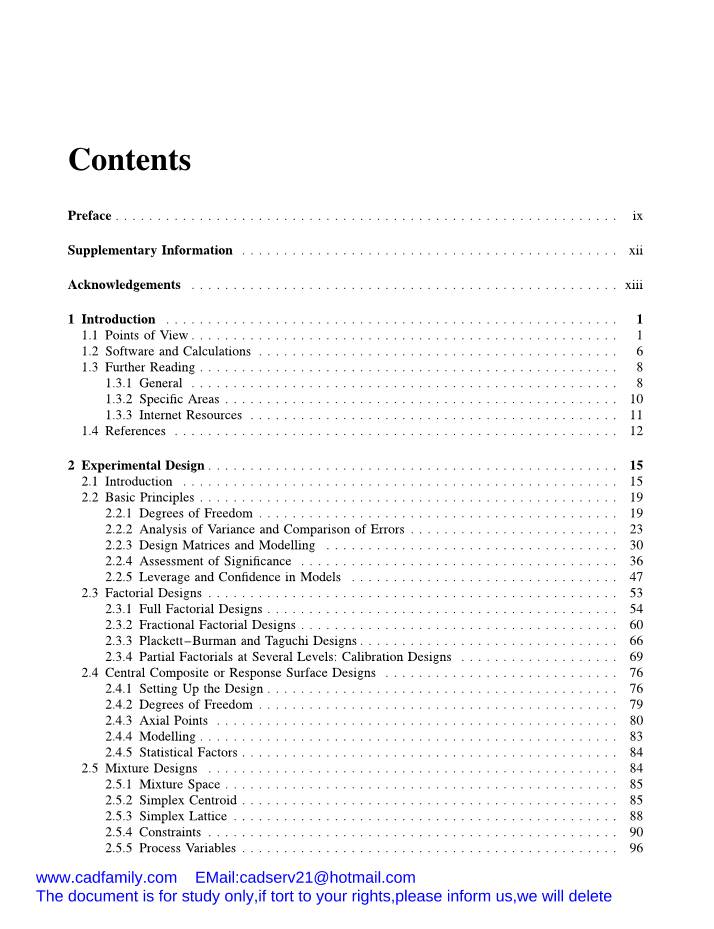


 设备数据采集
 工程招标采购
 搞笑表情
搞笑表情 微信头像
微信头像 CWMS冷库管理系统
 美女图片
美女图片 APP小游戏
 PPT模板
PPT模板 WMS仓库系统
 软件开发
软件开发