概要信息:
SAT Preparation Booklet 37
PLEASE DO NOT WRITE IN THIS AREA
SERIAL #
SAT Reasoning TestTM
Use a No. 2 pencil only. Be sure each mark is dark and completely
fills the intended circle. Completely erase any errors or stray marks.
(Print)
1
Last First M.I.
Your Name:
I agree to the conditions on the back of the SAT® test book.
Signature:
Home Address:
Date
Center:
(Print)
City State Zip Code
City State
Number and Street
Female Male
SEX5
DATE OF
BIRTH
Jan
Feb
Mar
Apr
May
Jun
Jul
Aug
Sep
Oct
Nov
Dec
MONTH DAY YEAR
1
2
3
0
1
2
3
4
5
6
5
6
5
6
7
8
9
0
8
1
2
3
4
7
8
9
0
9
4
7
0
1
2
3
4
5
6
7
8
9
0
1
2
3
4
5
6
7
8
9
0
1
2
3
4
5
6
7
8
9
0
1
2
3
4
5
6
7
8
9
0
1
2
3
4
5
6
7
8
9
0
1
2
3
4
5
6
7
8
9
0
1
2
3
4
5
6
7
8
9
0
1
2
3
4
5
6
7
8
9
0
1
2
3
4
5
6
7
8
9
0
1
2
3
4
5
6
7
8
9
REGISTRATION NUMBER6
(Copy from Admission Ticket.)
0
1
2
3
4
5
6
7
8
9
0
1
2
3
4
5
6
7
8
9
0
1
2
3
4
5
6
7
8
9
0
1
2
3
4
5
6
7
8
9
0
1
2
3
4
5
6
7
8
9
0
1
2
3
4
5
6
7
8
9
TEST BOOK
SERIAL NUMBER10
(Copy from front of test book.)
0
1
2
3
4
5
6
7
8
9
0
1
2
3
4
5
6
7
8
9
0
1
2
3
4
5
6
7
8
9
0
1
2
3
4
5
6
7
8
9
0
1
2
3
4
5
6
7
8
9
TEST
CENTER7
(Supplied by Test Center
Supervisor.)
TEST FORM
(Copy from back of test book.)9Important: Fill in items
8 and 9 exactly as shown
on the back of test book.
0
1
2
3
4
5
6
7
8
9
0
1
2
3
4
5
6
7
8
9
0
1
2
3
4
5
6
7
8
9
0
1
2
3
4
5
6
7
8
9
0
1
2
3
4
5
6
7
8
9
0
1
2
3
4
5
6
7
8
9
0
1
2
3
4
5
6
7
8
9
0
1
2
3
4
5
6
7
8
9
0
1
2
3
4
5
6
7
8
9
SOCIAL SECURITY
NUMBER3
FOR OFFICIAL USE ONLY
0 1 2 3 4 5 6 7 8 9
0 1 2 3 4 5 6 7 8 9
0 1 2 3 4 5 6 7 8 9
0 1 2 3 4 5 6 7 8 9
Last Name
(First 4 Letters)
YOUR NAME2
A
B
C
D
E
F
G
H
I
J
K
L
M
N
O
P
Q
R
S
T
U
V
W
X
Y
Z
A
B
C
D
E
F
G
H
I
J
K
L
M
N
O
P
Q
R
S
T
U
V
W
X
Y
Z
A
B
C
D
E
F
G
H
I
J
K
L
M
N
O
P
Q
R
S
T
U
V
W
X
Y
Z
A
B
C
D
E
F
G
H
I
J
K
L
M
N
O
P
Q
R
S
T
U
V
W
X
Y
Z
A
B
C
D
E
F
G
H
I
J
K
L
M
N
O
P
Q
R
S
T
U
V
W
X
Y
Z
A
B
C
D
E
F
G
H
I
J
K
L
M
N
O
P
Q
R
S
T
U
V
W
X
Y
Z
First
Init.
Mid.
Init.
–
’
–
’
–
’
Copyright © 2004 by College Entrance Examination Board. All rights reserved.
College Board, SAT, and the acorn logo are registered trademarks of the College Entrance Examination Board.
SAT Reasoning Test and SAT Subject Tests are trademarks owned by the College Entrance Examination Board.
FORM
CODE
1
2
3
4
5
6
7
8
9
0
(Copy and grid as on
back of test book.)
A
C
H
I
J
K
O
L
M
P
B
F
G
Q
S
V
E
D
R
N
U
T
W
Z
Y
X
A
C
H
I
J
K
O
L
M
P
B
F
G
Q
S
V
E
D
R
N
U
T
W
Z
Y
X
A
C
H
I
J
K
O
L
M
P
B
F
G
Q
S
V
E
D
R
N
U
T
W
Z
Y
X
A
C
H
I
J
K
O
L
M
P
B
F
G
Q
S
V
E
D
R
N
U
T
W
Z
Y
X
1
2
3
4
5
6
7
8
9
0
1
2
3
4
5
6
7
8
9
0
8
170232-001:654321 ISD5150
11030-36390 • NS114E1800 • Printed in U.S.A.
724843
SAT Preparation Booklet38
Yes
Page 2
I grant the College Board the unlimited right to use, reproduce, and publish my essay for any and all
purposes. My name will not be used in any way in conjunction with my essay. I understand that I am
free to mark "No," with no effect on my score.
No
Begin your essay on this page. If you need more space, continue on the next page. Do not write outside of the essay box.
Continue on the next page if necessary.
SECTION
1
SAT Preparation Booklet 39
PLEASE DO NOT WRITE IN THIS AREA
SERIAL #
Page 3
Continuation of ESSAY Section 1 from previous page. Write below only if you need more space.
SAT Preparation Booklet40
9
31
32
33
34
35
36
37
38
39
40
A B C D E
A B C D E
A B C D E
A B C D E
A B C D E
A B C D E
A B C D E
A B C D E
A B C D E
A B C D E
21
22
23
24
25
26
27
28
29
30
A B C D E
A B C D E
A B C D E
A B C D E
A B C D E
A B C D E
A B C D E
A B C D E
A B C D E
A B C D E
11
12
13
14
15
16
17
18
19
20
A B C D E
A B C D E
A B C D E
A B C D E
A B C D E
A B C D E
A B C D E
A B C D E
A B C D E
A B C D E
1
2
3
4
5
6
7
8
9
10
A B C D E
A B C D E
A B C D E
A B C D E
A B C D E
A B C D E
A B C D E
A B C D E
A B C D E
A B C D E
31
32
33
34
35
36
37
38
39
40
A B C D E
A B C D E
A B C D E
A B C D E
A B C D E
A B C D E
A B C D E
A B C D E
A B C D E
A B C D E
21
22
23
24
25
26
27
28
29
30
A B C D E
A B C D E
A B C D E
A B C D E
A B C D E
A B C D E
A B C D E
A B C D E
A B C D E
A B C D E
11
12
13
14
15
16
17
18
19
20
A B C D E
A B C D E
A B C D E
A B C D E
A B C D E
A B C D E
A B C D E
A B C D E
A B C D E
A B C D E
1
2
3
4
5
6
7
8
9
10
A B C D E
A B C D E
A B C D E
A B C D E
A B C D E
A B C D E
A B C D E
A B C D E
A B C D E
A B C D E
14
10
15
11
16
12
17
13
18
SECTION
2
SECTION
3
Use the answer spaces in the grids below for Section 2 or Section 3 only if you are told to do so
in your test book.
CAUTION
Student-Produced Responses ONLY ANSWERS ENTERED IN THE CIRCLES IN EACH GRID WILL BE SCORED. YOU WILL
NOT RECEIVE CREDIT FOR ANYTHING WRITTEN IN THE BOXES ABOVE THE CIRCLES.
Page 4
Start with number 1 for each new section. If a section has fewer questions than answer spaces, leave the extra
answer spaces blank. Be sure to erase any errors or stray marks completely.
0 0 0
1
2
3
4
5
6
7
8
9
1
2
3
4
5
6
7
8
9
1
2
3
4
5
6
7
8
9
1
2
3
4
5
6
7
8
9
⁄ ⁄
. . . .
0 0 0
1
2
3
4
5
6
7
8
9
1
2
3
4
5
6
7
8
9
1
2
3
4
5
6
7
8
9
1
2
3
4
5
6
7
8
9
⁄ ⁄
. . . .
0 0 0
1
2
3
4
5
6
7
8
9
1
2
3
4
5
6
7
8
9
1
2
3
4
5
6
7
8
9
1
2
3
4
5
6
7
8
9
⁄ ⁄
. . . .
0 0 0
1
2
3
4
5
6
7
8
9
1
2
3
4
5
6
7
8
9
1
2
3
4
5
6
7
8
9
1
2
3
4
5
6
7
8
9
⁄ ⁄
. . . .
0 0 0
1
2
3
4
5
6
7
8
9
1
2
3
4
5
6
7
8
9
1
2
3
4
5
6
7
8
9
1
2
3
4
5
6
7
8
9
⁄ ⁄
. . . .
0 0 0
1
2
3
4
5
6
7
8
9
1
2
3
4
5
6
7
8
9
1
2
3
4
5
6
7
8
9
1
2
3
4
5
6
7
8
9
⁄ ⁄
. . . .
0 0 0
1
2
3
4
5
6
7
8
9
1
2
3
4
5
6
7
8
9
1
2
3
4
5
6
7
8
9
1
2
3
4
5
6
7
8
9
⁄ ⁄
. . . .
0 0 0
1
2
3
4
5
6
7
8
9
1
2
3
4
5
6
7
8
9
1
2
3
4
5
6
7
8
9
1
2
3
4
5
6
7
8
9
⁄ ⁄
. . . .
0 0 0
1
2
3
4
5
6
7
8
9
1
2
3
4
5
6
7
8
9
1
2
3
4
5
6
7
8
9
1
2
3
4
5
6
7
8
9
⁄ ⁄
. . . .
0 0 0
1
2
3
4
5
6
7
8
9
1
2
3
4
5
6
7
8
9
1
2
3
4
5
6
7
8
9
1
2
3
4
5
6
7
8
9
⁄ ⁄
. . . .
SAT Preparation Booklet 41
9
31
32
33
34
35
36
37
38
39
40
A B C D E
A B C D E
A B C D E
A B C D E
A B C D E
A B C D E
A B C D E
A B C D E
A B C D E
A B C D E
21
22
23
24
25
26
27
28
29
30
A B C D E
A B C D E
A B C D E
A B C D E
A B C D E
A B C D E
A B C D E
A B C D E
A B C D E
A B C D E
11
12
13
14
15
16
17
18
19
20
A B C D E
A B C D E
A B C D E
A B C D E
A B C D E
A B C D E
A B C D E
A B C D E
A B C D E
A B C D E
1
2
3
4
5
6
7
8
9
10
A B C D E
A B C D E
A B C D E
A B C D E
A B C D E
A B C D E
A B C D E
A B C D E
A B C D E
A B C D E
31
32
33
34
35
36
37
38
39
40
A B C D E
A B C D E
A B C D E
A B C D E
A B C D E
A B C D E
A B C D E
A B C D E
A B C D E
A B C D E
21
22
23
24
25
26
27
28
29
30
A B C D E
A B C D E
A B C D E
A B C D E
A B C D E
A B C D E
A B C D E
A B C D E
A B C D E
A B C D E
11
12
13
14
15
16
17
18
19
20
A B C D E
A B C D E
A B C D E
A B C D E
A B C D E
A B C D E
A B C D E
A B C D E
A B C D E
A B C D E
1
2
3
4
5
6
7
8
9
10
A B C D E
A B C D E
A B C D E
A B C D E
A B C D E
A B C D E
A B C D E
A B C D E
A B C D E
A B C D E
14
10
15
11
16
12
17
13
18
Use the answer spaces in the grids below for Section 4 or Section 5 only if you are told to
do so in your test book.CAUTION
Student-Produced Responses
Page 5
Start with number 1 for each new section. If a section has fewer questions than answer spaces, leave the extra
answer spaces blank. Be sure to erase any errors or stray marks completely.
SECTION
4
SECTION
5
ONLY ANSWERS ENTERED IN THE CIRCLES IN EACH GRID WILL BE SCORED. YOU WILL
NOT RECEIVE CREDIT FOR ANYTHING WRITTEN IN THE BOXES ABOVE THE CIRCLES.
0 0 0
1
2
3
4
5
6
7
8
9
1
2
3
4
5
6
7
8
9
1
2
3
4
5
6
7
8
9
1
2
3
4
5
6
7
8
9
⁄ ⁄
. . . .
0 0 0
1
2
3
4
5
6
7
8
9
1
2
3
4
5
6
7
8
9
1
2
3
4
5
6
7
8
9
1
2
3
4
5
6
7
8
9
⁄ ⁄
. . . .
0 0 0
1
2
3
4
5
6
7
8
9
1
2
3
4
5
6
7
8
9
1
2
3
4
5
6
7
8
9
1
2
3
4
5
6
7
8
9
⁄ ⁄
. . . .
0 0 0
1
2
3
4
5
6
7
8
9
1
2
3
4
5
6
7
8
9
1
2
3
4
5
6
7
8
9
1
2
3
4
5
6
7
8
9
⁄ ⁄
. . . .
0 0 0
1
2
3
4
5
6
7
8
9
1
2
3
4
5
6
7
8
9
1
2
3
4
5
6
7
8
9
1
2
3
4
5
6
7
8
9
⁄ ⁄
. . . .
0 0 0
1
2
3
4
5
6
7
8
9
1
2
3
4
5
6
7
8
9
1
2
3
4
5
6
7
8
9
1
2
3
4
5
6
7
8
9
⁄ ⁄
. . . .
0 0 0
1
2
3
4
5
6
7
8
9
1
2
3
4
5
6
7
8
9
1
2
3
4
5
6
7
8
9
1
2
3
4
5
6
7
8
9
⁄ ⁄
. . . .
0 0 0
1
2
3
4
5
6
7
8
9
1
2
3
4
5
6
7
8
9
1
2
3
4
5
6
7
8
9
1
2
3
4
5
6
7
8
9
⁄ ⁄
. . . .
0 0 0
1
2
3
4
5
6
7
8
9
1
2
3
4
5
6
7
8
9
1
2
3
4
5
6
7
8
9
1
2
3
4
5
6
7
8
9
⁄ ⁄
. . . .
0 0 0
1
2
3
4
5
6
7
8
9
1
2
3
4
5
6
7
8
9
1
2
3
4
5
6
7
8
9
1
2
3
4
5
6
7
8
9
⁄ ⁄
. . . .
SAT Preparation Booklet42
9
31
32
33
34
35
36
37
38
39
40
A B C D E
A B C D E
A B C D E
A B C D E
A B C D E
A B C D E
A B C D E
A B C D E
A B C D E
A B C D E
21
22
23
24
25
26
27
28
29
30
A B C D E
A B C D E
A B C D E
A B C D E
A B C D E
A B C D E
A B C D E
A B C D E
A B C D E
A B C D E
11
12
13
14
15
16
17
18
19
20
A B C D E
A B C D E
A B C D E
A B C D E
A B C D E
A B C D E
A B C D E
A B C D E
A B C D E
A B C D E
1
2
3
4
5
6
7
8
9
10
A B C D E
A B C D E
A B C D E
A B C D E
A B C D E
A B C D E
A B C D E
A B C D E
A B C D E
A B C D E
31
32
33
34
35
36
37
38
39
40
A B C D E
A B C D E
A B C D E
A B C D E
A B C D E
A B C D E
A B C D E
A B C D E
A B C D E
A B C D E
21
22
23
24
25
26
27
28
29
30
A B C D E
A B C D E
A B C D E
A B C D E
A B C D E
A B C D E
A B C D E
A B C D E
A B C D E
A B C D E
11
12
13
14
15
16
17
18
19
20
A B C D E
A B C D E
A B C D E
A B C D E
A B C D E
A B C D E
A B C D E
A B C D E
A B C D E
A B C D E
1
2
3
4
5
6
7
8
9
10
A B C D E
A B C D E
A B C D E
A B C D E
A B C D E
A B C D E
A B C D E
A B C D E
A B C D E
A B C D E
14
10
15
11
16
12
17
13
18
SECTION
6
SECTION
7
Use the answer spaces in the grids below for Section 6 or Section 7 only if you are told to
do so in your test book.CAUTION
Student-Produced Responses
Start with number 1 for each new section. If a section has fewer questions than answer spaces, leave the extra
answer spaces blank. Be sure to erase any errors or stray marks completely.
ONLY ANSWERS ENTERED IN THE CIRCLES IN EACH GRID WILL BE SCORED. YOU WILL
NOT RECEIVE CREDIT FOR ANYTHING WRITTEN IN THE BOXES ABOVE THE CIRCLES.
PLEASE DO NOT WRITE IN THIS AREA
SERIAL #
Page 6
0 0 0
1
2
3
4
5
6
7
8
9
1
2
3
4
5
6
7
8
9
1
2
3
4
5
6
7
8
9
1
2
3
4
5
6
7
8
9
⁄ ⁄
. . . .
0 0 0
1
2
3
4
5
6
7
8
9
1
2
3
4
5
6
7
8
9
1
2
3
4
5
6
7
8
9
1
2
3
4
5
6
7
8
9
⁄ ⁄
. . . .
0 0 0
1
2
3
4
5
6
7
8
9
1
2
3
4
5
6
7
8
9
1
2
3
4
5
6
7
8
9
1
2
3
4
5
6
7
8
9
⁄ ⁄
. . . .
0 0 0
1
2
3
4
5
6
7
8
9
1
2
3
4
5
6
7
8
9
1
2
3
4
5
6
7
8
9
1
2
3
4
5
6
7
8
9
⁄ ⁄
. . . .
0 0 0
1
2
3
4
5
6
7
8
9
1
2
3
4
5
6
7
8
9
1
2
3
4
5
6
7
8
9
1
2
3
4
5
6
7
8
9
⁄ ⁄
. . . .
0 0 0
1
2
3
4
5
6
7
8
9
1
2
3
4
5
6
7
8
9
1
2
3
4
5
6
7
8
9
1
2
3
4
5
6
7
8
9
⁄ ⁄
. . . .
0 0 0
1
2
3
4
5
6
7
8
9
1
2
3
4
5
6
7
8
9
1
2
3
4
5
6
7
8
9
1
2
3
4
5
6
7
8
9
⁄ ⁄
. . . .
0 0 0
1
2
3
4
5
6
7
8
9
1
2
3
4
5
6
7
8
9
1
2
3
4
5
6
7
8
9
1
2
3
4
5
6
7
8
9
⁄ ⁄
. . . .
0 0 0
1
2
3
4
5
6
7
8
9
1
2
3
4
5
6
7
8
9
1
2
3
4
5
6
7
8
9
1
2
3
4
5
6
7
8
9
⁄ ⁄
. . . .
0 0 0
1
2
3
4
5
6
7
8
9
1
2
3
4
5
6
7
8
9
1
2
3
4
5
6
7
8
9
1
2
3
4
5
6
7
8
9
⁄ ⁄
. . . .
Section 7, the equating
section of this practice
test, has been omitted.
SAT Preparation Booklet 43
Page 7
Start with number 1 for each new section. If a section has fewer questions than answer spaces, leave the extra
answer spaces blank. Be sure to erase any errors or stray marks completely.
31
32
33
34
35
36
37
38
39
40
A B C D E
A B C D E
A B C D E
A B C D E
A B C D E
A B C D E
A B C D E
A B C D E
A B C D E
A B C D E
21
22
23
24
25
26
27
28
29
30
A B C D E
A B C D E
A B C D E
A B C D E
A B C D E
A B C D E
A B C D E
A B C D E
A B C D E
A B C D E
11
12
13
14
15
16
17
18
19
20
A B C D E
A B C D E
A B C D E
A B C D E
A B C D E
A B C D E
A B C D E
A B C D E
A B C D E
A B C D E
1
2
3
4
5
6
7
8
9
10
A B C D E
A B C D E
A B C D E
A B C D E
A B C D E
A B C D E
A B C D E
A B C D E
A B C D E
A B C D E
SECTION
8
31
32
33
34
35
36
37
38
39
40
A B C D E
A B C D E
A B C D E
A B C D E
A B C D E
A B C D E
A B C D E
A B C D E
A B C D E
A B C D E
21
22
23
24
25
26
27
28
29
30
A B C D E
A B C D E
A B C D E
A B C D E
A B C D E
A B C D E
A B C D E
A B C D E
A B C D E
A B C D E
11
12
13
14
15
16
17
18
19
20
A B C D E
A B C D E
A B C D E
A B C D E
A B C D E
A B C D E
A B C D E
A B C D E
A B C D E
A B C D E
1
2
3
4
5
6
7
8
9
10
A B C D E
A B C D E
A B C D E
A B C D E
A B C D E
A B C D E
A B C D E
A B C D E
A B C D E
A B C D E
SECTION
9
31
32
33
34
35
36
37
38
39
40
A B C D E
A B C D E
A B C D E
A B C D E
A B C D E
A B C D E
A B C D E
A B C D E
A B C D E
A B C D E
21
22
23
24
25
26
27
28
29
30
A B C D E
A B C D E
A B C D E
A B C D E
A B C D E
A B C D E
A B C D E
A B C D E
A B C D E
A B C D E
11
12
13
14
15
16
17
18
19
20
A B C D E
A B C D E
A B C D E
A B C D E
A B C D E
A B C D E
A B C D E
A B C D E
A B C D E
A B C D E
1
2
3
4
5
6
7
8
9
10
A B C D E
A B C D E
A B C D E
A B C D E
A B C D E
A B C D E
A B C D E
A B C D E
A B C D E
A B C D E
SECTION
10
Timing
• You will have 3 hours and 45 minutes to work on this test.
• There are ten separately timed sections:
! One 25-minute essay
! Six other 25-minute sections
! Two 20-minute sections
! One 10-minute section
• You may work on only one section at a time.
• The supervisor will tell you when to begin and end each section.
• If you finish a section before time is called, check your work on that
section. You may NOT turn to any other section.
• Work as rapidly as you can without losing accuracy. Don’t waste time
on questions that seem too difficult for you.
Marking Answers
• Carefully mark only one answer for each question.
• Make sure each mark is dark and completely fills the circle.
• Do not make any stray marks on your answer sheet.
• If you erase, do so completely. Incomplete erasures may be scored
as intended answers.
• Use only the answer spaces that correspond to the question numbers.
• You may use the test book for scratchwork, but you will not receive
credit for anything written there.
• After time has been called, you may not transfer answers to your
answer sheet or fill in circles.
• You may not fold or remove pages or portions of a page from this
book, or take the book or answer sheet from the testing room.
Scoring
• For each correct answer to a question, you receive one point.
• For questions you omit, you receive no points.
• For a wrong answer to a multiple-choice question, you lose
one-fourth of a point.
! If you can eliminate one or more of the answer choices as
wrong, you increase your chances of choosing the correct
answer and earning one point.
! If you can’t eliminate any choice, move on. You can return to
the question later if there is time.
• For a wrong answer to a student-produced response (“grid-in”) math
question, you don’t lose any points.
• The essay is scored on a 1 to 6 scale by two different readers. The
total essay score is the sum of the two readers’ scores.
• An off-topic or blank essay will receive a score of zero.
The passages for this test have been adapted from published material.
The ideas contained in them do not necessarily represent the opinions of
the College Board or Educational Testing Service.
SAT  Reasoning Test — General Directions
DO NOT OPEN THIS BOOK UNTIL THE
SUPERVISOR TELLS YOU TO DO SO.
YOUR NAME (PRINT)
LAST FIRST MI
TEST CENTER
NUMBER NAME OF TEST CENTER ROOM NUMBER
IMPORTANT:  The codes below are unique to your
test book. Copy them on your answer sheet in boxes 8
and 9 and fill in the corresponding circles exactly as
shown.
UNAUTHORIZED REPRODUCTION OR USE OF ANY PART OF THIS TEST IS PROHIBITED.
725383
A
B
C
D
E
F
G
H
I
J
K
L
M
N
O
P
Q
R
S
T
U
V
W
X
Y
Z
A
B
C
D
E
F
G
H
I
J
K
L
M
N
O
P
Q
R
S
T
U
V
W
X
Y
Z
0
1
2
3
4
5
6
7
8
9
0
1
2
3
4
5
6
7
8
9
0
1
2
3
4
5
6
7
8
9
A
B
C
D
E
F
G
H
I
J
K
L
M
N
O
P
Q
R
S
T
U
V
W
X
Y
Z
A
B
C
D
E
F
G
H
I
J
K
L
M
N
O
P
Q
R
S
T
U
V
W
X
Y
Z
FORM CODE8
(Copy and grid as on
back of test book.)
A B C D 1 2 3
TEST FORM9 (Copy from back of test book)
4162068
SAT Preparation Booklet44


ESSAY
Time — 25 minutes

Turn to page 2 of your answer sheet to write your ESSAY.

The essay gives you an opportunity to show how effectively you can develop and express ideas. You should, therefore, take
care to develop your point of view, present your ideas logically and clearly, and use language precisely.

Your essay must be written on the lines provided on your answer sheet—you will receive no other paper on which to write.
You will have enough space if you write on every line, avoid wide margins, and keep your handwriting to a reasonable size.
Remember that people who are not familiar with your handwriting will read what you write. Try to write or print so that what
you are writing is legible to those readers.

You have twenty-five minutes to write an essay on the topic assigned below. DO NOT WRITE ON ANOTHER TOPIC.
AN OFF-TOPIC ESSAY WILL RECEIVE A SCORE OF ZERO.


Think carefully about the issue presented in the following excerpt and the assignment below.

Given the importance of human creativity, one would think it should have a high priority among
our concerns. But if we look at the reality, we see a different picture. Basic scientific research is
minimized in favor of immediate practical applications. The arts are increasingly seen as
dispensable luxuries. Yet as competition heats up around the globe, exactly the opposite strategy
is needed.

Adapted from Mihaly Csikszentmihalyi, Creativity:  Flow and the Psychology of Discovery and
Invention


Assignment: Is creativity needed more than ever in the world today? Plan and write an essay in which you develop your
point of view on this issue. Support your position with reasoning and examples taken from your reading,
studies, experience, or observations.


DO NOT WRITE YOUR ESSAY IN YOUR TEST BOOK. You will receive credit only for what you write on your answer
sheet.


BEGIN WRITING YOUR ESSAY ON PAGE 2 OF THE ANSWER SHEET.


If you finish before time is called, you may check your work on this section only.
Do not turn to any other section in the test.

SAT Preparation Booklet 45
SAT Preparation Booklet46


SECTION 2
Time — 25 minutes
18 Questions

Turn to Section 2 (page 4) of your answer sheet to answer the questions in this section.

Directions:  This section contains two types of questions. You have 25 minutes to complete both types. For questions 1-8, solve
each problem and decide which is the best of the choices given. Fill in the corresponding circle on the answer sheet. You may
use any available space for scratchwork.


 1. If 4 3 19t u+ + = ,  then t u+ =
(A) 3
(B) 4
(C) 5
(D) 6
(E) 7


 2. In the figure above, three lines intersect at a point.
If f = 85 and c = 25,  what is the value of a ?
(A) 60
(B) 65
(C) 70
(D) 75
(E) 85

SAT Preparation Booklet 47


 3. If Marisa drove n miles in t hours, which of the
following represents her average speed, in miles per
hour?
(A) n
t
(B) t
n
(C) 1
nt

(D) nt

(E) n t2


 4. If a is an odd integer and b is an even integer, which
of the following is an odd integer?
(A) 3b
(B) a + 3
(C) 2 a b+
(D) a b+ 2
(E) 2a b+


 5. In the coordinate plane, the points F 2 1, ,  G 1 4, ,
and H 4 1,  lie on a circle with center P. What are the
coordinates of point P ?
(A) 0 0,
(B) 1 1,
(C) 1 2,
(D) 1 2,
(E) 2 5 2 5. , .


 6. The graph of ( )y f x  is shown above. If
3 6,x  for how many values of x does
( ) 2 ?f x
(A) None
(B) One
(C) Two
(D) Three
(E) More than three


 7. If the average (arithmetic mean) of t and t + 2  is x
and if the average of t and t − 2  is y, what is the
average of x and y ?
(A) 1

(B) t
2

(C) t

(D) t + 1
2
(E) 2t


 8. For all numbers x and y, let x y!  be defined
as x y x xy y!
2 2 .  What is the value
of ( ) ?3 1 1! !
(A)  5
(B)  13
(C)  27
(D) 170
(E) 183
SAT Preparation Booklet48


 9. Morgan’s plant grew from 42 centimeters to
57 centimeters in a year. Linda’s plant, which was
59 centimeters at the beginning of the year, grew twice
as many centimeters as Morgan’s plant did during the
same year. How tall, in centimeters, was Linda’s plant at
the end of the year?


10. Since the beginning of 1990, the number of squirrels
in a certain wooded area has tripled during every
  3-year period of time. If there were 5,400 squirrels in
the wooded area at the beginning of 1999, how many
squirrels were in the wooded area at the beginning
of 1990 ?

SAT Preparation Booklet 49


11. In the figure above, triangles ABC and CDE are
equilateral and line segment AE  has length 25. What
is the sum of the perimeters of the two triangles?


12. Marbles are to be removed from a jar that contains 12
red marbles and 12 black marbles. What is the least
number of marbles that could be removed so that the
ratio of red marbles to black marbles left in the jar will
be 4 to 3 ?


x v
v t
x pt
=
=
=
3
4

13. For the system of equations above, if x 0, what is
the value of p ?


14. If 2 1 1,x  what is one possible value of x ?


SAT Preparation Booklet50


15. For what positive number is the square root of the
number the same as the number divided by 40 ?


16. In rectangle ABDF above, C and E are midpoints of
sides BD  and ,DF  respectively. What fraction of
the area of the rectangle is shaded?


17. The graph above shows the amount of water

remaining in a tank each time a pail was used to

remove x gallons of water. If 5 gallons were in the
tank originally and 12
3
 gallons remained after the
last pail containing x gallons was removed, what

is the value of x ?


18. If 0 ≤ ≤x y  and x y x y+ − − ≥2 2 25,  what
is the least possible value of y ?


S T O P
If you finish before time is called, you may check your work on this section only.
Do not turn to any other section in the test.


-10-

SECTION 3
Time — 25 minutes
35 Questions

Turn to Section 3 (page 4) of your answer sheet to answer the questions in this section.

Directions:  For each question in this section, select the best answer from among the choices given and fill in the corresponding
circle on the answer sheet.

The following sentences test correctness and effectiveness
of expression. Part of each sentence or the entire sentence
is underlined; beneath each sentence are five ways of
phrasing the underlined material. Choice A repeats the
original phrasing; the other four choices are different. If
you think the original phrasing produces a better sentence
than any of the alternatives, select choice A; if not, select
one of the other choices.
In making your selection, follow the requirements of
standard written English; that is, pay attention to grammar,
choice of words, sentence construction, and punctuation.
Your selection should result in the most effective
sentence—clear and precise, without awkwardness or
ambiguity.

 EXAMPLE:
 Laura Ingalls Wilder published her first book
 and she was sixty-five years old then.
 (A) and she was sixty-five years old then
 (B) when she was sixty-five
 (C) at age sixty-five years old
 (D) upon the reaching of sixty-five years
 (E) at the time when she was sixty-five


 1. The poet Claude McKay was a native of Jamaica who
spent most of his life in the United States but writing
some of his poems in the Jamaican dialect.
(A) The poet Claude McKay was a native of Jamaica
who spent most of his life in the United States
but writing
(B) Being that he was a Jamaican who spent
most of his life in the United States, the
poet Claude McKay writing
(C) Although a native of Jamaica, the poet Claude
McKay spent most of his life in the United
States, he wrote
(D) Although the poet Claude McKay spent
most of his life in the United States, he
was a native of Jamaica and wrote
(E) Because he was a native of Jamaica who spent
most of his life in the United States, the poet
Claude McKay writing

 2. Many ancient Eastern rulers favored drinking vessels
made of celadon porcelain because of supposedly
revealing the presence of poison by cracking.
(A) because of supposedly revealing the presence of
poison
(B) for being supposed that it would reveal the
presence of poison
(C) because of being supposed to reveal
poison in it
(D) for it was supposed to reveal that there is poison
(E) because it was supposed to reveal the presence of
poison

 3. John believes that plants respond to human attention,
which causes his talking to his African violets every
night.
(A) attention, which causes his talking
(B) attention and talking is what is done
(C) attention and his talks
(D) attention; for this reason has been his talking
(E) attention; he therefore talks

 4. All the demands on soprano Kathleen Battle for
operatic performances, solo concerts, and special guest
appearances, tempting her to sing too often and
straining her voice.
(A) appearances, tempting her to sing too often and
straining
(B) appearances not only tempt her to sing too often
plus they strain
(C) appearances tempts her not only into singing too
often but then she strains
(D) appearances, tempting her into singing too often
and she therefore strains
(E) appearances tempt her to sing too often and strain

SAT Preparation Booklet 51


-11-

 5. One reason that an insect can walk on walls while a
human cannot is that the mass of its tiny body is far
lower than humans.
(A) far lower than humans
(B) far lower than that of a human’s body
(C) lower by far than humans
(D) far lower than a human
(E) far lower than is a human’s body

 6. In the 1980’s, the median price of a house more than
doubled, generally outdistancing the rate of inflation.
(A) generally outdistancing the rate of inflation
(B) generally this outdistanced the rate of inflation
(C) and the result was the general outdistancing of
inflation
(D) the general rate of inflation was thus outdistanced
(E) thus generally inflation had been outdistanced

 7. In the nineteenth century, reproductions of cathedrals
or castles made entirely of ice was often a popular
feature in North American winter carnivals.
(A) was often a popular feature
(B) often were popular features
(C) often was featured popularly
(D) often being popular features
(E) have been featured popularly

 8. A fine orchestral performance will exhibit the skills of
the musicians, their abilities to work as an ensemble,
and how he or she responds to the conductor.
(A) how he or she responds
(B) how to respond
(C) their responding
(D) their responses
(E) they respond

 9. The African tsetse fly does not need a brain, everything
it has to do in life is programmed into its nervous
system.
(A) brain, everything
(B) brain due to everything which
(C) brain, for everything
(D) brain; since, everything
(E) brain whereas everything

10. She was concerned about how Hank would react to
the incident, but in searching his face, he did not
seem to be at all embarrassed or troubled.
(A) in searching his face, he did not seem to be
(B) by searching his face, it showed that he
was not
(C) a search of his face showed that he seemed not
(D) searching his face, he did not seem to be
(E) his face being searched showed that he
was not

11. Explaining modern art is impossible, partly because of
its complexity but largely because of it rapidly
changing.
(A) of it rapidly changing
(B) it makes rapid changes
(C) of the rapidity with which it changes
(D) changing it is rapid
(E) it changes so rapid

SAT Preparation Booklet52


-12-


The following sentences test your ability to recognize
grammar and usage errors. Each sentence contains either
a single error or no error at all. No sentence contains more
than one error. The error, if there is one, is underlined
and lettered. If the sentence contains an error, select the
one underlined part that must be changed to make the
sentence correct. If the sentence is correct, select choice E.
In choosing answers, follow the requirements of standard
written English.

 EXAMPLE:

The other
A
 delegates and him
B
 immediately
C

 accepted the resolution drafted by
D
 the
 neutral states. No error
E


12. The ambassador was entertained lavish
A
 by
Hartwright, whose company
B
 has
C
 a monetary
interest in
D
 the industrial development of the
new country. No error
E
13. Among
A
 the discoveries made possible by
B

the invention of
C
 the telescope they found
D
that
 dark spots existed on the Sun in varying numbers.
No error
E
14. This liberal arts college has
A
 decided requiring
B

all students to study
C
 at least one
D
 non-European
language. No error
E
15. Twenty-five years after
A
 Alex Haley’s Roots stimulate
B

many people to research
C
 their family histories, new
technology has been developed to make the task
easier
D
. No error
E
16. For months the press had praised Thatcher’s handling
of the international crisis, and
A
 editorial views changed
quickly
B
 when
C
 the domestic economy worsened
D
.
No error
E
17. Experiments have shown
A
 that human skin provides
B

natural protection against a surprising
C
 large
number of
D
 infectious bacteria. No error
E
18. In the aggressive society created by
A
 William Golding
 in Lord of the Flies, both Ralph and Jack emerge
early on
B
 as the leader
C
 of
D
 the lost boys. No error
E


19. More than forty years have passed
A
 since
B
 a quarter
of a million people marched on Washington, D.C.,
in an attempt
C
 to secure
D
 civil rights for Black
Americans. No error
E
SAT Preparation Booklet 53


-13-

20. Careful analysis of pictures of the Moon reveal
A
 that
parts of the Moon’s surface are
B
 markedly
C
 similar to
parts of the Earth’s
D
. No error
E
21. London differs from
A
 other cities, such as
B
 Paris and
New York, in that
C
 its shopping areas are so widely
D

spread out. No error
E


22. The architect’s research shows that even when builders
construct
A
 houses of stone
B
, they still
C
 use the hammer
more than any tool
D
. No error
E
23. Of
A
 the two options, neither
B
 the system of appointing
judges to the bench nor the process of electing
C
 judges
are
D
 entirely satisfactory. No error
E
24. Carlos cherished the memory of the day when him
A

and his sister Rosa were presented
B
 with awards
in recognition of
C
 meritorious service to
D
 the
community. No error
E


25. The famous filmmaker had a tendency
A
 of changing
B

his recollections, perhaps out of boredom
C
 at having
D

to tell interviewers the same story over and over.
No error
E
26. Norwegian writer Sigrid Undset is like
A
 the novelist Sir
Walter Scott in
B
 her use of historical backgrounds, but
unlike his books
C
, she dwells on the psychological
aspects of
D
 her characters. No error
E
27. The television station has received
A
 many complaints
about
B
 the clothing advertisements, which some
C

viewers condemn to be
D
 tasteless. No error
E
28. The relationship between goby fish and striped shrimp
are truly
A
 symbiotic, for neither
B
 can survive
C
 without
D

the other. No error
E
29. Winston Churchill, unlike
A
 many English prime
ministers before him
B
, had deep insight into
C
 the
workings of
D
 the human mind. No error
E

SAT Preparation Booklet54


-14-

Directions:  The following passage is an early draft of an
essay. Some parts of the passage need to be rewritten.
Read the passage and select the best answers for the
questions that follow. Some questions are about particular
sentences or parts of sentences and ask you to improve
sentence structure or word choice. Other questions ask you
to consider organization and development. In choosing
answers, follow the requirements of standard written
English.

Questions 30-35 are based on the following passage.
(1) My father has an exceptional talent. (2) The
ability to understand people. (3) When I have a problem
that I think no one else will understand, I take it to my
father. (4) He listens intently, asks me some questions,
and my feelings are seemingly known by him exactly.
(5) Even my twin sister can talk to him more easily than
to me. (6) Many people seem too busy to take the time
to understand one another. (7) My father, by all
accounts, sees taking time to listen as essential to any
relationship, whether it involves family, friendship, or
work.
(8) At work, my father’s friends and work associates
benefit from this talent. (9) His job requires him to attend
social events and sometimes I go along. (10) I have
watched him at dinner; his eyes are fixed on whoever is
speaking, and he nods his head at every remark. (11) My
father emerges from such a conversation with what I believe
is a true sense of the speaker’s meaning. (12) In the same
way, we choose our friends.
(13) My father’s ability to listen affects his whole
life. (14) His ability allows him to form strong
relationships with his coworkers and earns him
lasting friendships. (15) It allows him to have open
conversations with his children. (16) Furthermore, it
has strengthened his relationship with my mother.
(17) Certainly, his talent is one that I hope to develop
as I mature.

30. Of the following, which is the best way to revise and
combine sentences 1 and 2 (reproduced below) ?
  My father has an exceptional talent. The ability to
understand people.
(A) My father has an exceptional talent and the ability
to understand people.
(B) My father has an exceptional talent that includes
the ability to understand people.
(C) My father has an exceptional talent:  the ability to
understand people.
(D) My father has an exceptional talent, it is his
ability to understand people.
(E) Despite my father’s exceptional talent, he still has
the ability to understand people.

31. Of the following, which is the best way to phrase
sentence 4 (reproduced below) ?
  He listens intently, asks me some questions, and my
feelings are seemingly known by him exactly.
(A) (As it is now)
(B) Listening intently, he will ask me some questions
and then my exact feelings are seemingly known
to him.
(C) As he listens to me and asks me some questions,
he seems to be knowing exactly my feelings.
(D) He listened to me and asked me some questions,
seeming to know exactly how I felt.
(E) He listens intently, asks me some questions, and
then seems to know exactly how I feel.

32. In sentence 7, the phrase by all accounts is best
replaced by
(A) however
(B) moreover
(C) to my knowledge
(D) like my sister
(E) but nevertheless

33. Which of the following sentences should be omitted to
improve the unity of the second paragraph?
(A) Sentence 8
(B) Sentence 9
(C) Sentence 10
(D) Sentence 11
(E) Sentence 12

SAT Preparation Booklet 55


-15-

34. In context, which of the following is the best way to
phrase the underlined portion of sentence 16
(reproduced below) ?
  Furthermore, it has strengthened his relationship with
my mother.
(A) (As it is now)
(B) Further strengthening
(C) But it strengthens
(D) However, he is strengthening
(E) Considering this, he strengthens

35. A strategy that the writer uses within the third
paragraph is to
(A) make false assumptions and use exaggeration
(B) include difficult vocabulary
(C) repeat certain words and sentence patterns
(D) argue in a tone of defiance
(E) turn aside from the main subject


S T O P
If you finish before time is called, you may check your work on this section only.
Do not turn to any other section in the test.

SAT Preparation Booklet56


SECTION 4
Time — 25 minutes
23 Questions

Turn to Section 4 (page 5) of your answer sheet to answer the questions in this section.

Directions:  For each question in this section, select the best answer from among the choices given and fill in the corresponding
circle on the answer sheet.

Each sentence below has one or two blanks, each blank
indicating that something has been omitted. Beneath
the sentence are five words or sets of words labeled A
through E. Choose the word or set of words that, when
inserted in the sentence, best fits the meaning of the
sentence as a whole.
Example:
Hoping to ------- the dispute, negotiators proposed
a compromise that they felt would be ------- to both
labor and management.
(A) enforce . . useful
(B) end . . divisive
(C) overcome . . unattractive
(D) extend . . satisfactory
(E) resolve . . acceptable


 1. Scientific discoveries are often thought of as the result
of ------- effort, but many discoveries have, in fact,
arisen from ------- or a mistake.
(A) conscientious . . a method
(B) incidental . . a mishap
(C) collaborative . . a design
(D) persistent . . an extension
(E) systematic . . an accident

 2. Nations that share a border are, by definition, -------.
(A) allied  (B) partisan  (C) contiguous
 (D) pluralistic  (E) sovereign

 3. Much of this author’s work, unfortunately, is -------,
with ------- chapter often immediately following a
sublime one.
(A) mystical . . a superior
(B) uneven . . a mediocre
(C) predictable . . an eloquent
(D) enthralling . . a vapid
(E) flippant . . an intelligible

 4. In young children, some brain cells have a ------- that
enables them to take over the functions of damaged
or missing brain cells.
(A) fragility  (B) reminiscence
 (C) perniciousness  (D) whimsicality
  (E) plasticity

 5. “Less government spending” is ------- of this political
party, a belief shared by most party members.
(A) an acronym  (B) a retraction  (C) a tenet
 (D) a plight  (E) a prospectus

SAT Preparation Booklet 57


-
The passages below are followed by questions based on their content; questions following a pair of related passages may also
be based on the relationship between the paired passages. Answer the questions on the basis of what is stated or implied in the
passages and in any introductory material that may be provided.

Questions 6-7 are based on the following passage.
Duke Ellington considered himself “the world’s greatest
listener.” In music, hearing is all. Judging by the two or
three thousand pieces of music Ellington wrote, he could
probably hear a flea scratching itself and put that rhythm
into one of his compositions. For him the sounds of the 5
world were the ingredients he mixed into appetizers,
main courses, and desserts to satisfy the appetite of his
worldwide audience. He wasn’t averse to going out in
a boat to catch the fish himself. He would raise the fowl
himself. But when that musical meal appeared before you 10
none of the drudgery showed.

 6. The author most likely refers to the “flea” in line 4
in order to
(A) highlight Ellington’s prodigious memory
(B) emphasize the quality of Ellington’s listening
skills
(C) indicate Ellington’s interest in different animal
sounds
(D) suggest that Ellington’s compositions were
marked by rhythmic similarities
(E) imply that Ellington could be overly concerned
about minutia

 7. In lines 5-11 (“For him . . . drudgery showed”),
the author’s point is primarily developed through
the use of
(A) comparison and contrast
(B) appeal to emotion
(C) exaggeration
(D) metaphor
(E) humor

Questions 8-9 are based on the following passage.
In the summer of 1911, the explorer Hiram Bingham III
bushwhacked his way to a high ridge in the Andes of Peru
and beheld a dreamscape out of the past. There, set against
looming peaks cloaked in snow and wreathed in clouds,
was Machu Picchu, the famous “lost city” of the Incas.  5
This expression, popularized by Bingham, served as
a magical elixir for rundown imaginations. The words
evoked the romanticism of exploration and archaeology
at the time. But finding Machu Picchu was easier than
solving the mystery of its place in the rich and powerful 10
Inca empire. The imposing architecture attested to the skill
and audacity of the Incas. But who had lived at this isolated
site and for what purpose?

 8. The words “magical elixir” (line 7) primarily
emphasize the
(A) motivation for an expedition
(B) captivating power of a phrase
(C) inspiration behind a discovery
(D) creative dimension of archaeology
(E) complexity of an expression

 9. The “mystery” discussed in lines 10-13 is most
analogous to that encountered in which of the
following situations?
(A) Being unable to locate the source of materials
used to construct an ancient palace
(B) Being unable to reconcile archaeological evi-
dence with mythical descriptions of an
ancient city
(C) Being unable to explain how ancient peoples
constructed imposing monuments using
only primitive technology
(D) Being unable to understand the religious
function of a chamber found inside an
ancient temple
(E) Being unable to discover any trace of a civ-
ilization repeatedly mentioned by ancient
authors

Line Line
SAT Preparation Booklet58


-
Questions 10-14 are based on the following passage.
This passage is from the preface to a 1997 book by
a United States journalist detailing a disagreement
between doctors and family members about a child’s
medical treatment at a hospital in California.
Under my desk I keep a large carton of cassette tapes.
Though they have all been transcribed, I still like to listen
to them from time to time.
Some are quiet and easily understood. They are filled
with the voices of American doctors, interrupted occasion- 5
ally by the clink of a coffee cup or beep of a pager. The
rest—more than half of them—are very noisy. They are
filled with the voices of the Lees family, Hmong refugees
from Laos who came to the United States in 1980. Against
a background of babies crying, children playing, doors 10
slamming, dishes clattering, a television yammering, and an
air conditioner wheezing, I can hear the mother’s voice, by
turns breathy, nasal, gargly, or humlike as it slides up and
down the Hmong language’s eight tones; the father’s voice,
louder, slower, more vehement; and my interpreter’s voice, 15
mediating in Hmong and English, low and deferential in
each. The hubbub summons sense-memories:  the coolness
of the red metal folding chair, reserved for guests, that was
always set up when I arrived in the apartment; the shadows
cast by the amulet that hung from the ceiling and swung in 20
the breeze on its length of grocer’s twine; the tastes of
Hmong food.
I sat on the Lees’ red chair for the first time on
May 19, 1988. Earlier that spring I had come to Merced,
California, because I had heard that there were some 25
misunderstandings at the county hospital between its
Hmong patients and medical staff. One doctor called them
“collisions,” which made it sound as if two different kinds
of people had rammed into each other, head on, to the
accompaniment of squealing brakes and breaking glass.  30
As it turned out, the encounters were messy but rarely
frontal. Both sides were wounded, but neither side seemed
to know what had hit it or how to avoid another crash.
I have always felt that the action most worth watching
occurs not at the center of things but where edges meet.  35
I like shorelines, weather fronts, international borders.
These places have interesting frictions and incongruities,
and often, if you stand at the point of tangency, you can
see both sides better than if you were in the middle of either
one. This is especially true when the apposition is cultural. 40
When I first came to Merced, I hoped that the culture of
American medicine, about which I knew a little, and the
culture of the Hmong, about which I knew nothing, would
somehow illuminate each other if I could position myself
between the two and manage not to get caught in the cross- 45
fire. But after getting to know the Lees family and their
daughter’s doctors and realizing how hard it was to blame
anyone, I stopped analyzing the situation in such linear
terms. Now, when I play the tapes late at night, I imagine
what they would sound like if I could splice them together, 50
so the voices of the Hmong and those of the American
doctors could be heard on a single tape, speaking a
common language.

10. In line 17, “summons” most nearly means
(A) sends for
(B) calls forth
(C) requests
(D) orders
(E) convenes

11. It can be inferred from lines 27-33 that “collisions”
was NOT an apt description because the
(A) clash between Hmong patients and medical
staff was indirect and baffling
(B) Hmong patients and the medical staff were
not significantly affected by the encounters
(C)  medical staff was not responsible for the
dissatisfaction of the Hmong patients
(D) misunderstandings between the Hmong
patients and the medical staff were easy to
resolve
(E) disagreement reached beyond particular
individuals to the community at large

12. Which of the following views of conflict is best
supported by lines 37-40 (“These . . . one”) ?
(A) Efforts to prevent conflicts are not always
successful.
(B) Conflict can occur in many different guises.
(C) In most conflicts, both parties are to blame.
(D) You can understand two parties that have resolved
their conflicts better than two parties that are
currently in conflict.
(E) You can learn more about two parties in conflict
as an observer than as an involved participant.

Line
SAT Preparation Booklet 59


-
13. According to lines 41-46 (“When I . . . crossfire”), the
author’s initial goal was to
(A) consider the perspectives of both the American
doctors and the Lees family to see what insights
might develop
(B) serve as a counselor to the county hospital’s
Hmong patients in order to ease their anxieties
(C) work out a compromise between the American
doctors and the Lees family
(D) acquire a greater knowledge of how the American
medical culture serves patients
(E) try to reduce the misunderstandings between the
American doctors and the Lees family and
promote good will

14. At the end of the passage, the author suggests that
it would be ideal if the
(A) differences between the Lees family and the
American doctors could be resolved quickly
(B) concerns and opinions of the Lees family and
the American doctors could be merged
(C) American doctors could take the time to learn
more about their Hmong patients
(D) Hmong patients could become more vocal in
defense of their rights
(E) Hmong patients could get medical treatment
consistent with their cultural beliefs

SAT Preparation Booklet60


-
Questions 15-23 are based on the following passages.
“Cloning” is the creation of a new individual from the
unique DNA (or genetic information) of another. The suc-
cessful cloning of a sheep named Dolly in 1997 sparked
a debate over the implications of cloning humans. Each
of the passages below was written in 1997.

Passage 1
Cloning creates serious issues of identity and individual-
ity. The cloned person may experience concerns about his
or her distinctive identity, not only because the person will
be in genotype (genetic makeup) and appearance identical to
another human being, but, in this case, because he or she 5
may also be twin to the person who is the “father” or
“mother”—if one can still call them that. What would be
the psychic burdens of being the “child” or “parent” of your
twin? The cloned individual, moreover, will be saddled
with a genotype that has already lived. He or she will not 10
be fully a surprise to the world.
People will likely always compare a clone’s perfor-
mance in life with that of the original. True, a cloned
person’s nurture and circumstances in life will be different;
genotype is not exactly destiny. Still, one must also expect 15
parental and other efforts to shape this new life after the
original—or at least to view the child with the original
vision always firmly in mind. Why else then would they
clone from the star basketball player, mathematician, and
beauty queen—or even dear old dad—in the first place? 20
Since the birth of Dolly, there has been a fair amount of
doublespeak on this matter of genetic identity. Experts have
rushed in to reassure the public that the clone would in no
way be the same person, or have any confusions about his
or her identity; they are pleased to point out that the clone 25
of film star Julia Roberts would not be Julia Roberts. Fair
enough. But one is shortchanging the truth by emphasizing
the additional importance of the environment, rearing, and
social setting:  genotype obviously matters plenty. That,
after all, is the only reason to clone, whether human beings 30
or sheep. The odds that clones of basketball star Larry Bird
will play basketball are, I submit, infinitely greater than
they are for clones of jockey Willie Shoemaker.

Passage 2
Given all the brouhaha, you’d think it was crystal clear
why cloning human beings is unethical. But what exactly  35
is wrong with it? What would a clone be? Well, he or she
would be a complete human being who happens to share
the same genes with another person. Today, we call such
people identical twins. To my knowledge no one has
argued that twins are immoral. “You should treat all clones 40
like you would treat all monozygous [identical] twins or
triplets,” concludes Dr. H. Tristam Engelhardt, a professor
of medicine at Baylor and a philosopher at Rice University.
“That’s it.” It would be unethical to treat a human clone as
anything other than a human being. 45
Some argue that the existence of clones would undermine
the uniqueness of each human being. “Can individuality,
identity, and dignity be severed from genetic distinctive-
ness, and from belief in a person’s open future?” asks
political thinker George Will. Will and others have  50
fallen under the sway of what one might call “genetic
essentialism,” the belief that genes almost completely
determine who a person is. But a person who is a clone
would live in a very different world from that of his or her
genetic predecessor. With greatly divergent experiences, 55
their brains would be wired differently. After all, even
twins who grow up together are separate people—distinct
individuals with different personalities and certainly no
lack of Will’s “individuality, identity, and dignity.”
But what about cloning exceptional human beings? 60
George Will put it this way:  “Suppose a clone of
basketball star Michael Jordan, age 8, preferred violin to
basketball? Is it imaginable? If so, would it be tolerable
to the cloner?” Yes, it is imaginable, and the cloner would
just have to put up with violin recitals. Kids are not com- 65
mercial property. Overzealous parents regularly push their
children into sports, music, and dance lessons, but given the
stubborn nature of individuals, those parents rarely manage
to make kids stick forever to something they hate. A ban on
cloning wouldn’t abolish pushy parents. 70

15. The authors of both passages agree that
(A) genetic characteristics alone cannot determine
a person’s behavior
(B) a formal code of ethical rules will be needed once
human beings can be cloned
(C) people who are cloned from others may have
greater professional opportunities
(D) identical twins and triplets could provide useful
advice to people related through cloning
(E) cloning human beings is a greater technological
challenge than cloning sheep

16. In line 13, the author of Passage 1 uses the word
“True” to indicate
(A) acknowledgement that the passage’s opening
arguments are tenuous
(B) recognition of a potential counterargument
(C) conviction about the accuracy of the facts
presented
(D) distrust of those who insist on pursuing
cloning research
(E) certainty that cloning will one day become
commonplace

Line
SAT Preparation Booklet 61


-
17. The question in lines 18-20 (“Why else . . . first place”)
chiefly serves to
(A) suggest that some issues are not easily resolved
(B) argue for the importance of parents in the lives
of children
(C) offer an anecdote revealing the flaw in a popular
misconception
(D) imply that cloning might displace more familiar
means of reproduction
(E) suggest the value perceived in a person who
might be selected for cloning

18. In line 21, “fair” most nearly means
(A) considerable
(B) pleasing
(C) ethical
(D) just
(E) promising

19. The author of Passage 1 mentions two sports stars
(lines 31-33) in order to
(A) argue against genetic analysis of any sports
star’s physical abilities
(B) distinguish between lasting fame and mere
celebrity
(C) clarify the crucial role of rigorous, sustained
training
(D) highlight the need for greater understanding of
the athletes’ genetic data
(E) suggest that athletes’ special skills have a genetic
component

20. In line 49, “open” most nearly means
(A) overt
(B) frank
(C) unrestricted
(D) unprotected
(E) public

21. In line 55, “divergent experiences” emphasizes that
which of the following is particularly important for
a developing child?
(A) Character
(B) Heritage
(C) Intelligence
(D) Environment
(E) Personality

22. In the quotation in lines 61-64, George Will
primarily draws attention to
(A) a weakness inherent in cloning theory
(B) a goal that some advocates of cloning
might share
(C) the limitations of human individuality
(D) the likelihood that children will rebel
against their parents
(E) the extent to which a cloned person
might differ from the original person

23. Both passages base their arguments on the unstated
assumption that
(A) genetic distinctiveness is crucial to human
survival as a species
(B) public concern about human cloning will
eventually diminish
(C) human cloning is a genuine possibility in
the future
(D) individualism is less prized today than it has
been in the past
(E) technological advances have had a mostly
positive impact on society


S T O P
If you finish before time is called, you may check your work on this section only.
Do not turn to any other section in the test.
SAT Preparation Booklet62
SAT Preparation Booklet 63
Unauthorized copying or reuse of
any part of this page is illegal.


SECTION 5
Time — 25 minutes
20 Questions

Turn to Section 5 (page 5) of your answer sheet to answer the questions in this section.

Directions:  For this section, solve each problem and decide which is the best of the choices given. Fill in the corresponding
circle on the answer sheet. You may use any available space for scratchwork.


 1. Each of the following is a factor of 80 EXCEPT
(A)  5
(B)  8
(C) 12
(D) 16
(E) 40


k wx
m w k
=
= −( )
3
1
 2. If k and m are defined by the equations above, what is
the value of m when w 4 and x 1 ?
(A) 0
(B) 3
(C) 12
(D) 24
(E) 36


 3. There are five houses on each side of a street, as
shown in the figure above. No two houses next to
each other on the same side of the street and no two
houses directly across from each other on opposite
sides of the street can be painted the same color. If the
houses labeled G are painted gray, how many of the
seven remaining houses cannot be painted gray?
(A) Two
(B) Three
(C) Four
(D) Five
(E) Six
SAT Preparation Booklet64
Unauthorized copying or reuse of
any part of this page is illegal.


 4. If 7 7 73 12n × = , what is the value of n ?
(A) 2
(B) 4
(C) 9
(D) 15
(E) 36


 PRICES
INVENTORY
CAPACITY
 Table Chair  Warehouse
1990 $240 $25  X Y Z
1995 $265 $30  Tables 30 80 30
2000 $280 $36 Chairs 125 200 140

 5. A furniture company makes one style of tables and
chairs. The chart on the left above gives the prices of
these tables and chairs in three different years. The
chart on the right gives the maximum number of tables
and chairs that can be stocked in each of three ware-
houses, X, Y, and Z.  Based on the prices shown, what
was the maximum possible value of the table and chair
inventory in warehouse Y in 1995 ?
(A) $23,950
(B) $26,500
(C) $27,200
(D) $28,400
(E) $29,500


 6. In the figure above, which of the following is greatest?
(A) a
(B) b
(C) c
(D) d
(E) e


 7. Which of the following could be the equation of the
graph above?
(A) 2 2y x
(B) 2( 2)y x
(C) 2 2y x
(D) 2( 2)y x
(E) 22y x


 8. What is the total number of right angles formed by the
edges of a cube?
(A) 36
(B) 24
(C) 20
(D) 16
(E) 12


 9. If p t1 3 0  and p is positive, what is the
value of t ?
(A) 3
(B) 1
(C) 0
(D) 1
(E) 3
SAT Preparation Booklet 65
Unauthorized copying or reuse of
any part of this page is illegal.


,x y
0, 100
1, 99
2, 96

10. Which of the following equations describes y in terms
of x for all ordered pairs in the table above?
(A) 2100y x
(B) 100y x
(C) 100 2y x
(D) 100 4y x
(E) 100 100y x


11. A stamp collecting club calculated that the average
(arithmetic mean) number of stamps in its members’
10 collections was 88. However, it was discovered that
2 numbers in the calculations were entered incorrectly.
The number 55 was entered as 75 and the number 78
as 88. What is the correct average number of stamps in
the 10 collections?
(A) 91
(B) 89
(C) 87
(D) 86
(E) 85


12. In the figure above, what is the slope of line ?
(A) r
s
(B) r
s
(C) s
r
(D) s
r
(E) 1
rs


13. In the figure above, if || m and r = 91, then t u+ =
(A) 178
(B) 179
(C) 180
(D) 181
(E) 182


14. If x is the coordinate of the indicated point on the
number line above, which of the lettered points has
coordinate −2x ?
(A) A
(B) B
(C) C
(D) D
(E) E


15. Points X and Y are two different points on a circle.
Point M is located so that line segment XM and
line segment YM have equal length. Which of the
following could be true?
I. M is the center of the circle.
II. M is on arc .XY
III. M is outside of the circle.

(A) I only
(B) II only
(C) I and II only
(D) II and III only
(E) I, II, and III


SAT Preparation Booklet66
Unauthorized copying or reuse of
any part of this page is illegal.


16. The graphs of the functions f and g are lines, as
shown above. What is the value of f g3 3 ?
(A) 1.5
(B) 2
(C) 3
(D) 4
(E) 5.5


17. If A is the set of prime numbers and B is the set of
two-digit positive integers whose units digit is 5, how
many numbers are common to both sets?
(A) None
(B) One
(C) Two
(D) Five
(E) Nine


18. If 75 percent of m is equal to k percent of 25, where
k 0, what is the value of  m
k
?
(A) 3
16

(B) 1
3

(C) 3
4

(D) 3
(E) 16
3

19. R is the midpoint of line segment ,PT  and Q is the
midpoint of line segment .PR  If S is a point between
R and T such that the length of segment QS  is 10
and the length of segment PS  is 19, what is the
length of segment ?ST
(A) 13
(B) 14
(C) 15
(D) 16
(E) 17


20. A telephone company charges x cents for the first
minute of a call and charges for any additional time
at the rate of y cents per minute. If a certain call
costs $5.55 and lasts more than 1 minute, which of
the following expressions represents the length of
that call, in minutes?
(A) 555 x
y

(B)
555 x y
y

(C)
555 x y
y

(D)
555 x y
y

(E) 555
x y


S T O P
If you finish before time is called, you may check your work on this section only.
Do not turn to any other section in the test.
SAT Preparation Booklet 67


-28-
SECTION 6
Time — 25 minutes
25 Questions

Turn to Section 6 (page 6) of your answer sheet to answer the questions in this section.

Directions:  For each question in this section, select the best answer from among the choices given and fill in the corresponding
circle on the answer sheet.

Each sentence below has one or two blanks, each blank
indicating that something has been omitted. Beneath
the sentence are five words or sets of words labeled A
through E. Choose the word or set of words that, when
inserted in the sentence, best fits the meaning of the
sentence as a whole.
Example:
Hoping to ------- the dispute, negotiators proposed
a compromise that they felt would be ------- to both
labor and management.
(A) enforce . . useful
(B) end . . divisive
(C) overcome . . unattractive
(D) extend . . satisfactory
(E) resolve . . acceptable


 1. Common garlic has ------- properties; during the
First World War British medics saved thousands
of lives by wrapping wounds with garlic-soaked
bandages.
(A) curative  (B) flavoring  (C) inferior
 (D) questionable  (E) infamous

 2. In her poems, Alice Walker retrieves and ------- parts
of Black culture that some have been all too quick to
------- the past as fossilized artifacts.
(A) revitalizes . . consign to
(B) conjoins . . exclude from
(C) realigns . . salvage from
(D) diffuses . . defer to
(E) refracts . . impose on

 3. The modest acceptance speech of the Academy Award-
winning actress revealed a ------- that contrasted with
her uninhibited screen performances.
(A) theatricality  (B) sullenness
 (C) flamboyance  (D) reserve
  (E) nonchalance

 4. Because howler monkeys rarely come out of the trees
in their arboreal habitat, the continued well-being of
the rain forest is ------- to their survival.
(A) inadequate  (B) tangential
 (C) indispensable  (D) baneful
  (E) expeditious

 5. Doug was both ------- and -------:  he possessed
penetrating acuity and discernment and was also
extremely humble.
(A) diligent . . supercilious
(B) perspicacious . . unpretentious
(C) obtuse . . penitent
(D) sagacious . . imposing
(E) apologetic . . unassuming

 6. The Mona Lisa, shipped in a private cabin and received
by important dignitaries, was treated more like -------
than a painting upon its arrival in the United States.
(A) a perfectionist (B) a maverick  (C) a potentate
 (D) an ascetic  (E) an interloper

 7. Despite its patent -------, this belief has become
so ------- that no amount of rational argument
will suffice to eradicate it.
(A) validity . . inconsequential
(B) implausibility . . entrenched
(C) credibility . . prevalent
(D) absurdity . . outmoded
(E) novelty . . infrequent

 8. The charlatan’s seemingly frank and open demeanor
was actually a ------- means of enlisting his patient’s
confidence.
(A) disingenuous  (B) debilitating
 (C) diminutive  (D) cathartic
  (E) prosaic

SAT Preparation Booklet68


-29-
The passages below are followed by questions based on their content; questions following a pair of related passages may also
be based on the relationship between the paired passages. Answer the questions on the basis of what is stated or implied in the
passages and in any introductory material that may be provided.

Questions 9-13 are based on the following passages.
Passage 1
It is striking how our culture has wholeheartedly
adopted the recycling ethic. Most parents have probably
received humbling lectures from their children after tossing
a glass jar or newspaper in the trash can. But the popularity
of recycling is even more surprising considering the incon- 5
veniences associated with it. Who hasn’t experienced the
annoyance of trying to satisfy complicated rules about what
can and cannot be recycled? Glass jars—but not their tops?
Plastics number 1 and 2—but not number 3? Still there is
no sign that the public is becoming impatient, so convinced 10
are people of the virtues of recycling.
Passage 2
Mandatory recycling programs aren’t good for posterity.
They offer mainly short-term benefits to a few groups—
like politicians and waste-handling corporations—while
diverting money from genuine social and environmental 15
problems. Recycling programs actually consume resources.
They require extra administrators and a continual public
relations campaign explaining what to do with dozens of
different products—recycle milk jugs but not milk cartons,
index cards but not construction paper. Collecting a ton of 20
recyclable items is three times more expensive than collect-
ing a ton of garbage because crews pick up less material
at each stop. Recycling may be the most wasteful activity
in the modern United States:  a waste of time and money,
a waste of human and natural resources. 25

 9. Which statement best characterizes the relationship
between Passage 1 and Passage 2 ?
(A) Passage 1 presents ethical objections to an action
that Passage 2 also censures.
(B) Passage 1 mocks a group of people that Passage 2
praises.
(C) Passage 1 describes a cultural phenomenon that
Passage 2 criticizes.
(D) Passage 1 discusses the historical foundations
of recycling, whereas Passage 2 considers
the future of recycling.
(E) Passage 1 describes people’s fascination with
recycling, whereas Passage 2 explains the
process of sorting recyclables.

10. Unlike Passage 1, Passage 2 focuses primarily on
recycling’s
(A) philosophical foundations
(B) economic impact
(C) popular appeal
(D) moral implications
(E) environmental benefits

11. The author of Passage 2 would most likely characterize
the “people” mentioned in line 11 as
(A) emotional
(B) indecisive
(C) unmotivated
(D) undemanding
(E) uninformed

12. The authors of both passages would most likely agree
that recycling rules are
(A) convoluted
(B) commendable
(C) unethical
(D) antiquated
(E) unenforceable

13. Compared to the tone of Passage 2, the tone of
Passage 1 is more
(A) pessimistic
(B) arrogant
(C) critical
(D) scholarly
(E) tempered

Line
SAT Preparation Booklet 69


-30-
Questions 14-25 are based on the following passage.
This passage is taken from a novel set in early twentieth-
century England. Mrs. Deverell is the widow of a shop-
keeper who lived and worked in Volunteer Street; their
daughter Angel has become a best-selling novelist. Here,
Mrs. Deverell finds herself in a new home that she and
Angel share in the prosperous village of Alderhurst.
“I never thought I would live in such a beautiful place,”
Mrs. Deverell told Angel when they first moved in. But
nowadays she often suffered from the lowering pain of
believing herself happy when she was not. “Who could
be miserable in such a place?” she asked. Yet, on misty 5
October evenings or on Sundays, when the church bells
began, sensations she had never known before came
over her.
She sometimes felt better when she went back to see
her friends on Volunteer Street; but it was a long way to  10
go. Angel discouraged the visits, and her friends seemed
to have changed. Either they put out their best china and
thought twice before they said anything, or they were
defiantly informal—“You’ll have to take us as you find
us”—and would persist in making remarks like “Pardon 15
the apron, but there’s no servants here to polish the grate.”
In each case, they were watching her for signs of grandeur
or condescension. She fell into little traps they laid and
then they were able to report to the neighbors. “It hasn’t
taken her long to start putting on airs.” She had to be 20
especially careful to recognize everyone she met, and
walked up the street with an expression of anxiety which
was misinterpreted as disdain.
The name “Deverell Family Grocer” stayed for a long
time over the shop, and she was pleased that it should, 25
although Angel frowned with annoyance when she heard
of it. Then one day the faded name was scraped and burnt
away, and on her next visit to Volunteer Street, she saw
that “Cubbage’s Stores” was painted there instead. She felt
an unaccountable panic and dismay at the sight of this and 30
at the strange idea of other people and furniture in those
familiar rooms. “Very nice folk,” she was told. “She’s
so friendly. Always the same. And such lovely kiddies.”
Mrs. Deverell felt slighted and wounded; going home
she was so preoccupied that she passed the wife of the 35
landlord of The Volunteer without seeing her. “I wouldn’t
expect Alderhurst people to speak to a barkeep’s wife,”
the woman told everyone in the saloon bar. “Even though
it was our Gran who laid her husband out when he died.”
All of their kindnesses were remembered and brooded  40
over; any past kindness Mrs. Deverell had done—and
they were many—only served to underline the change
which had come over her.
At a time of her life when she needed the security of
familiar things, these were put beyond her reach. It seemed 45
to her that she had wasted her years acquiring skills which
in the end were to be of no use to her:  her weather-eye for
a good drying day; her careful ear for judging the gentle
singing sound of meat roasting in the oven; her touch for
the freshness of meat; and how, by smelling a cake, she 50
could tell if it were baked. These arts, which had taken
so long to perfect, fell now into disuse. She would never
again, she grieved, gather up a great fragrant line of
washing in her arms to carry indoors. One day when they
had first come to the new house, she had passed through  55
the courtyard where sheets were hanging out:  she had
taken them in her hands and, finding them just at the right
stage of drying, had begun to unpeg them. They were
looped all about her shoulders when Angel caught her.
“Please leave work to the people who should do it,” she  60
had said. “You will only give offense.” She tried hard
not to give offense; but it was difficult. The smell of
ironing being done or the sound of eggs being whisked
set up a restlessness which she could scarcely control.
The relationship of mother and daughter seemed to  65
have been reversed, and Angel, now in her early twenties,
was the authoritative one; since girlhood she had been
taking on one responsibility after another, until she had
left her mother with nothing to perplex her but how to
while away the hours when the servants were busy and  70
her daughter was at work. Fretfully, she would wander
around the house, bored, but afraid to interrupt; she was
like an intimidated child.

14. Which interpretation of Mrs. Deverell’s statement
in line 1 (“I never . . . place”) is most fully supported
by the rest of the passage?
(A) It reveals an unsatisfied longing for beauty and
comfort.
(B) It suggests that Mrs. Deverell is unprepared for
her new life.
(C) It illustrates Mrs. Deverell’s desire to impress
her old friends.
(D) It hints at Mrs. Deverell’s increasing discomfort
with her daughter’s career.
(E) It indicates Mrs. Deverell’s inability to be happy
in any environment.

15. The “sensations” (line 7) might best be described
as feelings of
(A) anger and bitterness
(B) reverence and gratitude
(C) dejection and isolation
(D) nostalgia and serenity
(E) empathy and concern

Line
SAT Preparation Booklet70


-31-
16. The primary purpose of the second paragraph
(lines 9-23) is to show Mrs. Deverell’s
(A) surprise that her friends have not forgotten her
(B) nostalgia for her old neighborhood
(C) feelings of superiority toward her friends
(D) embarrassment about her former neighborhood
(E) changing relationship with her friends

17. The author most likely quotes Mrs. Deverell’s friends
in lines 14-16 in order to
(A) voice a concern
(B) dismiss a belief
(C) illustrate an attitude
(D) cite an authority
(E) mock an undertaking

18. The speaker of the sentence quoted in lines 15-16
(“Pardon . . . grate”) most likely intends to
(A) account for a peculiar style of dress
(B) bemoan the lack of adequate help around
the house
(C) frankly apologize for the messiness of
the family’s home
(D) indirectly express resentment about
a difference in social status
(E) overtly call attention to Mrs. Deverell’s
arrogant behavior

19. Mrs. Deverell’s reaction to the remarks quoted
in lines 32-33 suggests that she thinks that these
remarks
(A) contain an implicit criticism
(B) mischaracterize the new family
(C) are a poor attempt at humor
(D) stem from an old grudge
(E) insult the memory of her husband

20. Lines 40-43 (“All of . . . her”) suggest which of the
following about the customers in the saloon bar?
(A) They do not recall those occasions when
Mrs. Deverell was kind to them.
(B) They feel that Mrs. Deverell is still essentially
the same person that she has always been.
(C) They are not especially well acquainted with
Mrs. Deverell.
(D) They are more generous toward themselves
than they are toward Mrs. Deverell.
(E) They do not generally share the opinions of
the barkeeper’s wife.

21. Lines 45-52 (“It . . . disuse”) suggest which of the
following about the way that Mrs. Deverell had viewed
the task of running a household?
(A) She had believed some elements of it were
beneath her.
(B) She had understood the importance of its
sensory aspects.
(C) She had developed a regimented system.
(D) She had been afraid to ask Angel for her help.
(E) She had relied on household help to perform
certain chores.

22. The use of “arts” in line 51 most directly
emphasizes the
(A) pride Mrs. Deverell’s family took in
her housekeeping skills
(B) expertise Mrs. Deverell brought to her
household tasks
(C) importance of maintaining an orderly home
(D) rewards of preparing elaborate meals
(E) pleasure Mrs. Deverell found in teaching
young servants

SAT Preparation Booklet 71


-32-
23. Angel’s comments in lines 60-61 (“‘Please . . .
offense’”) imply that
(A) Mrs. Deverell has inadequate housekeeping
experience
(B) many people enjoy the opportunity to perform
household tasks
(C) Mrs. Deverell often hurts the feelings of others
(D) domestic tasks are unsuitable for Mrs. Deverell’s
new social status
(E) Mrs. Deverell is not a particularly efficient
worker

24. In line 69, “perplex” most nearly means
(A) trouble
(B) bewilder
(C) astonish
(D) entangle
(E) embarrass
25. In line 73, the author compares Mrs. Deverell to
an “intimidated child” primarily in order to
(A) criticize Mrs. Deverell for her naive view
of the world
(B) show that Mrs. Deverell continues to be
diminished in her new home
(C) imply that Mrs. Deverell cannot live up
to her responsibilities
(D) indicate the simplicity of Mrs. Deverell’s
new life
(E) justify Angel’s dismissal of her mother’s
feelings


S T O P
If you finish before time is called, you may check your work on this section only.
Do not turn to any other section in the test.
SAT Preparation Booklet72


SECTION 8
Time — 20 minutes
16 Questions

Turn to Section 8 (page 7) of your answer sheet to answer the questions in this section.

Directions:  For this section, solve each problem and decide which is the best of the choices given. Fill in the corresponding
circle on the answer sheet. You may use any available space for scratchwork.


 1. Conall had a box of 36 candy bars to sell for a class
fundraiser. He sold 10 of the bars on his own, and
his mother sold half of the remaining bars to her
coworkers. If no other bars were sold, what fraction
of Conall’s original 36 bars remained unsold?
(A) 5
8

(B) 11
36

(C) 1
3

(D) 13
36

(E) 7
18


 2. In !PQR  above, PR QR= . Which of the following
must be true?
(A) u x=
(B) x v=
(C) x z=
(D) y x=
(E) y z=

SAT Preparation Booklet 73


 3. The bar graph above shows the number of tons of
beans produced on a large farm for the years 1985
through 1991. For which of the following two-year
periods was the average (arithmetic mean) bean
production closest to the bean production in 1985 ?
(A) 1986-1987
(B) 1987-1988
(C) 1988-1989
(D) 1989-1990
(E) 1990-1991


 4. Marcus can spend no more than $120 on jeans and
shirts for school. He buys 3 pairs of jeans at $32
each. If x represents the dollar amount he can spend
on shirts, which of the following inequalities could
be used to determine the possible values for x ?
(A) 3 32 120! x
(B) ( )3 32 120! x
(C) 3 32 120! x
(D) 3 32 120! x
(E) x 3 32!


 5. If y is directly proportional to x, which of the
following could be the graph that shows the
relationship between y and x ?
(A)

(B)

(C)

(D)

(E)


 6. What is the perimeter of the trapezoid above?
(A) 52
(B) 72
(C) 75
(D) 80
(E) 87
SAT Preparation Booklet74


 7. A store discounts merchandise by 10 percent of the
original price at the end of each week and stops when
the merchandise is priced at 50 percent of the original
price. Which of the following graphs could correctly
represent the price of an article of merchandise over
an eight-week period?
(A)
(B)
(C)
(D)
(E)


 8. If
x y
a b
+
−
= 2
3
,  then
9 9
10 10
x y
a b
+
−
=
(A) 9
10
(B) 20
23
(C) 20
27
(D) 2
3
(E) 3
5


 9. The interior dimensions of a rectangular fish tank are
4 feet long, 3 feet wide, and 2 feet high. The water
level in the tank is 1 foot high. All of the water in this
tank is poured into an empty second tank. If the interior
dimensions of the second tank are 3 feet long, 2 feet
wide, and 4 feet high, what is the height of the water in
the second tank?
(A) 0.5 ft
(B) 1 ft
(C) 1.5 ft
(D) 2 ft
(E) 4 ft


1 2 3, ,
10. If m, n, and k are to be assigned different values from
the list above, how many different values will be
possible for the expression m n k ?
(A) Three
(B) Four
(C) Five
(D) Eight
(E) Nine


SAT Preparation Booklet 75


NUMBER OF EMPLOYEES AT COMPANY X
 First Shift Second Shift
Salary over $30,000 30 10
Salary $30,000 or less 40 20

11. The table above shows the number of employees at
Company X classified according to work shift and
salary. If a second-shift employee will be picked at
random, what is the probability that the employee’s
salary is over $30,000 ?
(A) 1
2

(B) 1
3

(C) 1
10

(D) 2
3

(E) 2
5


12. If x  is a positive integer satisfying x k7  and
x m9 ,  which of the following must be equal
to x11 ?
(A) m
k
2

(B) m k2

(C) m2 7

(D) 2
3
k m

(E) k 4

13. After the first term in a sequence of positive integers,
the ratio of each term to the term immediately
preceding it is 2 to 1. What is the ratio of the
8th term in this sequence to the 5th term?
(A)  6 to 1
(B)  8 to 5
(C)  8 to 1
(D)  64 to 1
(E) 256 to 1

14. In the figure above, the smaller circles each have
radius 3. They are tangent to the larger circle at
points A and C, and are tangent to each other at
point B, which is the center of the larger circle.
What is the perimeter of the shaded region?
(A) 6
(B) 8
(C) 9
(D) 12
(E) 15

15. Each of the following inequalities is true for some
values of x EXCEPT
(A) x x x2 3
(B) x x x3 2
(C) x x x2 3
(D) x x x3 2
(E) x x x3 2


16. In the figure above, AC = 6  and BC = 3. Point P
(not shown) lies on AB  between A and B such that
.CP AB  Which of the following could be the length
of CP ?
(A) 2
(B) 4
(C) 5
(D) 7
(E) 8
S T O P
If you finish before time is called, you may check your work on this section only.
Do not turn to any other section in the test.
SAT Preparation Booklet76


-47-
SECTION 9
Time — 20 minutes
19 Questions

Turn to Section 9 (page 7) of your answer sheet to answer the questions in this section.

Directions:  For each question in this section, select the best answer from among the choices given and fill in the corresponding
circle on the answer sheet.

Each sentence below has one or two blanks, each blank
indicating that something has been omitted. Beneath
the sentence are five words or sets of words labeled A
through E. Choose the word or set of words that, when
inserted in the sentence, best fits the meaning of the
sentence as a whole.
Example:
Hoping to ------- the dispute, negotiators proposed
a compromise that they felt would be ------- to both
labor and management.
(A) enforce . . useful
(B) end . . divisive
(C) overcome . . unattractive
(D) extend . . satisfactory
(E) resolve . . acceptable


 1. Unable to discover how the fire started, the inspectors
filed a tentative report stating that the cause was -------.
(A) noteworthy  (B) definitive  (C) fundamental
 (D) conclusive  (E) indeterminate

 2. The celebrants at the ------- party for Cinco De Mayo
were understandably ------- by the spectacle of the
mariachi bands and the colorful piñatas for the
children.
(A) somber . . amused
(B) lavish . . dazzled
(C) novel . . jaded
(D) mundane . . astounded
(E) joyous . . stymied

 3. “Hawaii” refers both to the group of  islands known
as the Hawaiian islands and to the largest island in
that -------.
(A) flora  (B) sierra  (C) archipelago
 (D) flotilla  (E) savanna

 4. Given the exponential growth of scientific knowledge,
medicine is far less ------- unsubstantiated fads than
it used to be; its record of folly, however, remains
an undeniable -------.
(A) suspicious of . . qualification
(B) averse to . . encumbrance
(C) vulnerable to . . embarrassment
(D) dependent on . . impossibility
(E) ignorant of . . oversight

 5. The aspiring writer, who remained ------- even after
being rejected by several major publishers, felt certain
of achieving literary -------.
(A) hopeless . . vindication
(B) disgruntled . . talent
(C) optimistic . . abasement
(D) undaunted . . celebrity
(E) obsequious . . neglect

 6. Fred often used ------- to achieve his professional
goals, even though such artful subterfuge alienated
his colleagues.
(A) chicanery  (B) diligence  (C) bombast
 (D) disputation  (E) consensus


-48-
The passage below is followed by questions based on its content. Answer the questions on the basis of what is stated or implied
in the passage and in any introductory material that may be provided.

Questions 7-19 are based on the following passage.
In the following passage from a newspaper commentary
written in 1968, an architecture critic discusses old
theaters and concert halls.
After 50 years of life and 20 years of death, the great
Adler and Sullivan Auditorium in Chicago is back in
business again. Orchestra Hall, also in Chicago, was
beautifully spruced up for its sixty-eighth birthday. In
St. Louis, a 1925 movie palace has been successfully 5
transformed into Powell Symphony Hall, complete with
handsome bar from New York’s demolished Metropolitan
Opera House.
Sentimentalism? Hardly. This is no more than a
practical coming of cultural age, a belated recognition  10
that fine old buildings frequently offer the most for the
money in an assortment of values, including cost, and
above all, that new cultural centers do not a culture
make. It indicates the dawning of certain sensibilities,
perspectives, and standards without which arts programs 15
are mockeries of everything the arts stand for.
The last decade has seen city after city rush pell-mell
into the promotion of great gobs of cultural real estate. It
has seen a few good new theaters and a lot of bad ones,
temples to bourgeois muses with all the panache of sub-20
urban shopping centers. The practice has been to treat the
arts in chamber-of-commerce, rather than in creative,
terms. That is just as tragic as it sounds.
The trend toward preservation is significant not only
because it is saving and restoring some superior buildings 25
that are testimonials to the creative achievements of other
times, but also because it is bucking the conventional
wisdom of the conventional power structure that provides
the backing for conventional cultural centers to house the
arts. 30
That wisdom, as it comes true-blue from the hearts and
minds of real estate dealers and investment bankers, is that
you don’t keep old buildings; they are obsolete. Anything
new is better than anything old and anything big is better
than anything small, and if a few cultural values are lost 35
along the way, it is not too large a price to pay. In addition,
the new, big buildings must be all in one place so they will
show. They’ll not only serve the arts, they’ll improve the
surrounding property values. Build now, and fill them later.
At the same time, tear down the past, rip out cultural 40
roots, erase tradition, rub out the architectural evidence that
the arts flowered earlier in our cities and enriched them and
that this enrichment is culture. Substitute a safe and sanitary
status symbol for the loss. Put up the shiny mediocrities of
the present and demolish the shabby masterpieces of the  45
past. That is the ironic other side of the “cultural explosion”
coin. In drama, and in life, irony and tragedy go hand in
hand.
Chicago’s Auditorium is such a masterpiece. With its
glowing, golden ambiance, its soaring arches and super-50
stage from which whispers can be heard in the far reaches
of the theater, it became a legend in its own time. One of
the great nineteenth-century works of Louis Sullivan and
Dankmar Adler and an anchor point of modern architectural
history, it has been an acknowledged model of acoustical 55
and aesthetic excellence. (Interestingly, the Auditorium is
a hard theater in which to install microphones today, and
many modern performers, untrained in balance and pro-
jection and reliant on technical mixing of sound, find it
hard to function in a near-perfect house.) 60
Until October 1967, the last performance at the Auditor-
ium was of Hellzapoppin’ in 1941, and the last use of the
great stage was for bowling alleys during the Second World
War. Closed after that, it settled into decay for the next
20 years. Falling plaster filled the hall, and the golden ceil-65
ing was partly ruined by broken roof drains. Last fall the
Auditorium reopened, not quite in its old glory, but close
to it. The splendors of the house were traced in the eight-
candlepower glory of carbon-filament lightbulbs of the
same kind used in 1889 when the theater, and electricity, 70
were new. Their gentle brilliance picked out restored archi-
tectural features in warm gilt and umber.
We have never had greater technical means or expertise
to make our landmarks bloom. The question is no longer
whether we can bring old theaters back to new brilliance, 75
but whether we can fill them when they’re done. As with
the new centers, that will be the acid cultural test.

 7. The principal function of the opening paragraph is to
(A) introduce the concept of conventional arts centers
(B) illustrate the trend toward revitalization of cultural
landmarks
(C) explore the connection between classical archi-
tecture and the arts
(D) provide an explanation for the theater’s resurgent
popularity
(E) contrast the beauty of old theaters with ordinary
modern buildings

Line
SAT Preparation Booklet 77


-49-
 8. On the basis of information provided in the rest of the
passage, the word “death” (line 1) best conveys
(A) flagging attendance
(B) wartime malaise
(C) demolition
(D) neglect
(E) disrepute

 9. The bar mentioned in line 7 had apparently been
(A) costly but symbolic
(B) beautiful but outdated
(C) enlarged and elongated
(D) treasured and imitated
(E) rescued and relocated

10. The question in line 9 is intended to
(A) expose the folly of the new construction
(B) convey the emotional burdens of the past
(C) provide a typical explanation for the renovations
(D) lament the decline of cultural values
(E) address the public’s indifference toward old
buildings

11. In lines 13-14, the phrase “new . . . make” most
directly suggests that
(A) modern architects lack the artistic reputations of
their predecessors
(B) the commercial treatment of culture encourages
art that is mass-produced
(C) culture evolves out of tradition and cannot be
instantly created
(D) historically significant venues positively influence
the creative process
(E) new cultural centers should be constructed in
collaboration with artists

12. The description in lines 20-21 (“temples . . . centers”)
best serves to
(A) scorn the architects’ commitment to historically
accurate renovations
(B) mock the timeworn theatrical works showcased in
modern cultural centers
(C) deprecate the appearance and character of many
new theaters
(D) downplay the government’s efforts to support the
arts
(E) poke good-humored fun at commercial
establishments

13. As described in lines 17-23, the “practice” refers to the
(A) commercialization of culture
(B) preservation of cultural treasures
(C) construction of shopping centers
(D) government funding of the arts
(E) distortion of theatrical works

14. In lines 27-30, the author uses the word “conventional”
several times in order to
(A) reveal the performers’ frustration with modern
theaters
(B) disparage the present-day treatment of the arts
(C) parody the creative efforts of contemporary artists
(D) emphasize the absurdity of a purely aesthetic
approach to the arts
(E) exaggerate the importance of tradition in the arts

15. The fifth paragraph (lines 31-39) primarily serves to
(A) criticize the way in which cultural buildings are
viewed as commodities
(B) assess the positive impact of the architects’
backlash against mediocrity
(C) contrast the business practices of real estate
brokers with those of bankers
(D) enumerate the costs and benefits of restoring
historic landmarks
(E) question the importance of the arts to society

SAT Preparation Booklet78


-50-
16. What does the imagery in lines 40-43 suggest?
(A) The dawning of an enlightened artistic sensibility
has stimulated support for preserving historic
theaters.
(B) The ill-conceived mandate to destroy architectural
masterpieces epitomizes the censorship of
creative expression.
(C) The desire for societal status symbols drives the
construction of grandiose cultural centers.
(D) The demolition of a historic landmark is
tantamount to the destruction of an invaluable
cultural legacy.
(E) The restoration of intimate old theaters will speed
the demise of large new arenas.

17. In lines 49-56, the description of the building primarily
serves to
(A) convey an appreciation for the technical
complexities of renovating theaters
(B) illustrate how nineteenth-century architecture
directly influenced modern building design
(C) highlight some unique aspects of an example
of fine architecture
(D) explain why some people disdain innovative
architecture
(E) show how restoration can strip a building of
its unique character

18. In lines 56-60, the author’s comment about micro-
phones implies that
(A) the near-perfect acoustics in a new theater divert
attention from the building’s aesthetic flaws
(B) audience members seated in the theater’s balcony
cannot fully appreciate the nuances of the
performers’ intonations
(C) the performances of modern-day actors tend to be
overly dependent on technology
(D) the absence of technically sophisticated
equipment has jeopardized the sound quality of
performances
(E) old theaters can remain viable because they
readily accommodate the new sound technology
that enhances a performance

19. Which challenge is emphasized by the author in the
final paragraph (lines 73-77) ?
(A) Designating theaters as historical landmarks
(B) Renewing a respect for architecture
(C) Providing opportunities for new artists
(D) Reviving classical plays
(E) Attracting appreciative audiences


S T O P
If you finish before time is called, you may check your work on this section only.
Do not turn to any other section in the test.
SAT Preparation Booklet 79


-52-

SECTION 10
Time — 10 minutes
14 Questions

Turn to Section 10 (page 7) of your answer sheet to answer the questions in this section.

Directions:  For each question in this section, select the best answer from among the choices given and fill in the corresponding
circle on the answer sheet.

The following sentences test correctness and effectiveness
of expression. Part of each sentence or the entire sentence
is underlined; beneath each sentence are five ways of
phrasing the underlined material. Choice A repeats the
original phrasing; the other four choices are different. If
you think the original phrasing produces a better sentence
than any of the alternatives, select choice A; if not, select
one of the other choices.
In making your selection, follow the requirements of
standard written English; that is, pay attention to grammar,
choice of words, sentence construction, and punctuation.
Your selection should result in the most effective
sentence—clear and precise, without awkwardness or
ambiguity.

 EXAMPLE:
 Laura Ingalls Wilder published her first book
 and she was sixty-five years old then.
 (A) and she was sixty-five years old then
 (B) when she was sixty-five
 (C) at age sixty-five years old
 (D) upon the reaching of sixty-five years
 (E) at the time when she was sixty-five


 1. People were unprepared for the sinking of the
Titanic simply because of believing that the ship
was unsinkable.
(A) of believing that the ship was unsinkable
(B) of having a belief in the ship as unsinkable
(C) they believed that the ship was unsinkable
(D) they believed the unsinkable nature of
the ship
(E) of a belief on their part of an
unsinkable ship

 2. When the weather forecaster predicts a severe storm,
this is when people usually rush to the supermarket to
stock up on groceries.
(A) storm, this is when people usually rush
(B) storm is usually when people are rushing
(C) storm is why people usually rush
(D) storm, people usually rush
(E) storm, it usually rushes people

 3. When, after bleak and lonely years in an English
public school, he returned to India, there was suddenly
perceived by himself a strong desire to write about the
people and land he loved.
(A) there was suddenly perceived by himself
(B) he suddenly was perceived
(C) suddenly the feeling that came to him being
(D) he suddenly felt
(E) suddenly he had the feeling of

 4. Curiosity about other people, about the ways they think
and act, has caused Jeff to meet some fascinating
characters as well as people which also really bore
him.
(A) people which also really bore him
(B) he encountered really boring people
(C) very boring people are also met
(D) some very boring people
(E) very boring people also

 5. During seasons when ticks carrying Lyme disease are
most prevalent, signs could be posted to deter hikers
about their venturing into tick-infested areas.
(A) about their venturing
(B) from their venturing
(C) from venturing
(D) by not venturing
(E) not to venture

80 SAT Preparation Booklet


-53-

 6. After Morris had spent ten minutes giving an answer,
Claudette found he had given her only one item of
information beyond what she already knew.
(A) beyond what she already knew
(B) beyond what she knows already
(C) beyond her knowledge at the current time
(D) to add to what she knew already presently
(E) in addition to her present knowledge then

 7. Although the kings and queens of England are
considered Canada’s monarchs, true political power
lies with the prime minister, that person is elected by
the Canadian citizenry.
(A) true political power lies with the prime minister,
that person is elected
(B) the person who holds true political power is the
prime minister, which is elected
(C) true political power lies with the prime minister,
who is elected
(D) the prime minister, the source of true political
power, elected
(E) true political power is with the prime minister and
is elected

 8. Led by vocalist Marlena McGhee Smalls, Gullah
tradition is preserved by the help of the Hallelujah
Singers of South Carolina through songs and stories.
(A) Gullah tradition is preserved by the help of the
Hallelujah Singers of South Carolina through
songs and stories
(B) the Hallelujah Singers of South Carolina help to
preserve Gullah tradition through songs and
stories
(C) the songs and stories of Gullah tradition are
preserved through the Hallelujah Singers
of South Carolina
(D) it is the Hallelujah Singers that help to preserve
the songs and stories of Gullah tradition in South
Carolina
(E) South Carolina’s Gullah tradition is preserved
through songs and stories by the Hallelujah
Singers

 9. Astronomy is the study of celestial bodies in outer
space, especially their positions, dimensions,
movements, and composition.
(A) especially their positions, dimensions, move-
ments, and composition
(B) and especially they are concerned with their
positions, dimensions, movements, and
composition
(C) especially studying their positions, dimensions,
movements, and composition
(D) especially their positions, dimensions, move-
ments, and with their composition
(E) with special study of their positions, dimensions,
movements, and including composition

10. All the talk about controlling noise, keeping rivers
clean, and planting trees have not impressed people
enough to be bringing about major changes in laws and
lifestyles.
(A) have not impressed people enough to be bringing
(B) have not made enough of an impression on people
to bring
(C) have not made people impressed enough to bring
(D) has not impressed people enough to bring
(E) has not made enough people impressed for
bringing

11. The furnace exploded, blowing off the door, spraying
greasy soot all over the basement floor, and it would
rattle furniture and windowpanes throughout the
building.
(A) it would rattle
(B) it rattled
(C) causing the rattling of
(D) the result was to rattle
(E) rattling


81SAT Preparation Booklet


-54-

12. The adaptation of a novel for the screen often requires
major adjustments in plot because the one art form
differs from the other in having other character-
revelation techniques.
(A) because the one art form differs from the other in
having other character-revelation techniques
(B) because the two art forms reveal character
in different ways
(C) because of the differing ways the two may use for
revealing a character
(D) inasmuch as there are different ways in the two art
forms for character revelation
(E) insofar as the two differ in how to reveal character

13. The opposing opinions expressed were that the school
should be torn down and, on the other hand, to keep it as
a historical landmark.
(A) were that the school should be torn down and, on
the other hand, to keep it
(B) was that the school should be torn down
or kept
(C) were that the school should be torn down and that
it should be kept
(D) were about them tearing the school down and
them keeping the school
(E) were if they should tear the school down and
keeping it

14. Feeling, perhaps, that their votes do not matter, the
number of young people going to the polls
are becoming increasingly smaller.
(A)  the number of young people going to the polls are
becoming increasingly smaller
(B) the number of young people going to the polls is
increasingly smaller
(C) increasingly smaller numbers of young
people are going to the polls
(D) young people are going to the polls in
increasingly smaller numbers
(E) young people, who in increasingly smaller
numbers are going to the polls


S T O P
If you finish before time is called, you may check your work on this section only.
Do not turn to any other section in the test.


82 SAT Preparation Booklet
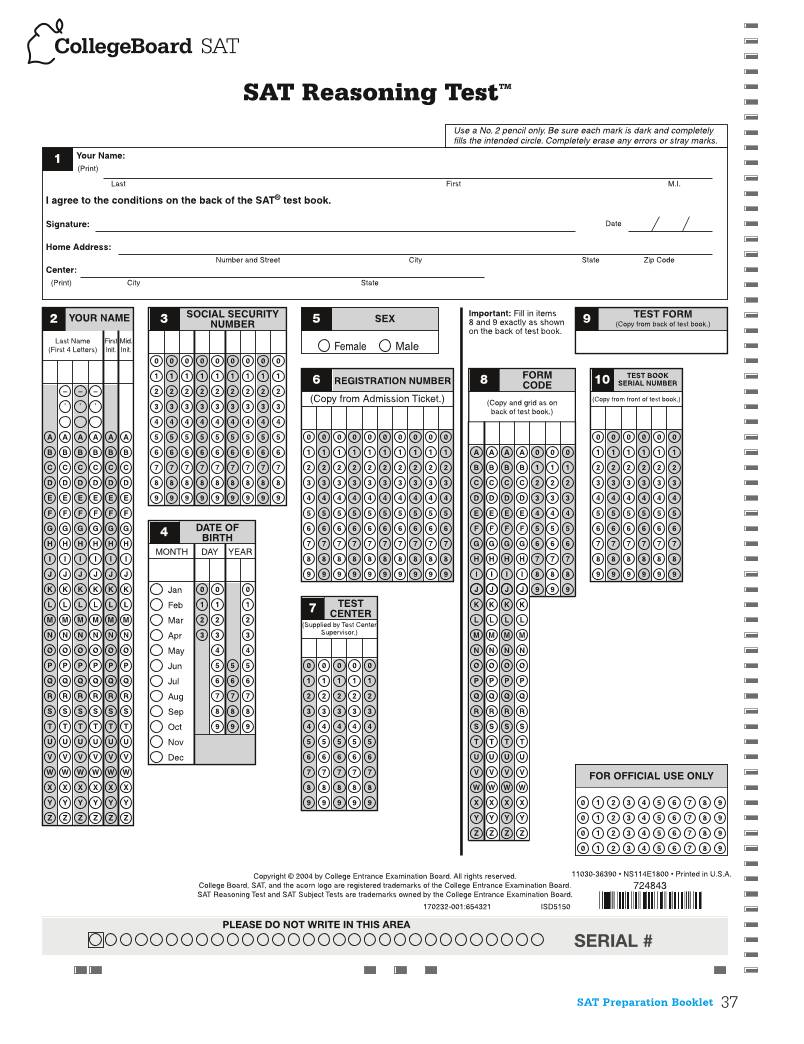
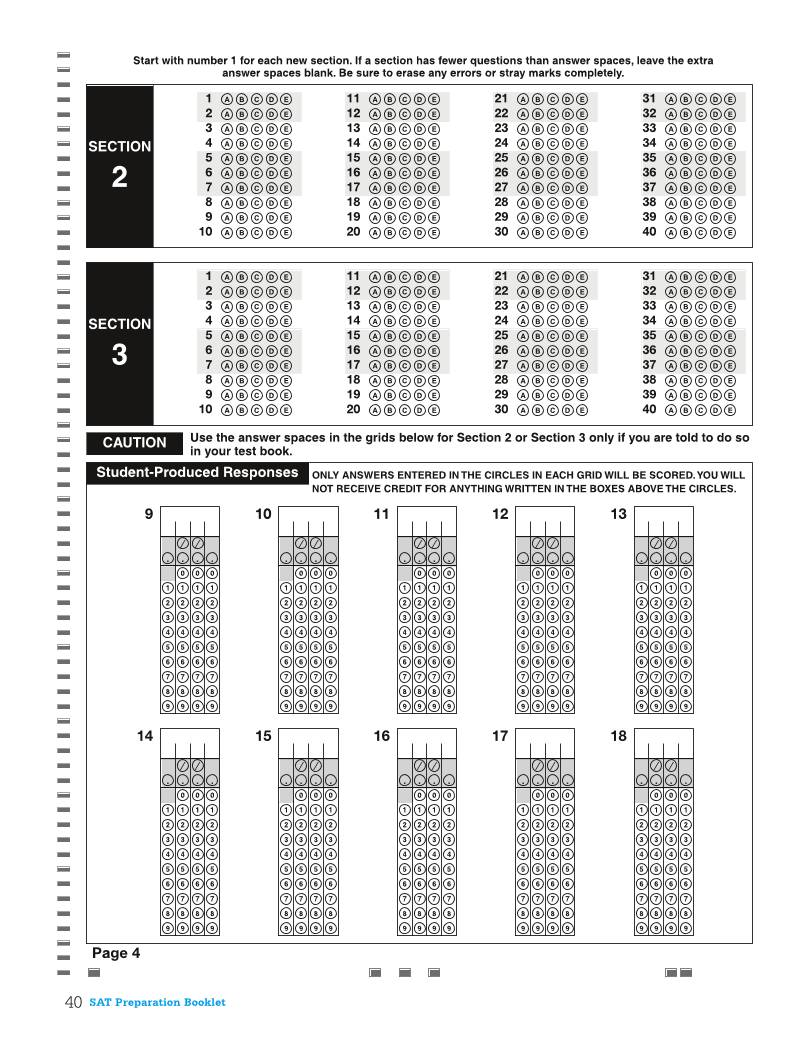
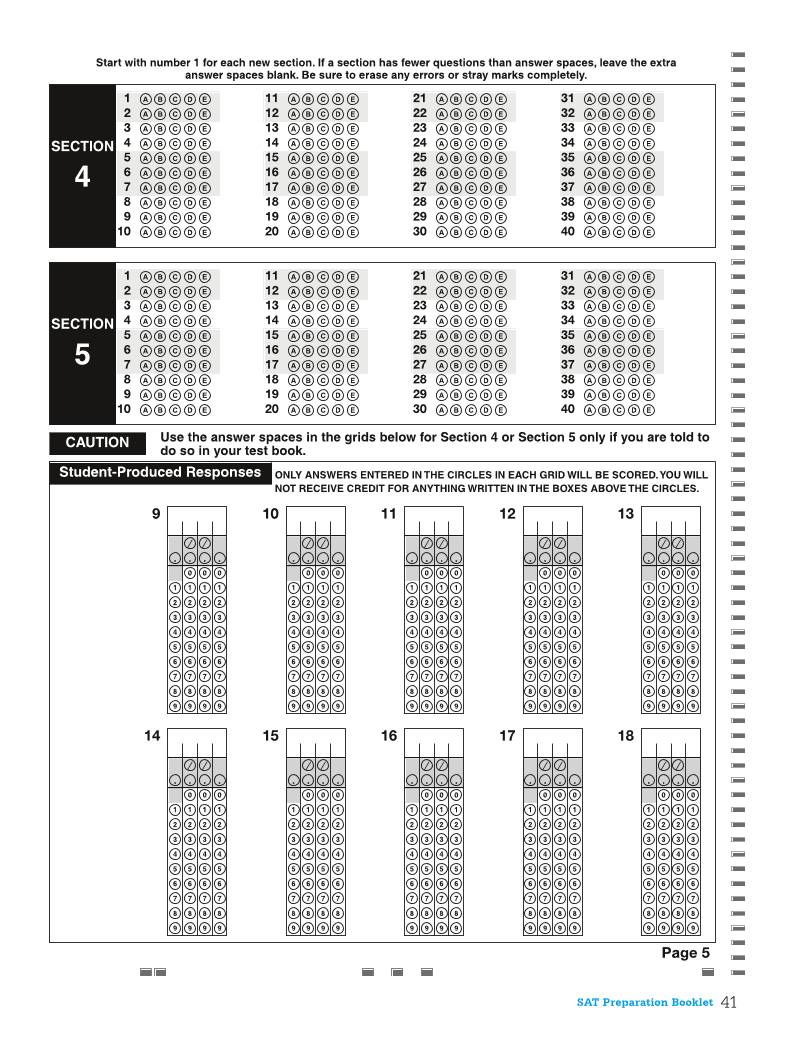


 设备数据采集
 工程招标采购
 搞笑表情
搞笑表情 微信头像
微信头像 CWMS冷库管理系统
 美女图片
美女图片 APP小游戏
 PPT模板
PPT模板 WMS仓库系统
 软件开发
软件开发