概要信息:
Phonics Mentor Joy Series
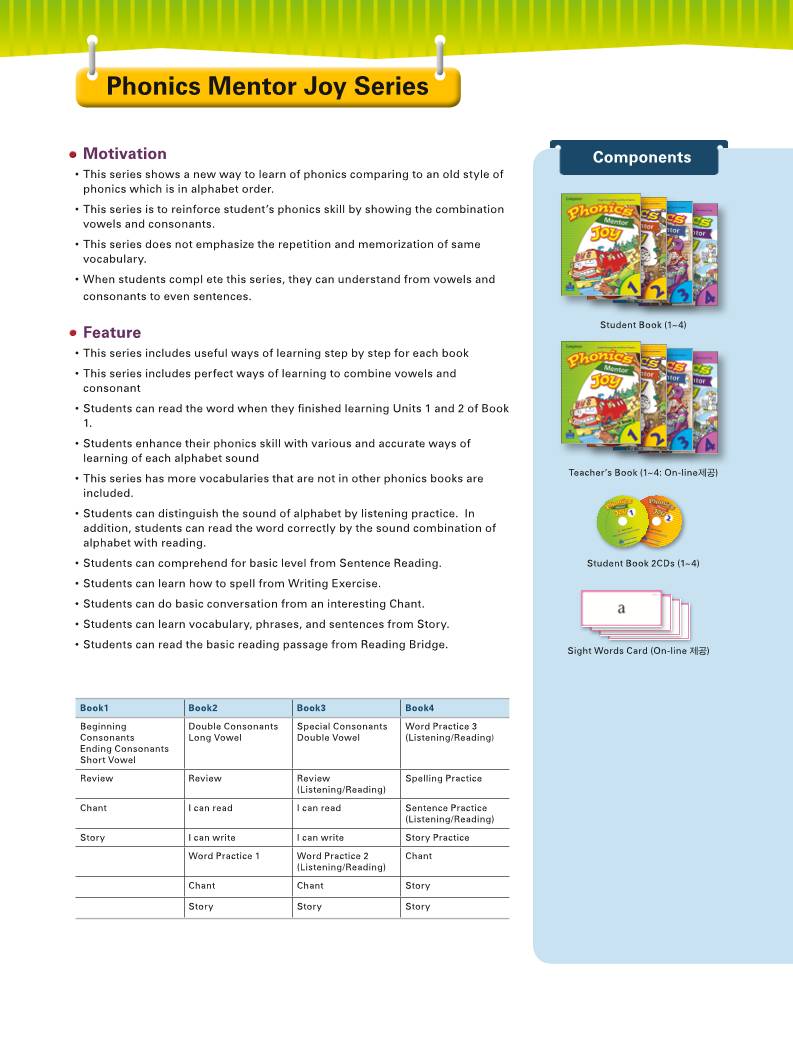
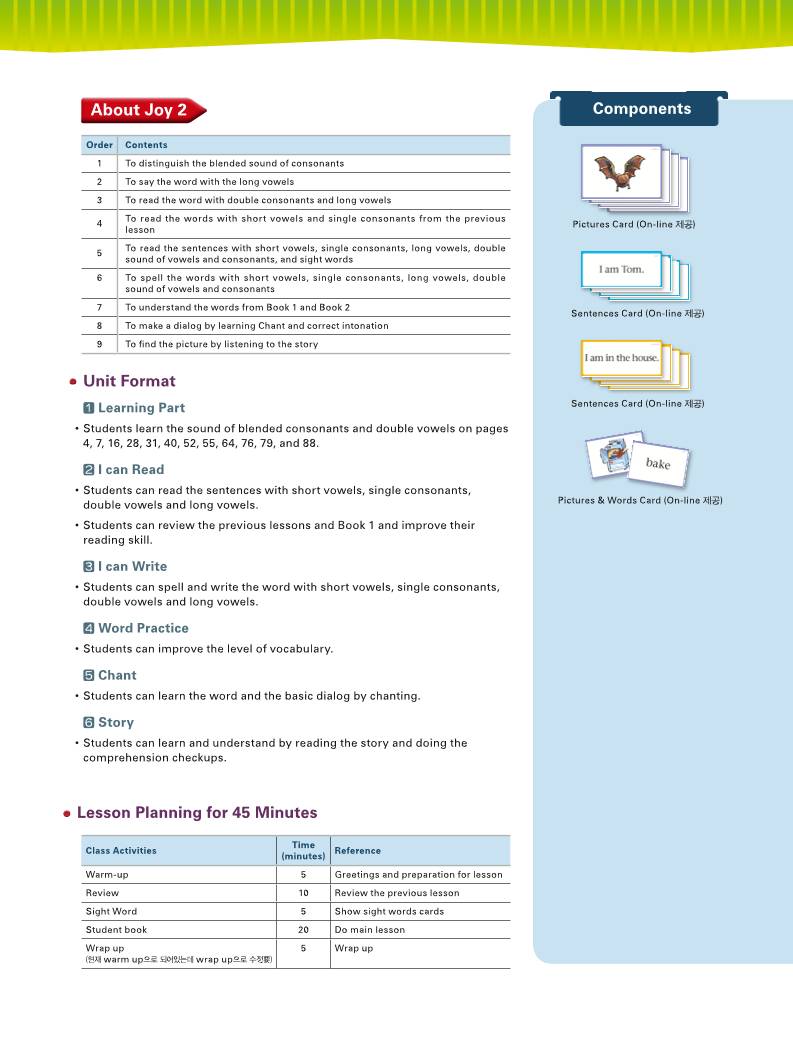
Components
Student Book (1~4)
Teacher’s Book (1~4: On-line제공)
Student Book 2CDs (1~4)
Sight Words Card (On-line 제공)
Motivation
• This series shows a new way to learn of phonics comparing to an old style of
phonics which is in alphabet order.
• This series is to reinforce student’s phonics skill by showing the combination
vowels and consonants.
• This series does not emphasize the repetition and memorization of same
vocabulary.
• When students compl ete this series, they can understand from vowels and
consonants to even sentences.
Feature
• This series includes useful ways of learning step by step for each book
• This series includes perfect ways of learning to combine vowels and
consonant
• Students can read the word when they finished learning Units 1 and 2 of Book
1.
• Students enhance their phonics skill with various and accurate ways of
learning of each alphabet sound
• This series has more vocabularies that are not in other phonics books are
included.
• Students can distinguish the sound of alphabet by listening practice.  In
addition, students can read the word correctly by the sound combination of
alphabet with reading.
• Students can comprehend for basic level from Sentence Reading.
• Students can learn how to spell from Writing Exercise.
• Students can do basic conversation from an interesting Chant.
• Students can learn vocabulary, phrases, and sentences from Story.
• Students can read the basic reading passage from Reading Bridge.
Book1 Book2 Book3 Book4
Beginning
Consonants
Ending Consonants
Short Vowel
Double Consonants
Long Vowel
Special Consonants
Double Vowel
Word Practice 3
(Listening/Reading)
Review Review Review
(Listening/Reading)
Spelling Practice
Chant I can read I can read Sentence Practice
(Listening/Reading)
Story I can write I can write Story Practice
 Word Practice 1 Word Practice 2
(Listening/Reading)
Chant
Chant Chant Story
Story Story Story
Components
Pictures Card (On-line 제공)
Pictures & Words Card (On-line 제공)
Sentences Card (On-line 제공)
Sentences Card (On-line 제공)
Order Contents
1 To distinguish the blended sound of consonants
2 To say the word with the long vowels
3 To read the word with double consonants and long vowels
4 To read the words with short vowels and single consonants from the previous
lesson
5 To read the sentences with short vowels, single consonants, long vowels, double
sound of vowels and consonants, and sight words
6 To spell the words with short vowels, single consonants, long vowels, double
sound of vowels and consonants
7 To understand the words from Book 1 and Book 2
8 To make a dialog by learning Chant and correct intonation
9 To find the picture by listening to the story
About Joy 2
Unit Format
1 Learning Part
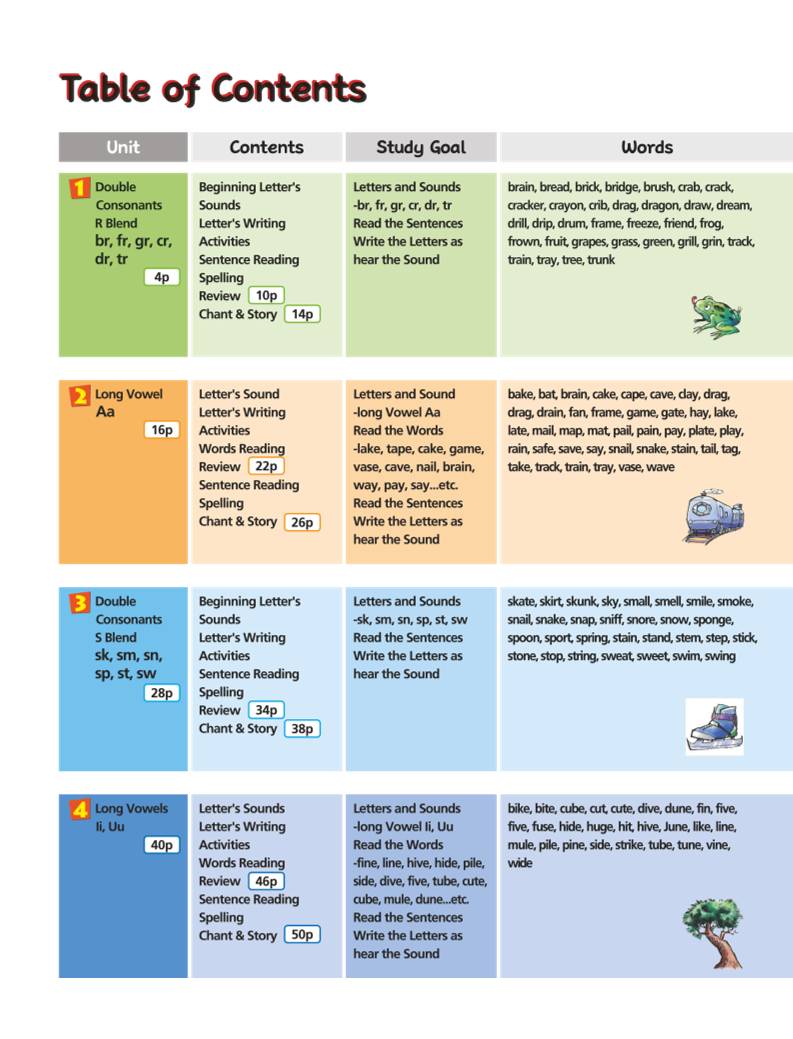
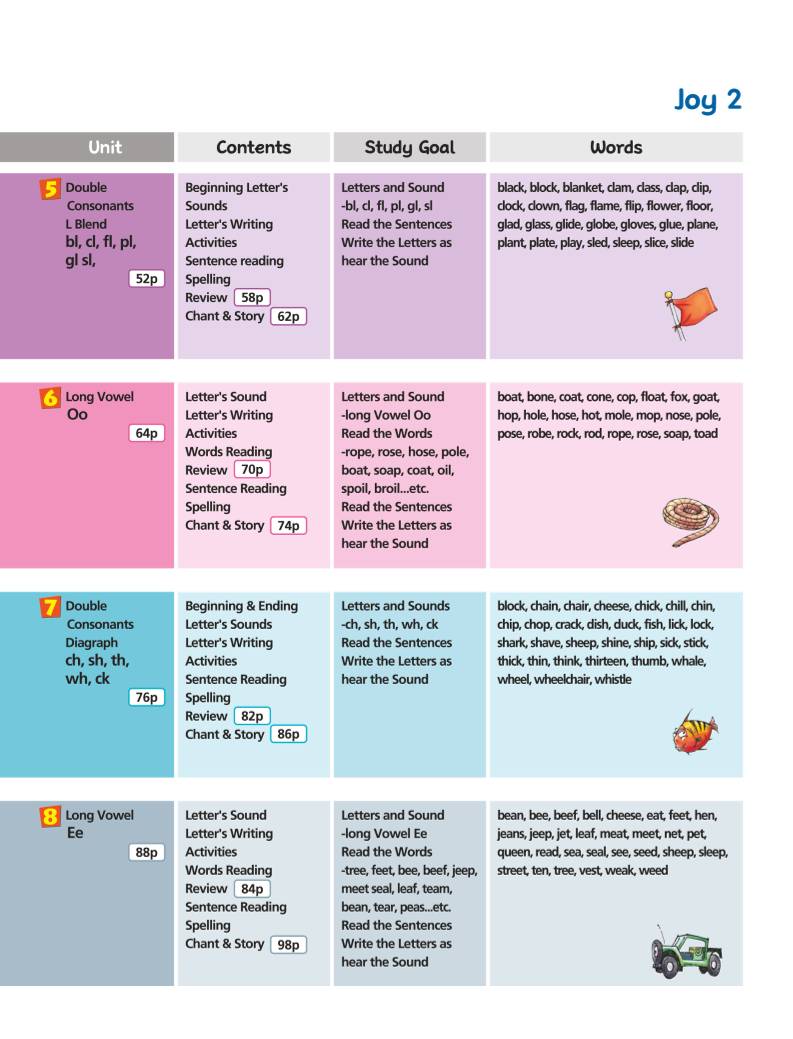
• Students learn the sound of blended consonants and double vowels on pages
4, 7, 16, 28, 31, 40, 52, 55, 64, 76, 79, and 88.
2 I can Read
• Students can read the sentences with short vowels, single consonants,
double vowels and long vowels.
• Students can review the previous lessons and Book 1 and improve their
reading skill.
3 I can Write
• Students can spell and write the word with short vowels, single consonants,
double vowels and long vowels.
4 Word Practice
• Students can improve the level of vocabulary.
5 Chant
• Students can learn the word and the basic dialog by chanting.
6 Story
• Students can learn and understand by reading the story and doing the
comprehension checkups.
Lesson Planning for 45 Minutes
Class Activities
Time
(minutes) Reference
Warm-up 5 Greetings and preparation for lesson
Review 10 Review the previous lesson
Sight Word 5 Show sight words cards
Student book 20 Do main lesson
Wrap up
(현재 warm up으로 되어있는데 wrap up으로 수정要)
5 Wrap up
Consonants Learning Page
Learning page
1,3,5,7Unit
Blended Double Consonants (pp. 4, 7, 28, 31, 52, 55)
• Play the audio CD. Have students repeat the double
consonant.
• Check that students can make the sound of the double
consonant, especially for r and l.
• Have students write the blended double consonant what they
heard.
• Have students do the listening practice below to check
spelling and sound of the double consonants.
Consonant Digraph (pp. 76, 79)
• Play the audio CD. Have students repeat the consonant
digraph.
• Consonants in Unit 7 do not have the sound upon the rules, so
teachers should show how to make the sound of consonant
that students can follow.
• Say the consonant digraphs and have students write or
distinguish them.
• Have students do the listening practice and check how much
they understand.
• Have students say the consonant digraphs in order to check
whether they can make sound or not.
• There are two different sound of –th, but the words with /o/
should be practiced for this unit.
• Make sure that students should look at the double consonants
when they listen.
•  Cheer up students who cannot make the sound of double
consonants.  Do not let the student repeat to make the sound
of double consonants.
•  Write the double consonants on a post-it. And place them
onto the student’s hand and have students rise their hand
what they have heard the double consonants.
Teacher Tip
• For correct pronunciation, teachers should emphasize the
shape of lips and tongue.
Teacher Tip
Phonics_16
Consonants Exercise Page1,3,5,7Unit
7
• Write the double consonants on the paper. Place them on the
table, and have two students come up front.  Have them pick
up the paper of the word what they have just heard.
•  Make sure that students do the listening practice by listening.
• - For more practice, say the word of the picture and point to
it in the student book after listening practice. Or point to the
picture and have students say the word of the picture.  For
this game, divide the class into two teams and play the game.
• Make the class fun by using some of the games mentioned
above.
Teacher Tip
Consonant Exercise 2 (pp. 9, 32)
• Have students find the cr sound without playing the audio CD.
Then play the audio CD and have students find the dr sound.
Play the audio CD three times.
• Check to see that students found the correct picture while
they listened.
• Make sure that students find the answer by listening to the
CD, not by looking at the picture. Tell them that they should
find the correct picture by listening.
• Say the word, and have students draw the picture on the
maze in the student book after the listening practice.
• Students can draw over the picture in the student book.
Teacher Tip
Consonant Exercise 1  (pp. 5, 6, 8, 29, 30, 33, 53, 54, 56,
57, 77, 78, 80, 81)
•  This practice is to distinguish the double consonant by
listening.
• For students who cannot distinguish the double consonant,
check that students know the sound of each consonant.
• If they don’t, this is why they cannot distinguish the double
consonants.
• Have students say the double consonants.
• Say the double consonant without playing the audio CD, for
example, /bread/ /br/ /red/ /br/ /red/ /bread/
Exercise Page
Phonics_18
Vowel Learning Page
Learning page
2,4,6,8Unit
Long Vowel Learning Page (pp. 16, 40, 64, 88)
• The long vowels are very important part of learning phonics.
• Show the difference between short vowels and long vowels,
for example, /ae/ for short vowel and /ai/ for long vowel.
• Play the audio CD and have students pay attention to long
vowels.
• Write the long vowels on the whiteboard and show students
how to make long vowels using two different letters, a + e =
ae /ae/, a+i=ai /ai/, a+y=ay /ay/
• Say the correct sound of long vowels and have students
repeat.
Long Vowel Listening Exercise 1
 (pp. 17, 18, 41, 42, 65, 66, 89, 90)
• Play the audio CD and have students distinguish the long and
short vowels.
• Have students color the words with long vowels while they
listen.
• Write “Long” and “Short” on a piece of paper and make two
sign boards with the paper. Give the board to students. Say
the words with short vowels and long vowels randomly.
Then have students show the correct board with the vowel
they have heard.
• Write the words with long vowels and have students read
them.  Then Say the words with short vowels and long
vowels randomly, and have students repeat.
Teacher Tip
• Say the word with long and short vowels without playing the
audio CD in order to find either long or short vowels.
• Cut the pictures of each unit on the back side of the student
book.  Show the pictures to students and have students say
the word with long or short vowels.
Teacher Tip
9
•  Draw a rectangle on a piece of paper to cover the picture of
the listening practice and cut the rectangle.  Hand out the
paper to each student.
• Have students read the words without looking the pictures.
• Then have students cover the words and say what it is by
looking at the pictures.
Teacher Tip
Long Vowel Reading Exercise 1 (pp. 20, 44, 68, 92)
• Have students read the word without listening.
• Make sure that students read the words focusing the sound of
long vowels.  Do not let them read the words all at once.
• Say, “Circle the letters that make the long vowel sound,”
and “Circle the long vowel letters and read the word.” while
students do the reading practice.
Long Vowel Listening Exercise 2 (pp. 19, 43, 67, 91)
• Have students do the listening practice for long vowels.
• Make sure that students can read the words in the student
book.  If not, read the words and have students repeat.
• Play the audio CD and say, “What letters make up the long
vowels sound?” for every single question.
Exercise Page
Long Vowel Reading Exercise 2 (pp. 21, 45, 69, 93)
• Have students read the words without listening.
• Make sure that students read the words focusing the sound of
long vowels.  Do not let them read the words all at once.
• Tell students that they are not allowed to match the word and
the picture by only looking at the pictures. Make sure that
they read the words first.
• Say, “Circle the letters that make the long vowel sound,”
and “Circle the long vowel letters and read the word.” while
students do the reading practice.
• Draw a rectangle on a piece of paper to cover the picture of
the listening practice and cut the rectangle. Hand out the
paper to each student.
•  Have students read the words without looking at the pictures.
• Then have students cover the words and say what it is by
looking the pictures.
•  Make a sentence with the words that students read.
•  Point the pictures and ask students, “What is it?” and “What
are they doing?” Then have students answer the questions.
Teacher Tip
Phonics_110
Review, Chant, and Story1~8Unit
Review (pp. 10, 12, 34, 46, 58, 70, 82, 94)
• This practice is to review what students have learned before.
• The practice questions at for Listening and Reading, enabling
students to check whether they can read and distinguish the
word’s sound.
• Have students solve the problems by themselves.
• Explain the questions and play the audio CD. Adjust the audio
CD depending on the class. Check whether students fully
understand or not.
I Can Read (pp. 12, 24, 36, 48, 60, 72, 84, 96)
• This practice is to improve students’ writing skills and to
remember the spelling.
• Have student spell out the words that they have already
learned.
• Have students read the words by focusing the sound of each
syllable.  Do not let students memorize and read the words all
at once.
•  Read the words without playing the audio CD if students have
a hard time spelling out the word.  Read the words by saying
each syllable, for example, /dish/ /d/ /i/ /sh/ /di/ /sh/ /dish/.
•  For more practice, use other words not in the student book.
Teacher Tip
11
Word Practice (pp. 13, 25, 37, 49, 61, 73, 85, 97)
• This practice is to enhance for the vocabulary level of students
so they can read and understand the reading passage from
the comprehension checkups.
• Play the audio CD and have students find the picture.
Chant (pp. 14, 26, 38, 50, 62, 74, 86, 98)
• This is to help to make a statement for basic dialog by chanting.
• Play the audio CD. Then have students chant by themselves
without listening.
• Have students do the role play.
• Use sentence pattern with other words in order to improve
student’s reading skill.
• Say the words and have students point to the pictures.
• Use Flash Cards with only pictures.
• Prepare picture cards and words cards separately using from
websites or the back side of student book. Say one word.
Then have students match the picture cards and word cards.
•  Make a sentence by showing the picture and using the word
of the picture.
• If students don’t understand, use some word pattern.
Teacher Tip
Phonics_112
Story (pp. 15, 27, 39, 51, 63, 75, 87, 99)
• Play the audio CD for the whole story. As time goes by, have
students read the story without listening.
• Play and stop the audio CD for each sentence. Then have
students find the picture for the sentence, or vice versa.
• For more practice, use the picture for making a hidden picture
game to find the word of the picture.
• Write the word from the picture and have students place the
sticker onto the picture.
• Read the sentence slowly and have students draw the picture
as much as they can. Have student present their work and say
the sentence.
13
Phonics_114
15
Phonics_116
17
Phonics_118
19


 设备数据采集
 工程招标采购
 搞笑表情
搞笑表情 微信头像
微信头像 CWMS冷库管理系统
 美女图片
美女图片 APP小游戏
 PPT模板
PPT模板 WMS仓库系统
 软件开发
软件开发