概要信息:
ary shock that defines the region known as the
heliosphere. Low-energy cosmic rays enter-
ing the heliosphere lose any information
about their arrival direction in reaching the
inner solar system as a result of substantial
deflections and scatterings.
The motion of cosmic rays in a magnetic
field is described by a transport equation that
takes into account the convection, diffusion,
drift, and adiabatic energy loss (if the field is
converging) or gain (if the field diverges).
This equation was first described by Parker (2,
3) and, in the case of the heliosphere, further
developed by others such as Forman and
Gleeson (4). The equation predicts that the
lower-energy cosmic-ray gas should move
with the Sun’s magnetic field, which rotates
with the Sun with a 27-day period. Such
behavior is called corotation. Corotation has
been observed for many years in lower-energy
observations (<5 × 10¹⁰ eV) and causes the
largest long-term anisotropy observed in this
energy range [see, for example, Hall et al. (5)
and references therein]. Above about 1011 eV,
solar influence declines, and the magnetic
field of the local spiral arm of the Galaxy is
expected to be the controlling feature for cos-
mic-ray propagation. However, the flux of
comic rays is reduced by 10 orders of magni-
tude from the low-energy part of the spec-
trum, and thus very large detection areas and
equipment operation with long-term stability
are needed to achieve the necessary statistics
to search for directional enhancements that
are only fractions of a percent.
Amenomori et al. have found directional
enhancements in the 1012 to 1015 eV energy
range and have also shown that the cosmic rays
are corotating with the local spiral arm of the
Galaxy. This requires the local spiral-arm field
extent and strength to be sufficient to trap the
cosmic-ray gas rather than to allow it to flow
past the heliosphere and generate an ani-
sotropy caused by the relative motion of
the heliosphere and the gas—the so-called
Compton-Getting effect. This anisotropy is
just like walking in still air—the wind is felt
from the direction in which you walk because
of your relative motion. Amenomori et al. see
the effect due to motion of Earth in its orbit,
giving confidence in their results, but when
this effect is removed there is no residual effect
that would indicate residual motion between
the heliosphere and the cosmic-ray gas. This
gives additional constraints to models of the
local spiral arm and the field within it.
The next step in the research is to deduce
the nature of enhancements that they have
found. The researchers must differentiate
between cosmic-ray particles or gamma rays
as the source. The Tibet air shower experiment
observes the particles of an atmospheric cas-
cade produced by cosmic rays. This cascade
involves the production of very high-energy
gamma rays that then undergo pair production
with the positrons annihilating and producing
further gamma rays. If the initiating interaction
is a gamma ray and not a particle, it is not a triv-
ial exercise to differentiate the responses, but it
can be and has been done by other groups. The
Tibet air shower team will now enhance their
system to achieve this differentiation, and we
can look forward to further results from the
experiment. Of course, increased statistics
with time will also allow the group to dig
deeper into the signal and possibly find more
subtle anisotropies and to more clearly define
the enhancements they have found. It will also
be extremely interesting to see what, if any, dif-
ferences in the lower-energy anisotropies they
observe following the next solar magnetic
reversal in a few years. This could tell us a
great deal about how the heliosphere and the
local spiral-arm field interact.
References
1. M. Amenomori et al., Science 314, 439 (2006).
2. E. N. Parker, Planet. Space Sci. 12, 735 (1964).
3. E. N. Parker, Planet. Space Sci. 13, 9 (1965).
4. M. A. Forman, L. J. Gleeson, Astrophys. Space Sci. 32, 77
(1975).
5. D. L. Hall, M. L. Duldig, J. E. Humble, Space Sci. Rev. 78,
401 (1996).
10.1126/science.1134046
430
1 particle/(m2 s1)
lo
g
 P
ar
ti
cl
es
/(
m
2
 s
r
s
G
eV
)
Knee
1 particle/(m2 yr1)
Ankle
1 particle/(km2 yr1)
?
Solar
influence
dominates
Galactic
influence
dominates
9 10 11 12 13 14 15 16 17 18 19 20
log Energy (eV)
3
0
–3
–6
–9
–12
–15
–18
–21
–24
–27
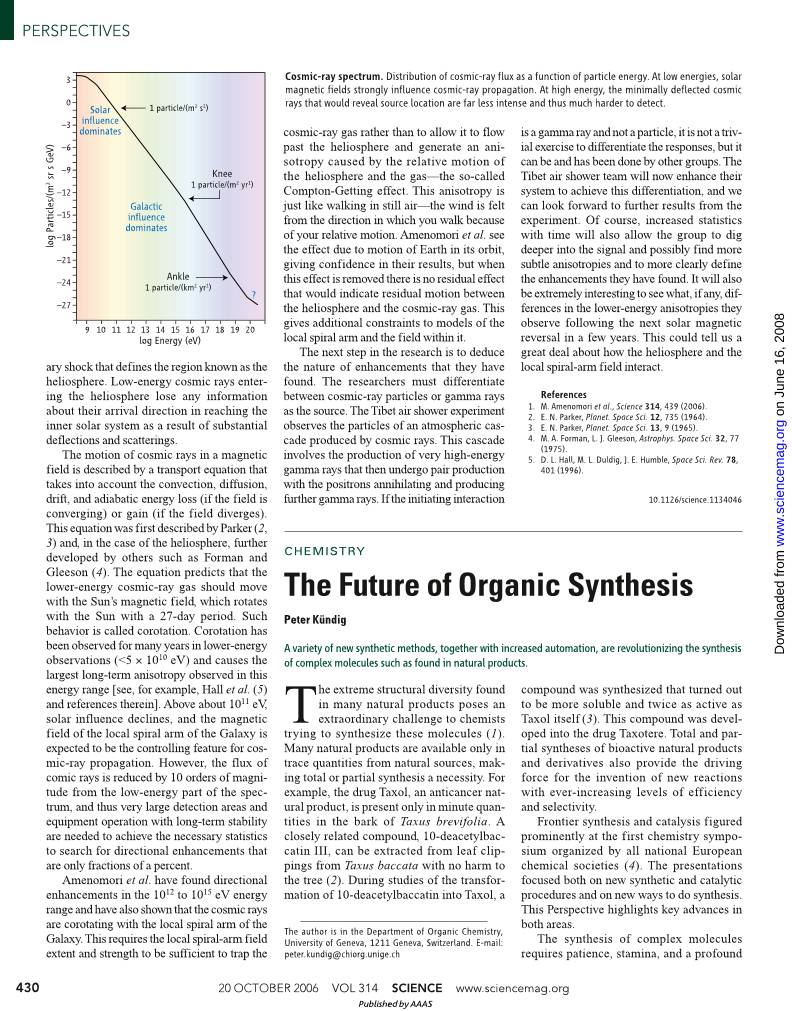
Cosmic-ray spectrum. Distribution of cosmic-ray flux as a function of particle energy. At low energies, solar
magnetic fields strongly influence cosmic-ray propagation. At high energy, the minimally deflected cosmic
rays that would reveal source location are far less intense and thus much harder to detect.
T
he extreme structural diversity found
in many natural products poses an
extraordinary challenge to chemists
trying to synthesize these molecules (1).
Many natural products are available only in
trace quantities from natural sources, mak-
ing total or partial synthesis a necessity. For
example, the drug Taxol, an anticancer nat-
ural product, is present only in minute quan-
tities in the bark of Taxus brevifolia. A
closely related compound, 10-deacetylbac-
catin III, can be extracted from leaf clip-
pings from Taxus baccata with no harm to
the tree (2). During studies of the transfor-
mation of 10-deacetylbaccatin into Taxol, a
compound was synthesized that turned out
to be more soluble and twice as active as
Taxol itself (3). This compound was devel-
oped into the drug Taxotere. Total and par-
tial syntheses of bioactive natural products
and derivatives also provide the driving
force for the invention of new reactions
with ever-increasing levels of efficiency
and selectivity.
Frontier synthesis and catalysis figured
prominently at the first chemistry sympo-
sium organized by all national European
chemical societies (4). The presentations
focused both on new synthetic and catalytic
procedures and on new ways to do synthesis.
This Perspective highlights key advances in
both areas.
The synthesis of complex molecules
requires patience, stamina, and a profound
A variety of new synthetic methods, together with increased automation, are revolutionizing the synthesis
of complex molecules such as found in natural products.
The Future of Organic Synthesis
Peter Kündig
CHEMISTRY
The author is in the Department of Organic Chemistry,
University of Geneva, 1211 Geneva, Switzerland. E-mail:
peter.kundig@chiorg.unige.ch
20 OCTOBER 2006 VOL 314 SCIENCE www.sciencemag.org
PERSPECTIVES
Published by AAAS
 o
n
Ju
ne
 1
6,
 2
00
8
w
w
w
.s
ci
en
ce
m
ag
.o
rg
D
ow
nl
oa
de
d
fr
om

knowledge of reaction mech-
anisms. Even for moderately
complex molecules, it is
not uncommon to require at
least 10 steps and sometimes
many more. Side reactions
produce waste, reduce effi-
ciency, and result in a sharp
drop of available material
after only a few synthetic
steps. Tuning of reactions,
work-up, and purifications
are all extremely time-con-
suming. Such syntheses bring
to light the limitations of
current chemical transfor-
mations. The drive for shorter
and more efficient synthesis procedures will
continue to challenge the resourcefulness of
synthetic chemists.
Chemists have developed numerous met-
hods to address these challenges and facili-
tate natural product syntheses. Major ad-
vances in catalytic applications have been
made. Stable, readily synthesized ruthenium
and molybdenum catalysts that allow the
exchange of substituents between different
olefins (metathesis; 2005 Nobel Prize in
chemistry to Y. Chauvin, R. H. Grubbs, and
R. R. Schrock) are now routinely used in
organic synthesis. Chiral amines have been
rediscovered as catalysts, and very elegant,
asymmetric, and useful synthetic methods
have emerged (5). New, more efficient vari-
ants of classical metal-catalyzed carbon-car-
bon coupling reactions allow alkyl coupling
and aryl chloride coupling reactions under
mild conditions (6). Bifunctional catalysis
(7, 8) and tandem and multistep catalytic
processes all convert very simple small
molecules in a series of reactions into
highly functionalized complex molecules;
these processes have become prominent (9).
Directed evolution of enzymes for synthesis
and the combination of metal-catalyzed
reactions with enzymes are also very prom-
ising developments (10, 11).
Combinatorial approaches and high-
throughput experimentation are also firmly
established. They are complemented by
the synthesis of self-adaptive combinatorial
libraries (12).
The need for cleaner, more sustainable
chemical practices also poses new chal-
lenges. Environmentally benign chemistry
and sustainable processes require new ways
of carrying out synthesis (13). Hence, in
addition to the development of new reac-
tions, reagents, and catalysts, novel ways to
assemble molecules are an important driver
for organic synthesis.
Automated synthesis, in which robots and
machines carry out much of the tedious
bench work, has made its entry into research
laboratories (14). The substitution of conven-
tional work-up, isolation of products, and
separation of catalysts and reagents by new
techniques is of major importance. Very
promising steps in this direction are now in
hand. For example, Leitner and co-workers
reported a catalyst cartridge system based on
a rhodium complex immobilized on a poly-
mer backbone, combined with supercritical
CO
2
as solvent and separation system. This
allowed a series of catalytic reactions to be
carried out sequentially (15). Related work
has also been reported by Webb and Cole-
Hamilton (16).
To facilitate the multistep synthesis of
complex molecules, Ley and co-workers
have turned to the use of solid-supported
reagents in a designed sequential and multi-
step fashion without the use of conventional
work-up procedures. They extended these
concepts to make use of advanced scaveng-
ing agents and catch-and-release tech-
niques, and combined them with continu-
ous-flow processing to create even greater
opportunities for organic synthesis.
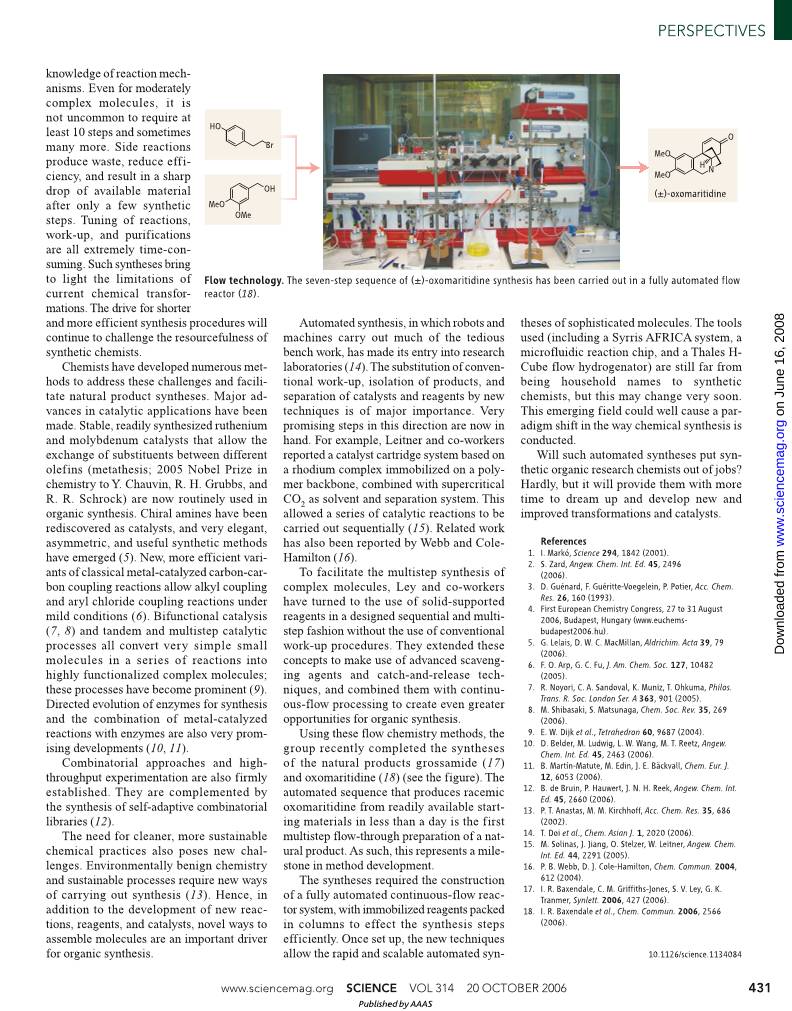
Using these flow chemistry methods, the
group recently completed the syntheses
of the natural products grossamide (17)
and oxomaritidine (18) (see the figure). The
automated sequence that produces racemic
oxomaritidine from readily available start-
ing materials in less than a day is the first
multistep flow-through preparation of a nat-
ural product. As such, this represents a mile-
stone in method development.
The syntheses required the construction
of a fully automated continuous-flow reac-
tor system, with immobilized reagents packed
in columns to effect the synthesis steps
efficiently. Once set up, the new techniques
allow the rapid and scalable automated syn-
theses of sophisticated molecules. The tools
used (including a Syrris AFRICA system, a
microfluidic reaction chip, and a Thales H-
Cube flow hydrogenator) are still far from
being household names to synthetic
chemists, but this may change very soon.
This emerging field could well cause a par-
adigm shift in the way chemical synthesis is
conducted.
Will such automated syntheses put syn-
thetic organic research chemists out of jobs?
Hardly, but it will provide them with more
time to dream up and develop new and
improved transformations and catalysts.
References
1. I. Markó, Science 294, 1842 (2001).
2. S. Zard, Angew. Chem. Int. Ed. 45, 2496
(2006).
3. D. Guénard, F. Guéritte-Voegelein, P. Potier, Acc. Chem.
Res. 26, 160 (1993).
4. First European Chemistry Congress, 27 to 31 August
2006, Budapest, Hungary (www.euchems-
budapest2006.hu).
5. G. Lelais, D. W. C. MacMillan, Aldrichim. Acta 39, 79
(2006).
6. F. O. Arp, G. C. Fu, J. Am. Chem. Soc. 127, 10482
(2005).
7. R. Noyori, C. A. Sandoval, K. Muniz, T. Ohkuma, Philos.
Trans. R. Soc. London Ser. A 363, 901 (2005).
8. M. Shibasaki, S. Matsunaga, Chem. Soc. Rev. 35, 269
(2006).
9. E. W. Dijk et al., Tetrahedron 60, 9687 (2004).
10. D. Belder, M. Ludwig, L. W. Wang, M. T. Reetz, Angew.
Chem. Int. Ed. 45, 2463 (2006).
11. B. Martín-Matute, M. Edin, J. E. Bäckvall, Chem. Eur. J.
12, 6053 (2006).
12. B. de Bruin, P. Hauwert, J. N. H. Reek, Angew. Chem. Int.
Ed. 45, 2660 (2006).
13. P. T. Anastas, M. M. Kirchhoff, Acc. Chem. Res. 35, 686
(2002).
14. T. Doi et al., Chem. Asian J. 1, 2020 (2006).
15. M. Solinas, J. Jiang, O. Stelzer, W. Leitner, Angew. Chem.
Int. Ed. 44, 2291 (2005).
16. P. B. Webb, D. J. Cole-Hamilton, Chem. Commun. 2004,
612 (2004).
17. I. R. Baxendale, C. M. Griffiths-Jones, S. V. Ley, G. K.
Tranmer, Synlett. 2006, 427 (2006).
18. I. R. Baxendale et al., Chem. Commun. 2006, 2566
(2006).
10.1126/science.1134084
431
HO
Br
OH
OMe
MeO
MeO
MeO
O
H
N
(±)-oxomaritidine
Flow technology. The seven-step sequence of (±)-oxomaritidine synthesis has been carried out in a fully automated flow
reactor (18).
www.sciencemag.org SCIENCE VOL 314 20 OCTOBER 2006
PERSPECTIVES
Published by AAAS
 o
n
Ju
ne
 1
6,
 2
00
8
w
w
w
.s
ci
en
ce
m
ag
.o
rg
D
ow
nl
oa
de
d
fr
om


 设备数据采集
 工程招标采购
 搞笑表情
搞笑表情 微信头像
微信头像 CWMS冷库管理系统
 美女图片
美女图片 APP小游戏
 PPT模板
PPT模板 WMS仓库系统
 软件开发
软件开发