概要信息:
1 CLYau 2005.02.07
Chemical Nomenclature: A Tutorial
Rules & Drills with Answers

Table of Contents

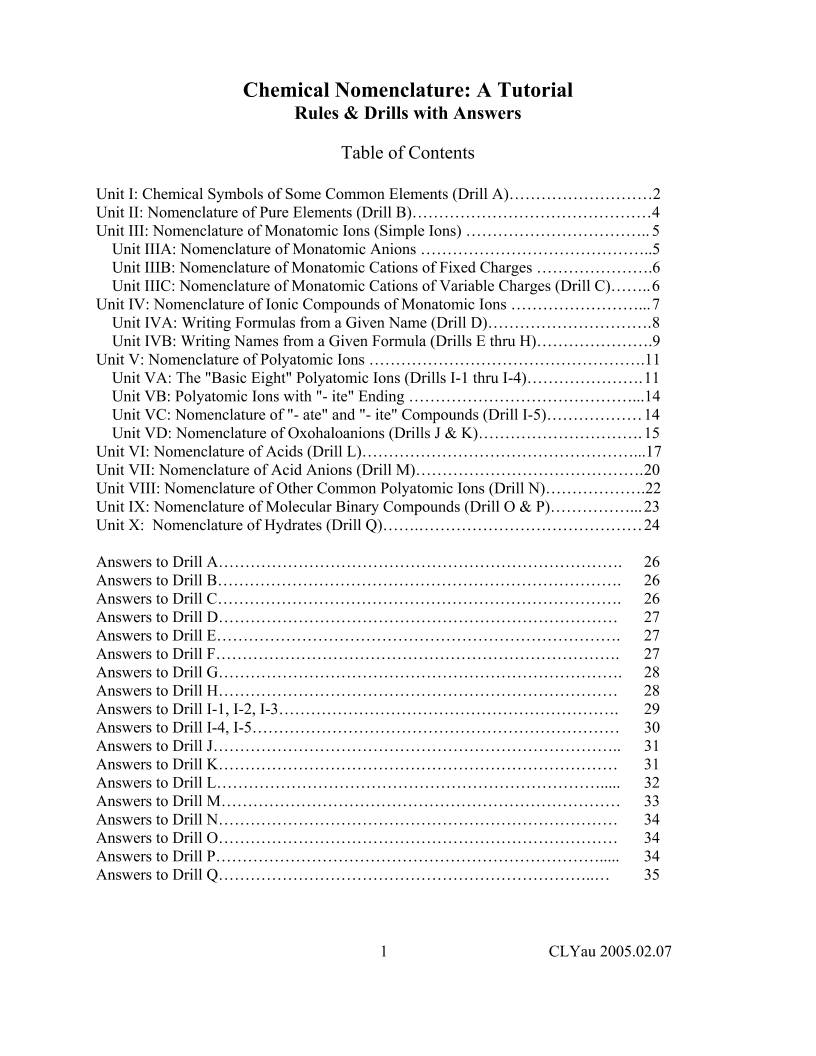
Unit I: Chemical Symbols of Some Common Elements (Drill A)………………………2
Unit II: Nomenclature of Pure Elements (Drill B)……………………………………… 4
Unit III: Nomenclature of Monatomic Ions (Simple Ions) …………………………….. 5
    Unit IIIA: Nomenclature of Monatomic Anions ……………………………………..5
    Unit IIIB: Nomenclature of Monatomic Cations of Fixed Charges ………………….6
    Unit IIIC: Nomenclature of Monatomic Cations of Variable Charges (Drill C)…….. 6
Unit IV: Nomenclature of Ionic Compounds of Monatomic Ions ……………………... 7
    Unit IVA: Writing Formulas from a Given Name (Drill D)…………………………. 8
    Unit IVB: Writing Names from a Given Formula (Drills E thru H)………………….9
Unit V: Nomenclature of Polyatomic Ions …………………………………………….11
    Unit VA: The "Basic Eight" Polyatomic Ions (Drills I-1 thru I-4)…………………. 11
    Unit VB: Polyatomic Ions with "- ite" Ending ……………………………………...14
    Unit VC: Nomenclature of "- ate" and "- ite" Compounds (Drill I-5)……………… 14
    Unit VD: Nomenclature of Oxohaloanions (Drills J & K)…………………………. 15
Unit VI: Nomenclature of Acids (Drill L)……………………………………………...17
Unit VII: Nomenclature of Acid Anions (Drill M)……………………………………. 20
Unit VIII: Nomenclature of Other Common Polyatomic Ions (Drill N)……………….22
Unit IX: Nomenclature of Molecular Binary Compounds (Drill O & P)……………... 23
Unit X:  Nomenclature of Hydrates (Drill Q)…….…………………………………… 24

Answers to Drill A…………………………………………………………………. 26
Answers to Drill B…………………………………………………………………. 26
Answers to Drill C…………………………………………………………………. 26
Answers to Drill D………………………………………………………………… 27
Answers to Drill E…………………………………………………………………. 27
Answers to Drill F…………………………………………………………………. 27
Answers to Drill G…………………………………………………………………. 28
Answers to Drill H………………………………………………………………… 28
Answers to Drill I-1, I-2, I-3………………………………………………………. 29
Answers to Drill I-4, I-5…………………………………………………………… 30
Answers to Drill J………………………………………………………………….. 31
Answers to Drill K………………………………………………………………… 31
Answers to Drill L………………………………………………………………..... 32
Answers to Drill M………………………………………………………………… 33
Answers to Drill N………………………………………………………………… 34
Answers to Drill O………………………………………………………………… 34
Answers to Drill P………………………………………………………………..... 34
Answers to Drill Q……………………………………………………………..… 35


 2 CLYau 2005.02.07
Chemical Nomenclature: A Tutorial
Rules & Drills with Answers

For beginning students, the study of nomenclature (system of naming chemicals) can seem
impossibly complex.  For that reason, the rules and drills presented here are broken down into
Units, and it is not advisable to study all the units at one sitting, but you should take it one unit at
a time.  If you are not able to spread out your work over several days, you should at least take a
break in between units.

Unit I: Chemical Symbols of Some Common Elements
You must first learn the symbols of some common elements.  Your instructor may have
different requirements on which elements you must learn.  The ones listed below are the one you
have to know to make use of this tutorial, and most likely they are the only ones you will ever
have to know even as you move on to more advanced courses.  You might want to put them on
flash cards.  You should drill yourself one way or another before you proceed to the next unit.
Notice that the elements below are boxed together in groups, some elements appearing in
more than one group.  My suggestion is you learn them in groups, in this order: Elements #1
through 18, Group IA, IIA, VIIA, VIIIA, Common Transition Elements, and finally, Other
Common Elements.  If you have trouble with spelling, you’ll find it easier to learn correct
spelling if you copy the names several times as you sound it out.  If you think this is too much
work, then you are taking the wrong course.  Studying chemistry takes work, regardless of how
smart you are.

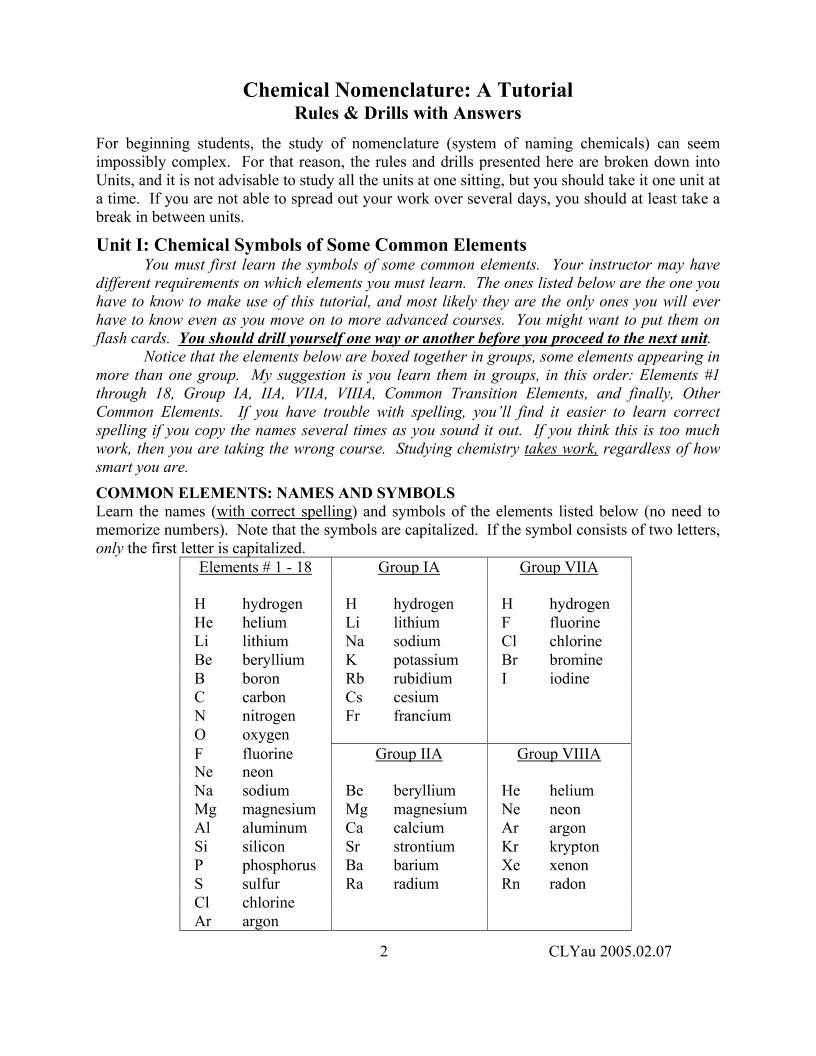
COMMON ELEMENTS: NAMES AND SYMBOLS
Learn the names (with correct spelling) and symbols of the elements listed below (no need to
memorize numbers).  Note that the symbols are capitalized.  If the symbol consists of two letters,
only the first letter is capitalized.
Elements # 1 - 18 Group IA Group VIIA

H hydrogen H hydrogen H hydrogen
He helium Li lithium F fluorine
Li lithium Na sodium Cl chlorine
Be beryllium K potassium Br bromine
B boron Rb rubidium I iodine
C carbon Cs cesium
N nitrogen Fr francium
O oxygen
F fluorine Group IIA Group VIIIA
Ne neon
Na sodium Be beryllium He helium
Mg magnesium Mg magnesium Ne neon
Al aluminum Ca calcium Ar argon
Si silicon Sr strontium Kr krypton
P phosphorus Ba barium Xe xenon
S sulfur Ra radium Rn radon
Cl chlorine
Ar argon
 3 CLYau 2005.02.07

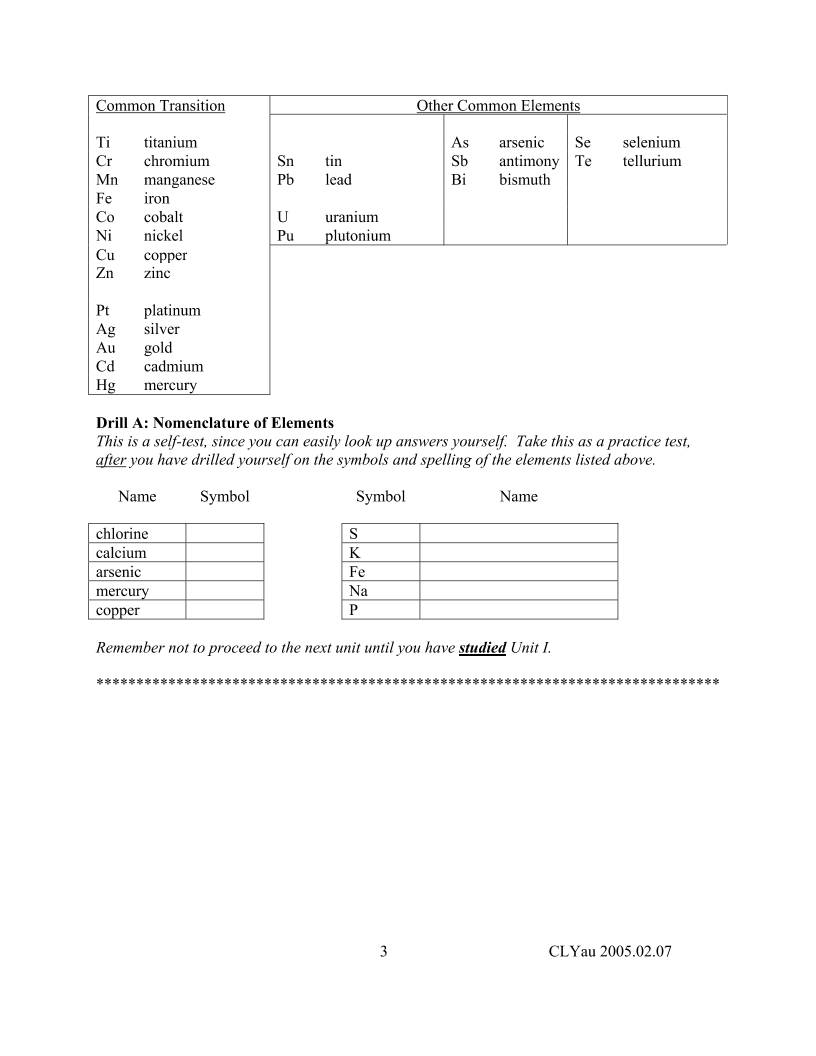
Common Transition Other Common Elements

Ti titanium  As arsenic Se selenium
Cr chromium Sn tin Sb antimony Te tellurium
Mn manganese Pb lead Bi bismuth
Fe iron
Co cobalt U uranium
Ni nickel Pu plutonium
Cu copper
Zn zinc

Pt platinum
Ag silver
Au gold
Cd cadmium
Hg mercury

Drill A: Nomenclature of Elements
This is a self-test, since you can easily look up answers yourself.  Take this as a practice test,
after you have drilled yourself on the symbols and spelling of the elements listed above.

Name Symbol  Symbol Name

chlorine   S
calcium   K
arsenic   Fe
mercury   Na
copper   P

Remember not to proceed to the next unit until you have studied Unit I.

******************************************************************************
 4 CLYau 2005.02.07
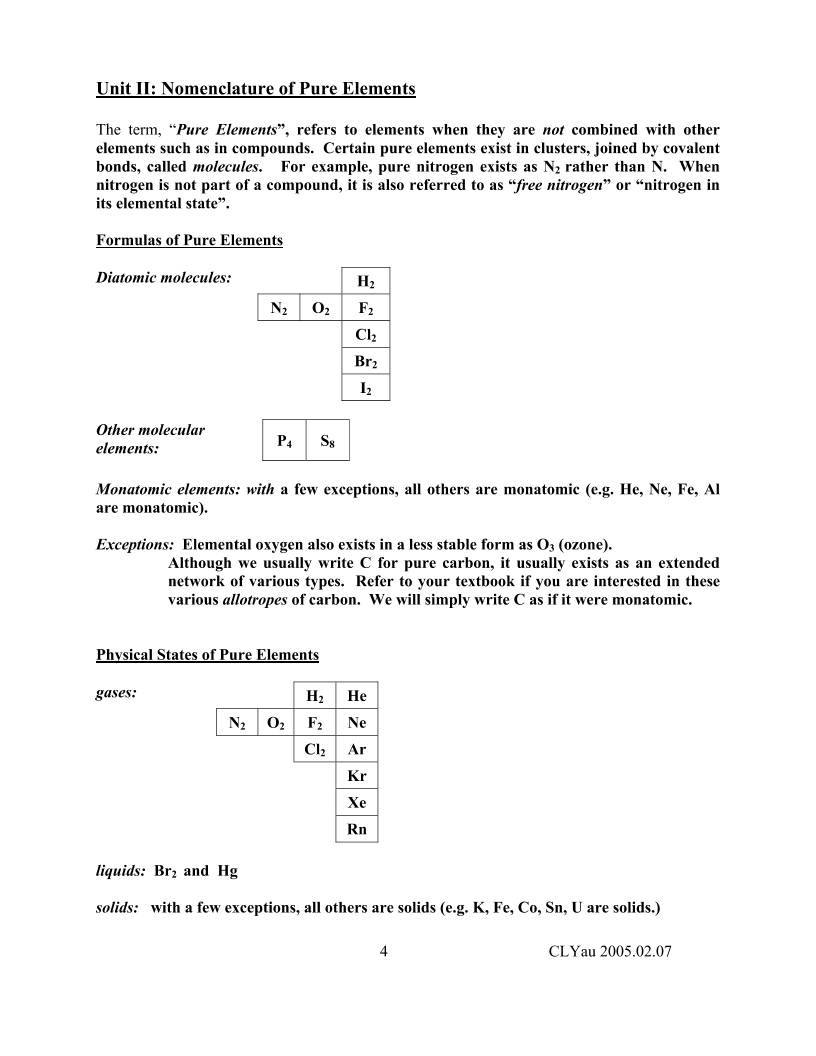
Unit II: Nomenclature of Pure Elements

The term, “Pure Elements”, refers to elements when they are not combined with other
elements such as in compounds.  Certain pure elements exist in clusters, joined by covalent
bonds, called molecules.   For example, pure nitrogen exists as N2 rather than N.  When
nitrogen is not part of a compound, it is also referred to as “free nitrogen” or “nitrogen in
its elemental state”.

Formulas of Pure Elements

Diatomic molecules:   H2
 N2 O2 F2
   Cl2
   Br2
   I2

Other molecular
elements: P4 S8

Monatomic elements: with a few exceptions, all others are monatomic (e.g. He, Ne, Fe, Al
are monatomic).

Exceptions:  Elemental oxygen also exists in a less stable form as O3 (ozone).
 Although we usually write C for pure carbon, it usually exists as an extended
network of various types.  Refer to your textbook if you are interested in these
various allotropes of carbon.  We will simply write C as if it were monatomic.


Physical States of Pure Elements

gases:   H2 He
 N2 O2 F2 Ne
   Cl2 Ar
    Kr
    Xe
    Rn

liquids:  Br2  and  Hg

solids:   with a few exceptions, all others are solids (e.g. K, Fe, Co, Sn, U are solids.)

 5 CLYau 2005.02.07
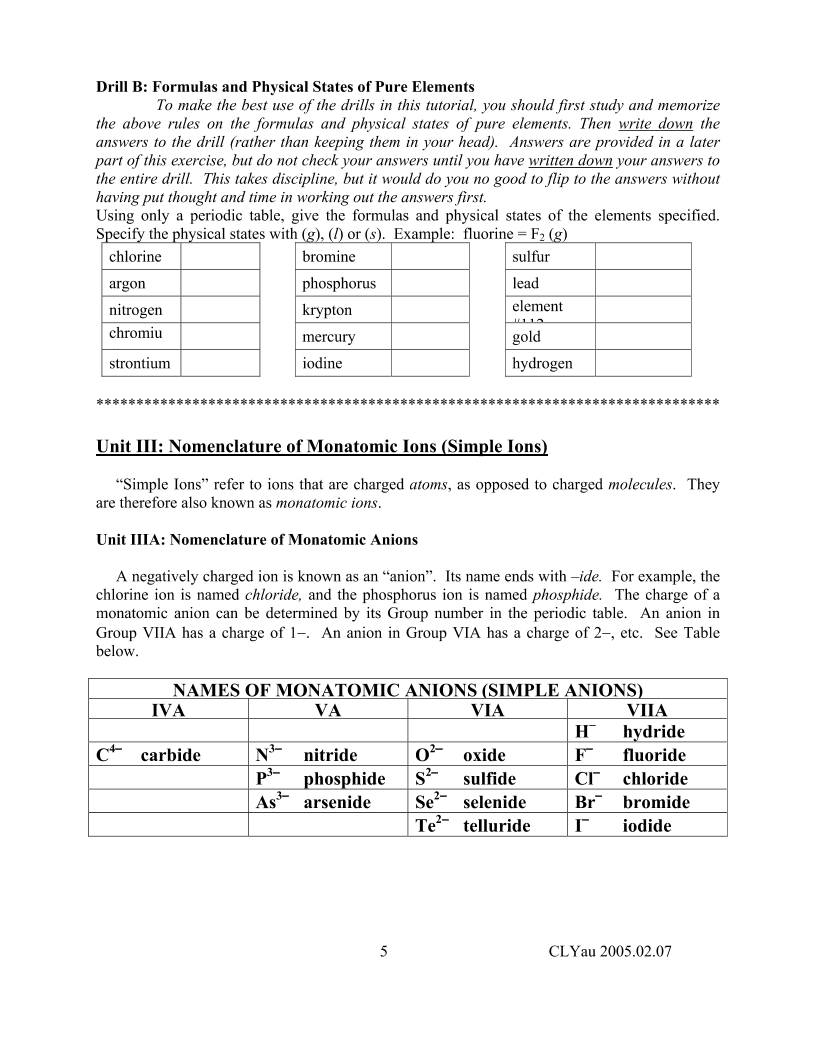
Drill B: Formulas and Physical States of Pure Elements
 To make the best use of the drills in this tutorial, you should first study and memorize
the above rules on the formulas and physical states of pure elements. Then write down the
answers to the drill (rather than keeping them in your head).  Answers are provided in a later
part of this exercise, but do not check your answers until you have written down your answers to
the entire drill.  This takes discipline, but it would do you no good to flip to the answers without
having put thought and time in working out the answers first.
Using only a periodic table, give the formulas and physical states of the elements specified.
Specify the physical states with (g), (l) or (s).  Example:  fluorine = F2 (g)
chlorine   bromine   sulfur
argon   phosphorus   lead
nitrogen   krypton   element
#112

chromiu
m
  mercury   gold
strontium   iodine   hydrogen

******************************************************************************

Unit III: Nomenclature of Monatomic Ions (Simple Ions)

     “Simple Ions” refer to ions that are charged atoms, as opposed to charged molecules.  They
are therefore also known as monatomic ions.

Unit IIIA: Nomenclature of Monatomic Anions

     A negatively charged ion is known as an “anion”.  Its name ends with –ide.  For example, the
chlorine ion is named chloride, and the phosphorus ion is named phosphide.  The charge of a
monatomic anion can be determined by its Group number in the periodic table.  An anion in
Group VIIA has a charge of 1−.  An anion in Group VIA has a charge of 2−, etc.  See Table
below.

NAMES OF MONATOMIC ANIONS (SIMPLE ANIONS)
IVA VA VIA VIIA
   H− hydride
C4−    carbide N3− nitride O2− oxide F− fluoride
 P3− phosphide S2− sulfide Cl− chloride
 As3− arsenide Se2− selenide Br− bromide
  Te2− telluride I− iodide

 6 CLYau 2005.02.07

Unit IIIB:  Nomenclature of Monatomic Cations of Fixed Charges

     A positively charged ion is known as a cation.  Cations in Group IA, IIA and aluminum have
fixed charges (i.e. nonvariable charges).  Those in Group IA always have a charge of 1+, and
those in Group IIA, a charge of 2+.  The aluminum ion always has a charge of 3+.  The name of
a monatomic cation of fixed charge is merely the name of the element followed by the word
“ion”.  Thus Na+ is “sodium ion”.  It is not necessary to specify the charge since it is
nonvariable.  There are a few other cations that also fall in this category, but we will keep it
simple for now and stick with just Groups IA, IIA and aluminum.

NAMES OF MONATOMIC CATIONS (SIMPLE CATIONS)
IA IIA IIIA
H+ hydrogen ion
Li+ lithium ion Be2+ beryllium ion
Na+ sodium ion Mg2+ magnesium ion Al3+ aluminum ion
K+ potassium ion Ca2+ calcium ion
Rb+ rubidium ion Sr2+ strontium ion
Cs+ cesium ion Ba2+ barium ion
Fr+ francium ion Ra2+ radium ion

Unit IIIC: Nomenclature of Monatomic Cations of Variable Charges

Cations not named above are assumed to be of variable charges.  For example iron can exist with
various charges, the most common of which are in the form of Fe2+ and Fe3+.  Their names
must therefore specify the charges.  This is done by following the name of the element with the
charge in Roman numerals, within parentheses.  Fe2+ is named iron(II) ion, and Fe3+ is named
iron(III) ion.  Tin(IV) ion refers to Sn4+.  Names based on this system of nomenclature are
known as “Stock names”.

Many of these ions have “common names”.  Of the two most common ions, the one with the
lower charge has the ending –ous, and that with the higher charge has the ending −ic.  Thus Fe2+
has the common name, of ferrous ion.  Fe3+ has the common name of ferric ion.  Since some of
these names are indeed quite commonly used (as in food labels), it would be wise to learn at least
the four common names included in the table below.

Formula Stock Name Common Name
Fe2+ iron(II) ion ferrous ion
Fe3+ iron(III) ion ferric ion
Cu+ copper(I) ion cuprous ion
Cu2+ copper(II) ion cupric ion

 7 CLYau 2005.02.07
Since the ending in the common name specifies the charge, it would be redundant (therefore
wrong) to also include the Roman numeral.  Thus Cu+ should not be named as cuprous(I) ion.
Incidentally, the ending –ous does not indicate the charge is 1+, nor 2+.  The –ous ending
indicates the lower charge of the two most common charges.  In the case of iron, the two
common charges are 2+ and 3+, so the lower charge would be 2+.  Thus ferrous refer to Fe2+
rather than Fe3+.

Note:  Dr. Yau will not require you to learn the common names. (You do need to know that Fe2+
is iron(II), but you do not need to know whether it is ferrous or ferric.)  Check with your own
instructor whether that is so in your class.

Drill C: Nomenclature of Monatomic Ions
Again, study the rules before taking this as a practice test.  Write down your answers and
compare them with the answers provided only after you have finished the entire drill.  You may
use only a periodic table.
FORMULA NAME NAME FORMULA
Rb+  nitride
Ba2+  iodide
P3–  oxide
Br –  chromium(III)
N3–  potassium ion
S2–  aluminum ion
V3+  magnesium
Cu2+  iron(II) ion
Ca  copper(I) ion

************************************************************************
Unit IV:  Nomenclature of Ionic Compounds of Monatomic Ions

An ionic compound is generally made of one type of cation combined with one type of anion.
The formula has no net charge even though the ions themselves are charged.  Thus, the number
of cations and the number of anions present must reflect a net charge of zero.  These numbers
appear as subscripts, immediately following each element.

For example, Na+ combines with Cl− to form NaCl (net charge of zero, so no charges are
shown).  When Na+ combines with O2−, however, you will need two Na+ to neutralize the
charge of 2− on the oxygen, to give Na2O.  When Mg2+ combines with Cl−, you will similarly
need two Cl– to neutralize the charge of 2+ on the magnesium, to give MgCl2.  Note that the
subscript 2 refers only to the number of Cl, and not the number of Mg.  When no subscript
shows, it is assumed to be one.  Thus, the formula MgCl2 tells us that there is one Mg ion for
every two Cl ions.  The subscripts show us the simplest ratio of cation to anion.  (It would be
wrong to write Mg2Cl4 because 2:4 can be reduced to 1:2.)

 8 CLYau 2005.02.07
When you combine Al3+ with O2−, in order to come up with a net charge of zero, you would
need two Al3+ and three O2−, to give Al2O3.  You can arrive at this answer by simply thinking
about how the charges must work out, or use the Cross Over Method.
 Al   3+
 O       2−


        Al  2    O    3

The Cross Over Method is merely a fast way to figure out how to make the net charge come out
zero.  It does not mean that Al now becomes 2− and oxygen now becomes 3+.  Note also that in
the Cross Over Method, the signs (charges) do not cross over (i.e. charges do not appear in the
subscript.)   Note also that in this method, you must always check that the subscripts are always
reduced to the simplest ratio.

 Mg   2+
 O       2−


        Mg  2    O    2       = MgO, not Mg2O2 !

Even though there are ions (and charges) present in the compound, we do not show the charges
in these formulas.  It would be improper to write Al3+
2O2−
3  or Mg2+O2−, unless you needed to
stress the charges for a special reason.

Unit IVA: Writing Formulas from a Given Name

First figure out the charges of the cation and the anion by examining the name. Then combine the
ions in a ratio that gives you a net charge of zero as described above.  If you have trouble
deciding what the charges are on the ions, you need to review Unit III !  You should be able to do
the drill without using anything but a periodic table.
For example, given the name, tin(II) oxide, you know that the ions are Sn2+ and O2−.
To write the formula for the compound with Sn2+ and O2−, you examine the charges and can see
that it will take one Sn2+ and one O2− to form a neutral compound.
Let’s look at another example.  Given the name, tin(IV) oxide, you know that the ions are Sn4+
and O2−.  In order to form a neutral compound, we must have one Sn4+ and two O2−.   The
formula must therefore be SnO2.
Now try out the Drill D.
 9 CLYau 2005.02.07
Drill D: Formulas of Ionic Compounds of Monatomic ions

NAME FORMULA
magnesium fluoride
lithium sulfide
calcium selenide
nickel(II) fluoride
copper(II) bromide
chromium(III) sulfide
tin(II) phosphide

---------------------------------------------------------------------------------------------------------
Unit IVB: Writing Names from a Given Formula
 Examine the formula.  If the cation belongs in the group that has fixed charges, then you just
name the cation, followed by the anion, but drop the word “ion” that comes in between.  For
example NaCl is sodium chloride, and not sodium ion chloride.  MgCl2 is magnesium chloride.

Drill E: Writing Names of Compounds with Cations of Fixed Charges

KBr
Li2O
Mg3As2
Na3P

 If the cation belongs in the group that has variable charges, you must figure out what that
charge is from the charge of the anion (which is always fixed).  Do not use the Cross Over
Method as it may lead to the wrong answer.  For example, the formula SnO tells us that Sn must
have a charge of 2+ since the oxygen ion is always 2−.  If you used the Cross Over Method, you
would have erroneously come up with Sn having 1+ charge.  The Cross Over Method may seem
to work, but it works only in some and not all cases.  So, it would be wiser not to use it at all for
going backwards (from formula to name).

 Remember that the charge is per ion.  Thus Cu2S tells us that Cu had a charge of 1+, not 2+.
Since the S ion is always 2− (Group VIA), the two Cu must have a total charge of 2+.  Thus
each Cu must have 1+.

 10 CLYau 2005.02.07
Drill F: Determining the Charge and Name of the Cation First, Then Name of Compound

Formula Charge of
Cation Name of Cation Name of Compound
MnO2
PbS
Cr2O3
Rb2Se
CuCl2
CuO
Cu2O

Check your answers to the above drill before going on.  If you have made any mistakes be sure
you find out why before you continue to the next drill.  If necessary you should review all the
previous Units.

Drill G: Nomenclature of Ionic Compounds of Monatomic Ions (Both Fixed & Variable
Charges)

FORMULA NAME  FORMULA NAME
 sodium oxide  RbBr
 magnesium nitride  FeBr2
 copper(I) sulfide  PbS
 manganese(II) iodide  BaO
 iron(III) phosphide  K2O
 copper(I) oxide  SbBr3
 tin(II) nitride  Fe3P2
 strontium oxide  Li2Se
 tin(IV) oxide  CuCl2


 11 CLYau 2005.02.07
Check your answers to the above drill before going on.  If you have made any mistakes be sure
you find out why before you continue to the next drill.  If necessary you should review all the
previous Units.

Extra Drill H: Nomenclature of Ionic Compounds of Monatomic Ions (Both Fixed &
Variable Charges)

FORMULA NAME
RaCl2
BiCl3
Fe203
CdBr2
MnO
MnO2


Unit V: Nomenclature of Polyatomic Ions

Unit VA: The “Basic Eight” Polyatomic Ions

In this unit you are asked to memorize the names and formulas of 8 polyatomic ions, to start
with.  You will be asked to learn more later on.  “Learning” means memorizing the correct
spelling of the name, the correct subscript(s) and charge of each ion.

1+ 1− 2− 3−
NH4
+
ammonium
C2H3O2
−
acetate*
CO3
2−
carbonate
PO4
3−
phosphate
 NO3
−
nitrate
SO4
2−
sulfate

 OH−
hydroxide

 ClO3
−
chlorate

    *acetate is also written as CH3CO2
−
In memorization, it helps to look for patterns.  Note that all but two of the ions have the ending
“−ate”.  For the ions with a charge of 1−, look up where the first element of each ion is located
on the period table (C, N, O, Cl).  Study the formulas and names of this group of ions before
 12 CLYau 2005.02.07
moving on to ions with a charge of 2−.  Again look up the location of the first element of each
ion in the periodic table (C and S).  Study these two names and formulas, and finally move to the
ion with a charge of 3−.  Look up the position of P in the periodic table.  After you have studied
each group based on charges, put them on flash cards and test yourself over and over.

Drill I - 1: Nomenclature of the "Basic Eight" Polyatomic Ions

NAME FORMULA FORMULA NAME
sulfate  OH−
acetate  SO4
2−
chlorate  NH4
+
ammonium  NO3
−
phosphate  ClO3
−
carbonate  PO4
3−
hydroxide  CO3
2−
nitrate  C2H3O2
−

Drill I - 2: Nomenclature of Compounds of the "Basic Eight" Polyatomic Ions With
Cations of Fixed Charges:

NAME FORMULA FORMULA NAME
sodium carbonate  K3PO4
strontium carbonate  Ca(NO3)2
aluminum sulfate  (NH4)2SO4
ammonium phosphate  Al(OH)3
aluminum chlorate  LiC2H3O2
potassium sulfate  MgCO3
calcium acetate  Ba(ClO3)2


 13 CLYau 2005.02.07
Drill I - 3: Nomenclature of Compounds of the "Basic Eight" Polyatomic Ions With
Cations of Variable Charges:

NAME FORMULA FORMULA NAME
iron(II) carbonate  Cu2CO3

iron(III) carbonate  CuCO3

copper(I) sulfate  SnSO4

cobalt(II) phosphate  Fe3(PO4)2

chromium(III) chlorate  Hg(C2H3O2)2
tin(IV) sulfate  BiPO4
antimony(III) acetate  Mn(ClO3)2


Drill I - 4: Compounds of the "Basic Eight" Polyatomic Ions and –ide ions With Cations of
Both Fixed and Variable Charges: (This helps you learn to distinguish between those that
require Roman numerals and those that do not.)

NAME FORMULA FORMULA NAME
calcium phosphate  Na3N
chromium(III) sulfide  NaNO3

potassium carbonate  K2SO4

magnesium acetate  CdCO3

chromium(III) hydroxide  FeCl2

aluminum chlorate  FeCl2

lead(IV) selenide  NH4NO3

copper(II) nitride  Mn(ClO3)2


 14 CLYau 2005.02.07
Unit VB: Polyatomic Ions with “−ite” Ending

In the previous unit (Unit VA) you learned six polyatomic ions with the “−ate” ending.  Certain
of these have counterparts with the “−ite” ending.  The only difference in formula for those with
“−ite” endings is in having one less oxygen.  The charge is unchanged.  For example, nitrate is
NO3
− and nitrite is NO2
−.  Below are the ones with which you should become familiar.

NO3
−
nitrate
SO4
2−
sulfate
PO4
3−
phosphate
NO2
−
nitrite
SO3
2−
sulfite
PO3
3−
phosphite

ClO3
−
chlorate
ClO2
−
chlorite

Unit VC: Nomenclature of “−ate” and “−ite” Compounds

The rules for naming and writing formulas for polyatomic ions are the same as for the
monatomic ions (see Unit VI).  The only difference is if (and only if) there is more than one
polyatomic ion, parenthesis must be used to avoid confusion.

For example, magnesium nitrite is Mg(NO2)2.  Since Mg is in Group IIA, it has a charge of 2+
and nitrite has a charge of 1− (from memory), to obtain a net charge of zero, there must be two
nitrite ions for every magnesium ion.  In the case of potassium acetate, since potassium is in
Group IA, it must have a charge of 1+, and acetate has a charge of 1−, the formula is simply
KC2H3O2.  No parenthesis is necessary.

In naming compounds with cations of variable charges, the charge of the cation must be deduced
from the charge of the anions.  It is therefore imperative that you have learned the charges of the
ions presented in Units VA and VB.  For example, MnSO4 should be named manganese(II)
sulfate.  Since you had previously memorized the fact that SO4
2−  has a charge of 2−, the
manganese ion must have a charge of 2+.  In the case of Cu(NO3)2, since the nitrate ion has a
charge of 1−, two nitrates would have a total charge of 2−.  Thus Cu must have a charge of 2+.
The name for Cu(NO3)2 is therefore Cu(II) nitrate or cupric nitrate.

 15 CLYau 2005.02.07
Drill I-5: Nomenclature of “−ate” and “−ite” ions and compounds

FORMULA NAME
SO4
2−
SO3
2−
 nitrite
 phosphite
 acetate
 chlorite
Na3PO4
K2SO3
Pb(OH)2
CoClO2
Ca(NO3)2
 iron(III) carbonate
 copper(I) sulfite
 cesium nitrite
 aluminum chlorate

Unit VD: Nomenclature of Oxohalo Anions

These are the anions that contain a halogen and various number of oxygen atoms.  In this unit we
will focus on the chlorine series.  Note that all have the charge of 1−.  Starting with chlorate
which is one of our “Basic Eight” from Unit VA, when we lose one oxygen, we get the one with
the −ite ending.  When we lose another oxygen, the name picks up the prefix hypo.  When we
lose yet another oxygen, there is no oxygen left and we have the simple monatomic ion with the
−ide ending (from Unit III).  Returning to chlorate as the base, if we add one extra oxygen, the
name picks up the prefix per.

ClO4
− perchlorate
ClO3
− chlorate
ClO2
− chlorite
ClO− hypochlorite
Cl− chloride


 16 CLYau 2005.02.07
Drill J: Nomenclature of Oxohalo Anions and Compounds:

FORMULA NAME
ClO−
ClO2
−
ClO4
−
 hypochlorite
 chlorate
 perchlorate
 chlorite
 chloride
 sodium chlorite
 magnesium chlorite
 ferrous perchlorate

Note that once you have learned the above oxochloro anions, you are just one step away from
learning the corresponding oxobromo and oxoiodo anions.  Your instructor may require you to
learn these as well:

perbromate, bromate, bromite, hypobromite, bromide
BrO4
− BrO3
− BrO2
− BrO− Br−

periodate,  iodate, iodite, hypoiodite, iodide
IO4
− IO3
− IO2
− ΙΟ− Ι−

 17 CLYau 2005.02.07
Drill K: Nomenclature of “−ate”, “−ite”, oxohaloanions & Their Compounds

FORMULA NAME
ClO4
−
ClO3
−
ClO2
−
ClO−
Cl−
 nitrite
 nitrate
 nitride
 hydroxide
Ca(ClO)2
Ca3(PO3)2
Sc(OH)2
Ti(NO3)3
Hg(ClO)2
K3N
 potassium perchlorate
 potassium sulfite
 aluminum sulfide
 sodium sulfate
 barium hydroxide
 ammonium carbonate
 copper(I) hypochlorite
 tin(IV) acetate
 chromium(III) phosphite
 magnesium chlorate
 zinc(II) phosphide
 calcium nitrite
************************************************************************

Unit VI: Nomenclature of Acids

The system of naming acids presented in this unit relies on how well  you know the formulas of
the polyatomic ions.  If necessary review all of the above units.

Starting with a polyatomic ion (such as SO4
2−), add as many H+ as necessary to neutralize the
charge.  For sulfate, with a charge of 2−, you would have to add two H+.  Generally the
hydrogen is placed at the front of the formula (H2SO4).  For phosphate, you would have to add
three H+, and the acid has the formula of H3PO4.
 18 CLYau 2005.02.07
The name of the acid depends on the ending of the anion.  If the ending is −ate, the
corresponding acid has the ending −ic acid.  If the ending is −ite, the corresponding acid has the
ending –ous acid.  If the ending is −ide, the acid has the prefix of hydro− and an ending of −ic
acid.
Ending of Anion Name of Corresponding Acid
−ate −ic acid
−ite −ous acid
−ide hydro−….−ic acid
Thus, sulfate becomes sulfuric acid; sulfite becomes sulfurous acid and sulfide becomes
hydrosulfuric acid.

Drill L: Nomenclature of Acids

 ANIONS CORRESPONDING ACIDS
Formula Name Formula Name
ClO4
– _______________ __________ __________________
ClO3
– _______________ __________ __________________
ClO2
– _______________ __________ __________________
ClO– _______________ __________ __________________
Cl– _______________ __________ __________________
Br− _______________ __________ __________________
I− _______________ __________ __________________
C2H3O2
− _______________ __________ __________________
NO3
− _______________ __________ __________________
NO2
− _______________ __________ __________________
OH− _______________ __________ __________________
ClO3
− _______________ __________ __________________
CO3
2− _______________ __________ __________________
SO4
2− _______________ __________ __________________
SO3
2− _______________ __________ __________________
PO4
3− _______________ __________ __________________
PO3
3− _______________ __________ __________________
 Drill continues on following page
 19 CLYau 2005.02.07

Name Formula Formula Name
sulfuric acid  HNO3
nitrous acid  H2CO3
hydrochloric acid  H3PO3
carbonic acid  HClO
phosphorous acid  H2SO4
chlorous acid  HC2H3O2
sulfurous acid  HNO2
hypochlorous acid  HClO4
chloric acid  HBr
phosphoric acid  H2SO3
nitric acid  H2Se
acetic acid  H3PO4
hydrotelluric acid  HOH

***********************************************************************
 20 CLYau 2005.02.07
Unit VII: Nomenclature of Acid Anions

In Unit VI you learned that acids generally have one or more H at the front of the formula.  It
does not have a charge because we have added as many H+ as necessary to keep it neutral.  An
“acid anion”, however, by definition must have a H in front (to be called an acid), as well as a
negative charge (to be called an anion).  It is derived from having added less than the necessary
number of H+.

For example, if we add only one H+ to the sulfate ion (SO4
2−), we would have the acid anion,
HSO4
−.  If we add only one H+ to the phosphite ion (PO3
3−), we would have the acid anion
HPO3
2−.  If we added two, we would have the acid anion H2PO3
−.  Note that the negative charge
of the anion is reduced by each additional H+.

Study the following names and formulas and then test yourself using flash cards:

CO3
2−
carbonate
 PO4
3−
phosphate
PO3
3−
phosphite
HCO3
−
hydrogen carbonate
or bicarbonate
 HPO4
2−
hydrogen phosphate
HPO3
2−
hydrogen phosphite
SO4
2−
sulfate
 H2PO4
−
dihydrogen phosphate
H2PO3
−
dihydrogen phosphite
HSO4
−
hydrogen sulfate
or bisulfate

SO3
2−
sulfite

HSO3
−
hydrogen sulfite
or bisulfite


 21 CLYau 2005.02.07
Drill M: Nomenclature of Acid Anions

 Formula Stock Name Common Name
(when appropriate)
1 Ca(HCO3)2
2 Fe(HCO3)2
3 Pb(HPO4)2                 xxxxxxxxxxxxxxxxx
4 AgHSO3
5 Bi(H2PO3)3                 xxxxxxxxxxxxxxxxx
6  barium hydrogen phosphate                xxxxxxxxxxxxxxxxx
7  magnesium hydrogen sulfite
8  aluminum hydrogen phosphate                xxxxxxxxxxxxxxxxx
9  mercury(II) dihydrogen
phosphite                xxxxxxxxxxxxxxxxx
10  zinc(II) hydrogen carbonate
11   barium bisulfite
12   iron(III) bicarbonate
13   copper(I) bisulfate
14   copper(II) dihydrogen phosphite
15
  tin(IV) hydrogen phosphate xxxxxxxxxxxxxxxxx
16
  antimony(III) hydrogen
phosphite xxxxxxxxxxxxxxxxx

***********************************************************************
 22 CLYau 2005.02.07
Unit VIII: Nomenclature of Other Common Polyatomic Ions

We began with a small set of polyatomic ions, the “Basic Eight” (see Unit V).  All the
subsequent units were based on solely those eight.  Now it is time to expand our base to a few
more ions that we often come across.  The nomenclature rules you have learned will apply to
these as well.

2+ 1– 2−
Hg2
2+
mercury(I) ion
CN–
cyanide
C2O4
2−
oxalate
 MnO4
–
permanganate
O2
2−
peroxide
  CrO4
2−
chromate
  Cr2O7
2−
dichromate

Drill N:  Nomenclature of Other Polyatomic Ions and Compounds

FORMULA NAME
FeCr2O7
Na2O2
HgO
 calcium cyanide
 ammonium oxalate
 silver(I) permanganate
 mercury(I) chloride
 mercury(II) chloride

***********************************************************************
 23 CLYau 2005.02.07
Unit IX: Nomenclature of Molecular Binary Compounds

Units III through VIII dealt with ions and ionic compounds.  In this unit we will deal with
molecular compounds.  In particular, the molecular binary compounds, compounds containing
only two nonmetals.  They involve a completely different set of rules.  Since there are no ions,
there are no charges and no Roman numerals.

The number of atoms of each element is specified by a Greek prefix (see table below).  The
second element has the ending “−ide”.  For example, N2F4 is named dinitrogen tetrafluoride.

When two vowels are adjacent to each other, one is dropped. For example P2O5 is named
diphosphorus pentoxide rather than pentaoxide.

When the first element has only one atom, the prefix mono is often omitted.  For example, NO2
is often referred to as nitrogen dioxide rather than mononitrogen dioxide.

When the second element has only one atom, the prefix mono is retained.  For example, CO is
carbon monoxide rather than monocarbon monoxide.

Number Prefix  Number Prefix
1 mono  6 hexa
2 di  7 hepta
3 tri  8 octa
4 tetra  9 nona
5 penta  10 deca

Drill O: Nomenclature of Molecular Binary Compounds

FORMULA NAME
CBr4
PCl5
S2Br2
N2O4
 sulfur dioxide
 diiodine trioxide
 dibromine monoxide

Remember that the rules stated here for using prefixes (mono, di, tri, etc.) are for molecular
binary compounds.  That excludes ionic compounds!  For ionic compounds you follow the rules
 24 CLYau 2005.02.07
you have learned from Units III through VIII earlier in this tutorial.  Thus PCl3 is phosphorus
trichloride, but AlCl3 is aluminum chloride and MnCl3 is manganese(III) chloride. You have
already learned all the rules (when to use prefixes, when to use Roman numerals and when not to
use either).  The drill below is to help you practise choosing the appropriate rules to follow.

The key is to first determine whether a compound is molecular or ionic.  That is easily done by
seeing whether the first element shown is a metal or nonmetal.  There are exceptions to this rule,
but for now, let us consider only the usual cases.  If the compound is molecular, you use prefixes.
If it is ionic, you must decide whether the cation has fixed or variable charges in order to
determine whether or not to use Roman numerals (Unit III).

Drill P: Drill in Determining When to Use Prefixes and Roman Numerals

FORMULA NAME
PbCl2
SCl2
MgCl2
Co2S3
Al2O3
N2Br4
K3P


***********************************************************************

Unit X: Nomenclature of Hydrates

A hydrate is a compound with a fixed number of water molecules as an integral part of its
structure.  An example is CuSO4⋅5H2O, a blue crystalline material.  As the formula
indicates, it has five water molecules for each unit of CuSO4.  Although it contains water
molecules, it is a solid.

Note that a hydrate is not simply a sample that is wet!  A wet sample would have a variable
amount of water and would not have the fixed ratio of water attached.

In naming hydrates, you would name the compound with the rules that you have learned
previously, followed by specifying how many water molecules are attached with a prefix.
 25 CLYau 2005.02.07
Thus, CuSO4⋅5H2O is named copper(II) sulfate pentahydrate, and cobalt(II) chloride
tetrahydrate has the formula CoCl2⋅4H2O.

Note that the dot in front of the formula H2O does not represent a multiplication sign!  It
merely separates out the H2O from the rest of the formula and the coefficient in front of the
H2O tells you how many water molecules are present.  CoCl2⋅4H2O, therefore, contains one
Co2+ ion, two Cl− ions and four water molecules.  It has a total of one cobalt, two chlorine,
eight hydrogen and four oxygen atoms.

Drill Q:  Drill on Naming Hydrates

Formula Name Name Formula
Ca(ClO3)2⋅2H2O  cobalt(II) fluoride tetrahydrate
Sn(SO4)2⋅2H2O  zinc(II) acetate dihydrate
NiSO4⋅7H2O  copper(II) nitrate trihydrate
Co(C2H3O2)2⋅4H2O  iron(III) bromide hexahydrate

************************************************************************

End of Nomenclature Tutorial
(See the following pages for the answers to the drills.)

If you have questions or comments you may contact me at cyau@ccbcmd.edu


 26 CLYau 2005.02.07
Answers to “Nomenclature: A Tutorial”

Drill A: Nomenclature of Elements

Name Symbol  Symbol Name

chlorine Cl  S sulfur
calcium Ca  K potassium
arsenic As  Fe iron
mercury Hg  Na sodium
copper Cu  P phosphorus

Drill B: Formulas and Physical States of Pure Elements

chlorine Cl2 (g)  bromine Br2 (l)  sulfur S8 (s)
argon Ar (g)  phosphorus P4 (s)  lead Pb (s)
nitrogen N2 (g)  krypton Kr (g)  element #112 Uub (s)
chromiu
m
Cr (s)  mercury Hg (l)  gold Au (s)
strontiu
m
Sr (s)  iodine I2 (s)  hydrogen H2 (g)

Drill C: Nomenclature of Monatomic Ions

FORMULA NAME  NAME FORMULA
Rb+ rubidium ion  nitride N3–
Ba2+ barium ion  iodide I –
P3– phosphide  oxide O2–
Br – bromide  chromium(III) Cr3+
N3– nitride  potassium ion K+
S2– sulfide  aluminum ion Al3+
V3+ vanadium(III)  magnesium Mg
Cu2+ copper(II) ion  ferrous ion Fe2+
Ca calcium  cuprous ion Cu+

 27 CLYau 2005.02.07
Drill D: Formulas of Ionic Compounds of Monatomic ions

NAME FORMULA
magnesium fluoride MgF2
lithium sulfide Li2S
calcium selenide CaSe
nickel(II) fluoride NiF2
cupric bromide CuBr2
chromium(III) sulfide Cr2S3
tin(II) phosphide Sn3P2

Drill E: Writing Names of Compounds with Cations of Fixed Charges

KBr potassium bromide
Li2O lithium oxide
Mg3As2 magnesium arsenide
Na3P sodium phosphide

Drill F: Determining the Charge and Name of the Cation First, Then Name of Compound

Formula Charge of
Cation Name of Cation Name of Compound
MnO2 4+ manganese(IV) ion manganese(IV) oxide
PbS 2+ lead(II) ion lead(II) sulfide
Cr2O3 3+ chromium(III) ion chromium(III) oxide
Rb2Se 1+ rubidium ion rubidium selenide
CuCl2 2+ copper(II) ion copper(II) chloride
CuO 2+ copper(II) ion copper(II) oxide
Cu2O 1+ copper(I) ion copper(I) oxide

 28 CLYau 2005.02.07
Drill G: Nomenclature of Ionic Compounds of Monatomic Ions
 (Both Fixed & Variable Charges)

FORMULA NAME  FORMULA NAME
Na2O sodium oxide  RbBr rubidium bromide
Mg3N2 magnesium nitride  FeBr2 iron(II) bromide
Cu2S cuprous sulfide  PbS lead(II) sulfide
MnI2 manganese(II) iodide  BaO barium oxide
FeP ferric phosphide  K2O potassium oxide
CuO cupric oxide  SbBr3 antimony(III) bromide
Sn3N2 tin(II) nitride  Fe3P2 iron(II) phosphide
SrO strontium oxide  Li2Se lithium selenide
SnO2 tin(IV) oxide  CuCl2 copper(II) chloride

Extra Drill H: Nomenclature of Ionic Compounds of Monatomic Ions
 (Both Fixed & Variable Charges)

FORMULA NAME
RaCl2 radium chloride
BiCl3 bismuth(III) chloride
Fe2O3 iron(III) oxide or ferric oxide
CdBr2 cadmium(II) bromide
MnO manganese(II) oxide
MnO2 manganese(IV) oxide

 29 CLYau 2005.02.07
Drill I - 1: Nomenclature of the "Basic Eight" Polyatomic Ions

NAME FORMULA FORMULA NAME
sulfate SO4
2− OH− hydroxide
acetate C2H3O2
− SO4
2− sulfate
chlorate ClO3
− NH4
+ ammonium
ammonium NH4
+ NO3
− nitrate
phosphate PO4
3− ClO3
− chlorate
carbonate CO3
2− PO4
3− phosphate
hydroxide OH−      CO3
2− carbonate
nitrate NO3
− C2H3O2
− acetate


Drill I - 2: Nomenclature of Compounds of the "Basic Eight" Polyatomic Ions With
Cations of Fixed Charges:

NAME FORMULA FORMULA NAME
sodium carbonate Na2CO3 K3PO4 potassium phosphate
strontium carbonate SrCO3     Ca(NO3)2 calcium nitrate
aluminum sulfate Al2(SO4)3     (NH4)2SO4 ammonium sulfate
ammonium
phosphate
(NH4)3PO4 Al(OH)3 aluminum hydroxide
aluminum chlorate Al(ClO3)3 LiC2H3O2 lithium acetate
potassium sulfate K2SO4     MgCO3 magnesium carbonate
calcium acetate            Ca(C2H3O2)2 Ba(ClO3)2 barium chlorate


Drill I - 3: Nomenclature of Compounds of the "Basic Eight" Polyatomic Ions With
Cations of Variable Charges:

NAME FORMULA NAME FORMULA
ferrous carbonate FeCO3
CuCO3 (stock name)
copper(II) carbonate
ferric carbonate Fe2(CO3)3
CuCO3 (common name)
cupric carbonate
cuprous sulfate Cu2SO4 SnSO4 tin(II) sulfate
cobalt(II) phosphate Co3(PO4)2
Fe3(PO4)2 (stock name)
iron(II) phosphate
chromium(III)
chlorate Cr(ClO3)3
Hg(C2H3O2)2 mercury(II) acetate
tin(IV) sulfate Sn(SO4)2 BiPO4 bismuth(III) phosphate
antimony(III) acetate
Sb(C2H3O2)3
or
Sb(CH3CO2)3
Mn(ClO3)2 manganese(II) chlorate
 30 CLYau 2005.02.07


Drill I - 4: Compounds of the "Basic Eight" Polyatomic Ions and –ide ions With Cations of
Both Fixed and Variable Charges: (learning to distinguish between those that require
Roman numerals and those that do not)
NAME FORMULA FORMULA NAME
calcium phosphate Ca3(PO4)2 Na3N sodium nitride
chromium(III) sulfide Cr2S3 NaNO3 sodium nitrate
potassium carbonate K2CO3 K2SO4 potassium sulfate
magnesium acetate Mg(CH3CO2)2 CdCO3 cadmium(II) carbonate
chromium(III) hydroxide Cr(OH)3 FeCl2
(stock name)
iron(II) chloride
aluminum chlorate Al(ClO3)3 FeCl2
(common name)
ferrous chloride
lead(IV) selenide PbSe2 NH4NO3 ammonium nitrate
cupric nitride Cu3N2 Mn(ClO3)2 manganese(II) chlorate
ferrous nitrate Fe(NO3)2 Cu3PO4
(common name)
cuprous phosphate


Drill I-5: Nomenclature of “−ate” and “−ite” ions and compounds

FORMULA NAME
SO4
2− sulfate
SO3
2− sulfite
NO2
– nitrite
PO3
3− phosphite
C2H3O2
− acetate
ClO2
− chlorite
Na3PO4 sodium phosphate
K2SO3 potassium sulfite
Pb(OH)2 lead(II) hydroxide
CoClO2 cobalt(I) chlorite
Ca(NO3)2 calcium nitrate
Fe2(CO3)3 iron(III) carbonate
Cu2SO3 copper(I) sulfite
CsNO2 cesium nitrite
Al(ClO3)3 aluminum chlorate

 31 CLYau 2005.02.07
Drill J: Nomenclature of Oxohalo Ions and Compounds:
FORMULA NAME
ClO− hypochlorite
ClO2
− chlorite
ClO4
− perchlorate
ClO− hypochlorite
ClO3
− chlorate
ClO4
− perchlorate
ClO2
− chlorite
Cl– chloride
NaClO2 sodium chlorite
Mg(ClO2)2 magnesium chlorite
Fe(ClO4)2 ferrous perchlorate

Drill K: Nomenclature of “−ate”, “−ite”, oxohaloanions & Their Compounds:
FORMULA NAME
ClO4
− perchlorate
ClO3
− chlorate
ClO2
− chlorite
ClO− hypochlorite
Cl− chloride
NO2
− nitrite
NO3
− nitrate
N3− nitride
OH− hydroxide
Ca(ClO)2 calcium hypochlorite
Ca3(PO3)2 calcium phosphite
Sc(OH)2 scandium(II) hydroxide
Ti(NO3)3 titanium(III) nitrate
Hg(ClO)2 mercury(II) hypochlorite
K3N potassium nitride
KClO4 potassium perchlorate
K2SO3 potassium sulfite
Al2S3 aluminum sulfide
Na2SO4 sodium sulfate
Ba(OH)2 barium hydroxide
(NH4)2CO3 ammonium carbonate
CuClO cuprous hypochlorite
Sn(C2H3O2)4 tin(IV) acetate
CrPO3 chromium(III) phosphite
Mg(ClO3)2 magnesium chlorate
Zn3P2 zinc(II) phosphide
Ca(NO2)2 calcium nitrite

 32 CLYau 2005.02.07
Drill L: Nomenclature of Acids

 ANIONS CORRESPONDING ACIDS

Formula Name Formula Name
ClO4
– perchlorate HClO4 perchloric acid
ClO3
– chlorate HClO3 chloric acid
ClO2
– chlorite HClO2 chlorous acid
ClO– hypochlorite HClO hypochlorous acid
Cl– chloride HCl hydrochloric acid
Br− bromide HBr hydrobromic acid
I− iodide HI hydroiodic acid
C2H3O2
− acetate HC2H3O2 acetic acid
NO3
− nitrate HNO3 nitric acid
NO2
− nitrite HNO2 nitrous acid
OH− hydroxide HOH water
ClO3
− chlorate HClO3 chloric acid
CO3
2− carbonate H2CO3 carbonic acid
SO4
2− sulfate H2SO4 sulfuric acid
SO3
2− sulfite H2SO3 sulfurous acid
PO4
3− phosphate H3PO4 phosphoric acid
PO3
3− phosphite H3PO3 phosphorous acid
 33 CLYau 2005.02.07

Name Formula Formula Name
sulfuric acid H2SO4 HNO3 nitric acid
nitrous acid HNO2 H2CO3 carbonic acid
hydrochloric acid HCl H3PO3 phosphorous acid
carbonic acid H2CO3 HClO hypochlorous acid
phosphorous acid H3PO3 H2SO4 sulfuric acid
chlorous acid HClO2 HC2H3O2 acetic acid
sulfurous acid H2SO3 HNO2 nitrous acid
hypochlorous acid HClO HClO4 perchloric acid
chloric acid HClO3 HBr hydrobromic acid
phosphoric acid H3PO4 H2SO3 sulfurous acid
nitric acid HNO3 H2Se hydroselenic acid
acetic acid HC2H3O2 H3PO4 phosphoric acid
hydrotelluric acid H2Te HOH water

Drill M: Nomenclature of Acid Anions

1.  calcium hydrogen carbonate,
 calcium bicarbonate
2.  iron(II) hydrogen carbonate,
 ferrous bicarbonate
3.  lead(IV) hydrogen phosphate
4.  silver(I) hydrogen sulfite,
  silver(I) bisulfite
5.  bismuth(III) dihydrogen phosphite
6.  BaHPO4
7.  Mg(HSO3)2 ,     magnesium bisulfite
8.  Al2(HPO4)3
9.   Hg(H2PO3)2
10. Zn(HCO3)2 ,  zinc(II) bicarbonate
11. Ba(HSO3)2 ,  barium hydrogen sulfite
12. Fe(HCO3)3 ,
 iron(III) hydrogen carbonate
13. CuHSO4 ,      copper(I) hydrogen sulfate
14. Cu(H2PO3)2 ,
 copper(II) dihydrogen phosphite
15. Sn(HPO4)2
16. Sb2(HPO3)3

 34 CLYau 2005.02.07
Drill N: Nomenclature of Other Polyatomic Ions and Compounds


Drill O: Nomenclature of Molecular Binary Compounds
FORMULA NAME
CBr4 carbon tetrabromide
PCl5 phosphorus pentachloride
S2Br2 disulfur dibromide
N2O4 dinitrogen tetroxide
SO2 sulfur dioxide
I2O3 diiodine trioxide
Br2O dibromine monoxide

Drill P: Drill in Determining When to Use Prefixes and Roman Numerals
FORMULA NAME
PbCl2 lead(II) chloride (ionic, cation with variable charges)
SCl2 sulfur dichloride (molecular)
MgCl2 magnesium chloride (ionic, cation with fixed charges)
Co2S3 cobalt(III) sulfide (ionic, cation with variable charges)
Al2O3 aluminum oxide (ionic, cation with fixed charges)
N2Br4 dinitrogen tetrabromide (molecular)
K3P potassium phosphide (ionic, cation with fixed charges)


FORMULA NAME
FeCr2O7 iron(II) dichromate
Na2O2 sodium peroxide
HgO mercury(II) oxide
Ca(CN)2 calcium cyanide
(NH4)2C2O4 ammonium oxalate
AgMnO4 silver(I) permanganate
Hg2Cl2 mercury(I) chloride
HgCl2 mercury(II) chloride
 35 CLYau 2005.02.07
Drill Q:  Drill on Naming Hydrates


Formula Name Name Formula
Ca(ClO3)2⋅2H2O calcium chlorate
dihydrate
cobalt(II) fluoride
tetrahydrate CoF2⋅4H2O
Sn(SO4)2⋅2H2O tin(IV) sulfate dihydrate zinc(II) acetate dihydrate Zn(C2H3O2)2⋅2H2O
NiSO4⋅7H2O nickel(II) sulfate
heptahydrate
copper(II) nitrate
trihydrate Cu(NO3)2⋅3H2O
Co(C2H3O2)2⋅4H
2O
cobalt(II) acetate
tetrahydrate
iron(III) bromide
hexahydrate FeBr3⋅6H2O


End of Answers to the Nomenclature Tutorial Drills

***********************************************************************


 设备数据采集
 工程招标采购
 搞笑表情
搞笑表情 微信头像
微信头像 CWMS冷库管理系统
 美女图片
美女图片 APP小游戏
 PPT模板
PPT模板 WMS仓库系统
 软件开发
软件开发