概要信息:
淘宝店铺名:华西教育 阿里旺旺:智龙雁少 更多考研 四六级 资料
1
基础语法讲义
主讲:屠浩民
欢迎使用新东方在线电子教材
一、简单句和并列句
1. 简单句的五种形式:
(1)主语+谓语(不及物动词);
(2)主语+谓语(及物动词)+宾语;
(3)主语+谓语+宾语+补语;
(4)主语+谓语+间接宾语+直接宾语;
(5)主语+系动词+表语。
两类系动词:①be动词;
②一些实义动词用作系动词:feel, taste, smell等;
2.
并列句:一个句子当中包含两个或更多互不相依存的主谓结构,中间用一些连接词连接起
来的句子。
并列句不能只用逗号隔开,而要用连接词连接。
连接词:
(1)并列关系句型:连接词有and, as well as, either…or…,neither…nor…,not only…but
also…
eg: Last year I met Kate and we became friends.
Either my uncle can do it, or my aunt can do it.
(2)转折概念并列句型:转折词有but
eg: It has no mouth, but it can talk.
(3)对比关系的并列句型:
eg: He liked sports, while I would rather collect stamps.
练习:2009年6月阅读
Cerling’s team collected tap water samples from 600 cities and constructed a mop of the
regional differences.(简单句)
Most hydrogen and oxygen atoms in water are stable, but traces of both elements are also
淘宝店铺名:华西教育 阿里旺旺:智龙雁少 更多考研 四六级 资料
present as heavier isotopes . (并列句)
简单句和并列句是复合句的基础。
二、句子成分
句子六大成分:主谓宾、定状表。
主语、宾语和表语:通常由代词或者名词构成,
定语:修饰名词;
状语:修饰形容词或者动词;
表语:接在系动词后面;
(一).代词:人称代词、物主代词、反身代词、指示代词、不定代词。
1人称代词:第一、二、三人称,主格、宾格、所有格;
I,you ,he,she, it, me, you, him, her, it, my, your, his, her, its.
2 物主代词
①形容词性物主代词:my, your, his, her, our, their,后面加名词;
②名词性物主代词:mine, yours, his, hers, ours, theirs,后面不能加名词。
eg: May I borrow your pen?
Mine is missing.
3反身代词:通过反身代词指代主语,使动作发出者把动作在形式上反射到发出者本人。强
调人称问题。
eg:I myself took Mary to the airport.
I cooked it myself.
4. 指示代词:this, that, these, those
5. 不定代词:some,someone,something,any,anyone,anything,no,no
one,nothing,all,both,neither,either,each,every,everybody,everyone,everything.
一些比较重要的不定代词之间的区别:
(1)all, each, every:
①
all和every可以指代三个或三个以上的人或物;all可以表示所有东西的总和,是一个不可分
割的整体; each只能表示两个或两个以上的人,侧重个体;
② all和every侧重整体,each侧重个体;
eg:Every staff of the university contributed to the fund.
Two girls came, and I gave an apple to each.
(2)everyone&every one
everyone等同于everybody,all people ,指的是所有的人;
eg:Everyone thinks they have the right to be here.
every one既可以指人,也可以指物,强调一个个体,通常用every one of ;
eg:Every one of us has faults and shortcomings.
Every one of the films we have shown this year has been a success.
(3)no one&none
no one 只能指人,none既可以指人,也可以指物,none后面还可以接of;
eg:No one failed the examination.
None of the students failed the examination.
6. it 的用法
(1)指代人,通常用于口语中;
2
淘宝店铺名:华西教育 阿里旺旺:智龙雁少 更多考研 四六级 资料
(2)书面语:
① it 用来指代时间、距离、温度、天气等
eg:It's three years since I saw him.
② it 用来前指或者后指
eg:I've lost my book. Where is it?
There is no doubt about it that he was a fine teacher.
③ it 做形式主语
eg:Is it possible to learn typewriting very quickly?
④ it
做形式宾语,通常放在谓语动词和宾语补足语(形容词)之间,真正的宾语放在宾补之后
常见动词有:feel, consider, find, believe, make, take, imagine, think, suppose, regard
eg:She thinks it no use telling me.
He has made it clear that he wouldn't agree to the plan.
⑤ it 用于强调句,构成句型It's…that/who…
如何区分强调句中的it和形式主语中的it?
eg:It's clear that they have won.
如果It's和that去掉后,剩下的部分依然能构成完整的句子,就是强调句;否则,即为形式
主语。
(二)名词
1. 可数名词
有单复数之分,若名词为单数,通常前面要加冠词a/an、the进行限定;若名词为复数,可
以加上the,或者直接用复数名词,或者加上数词来进行限定。
名词的复数形式可以直接加s/es,以y 结尾的,变y 为i ,再加es,还有一些特殊形式的。
有些单数名词的形式,是集合名词,可以用作复数,如police,cattle,people,mankind等
;
eg:Several hundred police were on duty at the demonstration yesterday.
Cattle are allowed to graze on the village common.
不可数名词:通常是物质名词或者抽象名词
2.
不可数名词:通常是物质名词或者抽象名词,其前可以不加任何东西,若有特指,可以加t
he.
前面可以加上单位词,进行分类:
常见单位词:
①a piece of +advice/bread/cloth/fortune/information/music/muse
②a bit of、an item of、an article of
3. 名词在翻译中遇到的问题:
(1)不可数名词和可数名词间的转换形式:
eg:water&waters(水域、海洋),sand&sands(沙滩),wood&woods(树林),goods
(商品),ash和ashes(废墟)
(2)名词表示特指时,可以加冠词
3
淘宝店铺名:华西教育 阿里旺旺:智龙雁少 更多考研 四六级 资料
①不定冠词:a/an,通常表示一,但是不强调数目,翻译时注意;
eg:Germany is a European country.
②定冠词:表示特定或特指
eg:Is this the book that you are looking for?
定冠词还可以使用于一些比较独特的语言现象:如指代地球或宇宙这种独一无二的事物
the+名词:表示全部或者整体
eg:Do you know who invented the computer?
用于乐器或专有名词前,如play the piano、the Thames
(三)数词
数词分为基数词和序数词
1. 表示大约的词汇:about,approximately,around,roughly,some,more or less, or so;
eg:About 200 people were killed in the crash.
The town is 5 Miles or so from here.
2. 表示多于的词汇:above,more than, over
3. 表示少于,不到的词汇:almost,below,less than, under
eg:It's 2:57, and it's almost 3 o'clock
4. 一些可以直接表示数字的单词: dozen、score、decade、hundred、thousand、million
这些词前面出现基数词,表示确切的数时,不能加复数;若不能表明确切数字,只是说大
约有多少的时候,以上这些词不可以加确切的基数词,但是可以将其变为复数,后加of;
eg:There are millions of kinds of matter in the world.
(四)形容词和副词
1. 定语
用来修饰名词,通常是形容词;若是单个形容词,一般放在修饰名词前;若为词组,
一般放在修饰名词之后;
形容词词组的两种情况:
(1)成对的形容词;
eg:She has many pencils, blue and red.
(2)形容词短语:
eg:I think he is a man suitable for the job.
形容词还可以做表语,放在be动词之后;
英语中有一些词语作表语和作定语时,含义会有所不同:
(1)certain:
作定语时,表示特定的:
eg: A certain Mr. Wang just came here to look for you.
作表语时,表示当然的,一定,相当于be sure;
(2)complete:
作定语时,表示完全的:
作表语时,表示完成的或完美的;
(3)ill:作定语时,表示坏的;作表语时,表示有病的;
(4)late: 作定语时,表示已故的;作表语时,表示晚的、迟到的;
(5)ready:作定语时,表示现成的;作表语时,表示准备好的、愿意做……;
(6)present:作定语时,表示目前的,相当于current;作表语时,表示出席,参加;
4
淘宝店铺名:华西教育 阿里旺旺:智龙雁少 更多考研 四六级 资料
the+形容词:表示一类人;
eg: the old, the poor, the blind, the rich, the young, the wounded
2. 状语:
通常由副词构成,副词可以修饰动词,形容词,乃至整个句子;
副词通常是褒义的,有部分是有否定含义的,常见否定含义副词有seldom,hardly,rarely
,scarcely;
其它副词通常是表示肯定的概念;
3. 形容词和副词的比较级:
(1)一些没有比较级的形容词和副词:
①单词本身的含义是表示比……年长、比……优秀、比……优等时,没有比较级概念;
如supreme,inferior,junior,senior,prior at ,后面搭配的介词一般是to,而不用than.
②有些单词本身的含义即是最,独一无二,没有比较级概念;
如absolute,entire,excellent,favorite,final.
(2)同级比较和异级比较:
①同级比较:as…as…/…times as…
②异级比较:(倍数或修饰词,表示多或少)+比较级+than
常见的修饰比较级的词有:much、still,even,by far,a bit,a little, a good deal或者倍数;
eg:The photography of Mars taken by satellite are much clearer than those taken from earth.
③比较级特殊用法词汇:
more…than…:
eg:He is more clever than honest.
the+比较级:越来越……
eg:The harder you work, the more you will learn.
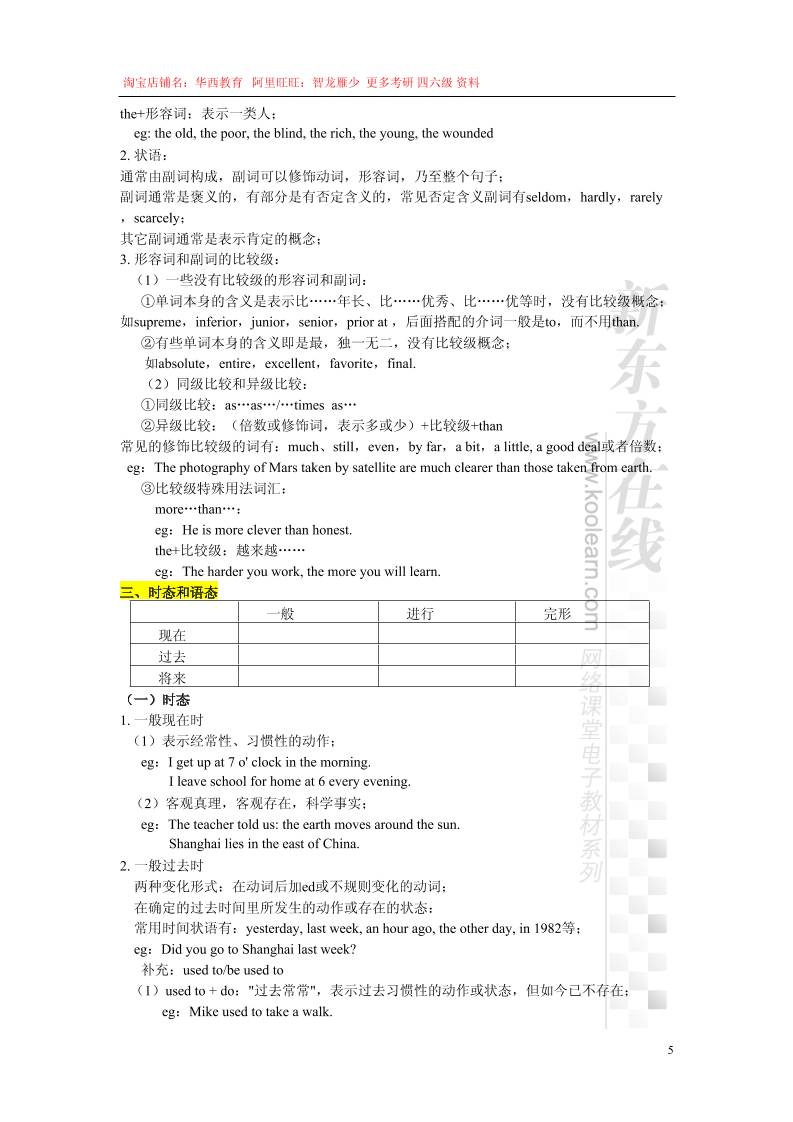
三、时态和语态
一般 进行 完形
现在
过去
将来
(一)时态
1. 一般现在时
(1)表示经常性、习惯性的动作;
eg:I get up at 7 o' clock in the morning.
I leave school for home at 6 every evening.
(2)客观真理,客观存在,科学事实;
eg:The teacher told us: the earth moves around the sun.
Shanghai lies in the east of China.
2. 一般过去时
两种变化形式:在动词后加ed或不规则变化的动词;
在确定的过去时间里所发生的动作或存在的状态:
常用时间状语有:yesterday, last week, an hour ago, the other day, in 1982等;
eg:Did you go to Shanghai last week?
补充:used to/be used to
(1)used to + do:"过去常常",表示过去习惯性的动作或状态,但如今已不存在;
eg:Mike used to take a walk.
5
淘宝店铺名:华西教育 阿里旺旺:智龙雁少 更多考研 四六级 资料
2)be used to + doing:
对……已感到习惯,或"习惯于",to是介词,后需加名词或动名词;
eg:Mike is used to taking a walk.
He is used to taking a shower with cold water.
(3)be used to do:被用来做……
eg:Leaves are used to fight enemies in Kong fu movies as the weapons.
典型例题
---- Your phone number again? I ___ quite catch it.
---- It's 69568442.
A. didn't B. couldn't C. don't D. can't
答案A.
本句虽没有明确的时间状语,但从语意上看出,在听的时候没有听懂这个动作发生在过去
,因此应用过去时。
一般过去式和过去完成时的对比:
(1)过去完成时:过去的过去;
eg:Before I came to Beijing, I had stayed in Shanghai.
①
一个句子里有两个谓语动词,一个发生在前,一个发生在后,发生在前的用一般过去时,
发生在后的用过去完成时;
eg:When the police arrived, the thieves had run away.
② 表示意向的动词,如hope, wish, expect, think, intend, mean,
suppose等,用过去完成时表示"原本…,却未能…"
eg:We had hoped that you would come, but you didn't.
We had thought that he would take part in the competition,but he didn't.
③ 虚拟语气:
若虚拟的现象与过去事实相反,则用过去完成时;
eg:If you had come to my birthday party, you would have seen Yaoming.
虚拟语气中可以用had+过去分词,表示对过去事实的虚拟;
3. 一般将来时
(1)shall/will, shall用于第一人称,常被will 所代替;
eg:Which paragraph shall I read first?
(2)be going to
+不定式,表示将来;表示要发生的事情有了预先的计划、准备或有迹象表明要发生;
eg:What are you going to do tomorrow?
What will you do this afternoon?
will表示纯粹的将来;
(3)be +不定式:表将来,按计划或正式安排将发生的事;
eg:We are to/will discuss the report next Saturday.
(4)be about to +不定式:意为马上做某事,后面不可以接时间状语;
eg:He is about to leave for Beijing.
注意:
(1)一般现在时有时也可表将来;
eg:The train leaves at six tomorrow morning.
① 趋向性动词come, go, arrive, leave, start, begin,
6
淘宝店铺名:华西教育 阿里旺旺:智龙雁少 更多考研 四六级 资料
return的一般现在时表将来,主要用来表示在时间上已确定或安排好的事情。
eg:When does the bus star? It stars in ten minutes.
② 在时间或条件句中,用一般现在时表将来;
eg:I'll write to you as soon as I arrive in Beijing.
(2)现在进行时也可表将来:通常用于口语,翻译为打算……;
come, go, start, arrive, leave, stay等词可以用进行时表将来;
4. 现在完成时
现在完成时用来表示之前已发生或完成的动作或状态,其结果对现在造成影响。
(1)过去发生的动作发生到现在,刚刚完成;
(2)从过去发生的动作,发生到现在,刚刚告一段落,但是后面会继续发生;
eg:I have just finished my homework.
It has rained for 3 days.
过去时与现在完成时的区别:
(1)过去时表示过去某时发生的动作或单纯叙述过去的事情,强调动作;现在完成时
为过去发生的,强调过去的事情对现在的影响,强调的是影响。
eg:I came to Beijing in 1995.
I have stayed in Beijing since 1995.
(2)过去时常与具体的时间状语连用,而现在完成时通常与段的时间状语连用,或无
时间状语;
一般过去时常用时间状语:yesterday, last week,…ago, in1980, in
October…(具体时间)
现在完成时常用时间状语:for, since, so far…(长期的段时间)
eg:He had dinner with me yesterday.
I have played basketball for 3 hours.
(3)现在完成时可表示持续到现在的动作或状态,动词一般是延续性的,如live, teach,
learn, work, study, know;过去时常用的非持续性动词有come, go, leave, start, die, finish,
become, get married等;
eg:He got married two years ago.
I have lived in Beijing for 10 years.
用于现在完成时的句型
(1)It is the first / second time…. that…结构中的从句部分,用现在完成时。
It is the first time that I have visited the city.
It was the third time that the boy had been late.
(2)This is the… that…结构,that 从句要用现在完成时.
This is the best film that I've (ever) seen.
这是我看过的最好的电影。
This is the first time (that) I've heard him sing. 这是我第一次听他唱歌。
典型例题
---Have you ____ been to our town before?
---No, it's the first time I ___ here.
A. even, come B. even, have come C. ever, come D. ever, have come
答案D. ever意为曾经或无论何时,反意词为never,此两词常用于完成时。 This is the
largest fish I have ever seen. It is / was the first time +that-clause 的句型中,从句要用完成时。
since和for的用法:
7
淘宝店铺名:华西教育 阿里旺旺:智龙雁少 更多考研 四六级 资料
since 用来说明动作起始时间,for用来说明动作延续时间长度;
eg:I have lived here for more than twenty years.
I have lived here since I was born.
for后面多接一段时间,而since后面则接一个时间点,若since后面也出现时间段,则在时间
段后加ago;
eg: I have lived here since twenty years ago.
错句:I have worked here since many years.
since句型:
It is +一段时间+ since从句,since从句要用一般过去时;
eg:It is two years since I became a postgraduate student.
It is three years since I joined the army.
5. 进行时态:一般进行时,过去进行时,将来进行时;
6. 现在完成进行时:have/has+been+doing
现在完成进行时和现在完成时的区别:
eg:It has rained for 3 days.
It has been raining for 3 days.
现在完成时不强调某一动作在某段时间内持续发生,现在完成进行时表示某一时间段内某
动作持续发生。
eg:I have been learning English for 5 years.
I have been learned English for 5 years.
(二)语态
一般 进行 完成
现在 am/is/are+过去分词 am/is/are+being+过去分词 have/has+been+过去分词
过去 was/were+过去分词 was/were+being+过去分词 had+been+过去分词
将来 will+be+过去分词
被动语态基本形式:be+动词过去分词;
eg:Forest have been cleared.
They were given a warm send off.
Their wedding will be held in the church.
不强调施动者,而只强调受动者;
eg:The book was written 20 years ago.
四、真题举例:
1. 真题2009年12月:
Despite the hardship he encountered, Mark never ______________(放弃对知识的追求).
放弃:give up, abandon,quit
追求:pursuit
give up/abandon/quit the pursuit of knowledge
gave up/abandoned/quit the pursuit of knowledge
2. 真题2009年6月:
The study shows that the poor functioning of the human body is _______
(与缺乏锻炼密切相关)
8
淘宝店铺名:华西教育 阿里旺旺:智龙雁少 更多考研 四六级 资料
is+doing/形容词:
be closely related to:
the lack of exercises:缺乏锻炼;
is closely related to the lack of exercises
3. 真题2008年12月:
Through the project, many people have received training and
(决定自己创业)
have received:现在完成时;
decided to:决定;
创业:launch their own enterprise
decided to launch their own enterprise
4. 真题2008年6月:
I can’t boot my computer now. Something must (一定出了毛病)with its operating
system.
出了毛病:out of control
Something must be out of control/wrong with…
五、定语从句:
eg:I know the girl.
The girl comes from Beijing.
I know the girl who comes from Beijing.
步骤:
1.找到两个句子中相同的名词;
2.将两个名词中的一个进行替换,若是人,用who替换;若是物,用which替换;that既可以
指人,又可以指物;
3. 将who 或which引导的句子放在相同名词之后;
eg:I like reading books.
The books were written by O Henry.
I like reading books which were written by O Henry.
eg:I planted a tree.
The tree is taller than the house.
The tree which I planted is taller than the house.
1. who/that/which所引导的句子必须放在相同名词之后;
eg:The teacher prized the boy.
The boy is my neighbor.
The boy who the teacher prized is my neighbor.
eg:This is the book.
You are looking for the book.
This is the book which you are looking for.
eg:This is the book.
You are interested in the book.
This is the book which you are interested in.
2. 谓语动词(结构)和后面的介词有两种关系:关系紧密&关系疏远;
9
淘宝店铺名:华西教育 阿里旺旺:智龙雁少 更多考研 四六级 资料
关系紧密:谓语结构和介词合成在一起,联系紧密,不可分割,一旦分割意思就会发生改
变;
eg:look for, be interested in , look after, look at
定语从句中如果谓语结构和介词关系紧密,则介词必须保留在谓语结构的后面,不能做任
何位置的改动;如果谓语结构和介词关系疏远,介词一般提到which/who/that的前面;
eg: This is the book which you are looking for.
This is the book which you are interested in.
This is the book in which you are interested.
This is the book which you asked for.
3. 关系代词和关系副词:
eg:Beijing is the place.
I was born in the place.
Beijing is the place which I was born in.
Beijing is the place in which I was born.
定语从句中,如果介词+which表示地点,则可以用where替换;
Beijing is the place where I was born.
eg: I can't forget the day.
I join the army on the day.
I can't forget the day which I join the army on.
I can't forget the day on which I join the army.
I can't forget the day when I join the army.
判断:This is the mountain village where I visited last year.
This is the mountain village in which I visited last year.
This is the mountain village which I visited in last year.
正确:This is the mountain village which/that I visited last year.
4. 判断关系代词和关系副词的方法:
(1)不管是关系代词还是关系副词,都取决于从句中的谓语动词;
若该谓语动词为及物动词,则一定使用关系代词;若该谓语动词为不及物动词,且其后没
有介词,则一定使用关系副词;
eg:I will never forget the days when I worked together with you.
I will never forget the days when I spent in the countryside.
I will never forget the days which I spent in the countryside.
(2)通过判断先行词在定语从句中的成分
eg:Is this the museum (that ) you visited a few days ago?
the museum:充当visit的宾语
Is this the museum ( in which/where ) the exhibition was held?
关系代词:前面句子里的先行词也要在后面的句子里充当主语或者宾语的成分;
介词+which,恰好表示时间和地点,可以替换成when,where这样的关系副词;
5 限定性定语从句和非限定性定语从句
(1) 非限定性定语从句:先行词(即名词)后有一个逗号;
10
淘宝店铺名:华西教育 阿里旺旺:智龙雁少 更多考研 四六级 资料
eg: In our school,there were 8 foreign teachers who come from
Australia.(限定性定语从句)
In our school,there were 8 foreign teachers, who come from
Australia.(非限定性定语从句)
限定性定语从句:定语从句和关系词关系非常紧密,删掉定语从句后,整个句子意思会改
变;
非限定性定语从句:定语从句和关系词关系不是很紧密,删掉定语从句后,整个句子意思
不会改变,定语从句只起到补充说明的意义;
eg:This is the house which we bought last month.
(2)非限定性定语从句:
①先行词是前面的整句话;
eg: He won the first place in the competition, which is out of our expectation.
We will spend the Spring Festival in Guangzhou, which was decided last year.
This is the house, which we bought last month.
②
非限定性定语从句:which引导非限制性定语从句只能放在后面,as则只能放在句子前面;
eg: Smoking is harmful to our heath, which we know.
Smoking is harmful to our heath, as we know.
As we know, smoking is harmful to our heath.
eg:Alice received an invitation from her boss( ) came as a surprise .
A. It B. that C. as D. which
(3)that和which的区别:
①什么时候不能用that,只能用which:非限定性定语从句中,即逗号之后;
eg:The tree, that is 400 years old, which is very famous here.
②什么时候不能用that,只能用which:非限定性定语从句中,即逗号之后;介词后面
不能用that,只能用which;
eg:The tree, that is 400 years old, which is very famous here.
We depend on the land, from which we can get our food.
in that:因为;
(4)什么时候不能用which,只能用that:
① 前面的先行词是不定代词,包括all,anything,nothing,the one, much,little等;
eg:Have you taken down everything that Mr. Lee has said?
② 如果先行词中出现了the only, the very等;
eg:This is the only way that we can think out.
③ 如果先行词中出现了序数词和形容词最高级;
eg:This is the best film that I have ever seen.
④ 如果先行词中即有人,又有物;
eg:They are talking about the school and the teachers that they visited yesterday.
例:Medical researchers are painfully aware that there are many problems
(他们至今还没找到答案).
They haven’t found solutions/answers to these problems.
11
淘宝店铺名:华西教育 阿里旺旺:智龙雁少 更多考研 四六级 资料
There are many problems which they haven’t found solutions/answers to.
例:(与我成长的地方相比),this town is more prosperous and exciting.
Compared with the place in which/where I grew up,
例:(听到他告诉我的消息),I could’t help laughing.
Hearing the news which/that he told me,
例:Career experts say that one of the ways job seekers can stay safe while using the Internet to
search out jobs is to conceal their identities.
当先行词中是the way的时候,后面的连接词可以用that,可以用which和in
which,甚至可以不填;
六.名词性从句
名词性从句:主语从句、宾语从句、表语从句及同位语从句;
定义:在句子中起名词作用的句子,且在句子中能担任主语、宾语、表语、同位语、介词
宾语等成分;
(1)同位语从句
eg:I know the man, the president of the New Oriental School.
同位语从句:对前面名词的进一步解释;
英语中的简单句:陈述句、一般疑问句、特殊疑问句。
eg:He is a student.
Are you a student?
Who is a student?
同位语从句:关系词不再和前面的名词有关系,而是取决于后面的从句;
eg:I know the fact.
He is a student.
I know the fact that he is a student.
eg:I have a question.
Are you a student?
I have a question whether you are a student.
I have a question who is a student.
①
从句仍然接在名词之后,名词有可能为answer,belief,concept,explanation,fact,hope,
message, news, promise, prove, question, thought等,后面可以接同位语从句;
形式:名词+从句;连接词取决于后面的从句是什么样的形式;
如果是陈述句,直接加that引导;
一般疑问句:先把一般疑问句变成陈述句语序,然后在其前加上weather或者if;
特殊疑问句:直接保留特殊疑问词,后面的句子变成陈述句语序;
eg: The news soon spread the whole school.
They had won the game.
The news that they had won the game soon spread the whole school.
The news that they had won the game came.
News came that they had won the game.
eg: Information has been issued.
More middle school student will be admitted to universities.
Information that more middle school student will be admitted to universities has been issued.
12
淘宝店铺名:华西教育 阿里旺旺:智龙雁少 更多考研 四六级 资料
Information has been issued that more middle school student will be admitted to universities.
eg: The question was answered by the family doctor
Weather we should send for a specialist.
The question whether we should send for a specialist was answered by the family doctor.
同位语从句的形式和定语从句的形式非常相似,两者最大的区别在于同位语从句的功
能在于对前面的名词进行进一步的解释,定语从句的功能在于对前面的名词进行进一步的
修饰和限定;
如果关系词为weather,how, what, 一定是同位语从句;
如果名词前的关系词为when, where,
why,若when前面的名词是地点,where前面的名词是时间,why
前面的名词是原因,那么一定是定语从句;若when, where,
why前面不是地点、时间和原因,那么是同位语从句;
如果关系词为which,则通过中文翻译进行区分;若which能翻译成哪一个,则一定是同位
语从句,若不能,则为定语从句;
如果关系词为that,则需要对句子进行成分分析来判定;如果that在句子中充当成分,则是
定语从句,否则即为同位语从句;
eg:The suggestion that she should stay in the room is good.
The suggestion that she has given in the meeting is good.
例:The fact that ordinary citizens are now starting to think seriously about the nation's moral
climate, says this ethics professor at the University of Chicago, is reason to hope that new ideas
will come forward to improve it.
(2) 宾语从句
从句部分的连词取决于从句时一般疑问句、特殊疑问句还是陈述句;
eg:We must find out who did all these.
I want to know whether he will come.
I hope that he will come.
① 宾语从句的时态:如果宾语从句前的动词是过去式,则宾语从句的时态应相应变成过
去时态;如果宾语从句是客观事实或真理,不管宾语从句前的动词时什么时态,宾语
从句都用一般现在时;
eg:The teacher told us that the earth is round.
eg:Todd Park, a local detective, said the method has helped him learn more about an
unidentified woman whose skeleton was found near Great Salt Lake.
② 宾语从句后接陈述句,用that引导,则that一般可以省略;
eg:I think that you are right.
③ 宾语从句如果谓语动词是doubt,后面接的一般疑问句通常用weather或if引导;如果前
面的谓语动词是don't doubt,则后面从句的连接词一定是that;
eg:I doubt whether he is telling the truth.
I don't that he is telling the truth.
宾语从句如果谓语动词是wonder,句型为I wonder if,后面的连接词不能用weather;
④宾语从句的否定转移:
① think, believe, suppose, expect, fancy,
imagine等动词后面宾语从句的否定词转移到主句中,即主句的谓语动词用否定式,而从句
13
淘宝店铺名:华西教育 阿里旺旺:智龙雁少 更多考研 四六级 资料
的谓语动词用肯定式;
eg:I don't think I know you.
I don' t believe he will come.
② 将seem, appear 等后的从句的否定转移到前面。
It doesn't seem that they know where to go.
It doesn't appear that we'll have a sunny day tomorrow.
(3)表语从句
构成方式:
若从句为陈述句,直接加that;
若从句为特殊疑问句:直接保留特殊疑问词,后面的句子变成陈述句语序;
若从句为一般疑问句:先把一般疑问句变成陈述句语序,然后在其前加上weather或者if;
eg:China is no longer what she used to be.
The question is who is responsible for what has happened.
(4)主语从句:主语变成一个句子
构成方式:
若从句为陈述句,直接加that;
若从句为特殊疑问句:直接保留特殊疑问词,后面的句子变成陈述句语序;
若从句为一般疑问句:先把一般疑问句变成陈述句语序,然后在其前加上whether或者if;
位置:直接置于句首;
eg:That the college will take in more students is true.
Whether he will come or not hasn't been decided.
Why he isn't here is not clear to everyone.
it 做形式主语的情况:
(1)It is+名词+主语从句;
eg:It is a pity that you should have to leave.
(2)It is+形容词+主语从句;
eg:It is clear that the whole project is due to failure.
如果是It is
necessary/important/strange/natural+that引导的主语从句,从句中的谓语动词一定要用should
+动词原形;
eg:It is necessary that one should master the skills of operating computer.
(3)It is+过去分词+主语从句;It is said/planted/expected…
eg:It is said that President Bush will visit our school next week.
(4)It is+不及物动词+形容词表语形式+主语从句;
eg:It seemed certain that he will win the prize.
七、 从句的判别和应用
从句的判别和应用:
eg:Weather she will come or not is unknown.(主语从句)
It is unknown whether he will come or not.(主语从句)
I don't know whether he will come or not.(宾语从句)
The question is whether he will come or not.(表语从句)
The question whether he will come or not is not settled.(同位语从句)
例:09年6月真题
14
淘宝店铺名:华西教育 阿里旺旺:智龙雁少 更多考研 四六级 资料
__________(很多人没有意识到的)is that Simon is a lover of sports , and football in particular .
what many people didn't realize
例:08年12月真题
It was very dark, but Mary seemed to (本能地知道该走哪条路) .
know which way to take by instinct
宾语从句
例:07年12月真题
In my sixties, one change I notice is that _________________ (我比以前更容易累了).
I feel/get tired more easily than before
例:真题08年6月
Global warming may or may not be the great environmental crisis of the 21st century, but-
regardless of whether it is or isn't - we won't do much about it.
例:Because they usually receive the same score on standard examinations. There is often
disagreement at who is the better student, Bob or Hellen?
例:真题08年12月
Your resume should attract a would-be boss's attention by demonstrating _____
(为什么你是某个特定职位的最佳人选).
宾语从句
Why you would be the best candidate for a certain position.
例: Since my childhood I have found that ________ (没有什么比读书对我更有吸引力).
nothing is more attractive/appealing to me than reading
八 状语从句
状语从句:两个独立的句子中间用一些含义不同的连接词连接;状语从句用来表达两个句
子之间的逻辑关系;分成原因状语、条件状语、结果状语、时间状语、地点状语、让步状
语、目的状语、比较状语、方式状语等九大类型;
eg:I got up late.
I was late for school.
Because I got up late, I was late for school. (原因状语从句)
I got up late,so I was late for school. (结果状语从句)
1. 地点状语:
地点状语从句通常由where, wherever,everywhere 引导;
eg:Where I live there are plenty of trees.
Wherever you work, you will gain much valuable experience as long as you are willing to
work.
Wherever=no matter where
Everywhere they went, they were warmly received.
Where there is a will, there is a way.
where:不能翻译成在……地方时,通常翻译为如果,表示在……条件下;
eg: Where you are confident,you will succeed.
eg:Where previously the bank had concentrated on the big infrastructure projects , such as
dams, roads and bridges,it begin to switch to projects which directly improved the basic services
of a country.
concentrated on :集中于;
2. 方式状语从句:
15
淘宝店铺名:华西教育 阿里旺旺:智龙雁少 更多考研 四六级 资料
方式状语从句通常由as, as if, as though,the way, what引导;
eg:Always do to the others as you would be done by.
When enter Rome do as the Romans do.
(1)as从句带有比喻的含义,意思是"正如…","就像";
(2)as if/though:"仿佛……似的","好像……似的";
有时用虚拟语气,有时不用;
eg:They completely ignore these facts as if (as though) they never existed.
(与事实相反,谓语用虚拟语气。)
He looks as if (as though) he had been hit by lighting.
(与事实相反,谓语用虚拟语气。)
It looks as if the weather may pick up very soon.
(实现的可能性较大,谓语用陈述语气。)
(3)the way:可以连接两个句子,表达就像……一样;
eg:I should do the job the way my father did.
Many Europeans now apparently view the US. the way many Americans view Mexican as
a cheap place to vacation, shop and party.
(4)what:就像,犹如;
eg:Air is to man what/as water is to fish.
句型:A is to B what C is to D.
eg:A1 Gore calls global warming an "inconvenient truth," as if merely recognizing it could
put us on a path to a solution.
put sb. on a path to a solution:找到解决的办法;
3. 目的状语从句
可以由that, so that, in order that, lest, for fear that, in case等词引导;
lest:以防;从句中的谓语动词必须用should+动词原形;
eg: He wrote the name down for fear that(lest) he should forget it.
He took the umbrella with him lest it should rain.
in case:以防;与lest不同,从句里的时态不做特殊变化;
eg:Take the umbrella with you in case it rains.
for feat that:和lest保持一致;
eg:A variety of activities should be organized so that participants can remain active as long as
they want and then go on to something else without feeling guilty and without letting the other
participants down.
let…down…:让……感到气馁;
4. 结果状语从句
结果状语从句常由so… that 或
such…that引导;so保留,that可以省略;如此……以至于……;
eg:He didn't abide by the contract so that he was fined.
He was so excited that he couldn't fall asleep.
He made such an inspiring speech that everybody got excited.
比较:so和 such
(1)so:so +形容词、副词+that;so+形容词+a/an+名词+that;
eg:The wind was so strong that we could hardly move forward.
He ran so fast that I couldn't catch up with him.
16
淘宝店铺名:华西教育 阿里旺旺:智龙雁少 更多考研 四六级 资料
It was so hot a day that crops wilted.
He is so lovely a boy that everyone loves him.
(2)such:such+a/an+形容词+名词+that
eg:It was such a hot day that crops wilted.
He is such a lovely boy that everyone loves him.
5. 比较状语从句:
than, as…as…,not so as…,(not) the same as, the+比较级;
eg:Light travels fast than sound.
the+比较级:
eg:The sooner,the better.
eg:Girls are thus seen as less valuable than boys and art kept at home to do housework while
their brothers are sent to school - the prophecy(预言) becomes self- fulfilling, trapping women
in a vicious circle (恶性循环) of neglect.
(1)当……的时候:while, when, as ;
when:强调一件事情正在发生的时候,另外一件事情突然发生;
eg:When I was watching TV, my mother came back.
while:强调两个动作同时进行,一边……一边……;
eg:My father is cooking while my mother is reading newspaper.
as:"随时间推移"
eg:As time went by, the days became longer and longer.
(2)一……就……:as soon as ,主将从现;用directly,immediately,
instantly连接两个句子;一些名词如the minute,the moment, the instant也可表示;no
sooner… than, hardly… when后面的句子需要倒装;
eg:I will write to you the moment/minute I arrived in Paris.
(3)特殊单词:by the time that, every/each time(使用时后面不要再加when)
(4)till&until:
① 肯定形式表示的意思是"做某事直至某时",动词必须是延续性的;
否定形式表达的意思是"直至某时才做某事",一般用until,动词为延续性或非延续性都可
以;
eg: I slept until midnight.
Wait till I call you.
She didn't arrive until 6 o'clock.
② Until可用于句首,而till通常不用于句首,通常用于句中;
eg: Until you told me, I had heard nothing of what happened.
eg:As you sleep you pass through a sequence of sleep states—light sleep, deep sleep and
REM (rapid eye movement) sleep—that repeats approximately every 90 minutes.
7. 条件状语从句:
(1)连接词:if, once, as long as, on condition that
① 如果引导的条件可以实现,主将从现;
② 如果引导的条件和事实相反,则用虚拟语气;
eg:If winter comes can spring be far behind.
As long as it doesn't rain, we can play.
You can go out on condition that you wear an overcoat.
Modern cars are far tougher to steal, as their engine management computer won't allow them
17
淘宝店铺名:华西教育 阿里旺旺:智龙雁少 更多考研 四六级 资料
to start unless they receive a unique ID code beamed out by the ignition (点火) key.
8. 原因状语从句
连接词:because, since, as, for ,now that, in that, owing to, due to, thanks to, because of , as a
result of;
比较:because, since, as和for
1)
because语势最强,用来说明人所不知的原因,回答why提出的问题。当原因是显而易见的
或已为人们所知,就用as或 since。
I didn't go, because I was afraid.
Since /As the weather is so bad, we have to delay our journey.
2)
由because引导的从句如果放在句末,且前面有逗号,则可以用for来代替。但如果不是说明
直接原因,而是多种情况加以推断,就只能用for。
He is absent today, because / for he is ill.
He must be ill, for he is absent today.
now that :既然;
in that :因为,通常只能放在句中,强调重要的,唯一的原因;
eg:Now that this semester is finished, I am going to rest a few days and take a trip.
Human beings are different from animals in that human can speak and think.
owing to, due to, thanks to, because of , as a result
of等短语后面只能接词或短语,不能接从句;
9. 让步状语从句
常见的连接词有though, although,as, while, even though
区分though,although,as
eg:Although/though he is a child, he can live by himself.
as 表示虽然的时候,要进行倒装;
Child as/though he is, he can live by himself.
eg:Although/though she works very hard, she makes very little progress.
Hard as she works, she makes very little progress.
Although/though she is young, she has travelled to many countries to put shows.
Young as she is, she has travelled to many countries to put shows.
while:连接两个句子,表示虽然,但是;
eg:He is experienced while he is young.
真题分析:
1.The anti-virus agent was not known (直到一名医生偶然发现了它)
until a doctor find it by chance.
2.I would prefer shopping online to shopping in a department store because
__________(它更加方便和省时)
it is more convenient and timesaving.
3.But since water is much cheaper than wine, and many of the fancier brands aren’t available in
stores, most diners don’t notice or care.
4. While there’s no question that continuous stress is harmful, several studies suggest that
challenging situations in which you’re able to rise to the occasion can be good for you.
九 从句的复习
18
淘宝店铺名:华西教育 阿里旺旺:智龙雁少 更多考研 四六级 资料
复合句:定语从句、名词性从句、状语从句。
定语从句:
1.
that,which,who的使用。一个句子当中有两个相同的名词,将其中的一个名词进行替换
,如果是人,用who;如果是物,用which;that既可以指人又可以指物。
2.
谓语动词(结构)和后面的介词有两种关系:关系紧密&关系疏远;定语从句中如果谓语
结构和介词关系紧密,则介词必须保留在谓语结构的后面,不能做任何位置的改动;如果
谓语结构和介词关系疏远,介词一般提到which/who/that的前面;
介词加which正好表示时间,可以表达成whe-
n;表示地点时,可以表达成where;表示原因时,变成why;
3.
限定性定语从句和非限定性定语从句。限定性定语从句:定语从句和关系词关系非常紧密
,删掉定语从句后,整个句子意思会改变;非限定性定语从句:定语从句和关系词关系不
是很紧密,删掉定语从句后,整个句子意思不会改变,定语从句只起到补充说明的意义;
2)非限定性定语从句:
g: He won the first place in the competition, which is out of our expectation.
② 非限定性定语从句:which引导非限制性定语从句只能放在后面,as则只能放在句子前面
名词性从句:主语从句、宾语从句、表语从句及同谓语从句;
形式:名词+从句;连接词取决于后面的从句是什么样的形式;如果是陈述句,直接加that
引导;
一般疑问句:先把一般疑问句变成陈述句语序,然后在其前加上weather或者if;特殊疑问
句:直接保留特殊疑问词,后面的句子变成陈述句语序;定义:在句子中起名词作用的句
子,且在句子中能担任主语、宾语、表语、同谓语、介词宾语等成分;
eg. Yuminhong, the president of New Oriental School.
状语从句:两个独立的句子中间用一些含义不同的连接词连接;状语从句用来表达两个句子
之间的逻辑关系;分成原因状语、条件状语、结果状语、时间状语、地点状语、让步状语
、目的状语、比较状语、方式状语等九大类型;
定语从句是名词+关系词+从句,关系词的用法取决于名词的问题;
名词性从句:同谓语从句:名词+关系词+从句,关系词跟后面的从句有关系,如果是陈述
句,直接加that引导;一般疑问句:先把一般疑问句变成陈述句语序,然后在其前加上weat
her或者if;特殊疑问句:直接保留特殊疑问词,后面的句子变成陈述句语序;
宾语从句:动词+关系词+从句;表语从句:系动词+关系词+从句;主语从句:关系词+从
句+谓语动词;名词性从句,其关系词的来源取决于后面的从句的性质。
状语从句:完整句子1+逻辑关系词+完整句子2;
如何区分定语从句和同谓语从句:whether,what,how接在名词后面一定是同谓语从句;
关系词是when
,where,why如果前面不是时间、地点、人物,那么是同谓语从句;如果是的话,则为定
语从句;如果见到which的话,which在句中翻译成“哪一个”,就是同谓语;翻译不成“
哪一个”就是定语从句;that
就是看它在句中是否充当成分,如果充当成分就是定语从句;不充当成分就是同谓语从句
;
Whether the plan is feasible remains to be proved. (主语从句)
是否这个计划是可行的仍然值得去考证。
19
淘宝店铺名:华西教育 阿里旺旺:智龙雁少 更多考研 四六级 资料
I worry about whether he can pass through the crisis of his illness. (宾语从句)
我担心他是否能度过疾病的危险期。
They are investigating the question whether the man is trustworthy. (同谓语从句)
At time when hiring qualified people is becoming more difficult(定语从句),employers who
can eliminate invalid bias from the process have a distinct advantage. (定语从句)
在雇佣合格人才变得越来越困难的时期,那些能够在雇佣过程中消除站不住脚的偏见的雇
主具有明显的优势。
Eg. While (让步状语从句)even the modestly educated sought an elevated tone when
(时间状语从句)they put pen to paper before the 1960s, even the most well regarded writing
since then has sought to capture spoken English on the page.
在20世纪60年代之前,当人们伏案写作的时候,即使那些接受教育不多的人也会追求一种
高雅的风格,但是从那以后,即使是那些令人敬仰的文学作品也在追求一种口语的风格。
Eg. About 45% of the world's population lived in the climate zone where mosquito transmit
disease.
全球45%的人口都生活在这样的一个区域,这个地方的蚊子会传播疾病。
Eg.He was an Asian American (who was) raised in a household where respectful zones in
authority was show by averting your eyes . (定语从句)
他是一个亚裔美国人,在他生长的环境当中,避免与有权威的人对视是对对方尊重的一种
表现。
十 as的用法
as在状语从句中可以表示时间、原因、让步;
as的基本使用情况:
1、as作介词,表示作为,一般情况下后面只能接一个名词;
eg. She works as a doctor.
As a League member, I'll take the lead in everything. 作为一名团员,事事我都要身先士卒。
2、as作关系代词,as引导这样的从句一般最好是放在句子的开头;
eg. The moon travels round the earth once every month which is known to everybody.
As is known to everybody, the moon travels round the earth once every month.
It is known to everybody that the moon travels round the earth once every month. (主语从句)
As we have seen,the focus of medical care in our society has been shifting from curing
disease to preventing disease - especially in terms of changing our many unhealthy behaviors,
such as poor eating habits, smoking and failure to exercise.
3、as 充当连词来构成状语从句;
① 时间状语从句(当.....的时候),eg. As the summer comes, the day becomes shorter and
shorter.
②原因状语从句(表示显而易见的原因),和since 在用法上保持一致。
eg. As she was not feeling well, we all sold her to stay at home.
因为她感觉到不舒服,我们都叫他留在家里。
③让步状语从句,although 引导的句子可以转换成as 的用法。
eg. Although she may fail....
Fail as she may
eg. Although the graph is simple.
Simple as the graph is.
eg. Although he is rich , he doesn't have any friends.
20
淘宝店铺名:华西教育 阿里旺旺:智龙雁少 更多考研 四六级 资料
Rich as he is, he doesn't have any friends.
④方式状语从句(就像....一样;正如....一样);
eg. Do as the instruction says. 按照说明书上的要求去做。
He came as we expected. 他就像我们所期待的那样来了。
⑤比较状语从句
eg. I'm as tall as you.
as短语:
as long as 只要; such as 例如 ; as soon as 一....就...... ; so as to 为了;as if 好像;
as though 好像; just as 正如;
You can go where you like as long as you getback before dark.
你可以去你任何想去的地方,只要你在天黑之前回来。(as long as 引导条件状语从句)
He talks as if he knew all about it.
他谈起这件事来就好像什么都知道似的。(as if 引导方式状语从句,从句中常用虚拟语气)
It is just as I told you. 情况正如我跟你说的一样。(just as引导表语从句)
翻译题目:
1、尽管他们很小, although they are small / small as they are
2、你所描述的这种人(Such people as you described) are rare nowadays.
3、This basket is 和那个一样的大(as big as that one)。
长句:
1. As the words begin to flow, the ideas will come out from the shadows and let themselves be
captured on your notepad or your screen.
(分析) as是连词的作用,译为“当....时候”,引导时间状语从句
(译文) 当文字开始倾泻,观点就会明朗,自己就会跃然纸上或是呈现在你的屏幕上。
2. Most likely, you will believe that this will take more time than you actually have and you will
end up staring blankly at the pages as the deadline draws near.
(分析)as引导的是时间状语从句,译为“随着.....”
(译文)
很有可能,你会相信这比你实际用的时间要长,随着最终期限的临近,你就会以茫然地盯
着纸这样的方式而结束。
as 可以作介词、关系代词、连词,分别引导状语、定语从句、状语从句。
It is known to everybody that
It is…that… 形式主语,强调句型
强调句型:无指代关系,也无实义,去掉后剩余的词仍能单独组成一个完整的句子。
eg. It is in 1998 that I came to Beijing.
It is clear that I came to Beijing. 我来到北京这件事是显而易见的。(形式主语)
简单句的构成,简单句中最主要的部分就是时态和语态的问题;语法的真正考查只有在翻
译和写作当中。另外就是简单句的句型形式,复合句就是两个简单句之间的逻辑关系,逻
辑关系搭配不一样才会形成不同的复合句形式;三大类复合句:名词性从句、定语从句、
状语从句;在这些句子中反复出现的单词就是as;高级语法中将会讲定语从句的省略、状
语从句的省略、分词作状语、分词作定语以及独立主格结构、虚拟语气的使用、倒装、否
定结构的运用。
21
淘宝店铺名:华西教育 阿里旺旺:智龙雁少 更多考研 四六级 资料
高级语法讲义
主讲:屠皓民
欢迎使用新东方在线电子教材
目 录
语法快速突破高级语法讲义............................................................................................................0
主讲:屠皓民....................................................................................................................................0
省略:................................................................................................................................................1
定语从句的回顾........................................................................................................................1
定语从句省略............................................................................................................................1
状语从句省略............................................................................................................................2
独立主格结构............................................................................................................................3
虚拟语气............................................................................................................................................4
倒装:................................................................................................................................................5
全部倒装....................................................................................................................................5
部分倒装....................................................................................................................................6
实例练习(1)..........................................................................................................................8
实例练习(2)..........................................................................................................................8
否定:................................................................................................................................................9
全部否定和部分否定................................................................................................................9
双重否定..................................................................................................................................10
实例练习..................................................................................................................................11
长难句分析......................................................................................................................................12
实例练习..................................................................................................................................12
非谓语动词......................................................................................................................................12
插入语..............................................................................................................................................15
强调句..............................................................................................................................................16
22
淘宝店铺名:华西教育 阿里旺旺:智龙雁少 更多考研 四六级 资料
省略:
定语从句的回顾
Fruit that contains vitamin C can relieve a cold.
The man who we met yesterday is a famous psychologist.
This is the right book that you are looking for.
2、关系词充当宾语的时候
3、关系词充当主语
(1)谓语结构为实词
(2)谓语结构为be + 名词
4、先行词为the way
定语从句省略
A control box fitted to the car contains a mini-cell phone, a micro-processor and memory, and a
GPS (全球定位系统) satellite positioning receiver. (06。6旧)
She is likely to have fewer but healthier children and can insist on the development of all her
children, ensuring that her daughters are given a fair chance. (06。6旧)
Interest in pursuing international careers has soared in recent years, enhanced by chronic (长久的)
personnel shortages that are causing companies to search beyond their home borders for
talent.(06。6旧)
It enrolls 90,000 students, a statistic used to support its claim to be the largest private university in
the country.(07.12)
Over the past three decades the number of students leaving home each year to study abroad has
grown at annual rate of 3.9 percent, from 800,000 in 1975 to 2.5 million in 2004. (07.12)
18. W: You had a job interview yesterday, didn’t you? How did it go?
M: Not too bad, I guess. There were about 20 candidates competing for the sales manager’s
job. And finally it was down to three of us, but the other two seemed better qualified.
Q: What does the man imply?
A)He is confident he will get the job.
B)His chance of getting the job is slim.
C)It isn’t easy to find a qualified sales manager.
D)The interview didn’t go as well as he expected.
Hamilton isn’t the only educator crossing the Atlantic. 09.12
汉密尔顿并不是第一位跨越大西洋到外国任职的教育家。
when the board of the University of Colorado searched for a new president, it wanted a leader
(who is) familiar with the state government, a major source of the university’s budget.
科罗拉多大学董事会在遴选新校长时,想聘用一个与州政府熟悉的领导人,因为州政府是
学校的主要资金来源。09.12
Career experts say that one of the ways (that) job seekers can stay safe while using the Internet to
search out jobs is to conceal their identities.
23
淘宝店铺名:华西教育 阿里旺旺:智龙雁少 更多考研 四六级 资料
职业专家说求职者用因特网找工作时保持安全的一个方法是隐瞒其真实身份。
状语从句省略
1、主句和从句的主语保持一致,称为分词作状语。
2、若前后主语不一致,则称作独立主格结构。
1、分词作状语
(1)条件:状语从句,前后主语一致
(2)形式:分词作状语在句首+分词作状语在句后
(3)省略方式:关系词(可保留)+动词形式变化(-ing/-ed)
一、用作时间状语
1. 典型例句
When [As soon as] the mouse saw the cat, it ran off.
Seeing the cat, the mouse ran off. 见到猫,老鼠就跑了。
真题示例:When _______ different cultures, we often pay attention only to the differences
without noticing the many similarities. (2006浙江卷)
A. compared B. being compared C. comparing D. having compared
二、用作原因状语
1. 典型例句
As she was very weak, she couldn’t move.
Because she was much discouraged, she moved on to London.
(1) ______ with so much trouble, we failed to complete the task on time. (2006四川卷)
A. Faced B. Face C. Facing D. To face
三、用作条件状语
1. 典型例句
If you work hard, you will succeed.
If we are united, we stand; if we are divided, we fall.
If we had been given more time, we could have done it better.
四、用作让步状语
1. 典型例句
Although living miles away, he attended the course. 虽然住在几英里以外,他仍去上课。
五、用作伴随状语
1. 典型例句
He sat in the chair reading a newspaper. 他坐在椅子上看报。
He came in, followed by his wife. 他走了进来,后面跟着他的妻子。
My cousin came to see me from the country, ______ me a full basket of fresh fruits.
A. brought B. bringing C. to bring D. had brought
We often provide our children with toys, footballs or basketballs, _____ that all children
like these things.
A. thinking B. think C. to think D. thought
六、用作方式状语
1. 典型例句
He came as we expected.
He came as he was expected.
I'm returning your letter as requested. 我按要求给你退信。
24
淘宝店铺名:华西教育 阿里旺旺:智龙雁少 更多考研 四六级 资料
七、用作结果状语
1. 典型例句
He fired and killed one of the passers-by.
He fired, killing one of the passers-by. 他开枪了,打死了一个过路人。
He died and left his wife with five children.
He died, leaving his wife with five children. 他死了,留下他妻子和五个孩子。
He glanced over at her, ______ that though she was tiny, she seemed very well put together.
A. noting B. noted C. to note D. having noted
Speeding off in a stolen car, the thief thinks he has got a great catch. But he is in for an
unwelcome surprise. (06.6旧)
_____ by the superstars on television, the young athletes trained hard and played intensely.
A) Imitated B) Imposed C) Insured D) Inspired (06.6旧)
When applying for a job, one usually has to submit a resume or curriculum vitae (CV).
Alarmed by this state of _____ , the Japan Automobile Manufacturers Association (JAMA)
proceeded a comprehensive study of the market in 2006. (09.完形)
A) mess B) boom C) growth D) decay
Sticking to the low end of the government estimates, the National Resources Defence Council
says there were maybe no more than 3.2 billion barrels of economically recoverable oil in the
coastal plain of the ANWR, a drop in the bucket that would do virtually nothing to ease
America's energy problems..
在状语从句中,若前后主从句主语一致,则省略从句的主语,将后面的动词发生形式
上的变化,
主动语态变成ing形式,若是被动语态,则变为ed 形式。
独立主格结构
一 、独立结构的构成:
只有当分词短语的逻辑主语和句子主语不一致时,我们才能用独立结构。独立结构只用做
状语,多用于书面语言。常见的独立结构有以下几种:
(一) 名词/代词+分词(包括现在分词和过去分词):
1 The boy ran quickly, his father following. (表示伴随情况)
2 He lay on his back, his hands acrossed under his head. (表示伴随情况)
(二)名词/代词+形容词:
1、They started home, their minds full of plans for increasing production. (表示伴随情况)
2、 He was silent for a moment, his lips tight. (表示伴随情况)
(三)名词/代词+副词:
1、 He put on his socks, wrong side out. (表示补充说明)
2 、The war over, all the Chinese people’s volunteers came back to China. (表示补充说明)
(四)名词/代词+介词(短语)
1 、She came in, a baby in her arms. (表示伴随情况)
2 、He went off, gun in hand. (表示伴随情况)
25
淘宝店铺名:华西教育 阿里旺旺:智龙雁少 更多考研 四六级 资料
二 独立结构在句子中的作用。
独立结构在句子中只能做状语,这种结构可以用来:
(一)表示时间:
His homework done, Jim decided to go and see the play.
(=After his homework was done, he decided to go and see the play.)
(二)表示原因:
The last bus having gone, we had to walk home.
(=Because the last bus having gone, we had to walk home. )
(三)表示条件:
Weather permitting, we’ll go for an outing tomorrow.
(=If weather permitting, we’ll go for an outing tomorrow.)
(四)表示伴随情况或伴随状况:
They walked through the forest, an old hunter leading the way.
(五)表示补充说明:
He lived in a wooden house with two rooms, one being a bedroom and the other being an office.
(=He lived in a wooden house with two rooms, one was a bedroom, the other was an office.)
三 独立变格的变化
在带有逻辑主语的分词及其短语前加”with”
1、 ——Why are they talking all the equipment away?
——The job ( ), they are packing up to leave.
A it to done B did C was did D done
2、Other things being equal, a man who expresses himself effectively is sure to succeed more
rapidly than the man whose command of language is poor.
虚拟语气
1. if 引导的虚拟语气(与事实相反)
If it rains tomorrow, I will stay at home.(主将从现)
表示与过去事实相反时,从句中应使用had+过去分词,主句中用would,could,might
+have+过去分词。
If you had got there earlier, you would have caught the bus.
若表示与现在事实相反,从句中所有的be都用were,动词要用过去式,从句中用would,co
uld,might+动词原形。
If there were no air, people would die.
If I had wings, I would fly over sea to see you.
表示与将来事实想法的时候,从句中be变成were,动词变为should+动词原形,从句中依然
是would,could,might+动词原词。
If it were Sunday tomorrow, we would not have an examination.
如果昨天你来参加我的生日宴会的话,你就能见到姚明了。
If you had come to my birthday yesterday, you would have seen Yao Ming.
If you had followed my advice yesterday, you would know how to do it now.
2. 倒装形式:当if引导的虚拟语气的从句当中,如果出现助动词had或者是were的时候,可以
省略if,讲had或者是were提前。
Were I you (=if I were you) , I would get up early in the morning.
Had you arrived at the station ten minutes earlier yesterday (=If you had arrived…), you could
26
淘宝店铺名:华西教育 阿里旺旺:智龙雁少 更多考研 四六级 资料
have caught the train.
Should it rain (=If it should rain), the crops would be saved.
【2】馒头面条原理
suggest,suggestion,suggested
当句子中出现建议、命令、要求这三个单词的时候,不管它是什么词性,也不管后面接的
是何种从句,从句中的动词都应使用should+动词原形,should可以省略。
这种从句与if引导的从句时不同的。
注意:此种情况虽未虚拟语气的一种用法,可后面的句子并不表示与事实相反。
常见的建议、命令及要求的单词:advice,suggest,propose,recommend,order,command
,demand,require,request,insist,urge;
Eg: He suggested that we should go to tomorrow’s exhibition together.
Mickle’s uncle insisted that he should not live in this hotel.
当suggest做表明讲时,后面不能使用虚拟语气。
He face suggested that she was ill. So I suggested that she should be sent to the nearest hospital
immediately.
【3】固定句型
It is time that ...
It is time that sb did sth…表示早就该做某事了。
It is high/about time that…
It is already five o’clock now. Don’t you think it it time we went home?
I think it is time that she made up her mind.
Therefore, I believe it is time we elevated the game to the level where it glance, thereby setting an
example to the rest of the sporting world.
Would rather that .....
只要是与现在或过去相反,从句当中be动词变为were;动词变成过去式。
如果与过去相反,则用had+过去分词。
(1).I would rather he came tomorrow than today.
(2).John would rather that she had not gone to the party yesterday evening.
(3).I would rather everything hadn' t happened in the past.
“It is (was)+形容词(或过去分词)+that……”结构中的虚拟语气
1. It is necessary that we (should 可省略,下同)have a walk now.
2.It was necessary that we (should) make everything ready ahead of time.
2. 3. It is required that nobody (should) smoke here.
3. 4. It is important that every pupil (should) be able to understand the rule of school.
As if ,wish 等后使用虚拟语气
Although it is summer, it seems as if it were spring.
He wished we would go home with him.
练习
1. He’ll be busy this afternoon. If he ___ free, he ___ to the cinema with you.
A. were to be; might go B. am going to be; will go
C.will be; might have gone D. is; will go
2. When Edison died, it was proposed that the American people _____ all power in their homes,
streets, and factories for several minutes in honor of this great man.
27
淘宝店铺名:华西教育 阿里旺旺:智龙雁少 更多考研 四六级 资料
A. turn off B. turned off
C. would turn off D. had turned off
3. Had I known her name, _____.
A. or does she know mine? B. and where does she live?
C. I would have invited her to lunch D. she would be beautiful
4. I’d rather you ______ by train, because I can't bear the idea of your being in an airplane in such
bad weather.
A. would go B. should go
C. went D. had gone
5. The victim ________ (本来会有机会活下来) if he had been taken to hospital in time.
would have a chance to survive (06.12翻译)
6. The professor required that ________ (我们交研究报告)。
we hand in our research report(s) (06.6翻译)
7. If Sept. 11 had never happened, the airport workers would not have been arrested and could
have gone on quietly living in America, probably indefinitely. (06.6阅读)
8. W: What would you do if you were in my place?
M: If Paul were my son, I’d just not worry. Now that his teacher is giving him extra help and he
is working hard himself, he’s sure to do well in the next exam.
Q: What’s the man’s suggestion to the woman?
13. A) Teaching her son by herself. C) Asking the teacher for extra help.
B) Having confidence in her son. D) Telling her son not to worry. (07.12)
1.You’d better take a sweater with you ________________ (以防天气变冷)
in case it (should) turn cold. (08.12)
10. If she had returned an hour earlier , Mary (就不会被大雨淋湿了). 09.6
. wouldn’t have been caught by the rain
11. You would not have failed if you __________________________(按照我的指令去做).
had followed my instructions/orders (09.12)
倒装:
全部倒装
在大学级别的考试中,应用是非常广泛的,包括在阅读、完形、写作以及翻译当中;
总共分为两种形式:全部倒装和部分倒装
全部倒装:主谓宾构成了正常的语序,把谓语动词提到了动词的前面,谓语动词直接发生在
主语之前,那么就是全部倒装。
另外一种情况就是,仍然是主、谓、宾结构,谓语动词都有时态、人称的变化,把谓语动
词上的助动词提到了主语的前面,这个就叫做部分倒装。
全部倒装的情况:
1. The bus is coming here.
Here comes the bus. 进行时态在变为倒装的时候要变为一般现在时。
2. Students went away.
Away went students.
28
淘宝店铺名:华西教育 阿里旺旺:智龙雁少 更多考研 四六级 资料
3. The boy rushed out.
Out rushed the boy.
here/away/out/ 在英语当中称作方位副词或时间副词。
①当首句为方位或时间副词,谓语动词为go,come等时通常用全部倒装。如果是进行
时态的话,倒装后要改为一般现在时。
Then came the hour we had been looking forward to. 方位副词或时间副词置于句首
② 如果句首出现了地点状语,句子也可以进行全部倒装。
The old man lives in the city center.
In the city center lives the old man.
A temple stands on the mountain.
On the mountain stands a temple.
③
当句子当中出现分词结构的时候,可以把现在分词或过去分词和地点状语联系在一起放在
句首,把be 动词留在中间当作谓语动词,主语放在后面。
Lying on the floor was a boy aged about 18.
On the floor lies a boy aged about 18.
Sitted on the ground are a group of young people.
eg. 访问北京的是300名日本青年。/ 300名日本青年正在访问北京。
300 Japanese young people are visiting Beijing.
Visiting Beijing are 300 Japanese young people.
全部倒装的情况:
①当首句为方位或时间副词,谓语动词为go,come等时通常用全部倒装。
② 如果句首出现了地点状语,句子也可以进行全部倒装。
③
当句子当中出现分词结构的时候,可以把现在分词或过去分词和地点状语联系在一起放在
句首,把be 动词留在中间当作谓语动词,主语放在后面。
主要出现在阅读当中,在翻译当中考到全部倒装的可能性比较小。
部分倒装
部分倒装的形式: 主谓宾保持原来的形式,谓语动词的助动词放到主语的前面。
1、当句首状语为否定词或带有否定意义的词语时,这个句子就需要部分倒装
这类词语有hardly, scarcely, rarely, seldom, never, few, little, less, at no time, by no means, in no
case, under no circumstance, in no way, on no account, on no consideration, no longer, not
only等。
eg. He never smokes. 他从来不抽烟。
Never does he smoke.
eg. Not only did the customer complain about the food, he also refused to pay for
it. 这位顾客不仅仅 抱怨食物不好,还拒绝付费。
eg. 在任何情况下我都不会相信你。Under no circumstance do I trust you.
2、当句首为only加状语的时候,这个句子需要部分倒装。
eg. Only with you can I feel happy.
eg. 只有当你来了这,我们才可以开始会议。 Only when you come, can we start themeeting.
29
淘宝店铺名:华西教育 阿里旺旺:智龙雁少 更多考研 四六级 资料
3、so......that 结构中的so位于句首时,常引起部分倒装
eg. He runs so fast that I can't catch up with him.
他跑得实在是太快了,以致于我都没有办法追上他。
So fast does he run that I can't catch up with him.
eg. The moon was so bright that the flowers bright as by day.
皓月当空,花朵就像白天那样的鲜艳。
So bright was the moon that the flowers bright as by day.
4、句子开头的as 处在第二个单词的位置上,表示虽然的意思。
eg. Although I am young, I can live by myself. 虽然我很小但是我却能养活自己了。
Young as I am, I can live by myself.
eg. Although she is a girl, she can support the hole family.
虽然她是个女孩,但是她却可以养活整个家庭的人。Girl as she is, she can support the hole
family.
eg. Although I like music very much,....
Much as I like music,.....
5、常见的固定搭配结构中需要用倒装的情况。
hardly.....when.... 一......就...... scarcely .....when.....
hardly,scarcely 后面一定要用过去完成时,when 后面用一般过去时。
eg. Hardly had he seen me when he ran away. 他一看到我就跑开了。
eg. Hardly had the baby cried when his mother rushed to carry him.
婴儿一哭,他妈妈就跑去抱他。
no sooner....than..... 一......就......
no sooner 后面一定要用过去完成时,than 的后面用一般过去时。
eg. No sooner had they reached home than it rained more and more heavily.
他们一到家,雨就越下越大起来。
the more ......the more... 越....越....
eg. The harder you work, the happier you feel. 你工作越努力,就越觉得快乐。
倒装分为全部倒装和部分倒装。
全部倒装:
①当首句为方位或时间副词,谓语动词为go,come等时通常用全部倒装。
② 如果句首出现了地点状语,句子也可以进行全部倒装。
③
当句子当中出现分词结构的时候,可以把现在分词或过去分词和地点状语联系在一起放在
句首,
把be 动词留在中间当作谓语动词,主语放在后面。
部分倒装:
1、当句首状语为否定词或带有否定意义的词语时,这个句子就需要部分倒装 。
2、当句首为only加状语的时候,这个句子需要部分倒装。
3、so......that 结构中的so位于句首时,常引起部分倒装 。
4、句子开头的as 处在第二个单词的位置上,表示虽然的意思。
5、常见的固定搭配结构中需要用倒装的情况。
30
淘宝店铺名:华西教育 阿里旺旺:智龙雁少 更多考研 四六级 资料
hardly.....when....; scarcely .....when..... ;no sooner....than.....: hardly,scarcely,no sooner
后面一定要用过去完成时,when 后面用一般过去时;the more ......the more... 越....越.... ;
实例练习(1)
1. 直到他完成使命(Not until he had fulfilled/finished his mission)did he realize that he
was seriously ill. (08.06)
2. The witness was told that under no circumstance ( should he lie to the court )
他都不应该对法庭撒谎。(07.12)
3. Only in the small town( does he feel secure and relaxed) 他才感觉安全和放松。he feels
secure and relaxed. (07.6)
4. Not only ( did he charge me too much ) 他向我收费过高, but he didn't do a good repair
job either. (06.6)
5. Only after I found out the truth( did I realize (that) he was innocent )
我才意识到他是无辜的。
6. Not until the game had begun ( did he arrive at the sports ground )他才到达运动场。
阅读中的倒装:
1. Among the report are more outrageous(令人无法容忍的)findings - a German fertilizer
described itself as "earthworm-friendly", a brand of flour said it was " non- polluting", and a
British toilet paper claimed to be "environmentally friendlier".(05.06阅读)
该报道当中,有很多让人无法忍受的发现,如:一种德国肥料被描绘成“对蚯蚓无害”;一
种新的品牌的面粉写道“没有任何污染”;还有一家英国公司的卫生纸被宣称为“环保者”。
2. Then one day a few years ago, out of my mouth came a sentence that would eventually
become me reply to any and all provocations: I don't talk about that anymore.(07.06阅读)
几年前的一天,我说了一句话并最终成为我对任何和全部挑衅的回答:关于那个问题我再
也不讨论了。
3. Deeply involved with this new technology is a breed of modern business people who have a
growing respect for the economic value of doing business abroad. (03.01阅读)
与新技术息息相关的是一些现代商人,他们日益看重国外生意的经济价值。
实例练习(2)
1. Reaching new peaks of popularity in North America is Iceberg Water, which is harvested from
icebergs off the coast of Newfoundland, Canada.(06.12阅读)
萃取自加拿大纽芬兰沿岸冰山的“冰水”在北美的受欢迎程度一再创出新高。
阅读当中遇到的句型:
一般情况下开始出现了地点状语或者是分词引导的一个状语结构,中间出现了谓语动词,
后面出现一个主语,主语后面接上一些限定(包括从句、补充说明等),这种形式就是出
现的全部倒装的形式。
2. Not only has the highway system affected the American economy by providing shipping routs,
it has led to the growth of spin-off industries like service stations, motels, restaurants, and
shopping centers/malls. (0606阅读)
31
淘宝店铺名:华西教育 阿里旺旺:智龙雁少 更多考研 四六级 资料
公路系统不但为美国经济的发展提供了运输路线,还带动了一批诸如加油站、汽车旅馆、
酒店、购物中心等相关行业的发展。
3. Only when it's gone do you wish you've done more to protect it.(0806阅读)
当你失去的时候,你才会希望自己原来能够多做点事情以保护好它。
only后面必须接状语的时候,句子才可以部分倒装。
eg. Only you can do this job.
4. Not only do we evaluate the cause of the pain, which can help us treat the pain better, but we
also help provide comprehensive therapy for depression and other psychological and social issues
related to chronic pain.(0706阅读)
我们不仅要找出疼痛的病因,帮助我们更好地治疗;还要提供综合疗法,治疗与慢性疼痛
相关的抑郁症和其他心理与社交问题。
5. Had I not attended this workshop, I would have automatically assumed the man was the best
candidate because the position required quite a bit of extensive travel.(0906阅读)
如果我不是参加了这次讲习班,我肯定会不由自主地认为那位男士候选人更合适,因为我
们这个空缺的岗位需要频繁出差。
6. It is said that never before has man been so highly successful in his attempts to modify the
weather on a very small scale.
据说人们从来没有过这么大的成功尝试用这么小的规模去描述气候。
一般情况下,全部倒装会在阅读中出现,只需要看出结构就可以了;部分倒装在翻译
题中也会进行考查,在备考过程中还是要特别的关注。
否定:
全部否定和部分否定
eg. All the birds can not fly.
Not all the birds can fly. 不是所有的鸟都会飞。
1. 部分否定
eg. All the birds can not fly. 并非所有的鸟都会飞。
None of the birds can fly. 所有的鸟都不会飞。
代词或副词如all, both,every,everybody, every day, everyone, everything,
everywhere等与not搭配使用时,表示部分否定,意思为“并非都是"等。
eg. All is not gold that glitters. 发光的并非都是金子。= Not all is gold that glitters.
2. 全部否定
英语中常用not, none, nobody, nothing, nowhere, neither, never等表示全部否定的概念。
eg. Nothing in the world is difficult for one who sets his mind to it. 世上无难
事,只怕有心人。
eg. W: Daddy, I 've decided to give up science and go to business school.
M: Well, it is your choice as long as pay your own way, but I should warn you
that not everyone with a business degree will make a successful manager.
Q: What do we learn from the conversation?
32
淘宝店铺名:华西教育 阿里旺旺:智龙雁少 更多考研 四六级 资料
A. The man doesn't have money for his daughter's graduate studies.
B. The man doesn't think his daughter will get a business degree.
C. The man insists that his daughter should pursue her studies in science.
D. The man advises his daughter to think carefully before making her decision.
双重否定
1.在阅读当中出现的频率更高一些。在一个句子中出现两个否定词:not, never, hardly,
scarcely, rarely, seldom, few, little, none等,双重否定表示肯定的概念。
eg. No one can command others who cannot command himself.
A perpson can command others who command himself. 正人先正己。
eg. Without the ability to think critically, to defend their ideas and understand the ideas of others,
they can not fully participate in our democracy.
如果没有能力进行批判性思维,维护自己的观点,并理解他人的观点,他们就不能充分的
参与我们的民主政治中来。
2.形式否定,意义肯定
eg. A man can never have too many ties. 一个男人可以拥有很多的领带。
A woman can never have too many dresses. 一个女人拥有再多的衣服也不为过。
eg. We can hardly praise his achievement too much. 对他的成就我们无论怎样赞扬也不过分。
eg. A mother can never be patient enough with her child. 一个母亲对她的孩子再怎
么耐心也不为过。
A teacher can never be strict enough with his students. 一个老师对他的学生
再怎么严格也不为过。
这种形式主要运用于阅读当中。
3. 形式肯定,意义否定
①more A than B 意思为“是A 不是B ;与其说是B ,不如说是A”
eg. The book seems to be more a dictionary than a grammar. 这本书看起来与其说是
一本语法书,不如说是一本词典。
He is more a composer than a singer. 与其说他是一个歌唱家不如说他是一个创
作者。
② anything but 意思为“一点都不是,根本不是,绝对不是”
eg. I am anything but a teacher. 我一定不是一个老师。
eg. I will do anything but that. 我决不干那件事。
③ no more .... than与 not more ....than
no more ...than意为“两者都不....”
eg. This book is no more interesting than that one. 这本书和那本书一样特别没趣。
not more....than 意为“两者都肯定,前者不如后者”
eg. This book is not more interesting than that one. 这本书不如那本书有趣。
eg. This boy is not more honest than that one.
这两男孩都很诚实,前面的男孩不如后面的男孩诚实。
This boy is no more honest than that one. 这两个男孩都不诚实。
④ no more than与 not more than
no more than 强调“少”,译作“只有、不过、仅仅”
33
淘宝店铺名:华西教育 阿里旺旺:智龙雁少 更多考研 四六级 资料
eg. He said no more than we had expected. 他只是说了我们所预料的而已。
eg. Though they think it takes no more than three days to fulfill the mission, I believe it takes not
less than six days. 虽然他们认为完成这任务只需三天,但我却认为至少需要六天。
not more than 是客观叙述,意为“不超过”。
eg. He has not more than five dollars on him. 他身上带的钱不超过五美元。
eg. He is not more than 10 years old. 他最多不超过10岁。
实例练习
1.
M: Wow, that's a big assignment we've got for the psychology class.
W: Well, it's not as bad as it looks. It isn't due until Thursday morning.
Q: What does the women mean?。
A. The assignment looks easy but actually it's quite difficult.
B. The assignment is too difficult for them to complete on time.
C. They cannot finish the assignment until Thursday.
D.They have plenty of time to work on the assignment.
2.
M: I ran into our friend Mark yesterday on the street and he said he hadn't heard from you for two
months.
W: Yes, I know. But I've been too busy to phone him.
Q: What can be inferred from the conversation?
A. The man saw Mark on the street two months ago.
B. The woman had forgotten Mark's phone number.
C. The woman made a phone call to Mark yesterday.
D.Mark and the woman had not been in touch for some time.
阅读当中:
eg. Researchers documented claims of environmental friendliness made by about 2,000 products
and found many too vague or too misleading to meet ISO standards.(0506阅读)
调查者将约2,000种产品上所标有的环保声明记录了下来,发现许多声明要么过于模糊,
要么误导性太强,都不符合ISO 标准。
eg. "Humans should not try to avoid stress any more than they would shun food, love or exercise."
said Dr.Hans Selye, the first physician to document the effects of stress on the
body.(0512阅读)
人们不应该躲避压力就像他们不应该躲避食物、爱情或锻炼身体一样,
no more .... than...= not....any more than...
eg. But those captured were anything but terrorists, most of them illegal immigrants from Central
or South America.(0606阅读)
这些被捕获的人绝对不是恐怖分子,他们之中大多数人只是中南美洲的非法移民。
eg. Sticking to the low end of government estimates, the National Resources Defense Council says
there may be no more than 3.2 billion barrels of economically recoverable oil in the coastal plain
of ANWR, a drop in the bucket that would do virtually nothing to ease America's energy
34
淘宝店铺名:华西教育 阿里旺旺:智龙雁少 更多考研 四六级 资料
problems.(0506阅读)
国家资源防御委员会坚信政府勘探预测中数据的下限,认为在ANWR的沿岸平原地带可以
经济性开采的石油只有32亿桶。这个数量对于缓解美国的能源问题实际上起不到什么作用
,简直是沧海一粟。
总结:
1. 部分否定
2. 全部否定
3. 双重否定:①在一个句子中出现两个否定词;②形式否定,意义肯定
4. 形式肯定,意义否定
5. no more .... than与 not more ....than ;no more than与 not more than
长难句分析
实例练习
长句:
eg. Yale professor and Harvard Hughes Medical Institute investigator Tian Xu directs a research
center focused on the genetics of human disease at Shanghai's Fudan University in collaboration
with faculty colleagues from both schools.(0712阅读)
由徐天教授(耶鲁大学教授,霍华德.休斯医学院研究员)负责的人类疾病遗传学研究中心
坐落在上海的复旦大学,但其工作人员却由耶鲁和复旦两所大学共同派人组成。
eg. Assuming you make it to the end of your natural term, about 78 years for men in Australia,
you'll die on average five years before a woman.(0812阅读)
假定你有幸活到生命的自然尽头--在澳大利亚男性大概是活到78岁--
你平均也要比女性早去世五年。
eg. When we begin to question our assumptions and challenge what we think we have learned
from our past, from the media , peers, family, friends, etc., we begin to realize that some of our
conclusions are flawed(有缺陷的) or contrary to our fundamental values.(0906阅读)
分析:when引导的是时间状语从句,question(质疑);challenge的宾语从句;这个句子就
是一个when引导的时间状语从句,又分别在主从句当中各嵌入了一个宾语从句。
译文:当我们开始质疑问我们的假设,并且向我们所认为的我们从过去的经历、媒体、同
辈、家人及朋友那里学到的东西发出挑战的时候,我们就会开始意识到我们的独断决定是
有缺陷的,或者说与我们的基本价值是相违背的。
eg. Coincident with concerns about the accelerating loss of species and habitats has been a
growing appreciation of the importance of biological diversity, the number of species in a
particular ecosystem, to the health of the Earth and human well-being.
分析:这个句子有三点需要搞清楚。首先,这个句子是一个倒装结构;句子真正的主语是a
ppreciation- n,其次,要弄清楚to the
health....中的to是与哪个词构成逻辑语义联系。它是与前面的名词importance
构成呼应,即the importance of .... to the health...,
即“对...健康的重要意义。”最后,要知道the number of species in a particular ecosystem
的作用是充当同位语,解释biological diversity这个概念。
35
淘宝店铺名:华西教育 阿里旺旺:智龙雁少 更多考研 四六级 资料
译文:人们对物种及其栖息地正加速丧失表示担忧,与此同时,人们一直越来越意识到生
物多样性--即在一个特定生态系统中物种的总数--对于地球乃至我们人类健康的重要意义。
非谓语动词
几种做句子成分的情况
1.不定式和动名词作主语的区别
(1)动名词作主语时,通常用以表示一件已知的事或经验。
不定式短语通常用来表示一件未完成的事或目的。
Climbing mountains is interesting.爬山很有趣。(经验)
Driving a car during the rush hour is tiring.在高峰时刻开车令人厌烦。(经验)
(2)不定式做主语,一般用it当形式主语,把作主语的不定式短语后置。
It took me only five minutes to finish the job.
2.不定式、动名词和分词作表语的区别
(1)不定式作表语
1)不定式作表语一般表示具体动作,特别是表示将来的动作。
To do two things at a time is to do neither.一次做两件事等于未做。
What I would suggest is to start work at once.我的建议是立刻开始干。
2)如果主语是不定式(表示条件),表语也是不定式(表示结果)。
To see is to believe.百闻不如一见。
(2)动名词作表语:动名词作表语,表示抽象的一般性的行为。
Our work is serving the people.我们的工作是为人民服务。
His hobby is collecting stamps.他的爱好是集邮。
(3)分词作表语
分词做表语有两种情况,一种是现在分词做表语,一种是过去分词做表语,这两者区别是
考试中经常考到的地方。
interesting使人感到高兴--interested感到高兴的
exciting令人激动的--excited感到激动的
puzzling令人费解的--puzzled感到费解的
satisfying令人满意的---satisfied感到满意的
旅行是有趣的,但是使人疲劳。Travelling is interesting but tiring.
The pupils will get confused if they are made to learn too
much.如果要学生学得太多,他们会感到糊涂的。
The argument is very convincing.他的论点很令人信服。
They were very excited at the news.听到这个消息,他们非常激动。
3.不定式和动名词作宾语的区别
begin开始 determine决定 manage设法 agree同意 love 喜欢 fail不能 plan计划
(2)有少数动词只能用动名词作宾语
acknowledge承认,admit 承认 dislike不喜欢,讨厌 advocate:提倡,主张 complete完成
appreciate 感激,欣赏 avoid避免 enjoy享有,喜爱 delay延迟 escape逃跑,逃避
deny否认
36
淘宝店铺名:华西教育 阿里旺旺:智龙雁少 更多考研 四六级 资料
consider 考虑 fancy幻想,爱好 mind 介意 miss错过 finish完成,结束不得
resist抵抗,阻止
imagine设想 postpone延迟,延期 practise 实行,实践 suggest建议 prevent阻止
keep保持 quit放弃停止 loathe非常讨厌,厌恶 recall回想
例如:I appreciate having been given the opportunity to study abroad two years ago.
我很感激两年前给我出国学习的机会。
(3)有些动词后使用动名词和动词不定式作宾语的差别
1)forget to do 忘记要去做某事(此事未做)
forget doing忘记做过某事(此事已做过或已发生)
2)stop to do 停止、中断(某件事),目的是去做另一件事
stop doing 停止正在或经常做的事
3)remember to do 记住去做某事(未做)
remember doing记得做过某事(已做)
4) regret to do对要做的事遗憾
regret doing对做过的事遗憾、后悔
5)try to do努力、企图做某事
try doing试验、试一试某种办法
6) mean to do打算,有意要…
mean doing意味着
7)need, want, deserve
+动名词表被动意义;+不定式被动表示“要(修、清理等)”意思。
Don't you remember seeing the man before?你不记得以前见过那个人吗?
You must remember to leave tomorrow.你可要记着是明天动身。
I regret to have to do this, but I have no
choice.我很遗憾必须这样去做,我实在没办法。
You must try to be more careful.你可要多加小心。
Let's try doing the work some other
way.让我们试一试用另外一种办法来做这工作。
4.不定式、现在分词和过去分词作定语的区别
The child standing over there is my brother.站在那儿的男孩子是我弟弟。
The room facing south is our classroom.朝南的房间是我们的教室。
The book written by professor Smith is very popular in China now.
由史密斯教授写的那本书在中国非常受欢迎
I have find my watch lost.
5.不定式和分词作状语的区别
(1)现在分词与过去分词作状语的区别。
1)现在分词作状语时,现在分词的动作就是句子主语的动作,它们之间的关系是主动关系
。
Not knowing what to do, he went to his parents for help.
由于不知如何办是好,他去找父母帮忙。
2)过去分词作状语时,过去分词表示的动作是句子主语承受的动作,它们之间的关
37
淘宝店铺名:华西教育 阿里旺旺:智龙雁少 更多考研 四六级 资料
系是被动关系。
Given more attention, the trees could have grown better.
6.非谓语动词常考的其它结构
(1)疑问词+不定式结构
疑问词who,what,which,when,where和how后加不定式可构成一种特殊的不定式短语。
它在句中可以用作主语、宾语、表语和双重宾语。
When to start has not been decided.何时动身尚未决定。(主语)
I don't know what to do.我不知道该怎么办。(宾语)
The difficulty was how to cross the river.困难在于如何过河。(表语)
I can tell you where to get this book.我可以告诉你哪里可以买到此书。(双重宾语)
(2)不带to的不定式
1)在表示生理感觉的动词后的不定式不带to。这类词有:
feel 觉得 observe 注意到,看到 overhear听到 watch注视 listen to听 perceive察觉,感知
notice注意 see看见 look at看 hear听
On seeing the young child fell into the lake,Eric sprang to his feet,and went on the rescue.
2)另一类是某些使役动词,如make, let,have等。
Let him do it.让他做吧。
I would have you know that I am ill.我想让你知道我病了。
①上述感觉动词与使役动词转换为被动结构时.其后的不定式一般需带to,
He was seen to come.
The boy was made to go to bed early.
3)在do nothing/anything/everything but(except)结构中。
例如:Last night I did nothing but watch
TV.昨天晚上,我除了看电视别的什么也没有干。
但是,如果谓语动词不是“do
nothing,anything,everything”,那么but(except)所跟的不定式则仍须带。
The doctor told him nothing but to stop
smoking.医生除了让他戒烟,其它什么都没有说。
There was nothing for them to do but to remain
silent.除了保持沉默以外,他们没有别的办法。
7.非谓语动词中的有关句型
(1)动名词作主语的句型
1)It is + no use, no good (fun, a great pleasure, a waste of time, a bore...)等名词+doing sth.
It is no use crying.哭没有用。It is no good objecting.反对也没有用。
It is a great fun playing football.打篮球很有趣。
2) It is + useless (nice, good,interesting, expensive等形容词)+ doing sth.
It is useless speaking.光说没用。
It is nice seeing you again.真高兴又遇到了你。
It is good playing chess after supper.晚饭后弈棋挺好。
38
淘宝店铺名:华西教育 阿里旺旺:智龙雁少 更多考研 四六级 资料
插入语
插入语通常是说话者对所表达意思的一种补充、强调、解释或者是说话人的一种态度。它
的位置比较灵活,常常会用逗号或者破折号和其他部分隔开,但是在语法上不会影响其他
成分。
插入语六大用法小结
例1 _____the more expensive the camera, the better its quality.
A.General speaking B.Speaking general
C.Generally speaking D.Speaking generally
小结:许多分词短语可以用作插入语,这样的分词短语有:strictly
speaking(严格地说),generally considering(一般认为), judging
from……(根据……判断)等。
例2 Two middle-aged passengers fell into the sea. ____,neither of them could swim.
A.In fact B.Luckily C.Unfortunately D.Naturally
小结:常用作插入语的副词或副词短语有:indeed(的确),surely(无疑),however(然
而),frankly(坦率地说),obviously(显然),naturally(天然地),luckily (happily)
for sb.(算某人幸运),fortunately(幸好),strangely(奇怪),briefly(简单地说)等。
例3 Your performance in the driving test didn’t reach the required standard,_____, you failed.
A.in the end B.after all C.in other words D.at the same time
小结:常用作插入语的介词短语有:in conclusion(总之),in a word(简而言之),in
short(简而言之),in general(一般说来),in a sense(在某种意义上),in my
view(在我看来),in his opinion(按照他的看法),in fact(事实上),at
first(首先), in addition(此外),of course(当然),to my surprise(使我惊奇的),to
her regret(使她遗憾的),for example(例如)等。
例4 It is so nice to hear from her._____,we last met more than thirty years ago.
A.What‘s more B.That is to say C.In other words D.Believe it or not
小结:用简短的句子结构作插入语,它们常置于句中或句末。这类简短的句子有:I am
sure(我可以肯定地说),I believe(我相信),do you know(你知道吗),you
see(你明白),I’m afraid(恐怕),it is said(据说),I suppose(我想),what’s
more(而且),what’s worse(更糟糕的是),that is(也就是说),what is
important(重要的是)等。
例5 _____ with you,I have no money to spare.
A.To be frank B.What’s more C.In addition D.However
小结:常用作插入语的不定式短语有:to be sure(无疑地),to sum up(概括地说),to
tell the truth(老实说)等。
例6 _____, he should have done such a thing.
A.Speaking general B.Strange to say C.Luckily D.Of course
小结:常用作插入语的形容词或其短语有:true(真的),funny(真可笑),needless to
say(不用说),most important of all(最为重要),worse still(更糟糕的),even
better(更好)等。
39
淘宝店铺名:华西教育 阿里旺旺:智龙雁少 更多考研 四六级 资料
Bill Gates, the billionaire Microsoft chairman without a single earned university degree, is by
his success raising new doubts about the worth of the business world’s favorite academic title: the
MBA (Master of Business Administration).
The problem, most participants in the debate acknowledge, is that the MBA has acquired an
aura (光环) of future riches and power far beyond its actual importance and usefulness.
Opinion surveys in the world’s two largest economies—Japan and the United States—show
consumerist definitions of success becoming ever more prevalent.
强调句
英语中表示强调的8种方式
1.用形容词“very”,“single”等表示强调
eg.You are the very person I'm looking for.
你就是我要找的那个人。
Red Army fought a battle on this very spot.
红军就在此地打过一仗。
Not a single person has been in the office this afternoon.
今天下午竟然没有一个人来过办公室。
2.用反身代词表示强调
e.g.I myself will see her off at the station. 我将亲自到车站为她送行。
You can do it well yourself. 你自己能做好这件事情。
3.用助词“do/does/did+动词原形”表示强调
e.g.The baby is generally healthy,but every now and then she does catch a cold.
那孩子的健康状况尚好,但就是偶尔患感冒。
Do be quiet.I told you I had a headache.务必安静,我告诉过你,我头疼。
4.用“...and that”,“...and those”,等结构表示强调
e.g.They fulfilled the task,and that in a few days.
他们在几天内完成的就是那项任务。
I gave her some presents,and those the day before yesterday.
前天我送给她的就是那些礼物。
5.用双重否定结构表示强调
e.g.There is no reason why this new immigrant should not have the same success.
完全有理由相信这些新移民应该拥有相同的成功。
A man can never have too many ties.
一个男人有再多的领带也不为过。
I can't thank you too much.
我无论怎样感谢你都不过份。
A mother can never be patient enough with her child.
I am not unfaithful to you.我对你无比忠诚。
6.用短语“in every way”,“in no way”,“by all means”,“by no means”,“only too”,“all
40
淘宝店铺名:华西教育 阿里旺旺:智龙雁少 更多考研 四六级 资料
too”,“but too”,“in heaven”,“in the world”,“in hell”,“on earth”,“under the
sun”等表示强调
e.g.His behaviour was in every way perfect.
他的举止确实无可挑剔。
The news was only too true.
这消息确实是事实。
Where in heaven were you then?
当时你到底在哪里?
7.用倒装句表示强调
8.用强调句型表示强调
It is that或 It is who
e.g.It was the headmaster who opened the door for me.
正是校长为我开的门。
It was yesterday that we carried out that experiment.
就是在昨天我们做了那个实验。
41


 设备数据采集
 工程招标采购
 搞笑表情
搞笑表情 微信头像
微信头像 CWMS冷库管理系统
 美女图片
美女图片 APP小游戏
 PPT模板
PPT模板 WMS仓库系统
 软件开发
软件开发