概要信息:
Basic Organic Nomenclature
The IUPAC Systematic Approach to
Nomenclature
I. The 'How' and the 'Why'
II .The Root Names
The Alkanes
I. Unbranched Alkanes.
II. Branched Alkanes
(i) Constitutional Isomers.
(ii) Locants.
(iii) Prefix Order.
(iv) Branched Branches.
III. Cycloalkanes.
(i) Monocyclic Alkanes
(ii) Stereochemistry (i)
IV. Bicyclic Alkanes.
(i) One Ring Carbon Common.
(ii) Two Ring Carbons Common.
Functional Groups with Prefixes Only.
I. The Groups.
II. Alkoxyalkanes (Ethers).
Functional Groups with Suffixes Only.
I. Introduction
II. Alkynes
III. Alkenes
(i) Naming Alkenes.
(ii) Alkene Stereoisomers.
Stereochemistry (ii).
(ii) Alkene Stereoisomers. E/Z.
Cahn-Ingold-Prelog Rules.
Functional Groups with Suffix and Prefix
I. Introduction: Priority Rules
II. Alkanamines (Amines)
III. Alkanols (Alcohols)
IV. Alkanones (Ketones)
V. Alkanals (Aldehydes)
VI. Alkanamides (Amides)
VII. Alkanoic Acids (Carboxylic Acids)
VIII. Alkanoates (Esters)
Aromatics
I. Monosubstituted Benzenes
II. Disubstituted Benzenes
III. Multisubstituted Benzenes
Stereochemistry (iii) Chirality
I. The phenomenon
II. Detecting Chirality in Molecules
(i) One Chirality Centre
(ii) More the One Chirality Centre
III. Drawing 3-D Structures in 2-D.
(i) Intro and Wedge Diagrams
(ii) Sawhorse and Newman
Projections
(iii) Fischer Projections
IV. Naming Enantiomers: R/S System
(i) One Chirality Centre
(ii) More than One Chirality Centre
V. Naming Enantiomers: Chiral
Molecules With No Chirality Centre.
(i) Axial Chirality
(ii) Helicity and Planar Chirality
Heterocyclics
I. Common Names Accepted by the
IUPAC
II. A Systematic Approach To
Heterocyclic Names

'The Why' :
Naming untold numbers of compounds!
The carbon atom is unique in its bonding in that it can form stable
molecules consisting of chains of carbon atoms of any length. Coupled with
the observation that each carbon atom forms four bonds to other atoms this
leads to incomprehensibly large numbers of possible molecules.
To be able to name such vast numbers of possible molecules requires a
systematic approach consisting of a set of arbitrary rules which are
readily learned and applied to each molecule individually to generate the
name.
The IUPAC nomenclature system is such a set of rules used widely by organic
chemists and this introduction to nomenclature will outline the rules in
this sytem for the simpler organic compounds.
Note that in addition to names invented for compounds because of their
origin, there were other attempts to produce a systematic nomenclature
system before the IUPAC system and sometimes compounds have several
different names, of which the IUPAC name may not be the one most commonly
used.
'The How' :
The two basic features of the IUPAC name.
Because every organic compound contains carbon, and almost every one
contains hydrogen, the names of these two elements do not appear directly
in the compound names. Instead the IUPAC system names a compound based
on the number of carbon atoms linked together in the longest continuous
chain of carbon atoms.
This is the first feature used in forming the IUPAC name.
The second feature arises from the observation that different organic
compounds containing similar carbon or non-carbon groups (so-called
functional groups) within the the molecules react similarly. This leads
to the compounds being grouped in families according to the functional
groups that they contain, and gives a second characteristic to be used
in the IUPAC name.

At its simplest, the IUPAC name for an organic compound contains these
two parts:
a root indicating how many carbon atoms are in the longest continuous chain
of carbon atoms
a prefix and/or suffix to indicate the family to which the compound
belongs.

For example, the name ethanol indicates a carbon chain of length two (eth-) and
an OH functional group (-anol).

The root name for an organic compound indicates the number of carbon atoms in
the longest continuous chain of carbon atoms containing the functional group.
Thus the root name is a code which tells the number of carbons.
This code must be memorized!

Note that from 5 carbons on the root name is derived from the Greek name for
the number. The following table gives the beginning of this code:
Root names in the IUPAC nomenclature system.
Number of
Carbon Atoms
Root Name
1 meth
2 eth
3 prop
4 but
5 pent
6 hex
7 hept
8 oct
9 non
10 dec
11 undec
12 dodec
13 tridec
14 tetradec
15 pentadec
20 icos
21 henicos
22 docos
30 triacont
40 tetracont


Alkanes
Family name: suffix: -ane
As previously noted, a carbon atom in a molecule forms 4 bonds to other atoms.
In this family of compounds all bonds are single (2 electron) bonds and each
carbon is bonded 4 times to either other carbons or to hydrogens.
Since atoms with 4 bonds and no lone pairs have a tetrahedral geometry, each
carbon atom in an alkane is tetrahedrally substituted.
The simplest member of the alkane family has one carbon bonded to four hydrogens.
The name of this compound (CH4) is obtained by putting together the root name
for one carbon (meth) and the family name (-ane) to give methane.
Other simple family members can be obtained by linking a number of carbons
together in a chain and completing the valence of carbon (4) by adding hydrogens.
The formulae and names for some of these compounds are shown in the table:
Names of some alkanes in the IUPAC nomenclature system.
Number of
Carbon Atoms
in Chain
Formula Line Drawing Alkane Name Model
1 CH4  methane
2 C2H6  ethane
3 C3H8
propane
4 C4H10
butane
5 C5H12
pentane
6 C6H14
hexane
7 C7H16
heptane
8 C8H18
octane
9 C9H20
nonane
10 C10H22 decane
To help with your review of these simple alkanes a page with the line drawings
and either the names or the formulae attached is available by clicking
appropriately.
Note that line structures/drawings are a quick and easy way of representing
organic molecules and you should become familiar with drawing them.

II Branched Alkanes (i)constitutional isomers
since carbon requires four bonds to other atoms, it is possible for compounds
to form in which more than two other carbon atoms are bonded to a carbon: up
to four other carbons, of course.
Note: It is sometimes convenient to refer to a carbon atom as primary (1°),
secondary (2°), tertiary (3°) or quaternary (4°) according to the number of
other carbon atoms directly bonded to it; further, this designation is extended
to the non-carbon atoms (or groups) attached to that carbon. Thus a 3° carbon
has three other carbons bonded to it, and, for an alkane, one hydrogen which
by extension is termed a 3° hydrogen.
This possibility of having the same number and type of atoms bonded together
in different ways is called isomerism: isomers are compounds having the same
molecular formula but different atomic arrangements. In the alkane series, the
number of possible isomers increases dramatically with number of carbons as
shown:
Number of Isomers of Alkanes.
Number of
Carbon Atoms
Number of Isomers
4 2
5 3
6 5
7 9
8 18
9 35
10 75
12 355
15 4,347
20 366,319

The IUPAC system of nomenclature deals with the presence of isomers in a very
easy way.
The smallest alkane to exhibit isomerism is butane with 2 isomers:

Isomer A has the four carbons in a chain and so is butane.

Isomer B has three carbons in a chain and the fourth carbon branching off the
centre. To name compounds such as this one, with branches, the IUPAC system:
1. chooses a root name to indicate the longest continuous chain of carbons,
in this case prop for the three carbons.
2. names the branch:
o using the root name for the longest continuous chain of carbons in
the branch (in this case meth for the one carbon)
o followed by -yl to indicate that this number of carbons is in a
branch.
3. puts the three parts of the name (branch + root + family) together to form
the compounds name, with the branch names prefixing the root, and the
family name taking its usual form.
Following these steps, compound B is named : methylpropane.

Work through the steps to come up with the following names for the three isomers
of pentane:
Pentane :


Methylbutane :

and
Dimethylpropane :


Note that close inspection of the static line forms:

using the dynamic model:

shows that the two forms represent the same molecule (methylbutane) turned
through 180°.

A point to note in these names:
• the two methyl branches are not written separately (methylmethylpropane),
instead the prefix di- is used.
Similarly the prefixes tri (3), tetra (4), penta (5), hexa (6), and so
on are used. (Did you note that Greek was being used here!)

This topic continues with the names of the 5 isomers of hexane and introduces
the numbering of the main chain.


Locants


here are five isomers of hexane, C6H14:
1.

hexane
2.

2-methylpentane
3.

3-methylpentane
4.

2,2-dimethylbutane
5.

2,3-dimethylbutane

Inspection of these isomers shows that the two methylpentanes (#2 and #3) and
the two dimethyl pentanes (#4 and #5) differ only in the positions on the main
chain of the methyl groups. Such isomers are termed positional or constitutional
isomers and as illustrated by the names of these pairs of isomers, different
constitutional isomers are distinguished by numbering the main chain.

Rule for naming constitutional isomers:
The carbon atoms in the main chain are numbered and the branches are prefixed
with the appropriate number (the locant) as a position identifier.

Rule for Numbering:
The numbering of the main chain is done in the direction which gives the lowest
number to the first branching point.

Rule for writing the name:
The position identifier (locant) is prefixed to the name of the branch using
hyphens to separate the position identifiers from the name. If there are two
or more of the same branch in a given molecule the prefixes di, tri, tetra,
etc., are used together with a set of position identifiers, one for each of
the branches, with the position identifiers separated by commas.
Note that each and every branch must have a position identifier, even if it
requires repeating the identifier as in 2,2-dimethylbutane.
Prefix order
branches can have any number of carbon atoms in them and each different branch
name is prefixed on the root name with its relevant position identifier.
Rule for ordering the prefixes:
The order of listing the branch prefixes is alphabetic before the addition of
the multiple prefix identifiers such as di, tri, etc..
Thus the correct order is: butyl, ethyl, methyl, propyl for example.
Example 1: Give the following compound an appropriate IUPAC name.

Analysis:
root: non
family: ane
branches (numbering from left):2-methyl, 4-ethyl, 5-propyl, 6-propyl.
Putting these together, a IUPAC name for the compound is:
4-ethyl-2-methyl-5,6-dipropylnonane.
Example 2: Give the following compound a IUPAC name.
Analysis:
root: dec
family: ane
branches (numbering from right):2-methyl, 3-ethyl, 5-methyl, 5-ethyl, 7-methyl,
7-ethyl.
Putting these together, a IUPAC name for the compound is:
3,5,7-triethyl-2,5,7-trimethyldecane.
The Branched Branched Alkanes.
One last point about branches: the branches themselves may have branches!
The IUPAC system requires that, if there are two or more choices for the longest
continuous chain of carbons, the one that reduces or eliminates the branches
on branches is the one to choose. When the branched branch situation cannot be
avoided, the branched branch can be numbered (starting at the carbon attached
to the main chain as number 1) and the position of the branches on the branch
indicated. When constructing the full name, to avoid ambiguity as to which
numbers are for the branches on the branch and which for the branches on the
main chain, put the whole branched branch name in parentheses, so (....).
For example the following compound is named:
5-(1-ethylpropyl)decane.
Note
• that putting the branched branch in parentheses clearly designates the
'1' as refering to the position of the ethyl group on the propyl branch.
• that the carbon of the propyl branch that is attached to the main chain
is designated '1'.

A second example is the compound
6-(3-methylbutyl)-5-(2-methylpropyl)undecane.

Here the position identifiers in the parentheses obviously refer to the
respective branches whilst those outside the parentheses equally obviously apply
to the main chain.

Because some small branched branches appear often, the IUPAC system allows the
use of names adopted from an older attempt to give compounds systematic names.
These name the branched branch and fix the position of the branch on the branch
in one go. The root of the name in all instances refers to the total number of
carbons in the branched branch.
In the following, the wavy line indicates the point of attachment to the main
chain.
Branched Branch Names.
# of carbons
in the branched branch
Name Line Diagram
3 isopropyl

4 sec-butyl

4 isobutyl

4 t-butyl

5 isoamyl

Notes on the use of these names:
1. iso is considered to be a part of the name of the alkyl group and so the
letter 'i' is used to place the groups in alphabetical order.
2. other prefixes which are hyphenated are not considered to be a part of
the groups name when placing the groups in alphabetical order. E.g.
sec-butyl is placed under the letter 'b' (not 's').
3. iso means a one carbon branch on the second to last carbon in the branch.

Examples:
1. 4-isopropyl-3-methylheptane:
2. 6-sec-butyl-5-isobutyldecane:
Cycloalkanes

Alkanes in which at least one of the continuous carbon chains is linked back
on to itself in the form of a ring are known as cycloalkanes.
To name such rings, the number of carbons in the ring forms the basis of the
name and the prefix cyclo is added to indicate that the ring exists.

Molecular formula note:
To form a ring, two hydrogens on the end carbons of a carbon chain are lost when
the new C,C bond is formed closing the ring. Thus, the molecular formula of a
cycloalkane differs from that of an acyclic alkane by two hydrogens for each
ring.
General formulae:
• alkanes: CnH2n+2
• cycloalkanes, one ring: CnH2n
• cycloalkanes, two rings: CnH2n-2
• etc.

Case 1.
If the ring contains the longest continuous chain of carbons then the root name
indicates this ring.
Simple Non-substituted Cycloalkanes.
Formula Name Line Diagram Molecular Model
C3H6 cyclopropane


C4H8 cyclobutane


C5H10 cyclopentane


C6H12 cyclohexane


Examples of substituted cycloalkanes in which the longest continuous chain is
the ring:


ethylcyclobutane 1-ethyl-2-methylcyclopentane
Note: the ring carbons are numbered in the same way that the main chain carbons
of acyclic (i.e. non-cyclic) alkanes are numbered.

Case 2.
When the ring carbon chain is not the longest carbon chain in the molecule (and
at other times to simplify the naming process), the ring forms the branch and
is named in a prefix to the root name (cyclo is still needed, this time in the
prefix):


4-cyclopentyloctane 3-cyclobutyl-1-cyclopropyl-4-methylpentane

Stereochemistry
So far we have met the possibility of isomers occuring because the carbon atoms
may be bonded together in different ways. These are constitutional or positional
or regioisomers. Recall that naming these requires the identification of both
the longest chain, and the position of the branches on that chain.
Another way in which atoms can be arranged differently from one molecule to
another is spatially. That is, if you examine the order in which the atoms are
bonded (the connectivity), it is the same for all isomers. What differs, making
the compounds isomers, is the way the atoms are organized spatially. Compounds
which have the same atoms and bond connectivity but which differ in the spatial
arrangement of the atoms such that the two arrangements cannot be interconverted
at room temperature are called stereoisomers.
Note, it is assumed that single (2-electron) bonds in open chain compounds can
rotate about the bond axis at room temperature and so conformations, which differ
by rotation around single bonds, are not considered to be stereoisomers.
The rigid structure of a ring, even though it is made up of single bonds, prohibits
free rotation of the atoms in the ring and so leads to the possibility of
stereoisomers.

For example, look at the two arrangements of the methyl branches on the two
isomers of 1,2-dimethylcyclopropane.
Compound A :
Compound B :
Use the molecular models for the following:
1. Note with the two molecules that the atom connectivity is the same in
each but that the spatial arrangement of the methyls differs from one
molecule to the other.
2. Note that for one isomer the two methyl groups appear on the same side
of the plane of the ring; for the other, they appear on different sides
of the plane of the ring.
3. Note which compound, A or B, has the two methyls on the same side of
the plane of the ring, and which one, B or A, has them on opposite sides.
Because the carbons in the ring cannot rotate around the connecting bonds, the
two compounds are not interconvertable without breaking the ring open (which
won't occur at room temperature!). These two compounds are stereoisomers of each
other.

To name stereoisomers in which a ring is the cause of the stereoisomerism, the
prefixes cis- and trans- are often used. In printed material the cis and trans
are often italicised, as here
trans means 'across' and so is used to name isomers in which the two groups are
positioned across the ring, i.e. on opposite sides of the plane of the ring.
Thus compound A, with the two methyls on opposite sides of the plane of the ring,
is named trans-1,2-dimethylcyclopropane.
cis is used to designate groups on the same side of the plane of the ring. Thus
compound B, above, is named cis-1,2- dimethylcyclopropane.

For the following compounds, look at the way the line structures are drawn to
indicate the stereoisomers and then look at the molecules with RasMol. For large
rings, the actual orientation of the atoms (as in the models) may have to be
studied quite carefully to determine whether they are the cis- or trans-forms.

Here are a few more examples, named.
1. trans-1-ethyl-2-methylcyclobutane:
2. trans-1,3-dimethylcyclopentane:
3. cis- and trans-1,2-dimethylcyclopentane:
trans-

cis-
3. For cyclohexane isomers, the puckered ring structure leads to some problems
in seeing the trans isomer. The three models below show one form for the cis
(first) and two forms for the trans isomer.
cis- and trans-1,2-dimethylcyclohexane:
cis-

trans-
trans-
(For this latter, look at the H atoms on the ring carbons having the methyl
groups.)


Bicycloalkanes
one ring carbon common

We have seen that if two (or more) carbon rings in a molecule are completely
separate from each other (i.e. they have no carbons common to the two rings),
then the naming is straight forward. However it is possible for the two rings
to be sharing one or two carbons, and special ways have been formulated to name
such compounds.
Compounds with two rings which share one or two carbons are called bicycloalkanes.
They are named differently depending whether the two rings are connected at one
carbon or at two.
In this first page, we look at rings sharing only one carbon, as illustrated
by the three examples:
Compound A :
Compound B :
Compound C :
Note: Look carefully at the pdb images: they show that the two rings are not
in the same plane, in fact they are at right angles to each other at the common
carbon. This is often not shown when the structures are put into two dimensions.

Naming:
Instead of naming these compounds as bicycloalkanes as might be supposed, the
whole two-ring structure is given the prefix spiro after the way the two rings
connect at the single carbon (in a sort of spiral!).
To name these compounds, the root name is taken from the total number of carbons
in both rings.
Thus for compound A above, there are 9 (nine) carbons in both rings together
leading to the name spirononane. However, the size of the two rings may vary,
for if you look closely at compounds B and C above, you will count 9 (nine) carbon
atoms in both rings for each of these compounds as well. So all are spirononanes,
but quite obviously they are constitutional isomers (differing in atom
connectivity) of each other.
To complete the naming of these compounds, the size of the two rings is used
to differentiate them: a count is made of the number of non- common carbons in
each ring, and the two numbers obtained in this count are used in the middle
of the name, in square brackets [..].
Thus :
compound A above has counts 4 and 4 in the two rings and so is spiro[4.4]nonane.
compound B is spiro[3.5]nonane,
compound C is spiro[2.6]nonane.

Hint: the sum of the two numbers plus 1 equals the number of carbons in the two
rings giving the root name: 4 + 4 + 1 = 9; 3 + 5 + 1 = 9; 2 + 6 + 1 = 9.

Syntax:
Note the syntax as to:
• where the brackets appear within the name
• the separator (a dot, not a comma this time)
• the order of the numbers...low to high.

Some further examples for you to examine:
Spiro[3.4]octane: ,
Spiro[5.5]undecane: ,
Spiro[4.5]decane: ,

Numbering for positioning ring substituents.
If substituents are present on the ring, numbering of the rings starts in the
small ring next to the ring junction, passes round this ring and through the
ring junction into the larger ring. The numbering goes round the two rings in
the direction which produces substituents with the lowest numbers in each ring.
Examples:
2,6-dimethylspiro[4.5]decane. ,
2,6-dimethylspiro[3.3]heptane. ,
1,2,4,8-tetramethylspiro[2.5]octane. ,


Two ring carbon common
When the two rings of the bicyclic compound have two carbons common there are
three different paths between the two common carbons following carbon, carbon
bonds. Take for example the following molecule:
,
In this example, the carbon atoms labeled a and b are the carbons common to the
two rings, often refered to as bridgehead carbons, and the three different paths
between a and b contain 1,2 and 4 intervening carbon atoms.
The generic name for compounds such as this is
bicyclo[x.y.z]alkane

where x, y, and z are the numbers of intervening carbons on the three paths between
the two bridgehead carbons cited in decreasing numerical order, and alk refers
to the total number of carbons in the ring systems. (For a check, this number
is the sum of the three numbers, x, y, and z, plus 2 for the two bridgehead
carbons.)
The compound illustrated above is thus named:
bicyclo[4.2.1]nonane
Note carefully the similarities and the differences in naming these compounds
and in naming the spiro compounds.

Other named examples:

bicyclo[2.2.1]heptane (aka norbornane)


bicyclo[4.3.2]undecane


bicyclo[4.1.0]heptane


bicyclo[4.4.0]decane, aka decalin
Before proceding further, make sure that you have this basic naming system
understood and learned.

Numbering the ring systems for substituent positioning
The rules for numbering the rings in these bicyclic compounds differ from those
for the spiro compounds and are as follows:
1. Start with one of the bridgehead carbons and number it 1.
2. Proceed round the longest chain of carbons to the second bridgehead.
3. Number the second bridgehead carbon and continue on round the next longest
chain of carbons back towards the first bridgehead carbon.
4. Pass over the first bridgehead carbon (it already has the number 1) and
along the shortest chain of carbons to the second bridgehead carbon again.
Examples.
Follow the numbering of the following two compounds:

bicyclo[2.2.1]heptane (aka norbornane)


bicyclo[4.1.0]heptane
Follow the naming of the following substituted bicycloalkanes:

7,7-dimethylbicyclo[2.2.1]heptane


4-ethyl-2-isopropylbicyclo[4.1.0]heptane


1-methyl-8-propylbicyclo[4.3.0]nonane


1,9-dimethylbicyclo[4.2.1]nonane


2,6,6-trimethylbicyclo[3.1.1]heptane

3. Functional Groups with Prefix Only (i)
Most functional groups are named by using either a suffix or a prefix. However
a few functional groups are only named as prefixes, which means that the rules
already learned for using prefixes can immediately be adopted for these such
compounds.
The following table shows a set of functional groups named only as prefixes,
and the corresponding prefix.
Functional groups expressed only as prefixes.
Functional Group IUPAC Prefix Family Name
F fluoro fluoroalkane
Cl chloro chloroalkane
Br bromo bromoalkane
I iodo iodoalkane
NO2 nitro nitroalkane
N3 azido azidoalkane
OR* alkoxy alkoxyalkane (aka ether)
* In this function, the R represents an alkyl group and is the only one of these
groups which needs to be discussed further.

Examples of the use of these prefixes (except alkoxy)
Examples of Functional groups expressed only as prefixes.
Compound IUPAC Name Molecular Model
CH3F Fluoromethane
CH3NO2 Nitromethane
CH3CH2N3 Azidoethane
CH2Cl2 Dichloromethane
CF3CCl2H 2,2-Dichloro-1,1,1-trifluoroethane

2-Iodobutane

Bromocyclohexane

2-Chlorospiro[4.5]decane

When alkyl branches and or more than one group named by a prefix are present
in the same molecule, the several prefixes are intermixed and listed in
alphabetical order.
Examples:

3-Ethyl-2-iodo-4-methylpentane


trans-1-Iodo-2-methylcyclohexane

3. Functional Groups with Prefix Only (ii)
Alkoxyalkanes
(Ethers)
xamination of the following line diagram for a representative ether:

shows that there are two chains of carbon atoms present, separated by the oxygen
atom. The basis of the IUPAC system is to name the shortest carbon chain,
including the oxygen, as a substituent on the other carbon chain. In the above
molecule, the shortest carbon chain is two carbons, so this chain, with the oxygen
becomes the substituent whilst the remaining three carbon chain forms the root.
The substituent chain is named as a prefix using the generic alkoxy (alk + oxy),
in this example it is ethoxy (2 carbons = eth + oxy) and it is substituted on
the first carbon of the remaining three carbon chain. The root takes on the ane
ending and the full name of this example is 1-ethoxypropane.
In summary:
the IUPAC systematic name for this family of compounds is alkoxyalkane
where
the shorter of the two carbon chains with the oxygen forms the alkoxy
prefix.
the longer of the two chains forms the root name, alkane.
Examine the following :
methoxymethane,
methoxyethane,
1-methoxypropane,
2-methoxypropane,
3-isopropoxypentane,
propoxycyclohexane,
When more substituents are present, the alkoxy substituent takes up its
alphabetical position in the list of prefixes:
3-ethoxy-2-methylpentane,
2-bromo-3-isopropoxy-4-methylpentane,

A note on common names for ethers.
An older but still acceptable naming system for the smaller ethers was to use
the generic name: alkyl alkyl ether (note the spaces between the words!) , where
the alkyls represent the two carbon chains, and the ether the
disubstituted-oxygen family.
Examples of this method for compounds previously named are:
dimethyl ether,
methyl ethyl ether,
methyl n-propyl ether,
methyl isopropyl ether,
Notes:
1. when the two alkyl groups are the same, they can be abbreviated dialkyl.
2. common names must be used for the alkyl chains, thus n-propyl and isopropyl
( not 1-propyl or 2-propyl)
3. diethyl ether or ethoxyethane,
is also known simply as ether.
4. Functional Groups with Suffix Only
I. Introduction
Most functional groups are named by using either a suffix or a prefix. However
two functional groups are named almost exclusively as suffixes.
The two functional groups are the C=C double bond and the C≡C triple bond. In
each case the group is named by changing the letter a in the suffix ane to e
for the double bond and to y for the triple bond.
The structure and names of the two-carbon and the three-carbon compounds,
together with the corresponding alkane are given in the table below:
Compound Structure IUPAC Name Family Name Model

ethane alkane

ethene alkene

ethyne alkyne

propane alkane

propene alkene

propyne alkyne

4. Functional Groups with Suffix Only
III. Alkenes (i)
he -ene name is given to the C,C double bond function. Like the -yne function,
the double bond may appear anywhere in the chain of carbon s and so requires
a position identifier. Study the following simple examples of the alkene family,
given with their names and models:
Alkene Structure IUPAC Name Model

ethene

propene

but-1-ene

methylpropene

pent-1-ene

hex-1-ene

2-methylpent-2-ene

2,3-dimethylbut-2-ene

cyclopentene

cyclohexene
Note from the above names that the locant is only the first number of the two
which identify the position of the double bond, exactly paralleling the situation
with the triple bond already studied. Thus although the double bond in hex-1-ene
is between carbons numbered 1 and 2 in the chain, only the first is required
to position the double bond, the second being understood to be the next higher
number.
This observation requires that the double bond be included in the main chain
that is used for the root name.
Notice also the positioning of the locant, immediately prior to the group it
is positioning.
4. Functional Groups with Suffix Only
III. Alkenes (ii)
Stereochemistry (ii)
tereoisomerism in the Alkene Family
The geometry at, and the nature of, the double bond leads to the possibility of stereoisomers a feature not
possible with the linear C,C triple bond.
The geometry at each of the carbons of a C,C double bond is approximately trigonal
planar. The nature of the C,C double bond is such that there is a high energy
barrier to rotation about the bond so that at normal conditions of temperature
there is no rotation possible.
Putting these two together gives a picture of a rigid, planar structure at a
C,C double bonded site, as can be seen in the model of ethene, CH2=CH2, where
all six atoms of the molecule are in the same plane.
Stereoisomers are compounds that have
the same molecular formula
the same connectivity
(that is all the atoms are connected together in exactly the same way)
but different spacial orientation of the atoms.
The cis/trans isomerism noted for cyclic compounds is an example of stereoisomerism already met.
Stereoisomerism in the alkene family occurs with as few as four carbons in the
molecule. For butene four isomers exist:
Alkene Structure IUPAC Name Model

but-1-ene

trans-but-2-ene

cis-but-2-ene

methylpropene
In this view of both cis- and trans-but-2-ene
note that connectivity is the same for both molecules, and that the difference
between the two is the spacial orientation of the two methyl groups attached
to the C,C double bond. Interchanging the two compounds is not possible without
breaking the pi bond. As in the nomenclature of ring compounds, trans indicates
across and cis indicates same side.
The occurance of this type of stereoisomerism depends on the presence of two
different groups at each end of the double bond, considered separately:

When using the cis/trans nomenclature, the cis or trans prefix refers to the
way that the main chain passes through the double bond, as can be seen in the
following illustrations:
Alkene Structure IUPAC Name Model
cis-hex-3-ene
trans-hex-3-ene

cis-3-methylhex-3-ene
trans-3-methylhex-3-ene
cis-2,6-dimethylhept-3-ene

4. Functional Groups with Suffix Only
III. Alkenes (iii)
E-Z Nomeclature
Although many compounds can be named uniquely using the cis/trans approach, there
are compounds which cannot be so distinguished. Take for example the two isomers
of 1-bromo-1-chloroprop-1-ene. Which of the halogens, bromine or chlorine is
to be trans to the methyl, and which one cis?

To overcome this difficulty, the IUPAC system introduces a different approach
to alkene nomenclature, an approach which prioritizes the two groups on each
end of the double bond and names according to the orientation of the two highest
priority groups. The system involves a set of arbitrary rules as follows:
Rules for Assigning E or Z.
1. The two ends of the double bond are considered separately.
2. The two groups at each end are prioritized (as noted above, the two groups
must be different if stereoisomers are to exist.)
3. The designation E (entgegen) is given to the stereoisomer in which the
two highest priority groups are across the double bond from each other.
4. The designation Z (zusammen) is given to the stereoisomer in which the
two highest priority groups are on the same side of the double bond.
The prioritization of the groups is also done by following a set of arbitrary
rules, in this case known as the Cahn-Ingold-Prelog rules:
The Cahn-Ingold-Prelog Rules for Assigning Group Priority in Stereochemistry.
1. Groups to be prioritized are compared atom by atom starting with the atom
connected to the site of the stereoisomerism, in this case the carbons
of the double bond.
2. The atoms being compared are prioritized according to their atomic number:
the higher the atomic number, the higher the priority.
Decreasing priority: I, Br, Cl, F, O, N, C, H.
3. If the atoms being compared have the same atomic number, but differ in
mass number (that is they are isotopes) then the prioritization is by
increasing mass number.
Decreasing priority: T, D, H. (i.e.
3
H,
2
H,
1
H).
4. If the two atoms are identical, then move along the chain of atoms away
from the stereochemical centre comparing atom by atom until a difference
is found.
Decreasing priority: BrCH2-, FCH2-, HOCH2-, CH3CH2-, CH3-.
5. For multiple bonds, consider each bond of the multiple bond as an
individual connection to the next atom:

Note:
• that the two systems of naming the alkene stereoisomers are quite different
and cannot be intermixed in a name. For the rest of this tutorial set,
the E/Z method will be used.
• that the cis/trans system is used exclusively for the stereoisomerism due
to a ring system.
Examples of the naming of alkene stereoisomers:
 Alkene Structure IUPAC Name Model
1

(E)-but-2-ene
2

(Z)-but-2-ene
3

(E)-1-bromo-1-chloroprop-1-ene
4

(Z)-1-bromo-1-chloroprop-1-ene
5

(Z)-1-bromo-2-methylbut-2-ene
6
(E)-12-bromo-6-hexyl
-5-propyldodec-5-ene

7

(E)-1-deuteropent-1-ene
8

(3Z)-3-ethylhepta-1,3-diene
Notes:
1. Examples 1 and 2 show the use of E/Z for routine alkene structures for
which cis/trans could have been used. Reminder: do not mix the systems.
2. Examples 5 and 6 show how the rules require you to move down the chain
away from the stereocentre (the double bond) until a difference is found.
3. Example 6 illustrates that the functional group named as a suffix takes
precedence in the numbering system and is given the lowest possible number.
4. Example 7 shows the isotope precedence rule applied.
5. Example 8 shows the C=C taking precedence over the C-C.
6. Example 8 also illustrates that di, tri, etc, can be used when more than
one double bond is present, and that in these cases the location of the
stereochemistry will have to be given (here by the (3Z) prefix showing
that the Z stereochemistry applies to the double bond at carbon 3).
(Strictly, with only one stereocentre there is no real need to put the
locant in. However, if more than one stereocentre must be labelled the
locants must be added.)
5. Functional Groups
with Suffix or Prefix
I. Introduction
The remaining functional groups to be covered in this tutorial have both a suffix and a prefix available for
using in compound names.
This occurs because it is more convenient to string together a number of different
functional groups using prefixes than using suffixes. So as a rule only one suffix
is allowed.
As with everything there is an exception to the general rule: the C,C double
bond suffix (en) and the C,C triple bond suffix (yn) can be used in addition
to other suffixes.
To decide which of the remaining functional groups is expressed as a suffix rather
than as a prefix, the functional groups are put into a priority order which to
some extent follows oxidation number. However it is probably best to keep the
table at hand and familiarize yourself with the actual order by rote.
Following is a table giving both suffix and prefix for the functional groups
included in the tutorial (plus a few others), and the priority order.

Table of functional group names listed in ascending order of priority.
When more than one of the following functional groups is present in a molecule, the one lowest down the
table has highest priority and uses the suffix, the other (or others) use(s) the prefix.
* - in this
tutorial
Formula Suffix Prefix
*

-amine amino
-

-thiol mercapto
*

-ol hydroxy
-

-thione thioxo
*

-one oxo
*

-al oxo, formyl
*

-nitrile cyano **
* -amide -
* -anoyl halide -
-

-sulfonic acid sulfo
*

-oic acid carboxy **
* -oate -
** Note: these two prefixes include the carbon of the functional group in the
name. When counting carbons, don't forget to omit this one in the longest chain
count!

Introductory Examples Using the Above Order of Priority
Structure IUPAC Name Notes Model

propan-1-ol 1 function

propan-1-amine 1 function

3-aminopropan-1-ol
-ol has higher
preference


hydroxypropanone
-one has higher
preference


propanoic acid
OH and =O on same
carbon : 1 function


5. Functional Groups
with Suffix or Prefix
II Alkanamines
(Amines)
Atomic grouping
Suffix -amine
Prefix amino
Position in chain anywhere
General formula CnH2n+3N
Note: since the suffix (-amine) has an initial vowel, the terminal -e of the
alkane name is dropped before the suffix is added, even if a locant is placed
immediately before the suffix.

One other point about amines: replacing the H atoms in the -NH2 group with other carbon groups does not
significantly change the chemistry of the compounds (it is the strong C-N bond and the nitrogen lone pair
of electrons which are mainly responsible for the chemistry). Consequently compounds with one, two or
three carbon groups attached to nitrogen are all classified as amines. Historically, the designation primary,
secondary, and tertiary amine has refered to the number of carbon atoms connected to the nitrogen.
Take care to distinguish between a secondary amine (two carbons attached to nitrogen) and secondary
alkanol (the OH group is attached to a carbon which itself is attached to two other carbons.

Finally, there are a number of acceptable ways of naming amines. The one given here is the one I prefer.

Examples : Primary Amines
Structure IUPAC Name Model
methanamine

ethanamine
propan-1-amine

propan-2-amine
ethane-1,2-diamine *
cyclopentanamine
* Because the suffix here is -diamine which starts with a consonant, the terminal
-e of the alkane name is retained.

Examples : Secondary Amines
The longest chain of carbons takes the root name (alkanamine) and the other chain becomes a substituent
with the locant N (italicised). The N is considered to be a lower locant than numerical locants, and so is
placed ahead of them.
Structure IUPAC Name Model
N-methylmethanamine
N-methylethanamine

N-ethylethanamine
N-methylpentan-3-amine

N,3-dimethylbutan-2-amine


Examples : Tertiary Amines
The longest chain of carbons takes the root name (alkanamine) and the other chains become a substituents
with the locant N (italicised). The N is considered to be a lower locant than numerical locants, and so is
placed ahead of them.
Structure IUPAC Name Model

N,N-dimethylmethanamine

N,N-dimethylethanamine

N-ethyl-N-methylethanamine
N-ethyl-N-methylheptan-4-amine

5. Functional Groups
with Suffix or Prefix
III Alkanols
(Alcohols)
Atomic grouping
Suffix -ol
Prefix hydroxy
Position in chain anywhere
General formula  CnH2n+2O
Common family name alcohols
Note: since the suffix (-ol) has an initial vowel, the terminal -e of the alkane
name is dropped before the suffix is added, even if a locant is placed immediately
before the suffix.

Unlike the alkanamines just considered, replacement of the H of the OH function does change the nature of
the compound. The H of the OH is weakly acidic (about the same as water), and it is responsible for the
presence of hydrogen bonding, making the lower members of the alkanol family less volatile than the
corresponding isomeric ethers.
(The ether family is named using a prefix only: alkoxy.)

Examples :
Structure IUPAC Name Model

methanol

ethanol

propan-1-ol

propan-2-ol

cyclopentanol

ethane-1,2-diol *

pent-4-en-2-ol
pent-3-yn-1-ol
4-aminobutan-1-ol
* Because the suffix here is -diol which starts with a consonant, the terminal
-e of the alkane name is retained.
5. Functional Groups
with Suffix or Prefix
IV Alkanones
(ketones)
Atomic grouping

Suffix -one
Prefix oxo
Position in chain
anywhere except at
end of chain
General formula  CnH2nO
Common family name ketone
Note: since the suffix (-one) has an initial vowel, the terminal -e of the alkane
name is dropped before the suffix is added, even if a locant is placed immediately
before the suffix.

Examples :
Structure IUPAC Name Model

propanone (aka acetone)

butanone

pentan-2-one

3,5-dimethylheptan-4-one

cyclohexanone

bicyclo[2.2.1]heptan-2-one
1-cyclohexylpentan-1-one

heptane-3,5-dione

4-ethyl-4-hydroxyhexan-2-one

(E)-pent-3-en-2-one

5. Functional Groups
with Suffix or Prefix
V Alkanals
(aldehydes)
Atomic grouping
Suffix -al
Prefix oxo
Position in chain
only at
end of chain
General formula  CnH2nO
Common family name aldehyde
Notes:
• When writing the -al suffix (alkanal) make absolutely sure that it is distiguishable from -ol
(alkanol).
If necessary, PRINT the 'o' or the 'a'.
• Since the suffix (-al) has an initial vowel, the terminal -e of the alkane name is dropped before the
suffix is added.
• The carbonyl group in tha alkanal (aldehyde) family is always at the end of a carbon chain. It is
this feature which makes it chemically distinguishable from the carbonyl in any other position in
the carbon chain: hydrogen atoms linked to a carbon which is also linked to an oxygen atom (either
singly or doubly) are readily oxidizable. Thus a major distinguishing feature between these two
carbonyl-containing compounds is that alkanals are readily oxidized, alkanones are not.
• Since the carbonyl group is at the end of the chain, this is always position 1 when it is the principle
group (i.e. when the suffix is being used) and the locant is omitted:
pentanal, NOT pentan-1-al.

However, if the oxo prefix is being used, the locant must also be used, since oxo is used for a
carbonyl group anywhere in the chain.

Examples :
Structure IUPAC Name Model

methanal (aka formaldehyde)

ethanal
nonanal

3-ethylpentanal

2-bromohexanal

pentanedial

3-oxohexanal

2-ethyl-3-hydroxybutanal
(2E,4Z)-octa-2,4-dienal

5. Functional Groups
with Suffix or Prefix
VI Alkanamides
(amides)
Atomic grouping
Suffix -amide
Position in chain
only at
end of chain
General formula  CnH2n+1NO
Common family name amide
Notes:
• Since the suffix (-amide) has an initial vowel, the terminal -e of the alkane name is dropped before
the suffix is added.
• The carbonyl group in tha alkanamide family is always at the end of a carbon chain and as such is
always position 1. As with the alkanals, the locant (1) is omitted.
pentanamide, NOT pentan-1-amide.

Examples :
Structure IUPAC Name Model

methanamide (aka formamide)

ethanamide (aka acetamide)

hexanamide

3-oxopentanamide
(E)-hept-2-enamide

As in the case of the alkanamines, the two hydrogens on the nitrogen may
be replaced by carbon residues without radically changing the chemical
nature of the compound. Thus the family alkanamide contains the N-
substituted compounds in addition to C-substituted compounds. The locant,
N, is used to indicate a substituting group on the nitrogen atom.
Structure IUPAC Name Model

N,N-dimethylmethanamide
(DMF)


N-ethyl-N-methylpropanamide
N,N,4-triethylhexanamide

5. Functional Groups
with Suffix or Prefix
VII Alkanoic Acids
(carboxylic acids)
Atomic grouping

Suffix -oic acid (two words)
Prefix carboxy (includes the carbon)
Position in chain
only at
end of chain
General formula  CnH2nO2
Common family name carboxylic acids
Notes:
• Since the suffix (-oic acid) has an initial vowel, the terminal -e of the alkane name is dropped
before the suffix is added.
• For the first time the IUPAC name consists of two words, there being a space before the word
'acid'.
• The carbonyl group in tha alkanoic acid family is always at the end of a carbon chain and as such
is always position 1. As with the alkanals and alkanamides, the locant (1) is omitted.
pentanoic acid, NOT pentan-1-oic acid.

Examples :
Structure IUPAC Name Model

methanoic acid
(aka formic acid)


ethanoic acid
(aka acetic acid)


propanoic acid

octanoic acid

(Z)-hex-2-enoic acid

6-methylheptanoic acid

3-chloropentanoic acid
hexanedioic acid

6-hydroxy-4-oxononanoic acid

5. Functional Groups
with Suffix or Prefix
VIII Alkyl Alkanoates
(esters)
Atomic grouping
Suffix -oate
Prefix -
Position in chain
only at
end of chain
General formula  CnH2nO2
Common family name ester
Notes:
• Since the suffix (-oate) has an initial vowel, the terminal -e of the alkane name is dropped before
the suffix is added.
• Esters have two carbon chains separated by an 'ether' oxygen. Both these chains must be named
separately in the full ester name which appears as two separate words in the form alkyl alkanoate.
The alkyl part of the name is given to the chain without the carbonyl group. The alkanoate part of
the name is given to the carbon chain which includes the carbonyl group: for this part it is as if the
-oic acid with the hydrogen on the oxygen has been substituted to give the -oate. These
designations are given without recourse to which is the longer chain. It is the position of the
carbonyl group which dictates which is alkyl and which is alkanoate.
• For the second time the IUPAC name consists of two words, there being a space between the word
'alkyl' and the word 'alkanoate'.
• The carbonyl group in the alkanoate family is always at the end of a carbon chain and as such is
always position 1. As with the alkanals, alkanamides, and alkanoic acids the locant (1) is omitted
on the alkanoate part of the name.
• The carbon chain not containing the carbonyl group may be attached at any carbon in the chain and
so must have a locant when isomers are possible. Note that the locant is placed immediately before
the -yl ending: e.g. hept-2-yl in the following.
hept-2-yl butanoate.

Examples :
Structure IUPAC Name Model

methyl methanoate

ethyl methanoate

methyl ethanoate

methylpropanoate

ethyl hexanoate

cyclohexyl ethanoate

but-2-yl 3-methylpentanoate

2,4-dimethylpent-3-yl 3-methylbutanoate
diethyl pentanedioate

6. Aromatic Compouds
I Monosubstituted Benzenes


Aromaticity is a feature of certain planar, fully conjugated ring systems, where
the 'whole is more than the sum of the parts' in that the ring is more stable
than might be expected by considering the stability of the parts it is made from.
Perhaps the prime example of this phenomenon is benzene, a six-membered ring
system which has quite a different stability and geometry, and hence chemistry,
than expected for cyclohexa-1,3,5-triene, the name for the 'sum of the parts'.
As a consequence of this I prefer the symbol:  in preference to the symbol:
to indicate the benzene ring, though both are acceptable.

I. Monosubstituted Benzene Derivatives
• 1a. For those substituent groups which are named only with prefixes, often
the prefix is attached to the parent name in the way we have become used
to.
Examples are:
ethylbenzene
t-butylbenzene
chlorobenzene
bromobenzene
nitrobenzene
ethoxybenzene
• 1.b. Exceptions to this rule are found in that a few derivatives have common
names which have been accepted into the IUPAC system. These will have to
be learned!
Examples:
toluene
cymene
anisole
• 2. If the benzene ring is on a carbon chain which is used to form the root
name, then the benzene ring uses the prefix: phenyl.
Examples:
3-phenyldecane
5-phenylpentanoic acid
• 3. Most other monosubstituted benzenes have common names which have been
accepted into the IUPAC system. And you've guessed it: they must be
learned!
Examples:
styrene
aniline
Simple amides derived from aniline can be named as 'anilides':
butanilide
phenol
Esters of phenol use the name 'phenyl':
phenyl ethanoate
Ethers of phenol can use the prefix 'phenoxy' if necessary:
3-phenoxyheptane
acetophenone
benzophenone
Other ketones with a benzene ring in them can use the prefix 'phenyl' for
the ring:
1-phenylhexan-1-one
benzaldehyde
benzamide
benzoic acid
Esters of benzoic acid are termed 'benzoates':
ethyl benzoate
phenyl benzoate
6. Aromatic Compouds
II Disubstituted Benzenes
1.  There are only 3 isomers for any particular disubstituted benzene because
of the symmetry of the planar ring. To identify these, the IUPAC system prefers
the use of numbers: 1,2; 1,3; 1,4.
However, there is in very common use another system which uses the prefixes:
ortho-, or o- for the 1,2 isomer;
meta-, or m- for the 1,3 isomer;
para-, or p- for the 1,4 isomer;
Examples:

1,2-dichlorobenzene, o-dichlorobenzene


1,3-dibromobenzene, m-dibromobenzene


1-bromo-4-chlorobenzene, p-bromochlorobenzene


1,3-dinitrobenzene, m-dinitrobenzene
2.  Unique common names are used for some disubstituted benzenes...they need
to be learned!

o-xylene
Also: meta- and para-xylene

m-cymene
Also: ortho- and para-cymene

p-toluidine
Also: ortho- and meta-toluidine

p-cresol
Also: ortho- and meta-cresol

phthalic acid
The 1,3 derivative is isophthalic acid, and the 1,4 derivative is terephthalic
acid

anthranilic acid
Only used with this isomer

hydroquinone
The 1,2 derivative is pyrocatechol, and the 1,3 derivative is resorcinol
3.  If no common name is used for the disubstituted benzene (as above), when
a common name is used with one or both of the substituents, the substituent of
higher preference is used to give the root name and the other substituent is
named in a prefix.

2-nitrobenzoic acid, o-nitrobenzoic acid


3-aminophenol, m-aminophenol


4-methoxyaniline, p-methoxyaniline
6. Aromatic Compounds
III Multisubstituted Benzenes
If three or more substituents are present on the benzene ring, use only numbers
to indicate where those substituents are:
Examples:

1,3,5-tribromobenzene


3-bromo-5-chloro-1-nitrobenzene


2-chloro-1,3-dinitrobenzene

If a common name exists for one or more of the substituents, the highest priority
group common name is used as the root and that group takes position 1 on the
ring and so does not need the locant.
Examples:

2,4-dinitroaniline


2,4,6-tribromobenzoic acid


3-bromo-5-chlorobenzenesulphonic acid


isopropyl 2,3-diiodobenzoate


2,4,6-trinitrotoluene
(aka TNT)

Occasionally a common name exists for a multisubstituted benzene.
Examples:

mesitylene


picric acid
7. Stereochemistry (iii)
Chirality
I. The Phenomenon
Stereoisomers are compounds with the same molecular formula and the same bond
connectivity which differ from each other in the way that the atoms are
distributed in space.
Stereoisomers were met in this series on nomenclature in the discussions to name
cycloalkenes (stereochemistry (i)) and alkenes (stereochemistry (ii)). In these
cases, the nature of the ring (which prevents rotation about the C,C bonds in
the ring) and of the C,C double bond (planar and, again, no free rotation at
the C=C due to the nature of the bonding) lead to the possibility of two spacial
arrangements around the double bond. These were identified as either cis or trans
(in the case of cycloalkanes) or E or Z for alkenes.
For the alkenes:


(E)-But-2-ene (Z)-But-2-ene both
In addition to stereoisomerism due to hindered rotation about bonds, a second
form of stereoisomerism occurs in compounds which have a 3-dimensional structure.
In this case stereoisomers occur because the molecule is such a shape that it
and its mirror image are not superimposable, that is, they are different
molecules.
Any object that has this property is termed a chiral object. We are used to seeing
such objects, for example hands, and screws (the mirror image of a left-hand
thread screw is a right-hand thread screw!).
Because molecules are three dimensional, chiral molecules exist: some molecules
cannot be superimposed on their mirror image.
Two chiral molecules and their mirror images are given below, each as two separate
images which can be individually rotated. With the pair, rotate the molecules
to see if they are superimposable (that is imagine sliding one across on top
of the other). In the first example, the two isomers are also shown in one frame
as if a mirror were placed between them to further show the phenomenon.
Example 1. Bromochloroiodomethane.


both
stereoisomers
In this case, rotate the models such that two of the halogens coincide
directionally, then look at the other two and you will see that they are pointing
in opposite directions: the two molecules cannot be superimposed, they are
different molecules. In this case, to convert one isomer into the other would
require that at least one bond in the molecule is broken and remade in a new
direction. This is often difficult or impossible to do without putting in enough
energy to destroy the molecule.
Example 2. Hexahelicene.

In this case the molecule has the shape of a screw thread, and so its mirror
image is the opposite screw thread, and the two are not superimposable. Again,
the two are different molecules: to convert one into the other would require
distorting the molecule so that the two ends could pass. At room temperature,
this much energy is not available, and the two isomers exist.

Enantiomers.
When a molecule is chiral, the two forms (the molecule and its mirror image)
are termed enantiomers.
enantiomers are mirror images of each other.
and
there are only two enantiomers for a chiral molecule.
7. Stereochemistry (iii)
Chirality
II. Detecting Chirality in Molecules (i)
One Chirality Centre
o repeat for emphasis:
Enantiomers.
When a molecule is chiral, the two forms (the molecule and its mirror image)
are termed enantiomers.
enantiomers are mirror images of each other.
and
there are only two enantiomers for a chiral molecule.

Detection of existence of enantiomers for a molecular structure.
Chirality is a phenomenon due to the spacial organization of the whole molecule.
For certain molecules, such as hexahelicene above, the recognition that the
molecule is chiral and so has an enantiomer is quite difficult, requiring that
the three-dimensional structure of the molecule be viewed.
However, for many organic molecules, detection of the chirality is relatively
easy. This stems from the fact that for simple organic molecules, the chirality
arises from the way that atoms or groups are arranged in a tetrahedral fashion
around the sp
3
 carbon.
In the example of bromochloroiodomethane above, it is the tetrahedral
arrangement of the four different groups about the carbon which leads to the
chirality. Thus:
for simple organic molecules, the presence or not of chirality can be determed
by searching the molecule for an sp
3
 carbon atom which is bonded to four different
atoms, or groups of atoms.
The presence of one (and only one) such carbon in a molecule indicates a chiral
molecule.
Such a carbon is a chirality centre. (The term stereocentre is also used.)
A chirality centre is an atom bonded to several other atoms which has the property
that interchanging two of the bonded atoms will lead to a different stereoisomer
(not necessarily the enantiomer).
For carbon, since it has a tetrahedral geometry for the four groups, this means
that only two stereoisomers can be formed by interchanging pairs of atoms.
Note that if more than one chirality centre exists in a molecule, it can no longer
be asserted that it is chiral without examining the molecule as a whole.

Examples of molecules which are chiral because of a single chirality
centre at a carbon:
1.
Butan-2-ol:

The chirality centre is carbon number 2, and the four atoms or atom groups
attached are:
hydroxy, ethyl, methyl, and hydrogen.

2.
1-Chloro-2,3-dimethylbutane:

The chirality centre is carbon number 2, and the four different groups or atoms
attached are:
chloromethyl, isopropyl, methyl, and hydrogen.

3.
3-Ethylhexanoic acid:

The chirality centre is carbon number 3, and the four different groups or atoms
attached are
carboxymethyl, propyl, ethyl, and hydrogen.
7. Stereochemistry (iii)
Chirality
II. Detecting Chirality in Molecules (ii)
More than One Chirality Centre
It is possible to have more than one chirality centre in any molecule.
For each such centre, there exists two spacial arrangements of the four groups
attached to the steregenic carbon centre. So for 2 such centres the number of
possibilities is four. This is readily seen by counting:
Let centre 1 have arrangements a and b, and centre 2 have arrangements a and b. The four
possibilities are then:
1a + 2a;
1a + 2b;
1b + 2a;
1b + 2b.
For 3 such centres, the number of possibilities is eight. (For each of the above
four arrangements for centres 1 and 2, carbon 3 can be a or b.)
It is readily seen that the number of isomers possible increases by 2 for each
chirality centre in the molecule. Thus
for n chirality centres the number of possible stereoisomers is 2
n
.

Symmetry considerations
In each of the above calculations and statements, about the number of stereoisomers for a given molecule
with chirality centres, note the use of the word possible. With the presence of two or more chiral carbons,
there exists the possibility of symmetry in the molecule (most often this appears as a plane of symmetry
between the centres.)
As a consequence, it is possible to have a molecule which contains several
chirality carbon centres, but which in total is achiral (that is not chiral).
If more than one chirality centre is present, the calculated number of
stereoisomers , 2
n
 is, therefore, only a theoretical maximum, and for some
structures there will be fewer stereoisomers in fact.

Enantiomers and Diastereoisomers
Enantiomers (to repeat!) are nonsuperimposable mirror images and as such can only exist in pairs.
When a structure has two or more chirality centres we have noted that more than
two stereoisomers exist. Therefore some pairs of stereoisomers of the structure
will be mirror images (and so enantiomers) and some pairs will not be mirror
images.
Stereoisomers which are not enantiomers (mirror images) are called
diastereoisomers.
Examples of diastereoisomers that we have already met are the E and Z
stereoisomers of alkenes.

7. Stereochemistry (iii)
Chirality
III. Drawing 3-D Structures in 2-D
(i) Wedges
Before looking at the way in which enantiomers are named, it is necessary to
be able to illustrate stereoisomers on two-dimensional surfaces. To overcome
the diffuculty of representing three-dimensional structures in two dimensions,
chemists have invented several different approaches, each valuable to illustrate
certain molecular features.
The approaches most commonly used, and introduced here, are:
wedge diagrams;
sawhorse diagrams;
Newman projections;
Fischer projections.

Wedge diagrams.
In this method, the spacial orientation at a particular atom in the molecule
is shown using wedge lines for the bonds:
a filled-in wedge denotes a bond coming out of the plane of the paper;
a dashed wedge denotes a bond going behind the plane of the paper;
a simple line denotes a bond lying in the plane of the paper.
In constructing these diagrams, it is usual to use one filled-in wedge, one dashed
wedge and two simple lines. When using this combination it is important to realize
that the two wedges (and hence the two simple lines also) must be adjacent to
each other as in:


The diagram is ambiguous if this is not the case!

Examples.
Example 1.
Illustrate the two enantiomers of 2-bromopropanoic acid using wedge diagrams:
wedge diagram pdb model


Compare the two diagrams to the 3-dimensional models, and note how diagrams do
indeed represent the two possible enantiomers in that they represent mirror
images of each other.
Note also that a switch from one diagram to the other can be achieved by switching
any two of the groups attached to the chirality centre.
Example 2.
Illustrate the two enantiomers of butan-2-ol using wedge diagrams:
wedge diagram pdb model


Make sure that you see the different stereoisomer represented by each diagram.
Observe that the two diagrams can be interchanged by exchanging any two of the
groups attached to the chirality centre.
7. Stereochemistry (iii)
Chirality
III. Drawing 3-D Structures in 2-D
(ii) Sawhorse and Newman Projections
These two methods of representing molecules in 2-D find most use in the
representation of 3-D structures in chemical reactions where the relative
positions of two groups on adjacent atoms in the molecule are important, and
in conformational analysis.

Sawhorse diagrams.
In this method, the spacial orientation at a particular bond in the molecule
is shown using a solid wedge line for the bond chosen and simple lines
for all other bonds. By this convention, simple lines from the front atom (thick
end of the wedge) are representing bonds coming out of the plane of the paper,
whilst lines from the rear atom (thin end of the wedge!) are representing bonds
going back into the plane of the paper


Examples.
Example 1.
Illustrate the two enantiomers of 2-bromopropanoic acid using sawhorse diagrams,
use the C2-C3 bond with C3 forward:
sawhorse diagram pdb model


Compare the two diagrams to the 3-dimensional models, and note how the two
diagrams do indeed represent the two possible enantiomers in that they represent
mirror images of each other.
Note that exchanging any two groups on the chirality centre (C2) creates the
sawhorse diagram for the enantiomer.
Example 2.
Illustrate the two enantiomers of butan-2-ol using sawhorse diagrams, use the
C2-C3 bond with C2 forward:
sawhorse diagram diagram pdb model


Again, make sure that you see the different isomer represented by each diagram.
And note again that exchanging any two groups/atoms on the chirality centre (C2)
converts one enantiomer into the other.

Exercises
Try the following sawhorse diagram exercises.

Newman projections.
Like sawhorse projections, Newman projections focus on one bond in the molecule.
In this case the molecule is viewed as if looking straight down the bond, so
that the two bonded atoms lie one behind the other.
The front atom of the two is a point, the rear atom of the two is a circle.
Bonds to the front atom are shown by lines issuing from the point which represents
the front atom.
Bonds to the rear atom are shown by lines starting from the circle which
represents the rear atom.

To be clear, the projections are usually shown with the front and back bonds
staggered, as in the following illustrations.
Example 1.
Show the two enantiomers of 2-bromopropanoic acid using Newman projections along
the C2 to C3 bond with C2 in front.
Newman projection pdb model


Note how the two enantiomers differ from each other: exchanging any two of the
groups/atoms on the chirality centre (C2) gives the enantiomer.
Example 2.
Illustrate the two enantiomers of butan-2-ol using Newman projections along the
C2 to C3 bond with C3 in front.
Newman projection pdb model


Note how the two enantiomers differ: exchanging any two groups/atoms on the
chirality centre (C2) changes the projection for one enantiomer into the
projection for the other.
7. Stereochemistry (iii)
Chirality
III. Drawing 3-D Structures in 2-D
(iii) Fischer Projections
Fischer projections are "coded" representations of wedge diagrams, and are
extremely useful for illustrating structures which contain more than one
chirality centre. All the bonds in these projections are simple lines, but by
convention:
horizontal lines are bonds projecting forward, out of the plane of the paper;
vertical lines are bonds projecting backwards, into the plane of the paper.

When more than one chirality centre is shown, they are usually connected with
vertical lines and these vertical lines are best considered to be in the same
plane as the paper).


Examples.
In the following examples, the equivalent wedge diagram is also shown so that
the orientation of the bonds in the Fischer projections can be assimilated.
Example 1.
Illustrate the two enantiomers of 2-bromopropanoic acid using Fischer
projections at the chirality centre (C2):
Fischer projection pdb model


Compare the two diagrams to the 3-dimensional models, and note how the two
diagrams do indeed represent the two possible enantiomers and that they represent
mirror images of each other.
In particular, note that exchanging any two groups/atoms at the chirality centre
produces the mirror image of that centre, and in this case (only the one chirality
centre) the enantiomer.
Example 2.
Fischer projections are most often used when more than one chirality centre is
present in the molecule. This second example illustrates this use of these
projections.
Illustrate the four stereoisomers of 3-bromobutan-2-ol using Fischer
projections:
(note: 4 isomers = 2
n
, with n = 2)
Fischer projection pdb model


Again, make sure that you see the different isomer represented by each diagram.

Diastereoisomerism
This last example has produced an example of stereoisomers which are not
enantiomers. Remember that enantiomers are mirror images of each other, and so
there are only ever two. Obviously then, all four of the stereoisomers of
3-bromobutan-2-ol above cannot be enantiomers. Recall that stereoisomers which
are not mirror images (enantiomers) are termed diastereoisomers.
For the first example (2-bromopropanoic acid) we noted that to change a Fischer
projection from one enantiomer to the other required only the interchange of
two of the groups/atoms on the chirality centre. If there are two or more
chirality centres, then to obtain the enantiomer of a molecule, two groups must
be interchanged at each chirality centre as reflection in a mirror will invert
everything in the molecule. (Do not under any circumstance exchange groups/atoms
between different chirality centres centres!!)
Check back to the second example and see that projections 1 and 2 represent one
pair of mirror images (enantiomers), and that projections 3 and 4 represent
another pair of mirror images (enantiomers).
Thus diagrams 1 and 3, 1 and 4, 2 and 3, and 2 and 4 represent the diastereoisomer
pairs possible for this molecule.

To repeat the definitions:
Enantiomers are mirror images of each other.
Diastereoisomers are stereoisomers which are not enantiomers.
Recall also that (E)-but-2-ene and (Z)-but-2-ene are stereoisomers which are
not enantiomers, and so are diastereoisomers.

7. Stereochemistry (iii)
Chirality
IV. Naming Enantiomers
R/S System
(i) One Chirality Center
So there are only ever two enantiomers, therefore requiring only two names to
distinguish them. The two designations are R and S, used in parenthesis in front
of the compounds name in the same fashion that E and Z are used for alkenes.
To determine whether a particular isomer is the R or the S isomer, the
Cahn-Ingold-Prelog priority rules are used in the same way that they are used
to determine E or Z for alkenes. For a review of these rules, see the page on
alkene nomenclature. In the case of a chirality carbon atom, there are four groups
attached and so priorities 1 (lowest) to 4 (highest) must be determined.
As a review make sure that you see the priority order in the following compounds:

1. Butan-2-ol:
Priority order is:
Priority atom(group)
4 O (OH)
3 C (CH2CH3)
2 C (CH3)
1 H

2. 3-Methylpent-1-en-4-yne:
Priority order is:
Priority atom(group)
4 C (yne)
3 C (ene)
2 C (CH3)
1 H

Identifying the R or S isomer.
Once the four groups/atoms around the chirality centre have been prioritized,
the R or S prefix can be determined as follows:
1. Rotate the molecule such that the group of lowest priority is pointing
directly away from you.
In effect, you are looking at the molecule as a Newland projection along
the bond to the atom of lowest priority, with the chirality center in front.
2. The other three groups are ordered from highest to lowest priority and
the direction of circular motion from highest to lowest is obtained.
o If the direction is clockwise, the label is R (for rectus).
o If the direction is anticlockwise, the label is S (for sinister).
3. The designation R or S is prefixed to the name of the compound.

Worked examples
Follow through the examples.
1. Butan-2-ol.
Prioritize the groups on the chirality centre:OH (4), C2H5 (3), CH3 (2), H (1).
The lowest priority group in this example is the H atom. Rotate the model so
that the hydrogen is pointing away from you:
Now trace the motion as you go from the highest priority group (the hydroxyl)
to the second highest (the ethyl) and finally to the third highest (the methyl).
In this case the motion is clockwise (to the right) and so the enantiomer is
designated R.
The full name for the isomer shown is (R)-butan-2-ol.

2. 3-Methylpentan-1-en-4-yne.
Prioritize the groups: yne (4), ene (3), CH3 (2), H (1).
The lowest priority group in this example is the H atom. Rotate this model so
that the hydrogen is pointing away from you:
Now trace the motion as you go from highest priority to lowest in the three
remaining groups. That is from yne through ene to methyl. The resulting motion
is anticlockwise or to the left: the isomer is the S enantiomer.
The full name for the isomer shown is (S)-3-methylpentan-1-en-4-yne.

Examples for you to work on.
The following structures are named. Make sure that you obtain the same name by
following through the process as given above.
To repeat it is:
1. Prioritize the four attached groups or atoms according to the
Cahn-Ingold-Prelog rules.
2. Rotate the model so that the lowest priority group of the four is pointing
away from you.
3. Trace the path between the remaining three groups starting with the one
of highest priority and working down the priority list.
4. If the traced path is clockwise (to the right) the enantiomer is designated
R.
If the traced path is anticlockwise (to the left) the enantiomer is
designated S.

Example 3:
(R)-Bromochloroiodomethane.

Example 4:
(S)-2-Iodobutane.

Example 5:
(R)-2-Bromopropanoic acid.

Example 6:
(S)-2,2-dimethylcyclopentan-1-ol.
7. Stereochemistry (iii)
Chirality
IV. Naming Enantiomers
R/S System
(ii) More than One Chirality Center
Molecules to be dealt with in this section have at least two sp
3
 carbon atoms
which, having four different groups attached, are chirality centres. The methods
to pick these out are what you might expect: examine the molecule for these atoms.
In the following examples, pick out the stereocentres.
Line drawing pdb model


In each of these cases there are two chirality centres:


In the 3-bromobutan-2-ol, carbons 2 and 3 are chirality centres.
In the 2,3-dibromobutane, carbons 2 and 3 are chirality centres.
In D-erythrose, carbons 2 and 3 are chirality centres.

Number of stereoisomers of a given structure.
For one chirality sp
3
 centre we have seen that there are two possible
stereoisomers which are mirror images of each other.
If a second chirality centre is present in a molecule, the number of possible
stereoisomers doubles to four: each chirality centre may by either R or S, so
the four possibilities are RR, SS, RS, and SR.
If a third chirality centre is present, the number of possible stereoisomers
doubles again to eight (third centre R with the above four, and third centre
S with the above four).
And for each subsequent chirality centre there is another doubling of the
possibilities. It follows from this that four four chirality centres there will
be 2 x 2 x 2 x 2 (ie 2
4
) possible stereoisomers.
In general, for n chirality centres the possible number of stereoisomers is 2
n
.
Example:
Cholic acid has 11 chirality centres. How many possible stereoisomers are there?

cholic acid
With 11 chirality centres, cholic acid has a possible 2
11
 = 2048 stereoisomers.
The model shows the only one, out of all possible stereoisomers, which exists
naturally.

Naming compounds with more than one stereocentre.
The naming of compounds with more than one chirality centre follows closely the
naming of molecules with one chirality centre:

At each chirality centre, decide whether the configuration is R or S.
Name the compound with all R/S designations as prefixes, but with locants
to identify which chirality centre is being refered to by the R or the
S.
Example.
The four stereoisomers of 3-bromobutan-2-ol are named as follows:
Line drawing IUPAC name pdb model

(2R,3R)-3-bromobutan-2-ol

(2S,3S)-3-bromobutan-2-ol

(2S,3R)-3-bromobutan-2-ol

(2R,3S)-3-bromobutan-2-ol

Further worked examples.
Line drawing IUPAC name pdb model

(2S,5R)-5-aminohexan-2-ol

(3S,5S)-5-isopropyl-2,3-dimethyloctane

(2R,3S)-2-chloro-4-methylpentan-3-amine

(2R,4R)-2-chloro-4-hydroxyhexanoic acid

. Stereochemistry (iii)
Chirality
V. Naming Enantiomers
Chiral Molecules
With No Chirality Centre
(i)Axial Chirality
Although chiral molecules containing chirality carbon centres are by far the
most usual, chiral molecules without a chirality centre exist.
Remember that the definition of chirality requires only that the mirror image
of a molecule be non-superimposible on that molecule.
These pages give the briefest of introductions to these molecules.

1. Axial Chirality.
If a chirality centre is considered a point causing chirality, axial chirality
can be imagined as being a line causing chirality, as if the point had been pulled
into a line.
The allenes (C=C=C) are one group of coumpounds showing this type of chirality.

a tetrasubstituted allene and its mirror image
The asymmetry in this type of molecule arises because the pi orbitals of the
two double bonds on the same carbon (the one represented by the dot in the above
line diagrams) are at right angles to each other. This means that the sigma bonds
at the ends of the allene system must be in planes which are also at right angles
to each other, in effect a tetrahedral centre elongated into a line.
One difference from a chirality centre that occurs with axial chirality is that
the substituents, which must be different when attached to one end of the axis,
may be the same pair at each end of the axis (as above). (In some ways this is
similar to the criterion for E/Z stereoisomers at a double bond.)
An example of an allene enantiomeric pair is given by penta-2,3-diene:

To name these two enantiomers the symbols Ra/Sa (a for axial) or P/M (for
plus/minus) are used.
To determine which enantiomer is which:
1. Separately, assign the two groups at each end of the axis a priority
using the Cahn-Ingold-Prelog rules.

2. Look at the molecule down the chiral axis.

3.1. To assign the symbol Ra or Sa:
Trace from the group of higher priority on the front carbon to the group
with lower priority on the front carbon, then on to the group of higher
priority on the back carbon and thence to the group of lower priority.
A clockwise (right) turn is assigned Ra; an anticlockwise (left) turn is
assigned Sa.

3.2. To assign the symbol P or M:
Trace from the group of higher priority on the front carbon to the group
of higher priority on the back carbon. A clockwise (right) turn is assigned
P; an anticlockwise turn is assigned M.

Following this through for the enantiomers of penta-2,3-diene:
Step Left Model Right Model
-
1
At each end:
methyl higher, hydrogen lower priority
2

3.1


Motion is clockwise
Ra enantiomer.
Motion is anticlockwise
Sa enantiomer.
3.2


Motion is anticlockwise
M enantiomer.
Motion is clockwise
P enantiomer.

See if you can follow the naming of the two enantiomers of
3-chloro-5-methylhepta-3,4-diene.


(P)- or
(Sa)-3-Chloro-5-methylhepta-3,4-diene

(M)- or
(Ra)-3-Chloro-5-methylhepta-3,4-diene

One other type of molecule with axial chirality is the 2,6,2,'6'-substituted
biphenyl group in which the substituents interfere with the free rotation about
the sigma bond between the two phenyl groups.
This phenomenon is named atropisomerism.
An example of such a molecule is 2-(2'Carboxy-6'-nitrophenyl)-3-nitrobenzoic
acid:
In this molecule the carboxyl and nitro groups are physically bulky enough to
interfere with each other such that they prevent free rotation about the benzene
to benzene sigma bond and thus lead to axial chirality.
Can you work out that the enantiomer modelled is the M (Ra) one?
7. Stereochemistry (iii)
Chirality
V. Naming Enantiomers
Chiral Molecules
With No Chirality Centre
(ii) Helicity and Planar Chirality

Reminder:
Although chiral molecules containing chirality carbon centres are by far the
most usual, chiral molecules without a chirality centre exist.
Remember that the definition of chirality requires only that the mirror image
of a molecule be non-superimposible on that molecule.
These pages give the briefest of introductions to these molecules.

2. Helicity.
Helicity is the chirality due to a helical (propeller or screw) shaped structure
for a molecule.
Here are two examples with their full names:

(M)-Hexahelicene (P)-Hexahelicene

(P)-Tetradecahelicene
As you see from the examples, you arrange the molecule so that you are looking
down its chiral axis, then follow the spiral:
clockwise to give P
anticlockwise to give M.

3. Planar Chirality
In this case the molecule contains a group of bonds in a plane with the chirality
resulting from the arrangement of the out of plane molecules.
An example of this is given by the molecule (E)-cyclooctene:

(E,P)-Cyclooctene (E,M)-Cyclooctene
In this case, put the plane of the molecule on the top and see that the bonds
spiral away and down from the double bond in a clockwise direction for the left
model, and in an anticlockwise direction for the right model.
Incidentally, this molecule has featured in work that seems to give a clue as
to how an exess of one enantiomer over another could have arisen naturally. See
chiral hydrocarbon.


8. Heterocyclics
(i) Common Names
Accepted by the IUPAC
ust a partial catalogue. If you need these I guess you'll have to get right down
and learn them!
Sorry!
Numbering is straight forward with O taking preference for lowest number over
S, and S over N. Where there is any doubt the numbering is shown.


furan thiophene pyrrole


pyrrolidine isoxazole isothiazole


pyrazole imidazole furazan


4H-pyran piperidine piperazine


morpholine quinuclidine pyridine


pyridazine pyrimidine pyrazine


indole purine quinoline

8. Heterocyclics
(ii) Systematic Approach
If you have been unable to find a name for your ring system from amongst the common names accepted by
IUPAC, this page introduces the IUPAC approach to naming heterocyclic systems with from 3 to 10 atoms
in a ring which contains oxygen, sulfur and/or nitrogen.
This systematic approach requires that the heteroatoms in the ring be named using
prefixes which are followed by a ring-size root and a suffix indicating whether
or not it contains the maximum number of double bonds. The number of different
possibilities to look through make this a non-trivial exercise!

1. Heteroatom prefixes and order of priority.
The following table is in decreasing order of priority:
Heteroatom (valence) Prefix
O (II) oxa
S (II) thia
N (III) aza
Note that the final a of these prefixes is omitted before a vowel.

2. The suffix
With N in Ring No N in Ring Number of
Atoms in Ring
(Root Source)
With
double
No
double
With
double
No
double
3
tri
irine iridine irene irane
4*
tetra
ete etidine ete etane
5* ole olidine ole olane
6 ine ** in ane
7 epine ** epin epane
hept
8
oct
ocine ** ocin ocane
9
non
onine ** onin onane
10
dec
ecine ** ecin ecane
* See table below
** use perhydro- + name with double bonds
*Names for compounds with 4 or 5 ring members and 1 (one) double
bond).
Ring Members With N No N
4 etine itene
5 oline olene

Some Examples


oxirane aziridine thirane


oxetane 1,2-diazetidine (R)-2-propylthietane


1,3-dioxolane 1,3-oxathiolane 1,3-oxazole


1,4-dioxane 1,3-oxathiane 1,3,5-triazine
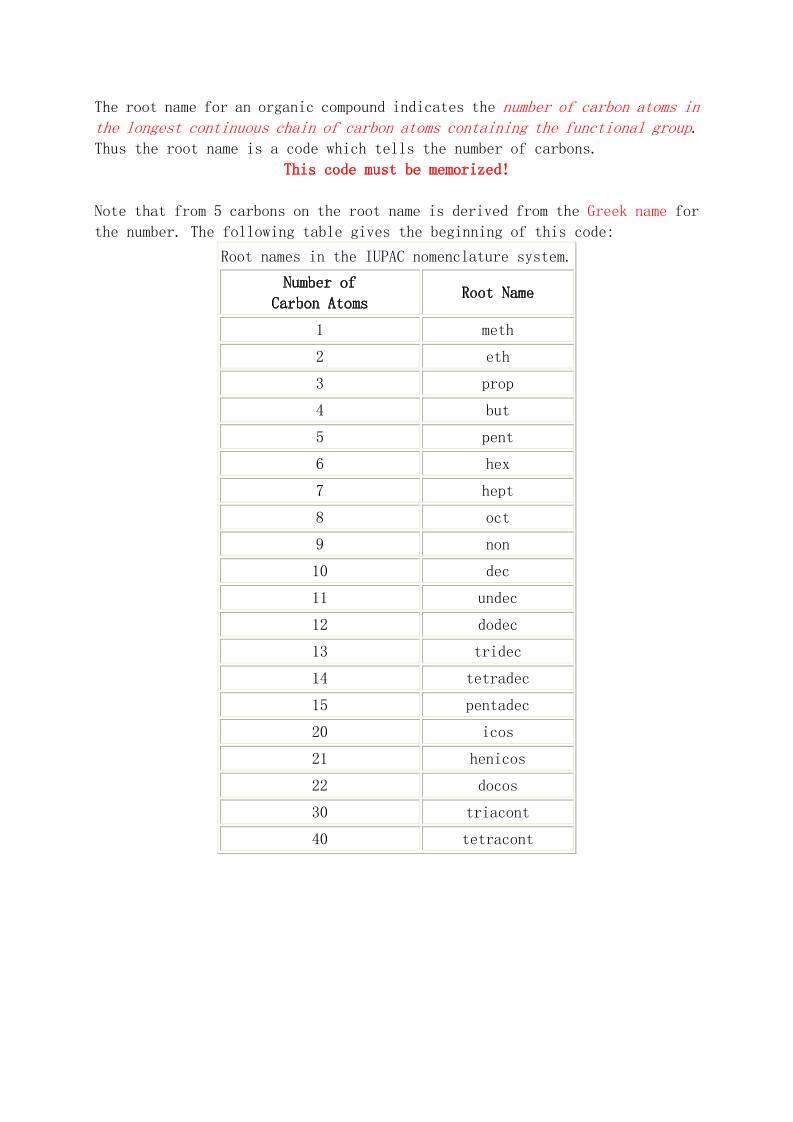
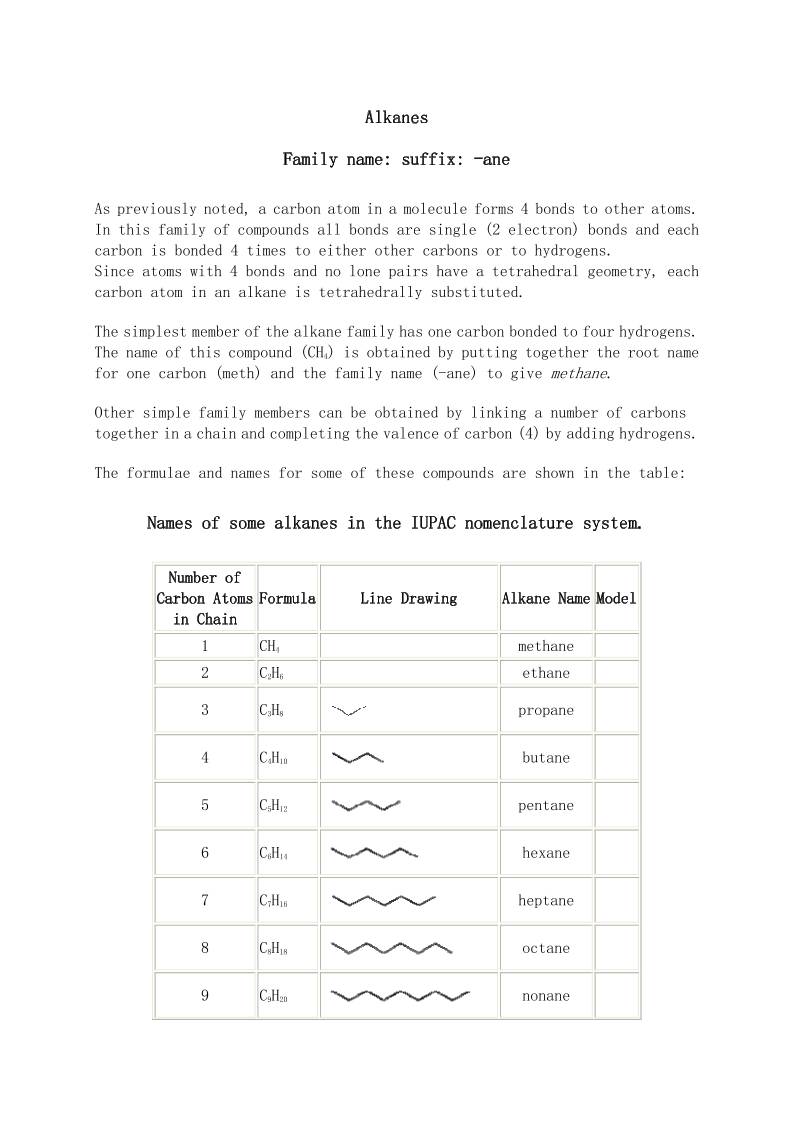
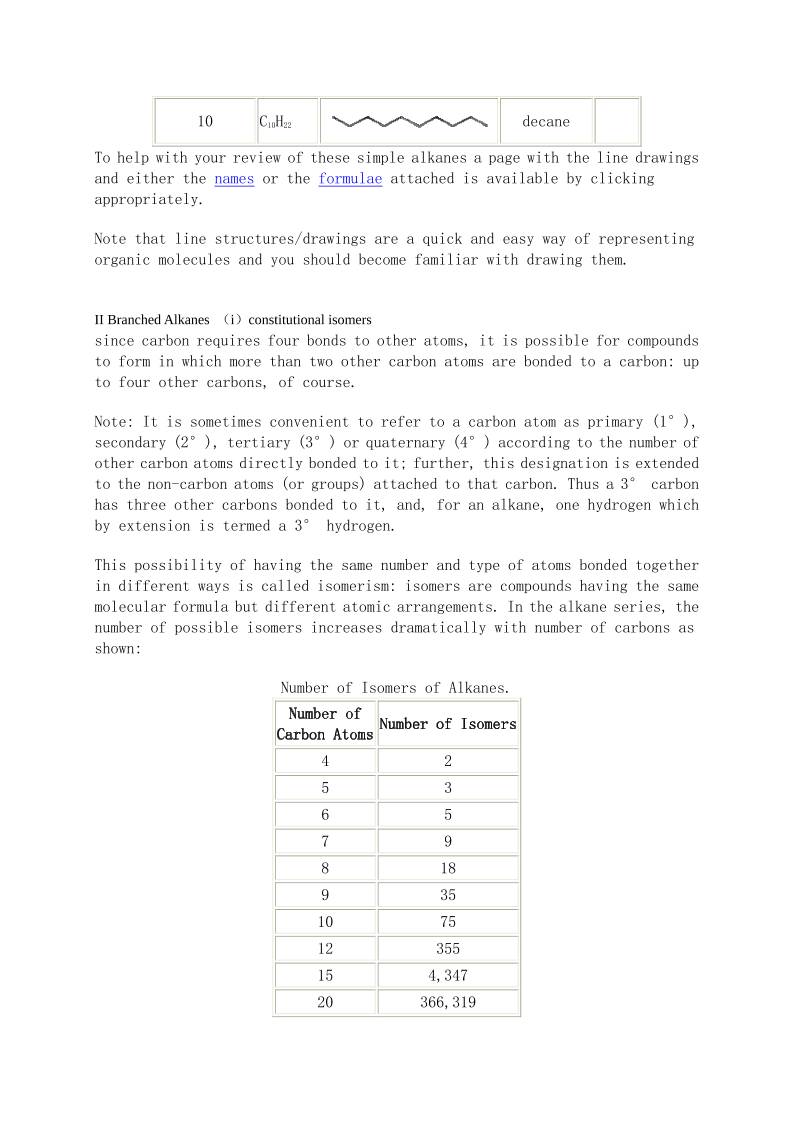


 设备数据采集
 工程招标采购
 搞笑表情
搞笑表情 微信头像
微信头像 CWMS冷库管理系统
 美女图片
美女图片 APP小游戏
 PPT模板
PPT模板 WMS仓库系统
 软件开发
软件开发