概要信息:
vision plan
parkmerced
DRAFT
   10.14.10
The Parkmerced Vision Plan lays out a conceptual framework for transforming the existing Parkmerced
housing development into a 21st century model of a healthy neighborhood.  Based on the vision set forth, the
accompanying Design Standards and Guidelines, Sustainability Plan, Transportation Plan, and Infrastructure
Report combine to create a comprehensive blueprint for guiding all future improvements to Parkmerced.
-  The Design Standards and Guidelines prescribe urban design controls for land use, open spaces, streets,
blocks  and individual buildings.  It also outlines a process for project implementation.
- The Sustainability Plan contains specific strategies and metrics which together address the management
and conservation of energy, water and other natural resources, as well as establish goals for green building
standards.
- The Transportation Plan provides a framework and management plan for addressing transit and vehicular
travel to and from the  neighborhood.
- The Infrastructure Report establishes an outline for anticipated site-wide improvements to all streets and
public rights-of-way, underground utilities, and grading.
The vision has been developed through a collaborative process with input from community members, local
agencies and departments, public advocacy organizations and design and engineering experts.
DRAFT
parkmerced
vision plan
01
02
03
Vision	 4
Principles	 6
Goals	 8
Strategies	 10
Context	 12
Watershed	Habitat	 16
Parkmerced	-	Then	+	Now	 18
Imperative	for	the	City	 20
Frameworks	 22
Land	Use	 24
Open	Space	 26
Street	Pattern	 28
Site	Hydrology	 30
Urban	Forest	 34
Recreation	 36
Light	Rail	 38
Buses	+	Shuttle	 40
Bicycle	 42
Pedestrian	 44
Vehicle	 46
Parking	+	Car	Storage	 48
Green	Infrastructure	 50
Urban	Form	 52
3
DRAFT
4
Principles	 6
Goals	 8
Strategies	 10
vision
01
DRAFT
“First life, then spaces, then buildings – the
other way around never works.”
Jan Gehl
re-invent the urban environment
The Parkmerced Vision Plan will transform the existing 60- to 70-year old 3,221 dwelling
units from a development of resource consumptive buildings and landscapes into a vital
neighborhood rooted in forward-thinking urban ecology.  The re-imagined Parkmerced will
offer its residents and neighbors a diversity of housing opportunities, a range of new open
spaces, and convenient neighborhood services and amenities.  The main goal in re-inventing
Parkmerced will be to craft a vibrant, pedestrian focused neighborhood where public spaces
and buildings frame a comfortable public realm and make a positive contribution to the
ecological and social health of the region and the city.
As a part of this effort, a variety of new alternative transit opportunities are proposed to help
reduce this portion of the city’s over-reliance on cars.  The M-Ocean View light rail Muni line is
intended to travel through the heart of Parkmerced, car and bike share pods are meant to dot
the neighborhood, and a low-emissions shuttle is proposed to provide reliable service between
Parkmerced and the nearby Daly City BART Station.
In the process, the neighborhood hydrology will be repaired by day-lighting the flow of rainwater
runoff as it passes through Parkmerced, allowing it to follow a more natural process.  This will
in turn help increase habitat and enhance the biodiversity of the neighborhood that was built
over when Parkmerced was first constructed.
The Parkmerced Vision Plan is intended to provide a conceptual framework that inspires
innovation and high quality in each specific project within the neighborhood.  The Parkmerced
design and planning team, in close collaboration with the San Francisco Planning Department,
has crafted the Parkmerced Vision Plan to include the following:
- Urban design principles and goals that set out an insightful vision for the future of Parkmerced;
- The ecological and social imperative for why Parkmerced should be re-invented; and
- Strategies that support the stated ecological, social and urban design principles and goals.
DRAFT
5
principles
Convenient, local-serving amenities, a diverse mix of housing
and a variety of outdoor activities will enliven the public realm
and promote a socially vibrant neighborhood
where people are the most important ingredient.
The presence of a regenerative network comprised of deeply
interconnected urban and natural systems
will establish an ecologically healthy neighborhood.
Focused growth integrated with access to viable alternative
transit options will encourage walking, biking and other forms of
green mobility.
Open spaces, streets and buildings that are designed to be
pedestrian focused will provide a comfortable and
aesthetically rich environment.
With input from residents, interested com-
munity members, relevant City and State
agencies and departments, planning ex-
perts and public advocacy groups, the fol-
lowing planning principles have been es-
tablished in order to guide Parkmerced into
the future.
DRAFT
6

8   │
DRAFT
P A R K M E R C E D  V I S I O N  P L A N  /  1 0 . 1 4 . 1 0
reinvent Parkmerced as a neighborhood with diverse
and engaging public spaces woven together to encourage
walking and outdoor activity and to promote a socially
vibrant neighborhood.
establish a common attitude towards healthy
neighborhoods and ecologically sustainable design as a
starting point to create a cohesive, yet aesthetically rich
environment, where urban and ecological systems are
deeply interconnected and mutually supportive.
provide a wide variety of housing types, including
rental and for-sale housing, located within a convenient
distance from transit and neighborhood services.
The goals below provide a description of the specific
objectives that are intended to be achieved at Parkmerced
and represent best practices in sustainable urban design.
goals
DRAFT
│  9 1 0 . 1 4 . 1 0  /  P A R K M E R C E D  V I S I O N  P L A N
foster a neighborhood character and scale that will create
a pedestrian focused environment, while encouraging a
diverse and unique identity for each block and building.
design buildings that reinforce an understanding and
respond to specific urban conditions that exist within
Parkmerced, such as the park edges, Neighborhood
Commons, the ‘social heart’ and a variety of street types.
cultivate a visually appealing landscape that celebrates
the neighborhood’s hydrology, creates natural habitat, and
promotes the efficient use of resources, while meeting the
community’s needs for recreation, open space, and local
food production.
10   │ P A R K M E R C E D  V I S I O N  P L A N  /  1 0 . 1 4 . 1 0
bio-corridor + neighborhood access hedgerows + primary linkages rainwater + neighborhood streets
Transform Gonzalez Drive into an easily navigable
boulevard connecting the neighborhood to the
surrounding community, as well as the Lake Merced
ecosystem.
Buffer against prevailing westerly winds and maximize
daylight penetration with a primary north-south
orientation, while focusing neighborhood access onto
these streets via their connection to Gonzalez Drive.
Create a fine grained street pattern and drainage network
that maximizes bio-filtration and offers a variety of
engaging pedestrian routes through the neighborhood.
Together the following 12 interconnected urban and
ecological design strategies illustrate how specific
ecological strategies enhance urban strategies and form
the framework for the neighborhood.
strategies
DRAFT
│  11 1 0 . 1 4 . 1 0  /  P A R K M E R C E D  V I S I O N  P L A N
stream corridor + social heart open space + building form ecological network + pedestrian walkways
Focus neighborhood services and social amenities at
the center of Parkmerced along a stream corridor that
cleans rainwater runoff and provides new habitat for
native plants and animals.
Encourage community interaction with gardens,
parks and recreation spaces set in public open
spaces, Neighborhood Commons and semi-private
courtyards, defined by the adjacent building edges.
Link all open spaces into an ecologically interconnected
and interdependent network with a system of pedestrian
connections that lead to the neighborhood’s social heart.
DRAFT
12
Watershed Habitat 16
Parkmerced - Then + Now 18
Imperative for the City 20
context
02
DRAFT
“The most important issue of  the 21st century will be
the condition of  the global environment.”
Ian Mcharg
create a healthy neighborhood
Located within Lake Merced’s historic watershed, Parkmerced occupies the transition zone
between the city and the natural realm.  At the time of Parkmerced’s original construction,
planning strategies neither understood nor attended to the natural function of existing ecological
systems that passed through the site.  While the street pattern layout and land use organization
represented a new vision of how neighborhoods should be planned at that time, the original
Parkmerced was a suburban vision for a single-use neighborhood where cars dominated as the
primary mode of transportation for residents to meet their daily needs.  Over time this original
strategy led to Parkmerced’s isolation from the surrounding Westside community and the rest of
San Francisco both physically and in terms of its neighborhood character.
Parkmerced is symptomatic of settlement patterns which have resulted in suburban sprawl
across the region.  This trend towards sprawl has: led to a loss of natural and agricultural lands,
impairing the region’s ecological function; created longer commutes, resulting in lost work
productivity and a lower quality of life; and required greater resource consumption, increasing
each person’s carbon footprint.  Additionally, this has resulted in an increased burden to regional
roadways and city streets, which must manage the increase of pass-through traffic due to the
daily influx of commuters and their cars.
DRAFT
13
PARKMERCED OCCUPIES THE TRANSITION ZONEDRAFT
BETWEEN THE CITY AND THE NATURAL REALM. DRAFT
Historic San Francisco creeks and wetlands, circa 1890
Westside Groundwater Basin
SITE
Landfill
Historic Creeks
Historic Marshes
16   │ P A R K M E R C E D  V I S I O N  P L A N  /  1 0 . 1 4 . 1 0
Characterized as a Franciscan biological region, Lake
Merced is one of the last remnants of this native habitat.
Protecting the ecology of Lake Merced is critical to ensure
the natural watershed habitat is capable of sustaining
native wildlife and preserving Lake Merced as a crucial
nesting site for waterfowl and shorebirds along the Pacific
Coast flyway (San Francisco Recreation & Parks).
Parkmerced is located within the watershed that feeds
and nourishes Lake Merced.  Historically, rainwater in this
natural drainage basin flowed towards Lake Merced to the
west, with surface water runoff cleansed and absorbed
by a healthy riparian habitat which was characterized by
a vegetative cover of coastal shrubs and plant life.  The
rainwater also infiltrated the highly permeable sand and
gravel soils, recharging the Westside Basin Aquifer which
stretches from Golden Gate Park to the City of South San
Francisco.
In 1905, renowned American architect and planner Daniel
Burnham presented his master plan for San Francisco.  At
that time, Lake Merced, owned by Spring Valley Water
Company, was still the City’s potable water source.  In
response to this condition, Burnham proposed a great
open space preserve (larger than Golden Gate Park) to
protect the Lake Merced watershed, including the lands
currently occupied by Parkmerced.
However, after the 1906 earthquake, San Francisco built
the Hetch Hetchy water system, originating high in the
Sierra Mountains, in order to develop an independent and
secure potable water source.
watershed habitat “Once a remote and rural corner of the City, the lake environs have
become increasingly urbanized over the decades, and the lake has
had to endure the consequences, including a shrinking watershed,
increased stormwater runoff, decreased groundwater recharge,
increased demand for recreation, and increased wear and tear on
facilities and the natural environment.”
SFPUC, Draft Lake Merced Watershed Report, 2010
DRAFT
Burnham master plan, 1905
Lake Merced, 1929 Lake Merced, 1953 Lake Merced, present
SITE
SITE SITE SITE
Westside Groundwater Basin
│  17 1 0 . 1 4 . 1 0  /  P A R K M E R C E D  V I S I O N  P L A N
Once this happened, the City quickly began to develop
over Lake Merced’s watershed.   The  natural water con-
veyance system was severely altered, and replaced by the
establishment of a completely separate, underground sew-
er and rainwater conveyance system, leading out to the
City’s Oceanside Wastewater Treatment Facility.  Large
swaths of impermeable surfaces, consisting of city streets,
surface parking lots and building roofs, have further im-
paired the natural watershed function by severely limiting
the amount of rainwater infiltration and recharge to the un-
derground aquifer.  Diverted surface runoff increases the
burden on San Francisco’s combined sewer-stormwater
system and the potential for overflows into the ocean at the
nearby treatment facility (Pezzetti et al. 1998, CDM 1999).
When the site was initially developed in the 1940’s, wide-
scale grading radically transformed the site’s natural to-
pography into a generally flat table top, tilted slightly to-
ward the west.  Soils filled the original drainage ways, and
an underground system replaced the natural watershed,
so that  rainwater was quickly put into pipes and moved
off-site to the City’s treatment facility.  This deprived the
site, the lake and the underground aquifer of much of its
annual rainfall.
The vast areas of planted lawn, which was typical of the
landscape fashion of that time, require approximately 55
million gallons of potable city water for irrigation.  Large
quantities of chemical fertilizers are also necessary to
maintain the expansive lawn areas and non-indigenous
plant species. Each year some of this fertilizer runs off into
surrounding streams and Lake Merced and has been iden-
tified as a potential cause of algae blooms  in the Lake
due to nutrient overload (Friends of Lake Merced, 2000).
These practices can no longer be sustained.
DRAFT
1950’s Marketing Materials
18   │ P A R K M E R C E D  V I S I O N  P L A N  /  1 0 . 1 4 . 1 0
Constructed between 1941 and 1951, Metropolitan Life Insurance Company (MetLife) built the original
Parkmerced residential complex as a response to the surging population and the associated demand for
housing in the Bay Area, resulting from war preparedness efforts and continuing through the end of World
War II.  MetLife hired Leonard Schultze & Associates of New York to design the street grid, open spaces, and
buildings at Parkmerced as one in a series of planned residential communities located throughout the country,
including Park La Brea in Los Angeles, Parkfairfax in Virginia, Parkchester in New York and Peter Cooper
Village / Stuyvesant Town in New York City. Thomas Church and Robert Royston developed the landscape
design for Parkmerced.  The original property contained 47 residential blocks, totaling 192 acres, including
associated service buildings and open spaces.
Based on urban planning principles of the time and a growing reliance on the automobile as a major
transportation mode, Parkmerced was conceived of and marketed as ‘suburban living in the city’.  This
desire for suburban-style living led to the creation of an auto-oriented neighborhood with: large-scale blocks;
roundabouts; and long distances to services and amenities.  This plan locked future generations of residents
into daily life patterns that are almost wholly dependent upon the car, isolating Parkmerced residents from the
mixed-use, transit-based lifestyle that is enjoyed by most San Franciscans.
Parkmerced, circa 1950
1
2
3
4
5
6
1 2 3
4 5 6
parkmerced then...
DRAFT
│  19 1 0 . 1 4 . 1 0  /  P A R K M E R C E D  V I S I O N  P L A N
Supporting land uses, such as a small retail center, playing fields, a school and undeveloped open space were
in distant and disparate locations along the edges of the site.  Their viability became untenable over the years
as residents drove their cars to more easily accessible and convenient services and amenities.  After MetLife
sold the property, a subsequent owner sold off these parcels to others as a means to reduce overhead and
maximize profitability.  The current ownership group took over the property in October 2005.  The neighborhood
currently encompasses 152 acres, approximately 80 percent of the original Parkmerced property and contains
3,221 existing rental apartments in 170 two-story residential buildings (referred to as “garden apartments”) and
11 13-story residential mid-rise buildings. The property also contains associated parking, building services, a
leasing/operations office, and a recently constructed private pre-school/day care facility.
Parkmerced remains an example of a highly resource consumptive planning model.   Residential trip surveys
performed in 2006 indicate an average of over 6 non-work related vehicle trips per unit per day to other
neighborhoods for basic services, shopping and amenities. Parkmerced’s landscapes consume over 55 million
gallons of potable water per year for maintenance and irrigation. By the completion of the Parkmerced plan the
garden apartments will be approximately eighty years old; they are un-insulated and have poor ventilation due
to the construction methodology employed during war-time material shortages.  In addition, these buildings
do not provide barrier-free access and socially turn their back on the street, greatly reducing the vibrancy and
sense of security of the public realm.
1
2
3
5
4
6
1 2 3
4 5 6
Parkmerced, circa 2010
...parkmerced now
DRAFT
Bay area average commute
time has doubled since 1987
2010 - 300,0001960 - 122,000
NUMBERS OF COMMUTERS
P A R K M E R C E D  V I S I O N  P L A N  /  1 0 . 1 4 . 1 020   │
imperative for the city
“We cannot afford another generation of sprawl. Businesses suffer
from higher costs, loss in worker productivity and underutilized
investments in older communities.”
Bank of America, et.al., Beyond Sprawl, Web 1996.
According to the Association of Bay Area Governments, the
San Francisco Bay Area population is set to increase by 2
million residents over the next 25 years. Increasing housing
opportunities within existing urban centers is imperative to
help address the region’s current unsustainable settlement
patterns.  The human, economic and ecological health of
the region is at stake.
With 41.2% of California’s total GHG emissions coming
from transportation, auto-dependant land use patterns are
one of the single largest contributors to the regions annual
CO2 emissions of roughly 12 tons per person (Inventory of
California Greenhouse Gas Emissions and Sinks: 1990 to
2002 Update, California Energy Commission, 2005).  Lack
of affordable housing opportunities in close proximity to
public transit and existing job centers is forcing more and
more Bay Area residents to commute longer distances,
stuck behind the steering wheel of a car rather than at
work or at home with their families.  Inundating our region’s
highways with daily commuters, the economic impact of
traffic congestion costs the region nearly $3 billion a year
in extra fuel costs and wasted time due to lost productivity
(the U.S. Department of Transportation and Caltrans).
GHG emissions are also a major contributor to global and
local ecological degradation, resulting in an increase in
surface air temperature and “killer” heat waves, rising sea
levels, increased flooding, decreased air quality, and a
reduction of wildlife habitat1.
The design and scale of the future Parkmerced will
substantially reduce miles traveled by car and contribute
towards achieving regional economic and environmental
goals for increasing resource efficiency.  The Parkmerced
vision is a once in a lifetime opportunity to transform a
large, aging housing complex into a vibrant, model of an
ecologically sustainable, walkable community. Transforming
Parkmerced will directly result in a reduction in resource
consumption and waste production while at the same time
increasing the quality of life for its residents.  Parkmerced
is one of the most important, long-range redevelopment
projects in the nation and will set the bar for this century’s
sustainable communities.
DRAFT
1  Kattenberg, A., F. Giorgi, H. Grassel, G.A. Meehl, J.F.B. Mitchell, R.J. Stouffer, T.
Tokioka, A.J. Weaver, and T.M.L. Wigley, 1996.  Climate models - projections of future
climate.  In Climate Change 1995: The Science of Climate Change, 285-357, (Eds
J.T. Houghton, L.G.M. Filho, B.A. Callander, N. Harris, A. Kattenberg, and K. Maskell)
Cambridge University Press, Cambridge, U.K.
San Francisco
0% 10% 20% 30%
Sunnyvale
Santa Clara
Oakland
Sacramento
Daly City
Vallejo
Hayward
San Jose
Fremont
40% 50%
19%
30%
30%
33%
33%
40%
42%
42%
42%
43%
17%
Tens of thousands of housing units are being built annually in the Bay Area’s greenbelt, in new auto-dependent suburbs.
Percentage of
households
with children
│  21 1 0 . 1 4 . 1 0  /  P A R K M E R C E D  V I S I O N  P L A N
DRAFT
22
Land Use 24
Open Space 26
Street Pattern 28
Site Hydrology 30
Urban Forest 34
Recreation 36
Light Rail 38
Buses + Shuttle 40
Pedestrian 42
Bicycle 44
Vehicle 46
Parking + Car Storage 48
Green Infrastructure 50
Urban Form 52
frameworks
03
DRAFT
ecological living
“The ballet of  the good city...never repeats itself  from place to place,
and in any one place is always replete with new improvisations.”
Jane Jacobs
‘Ecological living’ is the conceptual heart of a healthy neighborhood.  The following
planning frameworks will function in unison to promote ecological living and reduce natural
resource consumption while at the same time increasing social livability and encouraging
an economically vibrant neighborhood.  By doing so Parkmerced is set to shift towards a
renewable energy-based, pedestrian-focused neighborhood, linked to the rest of the city
through a diverse public realm network and a system of alternative transit, and therefore,
bringing the community more in balance with the natural ecology of the site.
Parkmerced’s vision for a  21st century healthy neighborhood includes:
- Healing the community’s relationship to the land upon which it sits;
- Providing a range of housing opportunities for a diverse population;
- Creating a variety of recreational and passive open spaces;
- Offering a lifestyle not dependent upon automobiles;
- Establishing a more efficient use of resources; and
- Reducing residents’ contributions to carbon production.

DRAFT
23
P A R K M E R C E D  V I S I O N  P L A N  /  1 0 . 1 4 . 1 024   │
socially vibrant neighborhood
land use
A mixed-use social heart located at the
center of the plan transforms Parkmerced
into a pedestrian-oriented neighborhood.
The re-imagined Parkmerced neighborhood will include
a variety of neighborhood services and amenities, giving
residents the choice of fulfilling their daily needs without
getting in their cars.  With these services and amenities
located within comfortable walking distance, residents
will  be able to walk their children to school on their way
to the train in the morning or stop at the market to pick up
groceries on their way home in the evening.
The central neighborhood serving retail will be located
along and near Crespi Drive.  Similar to other San
Francisco neighborhood retail streets, Crespi Drive will
be Parkmerced’s ‘social heart’, providing a place where
residents can meet their everyday needs and socialize
with their neighbors.  To further increase Parkmerced’s
social livability and ecological sustainability, a network of
smaller, social gathering places (known as “Neighborhood
Commons”) will fall within a two-minute walk of most
residents and is intended to consist of small retail shops,
business centers, neighborhood amenities and bicycle /
carshare pods, all anchored by a major neighborhood park.
To encourage and promote the art of ‘well-being’,
Parkmerced will seamlessly weave together fitness, food
production and positive social interaction.  Located along
the project’s southern edge, the Community Center will
offer residents a variety of uses and programs relating
to fitness, learning and wellness.  Immediately to the
east, outdoor flexible recreational spaces will provide
opportunities for soccer, softball or other similar activities.
As a critical component of any healthy neighborhood, the
pre-school / K-5 location just south of the social heart will
make Parkmerced a perfect place for families to call home.
Located immediately west of the Community Center, an
organic farm of approximately 2- to 3- acres in area will
act as a source for local food production, providing fruits
and vegetables for sale at the neighborhood grocery store,
local farmer’s markets or in local restaurants.
DRAFT
B
R
O
T
H
E
R
H
O
O
D

W
A Y
L
A
K
E

M
E
R
C
E
D

B
O
U
L
E
V
A
R
D
1
9
T H  A V E N U E
J
U
N
I
P
E
R
O

S
E
R
R
A


B
O
U
L
E
V
A
R
D
H
O
L
L
O
W
A
Y

A
V
E
N
U
E
F O N T  B O U L E V A R D
S A N  F R A N C I S C O
S T A T E  U N I V E R S I T Y
S A N  F R A N C I S C O
G O L F  C L U B
M E R C E D  H E I G H T S
L A K E
M E R C E D
C
R
E
S
P
I

D
R
I V
E
10 minute walking radius
2 minute walking radius
MIXED USE SOCIAL HEART
ORGANIC FARM /
RESTAURANT
SCHOOL / DAY CARE
COMMUNITY/ FITNESS CENTER
MIXED USE NEIGHBORHOOD
COMMONS
Neighborhood Commons
Evenly distributed throughout Parkmerced,
neighborhood commons will be social gathering
places anchored by small retail shops, business
centers for work at home, outdoor activities, bike
and car share pods, etc.
Social Heart
Retail on the ground floor with professional
offices above, the Parkmerced social heart
will include a neighborhood serving market
and other retail, making it convenient for
Parkmerced neighbors to walk or ride a
bike for daily errands.
Shop, Work and Support
Introducing a new variety of uses into
Parkmerced increases the livability of the
neighborhood, as well as reduces the
impacts residents currently have on local
and global ecological systems.
Education + Well-Being
To increase the social vibrancy and importance of the
social heart, the school site is centrally located and
accessible to all Parkmerced residents.  Living well and
being well are critical not only to sustain life, but for life
to thrive.  A Community and Fitness Center will provide
opportunities for recreation and social interaction.
│  25
DRAFT
Land Use
1 0 . 1 4 . 1 0  /  P A R K M E R C E D  V I S I O N  P L A N
Redefining the relationship between the built and natural
environments, the neighborhood’s open spaces and street
network will be transformed into a biologically diverse and
interconnected network of riparian zones, major new parks,
an organic urban farm, recreational playing fields, intimately-
scaled neighborhood courtyards, pedestrian trails and bike
pathways. Parkmerced’s landscapes will reinvigorate the
site’s hydrology, reestablish biodiversity and reconnect to
Lake Merced, while offering a comfortable setting for the
community’s outdoor activities.
The Parkmerced landscape will create a varied series of
neighborhood open spaces that support structured and
unstructured recreation for groups as well as individuals.
From the semi-private courtyards that encourage neighbors
to interact with each other to the public parks and plazas that
provide places for the neighborhood to gather, Parkmerced will
provide a range of outdoor experiences that enrich the social
life of the neighborhood.
The Vision Plan builds on ideas to regenerate the underlying
watershed and site ecology while supporting a socially
sustainable neighborhood.  The stream corridor will be the
backbone of the habitat restoration with it’s resource rich
environment attracting an array of native wildlife.  Only native,
acclimated or wildlife friendly plant species will be used on
site, both to minimize water consumption and to attract native
wildlife. Finally, in order to protect biodiversity and public health,
landscape maintenance will follow integrated pest management
and organic farming methods.  The landscape will create a
variety of other ecological zones including wetlands, coastal
woodlands, and meadows.
urban + natural systems
open space
Parkmerced will embrace a new paradigm, where
open spaces are meant to provide benefits for both
people and the functioning of ecological systems.
26   │ P A R K M E R C E D  V I S I O N  P L A N  /  1 0 . 1 4 . 1 0
DRAFT
B
R
O
T
H
E
R
H
O
O
D

W
A Y
L
A
K
E

M
E
R
C
E
D

B
O
U
L
E
V
A
R
D
1
9
T H  A V E N U E
J
U
N
I
P
E
R
O

S
E
R
R
A


B
O
U
L
E
V
A
R
D
H
O
L
L
O
W
A
Y

A
V
E
N
U
E
F O N T  B O U L E V A R D
S A N  F R A N C I S C O
S T A T E  U N I V E R S I T Y
S A N  F R A N C I S C O
G O L F  C L U B
M E R C E D  H E I G H T S
L A K E
M E R C E D
NEIGHBORHOOD PARKS
FOREST
ORGANIC FARM
STREAM CORRIDOR
COMMUNITY GARDENS
HEDGEROW TREES
PRIVATE OPEN SPACE /
COURTYARDS
Green Connector
Connecting the eastern and western edges
Parkmerced Gonzalez Drive weaves
through the neighborhood creating a robust
green link for people, water and habitat
from SFSU to Lake Merced.
Recreation and Active Play
Sports fields offer residents of
Parkmerced the opportunity to participate
in active recreation
Neighborhood Gathering
Places for residents of Parkmerced to
gather, the Neighborhood Commons are
active open spaces dedicated to social
engagement and recreation.
Hedgerows + Bio-Swales
North-South Streets act as small linear
‘greenways’  directing both water and
people towards the large open spaces at the
southern edge of the neighborhood.
Organic Farm + Stream Corridor
At the seam between human and ecological systems
rests organic farming and habitat restoration.  Gently
sloping away from the neighborhood social heart, towards
Lake Merced, will be a site for a_ professional, local
organic farm.  Directly adjacent is the stream corridor with
native and acclimated plants and wildlife.
Community Gardens
A place for residents to get their hands in the
dirt, the Community Gardens offer a setting for
those who enjoy the experience of cooking and
eating food that they have grown themselves.
│  27
DRAFT
Open Space
1 0 . 1 4 . 1 0  /  P A R K M E R C E D  V I S I O N  P L A N
28   │ P A R K M E R C E D  V I S I O N  P L A N  /  1 0 . 1 4 . 1 0
DRAFT
The Vision Plan conceives the streets at Parkmerced as a collection of outdoor living rooms, providing a comfortable
backdrop for the public life of the neighborhood.  Reflecting an emerging understanding of the negative impacts cars
have on the ecological and social health of our communities, Parkmerced will transform the street by reducing the
amount of roadway dedicated to cars and increasing the space given to people and underlying ecological systems.
Streets at Parkmerced will weave together social and ecological project benefits through a network of functions like:
sitting, walking and bicycling; and gathering, retaining and cleansing rainwater.
Creative and straightforward street designs will translate into a variety of simple and functional streetscapes.  Gonzalez
Drive and other secondary streets will help orient people as they move through the neighborhood.  Hedgerow streets will
be planted with wind buffering trees to address persistent cold winds from the west.  Alley Ways will include bio-gutters
to help convey rainwater after a storm and pervious paving to allow rainwater to infiltrate into the ground.
pedestrian focused
street pattern
Parkmerced reinvents
the street as a social and
ecological connector,
providing an effective
framework for movement
throughout the neighborhood.
B
R
O
T
H
E
R
H
O
O
D

W
A Y
L
A
K
E

M
E
R
C
E
D

B
O
U
L
E
V
A
R
D
1
9
T H  A V E N U E
J
U
N
I
P
E
R
O

S
E
R
R
A


B
O
U
L
E
V
A
R
D

H
O
L
L
O
W
A
Y

A
V
E
N
U
E
F O N T  B O U L E V A R D
S A N  F R A N C I S C O
S T A T E  U N I V E R S I T Y
S A N  F R A N C I S C O
G O L F  C L U B
M E R C E D  H E I G H T S
L A K E
M E R C E D
FONT BOULEVARD - NORTH
EAST-WEST STREET
ALLEY WAY
HEDGEROW STREET
CRESPI DRIVE -
NEIGHBORHOOD RETAIL
GONZALEZ DRIVE
FONT BOULEVARD - SOUTH
PEDESTRIAN PASEO
DIAZ AVENUE -
NEIGHBORHOOD RETAIL
JUAN BAUTISTA CIRCLE
CHUMASERO DRIVE
Neighborhood Retail
Similar to other San Francisco neighborhood-
serving retail streets, Crespi Drive provides
convenient access to services and amenities,
increasing the community’s livability.
Neighborhood Access
Focusing vehicle access to these North-
South Streets allows other streets to be
calmer and more pedestrian focused.
Neighborhood Boulevard
As the primary access street for
Parkmerced, Gonzalez Drive orients
residents and visitors, making finding
your way through the neighborhood
easier and more convenient.
Pedestrian Focus
Alley Ways are intended to be streetscape environments
where auto traffic is slowed and pedestrians have
priority. Their design helps dissipate persistent westerly
winds with a row of taller, wind deflecting trees, while
collecting rainwater into a network of biogutters.
Paseos
Walkways that cut through the middle of the
blocks provide a variety of engaging routes
for pedestrians and cyclists to choose from
as they move through the neighborhood.
│  29
DRAFT
Street Pattern
1 0 . 1 4 . 1 0  /  P A R K M E R C E D  V I S I O N  P L A N
B i o s w a l e
Native and water-
conserving acclimated
trees, meadows and
groundcover with reduced
water and fertilizer
requirements
Runoff  water recharging
ground water after being
cleaned through bio-
filltration
The proposed topography has been carefully designed to
create a more natural hydrological system, where rainwater
flows will recharge Lake Merced and underground aquifers
while significantly increasing urban biodiversity.
The redefined landscapes at Parkmerced will feature
rainwater runoff treatment as a prominent design feature.
A series of landscape elements including: biogutters;
bioswales; a new stream corridor; and ponds and wetlands
will filter and clean rainwater before discharging cleansed
water into Lake Merced. The armature for this water
movement will be a new branch-like network, leading from
rooftops all the way to Lake Merced.  Rainwater is intended
to travel from roof downspouts to biogutters, into a large
series of bioswales, and then into a seasonal stream with
a “laddered” series of ponds and check dams, leading to
a terminal wetland / pond which finally outflows to Lake
Merced.  Permeable paving, installed at the alley streets
and courtyards, will allow rainwater to infiltrate the ground.
Since water will be more efficiently distributed to the
landscape and native or ecologically sensitive plants will
be used, irrigation water needs will be reduced by 50%.
urban + natural systems
site hydrology
The future hydrology goals for the Parkmerced
neighborhood focus on conserving every drop of
water and putting it to use in regenerating a landscape
naturally in balance with the climate and rainfall.
Hinged access cover
I n f i l t r a t i o n  W e l l
30   │ P A R K M E R C E D  V I S I O N  P L A N  /  1 0 . 1 4 . 1 0
DRAFT
B
R
O
T
H
E
R
H
O
O
D

W
A Y
L
A
K
E

M
E
R
C
E
D

B
O
U
L
E
V
A
R
D
1
9
T H  A V E N U E
J
U
N
I
P
E
R
O

S
E
R
R
A


B
O
U
L
E
V
A
R
D
H
O
L
L
O
W
A
Y

A
V
E
N
U
E
F O N T  B O U L E V A R D
S A N  F R A N C I S C O
S T A T E  U N I V E R S I T Y
S A N  F R A N C I S C O
G O L F  C L U B
M E R C E D  H E I G H T S
L A K E
M E R C E D
RAINWATER BIO
CHANNELS
Bio-Swales + Bio-Gutters
Replacing typical gutters and storm drains, a
network of bioswales and biogutters makes
rainwater an integral and visible part of the
streetscape.
Cistern
Located under Juan Bautista Circle a
cistern collects and stores rainwater to
provide sufficient supply for year-round
irrigation.
Stream Corridor
The backbone of the site hydrology, the Stream Corridor
is a rich habitat attracting an array of native wildlife from
insects to birds.
│  31
DRAFT
Site Hydrology
1 0 . 1 4 . 1 0  /  P A R K M E R C E D  V I S I O N  P L A N
BIOGUTTER AT ALLEY WAY
STREAM CHANNEL  AT COURTYARD
SWALE CHANNEL AT COURTYARD
BIOSWALE AT PARK
urban + natural systems - site hydrology
32   │ P A R K M E R C E D  V I S I O N  P L A N  /  1 0 . 1 4 . 1 0
DRAFT
STREAM AT RIPARIAN CORRIDOR
LAKE MERCED
& AQUIFER
CISTERN AT SPORTS FIELD
│  33 1 0 . 1 4 . 1 0  /  P A R K M E R C E D  V I S I O N  P L A N
DRAFT
Parkmerced’s proximity to the ocean, with the accompanying
fog, wind, and sea spray, poses a challenging microclimate
for plant selection.   The plant palette is further limited by the
desire to use only native or acclimated species, ones which will
require little or no irrigation once established.
The recommended plant list, as described in the landscape
design guidelines, was developed in collaboration with one of
the most respected horticulturists in the Bay Area, Barrie Coate,
who carefully selected species to meet both the sustainable
and aesthetic needs of the project.   Species were considered
based on the following categories:  aesthetics, scale, micro-
climate, water-conserving, native, water and wind tolerance,
density, and transparency.
urban + natural systems
urban forest
The Parkmerced micro-climate is the dominating factor in
guiding tree selection. The frequent cold, salt-laden wind
determines what will succeed and where.
P A R K M E R C E D  V I S I O N  P L A N  /  1 0 . 1 4 . 1 034   │
DRAFT
J
U
N
I
P
E
R
O

S
E
R
R
A


B
O
U
L
E
V
A
R
D
L
A
K
E

M
E
R
C
E
D

B
O
U
L
E
V
A
R
D
1
9
T H  A V E N U E
H
O
L
L
O
W
A
Y

A
V
E
N
U
E
F O N T  B O U L E V A R D
S A N  F R A N C I S C O
S T A T E  U N I V E R S I T Y
S A N  F R A N C I S C O
G O L F  C L U B
M E R C E D  H E I G H T S
L A K E
M E R C E D
B
R
O
T
H
E
R
H
O
O
D

W
A Y
ALLEY
EAST-WEST CORRIDOR
BOULEVARD
HEDGEROW
GONZALEZ DRIVE
TOWER
STREAM CORRIDOR
ORCHARD
PARK & COURTYARD
URBAN FOREST
│  35
DRAFT
Urban Forest
1 0 . 1 4 . 1 0  /  P A R K M E R C E D  V I S I O N  P L A N
P A R K M E R C E D  V I S I O N  P L A N  /  1 0 . 1 4 . 1 036   │
DRAFT
As people’s awareness of the benefits of a healthy, active life style has increased so have people’s interests in walking,
biking, jogging and other recreational activities.  By providing a wide range of opportunities for residents to engage in
recreational activities, Parkmerced is meant to be a neighborhood where people of all ages and abilities are encouraged
to participate in some form of healthy, physical activity.  As the nerve center for a network of recreational and outdoor
activities, the Community and Fitness Center is a place dedicated to social interaction, health and well-being.  Located
at the southern edge of the ‘social heart’ the Community and Fitness Center will include a gym, swimming pools, sports
fields and other spaces and services focused on recreation and healing.  Adjacent to the Community and Fitness Center
is the ‘stream corridor’, providing a beautiful and rejuvenating setting for those residents that are drawn to quieter, slower
paced forms of physical recreation, such as strolling or meditation.  Community gardens provide an opportunity for those
who enjoy the art of cultivation and getting their hands dirty while being physically engaged.  Filling out the network is a
robust system of bicycle and pedestrian paths, linking these vital spaces together and connecting them to places such
as Lake Merced and a larger fabric of citywide opportunities for recreation and outdoor activity.
socially vibrant neighborhood
recreation
Weaving recreation and outdoor
activities throughout the public realm
will help enliven the neighborhood by
encouraging more people to spend
more time outside, while promoting
healthier life styles.
NEIGHBORHOOD COMMONS
FOREST
ORGANIC FARM
STREAM CORRIDOR
COMMUNITY GARDENS
BIKE ROUTES/ PATHS
PEDESTRIAN ROUTES
85
75
90
B
R
O
T
H
E
R
H
O
O
D

W
A Y
L
A
K
E

M
E
R
C
E
D

B
O
U
L
E
V
A
R
D
1
9
T H  A V E N U E
J
U
N
I
P
E
R
O

S
E
R
R
A


B
O
U
L
E
V
A
R
D
H
O
L
L
O
W
A
Y

A
V
E
N
U
E
F O N T  B O U L E V A R D
S A N  F R A N C I S C O
S T A T E  U N I V E R S I T Y
S A N  F R A N C I S C O
G O L F  C L U B
M E R C E D  H E I G H T S
L A K E
M E R C E D
Walking + Cycling
With an increased interest in outdoor
and physical activities more people
are spending their leisure time biking,
walking or jogging.  A network of
pedestrian and bicycle only paths offer
residents a convenient way to engage in
healthy outdoor activities.
Fitness Center + Sports Fields
The ‘nerve center’ for health and well-being
this is where Parkmerced residents come
to enjoy physically activities such as soccer,
swimming, aerobics, yoga and more.
Neighborhood Activies
Located in the Neighbrohood Commons are
a diverse program of neighborhood focosed
activities for all ages, such as: play structures,
lawn bolling or simply an open space to play.
Cultivating Activity
The Community Gardens offer a setting for
those who enjoy the art of cultivation while
being actively engaged.
Contemplative Outdoor Activity
Whether quietly strolling along the stream corridor or
meditating to the sound of water gently flowing by, this
peaceful setting is dedicated to the rejuvination of both
people and the local ecology.
Courtyard Recreation + Play
Depending on the types and program of adjacent
residential dwelling units, a variety of opportunities
for recreation are located within semi-private
courtyards, such as play sturctures, small gardens
and areas for stretching and fitness.
Recreation
│  37 1 0 . 1 4 . 1 0  /  P A R K M E R C E D  V I S I O N  P L A N
DRAFT
Each Parkmerced resident currently generates an average
of 6 vehicle trips per day, while 40% of San Francisco
residents still commute alone to work in their own cars.
Parkmerced proposes to provide a convenient transit
alternative and tie the neighborhood to the rest of the city,
by rerouting the M-Ocean View Muni line from 19th Avenue,
between Holloway Avenue and Junipero Serra Boulevard,
into the heart of neighborhood and then back to its current
alignment.
Associated with this new section of the M-Muni line would
be three new Muni stations. At the northeastern edge of the
Parkmerced ‘social heart’ a new transit plaza is intended
to include: a new Muni light rail station; bus stops; coffee
and news stands; and comfortable, sheltered areas to wait.
An additional station adjacent to the new grocery store is
centrally located within the ‘social heart’. The terminal station
at Font and Chumasero will provide convenient access to
residents in the southern-most part of the site and will also
allow for a future Muni connection to BART or accommodate
MTA’s TEP J-Line re-routing to this area.
Development intensity is meant to be greatest around these
new stations, capitalizing on the level of activity that they
would bring to the neighborhood. Making mass transit a
more viable and convenient option for Parkmerced residents
the new Muni stops are intended to be within a comfortable
10-minute walk for all residents.
green mobility
light rail
Like many other San Francisco neighborhoods,
Parkmerced will be a transit oriented neighborhood,
connected to the rest of the city by Muni.
P A R K M E R C E D  V I S I O N  P L A N  /  1 0 . 1 4 . 1 038   │
DRAFT
B
R
O
T
H
E
R
H
O
O
D

W
A Y
L
A
K
E

M
E
R
C
E
D

B
O
U
L
E
V
A
R
D
1
9
T H  A V E N U E
J
U
N
I
P
E
R
O

S
E
R
R
A


B
O
U
L
E
V
A
R
D

H
O
L
L
O
W
A
Y

A
V
E
N
U
E
F O N T  B O U L E V A R D
S A N  F R A N C I S C O
S T A T E  U N I V E R S I T Y
S A N  F R A N C I S C O
G O L F  C L U B
M E R C E D  H E I G H T S
L A K E
M E R C E D
M
10 minute walking radius
FUTURE MUNI STATION
MUNI LINE TO REMOVE
FUTURE  MUNI LINE
MUNI LINE TO REMAIN
MUNI STATION TO REMAIN
MUNI STATION TO REMOVE
FUTURE MUNI TO BART
Transit Plaza
Incorporating a relocated stop for the M-line
into a new transit plaza with connections to
bus lines and a new shuttle route that connects
to BART makes transit more convenient for
residents and neighbors of Parkmerced
Existing Line to be Relocated
The light rail tracks for the M-line on 19th
Ave, between Crespi Drive and Junipero
Serra Blvd., are proposed to be relocated so
the train engages Parkmerced.
Connection to BART
The potential for a future extension of
the light rail tracks would connect to Daly
City BART, providing a transit link to the
entire Bay Area.
DRAFT
│  39
Light Rail
1 0 . 1 4 . 1 0  /  P A R K M E R C E D  V I S I O N  P L A N
The Vision Plan proposes that a number of city bus lines
pass through and stop at Parkmerced, making transit more
convenient for residents of Parkmerced.  The existing 17-line
is intended to be rerouted along Font Boulevard to replace
the 18-line and would connect Parkmerced to Lakeshore
Plaza, Daly City BART and the Westlake Shopping Center
in Daly City.  Making connections to Muni more convenient
and efficient the 28, 28L, 29 and 91A are intended to all stop
at the new transit plaza located at the northeastern end of
Crespi Drive.
Helping to reduce the number of Parkmerced residents that
currently drive to BART, a low-emissions shuttle is meant to
travel between Parkmerced and the Daly City BART Station
during peak commuting hours. The shuttle would also act
as a shopper shuttle to Stonestown and Westlake.  Shuttle
stations are intended to be located conveniently throughout
Parkmerced with well lit, sheltered waiting areas.
green mobility
bus + shuttle
Providing viable transit options at Parkmerced will
make getting out of the car more convenient.
P A R K M E R C E D  V I S I O N  P L A N  /  1 0 . 1 4 . 1 040   │
DRAFT
B
R
O
T
H
E
R
H
O
O
D

W
A Y
L
A
K
E

M
E
R
C
E
D

B
O
U
L
E
V
A
R
D
1
9
T H  A V E N U E
J
U
N
I
P
E
R
O

S
E
R
R
A


B
O
U
L
E
V
A
R
D

H
O
L
L
O
W
A
Y

A
V
E
N
U
E
F O N T  B O U L E V A R D
S A N  F R A N C I S C O
S T A T E  U N I V E R S I T Y
S A N  F R A N C I S C O
G O L F  C L U B
M E R C E D  H E I G H T S
L A K E
M E R C E D
28
28L91A
29
17
S
S
OFF-PEAK SHUTTLE ROUTE
OFF-PEAK SHUTTLE ROUTE STATION
17 BUS LINE
29 BUS LINE
91A BUS LINE
28L BUS LINE
28L BUS LINE
PEAK SHUTTLE ROUTE
PEAK SHUTTLE ROUTE STATION
Low-Emissions Shuttle
A low-emissions shuttle to BART provides residents
of Parkmerced with a direct transit connection to a
regional rail system.
Rerouted Bus Lines
In order to optimize access to transit and
help improve the effectivness of the overall
‘green mobility’ strategy for Parkmerced a
number of bus lines have been rerouted
in conjunction with the city’s Transit
Effectiveness Plan.
Transit Plaza
Re-routing the 17-line to circle and stop at the
new transit plaza makes connections to light
rail and BART more convenient for all transit
riders in this part of the city.
DRAFT
│  41
Bus + Shuttle
1 0 . 1 4 . 1 0  /  P A R K M E R C E D  V I S I O N  P L A N
P A R K M E R C E D  V I S I O N  P L A N  /  1 0 . 1 4 . 1 042   │
Short block dimensions, frequent intersections and a variety of engaging pedestrian routes, form a neighborhood pattern
of streets and blocks that encourages walking.  Streets will be designed to provide a sheltered environment, buffered
against persistent cold winds from the west, while ample sidewalks will allow residents to comfortably walk through the
neighborhood alone or in groups.  Narrower curb-to-curb dimensions and other methods of reducing crossing distances
will increase pedestrian safety and in turn increase the likelihood that people will choose walking as a primary mode of
mobility.
A robust network of alleys, paseos and walks will allow people to meander through the Parkmerced neighborhood and
enjoy a landscape where the priority of cars has been greatly diminished.  Walking is widely recognized to be beneficial
for human health.  Walkers have a lower incidence of cancer, heart disease, stroke, diabetes and other diseases. They
live longer, receive mental health and spiritual benefits and are more likely to be actively engaged in their communities.  It
is safe to state that an increase in neighborhood walkability will have a direct impact on the overall health, well-being and
social vitality of a neighborhood.
green mobility
pedestrian
Streets at Parkmerced will
be for people first.
DRAFT
B
R
O
T
H
E
R
H
O
O
D

W
A Y
L
A
K
E

M
E
R
C
E
D

B
O
U
L
E
V
A
R
D
1
9
T H  A V E N U E
J
U
N
I
P
E
R
O

S
E
R
R
A


B
O
U
L
E
V
A
R
D

H
O
L
L
O
W
A
Y

A
V
E
N
U
E
F O N T  B O U L E V A R D
S A N  F R A N C I S C O
S T A T E  U N I V E R S I T Y
S A N  F R A N C I S C O
G O L F  C L U B
M E R C E D  H E I G H T S
L A K E
M E R C E D EXISTING NEIGHBORHOOD
PEDESTRIAN ROUTE
NEW NEIGHBORHOOD
PEDESTRIAN ROUTE
DEDICATED PEDESTRIAN PATH
Robust Connection
Gonzalez Drive is a major pedestrian artery
providing a dedicated pedestrian path that
links SFSU to the community/ fitness center,
organic farm, stream corridor and ultimately
Lake Merced.
Complete Network
With a diversity of pedestrian focused routes
throughout the neighborhood, Alley Ways,
Paseos and dedicated pedestrian paths form
a major a complete pedestrian network.
│  43
DRAFT
Pedestrian
1 0 . 1 4 . 1 0  /  P A R K M E R C E D  V I S I O N  P L A N
P A R K M E R C E D  V I S I O N  P L A N  /  1 0 . 1 4 . 1 044   │
With a combination of off-street bike paths and dedicated bike lanes on neighborhood roadways, Parkmerced will tie
into San Francisco City Bike Routes number 90 and 85.  An off-street bike path will follow Gonzalez Drive through the
entire neighborhood.  This paved, secure path will not only benefits residents of Parkmerced, but will also create a strong
bicycle connection to Lake Merced from Muni, San Francisco State University, as well as the residential neighborhoods
to the east of Parkmerced.  The roadway design for Tapia Avenue will also include a dedicated bike path, providing
a direct north-south connection through Parkmerced.  A number of bike share centers are intended to be distributed
throughout Parkmerced, offering opportunities to borrow bicycles either for commuters on their way to and/or from work
or for a leisurely ride through the park on the weekends.   There may be a future opportunity to tie into a larger citywide
bike share system, which the City is currently exploring.
green mobility
bicycle
Linking into San Francisco’s existing
bicycle network will increase the
connectivity between Parkmerced
and the rest of the city and offer
residents a viable option for
bicycling to meet their daily needs.
DRAFT
B
R
O
T
H
E
R
H
O
O
D

W
A Y
L
A
K
E

M
E
R
C
E
D

B
O
U
L
E
V
A
R
D
1
9
T H  A V E N U E
J
U
N
I
P
E
R
O

S
E
R
R
A


B
O
U
L
E
V
A
R
D

H
O
L
L
O
W
A
Y

A
V
E
N
U
E
F O N T  B O U L E V A R D
S A N  F R A N C I S C O
S T A T E  U N I V E R S I T Y
S A N  F R A N C I S C O
G O L F  C L U B
M E R C E D  H E I G H T S
L A K E
M E R C E D
85
75
90
85
DEDICATED OFF-STREET
PATH, PAVED
BIKE ROUTE
SHARED ROADWAY
PROPOSED SFSU
BIKE ROUTE
PROPOSED SFSU
BIKE ROUTE
(E) DEDICATED LANE ON
ROADWAY
(E) DEDICATED
OFF-STREET PATH, PAVED
(E) BIKE ROUTE
SHARED ROADWAY
(E) BIKE ROUTE NUMBER
DEDICATED LANE ON
ROADWAY
FUTURE PROPOSED
MULTI-USE PATH TO BE
COORDINATED WITH SFMTA
Robust Connection
Gonzalez Drive is a major bicycle artery
providing a dedicated bicycle path that links
SFSU to the fitness center, organic farm,
stream corridor and ultimately Lake Merced.
Bicycle Boulevard
Tapia Avenue is designed as a bicycle
boulevard with a dedicated bike path
providing a direct north-south connection
through the neighborhood.
Bicycle Libraries
Whether heading to work or to a picnic
at Lake Merced a network of bicycle
libraries makes it more convenient to get
out of your car and ride a bike!
Connected Network
Tying into existing city bicycle routes,
Parkmerced will enhance and increase the
bicycle connectivity in this part of the city.
│  45
DRAFT
Bicycle
1 0 . 1 4 . 1 0  /  P A R K M E R C E D  V I S I O N  P L A N
Vehicular access to the neighborhood will be increased
through new off-site improvements and a series of new ac-
cess points into Parkmerced.  New left turn lanes at Crespi
and Chumasero Drive will provide a comfortable entrance to
Parkmerced for vehicles driving north along 19th Ave.  Three
new access points will be added along Lake Merced Blvd.
helping disperse auto traffic on the west edge of the neigh-
borhood.
Gonzalez Drive and Font Blvd. will be primary vehicular
streets, providing two clear paths for vehicles to access the
neighborhood.  Giving residents a direct route within the
neighborhood is a structure of secondary access streets
branching off of Gonzalez Drive and Font Blvd.  With signifi-
cantly lower volumes of vehicular movement, neighborhood
and alley ways are intended to provide localized access and
typically are no longer than a few blocks.  Preferred garage
entry locations are along the neighborhood streets; while the
Alley Ways are intended to be pedestrian focused, shared
streets, where cars must slow down to share the road with
pedestrians.
Distributed throughout Parkmerced, car share hubs will pro-
vide easy access to a variety of different car types, which will
offer a convenient alternative to car ownership.
green mobility
vehicle
Streets at Parkmerced will help ease vehicular movement
through the neighborhood by increasing access to the
site and providing a clear hierarchy between primary
access and neighborhood streets.
P A R K M E R C E D  V I S I O N  P L A N  /  1 0 . 1 4 . 1 046   │
DRAFT
PROPOSED VEHICULAR ACCESS ROUTES
PRIMARY VEHICULAR ROUTES
SECONDARY VEHICULAR ROUTES
TERTIARY VEHICULAR ROUTES
QUATERNARY VEHICULAR ROUTES
OFF SITE IMPROVEMENT
Neighborhood Throughway
In order to help make the street pattern at Parkmerced
more legible, Gonzalez Drive provides a much needed
neighborhood throughway from which all streets at
Parkmerced can be understood.
19th Avenue + Junipero Serra
Boulevard Improvements
New landscaping, street furnishings and
traffic improvements along this stretch of
19th Avenue and Junipero Serra Boulevard,
between Crespi Drive and Brotherhood Way
will help to stitch together neighborhoods on
both sides of this major corridor.
Increased Access
Three new intersections along Lake
Merced Blvd. increase the overall
accessibility to Parkmerced, helping to
reduce congestion at any one intersection.
Improved Pedestrian Safety
The 19th Ave corridor will have improved
pedestrian safety and neighborhood access
by introducing new, north bound left turns
lanes at Crespi Drive and Chumeserro Blvd.
Improved Interchange
Adding dedicated merging lanes on
Junipero Serra Boulevard and Brotherhood
Way and improving sidewalk areas will
make this interchange more pedestrian
friendly while imporving traffic flow.
Vehicular Access
North-south streets act as secondary access
roads focusing auto traffic along a limited
number of streets as they pass through the
neighborhood.
│  47
DRAFT
Vehicle
1 0 . 1 4 . 1 0  /  P A R K M E R C E D  V I S I O N  P L A N
Parked cars and parking structures have cluttered urban land-
scapes for decades.  A disproportionate area of urbanized land is
dedicated to one form of parking or another.  As society’s fascina-
tion with cars wanes, new approaches to where cars are parked
have begun to emerge.  In order to create a public realm, includ-
ing streetscapes that are primarily dominated by people and land-
scape, most parked cars will be below grade, freeing up on grade
space for courtyards, Neighborhood Commons and other outdoor
spaces.  This will help to further establish a healthy relationship
between the inside of buildings and the outdoors.  When cars are
parked above grade they will be screened behind active, socially
engaging spaces such as commercial or housing.
This aggressive parking strategy will allow residents to treat
parking as ‘car storage’, encouraging those residents that live
in the center of the neighborhood to use transit and other forms
of ‘green mobility’ in order to meet daily needs.  All off-street
parking at Parkmerced will be ‘unbundled’ from the rental or pur-
chase fees for residential units, eliminating a financial burden for
those that choose not to own a car.  The neighborhood is divided
into four parking zones:
 1. Areas where no parking is allowed.
 2. Areas with one level of below grade parking.
 3. Areas with two levels of below grade parking.
 4. Areas with above grade parking.
To support those residents that choose not to own a car, car
share facilities will be strategically located throughout the neigh-
borhood to further increase access to a variety of mobility oppor-
tunities for residents of Parkmerced.  These facilities are gener-
ally located adjacent to Neighborhood Commons or the ‘social
heart’ to help capitalize on the comings and goings of people as
they utilize these neighborhood services.
green mobility
parking + garage storage
The parking strategy at Parkmerced is intended
to reduce the visual impact of parked cars on
the pedestrian environment while simultaneously
encourage the use of other forms of mobility.
48   │ P A R K M E R C E D  V I S I O N  P L A N  /  1 0 . 1 4 . 1 0
DRAFT
B
R
O
T
H
E
R
H
O
O
D

W
A Y
L
A
K
E

M
E
R
C
E
D

B
O
U
L
E
V
A
R
D
1
9
T H  A V E N U E
J
U
N
I
P
E
R
O

S
E
R
R
A


B
O
U
L
E
V
A
R
D
H
O
L
L
O
W
A
Y

A
V
E
N
U
E
F O N T  B O U L E V A R D
S A N  F R A N C I S C O
S T A T E  U N I V E R S I T Y
S A N  F R A N C I S C O
G O L F  C L U B
M E R C E D  H E I G H T S
L A K E
M E R C E D
ABOVE GRADE PARKING ZONE 1b
NO PARKING
BELOW GRADE PARKING ZONE 1a
BELOW GRADE PARKING ZONE 2
CAR SHARE
Car Share
Strategically located throughout the neighborhood car
share ‘pods’ will provide residents of Parkmerced with
a variety of types of cars for a range of uses such as a
regional outing or moving furniture.
Below Grade Parking
The vast majority of parking is located
below grade, allowing for a seamless
ground plane, uninterupted by parking lots,
parked cars or unsightly parking structures.
Above Grade Parking
Lining above grade parking structures with
lively uses that engage the public realm
eliminates dead streetedges while providing
adequate parking to serve the neighborhood.
Unbundled Parking
Locating the majority parking stalls on the
west side of Parkmerced, away from transit
encourages people to think twice before
getting in the car to go to the grocery store.
No Parking
Many blocks located in the neighborhood ‘so-
cial heart’ will not include parking at all, allowing
courtyards to be truly on grade and reducing the
amount of cars in the center of the neighbpr-
hood
│  49
DRAFT
Parking + Garage Storage
1 0 . 1 4 . 1 0  /  P A R K M E R C E D  V I S I O N  P L A N
This network of green infrastructure is intended to estab-
lish a healthy neighborhood, more in balance with local and
global ecologies, reduces natural resource consumption
and establishes human environments that are attractive
and meaningful.  A critical component to the implementa-
tion of the Parkmerced infrastructure will be to provide flex-
ibility in the future to incorporate the best, new and emerg-
ing technologies as they become available.  As a complete
neighborhood plan Parkmerced offers a unique opportu-
nity to employ green infrastructure elements at a district
scale, increasing the effectiveness of each strategy.
Energy
To reduce greenhouse gas emissions and energy con-
sumed by buildings, Parkmerced will deploy a compre-
hensive energy strategy.  Parkmerced will utilize creative,
yet practical solutions to help offset the anticipated energy
demands of future residents, including:  high-performance
building envelopes; passive solar design; installation of
renewable energy systems; and integrated district energy
systems.

Renewable energy systems such as photovoltaic solar
collectors and wind turbines will produce a percentage of
Parkmerced’s energy, reducing the need for off-site ener-
gy supplies.  Cogeneration facilities will act as micro-power
plants for the neighborhood and are capable of function-
ing from a wide variety of primary energy sources, including
natural gas and biomass.  Tying this entire system together
would be a  potential district energy loop, efficiently distrib-
uting electricity and hot water throughout the neighborhood.
Water
By utilizing the combined sewer system for household sani-
tary sewage only, rainwater at Parkmerced can be treated
as a resource. Collecting rainwater runoff through a combi-
nation of low impact development techniques including bio-
swales and other bio-filtration systems will help restore the
natural hydrology of the site.  The annual volume of water
for irrigation, for approximately the same number of acres of
open space, is expected to decrease from roughly 55 mil-
lion gallons of potable water per year (MG/yr) to just over 30
MG/yr of recycled and/or grey water.
urban + natural systems
green infrastructure
Infrastructure at Parkmerced will be created
as an interconnected and mutually supportive
network of urban and natural systems intended
to reduce overall resource consumption.
Through installation of efficient fixtures for low flow toilets,
sinks, showers, and laundry machines in both new and ex-
isting units and the use of recycled and/or grey water, the
average residential water use at Parkmerced is targeted to
be reduced to 38 gallons per capita per day.  This will re-
sult in less flow to San Francisco’s Oceanside Wastewater
Treatment Facility, which translates to less chemical use,
lower energy usage, and a reduction in overflows of effluent
into the Pacific Ocean.
Waste
Supporting San Francisco’s ambitious goal for “Zero waste
to landfill by 2020”, Parkmerced will make zero waste
practices easier for residents, keep construction waste di-
rected to landfill to a minimum, and implement simple, yet
effective maintenance practices in order to reduce unnec-
essary collection of yard waste.  Reducing the amount of
waste directed to landfill will also reduce the vehicle trips
needed to haul solid waste from the site.  This in turn will
help to reduce the overall GHG emissions for the entire
neighborhood.  Establishing an on-site, ‘green food chain’,
Parkmerced will compost yard waste and use it to fertilize
landscape areas.

50   │ P A R K M E R C E D  V I S I O N  P L A N  /  1 0 . 1 4 . 1 0
DRAFT
B
R
O
T
H
E
R
H
O
O
D

W
A Y
L
A
K
E

M
E
R
C
E
D

B
O
U
L
E
V
A
R
D
1
9
T H  A V E N U E
J
U
N
I
P
E
R
O

S
E
R
R
A


B
O
U
L
E
V
A
R
D
H
O
L
L
O
W
A
Y

A
V
E
N
U
E
F O N T  B O U L E V A R D
S A N  F R A N C I S C O
S T A T E  U N I V E R S I T Y
S A N  F R A N C I S C O
G O L F  C L U B
M E R C E D  H E I G H T S
L A K E
M E R C E D
Water Recycling
Parkmerced will utilize a dual plumbing system for
recycled water.  Recycled water will be used for irrigation,
laundry and toilet flushing.
Air-Source Heat Pump
Utilizing waste heat from commercial uses
to help heat water as it passes through
the District Water Loop helps reduce
unnecessary consumption of natural
resources and provides cooling for retail
and office uses.
Wind Turbines
Wind turbines will produce a percentage of
the Parkmerced’s energy, limiting the need for
off-site energy supplies.  A possible location for
wind turbines is along Lake Merced Boulevard.
Solar Ready
All buildings at Parkmerced are required
to design at least 50% of their roof area
to permit installation of south facing solar
collectors.
District Energy + Water Loop
A potential district wide energy and hot
water loop would allow for all systems to tie
together and direct resource flow to where it
is needed most.
Micro Power Grids
Within each block is the potential for the
creation of a small scale energy grid, complete
with cogeneration equipment that convert
waste heat into a useful energy source.
Green Food Chain
Parkmerced will compost yard waste and use it to
fertilize landscape area and the Organic Farm.  The
Organic Farm will cultivate produce that can be sold in
neighborhood markets and restaurants.
│  51
DRAFT
Green Infrastructure
1 0 . 1 4 . 1 0  /  P A R K M E R C E D  V I S I O N  P L A N
Reflecting this diversity, Parkmerced will be a place for
families with children, couples, singles, and seniors from
all walks of life.  A predominantly low-rise neighborhood,
punctuated by taller and medium-size residential buildings,
the Parkmerced’s urban form of will focus the greatest de-
velopment intensity in and around the social heart of the
neighborhood and the new Muni Stations.  Following the
natural topography of the site, overall building massing
and heights are generally lower in the western portions of
the neighborhood.
With a variety of townhome units, walk-ups, live/work flex
spaces, flats and other types of residential dwelling units,
and a range of studios, one-, two- and three-bedroom
units, Parkmerced will also offer for-sale or rental living op-
tions that will be necessary in fostering a diverse resident
population.  Increasing the number of homes within Park-
merced will help increase the social vibrancy of this corner
of San Francisco; minimize the number of car trips that are
clogging local streets; increase the viability of neighbor-
hood retail services and amenities; and play an important
role in reducing the impacts of human settlement on local
and global ecological systems.
New townhomes and walk-ups: 3 Stories
At 35’ in height, towhhomes and walk-ups will be located
primarily in the western portion of Parkmerced, creating a
fine-grained residential character and reducing the overall
neighborhood massing as it gets closer to Lake Merced.
New neighborhood fabric buildings: 4-6 Stories
Four-to six-story residential buildings, ranging from 45’-
65’, make up the primary character of Parkmerced and are
evenly distributed throughout the entire community.
New mid-rise buildings: 8-10 Stories
Located at key points throughout the neighborhood are
eight- to 10-story residential buildings ranging in height
from 85’-105’.  These medium-size buildings will occur in
key locations to help accent and define the character of
the Parkmerced while focusing residential density near
neighborhood services and amenities and Neighborhood
Commons.
Existing tall buildings: 13 Stories
The plan will retain the 11 existing 13-story, 130’ high resi-
dential buildings, which will undergo phased upgrades.
New tall buildings: 11-14 Stories
New 11- to 14-story residential buildings will be carefully
located near the existing taller residential buildings, in or-
der to limit their impact on existing neighborhood views-
heds.  These residential buildings provide a large number
of homes in an extremely efficient use of land area, help-
ing to focus density and create valuable open space for all
residents and neighbors.
socially vibrant neighborhood
urban form
With a range of living options, access to affordable
housing, and varied and visually attractive building
designs, Parkmerced will be a diverse and vibrant urban
neighborhood.
P A R K M E R C E D  V I S I O N  P L A N  /  1 0 . 1 4 . 1 052   │
DRAFT
B
R
O
T
H
E
R
H
O
O
D

W
A Y
L
A
K
E

M
E
R
C
E
D

B
O
U
L
E
V
A
R
D
1
9
T H  A V E N U E
J
U
N
I
P
E
R
O

S
E
R
R
A


B
O
U
L
E
V
A
R
D
H
O
L
L
O
W
A
Y

A
V
E
N
U
E
F O N T  B O U L E V A R D
S A N  F R A N C I S C O
S T A T E  U N I V E R S I T Y
S A N  F R A N C I S C O
G O L F  C L U B
M E R C E D  H E I G H T S
L A K E
M E R C E D
TOWER
LOW RISE
STACKED FLATS
NON-RESIDENTIAL
MID RISE
Mid-Rise Buildings
Evenly distributed throughout the western
half of Parkmerced, mid-rise buildings provide
residential density focused on neighborhood
gathering places within an articulated massing
that responds to the pedestrian environment.
Taller Buildings
Taller buildings are located around the
neighborhood social heart providing a
large number of homes in an extremely
efficient use of land area, focusing
density near transit and amenities.
Townhomes + Walk-Ups
Throughout the neighborhood small scale buildings,
including townhomes and walk-ups, define the pedestrian
environment.  In general smaller buildings are intended to be
located along smaller rights-of-ways such as Alley Streets.
Tallest Buildings
In order to respect existing viewsheds the
tallest buildings at Parkmerced have been
clustered around existing tall buildings.
│  53
DRAFT
Urban Form
1 0 . 1 4 . 1 0  /  P A R K M E R C E D  V I S I O N  P L A N

│  55 1 0 . 1 4 . 1 0  /  P A R K M E R C E D  V I S I O N  P L A N
“It is a moral obligation to do whatever we can to
confront the problem of  climate change”
Craig Hartman
DRAFT
DRAFT

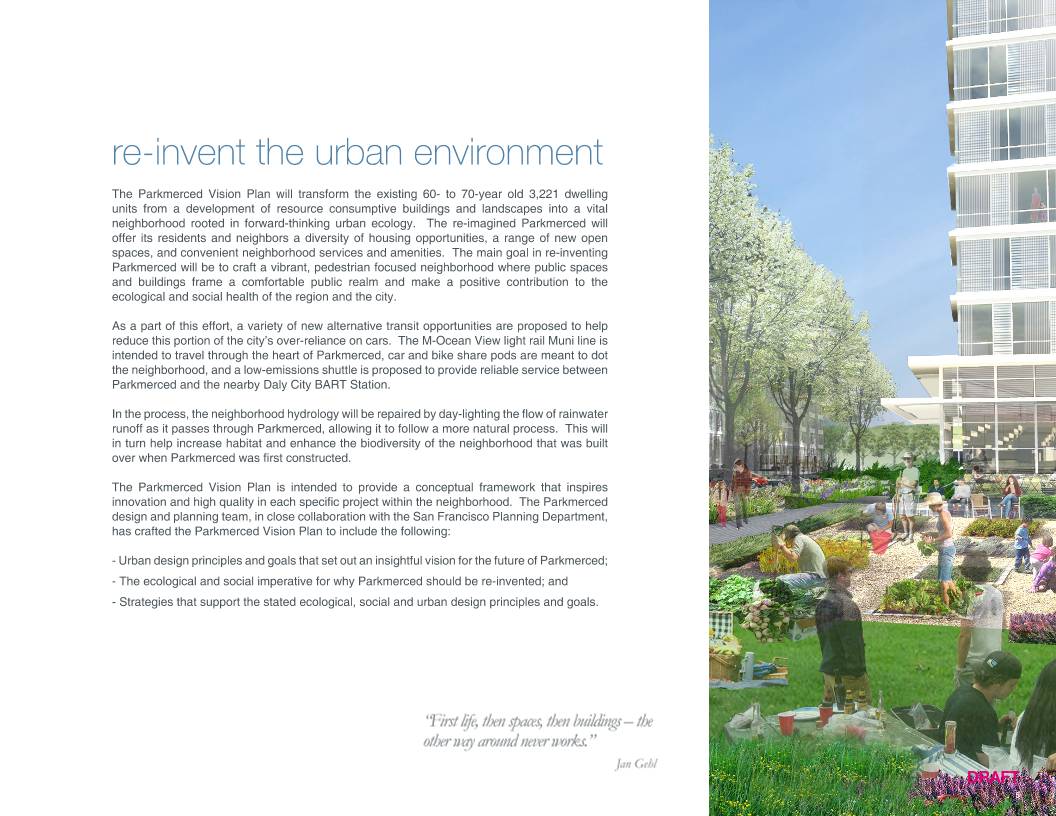


 设备数据采集
 工程招标采购
 搞笑表情
搞笑表情 微信头像
微信头像 CWMS冷库管理系统
 美女图片
美女图片 APP小游戏
 PPT模板
PPT模板 WMS仓库系统
 软件开发
软件开发