概要信息:
Test 1
LISTENING
SECTION 1    Questions 1-10
Questions 1-4
Complete the notes below.
Write NO MORE THAN THREE WORDS AND/OR A NUMBER for
each answer.

NOTES ON SOCIAL PROGERAMME
Example                               Answer
Number of trips per month                   5
Visit places which have:
                · Historical interest
                · good 1__________________
                · 2_______________________
Cost:             between £5.00 and £15.00 per person
Note:          special trips organized for groups of 3_______people
Time:          departure – 8.30 a.m.
                 return – 6.00 p.m.
To reserve a seat:   sing mane on the 4___________3 days in advance


Questions 5-10
Complete the table blew.
Write NO MORE THAN THREE WORDS AND/OR A NUMBER for
each answer.


WEEKEND TRIPS
Place Date Number of seats Optional extra
St Ives 5______________ 16 Hepworth Museum
London 16th February 45 6______________
7______________ 3rd March 18 S.S. Great Britain
Salisbury 18th March 50 Stonehenge
Bath 23rd March 16 8______________
For further information:
Read the 9____________ or see Social Assistant: Jane 10___________


SECTION 2    Questions 11-20
Questions 11-13
Complete the sentence below.
Write NO MORE THAN THREE WORDS AND/OR A NUMBER for
each answer.

RIVERSIDE INDUSTRIAL VILLAGE
11 Riverside Village was a good place to start an industry because it had water, raw
materials and fuels such as ______________and__________________.  .
12 The metal industry was established at Riverside Village by _____________ who
lived in the area.
13 There were over ____________ water-powered mills in the area in the
eighteenth century.


Questions 14-20
Label the plan below.
Write NO MORE THAN THREE WORDS for each answer.


The
Works
Office


The
Stables


The
17________
The
18______

The
16________

The
15________

Toilets
The
19
The Engine
Room
The Grinding
Shop
Yard

20______

The

for the

workers


Entrance
River
Car Park
14______Road


SECTION 3    Questions 21-30
Questions 21 and 22
Choose the correct letter, A, B or C.


21 Melanie says she has not started the assignment because
A  she was doing work for another course.
B  it was s really big assignment.
C  she hasn’t spent time in the library.
22  The lecture says that reasonable excuses for extensions are
A  planning problems.
B  problems with assignment.
C  personal illness or accident.


Questions 23-27
What recommendation does Dr Johnson make about the journal articles?
Choose your answers for the box and write the letters A-G next to
questions 23-27.

Example
Melanie could not borrow any books from the library because
A   the library was out.
B   she didn’t have time to look.
C   the books had already been borrowed.


               Jackson:      23   _________________
Roberts:      24   _________________
Morris:       25   _________________
Cooper:      26   _________________
Forster:      27   _________________


Questions 28-30
Label the chart below.
Choose your answer from the box below and write the letters A-H next to
questions 28-30.


A   must read
B   useful
C   limited value
D   read first section
E   read research methods
F   read conclusion
G   don’t read
Example                            Answer
Anderson and Hawker                   A


Population studies
Reasons for changing accommodation


100
90
80
70
60
50
40
30
20
10
0 1 2 3 4 5 6
C
E
G
28 _____
29_____
30_____
Possible reasons
A   uncooperative landlord
B   environment
C   space
D   noisy neighbors
E   near city
F   work location
G   transport
H   rent


SECTION 4    Question 31-40
Complete the notes below
Write NO MORE THSN TWO WORDS for each answer.


THE URBAN LANDSCAPE

Two areas of focus:
· the effect of vegetation on the urban climate
· ways of planning our 31______________ better

Large-scale impact of trees:
· they can make cities more or less 32______________
· in summer they can make cities cooler
· they can make inland cities more 33______________

Local impact of trees:
· they can make local areas
  -- more 43_______________
  -- cooler
  -- more humid
  -- less windy
  -- less 35__________________

Comparing trees and buildings

Temperature regulation:
· tress evaporate water through their 36__________________
· building surfaces may reach high temperatures
wind force:
· tall buildings cause more wind at 37___________________ level
· these 38__________________ the wind force

Noise:
· trees have a small effect on traffic noise
· 39_________________ frequency noise passes through trees

Important points to consider:
· trees require a lot of sunlight, water and 40______________ to grow


READING
READING PASSAGE 1
You should spend about 20 minutes on Questions 1-14 which are based on
Reading Passage 1 below.

Adults and children are frequently confronted with statements about the alarming rat
of loss of tropical rainforests. For example, one graphic illustration to which children
might readily relate is the estimate that rainforests are being destroyed at a rate
equivalent to one thousand football fields every forty minutes – about the duration of
a normal classroom period. In the face of the frequent and often vivid media coverage,
it is likely that children will have formed ideas about rainforests – what and where
they are, why they are important, what endangers them – independent of any formal
tuition. It is also possible that some of these ideas will be mistaken.
  Many studies have shown that children harbor misconceptions about ‘pure’,
curriculum science. These misconceptions do not remain isolated but become
incorporated into a multifaceted, but organized, conceptual framework, making it and
the component ideas, some of which are erroneous, more robust but also accessible to
modification. These ideas may be developed by children absorbing ideas through the
popular media. Sometimes this information may be erroneous. It seems schools may
not be providing an opportunity for children to re-express their ideas and so have
them tested and refined by teachers and their peers.
  Despite the extensive coverage in the popular media of the destruction of
rainforests, little formal information is available about children’s ideas in this area,
the aim of the present study is to start to provide such information, to help teachers
design their educational strategies to build upon correct ideas and to displace
misconceptions and to plan programs in environmental studies in their schools.
 The study surveys children’s scientific knowledge and attitudes to rainforests.


Secondary school children were asked to complete a questionnaire containing five
open-form questions. The most frequent responses to the first question were
descriptions which are self-evident from the term ‘rainforest’. Some children
described them as damp, wet or hot. The second question concerned the geographical
location of rainforests. The commonest responses were continents or countries: Africa
(given by 43% of children), South America (30%), Brazil (25%). Some children also
gave more general locations, such as being near the Equator.
 Responses to question three concerned the importance of rainforests. The dominant
idea, raised by 64% of the pupils, was that rainforests provide animals with habitats.
Fewer students responded that rainforests provide plant habitats, and even fewer
(60%) raised the idea of rainforest as animal habitats.
  Similarly, but at a lower level, more girls (13%) than boys (5%) said that
rainforests provided human habitats. These observations are generally consistent with
our previous studied of pupils’ views about the use and conservation of rainforests, in
which girls were shown to be more sympathetic to animals and expressed views
which seem to place an intrinsic value on non-human animal life.
  The fourth question concerned the causes of the destruction of rainforests. Perhaps
encouragingly, more than half of the pupil (59%) identified that it is human activities
which are destroying rainforests, some personalizing the responsibility by the use of
terms such as ‘we are’. About 18% of the pupils referred specifically to logging
activity.
  One misconception, expressed by some 1) % of the pupils, was that acid rain is
responsible for rainforest destruction; a similar proportion said that pollution is
destroying rainforests. Here, children are confusing rainforest destruction with
damage to the forests of Western Europe by these factors. While two fifths of the
students provided the information that the rainforests provide oxygen, in some cases
this response also embraced the misconception that rainforest destruction would
reduce atmospheric oxygen, making the atmosphere incompatible with human life on
Earth.


  In answer to the final question about the importance of rainforest conservation, the
majority of children simply said that we need rainforests to survive. Only a few of the
pupils (6%) mentioned that rainforest destruction may contribute to global warming.
This is surprising considering the high level of media coverage on this issue. Some
children expressed the idea that the conservation of rainforests is not important.
 The results of this study suggest that certain ideas predominate in the thinking of
children about rainforests. Pupils’ responses indicate some misconceptions in basic
scientific knowledge of rainforests’ ecosystems such as their ideas about rainforests as
habitats for animals, plants and humans and the relationship between climatic change
and destruction of rainforests.
  Pupils did not volunteer ideas that suggested that they appreciated the complexity
of causes of rainforest destruction. In other words, they gave no indication of an
appreciation of either the rage of ways in which rainforests are important or the
complex social, economic and political factors which drive the activities which are
destroying the rainforests. One encouragement is that the results of similar studies
about other environmental issues suggest that older children seem to acquire the
ability to appreciate value and evaluate conflicting views. Environmental education
offers an arena in which these sills can be developed, which is essential fore these
children as future decision –makers.


Question 1-8
Do the following statements agree with the information given in Reading
Passage 1?
In boxes 1-8 on your answer sheet write
     TRUE         if the statement agrees with the information
 FALSE        if the statement contradicts the information
     NOT GIVEN   if there is no information on this


1 The plight of the rainforests has largely been ignored by the media.
2 Children only accept opinions on rainforests that they encounter in their
classrooms.
3 It has been suggested that children hold mistaken views about the ‘pure’
science that they study at school.
4 The fact that children’s ideas about science from part of a larger framework of
ideas means that it is easier to change them.
5 The study involved asking children a number of yes/no questions such as ‘Are
there any rainforests in Africa?’
6 Girls are more likely than boys to hold mistaken views about the rainforests’
destruction.
7 The study reported here follows on from a series of studies that have looked at
children’s understanding of rainforests.
8 A second study has been planned to investigate primary school children’s ideas
about rainforests.


Question 9-13
The box below gives a list of responses A-P to the questionnaire discussed
in Reading Passage 1.
Answer the following questions by choosing the correct responses A-P.
Write your answers in boxes 9-13 on your answer sheet.
9 What was the children’s most frequent response when asked where the
rainforests were?
10 What was the most common response to the question about the importance of
the rainforests?
11 What did most children give as the reason for the loss of the rainforests?
12 Why did most children think it important for the rainforests to be protected?


13 Which of the responses is cited as unexpectedly uncommon, given the amount
of time spent on the issue by the newspapers and television?

 A  There is a complicated combination of reasons for the loss of the rain-
forests.
B  The rainforests are being destroyed by the same things that are destroy-
ing the forests of Western Europe.
C  Rainforests are located near the Equator.
D  Brazil is home to the rainforests.
E  Without rainforests some animals would have nowhere to live.
F  Rainforests are important habitats for a lot of plants.
G  People are responsible for the loss of the rainforests.
H  The rainforests are a source of oxygen.
I   Rainforests are of consequence for a number of different reasons.
J   As the rainforests are destroyed, the world gets warmer.
K  Without rainforests there would not be enough oxygen in the air.
L  There are people for whom the rainforests are home.
M  Rainforests are found in Africa.
N  Rainforests are not really important to human life.
O  The destruction of the rainforests is the direct result of logging activity.
P  Humans depend on the rainforests for their continuing existence.


Question 14
Choose the correct letter, A, B, C, D or E.
Write your answer in box 14 on your answer sheet.
Which of the following is the most suitable title for Reading Passage 1?
A The development of a program in environmental studies within a science
curriculum
B Children’s ideas about the rainforests and the implications for course
design
C The extent to which children have been misled by the media concerning
the rainforests
D    How to collect, collate and describe the ideas of secondary school children
E    The importance of the rainforests and the reasons for their destruction


READING PASSAGE 2
You should spend about 20 minutes on Questions 15-26 which are based
on Reading Passage 2 below.

What Do Whales Feel?


An examination of the functioning of the senses in cetaceans, the group of mammals
comprising whales, dolphins and porpoises

Some of the senses that we and other terrestrial mammals take for granted are
either reduced or absent in cetaceans or fail to function well in water. For example, it
appears from their brain structure that toothed species are unable to smell. Baleen
species, on the other hand, appear to have some related brain structures but it is not
known whether these are functional. It has been speculated that, as the blowholes
evolved and migrated to the top of the head, the neural pathways serving sense of
smell may have been nearly all sacrificed. Similarly, although at least some cetaceans
have taste buds, the nerves serving these have degenerated or are rudimentary.
The sense of touch has sometimes been described as weak too, but this view is
probably mistaken. Trainers of captive dolphins and small whales often remark on
their animals’ responsiveness to being touched or rubbed, and both captive and
freeranging cetacean individuals of all species (particularly adults and calves, or
members of the same subgroup) appear to make frequent contact. This contact may
help to maintain order within a group, and stroking or touching are part of the
courtship ritual in most species. The area around the blowhole is also particularly
sensitive and captive animals often object strongly to being touched there.
The sense of vision is developed to different degrees in different species. Baleen
species studied at close quarters underwater – specifically a grey whale calf in cap-
tivity for a year, and free-ranging right whales and humpback whales studied and


filmed off Argentina and Hawaii – have obviously tracked objects with vision under-
water, and they can apparently see moderately well both in water and in air. However,
the position of the eyes so restricts the field of vision in baleen whales that they pro-
bably do not have stereoscopic vision.
 On the other hand, the position of the eyes in most dolphins and porpoises
suggests that they have stereoscopic vision forward and downward. Eye position in
freshwater dolphins, which often swim on their side or upside down while feeding,
suggests that what vision they have is stereoscopic forward and upward. By compare-
son, the bottlenose dolphin has extremely keen vision in water. Judging from the way
it watches and tracks airborne flying fish, it can apparently see fairly well through the
air–water interface as well. And although preliminary experimental evidence suggests
that their in-air vision is poor, the accuracy with which dolphins leap high to take
small fish out of a trainer’s hand provides anecdotal evidence to the contrary.
 Such variation can no doubt be explained with reference to the habitats in which
individual species have developed. For example, vision is obviously more useful to
species inhabiting clear open waters than to those living in turbid rivers and flooded
plains. The South American boutu and Chinese beiji, for instance, appear to have very
limited vision, and the Indian susus are blind, their eyes reduced to slits that probably
allow them to sense only the direction and intensity of light.
 Although the senses of taste and smell appear to have deteriorated, and vision in
water appears to be uncertain, such weaknesses are more than compensated for by
cetaceans’ well-developed acoustic sense. Most species are highly vocal, although


they vary in the range of sounds they produce, and many forage for food using echo-
locationv①. Large baleen whales primarily use the lower frequencies and are often
limited in their repertoire. Notable exceptions are the nearly song-like choruses of
bowhead whales in summer and the complex, haunting utterances of the humpback
whales. Toothed species in general employ more of the frequency spectrum, and pro-
duce a wider variety of sounds, than baleen species (though the sperm whale appa-
rently produces a monotonous series of high-energy clicks and little else). Some of
the more complicated sounds are clearly communicative, although what role they may
play in the social life and ‘culture’ of cetaceans has been more the subject of wild
speculation than of solid science.
①. Echolocation: the perception of objects by means of sound wave echoes.


Questions 15–21
Complete the table below.
Choose NO MORE THAN THREE WORDS from Reading Passage 2 for
each answer.
Write your answers in boxes 15–21 on your answer sheet.

SENSE SPECIES ABILITY COMMENTS
Smell toothed no evidence from brain structure
baleen not certain related brain structures are present


Taste some types poor nerves linked to their
15__________are underdeveloped
Touch all yes region around the blowhole very
sensitive
Vision 16_________ yes probably do not have stereoscopic
vision
dolphins,
porpoises
yes probably have stereoscopic vision
17__________ and ____________
18_________ yes probably have stereoscopic vision
forward and upward
bottlenose
dolphin
yes exceptional in 19___________ and
good in air-water interface
boutu and beiji poor have limited vision
Indian susu no probably only sense direction and
intensity of light
Hearing most large
baleen
yes usually use 20______________;
repertoire limited
21__________
whales and ___
______ whales
yes song-like
toothed yes use more of frequency spectrum;
have wider repertoire


Questions 22–26
Answer the questions below using NO MORE THAN THREE WORDS
from the passage for each answer.
Write your answers in boxes 22–26 on your answer sheet.
22   Which of the senses is described here as being involved in mating?
23   Which species swims upside down while eating?
24   What can bottlenose dolphins follow from under the water?
25   Which type of habitat is related to good visual ability?
26   Which of the senses is best developed in cetaceans?


READING PASSAGE 3
You should spend about 20 minutes on Questions 27–40 which are based
on Reading Passage 3 below.

Visual Symbols and the Blind
Part 1
From a number of recent studies, it has become clear that blind people can
appreciate the use of outlines and perspectives to describe the arrangement of objects
and other surfaces in space. But pictures are more than literal representations. This
fact was drawn to my attention dramatically when a blind woman in one of my
investigations decided on her own initiative to draw a wheel as it was spinning. To
show this motion, she traced a curve inside the circle (Fig. 1). I was taken aback.
Lines of motion, such as the one she used, are a very recent invention in the history of
illustration. Indeed, as art scholar David Kunzle notes, Wilhelm Busch, a trend-set-
ting nineteenth-century cartoonist, used virtually no motion lines in his popular
figures until about 1877.

When I asked several other blind study subjects to draw a spinning wheel, one
particularly clever rendition appeared repeatedly: several subjects showed the wheel’s


spokes as curved lines. When asked about these curves, they all described them as
metaphorical ways of suggesting motion. Majority rule would argue that this device
somehow indicated motion very well. But was it a better indicator than, say, broken
or wavy lines – or any other kind of line, for that matter? The answer was not clear.
So I decided to test whether various lines of motion were apt ways of showing move-
ment or if they were merely idiosyncratic marks. Moreover, I wanted to discover
whether there were differences in how the blind and the sighted interpreted lines of
motion.
 To search out these answers, I created raised-line drawings of five different
wheels, depicting spokes with lines that curved, bent, waved, dashed and extended
beyond the perimeter of the wheel. I then asked eighteen blind volunteers to feel the
wheels and assign one of the following motions to each wheel: wobbling, spinning
fast, spinning steadily, jerking or braking. My control group consisted of eighteen
sighted undergraduates from the University of Toronto.
 All but one of the blind subjects assigned distinctive motions to each wheel. Most
guessed that the curved spokes indicated that the wheel was spinning steadily; the
wavy spokes, they thought, suggested that the wheel was wobbling; and the bent
spokes were taken as a sign that the wheel was jerking. Subjects assumed that spokes
extending beyond the wheel’s perimeter signified that the wheel had its brakes on and
that dashed spokes indicated the wheel was spinning quickly.
 In addition, the favored description for the sighted was the favored description for
the blind in every instance. What is more, the consensus among the sighted was bare-


ly higher than that among the blind. Because motion devices are unfamiliar to the
blind, the task I gave them involved some problem solving. Evidently, however, the
blind not only figured out meanings for each line of motion, but as a group they gene-
rally came up with the same meaning at least as frequently as did sighted subjects.

Part 2
We have found that the blind understand other kinds of visual metaphors as well.
One blind woman drew a picture of a child inside a heart – choosing that symbol, she
said, to show that love surrounded the child. With Chang Hong Liu, a doctoral stu-
dent from China, I have begun exploring how well blind people understand the sym-
bolism behind shapes such as hearts that do not directly represent their meaning. We
gave a list of twenty pairs of words to sighted subjects and asked them to pick from
each pair the term that best related to a circle and the term that best related to a square.
For example, we asked: What goes with soft? A circle or a square? Which shape goes
with hard?
All our subjects deemed the circle soft and the square hard. A full 94% ascribed
happy to the circle, instead of sad. But other pairs revealed less agreement: 79%
matched fast to slow and weak to strong, respectively. And only 51% linked deep to
circle and shallow to square. (See Fig. 2) When we tested four totally blind volun-
teers using the same list, we found that their choices closely resembled those made by
the sighted subjects. One man, who had been blind since birth, scored extremely well.
He made only one match differing from the consensus, assigning ‘far’ to square and


‘near’ to circle. In fact, only a small majority of sighted subjects – 53% – had paired
far and near to the opposite partners. Thus, we concluded that the blind interpret
abstract shapes as sighted people do.


 Fig. 2 Subjects were asked which word in each pair fits best with a circle and
  which with a square. These percentages show the level of consensus among
sighted subjects.


Questions 27–29
Choose the correct letter, A, B, C or D.
Write your answers in boxes 27–29 on your answer sheet.
27  In the first paragraph the writer makes the point that blind people
A   may be interested in studying art.
B   can draw outlines of different objects and surfaces.
C   can recognize conventions such as perspective.
D   can draw accurately.
28  The writer was surprised because the blind woman
A   drew a circle on her own initiative.
B   did not understand what a wheel looked like.
C   included a symbol representing movement.
D   was the first person to use lines of motion.
29  From the experiment described in Part 1, the writer found that the blind subjects
A   had good understanding of symbols representing movement.
B   could control the movement of wheels very accurately.
C   worked together well as a group in solving problems.
D   got better results than the sighted undergraduates.


Questions 30–32
Look at the following diagrams (Questions 30–32), and the list of types of
movement below.
Match each diagram to the type of movement A–E generally assigned to it
in the experiment.
Choose the correct letter A–E and write them in boxes 30–32 on your
answer sheet.


A  steady spinning
B  jerky movement
C  rapid spinning
D  wobbling movement
E  use of brakes


Questions 33–39
Complete the summary below using words from the box.
Write your answers in boxes 33–39 on your answer sheet.
NB You may use any word more than once.
In the experiment described in Part 2, a set of word 33_____________ was used to
investigate whether blind and sighted people perceived the symbolism in abstract
34__________ in the same way. Subjects were asked which word fitted best with a
circle and which with a square. From the 35______________ volunteers, everyone
thought a circle fitted ‘soft’ while a square fitted ‘hard’. However, only 51% of the
36____________ volunteers assigned a circle to 37_____________. When the test
was later repeated with 38_____________ volunteers, it was found that they made
39_____________ choices.

associations         blind         deep               hard
hundred            identical      pairs               shapes
sighted             similar       shallow             soft
words


Question 40
Choose the correct letter, A, B, C or D.
Write your answer in box 40 on your answer sheet.
Which of the following statements best summarizes the writer’s general
conclusion?
A  The blind represent some aspects of reality differently from sighted people.
B   The blind comprehend visual metaphors in similar ways to sighted people.
C   The blind may create unusual and effective symbols to represent reality.
D  The blind may be successful artists if given the right training.


WRITING
WRITING TASK 1
You should spend about 20 minutes on this task.

The table below shows the proportion of different categories of families
living in poverty in Australia in 1999.
Summarize the information by selecting and reporting the main features,
and make comparisons where relevant.

Write at least 150 words.

Family type

Proportion of people from each
household type living in poverty
single aged person
aged couple
single, no children
couple, no children
sole parent
couple with children
all households
6% (54,000)
4% (48,000)
19% (359,000)
7% (211,000)
21% (232,000)
12% (933,000)
11% (1,837,000)


WRITING TASK 2
You should spend about 40 minutes on this task.
Write about the following topic:
Compare the advantages and disadvantages of three of the following
as media for communicating information. State which you consider to
be the most effective.
·  comics
·  books
·  radio
·  television
·  film
·  theatre
Give reasons for your answer and include any relevant examples from your
own knowledge or experience.
Write at least 250 words.


SPEAKING
PART 1
The examiner asks the candidate about him/herself, his/her home, work or
studies and other familiar topics.
EXAMPLE
Friends
· Are your friends mostly your age or different ages? [Why?]
· Do you usually see your friends during the week or at weekends? [Why?]
· The last time you saw your friends, what did you do together?
· In what ways are your friends important to you?


PART 2
Describe an interesting historic place.
You should say:
what it is
where it is located
what you can see there now
and explain why this place is interesting.

You will have to talk about the topic for one to two minutes.
You have one minute to think about what you’re going to say.


You can make some notes to help you if you wish.


PART 3
Discussion topics:
Looking after historic places
Example questions:
How do people in your country feel about protecting historic buildings?
Do you think an area can benefit from having an interesting historic place locally? In
what way?
What do you think will happen to historic places or buildings in the future? Why?

The teaching of history at school
Example questions:
How were you taught history when you were at school?
Are there other ways people can learn about history, apart from at school? How?
Do you think history will still be a school subject in the future? Why?


TEST 2

LISTENING:
NUMBER OF QUESTIONS:42
TIME ALLOWED:40 minutes(听力 30 分钟,抄答案 10 分钟)


READING:
NUMBER OF QUESTIONS:40
TIME ALLOWED:60 minutes


WRITING:
TIME ALLOWED:60 minutes


Test 2

LISTENING
SECTION 1   Questions 1—10
Questions 1—5
Choose the correct letter, A, B or C.

Example:
How long has Sally been waiting?
A    five minutes
B    twenty minutes
○C    thirty minutes

1  What does Peter want to drink?
A tea
B  coffee
C   a cold drink
2   What caused Peter problems at the bank?
A The exchange rate was down.
B  He was late.
C   The computers weren’t working.


3   Who did Peter talk to at the bank?
A an old friend
B an American man
C a German man
4 Henry gave Peter a map of
    A the city.
    B  the bus routes.
    C  the train system.
5 What do Peter and Sally decide to order?
 A food and drinks
 B just food
 C just drinks


Questions 6–8
Complete the notes below using words from the box.

Art Gallery
Cathedral
Castle
Gardens
Markets


Tourist attractions open all day: 6_________________________ and Gardens
Tourist attractions NOT open on Mondays: 7____________________ and Castle
Tourist attractions which have free entry: 8____________________ and Markets


Questions 9 and 10
Complete the sentences below.
Write NO MORE THAN THREE WORDS for each answer.
9   The first place Peter and Sally will visit is the ______________________.
10  At the Cathedral, Peter really wants to ____________________________.


SECTION 2   Questions 11—20
Questions 11—20
Choose the correct letter, A, B or C.
11 The Counseling Service may contact tutors if
A  they are too slow in marking assignments.
B  they give students a lot of work.
C  they don’t inform students about their progress.
12 Stress may be caused by
 A  new teachers.
 B  time pressure.
 C  unfamiliar subject matter.
13 International students may find stress difficult to handle because
 A  they lack support from family and friends.
 B  they don’t have time to make new friends.
 C  they find it difficult to socialize.
14 A personal crisis may be caused by
 A  studying for too long overseas.
 B  business problems in the student’s own country.
 C  disruptions to personal relationships.
15 Students may lose self-esteem if
 A  they have to change courses.
 B  they don’t complete a course.


 C  their family puts too much pressure on them.
16 Students should consult Glenda Roberts if
 A  their general health is poor.
 B  their diet is too strict.
 C  they can’t eat the local food.
17 Students in financial difficulties can receive
 A  assistance to buy books.
 B  a loan to pay their course fees.
 C  a no-interest loan to cover study expenses.
18 Loans are also available to students who
 A  can’t pay their rent.
 B  need to buy furniture.
 C  can’t cover their living expenses.
19 The number of students counseled by the service last year was
 A  214.
 B  240.
 C  2,600.
20 The speaker thinks the Counseling Service
 A  has been effective in spite of staff shortages.
 B  is under-used by students.
 C  has suffered badly because of staff cuts.


SECTION 3   Questions 21—30
Questions 21—24
Complete the notes below.
Write NO MORE THAN TWO WORDS AND/OR A NUMBER for each
answer.

DETAILS OF ASSIGNMENT
Part 1   Essay
            Title: ‘Assess the two main methods of 21________________

in social science research’
        Number of words: 22__________
Part 2
 Choose one method.
Small-scale study
        Gather data from at least 23__________ subjects.
Part 3
        Number of words: 24__________
Report on study


Questions 25 and 26
Choose TWO letters A—E.
What TWO disadvantages of the questionnaire form of data collection do the


students discuss?
     A  The data is sometimes invalid.
  B  Too few people may respond.
  C  It is less likely to reveal the unexpected.
  D  It can only be used with literate populations.
E There is a delay between the distribution and return of questionnaires.


Questions 27—30
Complete the table below.
Write NO MORE THAN THREE WORDS OR A NUMBER for each answer.

AUTHOR TITLE PUBLISHER YEAR OF
PUBLICATION
27_________ ‘ Sample Surveys in
Social Science Research’

Bell 28_____________ 29_________
_

Wilson ‘Interviews that work’ Oxford
University
Press
30____________
_____________
_


SECTION 4   Question 31—40
Questions 31and 32
Choose the correct letter, A, B or C.
31 Corporate crime is generally committed
A against individuals.
B by groups.
C  for companies.
32  Corporate crime does NOT include
A  employees stealing from their company.
B  unintentional crime by employees.
C  fraud resulting from company policy.


Questions 33—38
Complete the notes below.
Write NO MORE THAN THREE WORDS for each answer.

Corporate crime has been ignored by:
a) the 33______________________ e.g. films.
b) 34_________________________________.

Reasons:
a) often more complex and needing 35_________________.
b) less human interest than conventional crime.
c) victims often 36_______________________.

Effects:
a) Economic costs
·may appear unimportant to 37________________
·can make large 38___________________ for company
·cause more losses to individuals than conventional crimes
b) Social costs
·make people lose trust in business world
·affect poorer people most


Questions 39 and 40
Choose TWO letters A—F.
The oil tanker explosion was an example of a crime which
    A  was no-one’s fault.
   B  was not a corporate crime.
  C  was intentional.
  D  was caused by indifference.
  E  had tragic results.
  F  made a large profit for the company.


READING
READING PASSAGE 1
You should spend about 20 minutes on Questions 1—13 which are based on
Reading Passage 1 below.

Lost for Words
Many minority languages are on the danger lists

 In the Native American Navajo nation, which sprawls across four states in the
American south-west, the native language is dying. Most of its speakers are middle-aged
or elderly. Although many students take classes in Navajo, the schools are run in English.
Street signs, supermarket goods and even their own newspaper are all in English. Not
surprisingly, linguists doubt that any native speakers of Navajo will remain in a hundred
years’ time.
 Navajo is far from alone. Half the world’s 6,800 languages are likely to vanish within
two generations—that’s one language lost every ten days. Never before has the planet’s
linguistic diversity shrunk at such a pace. ‘At the moment, we are heading for about
three or four languages dominating the world,’ says Mark Pagel, an evolutionary biologist
at the University of Reading. ‘It’s a mass extinction, and whether we will ever rebound
from the loss is difficult to know.’
 Isolation breeds linguistic diversity: as a result, the world is peppered with languages
spoken by only a few people. Only 250 languages have more than a million speakers, and


at least 3,000 have fewer than 2,500. It is not necessarily these small languages that are
about to disappear. Navajo is considered endangered despite having 150,000 speakers.
What makes a language endangered is not just the number of speakers, but how old they
are. If it is spoken by children it is relatively safe. The critically endangered languages are
those that are only spoken by the elderly, according to Michael Krauss, director of the
Alassk Native Language Center, in Fairbanks.
 Why do people reject the language of their parents? It begins with a crisis of
confidence, when a small community finds itself alongside a larger, wealthier society,
says Nicholas Ostler, of Britain’s Foundation for Endangered Languages, in Bath.
‘People lose faith in their culture,’ he says. ‘When the next generation reaches their
teens, they might not want to be induced into the old traditions.’
 The change is not always voluntary. Quite often, governments try to kill off a
minority language by banning its use in public or discouraging its use in schools, all to
promote national unity. The former US policy of running Indian reservation schools in
English, for example, effectively put languages such as Navajo on the danger list. But
Salikoko Mufwene, who chairs the Linguistics department at the University of Chicago,
argues that the deadliest weapon is not government policy but economic globalization.
‘Native Americans have not lost pride in their language, but they have had to adapt to
socio-economic pressures,’ he says. ‘They cannot refuse to speak English if most
commercial activity is in English.’ But are languages worth saving? At the very least,
there is a loss of data for the study of languages and their evolution, which relies on
comparisons between languages, both living and dead. When an unwritten and


unrecorded language disappears, it is lost to science.
Language is also intimately bound up with culture, so it may be difficult to preserve
one without the other. ‘If a person shifts from Navajo to English, they lose something,’
Mufwene says. ‘Moreover, the loss of diversity may also deprive us of different ways of
looking at the world.’ says Pagel. There is mounting evidence that learning a language
produces physiological changes in the brain. ‘Your brain and mine are different from the
brain of someone who speaks French, for instance,’ Pagel says, and this could affect our
thoughts and perceptions. ‘The patterns and connections we make among various
concepts may be structured by the linguistic habits of our community.’
So despite linguists’ best efforts, many languages will disappear over the next century.
But a growing interest in cultural identity may prevent the direst predictions from coming
true. ‘The key to fostering diversity is for people to learn their ancestral tongue, as well
as the dominant language,’ says Doug Whalen, founder and president of the Endangered
Language Fund in New Haven, Connecticut . ‘Most of these languages will not survive
without a large degree of bilingualism,’ he says. In New Zealand, classes for children
have slowed the erosion of Maori and rekindled interest in the language. A similar
approach in Hawaii has produced about 8,000 new speakers of Polynesian languages in
the past few years. In California,‘apprentice’ programs have provided life support to
several indigenous languages. Volunteer ‘apprentices’ pair up with one of the last living
speakers of a Native American tongue to learn a traditional skill such as basket weaving,
with instruction exclusively in the endangered language. After about 300 hours of
training they are generally sufficiently fluent to transmit the language to the next


generation. But Mufwene says that preventing a language dying out is not the same as
giving it new life by using it every day. ‘Preserving a language is more like preserving
fruits in a jar,’ he says.
However, preservation can bring a language back from the dead. There are examples
of languages that have survived in written form and then been revived by later
generations. But a written form is essential for this, so the mere possibility of revival has
led many speakers of endangered languages to develop systems of writing where none
existed before.


Questions 1—4
Complete the summary below.
Choose NO MORE THAN TWO WORDS from the passage for each answer.
Write your answers in boxes 1—4 on your answer sheet.
There are currently approximately 6,800 languages in the world. This great variety of
languages came about largely as a result of geographical 1___________. But in today’s
world, factors such as government initiatives and 2___________ are contributing to a
huge decrease in the number of languages. One factor which may help to ensure that
some endangered languages do not die out completely is people’s increasing appreciation
of their 3_________. This has been encouraged through programs of language classes for
children and through‘apprentice’ schemes, in which the endangered language is used as
the medium of instruction to teach people a 4__________. Some speakers of endangered


languages have been produced writing systems in order to help secure the survival of
their mother tongue.


Questions 5—9
Look at the following statements(Questions5—9)and the list of people in the
box below.
Match each statement with the correct person A—E.
Write the appropriate letter A—E in boxes 5—9 on your answer sheet.
NB You may use any letter more than once.
5  Endangered languages cannot be saved unless people learn to speak more than one
language.
6 Saving languages from extinction is not in itself a satisfactory goal.
7 The way we think may be determined by our language.
8 Young people often reject the established way of life in their community.
9 A change of language may mean a loss of traditional culture.

A  Michael Krauss
B  Salikoko Mufwene
C  Nicholas Ostler
D  Mark Pagel
E  Doug Whalen


Questions 10—13
Do the following statements agree with the views of the writer in Reading
Passage 1?
In boxes 10—13 on your answer sheet write
YES     if the statement agrees with the views of the writer
NO        if the statement contradicts the views of the writer
NOT GIVEN  if it is impossible to say what the writer thinks about this
10 The Navajo language will die out because it currently has too few speakers.
11 A large number of native speakers fail to guarantee the survival of a language.
12 National governments could do more to protect endangered languages.
13 The loss of linguistic diversity is inevitable.


READING PASSAGE 2
You should spend about 20 minutes on Questions 14—26 which are based on
Reading Passage 2 below.

Alternative Medicine in Australia
The first students to study alternative medicine at university level in Australia began
their four-year, full-time course at the University of Technology Sydney, in early 1994.
Their course covered, among other therapies, acupuncture. The theory they learnt is based


on the traditional Chinese explanation of this ancient healing art that it can regulate the
flow of‘Qi’ or energy through pathways in the body. This course reflects how far some
alternative therapies have come in their struggle for acceptance by the medical
establishment.
Australia has been unusual in the Western world in having a very conservative
attitude to natural or alternative therapies, according to Dr Paul Laver, a lecturer in Public
Health at the University of Sydney.‘We’ve had a tradition of doctors being fairly
powerful and I guess they are pretty loath to allow any pretenders to their position to
come into it.’ In many other industrialized countries, orthodox and alternative medicine
have worked‘hand in glove’ for years. In Europe, only orthodox doctors can prescribe
herbal medicine. In Germany, plant remedies account for 10% of the national turnover of
pharmaceuticals. Americans made more visits to alternative therapists than to orthodox
doctors in 1990, and each year they spend about $US12 billion on therapies that have not
been scientifically tested.
Disenchantment with orthodox medicine has seen the popularity of alternative
therapies in Australia climb steadily during the past 20 years. In a 1983 national health
survey, 1.9% of people said they had contacted a chiropractor, naturopath, osteopath,
acupuncturist or herbalist in the two weeks prior to the survey. By 1990, this figure had
risen to 2.6% of the population. The 550,000 consultations with alternative therapists
reported in the 1990 survey represented about an eighth of the total number of
consultations with medically qualified personnel covered by the survey, according to Dr
Laver and colleagues writing in the Australian Journal of Public Health in1993. ‘A


better educated and less accepting public has become disillusioned with the experts in
general, and increasingly skeptical about science and empirically based knowledge,’ they
said.‘The high standing of professionals, including doctors, has been eroded as a
consequence.’
Rather than resisting or criticizing this trend, increasing numbers of Australian
doctors, particularly younger ones, are forming group practices with alternative therapists
or taking courses themselves, particularly in acupuncture and herbalism. Part of the
incentive was financial, Dr Laver said. ‘The bottom line is that most general
practitioners are business people. If they see potential clientele going elsewhere, they
might want to be able to offer a similar service.'
In 1993, Dr Laver and his colleagues published a survey of 289 Sydney people who
attended eight alternative therapists’ practices in Sydney. These practices offered a wide
range of alternative therapies from 25 therapists. Those surveyed had experienced
chronicillnesses, for which orthodox medicine had been able to provide little relief. They
commented that they liked the holistic approach of their alternative therapists and the
friendly, concerned and detailed attention they had received. The cold, impersonal
manner of orthodox doctors featured in the survey. An increasing exodus from their
clinics, coupled with this and a number of other relevant surveys carried out in Australia,
all pointing to orthodox doctors’ inadequacies, have led mainstream doctors themselves
to begin to admit they could learn from the personal style of alternative therapists. Dr
Patrick Store, President of the Royal College of General Practitioners, concurs that
orthodox doctors could learn a lot about bedside manner and advising patients on


preventative health from alternative therapists.
According to the Australian Journal of Public Health, 18% of patients visiting
alternative therapists do so because they suffer from musculo-skeletal complaints, 12%
suffer from digestive problems, which is only 1% more than those suffering from
emotional problems. Those suffering from respiratory complaints represent 7% of their
patients, and candida sufferers represent an equal percentage. Headache sufferers and
those complaining of general ill health represent 6% and 5% of patients respectively and
a further 4% see therapists for general health maintenance.
The survey suggested that complementary medicine is probably a better term than
alternative medicine. Alternative medicine appears to be an adjunct sought in times of
disenchantment when conventional medicine seems not to offer the answer.


Questions 14 and 15
Choose the correct letter, A, B, C or D
Write your answers in boxes 14 and 15 on your answer sheet.
14   Traditionally, how have Australian doctors differed from doctors in many
Western countries?
    A  They have worked closely with pharmaceutical companies.
   B   They have often worked alongside other therapists.
   C  They have been reluctant to accept alternative therapists.


   D  They have regularly prescribed alternative remedies.
15   In 1990, Americans
    A  were prescribed more herbal medicines than in previous years.
   B  consulted alternative therapists more often than doctors.
   C  spent more on natural therapies than orthodox medicines.
   D  made more complaints about doctors than in previous years.


Questions 16—23
Do the following statements agree with the views of the writer in Reading
Passage 2?
In boxes 16—23 on your answer sheet write
YES     if the statement agrees with the views of the writer
NO        if the statement contradicts the views of the writer
NOT GIVEN  if it is impossible to say what the writer thinks about this
16 Australians have been turning to alternative therapies in increasing numbers over the
past 20 years.
17 Between 1983 and 1990 the numbers of patients visiting alternative therapists rose to
include a further 8% of the population.
18 The 1990 survey related to 550,000 consultations with alternative therapists.
19 In the past, Australians had a higher opinion of doctors than they do today.
20 Some Australian doctors are retraining in alternative therapies.


21 Alternative therapists earn higher salaries than doctors.
22 The 1993 Sydney survey involved 289 patients who visited alternative therapists for
acupuncture treatment.
23 All the patients in the 1993 Sydney survey had long-term medical complaints.


Questions 24—26
Complete the vertical axis on the table below.
Choose NO MORE THAN THREE WORDS from Reading Passage 2 for
each answer.
Write your answers in boxes 24—26 on your answer sheet.


READING PASSAGE 3
You should spend about 20 minutes on Questions 27—40 which are based on
Reading Passage 3 below.

Play is a Serious Business
Does play help develop bigger, better brains?
Bryant Furlow investigates.
A Playing is a serious business. Children engrossed in a make-believe world, fox cubs
play-fighting or kittens teasing a ball of string aren’t just having fun. Play may look like a
carefree and exuberant way to pass the time before the hard work of adulthood comes
along, but there’s much more to it than that. For a start, play can even cost animals their
lives. Eighty percent of deaths among juvenile fur seals occur because playing pups fail
to spot predators approaching. It is also extremely expensive in terms of energy. Playful
young animals use around two or three percent of their energy cavorting, and in children
that figure can be closer to fifteen percent. ‘Even two or three percent is huge,’ says John
Byers of Idaho University. ‘You just don’t find animals wasting energy like that,’ he
adds. There must be a reason.
B  But if play is not simply a developmental hiccup, as biologists once thought, why did
it evolve? The latest idea suggests that play has evolved to build big brains. In other
words, playing makes you intelligent. Playfulness, it seems, is common only among
mammals, although a few of the larger-brained birds also indulge. Animals at play often
use unique signs-tail-wagging in dogs, for example—to indicate that activity superficially


resembling adult behavior is not really in earnest. A popular explanation of play has been
that it helps juveniles develop the skills they will need to hunt, mate and socialize as
adults. Another has been that it allows young animals to get in shape for adult life by
improving their respiratory endurance. Both these ideas have been questioned in recent
years.
C  Take the exercise theory. If play evolved to build muscle or as a kind of endurance
training, then you would expect to see permanent benefits. But Byers points out that the
benefits of increased exercise disappear rapidly after training stops, so any improvement
in endurance resulting from juvenile play would be lost by adulthood.  ‘If the function
of play was to get into shape,’ says Byers, ‘the optimum time for playing would depend
on when it was most advantageous for the young of a particular species to do so. But it
doesn’t work like that.’ Across species, play tends to peak about halfway through the
suckling stage and then decline.
D  Then there’s the skills-training hypothesis. At first glance, playing animals do appear
to be practicing the complex manoeuvres they will need in adulthood. But a closer
inspection reveals this interpretation as too simplistic. In one study, behavioral ecologist
Tim Caro, from the University of California, looked at the predatory play of kittens and
their predatory behavior when they reached adulthood. He found that the way the cats
played had no significant effect on their hunting prowess in later life.
E  Earlier this year, Sergio Pellis of Lethbridge University, Canada, reported that there is
a strong positive link between brain size and playfulness among mammals in general.
Comparing measurements for fifteen orders of mammal, he and his team found larger


brains (for a given body size) are linked to greater playfulness. The converse was also
found to be true. Robert Barton of Durham University believes that, because large brains
are more sensitive to developmental stimuli than smaller brains, they require more play to
help mould them for adulthood. ‘I concluded it’s to do with learning, and with the
importance of environmental data to the brain during development,’ he says.
F  According to Byers, the timing of the playful stage in young animals provides an
important clue to what’s going on. If you plot the amount of time a juvenile devotes to
play each day over the course of its development, you discover a pattern typically
associated with a ‘sensitive period’-a brief development window during which the brain
can actually be modified in ways that are not possible earlier or later in life. Think of the
relative ease with which young children-but not infants or adults-absorb language. Other
researchers have found that play in cats, rats and mice is at its most intense just as this
‘window of opportunity’ reaches its peak.
G  ‘People have not paid enough attention to the amount of the brain activated by play,’
says Marc Bekoff from Colorado University. Bekoff studied coyote pups at play and
found that the kind of behavior involved was markedly more variable and unpredictable
than that of adults. Such behavior activates many different parts of the brain, he reasons.
Bekoff likens it to a behavioral kaleidoscope, with animals at play jumping rapidly
between activities. ‘They use behavior from a lot of different context-- predation,
aggression, reproduction,’ he says. ‘Their developing brain is getting all sorts of
stimulation.’
H  Not only is more of the brain involved in play than was suspected, but it also seems


to activate higher cognitive processes. ‘There’s enormous cognitive, involvement in play,’
says Bekoof. He points out that play often involves complex assessments of playmates,
ideas of reciprocity and the use of specialized signals and rules. He believes that play
creates a brain that has greater behavioral flexibility and improved potential for learning
later in life. The idea is backed up by the work of Stephen Siviy of Gettysburg College.
Siviy studied how bouts of play affected the brain’s levels of a particular chemical
associated with the stimulation and growth of nerve cells. He was surprised by the extent
of the activation. ‘Play just lights everything up,’ he says. By allowing link-ups between
brain areas that might not normally communicate with each other, play may enhance
creativity.
I  What might further experimentation suggest about the way children are raised in
many societies today? We already know that rat pups denied the chance to play grow
smaller brain components and fail to develop the ability to apply social rules when they
interact with their peers. With schooling beginning earlier and becoming increasingly
exam-orientated, play is likely to get even less of a look-in. Who knows what the result of
that will be?


Questions 27—32
Reading Passage 3 has nine paragraphs labeled A—I.
Which paragraph contains the following information?


Write the correct letter A—I in boxes 27—32 on your answer sheet.
NB You may use any letter more than once.
27 the way play causes unusual connections in the brain which are beneficial
28 insights from recording how much time young animals spend playing
29 a description of the physical hazards that can accompany play
30 a description of the mental activities which are exercised and developed during play
31 the possible effects that a reduction in play opportunities will have on humans
32 the classes of animals for which play is important


Questions 33—35
Choose THREE letters A—F.
Write your answers in boxes 33—35 on your answer sheet.
The list below gives some ways of regarding play.
Which THREE ways are mentioned by the writer of the text?
A a rehearsal for later adult activities
B a method animals use to prove themselves to their peer group
C an activity intended to build up strength for adulthood
D a means of communicating feelings
E a defensive strategy
F an activity assisting organ growth


Questions 36—40
Look at the following researchers(Questions36—40)and the list of findings
below.
Match each researcher with the correct finding.
Write the correct letter A—H in boxes 36—40 on your answer sheet.
36 Robert Barton
37 Marc Bekoff
38 John Byers
39 Sergio Pellis
40 Stephen Siviy

List of Findings
 A  There is a link between a specific substance in the brain and playing.
B  Play provides input concerning physical surroundings.
C  Varieties of play can be matched to different stages of evolutionary
history.
D  There is a tendency for mammals with smaller brains to play less.
E  Play is not a form of fitness training for the future.
F  Some species of larger-brained birds engage in play.
G  A wide range of activities are combined during play.
H  Play is a method of teaching survival techniques.


WRITING
WRITING TASK 1
You should spend about 20 minutes on this task.

The graph below shows the demand for electricity in England during
typical days in winter and summer. The pie chart shows how electricity is used
in an average English home.
Summarize the information by selecting and reporting the main features,
and make comparisons where relevant.

Write at least 150 words.


WRITING TASK 2
You should spend about 40 minutes on this task.
Write about the following topic:
    Happiness is considered very important in life.
    Why is it difficult to define?
    What factors are important in achieving happiness?
Give reasons for your answer and include any relevant examples from your
own knowledge or experience.
Write at least 250 words.


SPEAKING
PART 1
The examiner asks the candidate about him/herself, his/her home, work or
studies and other familiar topics.
EXAMPLE
Food and cooking
·What kinds of food do you like to eat?
·What kind of new food would you like to try? [Why?]
·Do you like cooking? [Why/ Why not?]
·What was the last meal you cooked?
·Do you prefer home-cooked food or food from restaurants? [Why?]


PART 2
Describe an interest or hobby that you enjoy.
You should say:
how you became interested in it
how long you have been doing it
why you enjoy it
and explain what benefits you get from this interest or hobby.

You will have to talk about the topic for one to two minutes.


You have one minute to think about what you’re going to say.
You can make some notes to help you if you wish.


PART 3
Discussion topics:
The social benefits of hobbies
Example questions:
Do you think having a hobby is good for people’s social life? In what way?
Are there any negative effects of a person spending too much time on their hobby? What
are they?
Why do you think people need to have an interest or hobby?

Leisure time
Example questions:
In your country, how much time do people spend on work and how much time on leisure?
Is this a good balance, do you think?
Would you say the amount of free time has changed much in the last fifty years?
Do you think people will have more or less free time in the future? Why?


Test 3

LISTENING
SECTION 1   Questions 1—10
Questions 1—4
Complete the form below.
Write NO MORE THAN THREE WORDS AND/OR NUMBERS for each
answer.

Accommodation Request Form

 Name                         Sara
 Age                           23
 Length of time in Australia:        1___________________
 Present address:                 Flat 1,
  539, 2_______________Road
 Canterbury 2036
  Present course:                  3_______________English
 Accommodation required form:     4_______________,
 7th September


Questions 5—7
Choose the correct letter, A, B or C.
5 Sara requires a
A  single room.
B  twin room.
C  triple room.
6  She would prefer to live with a
  A  family.
B  single person.
C  couple.
7   She would like to live in a
A  flat.
B  house.
C  studio apartment.


Questions 8—10
Complete the sentences below.
Write NO MORE THAN ONE WORD for each answer.
8 The ___________________ will be $320.
9 She needs to pay the rent by cash or cheque on a _______________ basis.
10 She needs to pay her part of the ___________________ bill.


SECTION 2   Questions 11—20
Questions 11—14
Choose the correct letter, A, B or C.
11 When is this year’s festival being held?
A 1—13 January
  B   5—17 January
  C   25—31 January
12  What will the reviewer concentrate on today?
  A   theatre
  B   dance
  C   exhibitions
13  How many circuses are there in the festival?
    A   one
  B   two
  C   several
14  Where does Circus Romano perform?
  A   in a theatre
  B   in a tent
  C   in a stadium


Questions 15—20
Complete the notes below.
Write NO MORE THAN THREE WORDS for each answer.

 Where Type of
performance
Highlights Type of
audience
Circus
Romano
 Clowns and
acrobats
Music and
15_________
16__________
Circus
Electrica
17___________
_____________
Dancers and
magician
Aerial displays 18__________
Mekong
Water
Puppets
19___________
____________
Puppets Seeing the
puppeteers at the
end
20__________
____________


SECTION 3   Questions 21—30
Questions 21—25
Choose the correct letter, A, B or C.
21 The man wants information on courses for
A   people going back to college.
B   postgraduate students.
C   business executives.
22  The‘Study for Success’ seminar lasts for
  A   one day.
B   two days.
C   three days.
23  In the seminar the work on writing aims to improve
  A   confidence.
  B   speed.
  C   clarity.
24  Reading sessions help students to read
  A   analytically.
  B   as fast as possible.
  C   thoroughly.
25  The seminar tries to
  A   prepare learners physically.
  B   encourage interest in learning.


  C   develop literacy skills.


Questions 26—30
Choose the correct letter, A, B or C.
26  A key component of the course is learning how to
A   use time effectively.
B   stay healthy.
C   select appropriate materials.
27  Students who want to do the‘Study for Success’ seminar should
  A   register with the Faculty Office.
  B   contact their Course Convenor.
  C   reserve a place in advance.
28  The‘Learning Skills for University Study’ course takes place on
  A   Monday, Wednesday and Friday.
  B   Monday, Tuesday and Wednesday.
  C   Monday, Thursday and Friday.
29  A feature of this course is
  A   a physical training component.
  B   advice on coping with stress.
  C   a detailed weekly planner.
30  The man chooses the‘Study for Success’ seminar because


  A   he is over forty.
  B   he wants to start at the beginning.
  C   he seeks to revise his skills.


SECTION 4   Questions 31—40
Questions 31 and 32
Complete the notes below.
Write NO MORE THAN TWO WORDS AND/OR A NUMBER for each
answer.

Procedures to establish student opinion:
New Union Building
·students were asked to give written suggestions on the building’s design
·these points informed the design of a 31______________
(there were 32_________________respondents)
·results collated and report produced by Union Committee


Questions 33—37
Complete the table below.
Write NO MORE THAN THREE WORDS for each answer.


CHOICE OF SITE
 Site One Site Two Site Three
Location City centre near
Faculty of
33___________
Outskirts near
park
  Out of town near the
34____________
  ____________
Advantages
and/or
disadvantages
Problems with
  35____________
  and ___________
Close to
   36___________
Access to living
  quarters. Larger site,
so more 37_______
________________


Questions 38
Choose TWO letters A—G.
Which TWO facilities did the students request in the new Union building?
A   a library
B   a games room
C   a student health centre
D   a mini fitness centre
E   a large swimming pool
F   a travel agency
G   a lecture theatre


Questions 39
Choose the correct letter, A, B or C.
Which argument was used AGAINST having a drama theatre?
A   It would be expensive and no students would use it.
B   It would be a poor use of resources because only a minority would use it.
C   It could not accommodate large productions of plays.


Questions 40
Choose TWO letters A—E.
Which TWO security measures have been requested?
  A   closed-circuit TV
  B   show Union Card on entering the building
  C   show Union Card when asked
  D   spot searchers of bags
  E   permanent Security Office on site


READING
READING PASSAGE 1
You should spend about 20 minutes on Questions 1—13 which are based on
Reading Passage 1 below.

Micro-Enterprise Credit for Street Youth
‘I am from a large, poor family and for many years we have done without breakfast. Ever
since I joined the Street Kids International program I have been able to buy my family
sugar and buns for breakfast. I have also bought myself decent second-hand clothes and
shoes.’
Doreen Soko

‘We’ve had business experience. Now I’m confident to expand what we’ve been doing.
I’ve learnt cash management, and the way of keeping money so we save for reinvestment.
Now business is a part of our lives. As well, we didn’t know each other before—now
we’ve made new friends.’
Fan Kaoma

Participants in the Youth skills Enterprise Initiative Program, Zambia


Introduction
Although small-scale business training and credit programs have become more common
throughout the world, relatively little attention has been paid to the need to direct such
opportunities to young people. Even less attention has been paid to children living on the
street or in difficult circumstance.
Over the past nine years, Street Kids International (S.K.I.) has been working with partner
organizations in Africa, Latin America and India to support the economic lives of street
children. The purpose of this paper is to share some of the lessons S.K.I and our partners
have learned.

Background
Typically, children do not end up on the streets due to a single cause, but to a combination
of factors: a dearth of adequately funded schools, the demand for income at home, family
breakdown and violence. The street may be attractive to children as a place to find
adventurous play and money. However, it is also a place where some children are
exposed, with little or no protection, to exploitative employment, urban crime, and abuse.
Children who work on the streets are generally involved in unskilled, labor-intensive
tasks which require long hours, such as shining shoes, carrying goods, guarding or
washing cars, and informal trading. Some may also earn income through begging, or
through theft and other illegal activities. At the same time, there are street children who
take pride in supporting themselves and their families and who often enjoy their work.
Many children may choose entrepreneurship because it allows them a degree of


independence, is less exploitative than many forms of paid-employment, and is flexible
enough to allow them to participate in other activities such as education and domestic
task.

Street Business Partnerships
S.K.I. has worked with partner organizations in Latin America, Africa and India to
develop innovative opportunities for street children to earn income.
• The S.K.I. Bicycle Courier Service first started in the Sudan. Participants in this
 enterprise were supplied with bicycles, which they used to deliver parcels and
   messages, and which they were required to pay for gradually from their wages. A
similar program was taken up in Bangalore, India.
• Another successful project, The Shoe Shine Collective, was a partnership program
with the Y.W.C.A. in the Dominican Republic. In this project, participants were lent
money to purchase shoe shine boxes. They were also given a safe place to store their
equipment, and facilities for individual savings plans.
• The Youth Skills Enterprise Initiative in Zambia is a joint program with the Red Cross
Society and the Y.W.C.A. Street youths are supported to start their own small business
through business training, life skills training and access to credit.

Lessons learned
The following lessons have emerged from the programs that S.K.I. and partner
organizations have created.


• Being an entrepreneur is not for everyone, nor for every street child. Ideally, potential
participants will have been involved in the organization’s programs for at least six
months, and trust and relationship building will have already been established.
• The involvement of the participants has been essential to the development of relevant
programs. When children have had a major role in determining procedures, they are
more likely to abide by and enforce them.
• It is critical for all loans to be linked to training programs that include the
development of basic business and life skills.
• There are tremendous advantages to involving parents or guardians in the program,
where such relationships exist. Home visits allow staff the opportunity to know where
the participants live, and to understand more about each individual’s situation.
• Small loans are provided initially for purchasing fixed assets such as bicycles, shoe
shine kits and basic building materials for a market stall. As the entrepreneurs gain
experience, the enterprises can be gradually expanded and consideration can be given
to increasing loan amounts. The loan amount in S.K.I. programs have generally
ranged from US$30-$100.
• All S.K.I. programs have charged interest on the loans, primarily to get the
entrepreneurs used to the concept of paying interest on borrowed money. Generally
the rates have been modest (lower than bank rates.)

Conclusion
There is a need to recognize the importance of access to credit for impoverished young


people seeking to fulfill economic needs. The provision of small loans to support the
entrepreneurial dreams and ambitions of youth can be an effective means to help them
change their lives. However, we believe hat credit must be extended in association with
other types of support that help participants develop critical life skills as well as
productive businesses.


Questions 1—4
Choose the correct letter, A, B, C or D.
Write your answers in boxes 1—4 on your answer sheet.
1 The quotations in the box at the beginning of the article
A   exemplify the effects of S.K.I.
B   explain why S.K.I. was set up.
C   outline the problems of street children.
D   highlight the benefits to society of S.K.I.
2  The main purpose of S.K.I. is to
  A   draw the attention of governments to the problem of street children.
  B   provide schools and social support for street children.
  C   encourage the public to give money to street children.
  D   give business training and loans to street children.
3 Which of the following is mentioned by the writer as a reason why children end up
living on the streets?


 A   unemployment
 B   war
 C   poverty
 D   crime
4 In order to become more independent, street children may
 A   reject paid employment.
 B   leave their families.
 C   set up their own businesses.
 D   employ other children.


Questions 5—8
Complete the table below.
Choose NO MORE THAN THREE WORDS from Reading Passage 1 for
each answer.
Write your answer in boxes 5—8 on your answer sheet.


Country Organizations
Involved
Type of Project Support Provided
5____________
and __________
·S.K.I. courier service ·provision of
  6_____________
Dominican
Republic
·S.K.I.
·Y.W.C.A.
7___________
___________
·loans
·storage facilities
·savings plans

Zambia

·S.K.I.
·The Red Cross
·Y.W.C.A.
setting up
small
businesses
·business training
·8_____________
training
·access to credit


Questions 9—12
Do the following statements agree with the claims of the writer in Reading
Passage 1?
In boxes 9—12 on your answer sheet write
YES       if the statement agrees with the claims of the writer
NO          if the statement contradicts the claims of the writer
NOT GIVEN  if it is impossible to say what the writer thinks about this
9 Any street child can set up their own small business if given enough support.
10 In some cases, the families of street children may need financial support from S.K.I.


11 Only one fixed loan should be given to each child.
12 The children have to pay back slightly more money than they borrowed.


Questions 13
Choose the correct letter, A, B, C or D.
Write your answer in box 13 on your answer sheet.
The writers conclude that money should only be lent to street children
  A   as part of a wider program of aid.
  B   for programs that are not too ambitious.
  C   when programs are supported by local businesses.
  D   if the projects planned are realistic and useful.


READING PASSAGE 2
You should spend about 20 minutes on Questions 14—26 which are based on
Reading Passage 2 on the following pages.
Questions 13
Reading Passage 2 has four sections A—D.
Choose the correct heading for each section from the list of headings below.
Write the correct numberⅠ—Ⅵ in the boxes 14—17 on your answer sheet.

List of Headings
Ⅰ    Causes of volcanic eruption
Ⅱ    Efforts to predict volcanic eruption
Ⅲ    Volcanoes and the features of our planet
Ⅳ    Different types of volcanic eruption
Ⅴ    International relief efforts
Ⅵ    The unpredictability of volcanic eruptions

14   Section A
15   Section B
16   Section C
17   Section D


Volcanoes — earth-shattering news
When Mount Pinatubo suddenly erupted on 9 June 1991, the power of volcanoes past
and present again hit the headlines.
A Volcanoes are the ultimate earth-moving machinery. A violent eruption can blow the
top few kilometers off a mountain, scatter fine ash practically all over the globe and hurl
rock fragments into the stratosphere to darken the skies a continent away.
 But the classic eruption — cone-shaped mountain, big bang, mushroom cloud and
surges of molten lava — is only a tiny part of a global story. Volcanism, the name given
to volcanic processes, really has shaped the world. Eruptions have rifted continents,
raised mountain chains, constructed islands and shaped the topography of the earth. The
entire ocean floor has a basement of volcanic basalt.
 Volcanoes have not only made the continents, they are also thought to have made the
world’s first stable atmosphere and provided all the water for the oceans, rivers and
ice-caps. There are now about 600 active volcanoes. Every year they add two or three
cubic kilometers of rock to the continents. Imagine a similar number of volcanoes
smoking away for the last 3,500 million years. That is enough rock to explain the
continental crust.
 What comes out of volcanic craters is mostly gas. More than 90% of this gas is water
vapor from the deep earth: enough to explain, over 3,500 million years, the water in the
oceans. The rest of the gas is nitrogen, carbon dioxide, sulphur dioxide, methane,
ammonia and hydrogen. The quantity of these gases, again multiplied over 3,500 million
years, is enough to explain the mass of the world’s atmosphere. We are alive because


volcanoes provided the soil, air and water we need.
B Geologists consider the earth as having a molten core, surrounded by a semi-molten
mantle and a brittle, outer skin. It helps to think of a soft-boiled egg with a runny yolk, a
firm but squishy white and a hard shell. If the shell is even slightly cracked during boiling,
the white material bubbles out and sets like a tiny mountain chain over the crack — like
an archipelago of volcanic islands such as the Hawaiian Islands. But the earth is so much
bigger and the mantle below is so much hotter.
 Even though the mantle rocks are kept solid by overlying pressure, they can still
slowly ‘flow’ like thick treacle. The flow, thought to be in the form of convection currents,
is powerful enough to fracture the ‘eggshell’ of the crust into plates, and keep them
bumping and grinding against each other, or even overlapping, at the rate of a few
centimeters a year. These fracture zones, where the collisions occur, are where
earthquakes happen. And, very often, volcanoes.
C These zones are lines of weakness, or hot spots. Every eruption is different, but put at
its simplest, where there are weaknesses, rocks deep in the mantle, heated to 1,350℃,
will start to expand and rise. As they do so, the pressure drops, and they expand and
become liquid and rise more swiftly.
 Sometimes it is slow: vast bubbles of magma — molten rock from the mantle —
inch lowards the surface, cooling slowly, to show through as granite extrusions(as on
Skye, or the Great Whin Sill, the lava dyke squeezed out like toothpaste that carries part
of Hadrian’s Wall in northern England). Sometimes — as in Northern Ireland, Wales and
the Karoo in South Africa — the magma rose faster, and then flowed out horizontally on


to the surface in vast thick sheets. In the Deccan plateau in western India, there are more
than two million cubic kilometers of lava, some of it 2,400 meters thick, formed over
500,000 years of slurping eruption.
 Sometimes the magma moves very swiftly indeed. It does not have time to cool as it
surges upwards. The gases trapped inside the boiling rock expand suddenly, the lava
glows with heat, it begins to froth, and it explodes with tremendous force. Then the
slightly cooler lava following it begins to flow over the lip of the crater. It happens on
Mars, it happened on the moon, it even happens on some of the moons of Jupiter and
Uranus. By studying the evidence, vulcanologists can read the force of the great blasts of
the past. Is the pumice light and full of holes? The explosion was tremendous. Are the
rocks heavy, with huge crystalline basalt shapes, like the Giant’s Causeway in Northern
Ireland? It was a slow, gentle eruption.
 The biggest eruptions are deep on the mid-ocean floor, where new lava is forcing the
continents apart and widening the Atlantic by perhaps five centimeters a year. Look at
maps of volcanoes, earthquakes and island chains like the Philippines and Japan, and you
can see the rough outlines of what are called tectonic plates — the plates which make up
the earth’s crust and mantel. The most dramatic of these is the Pacific ‘ring of fire’ where
there have been the most violent explosions — Mount Pinatubo near Manila, Mount St
Helen’s in the Rockies and El Chichón in Mexico about a decade ago, not to mention
world-shaking blasts like Krakatoa in the Sunda Straits in 1883.
D But volcanoes are not very predictable. That is because geological time is not like
human time. During quiet periods, volcanoes cap themselves with their own lava by


forming a powerful cone from the molten rocks slopping over the rim of the crater; later
the lava cools slowly into a huge, hard, stable plug which blocks one further eruption
until the pressure below becomes irresistible. In the case of Mount Pinatubo, this took
600 years.
 Then, sometimes, with only a small warning, the mountain blows its top. It did this at
Mont Pelée in Martinique at 7.49 a.m. on 8 May, 1902. Of a town of 28,000, only two
people survived. In 1815, a sudden blast removed the top 1,280 meters of Mount
Tambora in Indonesia. The eruption was so fierce that dust thrown into the stratosphere
darkened the skies, cancelling the following summer in Europe and North America.
Thousands starved as the harvests failed, after snow in June and frosts in August.
Volcanoes are potentially world news, especially the quiet ones.


Questions 18—21
Answer the questions below using NO MORE THAN THREE WORDS
AND/OR A NUMBER from the passage for each answer.
Write your answers in boxes 18—21 on your answer sheet.
18 What are the sections of the earth’s crust, often associated with volcanic activity,
called?
19  What is the name given to molten rock from the mantle?
20  What is the earthquake zone on the Pacific Ocean called?
21  For how many years did Mount Pinatubo remain inactive?


Questions 22—26
Complete the summary below.
Choose NO MORE THAN TWO WORDS from the passage for each answer.
Write your answers in boxes 22—26 on your answer sheet.
Volcanic eruptions have shaped the earth’s land surface. They may also have produced
the world’s atmosphere and 22_________. Eruptions occur when molten rocks from the
earth’s mantle rise and expand. When they become liquid, they move more quickly
through cracks in the surface. There are different types of eruption. Sometimes the
23_________ moves slowly and forms outcrops of granite on the earth’s surface. When it
moves more quickly it may flow out in thick horizontal sheets. Examples of this type of
eruption can be found in Northern Ireland, Wales, South Africa and 24_________. A third
type of eruption occurs when the lava emerges very quickly and 25_________ violently.
This happens because the magma moves so suddenly that 26_________ are emitted.


READING PASSAGE 3
You should spend about 20 minutes on Questions 27—40 which are based on
Reading Passage 3 below.

Obtaining Linguistic Data
A Many procedures are available for obtaining data about a language. They range from
a carefully planned, intensive field investigation in a foreign country to a casual intro-
spection about one's mother tongue carried out in an armchair at home.
B In all cases, someone has to act as a source of language data — an informant. Infor-
mants are (ideally) native speakers of a language, who provide utterances for analysis and
other kinds of information about the language (e.g. translations, comments about correct-
ness, or judgments on usage). Often, when studying their mother tongue, linguists act as
their own informants, judging the ambiguity, acceptability, or other properties of utte-
rances against their own intuitions. The convenience of this approach makes it widely
used, and it is considered the norm in the generative approach to linguistics. But a
linguist’s personal judgments are often uncertain, or disagree with the judgments of other
linguists, at which point recourse is needed to more objective methods of enquiry, using
non-linguists as informants. The latter procedure is unavoidable when working on foreign
languages, or child speech.
C Many factors must be considered when selecting informants — whether one is
working with single speakers (a common situation when languages have not been
described before), two people interacting, small groups or large-scale samples. Age, sex,


social background and other aspects of identity are important, as these factors are known
to influence the kind of language used. The topic of conversation and the characteristics
of the social setting (e.g. the level of formality) are also highly relevant, as are the per-
sonal qualities of the informants (e.g. their fluency and consistency). For larger studies,
scrupulous attention has been paid to the sampling theory employed, and in all cases,
decisions have to be made about the best investigative techniques to use.
D Today, researchers often tape-record informants. This enables the linguist’s claims
about the language to be checked, and provides a way of making those claims more
accurate (‘difficult’pieces of speech can be listened to repeatedly). But obtaining natural-
istic, good-quality data is never easy. People talk abnormally when they know they are
being recorded, and sound quality can be poor. A variety of tape-recording procedures
have thus been devised to minimize the ‘observer’s paradox’ (how to observe the way
people behave when they are not being observed). Some recordings are made without the
speakers being aware of the fact — a procedure that obtains very natural data, though
ethical objections must be anticipated. Alternatively, attempts can be made to make the
speaker forget about the recording, such as keeping the tape recorder out of sight, or us-
ing radio microphones. A useful technique is to introduce a topic that quickly involves
the speaker, and stimulates a natural language style (e.g. asking older informants about
how times have changed in their locality).
E An audio tape recording does not solve all the linguist’s problems, however. Speech
is often unclear and ambiguous. Where possible, therefore, the recording has to be
supplemented by the observer’s written comments on the non-verbal behavior of the


participants, and about the context in general. A facial expression, for example, can
dramatically alter the meaning of what is-said. Video recordings avoid these problems to
a large extent, but even they have limitations (the camera cannot be everywhere), and
transcriptions always benefit from any additional commentary provided by an observer.
F Linguists also make great use of structured sessions, in which they systematically ask
their informants for utterances that describe certain actions, objects or behavior. With a
bilingual informant, or through use of an interpreter, it is possible to use translation tech-
niques (‘How do you say table in your language?’). A large number of points can be
covered in a short time, using interview worksheets and questionnaires. Often, the re-
searcher wishes to obtain information about just a single variable, in which case a re-
stricted set of questions may be used: a particular feature of pronunciation, for example,
can be elicited by asking the informant to say a restricted set of words. There are also
several direct methods of elicitation, such as asking informants to fill in the blanks in a
substitution frame (e.g. I ___ see a car), or feeding them the wrong stimulus for correc-
tion (‘Is it possible to say I no can see?’).
G A representative sample of language, compiled for the purpose of linguistic analysis,
is known as a corpus. A corpus enables the linguist to make unbiased statements about
frequency of usage, and it provides accessible data for the use of different researchers. Its
range and size are variable. Some corpora attempt to cover the language as a whole, tak-
ing extracts from many kinds of text; others are extremely selective, providing a collec-
tion of material that deals only with a particular linguistic feature. The size of the corpus
depends on practical factors, such as the time available to collect, process and store the


data: it can take up to several hours to provide an accurate transcription of a few minutes
of speech. Sometimes a small sample of data will be enough to decide a linguistic hypo-
thesis; by contrast, corpora in major research projects can total millions of words. An
important principle is that all corpora, whatever their size, are inevitably limited in their
coverage, and always need to be supplemented by data derived from the intuitions of
native speakers of the language, through either introspection or experimentation.


Questions 27—31
Reading Passage 3 has seven paragraphs labeled A—G.
Which paragraph contains the following information?
Write the correct letter A—G in boxes 27—31 on your answer sheet.
NB You may use any letter more than once.
27 the effect of recording on the way people talk
28 the importance of taking notes on body language
29 the fact that language is influenced by social situation
30 how informants can be helped to be less self-conscious
31 various methods that can be used to generate specific data


Questions 32—36
Complete the table below.
Choose NO MORE THAN THREE WORDS from the passage for each
answer.
Write your answers in boxes 32—36 on your answer sheet.

METHODS OF
OBTAINING
LINGUISTIC DATA

ADVANTAGES

DISADVANTAGES
32___________
as informant
convenient method of enquiry
not objective enough
non-linguist
as informant
necessary with 33________
and child speech
the number of factors
to be considered
recording
an informant
allows linguists’ claims
to be checked
34_______ of sound
videoing
an informant
allows speakers’ 35_______
to be observed
36__________ might
miss certain things


Questions 37—40
Complete the summary of paragraph G below.
Choose NO MORE THAN THREE WORDS from the passage for each
answer.
Write your answers in boxes 37—40 on your answer sheet.
A linguist can use a corpus to comment objectively on 37__________. Some corpora
include a wide range of language while others are used to focus on a 38__________. The
length of time the process takes will affect the 39__________ of the corpus. No corpus
can ever cover the whole language and so linguists often find themselves relying on the
additional information that can be gained from the 40__________ of those who speak the
language concerned.


WRITING
WRITING TASK 1
You should spend about 20 minutes on this task.

The chart below shows the different levels of post-school qualifications in
Australia and the proportion of men and women who held them in 1999.
Summarize the information by selecting and reporting the main features,
and make comparisons where relevant.

Write at least 150 words.


WRITING TASK 2
You should spend about 40 minutes on this task.
Write about the following topic:
Creative artists should always be given the freedom to express their own
ideas (in words, pictures, music or film) in whichever way they wish.
There should be no government restrictions on what they do.
  To what extent do you agree or disagree with this opinion?
Give reasons for your answer and include any relevant examples from your
own knowledge or experience.
Write at least 250 words.


SPEAKING
PART 1
The examiner asks the candidate about him/herself, his/her home, work or
studies and other familiar topics.
EXAMPLE
Leisure
·Do you have any hobbies or interests? [What are they?]
·How did you become interested in (whatever hobby/ interest the candidate mentions)?
·What is there to do in your free time in (candidate’s home town/ village)?
·How do you usually spend your holidays?
·Is there anywhere you would particularly like to visit? [Why?]


PART 2
Describe a river, lake or sea which you like.
You should say:
what the river, lake or sea is called
where it is
what the land near it is like
and explain why you like this river, lake or sea.
You will have to talk about the topic for one to two minutes.
You have one minute to think about what you’re going to say.


You can make some notes to help you if you wish.


PART 3
Discussion topics:
Water-based leisure activities
Example questions:
What do people enjoy doing when they visit rivers, lakes or the sea? Why do you think
these activities are popular?
What benefits do you think people get from the activities they enjoy in the water?
What are the different advantages of going to the sea or to a swimming pool to enjoy
yourself? What do you think the disadvantages are?

The economic importance of rivers, lakes and the sea
Example questions:
How does water transport, like boats and ships, compare with other kinds? Are there any
advantages/ disadvantages of water transport?
How important is it for a town or city to be located near a river or the sea? Why?
Have there been any changes in the number of jobs available in fishing and water
transport industries, do you think? Why do you think this is?


Test 4

LISTENING
SECTION 1   Questions 1—10
Questions 1—10
Complete the notes below.
Write NO MORE THAN THREE WORDS AND/OR A NUMBER for each
answer.

GOODBYE PARTY FOR JOHN


Venue: 1_________________
   Invitations (Tony)
    Who to invite:                   -- John and his wife
                           -- Director
-- the 2_________________
                                   -- all the teachers
                                   -- all the 3_______________
Date for sending invitations:           4____________________
Present (Lisa)
Example                          Answer
Data                             22nd.December


Collect money during the             5___________________
Suggested amount per person:         6 $____________________
Check prices for:                  -- CD players
                                   -- 7______________________
                                   -- coffee maker
Ask guests to bring:                -- snacks
                                   -- 8_______________________
                                   -- 9_______________________
Ask student representative to prepare a  10_______________________


SECTION 2   Questions 11—20
Questions 11—15
Choose the correct letter, A, B or C.
11 To find out how much holidays cost, you should press button
A   one.
B   two.
C   three.
12 Travelite currently offer walking holidays
 A   only in Western Europe.
 B   all over Europe.
 C   outside Europe.
13 The walks offered by Travelite
 A   cater for a range of walking abilities.
 B   are planned by guides from the local area.
 C   are for people with good fitness levels.
14 On Travelite holidays, people holidaying alone pay
 A   the same as other clients.
 B   only a little more than other clients.
 C   extra only if they stay in a large room.
15 Entertainment is provided
 A   when guests request it.
 B   most nights.


 C   every night.


Questions 16—20
Complete the table below.
Write NO MORE THAN THREE WORDS AND/OR A NUMBER for each
answer.

Length of holiday Cost per person (including
all accommodation costs)
Special offers included in
price
3 days 16 $_____________ Pick up from the
17__________________
7 days $350 As above plus
·book of 18___________
·maps
14days 19 $_____________ As above plus membership
of a 20_______________


SECTION 3   Questions 21—30
Questions 21—26
Complete the table below.
Write NO MORE THAN THREE WORDS AND/OR A NUMBER for each
answer.

Experiment number Equipment Purpose
Experiment 1 21_____________ and
a table
To show how things move on
a cushion of air
Experiment 2 Lots of paperclips To show why we need
standard 22__________
Experiment 3 23_____________ and
a jar of water
To show how
24____________ grow
Experiment 4 Cardboard, colored
Pens and a
25________________
To teach children about how
26______________ is made
up
Experiment 5 A drill, an old record,
a pin/needle, paper,
a bolt
To make a record player in
order to learn about recording
sound


Questions 27—30
What problems do the speakers identify for each experiment?
Choose your answers from the box and write the letters A—H next to
questions 27—30.

Problems
A  too messy
B  too boring
C  too difficult
D  too much equipment
E  too long
F  too easy
G  too noisy
H  too dangerous

Experiment 1:      27_________________
Experiment 2:      28_________________
Experiment 3:      29_________________
Experiment 4:
Experiment 5:      30_________________


Example F


SECTION 3   Questions 31—40
Questions 31—34
Complete the notes below.
Write NO MORE THAN THREE WORDS AND/OR A NUMBER for each
answer.

Sharks in Australia

Length              largest caught:      16 meters
Weight              heaviest:           31_____________kg
Skeleton             cartilage
Skin texture          rough barbs
Swimming aide       fins and 32____________
Food                gathered from the ocean 33___________
                      Sharks locate food by using their 34___________


Questions 35—38
Choose the correct letter, A, B or C.
35 Shark meshing uses nets laid
A   along the coastline.
B   at an angle to the beach.
C   from the beach to the sea.
36   Other places that have taken up shark meshing include
     A   South Africa.
B   New Zealand.
C   Tahiti.
37   The average number of sharks caught in nets cash year is
     A   15.
     B   150.
     C   1,500.
38   Most sharks are caught in
     A   spring.
     B   summer.
     C   winter.


Questions 39 and 40
Choose TWO letters A—G.
Which TWO factors reduce the benefits of shark nets?
A   nets wrongly positioned
B   strong waves and currents
C   too many fish
D   sharks eat holes in nets
E   moving sands
F   nets too short
G   holes in nets scare sharks


READING
READING PASSAGE 1
You should spend about 20 minutes on Questions 1—13 which are based on
Reading Passage 1 below.

How Much Higher? How Much Faster?
— Limits to human sporting performance are not yet in sight —

Since the early years of the twentieth century, when the International Athletic Federa-
tion began keeping records, there has been a steady improvement in how fast athletes run,
how high they jump and how far they are able to hurl massive objects, themselves
included, through space. For the so-called power events — that require a relatively brief,
explosive release of energy, like the 100-metre sprint and the long jump — times and
distances have improved ten to twenty percent. In the endurance events the results have
been more dramatic. At the 1908 Olympics, John Hayes of the U.S. team ran a marathon
in a time of 2:55:18. In 1999, Morocco's Khalid Khannouchi set a new world record of
2:05:42, almost thirty percent faster.
No one theory can explain improvements in performance, but the most important fac-
tor has been genetics. ‘The athlete must choose his parents carefully,’ says Jesus Dapena,
a sports scientist at Indiana University, invoking an oft-cited adage. Over the past century,
the composition of the human gene pool has not changed appreciably, but with increasing
global participation in athletics — and greater rewards to tempt athletes — it is more


likely that individuals possessing the unique complement of genes for athletic perfor-
mance can be identified early. ‘Was there someone like [sprinter] Michael Johnson in the
1920s?’ Dapena asks. ‘I’m sure that there was, but his talent was probably never realiz-
ed.’
Identifying genetically talented individuals is only the first step. Michael Yessis, an
emeritus professor of Sports Science at California State University at Fullerton, maintains
that ‘genetics only determines about one third of what an athlete can do. But with the
right training we can go much further with that one third than we’ve been going.’ Yessis
believes that U.S. runners, despite their impressive achievements, are ‘running on their
genetics’. By applying more scientific methods, ‘they’re going to go much faster’. These
methods include strength training that duplicates what they are doing in their running
events as well as plyometrics, a technique pioneered in the former Soviet Union.
Whereas most exercises are designed to build up strength or endurance, plyometrics
focuses on increasing power — the rate at which an athlete can expend energy. When a
sprinter runs, Yessis explains, her foot stays in contact with the ground for just under a
tenth of a second, half of which is devoted to landing and the other half to pushing off.
Plyometric exercises help athletes make the best use of this brief interval.
Nutrition is another area that sports trainers have failed to address adequately. ‘Many
athletes are not getting the best nutrition, even through supplements,’ Yessis insists. Each
activity has its own nutritional needs. Few coaches, for instance, understand how
deficiencies in trace mineral can lead to injuries.


Focused training will also play a role in enabling records to be broken. ‘If we applied
the Russian training model to some of the outstanding runners we have in this country,’
Yessis asserts, ‘they would be breaking records left and right.’ He will not predict by how
much, however: ‘Exactly what the limits are it’s hard to say, but there will be increase
even if only by hundredths of a second, as long as our training continues to improve.’
One of the most important new methodologies is biomechanics, the study of the body
in motion. A biomechanics films an athlete in action and then digitizes her performance,
recording the motion of every joint and limb in three dimensions. By applying Newton’s
laws to these motions, ‘we can say that this athlete’s run is not fast enough; that this one
is not using his arms strongly enough during take-off,’ says Dapena, who uses these
methods to help high jumpers. To date, however, biomechan- ics has made only a small
difference to athletic performance.
Revolutionary ideas still come from the athletes themselves. For example, during the
1968 Olympics in Mexico City, a relatively unknown high jumper named Dick Fosbury
won the gold by going over the bar backwards, in complete contradiction of all the
received high-jumping wisdom, a move instantly dubbed the Fosbury flop. Fosbury him-
self did not know what he was doing. That understanding took the later analysis of bio-
mechanics, who put their minds to comprehending something that was too complex and
unorthodox ever to have been invented through their own mathe- maticcal simula- tions.
Fosbury also required another element that lies behind many improvements in athletic
performance: an innovation in athletic equipment. In Fosbury’s case, it was the cushions
that jumpers land on. Traditionally, high jumpers would land in pits filled with sawdust.


But by Fosbury’s time, sawdust pits had been replaced by soft foam cushions, ideal for
flopping.
In the end, most people who examination human performance are humbled by the
resourcefulness of athletes and the powers of the human body. ‘Once you study athletics,
you learn that it’s a vexingly complex issue,’ says John S.Raglin, a sports psychologist at
Indiana University. ‘Core performance is not a simple of mundane thing of higher, faster,
longer. So many variables enter into the equation, and our understanding in many cases is
fundamental. We’ve got a long way to go.’ For the foreseeable future, records will be
made to be broken.


Questions 1—6
Do the following statements agree with the information given in Reading
Passage 1?
In boxes 1-6 on your answer sheet write
TRUE         if the statement agrees with the information
FALSE        if the statement contradicts the information
NOT GIVEN   if there is no information on this
1   Modern official athletic records date from about 1900.
2   There was little improvement in athletic performance before the twentieth century.
3   Performance has improved most greatly in events requiring an intensive burst of
energy.
4   Improvements in athletic performance can be fully explained by genetics.
5   The parents of top athletes have often been successful athletes themselves.


6   The growing international importance of athletics means that gifted athletes can be
recognized at a younger age.


Questions 7—10
Complete the sentences below with words taken from Reading Passage 1.
Use ONE WORD for each answer.
Write your answers in boxes 7—10 on your answer sheet.
7 According to Professor Yessis, American runners are relying for their current
success on _________________.
8 Yessis describes a training approach from the former Soviet Union that aims to
develop an athlete’s __________________.
9 Yessis links an inadequate diet to __________________.
10 Yessis claims that the key to setting new records is better _________________.


Questions 11—13
Choose the correct letter, A, B, C or D.
Write your answers in boxes 11—13 on your answer sheet.
11   Biomechanics films are proving particularly useful because they enable trainers to
A   highlight areas for improvement in athletes.
B   assess the fitness levels of athletes.
C   select top athletes.


D   predict the success of athletes.
12   Biomechanics specialists used theoretical models to
     A   soften the Fosbury flop.
     B   create the Fosbury flop.
     C   correct the Fosbury flop.
     D   explain the Fosbury flop.
13   John S.Raglin believes our current knowledge of athletics is
     A   mistaken.
     B   basic.
     C   diverse.
     D   theoretical.


READING PASSAGE 2
You should spend about 20 minutes on Questions 14—27 which are based on
Reading Passage 2 below.

The Nature and Aims of Archaeology
Archaeology is partly the discovery of the treasures of the past, partly the careful
work of the scientific analyst, partly the exercise of the creative imagination. It is toiling
in the sun on an excavation in the Middle-East, it is working with living Inuit in the
snows of Alaska, and it is investigating the sewers of Roman Britain. But it is also the
painstaking task of interpretation, so that we come to understand what these things mean
for the human story. And it is the conservation of the world's cultural heritage against
looting and careless harm.
Archaeology, then, is both a physical activity out in the field, and an intellectual pur-
suit in the study or laboratory. That is part of its great attraction. The rich mixture of dan-
ger and detective work has also made it the perfect vehicle for fiction writers and film-
makers, from Agatha Christie with Murder in Mesopotamia to Stephen Spielberg with
Indiana Jones. However far from reality such portrayals are, they capture the essential
truth that archaeology is an exciting quest — the quest for knowledge about ourselves
and our past.
But how does archaeology relate to disciplines such as anthropology and history, that
are also concerned with the human story? Is archaeology itself a science? And what are
the responsibilities of the archaeologist in today's world?


Anthropology, at its broadest, is the study of humanity — our physical characteristic
as animals and our unique non-biological characteristics that we call culture. Culture in
this sense includes what the anthropologist, Edward Tylor, summarized in 1871 as
‘knowledge, belief, art, morals, custom and any other capabilities and habits acquired by
man as a member of society’. Anthropologists also use the term ‘culture’ in a more re-
stricted sense when they refer to the ‘culture’ of a particular society, meaning the non-
biological characteristics unique to that society, which distinguish it from other societies.
Anthropology is thus a broad discipline — so broad that it is generally broken down into
three smaller disciplines: physical anthropology, cultural anthropology and archaeology.
Physical anthropology, or biological anthropology as it is also called, concerns the
study of human biological or physical characteristics and how they evolved. Cultural
anthropology — or social anthropology — analyses human culture and society. Two of
its branches are ethnography (the study at first hand of individual living cultures) and
ethnology (which sets out to compare cultures using ethnographic evidence to derive
general principles about human society).
Archaeology is the ‘past tense of culture anthropology’. Whereas cultural anthropolo-
gists will often base their conclusions on the experience of living within contemporary
communities, archaeologists study past societies primarily through their material remains
— the buildings, tools and other artefacts that constitutes what is known as the material
culture left over from former societies.
Nevertheless, one of the most important tasks for the archaeologist today is to know
how to interpret material culture in human terms. How were those pots used? Why are


some dwellings round and others square? Here the methods of archaeology and ethno-
graphy overlap. Archaeologists in recent decades have developed ‘ethnography’, where,
like ethnographers, they live among contemporary communities, but with the specific
purpose of learning how such societies use material culture — how they make their
tools and weapons, why they build their settlements where they do, and so on. Moreover,
archaeology has an active role to play in the field of conservation. Heritage studies con-
stitutes a developing field, where it is realized that the world’s cultural heritage is a
diminishing resource which holds different meanings for different people.
If, then archaeology deals with the past, in what way does it differ from history? In
the broadest sense, just as archaeology is an aspect of anthropology, so too is it a part of
history — where we mean the whole history of humankind from its beginnings over
three million years ago. Indeed, for more than ninety-nine percent of that huge span of
time, archaeology — the study of past material culture — is the only significant source
of information. Conventional historical sources begin only with the introduction of writt-
en records around 3000 BC in western Asia, and much later in most other parts of the
world.
A commonly drawn distinction is between pre-history, i.e. the period before written
records — and history in the narrow sense, meaning the study of the past using written
evidence. To archaeology, which studies all cultures and periods, whether with or without
writing, the distinction between history and pre-history is a convenient dividing line that
recognizes the importance of the written word, but in no way lessens the importance of
the useful information contained in oral histories.


Since the aim of archaeology is the understanding of humankind, it is a humanistic
study, and since it deals with the human past, it is a historical discipline. But it differs
from the study of written history in a fundamental way. The material the archaeologist
finds does not tell us directly what to think. Historical records make statements, offer
opinions and pass judgments. The objects the archaeologists discover, on the other hand,
tell us nothing directly in themselves. In this respect, the practice of the archaeologist is
rather like that of the scientist, who collects data, conducts experiments, formulates a
hypothesis, tests the hypothesis against more data, and then, in conclusion, devises a
model that seems best to summarize the pattern observed in the data. The archaeologist
has to develop a picture of the past, just as the scientist has to develop a coherent view of
the natural world.


Questions 14—19
Do the following statements agree with the claims of the writer in Reading
Passage 2?
In boxes 14—19 on your answer sheet write
YES       if the statement agrees with the claims of the writer
NO          if the statement contradicts the claims of the writer
NOT GIVEN  if it is impossible to say what the writer thinks about this
14   Archaeology involves creativity as well as careful investigative work.
15   Archaeologists must be able to translate texts from ancient languages.


16   Movies give a realistic picture of the work of archaeologists.
17   Anthropologists define culture in more than one way.
18   Archaeology is a more demanding field of study than anthropology.
19   The history of Europe has been documented since 3,000 BC.


Questions 20 and 21
Choose TWO letters A—E.
Write your answers in boxes 20 and 21 on your answer sheet.
The list below gives some statements about anthropology.
Which TWO statements are mentioned by the writer of the text?
A   It is important for government planners.
B   It is a continually growing field of study.
C   It often involves long periods of fieldwork.
D   It is subdivided for study purposes.
E   It studies human evolutionary patterns.


Questions 22 and 23
Choose TWO letters A—E.
Write your answers in boxes 22 and 23 on your answer sheet.
The list below gives some of the tasks of an archaeologist.
Which TWO of these tasks are mentioned by the writer of the text?
A   examining ancient waste sites to investigate diet
B   studying cave art to determine its significance
C   deducing reasons for the shape of domestic buildings
D   investigating the way different cultures make and use objects.
E   examining evidence for past climate changes


Questions 24—27
Complete the summary of the last two paragraphs of Reading Passage 2.
Choose NO MORE THAN TWO WORDS from the passage for each answer.
Write your answers in boxes 24—27 on your answer sheet.
Much of the work of archaeologists can be done using written records but they find
24_______________ equally valuable. The writer describes archaeology as both a
25_______________ and a 26_______________. However, as archaeologists do not try
to influence human behavior, the writer compares their style of working to that of a
27_______________.


READING PASSAGE 3
You should spend about 20 minutes on Questions 28—40 which are based on
Reading Passage 3 on the following pages.
Questions 28—31
Reading Passage 3 has five sections A—E.
Choose the correct heading for section A and C—E from the list of headings
below.
Write the correct number i—viii in the boxes 28—31 on your answer sheet.

List of Headings
i    The connection between health-care and other human rights
ii    The development of market-based health systems
iii   The role of the state in health-care
iv   A problem shared by every economically developed country
v    The impact of recent change
vi   The views of the medical establishment
vii   The end of an illusion
viii  Sustainable economic development

28 Section A
29

Example                             Answer
Section B                           viii


29  Section C
30  Section D
31  Section E


The Problem of Scarce Resources
Section A
 The problem of how health-care resources should be allocated or apportioned, so that
they are distributed in both the most just and most efficient way, is not a new one. Every
health system in an economically developed society is faced with the need to decide
(either formally or informally) what proportion of the community’s total resources should
be spent on health-care; how resources are to be apportioned; what diseases and
disabilities and which forms of treatment are to be given priority; which members of the
community are to be given special consideration in respect of their health needs; and
which forms of treatment are the most cost-effective.

Section B
 What is new is that, from the 1950s onwards, there have been certain general changes
in outlook about the finitude of resources as a whole and of health-care resources in
particular, as well as more specific changes regarding the clientele of health-care
resources and the cost to the community of those resources. Thus, in the 1950s and 1960s,
there emerged an awareness in Western societies that resources for the provision of fossil


fuel energy were finite and exhaustible and that the capacity of nature or the environment
to sustain economic development and population was also finite. In other words, we
became aware of the obvious fact that there were ‘limits to growth’. The new
consciousness that there were also severe limits to health-care resources was part of this
general revelation of the obvious. Looking back, it now seems quite incredible that in the
national health systems that emerged in many counties in the years immediately after the
1939—45 World War, it was assumed without question that all the basic health needs of
any community could be satisfied, at least in principle; the ‘invisible hand’ of economic
progress would provide.

Section C
However, at exactly the same time as this new realization of the finite character of
health-care resources was sinking in, an awareness of a contrary kind was developing in
Western societies: that people have a basic right to health-care as a necessary condition of
a proper human life. Like education, political and legal processes and institutions, public
order, communication, transport and money supply, health-care came to be seen as one of
the fundamental social facilities necessary for people to exercise their other rights as
autonomous human beings. People are not in a position to exercise personal liberty and to
be self-determining if they are poverty-stricken, or deprived of basic education, or do not
live within a context of law and order. In the same way, basic health-care is a condition of
the exercise of autonomy.


Section D
Although the language of ‘rights’ sometimes leads to confusion, by the late 1970s it
was recognized in most societies that people have a right to health-care (though there has
been considerable resistance in the United States to the idea that there is a formal right to
health-care). It is also accepted that this right generates an obligation or duty for the state
to ensure that adequate health-care resources are provided out of the public purse. The
state has no obligation to provide a health-care system itself, but to ensure that such a
system is provided. Put another way, basic health-care is now recognized as a ‘public
good’, rather than a ‘private good’ that one is expected to buy for oneself. As the 1976
declaration of the World Health Organization put it: ‘The enjoyment of the highest
attainable standard of health is one of the fundamental rights of every human being
without distinction of race, religion, political belief, economic or social condition.’ As has
just been remarked, in a liberal society basic health is seen as one of the indispensable
conditions for the exercise of personal autonomy.

Section E
Just at the time when it became obvious that health-care resources could not possibly
meet the demands being made upon them, people were demanding that their fundamental
right to health-care be satisfied by the state. The second set of more specific changes that
have led to the present concern about the distribution of health-care resources stems from
the dramatic rise in health costs in most OECD① countries, accompanied by large-scale
demographic and social changes which have meant, to take one example, that elderly


people are now major (and relatively very expensive) consumers of health-care resources.
Thus in OECD countries as a whole, health costs increased from 3.8% of GDP② in 1960
to 7% of GDP in 1980, and it has been predicted that the proportion of health costs to
GDP will continue to increase. (In the US the current figure is about 12% of GDP, and in
Australia about 7.8% of GDP.)

As a consequence, during the 1980s a kind of doomsday scenario (analogous to similar
doomsday extrapolations about energy needs and fossil fuels or about population
increases) was projected by health administrators, economists and politicians. In this
scenario, ever-rising health costs were matched against static or declining resources.
①. Organization for Economic Cooperation and Development
②. Gross Domestic Product


Questions 32—35
Classify the following as first occurring
     A  between 1945 and 1950
     B  between 1950 and 1980
     C  after 1980
Write the correct letter A, B or C in boxes 32—35 on your answer sheet.
32   the realization that the resources of the national health systems were limited.
33   a sharp rise in the cost of health-care


34   a belief that all the health-care resources the community needed would be produced
by economic growth
35   an acceptance of the role of the state in guaranteeing the provision of health-care


Questions 36—40
Do the following statements agree with the views of the writer in Reading
Passage 3?
In boxes 36—40 on your answer sheet write
YES       if the statement agrees with the views of the writer
NO          if the statement contradicts the views of the writer
NOT GIVEN  if it is impossible to say what the writer thinks about this
36 Personal liberty and independence have never been regarded as directly linked to
health-care.
37 Health-care came to be seen as a right at about the same time that the limits of
health-care resources became evident.
38 In OECD countries population changes have had an impact on health-care costs in
recent years.
39 OECD governments have consistently underestimated the level of health-care
provision needed.
40 In most economically developed countries the elderly will have to make special
provision for their health-care in the future.


WRITING
WRITING TASK 1
You should spend about 20 minutes on this task.

 The charts below give information about travel to and from the UK, and
about the most popular countries for UK residents to visit.
Summarize the information by selecting and reporting the main features,
and make comparisons where relevant.

Write at least 150 words.


WRITING TASK 2
You should spend about 40 minutes on this task.
Write about the following topic:
In many countries schools have severe problems with student behavior.
What do you think are the causes of this?
What solutions can you suggest?
Give reasons for your answer and include any relevant examples from your
own knowledge or experience.
Write at least 250 words.


SPEAKING
PART 1
The examiner asks the candidate about him/herself, his/her home, work or
studies and other familiar topics.
EXAMPLE
Your favorite place
·What place do you most like to visit?
·How often do you visit this place?
·Why do you like it so much?
·Is it popular with many other people?
·Has it changed very much since you first went there? [In what way?]


PART 2
Describe a useful website you have visited.
You should say:
    what the website was
    how you found the address for this website
    what the website contained
and explain why it was useful to you.

You will have to talk about the topic for one to two minutes.


You have one minute to think about what you’re going to say.
You can make some notes to help you if you wish.


PART 3
Discussion topics:
The internet and communication
Example questions:
What effect has the internet had on the way people generally communicate with each
other?
Why do you think the internet is being used more and more for communication?
How reliable do you think information from the internet is? Why? What about the news
on the internet?

The internet and shopping
Example questions:
Why do you think some people use the internet for shopping? Why doesn’t everyone use
it in this way?
What kinds of things are easy to buy and sell online? Can you give me some examples?
Do you think shopping on the internet will be more or less popular in the future? Why?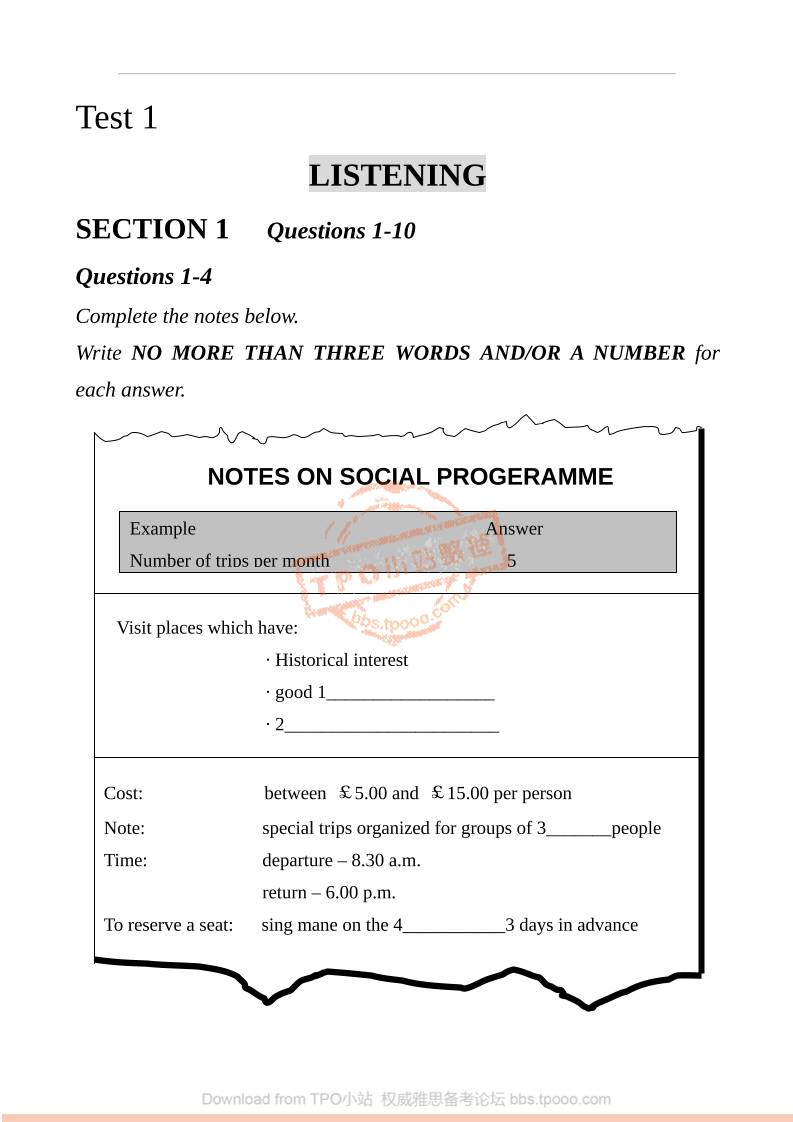


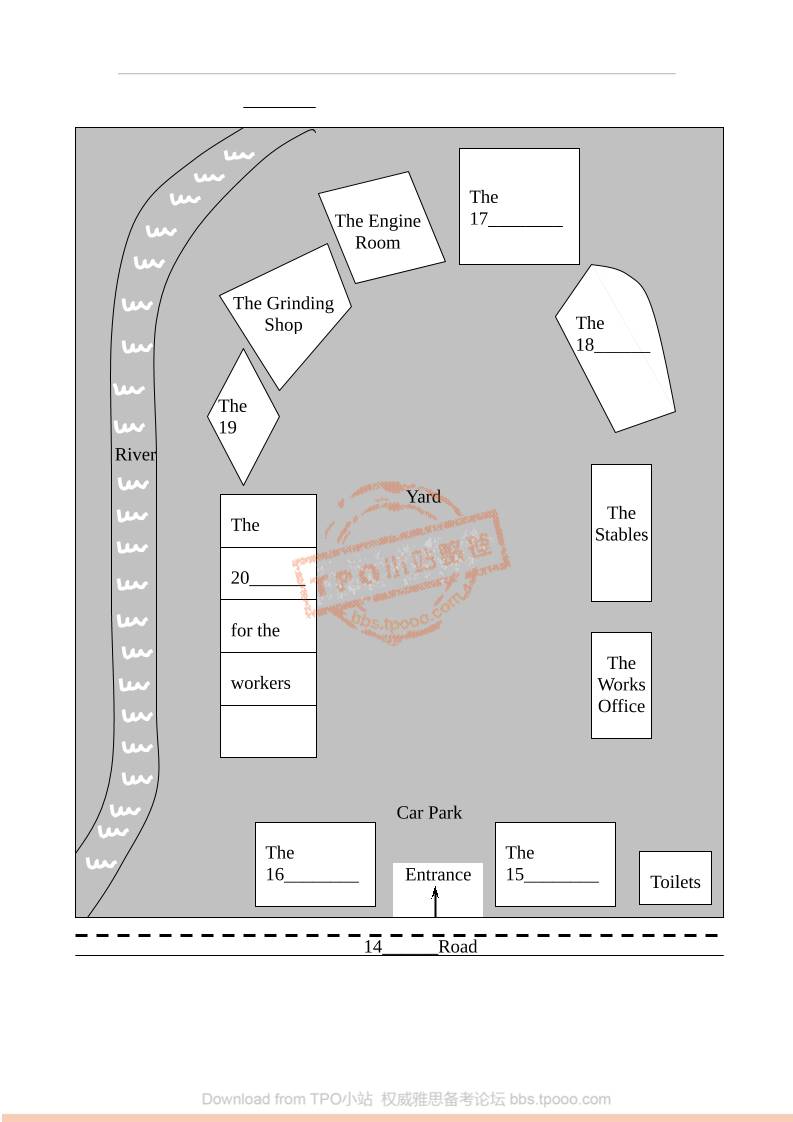
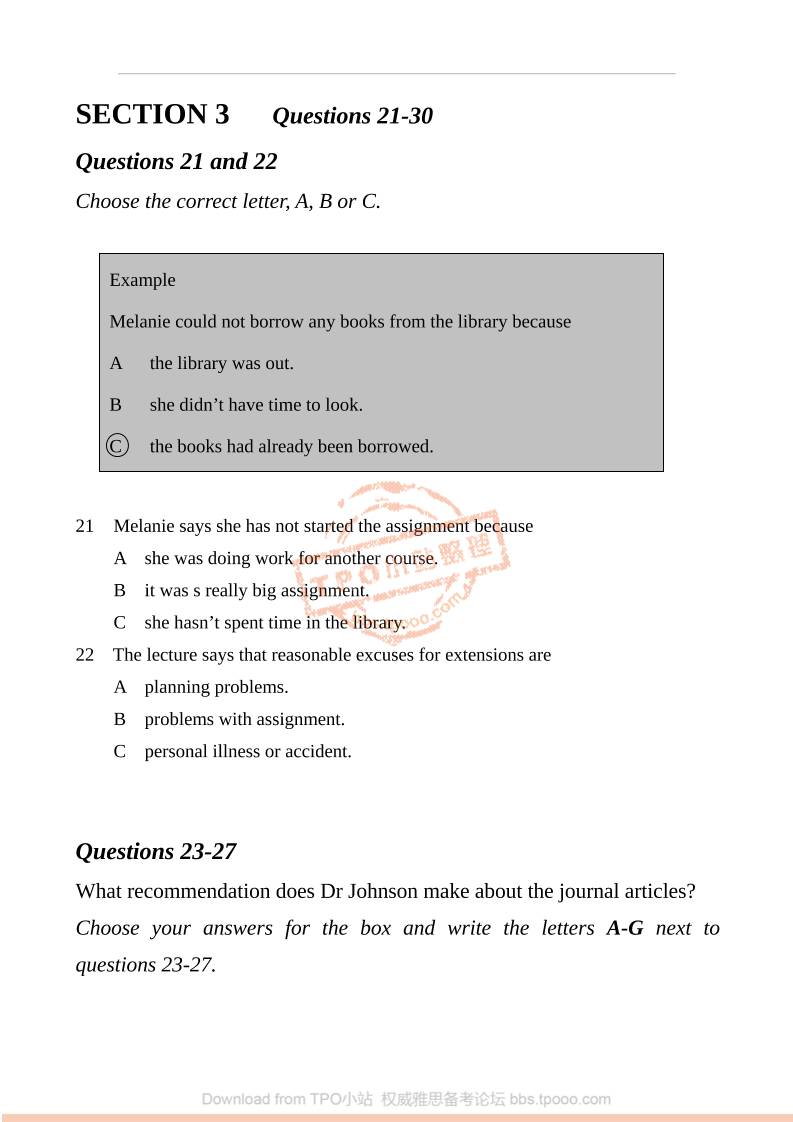


 设备数据采集
 工程招标采购
 搞笑表情
搞笑表情 微信头像
微信头像 CWMS冷库管理系统
 美女图片
美女图片 APP小游戏
 PPT模板
PPT模板 WMS仓库系统
 软件开发
软件开发