1.pdf
- 文件大小: 798.14KB
- 文件类型: pdf
- 上传日期: 2026-10-09
- 下载次数: 1
概要信息:
Ȧ
Business and
Professional
Excellence in the
Workplace
Richard Levine/Alamy Stock Photo
CHAPTER 1ƲBusiness and Professional excellence in the WorkPlaceƲƲ
communication has increasingly become a cornerstone of professional excellence in the
workplace. the popular social networking website twitter embodies both communication
and professional excellence; its entire platform relies on the drive for communication
while requiring a level of professionalism to make the company profitable. Below we take
a look at how twitter incorporates these two ideals.
x What it does: twitter is a global online information network that allows users to share
GSRXIRXERHGSRZIVWEXMSRWMRVIEPXMQI8LIGSQTER]LEWQSVIXLERQMPPMSRQSRXLP]
EGXMZIYWIVW[LSGVIEXIETTVS\MQEXIP]QMPPMSRX[IIXWIZIV]HE]
&WPEQ
8LMW
EQSYRXSJXVEǽGVIUYMVIWERIǺIGXMZIERHQSXMZEXIHXIEQSJIQTPS]IIWXSQEREKI
x Challenges: an anonymous survey conducted by Great rated! indicated that
SJIQTPS]IIWVITSVXIHXLEXXLIGSQTER]SJXIRSVEPQSWXEP[E]WTVSZMHIH
XVEMRMRKJEMVTVSQSXMSRWERHTIVWSREPP]GLEPPIRKMRK[SVO ERH
SJIQTPS]-
IIW JIPX XLEX 8[MXXIV SǺIVIH QSVI XLER NYWX E NSF FYX EPWS XLI STTSVXYRMX] XS
develop a worldwide forum of communication that creates special meaning.
x Atmosphere:8LIQENSVMX]SJ8[MXXIVIQTPS]IIWVITSVXIRNS]MRKXLIMVGSPPIEKYIWERH
ǻRHXLI[SVOTPEGIXSFIGSSTIVEXMZIERHJYR5VSJIWWMSREPI\GIPPIRGIVIUYMVIWIQTPS]-
IIWXS[SVOǼYMHP][MXLSRIERSXLIVXLYWQMRMQM̂ MRKQMWGSQQYRMGEXMSRERHGSRǼMGX
x Rewards:
SJIQTPS]IIWVITSVXIHXLEX8[MXXIVWYTTSVXWXLIMV[SVOƳPMJIFEP-
ance and compensates them fairly. feeling essential to company success is a
great motivator to encourage employees to strive for professional excellence.
chapter outline
Understanding the Importance of Human
Communication in Business and Professional
ŅĹƋåƻƋŸnj4
ŅĵĵƚĹĜϱƋĜŅĹ×eŅĵŞĬåƻ{ųŅÏ域nj6
ŅĵĵƚĹĜϱƋĜŅĹeŞŞųåĘåĹŸĜŅĹnj10
ŅĵĵƚĹĜϱƋĜŅĹ)ƋĘĜÏŸnj13
U)¥üŅų)ƻÏåĬĬåĹÏåĜĹƋĘåŅųĩŞĬ±Ïånj14
(LETXIV4FNIGXMZIW
After studying this chapter, you should be able to
1. %åĀĹåŞųŅü域ĜŅűĬåƻÏåĬĬåĹÏå±ĹÚ
communication
2. Identify business and professional
communication contexts
3. Identify the four KEYS to communication
in the workplace
4. Discuss the importance of human
communication in business and
professional contexts
5. Explain the components of the
communication model
6. Describe the communication challenges
posed by social media and technology
7. Identify the types and causes of
communication apprehension
8. Discuss communication and professional
excellence from an ethical perspective
ƲƲPART IƲBeGinninG communication PrinciPles
reading about employee feedback concerning twitter may have you motivated to find a
GEVIIVHIZSXIHXSWYGLTSWMXMZITVSJIWWMSREPI\GIPPIRGI-S[IZIVWYGGIWWJYPP]ETTP]MRK
XSERHFIMRKEGGITXIHEXWYGLERSVKERM^EXMSRMWRSIEW]JIEX=SYQE]EWO]SYVWIPJƸ;MPP.
be able to get an interview? Will i be considered for a promotion at work? Will i fit in at my
RI[NSF$;LEXƶWXLIFIWX[E]XSVYREQIIXMRK$;LEXEVIXLIUYEPMXMIWSJETVSJIWWMSREP
presentation? how should i respond to negative coworkers?” the preceding questions
EVIGSQQSRP]EWOIHF]TISTPIIRXIVMRKXLI[SVOTPEGIJSVXLIJMVWXXMQIEW[IPPEWF]
TISTPIGLERKMRKNSFXMXPIWHYXMIWSVGEVIIVW.XWIIQWXLEXVIKEVHPIWWSJXLITSWMXMSR
SVXLIMRHYWXV]MR[LMGL]SYHIWMVIXS[SVOXLIVIMWSRIXLMRKXLEX[MPPQEOISVFVIEO
the experience: communication. so welcome to the world of business and professional
communication. as you study business and professional communication over the course
SJXLMWWIQIWXIV[IIRGSYVEKI]SYVIKEVHPIWWSJ]SYVQENSVXSXEOIXLIWITVMRGMTPIWERH
SFNIGXMZIWXSLIEVX&JXIVEPPGSQQYRMGEXMSRMWXLIOI]XSTVSJIWWMSREPI\GIPPIRGIERH
professional excellence is the key to success.
UNDERSTANDING THE IMPORTANCE OF
HUMAN COMMUNICATION IN BUSINESS
AND PROFESSIONAL CONTEXTS
As you begin your study, it’s important to define what communication means.
Communication has been defined in many ways, but here’s the definition we pre-
fer: Human communication is the process of understanding our experiences
and the experiences of others through the use of verbal and nonverbal messages
(Edwards, Edwards, Wahl, & Myers, 2016; Ivy & Wahl, 2014; Regenbogen et al., 2012).
People come to understand that communication in everyday experiences is the
essential process and skill that helps them make sense of things in both personal
and professional contexts.
Even if you have some reservations about your communication skills, you prob-
ably consider yourself to be a good communicator and good listener. Most people do.
After all, it’s difficult to admit being bad at something you do all day, every day, for
your entire life. Because communication is so much a part of our everyday lives, we
think of communication as a simple process. Communicating comes so naturally to
us that we rarely feel the need to give communication a second thought. When was
the last time you really stopped and examined your communication skills? Do you
stop and examine your communication regularly? Most people don’t.
In some cases, people who fail to reflect on their communication skills trudge
through life thinking they are great communicators when they are, in actuality,
dreadful communicators. They exemplify a behavior called communication
bravado—perceiving their communication as effective, while those around them
perceive it as ineffective (Quintanilla & Mallard, 2008). Ineffective communica-
tors view communication as simply talking—but truly effective communicators
know it is far more complicated than that.
Do you take your communication skills for granted? Are you suffering from
communication bravado? Let us assure you that you do indeed have some weak-
nesses in your communication and listening, simply because everyone does.
However, understanding why communication is important and how the communi-
cation process works is the first step in overcoming those weaknesses and starting
on the road to professional excellence.
CHAPTER 1ƲBusiness and Professional excellence in the WorkPlaceƲƲ
In addition, there are several important ways in which the key areas of human
communication as a whole influence and are essential for effective communication
in the workplace.
Role-Taking
The critical functions of human communication (sending and receiving messages,
offering feedback, identifying the “role” of different communicators) must also be
applied to the context of business communication. For example, car salespeople
must basically give sales “presentations” to any potential buyers who visit their car
lot. Much of their success is determined by how well they can tailor their message
depending on the individual needs of many different customers. If customers give
verbal or nonverbal cues expressing concern about the fuel efficiency of their pro-
spective vehicle, the salesperson must modify the message to emphasize each car’s
gas mileage as a major selling point. This dynamic aspect of role-taking and feed-
back keeps the transaction flowing.
Previous Communication Experiences
The way people respond initially to new business transactions depends greatly on
their previous communication experiences in similar situations. Using the previous
example, have you experienced buying a new vehicle or making another major pur-
chase (house, major appliance, business)? Depending on whether that experience
was positive or negative, it helps form the basis for how you communicate in similar
transactions in the future. Therefore, from a business standpoint, your initial com-
munication impression is of critical importance.
Communication Channels
Depending on your physical location, your communication approach can alter sig-
nificantly (Ivy & Wahl, 2014). For example, your communication with a classmate will
likely be much more informal than your communication with a professor. Similarly,
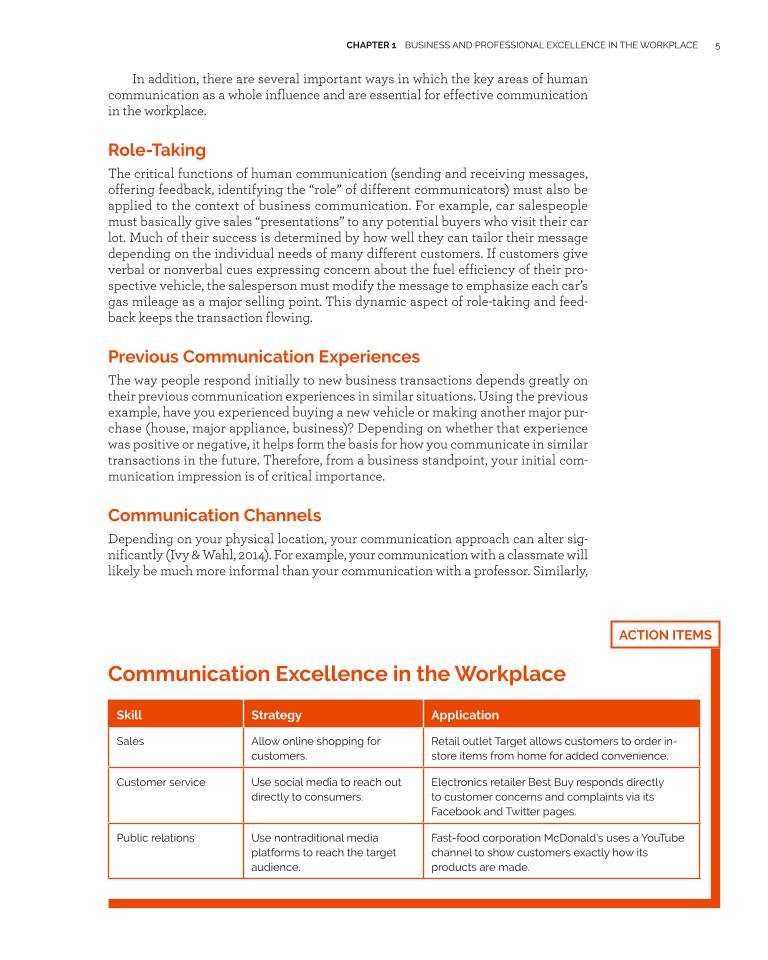
Communication Excellence in the Workplace
Skill Strategy Application
sales allow online shopping for
customers.
retail outlet target allows customers to order in-
store items from home for added convenience.
customer service use social media to reach out
directly to consumers.
electronics retailer Best Buy responds directly
to customer concerns and complaints via its
facebook and twitter pages.
Public relations use nontraditional media
platforms to reach the target
audience.
+EWXJSSHGSVTSVEXMSR2G)SREPHƶWYWIWE=SY8YFI
channel to show customers exactly how its
products are made.
ACTION ITEMS
ƲƲPART IƲBeGinninG communication PrinciPles
the channel of communication can also affect communication. Many people feel
comfortable taking a more aggressive or assertive tone when using email than when
engaging in face-to-face communication.
(YPXYVEP.RǼYIRGIW
The way we communicate, with whom we communicate, and what we commu-
nicate are almost always influenced by culture (Wahl & Scholl, 2014). Culture
is an ongoing social institution that has its own set of behavioral rules. For our
discussion, organizational culture influences how we (as members of a business
or professional organization) frame our communication with others both within
and outside that organization. For example, the communication that takes place
in a board meeting of lawyers will feature a different set of decorum, rules, and
norms when compared with a brainstorming session among creative writers
for a small company. To be a competent communicator in your organization,
you must be dynamic in adhering to the rules and norms of different
communication situations.
Communication Relationships
The perceived social hierarchy between communicators, whether they be strangers
or intimates, significantly influences the nature of the communication interaction.
The way you communicate with a customer would differ from the way you commu-
nicate with a coworker, which would also differ from how you communicate with
your supervisor. Organizational structures require that you be fluid in switching
your communication strategies depending on your relationship with the other
communicator(s). This includes not only your initial communication, but also the
type of feedback you give and the amount of appropriate self-disclosure the sender
and receiver provide one another.
Regardless of your major or the career path you eventually follow, effective
communication will be essential to your success in the workplace (Gray, 2010).
For instance, effective communication has been shown to affect employee engage-
ment and workplace relationships (Karanges, Johnston, Beatson, & Lings, 2015).
Your fellow students understand the value and importance of communication in
their careers. Of 116 students surveyed at a southwestern university, 97% agreed
that communication is a valuable skill, and 88% saw themselves using oral presen-
tation skills in their careers (Mallard & Quintanilla, 2007). Further support for the
importance of communication in your professional careers comes from business and
industry focus groups. You’ll notice that all the competencies listed in the “Tools for
Professional Excellence” box are connected to your study of business and profes-
sional communication in this course.
COMMUNICATION: A COMPLEX PROCESS
Communication is a complex process that consists of a number of elements, all of
which are in play every time you communicate (see Figure 1.1). Those who demon-
strate professional excellence consider these elements every time they communi-
cate. By the end of this semester, so will you. Let’s examine each of these elements
in more detail.
CHAPTER 1ƲBusiness and Professional excellence in the WorkPlaceƲƲ
Sender and Receiver
We stated earlier that, speaking practically, communication involves sending and
receiving messages. So it should be no surprise that you take on the roles of sender
and receiver when you communicate. When you are acting as the sender, you
encode your messages with verbal and nonverbal cues to help others understand
what you mean. When the receivers of your messages respond or decode your mes-
sage, you find out if your message was successfully transferred. In one sense, this
exchange of message and response is a cocreation of meaning, in that both parties
play a role in cocreating a meaningful exchange. Although the person initiating
the exchange (the sender) can’t control how the listener (or receiver) interprets
the message, the goal is for the listener to understand the meaning of the message
as the sender intended it.
The respective roles of sender and receiver in communication seem fairly
clear-cut, but in truth, communication is experienced in a more holistic manner—
not as senders and receivers but as communicators. Consider an example:
You run into a friend, Pat, while walking to class. Pat says, “Hey, how’s it
going?” You return the greeting and begin to tell Pat about your plans for the
weekend (you are attending a cousin’s wedding). At some point during the
story you are telling (how your cousin met her fiancé), you notice Pat check-
ing his wristwatch. You cut off your story and say goodbye, and each of you
walks to class. In one view of this example, you and Pat switch off as senders
and receivers: Pat sends you a greeting, which you receive; you send Pat an
explanation of your weekend plans and a story, which Pat receives; then Pat
sends you a nonverbal cue that time is short, which you receive by ending the
encounter. In another view of this example, you and Pat are both communica-
tors, as you simultaneously send and receive messages.
FIGURE 1.1
Interaction Model of Commmunication
NOISE
MESSAGE CHANNEL
MESSAGE CHANNEL
ENCODE DECODE
DECODE ENCODE
FEEDBACK TARGET
RECEIVER
FIELD OF EXPERIENCE
SOURCE
SENDER
FIELD OF EXPERIENCE
ƲƲPART IƲBeGinninG communication PrinciPles
Skills You Need for Your Career (based
on a 2015 Bloomberg survey of job recruiters)
;LIRXLMROMRKEFSYX]SYVJYXYVIGEVIIVTEXLGSRWMHIVXLIWOMPPWERHEXXVMFYXIWXLEXVIGVYMXIVWVIEPP]HIWMVI
Desirability Skills and Competencies
more common/less desired x initiative/risk-taking
x decision making
x Global mindset
x entrepreneurship
x Quantitative skills
x motivation/drive
less common/less desired x industry-related work experience
x adaptability
less common/more desired x strategic thinking
x creative problem solving
x leadership skills
x communication skills
more common/more desired x analytical thinking
x ability to work collaboratively
Source:1IZ]+
7SHOMR/
8LI'PSSQFIVKVIGVYMXIVVITSVX /SFWOMPPWGSQTERMIW[ERXFYXGERƶXKIX Bloomberg&HETXIHJVSQLXXT [[[FPSSQFIVK
GSQKVETLMGWNSFWOMPPWVITSVX
TOOLS FOR PROFESSIONAL EXCELLENCE 1.1
Message and Feedback
Implicit in the preceding discussion of senders and receivers is that a message is
communicated. One principle from the field of communication suggests that you
cannot not communicate.
To say that you cannot not communicate is not to say that everything is commu-
nication. Rather, it means that messages have both a verbal and a nonverbal com-
ponent. In the previous example, Pat did not say anything verbally, but he did send
a message nonverbally when he checked his watch. What was his message? That is
not clear. He may have been giving a nonverbal cue that your wedding story was
too long. He may have had an appointment and needed to be on his way. Only Pat
knows for sure. The point is, regardless of whether or not Pat intended to provide a
message, he did, and you responded in accordance with the meaning you took from
that message.
CHAPTER 1ƲBusiness and Professional excellence in the WorkPlaceƲƲ
Also included in the communication
model is feedback. In the model, you will
see that feedback is sent from the receiver
to the sender. However, since the distinc-
tion between sender and receiver is in
many ways arbitrary, feedback is the same
as the message. The notion of feedback
reminds us, as communicators, to look for
cues from the other person or persons with
whom we are communicating.
Channel
The channel is simply the method by
which you send your message. With all the
technology available today, deciding which channel to use can be a daunting task.
When you advance in your career and move into a leadership position, you’ll have
to evaluate the merits of various communication channels daily. Given the message,
should you meet with members of your team one-on-one or call a meeting? Is it
better to send a memo or an email? Should you call, or should you text? Each com-
munication channel brings with it a variety of strengths and weaknesses that will
be discussed in a later chapter.
Context
Always and everywhere, communication is contextual. Context refers to the loca-
tion, time, and occasion where communication occurs. Developing professional
excellence means beginning to assess your communication context and use that
information when developing your message. For instance, consider the context of
the business and professional communication course. Virtually everyone in the
course is there because they have to be. As a result, if you give a speech in this
course, your audience may not be interested in or knowledgeable about the topic
you select; you might need to educate them and take conscious steps to capture their
interest. However, if you are giving a speech to a group of employees about their
cost-of-living and merit raises, they will be hanging on your every word.
Noise
Noise is part of the communication context. Noise can be either external or inter-
nal. External noise includes distractions such as audible talking during a meeting,
ruffling of papers, or a cell phone going off in the next cubicle. For our purposes,
the definition of external noise is extended to include any external factor that could
interfere with a communicator’s ability to focus on the message. In a meeting, exter-
nal noise might also include a team member sending text messages with the sound
on or whispering while your boss is talking.
Internal noise encompasses any internal condition or state that interferes
with the communicator’s ability to focus on the message. If your meeting starts at
11:00 a.m., your team members may be looking forward to lunch; if you hold an
emergency meeting at 6:00 a.m., your team may be tired. Being hungry or tired cre-
ates internal noise. Developing professional excellence includes learning to consider
things such as context and noise when making decisions about your communication
Professionals send
and receive verbal and
nonverbal messages in a
variety of contexts.
5
M\EF
E]GS
Q
VE[
T
M\I
P1
MGI
R
WI
H
Y
R
H
I
V(
(
ƲƲPART IƲBeGinninG communication PrinciPles
interactions. Remember that both internal and external noise are doing more than
just preventing you from focusing on the message. That is, both types of noise can
interfere with your understanding of the message. You can be focused on a message
and still not understand.
COMMUNICATION APPREHENSION
Effective communication skills are essential if you want to excel in leadership. Put
simply, to move up the ladder of success, you must develop your communication
skills. Unfortunately, communication apprehension is a very real problem that stops
many talented individuals from achieving professional excellence. What is commu-
nication apprehension?
Types of Communication Apprehension
According to James C. McCroskey (1982), one of the leading researchers in the com-
munication discipline, communication apprehension is “an individual’s level of fear
or anxiety associated with either real or anticipated communication with another
person or persons” (p. 137). You can understand your own communication apprehen-
sion by thinking about your communication in particular situations. What types of
communication situations increase your apprehension? According to McCroskey
(1984), there are at least four types of communication apprehension:
x Trait communication apprehension means that one possesses a “shy trait.” In
general, shy people tend not to raise their hands in class a lot, avoid certain social
situations, and feel extremely anxious about giving a professional presentation.
x Context-based communication apprehension describes a fear of com-
municating in certain contexts. A fear of public speaking is a great exam-
ple of context communication apprehension. For example, a student may
Annoying Coworkers
As you read the passage below, consider what
ƾŇƣĮÚƐÆåƐ±ƐķŇŹåƐåýåσĞƽåƐÏŇķķƣĻĞϱƒĞŇĻƐžƒŹ±ƒåďDžƐ
in this situation.
)SYKNYWXFIKERERI[NSFEXEWSJX[EVIGSQTER]
-IPSZIWLMWRI[[SVOTPEGII\GITXJSVEJI[
obnoxious coworkers. these particular coworkers
GSRXMRYEPP]PIEZIJSSHERHXVEWLP]MRKEVSYRHTPE]
PSYHQYWMGMRXLIQMHHPISJXLI[SVOHE]ERHXIPP
MRETTVSTVMEXINSOIWMRJVSRXSJXLISXLIVIQTPS]IIW
EPPXSXLITSMRXXLEX)SYKƶWEFMPMX]XSKIX[SVO
done has deteriorated. doug has tried asking the
IQTPS]IIWXSUYMIXHS[RXSRSEZEMPERHMWRS[
considering bringing his concerns to the head
SJXLIGSQTER][LSMWVEVIP]MRXLISǽGI)SYK
decides to send the head of the company an email
in which he lets out all of his frustration.
Questions to Consider
Was sending an email the best way for doug to
I\TVIWWLMWJIIPMRKWEFSYXLMWGS[SVOIVWSVGSYPH
LILEZIYWIHEHMǺIVIRXGSQQYRMGEXMSRGLERRIP$
What are some things doug should keep in
mind the next time he communicates in the
workplace using email?
What are some situations where email is the
ideal form of communication?
YOUR COMMUNICATION INTERACTION
CHAPTER 1ƲBusiness and Professional excellence in the WorkPlaceƲƲ
not be nervous about meeting new people or participating in small groups,
but presenting a speech in front of the class promotes a high degree of
apprehension.
x Audience-based communication apprehension explains a person’s fear of
speaking to certain people or groups. For example, a person may feel com-
fortable speaking in front of friends in his or her social circle, but speaking
in front of colleagues at work makes him or her extremely nervous.
x Situational communication apprehension refers to apprehension to com-
municate in specific sets of circumstances; everyone at some point in their
lives is going to feel apprehensive about communicating something. Think
of a person you might want to impress, such as a boss or an interviewer.
In general, you are an outgoing person and don’t mind presenting in front
of people, but someone you want to impress may promote an uneasy or
anxious feeling.
Causes of Communication Apprehension
Now that we’ve reviewed the different types of communication apprehension, let’s
take a look at some of the causes. Communication scholar Michael Beatty (1988) lists
eight causes of communication apprehension. Review the list that follows to see if
any of the causes resonate with you personally:
x Novelty: If the type of communication situation, such as giving a speech or
running a meeting, is not something you do every day, it can create appre-
hension until you become familiar with this task or situation.
x Formality: Preparing and organizing something to be in the spotlight can
promote the feeling of formality that makes you nervous or apprehensive.
x Subordinate status: If someone in charge of you, such as a manager at work,
is evaluating your presentation, his or her higher status and evaluation can
cause anxiety.
x Peer evaluation: “How are my coworkers going to respond to me?” This ques-
tion addresses concerns you may have about your peers evaluating you.
These concerns can in turn cause apprehension.
x Dissimilarity: Sometimes you may feel different from the audience. Having
nothing in common with the audience causes anxiety.
x Conspicuousness: Feeling as though you are in the spotlight and all eyes are
on you can certainly cause anxiety.
x Lack of attention: When you feel as though a listener or the audience is bored
and uninterested in your message or presentation, you may begin to feel
apprehension.
x Prior history: Many people have had a bad experience during a communi-
cation interaction, such as an interview, a presentation, or a meeting. This
negative experience can create anxiety the next time you find yourself in a
similar situation.
As you can see, there are many different types and causes of communication
apprehension. Identifying the types and causes of your communication apprehen-
sion is important, but not nearly as important as learning the skills that will reduce
those fears.
ƲƲPART IƲBeGinninG communication PrinciPles
Personal Report of Communication Apprehension
As you read the index below and answer the
questions, think about how this knowledge can help
you be a better communicator.
Personal Report of Communication
Apprehension (PRCA-24)
8LI57(&MWXLIMRWXVYQIRXQSWX[MHIP]YWIH
to measure communication apprehension. the
measure permits one to obtain subscores on the
GSRXI\XWSJTYFPMGWTIEOMRKH]EHMGMRXIVEGXMSR
WQEPPKVSYTWERHPEVKIKVSYTW
8LMWMRWXVYQIRXMWGSQTSWIHSJWXEXIQIRXW
concerning feelings about communicating with
others. Please indicate the degree to which each
statement applies to you by marking whether you
strongly disagree disagree EVIneutral
agree 4; or strongly agree 5.
i dislike participating in group discussions.
,IRIVEPP].EQGSQJSVXEFPI[LMPI
participating in group discussions.
i am tense and nervous while
participating in group discussions.
4. i like to get involved in group discussions.
5. engaging in a group discussion with new
people makes me tense and nervous.
6. i am calm and relaxed while participating
in group discussions.
,IRIVEPP].EQRIVZSYW[LIR.LEZIXS
participate in a meeting.
9WYEPP].EQGSQJSVXEFPI[LIR.LEZIXS
participate in a meeting.
i am very calm and relaxed when i am called
on to express an opinion at a meeting.
i am afraid to express myself at meetings.
communicating at meetings usually
makes me uncomfortable.
i am very relaxed when answering
questions at a meeting.
While participating in a conversation with
ERI[EGUYEMRXERGI.JIIPZIV]RIVZSYW
i have no fear of speaking up in
conversations.
4VHMREVMP].EQZIV]XIRWIERHRIVZSYWMR
conversations.
4VHMREVMP].EQZIV]GEPQERHVIPE\IHMR
conversations.
While conversing with a new
EGUYEMRXERGI.JIIPZIV]VIPE\IH
.ƶQEJVEMHXSWTIEOYTMRGSRZIVWEXMSRW
i have no fear of giving a speech.
certain parts of my body feel very tense
and rigid while giving a speech.
i feel relaxed while giving a speech.
my thoughts become confused and
NYQFPIH[LIR.EQKMZMRKEWTIIGL
i face the prospect of giving a speech
[MXLGSRǻHIRGI
;LMPIKMZMRKEWTIIGL.KIXWSRIVZSYW.
forget facts i really know.
SCORING
,VSYTHMWGYWWMSR
ǯ
WGSVIWJSV.XIQWERH
WGSVIWJSV.XIQWERH
2IIXMRKW
ǯ
WGSVIWJSV.XIQW
ERH
WGSVIWJSV.XIQW
ERH
.RXIVTIVWSREP
ǯ
WGSVIWJSV.XIQWERH
WGSVIWJSV.XIQWERH
5YFPMGWTIEOMRK
ǯ
WGSVIWJSV.XIQW
ERH
WGSVIWJSV.XIQWERH
Group discussion score:
meetings score:
interpersonal score:
Public speaking score:
8SSFXEMR]SYVXSXEPWGSVIJSVXLI57(&WMQTP]
add your subscores together:
GSVIWGERVERKIJVSQXSGSVIWFIPS[
represent people who have very low communication
ETTVILIRWMSRGSVIWFIX[IIRERH
VITVIWIRX
people with average communication apprehension.
GSVIWEFSZI
VITVIWIRXTISTPI[LSLEZILMKL
levels of trait communication apprehension.
KNOW YOURSELF
CHAPTER 1ƲBusiness and Professional excellence in the WorkPlaceƲƲ
STEP BACK AND REFLECT
Ethical Considerations
8LVSYKLSYXXLMWXI\X]SY[MPPFIKMZIRSTTSVXYRMXMIWXSWXITFEGOERHVIǼIGXSRSXLIV
TISTPIƶWGSQQYRMGEXMSRMRXIVEGXMSRW'YXMRXLMWǻVWXI\IVGMWI[I[SYPHPMOI]SYXS
WXITFEGOERHVIǼIGXSR]SYVS[RGSQQYRMGEXMSR7IEHXLIUYIWXMSRWFIPS[;LIR
MXGSQIWXSFSXL]SYV[VMXXIRERH]SYVZIVFEPGSQQYRMGEXMSRGER]SYEP[E]WERW[IV
yes to these questions? can you think of examples for which you could not answer yes?
Lying: are you telling the truth?
Secrets: are you respecting the boundary placed around information by avoiding
disclosure to others?
Integrity: are you discerning right from wrong and explaining your reasoning for
]SYVHIGMWMSR$.RSXLIV[SVHWEVI]SYZSGEPEFSYXXLIIXLMGWHVMZMRK]SYVHIGMWMSR
IKGEVIERHPSZIǻRERGMEPVIWTIGXJSVMRHMZMHYEPVMKLXWIUYEPJSVEPP$
Aggressive communication: are you communicating with others without
aggression and abuse of power? are you communicating with others in a
HMKRMǻIHERHVIWTIGXJYPQERRIV$&VI]SYGSQQYRMGEXMRK[MXLQYXYEPVIWTIGX
and open dialogue?
Plagiarism (cheating): are you communicating information that is authentic and
RSXTPEKMEVM^IH$.WXLIWSYVGISJMRJSVQEXMSRFIMRKGVIHMXIHETTVSTVMEXIP]$
XIT'EGOERH7IǼIGX
have you ever taken part in any of these communication behaviors?
.JWSHMH]SYGSRWMHIVXLIQYRIXLMGEP$;L]SV[L]RSX$
did you consider them unprofessional? Why or why not?
COMMUNICATION ETHICS
With professional excellence as our goal, we believe that ethical behavior must serve
as a foundation for people to be treated with fairness, dignity, and respect. Central to
professional excellence is communication ethics. Ethics is the general term for the
discussion, determination, and deliberation processes that attempt to decide what is
right or wrong, what others should or should not do, and what is considered appropri-
ate in our individual, communal, and professional lives (By, Burnes, & Oswick, 2012;
Japp, Meister, & Japp, 2005; Johannesen, Valde, & Whedbee, 2008). What consider-
ations or factors help shape our ethical decisions as professionals? Ethical consider-
ations are the variety of factors important for us to consider in any scenario in which
we’re making a decision, conducting an evaluation, or making a selection (Bok, 1989,
1999; Carter, 1996; Japp et al., 2005; Mathenge, 2011; Tannen, 1998). Ethical consid-
erations vary from person to person, and it is not always as simple as the black-and-
white world of right and wrong. For example, you may experience ethical dilemmas,
situations that do not seem to present clear choices between right and wrong or good
and evil. If you are asked to do something illegal, then it may be easy to make a deci-
sion. “No, I will not do something illegal.” But what if it is not illegal? What if everyone
else does it? What if it is just bending the rules a little bit? The questions in the “Step
Back and Reflect” box are ones that ethical communicators must always consider.
ƲƲPART IƲBeGinninG communication PrinciPles
Many ethical considerations are con-
nected to our values and virtues. Values are
moral principles or rules that determine ethi-
cal behaviors. Values are often articulated in
should or should-not statements. Sometimes
values are presented as statements of what
a group believes or as lists of rules peo-
ple intend to honor. Many readers of this
text will take jobs in industries that ask all
employees to support organizational val-
ues, specific principles or guidelines such
as safety, teamwork, integrity, or ownership
that are typically outlined in support of any
given organizational mission or goal. For
example, some health care systems and pri-
vate education institutions ask employees to
support certain religious values. Regardless of industry, organizational values address
both the experience of the people working for the company and the experience of cus-
tomers with service and product quality. To minimize ethical dilemmas in your profes-
sional career, seek employment with organizations that share your values.
Once you’ve been promoted or elected into a particular position of leadership,
you may think, “That’s it—job over; I’ve arrived.” We emphasize that leadership is a
skill, one that needs to be developed and maintained throughout life. Think about
the qualities of excellent leaders. Ethics should be among those qualities. And like all
other leadership skills, your ethics must be developed and continually maintained.
Although not every reader of this book is currently in a leadership position, has the
goal of becoming a CEO, or even wants to become a leader, the KEYS process with
communication ethics at the foundation drives excellence in professional situations.
KEYS FOR EXCELLENCE
IN THE WORKPLACE
We opened this chapter with attention to how the popular social networking
website Twitter embodies communication and professional excellence by consid-
ering employees’ feedback about their experiences at work. We defined human
communication and provided a practical communication model. We defined
professional excellence: being recognized for your skills as a communicator,
serving as a role model to those around you, recognizing your strengths and
developing your weaknesses, being audience centered, understanding the con-
text, and possessing the ability to adapt and continually improve.
Next, we situated our topic of study within the workplace as a commu-
nication context and discussed communication apprehension as a common
obstacle for professionals. We introduced the KEYS process as a way for profes-
sionals to develop their communication. Know yourself means actively assess-
ing your skills as a communicator and then developing strategies to utilize
your strengths and develop your weaknesses. Evaluate the professional context
entails proactively addressing the needs of your audience and understanding
the constraints of the communication situation, as well as developing your
skills for communicating with a variety of audiences and situations. Your com-
munication interaction requires you to monitor your own verbal and nonverbal
cues, in addition to the cues from the audience within each communication
Taking part in
something as common
EWSǽGIKSWWMTMWER
ethical consideration.
Is the gossip true?
Does it show respect
for boundaries? What
does it say about your
integrity?
iS
to
ck
.c
o
m
/
M
ac
h
in
e
H
e
ad
z
CHAPTER 1ƲBusiness and Professional excellence in the WorkPlaceƲƲ
interaction. Step back and reflect encour-
ages you to examine the effectiveness of
verbal and nonverbal messages you convey
to others and the overall success of various
communication interactions and then take
what you’ve learned and start the process
again, developing the ability to adapt and
improve continually.
This introductory chapter has provided
you with an understanding of some of the
basic terminology and the importance of
communication excellence. In the second
chapter, we explore some of the most important verbal and nonverbal skills needed
to enter the workplace or, put simply, how to put the KEYS process into action.
Know yourself
Evaluate the professional context
Your communication interaction
Step back and reflect
EXECUTIVE SUMMARY
3S[XLEX]SYLEZIǻRMWLIHVIEHMRKXLMWGLETXIV]SYWLSYPHFIEFPIXS
Define professional excellence and communication:
y 5VSJIWWMSREPI\GIPPIRGIQIERWFIMRKVIGSKRM^IHJSV]SYVWOMPPWEWEGSQQYRMGEXSVERH
serving as a role model to others.
y human communication is the process of understanding our experiences and the
experiences of others through the use of verbal and nonverbal messages.
y 7IKEVHPIWWSJ]SYVQENSVSVXLIGEVIIVTEXL]SYIZIRXYEPP]JSPPS[IǺIGXMZI
GSQQYRMGEXMSR[MPPFIIWWIRXMEPXS]SYVWYGGIWWMRXLI[SVOTPEGI
T
Tom’s Lack of Communication
As you read this passage and answer the questions,
consider how the way you communicate has an
ethical dimension.
8SQMWEVIGIRXGSPPIKIKVEHYEXI[LSPERHIHENSF
as an information technology manager at a computer
QERYJEGXYVMRKTPERX8SQRIZIVVIEPP]IRNS]IH
XEPOMRKXSRI[TISTPIWSLIQEHIWYVILMWHIKVII
involved working with computers so that he could
QMRMQM^ILMWMRXIVEGXMSRW[MXLGS[SVOIVW-S[IZIV
SRGILIFIKERLMWRI[NSFMXFIGEQISFZMSYWXLEX
a great deal of his work involved interacting with
other people. Because tom disliked communicating
[MXLLMWGS[SVOIVWLI[EWSJXIRTIVGIMZIHEW
grumpy and unfriendly. management made several
EXXIQTXWXSGSEGL8SQSRLMWGSQQYRMGEXMSRWOMPPW
FYXLIVIJYWIHXSQEOIER]IǺSVXXS[SVO[IPP[MXL
others. his lack of communication led to technical
problems going unaddressed and sabotaged the
GSQTER]ƶWXIEQFEWIH[SVOMRKIRZMVSRQIRX8SQ
[EWIZIRXYEPP]ǻVIHJVSQLMWTSWMXMSRERHEXXIQTXIH
XSǻRHERSXLIVNSFXLEXHMHRSXVIUYMVILMQXSMRXIVEGX
with other employees.
Questions to Consider
What is the ethical issue with tom refusing to
communicate with his coworkers?
is tom wrong to assume that there are
QER]NSFWSYXXLIVIXLEXHSRSXVIUYMVI
communication skills?
;LEXGSYPH8SQLEZIHSRIHMǺIVIRXP]XSWEZI
LMWNSFEXXLEXTEVXMGYPEVGSQTER]$
4. -S[GSYPH8SQYWIXLI0*=TVSGIWWXSXVEMR
himself to be a better communicator?
ETHICAL CONNECTION
ƲƲPART IƲBeGinninG communication PrinciPles
Identify business and professional communication contexts:
y the business and professional contexts you will explore are beginning communication
TVMRGMTPIW
MIZIVFEPERHRSRZIVFEPGSQQYRMGEXMSRERHPMWXIRMRKXLINSFWIIOMRK
TVSGIWW[SVOTPEGIGYPXYVIERHHMZIVWMX]MRXIVTIVWSREPGSQQYRMGEXMSRXIEQ
GSQQYRMGEXMSRGSQQYRMGEXMSRERHXIGLRSPSK][VMXXIRGSQQYRMGEXMSRPIEHIVWLMT
TVIWIRXMRKEWETVSJIWWMSREPERH[SVOƳPMJIFEPERGI
T\\Z
Identify the four KEYS to communication in the workplace:
y Know yourself: challenging people to assess their skills as communicators
EGXMZIP]ERHXLIRHIZIPSTWXVEXIKMIWXSYXMPM^IXLIMVWXVIRKXLWERHHIZIPSTXLIMV
weaknesses.
y )ƽ±Įƣ±ƒåƐƒĚåƐŤŹŇüåžžĞŇĻ±ĮƐÏŇĻƒåDŽƒ× teaching people to address the needs of their audience
TVSEGXMZIP]ERHYRHIVWXERHXLIGSRWXVEMRXWSJXLITVSJIWWMSREPGSQQYRMGEXMSRGSRXI\X
as well as developing their skills for communicating with a variety of audiences and
contexts.
y Your communication interaction: asking people to monitor their own verbal and nonverbal
cues in addition to the cues of the audience within each communication interaction.
y ƒåŤƐƱÏīƐ±ĻÚƐŹåāåσ×I\EQMRMRKXLIIǺIGXMZIRIWWSJZIVFEPERHRSRZIVFEPQIWWEKIW[I
convey to others and the overall success of various communication interactions and then
XEOMRK[LEX[IƶZIPIEVRIHERHWXEVXMRKXLITVSGIWWEKEMR HIZIPSTMRKXLIEFMPMX]XSEHETX
ERHMQTVSZIGSRXMRYEPP]
T
Discuss the importance of human communication in business and professional contexts:
y role-taking and feedback are critical to the success of business and professional
communication.
y (SQQYRMGEXSVWEVIEǺIGXIHF]XLIMVTVIZMSYWGSQQYRMGEXMSRI\TIVMIRGIW
y 5L]WMGEPWYVVSYRHMRKWERHGSQQYRMGEXMSRGLERRIPWMRǼYIRGIGSQQYRMGEXSVW
y (SQQYRMGEXMSRMWEPXIVIHF]GYPXYVEPMRǼYIRGIW
y (SQQYRMGEXSVWEVIMRǼYIRGIHF]XLITIVGIMZIHVIPEXMSRWLMTFIX[IIRXLIQ
T
Explain the components of the communication model:
y 8LITIVWSRMRMXMEXMRKXLII\GLERKIMWXLIWIRHIV[LMPIXLITIVWSRPMWXIRMRKXSXLI
exchange is the receiver.
y ,IRIVEPP]WTIEOMRKXLITVSGIWWSJWIRHMRKERHVIGIMZMRKGSQQYRMGEXMSRMWXLEXE
message is communicated.
y ;LIR]SYEVIEGXMRKEWXLIWIRHIV]SYIRGSHI]SYVQIWWEKIW[MXLZIVFEPERH
nonverbal cues to help others understand what you mean.
y ;LIRXLIVIGIMZIVSJ]SYVQIWWEKIVIWTSRHWSVHIGSHIW]SYVQIWWEKI]SYǻRHSYXMJ
your message was successfully transferred.
y feedback is communication sent from the receiver back to the sender.
y 8LIGLERRIPMWXLIQIXLSHF][LMGL]SYWIRH]SYVQIWWEKI
IKZSMGITLSRIIQEMP
y (SRXI\XVIJIVWXSXLIPSGEXMSRXMQIERHSGGEWMSR[LIVIGSQQYRMGEXMSRSGGYVW
y noise can be either external or internal. external noise includes distractions such as
EYHMFPIXEPOMRKHYVMRKEQIIXMRKVYǾMRKSJTETIVWSVEGIPPTLSRIKSMRKSǺMRXLIRI\X
cubicle. internal noise encompasses any internal condition or state that interferes with the
GSQQYRMGEXSVƶWEFMPMX]XSJSGYWSRXLIQIWWEKI
T
CHAPTER 1ƲBusiness and Professional excellence in the WorkPlaceƲƲ
Describe the communication challenges posed by social media and technology:
y knowing when to use computer-mediated communication or face-to-face
communication can be challenging. a common problem now is that we have almost too
many choices available to us for communicating with others.
y 5VEGXMGMRKGYPXYVEPWIRWMXMZMX]GERFIHMǽGYPX&WFYWMRIWWERHGSQQIVGIMRGVIEWMRKP]XEOITPEGI
SREKPSFEPWGEPIXLIEFMPMX]XSGSQQYRMGEXI[MXLGYPXYVEPWIRWMXMZMX]GERRSXFISZIVWXEXIH
y .RJSVQEXMSRSZIVPSEHGERRIKEXMZIP]EǺIGX]SYV[SVOERHLIEPXL8LITVMGI[ITE]JSV
GSRZIRMIRGIERHMQQIHMEG][MXLGSQTYXIVQIHMEXIHGSQQYRMGEXMSRMWXLIHMǽGYPX]SJ
HMWGSRRIGXMRKJVSQMX
T
Identify the types and causes of communication apprehension:
y 8VEMXGSQQYRMGEXMSRETTVILIRWMSRQIERWXLEXSRITSWWIWWIWEƸWL]XVEMXƹ.RKIRIVEPWL]
TISTPIXIRHRSXXSVEMWIXLIMVLERHWMRGPEWWEPSXEZSMHGIVXEMRWSGMEPWMXYEXMSRWERHJIIP
extremely anxious about giving a professional presentation.
y context-based communication apprehension describes a fear of communicating in
certain contexts.
y &YHMIRGIFEWIHGSQQYRMGEXMSRETTVILIRWMSRI\TPEMRWETIVWSRƶWJIEVSJWTIEOMRKXS
certain people or groups.
y situational communication apprehension refers to apprehension to communicate in
WTIGMǻGWIXWSJGMVGYQWXERGIW IZIV]SRIEXWSQITSMRXMRXLIMVPMZIWMWKSMRKXSJIIP
apprehensive about communicating something.
y (EYWIWSJGSQQYRMGEXMSRETTVILIRWMSRMRGPYHIRSZIPX]
[LIRXLIX]TISJ
GSQQYRMGEXMSRMWRSXWSQIXLMRK]SYHSIZIV]HE]JSVQEPMX]
[LIREGSQQYRMGEXMSR
MWFIMRKTVITEVIHXLEX[MPPFIMRXLIWTSXPMKLXTIIVIZEPYEXMSR
[LIRGSRGIVRWEVMWI
EFSYXLS[GS[SVOIVW[MPPVIWTSRHERHTVMSVLMWXSV]
[LIRETVMSVFEHI\TIVMIRGIMRE
GSQQYRMGEXMSRMRXIVEGXMSRGEYWIWER\MIX]MRWMQMPEVWMXYEXMSRWEQSRKSXLIVW
T
Discuss communication and professional excellence from an ethical perspective:
y EthicsMWXLIKIRIVEPXIVQJSVXLIHMWGYWWMSRHIXIVQMREXMSRERHHIPMFIVEXMSRTVSGIWWIW
XLEXEXXIQTXXSHIGMHI[LEXMWVMKLXSV[VSRK[LEXSXLIVWWLSYPHSVWLSYPHRSXHSERH
[LEXMWGSRWMHIVIHETTVSTVMEXIMRSYVMRHMZMHYEPGSQQYREPERHTVSJIWWMSREPPMZIW
y ethical considerations are the variety of factors important for us to consider in any scenario
MR[LMGL[IƶVIQEOMRKEHIGMWMSRGSRHYGXMRKERIZEPYEXMSRSVQEOMRKEWIPIGXMSR
y ethical dilemmas are situations that do not seem to present clear choices between right
ERH[VSRKSVKSSHERHIZMP
T
:MWMXER]SJXLI[IFWMXIWJSVQENSVWSGMEPQIHMEGSQTERMIW
+EGIFSSO8[MXXIV1MROIH.R
IXG9RHIVXLIƸ&FSYX9WƹWIGXMSRVIEHXLIGSQTER]QMWWMSRWXEXIQIRXERHKSEPWJSV
XLISVKERM^EXMSR)S]SYFIPMIZIXLIGSQTER]GSQQYRMGEXIWTVSJIWWMSREPI\GIPPIRGIXS
its audience? Write a brief statement either agreeing or disagreeing with this question.
Break into small groups and create a bulleted list of what your team believes embodies
professional excellence in communication. compare your list with those of other groups
in the class. are there any practices that are universal across all groups?
IPIGXER]GSQTER]SVSVKERM^EXMSRERH[VMXIEFVMIJWYQQEV]SJMXWFIWX
communication practices. how can you apply these practices to your study of
communication and to your professional career?
EXPLORE缩略图:

高速下载:
正在进行安全检测...
点击后进入安全下载页,再进行实际下载。下载链接有效期 24 小时,过期会自动刷新。
下载说明:
- 文件描述:1.pdf,可用于在线分享与下载使用。
- 文件分类:文档资料
- 用途建议:适用于资料分享、学习交流、办公协作。
- 适合人群:学生、教师、办公人员、项目协作团队。
- 适配系统:Windows、macOS、Android、iOS 均可下载访问。