RPM 69 Education Only - Print Ready.pdf
- 文件大小: 207.71KB
- 文件类型: pdf
- 上传日期: 2025-10-24
- 下载次数: 0
概要信息:
© Les Mills International Ltd 2015RPM 69
RPM Presenters
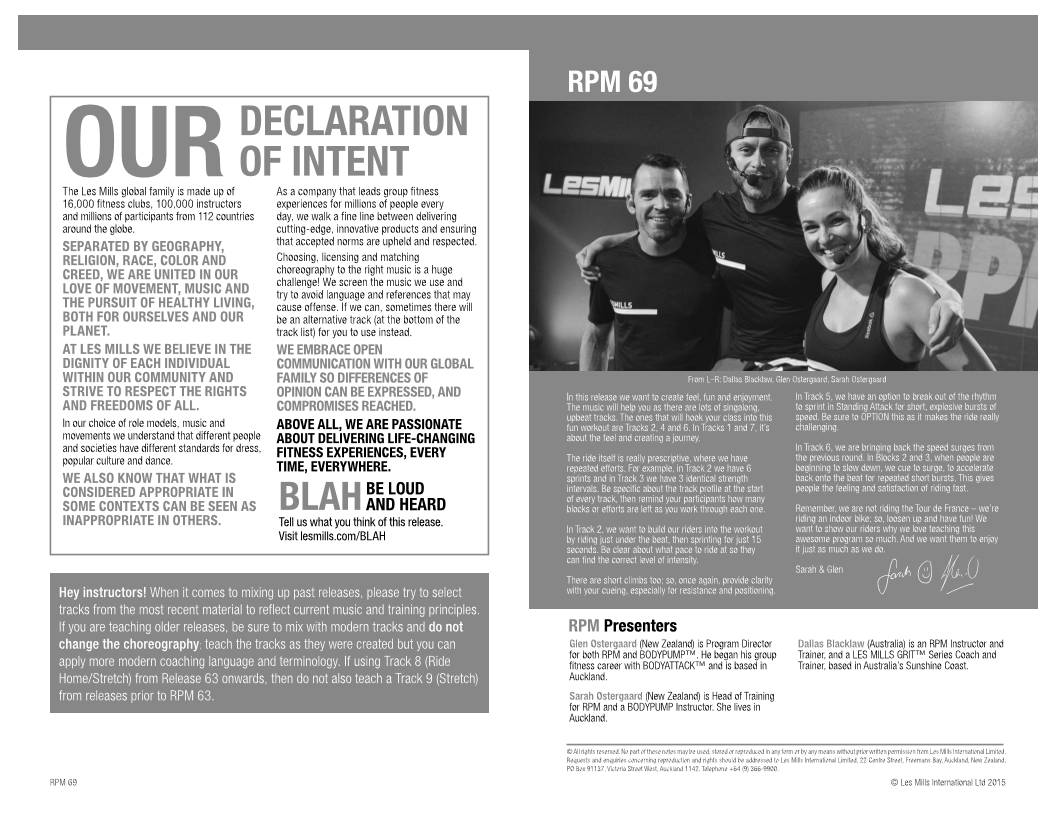
From L–R: Dallas Blacklaw, Glen Ostergaard, Sarah Ostergaard
Glen Ostergaard (New Zealand) is Program Director
for both RPM and BODYPUMP™. He began his group
fitness career with BODYATTACK™ and is based in
Auckland.
Sarah Ostergaard (New Zealand) is Head of Training
for RPM and a BODYPUMP Instructor. She lives in
Auckland.
Dallas Blacklaw (Australia) is an RPM Instructor and
Trainer, and a LES MILLS GRIT™ Series Coach and
Trainer, based in Australia’s Sunshine Coast.
RPM 69
© All rights reserved. No part of these notes may be used, stored or reproduced in any form or by any means without prior written permission from Les Mills International Limited.
Requests and enquiries concerning reproduction and rights should be addressed to Les Mills International Limited, 22 Centre Street, Freemans Bay, Auckland, New Zealand,
PO Box 91137, Victoria Street West, Auckland 1142. Telephone +64 (9) 366-9900.
In this release we want to create feel, fun and enjoyment.
The music will help you as there are lots of singalong,
upbeat tracks. The ones that will hook your class into this
fun workout are Tracks 2, 4 and 6. In Tracks 1 and 7, it’s
about the feel and creating a journey.
The ride itself is really prescriptive, where we have
repeated efforts. For example, in Track 2 we have 6
sprints and in Track 3 we have 3 identical strength
intervals. Be specific about the track profile at the start
of every track, then remind your participants how many
blocks or efforts are left as you work through each one.
In Track 2, we want to build our riders into the workout
by riding just under the beat, then sprinting for just 15
seconds. Be clear about what pace to ride at so they
can find the correct level of intensity.
There are short climbs too; so, once again, provide clarity
with your cueing, especially for resistance and positioning.
In Track 5, we have an option to break out of the rhythm
to sprint in Standing Attack for short, explosive bursts of
speed. Be sure to OPTION this as it makes the ride really
challenging.
In Track 6, we are bringing back the speed surges from
the previous round. In Blocks 2 and 3, when people are
beginning to slow down, we cue to surge, to accelerate
back onto the beat for repeated short bursts. This gives
people the feeling and satisfaction of riding fast.
Remember, we are not riding the Tour de France – we’re
riding an indoor bike; so, loosen up and have fun! We
want to show our riders why we love teaching this
awesome program so much. And we want them to enjoy
it just as much as we do.
Sarah & Glen
DECLARATION
OF INTENTOUR
The Les Mills global family is made up of
16,000 fitness clubs, 100,000 instructors
and millions of participants from 112 countries
around the globe.
SEPARATED BY GEOGRAPHY,
RELIGION, RACE, COLOR AND
CREED, WE ARE UNITED IN OUR
LOVE OF MOVEMENT, MUSIC AND
THE PURSUIT OF HEALTHY LIVING,
BOTH FOR OURSELVES AND OUR
PLANET.
AT LES MILLS WE BELIEVE IN THE
DIGNITY OF EACH INDIVIDUAL
WITHIN OUR COMMUNITY AND
STRIVE TO RESPECT THE RIGHTS
AND FREEDOMS OF ALL.
In our choice of role models, music and
movements we understand that different people
and societies have different standards for dress,
popular culture and dance.
WE ALSO KNOW THAT WHAT IS
CONSIDERED APPROPRIATE IN
SOME CONTEXTS CAN BE SEEN AS
INAPPROPRIATE IN OTHERS.
As a company that leads group fitness
experiences for millions of people every
day, we walk a fine line between delivering
cutting-edge, innovative products and ensuring
that accepted norms are upheld and respected.
Choosing, licensing and matching
choreography to the right music is a huge
challenge! We screen the music we use and
try to avoid language and references that may
cause offense. If we can, sometimes there will
be an alternative track (at the bottom of the
track list) for you to use instead.
WE EMBRACE OPEN
COMMUNICATION WITH OUR GLOBAL
FAMILY SO DIFFERENCES OF
OPINION CAN BE EXPRESSED, AND
COMPROMISES REACHED.
ABOVE ALL, WE ARE PASSIONATE
ABOUT DELIVERING LIFE-CHANGING
FITNESS EXPERIENCES, EVERY
TIME, EVERYWHERE.
Tell us what you think of this release.
Visit lesmills.com/BLAH
BLAH BE LOUD
AND HEARD
Hey instructors! When it comes to mixing up past releases, please try to select
tracks from the most recent material to reflect current music and training principles.
If you are teaching older releases, be sure to mix with modern tracks and do not
change the choreography; teach the tracks as they were created but you can
apply more modern coaching language and terminology. If using Track 8 (Ride
Home/Stretch) from Release 63 onwards, then do not also teach a Track 9 (Stretch)
from releases prior to RPM 63.
© Les Mills International Ltd 2015RPM 69
The fi tness industry is constantly searching
for training methods that will burn the most
amount of calories in the shortest time
possible. When it comes to resistance training,
what is the best approach to maximizing caloric
expenditure?
THE REP EFFECT™
We know that lifting weights is one of the
fastest ways to burn calories and create lean
muscle. LES MILLS BODYPUMP is based on
the principle that lifting lighter weights for a
high number of repetitions will create the same
workload as the more traditional approach of
lifting heavy weights for fewer reps. The high
number of repetitions generates muscular
fatigue to tone and strengthen the body and
burn calories. We call this THE REP EFFECT™.
One of the most important factors that affects
calorie expenditure is the activity of large
muscle groups. Let’s consider the Squat. The
effort required to perform this exercise is
infl uenced by two variables: the load we are
lifting, and how fast we are lifting it or the total
distance we move in a specifi c time interval.
So what causes the greatest energy output –
slow or fast contractions? Or – in BODYPUMP
language – a slow 4/4 tempo, or the faster
Singles?
Previous studies have confl icting answers to
this question. The argument for using slow
contractions is that you spend more time
controlling the movement – therefore reaching
fatigue more quickly. On the opposing side, the
support for using fast contractions is based on
the recruitment of ineffi cient fast-twitch muscle
fi bers, which requires more energy.
The existing disagreement between training
methods led us to put weight and speed in
BODYPUMP Squats to the test, as outlined
below.
We took 15 participants, between the ages of
18 and 40 years, and had them perform four
separate Squat conditions in a random order.
Each condition was devised to produce the
same amount of work for 4 minutes. Here’s
how the four conditions looked:
[WORK = LOAD ON BAR x NUMBER OF
REPETITIONS IN 4 MINUTES]
• Condition #1: 5 kg (11 lb) lifted at a
   contraction speed of 1 second = 120
   repetitions
• Condition #2: 10 kg (22 lb) lifted at a speed
   of one contraction every 2 seconds = 60
   repetitions
• Condition #3: 15 kg (33 lb) lifted at a speed
   of 3 seconds = 40 repetitions

• Condition #4: 20 kg (44 lb) lifted at a speed
   of 4 seconds = 30 repetitions altogether
The key factor to consider with each of these
four conditions is the fact that the amount of
work done in each of them was exactly the
same.
You can see this in the following simple
formula: work equals force times distance –
which, in this case, was weight multiplied by
speed.
WORK = FORCE x DISTANCE
#1 WORK = 5KG x 120 REP = 600
#2 WORK = 10KG x 60 REP = 600
#3 WORK = 15KG x 40 REP = 600
#4 WORK = 20KG x 30 REP = 600
The work output was exactly the same in each
of the four conditions, allowing us to compare
the calorie expenditure values.
The results proved conclusively that the faster
tempos burned the most calories. Despite
the fact that they were lifting a smaller
weight, participants expended 29.3% more
energy during the 5 kg conditions with faster
repetitions compared to the 20 kg condition
with a slower tempo. In other words, it’s the
speed of the movement that generates the
greatest energy expenditure – not the weight
of the load.
SQUAT STUDY
THE SCIENCE OF THE REP EFFECT™
It’s likely that the higher rate of energy
expenditure, despite the lighter loads, is due to
the recruitment of faster-acting muscle fi bers.
Simply put, we burn the most calories when
we lift a lighter weight for faster repetitions.
To get the best from BODYPUMP, you need
to keep the fast tempo AND increase your
weights. Once you have achieved a base
training level, increasing your weights
progressively will really maximize the amazing
results this program has to offer.
So there you have it – proof that BODYPUMP
truly is the ultimate calorie-burning workout as
we complete over 800 reps in every class!
© Les Mills International Ltd 2015RPM 69
THE ART OF
CONNECTION PART: 2
Without connection, we don’t have group
fi tness.
We want our participants to have a fi tness
experience in our classes, not just attend
another workout. To create these experiences
our members need to feel connected to the
music, to the workout, and to YOU. There
are multiple ways that you can create this
connection in your classes, so we decided to
ask some of our top instructors around the
world how they connect with their participants.
Here’s what they said…
Talk to people before the class starts.
Get to the studio early and make time to chat
to your members.
Learn a bit about them. Get to know your
members in class and fi nd out what their
fi tness goals are. Then, when you see them
achieving those goals (for example, completing
a full Pushup on their toes), acknowledge and
congratulate them!
Welcome your new people. Smile at them,
reassure them that you’re going to look after
them, and offer SMARTSTART as a fantastic
way to build up their fi tness gradually. Explain
what’s involved; for example, in a BODYPUMP
class, you can help them set up their
equipment and advise on weight selection.
Learn their names and use them during class.
Be real. Be yourself when you’re on stage –
don't put on a big instructor act! Think of your
class as though you’re hanging out with your
best friends; it’ll make it so much easier to
create a natural connection with people.
Make eye contact and use praise.
Acknowledge and congratulate them on their
efforts during and at the end of each class!
Ask for feedback and offer to help with any
questions after class. Allow time at the end
of the class to answer questions and perhaps
offer tips that can help them with their training.

It’s all about experimenting to fi nd what works
for you. Be brave enough to try these tools
in your next few classes to create meaningful
connections with your members. You won’t
believe the difference these will make!
© Les Mills International Ltd 2015RPM 69
RPM: CONNECTION AND
PERFORMANCE
We’ve made some big changes to the way
we train our new instructors, and we want
to ensure we keep everyone in our RPM
family up-to-date! Here’s what you need to
know to pack your studios and ensure that
nobody wants to miss your classes…
CONNECTION
We know that a lot of people start their fi tness
journey with RPM because it is a relatively
straightforward program to do. As well as
our beginners, we also have our intermediate
levels, and of course our elite riders. RPM
is inclusive of everyone. This means that if
you can connect with all kinds of people,
your classes will be packed. There are some
common connection basics that everyone in
your class will respond to.
Firstly, we must always approach the riders
in our classes with an attitude of eespect and
care. Remember, these people have given up
their time to come and train with YOU. Secondly
we can use a range of the following tools to
create a connection. These are…
• Remember their names and learn a little bit
   about them
• When you look at someone, hold eye
   contact and smile!
• Show positivity and use lots of praise
• Make contact with participants across all
   four quadrants of the
   room
• Use CRC - connect, recommend and
   commend to create positive change
Thirdly we need to connect with all the different
fi tness levels in our classes. So, this means:
easing the nerves of the beginner, creating new
goals and providing tips for the intermediate
riders, and having a sense of camaraderie and
offering challenges for the elite.
The best instructors, who create magical class
experiences, have a strong belief in what they
do. They express an infectious love for exercise,
movement, music and the program. Being
authentic is not about impersonating your
favorite presenter on stage – it’s about being
YOU... real, authentically YOU! To fi nd your
authentic self you need to know the reason that
you teach this program. So try this drill: grab a
piece of paper and write down all the reasons
that you love being an RPM instructor. Then
list them in order of importance. Next time you
teach, think about the top three reasons why
you love being an RPM instructor. How will you
demonstrate these reasons? Every time that
you enter the RPM studio, always come back
to your key reasons for teaching, and continue
to show this love of the program throughout
your class.
Ride the Rhythm
RPM is all about the music – it’s one of
the prime drivers in the workout and it’s
fundamental to riding in time with the rhythm.
To really inspire people, we need to fi nd
ways to connect them to the music and the
movements. When this occurs, it helps us to
feel free and allows us to go to an inspirational
place.
Here’s how we can Ride the Rhythm in RPM:
• We identify the WOW moments in the
   music
• We create space for the music and let it
   determine the emotion
• We sing the lyrics – especially the ones
   that resonate and inspire
• We cue at the correct time
• We prepare well by knowing our music
   inside out!
• Then we use our body, voice and facial
   expressions to match the music and bring
   out the emotion of each track.
Once we have identifi ed the different fi tness
levels in class, then we need to be able to
communicate with the different personality
types, ie extroverts and introverts. We all know
that some members are like your best friend
from their very fi rst class, whereas with others,
it will take time to build a rapport. Here are the
key ways to connect with these personality
types:
When it comes to extroverts…
• Give them independence – they might
   prefer to do things their own way!
• They like to be acknowledged and praised
   in front of others
• They get bored easily, so keep mixing
   things up so you can surprise them
• They usually just like to get 'stuck in' to
   things immediately.
Introverts, on the other hand…
• Don’t like to be embarrassed or singled
   out in class
• Don’t like being interrupted! Make sure you
   let them fi nish each part of the workout
• Like to know what’s coming up, so use lots
   of pre-cues
• When you’re talking to them outside of
   class, slow down your voice and body
   language, and lower your volume.
PERFORMANCE
How do we create Performance in RPM? After
all, to some extent we're restricted because
we are on a bike. However, we are working in
an intimate environment, with everyone sitting
close and working hard together. Our classes
need to have a feeling of intimacy as well as a
feeling of togetherness, creating a heart within
each class. To create this heart in your classes,
we have identifi ed two key components.
These are: your authentic self, and being a
multidimensional performer.
Show Enjoyment
The fi nal part is about allowing your authentic
self to demonstrate what you really enjoy
about RPM. When people can see you
enjoying the challenge of the program, they
will feel motivated and inspired to try harder
themselves! So how do we do this?
• Own your entrance – walk into the room
   confi dence and a sense of excitement
• Think of a time that you felt happy and full
   of fun! Use this feeling to center yourself
   before class and take that feeling into the
   room with you
• Be 100% present in the room – know your
   choreography and your coaching outcomes
   and you will be free to connect with
   your riders
• Be playful – fi nd your inner child! It’s OK to
   let that child out sometimes, to create
   a sense of fun and engagement. If your
   members can see you having a good time,
   they will too!
Connection and Performance create the glue
and the WOW factor that enable us to deliver
the ultimate indoor cycling workout. Practise
using these tools to take your classes to the
next level!
© Les Mills International Ltd 2015RPM 69
RPM combines the effects of 2 training
modalities: Cardiovascular training coupled with
short bursts of intensity.
What are the key benefi ts of these 2 training
methods?
CARDIOVASCULAR TRAINING
This is what most people are doing when they
jump on a treadmill or a stationary bike.
It involves sustained periods of exercise
operating between 60 and 80% of your
maximum heart rate and it challenges the
capacity of our muscles to operate for long
periods of time.
This type of training generates the following
changes:
• Increases aerobic capacity
Cardiovascular training increases our
aerobic capacity – meaning we get better at
providing oxygen to our muscles when they
need it.
• Improves heart function
It improves heart function by decreasing our
resting heart rate and increasing our stroke
volume – or the amount of blood that exits
the heart on each beat.
• Reduces blood pressure, decreases
   cholesterol and body fat
It also reduces blood pressure, decreases
cholesterol and increases the mobilization
and utilization of fat, ie it generates fat loss.
Cardiovascular disease is the biggest killer in
the Western world, so when these changes
take place we go a long way to reducing the
risks associated with this condition.
SHORT BURSTS OF INTENSITY
The second lot of effects comes from the Peaks
of Intensity in each working phase. In some of
these peaks our experienced riders will reach
intensities of over 85% of their maximum heart
rate. Training at these levels for short periods
accelerates our fi tness gains.
Changes experienced with this type of training
include:
ACCELERATED CHANGES IN OUR VO2
Increasing the intensity for short periods in
conjunction with this cardiovascular base has
been shown to rapidly improve VO2.
CHANGES IN BODY COMPOSITION
Including these short bursts of effort in our
training will cause changes in our body
composition. Many studies have shown that
including these variations in intensity is more
effective at reducing fat than steady-state
training -– throughout the workout.
So how do we know that RPM delivers on
these results?
A study conducted at Loughborough University
in the UK(1) measured the effects of doing
RPM for 8 weeks on individuals who were not
regularly active. Participating in classes 3 times
per week, with no changes in diet, generated
the following benefi ts:
• An 11% increase in VO2
• A 7% reduction in systolic blood pressure
• A 13.6% reduction in body fat
• Total cholesterol decreased by 13% including
   a 23.3% reduction in Low Density
   Lipoproteins or LDL’s – also known as ‘bad'
   cholesterol.
The participants also reduced – on average –
1 inch (3cm) in their waist circumference.
The subjects in this trial had a compliance rate
of 95% during the study, which was very high
for this type of group. Many of the participants
achieved a heart rate of 95% of their
maximum during the workouts – indicating the
effectiveness of the program to hit short peaks
of intensity from a cardiovascular training base.
RPM SCIENCE UPDATE
RPM delivers the combined benefi ts of
cardiovascular conditioning with multiple
peaks of intensity, along with the advantage
of great instruction and awesome music that
increases the attendance beyond what we
normally see with this type of training.
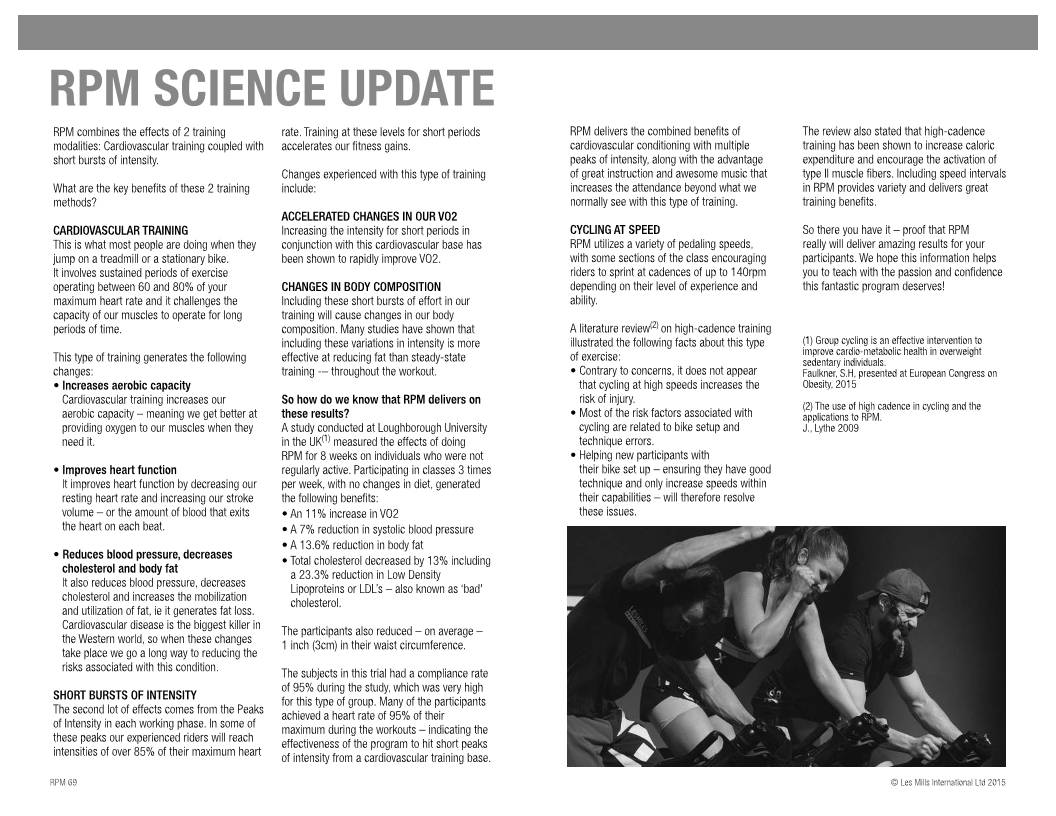
CYCLING AT SPEED
RPM utilizes a variety of pedaling speeds,
with some sections of the class encouraging
riders to sprint at cadences of up to 140rpm
depending on their level of experience and
ability.
A literature review(2) on high-cadence training
illustrated the following facts about this type
of exercise:
• Contrary to concerns, it does not appear
   that cycling at high speeds increases the
   risk of injury.
• Most of the risk factors associated with
   cycling are related to bike setup and
   technique errors.
• Helping new participants with
   their bike set up – ensuring they have good
   technique and only increase speeds within
   their capabilities – will therefore resolve
   these issues.
The review also stated that high-cadence
training has been shown to increase caloric
expenditure and encourage the activation of
type II muscle fi bers. Including speed intervals
in RPM provides variety and delivers great
training benefi ts.
So there you have it – proof that RPM
really will deliver amazing results for your
participants. We hope this information helps
you to teach with the passion and confi dence
this fantastic program deserves!
(1) Group cycling is an effective intervention to
improve cardio-metabolic health in overweight
sedentary individuals.
Faulkner, S.H, presented at European Congress on
Obesity, 2015
(2) The use of high cadence in cycling and the
applications to RPM.
J., Lythe 2009
缩略图:
高速下载:
正在进行安全检测...
点击后进入安全下载页,再进行实际下载。下载链接有效期 24 小时,过期会自动刷新。
下载说明:
- 文件描述:RPM 69 Education Only - Print Ready.pdf,可用于在线分享与下载使用。
- 文件分类:文档资料
- 用途建议:适用于资料分享、学习交流、办公协作。
- 适合人群:学生、教师、办公人员、项目协作团队。
- 适配系统:Windows、macOS、Android、iOS 均可下载访问。